EP0487073B1 - Dispositif pour l'examen de l'acuité visuelle - Google Patents
Dispositif pour l'examen de l'acuité visuelle Download PDFInfo
- Publication number
- EP0487073B1 EP0487073B1 EP91119834A EP91119834A EP0487073B1 EP 0487073 B1 EP0487073 B1 EP 0487073B1 EP 91119834 A EP91119834 A EP 91119834A EP 91119834 A EP91119834 A EP 91119834A EP 0487073 B1 EP0487073 B1 EP 0487073B1
- Authority
- EP
- European Patent Office
- Prior art keywords
- beam path
- lcd
- closure
- partial beam
- way
- Prior art date
- Legal status (The legal status is an assumption and is not a legal conclusion. Google has not performed a legal analysis and makes no representation as to the accuracy of the status listed.)
- Expired - Lifetime
Links
- 230000004304 visual acuity Effects 0.000 title claims 2
- 238000012360 testing method Methods 0.000 claims description 24
- 230000004438 eyesight Effects 0.000 claims description 19
- 230000003287 optical effect Effects 0.000 claims description 13
- 230000000007 visual effect Effects 0.000 claims 1
- 239000011521 glass Substances 0.000 description 10
- 238000000034 method Methods 0.000 description 2
- 230000001360 synchronised effect Effects 0.000 description 2
- 230000001419 dependent effect Effects 0.000 description 1
- 238000013461 design Methods 0.000 description 1
- 238000011161 development Methods 0.000 description 1
- 230000018109 developmental process Effects 0.000 description 1
- 239000000428 dust Substances 0.000 description 1
- 230000000694 effects Effects 0.000 description 1
- 208000001491 myopia Diseases 0.000 description 1
- 238000012549 training Methods 0.000 description 1
- 230000007704 transition Effects 0.000 description 1
Images

Classifications
-
- A—HUMAN NECESSITIES
- A61—MEDICAL OR VETERINARY SCIENCE; HYGIENE
- A61B—DIAGNOSIS; SURGERY; IDENTIFICATION
- A61B3/00—Apparatus for testing the eyes; Instruments for examining the eyes
- A61B3/02—Subjective types, i.e. testing apparatus requiring the active assistance of the patient
- A61B3/028—Subjective types, i.e. testing apparatus requiring the active assistance of the patient for testing visual acuity; for determination of refraction, e.g. phoropters
- A61B3/032—Devices for presenting test symbols or characters, e.g. test chart projectors
-
- A—HUMAN NECESSITIES
- A61—MEDICAL OR VETERINARY SCIENCE; HYGIENE
- A61B—DIAGNOSIS; SURGERY; IDENTIFICATION
- A61B3/00—Apparatus for testing the eyes; Instruments for examining the eyes
- A61B3/02—Subjective types, i.e. testing apparatus requiring the active assistance of the patient
-
- A—HUMAN NECESSITIES
- A61—MEDICAL OR VETERINARY SCIENCE; HYGIENE
- A61B—DIAGNOSIS; SURGERY; IDENTIFICATION
- A61B3/00—Apparatus for testing the eyes; Instruments for examining the eyes
- A61B3/02—Subjective types, i.e. testing apparatus requiring the active assistance of the patient
- A61B3/08—Subjective types, i.e. testing apparatus requiring the active assistance of the patient for testing binocular or stereoscopic vision, e.g. strabismus
Definitions
- the invention relates to a device for examining eyesight with a binocular beam path through which the examined person views optotypes or the like, according to the preamble of patent claim 1.
- Examples of such devices for examining eyesight with a binocular beam path are vision test devices or so-called glasses determination devices.
- a vision test device as is known, for example, from German utility model 19 63 161 - the person examined looks over a lens and / or mirror system which generates a defined partial beam path for each eye and which also has special conditions, such as distant vision or close vision. Can create conditions on an optotype holder that presents optotypes, such as optotypes, letters or numbers of different sizes, etc.
- a swiveling diaphragm is usually provided in the known eye test devices, which can either be swiveled into one or the other beam path or pivoted completely out of both beam paths.
- Such eye test devices of a different type than those provided in the preamble of claim 1 essentially consist of only one optotype holder onto which the person to be examined is directly, i.e. looks without an intermediate lens and / or mirror system.
- These eye test devices have the advantage that they are comparatively simple; it is disadvantageous, however, that there is no defined mono- or binocular beam path.
- a device for the presentation of optotypes using glasses is known from US-A-4,726,673.
- LCD closures are used in the spectacle frame, which open and close the respective beam path.
- test lenses with a certain optical effect can be introduced into each partial beam path.
- the examined person looks through the glasses determination device mono- or binocularly on an optotype holder and informs the ophthalmologist or optician of the effect with which she can best recognize optotype signs of a certain size.
- the eyewear determination devices currently in use have a series of lenses (Recoss lenses) arranged one behind the other in the direction of the optical axis, each of which carries a plurality of test lenses.
- the test lenses can be introduced into the beam path in such a way that a specific optical effect results in the respective partial beam path, the optical effects in the two partial beam paths being adjustable independently of one another with a fine gradation.
- diaphragms are provided on the Recoss disks, which carry the test lenses, which make it possible to close the respective partial beam path in order to achieve a monocular view, whereby the Recoss disk "only has a few places to close the beam path "must be rotated.
- the invention has for its object to develop a device for examining eyesight with a binocular beam path through which the examined person views optotypes or the like in such a way that with comparatively little effort not only quickly between binocular and monocular beam path or between the individual partial beam paths can be switched, but also a much more flexible and varied examination procedure than is possible with LCD closures arranged in a known manner.
- an LCD shutter is provided in each partial beam path of the binocular beam path and can be controlled by a control unit.
- the control unit controls the LCD shutters in such a way that one or both partial beam paths are continuously opened and closed synchronized.
- the LCD shutters are selectively controlled in such a way that they weaken the beam path in a predetermined manner in the form of a pattern.
- LCD closures which, in contrast to the device described in DE 31 33 608 C2, are not provided in the area of the optotype holder, but in the observation beam path and in the area of the optical system with the optical effect of each partial beam path, as will be explained in more detail below is carried out - a much more flexible and varied examination procedure than LCD closures arranged in a known manner. In addition, they also have a number of advantages over mechanical covers and closures:
- each LCD shutter in such a way that it continuously opens or closes the respective partial beam path or the pattern.
- a switch from binocular to monocular beam path that is not perceptible to the examined person or a switch between the partial beam paths can be implemented.
- the training is helpful in checking the twilight eyesight.
- the design according to the invention allows “switching” from one monocular beam path to the other monocular beam path or back to a binocular beam path much faster than with mechanical shutters.
- the effort involved in controlling the closures is significantly lower.
- LCD closures are not arranged in the area of the optotype holder, but rather in the area of the optical system of the examination device, distortions which can occur with LCD closures play a much smaller role than with LCD closures which are arranged directly at the viewing plane .
- the pattern can be, for example, a centering cross or a pinhole; the LCD shutter can also perform the additional function of an intermediate screen (claim 3).
- the LCD closure provided according to the invention can be used in conventionally constructed eye test devices or
- Glasses determination devices can be integrated without any problems even if these devices have not yet had a mechanical lock:
- the LCD shutter can be arranged between the lens system instead of the conventional swivel screen, which creates the conditions for distant vision (claim 5).
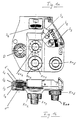
- FIG. 1 shows a part of a spectacle determination device known per se, namely the part through the view-through opening D (see FIG. 1a) of the examined person with the left eye (in FIG. 1a there is a view of the side facing the examined person) shown).
- the glasses determination device has three carrier disks (also referred to as Recoss disks) S 1 , S 2 , S 3 and S 4 for test glasses, filters etc.
- the special tests that can be set with a button Kn 1 are located in the carrier disk S 1 closest to the eye of the examined person.
- the carrier disc S 2 carries the lenses graduated in 3 dpt, while the carrier disc S 3 carries the glasses bridging these intervals in 0.25 dpt increments.
- the associated control buttons are Kn 2 and Kn 3 .
- cylindrical lenses are to be regarded as pre-connecting lenses to the carrier disc S 2 . They are switched on at the Kn 4 button and adjusted according to the axis by the Kn 5 rotary button.
- the glasses determination device shown in FIGS. 1a and 1b is known and is manufactured and sold by G. Rodenstock Instrumente GmbH under the name "Phoromat”.
- an LCD shutter 1 'or 1' ' is integrated into either the front or rear cover plate of the viewing opening of both beam paths, which a control unit (not shown), which is constructed in a manner known per se, controls such that one or both partial beam paths opened and closed synchronized.
- FIG. 2 shows in perspective the binocular beam path of an eye test device.
- the two eyes of the examined person are schematically labeled A.
- the eye test device has viewing openings D 1 and D 2 .
- a first lens system L l1 ..L r2 each consisting of two lenses, which creates distant vision conditions for the examined person.
- the beam path is deflected by a deflecting mirror U onto a test pane S, on which there are a number of patterns, of which only one is visible to the person examined through a diaphragm B.
- a pivotable lens system N l or N r is provided, which creates near-vision conditions.
- the vision test device is known and is also manufactured and sold by the aforementioned G. Rodenstock Instrumente GmbH.
- LCD closures 1 are provided between the two lenses L l1 and L l2 and L r1 and L r2 of the lens system which produces long-range vision conditions.
- the LCD closures which are integrated according to the invention in the devices for examining the eyesight shown in FIGS. 1 and 2, can be controlled selectively such that they open or close the partial beam path in the form of a pattern.
- the closures can also open one or both beam paths completely, so that binocular or monocular viewing of the optic signs is possible with the left or right eye.
- the pattern in which the LCD shutter closes the beam path can be, for example, a centering cross.
- other patterns such as pinholes or the like are also possible.
- the LCD closures can also be controlled so that they form an intermediate panel.
- control unit controls each LCD shutter 1 or 1 'in such a way that it continuously opens or closes the respective partial beam path or the pattern, so that, for example, a "soft" transition from one mode to another is possible.
Landscapes
- Life Sciences & Earth Sciences (AREA)
- Health & Medical Sciences (AREA)
- Medical Informatics (AREA)
- Biophysics (AREA)
- Ophthalmology & Optometry (AREA)
- Engineering & Computer Science (AREA)
- Biomedical Technology (AREA)
- Heart & Thoracic Surgery (AREA)
- Physics & Mathematics (AREA)
- Molecular Biology (AREA)
- Surgery (AREA)
- Animal Behavior & Ethology (AREA)
- General Health & Medical Sciences (AREA)
- Public Health (AREA)
- Veterinary Medicine (AREA)
- Eye Examination Apparatus (AREA)
Claims (5)
- Dispositif d'examen de l'acuité visuelle, comportant- des orifices d'observation intérieure ou traversante (D),- un chemin optique binoculaire des rayons se raccordant aux orifices d'observation intérieure ou traversante par lequel la personne examinée observe des signaux optiques ou des objets similaires,- un système optique (S ou L) disposé dans le chemin optique binoculaire, et- un dispositif de fermeture affecté à chaque chemin partiel de rayons,caractérisé en ce que le dispositif de fermeture est un dispositif de fermeture LCD (affichage à cristaux liquides) (1, 1', 1''), qui est prévu dans la zone du système optique, avec un effet optique sur chaque chemin partiel de rayons et en ce qu'un dispositif de commande est prévu, lequel commande sélectivement et individuellement les dispositifs de fermeture de façon telle que chaque fermeture LCD restreint ou affaiblit le chemin partiel de rayon(s) qui lui est affecté, d'une manière déterminée, susceptible d'être préalablement prescrite, sous forme d'un dessin ou d'un modèle, ainsi qu'elle ouvre, ou ferme, de façon continue le chemin partiel de rayons et le dessin ou modèle.
- Dispositif selon la revendication 1,
caractérisé en ce que le dessin ou modèle sur lequel le dispositif de fermeture ouvre ou ferme le chemin de rayons est une croix de centrage ou un écran ou un diaphragme muni d'un trou. - Dispositif selon la revendication 1 ou 2,
caractérisé en ce que le dessin forme un diaphragme intermédiaire. - Dispositif selon l'une des revendications 1 à 3, dans lequel, en vue de la détermination subjective de la réfraction, il est possible de mettre en place dans chaque chemin de rayons partiel une série de lentilles d'essai à distance les unes des autres dans la direction de l'axe optique, de façon telle qu'elles produisent un effet optique déterminé dans le chemin partiel de rayons considéré, caractérisé en ce que le dispositif de fermeture LCD considéré est disposé en amont ou en aval des lentilles d'essai.
- Dispositif selon l'une des revendications 1 à 3, dans lequel, pour l'exécution d'un essai de vue, un système de lentille est disposé dans chaque chemin de rayons, de façon telle que la personne examinée regarde le signe optique, ou l'objet similaire, dans des conditions de vue à grande distance, ou de vue à courte distance,
caractérisé en ce que chaque dispositif de fermeture LCD est disposé dans le système de lentilles.
Applications Claiming Priority (2)
| Application Number | Priority Date | Filing Date | Title |
|---|---|---|---|
| DE4036964 | 1990-11-20 | ||
| DE4036964A DE4036964A1 (de) | 1990-11-20 | 1990-11-20 | Vorrichtung zur untersuchung des sehvermoegens |
Publications (2)
| Publication Number | Publication Date |
|---|---|
| EP0487073A1 EP0487073A1 (fr) | 1992-05-27 |
| EP0487073B1 true EP0487073B1 (fr) | 1997-09-03 |
Family
ID=6418623
Family Applications (1)
| Application Number | Title | Priority Date | Filing Date |
|---|---|---|---|
| EP91119834A Expired - Lifetime EP0487073B1 (fr) | 1990-11-20 | 1991-11-19 | Dispositif pour l'examen de l'acuité visuelle |
Country Status (2)
| Country | Link |
|---|---|
| EP (1) | EP0487073B1 (fr) |
| DE (2) | DE4036964A1 (fr) |
Families Citing this family (6)
| Publication number | Priority date | Publication date | Assignee | Title |
|---|---|---|---|---|
| DE4222100C2 (de) * | 1992-07-07 | 1997-07-24 | Rodenstock Instr | Sehtestgerät und zugehörige Sehtestscheibe |
| US6350032B1 (en) * | 2000-02-09 | 2002-02-26 | Titmus Optical, Inc. | Vision testing apparatus |
| WO2002062209A1 (fr) * | 2001-02-07 | 2002-08-15 | Titmus Optical, Inc. | Appareil servant a tester la vue |
| US7390091B2 (en) | 2005-04-29 | 2008-06-24 | Sperian Protection Optical, Inc. | Vision testing apparatus |
| DE202010013741U1 (de) * | 2010-09-30 | 2010-12-09 | Oculus Optikgeräte GmbH | Sehtestgerät |
| CN104010564A (zh) | 2011-10-21 | 2014-08-27 | 肯特·泰伯 | 功能性视力测试仪 |
Family Cites Families (9)
| Publication number | Priority date | Publication date | Assignee | Title |
|---|---|---|---|---|
| DE1963163A1 (de) * | 1969-12-17 | 1971-06-24 | Walter Baetzel | Ultraschallreinigungsgeraet fuer Uhren und Schmuck |
| US4300818A (en) * | 1978-03-13 | 1981-11-17 | Schachar Ronald A | Multifocal ophthalmic lens |
| DE3133608C2 (de) * | 1981-01-24 | 1984-02-02 | Forschungsgesellschaft für Biomedizinische Technik, 5100 Aachen | "Anordnung zur Durchführung von Sehfunktionstests" |
| US4606624A (en) * | 1983-10-13 | 1986-08-19 | R. H. Burton Company | Refractor having simplified cylinder lens assembly |
| JPS61235310A (ja) * | 1985-04-08 | 1986-10-20 | Honda Motor Co Ltd | 塑性加工機における搬送装置 |
| DE3638226A1 (de) * | 1986-11-08 | 1988-05-11 | Rodenstock Instr | Vorrichtung zur beobachtung der hinteren augenabschnitte |
| US4726673A (en) * | 1986-05-05 | 1988-02-23 | University Of Southern California | Tachistoscope for presenting stimuli in lateralized form |
| US4927260A (en) * | 1988-10-11 | 1990-05-22 | Orville Gordon | Apparatus and method for the precision evaluation of visual function in the fovea centralis (macula) area of the retina |
| US5026151A (en) * | 1989-06-23 | 1991-06-25 | Mentor O & O, Inc. | Visual function tester with binocular vision testing |
-
1990
- 1990-11-20 DE DE4036964A patent/DE4036964A1/de not_active Withdrawn
-
1991
- 1991-11-19 EP EP91119834A patent/EP0487073B1/fr not_active Expired - Lifetime
- 1991-11-19 DE DE59108845T patent/DE59108845D1/de not_active Expired - Fee Related
Also Published As
| Publication number | Publication date |
|---|---|
| DE59108845D1 (de) | 1997-10-09 |
| EP0487073A1 (fr) | 1992-05-27 |
| DE4036964A1 (de) | 1992-05-21 |
Similar Documents
| Publication | Publication Date | Title |
|---|---|---|
| DE3881291T2 (de) | Sehapparat. | |
| DE69326038T2 (de) | Brillenartige Anzeigeapparat | |
| DE69011331T2 (de) | Schweisserhelm. | |
| EP0492044B1 (fr) | Appareil destiné à l'essai de la fonction visuelle | |
| EP0624073B1 (fr) | Dispositif de refraction pour la determination subjective des proprietes visuelles spheriques et astigmatiques de l'oeil | |
| DE60214314T2 (de) | Optometrisches Instrument | |
| DE2353862A1 (de) | Verfahren und vorrichtung zur entspannung der akkommodation eines auges | |
| DE3015488A1 (de) | Vorrichtung zum ermitteln der durchtrittspunkte der beiden sichtachsen an einem brillengestell | |
| EP0487073B1 (fr) | Dispositif pour l'examen de l'acuité visuelle | |
| EP2831662B1 (fr) | Système de visualisation d'images tridimensionnelles | |
| EP0362692A2 (fr) | Lunettes pour regarder sans fatigue le plan d'images d'un écran ou autres plans d'images | |
| DE3003588A1 (de) | Geraet zur pruefung des daemmerungssehens und der blendempfindlichkeit | |
| DE1817721A1 (de) | Flugzeugnavigationsverfahren | |
| DE19807716C2 (de) | Lochbrille, die zwei Lochblenden mit verstellbaren Löchern aufweist | |
| DE3241958C2 (fr) | ||
| DE19719694C2 (de) | Vorrichtung zum Erfassen und zum Anzeigen der Fehlsichtigkeit einer Person | |
| DE19929958C1 (de) | Lochbrille mit oder ohne Linsen | |
| DE657387C (de) | Blendschutzbrille | |
| DE19723915C2 (de) | Sehvorrichtung zur Behandlung der Sehkraft | |
| DE3624835A1 (de) | Kopfgetragenes spiegelstereoskop | |
| DE720272C (de) | Verfahren und Geraet zum Pruefen der Stellung der Brillenglaeser relativ zu den Augen des Brillentraegers | |
| DE7015772U (de) | Messspiegel zur zentrierung von brillenglaesern. | |
| CH458778A (de) | Sehtestgerät | |
| DE2241051A1 (de) | Kombiniertes system optischer einrichtungen fuer photographie und stereoskopische vision | |
| AT84999B (de) | Okular für Periskope, Entfernungsmesser u. dgl. Instrumente. |
Legal Events
| Date | Code | Title | Description |
|---|---|---|---|
| PUAI | Public reference made under article 153(3) epc to a published international application that has entered the european phase |
Free format text: ORIGINAL CODE: 0009012 |
|
| AK | Designated contracting states |
Kind code of ref document: A1 Designated state(s): CH DE FR GB IT LI |
|
| 17P | Request for examination filed |
Effective date: 19930119 |
|
| 17Q | First examination report despatched |
Effective date: 19941005 |
|
| GRAG | Despatch of communication of intention to grant |
Free format text: ORIGINAL CODE: EPIDOS AGRA |
|
| GRAH | Despatch of communication of intention to grant a patent |
Free format text: ORIGINAL CODE: EPIDOS IGRA |
|
| GRAH | Despatch of communication of intention to grant a patent |
Free format text: ORIGINAL CODE: EPIDOS IGRA |
|
| ITF | It: translation for a ep patent filed | ||
| GRAA | (expected) grant |
Free format text: ORIGINAL CODE: 0009210 |
|
| AK | Designated contracting states |
Kind code of ref document: B1 Designated state(s): CH DE FR GB IT LI |
|
| PG25 | Lapsed in a contracting state [announced via postgrant information from national office to epo] |
Ref country code: FR Free format text: LAPSE BECAUSE OF FAILURE TO SUBMIT A TRANSLATION OF THE DESCRIPTION OR TO PAY THE FEE WITHIN THE PRESCRIBED TIME-LIMIT Effective date: 19970903 |
|
| REG | Reference to a national code |
Ref country code: CH Ref legal event code: EP |
|
| GBT | Gb: translation of ep patent filed (gb section 77(6)(a)/1977) |
Effective date: 19970905 |
|
| REF | Corresponds to: |
Ref document number: 59108845 Country of ref document: DE Date of ref document: 19971009 |
|
| PGFP | Annual fee paid to national office [announced via postgrant information from national office to epo] |
Ref country code: DE Payment date: 19971030 Year of fee payment: 7 |
|
| PGFP | Annual fee paid to national office [announced via postgrant information from national office to epo] |
Ref country code: GB Payment date: 19971118 Year of fee payment: 7 |
|
| PG25 | Lapsed in a contracting state [announced via postgrant information from national office to epo] |
Ref country code: LI Free format text: LAPSE BECAUSE OF NON-PAYMENT OF DUE FEES Effective date: 19971130 Ref country code: CH Free format text: LAPSE BECAUSE OF NON-PAYMENT OF DUE FEES Effective date: 19971130 |
|
| EN | Fr: translation not filed | ||
| PLBE | No opposition filed within time limit |
Free format text: ORIGINAL CODE: 0009261 |
|
| STAA | Information on the status of an ep patent application or granted ep patent |
Free format text: STATUS: NO OPPOSITION FILED WITHIN TIME LIMIT |
|
| REG | Reference to a national code |
Ref country code: CH Ref legal event code: PL |
|
| 26N | No opposition filed | ||
| PG25 | Lapsed in a contracting state [announced via postgrant information from national office to epo] |
Ref country code: GB Free format text: LAPSE BECAUSE OF NON-PAYMENT OF DUE FEES Effective date: 19981119 |
|
| GBPC | Gb: european patent ceased through non-payment of renewal fee |
Effective date: 19981119 |
|
| PG25 | Lapsed in a contracting state [announced via postgrant information from national office to epo] |
Ref country code: DE Free format text: LAPSE BECAUSE OF NON-PAYMENT OF DUE FEES Effective date: 19990901 |
|
| PG25 | Lapsed in a contracting state [announced via postgrant information from national office to epo] |
Ref country code: IT Free format text: LAPSE BECAUSE OF NON-PAYMENT OF DUE FEES;WARNING: LAPSES OF ITALIAN PATENTS WITH EFFECTIVE DATE BEFORE 2007 MAY HAVE OCCURRED AT ANY TIME BEFORE 2007. THE CORRECT EFFECTIVE DATE MAY BE DIFFERENT FROM THE ONE RECORDED. Effective date: 20051119 |