EP0488023B1 - Microscope avec dispositif d'ajustement de la focalisation - Google Patents
Microscope avec dispositif d'ajustement de la focalisation Download PDFInfo
- Publication number
- EP0488023B1 EP0488023B1 EP91119709A EP91119709A EP0488023B1 EP 0488023 B1 EP0488023 B1 EP 0488023B1 EP 91119709 A EP91119709 A EP 91119709A EP 91119709 A EP91119709 A EP 91119709A EP 0488023 B1 EP0488023 B1 EP 0488023B1
- Authority
- EP
- European Patent Office
- Prior art keywords
- stage
- revolver
- holder
- movable member
- microscope
- Prior art date
- Legal status (The legal status is an assumption and is not a legal conclusion. Google has not performed a legal analysis and makes no representation as to the accuracy of the status listed.)
- Expired - Lifetime
Links
- 230000007246 mechanism Effects 0.000 title claims description 29
- 238000005286 illumination Methods 0.000 claims description 4
- 230000003287 optical effect Effects 0.000 description 3
- 238000009877 rendering Methods 0.000 description 2
- 230000006866 deterioration Effects 0.000 description 1
- 230000000694 effects Effects 0.000 description 1
Images



Classifications
-
- G—PHYSICS
- G02—OPTICS
- G02B—OPTICAL ELEMENTS, SYSTEMS OR APPARATUS
- G02B21/00—Microscopes
- G02B21/24—Base structure
- G02B21/241—Devices for focusing
-
- G—PHYSICS
- G02—OPTICS
- G02B—OPTICAL ELEMENTS, SYSTEMS OR APPARATUS
- G02B21/00—Microscopes
- G02B21/24—Base structure
- G02B21/26—Stages; Adjusting means therefor
Definitions
- the present invention relates to a microscope, and more particularly to one having an improved focus-adjusting mechanism.
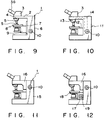
- Microscopes similar to Fig. 9 are disclosed in US-A-3 721 827 and 4 427 270 whereas microscopes similar to Fig. 10 are shown in US-A-4 660 942 and US 4 756 611.
- the microscope shown in Fig. 9 comprises a main unit 1, a lens barrel 3, a revolver 4, and an objective 5.
- the main unit 1 has an arm top 2 and arm body 6.
- the barrel 3 is connected at its lower end to the arm top 2 and has an eyepiece 3a fixed to its upper end.
- the revolver 4 is also connected to the arm top 2.
- the objective 5 is fixed to the revolver 4.
- the eyepiece 3a and the objective 5 are placed in the same viewing axis.
- the microscope further comprises a movable support 7, a stage 8, a stage holder 9, a focus adjustment knob 10, and a focus-adjusting mechanism (not shown).
- the movable support 7 is mounted on the front of the arm body 6 and can slide up and down, in parallel to the viewing axis.
- the stage 8 is held by the holder 9, which is fastened to the support 7.
- the focus adjustment knob 10 is mounted on one side of the arm body 6.
- the focus-adjusting mechanism is housed within the arm body 6 and connected to the focus adjustment knob 10.
- a specimen S is put on the stage 8 and placed on the viewing axis.
- the knob 10 is rotated, thus driving the focus-adjusting mechanism.
- the focus-adjusting mechanism moves the support 7 vertically. As a result, the stage 8 is moved up or down, bringing the specimen S to the focal point of the objective 5.
- the microscope shown in Fig. 10 is characterized in two respects. First, the stage holder 12 is immovably secured to the main unit 11. Second, the focus adjustment knob 10 and the revolver 13 are coupled to the focus-adjusting mechanism 14 housed within the main unit 11. Hence, as the knob 10 is rotated, the revolver 13 having an objective is moved vertically, whereby the focal point of the objective is moved to the specimen S.
- the microscope shown in Fig. 11 is characterized in that the arm top 16 is slidably attached to the arm body 15 of the main body 1. As the focus adjustment knob 10 is rotated, the arm top 16 is moved up or down, whereby the focal point of the objective is moved to the specimen S.
- the microscope shown in Fig. 12 is identical to the microscope of Fig. 11, except for three respects.
- a fixed support 17 containing an auxiliary focus-adjusting mechanism (not shown) is fastened to the main unit 1.
- an auxiliary focus adjustment knob 19 is mounted on one side of the support 17 and connected to the auxiliary focus adjustment mechanism.
- the stage holder 18 is slidably attached to the fixed support 17 and driven by the auxiliary focus-adjusting mechanism. Hence, the objective and the stage are independently moved vertically when the knobs 10 and 19 are rotated.
- the stage 8 can merely have limited size and rigidness since it is supported by a pole guide or a roll guide and is moved vertically to accomplish focus adjustment. Hence, the stage 8 cannot support a relatively heavy specimen, and is likely to be deformed, which results in various problems in microscopic observation.
- the distance between the objective and the lens barrel 3 is long unless the objective is an infinity type. Consequently, various optical deteriorations such as insufficiency of ambient light occur, making it impossible for the microscope to have a adequate focusing stroke.
- the arm top 16 has limited rigidness since it is moved vertically to effect focus adjustment. Thus, it would be impossible to mount a camera on the top arm.
- the object of the present invention is to provide a microscope having a focus-adjusting mechanism, in which either the specimen-supporting section or the objective-supporting section can be moved in order to achieve focus adjustment, and which enables a user to observe specimens of various weights in a desired magnification.
- the revolver not the arm top as a whole, is moved vertically along with the movable member, the load on the arm top is relatively small, making it possible to mount a heavy device (e.g., a camera) on the arm top. Further, since the movable member attached to the arm body is moved, too, the optical axis of the objective is not so deviated from that of the eyepiece, as in the case where only the revolver is moved vertically.
- a heavy device e.g., a camera
- the holder supporting the stage is attached to the movable member, and the revolver holding the objective is attached to the holder of the arm top.
- the focus adjustment is rotated, thus driving the focus-adjusting mechanism, the movable member is moved, whereby the stage is moved vertically, bringing the specimen toward or away from the objective.
- Figs. 1 to 4 show a microscope according to a first embodiment of the invention.
- the microscope comprises a main unit 20.
- the main unit 20 comprises a base 21, an arm body 22, and an arm top 23.
- the top of the arm top 23 is flat.
- a dovetail groove 24 is formed in the lower surface of the arm top 23.
- the base 21 is a hollow block and has a seat 31.
- the seat 31 has a through hole 32.
- the microscope further has a lens barrel 3, a movable support 25, a positioning pin 26, a focus adjustment knob 27, and a focus-adjusting mechanism (not shown).
- the barrel 3 is secured to the top of the top arm 23.
- the support 25 is mounted on the front of the arm body 22 and can move up and down.
- the movable support 25 has a vertical dovetail tenon 25a formed on its front.
- the positioning pin 26 protrudes from the front of the support 25.
- the focus adjustment knob 27 is mounted on one side of the arm body 22.
- the focus-adjusting mechanism is located within the main unit 20 and is coupled to the movable support 25.
- the mechanism is connected to the focus adjustment knob 27. It comprises a lack extending in vertical direction and a pinion set in engagement with the lack.
- the lack is fastened to the movable support 25, and the pinion is connected to the focus adjustment knob 27.
- the mechanism drives the support 25 upwards and down wards as the knob 27 is rotated in one direction and the opposite direction.
- Brackets 28a and 28b are fixed in the corner defined by the arm body 22 and the arm top 23, thus rendering the arm top 23 rigid.
- the brackets 28a and 28b are parallel to each other and so positioned that the upper end of the movable support 25 can move into the space between the brackets 28a and 28b.
- the support 25 can therefore has a sufficient focusing stroke.
- the microscope further comprises a revolver 33, an objective 34, a stage holder, and a stage 38.
- the revolver 33 has a dovetail tenon 33a.
- the objective 34 is attached to the revolver 33.
- the stage holder comprises an adapter 35 and a support 37.
- the adapter 35 has a thick portion 35b, and is fastened to the support 37 a screw 36.
- Fig. 3 which is a cross-sectional view taken along line A-A in Fig. 2
- the thick portion 35b of the adapter 35 has a dovetail groove 35a formed in that surface facing away from the support 37.
- Fig. 2 shows the microscope set in an operating mode (hereinafter called "stage-moving mode"), in which the stage 38 is moved to achieve focusing.
- stage-moving mode an operating mode
- the dovetail tenon 33a of the revolver 33 is fitted into the dovetail groove 24 of the arm top 23, and the revolver 33 is thereby connected to the arm top 23.
- the revolver 33 is rotated, placing the objective 34 on the viewing axis of the microscope.
- the stage holder is mounted onto the movable support 25, with the dovetail tenon 25a of the support 25 fitted in the dovetail groove 35a of the adapter 35.
- the stage holder is thereby connected to the support 25.
- the thick portion 35b of the adapter 35 abuts on the positioning pin 26 protruding from the front of the movable support 25, whereby the stage holder is set at a predetermined position with respect to the support 25.
- the pin position of the positioning pin 26 can be changed by an operator.
- the stage 38 is put on the upper surface of the support 37, and a specimen S is placed on the stage 38.
- a condenser mount is fixed to the lower surface of the support, and a condenser 39 is placed on the mount, with its axis aligned with the viewing axis of the microscope.
- the condenser 39 can therefore gather the light applied from the light source (not shown) provided within the base 21 and applies the light to the specimen S through holes (not shown) made in the support 37 and the stage 38, thereby illuminating the specimen S.
- Fig. 4 shows the microscope set in another operating mode (hereinafter called "objective-moving mode") in which the objective 34 is moved to achieve focusing.
- object-moving mode another operating mode
- a revolver holder 40 is attached to the movable support 25, and a stage fastener 41 is secured to the base 32.
- the revolver holder 40 has a substantially L-shaped cross section, and comprises a horizontal member and a vertical member.
- the horizontal member has a dovetail groove 40a in the lower surface.
- a revolver 33' is connected to the revolver holder 40, with its tenon fitted in the dovetail groove 40a of the holder 40.
- the vertical member has a dovetail groove (not shown) in that surface facing the movable support 25.
- the holder 40 is mounted onto the support 25, with the dovetail tenon 25a of the support 25 fitted in the dovetail groove of the holder 40.
- the revolver holder 40 is thereby connected to the movable support 25.
- the lower end of the vertical member abuts on the positioning pin 26 protruding from the support 25, whereby the stage fastener is set at a predetermined position with respect to the movable support 25.
- the stage fastener 41 has a L-shaped cross section, like the revolver holder 40. It is fastened at its lower end to the base 21 by a screw 42.
- a stage 38' is mounted on the upper surface of the stage fastener 41.
- a specimen S is put on the stage 38'.
- a condenser mount is fixed to the lower surface of the support, and a condenser 39' is placed on the mount, with its axis aligned with the viewing axis of the microscope.
- the condenser 39' can therefore gather the light applied from the light source provided within the base 21 and applies the light to the specimen S through holes (not shown) made in the stage fastener 41 and the stage 38', thereby illuminating the specimen S.
- the microscope is set in the stage-moving mode when the specimen S is light, or when the microscope needs to have a long focusing stroke.
- the stage holder and the revolver 33 have been attached to the movable support 25 and the arm top 23, respectively.
- the focus-adjusting mechanism drives the stage 38 upwards or downward, thereby accomplishing focusing.
- the microscope is set in the objective-moving mode when the specimen S is heavy. More specifically, as is shown in Fig. 4, the revolver holder 40 is attached to the support 25, and the stage fastener 41 is secured to the seat 31 of the base 21. Since the stage fastener 41 is fixed directly to the base 21, it is rigid enough to support the heavy specimen S steadily. Since the objective 34 can easily be moved toward and away from the specimen S, it is easy to perform focusing.
- the stage holder which is a movable member is attached to the movable support 25 when the specimen S is relatively light
- the revolver holder 40 also a movable member, is attached to the movable support 25 when the specimen S is relatively heavy.
- the support 25 is moved vertically as the focus adjustment knob 27 is rotated in one direction or the other, thereby moving the specimen S toward or away from the objective 34, or moving the objective 34 toward or away from the stage 38'.
- the revolver 33 is attached to the arm top 23; in the objective-moving mode, the revolver 33' is attached to the revolver holder 40. Since both the arm top 23 and the revolver holder 40 are rigid enough to hold the revolver, the objective 34 is held steadily, making it possible to perform accurate focusing, whether the microscope is set in the stage-moving mode when the specimen S is a light one, or the objective-moving mode when the specimen S is a heavy one.
- the microscope is advantageous in that the stages 38 and 38' can be one and the same, so can be the condensers 39 and 39', and so can be the revolvers 33 and 33'.
- the objective 34 can be used in both the stage-moving mode and the objective-moving mode.
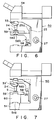
- Figs. 5 to 8 show a microscope according to a second embodiment of the invention.
- the microscope comprises a main unit 50, which in turn comprises a base 51, an arm body 52, and an arm top 53.
- the base 51 has a dovetail tenon 51a on its upper surface.
- a movable support 25 is mounted on the front of the arm body 52.
- the support 25 of the same type as the one used in the first embodiment, and has a vertical dovetail tenon 25a formed on its front.
- the arm top 53 has a dovetail groove 53a in its lower surface.
- a focus adjustment knob 27 is mounted on one side of the arm body 52 and connected to a focus-adjusting mechanism (not shown) which is located within the arm body 52 and of the same type as the one used in the first embodiment. Hence, the mechanism drives the support 25 upwards and down wards as the knob 27 is rotated in one direction and the opposite direction.
- the microscope further has a lens barrel 54, an eyepiece 55, a reflected flood tube 56, a lamp housing 57.
- the lens barrel 54 is secured to the top of the top arm 53, and contains the eyepiece 55 which has an optical axis aligned with the viewing axis of the microscope.
- the reflected flood tube 56 is connected, at one end, to the lens barrel 54 and, at the other end, the lamp housing 57.
- the housing 57 contains a illumination lamp (not shown).
- the tube 56 guides illumination light from the lamp to the lens barrel 54.
- the microscope has a reflected flood system of the type shown in Fig. 8.
- This system comprises a set of lenses 58 contained in the reflected flood tube 57, a ring mirror 59 located within the lens barrel 54, and a ring lens 36 located in a barrel 35 which also contains an objective 34.
- the light beams emitted by the lamp (not shown) pass through the lenses 58 into the lens barrel 54.
- the ring mirror 59 reflects the light beam by 90°.
- the light beams, thus reflected passes through the annular space between the objective 34 and the inner surface of the barrel 36, illuminating a specimen S.
- brackets 28a and 28b are fixed in the corner defined by the arm body 52 and the arm top 53, thus rendering the arm top 53 rigid.
- the brackets 28a and 28b are parallel to each other and so positioned that the upper end of the movable support 25 can move into the space between the brackets 28a and 28b.
- the support 25 can therefore has a sufficient focusing stroke.
- Fig. 6 shows the microscope set in the stage-moving mode, in which a stage 59 is moved to achieve focusing.
- the dovetail tenon of a revolver 33 is fitted into the dovetail groove 53a of the arm top 53, where by the revolver 33 is connected to the arm top 53.
- a stage/ revolver holder 58 is attached to the movable support 25. More specifically, the holder 58 is mounted on the movable support 25, with the dovetail tenon 25a of the support 25 fitted in the dovetail groove (not shown) of the stage/revolver holder 58.
- the stage 59 is mounted on the stage/revolver holder 58, with the dovetail tenon 58a of the holder 58 fitted in the dovetail groove made in the lower surface of the table 59.
- the specimen S is placed on the stage 59.
- Fig. 7 shows the microscope set in the objective-moving mode, in which the objective 34 is moved to achieve focusing.
- a revolver 33' is attached to the stage/revolver holder 58, with its dovetail tenon fitted in the dovetail groove 58b of the holder 58.
- a stationary stage fastener 60 is connected to the base 51, with the dovetail tenon 51a of the base 51 fitted in the dovetail groove made in the lower surface of the fastener 60.
- a stage 59' is fixed to the stage fastener 60, with the dovetail tenon of the fastener 60 fitted in the dovetail groove made in the lower surface of the stage 59'.
- a specimen S is put on the stage 59'.
- the stage/revolver holder 58 is fixed to the movable support 25 in both the stage-moving mode and the objective-moving mode. In either mode, the holder 58 is moved vertically as the focus adjustment knob 27 is rotated in one direction or the other, thereby moving the stage 59 toward or away from the objective 34, or moving the objective 34 toward or away from the stage 59'.
- the specimen S is illuminated with the light beams applied by means of the reflected flood system shown in Fig. 8.
- the second embodiment requires no condensers at all.
- the second embodiment is advantageous in that its operating mode can easily be switched, form the stage-moving mode to the objective-moving mode, or vice versa, since the revolver can be attached to the arm top 53 or the stage/revolver holder 58, and the stage can attached to the stage/revolver holder 58 or the stage fastener 60.
Landscapes
- Physics & Mathematics (AREA)
- Chemical & Material Sciences (AREA)
- Analytical Chemistry (AREA)
- General Physics & Mathematics (AREA)
- Optics & Photonics (AREA)
- Microscoopes, Condenser (AREA)
Claims (10)
- Microscope comprenant:un ensemble principal (20, 50) comprenant un socle (21, 51), un corps (22, 52) monté sur le socle (21, 51) et fixé à celui-ci, un bras supérieur (23) formé à la partie supérieure du corps (22, 52), une tourelle (33) fixée au bras supérieur (23), un objectif (34) fixé à la tourelle (33), un porte-objectif (3) supporté par le bras supérieur (23), un oculaire (3a) fixé au porte-objectif (3), une platine (59) pour supporter un échantillon, et un premier porte-tourelle (24), fixé au bras supérieur (23), pour supporter la tourelle (33),ledit microscope comprenant, en outre:un élément mobile (25) monté sur l'avant dudit corps (22, 52), face à l'échantillon supporté par ladite platine (59), et capable de se déplacer dans une direction verticale;un support de tourelle/platine (58), fixé audit élément mobile (25), pour supporter, de façon sélective, ladite tourelle (33) ou ladite platine (59), ledit support de tourelle/platine (58) comportant un second porte-tourelle (58b) pour supporter ladite tourelle (33), et une partie porte-platine ( 58a) pour supporter ladite platine (59);un bouton (27) de réglage de focale couplé au corps (22, 52);un mécanisme de mise au point placé a l'intérieur du corps (22, 52), couplé mécaniquement audit élément mobile (25) et audit bouton (27) de réglage de focale pour déplacer l'élément mobile (25) dans la direction verticale sur une distance proportionnelle à l'angle dont tourne le bouton (27);un support (41, 60) de platine destiné à être monté sur le socle (21, 51) dans le cas où l'objectif (34) est déplacé pour obtenir une mise au point; etun élément de soutien (31, 51a), monté sur le socle (21, 51) et fixé à celui-ci pour soutenir ledit support de platine (41, 60),microscope dans lequel, dans un premier mode de fonctionnement, pour déplacer ledit objectif (34) dans la direction verticale afin d'effectuer une mise au point, ledit support de tourelle/platine (58) supporte ladite tourelle (33) et est fixé audit élément mobile (25), et ledit support (41, 60) de platine est monté sur ledit socle (21), et dans un second mode de fonctionnement, ledit support de tourelle/platine (58) supporte ladite platine (59,) et, pour déplacer ladite platine (59) dans la direction verticale afin d'effectuer une mise au point, est fixé audit élément mobile (25), et ledit premier porte-tourelle (24) supporte ladite tourelle (33).
- Microscope selon la revendication 1, caractérisé par le fait qu'il comprend, en outre, un boîtier (57) de lampe contenant une lampe pour émettre de la lumière afin d'éclairer l'échantillon, et un tube (56) projecteur de lumière placé entre le boîtier (57) de lampe et ledit porte-objectif (3) pour guider jusque dans le porte-objectif la lumière issue du boîtier (57) de lampe.
- Microscope selon la revendication 1 ou 2, caractérisé par le fait que le support de tourelle/platine comporte un condenseur (39) pour appliquer une lumière d'éclairage à l'échantillon par le dessous.
- Microscope selon l'une quelconque des revendications précédentes, caractérisé par le fait qu'il comprend, en outre, un élément de positionnement (26), fixé audit élément mobile (25), pour supporter ledit support de tourelle/platine (58) et empêcher ledit porte-tourelle/platine (52) de se déplacer au moins vers le bas.
- Microscope selon la revendication 4, caractérisé par le fait que ledit support de tourelle/platine (58) comporte une face sur laquelle vient buter ledit élément de positionnement (26).
- Microscope selon l'une quelconque des revendications précédentes, caractérisé par le fait que ledit support (60) de platine comporte une surface inférieure, une surface supérieure, un premier élément d'assemblage formé sur la surface inférieure et conçu de manière à être assemblé avec le socle (21), et un second élément d'assemblage formé sur la surface supérieure et conçu de manière à être assemblé avec ladite platine (59).
- Microscope selon la revendication 1, caractérisé par le fait que ledit élément mobile (25) comporte un tenon (25a) en queue d'aronde, s'étendant dans la direction verticale, et ledit support de tourelle/platine (58) comporte une rainure en queue d'aronde destinée à recevoir ledit tenon (25a) en queue d'aronde dudit élément mobile (25), et un second porte-tourelle (58b) pour supporter ladite tourelle (33).
- Microscope selon la revendication 1, caractérisé par le fait que ledit élément mobile (25) comporte un tenon (25a) en queue d'aronde, s'étendant dans la direction verticale, et ledit support de tourelle/platine (58) comporte une rainure en queue d'aronde destinée à recevoir ledit tenon (25a) en queue d'aronde dudit élément mobile (25), et un élément d'assemblage (58a) conçu pour être assemblé avec ladite platine (33).
- Microscope selon l'une quelconque des revendications 1 à 6, caractérisé par le fait que ledit élément mobile (25) comporte un tenon (25a) en queue d'aronde, s'étendant dans la direction verticale, et ledit support de tourelle/platine (58) comporte une rainure en queue d'aronde destinée à recevoir ledit tenon (25a) en queue d'aronde dudit élément mobile (25).
- Microscope comprenant:un ensemble principal (20, 50) comprenant un socle (21, 51), un corps (22, 52) monté sur le socle (21, 51) et fixé à celui-ci, un bras supérieur (23) formé à la partie supérieure du corps (22, 52), une tourelle (33) fixée au bras supérieur (23), un objectif (34) fixé à la tourelle (33), un porte objectif (3) supporté par le bras supérieur (23), un oculaire (3a) fixé au porte-objectif (3), une platine (38, 59) pour supporter un échantillon, et un premier porte-tourelle (24), fixé au bras supérieur (23), pour supporter la tourelle (33),ledit microscope comprenant, en outre:un élément mobile (25) monté sur l'avant dudit corps (22, 52), face à l'échantillon supporté par ladite platine (38, 59) et capable de se déplacer dans une direction verticale;un porte-platine (37), pouvant être fixé audit élément mobile (25), pour supporter ladite platine (38);un second porte-tourelle (40) pouvant être fixé audit élément mobile (25) pour supporter ladite tourelle (33);un bouton (27) de réglage de focale, couplé au corps (22, 52);un mécanisme de réglage de focale disposé à l'intérieur du corps (22, 52), couplé mécaniquement audit élément mobile (25) et audit bouton (27) de réglage de focale pour déplacer l'élément mobile (25) dans la direction verticale sur une distance proportionnelle à un l'angle dont tourne le bouton (27);un support (41, 60) de platine destiné à être monté sur le socle (21, 51) dans le cas où l'on déplace l'objectif (34) pour obtenir une mise au point; etun élément de soutien (31, 51a) monté sur le socle (21, 51) et fixé à ce socle pour soutenir ledit support de platine (41, 60),microscope dans lequel, dans un premier mode de fonctionnement, ledit support de platine (41, 60) est monté sur ledit socle (21, 51), grâce à quoi ledit objectif (34) est déplacé dans la direction verticale pour effectuer une mise au point, ou dans lequel, dans un second mode de fonctionnement, ledit porte-platine (37) supporte ladite platine (38, 59) et est fixé audit élément mobile (25), et ledit premier porte-tourelle (24) supporte ladite tourelle (33), grâce à quoi ladite platine (38, 59) est déplacée dans la direction verticale pour effectuer une mise au point.
Applications Claiming Priority (2)
| Application Number | Priority Date | Filing Date | Title |
|---|---|---|---|
| JP313583/90 | 1990-11-19 | ||
| JP2313583A JP2966514B2 (ja) | 1990-11-19 | 1990-11-19 | 焦準機構付き顕微鏡 |
Publications (2)
| Publication Number | Publication Date |
|---|---|
| EP0488023A1 EP0488023A1 (fr) | 1992-06-03 |
| EP0488023B1 true EP0488023B1 (fr) | 1996-01-31 |
Family
ID=18043062
Family Applications (1)
| Application Number | Title | Priority Date | Filing Date |
|---|---|---|---|
| EP91119709A Expired - Lifetime EP0488023B1 (fr) | 1990-11-19 | 1991-11-19 | Microscope avec dispositif d'ajustement de la focalisation |
Country Status (4)
| Country | Link |
|---|---|
| US (1) | US5270855A (fr) |
| EP (1) | EP0488023B1 (fr) |
| JP (1) | JP2966514B2 (fr) |
| DE (1) | DE69116818T2 (fr) |
Families Citing this family (38)
| Publication number | Priority date | Publication date | Assignee | Title |
|---|---|---|---|---|
| US6292568B1 (en) | 1966-12-16 | 2001-09-18 | Scientific-Atlanta, Inc. | Representing entitlements to service in a conditional access system |
| DE4243488A1 (de) * | 1992-12-22 | 1994-06-23 | Zeiss Carl Fa | Operationsmikroskop |
| US5566021A (en) * | 1995-03-23 | 1996-10-15 | Pettingell; James T. | Microscope stage having a sliding grease interface |
| DE19654208C2 (de) * | 1996-12-24 | 2001-05-10 | Leica Microsystems | Mikroskop |
| JP3885305B2 (ja) * | 1997-08-27 | 2007-02-21 | 株式会社ニコン | 倒立顕微鏡 |
| JPH11344675A (ja) * | 1998-05-29 | 1999-12-14 | Nikon Corp | 倒立顕微鏡 |
| EP1028649A4 (fr) * | 1998-09-09 | 2004-10-20 | Dennis Q Mcmanus | Procede et dispositif de microscopie |
| US20030081310A1 (en) * | 1998-09-09 | 2003-05-01 | Mcmanus Dennis Q. | Microscopy method and apparatus |
| JP3968616B2 (ja) * | 1998-09-30 | 2007-08-29 | フジノン株式会社 | レンズ操作装置 |
| JP4461530B2 (ja) * | 1999-11-17 | 2010-05-12 | 株式会社ニコン | 実体顕微鏡 |
| JP4847649B2 (ja) * | 2000-07-10 | 2011-12-28 | オリンパス株式会社 | 顕微鏡焦準装置 |
| US6906858B2 (en) * | 2000-07-17 | 2005-06-14 | Olympus Optical Co., Ltd. | Microscope provided with an objective lens focusing apparatus and an objective lens switching apparatus |
| FR2819058B1 (fr) * | 2001-01-03 | 2003-05-16 | Jeulin Sa | Ensemble de microscope a molette de manoeuvre |
| JP4068371B2 (ja) * | 2001-06-13 | 2008-03-26 | 株式会社トプコン | 手術用顕微鏡 |
| DE10137964B4 (de) * | 2001-08-08 | 2004-04-08 | Leica Microsystems Wetzlar Gmbh | Mikroskop mit umschaltbarer Beleuchtung in mindestens zwei Spektralbereichen und Vorrichtung zur Beleuchtungsumschaltung |
| US6850362B2 (en) * | 2001-08-08 | 2005-02-01 | Atto Bioscience Inc. | Microscope optical system with a stationary sample stage and stationary viewing ports suited for viewing various fields of view of a sample |
| CN1327263C (zh) * | 2002-03-26 | 2007-07-18 | 株式会社拓普康 | 手术用显微镜 |
| DE10261663A1 (de) * | 2002-12-20 | 2004-07-01 | Carl Zeiss Jena Gmbh | Mikroskop |
| US7142358B2 (en) * | 2003-09-09 | 2006-11-28 | Gemological Institute Of America, Inc. | Gem microscope with portability kit |
| US7315414B2 (en) * | 2004-03-31 | 2008-01-01 | Swift Instruments, Inc. | Microscope with adjustable stage |
| DE112005002465B4 (de) * | 2004-10-08 | 2017-07-06 | Nikon Corp. | Mikroskopsystem |
| JP4539275B2 (ja) * | 2004-10-08 | 2010-09-08 | 株式会社ニコン | ユニット型顕微鏡装置 |
| DE102005003797A1 (de) * | 2005-01-26 | 2006-08-03 | Leica Microsystems Cms Gmbh | Mikroskop |
| EP1972984B1 (fr) * | 2005-09-22 | 2019-01-09 | Olympus Corporation | Microscope |
| JP4932384B2 (ja) | 2006-08-25 | 2012-05-16 | オリンパス株式会社 | 生体観察装置 |
| US20080137184A1 (en) | 2006-12-07 | 2008-06-12 | Hopler Mark D | Illumination System for Surgical Microscope |
| JP5087386B2 (ja) * | 2007-12-18 | 2012-12-05 | オリンパス株式会社 | 顕微鏡 |
| DE102008007452A1 (de) | 2008-01-31 | 2009-08-06 | Carl Zeiss Microimaging Gmbh | Laser-Scanning-Mikroskop und Baugruppe zur non-descannten Detektion |
| DE102010061166B3 (de) * | 2010-12-10 | 2012-05-31 | Leica Microsystems Cms Gmbh | Einrichtung und Verfahren zur justierten Anbringung eines Mikroskoptisches an einem Mikroskopstativ |
| JP4928638B2 (ja) * | 2011-02-17 | 2012-05-09 | オリンパス株式会社 | 顕微鏡 |
| JP2013105155A (ja) * | 2011-11-16 | 2013-05-30 | Olympus Corp | 顕微鏡システム |
| JP5959181B2 (ja) * | 2011-11-16 | 2016-08-02 | オリンパス株式会社 | 顕微鏡システム |
| JP5911354B2 (ja) * | 2012-03-30 | 2016-04-27 | オリンパス株式会社 | 倒立顕微鏡 |
| JP6879310B2 (ja) * | 2016-10-14 | 2021-06-02 | 株式会社ニコン | 顕微鏡装置 |
| JP6997207B2 (ja) * | 2017-03-22 | 2022-01-17 | アルコン インコーポレイティド | 再設定可能な外科用顕微鏡 |
| WO2022120603A1 (fr) * | 2020-12-08 | 2022-06-16 | 宁波职业技术学院 | Microscope facilitant la focalisation optique |
| DE102023113324B4 (de) | 2023-05-22 | 2025-03-27 | Thoms Engineering GmbH | Mikroskop |
| DE202023102816U1 (de) | 2023-05-22 | 2023-06-29 | Thoms Engineering GmbH | Mikroskop |
Family Cites Families (11)
| Publication number | Priority date | Publication date | Assignee | Title |
|---|---|---|---|---|
| DE2102922C3 (de) * | 1971-01-22 | 1978-08-24 | Ernst Leitz Wetzlar Gmbh, 6330 Wetzlar | Anordnung zum selbsttätigen Fokussieren auf in optischen Geräten zu betrachtende Objekte |
| US3984678A (en) * | 1974-04-05 | 1976-10-05 | Nippon Jido Seigyo Ltd. | Apparatus for automatically adjusting a microscope in focus |
| DE7838094U1 (de) * | 1978-12-22 | 1980-09-11 | Ernst Leitz Wetzlar Gmbh, 6300 Lahn- Wetzlar | Mikroskopstativ |
| JPS6111688Y2 (fr) * | 1979-11-29 | 1986-04-12 | ||
| US4445758A (en) * | 1982-06-07 | 1984-05-01 | Bausch & Lomb Incorporated | Mechanism for accomplishing coarse and fine adjustments in a microscope |
| US4660942A (en) * | 1984-07-02 | 1987-04-28 | Warner-Lambert Technologies Inc. | Microscope adjustment apparatus |
| US4756611A (en) * | 1984-08-31 | 1988-07-12 | Olympus Optical Co., Ltd. | Multiple-purpose microscope |
| JP2614843B2 (ja) * | 1985-12-02 | 1997-05-28 | オリンパス光学工業株式会社 | 自動焦点顕微鏡 |
| JPH0774856B2 (ja) * | 1986-10-16 | 1995-08-09 | オリンパス光学工業株式会社 | 自動焦点調節方法 |
| JPH01157308U (fr) * | 1988-04-21 | 1989-10-30 | ||
| JPH03245113A (ja) * | 1990-02-23 | 1991-10-31 | Olympus Optical Co Ltd | 顕微鏡 |
-
1990
- 1990-11-19 JP JP2313583A patent/JP2966514B2/ja not_active Expired - Fee Related
-
1991
- 1991-11-14 US US07/792,164 patent/US5270855A/en not_active Expired - Lifetime
- 1991-11-19 EP EP91119709A patent/EP0488023B1/fr not_active Expired - Lifetime
- 1991-11-19 DE DE69116818T patent/DE69116818T2/de not_active Expired - Fee Related
Also Published As
| Publication number | Publication date |
|---|---|
| EP0488023A1 (fr) | 1992-06-03 |
| DE69116818T2 (de) | 1996-09-05 |
| DE69116818D1 (de) | 1996-03-14 |
| JPH04184312A (ja) | 1992-07-01 |
| US5270855A (en) | 1993-12-14 |
| JP2966514B2 (ja) | 1999-10-25 |
Similar Documents
| Publication | Publication Date | Title |
|---|---|---|
| EP0488023B1 (fr) | Microscope avec dispositif d'ajustement de la focalisation | |
| US6239905B1 (en) | Inverted microscope | |
| US5777783A (en) | Microscope | |
| US4756611A (en) | Multiple-purpose microscope | |
| US4619503A (en) | Transmitted light and/or incident light inverse microscope | |
| US6909540B2 (en) | Microscope objective, microscope, and method for imaging a specimen | |
| JPH11344675A (ja) | 倒立顕微鏡 | |
| CN100454077C (zh) | 可反转的光学显微镜 | |
| JPS61112116A (ja) | 双眠筒を有する顕微鏡 | |
| US6313944B2 (en) | Microscope turret assembly and a microscope | |
| JP2003270537A (ja) | 高安定性光学顕微鏡 | |
| US2518252A (en) | Projection microscope | |
| JP3877380B2 (ja) | 光学顕微鏡 | |
| US20180045940A1 (en) | Microscope and optical unit | |
| JP2004318181A (ja) | 倒立顕微鏡 | |
| JPH1138326A (ja) | 倒立顕微鏡 | |
| JPH05232385A (ja) | マクロレンズを備えた顕微鏡 | |
| US7206128B2 (en) | Illumination unit of stereomicroscope | |
| US20050052733A1 (en) | An inverted microscope | |
| JP2011112880A (ja) | 顕微鏡 | |
| JP4819989B2 (ja) | 顕微鏡 | |
| JP3176678B2 (ja) | 顕微鏡照明装置 | |
| JP2001264641A (ja) | 倒立顕微鏡 | |
| JP2002277749A (ja) | 顕微鏡装置 | |
| JP2001083430A (ja) | 倒立顕微鏡装置 |
Legal Events
| Date | Code | Title | Description |
|---|---|---|---|
| PUAI | Public reference made under article 153(3) epc to a published international application that has entered the european phase |
Free format text: ORIGINAL CODE: 0009012 |
|
| 17P | Request for examination filed |
Effective date: 19911212 |
|
| AK | Designated contracting states |
Kind code of ref document: A1 Designated state(s): DE FR GB |
|
| 17Q | First examination report despatched |
Effective date: 19940216 |
|
| GRAA | (expected) grant |
Free format text: ORIGINAL CODE: 0009210 |
|
| AK | Designated contracting states |
Kind code of ref document: B1 Designated state(s): DE FR GB |
|
| ET | Fr: translation filed | ||
| REF | Corresponds to: |
Ref document number: 69116818 Country of ref document: DE Date of ref document: 19960314 |
|
| PLBE | No opposition filed within time limit |
Free format text: ORIGINAL CODE: 0009261 |
|
| STAA | Information on the status of an ep patent application or granted ep patent |
Free format text: STATUS: NO OPPOSITION FILED WITHIN TIME LIMIT |
|
| 26N | No opposition filed | ||
| REG | Reference to a national code |
Ref country code: GB Ref legal event code: IF02 |
|
| REG | Reference to a national code |
Ref country code: GB Ref legal event code: 746 Effective date: 20021025 |
|
| REG | Reference to a national code |
Ref country code: FR Ref legal event code: D6 |
|
| PGFP | Annual fee paid to national office [announced via postgrant information from national office to epo] |
Ref country code: DE Payment date: 20071115 Year of fee payment: 17 |
|
| PGFP | Annual fee paid to national office [announced via postgrant information from national office to epo] |
Ref country code: FR Payment date: 20071108 Year of fee payment: 17 Ref country code: GB Payment date: 20071114 Year of fee payment: 17 |
|
| GBPC | Gb: european patent ceased through non-payment of renewal fee |
Effective date: 20081119 |
|
| REG | Reference to a national code |
Ref country code: FR Ref legal event code: ST Effective date: 20090731 |
|
| PG25 | Lapsed in a contracting state [announced via postgrant information from national office to epo] |
Ref country code: DE Free format text: LAPSE BECAUSE OF NON-PAYMENT OF DUE FEES Effective date: 20090603 |
|
| PG25 | Lapsed in a contracting state [announced via postgrant information from national office to epo] |
Ref country code: GB Free format text: LAPSE BECAUSE OF NON-PAYMENT OF DUE FEES Effective date: 20081119 |
|
| PG25 | Lapsed in a contracting state [announced via postgrant information from national office to epo] |
Ref country code: FR Free format text: LAPSE BECAUSE OF NON-PAYMENT OF DUE FEES Effective date: 20081130 |