EP0488430B1 - Non-chromated cobalt conversion coating - Google Patents
Non-chromated cobalt conversion coating Download PDFInfo
- Publication number
- EP0488430B1 EP0488430B1 EP91202181A EP91202181A EP0488430B1 EP 0488430 B1 EP0488430 B1 EP 0488430B1 EP 91202181 A EP91202181 A EP 91202181A EP 91202181 A EP91202181 A EP 91202181A EP 0488430 B1 EP0488430 B1 EP 0488430B1
- Authority
- EP
- European Patent Office
- Prior art keywords
- cobalt
- solution
- salt
- substrate
- conversion coating
- Prior art date
- Legal status (The legal status is an assumption and is not a legal conclusion. Google has not performed a legal analysis and makes no representation as to the accuracy of the status listed.)
- Expired - Lifetime
Links
- 239000010941 cobalt Substances 0.000 title claims abstract description 118
- 229910017052 cobalt Inorganic materials 0.000 title claims abstract description 118
- GUTLYIVDDKVIGB-UHFFFAOYSA-N cobalt atom Chemical compound [Co] GUTLYIVDDKVIGB-UHFFFAOYSA-N 0.000 title claims abstract description 116
- 238000007739 conversion coating Methods 0.000 title claims abstract description 109
- 239000000243 solution Substances 0.000 claims abstract description 144
- 239000000758 substrate Substances 0.000 claims abstract description 70
- 238000000034 method Methods 0.000 claims abstract description 58
- 230000008569 process Effects 0.000 claims abstract description 53
- MHAJPDPJQMAIIY-UHFFFAOYSA-N Hydrogen peroxide Chemical compound OO MHAJPDPJQMAIIY-UHFFFAOYSA-N 0.000 claims abstract description 49
- 238000006243 chemical reaction Methods 0.000 claims abstract description 43
- 229910052751 metal Inorganic materials 0.000 claims abstract description 38
- 239000002184 metal Substances 0.000 claims abstract description 38
- XAGFODPZIPBFFR-UHFFFAOYSA-N aluminium Chemical compound [Al] XAGFODPZIPBFFR-UHFFFAOYSA-N 0.000 claims abstract description 35
- 229910052782 aluminium Inorganic materials 0.000 claims abstract description 35
- 150000002826 nitrites Chemical class 0.000 claims abstract description 34
- 238000005260 corrosion Methods 0.000 claims abstract description 31
- 230000007797 corrosion Effects 0.000 claims abstract description 31
- 150000003839 salts Chemical class 0.000 claims abstract description 30
- 239000003973 paint Substances 0.000 claims abstract description 29
- 239000000126 substance Substances 0.000 claims abstract description 26
- 229910000838 Al alloy Inorganic materials 0.000 claims abstract description 19
- 239000007800 oxidant agent Substances 0.000 claims abstract description 16
- UPWOEMHINGJHOB-UHFFFAOYSA-N oxo(oxocobaltiooxy)cobalt Chemical compound O=[Co]O[Co]=O UPWOEMHINGJHOB-UHFFFAOYSA-N 0.000 claims abstract description 16
- 239000007864 aqueous solution Substances 0.000 claims abstract description 10
- IVMYJDGYRUAWML-UHFFFAOYSA-N cobalt(ii) oxide Chemical class [Co]=O IVMYJDGYRUAWML-UHFFFAOYSA-N 0.000 claims abstract description 10
- 229910052700 potassium Inorganic materials 0.000 claims abstract description 10
- 229910052708 sodium Inorganic materials 0.000 claims abstract description 10
- PNEYBMLMFCGWSK-UHFFFAOYSA-N aluminium oxide Inorganic materials [O-2].[O-2].[O-2].[Al+3].[Al+3] PNEYBMLMFCGWSK-UHFFFAOYSA-N 0.000 claims abstract description 8
- UBEWDCMIDFGDOO-UHFFFAOYSA-N cobalt(II,III) oxide Inorganic materials [O-2].[O-2].[O-2].[O-2].[Co+2].[Co+3].[Co+3] UBEWDCMIDFGDOO-UHFFFAOYSA-N 0.000 claims abstract description 8
- 229910052593 corundum Inorganic materials 0.000 claims abstract description 8
- 229910001845 yogo sapphire Inorganic materials 0.000 claims abstract description 8
- 230000001747 exhibiting effect Effects 0.000 claims abstract description 7
- 229910052744 lithium Inorganic materials 0.000 claims abstract description 6
- FYYHWMGAXLPEAU-UHFFFAOYSA-N Magnesium Chemical compound [Mg] FYYHWMGAXLPEAU-UHFFFAOYSA-N 0.000 claims abstract description 5
- 239000011777 magnesium Substances 0.000 claims abstract description 5
- 229910052749 magnesium Inorganic materials 0.000 claims abstract description 5
- TWNQGVIAIRXVLR-UHFFFAOYSA-N oxo(oxoalumanyloxy)alumane Chemical compound O=[Al]O[Al]=O TWNQGVIAIRXVLR-UHFFFAOYSA-N 0.000 claims abstract description 4
- 238000000576 coating method Methods 0.000 claims description 83
- 239000011248 coating agent Substances 0.000 claims description 77
- FVAUCKIRQBBSSJ-UHFFFAOYSA-M sodium iodide Chemical compound [Na+].[I-] FVAUCKIRQBBSSJ-UHFFFAOYSA-M 0.000 claims description 64
- LPXPTNMVRIOKMN-UHFFFAOYSA-M sodium nitrite Chemical compound [Na+].[O-]N=O LPXPTNMVRIOKMN-UHFFFAOYSA-M 0.000 claims description 36
- 235000009518 sodium iodide Nutrition 0.000 claims description 21
- 238000007789 sealing Methods 0.000 claims description 16
- UFMZWBIQTDUYBN-UHFFFAOYSA-N cobalt dinitrate Chemical compound [Co+2].[O-][N+]([O-])=O.[O-][N+]([O-])=O UFMZWBIQTDUYBN-UHFFFAOYSA-N 0.000 claims description 14
- JHJLBTNAGRQEKS-UHFFFAOYSA-M sodium bromide Chemical compound [Na+].[Br-] JHJLBTNAGRQEKS-UHFFFAOYSA-M 0.000 claims description 14
- 150000001868 cobalt Chemical class 0.000 claims description 13
- 229910002651 NO3 Inorganic materials 0.000 claims description 12
- 239000000203 mixture Substances 0.000 claims description 12
- 150000002500 ions Chemical class 0.000 claims description 10
- 230000015572 biosynthetic process Effects 0.000 claims description 9
- 239000011734 sodium Substances 0.000 claims description 9
- 235000010288 sodium nitrite Nutrition 0.000 claims description 9
- NHNBFGGVMKEFGY-UHFFFAOYSA-N Nitrate Chemical compound [O-][N+]([O-])=O NHNBFGGVMKEFGY-UHFFFAOYSA-N 0.000 claims description 8
- -1 NiSO4.6H2O Chemical compound 0.000 claims description 7
- 229910000363 nickel(II) sulfate Inorganic materials 0.000 claims description 7
- 235000012149 noodles Nutrition 0.000 claims description 6
- 229910001981 cobalt nitrate Inorganic materials 0.000 claims description 5
- LGQLOGILCSXPEA-UHFFFAOYSA-L nickel sulfate Chemical compound [Ni+2].[O-]S([O-])(=O)=O LGQLOGILCSXPEA-UHFFFAOYSA-L 0.000 claims description 5
- 229940071125 manganese acetate Drugs 0.000 claims description 4
- UOGMEBQRZBEZQT-UHFFFAOYSA-L manganese(2+);diacetate Chemical compound [Mn+2].CC([O-])=O.CC([O-])=O UOGMEBQRZBEZQT-UHFFFAOYSA-L 0.000 claims description 4
- DTMHTVJOHYTUHE-UHFFFAOYSA-N thiocyanogen Chemical compound N#CSSC#N DTMHTVJOHYTUHE-UHFFFAOYSA-N 0.000 claims description 4
- PAWQVTBBRAZDMG-UHFFFAOYSA-N 2-(3-bromo-2-fluorophenyl)acetic acid Chemical compound OC(=O)CC1=CC=CC(Br)=C1F PAWQVTBBRAZDMG-UHFFFAOYSA-N 0.000 claims description 3
- QTBSBXVTEAMEQO-UHFFFAOYSA-M Acetate Chemical compound CC([O-])=O QTBSBXVTEAMEQO-UHFFFAOYSA-M 0.000 claims description 3
- 239000011572 manganese Substances 0.000 claims description 3
- LYGJENNIWJXYER-UHFFFAOYSA-N nitromethane Chemical group C[N+]([O-])=O LYGJENNIWJXYER-UHFFFAOYSA-N 0.000 claims description 3
- 229910000861 Mg alloy Inorganic materials 0.000 claims 2
- DGAQECJNVWCQMB-PUAWFVPOSA-M Ilexoside XXIX Chemical group C[C@@H]1CC[C@@]2(CC[C@@]3(C(=CC[C@H]4[C@]3(CC[C@@H]5[C@@]4(CC[C@@H](C5(C)C)OS(=O)(=O)[O-])C)C)[C@@H]2[C@]1(C)O)C)C(=O)O[C@H]6[C@@H]([C@H]([C@@H]([C@H](O6)CO)O)O)O.[Na+] DGAQECJNVWCQMB-PUAWFVPOSA-M 0.000 claims 1
- QGUAJWGNOXCYJF-UHFFFAOYSA-N cobalt dinitrate hexahydrate Chemical compound O.O.O.O.O.O.[Co+2].[O-][N+]([O-])=O.[O-][N+]([O-])=O QGUAJWGNOXCYJF-UHFFFAOYSA-N 0.000 claims 1
- KRVSOGSZCMJSLX-UHFFFAOYSA-L chromic acid Substances O[Cr](O)(=O)=O KRVSOGSZCMJSLX-UHFFFAOYSA-L 0.000 abstract description 12
- AWJWCTOOIBYHON-UHFFFAOYSA-N furo[3,4-b]pyrazine-5,7-dione Chemical compound C1=CN=C2C(=O)OC(=O)C2=N1 AWJWCTOOIBYHON-UHFFFAOYSA-N 0.000 abstract description 12
- 229910045601 alloy Inorganic materials 0.000 abstract description 3
- 239000000956 alloy Substances 0.000 abstract description 3
- 238000012360 testing method Methods 0.000 description 46
- 238000007654 immersion Methods 0.000 description 33
- XLYOFNOQVPJJNP-UHFFFAOYSA-N water Substances O XLYOFNOQVPJJNP-UHFFFAOYSA-N 0.000 description 21
- 229910001868 water Inorganic materials 0.000 description 17
- HEMHJVSKTPXQMS-UHFFFAOYSA-M Sodium hydroxide Chemical compound [OH-].[Na+] HEMHJVSKTPXQMS-UHFFFAOYSA-M 0.000 description 9
- 239000000376 reactant Substances 0.000 description 9
- 238000013019 agitation Methods 0.000 description 8
- 238000009472 formulation Methods 0.000 description 7
- 239000007921 spray Substances 0.000 description 7
- KGBXLFKZBHKPEV-UHFFFAOYSA-N boric acid Chemical compound OB(O)O KGBXLFKZBHKPEV-UHFFFAOYSA-N 0.000 description 6
- KTVIXTQDYHMGHF-UHFFFAOYSA-L cobalt(2+) sulfate Chemical compound [Co+2].[O-]S([O-])(=O)=O KTVIXTQDYHMGHF-UHFFFAOYSA-L 0.000 description 6
- 238000004833 X-ray photoelectron spectroscopy Methods 0.000 description 5
- JOPOVCBBYLSVDA-UHFFFAOYSA-N chromium(6+) Chemical compound [Cr+6] JOPOVCBBYLSVDA-UHFFFAOYSA-N 0.000 description 5
- 238000012545 processing Methods 0.000 description 5
- HWEMQFFLYLUZJN-UHFFFAOYSA-H N(=O)[O-].N(=O)[O-].N(=O)[O-].N(=O)[O-].N(=O)[O-].N(=O)[O-].[Co+2].[Co+2].[Co+2] Chemical compound N(=O)[O-].N(=O)[O-].N(=O)[O-].N(=O)[O-].N(=O)[O-].N(=O)[O-].[Co+2].[Co+2].[Co+2] HWEMQFFLYLUZJN-UHFFFAOYSA-H 0.000 description 4
- 239000000654 additive Substances 0.000 description 4
- 238000004458 analytical method Methods 0.000 description 4
- 238000004140 cleaning Methods 0.000 description 4
- ZVLZZJUHYPMZAH-UHFFFAOYSA-L cobalt(2+) dinitrite Chemical class [Co+2].[O-]N=O.[O-]N=O ZVLZZJUHYPMZAH-UHFFFAOYSA-L 0.000 description 4
- 239000008367 deionised water Substances 0.000 description 4
- 229910021641 deionized water Inorganic materials 0.000 description 4
- 230000000694 effects Effects 0.000 description 4
- 230000007613 environmental effect Effects 0.000 description 4
- 230000036571 hydration Effects 0.000 description 4
- 238000006703 hydration reaction Methods 0.000 description 4
- 239000012535 impurity Substances 0.000 description 4
- OKKJLVBELUTLKV-UHFFFAOYSA-N Methanol Chemical compound OC OKKJLVBELUTLKV-UHFFFAOYSA-N 0.000 description 3
- 230000000996 additive effect Effects 0.000 description 3
- 239000004327 boric acid Substances 0.000 description 3
- 150000001875 compounds Chemical class 0.000 description 3
- 150000004687 hexahydrates Chemical class 0.000 description 3
- 150000002825 nitriles Chemical class 0.000 description 3
- 239000011148 porous material Substances 0.000 description 3
- PUZPDOWCWNUUKD-UHFFFAOYSA-M sodium fluoride Chemical compound [F-].[Na+] PUZPDOWCWNUUKD-UHFFFAOYSA-M 0.000 description 3
- 239000010935 stainless steel Substances 0.000 description 3
- 229910001220 stainless steel Inorganic materials 0.000 description 3
- ZEBNDJQGEZXBCR-UHFFFAOYSA-H trisodium;cobalt(3+);hexanitrite Chemical compound [Na+].[Na+].[Na+].[Co+3].[O-]N=O.[O-]N=O.[O-]N=O.[O-]N=O.[O-]N=O.[O-]N=O ZEBNDJQGEZXBCR-UHFFFAOYSA-H 0.000 description 3
- USFZMSVCRYTOJT-UHFFFAOYSA-N Ammonium acetate Chemical compound N.CC(O)=O USFZMSVCRYTOJT-UHFFFAOYSA-N 0.000 description 2
- 229910000967 As alloy Inorganic materials 0.000 description 2
- 229910021580 Cobalt(II) chloride Inorganic materials 0.000 description 2
- 229910003206 NH4VO3 Inorganic materials 0.000 description 2
- PXHVJJICTQNCMI-UHFFFAOYSA-N Nickel Chemical compound [Ni] PXHVJJICTQNCMI-UHFFFAOYSA-N 0.000 description 2
- FAPWRFPIFSIZLT-UHFFFAOYSA-M Sodium chloride Chemical compound [Na+].[Cl-] FAPWRFPIFSIZLT-UHFFFAOYSA-M 0.000 description 2
- QAOWNCQODCNURD-UHFFFAOYSA-N Sulfuric acid Chemical compound OS(O)(=O)=O QAOWNCQODCNURD-UHFFFAOYSA-N 0.000 description 2
- WGLPBDUCMAPZCE-UHFFFAOYSA-N Trioxochromium Chemical compound O=[Cr](=O)=O WGLPBDUCMAPZCE-UHFFFAOYSA-N 0.000 description 2
- 229910001413 alkali metal ion Inorganic materials 0.000 description 2
- AZDRQVAHHNSJOQ-UHFFFAOYSA-N alumane Chemical group [AlH3] AZDRQVAHHNSJOQ-UHFFFAOYSA-N 0.000 description 2
- UNTBPXHCXVWYOI-UHFFFAOYSA-O azanium;oxido(dioxo)vanadium Chemical compound [NH4+].[O-][V](=O)=O UNTBPXHCXVWYOI-UHFFFAOYSA-O 0.000 description 2
- 238000005266 casting Methods 0.000 description 2
- 229910000361 cobalt sulfate Inorganic materials 0.000 description 2
- 229940044175 cobalt sulfate Drugs 0.000 description 2
- QAHREYKOYSIQPH-UHFFFAOYSA-L cobalt(II) acetate Chemical compound [Co+2].CC([O-])=O.CC([O-])=O QAHREYKOYSIQPH-UHFFFAOYSA-L 0.000 description 2
- 230000000536 complexating effect Effects 0.000 description 2
- 150000004673 fluoride salts Chemical class 0.000 description 2
- 238000010438 heat treatment Methods 0.000 description 2
- 239000003446 ligand Substances 0.000 description 2
- 239000000463 material Substances 0.000 description 2
- 229910017604 nitric acid Inorganic materials 0.000 description 2
- 229910000069 nitrogen hydride Inorganic materials 0.000 description 2
- 230000003647 oxidation Effects 0.000 description 2
- 238000007254 oxidation reaction Methods 0.000 description 2
- 230000001590 oxidative effect Effects 0.000 description 2
- 238000009428 plumbing Methods 0.000 description 2
- 239000011775 sodium fluoride Substances 0.000 description 2
- 235000013024 sodium fluoride Nutrition 0.000 description 2
- 238000003756 stirring Methods 0.000 description 2
- 239000005695 Ammonium acetate Substances 0.000 description 1
- 101150071146 COX2 gene Proteins 0.000 description 1
- 101100114534 Caenorhabditis elegans ctc-2 gene Proteins 0.000 description 1
- BVKZGUZCCUSVTD-UHFFFAOYSA-L Carbonate Chemical compound [O-]C([O-])=O BVKZGUZCCUSVTD-UHFFFAOYSA-L 0.000 description 1
- VEXZGXHMUGYJMC-UHFFFAOYSA-M Chloride anion Chemical compound [Cl-] VEXZGXHMUGYJMC-UHFFFAOYSA-M 0.000 description 1
- VYZAMTAEIAYCRO-UHFFFAOYSA-N Chromium Chemical compound [Cr] VYZAMTAEIAYCRO-UHFFFAOYSA-N 0.000 description 1
- 229910000531 Co alloy Inorganic materials 0.000 description 1
- 229910021503 Cobalt(II) hydroxide Inorganic materials 0.000 description 1
- 229910000599 Cr alloy Inorganic materials 0.000 description 1
- XFXPMWWXUTWYJX-UHFFFAOYSA-N Cyanide Chemical compound N#[C-] XFXPMWWXUTWYJX-UHFFFAOYSA-N 0.000 description 1
- 239000004593 Epoxy Substances 0.000 description 1
- JOYRKODLDBILNP-UHFFFAOYSA-N Ethyl urethane Chemical compound CCOC(N)=O JOYRKODLDBILNP-UHFFFAOYSA-N 0.000 description 1
- 229910020148 K2ZrF6 Inorganic materials 0.000 description 1
- 229910020261 KBF4 Inorganic materials 0.000 description 1
- 229910017717 NH4X Inorganic materials 0.000 description 1
- 229910004835 Na2B4O7 Inorganic materials 0.000 description 1
- 229910000990 Ni alloy Inorganic materials 0.000 description 1
- GRYLNZFGIOXLOG-UHFFFAOYSA-N Nitric acid Chemical compound O[N+]([O-])=O GRYLNZFGIOXLOG-UHFFFAOYSA-N 0.000 description 1
- 101150000187 PTGS2 gene Proteins 0.000 description 1
- ZLMJMSJWJFRBEC-UHFFFAOYSA-N Potassium Chemical compound [K] ZLMJMSJWJFRBEC-UHFFFAOYSA-N 0.000 description 1
- 229910000831 Steel Inorganic materials 0.000 description 1
- RTAQQCXQSZGOHL-UHFFFAOYSA-N Titanium Chemical compound [Ti] RTAQQCXQSZGOHL-UHFFFAOYSA-N 0.000 description 1
- 229910007567 Zn-Ni Inorganic materials 0.000 description 1
- 229910007614 Zn—Ni Inorganic materials 0.000 description 1
- 239000002253 acid Substances 0.000 description 1
- 150000007513 acids Chemical class 0.000 description 1
- 230000001464 adherent effect Effects 0.000 description 1
- 238000005273 aeration Methods 0.000 description 1
- 239000003513 alkali Substances 0.000 description 1
- 239000004411 aluminium Substances 0.000 description 1
- 235000019257 ammonium acetate Nutrition 0.000 description 1
- 229940043376 ammonium acetate Drugs 0.000 description 1
- 150000003863 ammonium salts Chemical class 0.000 description 1
- 238000002048 anodisation reaction Methods 0.000 description 1
- KHTPCDDBDQRIRX-UHFFFAOYSA-N azane;hydrate Chemical compound N.[NH4+].[OH-] KHTPCDDBDQRIRX-UHFFFAOYSA-N 0.000 description 1
- 239000003788 bath preparation Substances 0.000 description 1
- 230000009286 beneficial effect Effects 0.000 description 1
- 230000008901 benefit Effects 0.000 description 1
- 229910021538 borax Inorganic materials 0.000 description 1
- 150000001642 boronic acid derivatives Chemical class 0.000 description 1
- 230000005587 bubbling Effects 0.000 description 1
- 238000012512 characterization method Methods 0.000 description 1
- KXZJHVJKXJLBKO-UHFFFAOYSA-N chembl1408157 Chemical compound N=1C2=CC=CC=C2C(C(=O)O)=CC=1C1=CC=C(O)C=C1 KXZJHVJKXJLBKO-UHFFFAOYSA-N 0.000 description 1
- 239000011651 chromium Substances 0.000 description 1
- 229940011182 cobalt acetate Drugs 0.000 description 1
- GVPFVAHMJGGAJG-UHFFFAOYSA-L cobalt dichloride Chemical compound [Cl-].[Cl-].[Co+2] GVPFVAHMJGGAJG-UHFFFAOYSA-L 0.000 description 1
- MPMSMUBQXQALQI-UHFFFAOYSA-N cobalt phthalocyanine Chemical compound [Co+2].C12=CC=CC=C2C(N=C2[N-]C(C3=CC=CC=C32)=N2)=NC1=NC([C]1C=CC=CC1=1)=NC=1N=C1[C]3C=CC=CC3=C2[N-]1 MPMSMUBQXQALQI-UHFFFAOYSA-N 0.000 description 1
- 230000009918 complex formation Effects 0.000 description 1
- 239000000470 constituent Substances 0.000 description 1
- 150000004696 coordination complex Chemical class 0.000 description 1
- 229910052802 copper Inorganic materials 0.000 description 1
- 239000010949 copper Substances 0.000 description 1
- 238000000354 decomposition reaction Methods 0.000 description 1
- 230000008021 deposition Effects 0.000 description 1
- UQGFMSUEHSUPRD-UHFFFAOYSA-N disodium;3,7-dioxido-2,4,6,8,9-pentaoxa-1,3,5,7-tetraborabicyclo[3.3.1]nonane Chemical compound [Na+].[Na+].O1B([O-])OB2OB([O-])OB1O2 UQGFMSUEHSUPRD-UHFFFAOYSA-N 0.000 description 1
- 239000000428 dust Substances 0.000 description 1
- 239000003792 electrolyte Substances 0.000 description 1
- 238000001493 electron microscopy Methods 0.000 description 1
- 238000013551 empirical research Methods 0.000 description 1
- 239000000839 emulsion Substances 0.000 description 1
- 238000005516 engineering process Methods 0.000 description 1
- 239000004744 fabric Substances 0.000 description 1
- 238000007730 finishing process Methods 0.000 description 1
- 125000000350 glycoloyl group Chemical group O=C([*])C([H])([H])O[H] 0.000 description 1
- 239000008187 granular material Substances 0.000 description 1
- 230000036541 health Effects 0.000 description 1
- 238000011835 investigation Methods 0.000 description 1
- 229920000126 latex Polymers 0.000 description 1
- IDNHOWMYUQKKTI-UHFFFAOYSA-M lithium nitrite Chemical compound [Li+].[O-]N=O IDNHOWMYUQKKTI-UHFFFAOYSA-M 0.000 description 1
- 238000012423 maintenance Methods 0.000 description 1
- 238000004519 manufacturing process Methods 0.000 description 1
- 230000000873 masking effect Effects 0.000 description 1
- 230000007246 mechanism Effects 0.000 description 1
- 150000002739 metals Chemical class 0.000 description 1
- 238000007747 plating Methods 0.000 description 1
- 239000011591 potassium Substances 0.000 description 1
- 230000009467 reduction Effects 0.000 description 1
- 238000011160 research Methods 0.000 description 1
- 239000011780 sodium chloride Substances 0.000 description 1
- MNWBNISUBARLIT-UHFFFAOYSA-N sodium cyanide Chemical compound [Na+].N#[C-] MNWBNISUBARLIT-UHFFFAOYSA-N 0.000 description 1
- 235000010339 sodium tetraborate Nutrition 0.000 description 1
- 239000007787 solid Substances 0.000 description 1
- 239000002904 solvent Substances 0.000 description 1
- 239000010959 steel Substances 0.000 description 1
- 238000005211 surface analysis Methods 0.000 description 1
- 150000003567 thiocyanates Chemical class 0.000 description 1
- 239000010936 titanium Substances 0.000 description 1
- 229910052719 titanium Inorganic materials 0.000 description 1
- 238000009966 trimming Methods 0.000 description 1
- BSVBQGMMJUBVOD-UHFFFAOYSA-N trisodium borate Chemical compound [Na+].[Na+].[Na+].[O-]B([O-])[O-] BSVBQGMMJUBVOD-UHFFFAOYSA-N 0.000 description 1
- LSGOVYNHVSXFFJ-UHFFFAOYSA-N vanadate(3-) Chemical class [O-][V]([O-])([O-])=O LSGOVYNHVSXFFJ-UHFFFAOYSA-N 0.000 description 1
Images





Classifications
-
- C—CHEMISTRY; METALLURGY
- C23—COATING METALLIC MATERIAL; COATING MATERIAL WITH METALLIC MATERIAL; CHEMICAL SURFACE TREATMENT; DIFFUSION TREATMENT OF METALLIC MATERIAL; COATING BY VACUUM EVAPORATION, BY SPUTTERING, BY ION IMPLANTATION OR BY CHEMICAL VAPOUR DEPOSITION, IN GENERAL; INHIBITING CORROSION OF METALLIC MATERIAL OR INCRUSTATION IN GENERAL
- C23C—COATING METALLIC MATERIAL; COATING MATERIAL WITH METALLIC MATERIAL; SURFACE TREATMENT OF METALLIC MATERIAL BY DIFFUSION INTO THE SURFACE, BY CHEMICAL CONVERSION OR SUBSTITUTION; COATING BY VACUUM EVAPORATION, BY SPUTTERING, BY ION IMPLANTATION OR BY CHEMICAL VAPOUR DEPOSITION, IN GENERAL
- C23C22/00—Chemical surface treatment of metallic material by reaction of the surface with a reactive liquid, leaving reaction products of surface material in the coating, e.g. conversion coatings, passivation of metals
- C23C22/05—Chemical surface treatment of metallic material by reaction of the surface with a reactive liquid, leaving reaction products of surface material in the coating, e.g. conversion coatings, passivation of metals using aqueous solutions
- C23C22/68—Chemical surface treatment of metallic material by reaction of the surface with a reactive liquid, leaving reaction products of surface material in the coating, e.g. conversion coatings, passivation of metals using aqueous solutions using aqueous solutions with pH between 6 and 8
-
- C—CHEMISTRY; METALLURGY
- C23—COATING METALLIC MATERIAL; COATING MATERIAL WITH METALLIC MATERIAL; CHEMICAL SURFACE TREATMENT; DIFFUSION TREATMENT OF METALLIC MATERIAL; COATING BY VACUUM EVAPORATION, BY SPUTTERING, BY ION IMPLANTATION OR BY CHEMICAL VAPOUR DEPOSITION, IN GENERAL; INHIBITING CORROSION OF METALLIC MATERIAL OR INCRUSTATION IN GENERAL
- C23C—COATING METALLIC MATERIAL; COATING MATERIAL WITH METALLIC MATERIAL; SURFACE TREATMENT OF METALLIC MATERIAL BY DIFFUSION INTO THE SURFACE, BY CHEMICAL CONVERSION OR SUBSTITUTION; COATING BY VACUUM EVAPORATION, BY SPUTTERING, BY ION IMPLANTATION OR BY CHEMICAL VAPOUR DEPOSITION, IN GENERAL
- C23C22/00—Chemical surface treatment of metallic material by reaction of the surface with a reactive liquid, leaving reaction products of surface material in the coating, e.g. conversion coatings, passivation of metals
- C23C22/82—After-treatment
- C23C22/83—Chemical after-treatment
Definitions
- This environmental-quality invention is in the field of chemical conversion coatings formed on metal substrates, for example, on aluminum substrates. More particularly, one aspect of the invention is a new type of oxide coating (which I refer to as a "cobalt conversion coating") which is chemically formed on metal substrates.
- the invention enhances the quality of the environment of mankind by contributing to the maintenance of air and water quality.
- chemical conversion coatings are formed chemically by causing the surface of the metal to be "converted" into a tightly adherent coating, all or part of which consists of an oxidized form of the substrate metal.
- Chemical conversion coatings can provide high corrosion resistance as well as strong bonding affinity for paint.
- the industrial application of paint (organic finishes) to metals generally requires the use of a chemical conversion coating, particularly when the performance demands are high.
- aluminum protects itself against corrosion by forming a natural oxide coating, the protection is not complete.
- aluminum alloys particularly the high-copper 2000-series aluminum alloys, such as alloy 2024-T3, corrode much more rapidly than pure aluminum.
- the first is by anodic oxidation (anodization) in which the aluminum component is immersed in a chemical bath, such as a chromic or sulfuric acid bath, and an electric current is passed through the aluminum component and the chemical bath.
- a chemical bath such as a chromic or sulfuric acid bath
- an electric current is passed through the aluminum component and the chemical bath.
- the resulting conversion coating on the surface of the aluminum component offers resistance to corrosion and a bonding surface for organic finishes.
- the second type of process is by chemically producing a conversion coating, which is commonly referred to as a chemical conversion coating, by subjecting the aluminum component to a chemical solution, such as a chromic acid solution, but without using an electric current in the process.
- a chemical solution such as a chromic acid solution
- the chemical solution may be applied by immersion application, by manual application, or by spray application.
- the resulting conversion coating on the surface of the aluminum component offers resistance to corrosion and a bonding surface for organic finishes.
- the present invention relates to this second type of process for producing chemical conversion coatings.
- the chemical solution may be applied by immersion application, by various types of manual application, or by spray application.
- chromic acid process for forming chemical conversion coatings on aluminum substrates is described in various embodiments in Ostrander et al. U.S. Patent 2,796,370 and Ostrander et al. U.S. Patent 2,796,371, in military process specification MIL-C-5541, and in Boeing Process Specification BAC 5719.
- These chromic acid chemical conversion baths contain hexavalent chromium, fluorides, and cyanides, all of which present significant environmental as well as health and safety problems.
- the constituents of a typical chromic acid conversion bath are as follows: CrO 3 - "chromic acid” (hexavalent chromium); NaF - sodium fluoride; KBF 4 - potassium tetrafluoroborate; K 2 ZrF 6 - potassium hexafluorozirconate; K 3 Fe(CN) 6 - potassium ferricyanide; and, HNO 3 - nitric acid (for pH control).
- Chromic acid conversion films as formed on aluminum substrates, meet a 168 hours corrosion resistance criterion, but they primarily serve as a surface substrate for paint adhesion. Because of their relative thinness and low coating weights (430-1615 mg/m 2 (40-150 milligrams/ft 2 )), chromic acid conversion coatings do not cause a fatigue life reduction in the aluminum structure.
- the process according to the invention for forming an oxide film cobalt conversion coating exhibiting corrosion resistance and paint adhesion properties on a metal substrate comprises the steps of:
- the substrate may be aluminum or aluminum alloy, as well as magnesium and its alloys, Cd plated substrates and Zn plated substrates.
- the cobalt-III hexanitrite complex may be present in the form of Me 3 [Co(NO 2 ) 6 ], wherein Me corresponds to Na, K or Li.
- Another aspect of the invention is a chemical conversion coating solution for producing an oxide film cobalt conversion coating on a metal substrate, said solution comprising an aqueous solution of a soluble cobalt-III hexacoordinated complex in the form of a soluble cobalt-III hexanitrite complex, the concentration of said cobalt-III hexacoordinated complex being from 0.03 moles per liter (0.1 mole per gallon) of solution to the saturation limit of said cobalt-III hexacoordinated complex, said reaction solution is obtainable by reacting a cobalt-II salt with a metal nitrite salt, wherein the concentration of said cobalt-II salt is from 0.03 moles per liter (0.1 moles per gallon) of final solution to the saturation limit of the cobalt-II salt employed and the concentration of said metal nitrite salt is from 0.16 moles per liter (0.6 moles per gallon) of final solution, and an oxidizer to oxidize the cobalt-
- the substrate may be aluminum or aluminum alloy, as well as magnesium and its alloys, Cd plated substrates, and Zn plated substrates.
- the cobalt-III hexacoordinated complex may be present in the form of Me 3 [Co(NO 2 ) 6 ] wherein Me corresponds to Na, K, or Li.
- the cobalt conversion solution may be prepared by a bath makeup sequence including the steps of: (a) dissolving a metal nitrite salt; (b) dissolving an accelerator such as NaI; (c) dissolving a cobalt-II salt; and (d) then adding an oxidizer such as H 2 O 2 .
- the invention relates also to the obtained coated article exhibiting corrosion resistance and paint adhesion properties, the article including: (a) an aluminium or aluminium alloy substrate; and (b) a cobalt conversion coating formed on the substrate, the cobalt conversion coating including aluminum oxide Al 2 O 3 as the largest volume percent, and one or more cobalt oxides from the group consisting of CoO, Co 3 O 4 , and Co 2 O 3 , wherein the cobalt conversion coating has a thickness of 0.12 to 0.14 ⁇ m.
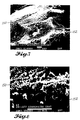
- FIGS. 1-20 are photomicrographs (scanning electron microscope operated at 20 KV) of aluminum alloy 2024-T3 test panels with cobalt conversion coatings made by the invention.
- FIGS. 1-16 show surface views and fracture views of unsealed cobalt conversion coatings.
- the photomicrographs of FIGS. 1-16 reveal a highly porous surface oxide (unsealed cobalt conversion coatings) with a thickness range of about 0.12 to 0.14 micron (1200 to 1400 Angstroms).
- FIGS. 1-4 show an unsealed cobalt conversion coating formed by a 20 minute immersion in a typical cobalt coating solution.
- FIGS. 5-8 show an unsealed cobalt conversion coating formed by a 30 minute immersion in a typical cobalt coating solution.
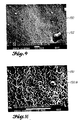
- FIGS. 9-12 show an unsealed cobalt conversion coating formed by a 50 minute immersion in a typical cobalt coating solution.
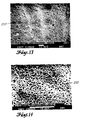
- FIGS. 13-16 show an unsealed cobalt conversion coating formed by a 60 minute immersion in a typical cobalt coating solution. There were only minor differences in oxide coating thickness between these immersion times. This suggests that at any given bath operating temperature, the oxide structure becomes self limiting.
- FIGS. 17-20 show surface views and fracture views of a sealed cobalt conversion coating.
- FIG. 1 is a photomicrograph at X10,000 magnification of a test panel showing a cobalt conversion coating 130 of the invention.
- the photomicrograph is a top view, from an elevated angle, of the upper surface of oxide coating 130.
- the top of oxide coating 130 is porous and looks like a layer of chow mein noodles.
- the porosity of oxide coating 130 gives excellent paint adhesion results.
- This test panel was immersed in a cobalt conversion coating solution for 20 minutes.
- the white bar is a length of 1 micron.
- FIG. 2 is a photomicrograph at X50,000 magnification of the test panel of FIG. 1.
- the photomicrograph is a top view, from an elevated angle, of the upper surface of oxide coating 130.
- FIG. 2 is a close-up, at higher magnification, of a small area of FIG. 1.
- the white bar is a length of 1 micron.
- FIG. 3 is a photomicrograph at X10,000 magnification of a test panel showing a side view of a fractured cross section of a cobalt conversion coating 130 of the invention.
- the fractured cross section of the aluminum substrate of the test panel is indicated by reference numeral 132.
- This test panel was immersed in a coating bath for 20 minutes. To make the photomicrograph, the test panel was bent and broken off to expose a cross section of oxide coating 130.
- the white bar is a length of 1 micron.
- FIG. 4 is a photomicrograph at X50,000 magnification of the test panel of FIG. 3 showing a side view of a fractured cross section of cobalt conversion coating 130 of the invention.
- FIG. 4 is a close-up, at higher magnification, of a small area of FIG. 3.
- the aluminum substrate of the test panel is indicated by reference numeral 132.
- the white bar is a length of 1 micron.
- Oxide coating 130 has a vertical thickness of about 0.12-0.14 micron.
- FIG. 5 is a photomicrograph at X10,000 magnification of another test panel showing another cobalt conversion coating 150 of the invention.
- the photomicrograph is a top view, from an elevated angle, of the upper surface of oxide coating 150.
- the top of oxide coating 150 is porous and looks like a layer of chow mein noodles.
- This test panel was immersed in a cobalt conversion coating solution for 30 minutes.
- the white bar is a length of 1 micron.
- FIG. 6 is a photomicrograph at X50,000 magnification of the test panel of FIG. 5.
- the photomicrograph is a top view, from an elevated angle, of the upper surface of oxide coating 150.
- FIG. 6 is a close-up, at higher magnification, of a small area of FIG. 5.
- the white bar is a length of 1 micron.
- FIG. 7 is a photomicrograph at X10,000 magnification of a test panel showing a side view of a fractured cross section of cobalt conversion coating 150 of the invention.
- the aluminum substrate of the test panel is indicated by reference numeral 152.
- This test panel was immersed in a coating bath for 30 minutes. To make the photomicrograph, the test panel was bent and broken off to expose a cross section of oxide coating 150.
- the white bar is a length of 1 micron.
- FIG. 8 is a photomicrograph at X50,000 magnification of the test panel of FIG. 7 showing a side view of a fractured cross section of cobalt conversion coating 150 of the invention.
- FIG. 8 is a close-up, at higher magnification, of a small area of FIG. 7.
- the aluminum substrate of the test panel is indicated by reference numeral 152.
- the white bar is a length of 1 micron.
- Oxide coating 150 has a vertical thickness of about 0.12-0.14 micron.
- FIG. 9 is a photomicrograph at X10,000 magnification of a test panel showing a cobalt conversion coating 190 of the invention.
- the photomicrograph is a top view, from an elevated angle, of the upper surface of oxide coating 190.
- the top of oxide coating 190 is porous and looks like a layer of chow mein noodles.
- This test panel was immersed in a cobalt conversion coating solution for 50 minutes.
- the oblong object indicated by reference numeral 192 is an impurity, believed to be a piece of oxidized material, on top of oxide coating 190.
- the white bar is a length of 1 micron.
- FIG. 10 is a photomicrograph at X50,000 magnification of the test panel of FIG. 9.
- the photomicrograph is a top view, from an elevated angle, of the upper surface of oxide coating 190.
- FIG. 10 is a close-up, at higher magnification, of a small area of FIG. 9.
- the roundish object indicated by reference numeral 192a is an unidentified impurity on top of oxide coating 190.
- the white bar is a length of 1 micron.
- FIG. 11 is a photomicrograph at X10,000 magnification of a test panel showing a side view of a fractured cross section of a cobalt conversion coating 190 of the invention.
- the fractured cross section of the aluminum substrate of the test panel is indicated by reference numeral 194.
- This test panel was immersed in a coating bath for 50 minutes. To make the photomicrograph, the test panel was bent and broken off to expose a cross section of oxide coating 190.
- the white bar is a length of 1 micron.
- FIG. 12 is a photomicrograph at X50,000 magnification of the test panel of FIG. 11 showing a side view of a fractured cross section of cobalt conversion coating 190 of the invention.
- FIG. 12 is a close-up, at higher magnification, of a small area of FIG. 11.
- the aluminum substrate of the test panel is indicated by reference numeral 194.
- the white bar is a length of 1 micron.
- Oxide coating 190 has a vertical thickness of about 0.12-0.14 micron.
- FIG. 13 is a photomicrograph at X10,000 magnification of another test panel showing a cobalt conversion coating 230 of the invention.
- the photomicrograph is a top view, from an elevated angle, of the upper surface of oxide coating 230.
- the top of oxide coating 230 is porous and looks like a layer of chow mein noodles.
- This test panel was immersed in a cobalt conversion coating solution for 60 minutes.
- the white bar is a length of 1 micron.
- FIG. 14 is a photomicrograph at X50,000 magnification of the test panel of FIG. 13.
- the photomicrograph is a top view, from an elevated angle, of the upper surface of oxide coating 230.
- FIG. 14 is a close-up, at higher magnification, of a small area of FIG. 13.
- the white bar is a length of 1 micron.
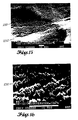
- FIG. 15 is a photomicrograph at X10,000 magnification of a test panel showing a side view of a fractured cross section of cobalt conversion coating 230 of the invention.
- the aluminum substrate of the test panel is indicated by reference numeral 232.
- This test panel was immersed in the coating bath for 60 minutes. To make the photomicrograph, the test panel was bent and broken off to expose a cross section of oxide coating 230.
- the white bar is a length of 1 micron.
- FIG. 16 is a photomicrograph at X50,000 magnification of the test panel of FIG. 15 showing a side view of a fractured cross section of cobalt conversion coating 230 of the invention.
- FIG. 16 is a close-up, at higher magnification, of a small area of FIG. 15.
- the white bar is a length of 1 micron.
- Oxide coating 150 has a vertical thickness of about 0.12-0.14 micron.
- FIG. 17 is a photomicrograph at X10,000 magnification of another test panel showing a sealed cobalt conversion coating 270 of the invention.
- the photomicrograph is a top view, from an elevated angle, of the upper surface of sealed oxide coating 270.
- This test panel was immersed in a sealing solution for 20 minutes.
- Sealed oxide coating 270 is not as porous as an unsealed oxide coating, the pores of the oxide coating being partially filled by hydration as a result of immersion in a sealing solution.
- the partial sealing of the oxide coating gives reduced paint adhesion results, but excellent corrosion resistance performance.
- the whitish areas identified by reference numeral 274 are believed to be impurities from the sealing solution.
- the white bar is a length of 1 micron.
- FIG. 18 is a photomicrograph at X50,000 magnification of the test panel of FIG. 17.
- the photomicrograph is a top view, from an elevated angle, of the upper surface of sealed oxide coating 270.
- FIG. 18 is a close-up, at higher magnification, of a small area of FIG. 17.
- Sealed oxide coating 270 is not as porous as an unsealed oxide coating, the pores of the oxide coating being partially filled by hydration as a result of immersion in a sealing solution.
- the white bar is a length of 1 micron.
- FIG. 19 is a photomicrograph at X10,000 magnification of a test panel showing a side view of a fractured cross section of sealed cobalt conversion coating 270 of the invention.
- the aluminum substrate of the test panel is indicated by reference numeral 272. This test panel was immersed in the sealing bath for 20 minutes. To make the photomicrograph, the test panel was bent and broken off to expose a cross section of oxide coating 270.
- the white bar is a length of 1 micron.
- FIG. 20 is a photomicrograph at X50,000 magnification of the test panel of FIG. 19 showing a side view of a fractured cross section of sealed cobalt conversion coating 270 of the invention.
- FIG. 20 is a close-up, at higher magnification, of a small area of FIG. 19.
- the white bar is a length of 1 micron.
- Sealed oxide coating 270 has a vertical thickness of about 0.12-0.14 micron.
- the first class is a cobalt conversion coating consisting of an oxide structure in unsealed condition and suitable for use in service where paint adhesion is especially important.
- the second class is a cobalt conversion coating consisting of an oxide structure in sealed condition and suitable for use in service where bare metal corrosion resistance performance is desired.
- cobalt coordination complexes are formed where the portion of the complex which includes the ligand (the bracketed portion in equations (1)-(5)) is negatively charged, i.e., (8) [Co(NO 2 ) 6 ] 3- and the complete complex is (9) Me 3 [Co(NO 2 ) 6 ] where Me corresponds to Na, K, or Li (alkali metal ions).
- This cobalt nitrite complex bath chemistry (equation (1)) has a distinct advantage over the previously described cobalt hexammine complex chemistry (equation (6)) in that pH control of the cobalt hexanitrite complex bath is not required.
- cobalt-III hexanitrite complexes are capable of forming oxide structures on aluminum substrates.
- the oxidizing ability of the cobalt-III hexanitrite complex is believed to be responsible for the formation of the observed oxide films (which I refer to as "cobalt conversion coatings") on aluminum substrates.
- the formation of oxide structures has been confirmed by instrumental analysis (Auger analysis and electron microscopy) of the coating.
- the photomicrographs in FIGS. 1-20 illustrate the appearance of the cobalt conversion coating of the invention.
- cobalt salts and metal nitrite salts are operable for cobalt complexing.
- cobalt-II salts which are operable in water solution are: cobalt nitrate, Co(NO 3 ) 2 ⁇ 6H 2 O; cobalt chloride, CoCl 2 ⁇ 6H 2 O; cobaltous sulfate, CoSO 4 ; cobaltous acetate, Co(CH 3 COO) 2 ⁇ 4H 2 O; and cobaltous basic carbonate, 2CoCO 3 ⁇ Co(OH) 2 ⁇ H 2 O.
- a nitrite salt such as NaNO 2 , KNO 2 , or LiNO 2 .
- cobalt-II salts may be used if they possess a minimum solubility in water or in a water solution containing a metal nitrite salt.
- the minimum solubility needed is 25 grams per 100 ml of water at 20°C (68°F) or 25 grams per 100 ml of water solution containing a metal nitrite salt at 20°C (68°F).
- the preferred reactants are Co(NO 3 ) 2 ⁇ 6H 2 O and NaNO 2 , since cobalt nitrite complexes formed with potassium or lithium nitrite are of limited solubility and will eventually drop out of an aqueous solution.
- a preferred chemical additive is an oxidizer, preferably hydrogen peroxide, H 2 O 2 .
- the function of the oxidizer is to oxidize the cobalt-II ions in solution to cobalt-III ions. Care must be taken that an excess amount of chemical oxidizer is not used because an excess would have the undesired effect of oxidizing the nitrite ions in solution to nitrate ions.
- the stream of air flowing into the tank functions as an oxidizer, so the presence of hydrogen peroxide is not essential for operability.
- the hydrogen peroxide increases the rate of oxidation of the cobalt-II ions in solution to cobalt-III ions and therefore is useful for commercial practice of the invention in that the solution becomes operational in a shorter period of time.
- reaction accelerator chemical such as sodium bromide (NaBr) or sodium iodide (NaI) may be added to the solution.
- NaBr sodium bromide
- NaI sodium iodide
- the reaction accelerator was found to have the effect of accelerating the formation of the oxide conversion coatings on aluminum alloy substrates as compared to solutions of cobalt-III hexanitrite complexes which did not contain this additive. The presence of the accelerator is not essential for operability. The accelerator increases the rate of formation of the oxide conversion coatings on aluminum alloys and therefore is useful for commercial practice of the invention.
- the preferred chemical reactants and additives are: Cobalt nitrate Co(N0 3 ) 2 ⁇ 6H 2 O Sodium nitrite NaNO 2 Hydrogen peroxide (oxidizer) H 2 O 2 Sodium iodide (accelerator) NaI
- the concentration of dissolved cobalt-II salt used may be from about 0.03 moles per liter (0.1 moles per gallon) of final solution up to the saturation limit of the cobalt-II salt employed.
- the concentration of dissolved metal nitrite salt may be from about 0.16 to 3.2 moles per liter (0.6 to 12 moles per gallon) of final solution.
- the concentration of oxidizer, such as hydrogen peroxide may be from complete omission up to about 0.1 moles per liter (0.5 moles per gallon) of final solution. As stated above, an excess amount of hydrogen peroxide has undesired effects.
- the concentration of accelerator salt, such as NaI, may be from complete omission up to the solubility limit of the accelerator in the solution.
- the pH of the bath may be from about 7.0 to 7.2.
- the temperature of the bath may be from about 20 °C (68°F) to 66°C (150°F); below 38°C (100°F coating formation is very slow; above 66°C (150°F) gradual decomposition of the cobalt-III hexanitrite complex occurs.
- the immersion time may be from about 3 minutes to 60 minutes.
- the cobalt conversion coating should be applied after all trimming and fabrication have been completed. Parts, where solution entrapment is possible, should not be subjected to immersion alkaline cleaning or immersion deoxidizing; manual cleaning and manual deoxidizing procedures should be used to obtain water break-free surfaces before applying cobalt conversion treatment.
- a water break-free surface is a surface which maintains a continuous water film for a period of at least 30 seconds after having been sprayed or immersion rinsed in clean water at a temperature below 38°C (100°F).
- Vapor degrease may be performed in accordance with Boeing Process Specification BAC 5408, emulsion clean in accordance with Boeing Process Specification BAC 5763, or solvent clean in accordance with Boeing Process Specification BAC 5750 if parts are greasy or oily. Parts with open faying surfaces or spot-welded joints where solution entrapment is possible should be immersed in cold water (or in hot and cold water) for 2 minutes after precleaning.
- Alkaline clean and rinse may be performed in accordance with Boeing Process Specification BAC 5744 or Boeing Process Specification BAC 5749 except for parts with open faying surfaces or spot welded joints, in which case, rinsing should be for at least 10 minutes using agitation with multiple immersions (a minimum of four times) followed by manual spray rinsing as required to prevent solution entrapment.
- Deoxidize and rinse may be performed in accordance with Boeing Process Specification BAC 5765 except for parts where solution entrapment is possible, which parts may be rinsed using the method described above under "Alkaline Cleaning". Castings may be deoxidized by either of the following methods:
- Example 1 The formulation of Example 1, with a molar ratio of nitrite salt to cobalt salt of about 12 to 1, is useful for producing oxide coatings exhibiting high paint adhesion in unsealed condition.
- Example 2 also having a molar ratio of nitrite salt to cobalt salt of about 12 to 1, is useful for producing oxide coatings possessing high paint adhesion properties in unsealed condition.
- any 2-valent soluble cobalt salt may be reacted with any soluble nitrite salt to form 3-valent cobalt hexanitrite complexes.
- this type of complexing is not restricted to nitrites only.
- cyanide salts were used (i.e., sodium cyanide, NaCN) to form hexacyano complexes of the type shown below (10) Me 3 [Co(CN) 6 ] and have yielded satisfactory conversion coatings on aluminum alloys.
- cyanide complexes will not be used because of environmental considerations.
- Nickel sulfate NiS0 4 ⁇ 6H 2 0 (hexahydrate) 40.2 (152) gm (about 0.15 (0.58) moles) 38.0-42.0 (144-159) gm Ammonium nitrate, NH 4 NO 3 30.1 (114) gm (about 0.375 (1.42) moles) 27.7-32.0 (105-121) gm Manganese acetate, Mn(CH 3 COO) 2 ⁇ 4H 2 O 20 (76) gm (about 0.082 (0.31) moles) 18-22 (68-84) gm Operating temperature 85 ⁇ 3°C (185 ⁇ 5° F)
- the immersion time in the sealing solution may be about 10-30 minutes, with 15 minutes being preferred.
- the sealing solution is believed to seal the cobalt conversion coating by a hydration mechanism.
- FIGS. 17-20, particularly FIG. 18, show a sealed cobalt conversion coating 270.
- Other sealing solutions which may be employed are as follows:
- Solutions 1-3 are not preferred because they lose their effectiveness over a period of time, whereas the solution in Example 4 has a long life.
- a continuous operating temperature range of the cobalt conversion tank of 49-60°C (120-140°F) yields optimum results with respect to coating performance on aluminum alloy substrates.
- Optimum paint adhesion is obtained when the tank is operated at or near 49°C (120°F), while optimum corrosion resistance performance is given at 60°C (140°F) in combination with the subsequent seal process.
- Immersion times in the cobalt conversion tank have an effect on the oxide coating thickness as measured by the coating weight (in unsealed condition) ranging from 430 to 646 mg/m 2 (40 to 60 mg/ft 2 ).
- An optimum immersion time for maximum paint adhesion is 15 minutes and for maximum corrosion resistance performance is 30 minutes.
- Salt spray corrosion resistance of cobalt conversion coatings produced by the above processes varies over a wide range, depending on reactant selection, immersion times, and bath operating temperatures. Preferred results are obtained when the formulation of Example 1 is utilized at immersion times of 30 minutes. In this way, sealed oxide coatings have been produced with 168 hrs. of salt spray corrosion resistance when sealed with the seal solution as described herein and tested in accordance with ASTM B117.
- Paint adhesion tests were conducted using aircraft paints qualified to Boeing Material Specification BMS 10-11 (a highly crosslinked epoxy primer) and BMS 10-60 (a highly crosslinked urethane topcoat).
- BMS 10-11 a highly crosslinked epoxy primer
- BMS 10-60 a highly crosslinked urethane topcoat
- corrosion resistance and paint adhesion performance properties have an inverse relationship. In general, where corrosion resistance is at a maximum, paint adhesion is at a minimum, and vice versa.
- the optional post-conversion step consisting of immersion into a heated solution (at 85 ⁇ 3°C (185 ⁇ 5°F)) of NiS0 4 /NH 4 NO 3 /Mn-acetate minimizes this problem by maintaining sufficient paint adhesion values while maintaining high corrosion resistance properties.
- ESCA electron spectroscopy for chemical analysis (also known as XPS or X-ray photoelectron spectroscopy).)
- the cobalt conversion coating consists of a mixture of oxides, namely, aluminum oxide, Al 2 O 3 , as the largest volume percent, and cobalt oxides, CoO, Co 3 O 4 , and Co 2 O 3 .
- the term "largest volume percent” means that the volume of this oxide exceeds the volume of any other oxide which is present, but the term “largest volume percent” does not necessarily imply that the volume of this oxide is more than 50 volume percent.
- the data further shows that in the lower portion of the oxide coating (that is, next to the aluminum substrate), the largest volume percent is Al 2 O 3 .
- the middle portion of the oxide coating is a mixture of CoO, Co 3 O 4 , Co 2 O 3 , and Al 2 O 3 .
- the data shows that in the top portion of the oxide coating, the largest volume percent is a mixture of Co 3 O 4 and Co 2 O 3 .
- FIGS. 1-4 show a cobalt conversion coating 130 (in the unsealed condition) formed by a 20 minute immersion in a typical cobalt conversion coating solution.
- FIGS. 5-8 show a cobalt conversion coating 150 (in the unsealed condition) formed by a 30 minute immersion in a typical cobalt conversion coating solution.
- FIGS. 9-12 show a cobalt conversion coating 190 (in the unsealed condition) formed by a 50 minute immersion in a typical cobalt conversion coating solution.
- FIGS. 1-4 show a cobalt conversion coating 130 (in the unsealed condition) formed by a 20 minute immersion in a typical cobalt conversion coating solution.
- FIGS. 5-8 show a cobalt conversion coating 150 (in the unsealed condition) formed by a 30 minute immersion in a typical cobalt conversion coating solution.
- FIGS. 9-12 show a cobalt conversion coating 190 (in the unsealed condition) formed by a 50 minute immersion in a typical cobalt
- FIGS. 13-16 show a cobalt conversion coating 230 (in the unsealed condition) formed by a 60 minute immersion in a typical cobalt conversion coating solution. Comparing FIGS. 1-4, FIGS. 5-8, FIGS. 9-12, and FIGS. 13-16, there does not appear to be any significant structural difference between coating 130, coating 150, coating 190, and coating 230. This suggests that at any given bath operating temperature, the oxide coating becomes self limiting.
- the top surface of the cobalt conversion coating as shown in FIGS. 1, 2, 5, 6, 9, 10, 13, and 14 is porous and bears a resemblance to chow mein noodles. This oxide structure provides appreciable surface area and porosity for good paint adhesion.
- FIGS. 17-20 show sealed cobalt conversion coating 270.
- the cobalt conversion coating was formed on the substrate and then the coating was partially sealed by immersion in a sealing solution.
- FIG. 18 shows the partially sealed structure of coating 270.
- Sealed oxide coating 270 is not as porous as an unsealed oxide coating, the pores of the oxide coating being partially filled by hydration as a result of immersion in a sealing solution. The partial sealing of the oxide coating gives reduced paint adhesion results, but excellent corrosion resistance performance.
Landscapes
- Chemical & Material Sciences (AREA)
- General Chemical & Material Sciences (AREA)
- Chemical Kinetics & Catalysis (AREA)
- Engineering & Computer Science (AREA)
- Materials Engineering (AREA)
- Mechanical Engineering (AREA)
- Metallurgy (AREA)
- Organic Chemistry (AREA)
- Chemical Treatment Of Metals (AREA)
- Chemically Coating (AREA)
Applications Claiming Priority (2)
| Application Number | Priority Date | Filing Date | Title |
|---|---|---|---|
| US62113290A | 1990-11-30 | 1990-11-30 | |
| US621132 | 1990-11-30 |
Publications (3)
| Publication Number | Publication Date |
|---|---|
| EP0488430A2 EP0488430A2 (en) | 1992-06-03 |
| EP0488430A3 EP0488430A3 (en) | 1992-12-16 |
| EP0488430B1 true EP0488430B1 (en) | 1997-06-11 |
Family
ID=24488866
Family Applications (1)
| Application Number | Title | Priority Date | Filing Date |
|---|---|---|---|
| EP91202181A Expired - Lifetime EP0488430B1 (en) | 1990-11-30 | 1991-08-27 | Non-chromated cobalt conversion coating |
Country Status (12)
| Country | Link |
|---|---|
| EP (1) | EP0488430B1 (ja) |
| JP (1) | JP3194607B2 (ja) |
| AT (1) | ATE154401T1 (ja) |
| AU (1) | AU650494B2 (ja) |
| BR (1) | BR9105184A (ja) |
| CA (1) | CA2056159C (ja) |
| DE (1) | DE69126507T2 (ja) |
| DK (1) | DK0488430T3 (ja) |
| ES (1) | ES2104655T3 (ja) |
| GR (1) | GR3024046T3 (ja) |
| MX (1) | MX9102254A (ja) |
| NZ (1) | NZ240779A (ja) |
Families Citing this family (27)
| Publication number | Priority date | Publication date | Assignee | Title |
|---|---|---|---|---|
| US5551994A (en) * | 1990-05-17 | 1996-09-03 | The Boeing Company | Non-chromated oxide coating for aluminum substrates |
| US5468307A (en) * | 1990-05-17 | 1995-11-21 | Schriever; Matthias P. | Non-chromated oxide coating for aluminum substrates |
| CA2087473C (en) * | 1990-05-17 | 2001-10-16 | Matthias P. Schriever | Non-chromated oxide coating for aluminum substrates |
| US5411606A (en) * | 1990-05-17 | 1995-05-02 | The Boeing Company | Non-chromated oxide coating for aluminum substrates |
| US5472524A (en) * | 1990-05-17 | 1995-12-05 | The Boeing Company | Non-chromated cobalt conversion coating method and coated articles |
| US5298092A (en) * | 1990-05-17 | 1994-03-29 | The Boeing Company | Non-chromated oxide coating for aluminum substrates |
| DE69130502T2 (de) * | 1991-07-19 | 1999-05-06 | The Boeing Co., Seattle, Wash. | Nicht-chromatierte Oxidüberzüge für Aluminiumsubstrate |
| CN1138873C (zh) * | 1992-06-25 | 2004-02-18 | 波音公司 | 在金属基体上形成钴转化膜层的方法,钴转化镀膜液及其用途 |
| RU2130977C1 (ru) * | 1993-01-19 | 1999-05-27 | Дзе Боинг Компани | Способ формирования оксидного кобальтового конверсионного покрытия и водный химический раствор для получения оксидного кобальтового конверсионного покрытия |
| ES2171170T3 (es) | 1993-09-13 | 2002-09-01 | Commw Scient Ind Res Org | Tratamiento de metales por medio de una solucion de limpieza que contiene iones acidos de tierras raras. |
| AUPM621194A0 (en) * | 1994-06-10 | 1994-07-07 | Commonwealth Scientific And Industrial Research Organisation | Conversion coating and process for its formation |
| PL320138A1 (en) | 1994-11-11 | 1997-09-15 | Commw Scient Ind Res Org | Method of and solution for obtaining a conversive coating on metal surface |
| GB9617416D0 (en) * | 1996-08-20 | 1996-10-02 | Minnesota Mining & Mfg | Thermal bleaching of infrared dyes |
| FR2752851B1 (fr) * | 1996-09-02 | 1998-11-13 | Cfpi Ind | Bain et procede de phosphatation de substrats metalliques, concentre pour la preparation de ce bain et substrats metalliques traites a l'aide de ces bain et procede |
| US5873953A (en) * | 1996-12-26 | 1999-02-23 | The Boeing Company | Non-chromated oxide coating for aluminum substrates |
| ZA983867B (en) * | 1997-05-16 | 1998-11-13 | Henkel Corp | Lithium and vanadium containing sealing composition and process therewith |
| US6315823B1 (en) | 1998-05-15 | 2001-11-13 | Henkel Corporation | Lithium and vanadium containing sealing composition and process therewith |
| US6432225B1 (en) * | 1999-11-02 | 2002-08-13 | The Boeing Company | Non-chromated oxide coating for aluminum substrates |
| AUPQ633200A0 (en) | 2000-03-20 | 2000-04-15 | Commonwealth Scientific And Industrial Research Organisation | Process and solution for providing a conversion coating on a metallic surface I |
| AUPQ633300A0 (en) | 2000-03-20 | 2000-04-15 | Commonwealth Scientific And Industrial Research Organisation | Process and solution for providing a conversion coating on a metallic surface ii |
| WO2003060019A1 (en) | 2002-01-04 | 2003-07-24 | University Of Dayton | Non-toxic corrosion protection pigments based on cobalt |
| US7235142B2 (en) | 2002-01-04 | 2007-06-26 | University Of Dayton | Non-toxic corrosion-protection rinses and seals based on cobalt |
| US7294211B2 (en) | 2002-01-04 | 2007-11-13 | University Of Dayton | Non-toxic corrosion-protection conversion coats based on cobalt |
| US6818313B2 (en) | 2002-07-24 | 2004-11-16 | University Of Dayton | Corrosion-inhibiting coating |
| US20040011252A1 (en) | 2003-01-13 | 2004-01-22 | Sturgill Jeffrey A. | Non-toxic corrosion-protection pigments based on manganese |
| JP4934984B2 (ja) * | 2005-03-31 | 2012-05-23 | 大日本印刷株式会社 | 金属酸化物膜の製造方法 |
| RU2416680C1 (ru) * | 2009-11-05 | 2011-04-20 | Федеральное государственное образовательное учреждение высшего профессионального образования "Астраханский государственный технический университет" | Электролит анодирования алюминия и его сплавов |
Family Cites Families (5)
| Publication number | Priority date | Publication date | Assignee | Title |
|---|---|---|---|---|
| US3905838A (en) * | 1974-04-10 | 1975-09-16 | Hikaru Ito | Bath for treating aluminum and aluminum alloys to form oxide film nonelectrolytically thereon and method for the treatment |
| US4381203A (en) * | 1981-11-27 | 1983-04-26 | Amchem Products, Inc. | Coating solutions for zinc surfaces |
| JPH0331484A (ja) * | 1989-06-27 | 1991-02-12 | Nippon Parkerizing Co Ltd | 亜鉛または亜鉛系メッキ材料の黒色化処理法 |
| JPH03226584A (ja) * | 1990-01-30 | 1991-10-07 | Nippon Parkerizing Co Ltd | 亜鉛系めっき鋼板用表面処理液及び表面処理方法 |
| US5298092A (en) * | 1990-05-17 | 1994-03-29 | The Boeing Company | Non-chromated oxide coating for aluminum substrates |
-
1991
- 1991-08-27 ES ES91202181T patent/ES2104655T3/es not_active Expired - Lifetime
- 1991-08-27 EP EP91202181A patent/EP0488430B1/en not_active Expired - Lifetime
- 1991-08-27 DK DK91202181.3T patent/DK0488430T3/da active
- 1991-08-27 AT AT91202181T patent/ATE154401T1/de not_active IP Right Cessation
- 1991-08-27 DE DE69126507T patent/DE69126507T2/de not_active Expired - Lifetime
- 1991-11-25 CA CA002056159A patent/CA2056159C/en not_active Expired - Lifetime
- 1991-11-27 AU AU88225/91A patent/AU650494B2/en not_active Ceased
- 1991-11-28 MX MX9102254A patent/MX9102254A/es not_active IP Right Cessation
- 1991-11-28 NZ NZ240779A patent/NZ240779A/en not_active IP Right Cessation
- 1991-11-28 BR BR919105184A patent/BR9105184A/pt not_active IP Right Cessation
- 1991-11-29 JP JP31608191A patent/JP3194607B2/ja not_active Expired - Lifetime
-
1997
- 1997-07-09 GR GR970401701T patent/GR3024046T3/el unknown
Also Published As
| Publication number | Publication date |
|---|---|
| JP3194607B2 (ja) | 2001-07-30 |
| CA2056159C (en) | 2001-07-03 |
| GR3024046T3 (en) | 1997-10-31 |
| HK1006861A1 (en) | 1999-03-19 |
| DE69126507T2 (de) | 1997-09-25 |
| EP0488430A3 (en) | 1992-12-16 |
| AU650494B2 (en) | 1994-06-23 |
| AU8822591A (en) | 1992-06-04 |
| CA2056159A1 (en) | 1992-05-31 |
| DK0488430T3 (da) | 1998-01-05 |
| ES2104655T3 (es) | 1997-10-16 |
| ATE154401T1 (de) | 1997-06-15 |
| MX9102254A (es) | 1992-06-01 |
| BR9105184A (pt) | 1992-07-21 |
| NZ240779A (en) | 1994-11-25 |
| DE69126507D1 (de) | 1997-07-17 |
| JPH059745A (ja) | 1993-01-19 |
| EP0488430A2 (en) | 1992-06-03 |
Similar Documents
| Publication | Publication Date | Title |
|---|---|---|
| EP0488430B1 (en) | Non-chromated cobalt conversion coating | |
| EP0458020B1 (en) | Non-chromated oxide coating for aluminum substrates | |
| EP0776384B1 (en) | Improved non-chromated oxide coating for aluminium substrates | |
| US5472524A (en) | Non-chromated cobalt conversion coating method and coated articles | |
| EP0646187B1 (en) | Non-chromated oxide coating for aluminum substrates | |
| US5411606A (en) | Non-chromated oxide coating for aluminum substrates | |
| EP0523288B1 (en) | Non-chromated oxide coating for aluminum substrates | |
| EP1230424B1 (en) | Non-chromated oxide coating for aluminum substrates | |
| US5873953A (en) | Non-chromated oxide coating for aluminum substrates | |
| US5378293A (en) | Non-chromated oxide coating for aluminum substrates | |
| US5468307A (en) | Non-chromated oxide coating for aluminum substrates | |
| HK1006861B (en) | Non-chromated cobalt conversion coating | |
| HK1013853B (en) | Non-chromated oxide coating for aluminum substrates | |
| KR100327142B1 (ko) | 금속기재상에코발트전환코팅을형성하기위한방법및화학전환코팅용액및상기방법으로제조한물품 | |
| KR100305009B1 (ko) | 알루미늄기판을위한비-크롬산염산화물코팅을형성하는방법 | |
| RU2130977C1 (ru) | Способ формирования оксидного кобальтового конверсионного покрытия и водный химический раствор для получения оксидного кобальтового конверсионного покрытия | |
| NZ245684A (en) | Solution and process for producing a cobalt conversion coating on a metal substrate |
Legal Events
| Date | Code | Title | Description |
|---|---|---|---|
| PUAI | Public reference made under article 153(3) epc to a published international application that has entered the european phase |
Free format text: ORIGINAL CODE: 0009012 |
|
| AK | Designated contracting states |
Kind code of ref document: A2 Designated state(s): AT BE CH DE DK ES FR GB GR IT LI LU NL SE |
|
| PUAL | Search report despatched |
Free format text: ORIGINAL CODE: 0009013 |
|
| AK | Designated contracting states |
Kind code of ref document: A3 Designated state(s): AT BE CH DE DK ES FR GB GR IT LI LU NL SE |
|
| 17P | Request for examination filed |
Effective date: 19930615 |
|
| 17Q | First examination report despatched |
Effective date: 19930719 |
|
| GRAG | Despatch of communication of intention to grant |
Free format text: ORIGINAL CODE: EPIDOS AGRA |
|
| GRAH | Despatch of communication of intention to grant a patent |
Free format text: ORIGINAL CODE: EPIDOS IGRA |
|
| GRAH | Despatch of communication of intention to grant a patent |
Free format text: ORIGINAL CODE: EPIDOS IGRA |
|
| GRAA | (expected) grant |
Free format text: ORIGINAL CODE: 0009210 |
|
| AK | Designated contracting states |
Kind code of ref document: B1 Designated state(s): AT BE CH DE DK ES FR GB GR IT LI LU NL SE |
|
| REF | Corresponds to: |
Ref document number: 154401 Country of ref document: AT Date of ref document: 19970615 Kind code of ref document: T |
|
| REG | Reference to a national code |
Ref country code: CH Ref legal event code: NV Representative=s name: ARNOLD & SIEDSMA AG Ref country code: CH Ref legal event code: EP |
|
| REF | Corresponds to: |
Ref document number: 69126507 Country of ref document: DE Date of ref document: 19970717 |
|
| REG | Reference to a national code |
Ref country code: GR Ref legal event code: FG4A Free format text: 3024046 |
|
| ET | Fr: translation filed | ||
| REG | Reference to a national code |
Ref country code: ES Ref legal event code: FG2A Ref document number: 2104655 Country of ref document: ES Kind code of ref document: T3 |
|
| REG | Reference to a national code |
Ref country code: DK Ref legal event code: T3 |
|
| PLBE | No opposition filed within time limit |
Free format text: ORIGINAL CODE: 0009261 |
|
| STAA | Information on the status of an ep patent application or granted ep patent |
Free format text: STATUS: NO OPPOSITION FILED WITHIN TIME LIMIT |
|
| 26N | No opposition filed | ||
| REG | Reference to a national code |
Ref country code: GB Ref legal event code: IF02 |
|
| PGFP | Annual fee paid to national office [announced via postgrant information from national office to epo] |
Ref country code: CH Payment date: 20100812 Year of fee payment: 20 Ref country code: ES Payment date: 20100915 Year of fee payment: 20 Ref country code: NL Payment date: 20100810 Year of fee payment: 20 |
|
| PGFP | Annual fee paid to national office [announced via postgrant information from national office to epo] |
Ref country code: SE Payment date: 20100812 Year of fee payment: 20 Ref country code: LU Payment date: 20100915 Year of fee payment: 20 Ref country code: IT Payment date: 20100823 Year of fee payment: 20 Ref country code: FR Payment date: 20100824 Year of fee payment: 20 Ref country code: DE Payment date: 20100825 Year of fee payment: 20 Ref country code: AT Payment date: 20100812 Year of fee payment: 20 |
|
| PGFP | Annual fee paid to national office [announced via postgrant information from national office to epo] |
Ref country code: GR Payment date: 20100719 Year of fee payment: 20 Ref country code: GB Payment date: 20100825 Year of fee payment: 20 |
|
| PGFP | Annual fee paid to national office [announced via postgrant information from national office to epo] |
Ref country code: DK Payment date: 20100812 Year of fee payment: 20 |
|
| PGFP | Annual fee paid to national office [announced via postgrant information from national office to epo] |
Ref country code: BE Payment date: 20100818 Year of fee payment: 20 |
|
| REG | Reference to a national code |
Ref country code: DE Ref legal event code: R071 Ref document number: 69126507 Country of ref document: DE |
|
| REG | Reference to a national code |
Ref country code: DE Ref legal event code: R071 Ref document number: 69126507 Country of ref document: DE |
|
| BE20 | Be: patent expired |
Owner name: THE *BOEING CY Effective date: 20110827 |
|
| REG | Reference to a national code |
Ref country code: CH Ref legal event code: PL |
|
| REG | Reference to a national code |
Ref country code: NL Ref legal event code: V4 Effective date: 20110827 |
|
| REG | Reference to a national code |
Ref country code: DK Ref legal event code: EUP |
|
| REG | Reference to a national code |
Ref country code: GB Ref legal event code: PE20 Expiry date: 20110826 |
|
| REG | Reference to a national code |
Ref country code: SE Ref legal event code: EUG |
|
| PG25 | Lapsed in a contracting state [announced via postgrant information from national office to epo] |
Ref country code: GB Free format text: LAPSE BECAUSE OF EXPIRATION OF PROTECTION Effective date: 20110826 |
|
| PG25 | Lapsed in a contracting state [announced via postgrant information from national office to epo] |
Ref country code: NL Free format text: LAPSE BECAUSE OF EXPIRATION OF PROTECTION Effective date: 20110827 |
|
| REG | Reference to a national code |
Ref country code: ES Ref legal event code: FD2A Effective date: 20120110 |
|
| PG25 | Lapsed in a contracting state [announced via postgrant information from national office to epo] |
Ref country code: ES Free format text: LAPSE BECAUSE OF EXPIRATION OF PROTECTION Effective date: 20110828 |
|
| PG25 | Lapsed in a contracting state [announced via postgrant information from national office to epo] |
Ref country code: DE Free format text: LAPSE BECAUSE OF EXPIRATION OF PROTECTION Effective date: 20110828 |