EP0488648B1 - Appareil d'enregistrement/reproduction d'informations optiques - Google Patents
Appareil d'enregistrement/reproduction d'informations optiques Download PDFInfo
- Publication number
- EP0488648B1 EP0488648B1 EP91310879A EP91310879A EP0488648B1 EP 0488648 B1 EP0488648 B1 EP 0488648B1 EP 91310879 A EP91310879 A EP 91310879A EP 91310879 A EP91310879 A EP 91310879A EP 0488648 B1 EP0488648 B1 EP 0488648B1
- Authority
- EP
- European Patent Office
- Prior art keywords
- light beam
- recording
- optical information
- temperature
- information
- Prior art date
- Legal status (The legal status is an assumption and is not a legal conclusion. Google has not performed a legal analysis and makes no representation as to the accuracy of the status listed.)
- Expired - Lifetime
Links
Images


Classifications
-
- G—PHYSICS
- G11—INFORMATION STORAGE
- G11B—INFORMATION STORAGE BASED ON RELATIVE MOVEMENT BETWEEN RECORD CARRIER AND TRANSDUCER
- G11B19/00—Driving, starting, stopping record carriers not specifically of filamentary or web form, or of supports therefor; Control thereof; Control of operating function ; Driving both disc and head
- G11B19/02—Control of operating function, e.g. switching from recording to reproducing
- G11B19/04—Arrangements for preventing, inhibiting, or warning against double recording on the same blank or against other recording or reproducing malfunctions
- G11B19/046—Detection or prevention or problems due to temperature
-
- G—PHYSICS
- G11—INFORMATION STORAGE
- G11B—INFORMATION STORAGE BASED ON RELATIVE MOVEMENT BETWEEN RECORD CARRIER AND TRANSDUCER
- G11B11/00—Recording on or reproducing from the same record carrier wherein for these two operations the methods are covered by different main groups of groups G11B3/00 - G11B7/00 or by different subgroups of group G11B9/00; Record carriers therefor
- G11B11/10—Recording on or reproducing from the same record carrier wherein for these two operations the methods are covered by different main groups of groups G11B3/00 - G11B7/00 or by different subgroups of group G11B9/00; Record carriers therefor using recording by magnetic means or other means for magnetisation or demagnetisation of a record carrier, e.g. light induced spin magnetisation; Demagnetisation by thermal or stress means in the presence or not of an orienting magnetic field
- G11B11/105—Recording on or reproducing from the same record carrier wherein for these two operations the methods are covered by different main groups of groups G11B3/00 - G11B7/00 or by different subgroups of group G11B9/00; Record carriers therefor using recording by magnetic means or other means for magnetisation or demagnetisation of a record carrier, e.g. light induced spin magnetisation; Demagnetisation by thermal or stress means in the presence or not of an orienting magnetic field using a beam of light or a magnetic field for recording by change of magnetisation and a beam of light for reproducing, i.e. magneto-optical, e.g. light-induced thermomagnetic recording, spin magnetisation recording, Kerr or Faraday effect reproducing
- G11B11/10502—Recording on or reproducing from the same record carrier wherein for these two operations the methods are covered by different main groups of groups G11B3/00 - G11B7/00 or by different subgroups of group G11B9/00; Record carriers therefor using recording by magnetic means or other means for magnetisation or demagnetisation of a record carrier, e.g. light induced spin magnetisation; Demagnetisation by thermal or stress means in the presence or not of an orienting magnetic field using a beam of light or a magnetic field for recording by change of magnetisation and a beam of light for reproducing, i.e. magneto-optical, e.g. light-induced thermomagnetic recording, spin magnetisation recording, Kerr or Faraday effect reproducing characterised by the transducing operation to be executed
- G11B11/10504—Recording
- G11B11/10506—Recording by modulating only the light beam of the transducer
-
- G—PHYSICS
- G11—INFORMATION STORAGE
- G11B—INFORMATION STORAGE BASED ON RELATIVE MOVEMENT BETWEEN RECORD CARRIER AND TRANSDUCER
- G11B11/00—Recording on or reproducing from the same record carrier wherein for these two operations the methods are covered by different main groups of groups G11B3/00 - G11B7/00 or by different subgroups of group G11B9/00; Record carriers therefor
- G11B11/10—Recording on or reproducing from the same record carrier wherein for these two operations the methods are covered by different main groups of groups G11B3/00 - G11B7/00 or by different subgroups of group G11B9/00; Record carriers therefor using recording by magnetic means or other means for magnetisation or demagnetisation of a record carrier, e.g. light induced spin magnetisation; Demagnetisation by thermal or stress means in the presence or not of an orienting magnetic field
- G11B11/105—Recording on or reproducing from the same record carrier wherein for these two operations the methods are covered by different main groups of groups G11B3/00 - G11B7/00 or by different subgroups of group G11B9/00; Record carriers therefor using recording by magnetic means or other means for magnetisation or demagnetisation of a record carrier, e.g. light induced spin magnetisation; Demagnetisation by thermal or stress means in the presence or not of an orienting magnetic field using a beam of light or a magnetic field for recording by change of magnetisation and a beam of light for reproducing, i.e. magneto-optical, e.g. light-induced thermomagnetic recording, spin magnetisation recording, Kerr or Faraday effect reproducing
- G11B11/10502—Recording on or reproducing from the same record carrier wherein for these two operations the methods are covered by different main groups of groups G11B3/00 - G11B7/00 or by different subgroups of group G11B9/00; Record carriers therefor using recording by magnetic means or other means for magnetisation or demagnetisation of a record carrier, e.g. light induced spin magnetisation; Demagnetisation by thermal or stress means in the presence or not of an orienting magnetic field using a beam of light or a magnetic field for recording by change of magnetisation and a beam of light for reproducing, i.e. magneto-optical, e.g. light-induced thermomagnetic recording, spin magnetisation recording, Kerr or Faraday effect reproducing characterised by the transducing operation to be executed
- G11B11/10515—Reproducing
-
- G—PHYSICS
- G11—INFORMATION STORAGE
- G11B—INFORMATION STORAGE BASED ON RELATIVE MOVEMENT BETWEEN RECORD CARRIER AND TRANSDUCER
- G11B11/00—Recording on or reproducing from the same record carrier wherein for these two operations the methods are covered by different main groups of groups G11B3/00 - G11B7/00 or by different subgroups of group G11B9/00; Record carriers therefor
- G11B11/10—Recording on or reproducing from the same record carrier wherein for these two operations the methods are covered by different main groups of groups G11B3/00 - G11B7/00 or by different subgroups of group G11B9/00; Record carriers therefor using recording by magnetic means or other means for magnetisation or demagnetisation of a record carrier, e.g. light induced spin magnetisation; Demagnetisation by thermal or stress means in the presence or not of an orienting magnetic field
- G11B11/105—Recording on or reproducing from the same record carrier wherein for these two operations the methods are covered by different main groups of groups G11B3/00 - G11B7/00 or by different subgroups of group G11B9/00; Record carriers therefor using recording by magnetic means or other means for magnetisation or demagnetisation of a record carrier, e.g. light induced spin magnetisation; Demagnetisation by thermal or stress means in the presence or not of an orienting magnetic field using a beam of light or a magnetic field for recording by change of magnetisation and a beam of light for reproducing, i.e. magneto-optical, e.g. light-induced thermomagnetic recording, spin magnetisation recording, Kerr or Faraday effect reproducing
- G11B11/10595—Control of operating function
-
- G—PHYSICS
- G11—INFORMATION STORAGE
- G11B—INFORMATION STORAGE BASED ON RELATIVE MOVEMENT BETWEEN RECORD CARRIER AND TRANSDUCER
- G11B7/00—Recording or reproducing by optical means, e.g. recording using a thermal beam of optical radiation by modifying optical properties or the physical structure, reproducing using an optical beam at lower power by sensing optical properties; Record carriers therefor
- G11B7/004—Recording, reproducing or erasing methods; Read, write or erase circuits therefor
- G11B7/0045—Recording
-
- G—PHYSICS
- G11—INFORMATION STORAGE
- G11B—INFORMATION STORAGE BASED ON RELATIVE MOVEMENT BETWEEN RECORD CARRIER AND TRANSDUCER
- G11B7/00—Recording or reproducing by optical means, e.g. recording using a thermal beam of optical radiation by modifying optical properties or the physical structure, reproducing using an optical beam at lower power by sensing optical properties; Record carriers therefor
- G11B7/12—Heads, e.g. forming of the optical beam spot or modulation of the optical beam
- G11B7/125—Optical beam sources therefor, e.g. laser control circuitry specially adapted for optical storage devices; Modulators, e.g. means for controlling the size or intensity of optical spots or optical traces
- G11B7/126—Circuits, methods or arrangements for laser control or stabilisation
Definitions
- the present invention relates to an information recording and/or reproducing apparatus for recording information on an optical information recording medium and/or reproducing the information, and more particularly to an optical information recording and/or reproducing apparatus which is suitable for bit edge recording (which is also called pit edge recording).
- An optical information recording and/or reproducing apparatus which optically records and/or reproduces information has been attracting a notice as one which meets the above requirement.
- An information recording mode in such an optical information recording and/or reproducing apparatus includes bit position recording (mark interval recording) in which the significance of the information is in the position of the center of the record bit, and bit edge recording (mark length recording) in which the significance of the information is in the position of the bit edge.
- the bit position recording has a characteristic of exactly recording the information while the bit edge recording has an advantage that a recording density is 1.5 times as high as that of the bit position recording. Accordingly, the bit edge recording is advantageous for higher density recording and the study on the bit edge recording has been actively done recently.
- the prior art bit edge recording has the following problem.
- heat mode recording in which a photo-energy is converted to a thermal energy which is used to record the information, edge positions of the beginning and the end of the record bit are determined by a critical temperature at the time of the recording. Accordingly, the edge position of the record bit is easily affected by a surrounding temperature of the apparatus and an internal temperature.
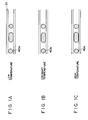
- Figs. 1A to 1C show changes of the record bit relative to a variation of temperature.
- Fig. 1A shows a record bit 40a in low temperature recording
- Fig. 1B shows a record bit 40b in ordinary temperature recording
- Fig. 1C shows a record bit 40c in high temperature recording. Recording conditions other than the temperature are identical. As seen from Figs. 1A - 1C, the higher the temperature is, the larger is the area of the record bit and the more does the edge position of the record bit change.
- Patent abstracts of Japan vol.8, No. 6(P-247) 12/1/1984 & JP-A-58-169303 disclose a magneto-optic recording method in which information is written on the magneto-optic recording medium using a modulated magnetic field, whilst the recording area is heated by a preheating light beam, to enable the recording area of the medium to heat to a higher temperature if the illuminating laser beam has a low power to increase the speed of recording.
- Patent abstracts of Japan vol.8, No. 257 (P-316) 24/11/1984 & JP-A-59-127242 disclose an optical recording and/or reproducing apparatus in which data is written onto a metal film utilising a preheating light beam which preheats the recording region of the recording medium before writing the information to enable the recording time to be decreased.
- Patent abstracts of Japan, vol.11, No. 45 (P-546) [2492], 10/2/1987 & JP-A-61-214266 disclose a magneto-optic recording and/or reproducing apparatus in which the recording bits are recorded by application of a magnetic field pulse in the presence of an illuminating laser beam for raising the temperature of the film.
- the temperature of the recording medium is controlled by a laser drive section which also controls the intensity of laser light in response to the information signal.
- a first aspect of the present invention provides an optical information recording apparatus as set out in claim 1.
- a second aspect of the present invention provides an optical information reproducing apparatus as set out in claim 3.
- a third aspect of the present invention provides a method of recording information as set out in claim 7.
- a fourth aspect of the present invention provides a method of reproducing information as set out in claim 8.
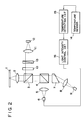
- FIG. 2 shows a configuration of an optical head optical system in the optical information recording and/or reproducing apparatus of the present invention.
- numeral 1 denotes an optical disk which is an optical information recording medium
- numeral 2 denotes an objective lens for condensing a light beam of a light source.
- the light source includes a semiconductor laser 6 for irradiating a preheating light beam and a semiconductor laser 9 for irradiating a recording light beam.
- the light beam of the preheating semiconductor laser 6 is collimated by a collimator lens 5, reflected by a beam splitter 4, passes through a beam splitter 3 and is directed to the objective lens 2.
- the incident light beam is condensed by the objective lens 2 and irradiated onto a recording layer of the optical disk 1 as a light spot 22 as shown in Fig. 3.
- the light beam of the recording semiconductor laser 9 which has a different wavelength from that of the preheating semiconductor laser 6 is collimated by a collimator lens 8 and converted to a circular beam by a beam shaping prism 7.
- the converted light beam passes through the beam splitters 4 and 3 and is directed to the objective lens 2.
- the incident light beam is condensed by the objective lens 2 and irradiated onto the recording layer of the optical disk 1 as a light spot 23 as shown in Fig. 3.
- the recording light spot 23 is irradiated such that it is located on an information track between tracking tracks 21.
- the preheating light spot 22 is sufficiently larger in size than the light spot 23 so that it irradiates the light spot 23 and its peripheral region.
- a light intensity of the recording light beam is modulated by a modulator (not shown) in accordance with a record signal.
- the recording layer is preheated by the preheating light beam to a temperature which does not cause the recording of information, and the intensity-modulated recording light beam is irradiated thereon to record the information.
- the light intensity of the recording semiconductor laser 9 is lowered to a reproducing power, and the reproducing light beam is irradiated to the optical disk 1 like the recording mode.
- the irradiated light beam is reflected by the optical disk 1, passes through the objective lens 2 and is directed to the beam splitter 3.
- the beam splitter 3 reflects the incident light beam to the reproducing light beam detection optical system.
- the detection optical system only the light beam of the semiconductor laser 9 is transmitted through a wavelength filter 10 and the light beam of the semiconductor laser 6 is blocked.
- the reproducing light beam transmitted through the wavelength filter 10 passes through an analyzer 13 and a focusing lens 11 and is detected by a photo-detector 12.
- the analyzer 13 is arranged because a polarized light is utilized when the optical disk 1 is a magneto-optical recording medium.
- a temperature sensor 14 shown in Fig. 2 senses an internal or external temperature of the apparatus, that is, an environmental temperature.
- a temperature detector 15 supplies a control signal which varies with the sensed output of the temperature sensor 14, to a light intensity control circuit 16, which controls the light intensity of the preheating semiconductor laser 6 in accordance with the control signal. It controls such that when the environmental temperature sensed by the temperature sensor 14 rises, the light intensity is lowered, and when the environmental temperature drops, the light intensity is increased. In this manner, the temperature of the recording layer in the irradiation area of the preheating light spot 22 is maintained constant without regard to the environmental temperature.
- Fig. 4 shows a relation between the light intensity of the light beam and the temperature of the recording layer of the optical disk.
- T B denotes a steady temperature by the preheating light beam and T o denotes the environmental temperature.
- T o denotes the environmental temperature.
- the steady temperature T B is set to a temperature which does not cause the recording of of the information.
- Tw denotes the recording temperature and Tr denotes the reproducing temperature.
- the light intensity of the recording semiconductor laser 9 is modulated within the temperature range.
- the recording spot irradiation area on the optical disk 1 can be maintained at the predetermined reproducing temperature Tr or recording temperature T w . Accordingly, the recording condition of the information is kept constant irrespective of the temperature. Thus, the problem of variation of the edge position of the record bit which was encountered in the prior art apparatus is solved and the information can be exactly recorded.
- Fig. 5 shows a relation between a coercive force of the magneto-optical recording medium and a temperature.
- a coercive force Hc at a room temperature gradually decreases as the temperature rises and reaches zero at Curie point Tc.
- a material having such a characteristic is an amorphous film of TbFeCo. It is also known that a Kerr effect decreases as the temperature rises, as the coercive force does. Accordingly, the temperature of the medium may be indirectly detected from an amplitude of a signal reproduced by using the Kerr effect.
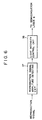
- Fig. 6 shows the embodiment based on the above finding.
- Numeral 17 denotes a reproduced signal amplitude detector for detecting the amplitude of the reproduced signal of the photo-detector 12.
- Numeral 16 denotes a light intensity control circuit which is identical to that shown in Fig. 2 and which controls the light intensity of the preheating semiconductor laser 6 in accordance with the reproduced signal amplitude.
- the medium temperature can be kept constant as it is in the previous embodiment.
- the present invention is not limited to the above embodiments. For example, data recorded under a predetermined temperature environment may be recorded in a monitor area of the medium as a medium temperature reference and the light intensity of the preheating light beam may be corrected prior to the recording.
- the light intensity of the preheating light beam is varied in accordance with the environmental temperature so that the medium temperature can be maintained at the predetermined temperature even if the environmental temperature changes. Accordingly, the information can always be recorded under the constant temperature condition and the change of the size or length of the record bit due to the temperature change is reduced and the information can be exactly recorded. The effect is particularly great in the bit edge recording in which the significance of information is in the edge position of the record bit.
Landscapes
- Physics & Mathematics (AREA)
- Optics & Photonics (AREA)
- Optical Head (AREA)
- Optical Recording Or Reproduction (AREA)
Claims (10)
- Appareil d'enregistrement d'informations optique comprenant :des moyens (6, 2) pour exposer une piste d'informations d'un support (1) d'enregistrement d'informations optique à un faisceau lumineux de préchauffage ; etdes moyens (9) pour exposer ladite piste d'informations du support (1) d'enregistrement d'informations optique à un faisceau lumineux d'enregistrement ;l'appareil étant caractérisé par le fait qu'il comprend en outre :des moyens (14, 15) de détection pour détecter la température ambiante de l'appareil ; etdes moyens (16) pour faire varier l'intensité lumineuse du faisceau lumineux de préchauffage en fonction du résultat de la détection desdits moyens (14, 15) de détection.
- Appareil d'enregistrement d'informations optique selon la revendication 1, comprenant des moyens pour reproduire des informations depuis le support (1) d'enregistrement.
- Appareil d'enregistrement d'informations optique comprenant :des moyens (6, 2) pour exposer une piste d'informations d'un support (1) d'enregistrement d'informations magnéto-optique à un faisceau lumineux de préchauffage pendant la reproduction ;des moyens pour exposer ladite piste d'informations dudit support (1) d'enregistrement d'informations magnéto-optique à un faisceau lumineux de reproduction ;l'appareil étant caractérisé par le fait qu'il comprend en outre :des moyens (14, 15) de détection pour détecter la température ambiante de l'appareil ; etdes moyens (16) pour faire varier l'intensité lumineuse du faisceau lumineux de préchauffage en fonction du résultat de la détection desdits moyens (14, 15) de détection.
- Appareil selon la revendication 1 ou 2, dans lequel ledit support (1) d'enregistrement d'informations optique est un support d'enregistrement magnéto-optique.
- Appareil selon l'une quelconque des revendications précédentes, dans lequel le faisceau lumineux de préchauffage et le faisceau lumineux d'enregistrement ont des longueurs d'onde différentes.
- Appareil selon l'une quelconque des revendications précédentes, lorsqu'elles dépendent de la revendication 2 ou de la revendication 3, dans lequel le faisceau lumineux de préchauffage et le faisceau lumineux de reproduction ont des longueurs d'onde différentes.
- Procédé d'enregistrement d'informations utilisant un appareil d'enregistrement d'informations optique, ledit procédé comprenant les étapes qui consistent :à exposer une piste d'informations d'un support (1) d'enregistrement d'informations optique à un faisceau lumineux de préchauffage ; età exposer ladite piste d'informations du support (1) d'enregistrement d'informations optique à un faisceau lumineux d'enregistrement ;le procédé étant caractérisé par le fait qu'il comprend les étapes supplémentaires qui consistent :à détecter la température ambiante de l'appareil ; età faire varier l'intensité lumineuse du faisceau lumineux de préchauffage en fonction du résultat de la détection.
- Procédé de reproduction d'informations utilisant un appareil de reproduction d'informations optique, ledit procédé comprenant les étapes qui consistent :à exposer une piste d'informations d'un support (1) d'enregistrement d'informations magnéto-optique à un faisceau lumineux de préchauffage ; età exposer ladite piste d'informations du support d'enregistrement d'informations magnéto-optique à un faisceau lumineux de reproduction ;le procédé étant caractérisé par le fait qu'il comprend les étapes supplémentaires qui consistent :à détecter la température ambiante de l'appareil ; età faire varier l'intensité lumineuse du faisceau lumineux de préchauffage en fonction du résultat de la détection.
- Procédé selon la revendication 7, dans lequel le support (1) d'enregistrement est un support d'enregistrement magnéto-optique.
- Procédé selon l'une quelconque des revendications 7 à 9, dans lequel le faisceau lumineux de préchauffage et le faisceau lumineux d'enregistrement ont des longueurs d'onde différentes.
Applications Claiming Priority (2)
| Application Number | Priority Date | Filing Date | Title |
|---|---|---|---|
| JP2321119A JP2851014B2 (ja) | 1990-11-27 | 1990-11-27 | 情報記録装置 |
| JP321119/90 | 1990-11-27 |
Publications (3)
| Publication Number | Publication Date |
|---|---|
| EP0488648A2 EP0488648A2 (fr) | 1992-06-03 |
| EP0488648A3 EP0488648A3 (en) | 1992-09-23 |
| EP0488648B1 true EP0488648B1 (fr) | 1997-10-29 |
Family
ID=18129033
Family Applications (1)
| Application Number | Title | Priority Date | Filing Date |
|---|---|---|---|
| EP91310879A Expired - Lifetime EP0488648B1 (fr) | 1990-11-27 | 1991-11-26 | Appareil d'enregistrement/reproduction d'informations optiques |
Country Status (4)
| Country | Link |
|---|---|
| US (1) | US5297128A (fr) |
| EP (1) | EP0488648B1 (fr) |
| JP (1) | JP2851014B2 (fr) |
| DE (1) | DE69128067T2 (fr) |
Families Citing this family (16)
| Publication number | Priority date | Publication date | Assignee | Title |
|---|---|---|---|---|
| JP3239962B2 (ja) * | 1992-09-10 | 2001-12-17 | キヤノン株式会社 | 光学的情報記録再生装置 |
| US5610879A (en) * | 1993-03-05 | 1997-03-11 | Matsushita Electric Industrial Co. Ltd. | Optical reproducing device, optical reproducing method using the same, and optical record medium used in the same |
| EP0644538A4 (fr) * | 1993-03-15 | 1995-12-20 | Nippon Kogaku Kk | Methode, support et appareil d'enregistrement magneto-optique. |
| US5461603A (en) * | 1993-04-22 | 1995-10-24 | Sony Corporation | Disc recording/reproducing apparatus having temperature control of the recording/reproducing processes |
| JPH07130080A (ja) * | 1993-11-02 | 1995-05-19 | Olympus Optical Co Ltd | 情報記録装置 |
| JP3333613B2 (ja) * | 1993-12-07 | 2002-10-15 | 株式会社日立製作所 | 光情報記録媒体並びに光情報記録再生方法及び光情報記録再生装置 |
| US5477520A (en) * | 1994-08-26 | 1995-12-19 | Eastman Kodak Company | System and method for high resolution optical recording using an induced shift in media absorption |
| JPH08147744A (ja) * | 1994-11-16 | 1996-06-07 | Canon Inc | 光記録装置 |
| US5537383A (en) * | 1995-03-01 | 1996-07-16 | Eastman Kodak Company | Optical data storage system with differential data detection and source noise subtraction for use with magneto-optic, write-once and other optical media |
| JPH097178A (ja) * | 1995-06-15 | 1997-01-10 | Nikon Corp | 光ディスクの再生方法、再生装置及び光ディスク |
| US5742566A (en) * | 1995-11-27 | 1998-04-21 | Sony Corporation | Optical recording methods and apparatus using light modulation technique based on detecting temperature of the medium |
| US6047289A (en) * | 1997-11-07 | 2000-04-04 | Novell, Inc. | Method and apparatus for directed data propagation |
| US6069853A (en) * | 1998-08-21 | 2000-05-30 | Terastor Corporation | Head including a heating element for reducing signal distortion in data storage systems |
| JP3876281B2 (ja) * | 2000-08-31 | 2007-01-31 | 独立行政法人産業技術総合研究所 | 情報記録方法 |
| JP2002298360A (ja) | 2001-03-30 | 2002-10-11 | Canon Inc | 情報記録媒体への情報記録方法及び情報記録装置 |
| JP2007122773A (ja) * | 2005-10-25 | 2007-05-17 | Canon Inc | 多値記録における記録ストラテジー |
Family Cites Families (4)
| Publication number | Priority date | Publication date | Assignee | Title |
|---|---|---|---|---|
| US3631415A (en) * | 1969-09-12 | 1971-12-28 | Honeywell Inc | Optical mass memory |
| US4530080A (en) * | 1981-04-07 | 1985-07-16 | Tdk Electronics Co., Ltd. | Optical recording/reproducing system |
| JPS60236137A (ja) * | 1984-05-08 | 1985-11-22 | Nippon Kogaku Kk <Nikon> | 同時消録型光磁気記録方式並びにそれに使用する記録装置及び記録媒体 |
| JPH0777025B2 (ja) * | 1985-10-16 | 1995-08-16 | 株式会社日立製作所 | 光学的記録再生装置 |
-
1990
- 1990-11-27 JP JP2321119A patent/JP2851014B2/ja not_active Expired - Fee Related
-
1991
- 1991-11-26 DE DE69128067T patent/DE69128067T2/de not_active Expired - Fee Related
- 1991-11-26 EP EP91310879A patent/EP0488648B1/fr not_active Expired - Lifetime
-
1992
- 1992-12-02 US US07/984,740 patent/US5297128A/en not_active Expired - Fee Related
Also Published As
| Publication number | Publication date |
|---|---|
| EP0488648A3 (en) | 1992-09-23 |
| US5297128A (en) | 1994-03-22 |
| DE69128067D1 (de) | 1997-12-04 |
| DE69128067T2 (de) | 1998-03-19 |
| JP2851014B2 (ja) | 1999-01-27 |
| JPH04192120A (ja) | 1992-07-10 |
| EP0488648A2 (fr) | 1992-06-03 |
Similar Documents
| Publication | Publication Date | Title |
|---|---|---|
| EP0559391B1 (fr) | Méthode et appareil d'enregistrement et de reproduction magnéto-optique | |
| EP0488648B1 (fr) | Appareil d'enregistrement/reproduction d'informations optiques | |
| EP0454038B1 (fr) | Méthode de contrôle pour faisceau d'enregistrement laser | |
| EP0653749B1 (fr) | Appareil et méthode d'enregistrement et/ou de reproduction d'informations optiques avec une fonction de réglage de la puissance de reproduction | |
| US6246641B1 (en) | Magneto-optical recording-reproducing method and apparatus utilizing domain wall displacement | |
| EP0594406B1 (fr) | Méthode et appareil d'enregistrement optique | |
| JPH01269261A (ja) | 光磁気記録再生装置 | |
| EP0220023B1 (fr) | Dispositif de mémoire magnéto-optique | |
| US5357493A (en) | Magneto-optic memory device for overwriting information on magneto-optic recording medium by using a pair of light spots without using an external magnetic field | |
| US5966347A (en) | Apparatus and method for reproducing data from a magneto-optic recording medium | |
| KR19990060578A (ko) | 광자기 기록매체상의 데이타 기록 방법 및 장치 | |
| JPS6355737A (ja) | 光学的情報記録再生装置 | |
| EP0595626B1 (fr) | Méthode et appareil de détermination de la condition d'enregistrement lors de la reécriture sur disque magnétooptique, par la méthode d'interruption du chauffage et la méthode des trains d'impulsions ainsi qu'appareil et méthode d'enregistrement | |
| JPH01191330A (ja) | 光学的情報処理装置 | |
| JPH01196733A (ja) | 光学的情報記録再生装置 | |
| JP3102714B2 (ja) | 光磁気記録装置 | |
| JP3249000B2 (ja) | 光学的情報記録再生装置 | |
| JP2856375B2 (ja) | 光磁気記録再生装置 | |
| JPH04325935A (ja) | 光学式記録再生装置 | |
| JP3271205B2 (ja) | 光学ヘッド装置 | |
| JPH01191329A (ja) | 光学的情報処理装置 | |
| JPH01191328A (ja) | カートリツジ及びそれを用いた光学的情報処理装置 | |
| WO2005024816A1 (fr) | Procede et dispositif d'evaluation du traitement thermiqueapplique a un support d'enregistrement d'information magneto-optique | |
| JPH09190669A (ja) | 情報再生装置及び光記録媒体の再生方法 | |
| JPH11120566A (ja) | 記録再生装置の立ち上げ方法及び記録再生装置 |
Legal Events
| Date | Code | Title | Description |
|---|---|---|---|
| PUAI | Public reference made under article 153(3) epc to a published international application that has entered the european phase |
Free format text: ORIGINAL CODE: 0009012 |
|
| AK | Designated contracting states |
Kind code of ref document: A2 Designated state(s): DE FR GB IT NL |
|
| PUAL | Search report despatched |
Free format text: ORIGINAL CODE: 0009013 |
|
| AK | Designated contracting states |
Kind code of ref document: A3 Designated state(s): DE FR GB IT NL |
|
| 17P | Request for examination filed |
Effective date: 19930208 |
|
| 17Q | First examination report despatched |
Effective date: 19950130 |
|
| GRAG | Despatch of communication of intention to grant |
Free format text: ORIGINAL CODE: EPIDOS AGRA |
|
| GRAH | Despatch of communication of intention to grant a patent |
Free format text: ORIGINAL CODE: EPIDOS IGRA |
|
| GRAH | Despatch of communication of intention to grant a patent |
Free format text: ORIGINAL CODE: EPIDOS IGRA |
|
| GRAA | (expected) grant |
Free format text: ORIGINAL CODE: 0009210 |
|
| AK | Designated contracting states |
Kind code of ref document: B1 Designated state(s): DE FR GB IT NL |
|
| PG25 | Lapsed in a contracting state [announced via postgrant information from national office to epo] |
Ref country code: IT Free format text: LAPSE BECAUSE OF FAILURE TO SUBMIT A TRANSLATION OF THE DESCRIPTION OR TO PAY THE FEE WITHIN THE PRE;WARNING: LAPSES OF ITALIAN PATENTS WITH EFFECTIVE DATE BEFORE 2007 MAY HAVE OCCURRED AT ANY TIME BEFORE 2007. THE CORRECT EFFECTIVE DATE MAY BE DIFFERENT FROM THE ONE RECORDED.SCRIBED TIME-LIMIT Effective date: 19971029 Ref country code: NL Free format text: LAPSE BECAUSE OF FAILURE TO SUBMIT A TRANSLATION OF THE DESCRIPTION OR TO PAY THE FEE WITHIN THE PRESCRIBED TIME-LIMIT Effective date: 19971029 |
|
| ET | Fr: translation filed | ||
| REF | Corresponds to: |
Ref document number: 69128067 Country of ref document: DE Date of ref document: 19971204 |
|
| NLV1 | Nl: lapsed or annulled due to failure to fulfill the requirements of art. 29p and 29m of the patents act | ||
| PLBE | No opposition filed within time limit |
Free format text: ORIGINAL CODE: 0009261 |
|
| STAA | Information on the status of an ep patent application or granted ep patent |
Free format text: STATUS: NO OPPOSITION FILED WITHIN TIME LIMIT |
|
| 26N | No opposition filed | ||
| REG | Reference to a national code |
Ref country code: GB Ref legal event code: IF02 |
|
| PGFP | Annual fee paid to national office [announced via postgrant information from national office to epo] |
Ref country code: GB Payment date: 20031112 Year of fee payment: 13 |
|
| PGFP | Annual fee paid to national office [announced via postgrant information from national office to epo] |
Ref country code: FR Payment date: 20031125 Year of fee payment: 13 |
|
| PGFP | Annual fee paid to national office [announced via postgrant information from national office to epo] |
Ref country code: DE Payment date: 20031126 Year of fee payment: 13 |
|
| PG25 | Lapsed in a contracting state [announced via postgrant information from national office to epo] |
Ref country code: GB Free format text: LAPSE BECAUSE OF NON-PAYMENT OF DUE FEES Effective date: 20041126 |
|
| PG25 | Lapsed in a contracting state [announced via postgrant information from national office to epo] |
Ref country code: DE Free format text: LAPSE BECAUSE OF NON-PAYMENT OF DUE FEES Effective date: 20050601 |
|
| GBPC | Gb: european patent ceased through non-payment of renewal fee |
Effective date: 20041126 |
|
| PG25 | Lapsed in a contracting state [announced via postgrant information from national office to epo] |
Ref country code: FR Free format text: LAPSE BECAUSE OF NON-PAYMENT OF DUE FEES Effective date: 20050729 |
|
| REG | Reference to a national code |
Ref country code: FR Ref legal event code: ST |