EP0488754B1 - Diamant-Durchflussmesser - Google Patents
Diamant-Durchflussmesser Download PDFInfo
- Publication number
- EP0488754B1 EP0488754B1 EP91311056A EP91311056A EP0488754B1 EP 0488754 B1 EP0488754 B1 EP 0488754B1 EP 91311056 A EP91311056 A EP 91311056A EP 91311056 A EP91311056 A EP 91311056A EP 0488754 B1 EP0488754 B1 EP 0488754B1
- Authority
- EP
- European Patent Office
- Prior art keywords
- fluid flow
- flow sensor
- sensor according
- sensor
- diamond
- Prior art date
- Legal status (The legal status is an assumption and is not a legal conclusion. Google has not performed a legal analysis and makes no representation as to the accuracy of the status listed.)
- Expired - Lifetime
Links
- 239000010432 diamond Substances 0.000 title claims abstract description 48
- 229910003460 diamond Inorganic materials 0.000 title claims abstract description 47
- 239000012530 fluid Substances 0.000 title claims abstract description 29
- 229910052796 boron Inorganic materials 0.000 claims abstract description 17
- ZOXJGFHDIHLPTG-UHFFFAOYSA-N Boron Chemical compound [B] ZOXJGFHDIHLPTG-UHFFFAOYSA-N 0.000 claims abstract description 13
- 239000013078 crystal Substances 0.000 claims abstract description 13
- 230000003647 oxidation Effects 0.000 claims abstract description 7
- 238000007254 oxidation reaction Methods 0.000 claims abstract description 7
- 239000004020 conductor Substances 0.000 claims description 10
- 238000000034 method Methods 0.000 claims description 9
- 239000000463 material Substances 0.000 claims description 7
- 238000005229 chemical vapour deposition Methods 0.000 claims description 5
- 230000015572 biosynthetic process Effects 0.000 claims description 4
- -1 boron ions Chemical class 0.000 claims description 4
- 238000003786 synthesis reaction Methods 0.000 claims description 4
- 238000005468 ion implantation Methods 0.000 claims description 2
- 239000007787 solid Substances 0.000 abstract description 4
- 239000010410 layer Substances 0.000 description 13
- BASFCYQUMIYNBI-UHFFFAOYSA-N platinum Chemical compound [Pt] BASFCYQUMIYNBI-UHFFFAOYSA-N 0.000 description 4
- OKTJSMMVPCPJKN-UHFFFAOYSA-N Carbon Chemical compound [C] OKTJSMMVPCPJKN-UHFFFAOYSA-N 0.000 description 3
- XEEYBQQBJWHFJM-UHFFFAOYSA-N Iron Chemical compound [Fe] XEEYBQQBJWHFJM-UHFFFAOYSA-N 0.000 description 3
- 239000002775 capsule Substances 0.000 description 3
- 239000003054 catalyst Substances 0.000 description 3
- 238000005259 measurement Methods 0.000 description 3
- XUIMIQQOPSSXEZ-UHFFFAOYSA-N Silicon Chemical compound [Si] XUIMIQQOPSSXEZ-UHFFFAOYSA-N 0.000 description 2
- 229910052799 carbon Inorganic materials 0.000 description 2
- 238000006243 chemical reaction Methods 0.000 description 2
- 229910017052 cobalt Inorganic materials 0.000 description 2
- 239000010941 cobalt Substances 0.000 description 2
- 238000010586 diagram Methods 0.000 description 2
- 239000002019 doping agent Substances 0.000 description 2
- 238000002513 implantation Methods 0.000 description 2
- 150000002500 ions Chemical class 0.000 description 2
- 229910052697 platinum Inorganic materials 0.000 description 2
- 229910052710 silicon Inorganic materials 0.000 description 2
- 239000010703 silicon Substances 0.000 description 2
- 239000000758 substrate Substances 0.000 description 2
- 238000005219 brazing Methods 0.000 description 1
- 238000003486 chemical etching Methods 0.000 description 1
- SFJBWZNTPHYOEH-UHFFFAOYSA-N cobalt Chemical compound [Co].[Co].[Co] SFJBWZNTPHYOEH-UHFFFAOYSA-N 0.000 description 1
- GUTLYIVDDKVIGB-UHFFFAOYSA-N cobalt atom Chemical compound [Co] GUTLYIVDDKVIGB-UHFFFAOYSA-N 0.000 description 1
- 238000007796 conventional method Methods 0.000 description 1
- 230000001419 dependent effect Effects 0.000 description 1
- ZOCHARZZJNPSEU-UHFFFAOYSA-N diboron Chemical compound B#B ZOCHARZZJNPSEU-UHFFFAOYSA-N 0.000 description 1
- 239000006185 dispersion Substances 0.000 description 1
- 238000005553 drilling Methods 0.000 description 1
- PCHJSUWPFVWCPO-UHFFFAOYSA-N gold Chemical compound [Au] PCHJSUWPFVWCPO-UHFFFAOYSA-N 0.000 description 1
- 229910052737 gold Inorganic materials 0.000 description 1
- 239000010931 gold Substances 0.000 description 1
- 229910002804 graphite Inorganic materials 0.000 description 1
- 239000010439 graphite Substances 0.000 description 1
- 229910052742 iron Inorganic materials 0.000 description 1
- 238000004519 manufacturing process Methods 0.000 description 1
- 238000005268 plasma chemical vapour deposition Methods 0.000 description 1
- 238000007747 plating Methods 0.000 description 1
- 239000000843 powder Substances 0.000 description 1
- 239000011253 protective coating Substances 0.000 description 1
- 239000011241 protective layer Substances 0.000 description 1
- 239000000523 sample Substances 0.000 description 1
- 230000035945 sensitivity Effects 0.000 description 1
- 229910052715 tantalum Inorganic materials 0.000 description 1
- GUVRBAGPIYLISA-UHFFFAOYSA-N tantalum atom Chemical compound [Ta] GUVRBAGPIYLISA-UHFFFAOYSA-N 0.000 description 1
Images

Classifications
-
- G—PHYSICS
- G01—MEASURING; TESTING
- G01F—MEASURING VOLUME, VOLUME FLOW, MASS FLOW OR LIQUID LEVEL; METERING BY VOLUME
- G01F1/00—Measuring the volume flow or mass flow of fluid or fluent solid material wherein the fluid passes through a meter in a continuous flow
- G01F1/68—Measuring the volume flow or mass flow of fluid or fluent solid material wherein the fluid passes through a meter in a continuous flow by using thermal effects
- G01F1/684—Structural arrangements; Mounting of elements, e.g. in relation to fluid flow
- G01F1/688—Structural arrangements; Mounting of elements, e.g. in relation to fluid flow using a particular type of heating, cooling or sensing element
-
- H—ELECTRICITY
- H01—ELECTRIC ELEMENTS
- H01C—RESISTORS
- H01C7/00—Non-adjustable resistors formed as one or more layers or coatings; Non-adjustable resistors made from powdered conducting material or powdered semi-conducting material with or without insulating material
- H01C7/04—Non-adjustable resistors formed as one or more layers or coatings; Non-adjustable resistors made from powdered conducting material or powdered semi-conducting material with or without insulating material having negative temperature coefficient
- H01C7/042—Non-adjustable resistors formed as one or more layers or coatings; Non-adjustable resistors made from powdered conducting material or powdered semi-conducting material with or without insulating material having negative temperature coefficient mainly consisting of inorganic non-metallic substances
- H01C7/048—Carbon or carbides
Definitions
- This invention relates to a fluid flow sensor.
- Gas flow measurements are commonly made with a hot-wire anemometer which comprises a fine wire which is heated to considerably above the ambient gas temperature and which is placed in a gas flow path. Gas flowing past the hot wire cools it, and measurement of the resulting temperature drop allows the gas flow velocity to be measured.
- a common way of carrying out the measurement is to apply a constant current to the wire, and to measure the variation in the voltage drop across the wire with variations in the gas flow velocity.
- the wire is made as thin and light as possible, typically having a length of approximately 5 mm and a diameter of 50 »m.
- the wire is thus very fragile and cannot easily be used in harsh environments.
- US-A-3 435 399 discloses a thermistor which includes a diamond element and which is in accordance with the precharacterising portion of claim 1.
- WO-A-88/02819 discloses a fluid flow detecting system which includes matched thermistors used to measure flow by one thermistor being placed in thermal contact with the fluid but out of the flow and one in the flow. The change of flow rate results in a change in the rates of dispersion coefficients of the thermistors.
- a fluid flow sensor having a body comprising a conductive or semi-conductive diamond crystal, and at least two spaced apart electrical contacts on the body to allow an electrical current to be passed through the body to raise its temperature, characterised in that the body is tapered, having a base region and a tip, with the electrical contacts being applied to the base region, and at least a selected portion of the body which is adapted to be exposed to the environment in use comprising a layer of diamond treated to increase its resistance to oxidation.
- the electrical contacts may be formed by inserting conductors into respective contact sites in the form of holes drilled into the diamond body.
- the contacts may be formed by applying metallic contacts to the body, by brazing, for example.
- the electrical contacts comprise respective portions of a metallic layer applied to the body, the respective portions being separated by a groove cut through the metallic layer.
- At least a portion of the body is boron doped to increase the resistance of the sensor to oxidation.
- the body may be uniformly boron doped during a diamond synthesis process.
- At least a portion of the surface of the body may be coated by chemical vapour deposition with a layer of diamond material containing boron, or implanted with boron ions.
- the rate of fluid flow may be measured by measuring the variation in the resistance of the sensor for a current supply of constant magnitude, or by measuring the variation in magnitude of current with the resistance and hence temperature of the sensors held constant.
- the invention extends to an anemometer including the fluid flow sensor, comprising a constant current source for applying a sufficiently large current to the sensor to heat it to above ambient temperature, and voltage sensing means for measuring the voltage across the sensor as a function of its temperature, so that the measured voltage corresponds to the rate of flow of fluid past the sensor.
- the anemometer circuit comprises a voltage source connectable across the sensor for applying a sufficiently large current to the sensor to heat it to above ambient temperature, an adjustable load connectable in parallel with the sensor, and current sensing means for measuring the relative currents in the sensor and the load, the load being adjustable in use to vary the current in the sensor to maintain it at a constant temperature, so that the relative magnitude of the current in the sensor measured by the current sensing means corresponds to the rate of flow of fluid past the sensor.
- the invention relies on the excellent thermal conductivity of diamond crystals to provide a robust air flow sensor which has equivalent or better response characteristics than a much more fragile hot wire sensor.
- the thermal diffusivity of diamond is approximately 50 times that of platinum, which is commonly used in hot wire sensors.
- an equivalent response can be obtained from a diamond sensor having a mass which is 50 times greater than that of an equivalent platinum hot wire sensor. From this it follows that a 50 »m wire sensor of the kind referred to above can be replaced by, for example, a conical solid diamond sensor having a height of 1 mm and a base 2 mm in diameter. It is not necessary to employ thin, fragile diamond films to obtain acceptable response characteristics.
- Such a solid diamond sensor is still physically small but is mechanically more robust than the hot wire sensor and can be mounted, for example, at the end of a probe in an abrasive environment.
- an air flow sensor of this kind could be mounted on an aircraft wing tip.
- the type of diamond used may be a synthetic or natural diamond crystal.
- the synthetic diamond can be formed by high pressure synthesis, and may be doped with boron, to prevent oxidation at high temperatures.
- a protective coating of boron-doped diamond may be applied to the diamond by chemical vapour deposition, using diborane gas (B2H6).
- B2H6 diborane gas
- Another method of creating a protective layer on the diamond is by implantation of boron ions, to produce a boron implanted layer on at least that portion of the diamond which will be exposed to a harsh environment.
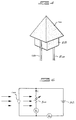
- FIGS 1 to 4 illustrate four variants of an air flow sensor according to the invention. It should be noted that, although the illustrated sensors have conical or pyramidal bodies, numerous other sensor configurations are possible, and the described embodiments are purely exemplary.
- the air flow sensor in Figure 1 has a solid conical body 10 of diamond material.
- the body has a flat base 12 in which two spaced apart contact sites 14 and 16 are formed by drilling holes in the base. Respective conductors 18 and 20 are inserted tightly into the drilled holes, and can be connected to an electronic anemometer circuit.
- the base 12 of the body 10 is metallised, for example by gold plating, and a groove 22 is then cut by a laser, dividing the base into two halves and separating the plated portions thereof.
- the laser-cut groove 22 is cleaned by chemical etching to remove any conductive graphite layer, and conductors 18 and 20 are then brazed on to the respective plated halves of the base.
- a single central contact is applied to the base 12 of the body 10, by either of the methods described above, for example.
- a metallic ring 24 is then deposited around the lower edge of the cone, and conductors 18 and 20 are, once again, applied to the respective contacts.
- the metallic layer 24 may effectively be provided by part of a clamp or mounting assembly which supports the diamond sensor physically as well as providing electrical contacts to it.
- FIG 4 a further embodiment of an air flow sensor is shown in which a recessed square cylindrical tailpiece 25 extends rearwardly from the base of a square pyramidal portion of the diamond body 10.
- Conductors 18 and 20 are fixed to opposite side faces of the tailpiece 25, so that the "active resistance" of the sensor lies in the tailpiece 25 between the contact points of the conductors 18 and 20.
- the high thermal diffusivity of diamond facilitates the rapid transfer of heat to this "active resistance" region.
- the body could be conical instead of pyramidal, and the recessed tailpiece could be round instead of square cylindrical.
- any method of making contacts to the diamond body which provides an acceptably linear contact can be used.
- ion implantation of p-type ions can be used to define relatively highly conductive contact zones on the diamond body, to which metallic conductors are attached.
- boron doping of the diamond material is desirable.
- boron-doped diamond crystals were synthesised in conventional high pressure/high temperature diamond synthesis apparatus.
- Diamond seed crystals of 40/45 mesh were placed on a seed pad in a tantalum reaction capsule.
- a layer of cobalt and iron catalyst material was placed on the seed pad.
- a layer of carbon source material comprising an admixture of 325 mesh diamond powder, cobalt and iron powder, and a small amount of Fe2B as a dopant.
- a further layer of catalyst was placed on the carbon source layer.
- the capsule was thereafter sealed and subjected to a temperature of 1 450°C and a pressure of 55 kilobars for ten hours. Stones of approximately 0.1 ct were recovered from the reaction capsule and then polished, whereafter they were ready for use. The stones can, of course, be cut to desired shapes using conventional techniques.
- the diamonds formed by the above method are uniformly doped with boron, with a boron concentration in the region of 1 000 ppm or greater.
- the diamond crystal can be coated with a boron-doped layer of diamond material, using a dopant gas containing boron in a CVD process.
- the preferred gas is diborane (B2H6).
- boron ions can be implanted into the surface of the diamond crystal.
- the implantation energy and ion dose are preferably selected to be below the threshold at which the diamond becomes amorphous. It is not necessary that the entire diamond crystal be coated or ion-implanted in the latter two methods.
- a selected portion of the crystal which will be exposed to a hostile environment in use can be coated or implanted, while the remaining portion of the of crystal is left untreated, except for the attachment of the electrical contacts.
- FIG. 5 shows, in a highly simplified form, an anemometer circuit employing the fluid flow sensor of the invention.
- the diamond body 10 is connected, by means of the conductors 18 and 20 attached thereto, to a constant current source 26 which applies a sufficiently large current to the diamond to cause it to be heated to more than 10°C above ambient temperature.
- a voltmeter 28 measures the voltage drop across the conductors, which is dependent on the electrical resistance of the sensor, which is in turn a function of its temperature.
- a flow of air or other gas indicated by the arrows in Figure 5
- an air or gas velocity reading can be obtained.
- an embodiment of an anemometer circuit is illustrated in which the rate of an air flow is measured by holding the resistance constant and varying the magnitude in current, so as to maintain the temperature of the sensor 10 at a constant level.
- This constant temperature embodiment is preferred, as it provides a superior noise level and frequency response performance.
- the sensor 10 and a variable resistor 30 are connected in parallel across a voltage source 32.
- a first ammeter A1 measures the current I passing through the variable resistor 30 and a second ammeter A2 measures the total current passing through both the variable resistor 30 and the sensor 10.
- the variable resistor 30 is constantly adjusted to vary the current passing through the sensor 10 so as to maintain it at a constant temperature.
- the ammeter A2 is used as a reference to ensure that the current through the circuit remains constant.
- the currents passing through ammeters A1 and A2 may be fed into a comparator comprising a differential amplifier followed by a proportional amplifier.
- the amount of heat given up by the sensor to the flow of fluid is proportional to I2R, and can be represented by the formula: I2R ⁇ (t s - t f )[K f + (A s S f ⁇ f v f )] 1 ⁇ 2
- t temperature
- S specific heat capacity
- ⁇ density
- K is a constant It is clear the the relationship between ⁇ I and the gas velocity is not linear.
- the described sensor can be used in relatively hostile environments, such as on the wing tip of an aircraft, where fragile hot-wire sensors would be unsuitable.
Landscapes
- Engineering & Computer Science (AREA)
- Microelectronics & Electronic Packaging (AREA)
- Physics & Mathematics (AREA)
- Electromagnetism (AREA)
- Fluid Mechanics (AREA)
- General Physics & Mathematics (AREA)
- Measuring Volume Flow (AREA)
- Investigating Or Analyzing Materials By The Use Of Ultrasonic Waves (AREA)
- Investigating Or Analyzing Materials By The Use Of Electric Means (AREA)
- Paper (AREA)
- Excavating Of Shafts Or Tunnels (AREA)
- Flow Control (AREA)
- Thermistors And Varistors (AREA)
Claims (14)
- Fluiddurchflußsensor mit einem Körper (10) mit einem leitenden oder halbleitenden Diamantkristall und mindestens zwei voneinander beabstandeten elektrischen Kontakten (18,20) an dem Körper, um zu ermöglichen, daß ein durch den Körper zu leitender elektrischer Strom dessen Temperatur erhöht, dadurch gekennzeichnet, daß der Körper konisch zuläuft, wobei er aufweist: einen Basisbereich (12) und eine Spitze, wobei die elektrischen Kontakte an dem Basisbereich angebracht sind, und mindestens einen gewählten Teil des Körpers, der derart ausgebildet ist, daß er bei Verwendung der Umgebung ausgesetzt werden kann, wobei er eine Diamantschicht aufweist, die derart behandelt ist, daß ihr Oxidationswiderstand erhöht ist.
- Fluiddurchflußsensor nach Anspruch 1, dadurch gekennzeichnet, daß die elektrischen Kontakte (18,20) an Kontaktstellen angebracht sind, welche in den Körper (10) gebohrte Löcher (14,16) aufweisen.
- Fluiddurchflußsensor nach Anspruch 1, dadurch gekennzeichnet, daß die elektrischen Kontakte metallische Leiter (18,20) aufweisen, die an den Körper (10) hartgelötet sind.
- Fluiddurchflußsensor nach Anspruch 1, dadurch gekennzeichnet, daß die elektrischen Kontakte an jeweiligen Kontaktzonen an dem Körper angebracht sind, die durch Ionenimplantation gebildet sind.
- Fluiddurchflußsensor nach Anspruch 1, dadurch gekennzeichnet, daß die elektrischen Kontakte jeweilige Bereiche einer auf den Körper (10) aufgebrachten Metallschicht (12) aufweisen, wobei die jeweiligen Bereiche durch eine durch die Metallschicht geschnittene Rille (22) voneinander getrennt sind.
- Fluiddurchflußsensor nach einem der Ansprüche 1 bis 5, dadurch gekennzeichnet, daß der Körper (10) im wesentlichen konisch ist, wobei an der Basis (12) des Körpers mindestens ein elektrischer Kontakt (18) angebracht ist.
- Fluiddurchflußsensor nach Anspruch 6, dadurch gekennzeichnet, daß an der Basis (12) des Körpers (10) ein erster elektrischer Kontakt (18) angebracht ist, wobei an dem an die Basis angrenzenden konischen Teil des Körpers ein zweiter ringförmiger elektrischer Kontakt (24) angebracht ist.
- Fluiddurchflußsensor nach einem der Ansprüche 1 bis 5, dadurch gekennzeichnet, daß der Körper (10) pyramidal oder konisch ist und ein zurückspringendes Endstück (25) aufweist, das sich von der Basis des Körpers an erstreckt, an der die elektrischen Kontakte angebracht sind.
- Fluiddurchflußsensor nach einem der Ansprüche 1 bis 8, dadurch gekennzeichnet, daß mindestens ein Teil des Körpers (10) bordotiert ist, um den Widerstand des Sensors gegenüber Oxidation zu erhöhen.
- Fluiddurchflußsensor nach Anspruch 9, dadurch gekennzeichnet, daß der Körper (10) während eines Diamantsyntheseprozesses gleichmäßig mit Bor dotiert wird.
- Fluiddurchflußsensor nach Anspruch 9, dadurch gekennzeichnet, daß mindestens ein Teil der Oberfläche des Körpers (10) durch Chemical-Vapour-Deposition mit einer borenthaltenden Diamantmaterialschicht beschichtet ist.
- Fluiddurchflußsensor nach Anspruch 9, dadurch gekennzeichnet, daß in wenigstens einen Teil der Oberfläche des Körpers (10) Borionen implantiert sind.
- Anemometer mit einem Fluiddurchflußsensor nach einem der Ansprüche 1 bis 12, dadurch gekennzeichnet, daß es ferner aufweist: eine Konstantstromquelle (26) zum Anlegen eines ausreichend großen Stroms an den Sensor, um diesen über die Umgebungstemperatur zu erwärmen, und eine Spannungsüberwachungseinrichtung (28) zum Messen der Spannung an dem Sensor in Abhängigkeit von seiner Temperatur, so daß die gemessene Spannung der Rate des den Sensor passierenden Fluidstroms entspricht.
- Anemometer mit einem Fluiddurchflußsensor nach einem der Ansprüche 1 bis 12, dadurch gekennzeichnet, daß es ferner aufweist: eine Spannungsquelle (32), die an den Sensor anschließbar ist, um einen ausreichend großen Strom an den Sensor anzulegen, um diesen über die Umgebungstemperatur zu erwärmen, eine einstellbare Last (30), die mit dem Sensor parallel geschaltet werden kann, und eine Stromüberwachungseinrichtung (A1,A2) zum Messen der relativen Ströme in dem Sensor und der Last, wobei die Last bei Benutzung einstellbar ist, um den Strom in dem Sensor zu variieren, um ihn auf einer konstanten Temperatur zu halten, so daß die von der Stromüberwachungseinrichtung gemessene relative Größe des Stroms in dem Sensor der Rate des den Sensor passierenden Fluidstroms entspricht.
Applications Claiming Priority (2)
| Application Number | Priority Date | Filing Date | Title |
|---|---|---|---|
| GB909025798A GB9025798D0 (en) | 1990-11-28 | 1990-11-28 | Diamond fluid flow sensor |
| GB9025798 | 1990-11-28 |
Publications (2)
| Publication Number | Publication Date |
|---|---|
| EP0488754A1 EP0488754A1 (de) | 1992-06-03 |
| EP0488754B1 true EP0488754B1 (de) | 1995-05-10 |
Family
ID=10686077
Family Applications (1)
| Application Number | Title | Priority Date | Filing Date |
|---|---|---|---|
| EP91311056A Expired - Lifetime EP0488754B1 (de) | 1990-11-28 | 1991-11-28 | Diamant-Durchflussmesser |
Country Status (7)
| Country | Link |
|---|---|
| EP (1) | EP0488754B1 (de) |
| JP (1) | JPH06341876A (de) |
| AT (1) | ATE122457T1 (de) |
| AU (1) | AU654157B2 (de) |
| DE (1) | DE69109633T2 (de) |
| GB (1) | GB9025798D0 (de) |
| ZA (1) | ZA919406B (de) |
Families Citing this family (2)
| Publication number | Priority date | Publication date | Assignee | Title |
|---|---|---|---|---|
| DE102005019418B4 (de) * | 2005-04-25 | 2007-03-15 | Krohne Messtechnik Gmbh & Co. Kg | Magnetisch-induktives Durchflußmeßgerät und Verfahren zur Herstellung eines magnetisch-induktiven Durchflußmeßgeräts |
| DE102006023916A1 (de) | 2006-05-19 | 2007-11-22 | Endress + Hauser Flowtec Ag | Magnetisch-induktives Durchflussmessgerät |
Family Cites Families (5)
| Publication number | Priority date | Publication date | Assignee | Title |
|---|---|---|---|---|
| US3352154A (en) * | 1965-06-16 | 1967-11-14 | Robert S Djorup | Heated element fluid flow sensor |
| US3435399A (en) * | 1966-04-19 | 1969-03-25 | Gen Electric | Thermistor device and method of producing said device |
| US4806900A (en) * | 1986-09-26 | 1989-02-21 | Naoji Fujimori | Thermistor and method for producing the same |
| JPH0664080B2 (ja) * | 1989-03-10 | 1994-08-22 | 山武ハネウエル株式会社 | フローセンサ用の温度補償回路 |
| JP2695000B2 (ja) * | 1989-04-11 | 1997-12-24 | 住友電気工業株式会社 | サーミスタ及びその製造方法 |
-
1990
- 1990-11-28 GB GB909025798A patent/GB9025798D0/en active Pending
-
1991
- 1991-11-28 JP JP3356112A patent/JPH06341876A/ja active Pending
- 1991-11-28 AT AT91311056T patent/ATE122457T1/de not_active IP Right Cessation
- 1991-11-28 DE DE69109633T patent/DE69109633T2/de not_active Expired - Fee Related
- 1991-11-28 AU AU88211/91A patent/AU654157B2/en not_active Ceased
- 1991-11-28 ZA ZA919406A patent/ZA919406B/xx unknown
- 1991-11-28 EP EP91311056A patent/EP0488754B1/de not_active Expired - Lifetime
Also Published As
| Publication number | Publication date |
|---|---|
| ZA919406B (en) | 1992-08-26 |
| DE69109633D1 (de) | 1995-06-14 |
| EP0488754A1 (de) | 1992-06-03 |
| AU654157B2 (en) | 1994-10-27 |
| AU8821191A (en) | 1992-06-04 |
| ATE122457T1 (de) | 1995-05-15 |
| DE69109633T2 (de) | 1995-09-07 |
| GB9025798D0 (en) | 1991-01-09 |
| JPH06341876A (ja) | 1994-12-13 |
Similar Documents
| Publication | Publication Date | Title |
|---|---|---|
| CA2316891C (en) | Time lag approach for measuring thermal conductivity and specific heat | |
| CN108398456B (zh) | 纳米尺度材料热导率的测试方法及装置 | |
| US4648271A (en) | Anemometer having a graphite fiber hot wire | |
| US5488350A (en) | Diamond film structures and methods related to same | |
| Plessner | Conductivity, Hall effect and thermo-electric power of selenium single crystals | |
| US5044767A (en) | Device for measuring thermal properties of a test substance-the transient plane source (TPS) method | |
| Urban et al. | High-resolution thin-film temperature sensor arrays for medical applications | |
| Gerlich et al. | High‐Temperature Specific Heats of Ge, Si, and Ge‐Si Alloys | |
| Huijsing et al. | Monolithic integrated direction-sensitive flow sensor | |
| EP0488754B1 (de) | Diamant-Durchflussmesser | |
| US6082200A (en) | Electronic device and method of use thereof | |
| US10393598B1 (en) | Heat flux gage | |
| JPH0749270A (ja) | 温度センサ | |
| Alterovitz et al. | Heat capacity and thermal conductivity of sintered Al2O3 at low temperatures by the heat pulse technique | |
| US6382031B1 (en) | Foil manometer | |
| McDonald et al. | Determination of the thermal conductivities of several molten alkali halides by means of a sheathed hot-wire technique | |
| EP0349174B1 (de) | Wärmefluss-Durchflussmesser | |
| US6727709B2 (en) | Vacuum gauge using peltier tip | |
| Friehe | Fine-scale measurements of velocity, temperature, and humidity in the atmospheric boundary layer | |
| KR100334131B1 (ko) | 펠티어 검침을 이용한 시료 표면의 열특성 측정 및 열성형장치 | |
| JP2567441B2 (ja) | 熱伝導率の測定方法、測定装置およびサーミスタ | |
| Leclercq et al. | Utilization of the Peltier effect for measuring a fluid property. Application for designing new sensors | |
| JP2531968B2 (ja) | 流速センサ及びそれを用いた流速測定装置 | |
| JPH0769221B2 (ja) | 温度検知材料、温度センサー及び温度測定方法 | |
| RU2145135C1 (ru) | Полупроводниковый термопреобразователь сопротивления |
Legal Events
| Date | Code | Title | Description |
|---|---|---|---|
| PUAI | Public reference made under article 153(3) epc to a published international application that has entered the european phase |
Free format text: ORIGINAL CODE: 0009012 |
|
| AK | Designated contracting states |
Kind code of ref document: A1 Designated state(s): AT BE CH DE FR GB IT LI NL SE |
|
| 17P | Request for examination filed |
Effective date: 19921202 |
|
| 17Q | First examination report despatched |
Effective date: 19940124 |
|
| GRAA | (expected) grant |
Free format text: ORIGINAL CODE: 0009210 |
|
| AK | Designated contracting states |
Kind code of ref document: B1 Designated state(s): AT BE CH DE FR GB IT LI NL SE |
|
| PG25 | Lapsed in a contracting state [announced via postgrant information from national office to epo] |
Ref country code: LI Effective date: 19950510 Ref country code: CH Effective date: 19950510 Ref country code: BE Effective date: 19950510 Ref country code: AT Effective date: 19950510 |
|
| REF | Corresponds to: |
Ref document number: 122457 Country of ref document: AT Date of ref document: 19950515 Kind code of ref document: T |
|
| ITF | It: translation for a ep patent filed | ||
| REF | Corresponds to: |
Ref document number: 69109633 Country of ref document: DE Date of ref document: 19950614 |
|
| REG | Reference to a national code |
Ref country code: CH Ref legal event code: PL |
|
| ET | Fr: translation filed | ||
| PGFP | Annual fee paid to national office [announced via postgrant information from national office to epo] |
Ref country code: FR Payment date: 19951109 Year of fee payment: 5 |
|
| PGFP | Annual fee paid to national office [announced via postgrant information from national office to epo] |
Ref country code: SE Payment date: 19951116 Year of fee payment: 5 |
|
| PGFP | Annual fee paid to national office [announced via postgrant information from national office to epo] |
Ref country code: GB Payment date: 19951120 Year of fee payment: 5 |
|
| PGFP | Annual fee paid to national office [announced via postgrant information from national office to epo] |
Ref country code: DE Payment date: 19951128 Year of fee payment: 5 |
|
| PGFP | Annual fee paid to national office [announced via postgrant information from national office to epo] |
Ref country code: NL Payment date: 19951129 Year of fee payment: 5 |
|
| PLBE | No opposition filed within time limit |
Free format text: ORIGINAL CODE: 0009261 |
|
| STAA | Information on the status of an ep patent application or granted ep patent |
Free format text: STATUS: NO OPPOSITION FILED WITHIN TIME LIMIT |
|
| 26N | No opposition filed | ||
| PG25 | Lapsed in a contracting state [announced via postgrant information from national office to epo] |
Ref country code: GB Effective date: 19961128 |
|
| PG25 | Lapsed in a contracting state [announced via postgrant information from national office to epo] |
Ref country code: SE Effective date: 19961129 |
|
| PG25 | Lapsed in a contracting state [announced via postgrant information from national office to epo] |
Ref country code: NL Effective date: 19970601 |
|
| GBPC | Gb: european patent ceased through non-payment of renewal fee |
Effective date: 19961128 |
|
| PG25 | Lapsed in a contracting state [announced via postgrant information from national office to epo] |
Ref country code: FR Effective date: 19970731 |
|
| NLV4 | Nl: lapsed or anulled due to non-payment of the annual fee |
Effective date: 19970601 |
|
| PG25 | Lapsed in a contracting state [announced via postgrant information from national office to epo] |
Ref country code: DE Effective date: 19970801 |
|
| EUG | Se: european patent has lapsed |
Ref document number: 91311056.5 |
|
| REG | Reference to a national code |
Ref country code: FR Ref legal event code: ST |
|
| PG25 | Lapsed in a contracting state [announced via postgrant information from national office to epo] |
Ref country code: IT Free format text: LAPSE BECAUSE OF NON-PAYMENT OF DUE FEES;WARNING: LAPSES OF ITALIAN PATENTS WITH EFFECTIVE DATE BEFORE 2007 MAY HAVE OCCURRED AT ANY TIME BEFORE 2007. THE CORRECT EFFECTIVE DATE MAY BE DIFFERENT FROM THE ONE RECORDED. Effective date: 20051128 |