EP0488930A1 - ABS-Formmassen - Google Patents
ABS-Formmassen Download PDFInfo
- Publication number
- EP0488930A1 EP0488930A1 EP91710041A EP91710041A EP0488930A1 EP 0488930 A1 EP0488930 A1 EP 0488930A1 EP 91710041 A EP91710041 A EP 91710041A EP 91710041 A EP91710041 A EP 91710041A EP 0488930 A1 EP0488930 A1 EP 0488930A1
- Authority
- EP
- European Patent Office
- Prior art keywords
- weight
- parts
- acrylonitrile
- styrene
- methyl methacrylate
- Prior art date
- Legal status (The legal status is an assumption and is not a legal conclusion. Google has not performed a legal analysis and makes no representation as to the accuracy of the status listed.)
- Granted
Links
Classifications
-
- C—CHEMISTRY; METALLURGY
- C08—ORGANIC MACROMOLECULAR COMPOUNDS; THEIR PREPARATION OR CHEMICAL WORKING-UP; COMPOSITIONS BASED THEREON
- C08L—COMPOSITIONS OF MACROMOLECULAR COMPOUNDS
- C08L25/00—Compositions of, homopolymers or copolymers of compounds having one or more unsaturated aliphatic radicals, each having only one carbon-to-carbon double bond, and at least one being terminated by an aromatic carbocyclic ring; Compositions of derivatives of such polymers
- C08L25/02—Homopolymers or copolymers of hydrocarbons
- C08L25/16—Homopolymers or copolymers of alkyl-substituted styrenes
-
- C—CHEMISTRY; METALLURGY
- C08—ORGANIC MACROMOLECULAR COMPOUNDS; THEIR PREPARATION OR CHEMICAL WORKING-UP; COMPOSITIONS BASED THEREON
- C08L—COMPOSITIONS OF MACROMOLECULAR COMPOUNDS
- C08L35/00—Compositions of homopolymers or copolymers of compounds having one or more unsaturated aliphatic radicals, each having only one carbon-to-carbon double bond, and at least one being terminated by a carboxyl radical, and containing at least one other carboxyl radical in the molecule, or of salts, anhydrides, esters, amides, imides or nitriles thereof; Compositions of derivatives of such polymers
- C08L35/06—Copolymers with vinyl aromatic monomers
-
- C—CHEMISTRY; METALLURGY
- C08—ORGANIC MACROMOLECULAR COMPOUNDS; THEIR PREPARATION OR CHEMICAL WORKING-UP; COMPOSITIONS BASED THEREON
- C08L—COMPOSITIONS OF MACROMOLECULAR COMPOUNDS
- C08L69/00—Compositions of polycarbonates; Compositions of derivatives of polycarbonates
-
- C—CHEMISTRY; METALLURGY
- C08—ORGANIC MACROMOLECULAR COMPOUNDS; THEIR PREPARATION OR CHEMICAL WORKING-UP; COMPOSITIONS BASED THEREON
- C08L—COMPOSITIONS OF MACROMOLECULAR COMPOUNDS
- C08L2205/00—Polymer mixtures characterised by other features
- C08L2205/02—Polymer mixtures characterised by other features containing two or more polymers of the same C08L -group
-
- C—CHEMISTRY; METALLURGY
- C08—ORGANIC MACROMOLECULAR COMPOUNDS; THEIR PREPARATION OR CHEMICAL WORKING-UP; COMPOSITIONS BASED THEREON
- C08L—COMPOSITIONS OF MACROMOLECULAR COMPOUNDS
- C08L25/00—Compositions of, homopolymers or copolymers of compounds having one or more unsaturated aliphatic radicals, each having only one carbon-to-carbon double bond, and at least one being terminated by an aromatic carbocyclic ring; Compositions of derivatives of such polymers
- C08L25/02—Homopolymers or copolymers of hydrocarbons
- C08L25/04—Homopolymers or copolymers of styrene
- C08L25/08—Copolymers of styrene
- C08L25/12—Copolymers of styrene with unsaturated nitriles
-
- C—CHEMISTRY; METALLURGY
- C08—ORGANIC MACROMOLECULAR COMPOUNDS; THEIR PREPARATION OR CHEMICAL WORKING-UP; COMPOSITIONS BASED THEREON
- C08L—COMPOSITIONS OF MACROMOLECULAR COMPOUNDS
- C08L51/00—Compositions of graft polymers in which the grafted component is obtained by reactions only involving carbon-to-carbon unsaturated bonds; Compositions of derivatives of such polymers
- C08L51/04—Compositions of graft polymers in which the grafted component is obtained by reactions only involving carbon-to-carbon unsaturated bonds; Compositions of derivatives of such polymers grafted on to rubbers
Definitions
- ABS polymers are characterized by balanced toughness, hardness, surface gloss and processability and have therefore been used in large quantities for years as a thermoplastic resin for the production of all kinds of molded parts.
- ABS materials With increasing use of these polymers, however, the requirements placed on ABS materials also increase, especially if new parts are to be produced from them or new areas of application are to be developed using these thermoplastic materials.
- materials are required that have a combination of high toughness, sufficiently high heat resistance, surface gloss that can be adjusted as specifically as possible and excellent thermoplastic processability.
- ABS materials that fulfill each of the required properties on their own are known.
- ABS polymers with high toughness are described in EP-A 116 330; however, only high-gloss systems with low heat resistance are available here.
- ABS polymers with a matt surface are e.g. described in EP-A 139 271; however, the preparation of these polymers is relatively complicated.
- ABS polymers with very good flowability by adding large amounts of lubricant is also known, but at the same time the other properties are adversely affected by this measure.
- the molding compositions according to the invention are produced by mixing A, B, C, D and E in the melt for such a long time, optionally with the addition of customary additives, until a homogeneous state is achieved.
- a preferred method for producing the molding compositions is to first mix B, C and D and then to mix this mixture with a mixture of A, E and, if appropriate, F.
- Thermoplastic polymers according to A which are suitable according to the invention are those from at least one monomer combination selected from styrene, ⁇ -methylstyrene, Methyl methacrylate, acrylonitrile.
- Particularly preferred polymers A are those composed of styrene / acrylonitrile mixtures and styrene / ⁇ -methylstyrene / acrylonitrile mixtures.
- the polymers A are known and can be prepared by free-radical polymerization, in particular by emulsion, suspension, solution or bulk polymerization (for example according to DE-OS 2 619 969); they can also be formed, for example, in the graft polymerization carried out in emulsion, suspension, solution or mass in the form of polymers which are not chemically bonded to the graft base (generally rubber). You need average molecular weights ( M ⁇ w ) have between 120,000 and 200,000, preferably between 120,000 and 150,000.
- Thermoplastic polymers B suitable according to the invention are those composed of 60 to 95% by weight, preferably 65 to 85% by weight, styrene and 40 to 5% by weight, preferably 35 to 15% by weight, acrylonitrile.
- the polymers B are known and can be prepared by free-radical polymerization, in particular by emulsion, suspension, solution or bulk polymerization (for example according to DE-OS 2 619 969). You need average molecular weights ( M ⁇ w ) have between 50,000 and 80,000, preferably between 60,000 and 80,000.
- Thermoplastic polymers C suitable according to the invention are those from at least one monomer combination selected from styrene, ⁇ -methylstyrene, methyl methacrylate and acrylonitrile. Particularly preferred polymers C are those composed of styrene / acrylonitrile mixtures, ⁇ -methylstyrene / acrylonitrile mixtures, styrene / ⁇ -methylstyrene / acrylonitrile mixtures.
- the polymers C are known and can be prepared by radical polymerization, in particular by emulsion, suspension, solution or bulk polymerization (for example according to DE-OS 2 619 969 using compounds which regulate molecular weight). You need average molecular weights ( M ⁇ w ) have between 1500 and 6000, preferably between 2000 and 6000.
- Suitable rubbers for the production of the first grafted rubber (component D) with a glass transition temperature of ⁇ 10 ° C. are in particular polybutadiene, butadiene / styrene copolymers, butadiene / acrylonitrile copolymers, polyisoprene or alkyl acrylate rubbers based on C1-C8 alkyl acrylates, especially ethyl -, Butyl, ethylhexyl acrylate.
- the alkyl acrylate rubbers can optionally contain up to 30% by weight (based on rubber weight) of monomers such as vinyl acetate, acrylonitrile, styrene, methyl methacrylate and / or vinyl ether in copolymerized form.
- the alkyl acrylate rubbers can furthermore contain smaller amounts, preferably up to 5% by weight (based on the weight of the rubber) of crosslinking ethylenically unsaturated monomers.
- crosslinkers are e.g.
- Graft base can also be acrylate rubbers with a core / shell structure with a core of cross-linked diene rubber made from one or more conjugated dienes, such as polybutadiene, or a copolymer of a conjugated diene with an ethylenically unsaturated monomer, such as styrene and / or acrylonitrile.
- conjugated dienes such as polybutadiene
- a copolymer of a conjugated diene with an ethylenically unsaturated monomer such as styrene and / or acrylonitrile.
- the preferred rubber for producing the graft rubbers D) is polybutadiene.
- the rubbers are present in the graft rubber D in the form of at least partially crosslinked particles having an average particle diameter of 0.05 to 0.5 ⁇ m, preferably 0.1 to 0.4 ⁇ m.
- the graft rubbers D contain 30 to 80 parts by weight, preferably 35 to 75 parts by weight, of a polymer of styrene, methyl methacrylate, acrylonitrile or mixtures thereof per 100 parts by weight of rubber.
- the graft rubbers D are obtained by radical graft polymerization of the above-mentioned monomers (mixtures) (styrene, methyl methacrylate, acrylonitrile) Presence of the rubbers to be grafted, preferably by emulsion polymerization; they are known throughout (see, for example, DE-OS 1 300 241).
- ABS polymers are particularly preferred graft rubbers D.
- Rubbers suitable for producing the second grafted rubber E with a glass transition temperature of ⁇ 10 ° C. are in particular polybutadiene, butadiene / styrene copolymers, butadiene / acrylonitrile copolymers and polyisoprene.
- Preferred rubbers for producing the graft rubbers E are polybutadiene and butadiene / styrene copolymers.
- the rubbers are present in the graft rubber E in the form of at least partially crosslinked particles having an average particle diameter (d50) of 1 to 5 ⁇ m, preferably of 1.2 to 3 ⁇ m.
- the graft rubbers E contain 100 to 150 parts by weight, preferably 110 to 140 parts by weight, of a polymer of styrene, ⁇ -methylstyrene, methyl methacrylate, acrylonitrile or mixtures thereof per 100 parts by weight of rubber.
- the graft rubbers E are prepared by radical graft polymerization of the above-mentioned monomers (mixtures) (styrene, ⁇ -methylstyrene, methyl methacrylate, acrylonitrile) in the presence of the rubbers to be grafted, preferably by solution or bulk polymerization; they are known throughout (see e.g. DE-OS 3 100 785). ABS polymers are particularly preferred graft rubbers E.
- Suitable polycarbonates F can be both homopolycarbonates and copolycarbonates from the diphenols of the formulas (I) and (II) wherein A is a single bond, C1-C5-alkylene, C2-C5-alkylidene, C5-C6-cycloalkylidene, -O-, -S- or -SO2-, R5 and R6 independently of one another represent methyl or halogen, in particular methyl, chlorine or bromine, R1 and R2 independently of one another are hydrogen, halogen, preferably chlorine or bromine, C1-C8-alkyl, preferably methyl, ethyl, C5-C6-cycloalkyl, preferably cyclohexyl, C6-C10-aryl, preferably phenyl, or C7-C12-aralkyl, preferably phenyl-C1-C4-alkyl, in particular benzyl, m is an integer from 4 to 7, preferably 4 or
- the polycarbonates according to component F can be both linear and branched, they can contain aromatic halogen, preferably bromine and / or chlorine, but they can also be free of aromatically bound halogen, that is to say halogen-free.
- the polycarbonates F can be used both individually and in a mixture.
- diphenols of the formulas (I) and (II) are either known from the literature or can be prepared by processes known from the literature (see, for example, EP-A 0 359 953).
- the preparation of the polycarbonates according to component F which are suitable according to the invention is known from the literature and can e.g. with phosgene according to the phase interface process or with phosgene after the process in a homogeneous phase (the so-called pyridine process), the molecular weight to be set in each case being achieved in a known manner by a corresponding amount of known chain terminators.
- Suitable chain terminators are e.g. Phenol or p-tert. -Butylphenol, but also long-chain alkylphenols such as 4- (1,3-tetramethyl-butyl) phenol according to DE-OS 28 42 005 or monoalkylphenols or dialkylphenols with a total of 8 to 20 C atoms in the alkyl substituents according to German Offenlegungsschrift No.
- 35 06 472 such as p-nonylphenyl, 2,5-di-tert-butylphenol, p-tert-octylphenol, p-dodecylphenol, 2- (3,5-dimethylheptyl) phenol and 4- (3,5-dimethylheptyl) phenol.
- the amount of chain terminators to be used is generally between 0.5 and 10 mol%, based on the sum of the diphenols (I) and (II) used in each case.
- polycarbonates according to component F which are suitable according to the invention can be branched in a known manner, preferably by incorporating from 0.05 to 2.0 mol%, based on the sum of the diphenols used, on three or four more than three-functional compounds, for example those with three or more than three phenolic OH groups.
- M ⁇ w medium weight average molecular weights
- Suitable diphenols of the formulas (I) and (II) are e.g. Hydroquinone, resorcinol, 4,4'-dihydroxydiphenyl, 2,2-bis (4-hydroxyphenyl) propane, 2,4-bis (4-hydroxyphenyl) -2-methylbutane, 2,2-bis (4- hydroxy-3,5-dimethylphenyl) propane, 2,2-bis (4-hydroxy-3,5-dichlorophenyl) propane, 2,2-bis (4-hydroxy-3,5-dibromophenyl) propane , 1,1-bis (4-hydroxyphenyl) cyclohexane, 1,1-bis (4-hydroxyphenyl) -3,3,5-trimethylcyclohexane, 1,1-bis (4-hydroxyphenyl) -3,3 -dimethylcyclohexane, 1,1-bis- (4-hydroxyphenyl) -3,3,5,5-tetramethylcyclohexane or 1,1-bis- (4-hydroxyphenyl)
- Preferred diphenols of the formula (I) are 2,2-bis (4-hydroxyphenyl) propane and 1,1-bis (4-hydroxyphenyl) cyclohexane, the preferred phenol of the formula (II) is 1,1-bis (4-hydroxyphenyl) -3,3,5-trimethylcyclohexane.
- Mixtures of diphenols can also be used.
- the mixtures according to the invention containing A, B, C, D, E, optionally F and, if appropriate, customary additives such as lubricants, stabilizers, pigments, mold release agents, antistatic agents, fillers (for example glass fibers, glass balls, silica gel) are prepared by adding the respective constituents in in a known manner, simultaneously or successively mixed at room temperature or at a higher temperature and then melt-compounded or melt-extruded at temperatures of 150 ° C. to 300 ° C. in conventional units such as internal kneaders, extruders or twin-screw screws.
- customary additives such as lubricants, stabilizers, pigments, mold release agents, antistatic agents, fillers (for example glass fibers, glass balls, silica gel) are prepared by adding the respective constituents in in a known manner, simultaneously or successively mixed at room temperature or at a higher temperature and then melt-compounded or melt-extruded at temperatures of 150 ° C. to 300 ° C.
- a preferred method for producing the molding compositions by mixing special combinations of individual components is described above; by This process succeeds in producing molding compounds which lead to molded parts with particularly uniform surfaces.
- the molding compositions of the present invention can be used for the production of moldings of any type, in which case conventional production methods can be used; They are particularly suitable for the production of parts in which a combination of high toughness, excellent thermoplastic processability and selectively adjustable low surface gloss is required, e.g. large cladding for the vehicle interior with long flow paths or housing for radio and television sets or computers, e.g. have a lot of ribs.
- the molding compositions are preferably processed by injection molding, but can also be e.g. be carried out by deep drawing from plates or films previously produced by known processes.
- the particle sizes given above always mean average particle diameter d50, determined by ultracentrifuge measurements according to W. Scholtan et al., Kolloid-Z. uZ polymers 250 (1972), 782-796 or by measuring electron micrographs.
- Thermoplastic resin B is Thermoplastic resin B
- the application components were compounded on a 4.5l internal kneader at temperatures between 160 ° C and 220 ° C.
- the molded articles were produced on an injection molding machine at 240 ° C.
- the notched impact strength (a k ) was determined at room temperature according to ISO 180 / 1A (unit kJ / m2), the processability was determined by measuring the volume flow index MVI according to DIN 53 735 U (unit: cm3 / 10 min) and the required filling pressure (see F Johannaber, Kunststoffe 74 (1984), 1, pages 2-5), the heat resistance was measured according to Vicat (method B) according to DIN 53 460 (unit: ° C).
- the gloss measurement was carried out according to DIN 67 530 on a flat plate at a reflection angle of 60 ° (reflectometer value) with the aid of the multi-angle reflectometer "Multi-Gloss" from Byk-Mallinckrodt.
- Table 1 shows the compositions of the molding compositions tested, and Table 2 shows the measurement data obtained. Compared to the comparative tests, only the mixtures according to the invention have high toughness, good heat resistance, excellent processability and adjustable degree of gloss.
Landscapes
- Chemical & Material Sciences (AREA)
- Health & Medical Sciences (AREA)
- Chemical Kinetics & Catalysis (AREA)
- Medicinal Chemistry (AREA)
- Polymers & Plastics (AREA)
- Organic Chemistry (AREA)
- Compositions Of Macromolecular Compounds (AREA)
Abstract
Description
- ABS-Polymerisate zeichnen sich durch ausgewogene Zähigkeit, Härte, Oberflächenglanz und Verarbeitbarkeit aus und werden daher schon seit Jahren in großen Mengen als thermoplastisches Harz für die Herstellung von Formteilen aller Art eingesetzt.
- Mit zunehmendem Einsatz dieser Polymerisate steigen jedoch auch die Anforderungen an die ABS-Werkstoffe, insbesondere dann, wenn daraus neuartige Teile hergestellt werden oder neue Anwendungsbereiche unter Einsatz dieser thermoplastischen Werkstoffe erschlossen werden sollen.
- So werden für neuartige Anwendungen, z.B. für die Herstellung großflächiger Teile oder Teile mit langen Fließwegen (z.B. im Automobilbereich oder im Gehäusesektor), Materialien benötigt, die eine Kombination aus hoher Zähigkeit, genügend hoher Wärmeformbeständigkeit, möglichst gezielt einstellbarem Oberflächenglanz und ausgezeichneter thermoplastischer Verarbeitbarkeit aufweisen.
- ABS-Werkstoffe, die jeder der geforderten Eigenschaften für sich alleine erfüllen, sind bekannt. Z.B. werden ABS-Polymerisate mit hoher Zähigkeit in der EP-A 116 330 beschrieben; allerdings sind hierbeinur hochglänzende Systeme mit geringen Wärmeformbeständigkeiten erhältlich.
- ABS-Polymere mit matter Oberfläche sind z.B. in EP-A 139 271 beschrieben; die Herstellung dieser Polymerisate ist jedoch relativ kompliziert.
- Die Herstellung von ABS-Polymerisaten mit sehr guter Fließfähigkeit durch Zusatz hoher Gleitmittelmengen ist ebenfalls bekannt, gleichzeitig werden durch diese Maßnahme jedoch die sonstigen Eigenschaften negativ beeinflußt.
- Es wurde gefunden, daß Formmassen vom ABS-Typ mit der geforderten Kombination aus sehr hoher Zähigkeit, genügend hoher Wärmeformbeständigkeit, gezielt einstellbarem geringem Oberflächenglanz und ausgezeichneter thermoplastischer Verarbeitbarkeit bestehen aus
- A) 10 bis 80 Gew.-Teilen, vorzugsweise 20 bis 70 Gew.-Teilen, eines oder mehrerer thermoplastischer Co- oder Terpolymerisate, aufgebaut aus wenigstens einer polymerisierten Vinylmonomerkombination, ausgewählt aus Styrol, α-Methylstyrol, Methylmethacrylat, Acrylnitril mit einem mittleren Molekulargewicht (

- B) 5 bis 60 Gew.-Teilen, vorzugsweise 7,5 bis 50 Gew.-Teilen, eines oder mehrerer thermoplastischer Copolymerisate aufgebaut aus 60 bis 95 Gew.-%, vorzugsweise 65 bis 85 Gew.-%, Styrol, und 40 bis 5 Gew.-%, vorzugsweise 35 bis 15 Gew.- %, Acrylnitril mit einem mittleren Molekulargewicht (

- C) 0,1 bis 20 Gew.-Teilen, vorzugsweise 0,5 bis 10 Gew.-Teilen, eines oder mehrerer thermoplastischer Co- oder Terpolymerisate, aufgebaut aus wenigstens einer polymerisierten Vinylmonomerenkombination, ausgewählt aus Styrol, α-Methylstyrol, Methylmethacrylat, Acrylnitril mit einem mittleren Molekulargewicht (

- D) 0,5 bis 40 Gew.-Teilen, vorzugsweise 1 bis 30 Gew.-Teilen, insbesondere 12 bis 30 Gew.-Teilen, eines teilchenförmigen gepfropften Kautschuks mit einer Glastemperatur ≦ 10°C und einen mittleren Teilchendurchmesser (d₅₀) von 0,05 bis 0,5 µm, vorzugsweise von 0,1 bis 0,4 µm, der pro 100 Gew.-Teile Kautschuk 30 bis 80 Gew.-Teile, vorzugsweise 35 bis 75 Gew.-Teile, eines Polymerisats aus Styrol, Methylmethacrylat, Acrylnitril oder Mischungen daraus chemisch gebunden enthält, und
- E) 0,5 bis 30 Gew.-Teilen, vorzugsweise 1 bis 20 Gew.-Teilen, insbesondere 2,5 bis 20 Gew.-Teilen, eines teilchenförmigen gepfropften Kautschuks mit einer Glastemperatur ≦ 10°C und einem mittleren Teilchendurchmesser (d₅₀) von 1 bis 5 µm, vorzugsweise von 1,2 bis 3 µm, der pro 100 Gew.-Teile Kautschuk 100 bis 150 Gew.-Teile, vorzugsweise 110 bis 140 Gew.-Teile, eines Polymerisats aus Styrol, α-Methylstyrol, Methylmethacrylat, Acrylnitril oder Mischungen daraus chemisch gebunden enthält,
und gegebenenfalls - F) 20 bis 200 Gew.-Teile, vorzugsweise 25 bis 150 Gew.-Teile (jeweils bezogen auf 100 Gew.-Teile A+B+C+D+E), eines oder mehrerer aromatischer Polycarbonate.
- Die Herstellung der erfindungsgemäßen Formmassen erfolgt durch so langes Vermischen von A, B, C, D, und E in der Schmelze, gegebenenfalls unter Zusatz üblicher Additive, bis ein homogener Zustand erreicht ist.
- Ein bevorzugtes Verfahren zur Herstellung der Formmassen ist, zunächst B, C und D zu mischen und anschließend diese Mischung mit einer Mischung von A, E und gegebenenfalls F zu vermischen.
- Erfindungsgemäß geeignete thermoplastische Polymerisate gemäß A sind solche aus wenigstens einer Monomerenkombination ausgewählt aus Styrol, α-Methylstyrol, Methylmethacrylat, Acrylnitril. Besonders bevorzugte Polymerisate A sind solche aus Styrol/Acrylnitril-Gemischen und Styrol/α-Methylstyrol/Acrylnitril-Gemischen.
- Die Polymerisate A sind bekannt und lassen sich durch radikalische Polymerisation, insbesondere durch Emulsions-, Suspensions-, Lösungs- oder Massepolymerisation herstellen (z.B. gemäß DE-OS 2 619 969); sie können z.B. auch bei der in Emulsion, Suspension, Lösung oder Masse durchgeführten Pfropfpolymerisation in Form von nicht chemisch an die Pfropfgrundlage (im allgemeinen Kautschuk) gebundenen Polymeren entstehen. Sie müssen mittlere Molekulargewichte (

- Erfindungsgemäß geeignete thermoplastische Polymerisate B sind solche aus 60 bis 95 Gew.-%, vorzugsweise 65 bis 85 Gew.-%, Styrol und 40 bis 5 Gew.-%, vorzugsweise 35 bis 15 Gew.-%, Acrylnitril.
- Die Polymerisate B sind bekannt und können durch radikalische Polymerisation, insbesondere durch Emulsions-, Suspensions-, Lösungs- oder Massepolymerisation hergestellt werden (z.B. gemäß DE-OS 2 619 969). Sie müssen mittlere Molekulargewichte (

- Erfindungsgemäß geeignete thermoplastische Polymerisate C sind solche aus wenigstens einer Monomerenkombination ausgewählt aus Styrol, α-Methylstyrol, Methylmethacrylat, Acrylnitril. Besonders bevorzugte Polymerisate C sind solche aus Styrol/Acrylnitril-Gemischen, α-Methylstyrol/Acrylnitril-Gemischen, Styrol/α-Methylstyrol/Acrylnitril-Gemischen.
- Die Polymerisate C sind bekannt und lassen sich durch radikalische Polymerisation, insbesondere durch Emulsions-, Suspensions-, Lösungs- oder Massepolymerisation herstellen (z.B. gemäß DE-OS 2 619 969 unter Verwendung molekulargewichtsregelnder Verbindungen). Sie müssen mittlere Molekulargewichte (

- Zur Herstellung des ersten gepfropften Kautschuks (Komponente D) geeignete Kautschuke mit einer Glastemperatur ≦ 10°C sind insbesondere Polybutadien, Butadien/Styrol-Copolymerisate, Butadien/Acrylnitril-Copolymerisate, Polyisopren oder Alkylacrylatkautschuke auf der Basis von C₁-C₈-Alkylacrylaten, insbesondere Ethyl-, Butyl-, Ethylhexylacrylat.
- Die Alkylacrylatkautschuke können gegebenenfalls bis zu 30 Gew.-% (bezogen auf Kautschukgewicht) Monomere wie Vinylacetat, Acrylnitril, Styrol, Methylmethacrylat und/oder Vinylether copolymerisiert enthalten. Die Alkylacrylatkautschuke können weiterhin kleinere Mengen, vorzugsweise bis zu 5 Gew.-% (bezogen auf Kautschukgewicht) vernetzend wirkender ethylenisch ungesättigter Monomerer enthalten. Solche Vernetzer sind z.B. Alkylendioldiacrylate und -methacrylate, Polyester-diacrylate und -methacrylate, Divinylbenzol, Trivinylbenzol, Triallylcyanurat, Allylacrylat, Allylmethacrylat, Butadien oder Isopren.
- Pfropfgrundlage können auch Acrylatkautschuke mit Kern/Mantel-Struktur sein mit einem Kern aus vernetztem Dienkautschuk aus einem oder mehreren konjugierten Dienen, wie Polybutadien, oder ein Copolymerisat eines konjugierten Diens mit einem ethylenisch ungesättigten Monomer wie Styrol und/oder Acrylnitril.
- Bevorzugter Kautschuk zur Herstellung der Pfropfkautschuke D) ist Polybutadien.
- Die Kautschuke liegen im Pfropfkautschuk D in Form wenigstens partiell vernetzter Teilchen eines mittleren Teilchendurchmessers von 0,05 bis 0,5 µm, bevorzugt von 0,1 bis 0,4 µm, vor.
- Die Pfropfkautschuke D enthalten pro 100 Gew.-Teile Kautschuk 30 bis 80 Gew.Teile, vorzugsweise 35 bis 75 Gew.-Teile, eines Polymerisats aus Styrol, Methylmethacrylat, Acrylnitril oder Mischungen daraus chemisch gebunden.
- Die Pfropfkautschuke D werden durch radikalische Pfropfpolymerisation der oben angegebenen Monomeren(gemische) (Styrol, Methylmethacrylat, Acrylnitril) in Gegenwart der zu pfropfenden Kautschuke, vorzugsweise durch Emulsionspolymerisation, hergestellt; sie sind durchweg bekannt (vgl. z.B. DE-OS 1 300 241).
- Besonders bevorzugte Pfropfkautschuke D sind die ABS-Polymerisate.
- Zur Herstellung des zweiten gepfropften Kautschuks E geeignete Kautschuke mit einer Glastemperatur ≦ 10°C sind insbesondere Polybutadien, Butadien/StyrolCopolymerisate, Butadien/Acrylnitril-Copolymerisate und Polyisopren.
- Bevorzugte Kautschuke zur Herstellung der Pfropfkautschuke E sind Polybutadien und Butadien/Styrol-Copolymerisate.
- Die Kautschuke liegen im Pfropfkautschuk E in Form wenigstens partiell vernetzter Teilchen eines mittleren Teilchendurchmessers (d₅₀) von 1 bis 5 µm, vorzugsweise von 1,2 bis 3 µm, vor.
- Die Pfropfkautschuke E enthalten pro 100 Gew.-Teile Kautschuk 100 bis 150 Gew.-Teile, vorzugsweise 110 bis 140 Gew.-Teile, eines Polymerisats aus Styrol, α-Methylstyrol, Methylmethacrylat, Acrylnitril oder Mischungen daraus chemisch gebunden.
- Die Pfropfkautschuke E werden durch radikalische Pfropfpolymerisation der oben angegebenen Monomeren(gemische) (Styrol, α-Methylstyrol, Methylmethacrylat, Acrylnitril) in Gegenwart der zu pfropfenden Kautschuke, vorzugsweise durch Lösungs- oder Massepolymerisation, hergestellt; sie sind durchweg bekannt (vgl. z.B. DE-OS 3 100 785). Besonders bevorzugte Pfropfkautschuke E sind ABS-Polymerisate.
- Geeignete Polycarbonate F können sowohl Homopolycarbonate als auch Copolycarbonate aus den Diphenolen der Formeln (I) und (II) sein
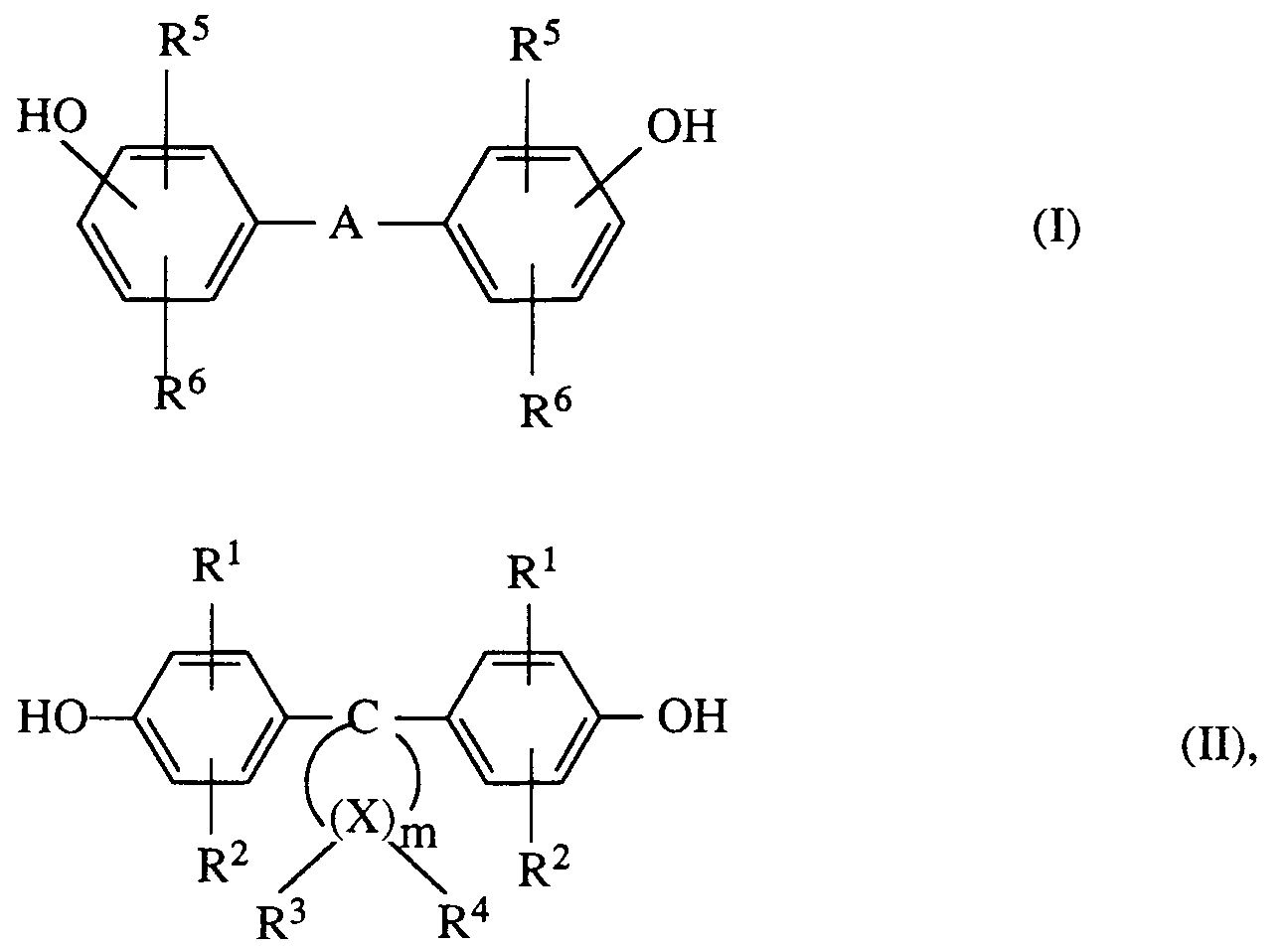
worin
A eine Einfachbindung, C₁-C₅-Alkylen, C₂-C₅-Alkyliden, C₅-C₆-Cycloalkyliden, -O-, -S- oder -SO₂- ist,
R⁵ und R⁶ unabhängig voneinander für Methyl oder Halogen, insbesondere für Methyl, Chlor oder Brom stehen,
R¹ und R² unabhängig voneinander Wasserstoff, Halogen, bevorzugt Chlor oder Brom, C₁-C₈-Alkyl, bevorzugt Methyl, Ethyl, C₅-C₆-Cycloalkyl, bevorzugt Cyclohexyl, C₆-C₁₀-Aryl, bevorzugt Phenyl, oder C₇-C₁₂-Aralkyl, bevorzugt Phenyl-C₁-C₄-alkyl, insbesondere Benzyl, bedeuten,
m eine ganze Zahl von 4 bis 7, bevorzugt 4 oder 5, ist,
R³ und R⁴ für jedes X individuell wählbar sind und unabhängig voneinander Wasserstoff oder C₁-C₆-Alkyl bedeuten und
X Kohlenstoff bedeutet. - Die Polycarbonate gemäß Komponente F können sowohl linear als auch verzweigt sein, sie können aromtisch gebundenes Halogen, vorzugsweise Brom und/oder Chlor enthalten, sie können aber auch frei von aromatisch gebundenem Halogen, also halogenfrei, sein.
- Die Polycarbonate F können sowohl einzeln als auch im Gemisch eingesetzt werden.
- Die Diphenole der Formeln (I) und (II) sind entweder literaturbekannt oder nach literaturbekannten Verfahren herstellbar (siehe z.B. EP-A 0 359 953).
- Die Herstellung der erfindungsgemäß geeigneten Polycarbonate gemäß Komponente F ist literaturbekannt und kann z.B. mit Phosgen nach dem Phasengrenzflächenverfahren oder mit Phosgen nach dem Vefahren in homogener Phase (dem sogenannten Pyridinverfahren) erfolgen, wobei das jeweils einzustellende Molekulargewicht in bekannter Weise durch eine entsprechende Menge an bekannten Kettenabbrechern erzielt wird.
- Geeignete Kettenabbrecher sind z.B. Phenol oder p-tert. -Butylphenol, aber auch langkettige Alkylphenole wie 4-(1,3-Tetramethyl-butyl)phenol gemäß DE-OS 28 42 005 oder Monoalkylphenole oder Dialkylphenole mit insgesamt 8 bis 20 C-Atomen in den Alkylsubstituenten gemäß deutscher Offenlegungsschrift Nr. 35 06 472, wie z.B. p-Nonylphenyl, 2,5-di-tert.-Butylphenol, p-tert.-Octylphenol, p-Dodecylphenol, 2-(3,5-Dimethylheptyl)-phenol und 4-(3,5-Dimethylheptyl)-phenol. Die Menge an einzusetzenden Kettenabbrechern beträgt im allgemeinen zwischen 0,5 und 10 Mol-%, bezogen auf die Summe der jeweils eingesetzen Diphenole (I) und (II).
- Die erfindungsgemäß geeigneten Polycarbonate gemäß Komponente F können in bekannter Weise verzweigt sein, und zwar vorzugsweise durch den Einbau von 0,05 bis 2,0 Mol-%, bezogen auf die Summe der eingesetzten Diphenole, an drei- oder mehr als dreifunktionellen Verbindungen, z.B. solchen mit drei oder mehr als drei phenolischen OH-Gruppen.
- Sie haben mittlere Gewichtsmittelmolekuilargewichte (

- Geeignete Diphenole der Formeln (I) und (II) sind z.B. Hydrochinon, Resorcin, 4,4′-Dihydroxydiphenyl, 2,2-Bis-(4-hydroxyphenyl)-propan, 2,4-Bis-(4-hydroxyphenyl)-2-methylbutan, 2,2-Bis-(4-hydroxy-3,5-dimethylphenyl)-propan, 2,2-Bis-(4-hydroxy-3,5-dichlorphenyl)-propan, 2,2-Bis-(4-hydroxy-3,5-dibromphenyl)-propan, 1,1-Bis-(4-hydroxyphenyl)-cyclohexan, 1,1-Bis-(4-hydroxyphenyl)-3,3,5-trimethylcyclohexan, 1,1-Bis-(4-hydroxyphenyl)-3,3-dimethylcyclohexan, 1,1-Bis-(4-hydroxyphenyl)-3,3,5,5-tetramethylcyclohexan oder 1,1-Bis-(4-hydroxyphenyl)-2,4,4-trimethylcyclopentan.
- Bevorzugte Diphenole der Formel (I) sind 2,2-Bis-(4-hydroxyphenyl)-propan und 1,1-Bis-(4-hydroxyphenyl)-cyclohexan, bevorzugtes Phenol der Formel (II) ist 1,1-Bis-(4-hydroxyphenyl)-3,3,5-trimethylcyclohexan.
- Es können auch Mischungen von Diphenolen eingesetzt werden.
- Die erfindungsgemäßen Mischungen, enthaltend A, B, C, D, E, gegebenenfalls F und gegebenenfalls übliche Zusatzstoffe wie Gleitmittel, Stabilisatoren, Pigmente, Entformungsmittel, Antistatika, Füllstoffe (z.B. Glasfasern, Glaskugeln, Kieselgel) werden hergestellt, indem man die jeweiligen Bestandteile in bekannter Weise simultan oder sukzessive bei Raumtemperatur oder bei höherer Temperatur vermischt und danach bei Temperaturen von 150°C bis 300°C in gebräuchlichen Aggregaten wie Innenknetem, Extrudern oder Doppelwellenschnecken schmelzcompoundiert oder schmelzextrudiert.
- Ein bevorzugtes Verfahren zur Herstellung der Formmassen durch Vermischen spezieller Kombinationen von Einzelkomponenten ist oben beschrieben; durch dieses Verfahren gelingt die Erzeugung von Formmassen, die zu Formteilen mit besonders einheitlichen Oberflächen führen.
- Die Formmassen der vorliegenden Erfindung können zur Herstellung von Formkörpem jeder Art verwendet werden, wobei übliche Herstellungsweisen benutzt werden können; insbesondere eignen sie sich zur Herstellung von solchen Teilen, bei denen eine Kombination aus hoher Zähigkeit, ausgezeichneter thermoplastischer Verarbeitbarkeit und gezielt einstellbarem geringem Oberflächenglanz gefordert wird wie z.B. großflächige Verkleidungen für den Kfz.-Innenraum mit langen Fließwegen oder Gehäuse für Radio- und Femsehgeräte oder Computer, die z.B. sehr viele Rippen aufweisen.
- Die Verarbeitung der Formmassen zu Formkörpern erfolgt vorzugsweise durch Spritzgießen, kann aber auch z.B. durch Tiefziehen aus vorher nach bekannten Verfahren hergestellten Platten oder Folien durchgeführt werden.
- Die oben angegebenen Teilchengrößen bedeuten immer mittlerer Teilchendurchmesser d₅₀, ermittelt durch Ultrazentrifugenmessungen nach W. Scholtan et al., Kolloid-Z. u.Z. Polymere 250 (1972), 782-796 oder durch Ausmessung elektronenmikroskopischer Aufnahmen.
- Statistisches Styrol/Acrylnitril = 72:28 -Copolymerisat mit einem

- Statistisches Styrol/Acrylnitril = 72:28 -Copolymerisat mit einem

- Statistisches Styrol/Acrylnitril = 72:28 -Copolymerisat mit einem

- Statistisches Styrol/Acrylnitril = 72:28 -Copolymerisat mit einem

- Pfropfkautschuk erhalten durch radikalische Emulsionspolymerisation eines Styrol/Acrylnitril = 72:28 -Gemisches unter Verwendung eines teilchenförmigen Polybutadiens, wobei ein mittlerer Teilchendurchmesser (d₅₀) von ca. 0,33 µm resultiert und pro 100 Gew.-Teile Polybutadien 55 Gew.-Teile Styrol/Acrylnitril-Copolymerisat chemisch an das Polybutadien gebunden sind.
- Pfropfkautschuk erhalten durch radikalische Lösungspolymerisation eines Styrol/Acrylnitril = 72:28 -Gemisches unter Verwendung eines Polybutadiens, wobei ein mittlerer Teilchendurchmesser (d₅₀) von ca. 1,2 µm resultiert und pro 100 Gew.-Teile Polybutadien 110 Gew.-Teile Styrol/Acrylnitril-Copolymerisat chemisch an das Polybutadien gebunden sind.
- Die Compoundierung der Einsatzkomponenten erfolgte auf einem 4,5l Innenkneter bei Temperaturen zwischen 160°C und 220°C. Die Herstellung der Formkörper erfolgte auf einer Spritzgießmaschine bei 240°C.
- Die Kerbschlagzähigkeit (ak) wurde bei Raumtemperatur nach ISO 180/1A (Einheit kJ/m²) ermittelt, die Verarbeitbarkeit wurde durch Messung des VolumenFließindex MVI nach DIN 53 735 U (Einheit: cm³/10 min) sowie des notwendigen Fülldruckes (siehe F. Johannaber, Kunststoffe 74 (1984), 1, Seiten 2-5), die Wärmeformbeständigkeit wurde nach Vicat (Methode B) gemäß DIN 53 460 (Einheit: °C) gemessen. Die Glanzmessung erfolgte nach DIN 67 530 an einer ebenen Platte bei einem Reflektionswinkel von 60° (Reflektometerwert) mit Hilfe des Mehrwinkel-Reflektometers " Multi-Gloss " der Firma Byk-Mallinckrodt.
- In Tabelle 1 sind die Zusammensetzungen der untersuchten Formmassen, in Tabelle 2 die erhaltenen Meßdaten zusammengestellt. Gegenüber den Vergleichsversuchen weisen nur die erfindungsgemäßen Mischungen hohe Zähigkeit, gute Wärmeformbeständigkeit, ausgezeicChnete Verarbeitbarkeit und einstellbaren Glanzgrad auf.


Claims (4)
- Thermoplastische Formmassen enthaltendA) 10 bis 80 Gew.-Teile, eines oder mehrerer thermoplastischer Co- oder Terpolymerisate, aufgebaut aus wenigstens einer polymerisierten Vinylmonomerkombination, ausgewählt aus Styrol, α-Methylstyrol, Methylmethacrylat, Acrylnitril mit einem mittleren Molekulargewicht (
 B) 5 bis 60 Gew.-Teile eines oder mehrerer thermoplastischer Copolymerisate, aufgebaut aus 60 bis 95 Gew.-% Styrol und 40 bis 5 Gew.-% Acrylnitril, mit einem mittleren Molekulargewicht (
 C) 0,1 bis 20 Gew.-Teile, eines oder mehrerer thermoplastischer Co-oder Terpolymerisate, aufgebaut aus wenigstens einer polymerisierten Vinylmonomerenkombination, ausgewählt aus Styrol, α-Methylstyrol, Methylmethacrylat, Acrylnitril mit einem mittleren Molekulargewicht (
 D) 0,5 bis 40 Gew.-Teile, eines teilchenförmigen gepfropften Kautschuks mit einer Glastemperatur ≦ 10°C und einem mittleren Teilchendurchmesser (d₅₀) von 0,05 bis 0,5 µm, der pro 100 Gew.-Teile Kautschuk 30 bis 80 Gew.-Teile, eines Polymerisats aus Styrol, Methylmethacrylat, Acrylnitril oder Mischungen daraus chemisch gebunden enthält, undE) 0,5 bis 30 Gew.-Teile eines teilchenförmigen gepfropften Kautschuks mit einer Glastemperatur ≦ 10°C und einem mittleren Teilchendurchmesser (d₅₀) von 1 bis 5 µm, der pro 100 Gew.-Teile Kautschuk 100 bis 150 Gew.-Teile eines Polymerisats aus Styrol, α-Methylstyrol, Methylmethacrylat, Acrylnitril oder Mischungen daraus chemisch gebunden enthält,
und gegebenenfallsF) 20 bis 200 Gew.-Teile (bezogen auf 100 Gew.-Teile A+B+C+D+E) eines oder mehrerer aromatischer Polycarbonate enthält. - Thermoplastische Formmassen enthaltendA) 20 bis 70 Gew.-Teile eines oder mehrerer thermoplastischer Co- oder Terpolymerisate, aufgebaut aus wenigstgens einer polymerisierten Vinylmonomerkombination, ausgewählt aus Styrol, α-Methylstyrol, Methylmethacrylat, Acrylnitril mit einem mittleren Molekulargewicht (
 B) 7,5 bis 50 Gew.-Teile eines oder mehrerer thermoplastischer Copolymerisate, aufgebaut aus 65 bis 85 Gew.-% Styrol und 35 bis 15 Gew.-% Acrylnitril mit einem mittleren Molekulargewicht (
 C) 0,5 bis 10 Gew.-Teile eines oder mehrerer thermoplastischer Co- oder Terpolymerisate, aufgebaut aus wenigstens einer polymerisierten Vinylmonomerenkombination, ausgewählt aus Styrol, α-Methylstyrol, Methylmethacrylat, Acrylnitril mit einem mittleren Molekulargewicht (
 D) 1 bis 30 Gew.-Teile eines teilchenförmigen gepfropften Kautschuks mit einer Glastemperatur ≦ 10°C und einen mittleren Teilchendurchmesser (d₅₀) von 0,1 bis 0,4 µm, der pro 100 Gew.-Teile Kautschuk 35 bis 75 Gew.-Teile eine Polymerisats aus Styrol, Methylmethacrylat, Acrylnitril oder Mischungen daraus chemisch gebunden enthält, undE) 1 bis 20 Gew.-Teile eines teilchenförmigen gepfropften Kautschuks mit einer Glastemperatur ≦ 10°C und einem mittleren Teilchendurchmesser (d₅₀) von 1,2 bis 3 µm, der pro 10 Gew.-Teile Kautschuk 110 bis 140 Gew.-Teile eines Polymerisats aus Styrol, α-Methylstyrol, Methylmethacrylat, Acrylnitril oder Mischungen daraus chemisch gebunden enthält,
und gegebenenfallsF) 25 bis 150 Gew.-Teile (bezogen auf 100 Gew.-Teile A+B+C+D+E) eines oder mehrerer aromatischer Polycarbonate. - Verfahren zur Herstellung von thermoplastischen Formmassen gemäß den Ansprüchen 1 und 2, dadurch gekennzeichnet, daß zunächst die Komponenten B, C und D gemischt werden, und anschließend die resultierende Mischung mit einer Mischung der Komponenten A, E und gegebenenfalls F vermischt wird.
- Verwendung der Formmassen gemäß Anspruch 1 zur Herstellung von Formkörpern.
Applications Claiming Priority (4)
| Application Number | Priority Date | Filing Date | Title |
|---|---|---|---|
| DE4038004 | 1990-11-29 | ||
| DE4038004 | 1990-11-29 | ||
| DE4122870 | 1991-07-11 | ||
| DE4122870A DE4122870A1 (de) | 1990-11-29 | 1991-07-11 | Abs-formmassen |
Publications (2)
| Publication Number | Publication Date |
|---|---|
| EP0488930A1 true EP0488930A1 (de) | 1992-06-03 |
| EP0488930B1 EP0488930B1 (de) | 1995-02-22 |
Family
ID=25898872
Family Applications (1)
| Application Number | Title | Priority Date | Filing Date |
|---|---|---|---|
| EP91710041A Expired - Lifetime EP0488930B1 (de) | 1990-11-29 | 1991-11-18 | ABS-Formmassen |
Country Status (4)
| Country | Link |
|---|---|
| US (1) | US5302663A (de) |
| EP (1) | EP0488930B1 (de) |
| JP (1) | JP3228770B2 (de) |
| DE (2) | DE4122870A1 (de) |
Cited By (5)
| Publication number | Priority date | Publication date | Assignee | Title |
|---|---|---|---|---|
| EP0568875A3 (de) * | 1992-05-06 | 1994-03-30 | Bayer Ag | |
| EP0601473A1 (de) * | 1992-12-10 | 1994-06-15 | BASF Aktiengesellschaft | Thermoplastische Formmassen auf der Basis von Polycarbonaten, Pfropfpolymerisaten und Styrol/Acrylnitril-Copolymerisaten |
| GB2315272A (en) * | 1996-07-12 | 1998-01-28 | Kaneka Corp | Rubber containing resin composition and styrene resin composition containing the same |
| WO2005000962A3 (de) * | 2003-06-26 | 2005-04-21 | Bayer Materialscience Ag | Polycarbonatformmassen mit verbesserter schmelzefliessfähigkeit und chemikalienbeständigkeit |
| TWI568790B (zh) * | 2012-04-05 | 2017-02-01 | 科思創德意志股份有限公司 | 用於簡易製造具有高光澤與無光澤組份型材之低溫韌性組份之經衝擊改質聚碳酸酯組成物 |
Families Citing this family (10)
| Publication number | Priority date | Publication date | Assignee | Title |
|---|---|---|---|---|
| US6228938B1 (en) * | 1992-05-06 | 2001-05-08 | Bayer Ag | ABS materials |
| DE69529815T2 (de) * | 1994-11-11 | 2003-12-04 | Kanegafuchi Kagaku Kogyo K.K., Osaka | Thermoplastische harzzusammensetzung und kraftfahrzeuginnenverkleidung |
| DE19600902A1 (de) * | 1996-01-12 | 1997-07-17 | Bayer Ag | Massen vom ABS-Typ für die Extrusions- und Tiefziehverarbeitung |
| US5932655A (en) * | 1997-11-19 | 1999-08-03 | Bayer Corporation | Weatherable resinous composition having improved opacity and impact strength |
| EP1764392A1 (de) * | 2005-09-14 | 2007-03-21 | Basf Aktiengesellschaft | Thermoplastische Formmasse mit verbesserter Haftung von elektoplattierten Metalschichten |
| BRPI0618404A2 (pt) * | 2005-10-12 | 2011-08-30 | Dow Global Technologies Inc | composição de copolìmero aromático de monovinilideno modificado por borracha polimerizada em massa, método para preparar uma composição de copolìmero aromático de monovinilideno modificado por borracha polimerizada em massa, método para produzir um artigo moldado ou extrudado e artigo moldado e extrudado |
| KR100680338B1 (ko) | 2005-12-07 | 2007-02-08 | 기아자동차주식회사 | 저광택 폴리카보네이트계 얼로이 열가소성 수지 조성물 |
| KR101134016B1 (ko) * | 2008-12-23 | 2012-04-05 | 제일모직주식회사 | 고내열 내스크래치 난연성 열가소성 수지 조성물 |
| CN102807746B (zh) * | 2012-08-17 | 2014-05-28 | 东莞市信诺橡塑工业有限公司 | 一种高硬度和高流动性的pc/pmma/as合金及其制备方法 |
| JP7671698B2 (ja) * | 2019-04-30 | 2025-05-02 | ロッテ ケミカル コーポレイション | 熱可塑性樹脂組成物およびこれを利用した成形品 |
Citations (3)
| Publication number | Priority date | Publication date | Assignee | Title |
|---|---|---|---|---|
| DE2901576A1 (de) * | 1979-01-17 | 1980-07-31 | Basf Ag | Schlagzaehe thermoplastische kunststoffmassen |
| EP0210510A1 (de) * | 1985-07-25 | 1987-02-04 | Bayer Ag | Thermoplastische Formmassen mit verbesserter Verarbeitbarkeit |
| EP0337187A2 (de) * | 1988-04-09 | 1989-10-18 | Bayer Ag | Polymerisatmischung für flexible Folien |
Family Cites Families (6)
| Publication number | Priority date | Publication date | Assignee | Title |
|---|---|---|---|---|
| US3928494A (en) * | 1973-01-09 | 1975-12-23 | Monsanto Co | Polyblend of two types of ABS graft polymers and a copolymer matrix |
| US3903200A (en) * | 1974-03-07 | 1975-09-02 | Monsanto Co | Continuous mass polymerization process for ABS polymeric polyblends |
| US4068064A (en) * | 1975-12-22 | 1978-01-10 | The Dow Chemical Company | Method for preparing monovinyl aromatic monomer-acrylonitrile copolymer |
| DE3304544A1 (de) * | 1983-02-10 | 1984-08-16 | Bayer Ag, 5090 Leverkusen | Abs-formmassen |
| DE3337940A1 (de) * | 1983-10-19 | 1985-05-09 | Bayer Ag, 5090 Leverkusen | Polymerlegierungen mit matter oberflaeche |
| DE3735754A1 (de) * | 1987-10-22 | 1989-05-03 | Basf Ag | Thermoplastische formmasse, verfahren zu ihrer herstellung und deren verwendung |
-
1991
- 1991-07-11 DE DE4122870A patent/DE4122870A1/de not_active Withdrawn
- 1991-11-18 DE DE59104690T patent/DE59104690D1/de not_active Expired - Lifetime
- 1991-11-18 EP EP91710041A patent/EP0488930B1/de not_active Expired - Lifetime
- 1991-11-22 JP JP33275791A patent/JP3228770B2/ja not_active Expired - Fee Related
-
1993
- 1993-06-01 US US08/070,494 patent/US5302663A/en not_active Expired - Lifetime
Patent Citations (3)
| Publication number | Priority date | Publication date | Assignee | Title |
|---|---|---|---|---|
| DE2901576A1 (de) * | 1979-01-17 | 1980-07-31 | Basf Ag | Schlagzaehe thermoplastische kunststoffmassen |
| EP0210510A1 (de) * | 1985-07-25 | 1987-02-04 | Bayer Ag | Thermoplastische Formmassen mit verbesserter Verarbeitbarkeit |
| EP0337187A2 (de) * | 1988-04-09 | 1989-10-18 | Bayer Ag | Polymerisatmischung für flexible Folien |
Cited By (9)
| Publication number | Priority date | Publication date | Assignee | Title |
|---|---|---|---|---|
| EP0568875A3 (de) * | 1992-05-06 | 1994-03-30 | Bayer Ag | |
| EP0601473A1 (de) * | 1992-12-10 | 1994-06-15 | BASF Aktiengesellschaft | Thermoplastische Formmassen auf der Basis von Polycarbonaten, Pfropfpolymerisaten und Styrol/Acrylnitril-Copolymerisaten |
| US5393836A (en) * | 1992-12-10 | 1995-02-28 | Basf Aktiengesellschaft | Thermoplastic molding materials based on polycarbonates, graft polymers and styrene/acrylonitrile copolymers |
| GB2315272A (en) * | 1996-07-12 | 1998-01-28 | Kaneka Corp | Rubber containing resin composition and styrene resin composition containing the same |
| US5990240A (en) * | 1996-07-12 | 1999-11-23 | Kaneka Corporation | Rubber-containing resin composition and styrene resin composition containing the same |
| GB2315272B (en) * | 1996-07-12 | 2000-12-06 | Kaneka Corp | Rubber-containing resin composition and styrene resin composition containing the same |
| WO2005000962A3 (de) * | 2003-06-26 | 2005-04-21 | Bayer Materialscience Ag | Polycarbonatformmassen mit verbesserter schmelzefliessfähigkeit und chemikalienbeständigkeit |
| KR101048934B1 (ko) * | 2003-06-26 | 2011-07-12 | 바이엘 머티리얼사이언스 아게 | 개선된 용융유동 거동 및 내약품성을 갖는 성형된폴리카르보네이트 재료 |
| TWI568790B (zh) * | 2012-04-05 | 2017-02-01 | 科思創德意志股份有限公司 | 用於簡易製造具有高光澤與無光澤組份型材之低溫韌性組份之經衝擊改質聚碳酸酯組成物 |
Also Published As
| Publication number | Publication date |
|---|---|
| US5302663A (en) | 1994-04-12 |
| EP0488930B1 (de) | 1995-02-22 |
| DE59104690D1 (de) | 1995-03-30 |
| JP3228770B2 (ja) | 2001-11-12 |
| JPH04332742A (ja) | 1992-11-19 |
| DE4122870A1 (de) | 1992-06-04 |
Similar Documents
| Publication | Publication Date | Title |
|---|---|---|
| EP0488932B1 (de) | ABS-Formmassen | |
| EP0023291B2 (de) | Stabilisierte thermoplastische Formmassen auf Basis von Polycarbonaten, ABS-Polymeren und Phosphiten | |
| EP0351648B1 (de) | Thermoplastische Polycarbonatformmassen mit flammwidrigen Eigenschaften | |
| EP0488930B1 (de) | ABS-Formmassen | |
| EP0576950B1 (de) | Thermoplastische Formmassen | |
| EP0463467B1 (de) | Thermoplastische Polycarbonatformmassen mit flammwidrigen Eigenschaften | |
| EP0199193B1 (de) | Thermoplastische Formmassen aus Polycarbonaten, Pfropfpolymerisaten und Copolymerisaten | |
| DE3735754A1 (de) | Thermoplastische formmasse, verfahren zu ihrer herstellung und deren verwendung | |
| EP1208156A2 (de) | Thermoplastische formmassen | |
| EP0432581B1 (de) | Thermoplastische Polycarbonatformmassen mit flammwidrigen Eigenschaften | |
| EP0179290B1 (de) | Thermoplastische Formmassen mit verbesserter Wärmeformbeständigkeit | |
| DE3521407A1 (de) | Thermoplastische formmassen mit verbesserter fliessnahtfestigkeit | |
| EP0570797A1 (de) | Polycarbonat-ABS-Formmassen | |
| EP0337105B1 (de) | Thermoplastische Formmassen enthaltend aliphatische Polycarbonate | |
| EP0601473B1 (de) | Thermoplastische Formmassen auf der Basis von Polycarbonaten, Pfropfpolymerisaten und Styrol/Acrylnitril-Copolymerisaten | |
| EP0332995B1 (de) | Thermoplastische Formmassen vom ABS-Typ mit hoher Zähigkeit und guter Verarbeitbarkeit | |
| EP0176811B1 (de) | Neue Stabilisatoren für ABS-Kunststoffe und ABS-Legierungen | |
| EP1151031B1 (de) | Polycarbonat formmassen mit antistatischen eingenschaften | |
| DE4300798A1 (de) | Polycarbonat/ABS-Formmassen enthaltend Ethylenvinylacetat-Copolymere | |
| EP0568875B1 (de) | ABS-Massen | |
| EP0576948B1 (de) | Thermoplastische Formmassen | |
| DE4214940A1 (de) | Thermoplastische Massen auf Basis von ABS-Polymerisaten | |
| DE4013112A1 (de) | Stabilisierte thermoplastische formmassen |
Legal Events
| Date | Code | Title | Description |
|---|---|---|---|
| PUAI | Public reference made under article 153(3) epc to a published international application that has entered the european phase |
Free format text: ORIGINAL CODE: 0009012 |
|
| AK | Designated contracting states |
Kind code of ref document: A1 Designated state(s): DE FR GB IT |
|
| 17P | Request for examination filed |
Effective date: 19920904 |
|
| 17Q | First examination report despatched |
Effective date: 19940809 |
|
| GRAA | (expected) grant |
Free format text: ORIGINAL CODE: 0009210 |
|
| AK | Designated contracting states |
Kind code of ref document: B1 Designated state(s): DE FR GB IT |
|
| GBT | Gb: translation of ep patent filed (gb section 77(6)(a)/1977) |
Effective date: 19950224 |
|
| REF | Corresponds to: |
Ref document number: 59104690 Country of ref document: DE Date of ref document: 19950330 |
|
| ITF | It: translation for a ep patent filed | ||
| ET | Fr: translation filed | ||
| PLBE | No opposition filed within time limit |
Free format text: ORIGINAL CODE: 0009261 |
|
| 26N | No opposition filed | ||
| REG | Reference to a national code |
Ref country code: GB Ref legal event code: IF02 |
|
| REG | Reference to a national code |
Ref country code: GB Ref legal event code: 732E |
|
| REG | Reference to a national code |
Ref country code: FR Ref legal event code: TP |
|
| PGFP | Annual fee paid to national office [announced via postgrant information from national office to epo] |
Ref country code: IT Payment date: 20081126 Year of fee payment: 18 |
|
| PGFP | Annual fee paid to national office [announced via postgrant information from national office to epo] |
Ref country code: FR Payment date: 20081112 Year of fee payment: 18 |
|
| PGFP | Annual fee paid to national office [announced via postgrant information from national office to epo] |
Ref country code: GB Payment date: 20081112 Year of fee payment: 18 |
|
| REG | Reference to a national code |
Ref country code: GB Ref legal event code: 732E Free format text: REGISTERED BETWEEN 20090611 AND 20090617 |
|
| GBPC | Gb: european patent ceased through non-payment of renewal fee |
Effective date: 20091118 |
|
| REG | Reference to a national code |
Ref country code: FR Ref legal event code: ST Effective date: 20100730 |
|
| PG25 | Lapsed in a contracting state [announced via postgrant information from national office to epo] |
Ref country code: FR Free format text: LAPSE BECAUSE OF NON-PAYMENT OF DUE FEES Effective date: 20091130 |
|
| PG25 | Lapsed in a contracting state [announced via postgrant information from national office to epo] |
Ref country code: GB Free format text: LAPSE BECAUSE OF NON-PAYMENT OF DUE FEES Effective date: 20091118 |
|
| PGFP | Annual fee paid to national office [announced via postgrant information from national office to epo] |
Ref country code: DE Payment date: 20101126 Year of fee payment: 20 |
|
| PG25 | Lapsed in a contracting state [announced via postgrant information from national office to epo] |
Ref country code: IT Free format text: LAPSE BECAUSE OF NON-PAYMENT OF DUE FEES Effective date: 20091118 |
|
| REG | Reference to a national code |
Ref country code: DE Ref legal event code: R071 Ref document number: 59104690 Country of ref document: DE |
|
| REG | Reference to a national code |
Ref country code: DE Ref legal event code: R071 Ref document number: 59104690 Country of ref document: DE |
|
| PG25 | Lapsed in a contracting state [announced via postgrant information from national office to epo] |
Ref country code: DE Free format text: LAPSE BECAUSE OF EXPIRATION OF PROTECTION Effective date: 20111119 |