EP0489320A1 - Aufblasbarer Prallschutzsack für Kraftfahrzeuge - Google Patents
Aufblasbarer Prallschutzsack für Kraftfahrzeuge Download PDFInfo
- Publication number
- EP0489320A1 EP0489320A1 EP91119999A EP91119999A EP0489320A1 EP 0489320 A1 EP0489320 A1 EP 0489320A1 EP 91119999 A EP91119999 A EP 91119999A EP 91119999 A EP91119999 A EP 91119999A EP 0489320 A1 EP0489320 A1 EP 0489320A1
- Authority
- EP
- European Patent Office
- Prior art keywords
- film
- airbag
- impact protection
- polyamide
- bag
- Prior art date
- Legal status (The legal status is an assumption and is not a legal conclusion. Google has not performed a legal analysis and makes no representation as to the accuracy of the status listed.)
- Withdrawn
Links
- 239000000463 material Substances 0.000 claims abstract 5
- -1 polypropylene Polymers 0.000 claims abstract 4
- 239000004952 Polyamide Substances 0.000 claims abstract 3
- 239000000203 mixture Substances 0.000 claims abstract 3
- 229920002647 polyamide Polymers 0.000 claims abstract 3
- 239000004698 Polyethylene Substances 0.000 claims abstract 2
- 239000004743 Polypropylene Substances 0.000 claims abstract 2
- 239000004433 Thermoplastic polyurethane Substances 0.000 claims abstract 2
- 229920000573 polyethylene Polymers 0.000 claims abstract 2
- 229920001155 polypropylene Polymers 0.000 claims abstract 2
- 229920000915 polyvinyl chloride Polymers 0.000 claims abstract 2
- 239000004800 polyvinyl chloride Substances 0.000 claims abstract 2
- 229920002803 thermoplastic polyurethane Polymers 0.000 claims abstract 2
- 239000011248 coating agent Substances 0.000 claims 2
- 238000000576 coating method Methods 0.000 claims 2
- 239000004744 fabric Substances 0.000 claims 2
- 229920000049 Carbon (fiber) Polymers 0.000 claims 1
- 229920003235 aromatic polyamide Polymers 0.000 claims 1
- 239000004917 carbon fiber Substances 0.000 claims 1
- 239000000835 fiber Substances 0.000 claims 1
- 239000003365 glass fiber Substances 0.000 claims 1
- VNWKTOKETHGBQD-UHFFFAOYSA-N methane Chemical compound C VNWKTOKETHGBQD-UHFFFAOYSA-N 0.000 claims 1
- 229920000728 polyester Polymers 0.000 claims 1
- 239000002759 woven fabric Substances 0.000 abstract 1
Images
Classifications
-
- B—PERFORMING OPERATIONS; TRANSPORTING
- B60—VEHICLES IN GENERAL
- B60R—VEHICLES, VEHICLE FITTINGS, OR VEHICLE PARTS, NOT OTHERWISE PROVIDED FOR
- B60R21/00—Arrangements or fittings on vehicles for protecting or preventing injuries to occupants or pedestrians in case of accidents or other traffic risks
- B60R21/02—Occupant safety arrangements or fittings, e.g. crash pads
- B60R21/16—Inflatable occupant restraints or confinements designed to inflate upon impact or impending impact, e.g. air bags
- B60R21/23—Inflatable members
- B60R21/235—Inflatable members characterised by their material
-
- B—PERFORMING OPERATIONS; TRANSPORTING
- B60—VEHICLES IN GENERAL
- B60R—VEHICLES, VEHICLE FITTINGS, OR VEHICLE PARTS, NOT OTHERWISE PROVIDED FOR
- B60R21/00—Arrangements or fittings on vehicles for protecting or preventing injuries to occupants or pedestrians in case of accidents or other traffic risks
- B60R21/02—Occupant safety arrangements or fittings, e.g. crash pads
- B60R21/16—Inflatable occupant restraints or confinements designed to inflate upon impact or impending impact, e.g. air bags
- B60R21/23—Inflatable members
- B60R21/231—Inflatable members characterised by their shape, construction or spatial configuration
- B60R2021/23123—Heat protection panels
-
- B—PERFORMING OPERATIONS; TRANSPORTING
- B60—VEHICLES IN GENERAL
- B60R—VEHICLES, VEHICLE FITTINGS, OR VEHICLE PARTS, NOT OTHERWISE PROVIDED FOR
- B60R21/00—Arrangements or fittings on vehicles for protecting or preventing injuries to occupants or pedestrians in case of accidents or other traffic risks
- B60R21/02—Occupant safety arrangements or fittings, e.g. crash pads
- B60R21/16—Inflatable occupant restraints or confinements designed to inflate upon impact or impending impact, e.g. air bags
- B60R21/23—Inflatable members
- B60R21/235—Inflatable members characterised by their material
- B60R2021/23571—Inflatable members characterised by their material characterised by connections between panels
- B60R2021/2359—Welding
-
- B—PERFORMING OPERATIONS; TRANSPORTING
- B60—VEHICLES IN GENERAL
- B60R—VEHICLES, VEHICLE FITTINGS, OR VEHICLE PARTS, NOT OTHERWISE PROVIDED FOR
- B60R21/00—Arrangements or fittings on vehicles for protecting or preventing injuries to occupants or pedestrians in case of accidents or other traffic risks
- B60R21/02—Occupant safety arrangements or fittings, e.g. crash pads
- B60R21/16—Inflatable occupant restraints or confinements designed to inflate upon impact or impending impact, e.g. air bags
- B60R21/23—Inflatable members
- B60R21/231—Inflatable members characterised by their shape, construction or spatial configuration
- B60R21/233—Inflatable members characterised by their shape, construction or spatial configuration comprising a plurality of individual compartments; comprising two or more bag-like members, one within the other
Definitions
- the invention relates to an inflatable impact protection bag for motor vehicles, called an airbag, consisting of a film or a film with a fabric coating.
- Inflatable impact protection bags are known in many versions under the name of airbag. They are installed in motor vehicles in order to ensure that the vehicle occupants, in particular the motor vehicle driver, are elastically caught in the event of a collision. Immediately after the vehicle collision, a propellant charge is electrically ignited by known devices. Due to the expansion of the propellant gas, the airbag stowed in a special steering wheel compartment is deployed and inflated. The impact energy of the body of the motor vehicle driver is absorbed to such a large extent by the airbag that a serious risk of injury to the vehicle driver can almost be excluded. The airbag in turn is vented through suitable openings or valves in such a way that the airbag collapses after a maximum of 500 milliseconds to such an extent that the field of vision of the vehicle driver is released for any necessary control of the motor vehicle.
- the airbags currently stowed in the steering wheel compartment were mainly manufactured by hand by sewing and / or vulcanizing fabrics coated with rubber or rubber-like substances. This is extremely expensive. Nevertheless, a constant tensile strength of the seams is not guaranteed for years.
- thermoplastic polyurethane polyvinyl chloride, polypropylene, polyethylene, polyamide or mixtures of these materials as the film.
- thermoplastic polyurethane, polyvinyl chloride, polypropylene, polyethylene, polyamide or mixtures of these materials were used as the film material, thermoplastic polyurethane based on ether, ester or mixture preferably being used.
- the 20-1000 ⁇ m thick foils with Shore hardnesses between 60A and 55D are produced depending on the later application - with or without fabric coating - in the blowing or calendering process.
- the films are coated with the abovementioned types of fabric, preferably with polyamide fabric, by means of an adhesion promoter, which is applied between the film and the fabric in the form of an adhesion promoter film or an adhesion promoter powder.
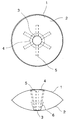
- the airbag consists of bag lid 1 - diameter 70-90 cm - bag bottom 2, initially identical to the bag lid, the retaining ring 3 for fastening the bag bottom to the gas generator, the installation part 4 with several retaining straps 5 for stabilization and shaping in the inflated condition and the heat shield 6.
- the airbag is manufactured as follows: The built-in part is welded to the center of the bag lid by means of ring electrodes. The retaining straps of the built-in part are pulled through the cut-out bag bottom, around the retaining ring - which is placed over the cutout of the bag bottom - the heat shield is inserted into the cutout of the bag bottom, and then the retaining straps, retaining ring and heat shield with the bag bottom on the circumference of the Section welded by means of a ring electrode. Ultimately, the bag lid and bag bottom are welded together using a ring electrode and the airbag is closed. Any ventilation holes can be punched into the foils before welding.
- Thermal contact, thermal pulse, high-frequency welding or a combination of these welding techniques can be used as welding methods.
- High-frequency welding shows good results in connection with heated electrodes and high pressure weight.
- a peel strength of> 4.5 N / mm with an elongation of> 80% was achieved with a 0.3 mm TPU (ether) film.
- TPU ether
- Thermoplastic polyurethane (TPU based on ether, ester or mixture), polyvinyl chloride, polypropylene, polyethylene, polyamide or mixtures of these thermoplastics, for example, can be used as the film material, TPU preferably being used.
- the 20-1000 ⁇ m thick foils with Shore hardnesses between 60A and 55D are produced with the blown or calender process, depending on the later application - with or without fabric coating.
- the coating with the above-mentioned types of fabric can, if necessary, be carried out by means of an adhesion promoter which is applied between the film and the tissue in the form of an adhesion promoter film or an adhesion promoter powder.
- Coating techniques include the lamination and flame lamination successfully applied.
- An ether-based TPU film with a thickness of 500 ⁇ m and a Shore hardness of 85A is used for the production of the bag lid and bottom.
- the built-in part is made from a 50 ⁇ m thick TPU film with polyamide fabric coating and an adhesion promoter film.
- the flame retardant consists of a 100 ⁇ m thick TPU film.
- the HF method is used for welding with electrodes heated at the same time.
- the complete airbag is made from a 100 ⁇ m thick TPU film with a polyamide fabric coating using the high-frequency welding process.
- An airbag is made from a 500 ⁇ m thick TPU film for the base and lid and a 1000 ⁇ m thick film for the inner part.
- the flame protection bag is also made of pure TPU (100 ⁇ m film).
- a combination in which all parts are made of the same material without buildup shows the advantage that the entire airbag can be recycled later without pretreatment (particularly interesting for high-quality thermoplastics such as TPU).
- the lid and bottom of the airbag are made of PVC film with a Shore hardness of 80A and a thickness of 500 ⁇ m, the built-in part is made of 100 ⁇ m soft PVC film with polyester fabric reinforcement, and the flame retardant is made of 100 ⁇ m PVC film.
- the individual parts are welded using a thermal pulse process.
- the lid and bottom of the airbag consist of a 100 ⁇ m TPU film with a coating of an elastic polyamide fabric, the built-in part made of 50 ⁇ m thick TPU film with an inelastic polyamide fabric as a coating, the flame protection bag made of 100 ⁇ m thick, pure TPU film.
- Suitable combinations of pure film with a high stretch (depending on the material and hardness up to over 700%) and a film with fabric coating with a low stretch (depending on the materials used below 50%) can improve the properties of the complete airbag in terms of energy absorption and cushioning , Retention force, etc. can be adjusted according to requirements.
Landscapes
- Engineering & Computer Science (AREA)
- Mechanical Engineering (AREA)
- Air Bags (AREA)
Abstract
Aufblasbarer Prallschutzsack für Kraftfahrzeuge, Airbag genannt, bestehend aus einer Folie oder einer Folie mit Gewebebeschichtung, wobei als Folie thermoplastisches Polyurethan, Polyvinylchlorid, Polypropylen, Polyethylen, Polyamid oder Mischungen dieser Materialien verwendet wird. <IMAGE>
Description
- Die Erfindung betrifft einen aufblasbaren Prallschutzsack für Kraftfahrzeuge, Airbag genannt, bestehend aus einer Folie oder einer Folie mit Gewebebeschichtung.
- Aufblasbare Prallschutzsäcke sind in vielen Ausführungen unter der Bezeichnung Airbag bekannt. Sie werden in Kraftfahrzeugen eingebaut, um bei Zusammenstößen ein elastisches Auffangen der Fahrzeuginsassen, insbesondere des Kraftfahrzeuglenkers, zu gewährleisten. Unmittelbar nach dem Fahrzeugaufprall wird durch bekannte Einrichtungen eine Treibgasladung elektrisch gezündet. Durch die Expansion des Treibgases wird der in einem speziellen Lenkradfach verstaute Airbag entfaltet und aufgeblasen. Die Aufprallenergie des Körpers des Kraftfahrzeuglenkers wird zu einem so großen Teil durch den Airbag aufgenommen, daß eine ernsthafte Verletzungsgefahr des Fahrzeuglenkers nahezu ausgeschlossen werden kann. Der Airbag seinerseits wird durch geeignete Öffnungen oder Ventile in der Art entlüftet, daß der Airbag nach maximal 500 Millisekunden soweit zusammengefallen ist, daß das Gesichtsfeld des Fahrzeuglenkers zu einer eventuell nötigen Steuerung des Kraftfahrzeugs wieder freigegeben wird.
- Die derzeit im Lenkradfach verstauten Airbags wurden durch Vernähen und/oder Vulkanisieren von mit Gummi oder gummiartigen Stoffen beschichteten Geweben überwiegend in Handarbeit hergestellt. Dies ist äußerst kostenintensiv. Trotzdem ist eine gleichbleibende Reißfestigkeit der Nähte über Jahre hinaus nicht gewährleistet.
- Es stellte sich daher die Aufgabe, eine deutliche Vereinfachung der Airbagherstellung bei gleichzeitiger Verbesserung der Alterungsbeständigkeit der Nähte zu erzielen, und durch die dann kostengünstigere Herstellung und längere Lagerungsfähigkeit der Prallschutzsäcke eine automatisierte Produktion und somit einen Massenumsatz zu ermöglichen.
- Diese Erfindung wird erfindungsgemäß dadurch gelöst, daß als Folie thermoplastisches Polyurethan, Polyvinylchlorid, Polypropylen, Polyethylen, Polyamid oder Mischungen dieser Materialien verwendet wird.
- Weitere Merkmale des erfindungsgemäßen Prallschutzsackes sind Gegenstand der Unteransprüche.
- Die Erfindung mit den wesentlichen erfinderischen Merkmalen wird im folgenden näher beschrieben und teilweise mittels Zeichnungen dargestellt. Erfindungsgemäß wurden als Folienmaterial beispielsweise thermoplatisches Polyurethan, Polyvinylchlorid, Polypropylen, Polyethylen, Polyamid oder Mischungen dieser Materialien verwendet, wobei vorzugsweise thermoplastisches Polyurethan auf Ether-, Ester- oder Mischbasis zum Einsatz kommt. Die 20-1000 µm dicken Folien mit Shorehärten zwischen 60A und 55D werden je nach späterer Anwendung - mit oder ohne Gewebebeschichtung - im Blas- oder Kalanderverfahren hergestellt. Die Beschichtung der Folien mit den obengenannten Gewebearten, vorzugsweise mit Polyamidgewebe, erfolgt mittels eines Haftvermittlers, der zwischen Folie und Gewebe in Form einer Haftvermittlerfolie oder eines Haftvermittlerpulvers aufgebracht wird.
- Der Airbag wird nachfolgend im Detail anhand einer Zeichnung näher erläutert.
- Figur 1 zeigt den Airbag in normalen Zustand,
- Figur 2 zeigt den Airbag in aufgeblasenem Zustand.
- Wie aus der Zeichnung ersichtlich, besteht der Airbag aus Bagdeckel 1 - Durchmesser 70-90 cm - Bagboden 2, zunächst identisch mit dem Bagdeckel, dem Halterring 3 zur Befestigung des Bagbodens am Gasgenerator, dem Einbauteil 4 mit mehreren Haltebändern 5 zur Stabilisierung und Formgebung im aufgeblasenen Zustand und dem Hitzeschild 6.
- Die Fertigung des Airbags erfolgt wie nachstehend:
Mittels Ringelektroden wird das Einbauteil im Zentrum des Bagdeckels mit demselben verschweißt. Die Haltebänder des Einbauteils werden durch den ausgeschnittenen Bagboden gezogen, um den Haltering - der über den Ausschnitt des Bagbodens gelegt ist - gelegt, das Hitzeschild wird in den Ausschnitt des Bagbodens eingelegt, und anschließend werden Haltebänder, Haltering und Hitzeschild mit dem Bagboden am Umfang des Ausschnitts mittels einer Ringelektrode verschweißt. Letztendlich werden Bagdeckel und Bagboden mittels einer Ringelektrode zusammengeschweißt und der Airbag geschlossen. Eventuelle Entlüftungslöcher können vor dem Zusammenschweißen in die Folien eingestanzt werden. - Als Schweißmethoden können das Wärmekontakt-, das Wärmeimpuls-, das Hochfrequenzschweißen oder eine Kombination dieser Schweißtechniken angewendet werden.
- Gute Ergebnisse zeigt das Hochfrequenzschweißen in Verbindung mit beheizten Elektroden und hohem Andruckgewicht. Im Standardhochfrequenzschweißverfahren wurde beispielsweise bei einer 0,3 mm TPU-(Ether)-Folie eine Schälfestigkeit von > 4,5 N/mm bei einer Dehnung von > 80 % erreicht. Für einen Standardfahrerairbag werden zur Fertigung drei Hochfrequenz-Ringelektroden benötigt.
- Als Folienmaterial können beispielsweise thermoplatisches Polyurethan (TPU auf Ether-, Ester- oder Mischbasis), Polyvinylchlorid, Polypropylen, Polyethylen, Polyamid oder Mischungen dieser Thermoplaste eingesetzt werden, wobei vorzugsweise TPU zum Einsatz kommt. Die 20-1000 µm dicken Folien mit Shorehärten zwischen 60A und 55D werden je nach späterer Anwendung - mit oder ohne Gewebebeschichtung - im Blas- oder Kalanderverfahren hergestellt.
- Die Beschichtung mit den obengenannten Gewebearten, vorzugsweise mit Polyamidgewebe, kann, wenn erforderlich, mittels eines Haftvermittlers erfolgen, der zwischen Folie und Gewebe in Form einer Haftvermittlerfolie oder eines Haftvermittlerpulvers aufgebracht wird. Als Beschichtungstechniken werden u.a. die Kaschierung und Flammkaschierung mit Erfolg angewendet.
- Eine TPU-Folie auf Etherbasis mit einer Dicke von 500 µm und einer Shorehärte von 85A wird für die Herstellung des Bagdeckels und -bodens verwendet. Das Einbauteil wird aus einer 50 µm dicken TPU-Folie mit Polyamidgewebebeschichtung und einer Haftvermittlerfolie hergestellt. Der Flammschutz besteht aus einer 100 µm starken TPU-Folie. Zum Verschweißen wird das HF-Verfahren mit gleichzeitig beheizten Elektroden angewendet.
- Der komplette Airbag wird aus einer 100 µm starken TPU-Folie mit Polyamidgewebebeschichtung im Hochfrequenzschweißverfahren hergestellt.
- Ein Airbag wird aus einer 500 µm dicken TPU-Folie für Boden und Deckel und einer 1000 µm dicken Folie für das Innenteil hergestellt. Der Flammschutzbeutel besteht ebenfalls aus reinem TPU (100 µm Folie).
- Eine Kombination, bei der alle Teile aus dem gleichen Material ohne Anhaftungen bestehen, zeigt den Vorteil, daß der gesamte Airbag später einmal ohne Vorbehandlung einem Rohstoffrecycling zugeführt werden kann (bei qualitativ hochwertigen Thermoplasten wie TPU besonders interessant).
- Deckel und Boden des Airbags bestehen aus PVC-Folie der Shorehärte 80A und einer Dicke von 500 µm, das Einbauteil aus einer 100 µm starken Weich-PVC-Folie mit Polyestergewebeverstärkung, der Flammschutz aus 100 µm PVC-Folie. Eine Verschweißung der Einzelteile erfolgt mittels Wärmeimpulsverfahren.
- Deckel und Boden des Airbags bestehen aus einer 100 µm TPU-Folie mit einer Beschichtung aus einem elastischen Polyamidgewebe, das Einbauteil aus 50 µm starker TPU-Folie mit einem unelastischen Polyamidgewebe als Beschichtung, der Flammschutzbeutel aus 100 µm dicker, reiner TPU-Folie.
- Durch geeignte Kombinationen von reiner Folie mit einer hohen Dehnung (je nach Material und Härte bis über 700 %) und einer Folie mit Gewebebeschichtung mit geringer Dehnung (je nach den verwendeten Materialien unter 50 %), können die Eigenschaften des kompletten Airbags bezüglich Energieaufnahme, Polsterwirkung, Rückhaltekraft, usw. je nach den Erfordernissen eingestellt werden.
Claims (4)
- Aufblasbarer Prallschutzsack für Kraftfahrzeuge, Airbag genannt, bestehend aus einer Folie oder einer Folie mit Gewebebeschichtung, dadurch gekennzeichnet, daß als Folie thermoplastisches Polyurethan, Polyvinylchlorid, Polypropylen, Polyethylen, Polyamid oder Mischungen dieser Materialien verwendet wird.
- Prallschutzsack nach Anspruch 1, dadurch gekennzeichnet, daß als Gewebebeschichtung ein Material mit mehr als 50 N/mm², beispielsweise Polyamid, Polyester, Polyaramid, Glasfaser, Kohlefaser, Naturfaser oder eine Mischung aus diesen Materialien verwendet wird.
- Prallschutzsack nach den Ansprüchen 1 und 2, dadurch gekennzeichnet, daß der Hitzeschild aus demselben Material wie der Prallschutzsack gefertigt wird.
- Prallschutzsack nach den Ansprüchen 1 bis 3, dadurch gekennzeichnet, daß im aufgeblasenen Zustand durch Hältebänder die Form des Prallschutzsackes vorgegeben wird.
Applications Claiming Priority (2)
| Application Number | Priority Date | Filing Date | Title |
|---|---|---|---|
| DE19904038910 DE4038910A1 (de) | 1990-12-06 | 1990-12-06 | Aufblasbarer prallschutzsack fuer kraftfahrzeuge |
| DE4038910 | 1990-12-06 |
Publications (1)
| Publication Number | Publication Date |
|---|---|
| EP0489320A1 true EP0489320A1 (de) | 1992-06-10 |
Family
ID=6419715
Family Applications (1)
| Application Number | Title | Priority Date | Filing Date |
|---|---|---|---|
| EP91119999A Withdrawn EP0489320A1 (de) | 1990-12-06 | 1991-11-23 | Aufblasbarer Prallschutzsack für Kraftfahrzeuge |
Country Status (3)
| Country | Link |
|---|---|
| EP (1) | EP0489320A1 (de) |
| JP (1) | JPH04266544A (de) |
| DE (1) | DE4038910A1 (de) |
Cited By (12)
| Publication number | Priority date | Publication date | Assignee | Title |
|---|---|---|---|---|
| US5452914A (en) * | 1993-04-02 | 1995-09-26 | Takata Corporation | Air bag for a motor vehicle |
| EP0701929A1 (de) * | 1994-09-14 | 1996-03-20 | Takata Corporation | Luftsack aus Harz |
| WO1997010973A1 (de) * | 1995-09-22 | 1997-03-27 | Joseph Rychter | Aufblasbarer gassack und verfahren zu dessen herstellung |
| WO1998041398A1 (en) * | 1997-03-14 | 1998-09-24 | E.I. Du Pont De Nemours And Company | Composite sheet material comprising polyamide film and fabric |
| US5997035A (en) * | 1996-08-06 | 1999-12-07 | Takata Corporation | Resin air bag |
| FR2791625A1 (fr) * | 1999-03-30 | 2000-10-06 | Aerazur | Procede de realisation d'un sac de securite gonflable, et sac obtenu par la mise-en-oeuvre de ce procede |
| EP1163992A2 (de) | 2000-06-15 | 2001-12-19 | Bayer Ag | Kunststoff-Metallverbundbauteil und Verfahren zu seiner Herstellung |
| DE102008048898A1 (de) * | 2008-09-25 | 2010-04-01 | Epurex Films Gmbh & Co. Kg | Membranfolie für Biogasanlagen |
| DE10301520B4 (de) * | 2002-11-29 | 2012-06-21 | Lanxess Deutschland Gmbh | Kunststoff-Metall-Verbundbauteil |
| EP2296944A4 (de) * | 2008-05-21 | 2013-02-13 | Automotive Tech Int | Folienairbags |
| US8747988B2 (en) | 2008-12-04 | 2014-06-10 | Bayer Materialscience Ag | Glued composite plastic part, method for the production thereof, and part made therefrom |
| US8822357B2 (en) | 2007-05-21 | 2014-09-02 | Automotive Technologies International, Inc. | Film airbags made from ribbons |
Families Citing this family (16)
| Publication number | Priority date | Publication date | Assignee | Title |
|---|---|---|---|---|
| JPH07291069A (ja) * | 1994-04-26 | 1995-11-07 | Takata Kk | エアバッグ |
| JPH0872649A (ja) * | 1994-09-01 | 1996-03-19 | Takata Kk | エアバッグ |
| JPH1044903A (ja) * | 1996-08-06 | 1998-02-17 | Takata Kk | 樹脂製エアバッグ |
| JPH1044188A (ja) | 1996-08-06 | 1998-02-17 | Takata Kk | 樹脂製エアバッグの製造方法及び樹脂製エアバッグ |
| JP3704897B2 (ja) * | 1997-07-14 | 2005-10-12 | タカタ株式会社 | シリコーン変性熱可塑性ポリウレタン樹脂製エアバッグ |
| DE19750443A1 (de) * | 1997-11-14 | 1999-05-20 | Opel Adam Ag | Rückhaltesystem für Fahrzeuginsassen |
| US6113141A (en) * | 1998-07-06 | 2000-09-05 | American Components, Inc. | Roll-over air bag |
| US6355123B1 (en) | 1998-07-06 | 2002-03-12 | Methode Electronics, Inc. | Roll-over air bag having a reinforced perimeter seal and associated method for producing a flat reinforced seal in a roll-over air bag |
| FR2807983B1 (fr) * | 2000-04-25 | 2002-07-19 | Bernard Castagner | Dispositif de securite personnelle en cas de chute |
| DE102007014919A1 (de) | 2007-03-26 | 2008-10-02 | Autoliv Development Ab | Gassack |
| DE102007014920B4 (de) | 2007-03-26 | 2020-03-12 | Autoliv Development Ab | Gassack |
| DE102007041667A1 (de) | 2007-09-01 | 2009-03-05 | Autoliv Development Ab | Gassack und Verfahren zu seiner Herstellung |
| JP2009090905A (ja) * | 2007-10-11 | 2009-04-30 | Gsk Intek Co Ltd | 安全エアバッグ布製品 |
| DE102009034557B4 (de) | 2009-07-23 | 2014-04-03 | Autoliv Development Ab | Gassack |
| DE102011116447A1 (de) * | 2011-10-20 | 2013-04-25 | Gm Global Technology Operations, Llc | Sicherheitseinrichtung mit elastischer Membran |
| DE102011116450A1 (de) | 2011-10-20 | 2013-04-25 | Gm Global Technology Operations, Llc | Sichrheitseinrichtung mit elastischer Membran |
Citations (3)
| Publication number | Priority date | Publication date | Assignee | Title |
|---|---|---|---|---|
| DE8714595U1 (de) * | 1987-11-03 | 1988-01-28 | Bloch, Klaus, 5205 St Augustin | Airbag für Kraftfahrzeuge |
| US4830401A (en) * | 1987-02-05 | 1989-05-16 | Honda Giken Kogyo Kabushiki Kaisha | Air bag assembly for restraining vehicle occupant |
| EP0363490A1 (de) * | 1987-12-11 | 1990-04-18 | Asahi Kasei Kogyo Kabushiki Kaisha | Schockabsorbierendes kissen und verfahren zur herstellung |
-
1990
- 1990-12-06 DE DE19904038910 patent/DE4038910A1/de not_active Withdrawn
-
1991
- 1991-11-23 EP EP91119999A patent/EP0489320A1/de not_active Withdrawn
- 1991-11-29 JP JP3316237A patent/JPH04266544A/ja not_active Withdrawn
Patent Citations (3)
| Publication number | Priority date | Publication date | Assignee | Title |
|---|---|---|---|---|
| US4830401A (en) * | 1987-02-05 | 1989-05-16 | Honda Giken Kogyo Kabushiki Kaisha | Air bag assembly for restraining vehicle occupant |
| DE8714595U1 (de) * | 1987-11-03 | 1988-01-28 | Bloch, Klaus, 5205 St Augustin | Airbag für Kraftfahrzeuge |
| EP0363490A1 (de) * | 1987-12-11 | 1990-04-18 | Asahi Kasei Kogyo Kabushiki Kaisha | Schockabsorbierendes kissen und verfahren zur herstellung |
Non-Patent Citations (1)
| Title |
|---|
| PATENT ABSTRACTS OF JAPAN vol. 14, no. 331 (M-999)(4274) 17. Juli 1990 & JP-A-2 114 035 ( TORAY IND INC ) 26. April 1990 * |
Cited By (19)
| Publication number | Priority date | Publication date | Assignee | Title |
|---|---|---|---|---|
| GB2290796A (en) * | 1993-04-02 | 1996-01-10 | Takata Corp | Air bag |
| US5452914A (en) * | 1993-04-02 | 1995-09-26 | Takata Corporation | Air bag for a motor vehicle |
| GB2290796B (en) * | 1993-04-02 | 1997-12-24 | Takata Corp | Air bag for a motor vehicle |
| US5997034A (en) * | 1994-09-14 | 1999-12-07 | Takata Corporation | Air bag made of resin |
| EP0701929A1 (de) * | 1994-09-14 | 1996-03-20 | Takata Corporation | Luftsack aus Harz |
| US6659501B2 (en) | 1995-09-22 | 2003-12-09 | Josef Rychter | Textile formed part having pre-determined three-dimensional shape |
| WO1997010973A1 (de) * | 1995-09-22 | 1997-03-27 | Joseph Rychter | Aufblasbarer gassack und verfahren zu dessen herstellung |
| US6454301B1 (en) | 1995-09-22 | 2002-09-24 | Joseph Rychter | Inflatable airbag with pre-determined three-dimensional shape |
| US6183009B1 (en) | 1995-09-22 | 2001-02-06 | Joseph Rychter | Inflatable airbag and a method of manufacturing the same |
| US5997035A (en) * | 1996-08-06 | 1999-12-07 | Takata Corporation | Resin air bag |
| WO1998041398A1 (en) * | 1997-03-14 | 1998-09-24 | E.I. Du Pont De Nemours And Company | Composite sheet material comprising polyamide film and fabric |
| FR2791625A1 (fr) * | 1999-03-30 | 2000-10-06 | Aerazur | Procede de realisation d'un sac de securite gonflable, et sac obtenu par la mise-en-oeuvre de ce procede |
| EP1163992A2 (de) | 2000-06-15 | 2001-12-19 | Bayer Ag | Kunststoff-Metallverbundbauteil und Verfahren zu seiner Herstellung |
| DE10301520B4 (de) * | 2002-11-29 | 2012-06-21 | Lanxess Deutschland Gmbh | Kunststoff-Metall-Verbundbauteil |
| US8822357B2 (en) | 2007-05-21 | 2014-09-02 | Automotive Technologies International, Inc. | Film airbags made from ribbons |
| USRE46533E1 (en) | 2007-05-21 | 2017-09-05 | Automotive Technologies International, Inc. | Film airbags |
| EP2296944A4 (de) * | 2008-05-21 | 2013-02-13 | Automotive Tech Int | Folienairbags |
| DE102008048898A1 (de) * | 2008-09-25 | 2010-04-01 | Epurex Films Gmbh & Co. Kg | Membranfolie für Biogasanlagen |
| US8747988B2 (en) | 2008-12-04 | 2014-06-10 | Bayer Materialscience Ag | Glued composite plastic part, method for the production thereof, and part made therefrom |
Also Published As
| Publication number | Publication date |
|---|---|
| JPH04266544A (ja) | 1992-09-22 |
| DE4038910A1 (de) | 1992-06-11 |
Similar Documents
| Publication | Publication Date | Title |
|---|---|---|
| EP0489320A1 (de) | Aufblasbarer Prallschutzsack für Kraftfahrzeuge | |
| DE4142884C2 (de) | Airbag | |
| DE3877961T2 (de) | Schockabsorbierendes kissen und verfahren zur herstellung. | |
| EP0454213B1 (de) | Gassack für Airbag-Systeme | |
| DE19581485B3 (de) | Air-Bag | |
| DE102010003026B4 (de) | Airbag | |
| DE4423937A1 (de) | Luft- bzw. Gassack für ein Motorfahrzeug | |
| DE19513297C2 (de) | Verfahren zum Herstellen eines Airbags | |
| EP3533601B1 (de) | Verbundstruktur für airbagabdeckung und nähprodukt der verbundstruktur | |
| DE69032826T2 (de) | Luftsack | |
| DE69109848T2 (de) | Luftkissen. | |
| DE10045082B4 (de) | Aufblasbarer Seitenvorhang | |
| DE4441187B4 (de) | Gassack und mit demselben versehene Gassackeinrichtung | |
| DE69909678T2 (de) | Luftsack | |
| DE19546143A1 (de) | Fahrzeuginsassen-Rückhalteeinrichtung | |
| EP0851817B1 (de) | Aufblasbarer gassack und verfahren zu dessen herstellung | |
| DE10151367B4 (de) | Innenverkleidungsteil für Kraftfahrzeuge | |
| DE2552815A1 (de) | Aufblasbarer prallschutzbalg fuer den fahrgastraum von kraftfahrzeugen | |
| DE102015003749A1 (de) | Airbag mit einem haltegurt mit reissnaht | |
| DE69728200T2 (de) | Doppelte Luftsackstruktur mit einem inneren Luftsack aus Elastomer und Verfahren zu ihrer Herstellung | |
| DE4229564C1 (de) | ||
| DE19830149A1 (de) | Gassack für ein Rückhaltesystem in Fahrzeugen und Gewebe zu seiner Herstellung | |
| DE102007059782A1 (de) | Aufblasbarer Vorhang mit integralem Schutzschild | |
| DE10039803A1 (de) | Fahrzeugdach, insbesondere für ein Kraftfahrzeug | |
| DE19936353A1 (de) | Airbag-System |
Legal Events
| Date | Code | Title | Description |
|---|---|---|---|
| PUAI | Public reference made under article 153(3) epc to a published international application that has entered the european phase |
Free format text: ORIGINAL CODE: 0009012 |
|
| AK | Designated contracting states |
Kind code of ref document: A1 Designated state(s): AT BE CH DE DK ES FR GB GR IT LI LU NL SE |
|
| 17P | Request for examination filed |
Effective date: 19920520 |
|
| 17Q | First examination report despatched |
Effective date: 19930811 |
|
| STAA | Information on the status of an ep patent application or granted ep patent |
Free format text: STATUS: THE APPLICATION HAS BEEN WITHDRAWN |
|
| 18W | Application withdrawn |
Withdrawal date: 19940408 |