EP0489544A2 - FSK-Modulator mit geschalteten Impedanzen - Google Patents
FSK-Modulator mit geschalteten Impedanzen Download PDFInfo
- Publication number
- EP0489544A2 EP0489544A2 EP91311045A EP91311045A EP0489544A2 EP 0489544 A2 EP0489544 A2 EP 0489544A2 EP 91311045 A EP91311045 A EP 91311045A EP 91311045 A EP91311045 A EP 91311045A EP 0489544 A2 EP0489544 A2 EP 0489544A2
- Authority
- EP
- European Patent Office
- Prior art keywords
- coupled
- input
- inverter
- output
- capacitor
- Prior art date
- Legal status (The legal status is an assumption and is not a legal conclusion. Google has not performed a legal analysis and makes no representation as to the accuracy of the status listed.)
- Withdrawn
Links
Images


Classifications
-
- H—ELECTRICITY
- H03—ELECTRONIC CIRCUITRY
- H03K—PULSE TECHNIQUE
- H03K5/00—Manipulating of pulses not covered by one of the other main groups of this subclass
- H03K5/156—Arrangements in which a continuous pulse train is transformed into a train having a desired pattern
- H03K5/1565—Arrangements in which a continuous pulse train is transformed into a train having a desired pattern the output pulses having a constant duty cycle
-
- H—ELECTRICITY
- H03—ELECTRONIC CIRCUITRY
- H03B—GENERATION OF OSCILLATIONS, DIRECTLY OR BY FREQUENCY-CHANGING, BY CIRCUITS EMPLOYING ACTIVE ELEMENTS WHICH OPERATE IN A NON-SWITCHING MANNER; GENERATION OF NOISE BY SUCH CIRCUITS
- H03B5/00—Generation of oscillations using amplifier with regenerative feedback from output to input
- H03B5/08—Generation of oscillations using amplifier with regenerative feedback from output to input with frequency-determining element comprising lumped inductance and capacitance
- H03B5/12—Generation of oscillations using amplifier with regenerative feedback from output to input with frequency-determining element comprising lumped inductance and capacitance active element in amplifier being semiconductor device
- H03B5/1203—Generation of oscillations using amplifier with regenerative feedback from output to input with frequency-determining element comprising lumped inductance and capacitance active element in amplifier being semiconductor device the amplifier being a single transistor
-
- H—ELECTRICITY
- H03—ELECTRONIC CIRCUITRY
- H03B—GENERATION OF OSCILLATIONS, DIRECTLY OR BY FREQUENCY-CHANGING, BY CIRCUITS EMPLOYING ACTIVE ELEMENTS WHICH OPERATE IN A NON-SWITCHING MANNER; GENERATION OF NOISE BY SUCH CIRCUITS
- H03B5/00—Generation of oscillations using amplifier with regenerative feedback from output to input
- H03B5/08—Generation of oscillations using amplifier with regenerative feedback from output to input with frequency-determining element comprising lumped inductance and capacitance
- H03B5/12—Generation of oscillations using amplifier with regenerative feedback from output to input with frequency-determining element comprising lumped inductance and capacitance active element in amplifier being semiconductor device
- H03B5/1228—Generation of oscillations using amplifier with regenerative feedback from output to input with frequency-determining element comprising lumped inductance and capacitance active element in amplifier being semiconductor device the amplifier comprising one or more field effect transistors
-
- H—ELECTRICITY
- H03—ELECTRONIC CIRCUITRY
- H03B—GENERATION OF OSCILLATIONS, DIRECTLY OR BY FREQUENCY-CHANGING, BY CIRCUITS EMPLOYING ACTIVE ELEMENTS WHICH OPERATE IN A NON-SWITCHING MANNER; GENERATION OF NOISE BY SUCH CIRCUITS
- H03B5/00—Generation of oscillations using amplifier with regenerative feedback from output to input
- H03B5/08—Generation of oscillations using amplifier with regenerative feedback from output to input with frequency-determining element comprising lumped inductance and capacitance
- H03B5/12—Generation of oscillations using amplifier with regenerative feedback from output to input with frequency-determining element comprising lumped inductance and capacitance active element in amplifier being semiconductor device
- H03B5/1237—Generation of oscillations using amplifier with regenerative feedback from output to input with frequency-determining element comprising lumped inductance and capacitance active element in amplifier being semiconductor device comprising means for varying the frequency of the generator
- H03B5/124—Generation of oscillations using amplifier with regenerative feedback from output to input with frequency-determining element comprising lumped inductance and capacitance active element in amplifier being semiconductor device comprising means for varying the frequency of the generator the means comprising a voltage dependent capacitance
- H03B5/1243—Generation of oscillations using amplifier with regenerative feedback from output to input with frequency-determining element comprising lumped inductance and capacitance active element in amplifier being semiconductor device comprising means for varying the frequency of the generator the means comprising a voltage dependent capacitance the means comprising voltage variable capacitance diodes
Definitions
- This invention relates to transmitters which include frequency shift key modulation.
- FSK (Frequency Shift Key) modulators are employed in optical data transmission to produce different levels of frequencies corresponding to a binary data input stream.
- Most existing modulators employ a varactor diode to vary the capacitance of an oscillator circuit and, therefore, the output frequency.
- the problem with such a technique is that the capacitance vs. voltage characteristic of the varactor tends to vary from part to part and over temperature.
- a modulator may employ switching between two crystal oscillators, but this tends to produce discontinuous phase transitions in the output.
- a further problem with present modulators used in optical transmission involves producing a square wave output signal with a fixed duty cycle (usually higher than 50 percent) suitable for driving an optical device.
- High speed comparators could be used, but would tend to draw excessive power.
- Recent proposals have included the use of an inverter to produce the square wave, but generally without any means for fixing the duty cycle in spite of changes in the inverter threshold (see, e.g., U.S. Patent 4,716,383, U.S. Patent 4,174,534, and U.S. Patent 4,603,301).
- the invention in one aspect, is a transmitter including a Frequency Shift Key modulator comprising an oscillator circuit adapted to produce a specific output level frequency.
- a capacitor is coupled in parallel with the oscillator circuit, and means are provided for switching the capacitor into and out of the parallel connection with the oscillator circuit in order to change the output level frequency.
- the switching means is responsive to a binary data input and comprises a PIN diode and a switchable current source coupled between the diode and the binary data input.
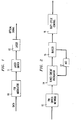
- FIG. 1 illustrates portions of a typical optical transmitter which utilizes an FSK modulator.
- Binary data is received by the modulator illustrated as block 10.
- the modulator converts the binary data into a duty cycle controlled square wave output signal having two levels of frequency.
- the high frequency typically corresponds to a "1" and the low frequency to a "0" of the binary data input.
- This output is coupled to a laser driver indicated by block 11 which creates the drive signal needed for the laser.
- the output of the laser driver is applied to a standard laser illustrated by block 12 to produce the optical signal which also comprises two levels of frequency corresponding to the original data input.
- the optical frequencies are at 11.85 MHz and 13.09 MHz.
- FIG. 2 illustrates in a block diagram further details of the modulator 10.
- the data input is coupled to a PIN switch network, 13, to be described, which operates on a tuned circuit oscillator 14.
- the oscillator is adapted to produce two sinusoidal output frequency levels depending upon the state of the switch network 13.
- the resulting signal is coupled to a buffer circuit 15 which prevents loading of the tuned oscillator circuit by other circuitry coupled thereto.
- the buffer also provides a feedback signal to an automatic gain control circuit, 17, applied to the oscillator 14.
- the output of the buffer is applied to a duty cycle control circuit, 16, to be described, which squares up the sinusoidal signal and adjusts the duty cycle to be compatible with the laser to be driven.
- FIG. 3 illustrates in more detail the portions of the modulator including the PIN switch network and oscillator circuit.
- the binary data input stream is coupled to the base of a bipolar transistor Q1 through a pair of inverters, 30 and 31, and a voltage divider formed by resistors R1 and R20.
- a dc voltage of approximately +5 volts, in this example, is applied at terminal 32 to bias the emitter of transistor Q1 through resistor R2.
- the collector of Q1 is coupled to the anode of PIN diode, D1, whose cathode is coupled to ground potential.
- a dc voltage of approximately -5 volts, in this example is applied at terminal 33 and is also coupled to the anode of diode D1 though inductor L1 and resistor R3.
- capacitor C1 is also coupled to the anode of PIN diode D1, and the other plate of capacitor C1 is coupled to the drain of field effect transistor (FET) T1. Also coupled to the drain of T1 is one plate of capacitor C2, while its other plate is coupled to ground potential. Feedback for oscillation is provided from the drain of T1 to the gate of T2 though capacitor C6.
- FET field effect transistor
- Transistor T1 has its drain biased by a constant dc potential at terminal 34, which in this example is +5 volts.
- the bias is supplied through inductor L2.
- the source of the transistor is grounded.
- the gate of the transistor T1 is coupled to the drain of field effect transistor T2 through a capacitor C3, and also to the automatic gain control circuit (17 of FIG. 2) through a resistor R4.
- a diode, D4, is coupled between the gate of T1 and ground.
- Transistor T2 has its drain biased by a constant dc voltage applied at terminal 35, which in this example is approximately +5 volts. The bias is supplied through a resistor R5. The source of transistor T2 is grounded. The gate of T2 is coupled through a capacitor C6 to the feedback from the drain of T1. Diode D5 and resistor R21 are coupled between the gate of T2 and ground.
- the combination comprising a tuned oscillator circuit producing a specified frequency at the output to the buffer, which in this particular example was 13.09 MHz and constitutes the high level frequency for the modulator. That is, T2 will invert and amplify the signal from the drain of T1, and re-apply it to the gate of T1, which also inverts and amplifies the signal, and the circuit will oscillate at a frequency according to the value of L2 and C2.
- the increased capacitance lowers the output frequency to a value, which in this example was 11.85 MHz, constituting the low level frequency of the modulator.
- capacitor C1 The switching of capacitor C1 is controlled by the network comprising PIN diode D1, transistor Q1, inductor L1 and resistor R3. It will be recognized that Q1, along with R1, R20, R2, D2 and D3, constitute a switchable current source.
- the base of Q1 is biased at a potential, such that a fixed current will flow from the collector through the diode D1 so that the diode D1 will exhibit a low rf resistance. This will bring C1 into active connection in parallel with the capacitor C2, thus increasing the capacitance and lowering the output frequency of the oscillator.
- Q1 When the data input is high (a "1"), however, Q1 will shut off.
- the bias at terminal 33 through the inductor L1 and resistor R3 will reverse bias diode D1 so that D1 will now exhibit a high rf resistance (i.e., low capacitance) thereby effectively disconnecting C1 from the oscillator circuit. This reduces the total capacitance and raises the output frequency to its higher level.
- the data rate in this example was 1.544 Mbitsec.
- the PIN diode D1 can be a standard switching diode with a low rf resistance (typically 1 ohm) at forward bias and a low capacitance (typically 0.7 pF) at reverse bias.
- a proper carrier lifetime for the output frequencies in this example would be 150 ns, and an appropriate reverse recovery time for the data rate in this example would be 50 ns.
- the output of the circuit of FIG. 3, after passing through a buffer circuit (15 of FIG. 2) is then coupled to the circuit of FIG. 4.
- the signal is first coupled to an inverter 40 through capacitor C11. Coupled between the output of the inverter and pound is a series connection of a resistor R7 and capacitor C8. The node between R7 and C8 is coupled to the noninverting (+) input of an operational amplifier (op amp), 41.
- op amp operational amplifier
- a constant dc voltage at terminal, 42 in this example approximately +5V, is divided down and filtered to form a reference voltage by R8 , R10 and C9. This reference voltage is applied to the inverting (-) input of the op amp through resistor R9.
- the output of the op amp is coupled to the input of inverter 40 through resistor R11.
- the output of inverter 40 is also coupled to a second inverter 43, which is used for buffering the output of inverter 40.
- the sinusoidal signal at the input of inverter 40 will be transformed into a square wave signal of reversed polarity at the output, and then returned to the original polarity after being sent through inverter 43. Since the threshold of the inverter will vary, op amp 41 is utilized to adjust the dc level of the sinusoidal input signal so that it will always produce a fixed duty cycle for the output square wave, which, in this example is a duty cycle of 50 percent. This is achieved by coupling the output signal through a low pass filter formed by the combination of resistor R7 and capacitor C8, and applying it to the "+" input of the op amp.
- the values of the resistor R7 and capacitor C8 are chosen so that the resulting signal applied to the op amp input is a dc signal equal to the duty cycle of the square wave signal output of the inverter, 40, multiplied by the supply voltage.
- the resistance of R7 was 10K ohms
- the capacitance of C8 was 0.1 microfarads
- the supply voltage was +5 volts.
- resistors R8 and R10 are chosen so that the reference voltage applied to the inverting (-) input of the op amp is equal to the voltage which will give the desired duty cycle, in this example 0.5 times the supply voltage, or 2.5 volts.
- the resistance of the resistors R8 and R10 was 10K ohms each.
- the output of op amp 41 applied back to the input of inverter 40 will, therefore, adjust the dc level of the input sinusoidal signal until the noninverting (+) input of the op amp is also at 2.5 volts. At that time, the output of inverter 40 will be at the desired 50 percent duty cycle, and op amp 41 will go into a quiescent state until such time as the threshold of inverter 40 should change and alter the duty cycle.
- the electrical drive duty cycle should be greater than 50 percent to achieve a 50 percent optical waveform duty cycle. In this example, the required duty cycle is approximately 60 percent. Consequently, the output of inverter 43 is coupled, through resistors R12, R18, and capacitor C10, to inverters 44 and 45 where the operation of duty cycle adjustment is repeated by op amp 46.
- the purpose of R12, R18 and C10 is to convert the square wave output of inverter 43 into a triangular wave so that duty cycle adjustment can be repeated.
- resistors R14 and R15 are chosen to produce a reference voltage of approximately 0.4 times the supply voltage, or 1 volt, at the inverting (-) input to achieve a 40 percent duty cycle signal at the output of inverter 44 so that the output of inverter 45 produces the desired 60 percent duty cycle.
- the signal is then sent to the laser driver to produce the optical output signal.
- the 60 percent duty cycle is not produced in one stage due to amplitude variations in the sine wave input to inverter 40 which occur in the oscillator circuit during the data transitions. Such amplitude variations would cause duty cycle jitter for any value other than 50 percent.
Landscapes
- Physics & Mathematics (AREA)
- Nonlinear Science (AREA)
- Semiconductor Lasers (AREA)
- Digital Transmission Methods That Use Modulated Carrier Waves (AREA)
- Inductance-Capacitance Distribution Constants And Capacitance-Resistance Oscillators (AREA)
Applications Claiming Priority (2)
| Application Number | Priority Date | Filing Date | Title |
|---|---|---|---|
| US07/622,704 US5136264A (en) | 1990-12-05 | 1990-12-05 | Transmitter including an fsk modulator having a switched capacitor |
| US622704 | 1990-12-05 |
Publications (2)
| Publication Number | Publication Date |
|---|---|
| EP0489544A2 true EP0489544A2 (de) | 1992-06-10 |
| EP0489544A3 EP0489544A3 (en) | 1993-09-08 |
Family
ID=24495191
Family Applications (1)
| Application Number | Title | Priority Date | Filing Date |
|---|---|---|---|
| EP19910311045 Withdrawn EP0489544A3 (en) | 1990-12-05 | 1991-11-28 | Switched impedance fsk modulator |
Country Status (4)
| Country | Link |
|---|---|
| US (1) | US5136264A (de) |
| EP (1) | EP0489544A3 (de) |
| JP (1) | JPH04291551A (de) |
| CA (1) | CA2054324A1 (de) |
Cited By (2)
| Publication number | Priority date | Publication date | Assignee | Title |
|---|---|---|---|---|
| GB2335098A (en) * | 1997-12-17 | 1999-09-08 | Ove Kris Gashus | Apparatus and method for frequency shift keying |
| EP1289213A3 (de) * | 2001-08-31 | 2003-10-08 | Leuze electronic GmbH + Co. | Optoelektronische Vorrichtung |
Families Citing this family (16)
| Publication number | Priority date | Publication date | Assignee | Title |
|---|---|---|---|---|
| DE4213882A1 (de) * | 1992-04-28 | 1993-11-04 | Bosch Gmbh Robert | Vorrichtung eines fahrzeugs zur datenuebertragung auf eine ortsfeste bake und damit gebildetes kommunikationssystem |
| DE4213879A1 (de) * | 1992-04-28 | 1993-11-04 | Bosch Gmbh Robert | Kommunikationssystem zur datenuebertragung von einem bewegten fahrzeug auf eine ortsfeste bake |
| DE4213881A1 (de) * | 1992-04-28 | 1993-11-04 | Bosch Gmbh Robert | System zur bidirektionalen datenuebertragung zwischen einer bake und einem fahrzeug |
| US5335107A (en) * | 1992-05-29 | 1994-08-02 | Regents Of The University Of California | Method and apparatus for modulation of self-pulsating diode laser's self-pulsating frequency |
| CN1091990C (zh) * | 1992-07-10 | 2002-10-02 | 陈克炯 | 一种脉冲通信方法及其装置 |
| JP2853115B2 (ja) * | 1992-09-11 | 1999-02-03 | 株式会社鷹山 | 信号統合回路 |
| US5367537A (en) * | 1993-05-24 | 1994-11-22 | Delco Electronics Corp. | Saw-based FSK modulating circuit |
| US5481228A (en) * | 1993-10-15 | 1996-01-02 | Hewlett-Packard Corporation | Method and apparatus for controlling oscillator duty cycle |
| JPH0884385A (ja) * | 1994-09-14 | 1996-03-26 | Tokai Rika Co Ltd | 送信装置 |
| US5856753A (en) * | 1996-03-29 | 1999-01-05 | Cypress Semiconductor Corp. | Output circuit for 3V/5V clock chip duty cycle adjustments |
| US6380815B1 (en) * | 1997-01-23 | 2002-04-30 | Vega Grieshaber Kg | Microwave pulse generator |
| US6275539B1 (en) * | 1998-07-20 | 2001-08-14 | Lear Automotive Dearborn, Inc. | System and method for modulating a frequency signal |
| US6061551A (en) | 1998-10-21 | 2000-05-09 | Parkervision, Inc. | Method and system for down-converting electromagnetic signals |
| US9325556B2 (en) | 1998-10-21 | 2016-04-26 | Parkervision, Inc. | Methods and systems for down-converting a signal |
| JP3883919B2 (ja) * | 2002-07-16 | 2007-02-21 | 富士通株式会社 | 状態検出機能を備えた光送信装置 |
| US7158049B2 (en) * | 2003-03-24 | 2007-01-02 | Schlumberger Technology Corporation | Wireless communication circuit |
Family Cites Families (16)
| Publication number | Priority date | Publication date | Assignee | Title |
|---|---|---|---|---|
| US3626209A (en) * | 1970-04-06 | 1971-12-07 | Electro Optical Ind Inc | Square wave generating circuit |
| US4174534A (en) * | 1978-01-20 | 1979-11-13 | Northern Telecom Limited | Master-slave voltage regulator employing pulse width modulation |
| JPS596093B2 (ja) * | 1979-04-09 | 1984-02-09 | 日本電気株式会社 | 光送信装置 |
| US4449247A (en) * | 1980-07-30 | 1984-05-15 | Harris Corporation | Local orderwire facility for fiber optic communication system |
| DE3246291C2 (de) * | 1982-12-14 | 1985-12-12 | SGS-ATES Deutschland Halbleiter-Bauelemente GmbH, 8018 Grafing | PLL-Schaltungsanordnung |
| JPS6027204A (ja) * | 1983-07-23 | 1985-02-12 | Murata Mfg Co Ltd | 発振回路装置 |
| JPS6093860A (ja) * | 1983-10-26 | 1985-05-25 | Sharp Corp | 高周波発振回路 |
| US4573025A (en) * | 1984-04-02 | 1986-02-25 | Motorola, Inc. | Drift-equalized, multi-frequency oscillator |
| JPS60260223A (ja) * | 1984-06-06 | 1985-12-23 | Matsushita Electric Ind Co Ltd | 自動スライス回路 |
| US4603301A (en) * | 1984-07-05 | 1986-07-29 | Hewlett-Packard Company | Amplitude insensitive delay lines in a frequency modulated signal detector |
| US4629906A (en) * | 1985-05-06 | 1986-12-16 | Motorola, Inc. | Bias sharing an electronic switch and an active device |
| US4716383A (en) * | 1986-06-23 | 1987-12-29 | Western Digital Corporation | Precise phase start-up voltage controlled oscillator with accurate duty cycle |
| US4918296A (en) * | 1987-03-06 | 1990-04-17 | Omron Tateisi Electronics Company | Article identifying system |
| JPH01307312A (ja) * | 1988-05-23 | 1989-12-12 | Advanced Micro Devicds Inc | 予め定められ制御された衝撃係数を有する一連のパルスを発生するための回路 |
| US4959827A (en) * | 1989-03-30 | 1990-09-25 | Laser Communications, Inc. | Laser signal mixer circuit |
| US4959557A (en) * | 1989-05-18 | 1990-09-25 | Compaq Computer Corporation | Negative feedback circuit to control the duty cycle of a logic system clock |
-
1990
- 1990-12-05 US US07/622,704 patent/US5136264A/en not_active Expired - Lifetime
-
1991
- 1991-10-28 CA CA002054324A patent/CA2054324A1/en not_active Abandoned
- 1991-11-25 JP JP3334530A patent/JPH04291551A/ja active Pending
- 1991-11-28 EP EP19910311045 patent/EP0489544A3/en not_active Withdrawn
Cited By (4)
| Publication number | Priority date | Publication date | Assignee | Title |
|---|---|---|---|---|
| GB2335098A (en) * | 1997-12-17 | 1999-09-08 | Ove Kris Gashus | Apparatus and method for frequency shift keying |
| US6185264B1 (en) * | 1997-12-17 | 2001-02-06 | Ove Kris Gashus | Apparatus and method for frequency shift keying |
| GB2335098B (en) * | 1997-12-17 | 2001-07-25 | Ove Kris Gashus | Apparatus and method for frequency shift keying |
| EP1289213A3 (de) * | 2001-08-31 | 2003-10-08 | Leuze electronic GmbH + Co. | Optoelektronische Vorrichtung |
Also Published As
| Publication number | Publication date |
|---|---|
| CA2054324A1 (en) | 1992-06-06 |
| EP0489544A3 (en) | 1993-09-08 |
| JPH04291551A (ja) | 1992-10-15 |
| US5136264A (en) | 1992-08-04 |
Similar Documents
| Publication | Publication Date | Title |
|---|---|---|
| US5136264A (en) | Transmitter including an fsk modulator having a switched capacitor | |
| US4243951A (en) | High repetition rate driver circuit for modulation of injection lasers | |
| JPH10224159A (ja) | 時間遅延補償広帯域クラスs変調器およびその方法 | |
| US5822685A (en) | Modulating reflector circuit | |
| JPH10163764A (ja) | 広帯域クラスs変調器およびその方法 | |
| MY107011A (en) | Beam scan velocity modulation apparatus. | |
| KR20050097932A (ko) | 용량성 장벽을 갖는 분리 인터페이스 및 그 분리인터페이스에 의해 신호를 전송하기 위한 방법 | |
| US4831280A (en) | High voltage pulse generating apparatus | |
| US4776036A (en) | RF-AM transmitter with pulse width modulator | |
| CA2040626C (en) | Light emitting element drive circuit | |
| JPH04220805A (ja) | 振幅変調rf増幅器 | |
| US6320460B1 (en) | Class D amplifier | |
| US4118677A (en) | Pulse width modulating circuit | |
| US4748421A (en) | Enhanced class SM power amplifier | |
| US4356432A (en) | Solid state power switch for gas discharge lamps | |
| CA2013866A1 (en) | Frequency shift keying modulation and demodulation for serial communication on a current loop | |
| US4343219A (en) | Delay line oscillator | |
| US4066981A (en) | EMP Resistant oscillator with fiber optic frequency determining means | |
| ES2106129T3 (es) | Amplificador de fuente de voltaje. | |
| JPH01166582A (ja) | レーザ駆動回路 | |
| GB2426646A (en) | Fet amplifier, pulse modulation module, and radar device | |
| CA1262263A (en) | Rf-am transmitter with pulse width modulator | |
| JP2910279B2 (ja) | レーザダイオード駆動回路 | |
| JPH1013475A (ja) | Ask変調回路 | |
| CA1283478C (en) | Vertical deflection current generator |
Legal Events
| Date | Code | Title | Description |
|---|---|---|---|
| PUAI | Public reference made under article 153(3) epc to a published international application that has entered the european phase |
Free format text: ORIGINAL CODE: 0009012 |
|
| AK | Designated contracting states |
Kind code of ref document: A2 Designated state(s): DE ES FR GB IT |
|
| RHK1 | Main classification (correction) |
Ipc: H03B 5/12 |
|
| RTI1 | Title (correction) | ||
| PUAL | Search report despatched |
Free format text: ORIGINAL CODE: 0009013 |
|
| AK | Designated contracting states |
Kind code of ref document: A3 Designated state(s): DE ES FR GB IT |
|
| 17P | Request for examination filed |
Effective date: 19940224 |
|
| RAP3 | Party data changed (applicant data changed or rights of an application transferred) |
Owner name: AT&T CORP. |
|
| 17Q | First examination report despatched |
Effective date: 19950721 |
|
| STAA | Information on the status of an ep patent application or granted ep patent |
Free format text: STATUS: THE APPLICATION HAS BEEN WITHDRAWN |
|
| 18W | Application withdrawn |
Withdrawal date: 19951002 |