EP0490638A2 - Verfahren zum Herstellen einer leckdichter Verbindung zwischen rohrförmigen Teilen in einem Flüssigkeitstransportsystem - Google Patents
Verfahren zum Herstellen einer leckdichter Verbindung zwischen rohrförmigen Teilen in einem Flüssigkeitstransportsystem Download PDFInfo
- Publication number
- EP0490638A2 EP0490638A2 EP91311475A EP91311475A EP0490638A2 EP 0490638 A2 EP0490638 A2 EP 0490638A2 EP 91311475 A EP91311475 A EP 91311475A EP 91311475 A EP91311475 A EP 91311475A EP 0490638 A2 EP0490638 A2 EP 0490638A2
- Authority
- EP
- European Patent Office
- Prior art keywords
- tubular member
- mandril
- lumen
- stricture
- annular
- Prior art date
- Legal status (The legal status is an assumption and is not a legal conclusion. Google has not performed a legal analysis and makes no representation as to the accuracy of the status listed.)
- Ceased
Links
Images

Classifications
-
- F—MECHANICAL ENGINEERING; LIGHTING; HEATING; WEAPONS; BLASTING
- F16—ENGINEERING ELEMENTS AND UNITS; GENERAL MEASURES FOR PRODUCING AND MAINTAINING EFFECTIVE FUNCTIONING OF MACHINES OR INSTALLATIONS; THERMAL INSULATION IN GENERAL
- F16L—PIPES; JOINTS OR FITTINGS FOR PIPES; SUPPORTS FOR PIPES, CABLES OR PROTECTIVE TUBING; MEANS FOR THERMAL INSULATION IN GENERAL
- F16L55/00—Devices or appurtenances for use in, or in connection with, pipes or pipe systems
-
- B—PERFORMING OPERATIONS; TRANSPORTING
- B29—WORKING OF PLASTICS; WORKING OF SUBSTANCES IN A PLASTIC STATE IN GENERAL
- B29C—SHAPING OR JOINING OF PLASTICS; SHAPING OF MATERIAL IN A PLASTIC STATE, NOT OTHERWISE PROVIDED FOR; AFTER-TREATMENT OF THE SHAPED PRODUCTS, e.g. REPAIRING
- B29C65/00—Joining or sealing of preformed parts, e.g. welding of plastics materials; Apparatus therefor
- B29C65/02—Joining or sealing of preformed parts, e.g. welding of plastics materials; Apparatus therefor by heating, with or without pressure
-
- A—HUMAN NECESSITIES
- A61—MEDICAL OR VETERINARY SCIENCE; HYGIENE
- A61M—DEVICES FOR INTRODUCING MEDIA INTO, OR ONTO, THE BODY; DEVICES FOR TRANSDUCING BODY MEDIA OR FOR TAKING MEDIA FROM THE BODY; DEVICES FOR PRODUCING OR ENDING SLEEP OR STUPOR
- A61M39/00—Tubes, tube connectors, tube couplings, valves, access sites or the like, specially adapted for medical use
- A61M39/10—Tube connectors; Tube couplings
- A61M39/12—Tube connectors; Tube couplings for joining a flexible tube to a rigid attachment
-
- B—PERFORMING OPERATIONS; TRANSPORTING
- B29—WORKING OF PLASTICS; WORKING OF SUBSTANCES IN A PLASTIC STATE IN GENERAL
- B29C—SHAPING OR JOINING OF PLASTICS; SHAPING OF MATERIAL IN A PLASTIC STATE, NOT OTHERWISE PROVIDED FOR; AFTER-TREATMENT OF THE SHAPED PRODUCTS, e.g. REPAIRING
- B29C57/00—Shaping of tube ends, e.g. flanging, belling or closing; Apparatus therefor, e.g. collapsible mandrels
-
- B—PERFORMING OPERATIONS; TRANSPORTING
- B29—WORKING OF PLASTICS; WORKING OF SUBSTANCES IN A PLASTIC STATE IN GENERAL
- B29C—SHAPING OR JOINING OF PLASTICS; SHAPING OF MATERIAL IN A PLASTIC STATE, NOT OTHERWISE PROVIDED FOR; AFTER-TREATMENT OF THE SHAPED PRODUCTS, e.g. REPAIRING
- B29C65/00—Joining or sealing of preformed parts, e.g. welding of plastics materials; Apparatus therefor
- B29C65/48—Joining or sealing of preformed parts, e.g. welding of plastics materials; Apparatus therefor using adhesives, i.e. using supplementary joining material; solvent bonding
- B29C65/4895—Solvent bonding, i.e. the surfaces of the parts to be joined being treated with solvents, swelling or softening agents, without adhesives
-
- B—PERFORMING OPERATIONS; TRANSPORTING
- B29—WORKING OF PLASTICS; WORKING OF SUBSTANCES IN A PLASTIC STATE IN GENERAL
- B29C—SHAPING OR JOINING OF PLASTICS; SHAPING OF MATERIAL IN A PLASTIC STATE, NOT OTHERWISE PROVIDED FOR; AFTER-TREATMENT OF THE SHAPED PRODUCTS, e.g. REPAIRING
- B29C66/00—General aspects of processes or apparatus for joining preformed parts
- B29C66/01—General aspects dealing with the joint area or with the area to be joined
- B29C66/03—After-treatments in the joint area
- B29C66/032—Mechanical after-treatments
-
- B—PERFORMING OPERATIONS; TRANSPORTING
- B29—WORKING OF PLASTICS; WORKING OF SUBSTANCES IN A PLASTIC STATE IN GENERAL
- B29C—SHAPING OR JOINING OF PLASTICS; SHAPING OF MATERIAL IN A PLASTIC STATE, NOT OTHERWISE PROVIDED FOR; AFTER-TREATMENT OF THE SHAPED PRODUCTS, e.g. REPAIRING
- B29C66/00—General aspects of processes or apparatus for joining preformed parts
- B29C66/01—General aspects dealing with the joint area or with the area to be joined
- B29C66/05—Particular design of joint configurations
- B29C66/10—Particular design of joint configurations particular design of the joint cross-sections
- B29C66/12—Joint cross-sections combining only two joint-segments; Tongue and groove joints; Tenon and mortise joints; Stepped joint cross-sections
- B29C66/122—Joint cross-sections combining only two joint-segments, i.e. one of the parts to be joined comprising only two joint-segments in the joint cross-section
- B29C66/1222—Joint cross-sections combining only two joint-segments, i.e. one of the parts to be joined comprising only two joint-segments in the joint cross-section comprising at least a lapped joint-segment
-
- B—PERFORMING OPERATIONS; TRANSPORTING
- B29—WORKING OF PLASTICS; WORKING OF SUBSTANCES IN A PLASTIC STATE IN GENERAL
- B29C—SHAPING OR JOINING OF PLASTICS; SHAPING OF MATERIAL IN A PLASTIC STATE, NOT OTHERWISE PROVIDED FOR; AFTER-TREATMENT OF THE SHAPED PRODUCTS, e.g. REPAIRING
- B29C66/00—General aspects of processes or apparatus for joining preformed parts
- B29C66/01—General aspects dealing with the joint area or with the area to be joined
- B29C66/05—Particular design of joint configurations
- B29C66/10—Particular design of joint configurations particular design of the joint cross-sections
- B29C66/12—Joint cross-sections combining only two joint-segments; Tongue and groove joints; Tenon and mortise joints; Stepped joint cross-sections
- B29C66/122—Joint cross-sections combining only two joint-segments, i.e. one of the parts to be joined comprising only two joint-segments in the joint cross-section
- B29C66/1224—Joint cross-sections combining only two joint-segments, i.e. one of the parts to be joined comprising only two joint-segments in the joint cross-section comprising at least a butt joint-segment
-
- B—PERFORMING OPERATIONS; TRANSPORTING
- B29—WORKING OF PLASTICS; WORKING OF SUBSTANCES IN A PLASTIC STATE IN GENERAL
- B29C—SHAPING OR JOINING OF PLASTICS; SHAPING OF MATERIAL IN A PLASTIC STATE, NOT OTHERWISE PROVIDED FOR; AFTER-TREATMENT OF THE SHAPED PRODUCTS, e.g. REPAIRING
- B29C66/00—General aspects of processes or apparatus for joining preformed parts
- B29C66/50—General aspects of joining tubular articles; General aspects of joining long products, i.e. bars or profiled elements; General aspects of joining single elements to tubular articles, hollow articles or bars; General aspects of joining several hollow-preforms to form hollow or tubular articles
- B29C66/51—Joining tubular articles, profiled elements or bars; Joining single elements to tubular articles, hollow articles or bars; Joining several hollow-preforms to form hollow or tubular articles
- B29C66/52—Joining tubular articles, bars or profiled elements
- B29C66/522—Joining tubular articles
- B29C66/5221—Joining tubular articles for forming coaxial connections, i.e. the tubular articles to be joined forming a zero angle relative to each other
-
- B—PERFORMING OPERATIONS; TRANSPORTING
- B29—WORKING OF PLASTICS; WORKING OF SUBSTANCES IN A PLASTIC STATE IN GENERAL
- B29C—SHAPING OR JOINING OF PLASTICS; SHAPING OF MATERIAL IN A PLASTIC STATE, NOT OTHERWISE PROVIDED FOR; AFTER-TREATMENT OF THE SHAPED PRODUCTS, e.g. REPAIRING
- B29C66/00—General aspects of processes or apparatus for joining preformed parts
- B29C66/50—General aspects of joining tubular articles; General aspects of joining long products, i.e. bars or profiled elements; General aspects of joining single elements to tubular articles, hollow articles or bars; General aspects of joining several hollow-preforms to form hollow or tubular articles
- B29C66/51—Joining tubular articles, profiled elements or bars; Joining single elements to tubular articles, hollow articles or bars; Joining several hollow-preforms to form hollow or tubular articles
- B29C66/53—Joining single elements to tubular articles, hollow articles or bars
- B29C66/532—Joining single elements to the wall of tubular articles, hollow articles or bars
- B29C66/5326—Joining single elements to the wall of tubular articles, hollow articles or bars said single elements being substantially flat
- B29C66/53261—Enclosing tubular articles between substantially flat elements
-
- B—PERFORMING OPERATIONS; TRANSPORTING
- B29—WORKING OF PLASTICS; WORKING OF SUBSTANCES IN A PLASTIC STATE IN GENERAL
- B29C—SHAPING OR JOINING OF PLASTICS; SHAPING OF MATERIAL IN A PLASTIC STATE, NOT OTHERWISE PROVIDED FOR; AFTER-TREATMENT OF THE SHAPED PRODUCTS, e.g. REPAIRING
- B29C66/00—General aspects of processes or apparatus for joining preformed parts
- B29C66/50—General aspects of joining tubular articles; General aspects of joining long products, i.e. bars or profiled elements; General aspects of joining single elements to tubular articles, hollow articles or bars; General aspects of joining several hollow-preforms to form hollow or tubular articles
- B29C66/51—Joining tubular articles, profiled elements or bars; Joining single elements to tubular articles, hollow articles or bars; Joining several hollow-preforms to form hollow or tubular articles
- B29C66/53—Joining single elements to tubular articles, hollow articles or bars
- B29C66/534—Joining single elements to open ends of tubular or hollow articles or to the ends of bars
- B29C66/5344—Joining single elements to open ends of tubular or hollow articles or to the ends of bars said single elements being substantially annular, i.e. of finite length, e.g. joining flanges to tube ends
-
- A—HUMAN NECESSITIES
- A61—MEDICAL OR VETERINARY SCIENCE; HYGIENE
- A61M—DEVICES FOR INTRODUCING MEDIA INTO, OR ONTO, THE BODY; DEVICES FOR TRANSDUCING BODY MEDIA OR FOR TAKING MEDIA FROM THE BODY; DEVICES FOR PRODUCING OR ENDING SLEEP OR STUPOR
- A61M39/00—Tubes, tube connectors, tube couplings, valves, access sites or the like, specially adapted for medical use
- A61M39/10—Tube connectors; Tube couplings
- A61M2039/1027—Quick-acting type connectors
-
- B—PERFORMING OPERATIONS; TRANSPORTING
- B29—WORKING OF PLASTICS; WORKING OF SUBSTANCES IN A PLASTIC STATE IN GENERAL
- B29C—SHAPING OR JOINING OF PLASTICS; SHAPING OF MATERIAL IN A PLASTIC STATE, NOT OTHERWISE PROVIDED FOR; AFTER-TREATMENT OF THE SHAPED PRODUCTS, e.g. REPAIRING
- B29C65/00—Joining or sealing of preformed parts, e.g. welding of plastics materials; Apparatus therefor
- B29C65/02—Joining or sealing of preformed parts, e.g. welding of plastics materials; Apparatus therefor by heating, with or without pressure
- B29C65/04—Dielectric heating, e.g. high-frequency welding, i.e. radio frequency welding of plastic materials having dielectric properties, e.g. PVC
-
- B—PERFORMING OPERATIONS; TRANSPORTING
- B29—WORKING OF PLASTICS; WORKING OF SUBSTANCES IN A PLASTIC STATE IN GENERAL
- B29C—SHAPING OR JOINING OF PLASTICS; SHAPING OF MATERIAL IN A PLASTIC STATE, NOT OTHERWISE PROVIDED FOR; AFTER-TREATMENT OF THE SHAPED PRODUCTS, e.g. REPAIRING
- B29C65/00—Joining or sealing of preformed parts, e.g. welding of plastics materials; Apparatus therefor
- B29C65/48—Joining or sealing of preformed parts, e.g. welding of plastics materials; Apparatus therefor using adhesives, i.e. using supplementary joining material; solvent bonding
-
- B—PERFORMING OPERATIONS; TRANSPORTING
- B29—WORKING OF PLASTICS; WORKING OF SUBSTANCES IN A PLASTIC STATE IN GENERAL
- B29C—SHAPING OR JOINING OF PLASTICS; SHAPING OF MATERIAL IN A PLASTIC STATE, NOT OTHERWISE PROVIDED FOR; AFTER-TREATMENT OF THE SHAPED PRODUCTS, e.g. REPAIRING
- B29C65/00—Joining or sealing of preformed parts, e.g. welding of plastics materials; Apparatus therefor
- B29C65/48—Joining or sealing of preformed parts, e.g. welding of plastics materials; Apparatus therefor using adhesives, i.e. using supplementary joining material; solvent bonding
- B29C65/52—Joining or sealing of preformed parts, e.g. welding of plastics materials; Apparatus therefor using adhesives, i.e. using supplementary joining material; solvent bonding characterised by the way of applying the adhesive
- B29C65/54—Joining or sealing of preformed parts, e.g. welding of plastics materials; Apparatus therefor using adhesives, i.e. using supplementary joining material; solvent bonding characterised by the way of applying the adhesive between pre-assembled parts
-
- B—PERFORMING OPERATIONS; TRANSPORTING
- B29—WORKING OF PLASTICS; WORKING OF SUBSTANCES IN A PLASTIC STATE IN GENERAL
- B29C—SHAPING OR JOINING OF PLASTICS; SHAPING OF MATERIAL IN A PLASTIC STATE, NOT OTHERWISE PROVIDED FOR; AFTER-TREATMENT OF THE SHAPED PRODUCTS, e.g. REPAIRING
- B29C65/00—Joining or sealing of preformed parts, e.g. welding of plastics materials; Apparatus therefor
- B29C65/48—Joining or sealing of preformed parts, e.g. welding of plastics materials; Apparatus therefor using adhesives, i.e. using supplementary joining material; solvent bonding
- B29C65/52—Joining or sealing of preformed parts, e.g. welding of plastics materials; Apparatus therefor using adhesives, i.e. using supplementary joining material; solvent bonding characterised by the way of applying the adhesive
- B29C65/54—Joining or sealing of preformed parts, e.g. welding of plastics materials; Apparatus therefor using adhesives, i.e. using supplementary joining material; solvent bonding characterised by the way of applying the adhesive between pre-assembled parts
- B29C65/548—Joining or sealing of preformed parts, e.g. welding of plastics materials; Apparatus therefor using adhesives, i.e. using supplementary joining material; solvent bonding characterised by the way of applying the adhesive between pre-assembled parts by capillarity
-
- B—PERFORMING OPERATIONS; TRANSPORTING
- B29—WORKING OF PLASTICS; WORKING OF SUBSTANCES IN A PLASTIC STATE IN GENERAL
- B29C—SHAPING OR JOINING OF PLASTICS; SHAPING OF MATERIAL IN A PLASTIC STATE, NOT OTHERWISE PROVIDED FOR; AFTER-TREATMENT OF THE SHAPED PRODUCTS, e.g. REPAIRING
- B29C66/00—General aspects of processes or apparatus for joining preformed parts
- B29C66/70—General aspects of processes or apparatus for joining preformed parts characterised by the composition, physical properties or the structure of the material of the parts to be joined; Joining with non-plastics material
- B29C66/71—General aspects of processes or apparatus for joining preformed parts characterised by the composition, physical properties or the structure of the material of the parts to be joined; Joining with non-plastics material characterised by the composition of the plastics material of the parts to be joined
-
- B—PERFORMING OPERATIONS; TRANSPORTING
- B29—WORKING OF PLASTICS; WORKING OF SUBSTANCES IN A PLASTIC STATE IN GENERAL
- B29L—INDEXING SCHEME ASSOCIATED WITH SUBCLASS B29C, RELATING TO PARTICULAR ARTICLES
- B29L2031/00—Other particular articles
- B29L2031/712—Containers; Packaging elements or accessories, Packages
- B29L2031/7148—Blood bags, medical bags
-
- Y—GENERAL TAGGING OF NEW TECHNOLOGICAL DEVELOPMENTS; GENERAL TAGGING OF CROSS-SECTIONAL TECHNOLOGIES SPANNING OVER SEVERAL SECTIONS OF THE IPC; TECHNICAL SUBJECTS COVERED BY FORMER USPC CROSS-REFERENCE ART COLLECTIONS [XRACs] AND DIGESTS
- Y10—TECHNICAL SUBJECTS COVERED BY FORMER USPC
- Y10S—TECHNICAL SUBJECTS COVERED BY FORMER USPC CROSS-REFERENCE ART COLLECTIONS [XRACs] AND DIGESTS
- Y10S285/00—Pipe joints or couplings
- Y10S285/915—Mastic
Definitions
- This invention relates to a leak resistant connection between tubular members in a fluid transport system, to an end construction for tubular members in such a system, and to a method of making a connection between tubular members in a fluid transport system.
- Fluid transport systems typically comprise a number of interconnected components. In most systems it is important that the connections between components be strong, reliable, and leak free. This is particularly true in medical applications, for example an intravenous fluid delivery system. Leakage in such a system might mean that a patient would not get adequate medication, and that health care workers could be exposed to the leaked medications. Leakage could also result in the aspiration of gas into the fluid delivery system. Moreover, the integrity and reliability of the connections are becoming increasingly important as the use of pressure infusion becomes more common, because the entire fluid system is under pressure. For example, the connection between the delivery tubing and the infusion pump cassette of the type disclosed in Archibald, U.S. Patent No. 4,382,753 is under pressure as the infusion pump pumps fluid through the system.
- U.S. Patent No. 4,137,117 discloses a method of making a solvent-bonded joint to an outlet port assembly of a parenteral fluid administration bag.
- the present invention provides a reliable and leak resistant connection between two generally tubular members in a fluid transport system.
- the invention also provides a method for making such a connection that is fast, simple, and easy, so that the connection is economical.
- the present invention also provides an improved construction for a tubular member adapted for use in a fluid transport system, to facilitate the formation of a leak resistant connection.
- the present invention provides a method for making the improved tubular member.
- connection of the present invention is of the type in which a first generally tubular member telescopingly receives the end of a second generally tubular member.
- the stricture engages the exterior of the portion of the second tubular member that is inside the lumen of the first tubular member.
- the stricture in the lumen of the first tubular member acts like an integral o-ring, assuring continuous contact between the first and second tubular members.
- the end of the second tubular member can be easily inserted into the first tubular member to make the connection.
- the overlapping portions of the first and second tubular members are preferably joined, for example by solvent welding.
- connection may also include a second continuus annular stricture inside the lumen of the first generally tubular member.
- the second stricture is spaced further from the end than the first stricture, and projects further into the lumen than the first stricture.
- the second stricture abuts the end of the second tubular member inside the first tubular member, forming a positive stop that limits how far the second tubular member can be inserted into the first tubular member.
- the method of the present invention of making the connection between two generally tubular members comprises the steps of forming at least one continuous annular stricture in the lumen of the first tubular member, and inserting the end of the second tubular member into the end of the first tubular member, beyond the stricture.
- the tubular members may be joined, for example with solvent welding.
- the method may further comprise the step of forming a second continuous annular stricture in the lumen of the first tubular member.
- the second stricture is spaced further from the end than the first stricture, and projects further into the lumen than the first stricture so that it can abut the end of the second tubular member.
- the end of the second tubular member is inserted into the lumen of the first tubular member, past the first stricture, until it abuts the second stricture.
- the step of forming the first and second strictures in the lumen of the first tubular member preferably comprises the steps of inserting a mandril, having at least one circumferential annular groove therein, into the end of the lumen of the first tubular member.
- the portion of the first tubular member surrounding the mandril is heated to form an annular projection on the inside wall of the first tubular member, in the groove in the mandril.
- the mandril is then removed, and the annular projection on the wall of the first tubular member forms continuous annular stricture in the lumen.
- the method may further comprise the step of pressing the portion of the first tubular member surrounding the mandril against the mandril, to facilitate the formation of the annular strictures in the grooves in the mandril.
- the step of heating the first generally tubular member may be done by applying RF energy to the tubular member. If a die is used to press the tubular member against the mandril, the die provides a convenient second pole for applying RF energy to the tubular member to heat it.
- the improved construction for a tubular member adapted for use in a fluid transport system comprises at least one continuous annular stricture inside the lumen of the tubular member, adjacent the end.
- the stricture forms a sealing member for engaging the exterior of a second tubular member inserted into the lumen.
- the construction may include a second continuous annular stricture inside the lumen of the tubular member, spaced further from the end than the first stricture.
- the second stricture projects further into the lumen than the first stricture, forming a stop for abutting the end of a second tubular member inserted into the lumen.
- a mandril having at least one circumferential annular groove therein, is inserted into the end of the lumen of the tubular member.
- the portion of the tubular member surrounding the mandril is heated to form an annular projection on the inside wall of the tubular member, in the groove in the mandril.
- the mandril is then removed from the lumen, and the annular projection on the wall of the tubular member forms continuous annular stricture in the lumen of the tubular member.
- the method of making the improved tubular member may further comprise the step of pressing the portion of the tubular member surrounding the mandril against the mandril, to facilitate the formation of the annular strictures in the grooves in the mandril.
- the step of heating the tubular member may be done by applying RF energy to the tubular member. If a die is used to press the tubular member against the mandril, the die provides a convenient second pole for RF heating of the tubular member.
- the connection of the present invention is reliable and leak resistant.
- the first continuous annular stricture in the first tubular member provides continuous contact with a second tubular member inserted therein, facilitating a leak-resistant connection, yet allows the second tubular member to be easily inserted into the first tubular member.
- the second continuous annular stricture provides a positive stop, facilitating the quick yet accurate insertion of the second tubular member into the first tubular member.
- the method for making the connection is fast, simple, and easy, so the connection is economical.
- the improved construction for a tubular member of this invention is particularly adapted to form leak resistant connections. And, like the method for making the connection, the method for making the construction is fast, simple, and easy.
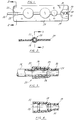
- connection between two generally tubular members according to the principles of this invention is shown in Figures 1-3.
- the connection is between a first generally tubular member -- a socket 22 on an infusion pump cassette 24, and a second generally tubular member -- the end of an intravenous line 26.
- infusion pump cassette 24 and intravenous line 26 the invention is not so limited, and applies to connections between any two generally tubular members in a fluid transport system.
- the cassette 24 is preferably made from a thermoplastic material, such as polyvinyl chloride.
- the cassette 24 shown in 1 is of the type disclosed in Archibald, U.S. Patent No. 4,382,753, in which the sockets 22 are formed between top and bottom generally planar pieces that are heat-sealed or otherwise joined together. Although the sockets 22 are formed between two planar members, they each have a generally tubular configuration.
- the intravenous line 26 may also be made of a thermoplastic material, such as polyvinyl chloride tubing. Both the socket 22 and the intravenous line 26 are preferably made from a solvent-weldable material.
- connection 20 between the socket 22 and the intravenous line 26 comprises at least one continuous annular stricture 28 inside the lumen 30 of the socket 22, adjacent the end 32.
- the stricture 28 is formed integrally with the wall of the socket 22, and projects into the lumen 30, forming an o-ring like sealing member that engages the exterior of a portion of the intravenous line 26 extending inside the lumen 30 of the socket 22. (See Figure 3).
- the stricture 28 assures continuous contact between the socket 22 and the intravenous line 26 around the circumference of the socket, resisting leakage between the socket 22 and the intravenous line 26.
- the overlapping portions of the socket 22 and the intravenous line 26 are preferably solvent-welded together, for example with cyclohexanone.
- connection 20 preferably further comprises a second annular stricture 34 inside the lumen 30 of the socket 22.
- the second stricture 34 is spaced further from the end 32 of the socket 22 than the first stricture 28.
- the second stricture projects further into the lumen 30 than the first stricture 28, projecting far enough into the lumen 32 to abut the end 36 of the intravenous line 26, limiting how far the end 36 of the intravenous line 26 can be inserted into the lumen 30 of the socket 22. (See Figure 3).
- the second stricture 34 functions as a stop, it does not have to be continuous, although it preferably is.
- the socket 22 and the intravenous line 26 are preferably sized so that the socket 22 must stretch slightly to accommodate the end of the intravenous line 26, to achieve a tight fit and cause the stricture 28 in the socket 22, to be held snugly against the exterior of the tube 22. (Compare Figures 3 and 4).
- the method of this invention of making a connection 20 between the ends of first and second generally tubular members 22, 26 comprises the step of forming at least one continuous annular stricture 28 in the lumen 30 of the first tubular member 22.
- the second tubular member 26 is then telescopingly inserted into the lumen 30.
- the two tubular members 22, 26 are then bonded together, preferably by solvent-welding.
- a suitable solvent for example cyclohexanone, is applied to at least one of, and preferably both, the interior of the first generally tubular member 22 and the exterior of the second tubular member 26.
- the end of the second tubular member 26 is inserted into lumen 30 of the first tubular member 22, and the two members 22, 26 are held together for a sufficient time for solvent welding to occur.
- the method preferably also comprises the step of forming a second continuous annular stricture 34 in the lumen 30 of the first tubular member 22, spaced further from the end 32 than the first stricture 28.
- the second stricture 34 has a higher profile than the first stricture 28, i.e. , it projects further into the lumen 30 than the first stricture 28, sufficiently to abut the end 36 of the second tubular member 26, when the second tubular member 26 is inserted into the lumen 30 of the first tubular member 22. Then, when the second tubular member 26 is inserted into the lumen 30 of the first tubular member 22, it is advanced past the first stricture 28 until its end abuts the second stricture 34.
- the first stricture 28 (and preferably the second stricture 34) are formed in the socket 22.
- the socket 22 and the intravenous line 26 are then bonded together.
- solvent is applied to the interior of the socket 22 and to the exterior of the intravenous line 26.
- the intravenous line 26 is then inserted into the socket, so that the end 36 passes the first stricture 28 and abuts the second stricture 34.
- the tubular members 22, 26 are held in place until the ends weld together.
- the step of forming the strictures 28 and 34 in the first tubular member comprises inserting a mandril 38 into the lumen 30 of the first tubular member, i.e. , the socket 22.
- the mandril 38 preferably has a tapered distal tip 40, to facilitate the insertion and removal of the tip 40 from the lumen 30.
- the tip 40 has at least one groove 42 which, as described below, serves as a mold for the first stricture 28.
- the sides of the groove 42 are preferably curved or chamfered (see Figure 7), so that the groove 42 forms the stricture 28 with a sloped leading edge (see Figure 4) to permit the end 36 of the intravenous line 26 to be easily inserted past the stricture 28, even though the stricture 28 projects sufficiently into the lumen 30 to engage the exterior of the intravenous line 26.
- the tip 40 of the mandril 38 preferably also has a second groove 44 which, as described below, serves as a mold for the second stricture 34. The second groove 44 is located closer to the distal end of the mandril 38 than the first groove 42.
- the groove 44 is deeper than the groove 42, and the sides of the groove 44 are preferably substantially vertical (see Figure 7), so that the groove 44 forms the stricture 34 with a flat leading edge (see Figure 4) to abut the end 36 of the intravenous line 26.
- the mandril 38 is preferably made of a conductive material, for example brass.
- the mandril 38 preferably includes a collar 46 that limits how far the tip 40 of the mandril 38 can be inserted into the lumen 30 of the first tubular member 22.
- the collar 46 is preferably made of a non-conductive substance, for example "Delrin".
- the method of forming the stricture 28, 34 preferably further comprises the step of pressing the portion of the tubular member 22 surrounding the tip 40 of the mandril 38 against the mandril 38 to facilitate the formation of the strictures 28 and 34 by forcing the material forming the wall of the tubular member 22 into the grooves 42 and 44 on the mandril 38.
- This can be conveniently done by compressing the portions of the tubular member 22 with a die, and in this preferred embodiment a pair of mating dies 48, as shown in Figures 5 and 7.
- Each die 48 has flanges 50 at its base for mounting the die 48 on a jig.
- Each die 48 also has a recess 52 for receiving and engaging a portion of the tubular member 22, and urging the tubular member 22 against the tip 40 of the mandril 38.
- the recess 52 is preferably tapered complementary to the taper of the tip 40 of the mandril 38.
- the dies 48 are preferably made from a conductive material, for example brass.
- the pair of dies 48 are particularly suited to forming the connection in a socket 22 on a cassette 24, because the dies 48 define a space between the dies 48 for accommodating the web of the cassette 24. (See Figure 5). However, when forming a connection with some other tubular member, a single die, or more than two dies may be more suitable.
- the tubular member 22 can be conveniently heated by applying RF energy to the material via the mandril 38.
- the dies 48 form a convenient second pole for the application of RF energy to the portions of the tubular member 22 surrounding the tip 40 of the mandril 38.
- the improved end construction for a tubular member 22 adapted for use in a fluid transport system to facilitate leak resistant connection with a second tubular member 26 is shown in longitudinal cross-section in Figure 4.
- the construction is incorporated in a socket 22 of a infusion pump cassette 24, although as discussed above the invention is not so limited.
- the construction comprises a first continuous annular stricture 28 in the lumen 30 of the socket 22, adjacent the end 32.
- the first stricture 28 forms a sealing member, similar to an integral o-ring, for engaging the exterior of a second tubular member 26 inserted into the lumen 30.
- the construction preferably also comprises a second stricture 34, spaced further from the end 32 than the first stricture 28, and projecting further into the lumen 30 than the first stricture 28.
- the second stricture 34 forms a stop for abutting the end 36 of a second tubular member 26 inserted into the lumen 30.
- the end construction is formed as described above with respect to making the connection 20.
- a mandril 38 is provided with a tip 40 that tapers from an outside diameter of 0.156 inches (0.40 cm) to an outside diameter of 0.120 inches (0.31 cm) in a six degree taper.
- the first groove 40 was machined to a depth of 0.007 inches (0.02 cm), and the second groove 42 was machined to a depth of 0.012 inches (0.03 cm).
- the tip 40 of the mandril 38 was inserted into the socket 22 of an infusion pump cassette 24.
- the cassette 24 is made from polyvinyl chloride, and the socket 22 had an inside diameter such that the tip 40 stretches the socket 22 slightly.
- Two opposing dies 48 each having a recess 52, complementary to the taper of the tip 40 of the mandril 38, were mounted on jigs, and closed around the tip 40 of the mandril 38, to compress the wall of the socket 22 against the tip 40 of the mandril 38, and urge material from the wall of the socket 22 into the grooves 40 and 42. (See Figures 5 and 7).
- the mandril 38 and the dies 48 are connected to an RF generator, for example a "Thermatron model KF-82" generator from Thermex Corp., Bay Shore, New York.
- the generator is activated at a setting of 045, and maintained for 1.0 seconds with the two poles being the two dies 48, in order to reinforce the socket 22.
- the generator is then activated a second time at a power setting of 032, and maintained for 0.75 seconds, with one pole being the mandril 38 and the other pole being the dies 48.
- the socket 22 is allowed to cool for two seconds before the mandril 38 is removed.
- a length of polyvinyl chloride tubing 26 with an inner diameter of 0.120 inches (0.31 cm) and an outer diameter of 0.162 inches (0.41 cm) is then dipped into a beaker of cyclohexanone, and inserted into the socket 22 until its end 36 abutted the second stricture 34.
- the tubing 26 and the socket 22 are sized so that the socket 22 is slightly stretched during this insertion. (See Figure 3).
- the tubing 26 and the socket 22 are left undisturbed to permit solvent welding to occur, bonding the tubing 26 in the socket 22.
Landscapes
- Engineering & Computer Science (AREA)
- Mechanical Engineering (AREA)
- Health & Medical Sciences (AREA)
- Heart & Thoracic Surgery (AREA)
- Pulmonology (AREA)
- Anesthesiology (AREA)
- Biomedical Technology (AREA)
- Hematology (AREA)
- Life Sciences & Earth Sciences (AREA)
- Animal Behavior & Ethology (AREA)
- General Health & Medical Sciences (AREA)
- Public Health (AREA)
- Veterinary Medicine (AREA)
- General Engineering & Computer Science (AREA)
- Infusion, Injection, And Reservoir Apparatuses (AREA)
Applications Claiming Priority (2)
| Application Number | Priority Date | Filing Date | Title |
|---|---|---|---|
| US626826 | 1984-07-02 | ||
| US07/626,826 US5203943A (en) | 1990-12-13 | 1990-12-13 | Method of forming internal strictures in a tubular member and a bonding connection with an inserted tube |
Publications (2)
| Publication Number | Publication Date |
|---|---|
| EP0490638A2 true EP0490638A2 (de) | 1992-06-17 |
| EP0490638A3 EP0490638A3 (en) | 1993-08-18 |
Family
ID=24512026
Family Applications (1)
| Application Number | Title | Priority Date | Filing Date |
|---|---|---|---|
| EP19910311475 Ceased EP0490638A3 (en) | 1990-12-13 | 1991-12-10 | Method of making a leak resistant connection between tubular members in a fluid transport system |
Country Status (5)
| Country | Link |
|---|---|
| US (1) | US5203943A (de) |
| EP (1) | EP0490638A3 (de) |
| JP (1) | JPH04292176A (de) |
| KR (1) | KR920012805A (de) |
| MX (1) | MX9102367A (de) |
Cited By (2)
| Publication number | Priority date | Publication date | Assignee | Title |
|---|---|---|---|---|
| EP0593224A3 (en) * | 1992-10-13 | 1994-06-29 | Automatic Liquid Packaging | Container permitting total withdrawal of contents and manufacture of the same |
| FR3007496A1 (fr) * | 2013-06-25 | 2014-12-26 | Technoflex | Procede de fabrication d'un raccord |
Families Citing this family (26)
| Publication number | Priority date | Publication date | Assignee | Title |
|---|---|---|---|---|
| US5259894A (en) * | 1990-01-26 | 1993-11-09 | Sampson Richard K | Method for solvent bonding non-porous materials to automatically create variable bond characteristics |
| CA2167188A1 (en) * | 1993-08-06 | 1995-02-16 | Dan L. Fanselow | Chlorine-free multilayered film medical device assemblies |
| US5591337A (en) * | 1993-09-14 | 1997-01-07 | Baxter International Inc. | Apparatus for filtering leukocytes from blood cells |
| JP3637495B2 (ja) * | 1993-09-14 | 2005-04-13 | バクスター、インターナショナル、インコーポレイテッド | 医療用容器のポート |
| US5951062A (en) * | 1997-05-28 | 1999-09-14 | Miller; Daniel A. | Saddle-less fitting |
| US5804437A (en) * | 1997-08-19 | 1998-09-08 | Biomerieux Vitek, Inc. | Locking structure for securing a fluid transfer tube |
| US6497676B1 (en) | 2000-02-10 | 2002-12-24 | Baxter International | Method and apparatus for monitoring and controlling peritoneal dialysis therapy |
| US6781099B2 (en) * | 2001-03-12 | 2004-08-24 | Karl-Heinz Krah Gmbh | Electrofusion socket forming system |
| US20030125662A1 (en) | 2002-01-03 | 2003-07-03 | Tuan Bui | Method and apparatus for providing medical treatment therapy based on calculated demand |
| US7238164B2 (en) | 2002-07-19 | 2007-07-03 | Baxter International Inc. | Systems, methods and apparatuses for pumping cassette-based therapies |
| DE10322090A1 (de) * | 2003-05-15 | 2004-12-23 | Siemens Ag | Anschluss |
| TWM271973U (en) * | 2004-12-24 | 2005-08-01 | Ching-Wen Chen | Improved connection structure of a metal connector |
| US20070209757A1 (en) * | 2006-03-10 | 2007-09-13 | Hengel James F | Method for attaching tubes using an adhesive |
| US8558964B2 (en) | 2007-02-15 | 2013-10-15 | Baxter International Inc. | Dialysis system having display with electromagnetic compliance (“EMC”) seal |
| US7998115B2 (en) | 2007-02-15 | 2011-08-16 | Baxter International Inc. | Dialysis system having optical flowrate detection |
| US8361023B2 (en) | 2007-02-15 | 2013-01-29 | Baxter International Inc. | Dialysis system with efficient battery back-up |
| US8870812B2 (en) | 2007-02-15 | 2014-10-28 | Baxter International Inc. | Dialysis system having video display with ambient light adjustment |
| US7731689B2 (en) | 2007-02-15 | 2010-06-08 | Baxter International Inc. | Dialysis system having inductive heating |
| WO2014058413A1 (en) * | 2012-10-09 | 2014-04-17 | Hamilton Sundstrand Corporation | Method for attaching metallic flanges to thermal plastic ducts |
| CN105407959B (zh) * | 2013-07-31 | 2019-07-26 | 泰尔茂株式会社 | 连接器和输液组件 |
| US10982381B2 (en) * | 2014-10-06 | 2021-04-20 | Natural Fiber Welding, Inc. | Methods, processes, and apparatuses for producing welded substrates |
| JP7421861B2 (ja) | 2016-03-25 | 2024-01-25 | ナチュラル ファイバー ウェルディング インコーポレーテッド | 溶着された基材を製造するための方法、プロセス、及び装置 |
| MX2018013351A (es) | 2016-05-03 | 2019-02-20 | Natural Fiber Welding Inc | Metodos, procesos y aparatos para producir sustratos teñidos y soldados. |
| US11179516B2 (en) | 2017-06-22 | 2021-11-23 | Baxter International Inc. | Systems and methods for incorporating patient pressure into medical fluid delivery |
| CA3081567C (en) | 2017-11-03 | 2024-01-02 | Hollister Incorporated | Methods of bonding components to polymeric substrates |
| TWI829660B (zh) | 2017-11-11 | 2024-01-21 | 美商天然纖維焊接股份有限公司 | 紗與熔接紗 |
Family Cites Families (27)
| Publication number | Priority date | Publication date | Assignee | Title |
|---|---|---|---|---|
| US3128504A (en) * | 1958-05-19 | 1964-04-14 | Mcgaw Lab Inc | Method for making a plastic drip chamber |
| DE1924206U (de) * | 1965-08-06 | 1965-09-23 | Anger Kunststoff | Kunststoffrohrverbindung. |
| GB1177450A (en) * | 1968-07-24 | 1970-01-14 | Brecque Engineering Company Lt | Improvements in Hollow Vessels |
| AT328175B (de) * | 1971-02-08 | 1976-03-10 | Arvi Tammivuori | Vorrichtung zur herstellung einerringformigen nut an der innenseite eines rohres aus thermoplastischem kunststoff |
| US3989280A (en) * | 1972-09-18 | 1976-11-02 | Schwarz Walter | Pipe joint |
| US3997195A (en) * | 1975-06-05 | 1976-12-14 | Merit Plastics, Inc. | Non-threaded tubing connector |
| AR207088A1 (es) * | 1975-07-29 | 1976-09-09 | Anger Anton Maschbau | Procedimiento para producir un articulo de material sintetico |
| US4064206A (en) * | 1975-09-17 | 1977-12-20 | Seufert Kunststoffverpackung G | Process for forming flexible fold lines in thermoplastic sheets |
| US3994515A (en) * | 1975-11-21 | 1976-11-30 | Cotten Roger C | Joinder of plastic pipe |
| US4181549A (en) * | 1977-03-10 | 1980-01-01 | American Hospital Supply Corporation | Solvent-bonded joint and method of making the same |
| US4256333A (en) * | 1977-03-10 | 1981-03-17 | American Hospital Supply Corporation | Solvent-bonded joint |
| US4137117A (en) * | 1977-03-10 | 1979-01-30 | American Hospital Supply Corporation | Method of making a solvent-bonded joint |
| US4229028A (en) * | 1978-12-20 | 1980-10-21 | Universal Sewer Pipe Company | Pipe coupler |
| US4382753A (en) * | 1979-03-09 | 1983-05-10 | Avi, Inc. | Nonpulsating IV pump and disposable pump chamber |
| US4410322A (en) * | 1979-03-09 | 1983-10-18 | Avi, Inc. | Nonpulsating TV pump and disposable pump chamber |
| AT362925B (de) * | 1979-10-11 | 1981-06-25 | Anger Anton Maschbau | Spritzgussform zum herstellen von fittingen und rohrverbindern aus thermoplastischem kunststoff |
| US4396816A (en) * | 1979-11-27 | 1983-08-02 | The Continental Group, Inc. | Apparatus for processing polyethylene terephthalate preforms |
| US4576671A (en) * | 1983-07-06 | 1986-03-18 | Nippon Medical Supply | Method of manufacturing alate medical needle |
| FR2598963B1 (fr) * | 1986-05-21 | 1988-12-23 | Prepac Sarl | Dispositif de soudage d'un embout sur un film thermoplastique |
| US4900389A (en) * | 1986-10-10 | 1990-02-13 | Baxter Travenol Laboratories, Inc. | Method of sealing an article via radio frequency |
| US4758386A (en) * | 1987-01-15 | 1988-07-19 | Itt | Wave-shaped AC arc for lensing system |
| DE3702612A1 (de) * | 1987-01-29 | 1988-08-11 | Braun Melsungen Ag | Verbindungsstueck, insbesondere fuer medizinische ueberleitungsgeraete |
| DE3715184A1 (de) * | 1987-05-07 | 1988-12-01 | Friedrichsfeld Gmbh | Verbindungsanordnung |
| US4880580A (en) * | 1987-12-03 | 1989-11-14 | Ashland Oil, Inc. | Reusable plastic drum container assembly and process for refitting such plastic drum container assembly |
| JPH01217883A (ja) * | 1988-02-25 | 1989-08-31 | Jiyuuou:Kk | 誘導加熱コイル用ボビン |
| FR2628639B1 (fr) * | 1988-03-21 | 1994-03-04 | Microtechnic | Dispositif implantable pour perfusion de liquides medicaux |
| US4943224A (en) * | 1989-02-10 | 1990-07-24 | General Electric Company | Apparatus employing integral dielectric heater for roll forming thermoplastic material |
-
1990
- 1990-12-13 US US07/626,826 patent/US5203943A/en not_active Expired - Fee Related
-
1991
- 1991-12-04 MX MX9102367A patent/MX9102367A/es not_active IP Right Cessation
- 1991-12-10 EP EP19910311475 patent/EP0490638A3/en not_active Ceased
- 1991-12-11 KR KR1019910022610A patent/KR920012805A/ko not_active Withdrawn
- 1991-12-12 JP JP3328660A patent/JPH04292176A/ja not_active Withdrawn
Cited By (6)
| Publication number | Priority date | Publication date | Assignee | Title |
|---|---|---|---|---|
| EP0593224A3 (en) * | 1992-10-13 | 1994-06-29 | Automatic Liquid Packaging | Container permitting total withdrawal of contents and manufacture of the same |
| AU668214B2 (en) * | 1992-10-13 | 1996-04-26 | Automatic Liquid Packaging, Inc. | Full withdrawal container and method |
| AU695528B2 (en) * | 1992-10-13 | 1998-08-13 | Automatic Liquid Packaging, Inc. | Full withdrawal container and method |
| EP0888865A3 (de) * | 1992-10-13 | 1999-04-07 | Automatic Liquid Packaging, Inc. | Herstellung von Behältern |
| FR3007496A1 (fr) * | 2013-06-25 | 2014-12-26 | Technoflex | Procede de fabrication d'un raccord |
| EP2818308A1 (de) * | 2013-06-25 | 2014-12-31 | Technoflex | Verfahren zur Herstellung eines Anschlusses |
Also Published As
| Publication number | Publication date |
|---|---|
| JPH04292176A (ja) | 1992-10-16 |
| US5203943A (en) | 1993-04-20 |
| KR920012805A (ko) | 1992-07-27 |
| EP0490638A3 (en) | 1993-08-18 |
| MX9102367A (es) | 1992-07-01 |
Similar Documents
| Publication | Publication Date | Title |
|---|---|---|
| US5203943A (en) | Method of forming internal strictures in a tubular member and a bonding connection with an inserted tube | |
| US5345070A (en) | Radio frequency tubing sealer | |
| US4650452A (en) | Method for joining a tube to a collection pouch | |
| EP0041955B1 (de) | "luer-konus"-verbindungseinrichtung | |
| US4219912A (en) | Injection site having thermoplastically sealed injection port | |
| US4673400A (en) | Aseptic connector assembly for conduits for sterile fluids | |
| US4209013A (en) | Sterile connection system using flexible container | |
| US4574173A (en) | Device for RF welding an IV tube to a catheter lumen | |
| EP1517723B1 (de) | Aktive luer-verbindung mit membrane und behälter mit verbindung | |
| EP0903214B1 (de) | Vorrichtung zum sterilen Verschweissen von Kunststoffrohren unter hermetischem Abschluss | |
| JPH0119955Y2 (de) | ||
| US20080132876A1 (en) | Connector System for Sterile Connection | |
| US4693710A (en) | Tube and fitting assembly and method of making same | |
| US3918450A (en) | Catheter adapter | |
| GB1573949A (en) | Covered cannulas | |
| MX2007000768A (es) | Metodo y sistemas para proporcionar una interfase para un dispositivo de infusion. | |
| US4523968A (en) | Tube and fitting assembly and method of making same | |
| EP0161863A2 (de) | Verfahren zur Herstellung einer Vorrichtung zur Infusion von medizinischen Flüssigkeiten in einen Patienten | |
| EP0723851A2 (de) | Gerät zum hermetischen Verbinden/Abschliessen | |
| EP0200483A2 (de) | Einsatz für ein an einen Beutel zu schweissendes Rohr | |
| EP0852180B1 (de) | Medizinische Vorrichtung mit Verzweigung und Verfahren zu ihrer Herstellung | |
| JPH0694167B2 (ja) | 2個のフォイル間にそう入体を溶着する方法 | |
| US20170296287A1 (en) | Method for sealing a reusable electrical surgical instrument | |
| EP0245119B1 (de) | Einstichdorn mit umgekehrter Konizität | |
| JPH0769034B2 (ja) | 合成樹脂管の接合方法 |
Legal Events
| Date | Code | Title | Description |
|---|---|---|---|
| PUAI | Public reference made under article 153(3) epc to a published international application that has entered the european phase |
Free format text: ORIGINAL CODE: 0009012 |
|
| AK | Designated contracting states |
Kind code of ref document: A2 Designated state(s): DE FR GB IT |
|
| PUAL | Search report despatched |
Free format text: ORIGINAL CODE: 0009013 |
|
| RHK1 | Main classification (correction) |
Ipc: B29C 65/48 |
|
| AK | Designated contracting states |
Kind code of ref document: A3 Designated state(s): DE FR GB IT |
|
| 17P | Request for examination filed |
Effective date: 19940210 |
|
| 17Q | First examination report despatched |
Effective date: 19951030 |
|
| GRAG | Despatch of communication of intention to grant |
Free format text: ORIGINAL CODE: EPIDOS AGRA |
|
| STAA | Information on the status of an ep patent application or granted ep patent |
Free format text: STATUS: THE APPLICATION HAS BEEN REFUSED |
|
| 18R | Application refused |
Effective date: 19970309 |