EP0490700A2 - Verfahren zum Betrieb und Kontrolle der Balligkeitsregelung in Vielwalzengerüsten - Google Patents
Verfahren zum Betrieb und Kontrolle der Balligkeitsregelung in Vielwalzengerüsten Download PDFInfo
- Publication number
- EP0490700A2 EP0490700A2 EP91311615A EP91311615A EP0490700A2 EP 0490700 A2 EP0490700 A2 EP 0490700A2 EP 91311615 A EP91311615 A EP 91311615A EP 91311615 A EP91311615 A EP 91311615A EP 0490700 A2 EP0490700 A2 EP 0490700A2
- Authority
- EP
- European Patent Office
- Prior art keywords
- rack
- crown
- saddle
- mill
- computer
- Prior art date
- Legal status (The legal status is an assumption and is not a legal conclusion. Google has not performed a legal analysis and makes no representation as to the accuracy of the status listed.)
- Ceased
Links
Images




Classifications
-
- B—PERFORMING OPERATIONS; TRANSPORTING
- B21—MECHANICAL METAL-WORKING WITHOUT ESSENTIALLY REMOVING MATERIAL; PUNCHING METAL
- B21B—ROLLING OF METAL
- B21B37/00—Control devices or methods specially adapted for metal-rolling mills or the work produced thereby
- B21B37/28—Control of flatness or profile during rolling of strip, sheets or plates
- B21B37/30—Control of flatness or profile during rolling of strip, sheets or plates using roll camber control
-
- B—PERFORMING OPERATIONS; TRANSPORTING
- B21—MECHANICAL METAL-WORKING WITHOUT ESSENTIALLY REMOVING MATERIAL; PUNCHING METAL
- B21B—ROLLING OF METAL
- B21B13/00—Metal-rolling stands, i.e. an assembly composed of a stand frame, rolls, and accessories
- B21B13/14—Metal-rolling stands, i.e. an assembly composed of a stand frame, rolls, and accessories having counter-pressure devices acting on rolls to inhibit deflection of same under load; Back-up rolls
- B21B13/147—Cluster mills, e.g. Sendzimir mills, Rohn mills, i.e. each work roll being supported by two rolls only arranged symmetrically with respect to the plane passing through the working rolls
-
- B—PERFORMING OPERATIONS; TRANSPORTING
- B21—MECHANICAL METAL-WORKING WITHOUT ESSENTIALLY REMOVING MATERIAL; PUNCHING METAL
- B21B—ROLLING OF METAL
- B21B35/00—Drives for metal-rolling mills, e.g. hydraulic drives
- B21B2035/005—Hydraulic drive motors
Definitions
- the present invention relates to cold rolling cluster strip mills of the general type shown in U.S. Patent Nos. 2,169,711; 2,187,250; 2,194,212; 2,776,586; 3,147,648 and 4,156,359, and is particularly directed to a method and apparatus for controlling the crown of the mill in response to a single key stroke action taken by the operator.
- the invention will be specifically disclosed in connection with a mill computercon- trol system which is adapted to position the backing shaft at each respective support saddles accurately in response to keyboard command.
- the amount of the crown and tilt of the roll is determined by the mill computer control system in response to simple key stroke commands, with the adjustments being effected through the position control loop.
- the function of the crown adjustment on a cold rolling strip mill is to shape the profile of the roll gap to the profile of the strip entering the mill, in order to produce uniform elongation, and hence good flatness of the strip being processed.
- the crown adjustment mechanism on all Sendzimir large cluster mills since 1957 has been effected via an eccentric ring mounted in each respective support saddle in the uppermost two backing shafts.
- the eccentric ring has two gear pinions mounted to it, one on each side, and attached to the ring by rivets.
- a rack engages with the gear pinions and causes rotation of the eccentric ring as it is traversed.
- An independent drive is supplied for each rack, so that the position of the backing shaft can be adjusted at each saddle location.
- a typical construction of the adjustment mechanism of rack, pinions and eccentric rings is shown in Figure 9 of U.S. Patent 3,147,648. It is also shown in Figures 3-6 of U.S. Patent 4,289,013.
- position transducers such as potentiometers or differential transformers (LVDT's or RVDT's)
- LVDT's or RVDT's were used to sense rack position, and were electrically connected to edge type moving coil meters mounted vertically side by side in the operator's desk, as remote readouts of rack position.
- linear bar graph indicators consisting of rows of light emitting diode elements, such as those made by Dixson, Inc., of Grand Junction, Colorado, became available, and were used in place of the moving coil meters.
- Such position indication systems are quite common today.
- U.S. Patent 4,156,359 teaches how "tilt” and “crown” adjustment of the drives in response to a single push button command could both be achieved, but without the ability to operate the drives individually.
- the crown adjustment is controlled by the rotation of a shaft having eccentric cams, carried by a frame pivotably mounted above the roll. Tilting of the frame produces a concurrent tilt of the crown shape.
- a mill control system which allows both the crown and tilt to be adjusted, while retaining the ability to adjust the saddles individually.
- Individual saddle adjustment which allows the position at each saddle to be varied in order to accommodate tolerances or other deviations is also needed.
- Such a mill control system should preferably be responsive to single key stroke or push button commands in order to allow easy operation.
- Yet another object of the present invention is to provide a mill control system which operates in response to a minimum number of key stroke commands, preferably a single key stroke command for each function being adjusted.
- a still further object of the present invention is to provide a mill control system which allows contemplated adjustments to the profile of the rolls to be made without actually immediately changing the profile of the roll.
- a mill computer control system for automatically controlling the position of the individual drives in accordance with at least one predetermined equation so as to produce variable profile forms of the roll gap.
- Crown forms and tapered forms are generated by the computer in response to single keystroke commands on the keyboard.
- the drives may be adjusted simultaneously or individually. Individual adjustments may be made which are preserved during changes in the crown form or the tapered form.
- a mill computer control system for operation of a type 1 system at one saddle position with an on-off position control loop, to control the positions of the drives to produce variable profile forms of the roll gap.
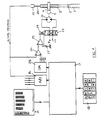
- Crown adjustment rack 1 is pinned via clevis pin 2 to threaded adjustment rod 3, which engages with screw threads in the bore of wormheel 4 driven by hydraulic motor 6 via spindle 7 and worm 5.
- Elements 3, 4, and 5 constitute the moving portions of the on/off position control loop system hydraulic jack.
- Hydraulic oil is supplied to hydraulic motor 6 via solenoid valve 8 and flow control valve module 9, the oil coming from a pressure source P and returning to tank.
- Two solenoids 10 and 12 of solenoid valve 8 are energized as required by electronic computer 17 via a signal from digital output board 14 (such as the P10-12 board made by Metrabyte Corporation of Taunton, Massachusetts) to solid state relays 11 and 13 respectively.
- An extension rod 20 attached to adjustment rod 3 is attached to the core of linear variable differential transformer (LVDT) 15, such as those made by Schaevitz Corporation of Pennsauken, New Jersey.
- LVDT 15 acts as a transducer to sense axial movement of extension rod 20 and the corresponding axial movement of rod 3, and sends an analog signal proportional to displacement of rod 3 to computer 17 via analog digital converter board 16 (such as the DAS-16 board made by Metrabyte Corporation).
- analog digital converter board 16 such as the DAS-16 board made by Metrabyte Corporation.
- Other transducer types such as potentiometers or "Tem- posonics" transducers made by MTS Corporation of Eden Prairie, Minnesota could also be used.
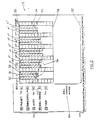
- FIG. 2 there is shown an enlarged diagrammatic view of the screen of computer display 19.
- Display 19, which is preferably in color, is illustrated as monochromatic due to the black and white limitations of the drawings.
- Display 19 is illustrated for a mill having 4 bearings and 5 saddles on each backing shaft.
- Each saddle location is represented as a respective group of graph bars 31 and 32, separated from each other by scales 32a.
- Central bar 31 is a graphic representation of the preset rack position, as determined and established by computer 17 in response to keyboard commands by the operator, as described below.
- Side bars 32 are a graphic representation of the actual rack position as measured by LVDT 15. The lengths of both side bars 32 vary concomitantly with each other.
- display 19 may use other methods, preferably graphic, to display the preset rack positions and actual rack positions, as well as any other relevant information.
- central bar 31 and side bars 32 represent the preset rack positions and actual rack positions, respectively.
- the scale is inverted relative to the actual rack position because the scale is intended to represent the upper work roll position to the operator. Because of the geometry of the eccentric ring, the upper work roll actually moves up as the rack moves down. Thus, the top of the scale 39 represents the fully down rack position, while the bottom of the scale 37 represent the fully up rack position.
- the ends of bars 31 form the preset crown shape, as indicated by line 35.
- the ends of bars 32 represent the actual crown shape, as indicated by line 34.
- line 37 and "roll change" range indicator 40 are not normally displayed on the monitor.
- computer 17 is programmed to prevent the movement of any rack and the setting of any preset rack position outside of the working range.
- the lower ends of central bar 31 or side bars 32 can only be positioned between the top of the scale 39 and line 38, i.e. within the working range, during normal operation.
- Display 19 also includes mode indicating indicia 33, specifically illustrated as “preset”, “immediate”, “auto”, “roll change”, and “stop”. Each of the indicia represents an operational mode of the computer control system. An indicator is displayed or illuminated next to the appropriate mode indicator indicia 33, and is used to indicate the current operational mode of the system, respectively identified as 41a, 41b, 41c, 41d and 41 e. Legend 33a is shown at the bottom of display 19, and indicates the commands corresponding to the keys on keyboard 18 which may be used to adjust the racks.
- the position of each particular rack is controlled by a position control loop.
- a position control loop One type is an on/off position control loop, such as is utilized with the embodiments shown in FIGS. 1 and 3.
- Another type is a proportional position control loop, as is utilized with the embodiments shown in FIGS. 4 and 5.
- the operation of the mill computer control system varies between the on/off position control loop and the proportional position control loop.
- the mill computer control system will first be described in combination with an on/off position control loop, as is used with the embodiments shown in FIGS. 1 and 3. Following that complete description, the proportional position control loop as is used with the embodiments shown in FIGS. 4 and 5 will be detailed.
- the on/off position control loop function is performed by the computer. Based on selections made by the operator, the mill computer control system generates a "command" rack position for each rack. When a change in the actual rack position is desired, a new "preset” rack position is selected by the operator, as described below. After a new preset rack position is selected, the command rack position is changed by the computer 17 and the position control loop function of the computer system is activated to effect the change in actual rack position, beginning by comparing the actual position of each rack, based on the signal from the position indicating LVDT 15, to the respective command rack position.
- the position control loop energizes the appropriate position control mechanism, such as solid state relay 11 or 13 ( Figure 1) to move the position of rack 1 until its actual position corresponds to the command rack position.
- An allowable tolerance range referred to as hysteresis, is incorporated in the position control loop so that once the actual rack position is within the allowable range of the command rack position, the position control mechanism is turned off.
- the position control mechanism is activated by entering the appropriate operational mode (as described below) and remains activated until the actual rack position is within the hysteresis range of the command rack position.
- the screw jacks of Figures 1 and 3 do not allow drift, so active position control is not necessary.
- the position control loop becomes inactive until a further change in the actual rack position is to be effected.
- the position control loop When the position control loop is active, rather than constantly monitoring the actual rack position of each rack, the position control loop continuously sequentially monitors the actual rack position of each rack in comparison to the corresponding command rack position for that rack. Once an actual rack position has been sampled, and the position control mechanism energized if necessary, the position control loop then monitors the actual rack position at the next saddle location, performing the same analysis and continuing on to each subsequent saddle location until the actual rack positions at all saddle locations have been sampled and analyzed in this manner. This cycle may be completely performed several times a second.
- the position control loop deenergizes that rack's position control mechanism, and continues on thereafter to the next sequential saddle location.
- the position control loop is continually monitoring the actual rack positions at all saddle locations by endlessly and sequentially cycling through all saddle locations as described. Once all of the racks have reached the new command rack positions, the position control loop becomes inactive.
- a new preset rack position is selected by the operator, and new command rack positions will be set by the mill control system when one of the appropriate operational modes is entered, as described below.
- the position control loop operates to drive the actual position of the racks to the position corresponding to the new command rack position.
- the movement of any individual rack is subject to a permissive condition which is set up to prevent excessive bending of the backing shafts of the mill and possible overloading of some saddles or bearings.
- the shaft curvature is calculated based on the actual rack position of the rack being monitored, and of the actual rack positions at the neighboring saddle locations. (Neighboring saddle locations are not limited to the immediate neighbors.) If excessive curvature is present, the movement of that rack will be stopped, and reevaluated during the next monitoring cycle of the control loop. Once the curvature of the roll at that particular saddle location returns to within the permissive curvature, movement will be restarted.
- the mill computer control system includes five operational modes, identified as preset, immediate, auto, roll change and stop. Any particular operational mode is entered by executing the appropriate key stroke commands on keyboard 18, such as depressing the key corresponding to the first letter of the operational mode, as illustrated in the Figures.
- the preset mode allows adjustments to the preset rack positions to be made without immediately effecting a change in the command rack position or the actual rack position. While the system is in the preset mode, the position control loop is inactive, precluding any movement of the racks.
- the preset mode it is possible to adjust the preset rack position at a single saddle.
- computer 17 selects a "current saddle", at which the preset rack position can be adjusted up or down by depressing the up arrow or down arrow on keyboard 18.
- the preset rack positions at other saddle locations may also be individually adjusted up or down by depressing the left or right arrow key until the desired saddle location becomes the "current" saddle location.
- the speed of change of the preset rack positions is controlled by the computer based on the program instructions.
- Display 19 highlights the "current" saddle location which has been selected by the operator using the left arrow key or right arrow key, displaying central bar 31 of the "current” saddle in a different color, or in the case of a monochrome display, in different intensity or cross-hatching from that of the other saddles.
- the position of the lower end of central bar 31 moves concomitantly with the changes selected by depressing either the up arrow or down arrow key, to reflect the new preset rack position being set by the operator.
- the corresponding central bar 31 is appropriately highlighted to identify the "current” saddle.
- All of the preset rack positions may also be simultaneously moved up or down an equal amount, for example, by depressing the "U” key or the "D” key respectively.
- the preset mode it is also possible to adjust the preset crown shape by changing all of the preset rack positions simultaneously by making the appropriate keyboard entry on keyboard 18, or any other appropriate means for inputting instructions to the computer 17.
- This can be accomplished, for example, by depressing the "+” key to make the preset crown shape more convex, and by depressing the "-" key to make the preset crown shape less convex.
- the ends of the respective central bars 31 move accordingly in response to the "+" or the "-" keys to reflect graphically on display 19 the changes to the preset rack positions which are being made.
- the more convex form of the crown shape is illustrated by line 34 in Figure 2, while the less convex form is illustrated by line 35.
- the preset rack positions of the two outermost saddle locations are normally moved equally in the opposite direction in reference to the movement of the center saddle preset rack position. This enables full convex or concave profiles to be obtained, since at maximum convex crown, the preset rack position at the innermost saddle location will then be at one end of the working range and the preset rack position at the two outermost saddle locations will be at the other end of the working range.
- the system maintains or preserves the individual saddle location adjustments to the corresponding command rack positions even though the crown form of the roll gap or the tilt of the crown form is modified.
- the vertical positions of the preset rack positions are determined according to at least one following predetermined equation which is stored in the memory of the computer 17.
- the predetermined equation is:
- the computer program sets the rate at which the coefficients K 1 , K 2 , K h and K s are changed.Once the command rack positions and the actual rack positions become equal to the preset rack positions, they are also given by the above formulas.
- formula (I) is a parabolic formula
- any algebraic equation including, for example, polynomial, exponential and linear equations
- the system may be set up to accommodate shifts in the horizontal location of the apex of the crown as well as the horizontal location of the center of the tilt function.
- formula (I) is the preferred embodiment of the predetermined equation, and other algebraic equations may be used without departing from this invention.
- the first permissive condition is that the preset rack position as indicated by the bottom of central bar 31 must not be moved outside of the working range. In other words, the bottom of any bar 31 must not go above line 39 or below line 38.
- the second permissive condition is the excessive bending permissive condition described above with respect to the position control loop. An excessive bend is diagrammatically shown at 36 in Fig. 2. When applied in the preset mode, the excessive bending permissive condition prevents the preset rack position, and the corresponding bottom of any central bar 31 from being moved to a location which would cause excessive bending of the backing shafts of the mill once the position control loop is activated, as described below.
- the next step is to effect these changes in the mill by changing the command rack positions and activating the position control loop. This is accomplished by placing the mill computer control system in the auto mode by depressing the appropriate button on keyboard 18.
- the preset mode indicator 41a When the auto mode is entered from the preset mode, the preset mode indicator 41a is deleted and the auto mode indicator 41c is displayed.
- the command rack positions are set equal to the preset rack positions and the position control loop is activated, which then detects any difference between the newly set command rack position and the actual rack position; and operates as described above by energizing the appropriate position control mechanism in order to drive the actual rack position toward the command rack position, as appropriate, at each saddle location.
- the movements at all saddle locations will be complete.
- the mill computer control system will automatically switch to the stop mode, and indicate this by deleting the auto mode indicator 41c and displaying the stop mode indicator 41e.
- the position control loop is inactive and the actual rack position indicator bars 32 will be substantially equal in length to the corresponding central preset rack position bars 31.
- the stop mode may also be entered directly from any other operational mode by the operator by depressing the appropriate key, such as "S".
- the stop mode deactivates the position control loop.
- the stop mode is entered prior to the completion of all of the rack movements to the new command rack positions, at least one rack will be stopped short of its ultimate destination, and the length of the respective indicator bar 32 will be different from bar 31.
- the auto mode or immediate mode
- the position control loop will be reactivated, and the rack will again be driven toward the command rack position, stopping when such command rack positions are achieved or when the stop mode is again entered.
- the mill computer control system may also be operated in the immediate mode, which may be entered by depressing the appropriate key on keyboard 18. This causes any mode indicator being displayed to be deleted and immediate mode indicator 41 b to be displayed.
- the preset rack positions may be adjusted exactly as described above with reference to the preset mode.
- the command rack positions are immediately set equal to the preset rack positions, and the position control loop is active and immediately senses any changes made in the command rack positions.
- the position control loop immediately begins to drive the corresponding racks in the appropriate directions upon any change to the preset rack positions.
- the corresponding preset rack position bar 31 will progressively increase in length, and the actual rack position bars 32 will tend to follow bar 31.
- the rate of change (as predetermined by the computer program with respect to the coefficients as described above) of the preset rack position (and, concommitantly, the command rack position) will be at least slightly greater than the rate of change of the actual rack position so as to preclude undesirable cyclical operation of relays 10 and 12 (or solid state relays 11 and 13).
- the length of central preset rack position bar 31 will no longer change, and bars 32 will "catch up" to bar 31 and both will remain at the newly selected position.
- the immediate mode will be selected.
- the crown of the roll can be increased or decreased by hitting the "+” or “-” keys, and the tilt of the roll can be trimmed using the "/" or “ ⁇ ” keys while a strip is being rolled.
- the mill computer control system thus allows contemporaneous adjustment of the relative tightness of the front and the rear edges of the strip being rolled, and ensures that the strip tracks straight down the middle of the mill.
- the ability to control the crown of the roll using two pushbuttons is of vast benefit to mill operators, and obviates the need for using 10 pushbuttons (for a mill having 5 saddles/shaft) or 5 separate sidewire controls.
- individual drives can still be adjusted in the immediate mode by using the four arrow keys on keyboard 18.
- the last mode of operation is the roll change mode. This mode is utilized when there is no strip in the mill, and all rolls have been removed from the mill. It is intended to aid the maintenance department during the changing of the two backing shaft assemblies containing the crown adjusting pinions upon which the crown adjusting racks act. Before removing these assemblies from the mill it is necessary to withdraw the racks from engagement with the pinions, otherwise parts will become damaged.
- the roll change mode is selected by hitting the key Ron keyboard 18. This will cause roll change indicator 41 d to be displayed, and any other indicator to be deleted. Also line 37 and roll change range sign 40 will appear on the display.
- the crown adjusting racks must be operated individually to engage them with the crown pinions on the backing shafts. This is done very carefully with a mechanic lying in the mill with a flashlight to check that the engagement takes place properly.
- the operator uses the left and right direction keys on keyboard 18 to select the saddle. First the crown adjustment rack at the back of the mill is selected. Then the operator uses the up direction key to drive the rack down into engagement (with bars 31 and 32 moving concomitantly upwardly) with the crown pinions, stopping and starting as instructed by the mechanic, until the rack is correctly engaged with the pinions, the bottom of bars 31 and 32 will then be above line 38.
- the computer control system deenergizes relays 11 and 13 for all 5 saddle positions.
- Computer 17 examines the 5 transducer output signals to determine the 5 actual rack positions, and displays these 5 positions on display 19 using the respective outer bars 32.
- Computer 17 sets the preset rack positions for the 5 saddle locations equal to the respective 5 actual rack positions and displays these preset rack positions using inner bars 31. This process avoids transient conditions at start up.
- Fig. 3 shows a mill control system for a type 2 crown positioning system, where an AC electric motor 21 is used in place of hydraulic motor 6 of fig. 1.
- AC electric motor 21 is used in place of hydraulic motor 6 of fig. 1.
- reversing contactor 22 is used, with " forward" and “ reverse” coils of contactor 22 being actuated by solid state relays 11 and 13.
- the operation of the mill control system of Fig. 3 is identical to that described above for the mill control system of Fig. 1.
- Fig. 4 shows an embodiment of the present invention which is configured for a system having type 1 drives.
- the on-off position control loop of Fig. 1 is replaced by a proportional closed loop positioning system.
- the position of rack 1 and adjusting screw 3 is sensed by transducer 15 as described above in reference to Fig. 1.
- the command rack position set by computer 17 is converted to a suitably scaled analog command rack position signal by analog/digital interface board 28 (such as the DT 2815 made by Data Translation Corporation of Marlboro, Massachusetts).
- analog signal is fed to the positive input of differential amplifier 26 with the actual rack position analog signal from transducer 15 being fed to the negative input of differential amplifier 26.
- the signal generated at the output of differential amplifier 26 represents the error signal which is proportional to the difference between the command rack position and the actual rack position.
- the output signal of differential amplifier 26 is suitably amplified, fed to the input of servoamplifier 25, whose output drives coil 24 of servovalve 23 with a current which is proportional to the error signal, the current being sensed by resistor27.
- Coil 24 is connected so that the current causes the servovalve to deliver proportional oil flow to hydraulic motor 21 in such a direction as to drive the actual rack position towards the command rack position.
- the rack is therefore driven at a speed which is proportional to the difference between the actual rack position and the command rack position.
- FIG. 5 Another embodiment is shown in Fig. 5 for a system having type 3 drives.
- the position control system is functionally identical to the embodiment of Fig. 4 although the hydraulic motor/worm/wormheel/screw combination shown in Fig. 4 has been replaced by hydraulic cylinder 30, which is connected to rack 1 by piston rod 29 and clevis pin 2.
- FIG. 4 and 5 utilize a proportional position control loop, which is accompanied by several functional differences in comparison to the on/off position control loop of the embodiment of Figures 1 and 3.
- the position control loop function is performed by a separate D.C. analog type proportional control loop rather than by the computer 17.
- these embodiments are by way of example only, and it is entirely possible to remove the error amplifier 25 shown in these examples, and to use the computer 17 to subtract the actual rack position signal from the position signal, and to send the resultant position error signal, via the digital/analog output board directly to servoamplifier 25, without departing in any way from the spirit of the invention.
- a further advantage of these embodiments of the present invention is that it is not necessary to adjust zero and span of position transducer 15. This is because the transducers can be effectively calibrated by storing their output signals at each end of the stroke in the computer's memory. Subsequently the computer calculates position sensed by the transducer by direct interpolation, comparing transducer output signal with the stored end of stroke signals.
- the proportional position control loop is always active, holding the actual rack position at the command rack position with virtually no hysteresis.
- the proportional position control loop continuously sequentially monitors the actual rack position of each rack in comparison to the corresponding command rack position for that rack, as with the on/off position control loop.
- the computer 17 continuously generates a command rack position signal for each saddle location which is delivered to the proportional position control loop.
- the position control loop actively maintains the actual rack positions equal to the respective command rack positions, thereby compensating for any drift.
- the computer 17 does not change the position signal it sends to the control loop as a step function, i.e., all at once, but rather ramps (changes) the command rack position signal from its current value to a value corresponding to the preset rack position over a period of time. If the immediate mode is entered by the operator rather than the auto mode, the ramping of the command rack position signal is dictated by the predetermined rate of change of the coefficients (as described above), since the command rack positions are immediately set equal to the preset rack positions.
- the rate of change (ramp rate) of the command rack position signal is selected so that the command rack position signal always remains at least slightly ahead of the changing actual rack position.
- the total full stroke time for the rack is 20 seconds.
- the ramp rate is slightly higher than that.
- each rack With the proportional control loop, the movement and position of each rack is simultaneouvly controlled by controlling the command rack position such that each rack reaches its final position at the same time regardless of where it started or how far it has traveled.
- This causes the racks to move simultaneously in unison in accordance with the predetermined equation, which, in the preferred embodiment, is formula (1).
- the racks move simultaneously in unison parabolically (when crown shape is preset) or linearly (when tilt is preset) rather than only to a parabolic location or a linear location.
- the predetermined equation is not parabolic, but rather a different algebraic equation, then the movement will not necessarily be "parabolic", but the positional relationships between the drives will be maintained in accordance with the terms of the predetermined equation.
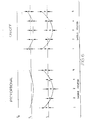
- Figures 6 and 7 illustrate the differences in the movement between the proportional position control loop and the on/off position control loop.
- Figure 6 illustrates the intermediate crown shape of the mill as the profile is changed from a flat profile at To to a parabolic crown shape profile according to formula (1) at T f for both the proportional and on/off control loops.
- the crown shape generated by the movement of the racks when controlled by the proportional control loop is illustrated as producing movement in accordance with formula (1) from start, To, to finish, T f , and maintaining the position of the racks in accordance with formula (1) at any intermediate time, T.
- the racks at the outermost saddles 1 and 5 have been moved a distance B above the reference line.
- the racks at saddles 2 and 4 have moved a distance A below the reference line
- the rack at saddle 3 has moved a distance B below the reference line.
- the on/off control loop column of Figure 6 there is illustrated the change in crown shape and accompanying movement of the racks which occurs with the on/off control loop.
- the racks at saddles 2 and 4 have moved downwardly a distance equal to A, which is their respective final positions. Since all of the racks move at the same speed, the racks at outer saddle positions 1 and 5 have also traveled the same distance A above the reference line, and the rack at saddle 3 has moved the same distance A below the reference line.
- the crown shape shown at T f illustrates the final movement of the racks at saddles 1 and 5 to their final positions, a distance B above the reference line, and of the rack at saddle 3 a distance B below the reference line.
- the final crown shape for the on/off control loop is the same as the proportional control loop, although the on/off control loop did not generate simultaneous unison movement or intermediate positions in accordance with formula (1).
- Figure 7 illustrates the same principle as Figure 6 when only tilt is present.
- the tilt profile of the mill remains linear as it moves from its initial position to its final position.
- the tilt profile rotates about saddle position 3 essentially as a straight line to reach the final position at T f , where the racks at saddles 1 and 5 have been displaced in opposite directions from the reference line a distance D, and the racks at saddles 2 and 4 have been displaced in opposite directions from the reference line a distance C.
- An intermediate, linear tilt profile is shown at T 1 .
- the on/off control loop column of Figure 7 illustrates the corresponding movement of the racks and change of the tilt profile.
- the racks at saddles 2 and 4 have traveled in opposite directions from the reference line a distance C, which is their respective final positions. Since all of the racks move at the same speed, the racks at outer saddle positions 1 and 5 have also traveled the same distance as the racks at saddle positions 2 and 4, resulting in the horizontal segments of the tilt profile between saddle positions 1 and 2 and saddle positions 4 and 5. Beyond T, only the racks at saddle positions 1 and 5 continue to move, until they have reached a distance D from the reference line as illustrated at T f .
- the tilt profile of the on/off control loop at T f is identical to the tilt profile of the proportional control loop at T f , although the movement between the initial position and the final position was not controlled according to formula (1).
- the command rack positions cannot be changed, but the preset rack positions may be changed as described above in reference to the on/off position control loop.
- the position control loop is active, the actual rack position does not change, because the command rack position and corresponding command rack position signals generated by the computer 17 do not change in the preset mode, but remain at the previous command rack positions (which in equilibrium, are the actual rack positions).
- the computer When the auto mode is entered from the preset mode, the computer immediately begins to ramp the command rack position signals toward the new preset rack position, thereby causing the position control loop to begin driving the racks. Once the new preset rack positions have been achieved by all the racks, the system automatically enters the stop mode, wherein further changes in the command rack position signals do not occur even though the position control loop remains active. Indicator bars 31 and 32 for each respective saddle location will now be equal in length.
- stop mode is entered manually from the automatic mode by the operator before the complete change of all the racks has occurred, movement of all of the racks is stopped. This is accomplished by preventing further ramping of the command rack position signals. This permits the position control loop to remain active, holding the actual rack positions equal to the respective command rack positions as they existed at the time that stop was entered. Reentering the auto mode at this point will restart the ramping process toward the preset rack position from where the process was stopped.
- the command rack position signal will exactly track any changes in the respective preset rack position. If any movement key, such as the down arrow, is depressed continuously, changes in the command rack position will occur slightly faster than changes in the actual rack position. Movements of the racks are still subject to the permissive conditions outlined above. These conditions are controlled by the computer 17 by controlling the command rack position signals so that the conditions are met. If a saddle location does not meet the conditions, further movement at that location is prevented until such time as the conditions are met. Changes in the crown shape or tilt are prevented if such changes would attempt to set the rack position outside of the working range.
- a number of additional features are enabled by using the mill computer control system. For example, if a particular crown profile is found to be effective when rolling a particular pass (defined by material to be rolled, its initial thickness, width and hardness, and its final thickness), such a profile can be stored in the computer's memory and recalled by the operator when needed. A number of such profiles can be stored.
- a stored crown profile consists (in the embodiments described) of a set of five stored rack position values, one for each of the five racks. When a stored crown profile is recalled, the respective preset rack position values are set equal to the five stored rack position values.
- a rack force profile as a set of five racks forces, one for each rack.
- the rack forces can be measured using pressure transducers (not shown) connected to each cylinder in the embodiment of Figure 5.
- pressure transducers not shown
- a particular rack force profile is found to be effective when rolling a particular pass, such a profile can be stored on the computer and recalled by the operator when needed.
- the rack force profile could be displayed on a screen similar to that shown in Figure 2 where the central bars 31 would represent the preset rack force and the outer bars 32 would represent the actual rack force.
- the rack force is actually a measure of roll separating force which should be substantially constant across the width of the strip.
- the rack force on each of the saddles which lie within the width of the strip should be substantially equal, whereas the rack force on those saddles which lie outside the width of the strip should be close to zero.
- single key press commands on computer keyboard 18 are used to activate the various functions, it is also possible to use 2 (or more) key combinations such as ⁇ CTRL> preceding other keys. This procedure has the advantage of minimizing the possibility of accidental key presses affecting the system.
- single key press commands includes such 2 (or more) key combinations.
Landscapes
- Engineering & Computer Science (AREA)
- Mechanical Engineering (AREA)
- Control Of Metal Rolling (AREA)
- Control Of Position Or Direction (AREA)
Applications Claiming Priority (2)
| Application Number | Priority Date | Filing Date | Title |
|---|---|---|---|
| US07/628,221 US5179851A (en) | 1990-12-14 | 1990-12-14 | Crown adjustment control system for cluster mills |
| US628221 | 1990-12-14 |
Publications (2)
| Publication Number | Publication Date |
|---|---|
| EP0490700A2 true EP0490700A2 (de) | 1992-06-17 |
| EP0490700A3 EP0490700A3 (en) | 1992-08-26 |
Family
ID=24517983
Family Applications (1)
| Application Number | Title | Priority Date | Filing Date |
|---|---|---|---|
| EP19910311615 Ceased EP0490700A3 (en) | 1990-12-14 | 1991-12-13 | Method of operation and control of crown adjustment system drives on cluster mills |
Country Status (3)
| Country | Link |
|---|---|
| US (1) | US5179851A (de) |
| EP (1) | EP0490700A3 (de) |
| JP (1) | JPH07314010A (de) |
Families Citing this family (5)
| Publication number | Priority date | Publication date | Assignee | Title |
|---|---|---|---|---|
| US6826941B2 (en) | 2000-12-29 | 2004-12-07 | Ronald L. Plesh, Sr. | Roller apparatus with improved height adjustability |
| KR100832985B1 (ko) * | 2001-07-13 | 2008-05-27 | 주식회사 포스코 | 정밀도가 높은 판재의 압연방법 |
| US6997938B2 (en) * | 2002-02-12 | 2006-02-14 | Scimed Life Systems, Inc. | Embolic protection device |
| US7765844B2 (en) * | 2007-12-20 | 2010-08-03 | Intergrated Industrial Systems, Inc. | Prestressed rolling mill housing assembly with improved operational features |
| CN114260316B (zh) * | 2020-09-16 | 2024-04-05 | 宝山钢铁股份有限公司 | 森吉米尔轧机第二中间辊的从动辊 |
Family Cites Families (33)
| Publication number | Priority date | Publication date | Assignee | Title |
|---|---|---|---|---|
| US2169711A (en) * | 1935-07-16 | 1939-08-15 | American Rolling Mill Co | Rolling mill adjustment |
| NL62082C (de) * | 1935-07-16 | |||
| DE698450C (de) * | 1936-10-16 | 1940-11-11 | Tadeusz Sendzimir | ei Bandwalzwerken |
| LU29117A1 (de) * | 1948-06-10 | |||
| US2982901A (en) * | 1956-04-27 | 1961-05-02 | Gen Electric | Repositioning selective control system |
| BE634026A (de) * | 1962-06-26 | |||
| US3287946A (en) * | 1963-12-30 | 1966-11-29 | Allis Chalmers Mfg Co | Automatic gauge control with manual adjustment |
| US3478559A (en) * | 1966-05-20 | 1969-11-18 | Natalis H Polakowski | Flexible strip rolling mill |
| US3566638A (en) * | 1968-05-29 | 1971-03-02 | Textron Inc | Screwdown system for a rolling mill |
| US3644897A (en) * | 1970-01-15 | 1972-02-22 | Robertshaw Controls Co | Automatic control point adjustment system and method |
| US3976981A (en) * | 1971-03-02 | 1976-08-24 | Rosemount Engineering Company Limited | Multi-channel control systems |
| JPS5024902B2 (de) * | 1972-01-28 | 1975-08-19 | ||
| US4022040A (en) * | 1975-09-25 | 1977-05-10 | T. Sendzimir, Inc. | Method of operation and control of crown adjustment system drives on cluster mills |
| US4037087A (en) * | 1976-05-27 | 1977-07-19 | Bethlehem Steel Corporation | Rolling mill control method and apparatus having operator update of presets |
| US4125004A (en) * | 1977-07-12 | 1978-11-14 | Amtel, Inc. | Rolling mill gauge control system |
| US4156359A (en) * | 1977-10-19 | 1979-05-29 | T. Sendzimir, Inc. | Method of operation of crown adjustment system drives on cluster mills |
| GB2021809B (en) * | 1977-11-22 | 1982-04-07 | Loewy Robertson Eng Co Ltd | Mill control |
| DE2911621A1 (de) * | 1978-03-31 | 1979-10-04 | Loewy Robertson Eng Co Ltd | Verfahren zum betreiben eines walzwerks zur erzeugung von metallbaendern |
| DE2835514C2 (de) * | 1978-08-12 | 1982-12-02 | Sundwiger Eisenhütte Maschinenfabrik Grah & Co, 5870 Hemer | Vorrichtung zum axialen Verschieben von konischen Zwischenwalzen in einem Mehrrollen-Walzgerüst |
| GB2038218B (en) * | 1978-12-29 | 1982-10-20 | Sendzimir Inc T | Roll gap adjustment system for cluster mills |
| JPS5630014A (en) * | 1979-08-17 | 1981-03-26 | Kobe Steel Ltd | Rolling mill |
| US4289013A (en) * | 1979-08-29 | 1981-09-15 | Textron, Inc. | Crown control for rolling mill |
| JPS5861908A (ja) * | 1981-10-09 | 1983-04-13 | Mitsubishi Heavy Ind Ltd | 多段クラスタ圧延機のロ−ルクラウン零調装置 |
| JPS58116915A (ja) * | 1981-12-28 | 1983-07-12 | Mitsubishi Heavy Ind Ltd | 多段クラスタ圧延機の板形状制御方法 |
| JPS61255710A (ja) * | 1985-05-10 | 1986-11-13 | Mitsubishi Heavy Ind Ltd | クラスタ圧延機の形状制御装置 |
| JPS61296904A (ja) * | 1985-06-26 | 1986-12-27 | Nippon Steel Corp | 圧延機 |
| JPH0659490B2 (ja) * | 1986-01-29 | 1994-08-10 | 三菱重工業株式会社 | クラスタ圧延機の形状制御方法 |
| JPS6316804A (ja) * | 1986-07-07 | 1988-01-23 | Kawasaki Steel Corp | 多段クラスタ圧延機における板形状制御方法 |
| JPS63132710A (ja) * | 1986-11-21 | 1988-06-04 | Kobe Steel Ltd | 多段圧延機のクラウン制御方法 |
| US4839818A (en) * | 1987-09-25 | 1989-06-13 | Essex Group, Inc. | Magnet wire oven control apparatus |
| JPH01113104A (ja) * | 1987-10-23 | 1989-05-01 | Kobe Steel Ltd | 多段圧延機のクラウン制御方法 |
| US5010756A (en) * | 1988-11-29 | 1991-04-30 | Kabushiki Kaisha Kobe Seiko Sho | Method of and apparatus for controlling shape of rolled material on multi-high rolling mill |
| EP0401685B2 (de) * | 1989-06-05 | 2000-03-08 | Kawasaki Steel Corporation | Vielwalzengerüst |
-
1990
- 1990-12-14 US US07/628,221 patent/US5179851A/en not_active Expired - Fee Related
-
1991
- 1991-11-27 JP JP3312436A patent/JPH07314010A/ja active Pending
- 1991-12-13 EP EP19910311615 patent/EP0490700A3/en not_active Ceased
Also Published As
| Publication number | Publication date |
|---|---|
| EP0490700A3 (en) | 1992-08-26 |
| JPH07314010A (ja) | 1995-12-05 |
| US5179851A (en) | 1993-01-19 |
Similar Documents
| Publication | Publication Date | Title |
|---|---|---|
| US3253438A (en) | Automatic strip gauge control for a rolling mill | |
| US4651547A (en) | Process for adjusting the thickness and profile of a flat product in the course of rolling | |
| US4486841A (en) | Bending press | |
| EP0523205B1 (de) | Walz- oder walzgiessanlage mit einer messeinrichtung zur walzspaltregelung und verfahren zu deren betrieb | |
| KR940010442B1 (ko) | 만능형압연대용 조정장치 | |
| US4481800A (en) | Cold rolling mill for metal strip | |
| US3496744A (en) | Method and apparatus for controlling the contours of rolling mill rolls to obtain metal sheet or strip of superior flatness | |
| US4711109A (en) | Controlling thickness and planarity of hot rolled strips | |
| NO865334L (no) | Maskin til krumning av blikk. | |
| US5179851A (en) | Crown adjustment control system for cluster mills | |
| US5509285A (en) | Method and apparatus for measuring flatness and rolling control apparatus | |
| US4463586A (en) | Auto wrap angle/positioner for shape sensing roll | |
| US4289013A (en) | Crown control for rolling mill | |
| US5243902A (en) | Hydraulic bending press with movable lower platen | |
| KR870001491B1 (ko) | 금속의 압연방법 | |
| US5949684A (en) | Automatic roll groove alignment | |
| JP7587026B2 (ja) | 金属ストリップの圧延のための装置および方法 | |
| KR0148612B1 (ko) | 쌍교차 압연기의 가역압연 제어방법 | |
| EP0500324B1 (de) | Verfahren und Vorrichtung zur Steuerung der hydraulischen Anstellung in einem Walzwerk | |
| CA1111934A (en) | Method and apparatus for providing improved automatic gage control setup in a rolling mill | |
| JP3142186B2 (ja) | 板圧延機の圧延制御方法 | |
| JPH0459048B2 (de) | ||
| US5109687A (en) | Device for adjustment of barrel width of roll type straightener | |
| JPS59110407A (ja) | ロ−ルスタンド | |
| KR100325334B1 (ko) | 연속냉간압연에서의판두께제어방법 |
Legal Events
| Date | Code | Title | Description |
|---|---|---|---|
| PUAI | Public reference made under article 153(3) epc to a published international application that has entered the european phase |
Free format text: ORIGINAL CODE: 0009012 |
|
| AK | Designated contracting states |
Kind code of ref document: A2 Designated state(s): DE FR GB IT |
|
| PUAL | Search report despatched |
Free format text: ORIGINAL CODE: 0009013 |
|
| AK | Designated contracting states |
Kind code of ref document: A3 Designated state(s): DE FR GB IT |
|
| 17P | Request for examination filed |
Effective date: 19921125 |
|
| 17Q | First examination report despatched |
Effective date: 19940511 |
|
| GRAG | Despatch of communication of intention to grant |
Free format text: ORIGINAL CODE: EPIDOS AGRA |
|
| STAA | Information on the status of an ep patent application or granted ep patent |
Free format text: STATUS: THE APPLICATION HAS BEEN REFUSED |
|
| 18R | Application refused |
Effective date: 19980305 |