EP0493602A1 - Procede de production de 2',3'-didesoxy-2',3'-dideshydronucleoside - Google Patents
Procede de production de 2',3'-didesoxy-2',3'-dideshydronucleoside Download PDFInfo
- Publication number
- EP0493602A1 EP0493602A1 EP91911951A EP91911951A EP0493602A1 EP 0493602 A1 EP0493602 A1 EP 0493602A1 EP 91911951 A EP91911951 A EP 91911951A EP 91911951 A EP91911951 A EP 91911951A EP 0493602 A1 EP0493602 A1 EP 0493602A1
- Authority
- EP
- European Patent Office
- Prior art keywords
- dideoxy
- general formula
- catalyst
- reaction system
- reaction
- Prior art date
- Legal status (The legal status is an assumption and is not a legal conclusion. Google has not performed a legal analysis and makes no representation as to the accuracy of the status listed.)
- Withdrawn
Links
- 0 *CC(C=C1)OC1S Chemical compound *CC(C=C1)OC1S 0.000 description 5
Images




Classifications
-
- C—CHEMISTRY; METALLURGY
- C07—ORGANIC CHEMISTRY
- C07D—HETEROCYCLIC COMPOUNDS
- C07D473/00—Heterocyclic compounds containing purine ring systems
-
- C—CHEMISTRY; METALLURGY
- C07—ORGANIC CHEMISTRY
- C07D—HETEROCYCLIC COMPOUNDS
- C07D405/00—Heterocyclic compounds containing both one or more hetero rings having oxygen atoms as the only ring hetero atoms, and one or more rings having nitrogen as the only ring hetero atom
- C07D405/02—Heterocyclic compounds containing both one or more hetero rings having oxygen atoms as the only ring hetero atoms, and one or more rings having nitrogen as the only ring hetero atom containing two hetero rings
- C07D405/04—Heterocyclic compounds containing both one or more hetero rings having oxygen atoms as the only ring hetero atoms, and one or more rings having nitrogen as the only ring hetero atom containing two hetero rings directly linked by a ring-member-to-ring-member bond
Definitions
- the present invention relates to a method of manufacturing 2',3'-dideoxy-2',3'-didehydronucleosides.
- 2',3'-dideoxy-2'3'-didehydronucleosides which are known to exhibit resistances to virus and cancer, known as anti-HIV agents and, thus, useful as raw materials of medicines, are represented by general formula (I) given below: where R1 denotes a hydroxyl group which may have a protective group in some cases, and B represents purine base or pyrimidine base.
- the known methods exemplified above involve many treating steps and use costly reagents as raw materials in many cases.
- the known methods are low in yield, unsatisfactory in economy and, thus, are not suitable for the industrial application.
- the present invention which has been achieved in an attempt to overcome the above-noted defects inherent in the prior arts, is intended to provide a method which permits manufacturing 2',3'-dideoxy-2',3'-didehydronucleosides easily and at a low cost.
- a ribonucleoside derivative represented by general formula (II) is used as a starting material.
- the ribonucleocide derivative available in the nature can be used in the present invention.
- the starting material (II) can be obtained by conversion from a ribonucleoside derivative represented by general formula (IV) given below, which can be prepared by a known method; where R1 is a hydroxyl group which may have a protective group in some cases, and B is purine base or pyrimidine base.
- R1 included in the ribonucleoside derivative represented by general formula (II) denotes a hydroxyl group which may have a protective group in some cases.
- the protective group includes, for example, acyl groups such as acetyl, propionyl, pivaloyl and benzoyl; aralkyl groups such as trityl; alkyl carbonyl groups such as ethoxy carbonyl and t-butoxy carbonyl; aryl carbonyl groups such as phenoxy carbonyl; and triorganosilyl groups such as t-butyl dimethyl silyl.
- the protective group is not necessarily restricted to those exemplified above.
- the phenyl group may be a substituted phenyl group having a substituent of, for example, a halogen atom, an alkyl group, a nitro group or an alkoxy group.
- the group R2 included in the rebonucleoside derivative represented by general formula (II) denotes an alkyl group such as methyl or ethyl, or a phenyl group which may have a substituent in some cases.
- the group B included in the ribonucleoside derivative represented by general formula (II) denotes a series of bases consisting of pyrimidine bases and purine bases.
- the pyrimidine base includes, for example, uracil, cytosine, thymine, 5-fluorouracil, 5-chlorouracil, 5-bromouracil, 5-iodouracil, 5-ethyluracil, 5-trifluoromethyl uracil, and 5-carboxyl uracil.
- the purine base includes, for example, adenine, guanine, hypoxanthine, xanthine, 2-chloropurine, 6-chloropurine, 2,6-dichloropurine, 2-amino-6-chloropurine, 2,6-diaminopurine, 6-mercaptopurine, 6-methyl thiopurine and 2-aminopurine.
- the pyrimidine base and the purine base need not be restricted to those exemplified above.
- the method of the present invention comprises step (a) in which a chemical reaction is carried out between a ribonucleoside derivative (II) and an acid anhydride so as to obtain an intermediate product (III) and step (b) in which the intermediate product (III) is subjected to decarboxylation treatment by heating or the like so as to obtain a desired product of 2',3'-dideoxy-2',3'-didehydronucleoside.
- the reaction in step (a) is carried out in the presence of a catalyst.
- a free acid is neutralized by, for example, the addition of a base in step (b) so as to carry out the decarboxylation under a neutral or basic condition.
- reaction should be carried out at 0 to 200°C for 30 minutes to 24 hours.
- the acid anhydride reacting with the ribonucleoside derivative (II) in step (a) includes, for example, acetic anhydride, chloroacetic anhydride, dichloroacetic anhydride, trichloroacetic anhydride, trifluoroacetic anhydride, benzoic anhydride, and propionic anhydride.
- acetic anhydride chloroacetic anhydride, dichloroacetic anhydride, trichloroacetic anhydride, trifluoroacetic anhydride, benzoic anhydride, and propionic anhydride.
- These anhydrides can be used singly or together with another solvent, as desired, such as xylene, N,N-dimethyl formamide, butyl acetate or nitrobenzene.
- the group R3 included in the intermediate product (III) represents an acyl group portion of the acid anhydride noted above.
- the catalyst used in step (a) includes, for example, solid acids such as hydrous zirconium oxide, hydrous titanium oxide, hydrous aluminum oxide, hydrous tin oxide, titanium oxide, zirconium oxide, silica gel, alumina, and zeolite; organic acids such as acetic acid, propionic acid, and p-toluene-snlfonic acid; mineral acids such as hydrochloric acid, sulfuric acid and phosphoric acid; and an acidic ion exchange resin. It is particularly desirable to use hydrous zirconium oxide (HZO) as the catalyst. In this case, the intermediate product (III) can be accumulated within the reaction system in a short time.
- solid acids such as hydrous zirconium oxide, hydrous titanium oxide, hydrous aluminum oxide, hydrous tin oxide, titanium oxide, zirconium oxide, silica gel, alumina, and zeolite
- organic acids such as acetic acid, propionic acid, and p-toluene-sn
- step (a) proceeds even in the absence of a catalyst. In this case, however, the forming rate of the intermediate product (III) is very low as in the conventional method.
- the intermediate product (III) formed in step (a) is partially converted into the desired product of 2',3'-dideoxy-2', 3'-didehydronucleoside (I) in step (a).
- the glycoside bond of compound (I) thus formed is cleaved by the acid present within the reaction system and, thus, compound (I) is decomposed. It follows that it is desirable to finish the reaction for forming the intermediate product (III) in a short time. In other words, the yield of the desired product (I) is lowered with increase in the reaction time.
- the intermediate product (III) formed in step (a) is subjected to a decarboxylation treatment so as to convert the intermediate product (III) into the desired compound of 2',3'-dideoxy-2',3'-didehydronucleoside (I).
- the decarboxylation treatment in step (b) is carried out in a neutral or basic reaction system and, thus, a base is added to the reaction system in step (b). If the decarboxylation treatment is carried out under an acidic condition, the glycoside bond of the nucleoside is cleaved, with the result that the nucleoside is decomposed into a base and a sugar part.
- the expression "neutral or basic” condition referred to above denotes that the reaction system is not acidic.
- the base used in step (b) for rendering the reaction system neutral or basic includes, for example, amines such as triethyl amine, n-tributyl amine, and pyridine; metal alkoxides such as sodium methoxide and sodium ethoxide; basic ion exchange resin; and inorganic bases such as sodium hydrogencarbonate and sodium hydride.
- the ribonucleoside derivative (II) does not react with the acid anhydride so as to stop formation of the intermediate product (III).
- the reaction product is purified by the ordinary method such as the extraction method or recrystallization method so as to obtain the desired compound of 2',3'-dideoxy-2',3'-didehydronucleosides represented by general formula (I).
- a de-protection treatment is applied for the purifying purpose, as desired.
- the method of the present invention comprises step (a) in which a chemical reaction between a ribonucleoside derivative (II) and an acid anhydride is carried out in the presence of a catalyst so as to obtain an intermediate product (III) with a high yield, and step (b) in which the intermediate product (III) is subjected to a decarboxylation treatment by heating.
- step (b) is carried out under an acidic condition, the glycoside bond of the intermediate product (III) is cleaved, with the result that the purine base or pyrimidine base denoted by B in general formula (III) is separated.
- step (b) the reaction system in step (b) is rendered neutral or basic so as to prevent the intermediate product (III) from being decomposed by an acid and, thus, to obtain the desired compounds of 2',3'-dideoxy-2',3'-didehydronucleosides with a high yield.
- 0.02 g (0.11 mmol) of hydrated p-toluene sulfonate was added to a suspension prepared by adding 2.00 g (7.75 mmol) of 5-methyl uridine to 10 ml of methyl orthoformate. The resultant mixture was kept stirred overnight at room temperature. Then, the liquid material was neutralized with 21 ⁇ l of 28% sodium methoxide in methanol, followed by removing the solvent under a reduced pressure. Then, 12 ml of acetic anhydride was added to the residue, and the mixture was heated at 100°C for one hour.
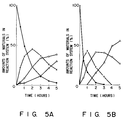
- Fig. 1 is a graph showing the results. In the graph of Fig.
- Fig. 1 the materials present in the reaction system, which are defined as follows:
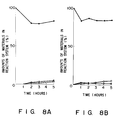
- Example 2 the decomposition product was detected in only three hours later in Example 2 in which the amine was added only once. On the other hand, the decomposition product was not detected more than 5 hours in Example 3 in which the amine was added every hour. It should be noted in this connection that the amine added to the reaction system is consumed for the neutralization of acetic acid which is generated in the reaction system to form the intermediate product, with the result that it is difficult to maintain the reaction system neutral or basic.
- the rate of decrease in the amount of the starting material is low in the case where a catalyst is not used. Clearly, the conversion rate from the starting material into the intermediate product is low. In the case of using hydrous zirconium oxide as a catalyst, however, the amount of the starting material is rapidly decreased to form the intermediate product, as apparent from Figs. 1 to 5C. In the case of using silicon dioxide (Fig. 6) and acetic acid as a catalyst (Fig. 7), the rate of decrease in the amount of the starting material is somewhat improved. However, the improvement is insufficient.
- Example 14 5'-O-acetyl-2',3'-dideoxy- 2',3'-didehydroinosine was manufactured in the same treatment as in Example 4, except that a mixed liquid consisting of acetic anhydride (Ac2O) and nitrobenzene (PhNO2) in mixing amounts shown in Table 3 was used as a solvent in these Examples 14 to 17 in place of acetic anhydride used in Example 4.
- the reaction time between the HZO addition and the n-tributylamine addition was set at 0.75 hour.
- Example 17 1.0 ml (4.5 mmol) of n-tributylamine was added to the reaction mixture.
- Table 3 also shows the product yield in each of these Examples.
- Table 3 Example Ac2O (mmol) PhNO2 (ml) Yield (%) 14 2.25 2.8 7 15 4.50 2.6 21 16 9.0 2.2 18 17 4.5 2.6 9
- Example 18 5'-O-acetyl-2',3'-dideoxy- 2',3'-didehydroinosine was manufactured in the same treatment as in Example 4, except that 3.0 ml of propionic anhydride was used as solvent in Example 18 in place of acetic anhydride used in Example 4. The product yied in Example 18 was 21%.
- Example 27 SiO2 was used as a catalyst in an amount three times as large as in the ordinary case. Also, TiO2 used in Example 28 was of rutil type.
- HEO hydrous aluminum oxide and hydrous tin oxide
- AcOH acetic acid and molecular shieve 4A (i.e., zeolite available on the market), respectively.
- Example 23 The treatments similar to those of Example 23 were carried out so as to obtain 5'-O-(t-butyl diphenyl silyl)-2',3'-dideoxy-2',3'-didehydroinosine, except that a mixed solution containing acetic anhydride (Ac2O) and xylene in amounts as shown in Table 6 was used as a solvent in place of acetic anhydride used in Example 23, and that the reaction time between the HZO addition and the n-tributylamine addition was set at one hour in Examples 33 to 35.
- Table 6 Example Ac2O (mmol) Xylene (ml) Yield (%) 33 1.125 1.4 20 34 2.25 1.3 16 35 4.5 1.1 16
- Example 23 The treatments similar to those of Example 23 were carried out so as to obtain 5'-O-(t-butyl diphenyl silyl)-2',3'-dideoxy-2',3'-didehydroinosine, except that a mixed solution containing 2.25 mmol of acetic anhydride and 1.3 ml of xylene was used as a solvent in place of acetic anhydride used in Example 23, an acidic ion exchange resin was used as a catalyst in Example 36, and that the reaction time between the catalyst addition and the n-tributylamine addition was set at 3 hours in Example 36.
- the product yield in Example 36 was 21%.
- Example 23 The treatments similar to those of Example 23 were carried out so as to obtain 5'-O-(t-butyl diphenyl silyl)-2',3'-dideoxy-2',3'-didehydroinosine, except that a mixed solution containing 2.25 mmol of acetic anhydride and 1.3 ml of xylene was used as a solvent in place of acetic anhydride used in Example 23, the reaction time between the HZO addition and the subsequent addition of a base was set at 0.5 hour in Examples 37 to 39, and that the base materials shown in Table 7 were used in Examples 37 to 39 in place of n-tributylamine used in Example 23. Table 7 also shows the product yield. Table 7 Example Base (ml) Yield (%) 37 2,6-ruthidine 1.5 15 38 di-isobutylamine 1.5 4 39 dicyclohexylamine 1.5 8
- Example 23 The treatments similar to those of Example 23 were carried out so as to obtain 5'-O-(t-butyl diphenyl silyl)-2',3'-dideoxy-2',3'-didehydroinosine, except that a mixed solution containing 2.25 mmol of acetic anhydride and 1.3 ml of xylene was used as a solvent in place of acetic anhydride used in Example 23, the reaction time between the HZO addition and the subsequent addition of a base was set as shown in Table 8, and that the reaction temperature during the reaction time noted above was set as shown in Table 8. In Example 44, n-tributylamine was added to the reaction system in an amount of 0.5 ml (2.25 mmol). Table 8 also shows the product yield. Table 8 Example Reaction Temp. Reaction Time Yield (%) 40 100°C 1.5 hours 24 41 110°C 1.0 hour 15 42 120°C 1.0 hour 28 43 140°C 0.5 hour 8 44 130°C 0.5 hour 22
- Example 23 The treatments similar to those of Example 23 were carried out, except that a catalyst was not used and that n-tributylamine was added to the reaction system in an amount of 3.0 ml in Comparative Example 9.
- the amount of 5'-O-(t-butyl diphenyl silyl)-2',3'-dideoxy-2',3'-didehydroinosine was measured 6.0 hours after the initiation of the reaction.
- the product yield was found to be 1%.
- Example 23 The treatments similar to those of Example 23 were carried out, except that a catalyst was not used and a mixture liquid consisting of 2.25 mmol of acetic anhydride and 1.3 ml of xylene was used as a solvent in place of acetic anhydride used in Example 23, and that n-tributyl-amine was added to the reaction system in an amount of 3.0 ml in Comparative Example 10.
- the amount of 5'-O-(t-butyl diphenyl silyl)-2',3'-dideoxy- 2',3'-didehydroinosine was measured 5.0 hours after the initiation of the reaction. The product yield was found to be 1%.
- N6-5'-0-diacetyl-2',3'-methoxymethylidene adenosine was dissolved in 1.0 ml of acetic anhydride. Then, the treatments as in Example 45 were carried out, resulting in failure to obtain of N6-5'-0-dibenzyl-2',3'-dideoxy-2',3'-didehydroadenocine.
Landscapes
- Chemical & Material Sciences (AREA)
- Organic Chemistry (AREA)
- Low-Molecular Organic Synthesis Reactions Using Catalysts (AREA)
Abstract
Applications Claiming Priority (4)
| Application Number | Priority Date | Filing Date | Title |
|---|---|---|---|
| JP20042190 | 1990-07-27 | ||
| JP200421/90 | 1990-07-27 | ||
| JP33864990 | 1990-11-30 | ||
| JP338649/90 | 1990-11-30 |
Publications (2)
| Publication Number | Publication Date |
|---|---|
| EP0493602A1 true EP0493602A1 (fr) | 1992-07-08 |
| EP0493602A4 EP0493602A4 (en) | 1993-01-20 |
Family
ID=26512183
Family Applications (1)
| Application Number | Title | Priority Date | Filing Date |
|---|---|---|---|
| EP19910911951 Withdrawn EP0493602A4 (en) | 1990-07-27 | 1991-06-26 | Process for producing 2',3'-dideoxy-2',3'-didehydronucleoside |
Country Status (2)
| Country | Link |
|---|---|
| EP (1) | EP0493602A4 (fr) |
| WO (1) | WO1992002516A1 (fr) |
Cited By (1)
| Publication number | Priority date | Publication date | Assignee | Title |
|---|---|---|---|---|
| US7816513B2 (en) | 2003-06-16 | 2010-10-19 | Ajinomoto Co., Inc. | Inosine derivatives and production methods therefor |
Family Cites Families (6)
| Publication number | Priority date | Publication date | Assignee | Title |
|---|---|---|---|---|
| JPS5828279B2 (ja) * | 1975-08-28 | 1983-06-15 | ヤマサ醤油株式会社 | ウリジンユウドウタイノセイゾウホウ |
| JPS5293779A (en) * | 1976-01-31 | 1977-08-06 | Teikoku Chem Ind Corp Ltd | 5-substituted or non-substituted uracil derivatives and their preparat ion |
| JPS53108982A (en) * | 1977-03-01 | 1978-09-22 | Sanyo Kokusaku Pulp Co Ltd | Preparation of pseudoisocytidine and its acid addition salt |
| JPS53147089A (en) * | 1977-05-30 | 1978-12-21 | Ajinomoto Co Inc | Lactone derivatives |
| JPS6383048A (ja) * | 1986-09-25 | 1988-04-13 | Mect Corp | 炭素環c−ヌクレオシド前駆体及びその製造方法 |
| US4904770A (en) * | 1988-03-24 | 1990-02-27 | Bristol-Myers Company | Production of 2',3'-dideoxy-2',3'-didehydronucleosides |
-
1991
- 1991-06-26 EP EP19910911951 patent/EP0493602A4/en not_active Withdrawn
- 1991-06-26 WO PCT/JP1991/000857 patent/WO1992002516A1/fr not_active Ceased
Cited By (2)
| Publication number | Priority date | Publication date | Assignee | Title |
|---|---|---|---|---|
| US7816513B2 (en) | 2003-06-16 | 2010-10-19 | Ajinomoto Co., Inc. | Inosine derivatives and production methods therefor |
| US8288526B2 (en) | 2003-06-16 | 2012-10-16 | Ajinomoto Co., Inc. | Inosine derivatives and production methods therefor |
Also Published As
| Publication number | Publication date |
|---|---|
| WO1992002516A1 (fr) | 1992-02-20 |
| EP0493602A4 (en) | 1993-01-20 |
Similar Documents
| Publication | Publication Date | Title |
|---|---|---|
| US6090932A (en) | Method of preparation of known and novel 2'-modified nucleosides by intramolecular nucleophilic displacement | |
| US5426183A (en) | Catalytic stereoselective glycosylation process for preparing 2'-deoxy-2',2'-difluoronucleosides and 2'-deoxy-2'-fluoronucleosides | |
| US5606048A (en) | Stereoselective glycosylation process for preparing 2'-Deoxy-2', 2'-difluoronucleosides and 2'-deoxy-2'-fluoronucleosides | |
| EP0587364B1 (fr) | Procédé pour l'anomérisation des nucléosides | |
| US4851519A (en) | Pyrimidine derivatives | |
| EP0547910B1 (fr) | Procédé pour la préparation de 2-chloro-2'-déoxyadénosine | |
| US5218106A (en) | 2',3'-dideoxy-2'-fluoronucleosides | |
| CN115362161B (zh) | 用于制备3’-o-氨基-2’-脱氧核糖核苷-5’-三磷酸的方法 | |
| IL158185A (en) | Process for the preparation of 2'-halo-beta-l-arabinofuranosyl nucleosides | |
| EP0389110B1 (fr) | Procédé pour préparer la 2'-déoxy-5-trifluorméthyl-ss-uridine | |
| US5310895A (en) | Method for production of nucleoside derivatives by selective hydrolysis | |
| EP0493602A1 (fr) | Procede de production de 2',3'-didesoxy-2',3'-dideshydronucleoside | |
| Hancox et al. | Some reactions of 4′-thionucleosides and their sulfones | |
| US5264561A (en) | Method of manufacturing 2',3'-dideoxy-2',3'-didehydronucleosides | |
| SK278598B6 (en) | Method for preparation of deoxynucleosides | |
| US5817639A (en) | Purine 4'-thioarabinonucleosides | |
| WO1993023415A1 (fr) | SYNTHESE CHIMIQUE DE 2',3'-DIDESOXYNUCLEOSIDE 5'-(α-THIO)TRIPHOSPHATES | |
| JPH0717670B2 (ja) | ヌクレオシド誘導体の製造方法 | |
| JP2870901B2 (ja) | 選択的加水分解によるジデオキシヌクレオシド誘導体の製造方法 | |
| JP2747849B2 (ja) | 2’―デオキシヌクレオシド類の選択的アシル化方法 | |
| US6175005B1 (en) | Process for the preparation of cyclic ethers containing an o-silylated hydroxyl group | |
| JPWO1992002516A1 (ja) | 2′,3′―ジデオキシ―2′,3′―ジデヒドロヌクレオシド類の製造方法 | |
| JP3006009B2 (ja) | 選択的加水分解によるヌクレオシド誘導体の製造方法 | |
| KR910005899B1 (ko) | 3'-데옥시 아라비노 프라노실 피리미딘 누클레오시드 유도체 | |
| JPH10226697A (ja) | 2’−o−シリル環状ケイ素化ヌクレオシド誘導体、その製造方法及びこれを用いた2’−o−シリルヌクレオシドの製造方法 |
Legal Events
| Date | Code | Title | Description |
|---|---|---|---|
| PUAI | Public reference made under article 153(3) epc to a published international application that has entered the european phase |
Free format text: ORIGINAL CODE: 0009012 |
|
| 17P | Request for examination filed |
Effective date: 19920327 |
|
| AK | Designated contracting states |
Kind code of ref document: A1 Designated state(s): DE FR GB |
|
| A4 | Supplementary search report drawn up and despatched |
Effective date: 19921130 |
|
| AK | Designated contracting states |
Kind code of ref document: A4 Designated state(s): DE FR GB |
|
| 17Q | First examination report despatched |
Effective date: 19950814 |
|
| RAP1 | Party data changed (applicant data changed or rights of an application transferred) |
Owner name: YUKI GOSEI KOGYO CO., LTD. Owner name: JAPAN TOBACCO INC. |
|
| STAA | Information on the status of an ep patent application or granted ep patent |
Free format text: STATUS: THE APPLICATION IS DEEMED TO BE WITHDRAWN |
|
| 18D | Application deemed to be withdrawn |
Effective date: 19960227 |