EP0493968A1 - Procédé et dispositif pour mouler un membre annulaire - Google Patents
Procédé et dispositif pour mouler un membre annulaire Download PDFInfo
- Publication number
- EP0493968A1 EP0493968A1 EP91312042A EP91312042A EP0493968A1 EP 0493968 A1 EP0493968 A1 EP 0493968A1 EP 91312042 A EP91312042 A EP 91312042A EP 91312042 A EP91312042 A EP 91312042A EP 0493968 A1 EP0493968 A1 EP 0493968A1
- Authority
- EP
- European Patent Office
- Prior art keywords
- lower mold
- extruded
- receiving surface
- segments
- extruder
- Prior art date
- Legal status (The legal status is an assumption and is not a legal conclusion. Google has not performed a legal analysis and makes no representation as to the accuracy of the status listed.)
- Withdrawn
Links
- 238000000034 method Methods 0.000 title claims abstract description 13
- 239000000463 material Substances 0.000 claims abstract description 89
- 238000001125 extrusion Methods 0.000 claims description 11
- 229920001971 elastomer Polymers 0.000 abstract description 16
- 239000005060 rubber Substances 0.000 abstract description 16
- 239000011324 bead Substances 0.000 abstract description 2
- 239000000945 filler Substances 0.000 abstract description 2
- 239000000470 constituent Substances 0.000 abstract 1
- 238000010276 construction Methods 0.000 description 5
- 238000001816 cooling Methods 0.000 description 4
- 230000007246 mechanism Effects 0.000 description 2
- 230000008602 contraction Effects 0.000 description 1
Images

Classifications
-
- B—PERFORMING OPERATIONS; TRANSPORTING
- B29—WORKING OF PLASTICS; WORKING OF SUBSTANCES IN A PLASTIC STATE IN GENERAL
- B29C—SHAPING OR JOINING OF PLASTICS; SHAPING OF MATERIAL IN A PLASTIC STATE, NOT OTHERWISE PROVIDED FOR; AFTER-TREATMENT OF THE SHAPED PRODUCTS, e.g. REPAIRING
- B29C31/00—Handling, e.g. feeding of the material to be shaped, storage of plastics material before moulding; Automation, i.e. automated handling lines in plastics processing plants, e.g. using manipulators or robots
- B29C31/04—Feeding of the material to be moulded, e.g. into a mould cavity
- B29C31/042—Feeding of the material to be moulded, e.g. into a mould cavity using dispensing heads, e.g. extruders, placed over or apart from the moulds
- B29C31/047—Feeding of the material to be moulded, e.g. into a mould cavity using dispensing heads, e.g. extruders, placed over or apart from the moulds combined with moving moulds
-
- B—PERFORMING OPERATIONS; TRANSPORTING
- B29—WORKING OF PLASTICS; WORKING OF SUBSTANCES IN A PLASTIC STATE IN GENERAL
- B29C—SHAPING OR JOINING OF PLASTICS; SHAPING OF MATERIAL IN A PLASTIC STATE, NOT OTHERWISE PROVIDED FOR; AFTER-TREATMENT OF THE SHAPED PRODUCTS, e.g. REPAIRING
- B29C48/00—Extrusion moulding, i.e. expressing the moulding material through a die or nozzle which imparts the desired form; Apparatus therefor
- B29C48/001—Combinations of extrusion moulding with other shaping operations
-
- B—PERFORMING OPERATIONS; TRANSPORTING
- B29—WORKING OF PLASTICS; WORKING OF SUBSTANCES IN A PLASTIC STATE IN GENERAL
- B29C—SHAPING OR JOINING OF PLASTICS; SHAPING OF MATERIAL IN A PLASTIC STATE, NOT OTHERWISE PROVIDED FOR; AFTER-TREATMENT OF THE SHAPED PRODUCTS, e.g. REPAIRING
- B29C48/00—Extrusion moulding, i.e. expressing the moulding material through a die or nozzle which imparts the desired form; Apparatus therefor
- B29C48/001—Combinations of extrusion moulding with other shaping operations
- B29C48/0022—Combinations of extrusion moulding with other shaping operations combined with cutting
-
- B—PERFORMING OPERATIONS; TRANSPORTING
- B29—WORKING OF PLASTICS; WORKING OF SUBSTANCES IN A PLASTIC STATE IN GENERAL
- B29C—SHAPING OR JOINING OF PLASTICS; SHAPING OF MATERIAL IN A PLASTIC STATE, NOT OTHERWISE PROVIDED FOR; AFTER-TREATMENT OF THE SHAPED PRODUCTS, e.g. REPAIRING
- B29C48/00—Extrusion moulding, i.e. expressing the moulding material through a die or nozzle which imparts the desired form; Apparatus therefor
- B29C48/03—Extrusion moulding, i.e. expressing the moulding material through a die or nozzle which imparts the desired form; Apparatus therefor characterised by the shape of the extruded material at extrusion
- B29C48/07—Flat, e.g. panels
-
- B—PERFORMING OPERATIONS; TRANSPORTING
- B29—WORKING OF PLASTICS; WORKING OF SUBSTANCES IN A PLASTIC STATE IN GENERAL
- B29C—SHAPING OR JOINING OF PLASTICS; SHAPING OF MATERIAL IN A PLASTIC STATE, NOT OTHERWISE PROVIDED FOR; AFTER-TREATMENT OF THE SHAPED PRODUCTS, e.g. REPAIRING
- B29C48/00—Extrusion moulding, i.e. expressing the moulding material through a die or nozzle which imparts the desired form; Apparatus therefor
- B29C48/03—Extrusion moulding, i.e. expressing the moulding material through a die or nozzle which imparts the desired form; Apparatus therefor characterised by the shape of the extruded material at extrusion
- B29C48/09—Articles with cross-sections having partially or fully enclosed cavities, e.g. pipes or channels
-
- B—PERFORMING OPERATIONS; TRANSPORTING
- B29—WORKING OF PLASTICS; WORKING OF SUBSTANCES IN A PLASTIC STATE IN GENERAL
- B29C—SHAPING OR JOINING OF PLASTICS; SHAPING OF MATERIAL IN A PLASTIC STATE, NOT OTHERWISE PROVIDED FOR; AFTER-TREATMENT OF THE SHAPED PRODUCTS, e.g. REPAIRING
- B29C48/00—Extrusion moulding, i.e. expressing the moulding material through a die or nozzle which imparts the desired form; Apparatus therefor
- B29C48/03—Extrusion moulding, i.e. expressing the moulding material through a die or nozzle which imparts the desired form; Apparatus therefor characterised by the shape of the extruded material at extrusion
- B29C48/131—Curved articles
-
- B—PERFORMING OPERATIONS; TRANSPORTING
- B29—WORKING OF PLASTICS; WORKING OF SUBSTANCES IN A PLASTIC STATE IN GENERAL
- B29C—SHAPING OR JOINING OF PLASTICS; SHAPING OF MATERIAL IN A PLASTIC STATE, NOT OTHERWISE PROVIDED FOR; AFTER-TREATMENT OF THE SHAPED PRODUCTS, e.g. REPAIRING
- B29C48/00—Extrusion moulding, i.e. expressing the moulding material through a die or nozzle which imparts the desired form; Apparatus therefor
- B29C48/15—Extrusion moulding, i.e. expressing the moulding material through a die or nozzle which imparts the desired form; Apparatus therefor incorporating preformed parts or layers, e.g. extrusion moulding around inserts
- B29C48/154—Coating solid articles, i.e. non-hollow articles
- B29C48/155—Partial coating thereof
-
- B—PERFORMING OPERATIONS; TRANSPORTING
- B29—WORKING OF PLASTICS; WORKING OF SUBSTANCES IN A PLASTIC STATE IN GENERAL
- B29C—SHAPING OR JOINING OF PLASTICS; SHAPING OF MATERIAL IN A PLASTIC STATE, NOT OTHERWISE PROVIDED FOR; AFTER-TREATMENT OF THE SHAPED PRODUCTS, e.g. REPAIRING
- B29C48/00—Extrusion moulding, i.e. expressing the moulding material through a die or nozzle which imparts the desired form; Apparatus therefor
- B29C48/25—Component parts, details or accessories; Auxiliary operations
- B29C48/266—Means for allowing relative movements between the apparatus parts, e.g. for twisting the extruded article or for moving the die along a surface to be coated
-
- B—PERFORMING OPERATIONS; TRANSPORTING
- B29—WORKING OF PLASTICS; WORKING OF SUBSTANCES IN A PLASTIC STATE IN GENERAL
- B29C—SHAPING OR JOINING OF PLASTICS; SHAPING OF MATERIAL IN A PLASTIC STATE, NOT OTHERWISE PROVIDED FOR; AFTER-TREATMENT OF THE SHAPED PRODUCTS, e.g. REPAIRING
- B29C48/00—Extrusion moulding, i.e. expressing the moulding material through a die or nozzle which imparts the desired form; Apparatus therefor
- B29C48/25—Component parts, details or accessories; Auxiliary operations
- B29C48/30—Extrusion nozzles or dies
- B29C48/32—Extrusion nozzles or dies with annular openings, e.g. for forming tubular articles
- B29C48/335—Multiple annular extrusion nozzles in coaxial arrangement, e.g. for making multi-layered tubular articles
-
- B—PERFORMING OPERATIONS; TRANSPORTING
- B29—WORKING OF PLASTICS; WORKING OF SUBSTANCES IN A PLASTIC STATE IN GENERAL
- B29C—SHAPING OR JOINING OF PLASTICS; SHAPING OF MATERIAL IN A PLASTIC STATE, NOT OTHERWISE PROVIDED FOR; AFTER-TREATMENT OF THE SHAPED PRODUCTS, e.g. REPAIRING
- B29C2793/00—Shaping techniques involving a cutting or machining operation
- B29C2793/0027—Cutting off
-
- B—PERFORMING OPERATIONS; TRANSPORTING
- B29—WORKING OF PLASTICS; WORKING OF SUBSTANCES IN A PLASTIC STATE IN GENERAL
- B29C—SHAPING OR JOINING OF PLASTICS; SHAPING OF MATERIAL IN A PLASTIC STATE, NOT OTHERWISE PROVIDED FOR; AFTER-TREATMENT OF THE SHAPED PRODUCTS, e.g. REPAIRING
- B29C48/00—Extrusion moulding, i.e. expressing the moulding material through a die or nozzle which imparts the desired form; Apparatus therefor
-
- B—PERFORMING OPERATIONS; TRANSPORTING
- B29—WORKING OF PLASTICS; WORKING OF SUBSTANCES IN A PLASTIC STATE IN GENERAL
- B29C—SHAPING OR JOINING OF PLASTICS; SHAPING OF MATERIAL IN A PLASTIC STATE, NOT OTHERWISE PROVIDED FOR; AFTER-TREATMENT OF THE SHAPED PRODUCTS, e.g. REPAIRING
- B29C48/00—Extrusion moulding, i.e. expressing the moulding material through a die or nozzle which imparts the desired form; Apparatus therefor
- B29C48/03—Extrusion moulding, i.e. expressing the moulding material through a die or nozzle which imparts the desired form; Apparatus therefor characterised by the shape of the extruded material at extrusion
-
- B—PERFORMING OPERATIONS; TRANSPORTING
- B29—WORKING OF PLASTICS; WORKING OF SUBSTANCES IN A PLASTIC STATE IN GENERAL
- B29C—SHAPING OR JOINING OF PLASTICS; SHAPING OF MATERIAL IN A PLASTIC STATE, NOT OTHERWISE PROVIDED FOR; AFTER-TREATMENT OF THE SHAPED PRODUCTS, e.g. REPAIRING
- B29C48/00—Extrusion moulding, i.e. expressing the moulding material through a die or nozzle which imparts the desired form; Apparatus therefor
- B29C48/03—Extrusion moulding, i.e. expressing the moulding material through a die or nozzle which imparts the desired form; Apparatus therefor characterised by the shape of the extruded material at extrusion
- B29C48/12—Articles with an irregular circumference when viewed in cross-section, e.g. window profiles
-
- B—PERFORMING OPERATIONS; TRANSPORTING
- B29—WORKING OF PLASTICS; WORKING OF SUBSTANCES IN A PLASTIC STATE IN GENERAL
- B29C—SHAPING OR JOINING OF PLASTICS; SHAPING OF MATERIAL IN A PLASTIC STATE, NOT OTHERWISE PROVIDED FOR; AFTER-TREATMENT OF THE SHAPED PRODUCTS, e.g. REPAIRING
- B29C48/00—Extrusion moulding, i.e. expressing the moulding material through a die or nozzle which imparts the desired form; Apparatus therefor
- B29C48/15—Extrusion moulding, i.e. expressing the moulding material through a die or nozzle which imparts the desired form; Apparatus therefor incorporating preformed parts or layers, e.g. extrusion moulding around inserts
- B29C48/154—Coating solid articles, i.e. non-hollow articles
-
- B—PERFORMING OPERATIONS; TRANSPORTING
- B29—WORKING OF PLASTICS; WORKING OF SUBSTANCES IN A PLASTIC STATE IN GENERAL
- B29D—PRODUCING PARTICULAR ARTICLES FROM PLASTICS OR FROM SUBSTANCES IN A PLASTIC STATE
- B29D30/00—Producing pneumatic or solid tyres or parts thereof
- B29D30/06—Pneumatic tyres or parts thereof (e.g. produced by casting, moulding, compression moulding, injection moulding, centrifugal casting)
- B29D30/48—Bead-rings or bead-cores; Treatment thereof prior to building the tyre
- B29D2030/481—Fillers or apexes
-
- B—PERFORMING OPERATIONS; TRANSPORTING
- B29—WORKING OF PLASTICS; WORKING OF SUBSTANCES IN A PLASTIC STATE IN GENERAL
- B29L—INDEXING SCHEME ASSOCIATED WITH SUBCLASS B29C, RELATING TO PARTICULAR ARTICLES
- B29L2030/00—Pneumatic or solid tyres or parts thereof
-
- B—PERFORMING OPERATIONS; TRANSPORTING
- B29—WORKING OF PLASTICS; WORKING OF SUBSTANCES IN A PLASTIC STATE IN GENERAL
- B29L—INDEXING SCHEME ASSOCIATED WITH SUBCLASS B29C, RELATING TO PARTICULAR ARTICLES
- B29L2031/00—Other particular articles
- B29L2031/709—Articles shaped in a closed loop, e.g. conveyor belts
- B29L2031/7096—Rings or ring-like articles
Definitions
- This invention relates to an apparatus and a method for forming an annular member by the use of an extruder.
- annular members are often used, which are made of annular rubbers having heights in their radial direction relatively larger than thicknesses in their axial directions.
- Such annular members have been formed in the following manner as disclosed, for example, Japanese Patent Application Laid-open No. 1-314,151.
- a rubber is extruded by an extruder to form belt-shaped rubbers which are then transferred to a conical-trapezoid mold by turning transferred directions with the aid of a plurality of rollers.
- the belt-shaped rubbers are then attached to the outer conical circumferential surface of the mold by means of attaching rollers.
- the belt-shaped rubbers are cooled without being restrained therearound after they are extruded from the extruder. Therefore, amounts of elongation or contraction of the rubbers are locally different which make it very difficult to obtain a desired contour (cross-sectional shape) of the rubbers.
- the cooled belt-shaped rubbers are attached to the mold to obtain an annular member having a larger height in the radial direction relative to its thickness.
- Such an annular member has the outer circumference much larger than the inner circumference.
- the belt-shaped rubbers are locally deformed from attached positions due to internal stresses therein so that the shape of the belt-shaped rubbers are changed in various manner.
- the plural rollers are needed for turning the transferred directions and attaching the rubbers to the mold, which make the apparatus complicated in construction and expensive.
- the apparatus for forming an annular member comprises at least one lower mold having a receiving surface, rotating means for rotating the lower mold about the rotating axis perpendicular to the receiving surface, and an extruder having a mouthpiece arranged closely adjacent the receiving surface of the lower mold for extruding a material through the mouthpiece so as to adhere to the receiving surface of the rotating lower mold to form an arcuately curved extruded material on the receiving surface of the lower mold.
- the method for forming an annular member comprises steps of rotating at least one lower mold having a receiving surface dividable into plural segments about the rotating axis perpendicular to the receiving surface, extruding a material through a mouthpiece of an extruder so as to adhere onto the receiving surface to form an arcuately curved extruded material on the receiving surface, cutting the extruded material substantially along divided lines of the lower mold, removing and transferring the lower mold segment having the extruded material adhering thereon from a forming unit, gathering together such lower mold segments each having the extruded material to restore the original lower mold, and joining ends of the extruded materials adhering to the lower mold segments to form an endless annular member.
- the lower mold having the receiving surface is rotated about the rotating axis perpendicular to the receiving surface, while a material is extruded through the mouthpiece of the extruder so as to adhere to the receiving surface to form an arcuately curved extruded material thereon.
- the extruded material is progressively cooled with the lapse of time. During the cooling, the extruded material adheres to the receiving surface of the lower mold, so that the material is strongly restrained by the receiving surface to maintain the shape of the material being extruded.
- the extruded material adheres to the receiving surface of the lower mold substantially at the same time as it is extruded or during its is soft and fragile at a high temperature so that it is not deformed even if the outer circumference is much longer than the inner circumference of the extruded material. Further, high accuracy roundness of the extruded material can be ensured because it is extruded and adheres to the receiving surface of the rotating lower mold. Moreover, the material is extruded from the extruder directly to the lower mold and adheres thereto. Therefore, the apparatus becomes simple in construction and inexpensive without requiring rollers for turning directions and attaching the material to the mold in the prior art.
- the extruded arcuate material on the receiving surface is cut substantially along divided lines of the lower mold dividable into plural lower mold segments.
- the lower mold segment having the extruded material adhering thereto is then removed from the forming unit and transferred to a restoration position where the plural lower mold segments having extruded materials adhering thereto are gathered together to restore or form the original lower mold.
- the gathered lower mold segments include the arcuate extruded materials adhering thereon, respectively, to form as a whole an annular member. Ends of the arcuate extruded materials adhering to the lower mold segments are joined with each other to form an endless annular member.
- a pair of support means 11 are arranged on a floor 12, and horizontal lower molds 13 each in the form of an octagonal plate having at its top a flat receiving surface 14 are supported on the support means 11, respectively.
- the lower molds 13 are rotated about respective axes perpendicular to the receiving surfaces 14 in opposite directions shown by arrows (Fig. 1) by means of the support means as rotating means.
- each of the support means 11 includes a vertically moving mechanism such as a cylinder, a screw shaft or the like so that the lower mold 13 is moved to maintain the constant distance to a mouthpiece of an extruder (later described).
- Each of the lower molds 13 is split or divided into plural segments along straight lines intersecting the rotating axis of the support means 11.
- the lower mold 13 is divided into a pair of lower mold segments 15 and 16 of the same configuration.
- An elongated receiving plate 17 is arranged between the lower mold segments 15 and 16 and fixed to the support means 11.
- the lower mold segments 15 and 16 are detachably secured to the support means 11.
- Cutters 18 are provided movably along the receiving plates 17, respectively.
- each of the cutters 18 moves along the receiving plate 17 to cut the extruded material G along the divided line of the lower mold 13 in cooperation with the receiving plate 17.
- the lower mold segment 15 or 16 supporting thereon the extruded material G is removed from the support means 11 and transferred to a restoring position by means of transfer means (not shown).
- a lower mold segment 15 or 16 not having an extruded material G is brought into the position in place of the removed lower mold segment 15 or 16.
- An extruder 21 is arranged above the lower molds 13 and includes therein a passage 22 through which a material G to be extruded passes.
- the material G in this embodiment is a raw rubber which is soft and fragile and at a high temperature.
- Outlets 23 of the passage 22 open immediately above the receiving surfaces 14, respectively.
- a screw 24 is provided in the passage 22 and is adapted to be rotated to feed the material G through the passage 22 toward the outlets 23.
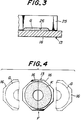
- the extruder 21 has mouthpieces 25 arranged in the proximity of or immediately above the lower molds 13. Each of the mouthpieces 25 is formed with an extrusion opening 26 of a predetermined shape (Fig. 3). The material G is extruded through the extrusion openings 26 of the mouthpieces 25 so that the two extruded materials G on the receiving surfaces 14 have a cross-section similar to the shape of the extrusion openings 26.
- the support means 11 are actuated to rotate the lower molds 13 about their rotating axes, while the extruder 21 is actuated to rotate the screw 24.
- a material G to be extruded is transferred toward the outlets 23 and urged against the receiving surfaces 14 of the lower molds 13 immediately before passing through the mouthpieces 25.
- the extruded material G is a raw rubber at a high temperature so that it adheres or sticks to the receiving surfaces 14 of the rotating lower molds 13. After the extruded material G is partially adheres to the rotating lower molds 13, the material G is extruded through the extrusion openings 26 of the mouthpieces 25 to be formed into a desired contour.
- the extruding speed of the material G and the rotating speed of the lower molds 13 are adjusted in order to assure the adhesion of the extruded material G to the receiving surfaces of the lower molds 13.
- the material G extruded from the extrusion openings is formed into arcuate or curved shapes by the rotations of the lower molds 13 in the directions of the arrows (in Fig. 1). Therefore, if the distances from the extrusion opening 26 to the rotating axes of the lower molds 13 are adjusted, radii of curvatures of the arcuately extruded material G can be modified.
- the extruded material G from the extruder 21 is progressively cooled with the lapse of time.
- the extruded material G is strongly restrained by the receiving surfaces 14 to maintain its shapes during its cooling, because it adheres to the receiving surfaces 14.
- the material G adheres to the receiving surfaces 14 of the lower molds 13 substantially the same time as the extrusion or in this embodiment immediately before the extrusion or during being soft and fragile at the high temperature. Therefore, the extruded material G is not deformed even if there is a great difference in length between inner and outer circumferences of the arcuately extruded material. Moreover, the material G is extruded against the receiving surfaces 14 of the lower molds 13 and adheres thereto so that the extruded materials are circularly formed in high roundness on the receiving surfaces 14 of the lower molds 13. Further, the material G is extruded from the extruder 21 directly to the lower molds 13 and adheres thereto. Therefore, the apparatus is simple in construction and inexpensive because any rollers are not needed for turning directions and attaching the material to the surface. Such rollers are otherwise required as in the prior art.
- the cutters 18 are moved along the divided lines between the lower mold segments 15 and 16 or the receiving plates 17 to cut the extruded materials G.
- the lower mold segments 16 each having the extruded material G adhering thereto are then removed from the forming units by means of transfer means (not shown), while the same time empty lower mold segments 16 poised on the sides of the lower molds 13 are transferred into the forming units by means of transfer means to form new lower molds 13 with the remaining lower mold segments 15, respectively.
- the extruded materials G adhering to the respective lower mold segments are joined with their ends to form an endless annular member K made of the rubber having the height in the radial direction relatively larger than its thickness.
- the cooling, transferring and joining are effected in the state of the materials G adhering to the lower mold segments 15 or 16 so that the annular member K of a desired shape can be readily obtained without being deformed.
- the receiving surfaces 14 of the lower molds 13 are flat, and at the same time the mouthpieces 25 are formed with extrusion openings 26 to produce the extruded materials G having a desired contour
- the receiving surfaces of the lower molds may be formed with recesses of predetermined shapes, or the receiving surfaces may be formed with recesses and the mouthpiece may be formed with extrusion openings to obtain extruded materials G of a desired contour.
- the lower molds 13 may be conical or frustoconical instead of disc-shaped molds in the above embodiment. While the lower molds are divided into two lower mold segments 15 and 16, they may be divided into lower mold segments more than three.
- the invention can readily obtain annular members in the form of desired shapes by the use of the apparatus simple in construction and inexpensive.
Landscapes
- Engineering & Computer Science (AREA)
- Mechanical Engineering (AREA)
- Manufacturing & Machinery (AREA)
- Robotics (AREA)
- Extrusion Moulding Of Plastics Or The Like (AREA)
- Tyre Moulding (AREA)
Applications Claiming Priority (2)
| Application Number | Priority Date | Filing Date | Title |
|---|---|---|---|
| JP416173/90 | 1990-12-29 | ||
| JP02416173A JP3107575B2 (ja) | 1990-12-29 | 1990-12-29 | 環状部材の成形装置および成形方法 |
Publications (1)
| Publication Number | Publication Date |
|---|---|
| EP0493968A1 true EP0493968A1 (fr) | 1992-07-08 |
Family
ID=18524414
Family Applications (1)
| Application Number | Title | Priority Date | Filing Date |
|---|---|---|---|
| EP91312042A Withdrawn EP0493968A1 (fr) | 1990-12-29 | 1991-12-24 | Procédé et dispositif pour mouler un membre annulaire |
Country Status (3)
| Country | Link |
|---|---|
| US (2) | US5167892A (fr) |
| EP (1) | EP0493968A1 (fr) |
| JP (1) | JP3107575B2 (fr) |
Cited By (2)
| Publication number | Priority date | Publication date | Assignee | Title |
|---|---|---|---|---|
| EP0899080A3 (fr) * | 1997-08-29 | 1999-08-11 | Bridgestone Corporation | Procédé et dispositif pour la fabrication d' éléments de remplissage pour talons de pneumatique |
| CN115609944A (zh) * | 2022-10-26 | 2023-01-17 | 中国计量大学 | 基于双凸轮驱动的橡胶圈点胶成型装置 |
Families Citing this family (12)
| Publication number | Priority date | Publication date | Assignee | Title |
|---|---|---|---|---|
| JP4491963B2 (ja) * | 2000-12-19 | 2010-06-30 | 横浜ゴム株式会社 | 円環状ゴム状弾性部材の成形方法及びその成形装置 |
| US20040089400A1 (en) * | 2002-11-08 | 2004-05-13 | Vargo Richard David | Method and apparatus for forming an annular elastomeric tire component |
| JP4589065B2 (ja) * | 2004-09-10 | 2010-12-01 | 東洋ゴム工業株式会社 | タイヤ用円環状部材の成形方法及び成形装置 |
| US7951316B2 (en) * | 2005-04-05 | 2011-05-31 | Exxonmobil Chemical Patents Inc. | Process for pipe seal manufacture |
| US20070031529A1 (en) * | 2005-08-04 | 2007-02-08 | Koch Brian R | Apparatus for forming elastomeric tire component and a tire |
| US7780809B2 (en) * | 2005-08-04 | 2010-08-24 | The Goodyear Tire & Rubber Company | Method for forming elastomeric tire component and a tire |
| US7628945B1 (en) * | 2006-02-17 | 2009-12-08 | Collins Larry P | Extruded radiused plastic articles and method of forming the same |
| EP1870229A1 (fr) * | 2006-06-23 | 2007-12-26 | Advanced Elastomer Systems, L.P. | Procédé de fabrication de un joint d'étanchéité pour tuyaux et dispositif pour la mise en oeuvre d'un tel procédé |
| JP5260378B2 (ja) * | 2009-03-27 | 2013-08-14 | 東洋ゴム工業株式会社 | 円環状部材成形方法及び円環状部材成形装置 |
| US10494459B2 (en) | 2014-10-17 | 2019-12-03 | Sumitomo Rubber Industries, Ltd. | Rubber composition for pneumatic tires |
| JP6235990B2 (ja) * | 2014-10-17 | 2017-11-22 | 住友ゴム工業株式会社 | シーラントタイヤ |
| CN106715160B (zh) | 2014-10-17 | 2019-09-03 | 住友橡胶工业株式会社 | 充气轮胎及其制造方法 |
Citations (3)
| Publication number | Priority date | Publication date | Assignee | Title |
|---|---|---|---|---|
| GB314600A (en) * | 1928-04-04 | 1929-07-04 | Dunlop Rubber Co | Improvements in or relating to the manufacture of rubber or the like tubes and apparatus therefor |
| US4198367A (en) * | 1976-08-30 | 1980-04-15 | Burrell John R | Method and apparatus for producing retreading envelopes |
| EP0019994A1 (fr) * | 1979-04-10 | 1980-12-10 | Automotive Products Public Limited Company | Procédé pour la fabrication de garnitures de friction annulaires |
Family Cites Families (17)
| Publication number | Priority date | Publication date | Assignee | Title |
|---|---|---|---|---|
| US2030211A (en) * | 1932-01-20 | 1936-02-11 | Safety Car Heating & Lighting | Apparatus for making helical carbon piles |
| US2041432A (en) * | 1933-07-15 | 1936-05-19 | Roth Carl | Cruller machine |
| US2303554A (en) * | 1940-08-02 | 1942-12-01 | Ohio Rubber Co | Apparatus for making vulcanized rubber |
| US2499397A (en) * | 1945-07-07 | 1950-03-07 | Lyon George Albert | Method of and apparatus for forming thin annular plastic articles |
| US2478199A (en) * | 1946-04-01 | 1949-08-09 | Lyon George Albert | Method and apparatus for forming plastic articles |
| US2774992A (en) * | 1949-10-04 | 1956-12-25 | Swedish Crucible Steel Company | Process of producing pearlescent plastic articles |
| US2648098A (en) * | 1949-10-04 | 1953-08-11 | Swedish Crucible Steel Company | Process for producing pearlescent plastic articles |
| US3243848A (en) * | 1962-12-12 | 1966-04-05 | James A Miller | Extruding machine with automatic metering control |
| US3326145A (en) * | 1965-05-28 | 1967-06-20 | Leonard H Austin | Feed frame |
| US3433182A (en) * | 1966-04-11 | 1969-03-18 | Thompson Bagel Machine Mfg Cor | Automatic feeding cutoff and bagel forming machine |
| DE2431385C3 (de) * | 1974-06-29 | 1980-04-24 | Hoechst Ag, 6000 Frankfurt | Verfahren und Vorrichtung zur Herstellung von verstreckten Flachfolienbahnen aus thermoplastischen Kunststoffen |
| EP0234376B1 (fr) * | 1986-02-27 | 1992-09-02 | Frisco-Findus Ag | Appareil d'extrusion |
| CH671184A5 (fr) * | 1986-11-19 | 1989-08-15 | Bucher Guyer Ag Masch | |
| FR2618329B1 (fr) * | 1987-07-22 | 1997-03-28 | Dow Corning Sa | Procede de fabrication d'un anneau capable d'assurer la liberation d'un agent therapeutique, et anneau fabrique par ce procede |
| GB8724849D0 (en) * | 1987-10-23 | 1987-11-25 | Apsley Metals Ltd | Manufacture of tyres |
| GB8809646D0 (en) * | 1988-04-23 | 1988-05-25 | Apsley Metals Ltd | Apparatus for manufacture of pneumatic tyre |
| US5069849A (en) * | 1990-02-07 | 1991-12-03 | Wain Peter L | Method for forming a molding |
-
1990
- 1990-12-29 JP JP02416173A patent/JP3107575B2/ja not_active Expired - Fee Related
-
1991
- 1991-12-24 EP EP91312042A patent/EP0493968A1/fr not_active Withdrawn
- 1991-12-30 US US07/814,459 patent/US5167892A/en not_active Expired - Lifetime
-
1992
- 1992-08-21 US US07/933,311 patent/US5297949A/en not_active Expired - Lifetime
Patent Citations (3)
| Publication number | Priority date | Publication date | Assignee | Title |
|---|---|---|---|---|
| GB314600A (en) * | 1928-04-04 | 1929-07-04 | Dunlop Rubber Co | Improvements in or relating to the manufacture of rubber or the like tubes and apparatus therefor |
| US4198367A (en) * | 1976-08-30 | 1980-04-15 | Burrell John R | Method and apparatus for producing retreading envelopes |
| EP0019994A1 (fr) * | 1979-04-10 | 1980-12-10 | Automotive Products Public Limited Company | Procédé pour la fabrication de garnitures de friction annulaires |
Cited By (3)
| Publication number | Priority date | Publication date | Assignee | Title |
|---|---|---|---|---|
| EP0899080A3 (fr) * | 1997-08-29 | 1999-08-11 | Bridgestone Corporation | Procédé et dispositif pour la fabrication d' éléments de remplissage pour talons de pneumatique |
| US6264780B1 (en) | 1997-08-29 | 2001-07-24 | Bridgestone Corporation | Method of manufacturing bead filler and apparatus for forming filler portion |
| CN115609944A (zh) * | 2022-10-26 | 2023-01-17 | 中国计量大学 | 基于双凸轮驱动的橡胶圈点胶成型装置 |
Also Published As
| Publication number | Publication date |
|---|---|
| JP3107575B2 (ja) | 2000-11-13 |
| US5167892A (en) | 1992-12-01 |
| JPH04226741A (ja) | 1992-08-17 |
| US5297949A (en) | 1994-03-29 |
Similar Documents
| Publication | Publication Date | Title |
|---|---|---|
| US5167892A (en) | Annular member forming method | |
| KR920009933B1 (ko) | 공기 타이어 제조 장치 | |
| CA1188964A (fr) | Pneu et methode d'application de produit de scellement | |
| US5203938A (en) | Method and apparatus for forming an apex filler and/or applying an apex filler to a bead ring sub-assembly | |
| EP1145835B1 (fr) | Procede de fabrication d'une carcasse de pneumatique | |
| US5709768A (en) | Apparatus with adjustable circumference made up of a plurality of interconnected shoes | |
| JP2002532285A (ja) | 自動車ホイール用タイヤの部品を製造する方法および装置 | |
| CN1498748A (zh) | 形成环形的弹性轮胎部件的方法和设备 | |
| CA2058397A1 (fr) | Methode de formation d'un pli | |
| US5011397A (en) | Apparatus for producing prevulcanized treads | |
| EP0555419A4 (fr) | Procede et appareil servant a confectionner un bourrage sur tringle et/ou a appliquer un bourrage sur tringle a un sous-ensemble talon. | |
| EP0621124A1 (fr) | Procédé et dispositif de fabrication de pneus et de stockage d'un matériau en forme de bande | |
| KR102011541B1 (ko) | 베이스 타이어에 트레드 링을 장착하기 위한 장치 및 갱생 타이어의 제조 방법 | |
| EP0737523B1 (fr) | Procédé et dispositif pour le changement rapide des rouleaux dans un dispositif de calandrage | |
| EP1127683A2 (fr) | Tambour de confection pour la fabrication d'une ceinture repliée pour pneus | |
| US4569711A (en) | Manufacture of elastomeric material coponents | |
| CA1264435A (fr) | Machine de fabrication de pneus | |
| EP1457309A1 (fr) | Tambour expensible d'enroulement des pneus et procédé de fabrication des pneus | |
| WO2010126507A1 (fr) | Appareil et procédé pour former des ceintures de pneu présentant des câbles posés à des angles variables | |
| JPH059147Y2 (fr) | ||
| EP1082207B1 (fr) | Procede et appareil de mise en forme de composants pour pneumatiques | |
| JPS63158235A (ja) | 空気入りタイヤ | |
| JPH07205332A (ja) | タイヤ用ゴム部材およびその成形方法 | |
| US1276821A (en) | Method of making solid tires. | |
| JP3938332B2 (ja) | 円環状ゴム部材の成形装置におけるダイス装置 |
Legal Events
| Date | Code | Title | Description |
|---|---|---|---|
| PUAI | Public reference made under article 153(3) epc to a published international application that has entered the european phase |
Free format text: ORIGINAL CODE: 0009012 |
|
| AK | Designated contracting states |
Kind code of ref document: A1 Designated state(s): DE ES FR GB IT |
|
| 17P | Request for examination filed |
Effective date: 19920626 |
|
| 17Q | First examination report despatched |
Effective date: 19931022 |
|
| STAA | Information on the status of an ep patent application or granted ep patent |
Free format text: STATUS: THE APPLICATION IS DEEMED TO BE WITHDRAWN |
|
| 18D | Application deemed to be withdrawn |
Effective date: 19950110 |