EP0496701A1 - Sulfonylharnstoffe als Herbizide - Google Patents
Sulfonylharnstoffe als Herbizide Download PDFInfo
- Publication number
- EP0496701A1 EP0496701A1 EP92810027A EP92810027A EP0496701A1 EP 0496701 A1 EP0496701 A1 EP 0496701A1 EP 92810027 A EP92810027 A EP 92810027A EP 92810027 A EP92810027 A EP 92810027A EP 0496701 A1 EP0496701 A1 EP 0496701A1
- Authority
- EP
- European Patent Office
- Prior art keywords
- formula
- alkyl
- methyl
- oder
- hydrogen
- Prior art date
- Legal status (The legal status is an assumption and is not a legal conclusion. Google has not performed a legal analysis and makes no representation as to the accuracy of the status listed.)
- Granted
Links
Classifications
-
- C—CHEMISTRY; METALLURGY
- C07—ORGANIC CHEMISTRY
- C07D—HETEROCYCLIC COMPOUNDS
- C07D405/00—Heterocyclic compounds containing both one or more hetero rings having oxygen atoms as the only ring hetero atoms, and one or more rings having nitrogen as the only ring hetero atom
- C07D405/02—Heterocyclic compounds containing both one or more hetero rings having oxygen atoms as the only ring hetero atoms, and one or more rings having nitrogen as the only ring hetero atom containing two hetero rings
- C07D405/12—Heterocyclic compounds containing both one or more hetero rings having oxygen atoms as the only ring hetero atoms, and one or more rings having nitrogen as the only ring hetero atom containing two hetero rings linked by a chain containing hetero atoms as chain links
-
- C—CHEMISTRY; METALLURGY
- C07—ORGANIC CHEMISTRY
- C07D—HETEROCYCLIC COMPOUNDS
- C07D521/00—Heterocyclic compounds containing unspecified hetero rings
-
- A—HUMAN NECESSITIES
- A01—AGRICULTURE; FORESTRY; ANIMAL HUSBANDRY; HUNTING; TRAPPING; FISHING
- A01N—PRESERVATION OF BODIES OF HUMANS OR ANIMALS OR PLANTS OR PARTS THEREOF; BIOCIDES, e.g. AS DISINFECTANTS, AS PESTICIDES OR AS HERBICIDES; PEST REPELLANTS OR ATTRACTANTS; PLANT GROWTH REGULATORS
- A01N47/00—Biocides, pest repellants or attractants, or plant growth regulators containing organic compounds containing a carbon atom not being member of a ring and having no bond to a carbon or hydrogen atom, e.g. derivatives of carbonic acid
- A01N47/08—Biocides, pest repellants or attractants, or plant growth regulators containing organic compounds containing a carbon atom not being member of a ring and having no bond to a carbon or hydrogen atom, e.g. derivatives of carbonic acid the carbon atom having one or more single bonds to nitrogen atoms
- A01N47/28—Ureas or thioureas containing the groups >N—CO—N< or >N—CS—N<
- A01N47/36—Ureas or thioureas containing the groups >N—CO—N< or >N—CS—N< containing the group >N—CO—N< directly attached to at least one heterocyclic ring; Thio analogues thereof
-
- C—CHEMISTRY; METALLURGY
- C07—ORGANIC CHEMISTRY
- C07D—HETEROCYCLIC COMPOUNDS
- C07D305/00—Heterocyclic compounds containing four-membered rings having one oxygen atom as the only ring hetero atoms
- C07D305/02—Heterocyclic compounds containing four-membered rings having one oxygen atom as the only ring hetero atoms not condensed with other rings
- C07D305/04—Heterocyclic compounds containing four-membered rings having one oxygen atom as the only ring hetero atoms not condensed with other rings having no double bonds between ring members or between ring members and non-ring members
- C07D305/08—Heterocyclic compounds containing four-membered rings having one oxygen atom as the only ring hetero atoms not condensed with other rings having no double bonds between ring members or between ring members and non-ring members with hetero atoms or with carbon atoms having three bonds to hetero atoms with at the most one bond to halogen, e.g. ester or nitrile radicals, directly attached to ring atoms
-
- C—CHEMISTRY; METALLURGY
- C07—ORGANIC CHEMISTRY
- C07D—HETEROCYCLIC COMPOUNDS
- C07D331/00—Heterocyclic compounds containing rings of less than five members, having one sulfur atom as the only ring hetero atom
- C07D331/04—Four-membered rings
Definitions
- the present invention relates to novel, herbicidally active and plant growth-regulating N-phenylsulfonyl-N'-pyrimidinyl-, N'-triazinyl- and N'-triazolylureas and -thioureas, processes for their preparation, agents containing them as active ingredients, and their use for combating of weeds, especially selectively in crops or to regulate and inhibit plant growth.
- Urea compounds, triazine compounds and pyrimidine compounds with herbicidal activity are generally known. Such compounds are described, for example, in European Patent Applications No. 0 007 687, 0 030 138, 0 073 562 and 0 126 711.
- halogen, fluorine, chlorine, bromine and iodine are to be understood, preferably fluorine, chlorine and bromine.
- alkyl groups occurring in the substituent definitions can be straight-chain or branched and are, for example, methyl, ethyl, n-propyl, isopropyl, n-butyl, sec-butyl, iso-butyl or tert-butyl.
- the alkyl groups which are present as or in the substituents preferably have 1-3 carbon atoms.
- Alkenyl means straight-chain or branched alkenyl, such as e.g. Vinyl, allyl, methallyl, 1-methylvinyl or but-2-en-1-yl. Alkenyl radicals with a chain length of 2 to 3 carbon atoms are preferred.
- Haloalkyl is, for example, fluoromethyl, difluoromethyl, trifluoromethyl, chloromethyl, dichloromethyl, trichloromethyl, 2,2,2-trifluoroethyl, 2-fluoroethyl, 2-chloroethyl and 2,2,2-trichlorethyl; preferably trichloromethyl, difluorochloromethyl, trifluoromethyl and dichlorofluoromethyl.
- Alkoxy is, for example, methoxy, ethoxy, propyloxy, i-propyloxy, n-butyloxy, iso-butyloxy, sec-butyloxy and tert-butyloxy; preferably methoxy and ethoxy.
- Haloalkoxy is e.g. Difluoromethoxy, trifluoromethoxy, 2,2,2-trifluoroethoxy, 1,1,2,2-tetrafluoroethoxy, 2-fluoroethoxy, 2-chloroethoxy and 2,2-difluoroethoxy; preferably difluoromethoxy, 2-chloroethoxy and trifluoromethoxy.
- Alkylthio is, for example, methylthio, ethylthio, propylthio, isopropylthio, n-butylthio, iso-butylthio, sec-butylthio or tert-butylthio, preferably methylthio and ethylthio.
- alkoxyalkoxy examples are: methoxymethoxy, methoxyethoxy, methoxypropyloxy, ethoxymethoxy, ethoxyethoxy and propyloxymethoxy.
- Alkylamino is, for example, methylamino, ethylamino, n-propylamino or iso-propylamino.
- Dialkylamino stands for example for dimethylamino, methylethylamino, diethylamino or n-propylmethylamino.
- the invention also includes the salts which the compounds of formula 1 can form with amines, alkali and alkaline earth metal bases or quaternary ammonium bases.
- alkali and alkaline earth metal hydroxides as salt formers, the hydroxides of lithium, sodium, potassium, magnesium or calcium should be emphasized, but especially those of sodium or potassium.
- amines suitable for salt formation are primary, secondary and tertiary aliphatic and aromatic amines such as methylamine, ethylamine, propylamine, isopropylamine, the four isomeric butylamines, dimethylamine, diethylamine, diethanolamine, dipropylamine, diisopropylamine, di-n-butylamine, pyrrolidine, Piperidine, morpholine, trimethylamine, triethylamine, tripropylamine, quinuclidine, pyridine, quinoline and iso-quinoline, but especially ethyl, propyl, diethyl or triethylamine, but especially iso-propylamine and diethanolamine.
- primary, secondary and tertiary aliphatic and aromatic amines such as methylamine, ethylamine, propylamine, isopropylamine, the four isomeric butylamines, dimethylamine, diethylamine
- quaternary ammonium bases are generally the cations of halogen ammonium salts, e.g. the teaamethylammonium cation, the trimethylbenzylammonium cation, the triethylbenzylammonium cation, the tetraethylammonium cation, the trimethylethylammonium cation, but also the ammonium cation.
- halogen ammonium salts e.g. the teaamethylammonium cation, the trimethylbenzylammonium cation, the triethylbenzylammonium cation, the tetraethylammonium cation, the trimethylethylammonium cation, but also the ammonium cation.
- Preferred compounds of the formula are those in which W is oxygen, Z being preferably Z1 and X being oxygen or sulfur, but particularly preferably being oxygen and E being nitrogen.
- Z is Z1 and X is oxygen or sulfur, but particularly preferably is oxygen and E is methine.
- Compounds of the formula can also be prepared by reacting a compound of formula VIII with a compound of formula V in the presence of an ammonium, phosphonium, sulfonium or alkali metal cyanate salt of formula X where M represents an alkali metal or the group R 15 R 16 R 17 R 18 Q, where R 15 R 16 R 17 R 18 independently of one another is C 1 -C 18 alkyl, benzyl or phenyl, the total number of C - Atoms is not larger than 36; and Q represents nitrogen, sulfur or phosphorus.
- the compounds N- [2- (oxetane-3-oxycarbonyl)] - phenylsulfonyl-N '- (4-methoxy-6-methyl-1,3,5-triazinyl) urea can be particularly advantageously; N- [2- (oxetan-3-oxy-carbonyl)] phenylsulfonyl-N '- (4,6-dimethyl-pyrimidin-2-yl) urea; N- [2- (oxetan-3-oxycarbonyl)] phenylsulfonyl-N '- (4-methoxy-6-methyl-pyrimidin-2-yl) urea; and produce N- [2- (oxetan-3-oxycarbonyl)] phenylsulfonyl-N '- (4,6-dimethoxypyridin-2-yl) urea.
- Such implementations are described in Swiss Patent No. 662,348.
- the reactions to compounds of the formula are advantageously carried out in aprotic, inert organic solvents.
- solvents are hydrocarbons such as benzene, toluene, xylene or cyclohexane, chlorinated hydrocarbons such as dichloromethane, trichloromethane, carbon tetrachloride or chlorobenzene, ethers such as diethyl ether, ethylene glycol dimethyl ether, diethylene glycol dimethyl ether, tetrahydrofuran or dioxane, nitriles such as acetonitrile amide or diethyl nitride such as acetonitrile or amine propyl amide or amine nitrile such as acetonitrile or amine nitrile such as acetonitrile or amine or Methyl pyrrolidinone.
- the reaction temperatures are preferably between -20 ° and +120 ° C.
- Bases include, in particular, tertiary amines such as trimethylamine, triethylamine, quinuclidine, 1,4-diazabicyclo- (2.2.2) octane, 1,5-diazabicyclo (4.3.0) non-5-ene or 1,5-diazabicyclo (5.4.0) undec-7-en suitable.
- tertiary amines such as trimethylamine, triethylamine, quinuclidine, 1,4-diazabicyclo- (2.2.2) octane, 1,5-diazabicyclo (4.3.0) non-5-ene or 1,5-diazabicyclo (5.4.0) undec-7-en suitable.
- inorganic bases such as hydrides such as sodium or calcium hydride, hydroxides such as sodium and potassium hydroxide, carbonates such as sodium and potassium carbonate or hydrogen carbonates such as potassium and sodium hydrogen carbonate can also be used as bases.
- the end products of the formula can be isolated by concentrating and / or evaporating the solvent and can be purified by recrystallizing or triturating the solid residue in solvents in which they do not dissolve well, such as ethers, aromatic hydrocarbons or chlorinated hydrocarbons.
- R 15 is preferably phenyl, which can be substituted by C 1 -C 4 -alkyl or halogen, very particularly preferably phenyl.
- the phenylsulfonamides of the formula II are new compounds which have been specially developed and manufactured for the preparation of the active compounds of the formula. They therefore form an object of the present invention. They can be obtained from the corresponding phenylsulfochlorides of the formula VIII wherein R 2 and X have the meaning given under formula, by reaction with ammonia. Such implementations are known and familiar to the person skilled in the art.
- the phenylsulfochlorides of the formula VIII are new compounds which have been specially developed and manufactured for the preparation of the active compounds of the formula. They therefore also form an object of the present invention.
- the phenylsulfochlorides of the formula VIII are prepared by the correspondingly substituted 2-chlorosulfonylbenzoylchlorides (see, for example, D. Davis, Soc. 2042, 2044 (1932)) in the presence of a base with a compound of the formula IX where X has the meaning given under formula. Such reactions are known and familiar to the person skilled in the art.
- Phenylsulfochlorides of the formula VIII, in which X is oxygen can also be prepared by reacting 2-isopropylthiobenzoic acid (see, for example, H. Gilman, FJWebb, Am. Soc 71, 4062-4063) with thionyl chloride to give the corresponding benzoic acid chloride, which is then reacted with 3-hydroxy-oxetane is converted in the presence of a base to the corresponding 2-isopropylthio-benzoic acid oxetan-3-yl ester in order finally to obtain the sulfochloride of the formula VIII by reaction with chlorine.
- 2-isopropylthiobenzoic acid see, for example, H. Gilman, FJWebb, Am. Soc 71, 4062-4063
- thionyl chloride to give the corresponding benzoic acid chloride, which is then reacted with 3-hydroxy-oxetane is converted in the presence of a base to the corresponding
- the sulfonyl carbamates and thiocarbamates of Formula IV are new and form an object of the present invention. They can be obtained, for example, by reacting the sulfonamides of the formula 11 with diphenyl carbamate or thiocarbamate in the presence of a base. Such reactions are known and familiar to the person skilled in the art.
- N-pyrimidinyl and N-triazinyl carbamates are described, for example, in EP-A-0101670.
- N-triazolyl carbamates can be prepared analogously.
- the active compounds of the formula are generally successfully used at application rates of 0.001 to 2 kg / ha, in particular 0.005 to 1 kg / ha.
- the dosage required for the desired effect can be determined by experiment. It depends on the type of action, the stage of development of the crop and the weed, and on the application (location, time, process) and, depending on these parameters, can vary within wide ranges.
- the compounds of the formula I are notable for growth-inhibiting and herbicidal properties which make them excellent for use in crops of useful plants, in particular in crops, cotton, soybeans, rapeseed, maize and rice, the use in soybean culture and cereals being very particularly preferred .
- Weed control in soybean crops is preferably carried out postemergent.
- the compounds of the formula are notable for their good degradability.
- the invention also relates to herbicidal and plant growth regulating compositions which comprise a new active ingredient of the formula I, and to processes for inhibiting plant growth.
- Plant growth regulators are substances which bring about agronomically desired biochemical and / or physiological and / or morphological changes in / on the plant.
- the active substances contained in the agents according to the invention influence plant growth in various ways depending on the time of application, dosage, type of application and environmental conditions.
- Plant growth regulators of the formula can, for example, inhibit the vegetative growth of plants. This type of effect is of interest on lawns, in ornamental plant growing, in orchards, on road embankments, on sports and industrial facilities, but also in the targeted inhibition of secondary drives such as tobacco.
- the inhibition of vegetative growth in cereals by means of stalk reinforcement leads to reduced storage, similar agronomic effects can be achieved in rapeseed, sunflowers, maize and other crops.
- the number of plants per area can be increased by inhibiting vegetative growth.
- Another area of application for growth inhibitors is the selective control of soil-covering plants in plantations or long-range crops by strong growth inhibition without killing these ground cover plants, so that competition with the main crop is eliminated, but the agronomically positive effects such as erosion prevention, nitrogen binding and soil loosening are retained.
- a process for inhibiting plant growth is to be understood as controlling natural plant development without changing the life cycle of the plant, which is determined by genetic properties, in the sense of a mutation.
- the method of growth regulation is applied at a specific point in time in the development of the plant.
- the active compounds of the formula I can be applied before or after the plants emerge, for example already on the seeds or the seedlings, on roots, bulbs, stems, leaves, flowers or other parts of plants. This can e.g. by applying the active ingredient itself or in the form of an agent to the plants and / or by treating the nutrient medium of the plant (soil).
- the dressing of the seed or the treatment of the germinated seedling are naturally the preferred methods of application, because the treatment of the active ingredient is aimed entirely at the culture of the goat.
- 0.01 g to 4.0 g of active substance per 1 kg of seed pot are used, depending on the method, which also allows the addition of other active substances or micronutrients, to deviate upwards or downwards from the specified limit concentrations (repeat stain).
- the active ingredient is applied to mineral granulate carriers or polymerized granules (urea / formaldehyde) in solution and left to dry. If necessary, a coating can be applied (coating granules), which allows the active ingredient to be dispensed in doses over a certain period of time.
- mineral granulate carriers or polymerized granules urea / formaldehyde
- a coating can be applied (coating granules), which allows the active ingredient to be dispensed in doses over a certain period of time.
- the compounds of the formula are used in unchanged form, as can be obtained from synthesis, or preferably with the auxiliaries customary in formulation technology and are therefore used, for example, in to emulsifiable concentrates, directly sprayable or dilutable solutions, diluted emulsions, wettable powders, soluble powders, dusts, granules, also encapsulations in e.g. polymeric materials processed in a known manner.
- the application methods such as spraying, atomizing, dusting, wetting, scattering or pouring, are selected in the same way as the type of agent, in accordance with the intended objectives and the prevailing conditions.
- the formulations i.e. the agents, preparations or compositions containing the active ingredient of the formula and optionally one or more solid or liquid additives are prepared in a known manner, e.g. by intimately mixing and / or grinding the active ingredients with extenders, e.g. with solvents, solid carriers and optionally surface-active compounds (surfactants).
- extenders e.g. with solvents, solid carriers and optionally surface-active compounds (surfactants).
- Possible solvents are: aromatic hydrocarbons, in particular fractions C 8 to C 12 , such as mixtures of alkylbenzenes, for example xylene mixtures or alkylated naphthalenes; aliphatic and cycloaliphatic hydrocarbons such as paraffins, cyclohexane or tetrahydronaphthalene; Alcohols such as ethanol, propanol or butanol; Glycols and their ethers and esters such as propylene glycol or dipropylene glycol ether, ketones such as cyclohexanone, isophorone or diacetone alcohol, strong polar solvents such as N-methyl-2-pyrrolidone, dimethyl sulfoxide or water, vegetable oils and their esters such as rapeseed, castor or soybean oil; possibly also silicone oils.
- aromatic hydrocarbons in particular fractions C 8 to C 12 , such as mixtures of alkylbenzenes, for example xylene mixtures or
- Natural rock flours such as calcite, talc, kaolin, montmorillonite or attapulgite, are generally used as solid carriers, for example for dusts and dispersible powders.
- Porous types such as pumice, broken brick, sepiolite or bentonite can be used as granular, adsorptive granulate carriers, and non-sorptive carrier materials, such as calcite or sand.
- a large number of pregranulated materials of inorganic or organic nature such as, in particular, dolomite or comminuted plant residues can be used.
- suitable surface-active compounds are nonionic, cationic and / or anionic surfactants with good emulsifying, dispersing and wetting properties.
- surfactants are also to be understood as mixtures of surfactants.
- Suitable anionic surfactants can be both so-called water-soluble soaps and water-soluble synthetic surface-active compounds.
- soaps are the alkali, alkaline earth or optionally substituted ammonium salts of higher fatty acids (C 1O -C 22 ), such as the Na or K salts of oleic or stearic acid, or of natural fatty acid mixtures, for example from coconut or Tallow oil can be extracted.
- higher fatty acids C 1O -C 22
- the fatty acid methyl taurine salts should also be mentioned.
- the fatty alcohol sulfonates or sulfates are usually present as alkali, alkaline earth or optionally substituted ammonium salts and have an alkyl radical with 8 to 22 carbon atoms, alkyl also including the alkyl part of acyl radicals, e.g. the Na or Ca salt of lignin sulfonic acid, dodecylsulfuric acid ester or a fatty alcohol sulfate mixture made from natural fatty acids.
- This subheading also includes the salts of sulfuric acid esters and sulfonic acids from fatty alcohol-ethylene oxide adducts.
- the sulfonated benzimidazole derivatives preferably contain 2 sulfonic acid groups and a fatty acid residue with 8-22 carbon atoms.
- Alkylarylsulfonates are e.g. the Na, Ca or triethanolamine salts of dodecylbenzenesulfonic acid, dibutylnaphthalenesulfonic acid, or a naphthalenesulfonic acid-formaldehyde condensation product.
- Corresponding phosphates such as e.g. Salts of the phosphoric acid ester of a p-nonylphenol (4-14) ethylene oxide adduct or phospholipids in question.
- Suitable nonionic surfactants are primarily polyglycol ether derivatives of aliphatic or cycloaliphatic alcohols, saturated or unsaturated fatty acids and alkylphenols, which can contain 3 to 30 glycol ether groups and 8 to 20 carbon atoms in the (aliphatic) hydrocarbon radical and 6 to 18 carbon atoms in the alkyl radical of the alkylphenols.
- nonionic surfactants are the water-soluble polyethylene oxide adducts containing 20 to 250 ethylene glycol ether groups and 10 to 100 propylene glycol ether groups with polypropylene glycol, ethylene diaminopolypropylene glycol and alkyl polypropylene glycol with 1 to 10 carbon atoms in the alkyl chain.
- the compounds mentioned usually contain 1 to 5 ethylene glycol units per propylene glycol unit.
- nonionic surfactants include nonylphenol polyethoxyethanols, castor oil polyglycol ethers, polypropylene-polyethylene oxide adducts, tributylphenoxypolyethoxyethanol, polyethylene glycol and octylphenoxypolyethoxyethanol.
- Fatty acid esters of polyoxyethylene sorbitan such as polyoxyethylene sorbitan trioleate, are also suitable.
- the cationic surfactants are primarily quaternary ammonium salts which contain at least one alkyl radical having 8 to 22 carbon atoms as N substituents and, as further substituents, have lower, optionally halogenated alkyl, benzyl or lower hydroxyalkyl radicals.
- the salts are preferably in the form of halides, methyl sulfates or ethyl sulfates, e.g. the stearyl trimethyl ammonium chloride or the benzyl di (2-chloroethyl) ethyl ammonium bromide.
- the pesticidal preparations generally contain 0.1 to 99%, in particular 0.1 to 95%, active ingredient of the formula I, 1 to 99% of a solid or liquid additive and 0 to 25%, in particular 0.1 to 25% of one Surfactants.
- the agents can also contain other additives such as stabilizers, for example epoxidized vegetable oils (epoxidized coconut oil, rapeseed oil or soybean oil), defoamers, such as silicone oil, preservatives, viscosity regulators, binders, adhesives and fertilizers or other active ingredients to achieve special effects contain.
- stabilizers for example epoxidized vegetable oils (epoxidized coconut oil, rapeseed oil or soybean oil), defoamers, such as silicone oil, preservatives, viscosity regulators, binders, adhesives and fertilizers or other active ingredients to achieve special effects contain.
- Emulsifiable concentrates are:
- a mixture of 20.7 g of 3-hydroxy-thiaetane, 20.0 g of pyridine and 250 ml of absolute toluene is added dropwise at a temperature of 0 ° to 10 ° C. with a solution of 52.8 g of 2-chlorosulfonyl-benzoyl chloride and 100 ml of absolute toluene are added.
- the mixture is then stirred at a temperature of 20-25 ° C for 2 hours and then 300 ml of ice water are added to the reaction mixture.
- a mixture of 4.44 g of 3-hydroxy-oxetane, 6.64 g of pyridine and 60 ml of absolute toluene are added dropwise at a temperature of 15 to 20 ° C. with a mixture of 12.9 g of 2-isopropylthio-benzoic acid chloride and 20 ml absolute toluene.
- the resulting suspension is stirred for 2 hours at a temperature of 20-25 ° C and for a further 3 hours at a temperature of 40-45 ° C.
- water washing the organic phase with water, drying and evaporating, 12.6 g of 2-isopropylthio-benzoic acid oxetan-3-yl ester are obtained as a light yellow oil.
- a mixture of 2.57 g of 2- (oxetane-3-oxycarbonyl) phenylsulfonamide, 2.6 g of 4-methoxy-6-methyl-1,3,5-triazinyl-phenylcarbamate and 40 ml of absolute dioxane are used at 20-25 ° C dropwise with a mixture of 1.52 g of diazabicyclo- [5.4.0] -undec-7-ene (1.5-5) and 5 ml of absolute dioxane and then stirred for 4 hours at a temperature of 20 to 25 ° C.
- N- [2- (oxetan-3-oxycarbonyl) are obtained by adding water, adding 10% strength hydrochloric acid to a pH of 5, extracting with ethyl acetate, drying the organic phase, evaporating and crystallizing from ethyl acetate ) -phenylsulfonyl] -N '- (4-methoxy-6-methyl-1,3,5-triazinyl) urea (compound no. 3.011) with a melting point of 162 to 163 ° C (dec.).
- a mixture of 2.57 g of 2- (oxetan-3-oxycarbonyl) phenylsulfonamide, 2.14 g of diphenyl carbonate, 1.38 g of potassium carbonate and 13 ml of dimethylformamide is allowed to stir at a temperature of 20-25 ° C for 15 hours. Then the reaction mixture is poured into ice water, the pH is adjusted to 5-6 by tapping 10% hydrochloric acid, extracted with ethyl acetate and washed with water.
- the active ingredient is mixed well with the additives and ground well in a suitable mill.
- Spray powder is obtained which can be diluted with water to form suspensions of any desired concentration.
- Emulsions of any desired concentration can be prepared from such concentrates by dilution with water.
- Ready-to-use dusts are obtained by intimately mixing the carrier substances with the active ingredient.
- the active ingredient is mixed with the additives, ground and moistened with water. This mixture is extruded and then dried in a stream of air.
- the finely ground active ingredient is evenly applied in a mixer to the kaolin moistened with polyethylene glycol. In this way, dust-free coating granules are obtained.
- a suspension concentrate is thus obtained, from which suspensions of any desired concentration can be prepared by dilution with water.
- the compounds of the formula are used in unchanged form or, preferably, as agents together with the auxiliaries customary in formulation technology and are therefore, for example, to emulsion concentrates, directly sprayable or dilutable solutions, diluted emulsions, wettable powders, soluble powders, dusts, granules, also encapsulations in e.g. polymeric fabrics, processed in a known manner.
- the methods of application such as spraying, atomizing, dusting, scattering or pouring are chosen in the same way as the type of agent, in accordance with the intended objectives and the prevailing conditions.
- the test is evaluated 15 days after the treatment.
- Example B3 Herbicidal action for water rice (paddy)
- the water weeds Echinochloa crus galli and Monocharia vag. are sown in plastic beakers (60 cm 2 surface, 500 ml volume). After sowing, water is added to the surface of the earth. 3 days after sowing, the water level is raised to slightly above the surface of the earth (3-5 mm). Application is carried out 3 days after sowing by spraying the test substances onto the vessels. The dose used corresponds to an amount of active ingredient of 8-500 g AS per hectare. The plant cups are then placed in the greenhouse under optimal growth conditions for the rice weeds, ie at 25 ° -30 ° C. and high air humidity.
Landscapes
- Chemical & Material Sciences (AREA)
- Organic Chemistry (AREA)
- Life Sciences & Earth Sciences (AREA)
- Agronomy & Crop Science (AREA)
- Pest Control & Pesticides (AREA)
- Plant Pathology (AREA)
- Health & Medical Sciences (AREA)
- Engineering & Computer Science (AREA)
- Dentistry (AREA)
- General Health & Medical Sciences (AREA)
- Wood Science & Technology (AREA)
- Zoology (AREA)
- Environmental Sciences (AREA)
- Agricultural Chemicals And Associated Chemicals (AREA)
- Plural Heterocyclic Compounds (AREA)
- Preparation Of Compounds By Using Micro-Organisms (AREA)
- Nitrogen And Oxygen Or Sulfur-Condensed Heterocyclic Ring Systems (AREA)
- Saccharide Compounds (AREA)
- Indole Compounds (AREA)
Abstract

- X für Sauerstoff, Schwefel, SO oder SO2;
- W für Sauerstoff oder Schwefel ;
- R1 für Wasserstoff oder Methyl ;
- R2für Wasserstoff, Fluor, Chlor, Brom, Jod, (X)nR3, NO2, NR4R5, - C≡CR6,
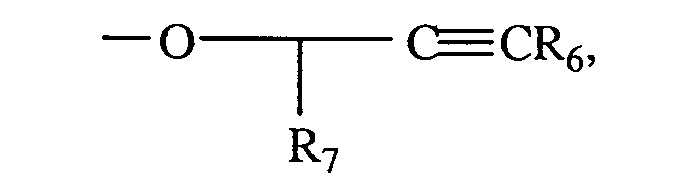
- n für die Zahl 0 oder 1 ;
- R3für C1-C4-Alkyl, oder durch 1-4 Halogenatome, C1-C3-Alkoxy oder C1-C3-Alkylthio substituiertes C1-C4-Alkyl ; C2-C4Alkenyl, oder durch 1-4 Halogenatome substituiertes C2-C4Alkenyl ;
- R4für Wasserstoff, CH30, CH3CH20 oder C1-C3-Alkyl ;
- R5für Wasserstoff oder C1-C3-Alkyl ;
- R6für Wasserstoff, Methyl oder Ethyl ;
- R7für Wasserstoff oder Methyl ;
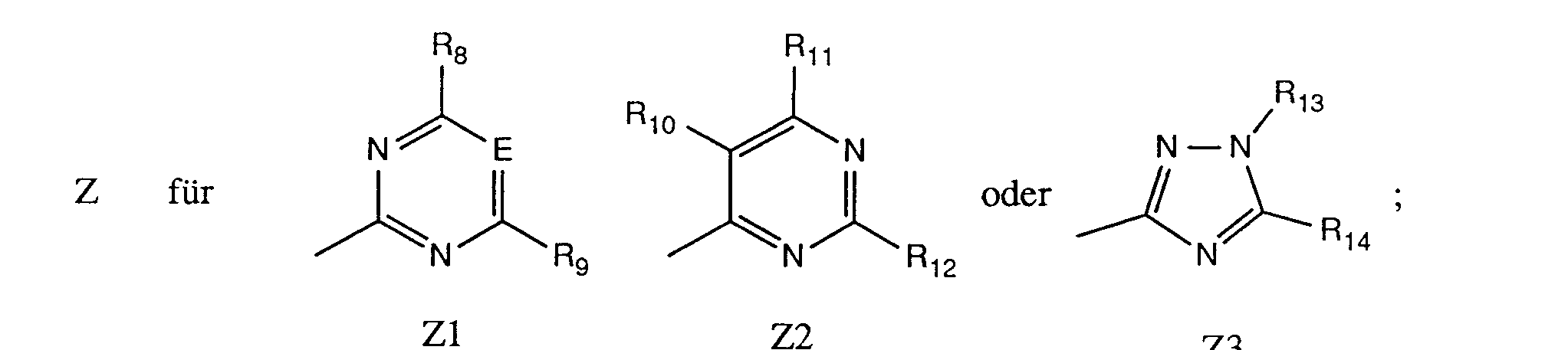
- E für Methin oder Stickstoff;
- R8 für C1-C4-Alkyl, C1-C4-Alkoxy, C1-C4-Halogenalkoxy, C1-C4-Halogenalkyl, C1-C4-Halogenalkylthio, C1-C4-Alkylthio, Halogen, C2-C5-Alkoxyalkyl, C2-C5-Alkoxyalkoxy, Amino, C1-C3-Alkylamino oder Di-(C1-C3Alkyl)amino ;
- R9 für C1-C4-Alkyl, C1-C4-Alkoxy, C1-C4-Halogenalkoxy, C1-C4-Halogenalkylthio, C1-C4-Alkylthio, C2-C5-Alkoxyalkyl, C2-C5-Alkoxyalkoxy, C2-C5-Alkylthioalkyl oder Cyclopropyl ;
- R10 für Wasserstoff, Fluor, Chlor, Methyl, Trifluormethyl, CH30, CH3CH20, CH3S, CH3SO, CH3SO2 oder Cyano ;
- R11 für Methyl, Ethyl, CH30, CH3CH20, Fluor oder Chlor;
- R12 für Methyl, Ethyl, CH30, CH3CH20, Fluor oder Chlor ;
- R13 für C1-C3-Alkyl ;
- R14 für C1-C3-Alkyl, C1-C3-Alkoxy, Chlor oder OCHF2 stehen ;
- sowie den Salzen dieser Verbindungen ;
- mit den Maßgaben, daß
- E für Methin steht wenn R8 Halogen bedeutet ; und
- E für Methin steht wenn R8 oder R9 OCHF2 oder SCHF2 bedeuten, und die Salze dieser Verbindungen mit Aminen, Alkali- oder Erdalkalimetallbasen oder mit quaternären Ammoniumbasen haben gute pre-und postemergent-selektive herbizide und wuchsregulierende Eigenschaften.
Description
- Die vorliegende Erfindung betrifft neue, herbizid wirksame und pflanzenwuchsregulierende N-Phenylsulfonyl-N'-pyrimidinyl-, N'-triazinyl- und N'-triazolylharnstoffe und -thioharnstoffe, Verfahren zu ihrer Herstellung, sie als Wirkstoffe enthaltende Mittel, sowie deren Verwendung zum Bekämpfen von Unkräutern, vor allem selektiv in Nutzpflanzenkulturen oder zum Regulieren und Hemmen des Pflanzenwachstums.
- Harnstoffverbindungen, Triazinverbindungen und Pyrimidinverbindungen mit herbizider Wirkung sind allgemein bekannt. Derartige Verbindungen werden beispielsweise in den Europäischen Patentanmeldungen Nr. 0 007 687, 0 030 138, 0 073 562 und 0 126 711 beschrieben.
- Es wurden nun neue Sulfonylharnstoffe und -thioharnstoffe mit herbiziden und pflanzenwachstumsregulierenden Eigenschaften gefunden.
- Die erfindungsgemäßen N-Phenylsulfonyl-N'-pyrimidinyl-, N'-triazinyl- und N'-triazolylharnstoffe und -thioharnstoffe entsprechen der Formel I
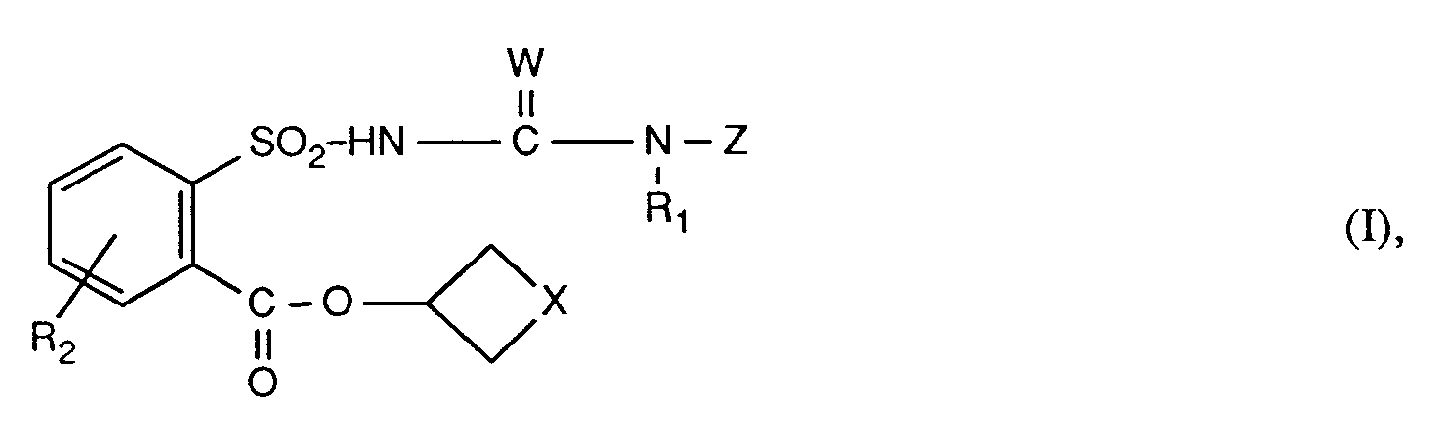
- X für Sauerstoff, Schwefel, SO oder SO2;
- W für Sauerstoff oder Schwefel;
- R1 für Wasserstoff oder Methyl;
- R2 für Wasserstoff, Fluor, Chlor, Brom, Jod, (X)nR3, NO2, NR4R5, -C≡CR6,

- n für die Zahl 0 oder 1;
- R3 für C1-C4-Alkyl, oder durch 1-4 Halogenatome, C1-C3-Alkoxy oder C1-C3-Alkylthio substituiertes C1-C4-Alkyl; C2-C4Alkenyl, oder durch 1-4 Halogenatome substituiertes C2-C4Alkenyl;
- R4 für Wasserstoff, CH30, CH3CH20 oder C1-C3-Alkyl;
- R5 für Wasserstoff oder C1-C3-Alkyl;
- R6 für Wasserstoff, Methyl oder Ethyl;
- R7 für Wasserstoff oder Methyl;

- E für Methin oder Stickstoff;
- R8 für C1-C4-Alkyl, C1-C4-Alkoxy, C1-C4-Halogenalkoxy, C1-C4-Halogenalkyl, C1-C4-Halogenalkylt- hio, C1-C4-Alkylthio, Halogen, C2-C5-Alkoxyalkyl, C2-C5-Alkoxyalkoxy, Amino, C1-C3-Alkylamino oder Di-(C1-C3Alkyl)amino;
- R9 für C1-C4-Alkyl, C1-C4-Alkoxy, C1-C4-Halogenalkoxy, C1-C4-Halogenalkylthio, C1-C4-Alkylthio, C2-C5-Alkoxyalkyl, C2-C5-Alkoxyalkoxy, C2-C5-Alkylthioalkyl oder Cyclopropyl;
- Rio für Wasserstoff, Fluor, Chlor, Methyl, Trifluormethyl, CH30, CH3CH20, CH3S, CH3SO, CH3S02 oder Cyano;
- R11 für Methyl, Ethyl, CH30, CH3CH20, Fluor oder Chlor,
- R12 für Methyl, Ethyl, CH30, CH3CH20, Fluor oder Chlor,
- R13 für C1-C3-Alkyl;
- R14 für C1-C3-Alkyl, C1-C3-Alkoxy, Chlor oder OCHF2 stehen;
- sowie den Salzen dieser Verbindungen;
- mit den Maßgaben, daß
- E für Methin steht wenn R8 Halogen bedeutet; und
- E für Methin steht wenn R8 oder Rg OCHF2 oder SCHF2 bedeuten.
- In den obigen Definitionen ist unter Halogen, Fluor, Chlor, Brom und Jod, vorzugsweise Fluor, Chlor und Brom zu verstehen.
- Die in den Substituentendefinitionen vorkommenden Alkylgruppen können geradkettig oder verzweigt sein und stehen beispielsweise für Methyl, Ethyl, n-Propyl, iso-Propyl, n-Butyl, sek.-Butyl, iso-Butyl oder tert.-Butyl. Vorzugsweise besitzen die als oder in den Substituenten vorkommendenen Alkylgruppen 1-3 Kohlenstoffatome.
- Unter Alkenyl ist geradkettiges oder verzweigtes Alkenyl zu verstehen, wie z.B. Vinyl, Allyl, Methallyl, 1-Methylvinyl oder But-2-en-1-yl. Bevorzugt sind Alkenylreste mit einer Kettenlänge von 2 bis 3 Kohlenstoffatomen.
- Halogenalkyl ist beispielsweise Fluormethyl, Difluormethyl, Trifluormethyl, Chlormethyl, Dichlormethyl, Trichlormethyl, 2,2,2-Trifluorethyl, 2-Fluorethyl, 2-Chlorethyl und 2,2,2-Trichlorethyl; vorzugsweise Trichlormethyl, Difluorchlormethyl, Trifluormethyl und Dichlorfluormethyl.
- Alkoxy ist beispielsweise Methoxy, Ethoxy, Propyloxy, i-Propyloxy, n-Butyloxy, iso-Butyloxy, sek.-Butyloxy und tert.-Butyloxy; vorzugsweise Methoxy und Ethoxy.
- Halogenalkoxy ist z.B. Difluormethoxy, Trifluormethoxy, 2,2,2-Trifluorethoxy, 1,1,2,2-Tetrafluorethoxy, 2-Fluorethoxy, 2-Chlorethoxy und 2,2-Difluorethoxy; vorzugsweise Difluormethoxy, 2-Chlorethoxy und Trifluormethoxy.
- Alkylthio ist beispielsweise Methylthio, Ethylthio, Propylthio, Isopropylthio, n-Butylthio, iso-Butylthio, sek.-Butylthio oder tert.-Butylthio, vorzugsweise Methylthio und Ethylthio.
- Beispiele für Alkoxyalkoxy sind: Methoxymethoxy, Methoxyethoxy, Methoxypropyloxy, Ethoxymethoxy, Ethoxyethoxy sowie Propyloxymethoxy.
- Alkylamino ist beispielsweise Methylamino, Ethylamino, n-Propylamino oder iso-Propylamino. Dialkylamino steht beispielsweise für Dimethylamino, Methylethylamino, Diethylamino oder n-Propylmethylamino.
- Die Erfindung umfaßt ebenfalls die Salze, die die Verbindungen der Formel 1 mit Aminen, Alkali- und Erdalkalimetallbasen oder quaternären Ammoniumbasen bilden können.
- Unter Alkali- und Erdalkalimetallhydroxiden als Salzbildner sind die Hydroxide von Lithium, Natrium, Kalium, Magnesium oder Calcium hervorzuheben, insbesondere aber die von Natrium oder Kalium.
- Beispiele für zur Salzbildung geeignete Amine sind primäre, sekundäre und tertiäre aliphatische und aromatische Amine wie Methylamin, Ethylamin, Propylamin, iso-Propylamin, die vier isomeren Butylamine, Dimethylamin, Diethylamin, Diethanolamin, Dipropylamin, Diisopropylamin, Di-n-butylamin, Pyrrolidin, Piperidin, Morpholin, Trimethylamin, Triethylamin, Tripropylamin, Chinuclidin, Pyridin, Chinolin und iso-Chinolin, insbesondere aber Ethyl-, Propyl-, Diethyl- oder Triethylamin, vor allem aber iso-Propylamin und Diethanolamin.
- Beispiele für quaternäre Ammoniumbasen sind im allgemeinen die Kationen von Halogenammoniumsalzen, z.B. das Teaamethylammoniumkation, das Trimethylbenzylammoniumkation, das Triethylbenzylammoniumkation, das Tetraethylammoniumkation, das Trimethylethylammoniumkation, aber auch das Ammoniumkation.
- Unter den Verbindungen der Formel sind diejenigen bevorzugt, in denen W für Sauerstoff steht, wobei vorzugsweise Z für Z1 und X für Sauerstoff oder Schwefel, besonders bevorzugt jedoch für Sauerstoff steht und E Stickstoff bedeutet.
- Ferner ist diejenige Gruppe von Verbindungen der Formel hervorzuheben, in der Z für Z1 und X für Sauerstoff oder Schwefel, besonders bevorzugt jedoch für Sauerstoff steht und E Methin bedeutet.
- Aus diesen beiden Gruppen von Verbindungen der Formel I sind diejenigen von besonderem Interesse, in denen
- R2 für Wasserstoff, Fluor, Chlor, OCH3, OCHF2, Methyl, SCH3, Methoxy, Ethoxy oder Chlorethoxy;
- R8 für C1-C3-Alkyl, C1-C3-Alkoxy, C1-C2-Halogenalkoxy, Trifluormethyl, CHF2, CH2F, CH20CH3, Fluor, Chlor, NH2, NHCH3, N(CH3)2, SCH3 oder CH2OCH3; und
- Rg für C1-C3-Alkyl, C1-C3-Alkoxy, C1-C2Halogenalkoxy oder Cyclopropyl stehen.
- Bei besonders bevorzugten Verbindungen aus dieser Gruppe stehen
- R2 für Wasserstoff;
- R8 für Methyl, Ethyl, OCH3, OC2H5, OCHF2, OCH2CF3, Chlor, NHCH3, N(CH3)2 oder CH2OCH3; und
- R9 für Methyl, OCH3, OCHF2, OC2H5 oder Cyclopropyl. In einer weiteren bevorzugten Untergruppe von Verbindungen der Formel stehen
- W für Sauerstoff;
- Z für Z1;
- X für Schwefel;
- R2 für Wasserstoff, Fluor, Chlor, OCH3, OCHF2, Methyl oder Methylthio;
- R8 für C1-C3-Alkyl, C1-C3-Alkoxy, C1-C2-Halogenalkoxy, CF3, CHF2, CH2F, CH2OCH3, Fluor, Chlor, NH2, NHCH3, N(CH3)2, SCH3 oder CH2OCH3; und
- R9 für C1-C3Alkyl, C1-C3-Alkoxy, C1-C2-Halogenalkoxy oder Cyclopropyl. Aus dieser Gruppe sind diejenigen Verbindungen der Formel von Interesse, bei denen
- W für Sauerstoff;
- Z für Z1;
- X für Schwefel;
- R2 für Wasserstoff;
- R8 für Methyl, Ethyl, OCH3, OC2H5, OCHF2, OCH2CF3, Cl, NHCH3, N(CH3)2 oder CH2OCH3; und
- R9 für Methyl, OCH3, OCHF2, OC2H5 oder Cyclopropyl stehen.
- Als bevorzugte Einzelverbindungen aus dem Umfang der Formel sind zu nennen: N- [2-(Oxetan-3-oxy-carbonyl)]-phenylsulfonyl-N'-(4-methoxy-6-methyl-1,3,5-triazinyl)-harnstoff; N- [2-(Oxetan-3-oxy-carbonyl)]-phenylsulfonyl-N'-(4,6-dimethyl-pyrimidin-2-yl)-harnstoff; N- [2-(Oxetan-3-oxy-carbonyl)]-phenylsulfonyl-N'-(4-methoxy-6-methyl-pyrimidin-2-yl)-harnstoff; und N- [2-(Oxetan-3-oxy-carbonyl)]-phenylsulfonyl-N'-(4,6-dimethoxy-pyrimidin-2-yl)-harnstoff.
- Die Verbindungen der Formel können hergestellt werden, indem man entweder
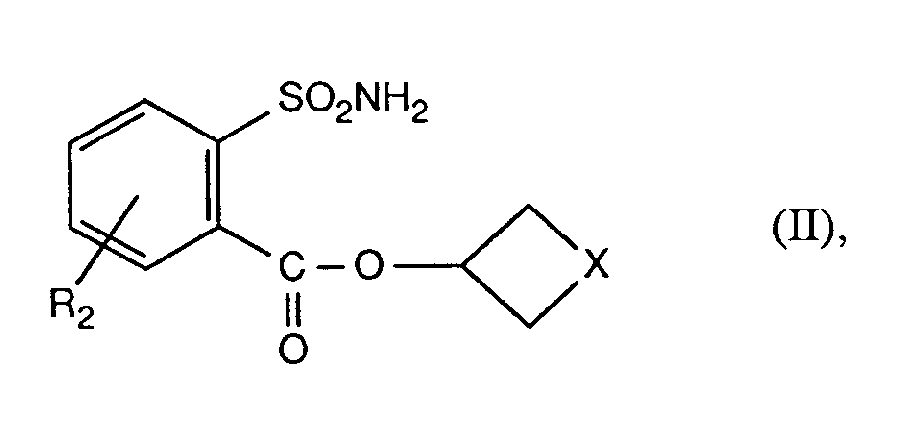
- a) ein Phenylsulfonamid der Formel II

- b) ein Sulfonylcarbamat oder -thiocarbamat der Formel IV


- c) ein Phenylsulfonamid der Formel II


- Verbindungen der Formel können ferner hergestellt werden indem man eine Verbindung der Formel VIII mit einer Verbindung der Formel V in Gegenwart eines Ammonium-, Phosphonium-, Sulfonium- oder Alkalimetallcyanatsalzes der Formel X

- Die Umsetzungen zu Verbindungen der Formel werden vorteilhafterweise in aprotischen, inerten organischen Lösungsmitteln vorgenommen. Solche Lösungsmittel sind Kohlenwasserstoffe wie Benzol, Toluol, Xylol oder Cyclohexan, chlorierte Kohlenwasserstoffe wie Dichlormethan, Trichlormethan, Tetrachlormethan oder Chlorbenzol, Ether wie Diethylether, Ethylenglykoldimethylether, Diethylenglykoldimethylether, Tetrahydrofuran oder Dioxan, Nitrile wie Acetonitril oder Propionitril, Amide wie Dimethylformamid, Diethylformamid oder N-Methylpyrrolidinon. Die Reaktionstemperaturen liegen vorzugsweise zwischen -20° und +120°C.
- Die Umsetzungen verlaufen im allgemeinen leicht exotherm und können bei Raumtemperatur durchgeführt werden. Zwecks Abkürzung der Reaktionszeit oder auch zum Einleiten der Umsetzung wird zweckdienlich für kurze Zeit bis zum Siedepunkt des Reaktionsgemisches aufgewärmt. Die Reaktionszeiten können ebenfalls durch Zugabe einiger Tropfen Base als Reaktionskatalysator verkürzt werden. Als Basen sind insbesondere tertiäre Amine wie Trimethylamin, Triethylamin, Chinuclidin, 1,4-Diazabicyclo-(2.2.2)-octan, 1,5-Diazabicy- clo(4.3.0)non-5-en oder 1,5-Diazabicyclo(5.4.0)undec-7-en geeignet. Als Basen können aber auch anorganische Basen wie Hydride wie Natrium- oder Calciumhydrid, Hydroxide wie Natrium- und Kaliumhydroxid, Carbonate wie Natrium- und Kaliumcarbonat oder Hydrogencarbonate wie Kalium- und Natriumhydrogencarbonat verwendet werden.
- Die Endprodukte der Formel können durch Einengen und/oder Verdampfen des Lösungsmittels isoliert und durch Umkristallisieren oder Zerreiben des festen Rückstandes in Lösungsmitteln, in denen sie sich nicht gut lösen, wie Ether, aromatischen Kohlenwasserstoffe oder chlorierten Kohlenwasserstoffe, gereinigt werden.
- In den oben beschriebenen Herstellungsverfahren der Verbindungen der Formel steht R15 vorzugsweise für Phenyl, welches durch C1-C4-Alkyl oder Halogen substituiert sein kann, ganz besonders bevorzugt für Phenyl.
- Die Phenylsulfonamide der Formel II sind neue Verbindungen die speziell für die Herstellung der Wirkstoffe der Formel entwickelt und hergestellt wurden. Sie bilden daher einen Gegenstand dervorliegenden Erfindung. Sie lassen sich aus den entsprechenden Phenylsulfochloriden der Formel VIII

- Die Phenylsulfochloride der Formel VIII sind neue Verbindungen die speziell für die Herstellung der Wirkstoffe der Formel entwickelt und hergestellt wurden. Sie bilden daher ebenfalls einen Gegenstand der vorliegenden Erfindung. Die Phenylsulfochloride der Formel VIII werden hergestellt, indem man die entsprechend substituierten 2-Chlorsulfonyl-benzoylchloride (siehe z.B. D.Davis, Soc. 2042,2044 (1932)) in Gegenwart einer Base mit einer Verbindung der Formel IX

- Phenylsulfochloride der Formel VIII, worin X für Sauerstoff steht, können auch hergestellt werden, indem man 2-lsopropylthiobenzoesäure (siehe z.B. H.Gilman, F.J.Webb, Am. Soc 71, 4062-4063) mit Thionylchlorid zum entsprechenden Benzoesäurechlorid umsetzt, welches anschließend mit 3-Hydroxy-oxetan in Gegenwart einer Base zum entsprechenden 2-lsopropylthio-benzoesäureoxetan-3-ylester überführt wird, um schließlich durch Umsetzung mit Chlor das Sulfochlorid der Formel VIII zu erhalten. Derartige Umsetzungen sind bekannt und dem Fachmann geläufig.
- Verbindungen der Formel IX und deren Herstellung sind bekannt (siehe z.B. B.Lamm et al., Acta Chem. Scand. 28, 701 (1974) oder J. Org. Chem. 48, 2953-2956 (1983)).
- Die Sulfonylcarbamate und -thiocarbamate der Formel IV sind neu und bilden einen Gegenstand dervorliegenden Erfindung. Sie können beispielsweise durch Umsetzung der Sulfonamide der Formel 11 mit Diphenylcarbamat bzw. -thiocarbamat in Gegenwart einer Base erhalten werden. Derartige Reaktionen sind bekannt und dem Fachmann geläufig.
- Die Amine der Formel V werden in den europaischen Patentanmeldungen Nr. 0 007 687, 0 030138, 0 073 562 und 0 126 711 sowie im USP 4,579,584 beschrieben.
- Verfahren zur Herstellung von N-Pyrimidinyl- und N-Triazinylcarbamaten sind beispielsweise in EP-A-0101670 beschrieben. N-Triazolylcarbamate können analog hergestellt werden.
- Die Wirkstoffe der Formel werden in der Regel mit Aufwandmengen von 0,001 bis 2 kg/ha insbesondere 0,005 bis 1 kg/ha erfolgreich eingesetzt. Die für die erwünschte Wirkung erforderliche Dosierung kann durch Versuche ermitteltwerden. Sie ist abhängig von derArt der Wirkung, dem Entwicklungsstadium der Kulturpflanze und des Unkrauts sowie von der Applikation (Ort, Zeit, Verfahren) und kann, bedingt durch diese Parameter, innerhalb weiter Bereiche variieren.
- Die Verbindungen der Formel I zeichnen sich durch wuchshemmende und herbizide Eigenschaften aus, die sie ausgezeichnet zum Einsatz in Kulturen von Nutzpflanzen, insbesondere in Geaeide, Baumwolle, Soja, Raps, Mais und Reis befähigen, wobei der Einsatz in Sojakultur und Getreide ganz besonders bevorzugt ist. Vorzugsweise erfolgt die Bekämpfung der Unkräuter in Sojakulturen postemergent. Insbesondere zeichnen sich die Verbindungen der Formel durch ihre gute Abbaubarkeit aus.
- Die Erfindung betrifft auch herbizide und pflanzenwachstumsregulierende Mittel, welche einen neuen Wirkstoff der Formel I enthalten, sowie Verfahren zur Hemmung des Pflanzenwuchses.
- Pflanzenwachstumsregulatoren sind Substanzen, die in/an der Pflanze agronomisch erwünschte biochemische und/oder physiologische und/oder morphologische Veränderungen bewirken.
- Die in den erfindungsgemäßen Mitteln enthaltenen Wirkstoffe beeinflussen das Pflanzenwachstumje nach Applikationszeitpunkt, Dosierung, Applikationsart und Umweltbedingungen in verschiedener Weise. Pflanzenwuchsregulatoren der Formel können zum Beispiel das vegetative Wachstum von Pflanzen hemmen. Diese Art der Wirkung ist von Interesse auf Rasenflächen, im Zierpflanzenbau, in Obstplantagen, an Straßenböschungen, auf Sport- und Industrieanlagen, aber auch bei der gezielten Hemmung von Nebentrieben wie bei Tabak. Im Ackerbau führt die Hemmung des vegetativen Wachstums bei Getreide über eine Halmverstärkung zu reduziertem Lager, ähnliche agronomische Wirkungen erreicht man in Raps, Sonnenblumen, Mais und anderen Kulturpflanzen. Des weiteren kann durch Hemmung des vegetativen Wachstums die Anzahl Pflanzen pro Fläche erhöht werden. Ein weiteres Einsatzgebiet von Wuchshemmern ist die selektive Kontrolle von bodendekkenden Pflanzen in Plantagen oder weitreihigen Kulturen durch starke Wuchshemmung, ohne diese Bodendecker abzutöten, sodass die Konkurrenz gegenüber der Hauptkultur ausgeschaltet ist, die agronomisch positiven Effekte wie Erosionsverhinderung, Stickstoffbindung und Bodenlockerung aber erhalten bleiben.
- Unter einem Verfahren zur Hemmung des Pflanzenwachstums ist eine Steuerung der natürlichen Pflanzenentwicklung zu verstehen, ohne den von genetischen Eigenschaften determinierten Lebenszyklus der Pflanze im Sinne einer Mutation zu verändern. Das Verfahren derWuchsreguiierung wird zu einem im Einzelfall zu bestimmenden Entwicklungszeitpunkt der Pflanze angewendet. Die Applikation der Wirkstoffe der Formel I kann vor oder nach dem Auflaufen der Pflanzen erfolgen, beispielsweise bereits auf die Samen oder die Sämlinge, auf Wurzeln, Knollen, Stengel, Blätter, Blüten oder andere Pflanzenteile. Dies kann z.B. durch Aufbringen des Wirkstoffes selbst oder in Form eines Mittels auf die Pflanzen und/oder durch Behandlung des Nährmediums der Pflanze (Erdboden) geschehen.
- Für die Verwendung der Verbindungen der Formel oder sie enthaltender Mittel zur Regulierung des Pflanzenwachstums kommen verschiedene Methoden und Techniken in Betracht, wie beispielsweise die folgenden:
-
- a) Beizung der Samen mit einem als Spritzpulver formulierten Wirkstoff durch Schütteln in einem Gefäß bis zur gleichmäßigen Verteilung auf der Samenoberfläche (Trockenbeizung). Man verwendet dabei bis zu 4 g Wirkstoff der Formel (bei einer 50 %igen Formulierung: bis zu 8,0 g Spritzpulver) pro 1 kg Saatgut.
- b) Beizung der Samen mit einem Emulsionskonzentrat des Wirkstoffs oder mit einer wäßrigen Lösung des als Spritzpulver formulierten Wirkstoffs der Formel nach Methode a) (Naßbeizung).
- c) Beizung durch Tauchen des Saatguts in einer Brühe mit bis zu 1000 ppm Wirkstoff der Formel während 1 bis 72 Stunden und gegebenenfalls nachfolgendes Trocknen der Samen (Tauchbeizung, Seed soaking).
- Die Beizung des Saatguts oder die Behandlung des angekeimten Sämlings sind naturgemäß die bevorzugten Methoden der Applikation, weil die Wirkstoffbehandlung vollständig auf die Ziekultur gerichtet ist. Man verwendet in der Regel 0,01 g bis 4,0 g Aktivsubstanz pro 1 kg Saatpot, wobei man je nach Methodik, die auch den Zusatz anderer Wirkstoffe oder Mikronästoffe ermöglicht, von den angegebenen Grenzkonzentrationen nach oben oder unten abweichen kann (Wiederholungsbeize).
- Der Wirkstoff wird in Lösung auf mineralische Granulatträger oder polymerisierte Granulate (Harnstoff/Formaldehyd) aufgezogen und trocknen gelassen. Gegebenenfalls kann ein Überzug aufgebracht werden (Umhüllungsgranulate), der es erlaubt, den Wirkstoff über einen bestimmten Zeitraum dosiert abzugeben.
- Die Verbindungen der Formel werden in unveränderter Form, wie aus der Synthese erhältlich, oder vorzugsweise mit den in der Formulierungstechnik üblichen Hilfsmitteln eingesetzt und werden daherz.B. zu emulgierbaren Konzentraten, direkt versprühbaren oder verdünnbaren Lösungen, verdünnten Emulsionen, Spritzpulvern, löslichen Pulvern, Stäubemitteln, Granulaten, auch Verkapselungen in z.B. polymeren Stoffen in bekannterweise verarbeitet. Die Anwendungsverfahren wie Versprühen, Vernebeln, Verstäuben, Benetzen, Verstreuen oder Gießen werden gleich wie die Art der Mittel den angestrebten Zielen und den gegebenen Verhältnissen entsprechend gewählt.
- Die Formulierungen, d.h. die den Wirkstoff der Formel und gegebenenfalls einen oder mehrere feste oder flüssige Zusatzstoffe enthaltenden Mittel, Zubereitungen oder Zusammensetzungen werden in bekannter Weise hergestellt, z.B. durch inniges Vermischen und/oder Vermahlen der Wirkstoffe mit Streckmitteln, wie z.B. mit Lösungsmitteln, festen Trägerstoffen und gegebenenfalls oberflächenaktiven Verbindungen (Tensiden).
- Als Lösungsmittel können in Frage kommen: Aromatische Kohlenwasserstoffe, insbesondere die Fraktionen C8 bis C12, wie Mischungen von Alkylbenzolen, z.B. Xylolgemische oder alkylierte Naphthaline; aliphatische und cycloaliphatische Kohlenwasserstoffe wie Paraffine, Cyclohexan oder Tetrahydronaphthalin; Alkohole, wie Ethanol, Propanol oder Butanol; Glykole sowie deren Ether und Ester, wie Propylenglykol oder Dipropylenglykolether, Ketone wie Cyclohexanon, Isophoron oder Diacetonalkohol, starke polare Lösungsmittel wie N-Methyl-2-pyrrolidon, Dimethylsulfoxid oder Wasser, Pflanzenöle sowie deren Ester, wie Raps-, Ricinus- oder Sojaöl; gegebenenfalls auch Silikonöle.
- Als feste Trägerstoffe, z.B. für Stäubemittel und dispergierbare Pulver, werden in der Regel natürliche Gesteinsmehle verwendet, wie Calcit, Talkum, Kaolin, Montmorillonit oder Attapulgit. Zur Verbesserung der physikalischen Eigenschaften können auch hochdisperse Kieselsäure oder hochdisperse saugfähige Polymerisate zugesetzt werden. Als gekörnte, adsorptive Granulatträger kommen poröse Typen wie z.B. Bimsstein, Ziegelbruch, Sepiolit oder Bentonit, als nicht sorptive Trägermaterialien z.B. Calcit oder Sand in Frage. Darüber hinaus kann eine Vielzahl von vorgranulierten Materialien anorganischer oder organischer Natur wie insbesondere Dolomit oder zerkleinerte Pflanzenrückstände verwendet werden.
- Als oberflächenaktive Verbindungen kommen je nach der Art des zu formulierenden Wirkstoffes der Formel I nichtionogene, kation- und/oder anionaktive Tenside mit guten Emulgier-, Dispergier- und Netzeigenschaften in Betracht. Unter Tensiden sind auch Tensidgemische zu verstehen.
- Geeignete anionische Tenside können sowohl sog. wasserlösliche Seifen wie wasserlösliche synthetische oberflächenaktive Verbindungen sein.
- Als Seifen seien die Alkali-, Erdalkali oder gegebenenfalls substituierten Ammoniumsalze von höheren Fettsäuren (C1O-C22), wie z.B. die Na- oder K-Salze der Öl- oder Stearinsäure, oder von natürlichen Fettsäuregemischen genannt, die z.B. aus Kokosnuß- oder Talgöl gewonnen werden können. Ferner sind auch die Fettsäure-methyl-taurinsalze zu erwähnen.
- Häufiger werden jedoch sog. synthetische Tenside verwendet, insbesondere Fettalkoholsulfonate, Fettalkoholsulfate, sulfonierte Benzimidazolderivate oder Alkylarylsulfonate.
- Die Fettalkoholsulfonate oder -sulfate liegen in der Regel als Alkali-, Erdalkali- oder gegebenenfalls substituierte Ammoniumsalze vor und weisen einen Alkylrest mit 8 bis 22 C-Atomen auf, wobei Alkyl auch den Alkylteil von Acylresten einschließt, z.B. das Na- oder Ca-Salz der Ligninsulfonsäure, des Dodecylschwefelsäureesters oder eines aus natürlichen Fettsäuren hergestellten Fettalkoholsulfatgemisches. Hierher gehören auch die Salze der Schwefelsäureester und Sulfonsäuren von Fettalkohol-Ethylenoxid-Addukten. Die sulfonierten Benzimidazolderivate enthalten vorzugsweise 2 Sulfonsäuregruppen und einen Fettsäurerest mit 8-22 C-Atomen. Alkylarylsulfonate sind z.B. die Na-, Ca- oder Triethanolaminsalze der Dodecylbenzolsulfonsäure, der Dibutylnaphthalinsulfonsäure, oder eines Naphthalinsulfonsäure-Formaldehydkondensationsproduktes.
- Ferner kommen auch entsprechende Phosphate wie z.B. Salze des Phosphorsäureesters eines p-Nonylphenol-(4-14)-Ethylenoxid-Adduktes oder Phospholipide in Frage.
- Als nichtionische Tenside kommen in erster Linie Polyglykoletherderivate von aliphatischen oder cycloaliphatischen Alkoholen, gesättigten oder ungesättigten Fettsäuren und Alkylphenolen in Frage, die 3 bis 30 Glykolethergruppen und 8 bis 20 Kohlenstoffatome im (aliphatischen) Kohlenwasserstoffrest und 6 bis 18 Kohlenstoffatome im Alkylrest der Alkylphenole enthalten können.
- Weitere geeignete nichtionische Tenside sind die wasserlöslichen, 20 bis 250 Ethylenglykolethergruppen und 10 bis 100 Propylenglykolethergruppen, enthaltenden Polyethylenoxidaddukte an Polypropylenglykol, Ethylendiaminopolypropylenglykol und Alkylpolypropylenglykol mit 1 bis 10 Kohlenstoffatomen in derAlkylkette. Die genannten Verbindungen enthalten üblicherweise pro Propylenglykol-Einheit 1 bis 5 Ethylenglykoleinheiten.
- Als Beispiele nicht ionischer Tenside seien Nonylphenolpolyethoxyethanole, Ricinusölpolyglykolether, Polypropylen-Polyethylenoxidaddukte, Tributylphenoxypolyethoxyethanol, Polyethylenglykol und Octylphenoxypolyethoxyethanol erwähnt.
- Ferner kommen auch Fettsäureester von Polyoxyethylensorbitan wie das Polyoxyethylensorbitan-trioleat in Betracht.
- Bei den kationischen Tensiden handelt es sich vor allem um quartäre Ammoniumsalze, welche als N-Substituenten mindestens einen Alkylrest mit 8 bis 22 C-Atomen enthalten und als weitere Substituenten niedrige, gegebenenfalls halogenierte Alkyl-, Benzyl- oder niedrige Hydroxyalkylreste aufweisen. Die Salze liegen vorzugsweise als Halogenide, Methylsulfate oder Ethylsulfate vor, z.B. das Stearyltrimethylammoniumchlorid oder das Benzyldi-(2-chlorethyl)-ethylammoniumbromid.
- Die in der Formulierungstechnik gebräuchlichen Tenside sind u.a. in folgenden Publikationen beschrieben:
- - "Mc Cutcheon's Detergents and Emulsifiers Annual", Mc Publishing Corp., Glen Rock, New Jersey, 1988.
- - M. and J. Ash, "Encyclopedia of Surfactants", Vol. 1-111, Chemical Publishing Co., New York, 1980-1981.
- - Dr. Helmut Stache "Tensid-Taschenbuch", Carl Hanser Verlag, München/Wien 1981.
- Die pestiziden Zubereitungen enthalten in der Regel 0,1 bis 99 %, insbesondere 0,1 bis 95 %, Wirkstoff der Formel I, 1 bis 99 % eines festen oder flüssigen Zusatzstoffes und 0 bis 25 %, insbesondere 0,1 bis 25 % eines Tensides.
- Während als Handelsware eher konzentrierte Mittel bevorzugt werden, verwendet der Endverbraucher in der Regel verdünnte Mittel.
- Die Mittel können auch weitere Zusätze wie Stabilisatoren z.B. gegebenenfalls epoxydierte Pflanzenöle (epoxydiertes Kokosnußöl, Rapsöl oder Sojaöl), Entschäumer, z.B. Silikonöl, Konservierungsmittel, Viskositätsregulatoren, Bindemittel, Haftmittel sowie Dünger oder andere Wirkstoffe zur Erzielung spezieller Effekte enthalten.
- Insbesondere setzen sich bevorzugte Formulierungen folgendermaßen zusammen: (% = Gewichtsprozent)
-
- Aktiver Wirkstoff: 1 bis 20 %, vorzugsweise 5 bis 10 %
- oberflächenaktives Mittel: 5 bis 30 %, vorzugsweise 10 bis 20 %
- flüssiges Trägermittel: 15 bis 94 %, vorzugsweise 70 bis 85 %
-
- Aktiver Wirkstoff: 0,1 bis 10 %, vorzugsweise 0,1 bis 1 %
- festes Trägermittel: 99,9 bis 90 %, vorzugsweise 99,9 bis 99 %
-
- Aktiver Wirkstoff: 5 bis 75 %, vorzugsweise 10 bis 50 %
- Wasser: 94 bis 24 %, vorzugsweise 88 bis 30 %
- oberflächenaktives Mittel: 1 bis 40 %, vorzugsweise 2 bis 30 %
-
- Aktiver Wirkstoff: 0,5 bis 90 %, vorzugsweise 1 bis 80 %
- oberflächenaktives Mittel: 0,5 bis 20 %, vorzugsweise 1 bis 15 %
- festes Trägermaterial: 5 bis 95 %, vorzugsweise 15 bis 90 %
-
- Aktiver Wirkstoff: 0,5 bis 30 %, vorzugsweise 3 bis 15 %
- festes Trägermittel: 99,5 bis 70 %, vorzugsweise 97 bis 85 %
-

- Eine Mischung von 20,7 g 3-Hydroxy-thiaetan, 20,0 g Pyridin und 250 ml absolutem Toluol wird bei einer Temperatur von 0° bis 10°C tropfenweise mit einer Lösung von 52,8 g 2-Chlorsulfonyl-benzoylchlorid und 100 ml absolutem Toluol versetzt. Dann wird während 2 Stunden bei einer Temperatur von 20-25°C gerührt und anschließend das Reaktionsgemisch mit 300 ml Eiswasser versetzt. Durch Abtrennen der organischen Phase, Waschen mit Wasser und Trocknen über Natriumsulfat erhält man eine Toluollösung von 2-Thiaetanoxy-carbonyl-phenylsulfochlorid, die ohne weitere Aufarbeitung in Beispiel H2 eingesetzt wird.
-

- In eine Toluollösung von 2-(Thiaetan-3-oxycarbonyl)-phenylsulfochlorid (Herstellung bescrieben in Beispiel H1) werden 8,5 g Ammoniakwährend 1 Stunde eingeleitet. Nach dem Versetzen des Reaktionsgemisches mit 400 ml Eiswasser, Abfiltrieren, Waschen mit Wasser und anschließendem Trocknen erhält man 39,3 g 2-Thiaetanoxy-carbonyl-phenylsulfonamid mit einem Schmelzpunkt von 145 bis 146°C.
-

- Eine Mischung von 1,23 g 2-(Thiaetan-3-oxycarbonyl)-phenylsulfonamid, 1,26 g 4-Chlor-6-methoxy-1,3-pyrimidin-2-yl-phenylcarbamat und 20 ml absolutem Dioxan wird tropfenweise mit einer Mischung von 0,69 g Diazabicyclo-[5.4.0]-undec-7-en und 5 ml absolutem Dioxan versetzt und anschließend 4 Stunden bei einer Temperatur von 20 bis 25°C gerührt. Durch Eingießen in Wasser, Zutropfen von 10 %iger Salzsäure bis pH 5, Extrahieren mit Essigsäureethylester, Trocknen der organischen Phase, Eindampfen und Kristallisieren aus Essigsäureethylester erhält man 1, 15 g N-[2-(Thiaetan-3-oxycarbonyl)-phenylsulfonyl]-N'-(4-Chlor-6- methoxy-1,3-pyrimidin-2-yl)-harnstoff mit einem Schmelzpunkt von 180 bis 181°C (Zers.).
-

- Eine Mischung von 15,7 g 2-lsopropylthio-benzoesäure und 15,7 g Thionylchlorid wird sehr langsam zum Rückfluß erwärmt und bis zur Beendigung der Gasentwicklung unter Rückfluß gehalten. Durch vollständiges Abdampfen des überschüssigen Thionylchlorides erhält man 17,3 g ungereinigtes 2-Isopropylsulfonyl-benzoesäurechlorid als gelbes Öl.
-

- Eine Mischung von 4,44 g 3-Hydroxy-oxetan, 6,64 g Pyridin und 60 ml absolutem Toluol werden bei einer Temperatur von 15 bis 20°C tropfenweise mit einer Mischung von 12,9 g 2-lsopropylthio-benzoesäurechlorid und 20 ml absolutem Toluol versetzt. Die entstandene Suspension wird 2 Stunden bei einer Temperatur von 20-25°C und weitere 3 Stunden bei einer Temperatur von 40-45°C gerührt. Durch Versetzen des Reaktionsgemisches mit Wasser, Waschen der organischen Phase mit Wasser, Trocknen und Eindampfen erhält man 12,6 g 2-lsopropylthio-benzoesäureoxetan-3-ylester als hellgelbes Öl.
-

- In eine Mischung von 12,6 g 2-lsopropylthio-benzoesäureoxetan-3-ylester, 12,9 g Natriumacetat und 100 ml 50 %ige Essigsäure wird bei einer Temperatur von - 5° bis 0°C während 1 Stunde 11,2 g Chlor eingeleitet und anschließend 15 Minuten bei einerTemperaturvon 0°C gerührt. Durch Versetzen des Reaktionsgemisches mit Methylenchlorid, Waschen der organischen Phase mit Eiswasser und Trocknen erhält man eine Methylenchloridlösung von 2-(Oxetan-3-oxycarbonyl)-phenylsulfochlorid, welches ohne weitere Reinigung in Beispiel H7 eingesetzt wird.
-

- In eine Methylenchloridlösung von 2-(Oxetan-3-oxycarbonyl)-phenylsulfochlorid (Beispiel H6) wird während 45 Minuten bei einer Temperatur von 0° bis 5°C 2,5 g Ammoniak eingeleitet. Durch Versetzen des Reaktionsgemisches mit Wasser, Waschen der organischen Phase mit Wasser, Trocknen, Eindampfen und Kristallisieren aus einem Methylenchlorid/Diethylether-Gemisch erhält man 6,7 g 2-(Oxetan-3-oxycarbonyl)-phenylsulfonamid mit einem Schmelzpunkt von 169 bis 170°C.
-

- Eine Mischung von 2,57 g 2-(Oxetan-3-oxycarbonyl)-phenylsulfonamid, 2,6 g 4-Methoxy-6-methyl-1,3,5-triazinyl-phenylcarbamat und 40 ml absolutem Dioxan werden bei 20-25°C tropfenweise mit einer Mischung von 1,52 g Diazabicyclo-[5.4.0]-undec-7-en(1.5-5) und 5 ml absolutem Dioxan versetzt und anschließend 4 Stunden bei einer Temperatur von 20 bis 25°C gerührt. Durch Eingeben in Wasser, Zutropfen von 10 %iger Salzsäure bis zur Einstellung eines pH von 5, Extrahieren mit Essigester, Trocknen der organischen Phase, Eindampfen und Kristallisieren aus Essigsäureethylester erhält man 2,8 g N-[2-(Oxetan-3-oxycarbonyl)-phenylsulfonyl]-N'-(4-methoxy-6-methyl-1,3,5-triazinyl)-harnstoff (Verbindung Nr. 3.011) mit einem Schmelzpunkt von 162 bis 163°C (Zers.).
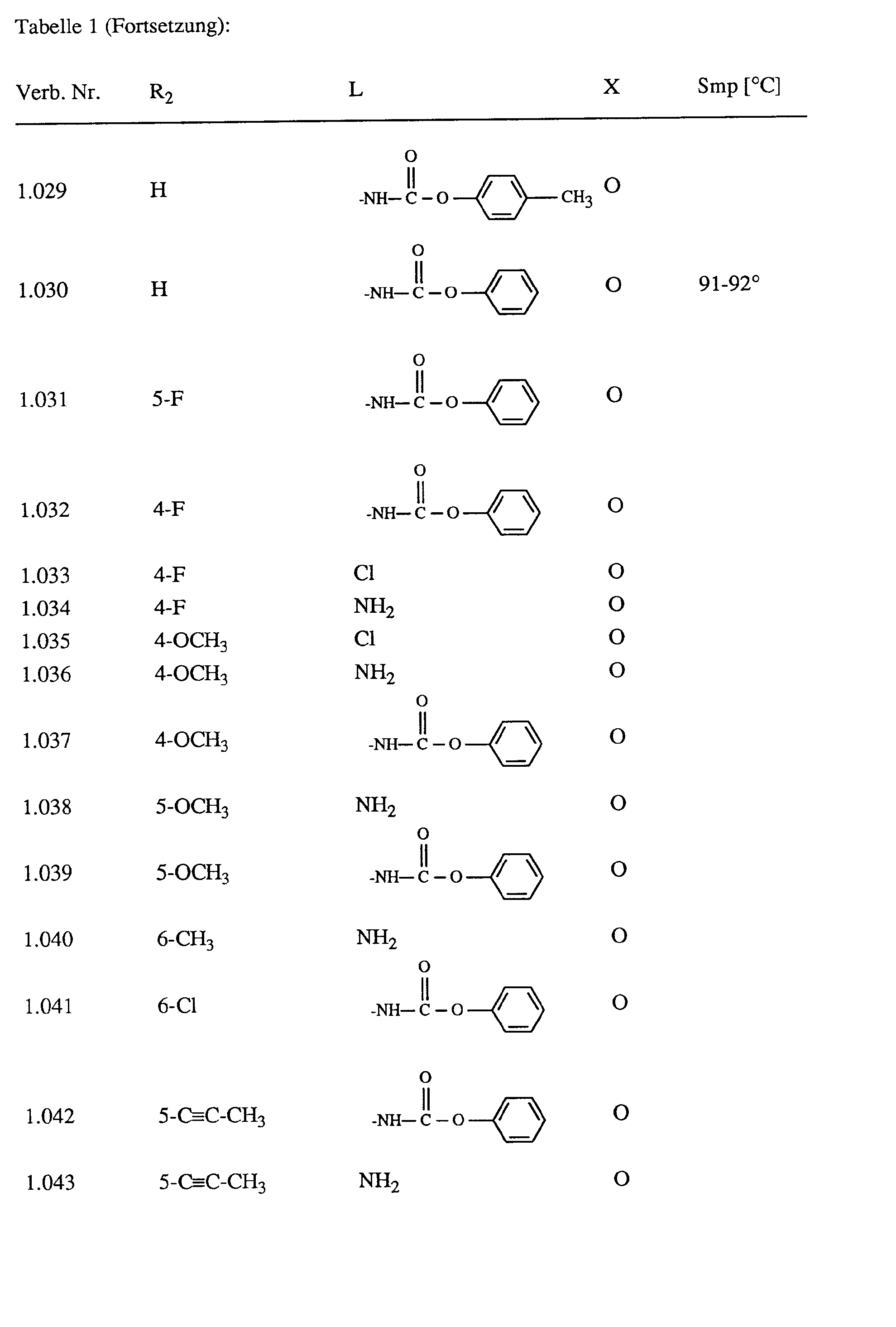
- Beispiel H9: N-[2-(Oxetan-3-oxycarbonyl)-phenylsulfonyl]-phenylcarbamat (Verbindung Nr. 1.030):

- Eine Mischung aus 2,57 g 2-(Oxetan-3-oxycarbonyl)-phenylsulfonamid, 2, 14 g Diphenylcarbonat, 1,38 g Kaliumcarbonat und 13 ml Dimethylformamid läßt man bei einer Temperaturvon 20-25°C 15 Stunden lang rühren. Anschließend gibt man die Reaktionsmischung in Eiswasser, stellt den pH-Wert durch Zuaopfen 10%iger Salzsäwe auf den Wert 5-6 ein, extrahiert mit Essigsäureethylester und wäscht mit Wasser. Nach Trocknen über Natriumsulfat, Eindampfen und Kristallisieren des Rückstandes aus Diethylether erhält man 2,2 g N-[2-(Oxetan-3-oxycarbonyl)-phenylsulfonyl]-phenylcarbamat (Verbindung 1.030) mit einem Schmelzpunkt von 91 -92°C.
-

- Eine Mischung aus 0,75 g N-[2-(Oxetan-3-oxycarbonyl)-phenylsulfonyl]-phenylcarbamat, 0,34 g 2-Amino-4-methoxy-6-(2,2,2-trifluorethoxy)-pyrimidin und 7 ml Dioxan läßt man bei einer Temperatur von 90-95°C 4 Stunden lang rühren. Nach Eindampfen der Reaktionsmischung und Kristallisieren des Rückstandes aus Aceton erhält man 0,7 g N-[2-(Oxetan-3-oxycarbonyl)-phenylsulfonyl]-N'-[4-methoxy-6-(2,2,2-trifluorethoxy-)pyrimidin-2-yl]-harnstoff (Verbindung Nr. 2.034) mit einem Schmelzpunkt von 185-186°C.
- In analoger Weise werden die in den angeschlossenen Tabellen aufgelisteten Verbindungen der Formel I sowie deren Zwischenprodukte hergestellt.
-



- Formulierungsbeispiele für Wirkstoffe der Formel I (% = Gewichtsprozent)

- Der Wirkstoff wird mit den Zusatzstoffen gut vermischt und in einer geeigneten Mühle gut vermahlen. Man erhält Spritzpulver, die sich mit Wasser zu Suspensionen jeder gewünschten Konzentration verdünnen lassen.

- Aus solchen Konzentraten können durch Verdünnen mit Wasser Emulsionen jeder gewünschten Konzentration hergestellt werden.

- Durch inniges Vermischen der Trägerstoffe mit dem Wirkstoff erhält man gebrauchsfertige Stäubemittel.

- Der Wirkstoff wird mit den Zusatzstoffen vermischt, vermahlen und mit Wasser angefeuchtet. Dieses Gemisch wird extrudiert und anschließend im Luftstrom getrocknet.

- Der fein gemahlene Wirkstoff wird in einem Mischer auf das mit Polyethylenglykol angefeuchtete Kaolin gleichmäßig aufgetragen. Auf diese Weise erhält man staubfreie Umhüllungs-Granulate.

- Der fein gemahlene Wirkstoff wird mit den Zusatzstoffen innig vermischt. Man erhält so ein SuspensionsKonzentrat, aus welchem durch Verdünnen mit Wasser Suspensionen jeder gewünschten Konzentration hergestellt werden können.

- Die Verbindungen der Formel werden in unveränderter Form oder vorzugsweise als Mittel zusammen mit den in der Formulierungstechnik üblichen Hilfsmitteln eingesetzt und werden daher z.B. zu Emulsionskonzentraten, direkt versprühbaren oder verdünnbaren Lösungen, verdünnten Emulsionen, Spritzpulvern, löslichen Pulvern, Stäubemitteln, Granulaten, auch Verkapselungen in z.B. polymeren Stoffen, in bekannter Weise verarbeitet. Die Anwendungsverfahren wie Versprühen, Vernebeln, Verstäuben, Verstreuen oder Gießen werden gleich wie die Art der Mittel den angestrebten Zielen und den gegebenen Verhältnissen entsprechend gewählt.
- Kunststofftöpfe werden mit expandiertem Vermiculit (Dichte: 0,135 g/cm3, Wasseradsorptionsvermögen: 0,565 1/1) gefüllt. Nach dem Sättigen des nicht adsorptiven Vermiculits mit einer wäßrigen Wirkstoffemulsion in deionisiertem Wasser, die die Wirkstoffe in einer Konzentration von 70,8 ppm enthält, werden Samen der folgenden Pflanzen auf die Oberfläche gesät: Nasturtium officinalis, Agrostis tenuis, Stellaria media und Digitaria sanguinalis. Die Versuchsgefäße werden anschließend in einer Klimakammer bei einer Temperatur von 20 °C, einer Beleuchtung von ca. 20 kLux und einer relativen Luftfeuchtigkeit von 70 % gehalten. Während einer Keimphase von 4 bis 5 Tagen werden die Töpfe zur Erhöhung der örtlichen Luftfeuchtigkeit mit lichtdurchlässigem Material abgedeckt und mit deionisiertem Wasser gegossen. Nach dem 5. Tag wird dem Gießwasser 0,5 % eines handelsüblichen Flüssigdüngers zugesetzt. 12 Tage nach der Aussaat wird der Versuch ausgewertet und die Wirkung auf die Versuchspflanzen nach dem folgenden Mäßstab bewertet:
- 1 : Pflanze nicht gekeimt oder total abgestorben
- 2-3 : sehr starke Wirkung
- 4-6 : mittlere Wirkung
- 7-8 : schwache Wirkung
- 9 : keine Wirkung (wie unbehandelte Kontrolle)
- Eine Anzahl Unkräuter, sowohl monokotyle wie dikotyle, wurden nach dem Auflaufen (im 4- bis 6-Blattstadium) mit einer wäßrigen Wirkstoffdispersion in einer Dosierung von 8-500 g Wirksubstanz pro Hektar auf die Pflanzen gespritzt und diese bei 24°-26°C und 45-60 % relativer Luftfeuchtigkeit gehalten. 15 Tage nach der Behandlung wird der Versuch ausgewertet.
- Nach 3 Wochen wird die Herbizidwirkung mit einem neunstufigen (1 = vollständige Schädigung, 9 = keine Wirkung) Boniturschema im Vergleich in einer unbehandelten Kontrollgruppe bewertet. Boniturnoten von 1 bis 4 (insbesondere 1 bis 3) weisen auf eine gute bis sehr gute Herbizidwirkung hin. Bonitumoten von 6 bis 9 (insbesondere von 7 bis 9) weisen auf eine gute Toleranz (insbesondere bei Kulturpflanzen) hin.
- In diesem Versuch zeigen die Verbindungen der Formel starke Herbizidwirkung.
- Die Wasserunkräuter Echinochloa crus galli und Monocharia vag. werden in Plastikbechern (60 cm2 Obefläche, 500 ml Volumen) ausgesät. Nach der Saat wird bis zur Erdoberfläche mit Wasser aufgefüllt. 3 Tage nach der Saat wird der Wasserspiegel bis leicht über die Erdobefläche erhöht (3-5 mm). Die Applikation erfolgt 3 Tage nach der Saat durch eine Spritzung der Prüfsubstanzen auf die Gefäße. Die verwendete Dosis entspricht einer Wirkstoffmenge von 8-500 g AS pro Hektar. Die Pflanzenbecher werden dann im Gewächshaus unter optimalen Wachstumsbedingungen für die Reisunkräuter aufgestellt, d.h. bei 25°-30°C und hoher Luftfeuchtigkeit.
- Die Auswertung der Versuche findet 3 Wochen nach Applikation statt. Die Verbindungen der Formel 1 schädigen dabei die Unkräuter.

Claims (46)

worin


sowie den Salzen dieser Verbindungen;
mit den Maßgaben, daß


Applications Claiming Priority (2)
| Application Number | Priority Date | Filing Date | Title |
|---|---|---|---|
| CH22091 | 1991-01-25 | ||
| CH220/91 | 1991-01-25 |
Publications (2)
| Publication Number | Publication Date |
|---|---|
| EP0496701A1 true EP0496701A1 (de) | 1992-07-29 |
| EP0496701B1 EP0496701B1 (de) | 1996-03-06 |
Family
ID=4182017
Family Applications (1)
| Application Number | Title | Priority Date | Filing Date |
|---|---|---|---|
| EP92810027A Expired - Lifetime EP0496701B1 (de) | 1991-01-25 | 1992-01-16 | Sulfonylharnstoffe als Herbizide |
Country Status (39)
| Country | Link |
|---|---|
| US (4) | US5209771A (de) |
| EP (1) | EP0496701B1 (de) |
| JP (1) | JPH04346983A (de) |
| KR (1) | KR920014807A (de) |
| CN (1) | CN1039771C (de) |
| AP (1) | AP296A (de) |
| AT (1) | ATE135004T1 (de) |
| AU (2) | AU645389B2 (de) |
| BG (1) | BG61187B1 (de) |
| BR (1) | BR9200213A (de) |
| CA (1) | CA2059882C (de) |
| CZ (1) | CZ279595B6 (de) |
| DE (1) | DE59205530D1 (de) |
| DK (1) | DK0496701T3 (de) |
| EE (1) | EE02947B1 (de) |
| EG (1) | EG19684A (de) |
| ES (1) | ES2084975T3 (de) |
| FI (1) | FI920279A7 (de) |
| GR (1) | GR3019245T3 (de) |
| HR (1) | HRP950137A2 (de) |
| HU (1) | HUT60603A (de) |
| IE (1) | IE71042B1 (de) |
| IL (3) | IL100741A (de) |
| LT (1) | LT3731B (de) |
| LV (1) | LV10610B (de) |
| MA (1) | MA22399A1 (de) |
| MD (1) | MD707C2 (de) |
| MX (1) | MX9200273A (de) |
| NO (1) | NO179251C (de) |
| NZ (1) | NZ241385A (de) |
| PL (2) | PL169407B1 (de) |
| RO (1) | RO106991B1 (de) |
| RU (1) | RU2056415C1 (de) |
| SI (1) | SI9210060A (de) |
| SK (1) | SK278536B6 (de) |
| TN (1) | TNSN92005A1 (de) |
| TR (1) | TR25726A (de) |
| UY (1) | UY23364A1 (de) |
| ZA (1) | ZA92503B (de) |
Cited By (15)
| Publication number | Priority date | Publication date | Assignee | Title |
|---|---|---|---|---|
| WO1993017016A1 (en) * | 1992-02-21 | 1993-09-02 | Ciba-Geigy Ag | Sulfonylureas as herbicides |
| EP0585199A1 (de) * | 1992-07-30 | 1994-03-02 | Ciba-Geigy Ag | Selektiv-herbizides Mittel |
| LT3020B (lt) | 1992-02-21 | 1994-08-25 | Ciba Geigy Ag | Nauji sulfonilkarbamidai |
| EP0657100A3 (de) * | 1993-12-08 | 1995-11-02 | Ciba Geigy Ag | Selektiv-herbizides Mittel. |
| WO1996008165A1 (en) * | 1994-09-13 | 1996-03-21 | Wm. Wrigley Jr. Company | Continuous chewing gum manufacture from base concentrate |
| WO1996008146A3 (en) * | 1994-09-06 | 1996-07-25 | Ciba Geigy Ag | Herbicidal synergistic composition and method of weed control |
| WO1998013361A1 (en) * | 1996-09-26 | 1998-04-02 | Novartis Ag | Herbicidal composition |
| WO1998032743A1 (de) * | 1997-01-23 | 1998-07-30 | Hoechst Schering Agrevo Gmbh | Phenylsulfonylharnstoffe, verfahren zu ihrer herstellung und ihre verwendung als herbizide und pflanzenwachstumsregulatoren |
| WO1999057966A1 (de) | 1998-05-14 | 1999-11-18 | Aventis Cropscience Gmbh | Transgene sulfonylharnstoff-tolerante zuckerrüben |
| WO1999057965A1 (de) | 1998-05-14 | 1999-11-18 | Aventis Cropscience Gmbh | Sulfonylharnstoff-tolerante zuckerrübenmutanten |
| WO2000008937A1 (de) | 1998-08-13 | 2000-02-24 | Aventis Cropscience Gmbh | Herbizide mittel für tolerante oder resistente baumwollkulturen |
| WO2000008936A1 (de) | 1998-08-13 | 2000-02-24 | Aventis Cropscience Gmbh | Herbizide mittel für tolerante oder resistente maiskulturen |
| EP0809436B1 (de) * | 1995-02-13 | 2000-03-01 | Novartis AG | Herbizide zusammensetzung und verfahren zur bekämpfung und unkräutern |
| US6586367B2 (en) | 1996-09-05 | 2003-07-01 | Syngenta Crop Protection, Inc. | Process for the control of weeds |
| EP2327305A1 (de) | 1998-08-13 | 2011-06-01 | Bayer CropScience AG | Herbizide Mittel für tolerante oder resistente Sojakulturen |
Families Citing this family (13)
| Publication number | Priority date | Publication date | Assignee | Title |
|---|---|---|---|---|
| ATE135004T1 (de) * | 1991-01-25 | 1996-03-15 | Ciba Geigy Ag | Sulfonylharnstoffe als herbizide |
| US5519148A (en) * | 1991-01-25 | 1996-05-21 | Ciba-Geigy Corporation | Sulfonylureas |
| US6783006B1 (en) | 1994-02-24 | 2004-08-31 | Syngenta Investment Corp. | Container for chemicals |
| ATE188213T1 (de) * | 1995-06-29 | 2000-01-15 | Novartis Ag | Verfahren zur herstellung von 3-hydroxyoxetanen |
| ATE546043T1 (de) * | 2002-03-29 | 2012-03-15 | Kumiai Chemical Industry Co | Granulatförmige agrarchemikalienzusammensetzung |
| EP2052606A1 (de) | 2007-10-24 | 2009-04-29 | Bayer CropScience AG | Herbizid-Kombination |
| USD585914S1 (en) * | 2008-06-20 | 2009-02-03 | Illinois Tool Works Inc. | Grinder/polisher |
| DE102008037620A1 (de) | 2008-08-14 | 2010-02-18 | Bayer Crop Science Ag | Herbizid-Kombination mit Dimethoxytriazinyl-substituierten Difluormethansulfonylaniliden |
| HRP20211509T1 (hr) | 2010-10-15 | 2021-12-24 | Bayer Cropscience Aktiengesellschaft | Upotreba herbicida inhibitora als za suzbijanje neželjene vegetacije u biljkama beta vulgaris tolerantnim na herbicide inhibitore als |
| AU2012251597B2 (en) | 2011-05-04 | 2015-11-05 | Bayer Intellectual Property Gmbh | Use of ALS inhibitor herbicides for control of unwanted vegetation in ALS inhibitor herbicide tolerant Brassica, such as B. napus, plants |
| RS57806B2 (sr) | 2012-12-13 | 2022-07-29 | Bayer Cropscience Ag | Upotreba als inhibitora herbicida za kontrolu neželjene vegetacije kod beta vulgaris biljaka tolerantnih na als inhibitore herbicida |
| MD1088Z (ro) * | 2016-04-13 | 2017-06-30 | Институт Генетики, Физиологии И Защиты Растений Академии Наук Молдовы | Procedeu de cultivare a plantelor de cultură |
| US20240401073A1 (en) | 2021-10-15 | 2024-12-05 | KWS SAAT SE & Co. KGaA | Als inhibitor herbicide tolerant beta vulgaris mutants |
Citations (4)
| Publication number | Priority date | Publication date | Assignee | Title |
|---|---|---|---|---|
| EP0007687A1 (de) * | 1978-05-30 | 1980-02-06 | E.I. Du Pont De Nemours And Company | Sulfonamide, Verfahren zu ihrer Herstellung, diese Sulfonamide enthaltende Zusammensetzungen und ein Verfahren zur Beeinflussung des Pflanzenwachstums |
| EP0030138A1 (de) * | 1979-11-30 | 1981-06-10 | E.I. Du Pont De Nemours And Company | Herbizide Sulfonamide und deren Zusammensetzungen, Herstellung und Verwendung |
| EP0291851A2 (de) * | 1987-05-19 | 1988-11-23 | BASF Aktiengesellschaft | Herbizide Sulfonylharnstoffe, Verfahren zu ihrer Herstellung und ihre Verwendung zur Beeinflussung des Pflanzenwachstums |
| US4892946A (en) * | 1979-11-30 | 1990-01-09 | E. I. Du Pont De Nemours And Company | Agricultural sulfonamides |
Family Cites Families (13)
| Publication number | Priority date | Publication date | Assignee | Title |
|---|---|---|---|---|
| US4383113A (en) * | 1978-05-30 | 1983-05-10 | E. I. Du Pont De Nemours And Company | Agricultural sulfonamides |
| JPS5947600B2 (ja) * | 1980-06-12 | 1984-11-20 | 旭化成株式会社 | 加工殿粉 |
| GR71993B (de) * | 1980-11-19 | 1983-08-26 | Stavffer Chemical Company | |
| AU550945B2 (en) * | 1981-07-10 | 1986-04-10 | E.I. Du Pont De Nemours And Company | Triazolyl-(imidazolyl)-sulphonyl-ureas |
| US4579584A (en) * | 1981-10-13 | 1986-04-01 | Ciba-Geigy Corporation | N-phenylsulfonyl-N'-triazinylureas |
| EP0101670B1 (de) | 1982-08-23 | 1988-03-09 | Ciba-Geigy Ag | Verfahren zur Herstellung von herbiziden und pflanzenwuchsregulierenden Sulfonylharnstoffen |
| EP0126711B1 (de) * | 1983-05-16 | 1989-08-02 | Ciba-Geigy Ag | Herbizid wirksame und pflanzenwuchsregulierende Pyrimidin-Derivate, deren Herstellung und Verwendung |
| US4546179A (en) * | 1983-11-23 | 1985-10-08 | E. I. Du Pont De Nemours And Company | Process for preparing sulfonylureas |
| DE3811777A1 (de) * | 1988-04-08 | 1989-10-19 | Hoechst Ag | Heterocyclisch substituierte alkyl- und alkenylsulfonylharnstoffe, verfahren zu ihrer herstellung und ihre verwendung als herbizide oder pflanzenwachstumsregulatoren |
| US5084082A (en) * | 1988-09-22 | 1992-01-28 | E. I. Du Pont De Nemours And Company | Soybean plants with dominant selectable trait for herbicide resistance |
| JP2598317B2 (ja) * | 1989-02-08 | 1997-04-09 | 呉羽化学工業株式会社 | N‐置換‐3‐(含窒素5員環)ベンゼンスルホンアミド誘導体、その製造方法及び除草剤 |
| EP0452500B1 (de) * | 1989-10-27 | 1997-03-12 | Nissan Chemical Industries, Limited | Sulfamidosulfonylharnstoffderivate und herbizide |
| ATE135004T1 (de) * | 1991-01-25 | 1996-03-15 | Ciba Geigy Ag | Sulfonylharnstoffe als herbizide |
-
1992
- 1992-01-16 AT AT92810027T patent/ATE135004T1/de not_active IP Right Cessation
- 1992-01-16 DE DE59205530T patent/DE59205530D1/de not_active Expired - Fee Related
- 1992-01-16 EP EP92810027A patent/EP0496701B1/de not_active Expired - Lifetime
- 1992-01-16 DK DK92810027.0T patent/DK0496701T3/da not_active Application Discontinuation
- 1992-01-16 ES ES92810027T patent/ES2084975T3/es not_active Expired - Lifetime
- 1992-01-20 SI SI9210060A patent/SI9210060A/sl unknown
- 1992-01-21 EG EG3692A patent/EG19684A/xx active
- 1992-01-21 US US07/823,515 patent/US5209771A/en not_active Expired - Lifetime
- 1992-01-22 FI FI920279A patent/FI920279A7/fi unknown
- 1992-01-22 MX MX9200273A patent/MX9200273A/es not_active IP Right Cessation
- 1992-01-23 KR KR1019920000923A patent/KR920014807A/ko not_active Ceased
- 1992-01-23 CA CA002059882A patent/CA2059882C/en not_active Expired - Lifetime
- 1992-01-23 NZ NZ241385A patent/NZ241385A/xx unknown
- 1992-01-23 AU AU10432/92A patent/AU645389B2/en not_active Ceased
- 1992-01-23 BR BR929200213A patent/BR9200213A/pt not_active IP Right Cessation
- 1992-01-23 IL IL10074192A patent/IL100741A/en not_active IP Right Cessation
- 1992-01-24 TR TR92/0071A patent/TR25726A/xx unknown
- 1992-01-24 RO RO9200013A patent/RO106991B1/ro unknown
- 1992-01-24 PL PL92296107A patent/PL169407B1/pl unknown
- 1992-01-24 PL PL92293282A patent/PL169554B1/pl unknown
- 1992-01-24 ZA ZA92503A patent/ZA92503B/xx unknown
- 1992-01-24 CZ CS92215A patent/CZ279595B6/cs unknown
- 1992-01-24 BG BG95816A patent/BG61187B1/bg unknown
- 1992-01-24 JP JP4034412A patent/JPH04346983A/ja active Pending
- 1992-01-24 MA MA22685A patent/MA22399A1/fr unknown
- 1992-01-24 IE IE920224A patent/IE71042B1/en not_active IP Right Cessation
- 1992-01-24 AP APAP/P/1992/000351A patent/AP296A/en active
- 1992-01-24 SK SK215-92A patent/SK278536B6/sk unknown
- 1992-01-24 TN TNTNSN92005A patent/TNSN92005A1/fr unknown
- 1992-01-24 CN CN92100442A patent/CN1039771C/zh not_active Expired - Lifetime
- 1992-01-24 RU SU925010749A patent/RU2056415C1/ru active
- 1992-01-24 HU HU9200237A patent/HUT60603A/hu unknown
- 1992-01-24 NO NO920328A patent/NO179251C/no unknown
- 1992-01-27 UY UY23364A patent/UY23364A1/es unknown
-
1993
- 1993-02-08 US US08/014,947 patent/US5286709A/en not_active Expired - Lifetime
- 1993-05-25 LV LVP-93-413A patent/LV10610B/lv unknown
- 1993-11-19 US US08/154,768 patent/US5412107A/en not_active Expired - Lifetime
- 1993-12-21 LT LTIP1655A patent/LT3731B/lt not_active IP Right Cessation
-
1994
- 1994-02-14 AU AU55137/94A patent/AU653480B2/en not_active Ceased
- 1994-07-14 MD MD94-0282A patent/MD707C2/ro unknown
- 1994-11-17 EE EE9400402A patent/EE02947B1/xx unknown
-
1995
- 1995-03-23 HR HRP-60/92A patent/HRP950137A2/hr not_active Application Discontinuation
- 1995-04-10 US US08/419,307 patent/US5597779A/en not_active Expired - Lifetime
- 1995-12-05 IL IL11625495A patent/IL116254A0/xx unknown
- 1995-12-05 IL IL11625395A patent/IL116253A0/xx unknown
-
1996
- 1996-03-07 GR GR960400509T patent/GR3019245T3/el unknown
Patent Citations (4)
| Publication number | Priority date | Publication date | Assignee | Title |
|---|---|---|---|---|
| EP0007687A1 (de) * | 1978-05-30 | 1980-02-06 | E.I. Du Pont De Nemours And Company | Sulfonamide, Verfahren zu ihrer Herstellung, diese Sulfonamide enthaltende Zusammensetzungen und ein Verfahren zur Beeinflussung des Pflanzenwachstums |
| EP0030138A1 (de) * | 1979-11-30 | 1981-06-10 | E.I. Du Pont De Nemours And Company | Herbizide Sulfonamide und deren Zusammensetzungen, Herstellung und Verwendung |
| US4892946A (en) * | 1979-11-30 | 1990-01-09 | E. I. Du Pont De Nemours And Company | Agricultural sulfonamides |
| EP0291851A2 (de) * | 1987-05-19 | 1988-11-23 | BASF Aktiengesellschaft | Herbizide Sulfonylharnstoffe, Verfahren zu ihrer Herstellung und ihre Verwendung zur Beeinflussung des Pflanzenwachstums |
Cited By (26)
| Publication number | Priority date | Publication date | Assignee | Title |
|---|---|---|---|---|
| LT3020B (lt) | 1992-02-21 | 1994-08-25 | Ciba Geigy Ag | Nauji sulfonilkarbamidai |
| WO1993017016A1 (en) * | 1992-02-21 | 1993-09-02 | Ciba-Geigy Ag | Sulfonylureas as herbicides |
| EP0585199A1 (de) * | 1992-07-30 | 1994-03-02 | Ciba-Geigy Ag | Selektiv-herbizides Mittel |
| US5350734A (en) * | 1992-07-30 | 1994-09-27 | Ciba-Geigy Corporation | Selective herbidical composition comprising oxetan-3-oxycarbonylphenylsulfonylurea herbicides and quinoline derivatives as safeners |
| EP0657100A3 (de) * | 1993-12-08 | 1995-11-02 | Ciba Geigy Ag | Selektiv-herbizides Mittel. |
| WO1996008146A3 (en) * | 1994-09-06 | 1996-07-25 | Ciba Geigy Ag | Herbicidal synergistic composition and method of weed control |
| WO1996008165A1 (en) * | 1994-09-13 | 1996-03-21 | Wm. Wrigley Jr. Company | Continuous chewing gum manufacture from base concentrate |
| EP0809436B1 (de) * | 1995-02-13 | 2000-03-01 | Novartis AG | Herbizide zusammensetzung und verfahren zur bekämpfung und unkräutern |
| US7407913B2 (en) | 1996-09-05 | 2008-08-05 | Syngenta Crop Protection, Inc. | Process for the control of weeds |
| US6586367B2 (en) | 1996-09-05 | 2003-07-01 | Syngenta Crop Protection, Inc. | Process for the control of weeds |
| WO1998013361A1 (en) * | 1996-09-26 | 1998-04-02 | Novartis Ag | Herbicidal composition |
| US6294504B1 (en) | 1996-09-26 | 2001-09-25 | Syngenta Crop Protection, Inc. | Herbicidal composition |
| WO1998032743A1 (de) * | 1997-01-23 | 1998-07-30 | Hoechst Schering Agrevo Gmbh | Phenylsulfonylharnstoffe, verfahren zu ihrer herstellung und ihre verwendung als herbizide und pflanzenwachstumsregulatoren |
| US6410483B1 (en) | 1997-01-23 | 2002-06-25 | Hoechst Schering Agrevo Gmbh | Phenylsulfonylureas, processes for their preparation, and their use as herbicides and plant growth regulators |
| WO1999057965A1 (de) | 1998-05-14 | 1999-11-18 | Aventis Cropscience Gmbh | Sulfonylharnstoff-tolerante zuckerrübenmutanten |
| WO1999057966A1 (de) | 1998-05-14 | 1999-11-18 | Aventis Cropscience Gmbh | Transgene sulfonylharnstoff-tolerante zuckerrüben |
| BG65288B1 (bg) * | 1998-08-13 | 2007-12-28 | Aventis Cropscience Gmbh | Хербицидни средства за толерантни или устойчиви царевични култури |
| WO2000008936A1 (de) | 1998-08-13 | 2000-02-24 | Aventis Cropscience Gmbh | Herbizide mittel für tolerante oder resistente maiskulturen |
| WO2000008937A1 (de) | 1998-08-13 | 2000-02-24 | Aventis Cropscience Gmbh | Herbizide mittel für tolerante oder resistente baumwollkulturen |
| EP2319317A1 (de) | 1998-08-13 | 2011-05-11 | Bayer CropScience AG | Herbizide Mittel für tolerante oder resistente Baumwollkulturen |
| EP2319315A1 (de) | 1998-08-13 | 2011-05-11 | Bayer CropScience AG | Herbizide Mittel für tolerante oder resistente Maiskulturen |
| EP2319316A1 (de) | 1998-08-13 | 2011-05-11 | Bayer CropScience AG | Herbizide Mittel für tolerante oder resistente Maiskulturen |
| EP2327305A1 (de) | 1998-08-13 | 2011-06-01 | Bayer CropScience AG | Herbizide Mittel für tolerante oder resistente Sojakulturen |
| EP2329718A1 (de) | 1998-08-13 | 2011-06-08 | Bayer CropScience AG | Herbizide Mittel für tolerante oder resistente Sojakulturen |
| EP2329719A1 (de) | 1998-08-13 | 2011-06-08 | Bayer CropScience AG | Herbizide Mittel für tolerante oder resistente Sojakulturen |
| EP2904902A1 (de) | 1998-08-13 | 2015-08-12 | Bayer CropScience AG | Herbizide Mittel für tolerante oder resistente Sojakulturen |
Also Published As
Similar Documents
| Publication | Publication Date | Title |
|---|---|---|
| EP0496701B1 (de) | Sulfonylharnstoffe als Herbizide | |
| EP0099339B1 (de) | Anellierte N-Phenylsulfonyl-N'-pyrimidinyl- und -triazinylharnstoffe | |
| EP0084020B1 (de) | N-Arylsulfonyl-N'-pyrimidinylharnstoffe | |
| EP0120814B1 (de) | N-Phenylsulfonyl-N'-pyrimidinyl- und -triazinylharnstoffe | |
| EP0044809B1 (de) | N-(2-substituierte Phenylsulfonyl)-N'-triazinylharnstoffe | |
| EP0070802B1 (de) | N-Phenylsulfonyl-N'-pyrimidinyl- und -triazinylharnstoffe | |
| EP0072347B1 (de) | N-Phenylsulfonyl-N'-pyrimidinyl- und -triazinylharnstoffe | |
| EP0262096B1 (de) | Aminopyrazinone und Aminotriazinone | |
| EP0097122B1 (de) | N-Heterocyclosulfonyl-N'-pyrimidinyl- und -triazinylharnstoffe | |
| EP0126711B1 (de) | Herbizid wirksame und pflanzenwuchsregulierende Pyrimidin-Derivate, deren Herstellung und Verwendung | |
| DE69225768T2 (de) | Sulfonylharnstoffe | |
| EP0116518A1 (de) | N-Phenylsulfonyl-N'-pyrimidinyl- und -triazinylharnstoffe | |
| EP0096003B2 (de) | Neue Sulfonyl(thio)harnstoffe, Verfahren zu deren Herstellung und deren Verwendung als Herbizide und/oder Wachstumsregulatoren | |
| EP0141777A2 (de) | Herbizide Sulfonylharnstoffe | |
| SI9300627A (en) | Selective herbicid comprising pyridinsulphonylureas and sulphamoylphenylureas | |
| EP0161211A1 (de) | N-Heterocyclosulfonyl-N'-pyrimidinyl- und -triazinylharnstoffe | |
| EP0459949B1 (de) | Sulfonylharnstoffe mit herbizider und pflanzenwuchsregulierender Wirkung | |
| EP0128116B1 (de) | Anellierte N-Phenylsulfonyl-N'-pyrimidinyl- und -triazinylharnstoffe | |
| EP0112803B1 (de) | Phosphorhaltige N-Phenylsulfonyl-N'-pyrimidinyl- und -triazinylharnstoffe | |
| EP0558445A1 (de) | Sulfonylharnstoffe als Herbizide | |
| EP0434624B1 (de) | Triazolylsulfonamide | |
| EP0401168A2 (de) | Neue Herbizide | |
| EP0169815B1 (de) | N-Arylsulfonyl-N'-triazinyl- und -pyrimidinylharnstoffe | |
| EP0402316B1 (de) | Sulfonylharnstoffe | |
| EP0582021B1 (de) | Sulfonylharnstoffe als Herbizide |
Legal Events
| Date | Code | Title | Description |
|---|---|---|---|
| PUAI | Public reference made under article 153(3) epc to a published international application that has entered the european phase |
Free format text: ORIGINAL CODE: 0009012 |
|
| AK | Designated contracting states |
Kind code of ref document: A1 Designated state(s): AT BE CH DE DK ES FR GB GR IT LI LU NL PT SE |
|
| 17P | Request for examination filed |
Effective date: 19920926 |
|
| 17Q | First examination report despatched |
Effective date: 19931117 |
|
| GRAA | (expected) grant |
Free format text: ORIGINAL CODE: 0009210 |
|
| AK | Designated contracting states |
Kind code of ref document: B1 Designated state(s): AT BE CH DE DK ES FR GB GR IT LI LU NL PT SE |
|
| REF | Corresponds to: |
Ref document number: 135004 Country of ref document: AT Date of ref document: 19960315 Kind code of ref document: T |
|
| REG | Reference to a national code |
Ref country code: DK Ref legal event code: T3 |
|
| REF | Corresponds to: |
Ref document number: 59205530 Country of ref document: DE Date of ref document: 19960411 |
|
| ITF | It: translation for a ep patent filed | ||
| ET | Fr: translation filed | ||
| REG | Reference to a national code |
Ref country code: ES Ref legal event code: FG2A Ref document number: 2084975 Country of ref document: ES Kind code of ref document: T3 |
|
| GBT | Gb: translation of ep patent filed (gb section 77(6)(a)/1977) |
Effective date: 19960423 |
|
| REG | Reference to a national code |
Ref country code: GR Ref legal event code: FG4A Free format text: 3019245 |
|
| SC4A | Pt: translation is available |
Free format text: 960321 AVAILABILITY OF NATIONAL TRANSLATION |
|
| PLBE | No opposition filed within time limit |
Free format text: ORIGINAL CODE: 0009261 |
|
| REG | Reference to a national code |
Ref country code: CH Ref legal event code: PFA Free format text: CIBA-GEIGY AG TRANSFER- NOVARTIS AG |
|
| 26N | No opposition filed | ||
| REG | Reference to a national code |
Ref country code: GB Ref legal event code: 732E |
|
| NLS | Nl: assignments of ep-patents |
Owner name: NOVARTIS AG |
|
| REG | Reference to a national code |
Ref country code: FR Ref legal event code: TP |
|
| PGFP | Annual fee paid to national office [announced via postgrant information from national office to epo] |
Ref country code: FR Payment date: 19971126 Year of fee payment: 7 |
|
| PGFP | Annual fee paid to national office [announced via postgrant information from national office to epo] |
Ref country code: BE Payment date: 19971128 Year of fee payment: 7 |
|
| PGFP | Annual fee paid to national office [announced via postgrant information from national office to epo] |
Ref country code: NL Payment date: 19971130 Year of fee payment: 7 |
|
| PGFP | Annual fee paid to national office [announced via postgrant information from national office to epo] |
Ref country code: DK Payment date: 19971205 Year of fee payment: 7 Ref country code: DE Payment date: 19971205 Year of fee payment: 7 |
|
| PGFP | Annual fee paid to national office [announced via postgrant information from national office to epo] |
Ref country code: SE Payment date: 19971208 Year of fee payment: 7 |
|
| PGFP | Annual fee paid to national office [announced via postgrant information from national office to epo] |
Ref country code: GR Payment date: 19971210 Year of fee payment: 7 |
|
| PGFP | Annual fee paid to national office [announced via postgrant information from national office to epo] |
Ref country code: AT Payment date: 19971211 Year of fee payment: 7 |
|
| PGFP | Annual fee paid to national office [announced via postgrant information from national office to epo] |
Ref country code: PT Payment date: 19971215 Year of fee payment: 7 |
|
| PGFP | Annual fee paid to national office [announced via postgrant information from national office to epo] |
Ref country code: CH Payment date: 19971217 Year of fee payment: 7 |
|
| PGFP | Annual fee paid to national office [announced via postgrant information from national office to epo] |
Ref country code: GB Payment date: 19971218 Year of fee payment: 7 |
|
| REG | Reference to a national code |
Ref country code: ES Ref legal event code: PC2A |
|
| PGFP | Annual fee paid to national office [announced via postgrant information from national office to epo] |
Ref country code: ES Payment date: 19980121 Year of fee payment: 7 |
|
| PG25 | Lapsed in a contracting state [announced via postgrant information from national office to epo] |
Ref country code: GB Free format text: LAPSE BECAUSE OF NON-PAYMENT OF DUE FEES Effective date: 19990116 Ref country code: AT Free format text: LAPSE BECAUSE OF NON-PAYMENT OF DUE FEES Effective date: 19990116 |
|
| PG25 | Lapsed in a contracting state [announced via postgrant information from national office to epo] |
Ref country code: SE Free format text: LAPSE BECAUSE OF NON-PAYMENT OF DUE FEES Effective date: 19990117 |
|
| PG25 | Lapsed in a contracting state [announced via postgrant information from national office to epo] |
Ref country code: ES Free format text: LAPSE BECAUSE OF NON-PAYMENT OF DUE FEES Effective date: 19990118 |
|
| PG25 | Lapsed in a contracting state [announced via postgrant information from national office to epo] |
Ref country code: LI Free format text: LAPSE BECAUSE OF NON-PAYMENT OF DUE FEES Effective date: 19990131 Ref country code: GR Free format text: LAPSE BECAUSE OF NON-PAYMENT OF DUE FEES Effective date: 19990131 Ref country code: CH Free format text: LAPSE BECAUSE OF NON-PAYMENT OF DUE FEES Effective date: 19990131 Ref country code: BE Free format text: LAPSE BECAUSE OF NON-PAYMENT OF DUE FEES Effective date: 19990131 |
|
| PG25 | Lapsed in a contracting state [announced via postgrant information from national office to epo] |
Ref country code: DK Free format text: LAPSE BECAUSE OF NON-PAYMENT OF DUE FEES Effective date: 19990202 |
|
| BERE | Be: lapsed |
Owner name: NOVARTIS A.G. Effective date: 19990131 |
|
| PG25 | Lapsed in a contracting state [announced via postgrant information from national office to epo] |
Ref country code: PT Free format text: LAPSE BECAUSE OF NON-PAYMENT OF DUE FEES Effective date: 19990731 |
|
| PG25 | Lapsed in a contracting state [announced via postgrant information from national office to epo] |
Ref country code: NL Free format text: LAPSE BECAUSE OF NON-PAYMENT OF DUE FEES Effective date: 19990801 |
|
| GBPC | Gb: european patent ceased through non-payment of renewal fee |
Effective date: 19990116 |
|
| REG | Reference to a national code |
Ref country code: CH Ref legal event code: PL |
|
| PG25 | Lapsed in a contracting state [announced via postgrant information from national office to epo] |
Ref country code: FR Free format text: LAPSE BECAUSE OF NON-PAYMENT OF DUE FEES Effective date: 19990930 |
|
| PG25 | Lapsed in a contracting state [announced via postgrant information from national office to epo] |
Ref country code: DE Free format text: LAPSE BECAUSE OF NON-PAYMENT OF DUE FEES Effective date: 19991103 |
|
| REG | Reference to a national code |
Ref country code: FR Ref legal event code: ST |
|
| REG | Reference to a national code |
Ref country code: PT Ref legal event code: MM4A Free format text: LAPSE DUE TO NON-PAYMENT OF FEES Effective date: 19990731 |
|
| REG | Reference to a national code |
Ref country code: DK Ref legal event code: EBP |
|
| REG | Reference to a national code |
Ref country code: ES Ref legal event code: FD2A Effective date: 20010910 |
|
| PGFP | Annual fee paid to national office [announced via postgrant information from national office to epo] |
Ref country code: IT Payment date: 20110120 Year of fee payment: 20 Ref country code: LU Payment date: 20110215 Year of fee payment: 20 |