EP0496754B2 - Verfahren und vorrichtung zur echtheitsprüfung von geld - Google Patents
Verfahren und vorrichtung zur echtheitsprüfung von geld Download PDFInfo
- Publication number
- EP0496754B2 EP0496754B2 EP90914947A EP90914947A EP0496754B2 EP 0496754 B2 EP0496754 B2 EP 0496754B2 EP 90914947 A EP90914947 A EP 90914947A EP 90914947 A EP90914947 A EP 90914947A EP 0496754 B2 EP0496754 B2 EP 0496754B2
- Authority
- EP
- European Patent Office
- Prior art keywords
- measurements
- coin
- acceptance
- ranges
- money
- Prior art date
- Legal status (The legal status is an assumption and is not a legal conclusion. Google has not performed a legal analysis and makes no representation as to the accuracy of the status listed.)
- Expired - Lifetime
Links
- 238000000034 method Methods 0.000 title claims abstract description 46
- 238000005259 measurement Methods 0.000 claims abstract description 132
- 230000001419 dependent effect Effects 0.000 claims abstract description 8
- 238000012360 testing method Methods 0.000 claims description 29
- 230000008859 change Effects 0.000 claims description 9
- 230000000694 effects Effects 0.000 claims description 5
- 238000012886 linear function Methods 0.000 claims description 5
- 230000004044 response Effects 0.000 claims description 5
- 238000012887 quadratic function Methods 0.000 claims 1
- 241000237858 Gastropoda Species 0.000 description 8
- 230000009467 reduction Effects 0.000 description 6
- 238000010200 validation analysis Methods 0.000 description 6
- 230000006870 function Effects 0.000 description 4
- 230000002411 adverse Effects 0.000 description 2
- 230000009286 beneficial effect Effects 0.000 description 2
- 238000010586 diagram Methods 0.000 description 2
- 230000005672 electromagnetic field Effects 0.000 description 2
- 230000001939 inductive effect Effects 0.000 description 2
- 238000003780 insertion Methods 0.000 description 2
- 230000037431 insertion Effects 0.000 description 2
- 230000007246 mechanism Effects 0.000 description 2
Images

Classifications
-
- G—PHYSICS
- G07—CHECKING-DEVICES
- G07D—HANDLING OF COINS OR VALUABLE PAPERS, e.g. TESTING, SORTING BY DENOMINATIONS, COUNTING, DISPENSING, CHANGING OR DEPOSITING
- G07D5/00—Testing specially adapted to determine the identity or genuineness of coins, e.g. for segregating coins which are unacceptable or alien to a currency
-
- G—PHYSICS
- G07—CHECKING-DEVICES
- G07D—HANDLING OF COINS OR VALUABLE PAPERS, e.g. TESTING, SORTING BY DENOMINATIONS, COUNTING, DISPENSING, CHANGING OR DEPOSITING
- G07D5/00—Testing specially adapted to determine the identity or genuineness of coins, e.g. for segregating coins which are unacceptable or alien to a currency
- G07D5/08—Testing the magnetic or electric properties
Definitions
- This invention relates to a method and apparatus for validating items of money, such as coins or banknotes.
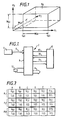
- each of the three orthogonal axes P 1 , P 2 and P 3 represent the three independent measurements.
- the measurement P 1 is expected to fall within a range (or window) W A1 , which lies within the upper and lower limits U A1 and L A1 .
- the properties P 2 and P 3 are expected to lie within the ranges W A2 and W A3 , respectively. If all three measurements lie within the respective windows, the coin is deemed to be an acceptable coin of type A. In these circumstances, the measurements will lie within an acceptance region indicated at R A in Figure 1.
- the acceptance region R A is three dimensional, but of course it may be two dimensional or may have more than three dimensions depending upon the number of independent measurements made on the coin.
- a coin validator which is arranged to validate more than one type of coin would have different acceptance regions R B , R C , etc., for different coin types B, C, etc.
- each coin property measurement can be compared against stored upper and lower limit values defining the acceptance windows.
- each measurement may be checked to determine whether it is within a predetermined tolerance of a specific value.
- each measurement may be checked to determine whether it is equal to a specific value, in which case the permitted deviation of the measurement from an expected value is determined by the tolerance of the circuitry.
- GB-A-1 405 937 discloses circuitry in which the tolerance is determined by the selection of the stages of a digital counter which are decoded when the count representing the measurement is checked.
- each measurement can be checked against the respective range for every coin type before reaching the decision as to whether a tested coin is authentic, and if so the denomination of the coin.
- one of the tests could be used for pre-classifying the coin so that subsequent test measurements are only checked against the windows for the coin types determined by the pre-classification step.
- a first test provisionally classifies the coin into one of three types, in dependence upon the count reached by a counter. The counter is then caused to count down at a rate which is determined by the results of the pre-classification test. If the final count is equal to a predetermined number (e.g. zero), the coin is determined to be a valid coin of the type determined in the pre-classification test.
- each acceptance window is always predetermined before the test is carried out.
- Some validators have means for adjusting the acceptance windows. The purpose of the adjustment is to either increase the proportion of valid coins which are determined to be acceptable (by increasing the size of the acceptance window) or to reduce the number of counterfeit coins which are erroneously deemed to be valid (by reducing the size of the acceptance window). Adjustment of the window is carried out either manually, or automatically (e.g. as in EP-A-0155126). In any event, the result of the window adjustment is that the upper and lower limits of the acceptance window are predetermined.
- This technique is highly effective for avoiding acceptance of such slugs, even when the properties of the slugs lie within the ranges for a different, genuine coin denomination.
- the acceptance region for the genuine denomination is effectively reduced by the amount of overlap with the "acceptance region" for the slugs, because any slugs are rejected.
- this technique is only effective for a single specific slug with known properties, and the effect it has on the acceptance ratio for genuine coins is indeterminate.
- EP-A-0086648 discloses a coin validator which utilises windows defining an acceptance region having linear or planar boundaries, as does GB-A-2211337.
- US-A-4349095 discloses a coin validator using a "pre-classification" technique in which a first test determines a likely denomination which is then used to set the acceptance range for a subsequent test, in generally the same manner as in GB-A-1405937 discussed above.
- EP-A-0367921 forms part of the state of the art under Art. 54(3), in respect of AT, CH, DE, FR, GB, IT and LI. It discloses a method and apparatus for validating coins in which measurements are taken, and a value which is a function of the measurements is tested against a threshold, so as to test whether the measurements lie within respective ranges which define an ellipse derived statistically from acceptable coins, and to accept a coin where they lie within the ellipse.
- the first and second measurements are "different measurements".
- the reference to "different measurements” is intended to indicate the measurement of different physical characteristics of the tested item, as distinct from merely taking the same measurement at different times to indicate a single physical characteristic or combination of such characteristics. For example, in GB-A- 1 405 937, and in several other prior art arrangements, the time taken for a coin to travel between two points is measured. Although this could be regarded as taking two time measurements and subtracting the difference, the purpose is simply to obtain a single measurement determined by a particular combination of physical characteristics, and therefore this does not represent “different measurements” as this is understood in the present case.
- the invention can be carried out in many ways.
- Two or more property measurements may be combined in order to derive a value which is a predetermined non-linear function of these measurements, and the result may be compared with a predetermined acceptance window. Because the derived value is a function of two measurements, it will be understood that the permitted range of values for each measurement will be dependent upon the other measurement(s).
- the invention also extends to money validating apparatus arranged to operate in accordance with a method of the invention, and to a method of setting-up such an apparatus.
- the coin testing apparatus 2 shown schematically in Figure 2 has a set of coin sensors indicated at 4. Each of these is operable to measure a different property of a coin inserted in the apparatus, in a manner which is in itself well known. Each sensor provides a signal indicating the measured value of the respective parameter on one of a set of output lines indicated at 6.
- An LSI 8 receives these signals.
- the LSI 8 contains a read-only memory storing an operating program which controls the way in which the apparatus operates. Instead of an LSI, a standard microprocessor may be used.
- the LSI is operable to compare each measured value received on a respective one of the input lines 6 with upper and lower limit values stored in predetermined locations in a PROM 10.
- the PROM 10 could be any other type of memory circuit, and could be formed of a single or several integrated circuits, or may be combined with the LSI 8 (or microprocessor) into a single integrated circuit.
- the LSI 8 which operates in response to timing signals produced by a clock 12, is operable to address the PROM 10 by supplying address signals on an address bus 14.
- the LSI also provides a "PROM-enable" signal on line 16 to enable the PROM.
- a limit value is delivered from the PROM 10 to the LSI 8 via a data bus 18.
- one embodiment of the invention may comprise three sensors, for respectively measuring the conductivity, thickness and diameter of inserted coins.
- Each sensor comprises one or more coils in a self-oscillating circuit.
- a change in the inductance of each coil caused by the proximity of an inserted coin causes the frequency of the oscillator to alter, whereby a digital representation of the respective property of the coin can be derived.
- a change in the Q of the coil caused by the proximity of an inserted coin causes the voltage across the coil to alter, whereby a digital output representative of conductivity of the coin may be derived.
- each coil provides an output predominantly dependent upon a particular one of the properties of conductivity, diameter and thickness, it will be appreciated that each measurement will be affected to some extent by other coin properties.
- the change, i.e. difference, from the idle value i.e. the signal value without a coin present
- the idle frequency is subtracted from the frequency with a coin present.
- the voltage with a coin present is divided by the idle voltage.
- the term "measurement" will be understood to include an embodiment in which, instead of the raw sensor output, the change in sensor output from its idle value is formed, for example by either of these two methods.
- the apparatus so far described corresponds to that disclosed in GB-A-2094008.
- the measurements produced by the three sensors 4 are compared with the values stored in the region of the PROM 10 shown in Figure 3.
- the thickness measurement is compared with the twelve values, representing the limits of six ranges for the respective coins A to F, in the row marked P 1 in Figure 3. If the measured thickness value lies within the upper and lower limits of the thickness range for a particular coin (e.g. if it lies between the upper and lower limits U A1 and L A1 for the coin A), then the thickness test for that coin has been passed.
- the diameter measurement is compared with the twelve upper and lower limit values in the row P 2
- the conductivity measurement is compared with the limit values in the row marked P 3 .
- the LSI 8 produces an ACCEPT signal on one of a group of output lines 24, and a further signal on another of the output lines 24 to indicate the denomination of the coin being tested.
- the validator has an accept gate (not shown) which adopts one of two different states depending upon whether the ACCEPT signal is generated, so that all tested coins deemed genuine are directed along an accept path and all other tested items along another path.
- the validator of GB-A-2094008 has acceptance regions, defined by the values stored in PROM 10, generally of the form shown in Figure 1.
- one of the six acceptance regions is modified in form in a manner similar, but not identical, to the form shown in R A in Figure 4, so as to differ from the region of Figure 1 in that it has been reduced by the volume shown at r A .
- any received items having properties falling within the volume r A will not be accepted by the validator.
- the acceptance ratio is improved.
- the acceptance region R A is similar to that shown in Figure 1 except that it has been reduced by the volume indicated at r A at one corner.
- the volume r A is defined by the interception of the region R A and surface indicated at PL.
- the surface PL shown in Figure 4 is planar, this is intended illustratively.
- the present invention is concerned exclusively with acceptance regions having at least one non-planar surface PL, as discussed below, and hence the acceptance region of Figure 4 per se is not an embodiment of the invention.
- the acceptance regions R B , R C , etc. each have the form shown in Figure 1, although if desired each could be modified to the form shown in Figure 4 or a non linear version thereof according to the present invention.
- the property measurements P 1 , P 2 and P 3 are taken.
- the program checks to determine whether the following conditions are met: c 1 P 1 + c 2 P 2 + c 3 P 3 + c 4 + c 5 - P 1 2 ⁇ 0, where c 1 , c 2 , c 3 , c 4 and c 5 are predetermined coefficients stored in a memory (e.g. the PROM 10) of the validator. If the conditions are not met, this indicates that the property measurements define a point which is located on the side S 1 of the surface PL shown in Figure 4, and therefore the program proceeds to step 104, where the property measurements are checked against the acceptance regions for coin denominations B, C, etc. in the conventional way.
- step 105 the property measurements are compared with the acceptance region R A , in the normal way. This step will be reached only if the property measurements lie on the side S 2 of the surface PL. If the measurements are found to lie within the region R A , the program proceeds to step 106, where the signals indicating receipt of genuine coin of denomination A are issued. Otherwise, the program proceeds to step 104 to check for other denominations.
- the reduction r A in the unmodified acceptance region R A is located at a corner or along an edge of the region R A .
- This is not essential. It may in some circumstances be desirable to locate the region r A closer to the centre of the region R A , or towards the centre of a surface thereof.
- the reduction region r A could be in the form of a trough extending along the centre of one of the surfaces defining the region R A .
- This may be of use in validating coins which produce different measurements depending upon their orientation within the validator when being tested, e.g. depending upon whether a coin is inserted with its "heads" side on the left or right. Such measurements may be grouped in one or two major areas depending upon orientation, so that properties which are found to lie in a central region indicate that the tested item is unlikely to be genuine.
- non-planar boundaries of the acceptance region could have any configuration. This applies also to any non-acceptance regions R N which may be used.
- An example of another possible equation is: P 1 P 2 ⁇ k, where k is a predetermined value.
- any of the acceptance regions may be reduced by more than one of the volumes r A .
- the unmodified acceptance region R A is reduced by the region r A in one corner thereof, it could additionally be reduced by other volumes located in separate positions; i.e. other surfaces could intersect the acceptance region R A to define additional non-acceptance regions r A .
- the effective acceptance region is defined by sets of windows (representing the unmodified region R A ) together with additional parameters representing the reduction r A in that region.
- the unmodified window limits it is not essential that the unmodified window limits be employed.
- the entire effective acceptance region R A can be defined by, for example, formulae such as those used above.
- This invention relates to a method and apparatus for validating items of money, such as coins or banknotes.
- each of the three orthogonal axes P 1 , P 2 and P 3 represent the three independent measurements.
- the measurement P 1 is expected to fall within a range (or window) W A1 , which lies within the upper and lower limits U A1 and L A1 .
- the properties P 2 and P 3 are expected to lie within the ranges W A2 and W A3 , respectively. If all three measurements lie within the respective windows, the coin is deemed to be an acceptable coin of type A. In these circumstances, the measurements will lie within an acceptance region indicated at R A in Figure 1.
- the acceptance region R A is three dimensional, but of course it may be two dimensional or may have more than three dimensions depending upon the number of independent measurements made on the coin.
- a coin validator which is arranged to validate more than one type of coin would have different acceptance regions R B , R C , etc., for different coin types B, C, etc.
- each coin property measurement can be compared against stored upper and lower limit values defining the acceptance windows.
- each measurement may be checked to determine whether it is within a predetermined tolerance of a specific value.
- each measurement may be checked to determine whether it is equal to a specific value, in which case the permitted deviation of the measurement from an expected value is determined by the tolerance of the circuitry.
- GB-A-1 405 937 discloses circuitry in which the tolerance is determined by the selection of the stages of a digital counter which are decoded when the count representing the measurement is checked.
- each measurement can be checked against the respective range for every coin type before reaching the decision as to whether a tested coin is authentic, and if so the denomination of the coin.
- one of the tests could be used for pre-classifying the coin so that subsequent test measurements are only checked against the windows for the coin types determined by the pre-classification step.
- a first test provisionally classifies the coin into one of three types, in dependence upon the count reached by a counter. The counter is then caused to count down at a rate which is determined by the results of the pre-classification test. If the final count is equal to a predetermined number (e.g. zero), the coin is determined to be a valid coin of the type determined in the pre-classification test.
- each acceptance window is always predetermined before the test is carried out.
- Some validators have means for adjusting the acceptance windows. The purpose of the adjustment is to either increase the proportion of valid coins which are determined to be acceptable (by increasing the size of the acceptance window) or to reduce the number of counterfeit coins which are erroneously deemed to be valid (by reducing the size of the acceptance window). Adjustment of the window is carried out either manually, or automatically (e.g. as in EP-A-0155126). In any event, the result of the window adjustment is that the upper and lower limits of the acceptance window are predetermined.
- This technique is highly effective for avoiding acceptance of such slugs, even when the properties of the slugs lie within the ranges for a different, genuine coin denomination.
- the acceptance region for the genuine denomination is effectively reduced by the amount of overlap with the "acceptance region" for the slugs, because any slugs are rejected.
- this technique is only effective for a single specific slug with known properties, and the effect it has on the acceptance ratio for genuine coins is indeterminate.
- EP-A-0086648 discloses a coin validator which utilises windows defining an acceptance region having linear or planar boundaries, as does GB-A-2211337.
- US-A-4349095 discloses a coin validator using a "pre-classification" technique in which a first test determines a likely denomination which is then used to set the acceptance range for a subsequent test, in generally the same manner as in GB-A-1405937 discussed above.
- EP-A-0367921 forms part of the state of the art under Art. 54(3), in respect of AT, CH, DE, FR, GB, IT and LI. It discloses a method and apparatus for validating coins in which measurements are taken, and a value which is a function of the measurements is tested against a threshold, so as to test whether the measurements lie within respective ranges which define an ellipse derived statistically from acceptable coins, and to accept a coin where they lie within the ellipse.
- the first and second measurements are "different measurements".
- the reference to "different measurements” is intended to indicate the measurement of different physical characteristics of the tested item, as distinct from merely taking the same measurement at different times to indicate a single physical characteristic or combination of such characteristics. For example, in GB-A- 1 405 937, and in several other prior art arrangements, the time taken for a coin to travel between two points is measured. Although this could be regarded as taking two time measurements and subtracting the difference, the purpose is simply to obtain a single measurement determined by a particular combination of physical characteristics, and therefore this does not represent “different measurements” as this is understood in the present case.
- the invention can be carried out in many ways.
- Two or more property measurements may be combined in order to derive a value which is a predetermined non-linear function of these measurements, and the result may be compared with a predetermined acceptance window. Because the derived value is a function of two measurements, it will be understood that the permitted range of values for each measurement will be dependent upon the other measurement(s).
- the invention also extends to money validating apparatus arranged to operate in accordance with a method of the invention, and to a method of setting-up such an apparatus.
- the coin testing apparatus 2 shown schematically in Figure 2 has a set of coin sensors indicated at 4. Each of these is operable to measure a different property of a coin inserted in the apparatus, in a manner which is in itself well known. Each sensor provides a signal indicating the measured value of the respective parameter on one of a set of output lines indicated at 6.
- An LSI 8 receives these signals.
- the LSI 8 contains a read-only memory storing an operating program which controls the way in which the apparatus operates. Instead of an LSI, a standard microprocessor may be used.
- the LSI is operable to compare each measured value received on a respective one of the input lines 6 with upper and lower limit values stored in predetermined locations in a PROM 10.
- the PROM 10 could be any other type of memory circuit, and could be formed of a single or several integrated circuits, or may be combined with the LSI 8 (or microprocessor) into a single integrated circuit.
- the LSI 8 which operates in response to timing signals produced by a clock 12, is operable to address the PROM 10 by supplying address signals on an address bus 14.
- the LSI also provides a "PROM-enable" signal on line 16 to enable the PROM.
- a limit value is delivered from the PROM 10 to the LSI 8 via a data bus 18.
- one embodiment of the invention may comprise three sensors, for respectively measuring the conductivity, thickness and diameter of inserted coins.
- Each sensor comprises one or more coils in a self-oscillating circuit.
- a change in the inductance of each coil caused by the proximity of an inserted coin causes the frequency of the oscillator to alter, whereby a digital representation of the respective property of the coin can be derived.
- a change in the Q of the coil caused by the proximity of an inserted coin causes the voltage across the coil to alter, whereby a digital output representative of conductivity of the coin may be derived.
- each coil provides an output predominantly dependent upon a particular one of the properties of conductivity, diameter and thichness, it will be appreciated that each measurement will be affected to some extent by other coin properties.
- the change, i.e. difference, from the idle value i.e. the signal value without a coin present
- the idle frequency is subtracted from the frequency with a coin present.
- the voltage with a coin present is divided by the idle voltage.
- the term "measurement" will be understood to include an embodiment in which, instead of the raw sensor output, the change in sensor output from its idle value is formed, for example by either of these two methods.
- the apparatus so far described corresponds to that disclosed in GB-A-2094008.
- the measurements produced by the three sensors 4 are compared with the values stored in the region of the PROM 10 shown in Figure 3.
- the thickness measurement is compared with the twelve values, representing the limits of six ranges for the respective coins A to F, in the row marked P 1 in Figure 3. If the measured thickness value lies within the upper and lower limits of the thickness range for a particular coin (e.g. if it lies between the upper and lower limits U A1 and L A1 for the coin A), then the thickness test for that coin has been passed.
- the diameter measurement is compared with the twelve upper and lower limit values in the row P 2
- the conductivity measurement is compared with the limit values in the row marked P 3 .
- the LSI 8 produces an ACCEPT signal on one of a group of output lines 24, and a further signal on another of the output lines 24 to indicate the denomination of the coin being tested.
- the validator has an accept gate (not shown) which adopts one of two different states depending upon whether the ACCEPT signal is generated, so that all tested coins deemed genuine are directed along an accept path and all other tested items along another path.
- the validator of GB-A-2094008 has acceptance regions, defined by the values stored in PROM 10, generally of the form shown in Figure 1.
- one of the six acceptance regions is modified in form in a manner similar, but not identical, to the form shown in R A in Figure 4, so as to differ from the region of Figure 1 in that it has been reduced by the volume shown at r A .
- any received items having properties falling within the volume r A will not be accepted by the validator.
- the acceptance ratio is improved.
- the acceptance region R A is similar to that shown in Figure 1 except that it has been reduced by the volume indicated at r A at one corner.
- the volume r A is defined by the interception of the region R A and surfaces indicated at PL.
- the surface PL shown in Figure 4 is planar, this is intended illustratively.
- the present invention is concerned exclusively with acceptance regions having at least one non-planar surface PL, as discussed below, and hence the acceptance region of Figure 4 per se is not an embodiment of the invention.
- the acceptance regions R B , R C , etc. each have the form shown in Figure 1, although if desired each could be modified to the form shown in Figure 4 or a non linear version thereof according to the present invention.
- the property measurements P 1 , P 2 and P 3 are taken.
- the program checks to determine whether the following conditions are met: c 1 P 1 + c 2 P 2 + c 3 P 3 + c 4 + c 5 - P 1 2 ⁇ 0, where c 1 , c 2 , c 3 , c 4 and c 5 are predetermined coefficients stored in a memory (e.g. the PROM 10) of the validator. If the conditions are not met, this indicates that the property measurements define a point which is located on the side S 1 of the surface PL shown in Figure 4, and therefore the program proceeds to step 104, where the property measurements are checked against the acceptance regions for coin denominations B, C, etc. in the conventional way.
- step 105 the property measurements are compared with the acceptance region R A , in the normal way. This step will be reached only if the property measurements lie on the side S 2 of the surface PL. If the measurements are found to lie within the region R A , the program proceeds to step 106, where the signals indicating receipt of genuine coin of denomination A are issued. Otherwise, the program proceeds to step 104 to check for other denominations.
- the reduction r A in the unmodified acceptance region R A is located at a corner or along an edge of the region R A .
- This is not essential. It may in some circumstances be desirable to locate the region r A closer to the centre of the region R A , or towards the centre of a surface thereof.
- the reduction region r A could be in the form of a trough extending along the centre of one of the surfaces defining the region R A .
- This may be of use in validating coins which produce different measurements depending upon their orientation within the validator when being tested, e.g. depending upon whether a coin is inserted with its "heads" side on the left or right. Such measurements may be grouped in one or two major areas depending upon orientation, so that properties which are found to lie in a central region indicate that the tested item is unlikely to be genuine.
- non-planar boundaries of the acceptance region could have any configuration. This applies also to any non-acceptance regions R N which may be used.
- An example of another possible equation is: P 1 P 2 ⁇ k, where k is a predetermined value.
- any of the acceptance regions may be reduced by more than one of the volumes r A .
- the unmodified acceptance region R A is reduced by the region r A in one corner thereof, it could additionally be reduced by other volumes located in separate positions; i.e. other surfaces could intersect the acceptance region R A to define additional non-acceptance regions r A .
- the effective acceptance region is defined by sets of windows (representing the unmodified region R A ) together with additional parameters representing the reduction r A in that region.
- the unmodified window limits it is not essential that the unmodified window limits be employed.
- the entire- effective acceptance region R A can be defined by, for example, formulae such as those used above.
Landscapes
- Physics & Mathematics (AREA)
- General Physics & Mathematics (AREA)
- Testing Of Coins (AREA)
- Inspection Of Paper Currency And Valuable Securities (AREA)
- Basic Packing Technique (AREA)
- Control Of Vending Devices And Auxiliary Devices For Vending Devices (AREA)
- Container, Conveyance, Adherence, Positioning, Of Wafer (AREA)
- Financial Or Insurance-Related Operations Such As Payment And Settlement (AREA)
Claims (22)
- Verfahren zur Echtheitsprüfung von Geld mit Gewinnen mindestens einer ersten und einer zweiten Messung (P1, P2) entsprechend unterschiedlicher Eigenschaften eines geprüften Gegenstands von ersten und zweiten verschiedenen Sensoren, Bestimmen, ob die erste und die zweite Messung (P1, P2) entsprechenderweise innerhalb eines ersten und eines zweiten Bereichs (WA1, WA2) liegen, die zu einer bestimmten Geldart (A) gehören, und Erzeugen eines Signals, das anzeigt, daß Geld dieser Art geprüft wurde, wenn die Messungen in die entsprechenden Bereiche für diese Art fallen, dadurch gekennzeichnet, daß sich mindestens der erste Bereich (WA1) dieser Geldart (A) in Abhängigkeit mindestens der zweiten Messung (P2) so ändert, daß der erste und der zweite Bereich einen Annahmebereich (RA) mit einer nicht-ebenen Grenze (PL) festlegen.
- Verfahren nach Anspruch 1, wobei, wenn die zweite Messung (P2) den Durchschnitt der bestimmten Geldart (A) darstellt, der gewählte erste Messungsbereich (WA1) relativ groß ist.
- Verfahren nach einem der vorhergehenden Ansprüche, wobei die erste und die zweite Messung (P1, P2) im wesentlichen unabhängig voneinander sind.
- Verfahren nach Anspruch 1, wobei die Gegenstände Münzen sind.
- Verfahren nach Anspruch 4, wobei die Messungen (P1, P2) den Wechsel von einem Leerlaufwert eines Parameters zu dem Parameterwert, wenn eine Münze gemessen wird, darstellen.
- Verfahren nach Anspruch 4, wobei die erste und die zweite Messung (P1, P2) mindestens vorwiegend Messungen der entsprechenden Eigenschaften Leitfähigkeit, Dicke und/oder Durchmesser des geprüften Gegenstands sind.
- Verfahren nach Anspruch 4 mit einem Gewinnen einer ersten, einer zweiten und einer dritten Messung, die vorwiegend Messungen der Leitfähigkeit, der Dicke und des Durchmessers des geprüften Gegenstands sind.
- Verfahren nach einem der vorhergehenden Ansprüche mit einem Gewinnen eines Werts, der eine Funktion mindestens der ersten und der zweiten Messung ist.
- Verfahren nach Anspruch 8, wobei der Schritt des Bestimmens, ob die erste und die zweite Messung wirksam innerhalb des entsprechenden ersten und zweiten Bereichs liegen, sowohl einen Schritt zum Bestimmen, ob der gewonnene Wert das Annahmekriterium erfüllt, als auch einen Schritt zum getrennten Bestimmen, ob die Messungen jeweils innerhalb entsprechender vorbestimmter oberer und unterer Grenzen liegen, enthält.
- Verfahren nach Anspruch 8 oder 9, wobei die wirksamen Bereiche, innerhalb der die erste und die zweite Messung liegen müssen, damit das zu einer bestimmten Geldart gehörende Annahmekriterium erfüllt ist, einen Annahmebereich (RA) mit ebenen Grenzen sowie der genannten nicht ebenen Grenze festlegen.
- Verfahren nach Anspruch 8 oder 9, wobei der gesamte Annahmebereich (RA) durch eine nicht-lineare Funktion festgelegt ist.
- Verfahren nach einem der Ansprüche 4 bis 7, wobei die erste und die zweite Messung (P1, P2) die Wirkung der Münze auf ein Magnetfeld betreffen.
- Verfahren nach einem der vorhergehenden Ansprüche, wobei der Annahmebereich so geformt ist, daß er Punkte (RA) enthält, die durch Kombinationen der ersten und der zweiten Messung (P1, P2) festgelegt sind, denen gültige Gegenstände der bestimmten Gegenstandsart (A) wahrscheinlich entsprechen, und daß er benachbarte Punkte (rA), denen ungültige Gegenstände relativ wahrscheinlich und gültige Gegenstände relativ unwahrscheinlich entsprechen, ausschließt.
- Verfahren nach Anspruch 8 oder 9, wobei die Funktion eine quadratische Funktion aufweist.
- Verfahren zum Einrichten eines Geldprüfgeräts, das geeignet ist, Geldgegenstände zu prüfen, indem mindestens zwei Messungen (P1, P2) eines geprüften Gegenstands gewonnen werden und bestimmt wird, ob die Messungen (P1, P2) wirksam innerhalb entsprechender Bereiche (WA1, WA2) liegen, die zu einer bestimmten Geldart (A) gehören, und ein Signal zu erzeugen, das anzeigt, daß Geld dieser Art (A) geprüft wurde, wenn alle Messungen in die entsprechenden Bereiche für diese Art fallen, wobei das Verfahren einen Schritt zum Festlegen der wirksamen Bereiche (WA1, WA2) in Übereinstimmung mit Messungen von Beispielen der bestimmten Geldart beinhaltet und gekennzeichnet ist durch einen Schritt zum Bestimmen eines Bereichs (rA), der eine Kombination aus Bereichen darstellt, die Messungen enthalten, die einzeln Gegenstände der bestimmten Geldart angeben, in Kombination aber einen Gegenstand angeben, der unwahrscheinlich ein Gegenstand der bestimmten Geldart ist, und Veranlassen, daß die festgelegten wirksamen Bereiche (RA) den genannten Bereich (rA) ausschließen, wobei die festgelegten wirksamen Bereiche einen Annahmebereich mit nicht-ebener Grenze (PL) festlegen.
- Vorrichtung zur Echtheitsprüfung von Geld miteiner ersten und einer zweiten Sensoreinrichtung (4) zum Prüfen eines Gegenstands und Gewinnen mindestens einer ersten und einer zweiten Messung (P1, P2) von entsprechend unterschiedlichen Eigenschaften des Gegenstands, undeiner Einrichtung (8) zum Erzeugen eines Signals, das anzeigt, daß Geld einer bestimmten Art (A) geprüft wurde, in Reaktion auf eine Bestimmung, daß die erste und die zweite Messung (P1, P2) entsprechenderweise innerhalb eines ersten und eines zweiten Bereichs (WA1, WA2) liegen, so daß der erste Bereich von mindestens dem Wert der zweiten Messung abhängt,
gekennzeichnet durch eine Bestimmungseinrichtung (8) zum Bestimmen, ob die erste und die zweite Messung (P1, P2) in einen Annahmebereich (RA) mit einer nicht-ebenen Grenze (PL) wie durch den ersten und den zweiten Bereich festgelegt fallen. - Vorrichtung nach Anspruch 16, wobei die Bestimmungseinrichtung (8) einen Wert gewinnen kann, der eine nicht-lineare Funktion der ersten und der zweiten Messung (P1, P2) darstellt, und prüfen kann, ob der Wert ein Annahmekriterium erfüllt.
- Vorrichtung nach Anspruch 16 oder 17, wobei der gesamte Annahmebereich (RA) von einer nicht-linearen Funktion der ersten und der zweiten Messung (P1, P2) festgelegt ist.
- Vorrichtung nach einem der Ansprüche 16 bis 18, wobei die Gewinnungseinrichtung eine magnetische Sensoreinrichtung (4) aufweist.
- Vorrichtung nach einem der Ansprüche 16 bis 19, wobei der Annahmebereich (RA) so geformt ist, daß er Punkte (RA) enthält, die durch eine Kombination der ersten und der zweiten Messung festgelegt sind, denen gültige Gegenstände der genannten Art wahrscheinlich entsprechen, und daß er benachbarte Punkte (rA), denen ungültige Gegenstände relativ wahrscheinlich und gültige Gegenstände relativ unwahrscheinlich entsprechen, ausschließt.
- Münzprüfgerät nach einem der Ansprüche 16 bis 20.
- Banknotenprüfgerät nach einem der Ansprüche 16 bis 20.
Priority Applications (1)
| Application Number | Priority Date | Filing Date | Title |
|---|---|---|---|
| EP95118287A EP0708420B1 (de) | 1989-10-18 | 1990-10-15 | Verfahren und Vorrichtung zur Echtheitsprüfung von Geld |
Applications Claiming Priority (3)
| Application Number | Priority Date | Filing Date | Title |
|---|---|---|---|
| GB8923456A GB2238152B (en) | 1989-10-18 | 1989-10-18 | Method and apparatus for validating coins |
| GB8923456 | 1989-10-18 | ||
| PCT/GB1990/001588 WO1991006074A1 (en) | 1989-10-18 | 1990-10-15 | Method and apparatus for validating money |
Related Child Applications (2)
| Application Number | Title | Priority Date | Filing Date |
|---|---|---|---|
| EP95118287.2 Division-Into | 1990-10-15 | ||
| EP95118287A Division EP0708420B1 (de) | 1989-10-18 | 1990-10-15 | Verfahren und Vorrichtung zur Echtheitsprüfung von Geld |
Publications (3)
| Publication Number | Publication Date |
|---|---|
| EP0496754A1 EP0496754A1 (de) | 1992-08-05 |
| EP0496754B1 EP0496754B1 (de) | 1996-08-21 |
| EP0496754B2 true EP0496754B2 (de) | 2000-09-13 |
Family
ID=10664765
Family Applications (2)
| Application Number | Title | Priority Date | Filing Date |
|---|---|---|---|
| EP90914947A Expired - Lifetime EP0496754B2 (de) | 1989-10-18 | 1990-10-15 | Verfahren und vorrichtung zur echtheitsprüfung von geld |
| EP95118287A Revoked EP0708420B1 (de) | 1989-10-18 | 1990-10-15 | Verfahren und Vorrichtung zur Echtheitsprüfung von Geld |
Family Applications After (1)
| Application Number | Title | Priority Date | Filing Date |
|---|---|---|---|
| EP95118287A Revoked EP0708420B1 (de) | 1989-10-18 | 1990-10-15 | Verfahren und Vorrichtung zur Echtheitsprüfung von Geld |
Country Status (14)
| Country | Link |
|---|---|
| US (1) | US5984074A (de) |
| EP (2) | EP0496754B2 (de) |
| JP (1) | JP2962576B2 (de) |
| KR (1) | KR960001452B1 (de) |
| AT (1) | ATE141702T1 (de) |
| AU (1) | AU654263B2 (de) |
| BR (1) | BR9007788A (de) |
| CA (1) | CA2067823C (de) |
| DE (2) | DE69028209T3 (de) |
| ES (2) | ES2090142T5 (de) |
| GB (2) | GB2238152B (de) |
| HU (1) | HUT61413A (de) |
| IE (1) | IE903708A1 (de) |
| WO (1) | WO1991006074A1 (de) |
Families Citing this family (33)
| Publication number | Priority date | Publication date | Assignee | Title |
|---|---|---|---|---|
| US5167313A (en) * | 1990-10-10 | 1992-12-01 | Mars Incorporated | Method and apparatus for improved coin, bill and other currency acceptance and slug or counterfeit rejection |
| DE69132520T3 (de) † | 1991-03-27 | 2004-09-23 | Nippon Conlux Co., Ltd. | Vorrichtung und Verfahren zum Unterscheiden von Münzen |
| JP2948035B2 (ja) * | 1992-11-11 | 1999-09-13 | 株式会社日本コンラックス | コインの判別方法および判別装置 |
| CH684856A5 (de) * | 1992-11-30 | 1995-01-13 | Mars Inc | Verfahren zur Klassifizierung eines Musters - insbesondere eines Musters einer Banknote oder einer Münze - und Einrichtung zur Durchführung des Verfahrens. |
| WO1995027953A1 (en) * | 1994-04-12 | 1995-10-19 | Thomas Anatolievich Dozorov | Method of identifying found objects |
| JP3366438B2 (ja) * | 1994-05-25 | 2003-01-14 | 東洋通信機株式会社 | 紙葉類の種類識別方法 |
| GB9419912D0 (en) * | 1994-10-03 | 1994-11-16 | Coin Controls | Optical coin sensing station |
| US5931277A (en) | 1995-05-09 | 1999-08-03 | Mars, Incorporated | Money validation system using acceptance criteria |
| DE19524963A1 (de) * | 1995-07-08 | 1997-01-09 | Bosch Gmbh Robert | Schaltnetzteil mit B-Steuerung |
| JPH11509350A (ja) * | 1995-07-14 | 1999-08-17 | コイン コントロールズ リミテッド | コイン識別機 |
| GB9601335D0 (en) | 1996-01-23 | 1996-03-27 | Coin Controls | Coin validator |
| GB9611659D0 (en) | 1996-06-05 | 1996-08-07 | Coin Controls | Coin validator calibration |
| GB2323199B (en) | 1997-02-24 | 2000-12-20 | Mars Inc | Method and apparatus for validating coins |
| GB2323200B (en) | 1997-02-24 | 2001-02-28 | Mars Inc | Coin validator |
| US6078683A (en) * | 1997-11-20 | 2000-06-20 | De La Rue, Inc. | Method and system for recognition of currency by denomination |
| GB2331828B (en) | 1997-11-28 | 2001-08-08 | Mars Inc | Currency validation apparatus and method |
| GB2326964B (en) | 1998-03-23 | 1999-06-16 | Coin Controls | Coin changer |
| GB2339316A (en) | 1998-07-09 | 2000-01-19 | Mars Inc | Coin validators |
| GB2341263B (en) | 1998-08-14 | 2002-12-18 | Mars Inc | Method and apparatus for validating currency |
| WO2000026861A1 (en) | 1998-10-29 | 2000-05-11 | De La Rue International Limited | Method and system for recognition of currency by denomination |
| GB2345372B (en) | 1998-12-30 | 2003-04-16 | Mars Inc | Method and apparatus for validating coins |
| GB2348729A (en) | 1999-04-07 | 2000-10-11 | Mars Inc | A money validator reprogrammable using externally recieved data |
| DE60033535T2 (de) | 2000-12-15 | 2007-10-25 | Mei, Inc. | Geldechtheitsprüfer |
| DE60137063D1 (de) * | 2001-12-28 | 2009-01-29 | Mei Inc | Verfahren und Vorrichtung zur Sortierung von Währungsartikeln |
| EP1324280A1 (de) * | 2001-12-28 | 2003-07-02 | Mars Incorporated | Verfahren und Vorrichtung zum Klassifizieren von Bargeld |
| EP1324281A1 (de) * | 2001-12-28 | 2003-07-02 | Mars, Incorporated | Verfahren und Vorrichtung zum Klassifizieren von Geld |
| DE10222771A1 (de) * | 2002-05-16 | 2003-12-04 | Walter Hanke Mech Werkstaetten | Verfahren und optische Meßeinrichtung zum Prüfen von Münzen oder münzähnlichen Gegenständen |
| US7381126B2 (en) | 2003-11-03 | 2008-06-03 | Coin Acceptors, Inc. | Coin payout device |
| GB0406105D0 (en) | 2004-03-18 | 2004-04-21 | Ncr Int Inc | A self-service terminal |
| US9036890B2 (en) | 2012-06-05 | 2015-05-19 | Outerwall Inc. | Optical coin discrimination systems and methods for use with consumer-operated kiosks and the like |
| US8739955B1 (en) * | 2013-03-11 | 2014-06-03 | Outerwall Inc. | Discriminant verification systems and methods for use in coin discrimination |
| US9443367B2 (en) | 2014-01-17 | 2016-09-13 | Outerwall Inc. | Digital image coin discrimination for use with consumer-operated kiosks and the like |
| JP2021026606A (ja) * | 2019-08-07 | 2021-02-22 | グローリー株式会社 | 紙葉類処理装置および異物検出方法 |
Citations (2)
| Publication number | Priority date | Publication date | Assignee | Title |
|---|---|---|---|---|
| DE2646025A1 (de) † | 1976-10-12 | 1978-04-13 | Siemens Ag | Elektronische muenzpruefung mit mathematisch definierten annahmebereichen |
| GB2094008A (en) † | 1981-02-11 | 1982-09-08 | Mars Inc | Improvements in and relating to apparatus for checking the validity of coins |
Family Cites Families (18)
| Publication number | Priority date | Publication date | Assignee | Title |
|---|---|---|---|---|
| DE2012376C3 (de) * | 1970-03-16 | 1975-04-30 | Siemens Ag, 1000 Berlin Und 8000 Muenchen | Schaltungsanordnung zum Unterscheiden zwischen unterschiedlichen metallischen Gegenständen, insbesondere Münzen |
| BE774761A (fr) * | 1970-11-02 | 1972-02-14 | Prumm Georg J | Procede et appareil pour la verification electronique des pieces de monnaie |
| BE787128A (fr) * | 1971-08-16 | 1972-12-01 | Mars Inc | Discriminateur de pieces de monnaie |
| FR2359468A2 (fr) * | 1976-07-23 | 1978-02-17 | Crouzet Sa | Nouveau selecteur de pieces de monnaie pour distributeurs automatiques |
| US4349095A (en) * | 1977-02-19 | 1982-09-14 | P A Management Consultants Limited | Coin discriminating apparatus |
| GB2071895B (en) * | 1978-02-18 | 1982-09-15 | Pa Management Consult | Coin discriminating apparatus |
| CH634411A5 (en) * | 1978-10-10 | 1983-01-31 | Sodeco Compteurs De Geneve | Method for determining suitable optical wavelengths, for distinguishing test objects optically, and appliance required therefor and application of the method |
| GB2118344A (en) * | 1982-02-12 | 1983-10-26 | Mars Inc | Coin testing apparatus |
| JPS5927383A (ja) * | 1982-08-06 | 1984-02-13 | 株式会社ユニバ−サル | 学習式硬貨等の選別装置 |
| ZA851248B (en) | 1984-03-01 | 1985-11-27 | Mars Inc | Self tuning coin recognition system |
| GB8511163D0 (en) * | 1985-05-02 | 1985-06-12 | Howells G | Coin handling apparatus |
| US4705154A (en) * | 1985-05-17 | 1987-11-10 | Matsushita Electric Industrial Co. Ltd. | Coin selection apparatus |
| US4895238A (en) * | 1987-04-16 | 1990-01-23 | Pom, Incorporated | Coin discriminator for electronic parking meter |
| DK546087A (da) * | 1987-10-19 | 1989-04-20 | Gn Telematic A S | Fremgangsmaade og apparat til undersoegelse af moenter |
| JPH0786939B2 (ja) * | 1988-05-27 | 1995-09-20 | 株式会社日本コンラックス | 硬貨識別装置 |
| CH676162A5 (de) * | 1988-11-07 | 1990-12-14 | Ascom Autelca Ag | |
| IT1232019B (it) * | 1989-02-23 | 1992-01-23 | Urmet Spa | Perfezionamento ai selezionatori di monete |
| GB2254948B (en) * | 1991-04-15 | 1995-03-08 | Mars Inc | Apparatus and method for testing coins |
-
1989
- 1989-10-18 GB GB8923456A patent/GB2238152B/en not_active Expired - Fee Related
-
1990
- 1990-10-15 BR BR909007788A patent/BR9007788A/pt unknown
- 1990-10-15 AU AU65258/90A patent/AU654263B2/en not_active Ceased
- 1990-10-15 DE DE69028209T patent/DE69028209T3/de not_active Expired - Fee Related
- 1990-10-15 WO PCT/GB1990/001588 patent/WO1991006074A1/en not_active Ceased
- 1990-10-15 ES ES90914947T patent/ES2090142T5/es not_active Expired - Lifetime
- 1990-10-15 DE DE69034216T patent/DE69034216T2/de not_active Expired - Fee Related
- 1990-10-15 AT AT90914947T patent/ATE141702T1/de not_active IP Right Cessation
- 1990-10-15 EP EP90914947A patent/EP0496754B2/de not_active Expired - Lifetime
- 1990-10-15 EP EP95118287A patent/EP0708420B1/de not_active Revoked
- 1990-10-15 JP JP2513968A patent/JP2962576B2/ja not_active Expired - Fee Related
- 1990-10-15 CA CA002067823A patent/CA2067823C/en not_active Expired - Fee Related
- 1990-10-15 ES ES95118287T patent/ES2253741T3/es not_active Expired - Lifetime
- 1990-10-16 IE IE370890A patent/IE903708A1/en unknown
-
1992
- 1992-04-17 KR KR92070887A patent/KR960001452B1/ko not_active Expired - Fee Related
- 1992-04-17 HU HU921317A patent/HUT61413A/hu unknown
-
1994
- 1994-01-26 GB GB9401256A patent/GB2272319B/en not_active Expired - Fee Related
- 1994-05-06 US US08/239,363 patent/US5984074A/en not_active Expired - Fee Related
Patent Citations (2)
| Publication number | Priority date | Publication date | Assignee | Title |
|---|---|---|---|---|
| DE2646025A1 (de) † | 1976-10-12 | 1978-04-13 | Siemens Ag | Elektronische muenzpruefung mit mathematisch definierten annahmebereichen |
| GB2094008A (en) † | 1981-02-11 | 1982-09-08 | Mars Inc | Improvements in and relating to apparatus for checking the validity of coins |
Non-Patent Citations (1)
| Title |
|---|
| Angewandte multivariate Statistik by Bernhard Flury and Hans Riedwyl, Gustaf Fischer Verlag, Stittgart, New York, 1983 Chapter 8, Identification analysis pages 1-4 and 99-106 † |
Also Published As
| Publication number | Publication date |
|---|---|
| BR9007788A (pt) | 1992-09-01 |
| GB2238152A (en) | 1991-05-22 |
| HUT61413A (en) | 1992-12-28 |
| CA2067823C (en) | 2000-04-04 |
| GB9401256D0 (en) | 1994-03-23 |
| GB2272319A (en) | 1994-05-11 |
| AU654263B2 (en) | 1994-11-03 |
| GB2272319B (en) | 1994-07-27 |
| US5984074A (en) | 1999-11-16 |
| EP0708420B1 (de) | 2006-01-11 |
| ES2253741T3 (es) | 2006-06-01 |
| ES2090142T3 (es) | 1996-10-16 |
| AU6525890A (en) | 1991-05-16 |
| HU9201317D0 (en) | 1992-08-28 |
| JP2962576B2 (ja) | 1999-10-12 |
| EP0708420A3 (de) | 1999-12-29 |
| CA2067823A1 (en) | 1991-04-19 |
| WO1991006074A1 (en) | 1991-05-02 |
| IE903708A1 (en) | 1991-04-24 |
| ATE141702T1 (de) | 1996-09-15 |
| EP0496754B1 (de) | 1996-08-21 |
| DE69028209T3 (de) | 2000-12-21 |
| DE69034216D1 (de) | 2006-04-06 |
| GB2238152B (en) | 1994-07-27 |
| EP0496754A1 (de) | 1992-08-05 |
| DE69028209T2 (de) | 1997-02-20 |
| KR960001452B1 (en) | 1996-01-30 |
| GB8923456D0 (en) | 1989-12-06 |
| DE69034216T2 (de) | 2006-09-21 |
| KR920704244A (ko) | 1992-12-19 |
| ES2090142T5 (es) | 2000-12-01 |
| DE69028209D1 (de) | 1996-09-26 |
| EP0708420A2 (de) | 1996-04-24 |
| JPH05501319A (ja) | 1993-03-11 |
Similar Documents
| Publication | Publication Date | Title |
|---|---|---|
| EP0496754B1 (de) | Verfahren und vorrichtung zur echtheitsprüfung von geld | |
| EP0685826B1 (de) | Vorrichtung und Verfahren zur verbesserten Annahme von Münzen, Geldscheinen oder anderen Zahlungsmitteln und Zurückweisung von Falschgeld oder anderen gefälschten Zahlungsmitteln | |
| HK1007028B (en) | Method and apparatus for improved coin, bill and other currency acceptance and slug or counterfeit rejection | |
| GB2300746A (en) | Currency discriminators | |
| EP0581787B1 (de) | Verfahren und vorrichtung zum prüfen von geld | |
| US5615760A (en) | Method and apparatus for validating money | |
| US5404987A (en) | Method and apparatus for validating money | |
| US6886680B2 (en) | Method and apparatus for classifying currency articles | |
| US5971128A (en) | Apparatus for validating items of value, and method of calibrating such apparatus | |
| EP0781439B1 (de) | Vorrichtung zum prüfen von wertgegenständen und verfahren zum kalibrieren einer solchen vorrichtung | |
| CA2194711C (en) | Method and apparatus for improved coin, bill and other currency acceptance and slug or counterfeit rejection | |
| HK1013713A (en) | Method and apparatus for improved coin, bill or other currency acceptance and slug or counterfeit rejection |
Legal Events
| Date | Code | Title | Description |
|---|---|---|---|
| PUAI | Public reference made under article 153(3) epc to a published international application that has entered the european phase |
Free format text: ORIGINAL CODE: 0009012 |
|
| 17P | Request for examination filed |
Effective date: 19920515 |
|
| AK | Designated contracting states |
Kind code of ref document: A1 Designated state(s): AT BE CH DE DK ES FR GB GR IT LI LU NL SE |
|
| 17Q | First examination report despatched |
Effective date: 19941018 |
|
| GRAH | Despatch of communication of intention to grant a patent |
Free format text: ORIGINAL CODE: EPIDOS IGRA |
|
| GRAH | Despatch of communication of intention to grant a patent |
Free format text: ORIGINAL CODE: EPIDOS IGRA |
|
| GRAA | (expected) grant |
Free format text: ORIGINAL CODE: 0009210 |
|
| AK | Designated contracting states |
Kind code of ref document: B1 Designated state(s): AT BE CH DE DK ES FR GB GR IT LI LU NL SE |
|
| PG25 | Lapsed in a contracting state [announced via postgrant information from national office to epo] |
Ref country code: GR Free format text: LAPSE BECAUSE OF FAILURE TO SUBMIT A TRANSLATION OF THE DESCRIPTION OR TO PAY THE FEE WITHIN THE PRESCRIBED TIME-LIMIT Effective date: 19960821 Ref country code: DK Effective date: 19960821 Ref country code: AT Effective date: 19960821 Ref country code: BE Effective date: 19960821 |
|
| REF | Corresponds to: |
Ref document number: 141702 Country of ref document: AT Date of ref document: 19960915 Kind code of ref document: T |
|
| XX | Miscellaneous (additional remarks) |
Free format text: TEILANMELDUNG 95118287.2 EINGEREICHT AM 21/11/95. |
|
| REG | Reference to a national code |
Ref country code: CH Ref legal event code: NV Representative=s name: KIRKER & CIE SA |
|
| ITF | It: translation for a ep patent filed | ||
| REF | Corresponds to: |
Ref document number: 69028209 Country of ref document: DE Date of ref document: 19960926 |
|
| REG | Reference to a national code |
Ref country code: ES Ref legal event code: FG2A Ref document number: 2090142 Country of ref document: ES Kind code of ref document: T3 |
|
| ET | Fr: translation filed | ||
| PG25 | Lapsed in a contracting state [announced via postgrant information from national office to epo] |
Ref country code: LU Free format text: LAPSE BECAUSE OF NON-PAYMENT OF DUE FEES Effective date: 19961031 |
|
| REG | Reference to a national code |
Ref country code: ES Ref legal event code: FG2A Ref document number: 2090142 Country of ref document: ES Kind code of ref document: T3 |
|
| PG25 | Lapsed in a contracting state [announced via postgrant information from national office to epo] |
Ref country code: SE Effective date: 19961121 |
|
| PLBI | Opposition filed |
Free format text: ORIGINAL CODE: 0009260 |
|
| PLBF | Reply of patent proprietor to notice(s) of opposition |
Free format text: ORIGINAL CODE: EPIDOS OBSO |
|
| 26 | Opposition filed |
Opponent name: GIESECKE & DEVRIENT GMBH Effective date: 19970520 |
|
| NLR1 | Nl: opposition has been filed with the epo |
Opponent name: GIESECKE & DEVRIENT GMBH |
|
| PLBF | Reply of patent proprietor to notice(s) of opposition |
Free format text: ORIGINAL CODE: EPIDOS OBSO |
|
| PLBF | Reply of patent proprietor to notice(s) of opposition |
Free format text: ORIGINAL CODE: EPIDOS OBSO |
|
| PLBQ | Unpublished change to opponent data |
Free format text: ORIGINAL CODE: EPIDOS OPPO |
|
| PLAB | Opposition data, opponent's data or that of the opponent's representative modified |
Free format text: ORIGINAL CODE: 0009299OPPO |
|
| R26 | Opposition filed (corrected) |
Opponent name: GIESECKE & DEVRIENT GMBH Effective date: 19970520 |
|
| PLAW | Interlocutory decision in opposition |
Free format text: ORIGINAL CODE: EPIDOS IDOP |
|
| NLR1 | Nl: opposition has been filed with the epo |
Opponent name: GIESECKE & DEVRIENT GMBH |
|
| PLAW | Interlocutory decision in opposition |
Free format text: ORIGINAL CODE: EPIDOS IDOP |
|
| RIC2 | Information provided on ipc code assigned after grant |
Free format text: 7G 07D 5/00 A |
|
| PUAH | Patent maintained in amended form |
Free format text: ORIGINAL CODE: 0009272 |
|
| STAA | Information on the status of an ep patent application or granted ep patent |
Free format text: STATUS: PATENT MAINTAINED AS AMENDED |
|
| 27A | Patent maintained in amended form |
Effective date: 20000913 |
|
| AK | Designated contracting states |
Kind code of ref document: B2 Designated state(s): AT BE CH DE DK ES FR GB GR IT LI LU NL SE |
|
| XX | Miscellaneous (additional remarks) |
Free format text: TEILANMELDUNG 95118287.2 EINGEREICHT AM 21/11/95. |
|
| ITF | It: translation for a ep patent filed | ||
| REG | Reference to a national code |
Ref country code: CH Ref legal event code: AEN Free format text: MAINTIEN DU BREVET DONT L'ETENDUE A ETE MODIFIEE |
|
| NLR2 | Nl: decision of opposition | ||
| ET3 | Fr: translation filed ** decision concerning opposition | ||
| REG | Reference to a national code |
Ref country code: ES Ref legal event code: DC2A Kind code of ref document: T5 Effective date: 20001017 |
|
| NLR3 | Nl: receipt of modified translations in the netherlands language after an opposition procedure | ||
| REG | Reference to a national code |
Ref country code: GB Ref legal event code: IF02 |
|
| PGFP | Annual fee paid to national office [announced via postgrant information from national office to epo] |
Ref country code: FR Payment date: 20021008 Year of fee payment: 13 |
|
| PGFP | Annual fee paid to national office [announced via postgrant information from national office to epo] |
Ref country code: NL Payment date: 20021031 Year of fee payment: 13 |
|
| PG25 | Lapsed in a contracting state [announced via postgrant information from national office to epo] |
Ref country code: NL Free format text: LAPSE BECAUSE OF NON-PAYMENT OF DUE FEES Effective date: 20040501 |
|
| PG25 | Lapsed in a contracting state [announced via postgrant information from national office to epo] |
Ref country code: FR Free format text: LAPSE BECAUSE OF NON-PAYMENT OF DUE FEES Effective date: 20040630 |
|
| NLV4 | Nl: lapsed or anulled due to non-payment of the annual fee |
Effective date: 20040501 |
|
| REG | Reference to a national code |
Ref country code: FR Ref legal event code: ST |
|
| PGFP | Annual fee paid to national office [announced via postgrant information from national office to epo] |
Ref country code: CH Payment date: 20041015 Year of fee payment: 15 |
|
| PG25 | Lapsed in a contracting state [announced via postgrant information from national office to epo] |
Ref country code: LI Free format text: LAPSE BECAUSE OF NON-PAYMENT OF DUE FEES Effective date: 20051031 Ref country code: CH Free format text: LAPSE BECAUSE OF NON-PAYMENT OF DUE FEES Effective date: 20051031 |
|
| REG | Reference to a national code |
Ref country code: CH Ref legal event code: PL |
|
| REG | Reference to a national code |
Ref country code: GB Ref legal event code: 732E |
|
| REG | Reference to a national code |
Ref country code: GB Ref legal event code: 732E |
|
| PGFP | Annual fee paid to national office [announced via postgrant information from national office to epo] |
Ref country code: ES Payment date: 20071120 Year of fee payment: 18 Ref country code: DE Payment date: 20071011 Year of fee payment: 18 |
|
| PGFP | Annual fee paid to national office [announced via postgrant information from national office to epo] |
Ref country code: IT Payment date: 20071027 Year of fee payment: 18 |
|
| PGFP | Annual fee paid to national office [announced via postgrant information from national office to epo] |
Ref country code: GB Payment date: 20071010 Year of fee payment: 18 |
|
| GBPC | Gb: european patent ceased through non-payment of renewal fee |
Effective date: 20081015 |
|
| PG25 | Lapsed in a contracting state [announced via postgrant information from national office to epo] |
Ref country code: IT Free format text: LAPSE BECAUSE OF NON-PAYMENT OF DUE FEES Effective date: 20081015 Ref country code: DE Free format text: LAPSE BECAUSE OF NON-PAYMENT OF DUE FEES Effective date: 20090501 |
|
| PG25 | Lapsed in a contracting state [announced via postgrant information from national office to epo] |
Ref country code: GB Free format text: LAPSE BECAUSE OF NON-PAYMENT OF DUE FEES Effective date: 20081015 |
|
| REG | Reference to a national code |
Ref country code: ES Ref legal event code: FD2A Effective date: 20081016 |
|
| PG25 | Lapsed in a contracting state [announced via postgrant information from national office to epo] |
Ref country code: ES Free format text: LAPSE BECAUSE OF NON-PAYMENT OF DUE FEES Effective date: 20081016 |