EP0497151B2 - Procédé pour la fabrication en continu d'articles de faible épaisseur à partir de matière céramique - Google Patents
Procédé pour la fabrication en continu d'articles de faible épaisseur à partir de matière céramique Download PDFInfo
- Publication number
- EP0497151B2 EP0497151B2 EP92100649A EP92100649A EP0497151B2 EP 0497151 B2 EP0497151 B2 EP 0497151B2 EP 92100649 A EP92100649 A EP 92100649A EP 92100649 A EP92100649 A EP 92100649A EP 0497151 B2 EP0497151 B2 EP 0497151B2
- Authority
- EP
- European Patent Office
- Prior art keywords
- ceramic material
- rolling
- process according
- preform
- ceramic
- Prior art date
- Legal status (The legal status is an assumption and is not a legal conclusion. Google has not performed a legal analysis and makes no representation as to the accuracy of the status listed.)
- Expired - Lifetime
Links
- 238000000034 method Methods 0.000 title claims abstract description 38
- 229910010293 ceramic material Inorganic materials 0.000 title claims abstract description 20
- 238000004519 manufacturing process Methods 0.000 title abstract description 14
- 238000005096 rolling process Methods 0.000 claims abstract description 47
- 238000001035 drying Methods 0.000 claims abstract description 15
- 239000002994 raw material Substances 0.000 claims abstract description 6
- 238000010304 firing Methods 0.000 claims abstract description 5
- 239000000654 additive Substances 0.000 claims abstract description 4
- 239000000919 ceramic Substances 0.000 claims description 59
- 239000000843 powder Substances 0.000 claims description 9
- 238000005056 compaction Methods 0.000 claims description 6
- OKTJSMMVPCPJKN-UHFFFAOYSA-N Carbon Chemical compound [C] OKTJSMMVPCPJKN-UHFFFAOYSA-N 0.000 claims description 5
- 239000004927 clay Substances 0.000 claims description 5
- 238000001125 extrusion Methods 0.000 claims description 5
- 230000015572 biosynthetic process Effects 0.000 claims description 4
- 229910052799 carbon Inorganic materials 0.000 claims description 4
- 238000010924 continuous production Methods 0.000 claims description 4
- 229910052751 metal Inorganic materials 0.000 claims description 3
- 239000002184 metal Substances 0.000 claims description 3
- 150000004767 nitrides Chemical class 0.000 claims description 2
- 239000011230 binding agent Substances 0.000 description 15
- XLYOFNOQVPJJNP-UHFFFAOYSA-N water Substances O XLYOFNOQVPJJNP-UHFFFAOYSA-N 0.000 description 11
- 238000000465 moulding Methods 0.000 description 9
- 238000005266 casting Methods 0.000 description 8
- 238000003825 pressing Methods 0.000 description 8
- 230000006835 compression Effects 0.000 description 6
- 238000007906 compression Methods 0.000 description 6
- 239000004014 plasticizer Substances 0.000 description 5
- 238000007493 shaping process Methods 0.000 description 5
- 229920003086 cellulose ether Polymers 0.000 description 4
- 239000007788 liquid Substances 0.000 description 4
- 229910018072 Al 2 O 3 Inorganic materials 0.000 description 3
- 238000005253 cladding Methods 0.000 description 3
- 239000002131 composite material Substances 0.000 description 3
- 230000000694 effects Effects 0.000 description 3
- 239000000835 fiber Substances 0.000 description 3
- 239000011888 foil Substances 0.000 description 3
- TWNQGVIAIRXVLR-UHFFFAOYSA-N oxo(oxoalumanyloxy)alumane Chemical compound O=[Al]O[Al]=O TWNQGVIAIRXVLR-UHFFFAOYSA-N 0.000 description 3
- 238000007569 slipcasting Methods 0.000 description 3
- XKRFYHLGVUSROY-UHFFFAOYSA-N Argon Chemical compound [Ar] XKRFYHLGVUSROY-UHFFFAOYSA-N 0.000 description 2
- 229920000049 Carbon (fiber) Polymers 0.000 description 2
- 238000005452 bending Methods 0.000 description 2
- 239000013078 crystal Substances 0.000 description 2
- 239000000463 material Substances 0.000 description 2
- 239000007769 metal material Substances 0.000 description 2
- 238000002156 mixing Methods 0.000 description 2
- 238000013001 point bending Methods 0.000 description 2
- 238000004080 punching Methods 0.000 description 2
- 238000005245 sintering Methods 0.000 description 2
- 239000002904 solvent Substances 0.000 description 2
- 238000004804 winding Methods 0.000 description 2
- 229910000831 Steel Inorganic materials 0.000 description 1
- 210000001015 abdomen Anatomy 0.000 description 1
- 239000012223 aqueous fraction Substances 0.000 description 1
- 229910052786 argon Inorganic materials 0.000 description 1
- 239000004917 carbon fiber Substances 0.000 description 1
- 229920002678 cellulose Polymers 0.000 description 1
- 239000001913 cellulose Substances 0.000 description 1
- 238000005260 corrosion Methods 0.000 description 1
- 230000007797 corrosion Effects 0.000 description 1
- 238000005520 cutting process Methods 0.000 description 1
- 238000000280 densification Methods 0.000 description 1
- 238000004049 embossing Methods 0.000 description 1
- 230000008020 evaporation Effects 0.000 description 1
- 238000001704 evaporation Methods 0.000 description 1
- 239000007789 gas Substances 0.000 description 1
- 229910002804 graphite Inorganic materials 0.000 description 1
- 239000010439 graphite Substances 0.000 description 1
- 230000005484 gravity Effects 0.000 description 1
- 238000000265 homogenisation Methods 0.000 description 1
- 238000009434 installation Methods 0.000 description 1
- 238000000462 isostatic pressing Methods 0.000 description 1
- 238000005272 metallurgy Methods 0.000 description 1
- VNWKTOKETHGBQD-UHFFFAOYSA-N methane Chemical compound C VNWKTOKETHGBQD-UHFFFAOYSA-N 0.000 description 1
- 229930014626 natural product Natural products 0.000 description 1
- 229910052575 non-oxide ceramic Inorganic materials 0.000 description 1
- 239000011225 non-oxide ceramic Substances 0.000 description 1
- 229910052574 oxide ceramic Inorganic materials 0.000 description 1
- 239000011224 oxide ceramic Substances 0.000 description 1
- RVTZCBVAJQQJTK-UHFFFAOYSA-N oxygen(2-);zirconium(4+) Chemical compound [O-2].[O-2].[Zr+4] RVTZCBVAJQQJTK-UHFFFAOYSA-N 0.000 description 1
- 239000004033 plastic Substances 0.000 description 1
- 230000001681 protective effect Effects 0.000 description 1
- 230000002787 reinforcement Effects 0.000 description 1
- 239000002002 slurry Substances 0.000 description 1
- 238000007711 solidification Methods 0.000 description 1
- 230000008023 solidification Effects 0.000 description 1
- 239000010959 steel Substances 0.000 description 1
- 239000000126 substance Substances 0.000 description 1
- 230000000930 thermomechanical effect Effects 0.000 description 1
- 238000013022 venting Methods 0.000 description 1
- 229910001928 zirconium oxide Inorganic materials 0.000 description 1
Images
Classifications
-
- B—PERFORMING OPERATIONS; TRANSPORTING
- B28—WORKING CEMENT, CLAY, OR STONE
- B28B—SHAPING CLAY OR OTHER CERAMIC COMPOSITIONS; SHAPING SLAG; SHAPING MIXTURES CONTAINING CEMENTITIOUS MATERIAL, e.g. PLASTER
- B28B3/00—Producing shaped articles from the material by using presses; Presses specially adapted therefor
- B28B3/12—Producing shaped articles from the material by using presses; Presses specially adapted therefor wherein one or more rollers exert pressure on the material
- B28B3/126—Producing shaped articles from the material by using presses; Presses specially adapted therefor wherein one or more rollers exert pressure on the material on material passing directly between the co-operating rollers
Definitions
- the invention relates to a process for continuous Production of thin-walled moldings, such as plates, strips, pipes or the like Like. from clay-free ceramic mass by the raw and Additives for the ceramic mass moistened and mixed the mixed ceramic mass into a green body shaped, divided if necessary, and the green body by drying and Firing is solidified to the shaped body.
- Under a thin-walled molded body is one with a thickness in Understand range between about 1 to 10 mm.
- the ceramic raw materials mostly in powder form, viewed, while among the additives, plasticizers, plasticizers, Binder u. Like. To be understood.
- CH-A-394 013 shows a process for continuous Manufacture of large cladding panels made of ceramic Material in which the plastic mass from the mouthpiece of a Extrusion press with a slightly smaller width and a slightly larger thickness, than corresponds to the cross section of the plate to be produced, in Formed, that is, is shaped.
- This shape follows a first calibration process between two rollers, with which slightly reduces the thickness of the pressed tape becomes. Then there are cutting undercuts from the introduced a surface of the mass strand, and it takes place another calibration between two rollers.
- the rolling or The calibration process serves the purpose when pressing the Mass strands arising from the press die to remove.
- the ceramic mass used is in particular with a humidity of 18% and adjusted through the mouthpiece the extrusion press. By pre-drying on one Water content of about 10% turns the emerging strand into one Leather-hard condition spent and then processed.
- FR-A-1 271 493 and US-A-3 007 222 also show that Manufacture of tiles and other wall cladding panels, at but the shape of the tile is not one Extrusion process, but done by a rolling process.
- a such tile or cladding panel is not pronounced as thin plate, but rather has a relative large wall thickness. Wall thicknesses between 0.025 and 3.75 mm mentioned, but only for relatively small-sized parts. Water levels are said to be 7 to 13% if it is clay-containing masses. At higher clay-containing masses Water contents from 12 to 18% stated. It will refer to the Need for the simultaneous presence of an organic Binders pointed out, so the combination between organic Binder and water content. Water contents of 8 to 15% called.
- the roll gap using the stops is set comparatively smaller, there is a Increasing the compaction effect and thus a larger one Bulk density.
- the bulk densities can be between 40 and 90% of the theoretical value fluctuate. Frictional forces act in the roll gap, gravity and, as a reaction force, compression forces of the rollers on the ceramic mass. In addition to the fixed one The nip is also the diameter and the drive speed of the rollers is important for the achievable result. In this way you can form-solidified green bodies produce the further handling, for example one Sintering process, are accessible.
- the water content of the used ceramic mass should be in the range of 5 to 10% to achieve good results. If lower water levels, about 2 to 4% by weight are used to obtain one highly porous green body, which does not have a compacting effect is noticeable.
- the invention has for its object a method for the continuous production of thin-walled moldings To show from clay-free ceramic mass, which can be produced in a particularly energy-saving manner and nevertheless improved Have strength properties.
- this is the method described at the outset thereby achieved that the ceramic mass with moisture from 2 to 5% by weight and the shape and Compaction of the green body by rolling with the introduction of Textures and influencing the structure in the ceramic mass he follows.
- Rollers are understood here to mean that the ceramic Mass z. B. by one of two opposing rollers formed roll gap is passed and compacted, so that a band is formed as a green body, which is divided or, if necessary can be processed in another way.
- Adjust the humidity to an area that covers both the typical moisture content of slip casting on the one hand like also avoids dry pressing, one results particularly energy-saving manufacturing option because of Drying process can be made less expensive and also the burning process z. B.
- the green body already has a relatively high strength, the in any case is higher than in the film casting, so that none Problems in handling the green body at its Further processing arise.
- the Structure is adjustable, and it can be characterized by the typical Rolling textures in the ceramic mass achieve that positive on the mechanical and / or thermal and / or electrical properties of the moldings to be produced impact. Rolling has another advantage over that Casting foil that already without venting the ceramic Mass molded body with comparatively lower porosity are achievable.
- the moisture content can be found in the Set the specified range between about 2 to 5% by weight, whereby the properties of the thin-walled molded body over the Moisture content can be controlled to a certain extent.
- a lower humidity results in a lower porosity and one high thermal conductivity and high strength.
- a high Moisture results in high porosity and therefore (up to to a certain limit) a high one Resistance to temperature changes.
- the new Processes can not only be molded in a thickness range of 1 mm or 10 mm, as with film casting on the one hand and in the manufacture of tiles on the other hand, but it the intermediate thickness ranges can also be useful be exploited.
- the process is surprisingly for such ceramic masses applicable that have no clay or Contain plasticizing part.
- the compression of the components of the ceramic mass is made by the pressing pressure during rolling.
- By the use of the new method is particularly low "Molding costs" because the rollers used in the process are changed of the roll gap are usually adjustable against each other to the to achieve the desired cross section.
- the new process also allows a multi-stage procedure in such a way that several rolling processes or stages can be connected in series and in this way the degree of compaction is further increased. Even coarse-grained fractions or parts within the ceramic Dimensions can be processed with the new process.
- the Moisture levels within the specified range between 2 and 5% by weight also stand out against moisture contents, as they e.g. B. are known in tile manufacture. Surprisingly, ceramic materials can be added It is advantageous to roll adherence to such moisture contents. Here are the resulting textures and structural influences an advantage and not, as before, a disadvantage.
- the new processes also opens up thickness ranges that have not yet been used were very difficult to control.
- the ceramic mass can be evacuated before rolling. It will here a negative pressure is applied to the porosity of the green body and lower the molded body and ultimately also the strength to increase.
- the ceramic mass can be heated before or during the rolling. This improves the workability. This is especially true for raw materials and aggregates containing pitch and tar.
- the ceramic mass before rolling extrude the one provided by the extruder Shaping is used to order the ceramic mass pre-distributed feed to the roll gap. It is also possible the ceramic mass z. B. by extrusion pre-compress, so that the subsequent Rolling process the actual or final compaction process represents.
- Rolling can be done by profiling the green body.
- profiled rollers can also be used, for example Grooves, shoulders or the like in the green body when rolling with to form.
- Such shapes are particularly one Further processing of the shaped bodies into kiln furniture sensible.
- a meandering deformed film or plate can e.g. Belly Intermediate layer in a composite material, similar to how this in the production of corrugated cardboard on the Pulp area is known.
- carbide, nitride can also be used advantageously or metallic powder to be rolled onto it Way the electrical and / or thermal Adjust properties of the molded body and to favor. Ceramic fibers, carbon fibers, Metal fibers or the like can also be rolled in. This then represent a thermo-mechanical reinforcement The rolling process must of course depend on the type of fibers be adjusted.
- the green body can also without More to be wound up to several layers on the one hand to increase the thickness, on the other hand laminate to produce with conscious layer formation. Even composite bodies can be made in this way. Even that Winding thin strips into tubes and similar shaped articles is easily possible.
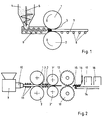
- FIG 1 is a rolling mill through the rolls 1 and 2 indicated schematically.
- the roller 2 can be stationary be while the roller 1 with the roller 2 a nip 3rd can be hydraulically adjusted to one exert the necessary pressure on the ceramic mass.
- the ceramic mass is composed of the Raw and aggregates prepared and according to the corresponding Mixing and moistening in a hopper 4 given in which an agitator 5 is arranged. With help of the agitator 5, the ceramic mass gets into the Effective range of a screw conveyor 6, the ceramic mass feeds the roll gap 3, so that the desired set thickness of the ceramic strip to be rolled arises.
- a rolled strip 7 is formed in the roll gap 3 and is guided away on a roller conveyor 8. It can be here the division into individual green bodies connect what is no longer shown. In the area of the agitator 5 or the screw conveyor 6 can vent the ceramic mass.
- FIG 2 is a slightly modified device shown.
- the ceramic mass from raw and Mixed aggregates become ceramic Press 9 fed and driven out through a mouthpiece 10, so that here a certain pre-compression of the ceramic mass takes place.
- Via a conveyor 11 ceramic mass a first pair of rollers, consisting of the Rolls 1 and 2, fed and in the roll gap 3 further condensed so that here the band 7 is formed.
- Band 7 is running then in a second rolling device with the rollers 1 ' and 2 'and finally comes into a pair of shaping rollers 12 and 13, through which the belt 7 in a Waveform is brought.
- a conveyor 14 takes the corrugated Band 15, which in a punch 16 in sections is divided. Then the sections get into a Drying device 17 and a kiln 18.
- a fine-grained Al 2 O 3 powder in a grain fraction smaller than 1 ⁇ m was mixed with different binder proportions.
- Cellulose ether was used as a binder as a 1% solution in water. In addition, no moisture was introduced.
- the ceramic mass formed in this way was rolled in a one-stage installation, for example according to FIG. 1, a ceramic strip having a width of 75 mm and a thickness of 2 mm being produced.
- the contact pressure of the rollers 1, 2 was 50 bar.
- the resulting rolled Al 2 O 3 strip was divided into 100 mm long plates. The plates were dried in a drying oven at 110 ° C for 24 hours. This was followed by firing in a kiln at 1650 ° C for two hours.
- Binder content (% by weight) Moisture (% by weight) Gross density (g / cm 3 ) Porosity (%) Flexural strength (N / mm 2 ) 2nd 1.98 3.52 9.6 81.5 + 4.0 7 6.93 3.15 19.0 78.3 + 5.6 10th 9.0 2.86 25.5 73.1 + 3.0
- the bending strength was determined in a 3-point bending test. In in the manner described, plates were produced which, for. B. as Kiln furniture appear suitable. You can see from the specified table that with increasing moisture content the The bulk density drops, the porosity increases and the bending strength becomes lower.
- the ceramic mass was produced from fine Al 2 O 3 powder with a fraction smaller than 1 ⁇ m together with 10% by weight of a powdery binder in the form of a cellulose derivative and with varying amounts of moisture. It was rolled into thin plates with a thickness of about 2 mm under a pressure of 50 bar. After drying similar to that in the exemplary embodiment in FIG. 1, the fire was carried out at 1650 ° C. for 2 hours.
- the result was aluminum oxide plates with the following properties: Water fraction (weight fraction) Gross density (g / cm 3 ) Porosity (%) Flexural strength (N / mm 2 ) (3-point bending test) 2nd 3.12 18.6 58.6 + 3.4 7 3.05 22.9 67.8 + 7.5 10th 2.86 25.5 73.1 + 3.0
- the ceramic mass was made of fine aluminum oxide with a Grain fraction smaller than 1 ⁇ m and with the addition of 5% by weight liquid binder of a 1% solution of cellulose ether in Water created. A pressure of 50 bar was reached during rolling upset. In a downstream punch press, the continuous tape small platelets measuring 20 x 20 x Punched 2 mm. These were dried at 100 ° C in 8 hours and fired tightly in an electric furnace at 1650 ° C for 4 hours, see above that there is a porosity of 0%. Such moldings are suitable for use as carrier plates in the electrical industry Find.
- a zirconium oxide with a grain size of less than 0.1 mm was used 5% by weight of liquid binder from cellulose ether as a 1% solution in Water and 5% by weight graphite with a smaller grain fraction 0.1 mm mixed.
- the mixed ceramic mass was mixed with a Contact pressure of 80 bar rolled and then divided. It carbon-containing plates with a homogeneous structure and a porosity of 12.3%. The thickness was 8 mm.
- the Further processing of this material into a composite material appears e.g. B. suitable for use in metallurgy. Man recognizes from this example that the rolling pressure increases and the Moisture content was chosen to be comparatively low.
- the rolling mill is followed by a winding system in order to rolled up the rolled ceramic tape in an inclined spiral and in this way and how to form a tube.
- the offset became similar to that Example 3 chosen.
- the coiled tube showed one Inner diameter of 150 mm and an outer diameter of 170 mm on. Solidification of the pipe and sintering of the edges happened after drying in a fire of 1650 ° C for 10 Hours.
Landscapes
- Engineering & Computer Science (AREA)
- Manufacturing & Machinery (AREA)
- Chemical & Material Sciences (AREA)
- Ceramic Engineering (AREA)
- Mechanical Engineering (AREA)
- Press-Shaping Or Shaping Using Conveyers (AREA)
- Compositions Of Oxide Ceramics (AREA)
- Manufacturing Of Tubular Articles Or Embedded Moulded Articles (AREA)
- Producing Shaped Articles From Materials (AREA)
Claims (12)
- Procédé de fabrication en continu de corps façonnés à paroi mince, tels que plaques, bandes, tubes ou similaires, dans une pâte céramique ne contenant pas d'argile, en ce que les matières premières et les additifs pour la pâte céramique sont humidifiés et mélangés, la pâte céramique mélangée est formée en un produit vert, éventuellement subdivisé, et le produit vert est consolidé dans sa forme par séchage et cuisson pour donner le corps façonné, caractérisé en ce que la pâte céramique est réglée sur une humidité de 2 à 5 % en poids, et en ce que la pâte céramique est passée à travers une fente (3) formée par deux rouleaux (1, 2) disposés en regard l'un de l'autre pour être compactée sous la commande appropriée du degré de compactage et des propriétés de densité moyennant une pression d'application des rouleaux (1, 2) qui peut être choisie et réglée, et par insertion de textures et influence sur la structure dans la pâte céramique.
- Procédé selon la revendication 1, caractérisé en ce que la pâte céramique est alimentée à l'aide d'une vis sans fin de transport (6) ou par un dispositif de convoyage (11) dans la fente formée entre les rouleaux de manière que l'épaisseur souhaitée du produit vert soit obtenue.
- Procédé selon la revendication 1 ou 2, caractérisé en ce qu'il est fait le vide dans la pâte céramique avant le laminage.
- Procédé selon l'une des revendications 1 à 3, caractérisé en ce que la pâte céramique est chauffée avant ou pendant le laminage.
- Procédé selon une ou plusieurs des revendications 1 à 4, caractérisé en ce que la pâte céramique est extrudée avant le laminage.
- Procédé selon les revendications 1 à 5, caractérisé en ce que la pâte céramique est précompactée, par exemple par extrudage.
- Procédé selon une ou plusieurs des revendications 1 à 6, caractérisé en ce que le laminage s'effectue par profilage du produit vert.
- Procédé selon une ou plusieurs des revendications 1 à 7, caractérisé en ce que le produit vert est déformé en méandres, pendant ou après le laminage.
- Procédé selon une ou plusieurs des revendications 1 à 8, caractérisé en ce que pendant le laminage, des poudres de carbures, de nitrures ou métalliques sont laminées en même temps.
- Procédé selon une ou plusieurs des revendications 1 à 9, caractérisé en ce que pendant le laminage, des fibres céramiques, des fibres de carbone, des fibres métalliques ou similaires sont laminées en même temps.
- Procédé selon une ou plusieurs des revendications 1 à 10, caractérisé en ce que directement après le laminage le produit vert éventuellement subdivisé, est séché en continu et éventuellement cuit en continu.
- Procédé selon une ou plusieurs des revendications 1 à 11, caractérisé en ce que le produit vert est enroulé, de préférence en plusieurs couches.
Applications Claiming Priority (2)
| Application Number | Priority Date | Filing Date | Title |
|---|---|---|---|
| DE4102469 | 1991-01-28 | ||
| DE4102469A DE4102469A1 (de) | 1991-01-28 | 1991-01-28 | Verfahren zur kontinuierlichen herstellung duennwandiger formkoerper aus keramischer masse |
Publications (3)
| Publication Number | Publication Date |
|---|---|
| EP0497151A1 EP0497151A1 (fr) | 1992-08-05 |
| EP0497151B1 EP0497151B1 (fr) | 1996-03-27 |
| EP0497151B2 true EP0497151B2 (fr) | 1999-08-25 |
Family
ID=6423860
Family Applications (1)
| Application Number | Title | Priority Date | Filing Date |
|---|---|---|---|
| EP92100649A Expired - Lifetime EP0497151B2 (fr) | 1991-01-28 | 1992-01-16 | Procédé pour la fabrication en continu d'articles de faible épaisseur à partir de matière céramique |
Country Status (4)
| Country | Link |
|---|---|
| EP (1) | EP0497151B2 (fr) |
| AT (1) | ATE135950T1 (fr) |
| DE (2) | DE4102469A1 (fr) |
| ES (1) | ES2086558T5 (fr) |
Families Citing this family (6)
| Publication number | Priority date | Publication date | Assignee | Title |
|---|---|---|---|---|
| US5384030A (en) * | 1994-02-15 | 1995-01-24 | General Motors Corporation | Exhaust sensor including a composite tile sensing element and methods of making the same |
| DE19901533C2 (de) * | 1999-01-16 | 2003-04-10 | Villeroy & Boch | Vorrichtung für die Herstellung von Dekor- oder Glasurmasse aufweisenden Keramikrohlingen |
| US8679302B2 (en) | 2005-11-14 | 2014-03-25 | Guardian Industries Corp. | Silicon titanium oxide coating, coated article including silicon titanium oxide coating, and method of making the same |
| DE102006036624B4 (de) * | 2006-08-03 | 2009-08-20 | Schunk Kohlenstofftechnik Gmbh | Werkstückträger sowie Verfahren zur Herstellung eines solchen |
| DE102011120547B4 (de) | 2011-12-02 | 2018-10-18 | Technische Universität Dresden | Brennhilfsmittel, als Träger für Bauteile bei einer Wärmebehandlung |
| HUE031514T2 (en) * | 2012-10-22 | 2017-07-28 | Imerys Ceram France | Procedure for producing inorganic sheet |
Family Cites Families (7)
| Publication number | Priority date | Publication date | Assignee | Title |
|---|---|---|---|---|
| US3007222A (en) * | 1953-01-02 | 1961-11-07 | Gladding Mcbean & Co | Method for continuous manufacture of ceramic sheets |
| FR1271493A (fr) * | 1959-11-30 | 1961-09-15 | Gladding | Procédé de fabrication continue d'objets céramiques très minces |
| CH394013A (de) * | 1960-04-16 | 1965-06-15 | Aton Planungs & Baugesellschaft Fuer Die Keramische Industrie Mbh | Verfahren zur kontinuierlichen Herstellung von grossflächigen Verkleidungsplatten aus keramischem Werkstoff |
| DE1205435B (de) * | 1961-05-10 | 1965-11-18 | Gottfried Cremer Dr | Verfahren zum kontinuierlichen Herstellen von duennwandigen Wandverkleidungsplatten aus keramischem Werkstoff und Tunnelofen zur Durchfuehrung des Verfahrens |
| GB982128A (en) * | 1962-12-20 | 1965-02-03 | Fetok Gmbh | Process for producing thin sheets of plastic ceramic materials |
| JPS61291445A (ja) * | 1985-06-18 | 1986-12-22 | イソライト工業株式会社 | セラミツクフアイバ−ブランケツトの処理方法 |
| DD285041A5 (de) * | 1989-06-23 | 1990-12-05 | Veb Chemieanlagenbaukombinat Leipzig-Grimma Stammbetrieb,Dd | Vorrichtung zur kontinuierlichen herstellung von 3-dimensional profilierten, duennwandigen formlingen aus plastischen baendern oder platten keramischen grundmaterials, deren neutrale faser der profilstruktur entspricht |
-
1991
- 1991-01-28 DE DE4102469A patent/DE4102469A1/de not_active Withdrawn
-
1992
- 1992-01-16 ES ES92100649T patent/ES2086558T5/es not_active Expired - Lifetime
- 1992-01-16 AT AT92100649T patent/ATE135950T1/de not_active IP Right Cessation
- 1992-01-16 EP EP92100649A patent/EP0497151B2/fr not_active Expired - Lifetime
- 1992-01-16 DE DE59205793T patent/DE59205793D1/de not_active Expired - Fee Related
Also Published As
| Publication number | Publication date |
|---|---|
| EP0497151B1 (fr) | 1996-03-27 |
| ES2086558T5 (es) | 1999-12-01 |
| ATE135950T1 (de) | 1996-04-15 |
| DE4102469A1 (de) | 1992-07-30 |
| DE59205793D1 (de) | 1996-05-02 |
| ES2086558T3 (es) | 1996-07-01 |
| EP0497151A1 (fr) | 1992-08-05 |
Similar Documents
| Publication | Publication Date | Title |
|---|---|---|
| DE69226335T2 (de) | Verbessertes Extrusionsverfahren und Vorrichtung zum Herstellen von Gegenständen aus pulverigem Material | |
| DE3413646C2 (fr) | ||
| DE2752752C2 (de) | Verfahren zur Herstellung von Körpern mit Bienenwabenstruktur aus Keramikstoffen der Bariumtitanatgruppe mit positiven Temperatur-Widerstands-Koeffizienten des elektrischen Widerstandes | |
| DE2946374A1 (de) | Verfahren zur herstellung von verpressbarem polyimidgranulat | |
| DE3435043A1 (de) | Polygranularer kohlenstoffkoerper und verfahren zu seiner herstellung | |
| DE2421311A1 (de) | Keramisches erzeugnis, insbesondere keramisches bauteil und verfahren zur herstellung desselben | |
| EP0497151B1 (fr) | Procédé pour la fabrication en continu d'articles de faible épaisseur à partir de matière céramique | |
| DE2528856A1 (de) | Verfahren und vorrichtung zum extrudieren von aluminiumprofilen | |
| DE2511979C3 (de) | Verfahren zum Herstellen von Feuerfestkörpern | |
| DE3105593A1 (de) | Verfahren zur herstellung von plastischen massen zur weiterverarbeitung zu feuerbestaendigen oder feuerfesten materialien, nach dem verfahren hergestellte massen und ihre verwendung | |
| DE3701511A1 (de) | Waermeisolierende faserformkoerper, verfahren zu ihrer herstellung und ihre verwendung | |
| DE3808348C1 (fr) | ||
| EP0536584B1 (fr) | Procédé de préparation d'un matériau composite comprenant au moins deux couches | |
| CH495300A (de) | Verfahren zur Herstellung von keramischen Materialien und nach diesem Verfahren hergestellter keramischer Formkörper | |
| DE2928955A1 (de) | Verfahren zum herstellen von verbundwerkstoff mit in einer im wesentlichen metallischen matrix angeordneten verstaerkungsfasern | |
| EP0039013A1 (fr) | Procédé d'extrusion | |
| DE19526849C2 (de) | Verfahren zur Herstellung von grobkeramischen Tonprodukten und durch das Verfahren hergestellte Produkte | |
| DE3149796C2 (fr) | ||
| EP0206989A1 (fr) | Matériau exempt d'amiante contenant des fibres minérales et son procédé de fabrication | |
| DE969788C (de) | Verfahren zur Herstellung von duennen keramischen Scheiben | |
| DE1483720B1 (de) | Presskoerper erhoehter Dichte und Festigkeit aus Wolframpulver | |
| EP3480180B1 (fr) | Mélange de matières premières pour la fabrication d'un carreau en grès cérame | |
| DE10111487A1 (de) | Verfahren und Vorrichtung zur Herstellung eines schaumporosierten Mauerziegels, sowie schaumporosierter Mauerziegel | |
| DE2205119C3 (de) | Asbestfaserplatte | |
| DE3923655A1 (de) | Traeger zum brennen von keramik und verfahren zu deren herstellung |
Legal Events
| Date | Code | Title | Description |
|---|---|---|---|
| PUAI | Public reference made under article 153(3) epc to a published international application that has entered the european phase |
Free format text: ORIGINAL CODE: 0009012 |
|
| AK | Designated contracting states |
Kind code of ref document: A1 Designated state(s): AT BE CH DE ES FR GB IT LI NL SE |
|
| 17P | Request for examination filed |
Effective date: 19920606 |
|
| 17Q | First examination report despatched |
Effective date: 19931004 |
|
| RIN1 | Information on inventor provided before grant (corrected) |
Inventor name: GOERENZ, EDMUND, DIPL.-MINERALOGE Inventor name: RYMON-LIPINSKI, TADEUSZ, DR. |
|
| ITF | It: translation for a ep patent filed | ||
| GRAH | Despatch of communication of intention to grant a patent |
Free format text: ORIGINAL CODE: EPIDOS IGRA |
|
| GRAA | (expected) grant |
Free format text: ORIGINAL CODE: 0009210 |
|
| AK | Designated contracting states |
Kind code of ref document: B1 Designated state(s): AT BE CH DE ES FR GB IT LI NL SE |
|
| REF | Corresponds to: |
Ref document number: 135950 Country of ref document: AT Date of ref document: 19960415 Kind code of ref document: T |
|
| REG | Reference to a national code |
Ref country code: CH Ref legal event code: NV Representative=s name: DR. CONRAD A. RIEDERER PATENTANWALT |
|
| GBT | Gb: translation of ep patent filed (gb section 77(6)(a)/1977) |
Effective date: 19960328 |
|
| REF | Corresponds to: |
Ref document number: 59205793 Country of ref document: DE Date of ref document: 19960502 |
|
| ET | Fr: translation filed | ||
| REG | Reference to a national code |
Ref country code: ES Ref legal event code: FG2A Ref document number: 2086558 Country of ref document: ES Kind code of ref document: T3 |
|
| PLBQ | Unpublished change to opponent data |
Free format text: ORIGINAL CODE: EPIDOS OPPO |
|
| PLBI | Opposition filed |
Free format text: ORIGINAL CODE: 0009260 |
|
| PLBF | Reply of patent proprietor to notice(s) of opposition |
Free format text: ORIGINAL CODE: EPIDOS OBSO |
|
| 26 | Opposition filed |
Opponent name: SAVOIE-REFRACTAIRES Effective date: 19961221 |
|
| NLR1 | Nl: opposition has been filed with the epo |
Opponent name: SAVOIE-REFRACTAIRES |
|
| PLBF | Reply of patent proprietor to notice(s) of opposition |
Free format text: ORIGINAL CODE: EPIDOS OBSO |
|
| PLAW | Interlocutory decision in opposition |
Free format text: ORIGINAL CODE: EPIDOS IDOP |
|
| PLAW | Interlocutory decision in opposition |
Free format text: ORIGINAL CODE: EPIDOS IDOP |
|
| PUAH | Patent maintained in amended form |
Free format text: ORIGINAL CODE: 0009272 |
|
| STAA | Information on the status of an ep patent application or granted ep patent |
Free format text: STATUS: PATENT MAINTAINED AS AMENDED |
|
| 27A | Patent maintained in amended form |
Effective date: 19990825 |
|
| AK | Designated contracting states |
Kind code of ref document: B2 Designated state(s): AT BE CH DE ES FR GB IT LI NL SE |
|
| REG | Reference to a national code |
Ref country code: CH Ref legal event code: AEN Free format text: AUFRECHTERHALTUNG DES PATENTES IN GEAENDERTER FORM |
|
| ET3 | Fr: translation filed ** decision concerning opposition | ||
| GBTA | Gb: translation of amended ep patent filed (gb section 77(6)(b)/1977) | ||
| ITF | It: translation for a ep patent filed | ||
| REG | Reference to a national code |
Ref country code: ES Ref legal event code: DC2A Kind code of ref document: T5 Effective date: 19991015 |
|
| NLR3 | Nl: receipt of modified translations in the netherlands language after an opposition procedure | ||
| REG | Reference to a national code |
Ref country code: GB Ref legal event code: IF02 |
|
| PGFP | Annual fee paid to national office [announced via postgrant information from national office to epo] |
Ref country code: IT Payment date: 20060131 Year of fee payment: 15 |
|
| PGFP | Annual fee paid to national office [announced via postgrant information from national office to epo] |
Ref country code: AT Payment date: 20070104 Year of fee payment: 16 |
|
| PGFP | Annual fee paid to national office [announced via postgrant information from national office to epo] |
Ref country code: NL Payment date: 20070124 Year of fee payment: 16 |
|
| PGFP | Annual fee paid to national office [announced via postgrant information from national office to epo] |
Ref country code: GB Payment date: 20070125 Year of fee payment: 16 |
|
| PGFP | Annual fee paid to national office [announced via postgrant information from national office to epo] |
Ref country code: ES Payment date: 20070126 Year of fee payment: 16 |
|
| PGFP | Annual fee paid to national office [announced via postgrant information from national office to epo] |
Ref country code: CH Payment date: 20070129 Year of fee payment: 16 Ref country code: SE Payment date: 20070129 Year of fee payment: 16 |
|
| PGFP | Annual fee paid to national office [announced via postgrant information from national office to epo] |
Ref country code: DE Payment date: 20070228 Year of fee payment: 16 |
|
| PGFP | Annual fee paid to national office [announced via postgrant information from national office to epo] |
Ref country code: BE Payment date: 20070301 Year of fee payment: 16 |
|
| PGFP | Annual fee paid to national office [announced via postgrant information from national office to epo] |
Ref country code: FR Payment date: 20070117 Year of fee payment: 16 |
|
| BERE | Be: lapsed |
Owner name: *DYKO INDUSTRIEKERAMIK G.M.B.H. Effective date: 20080131 |
|
| REG | Reference to a national code |
Ref country code: CH Ref legal event code: PL |
|
| EUG | Se: european patent has lapsed | ||
| GBPC | Gb: european patent ceased through non-payment of renewal fee |
Effective date: 20080116 |
|
| NLV4 | Nl: lapsed or anulled due to non-payment of the annual fee |
Effective date: 20080801 |
|
| PG25 | Lapsed in a contracting state [announced via postgrant information from national office to epo] |
Ref country code: DE Free format text: LAPSE BECAUSE OF NON-PAYMENT OF DUE FEES Effective date: 20080801 Ref country code: LI Free format text: LAPSE BECAUSE OF NON-PAYMENT OF DUE FEES Effective date: 20080131 Ref country code: NL Free format text: LAPSE BECAUSE OF NON-PAYMENT OF DUE FEES Effective date: 20080801 Ref country code: CH Free format text: LAPSE BECAUSE OF NON-PAYMENT OF DUE FEES Effective date: 20080131 |
|
| PG25 | Lapsed in a contracting state [announced via postgrant information from national office to epo] |
Ref country code: AT Free format text: LAPSE BECAUSE OF NON-PAYMENT OF DUE FEES Effective date: 20080116 |
|
| REG | Reference to a national code |
Ref country code: FR Ref legal event code: ST Effective date: 20081029 |
|
| PG25 | Lapsed in a contracting state [announced via postgrant information from national office to epo] |
Ref country code: GB Free format text: LAPSE BECAUSE OF NON-PAYMENT OF DUE FEES Effective date: 20080116 |
|
| PG25 | Lapsed in a contracting state [announced via postgrant information from national office to epo] |
Ref country code: SE Free format text: LAPSE BECAUSE OF NON-PAYMENT OF DUE FEES Effective date: 20080117 |
|
| PG25 | Lapsed in a contracting state [announced via postgrant information from national office to epo] |
Ref country code: BE Free format text: LAPSE BECAUSE OF NON-PAYMENT OF DUE FEES Effective date: 20080131 |
|
| REG | Reference to a national code |
Ref country code: ES Ref legal event code: FD2A Effective date: 20080117 |
|
| PG25 | Lapsed in a contracting state [announced via postgrant information from national office to epo] |
Ref country code: FR Free format text: LAPSE BECAUSE OF NON-PAYMENT OF DUE FEES Effective date: 20080131 |
|
| PG25 | Lapsed in a contracting state [announced via postgrant information from national office to epo] |
Ref country code: ES Free format text: LAPSE BECAUSE OF NON-PAYMENT OF DUE FEES Effective date: 20080117 |
|
| PG25 | Lapsed in a contracting state [announced via postgrant information from national office to epo] |
Ref country code: IT Free format text: LAPSE BECAUSE OF NON-PAYMENT OF DUE FEES Effective date: 20070116 |