EP0497155B1 - Procédé de décokéfaction de fours de pyrolyse - Google Patents
Procédé de décokéfaction de fours de pyrolyse Download PDFInfo
- Publication number
- EP0497155B1 EP0497155B1 EP92100682A EP92100682A EP0497155B1 EP 0497155 B1 EP0497155 B1 EP 0497155B1 EP 92100682 A EP92100682 A EP 92100682A EP 92100682 A EP92100682 A EP 92100682A EP 0497155 B1 EP0497155 B1 EP 0497155B1
- Authority
- EP
- European Patent Office
- Prior art keywords
- gas
- decoking
- waste
- cracking
- decoking gas
- Prior art date
- Legal status (The legal status is an assumption and is not a legal conclusion. Google has not performed a legal analysis and makes no representation as to the accuracy of the status listed.)
- Expired - Lifetime
Links
- 238000005235 decoking Methods 0.000 title claims abstract description 41
- 238000000197 pyrolysis Methods 0.000 title abstract 2
- 238000000034 method Methods 0.000 claims abstract description 16
- UGFAIRIUMAVXCW-UHFFFAOYSA-N Carbon monoxide Chemical compound [O+]#[C-] UGFAIRIUMAVXCW-UHFFFAOYSA-N 0.000 claims abstract description 13
- 229930195733 hydrocarbon Natural products 0.000 claims abstract description 11
- 150000002430 hydrocarbons Chemical class 0.000 claims abstract description 11
- 229910002091 carbon monoxide Inorganic materials 0.000 claims abstract description 9
- 230000003197 catalytic effect Effects 0.000 claims abstract description 9
- 238000004227 thermal cracking Methods 0.000 claims abstract description 7
- 239000007789 gas Substances 0.000 claims description 56
- 238000005336 cracking Methods 0.000 claims description 17
- XLYOFNOQVPJJNP-UHFFFAOYSA-N water Substances O XLYOFNOQVPJJNP-UHFFFAOYSA-N 0.000 claims description 6
- 230000003647 oxidation Effects 0.000 claims description 5
- 238000007254 oxidation reaction Methods 0.000 claims description 5
- 239000003054 catalyst Substances 0.000 claims description 4
- QVGXLLKOCUKJST-UHFFFAOYSA-N atomic oxygen Chemical compound [O] QVGXLLKOCUKJST-UHFFFAOYSA-N 0.000 claims description 2
- 229910052760 oxygen Inorganic materials 0.000 claims description 2
- 239000001301 oxygen Substances 0.000 claims description 2
- 239000002699 waste material Substances 0.000 claims 6
- 238000009434 installation Methods 0.000 claims 1
- 239000002912 waste gas Substances 0.000 claims 1
- 239000000203 mixture Substances 0.000 abstract description 4
- 238000006243 chemical reaction Methods 0.000 description 6
- 239000003546 flue gas Substances 0.000 description 5
- CURLTUGMZLYLDI-UHFFFAOYSA-N Carbon dioxide Chemical compound O=C=O CURLTUGMZLYLDI-UHFFFAOYSA-N 0.000 description 4
- 238000002485 combustion reaction Methods 0.000 description 4
- 230000005855 radiation Effects 0.000 description 4
- 230000004992 fission Effects 0.000 description 3
- 238000010438 heat treatment Methods 0.000 description 3
- 239000004215 Carbon black (E152) Substances 0.000 description 2
- 229910002092 carbon dioxide Inorganic materials 0.000 description 2
- 239000001569 carbon dioxide Substances 0.000 description 2
- 238000004140 cleaning Methods 0.000 description 2
- 239000000571 coke Substances 0.000 description 2
- 238000004939 coking Methods 0.000 description 2
- 238000007086 side reaction Methods 0.000 description 2
- VGGSQFUCUMXWEO-UHFFFAOYSA-N Ethene Chemical compound C=C VGGSQFUCUMXWEO-UHFFFAOYSA-N 0.000 description 1
- 239000005977 Ethylene Substances 0.000 description 1
- 150000001336 alkenes Chemical class 0.000 description 1
- 230000015572 biosynthetic process Effects 0.000 description 1
- 239000000470 constituent Substances 0.000 description 1
- 238000001816 cooling Methods 0.000 description 1
- 230000006866 deterioration Effects 0.000 description 1
- 238000009826 distribution Methods 0.000 description 1
- 230000007613 environmental effect Effects 0.000 description 1
- 238000005194 fractionation Methods 0.000 description 1
- 239000000446 fuel Substances 0.000 description 1
- 239000003517 fume Substances 0.000 description 1
- 238000009413 insulation Methods 0.000 description 1
- 239000007788 liquid Substances 0.000 description 1
- 238000013021 overheating Methods 0.000 description 1
- 238000010791 quenching Methods 0.000 description 1
- 239000000779 smoke Substances 0.000 description 1
Images
Classifications
-
- C—CHEMISTRY; METALLURGY
- C10—PETROLEUM, GAS OR COKE INDUSTRIES; TECHNICAL GASES CONTAINING CARBON MONOXIDE; FUELS; LUBRICANTS; PEAT
- C10G—CRACKING HYDROCARBON OILS; PRODUCTION OF LIQUID HYDROCARBON MIXTURES, e.g. BY DESTRUCTIVE HYDROGENATION, OLIGOMERISATION, POLYMERISATION; RECOVERY OF HYDROCARBON OILS FROM OIL-SHALE, OIL-SAND, OR GASES; REFINING MIXTURES MAINLY CONSISTING OF HYDROCARBONS; REFORMING OF NAPHTHA; MINERAL WAXES
- C10G9/00—Thermal non-catalytic cracking, in the absence of hydrogen, of hydrocarbon oils
- C10G9/14—Thermal non-catalytic cracking, in the absence of hydrogen, of hydrocarbon oils in pipes or coils with or without auxiliary means, e.g. digesters, soaking drums, expansion means
- C10G9/16—Preventing or removing incrustation
Definitions
- the invention relates to a method for decoking a cracking furnace for thermal cracking of hydrocarbons, in which a decoking gas is passed through coked plant parts, a decoking exhaust gas being produced.
- the thermal cracking of hydrocarbons is of great technical importance.
- the thermal cracking of the hydrocarbons is usually carried out in canned tubes which are arranged in a heatable cracking zone.
- the fission products are cooled in a downstream fission gas cooler in order to bring the fission reactions to a standstill.
- a number of side reactions occur which lead to economically uninteresting or even disruptive products.
- Such a disruptive side reaction can be seen in the coking of parts of the plant, in particular the canned pipes and the cracked gas cooler, since it leads to a deterioration in the heat transfer and, in extreme cases, even the laying individual line elements can result.
- a decoking gas e.g. a mixture of air and / or water vapor, through which the externally heated can and the still cooled can gas cooler are passed.
- a decoking gas e.g. a mixture of air and / or water vapor, through which the externally heated can and the still cooled can gas cooler are passed.
- the deposits burn off by oxidation or water gas reaction.
- the resulting decoking exhaust gas can, for example, have peak values of up to about 20,000 vol ppm carbon monoxide in the dry exhaust gas. Since direct release of the decoking gas to the atmosphere should be avoided for environmental reasons, the decoking gas is introduced into the furnace of the cracking furnace for post-combustion according to the prior art. Since the amount of the decoking gas in relation to the amount of flue gas resulting from the underfired output of the cracking furnace is large during the decoking, a great deal of effort must be expended for a uniform supply of the decoking gas over the entire combustion chamber in order to be able to operate the furnace burners safely and without problems. This requires a complex gas duct system.
- the heating gas requirement during decoking is also increased by the addition of the relatively large amount of exhaust gas that has to be heated.
- exhaust gas recirculation has consequences for the design of the convection zone, which usually has to be designed for higher temperatures when it is recirculated.
- the object of the present invention is to design a method of the type mentioned in such a way that extensive cleaning of the decoking gas is achieved in an economical manner, so that it can be released into the atmosphere without hesitation.
- This object is achieved in that the decoking exhaust gas is treated catalytically.
- the process is considerably simplified.
- the carbon monoxide content and other unburned constituents in the decoking gas are reduced to such an extent that the decoking gas can be released directly into the atmosphere.
- An oxidation catalytic converter is expediently used which permits extensive oxidation, for example of carbon monoxide to carbon dioxide, at the given exhaust gas temperatures.
- the catalytic treatment of the decoking gas is preferably carried out at an exhaust gas temperature of approximately 200 to 600 ° C.
- the cracked tubes are usually followed by a cracked gas cooler for cooling the cracked products, which, like the cracked tubes, cokes during the cracking operation.
- the decoking gas is therefore passed over the cracked gas cooler and, after leaving the cooler, has the desired temperature of approximately 200 to approximately 600 ° C., so that it does not have to be heated or cooled for catalytic afterburning.
- the catalytic converter can be installed in the exhaust pipe to the chimney, which is required anyway.
- a gas stream containing water vapor and / or oxygen, in particular a water vapor / air mixture, is preferably used as the decoking gas.
- a particular advantage of the process according to the invention is the fact that the catalyst does not require any operating resources, which makes the process extremely economical.
- the process reduces the amount of carbon monoxide in the decoking flue gas to below the currently strictest flue gas limit values with high operational reliability.
- no complex exhaust gas distribution system is required in the furnace of the cracking furnace.
- the combustion chamber insulation does not have to be broken through the exhaust gas inlet, so that heat losses and the risk of supplying false air are avoided. Therefore, in the method according to the invention, the heating gas requirement is significantly lower in all operating modes than in the known methods, in particular there is no disturbance to the furnace operation, e.g. unfavorable change in the flame pattern and the resulting overheating of individual zones.
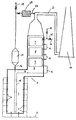
- a cracking furnace 1 is shown in a highly simplified form, which is designed for the thermal cracking of hydrocarbons, such as naphtha or gas oil. It essentially consists of a radiation zone 2 and a convection zone 3.
- the high temperatures required for the thermal splitting of the hydrocarbons are generated by burners 4.
- the burners 4 are supplied with liquid or gaseous fuel via line 5.
- the hot flue gases formed during the combustion pass at the upper end of the radiation zone 2 via a connecting channel 6 into the laterally offset convection zone 3.
- Fresh hydrocarbon feedstock is fed via line 11 to the heat exchanger 7 arranged in the upper region of the convection zone and is preheated there against flue gas which has already largely cooled. It is then fed via lines 12 and 13 into heat exchangers 8 and 9 in order to be further heated there. It then reaches the radiation zone 2 via line 14 and is heated there to the desired reaction temperature in a radiation-heated coil 15.
- the hot cracked gases exit the cracking furnace 1 at 16 and are immediately cooled in a quench cooler 17 in order to bring the cracking reactions to a standstill.
- the cooled cracked gases leave the system shown here via line 18 and are fed to a fractionation.
- the decoking gas is drawn off from the cracking furnace 1 at 16 and passed over the cracking gas cooler 17. There the decoking gas is cooled down to a temperature of approx. 400 ° C. The decoking gas now has a temperature suitable for catalytic conversion of the carbon monoxide to carbon dioxide. After leaving the gap cooler 17, the decoking gas is fed to an oxidation catalyst 21. The cleaned decoking exhaust gas drawn off from the catalytic converter 21 is fed to the chimney 10 via line 22 and the exhaust pipe 23. The proportion of carbon monoxide in the cleaned exhaust gas is so low that it is safe to release it into the atmosphere.
Landscapes
- Chemical & Material Sciences (AREA)
- Oil, Petroleum & Natural Gas (AREA)
- Engineering & Computer Science (AREA)
- Physics & Mathematics (AREA)
- Chemical Kinetics & Catalysis (AREA)
- General Chemical & Material Sciences (AREA)
- Thermal Sciences (AREA)
- Organic Chemistry (AREA)
- Production Of Liquid Hydrocarbon Mixture For Refining Petroleum (AREA)
- Exhaust Gas Treatment By Means Of Catalyst (AREA)
- Treating Waste Gases (AREA)
- Fire-Extinguishing Compositions (AREA)
- Processing Of Solid Wastes (AREA)
- Carbon And Carbon Compounds (AREA)
Claims (6)
- Procédé de décokéfaction d'un four de craquage pour le craquage thermique d'hydrocarbures, dans lequel on fait circuler un gaz de décokéfaction dans les parties de l'installation encrassées par le coke, ce qui donne naissance à un gaz d'échappement de décokéfaction, caractérisé en ce qu'on traite les effluents gazeux de décokéfaction par voie catalytique.
- Procédé selon la revendication 1, caractérisé en ce que l'on introduit, comme gaz de décokéfaction, un courant de gaz contenant de la vapeur d'eau et/ou de l'acide.
- Procédé selon la revendication 1 ou 2, caractérisé en ce que l'on évacue directement à l'atmosphère les effluents gazeux de décokéfaction traités par voie catalytique.
- Procédé selon l'une des revendications 1 à 3, caractérisé en ce que, pour le traitement catalytique des effluents gazeux de décokéfaction, on utilise un catalyseur d'oxydation pour l'oxydation du monoxyde de carbone et des autres composants incomplètement brûlés.
- Procédé selon l'une des revendications 1 à 4, caractérisé en ce que l'on réalise le traitement catalytique des effluents gazeux de décokéfaction à une température comprise entre environ 200 et environ 600°C.
- Procédé selon l'une des revendications 1 à 5, dans lequel un réfrigérant de gaz craqué est monté en aval du four de craquage pour refroidir les produits obtenus par craquage, caractérisé en ce que l'on amène tout d'abord les effluents gazeux de décokéfaction au réfrigérant de gaz craqué et en ce qu'on les traite ensuite par voie catalytique.
Applications Claiming Priority (2)
| Application Number | Priority Date | Filing Date | Title |
|---|---|---|---|
| DE4102862A DE4102862A1 (de) | 1991-01-31 | 1991-01-31 | Verfahren zur entkokung von spaltoefen |
| DE4102862 | 1991-01-31 |
Publications (2)
| Publication Number | Publication Date |
|---|---|
| EP0497155A1 EP0497155A1 (fr) | 1992-08-05 |
| EP0497155B1 true EP0497155B1 (fr) | 1994-10-05 |
Family
ID=6424086
Family Applications (1)
| Application Number | Title | Priority Date | Filing Date |
|---|---|---|---|
| EP92100682A Expired - Lifetime EP0497155B1 (fr) | 1991-01-31 | 1992-01-16 | Procédé de décokéfaction de fours de pyrolyse |
Country Status (4)
| Country | Link |
|---|---|
| EP (1) | EP0497155B1 (fr) |
| AT (1) | ATE112588T1 (fr) |
| DE (2) | DE4102862A1 (fr) |
| ES (1) | ES2065077T3 (fr) |
Families Citing this family (3)
| Publication number | Priority date | Publication date | Assignee | Title |
|---|---|---|---|---|
| HRP930942B1 (en) * | 1993-05-31 | 1997-06-30 | Inos D O O | Process for the preparation of vinyl chloride |
| DE102007048984A1 (de) | 2007-10-12 | 2009-04-16 | Linde Aktiengesellschaft | Verfahren zur Entkokung von Spaltöfen |
| CN113701172B (zh) * | 2020-05-20 | 2024-03-12 | 中国石化工程建设有限公司 | 处理乙烯裂解炉烧焦气的方法 |
Family Cites Families (2)
| Publication number | Priority date | Publication date | Assignee | Title |
|---|---|---|---|---|
| DE3010000A1 (de) * | 1980-03-15 | 1981-09-24 | Basf Ag, 6700 Ludwigshafen | Verfahren zur thermischen entkokung von spaltgaskuehlern |
| US4921830A (en) * | 1988-04-13 | 1990-05-01 | Phillips Petroleum Company | Catalyst for the oxidation of carbon monoxide |
-
1991
- 1991-01-31 DE DE4102862A patent/DE4102862A1/de not_active Withdrawn
-
1992
- 1992-01-16 AT AT92100682T patent/ATE112588T1/de not_active IP Right Cessation
- 1992-01-16 DE DE59200572T patent/DE59200572D1/de not_active Expired - Fee Related
- 1992-01-16 ES ES92100682T patent/ES2065077T3/es not_active Expired - Lifetime
- 1992-01-16 EP EP92100682A patent/EP0497155B1/fr not_active Expired - Lifetime
Also Published As
| Publication number | Publication date |
|---|---|
| EP0497155A1 (fr) | 1992-08-05 |
| ES2065077T3 (es) | 1995-02-01 |
| DE59200572D1 (de) | 1994-11-10 |
| ATE112588T1 (de) | 1994-10-15 |
| DE4102862A1 (de) | 1992-08-06 |
Similar Documents
| Publication | Publication Date | Title |
|---|---|---|
| US7977524B2 (en) | Process for decoking a furnace for cracking a hydrocarbon feed | |
| US4361478A (en) | Method of preheating hydrocarbons for thermal cracking | |
| DE4327953A1 (de) | Anlage zur thermischen Abfallentsorgung sowie Verfahren zum Betrieb einer solchen Anlage | |
| EP0110093B1 (fr) | Dispositif d'obtention d'un produit gazeux contenant de l'hydrogène et de l'oxyde de carbone | |
| DE1568469A1 (de) | Verfahren zum thermischen Kracken von Kohlenwasserstoffen | |
| EP2501462A1 (fr) | Procédé de réduction d'oxydes d'azote provenant des gaz sortant d'un four à coke | |
| CN118129165A (zh) | 一种降低氮氧化物排放的方法及燃烧系统 | |
| EP0497155B1 (fr) | Procédé de décokéfaction de fours de pyrolyse | |
| DE2629082A1 (de) | Verfahren und anlage zur waermebehandlung von feingut | |
| WO1982002585A1 (fr) | Procede d'exploitation thermique des ordures et installation pour la mise en oeuvre du procede | |
| EP0482306B1 (fr) | Procédé et dispositif pour la combustion des copeaux de bois en produisant des fumées pauvres en substances nocives et à puissance de combustion continûment réglable | |
| DE2444333A1 (de) | Ofen zum cracken von kohlenwasserstoffen zum herstellen von olefinen | |
| DE2241891C3 (de) | Verfahren und Vorrichtung zur Verbrennung von bei der Reinigung von Koksofengasen anfallenden Ammoniakschwaden | |
| DE102009016695A1 (de) | Verfahren und Vorrichtung zur Spaltung von Kohlenwasserstoffen | |
| EP0180953B1 (fr) | Procédé et dispositif pour la production d'une atmosphère protectrice | |
| DE869192C (de) | Verfahren zur Umsetzung von Kohlenwasserstoffe enthaltenden Gasen zu Wasserstoff und Kohlenoxyd | |
| DE2711883A1 (de) | Regenerativkoksofenbatterie | |
| DE3831558C2 (fr) | ||
| DE69812932T2 (de) | Verfahren und vorrichtung zur beheizung eines drehrohrofens zur vergasung und zur pyrolyse von organischen substanzen | |
| EP2048217A2 (fr) | Procédé de décocage de fours de craquage | |
| DE1250424B (de) | Verfahren zur thermischen Spaltung von Kohlenwasserstoffen zu vorw egend Acetylen und Äthylen | |
| DE4400430A1 (de) | Verfahren zum thermokatalytischen Spalten von höhersiedenden Kohlenwasserstoffen und Spaltofen | |
| WO2020025163A1 (fr) | Système de récupération de chaleur pour un four pourvu d'un ou de plusieurs brûleurs | |
| RU1790597C (ru) | Способ получени низших олефинов | |
| DE3437970A1 (de) | Verfahren und vorrichtung zum betreiben eines selbstbrennenden tunnelofens |
Legal Events
| Date | Code | Title | Description |
|---|---|---|---|
| PUAI | Public reference made under article 153(3) epc to a published international application that has entered the european phase |
Free format text: ORIGINAL CODE: 0009012 |
|
| AK | Designated contracting states |
Kind code of ref document: A1 Designated state(s): AT BE DE ES FR GB IT NL |
|
| 17P | Request for examination filed |
Effective date: 19920916 |
|
| 17Q | First examination report despatched |
Effective date: 19930507 |
|
| ITF | It: translation for a ep patent filed | ||
| GRAA | (expected) grant |
Free format text: ORIGINAL CODE: 0009210 |
|
| AK | Designated contracting states |
Kind code of ref document: B1 Designated state(s): AT BE DE ES FR GB IT NL |
|
| PG25 | Lapsed in a contracting state [announced via postgrant information from national office to epo] |
Ref country code: GB Effective date: 19941005 |
|
| REF | Corresponds to: |
Ref document number: 112588 Country of ref document: AT Date of ref document: 19941015 Kind code of ref document: T |
|
| REF | Corresponds to: |
Ref document number: 59200572 Country of ref document: DE Date of ref document: 19941110 |
|
| ET | Fr: translation filed | ||
| REG | Reference to a national code |
Ref country code: ES Ref legal event code: FG2A Ref document number: 2065077 Country of ref document: ES Kind code of ref document: T3 |
|
| PGFP | Annual fee paid to national office [announced via postgrant information from national office to epo] |
Ref country code: AT Payment date: 19950313 Year of fee payment: 4 |
|
| PGFP | Annual fee paid to national office [announced via postgrant information from national office to epo] |
Ref country code: FR Payment date: 19950324 Year of fee payment: 4 |
|
| PGFP | Annual fee paid to national office [announced via postgrant information from national office to epo] |
Ref country code: ES Payment date: 19950328 Year of fee payment: 4 |
|
| GBV | Gb: ep patent (uk) treated as always having been void in accordance with gb section 77(7)/1977 [no translation filed] |
Effective date: 19941005 |
|
| PLBE | No opposition filed within time limit |
Free format text: ORIGINAL CODE: 0009261 |
|
| STAA | Information on the status of an ep patent application or granted ep patent |
Free format text: STATUS: NO OPPOSITION FILED WITHIN TIME LIMIT |
|
| 26N | No opposition filed | ||
| PG25 | Lapsed in a contracting state [announced via postgrant information from national office to epo] |
Ref country code: AT Effective date: 19960116 |
|
| PG25 | Lapsed in a contracting state [announced via postgrant information from national office to epo] |
Ref country code: ES Free format text: LAPSE BECAUSE OF NON-PAYMENT OF DUE FEES Effective date: 19960117 |
|
| PG25 | Lapsed in a contracting state [announced via postgrant information from national office to epo] |
Ref country code: FR Effective date: 19960930 |
|
| REG | Reference to a national code |
Ref country code: FR Ref legal event code: ST |
|
| PGFP | Annual fee paid to national office [announced via postgrant information from national office to epo] |
Ref country code: NL Payment date: 19970130 Year of fee payment: 6 |
|
| PGFP | Annual fee paid to national office [announced via postgrant information from national office to epo] |
Ref country code: BE Payment date: 19970318 Year of fee payment: 6 |
|
| PG25 | Lapsed in a contracting state [announced via postgrant information from national office to epo] |
Ref country code: BE Free format text: LAPSE BECAUSE OF NON-PAYMENT OF DUE FEES Effective date: 19980131 |
|
| BERE | Be: lapsed |
Owner name: LINDE A.G. Effective date: 19980131 |
|
| PG25 | Lapsed in a contracting state [announced via postgrant information from national office to epo] |
Ref country code: NL Free format text: LAPSE BECAUSE OF NON-PAYMENT OF DUE FEES Effective date: 19980801 |
|
| NLV4 | Nl: lapsed or anulled due to non-payment of the annual fee |
Effective date: 19980801 |
|
| REG | Reference to a national code |
Ref country code: ES Ref legal event code: FD2A Effective date: 19990201 |
|
| PG25 | Lapsed in a contracting state [announced via postgrant information from national office to epo] |
Ref country code: IT Free format text: LAPSE BECAUSE OF NON-PAYMENT OF DUE FEES Effective date: 20050116 |
|
| PGFP | Annual fee paid to national office [announced via postgrant information from national office to epo] |
Ref country code: DE Payment date: 20080110 Year of fee payment: 17 |
|
| PG25 | Lapsed in a contracting state [announced via postgrant information from national office to epo] |
Ref country code: DE Free format text: LAPSE BECAUSE OF NON-PAYMENT OF DUE FEES Effective date: 20090801 |