EP0497976B1 - Verfahren zur herstellung von acetalen - Google Patents
Verfahren zur herstellung von acetalen Download PDFInfo
- Publication number
- EP0497976B1 EP0497976B1 EP90912467A EP90912467A EP0497976B1 EP 0497976 B1 EP0497976 B1 EP 0497976B1 EP 90912467 A EP90912467 A EP 90912467A EP 90912467 A EP90912467 A EP 90912467A EP 0497976 B1 EP0497976 B1 EP 0497976B1
- Authority
- EP
- European Patent Office
- Prior art keywords
- lower alcohol
- alcohol
- reaction
- production process
- charged
- Prior art date
- Legal status (The legal status is an assumption and is not a legal conclusion. Google has not performed a legal analysis and makes no representation as to the accuracy of the status listed.)
- Expired - Lifetime
Links
- 238000000034 method Methods 0.000 title claims abstract description 52
- 150000001241 acetals Chemical class 0.000 title 1
- 238000006243 chemical reaction Methods 0.000 claims abstract description 118
- LFQSCWFLJHTTHZ-UHFFFAOYSA-N Ethanol Chemical compound CCO LFQSCWFLJHTTHZ-UHFFFAOYSA-N 0.000 claims abstract description 100
- -1 acetal compounds Chemical class 0.000 claims abstract description 44
- DHKHKXVYLBGOIT-UHFFFAOYSA-N acetaldehyde Diethyl Acetal Natural products CCOC(C)OCC DHKHKXVYLBGOIT-UHFFFAOYSA-N 0.000 claims abstract description 36
- XLYOFNOQVPJJNP-UHFFFAOYSA-N water Substances O XLYOFNOQVPJJNP-UHFFFAOYSA-N 0.000 claims abstract description 35
- 239000003960 organic solvent Substances 0.000 claims abstract description 26
- 230000002209 hydrophobic effect Effects 0.000 claims abstract description 24
- 239000003377 acid catalyst Substances 0.000 claims abstract description 16
- HUMNYLRZRPPJDN-UHFFFAOYSA-N benzenecarboxaldehyde Natural products O=CC1=CC=CC=C1 HUMNYLRZRPPJDN-UHFFFAOYSA-N 0.000 claims abstract description 15
- FBPFZTCFMRRESA-JGWLITMVSA-N D-glucitol Chemical compound OC[C@H](O)[C@@H](O)[C@H](O)[C@H](O)CO FBPFZTCFMRRESA-JGWLITMVSA-N 0.000 claims abstract description 10
- QNGNSVIICDLXHT-UHFFFAOYSA-N para-ethylbenzaldehyde Natural products CCC1=CC=C(C=O)C=C1 QNGNSVIICDLXHT-UHFFFAOYSA-N 0.000 claims abstract description 10
- FBPFZTCFMRRESA-FSIIMWSLSA-N D-Glucitol Natural products OC[C@H](O)[C@H](O)[C@@H](O)[C@H](O)CO FBPFZTCFMRRESA-FSIIMWSLSA-N 0.000 claims abstract description 6
- 239000000600 sorbitol Substances 0.000 claims abstract description 6
- OKKJLVBELUTLKV-UHFFFAOYSA-N Methanol Chemical compound OC OKKJLVBELUTLKV-UHFFFAOYSA-N 0.000 claims description 75
- 230000008569 process Effects 0.000 claims description 28
- 238000004519 manufacturing process Methods 0.000 claims description 27
- 239000000758 substrate Substances 0.000 claims description 27
- 239000011541 reaction mixture Substances 0.000 claims description 24
- 150000005846 sugar alcohols Polymers 0.000 claims description 21
- 125000001997 phenyl group Chemical group [H]C1=C([H])C([H])=C(*)C([H])=C1[H] 0.000 claims description 18
- 238000006482 condensation reaction Methods 0.000 claims description 10
- UHOVQNZJYSORNB-UHFFFAOYSA-N Benzene Chemical compound C1=CC=CC=C1 UHOVQNZJYSORNB-UHFFFAOYSA-N 0.000 claims description 9
- 238000009833 condensation Methods 0.000 claims description 9
- 230000005494 condensation Effects 0.000 claims description 9
- XPFVYQJUAUNWIW-UHFFFAOYSA-N furfuryl alcohol Chemical compound OCC1=CC=CO1 XPFVYQJUAUNWIW-UHFFFAOYSA-N 0.000 claims description 9
- 125000004178 (C1-C4) alkyl group Chemical group 0.000 claims description 7
- 125000004432 carbon atom Chemical group C* 0.000 claims description 7
- XDTMQSROBMDMFD-UHFFFAOYSA-N Cyclohexane Chemical compound C1CCCCC1 XDTMQSROBMDMFD-UHFFFAOYSA-N 0.000 claims description 6
- QAOWNCQODCNURD-UHFFFAOYSA-N Sulfuric acid Chemical compound OS(O)(=O)=O QAOWNCQODCNURD-UHFFFAOYSA-N 0.000 claims description 6
- XXROGKLTLUQVRX-UHFFFAOYSA-N allyl alcohol Chemical compound OCC=C XXROGKLTLUQVRX-UHFFFAOYSA-N 0.000 claims description 6
- 238000009835 boiling Methods 0.000 claims description 5
- VEXZGXHMUGYJMC-UHFFFAOYSA-N Hydrochloric acid Chemical compound Cl VEXZGXHMUGYJMC-UHFFFAOYSA-N 0.000 claims description 4
- NBIIXXVUZAFLBC-UHFFFAOYSA-N Phosphoric acid Chemical compound OP(O)(O)=O NBIIXXVUZAFLBC-UHFFFAOYSA-N 0.000 claims description 4
- 125000001624 naphthyl group Chemical group 0.000 claims description 4
- 125000001712 tetrahydronaphthyl group Chemical group C1(CCCC2=CC=CC=C12)* 0.000 claims description 4
- JOXIMZWYDAKGHI-UHFFFAOYSA-N toluene-4-sulfonic acid Chemical compound CC1=CC=C(S(O)(=O)=O)C=C1 JOXIMZWYDAKGHI-UHFFFAOYSA-N 0.000 claims description 4
- JIAARYAFYJHUJI-UHFFFAOYSA-L zinc dichloride Chemical compound [Cl-].[Cl-].[Zn+2] JIAARYAFYJHUJI-UHFFFAOYSA-L 0.000 claims description 4
- 125000004642 (C1-C12) alkoxy group Chemical group 0.000 claims description 3
- 125000004400 (C1-C12) alkyl group Chemical group 0.000 claims description 3
- 125000000229 (C1-C4)alkoxy group Chemical group 0.000 claims description 3
- TVXBFESIOXBWNM-UHFFFAOYSA-N Xylitol Natural products OCCC(O)C(O)C(O)CCO TVXBFESIOXBWNM-UHFFFAOYSA-N 0.000 claims description 3
- 125000002915 carbonyl group Chemical group [*:2]C([*:1])=O 0.000 claims description 3
- 125000003178 carboxy group Chemical group [H]OC(*)=O 0.000 claims description 3
- 239000002612 dispersion medium Substances 0.000 claims description 3
- 125000005843 halogen group Chemical group 0.000 claims description 3
- HEBKCHPVOIAQTA-UHFFFAOYSA-N meso ribitol Natural products OCC(O)C(O)C(O)CO HEBKCHPVOIAQTA-UHFFFAOYSA-N 0.000 claims description 3
- 229930195734 saturated hydrocarbon Natural products 0.000 claims description 3
- 239000000811 xylitol Substances 0.000 claims description 3
- HEBKCHPVOIAQTA-SCDXWVJYSA-N xylitol Chemical compound OC[C@H](O)[C@@H](O)[C@H](O)CO HEBKCHPVOIAQTA-SCDXWVJYSA-N 0.000 claims description 3
- 229960002675 xylitol Drugs 0.000 claims description 3
- 235000010447 xylitol Nutrition 0.000 claims description 3
- DNIAPMSPPWPWGF-GSVOUGTGSA-N (R)-(-)-Propylene glycol Chemical class C[C@@H](O)CO DNIAPMSPPWPWGF-GSVOUGTGSA-N 0.000 claims description 2
- USWINTIHFQKJTR-UHFFFAOYSA-N 3-hydroxynaphthalene-2,7-disulfonic acid Chemical compound C1=C(S(O)(=O)=O)C=C2C=C(S(O)(=O)=O)C(O)=CC2=C1 USWINTIHFQKJTR-UHFFFAOYSA-N 0.000 claims description 2
- JDQDSEVNMTYMOC-UHFFFAOYSA-N 3-methylbenzenesulfonic acid Chemical compound CC1=CC=CC(S(O)(=O)=O)=C1 JDQDSEVNMTYMOC-UHFFFAOYSA-N 0.000 claims description 2
- DOBIZWYVJFIYOV-UHFFFAOYSA-N 7-hydroxynaphthalene-1,3-disulfonic acid Chemical compound C1=C(S(O)(=O)=O)C=C(S(O)(=O)=O)C2=CC(O)=CC=C21 DOBIZWYVJFIYOV-UHFFFAOYSA-N 0.000 claims description 2
- 125000000217 alkyl group Chemical group 0.000 claims description 2
- 229910000147 aluminium phosphate Inorganic materials 0.000 claims description 2
- 238000013459 approach Methods 0.000 claims description 2
- 239000012298 atmosphere Substances 0.000 claims description 2
- 239000011261 inert gas Substances 0.000 claims description 2
- 125000001449 isopropyl group Chemical group [H]C([H])([H])C([H])(*)C([H])([H])[H] 0.000 claims description 2
- PSZYNBSKGUBXEH-UHFFFAOYSA-N naphthalene-1-sulfonic acid Chemical compound C1=CC=C2C(S(=O)(=O)O)=CC=CC2=C1 PSZYNBSKGUBXEH-UHFFFAOYSA-N 0.000 claims description 2
- 239000011592 zinc chloride Substances 0.000 claims description 2
- 235000005074 zinc chloride Nutrition 0.000 claims description 2
- SRSXLGNVWSONIS-UHFFFAOYSA-N benzenesulfonic acid Chemical group OS(=O)(=O)C1=CC=CC=C1 SRSXLGNVWSONIS-UHFFFAOYSA-N 0.000 claims 1
- 229940092714 benzenesulfonic acid Drugs 0.000 claims 1
- 239000000725 suspension Substances 0.000 claims 1
- 150000003934 aromatic aldehydes Chemical class 0.000 abstract description 2
- AMQJEAYHLZJPGS-UHFFFAOYSA-N N-Pentanol Chemical compound CCCCCO AMQJEAYHLZJPGS-UHFFFAOYSA-N 0.000 abstract 1
- 150000003935 benzaldehydes Chemical class 0.000 abstract 1
- 239000000047 product Substances 0.000 description 30
- 239000000203 mixture Substances 0.000 description 26
- 125000002777 acetyl group Chemical class [H]C([H])([H])C(*)=O 0.000 description 19
- 230000015572 biosynthetic process Effects 0.000 description 7
- HEMHJVSKTPXQMS-UHFFFAOYSA-M Sodium hydroxide Chemical compound [OH-].[Na+] HEMHJVSKTPXQMS-UHFFFAOYSA-M 0.000 description 6
- 239000006227 byproduct Substances 0.000 description 6
- 230000000052 comparative effect Effects 0.000 description 6
- 125000001424 substituent group Chemical group 0.000 description 6
- 238000011067 equilibration Methods 0.000 description 5
- 239000007788 liquid Substances 0.000 description 5
- 239000002002 slurry Substances 0.000 description 5
- 239000003795 chemical substances by application Substances 0.000 description 4
- 230000035484 reaction time Effects 0.000 description 4
- 238000011160 research Methods 0.000 description 4
- 229920005989 resin Polymers 0.000 description 4
- 239000011347 resin Substances 0.000 description 4
- 238000003756 stirring Methods 0.000 description 4
- ZWEHNKRNPOVVGH-UHFFFAOYSA-N 2-Butanone Chemical compound CCC(C)=O ZWEHNKRNPOVVGH-UHFFFAOYSA-N 0.000 description 3
- KWYUFKZDYYNOTN-UHFFFAOYSA-M Potassium hydroxide Chemical compound [OH-].[K+] KWYUFKZDYYNOTN-UHFFFAOYSA-M 0.000 description 3
- YXFVVABEGXRONW-UHFFFAOYSA-N Toluene Chemical compound CC1=CC=CC=C1 YXFVVABEGXRONW-UHFFFAOYSA-N 0.000 description 3
- 150000001875 compounds Chemical class 0.000 description 3
- 230000007423 decrease Effects 0.000 description 3
- VLKZOEOYAKHREP-UHFFFAOYSA-N n-Hexane Chemical compound CCCCCC VLKZOEOYAKHREP-UHFFFAOYSA-N 0.000 description 3
- 239000000243 solution Substances 0.000 description 3
- NWXADGGHXYSLSP-IYWMVGAKSA-N (3s,4s,5s,6r)-1,8-diphenylocta-1,7-diene-2,3,4,5,6,7-hexol Chemical class OC([C@H](O)[C@@H](O)[C@H](O)[C@H](O)C(O)=CC=1C=CC=CC=1)=CC1=CC=CC=C1 NWXADGGHXYSLSP-IYWMVGAKSA-N 0.000 description 2
- IJGRMHOSHXDMSA-UHFFFAOYSA-N Atomic nitrogen Chemical compound N#N IJGRMHOSHXDMSA-UHFFFAOYSA-N 0.000 description 2
- 239000004129 EU approved improving agent Substances 0.000 description 2
- KFZMGEQAYNKOFK-UHFFFAOYSA-N Isopropanol Chemical compound CC(C)O KFZMGEQAYNKOFK-UHFFFAOYSA-N 0.000 description 2
- LRHPLDYGYMQRHN-UHFFFAOYSA-N N-Butanol Chemical compound CCCCO LRHPLDYGYMQRHN-UHFFFAOYSA-N 0.000 description 2
- IMNFDUFMRHMDMM-UHFFFAOYSA-N N-Heptane Chemical compound CCCCCCC IMNFDUFMRHMDMM-UHFFFAOYSA-N 0.000 description 2
- JUJWROOIHBZHMG-UHFFFAOYSA-N Pyridine Chemical compound C1=CC=NC=C1 JUJWROOIHBZHMG-UHFFFAOYSA-N 0.000 description 2
- 239000002253 acid Substances 0.000 description 2
- 150000007513 acids Chemical class 0.000 description 2
- 239000000654 additive Substances 0.000 description 2
- 239000000853 adhesive Substances 0.000 description 2
- 230000001070 adhesive effect Effects 0.000 description 2
- 125000003118 aryl group Chemical group 0.000 description 2
- 230000008901 benefit Effects 0.000 description 2
- DIOQZVSQGTUSAI-UHFFFAOYSA-N decane Chemical compound CCCCCCCCCC DIOQZVSQGTUSAI-UHFFFAOYSA-N 0.000 description 2
- 229910001873 dinitrogen Inorganic materials 0.000 description 2
- 238000004821 distillation Methods 0.000 description 2
- SNRUBQQJIBEYMU-UHFFFAOYSA-N dodecane Chemical compound CCCCCCCCCCCC SNRUBQQJIBEYMU-UHFFFAOYSA-N 0.000 description 2
- 238000001035 drying Methods 0.000 description 2
- 230000000694 effects Effects 0.000 description 2
- IIEWJVIFRVWJOD-UHFFFAOYSA-N ethylcyclohexane Chemical compound CCC1CCCCC1 IIEWJVIFRVWJOD-UHFFFAOYSA-N 0.000 description 2
- 238000002844 melting Methods 0.000 description 2
- 230000008018 melting Effects 0.000 description 2
- UAEPNZWRGJTJPN-UHFFFAOYSA-N methylcyclohexane Chemical compound CC1CCCCC1 UAEPNZWRGJTJPN-UHFFFAOYSA-N 0.000 description 2
- BKIMMITUMNQMOS-UHFFFAOYSA-N nonane Chemical compound CCCCCCCCC BKIMMITUMNQMOS-UHFFFAOYSA-N 0.000 description 2
- 239000002667 nucleating agent Substances 0.000 description 2
- 239000012071 phase Substances 0.000 description 2
- 239000000843 powder Substances 0.000 description 2
- BDERNNFJNOPAEC-UHFFFAOYSA-N propan-1-ol Chemical compound CCCO BDERNNFJNOPAEC-UHFFFAOYSA-N 0.000 description 2
- 238000010992 reflux Methods 0.000 description 2
- 239000007858 starting material Substances 0.000 description 2
- 239000000126 substance Substances 0.000 description 2
- RSJKGSCJYJTIGS-UHFFFAOYSA-N undecane Chemical compound CCCCCCCCCCC RSJKGSCJYJTIGS-UHFFFAOYSA-N 0.000 description 2
- FMZUHGYZWYNSOA-VVBFYGJXSA-N (1r)-1-[(4r,4ar,8as)-2,6-diphenyl-4,4a,8,8a-tetrahydro-[1,3]dioxino[5,4-d][1,3]dioxin-4-yl]ethane-1,2-diol Chemical compound C([C@@H]1OC(O[C@@H]([C@@H]1O1)[C@H](O)CO)C=2C=CC=CC=2)OC1C1=CC=CC=C1 FMZUHGYZWYNSOA-VVBFYGJXSA-N 0.000 description 1
- HZVFRKSYUGFFEJ-YVECIDJPSA-N (2r,3r,4s,5r)-7-phenylhept-6-ene-1,2,3,4,5,6-hexol Chemical compound OC[C@@H](O)[C@@H](O)[C@H](O)[C@@H](O)C(O)=CC1=CC=CC=C1 HZVFRKSYUGFFEJ-YVECIDJPSA-N 0.000 description 1
- ZXDOJLXKYNWBMK-UHFFFAOYSA-N 1,2,3,4-tetrahydronaphthalene-1-carbaldehyde Chemical compound C1=CC=C2C(C=O)CCCC2=C1 ZXDOJLXKYNWBMK-UHFFFAOYSA-N 0.000 description 1
- 239000002841 Lewis acid Substances 0.000 description 1
- CTQNGGLPUBDAKN-UHFFFAOYSA-N O-Xylene Chemical compound CC1=CC=CC=C1C CTQNGGLPUBDAKN-UHFFFAOYSA-N 0.000 description 1
- BBOJIRGYYRVOOE-BWTSREIZSA-N OC([C@@H](O)[C@H](O)[C@@H](O)C(O)=CC=1C=CC=CC=1)=CC1=CC=CC=C1 Chemical class OC([C@@H](O)[C@H](O)[C@@H](O)C(O)=CC=1C=CC=CC=1)=CC1=CC=CC=C1 BBOJIRGYYRVOOE-BWTSREIZSA-N 0.000 description 1
- 239000004698 Polyethylene Substances 0.000 description 1
- 239000004743 Polypropylene Substances 0.000 description 1
- 241000220317 Rosa Species 0.000 description 1
- 230000009471 action Effects 0.000 description 1
- 238000013019 agitation Methods 0.000 description 1
- 150000001298 alcohols Chemical class 0.000 description 1
- 150000001299 aldehydes Chemical class 0.000 description 1
- 238000004458 analytical method Methods 0.000 description 1
- 239000007864 aqueous solution Substances 0.000 description 1
- 150000008107 benzenesulfonic acids Chemical group 0.000 description 1
- 239000003054 catalyst Substances 0.000 description 1
- 230000008859 change Effects 0.000 description 1
- 239000007795 chemical reaction product Substances 0.000 description 1
- 238000004040 coloring Methods 0.000 description 1
- 230000002860 competitive effect Effects 0.000 description 1
- 239000002537 cosmetic Substances 0.000 description 1
- 229940087101 dibenzylidene sorbitol Drugs 0.000 description 1
- 239000006185 dispersion Substances 0.000 description 1
- 239000003814 drug Substances 0.000 description 1
- 238000011156 evaluation Methods 0.000 description 1
- 239000007789 gas Substances 0.000 description 1
- 238000004817 gas chromatography Methods 0.000 description 1
- 238000004128 high performance liquid chromatography Methods 0.000 description 1
- 230000007062 hydrolysis Effects 0.000 description 1
- 238000006460 hydrolysis reaction Methods 0.000 description 1
- 239000000976 ink Substances 0.000 description 1
- 238000002955 isolation Methods 0.000 description 1
- 150000007517 lewis acids Chemical class 0.000 description 1
- 239000007791 liquid phase Substances 0.000 description 1
- 239000000463 material Substances 0.000 description 1
- GYNNXHKOJHMOHS-UHFFFAOYSA-N methyl-cycloheptane Natural products CC1CCCCCC1 GYNNXHKOJHMOHS-UHFFFAOYSA-N 0.000 description 1
- 238000012544 monitoring process Methods 0.000 description 1
- SYSQUGFVNFXIIT-UHFFFAOYSA-N n-[4-(1,3-benzoxazol-2-yl)phenyl]-4-nitrobenzenesulfonamide Chemical class C1=CC([N+](=O)[O-])=CC=C1S(=O)(=O)NC1=CC=C(C=2OC3=CC=CC=C3N=2)C=C1 SYSQUGFVNFXIIT-UHFFFAOYSA-N 0.000 description 1
- 150000004002 naphthaldehydes Chemical class 0.000 description 1
- 230000003472 neutralizing effect Effects 0.000 description 1
- 230000001473 noxious effect Effects 0.000 description 1
- TVMXDCGIABBOFY-UHFFFAOYSA-N octane Chemical compound CCCCCCCC TVMXDCGIABBOFY-UHFFFAOYSA-N 0.000 description 1
- FXLOVSHXALFLKQ-UHFFFAOYSA-N p-tolualdehyde Chemical compound CC1=CC=C(C=O)C=C1 FXLOVSHXALFLKQ-UHFFFAOYSA-N 0.000 description 1
- 239000003973 paint Substances 0.000 description 1
- 239000003495 polar organic solvent Substances 0.000 description 1
- 229920000573 polyethylene Polymers 0.000 description 1
- 229920013716 polyethylene resin Polymers 0.000 description 1
- 229920000642 polymer Polymers 0.000 description 1
- 229920001155 polypropylene Polymers 0.000 description 1
- 239000002244 precipitate Substances 0.000 description 1
- 230000001376 precipitating effect Effects 0.000 description 1
- 238000002360 preparation method Methods 0.000 description 1
- 230000002035 prolonged effect Effects 0.000 description 1
- 238000010298 pulverizing process Methods 0.000 description 1
- 238000000746 purification Methods 0.000 description 1
- 239000012264 purified product Substances 0.000 description 1
- UMJSCPRVCHMLSP-UHFFFAOYSA-N pyridine Natural products COC1=CC=CN=C1 UMJSCPRVCHMLSP-UHFFFAOYSA-N 0.000 description 1
- 230000009467 reduction Effects 0.000 description 1
- 239000002904 solvent Substances 0.000 description 1
- 239000013008 thixotropic agent Substances 0.000 description 1
- 239000008096 xylene Substances 0.000 description 1
Classifications
-
- C—CHEMISTRY; METALLURGY
- C07—ORGANIC CHEMISTRY
- C07D—HETEROCYCLIC COMPOUNDS
- C07D493/00—Heterocyclic compounds containing oxygen atoms as the only ring hetero atoms in the condensed system
- C07D493/02—Heterocyclic compounds containing oxygen atoms as the only ring hetero atoms in the condensed system in which the condensed system contains two hetero rings
- C07D493/04—Ortho-condensed systems
Definitions
- the present invention relates to a process for producing acetal compounds such as dibenzylidene-sorbitols and nucleus-substituted products thereof, and more particularly to an industrially advantageous process for producing acetals with a high efficiency by a facilitated procedure.
- Acetal compounds such as dibenzylidenesorbitols, dibenzylidenexylitols and nucleus-substituted products thereof possess peculiar properties as additives and have found wide use as transparency improving agents and nucleating agents for polypropylene resins, polyethylene resins, polyethylene terephthlate resins and the like; heat-resistant flowability imparting agents for polymers; flowability improving agents and thixotropic agents for paints, ink and adhesives; and solidifying agents for adhesives, cosmetics and pharmaceuticals.
- acetal compounds are prepared usually by the condensation of an aromatic aldehyde with a polyhydric alcohol such as sorbitol or xylitol (the aromatic aldehyde compound and the polyhydric alcohol will hereinafter be referred to as "substrates").
- a polyhydric alcohol such as sorbitol or xylitol
- the acetal compound prepared by the conventional process includes not only isomers which are effective as the above-mentioned additives, i.e., 1,3;2,4-didioxane-type isomers represented by the general formula wherein A' and B' are the same or different and each represents a substituted or unsubstituted aromatic ring group, and p is 0 or 1, but also monodioxane-type isomers represented by the general formula wherein B' and p are as defined above, and dioxolan-type isomers represented by the general formulae wherein A', B' and p are as defined above.
- the dioxolan-type isomers which are thermally unstable, often decompose, consequently releasing a noxious odor or coloring the resin. To reduce the content of the isomer has therefore been a very important subject of research.
- sorbitol is reacted with benzaldehyde in the presence of cyclohexane and one or at least two of C 6 to C 16 saturated hydrocarbons using a water-soluble organic solvent when so required to prepare dibenzylidenesorbitol or a mixture thereof with mono-benzylidenesorbitol.
- This process is considerably useful when the reaction system is up to about 15 wt. % in the slurry concentration of the product but inevitably permits formation of about 6 to about 20 wt. % of dioxolan-type isomers as by-products. Accordingly, the process requires purification with use of methanol or methyl ethyl ketone to remove the isomers. Further, the use of a lower alcohol as the water-soluble organic solvent still fails to achieve a fully satisfactory conversion, similarly permitting inevitable formation of dioxolan-type isomers as by-products.
- the substrates of high concentration are subjected to condensation with forced agitation in the presence of an acid catalyst, cyclohexane or like hydrophobic organic solvent and lower alcohol or like water-soluble polar organic solvent.
- the process involves the likelihood that locally the acid catalyst will not be neutralized uniformly when the resulting reaction mixture in the form of a gel is purified for the isolation of the desired product because of the high concentration of the substrates.
- the product is unstable in quality, for example, owing to hydrolysis which occurs during a drying step to lower the purity.
- a low yield will result not infrequently. Therefore, a production operation is unstable.
- the charging rate if great, entails undesirable results such as a reduced conversion, formation of a gel and production of dioxolan-type isomers.
- the later stage of reaction requires a very high charging rate of the pre-reaction mixture to inevitably entail a lower conversion.
- the desired product can be prepared with a remarkably increased reaction efficiency and also with improved selectivity by the simplified procedure of adding a divided portion of a lower alcohol to the reaction system, subsequently drawing off the added lower alcohol and the resulting water from the reaction mixture by vapor-liquid equilibration or in the form of an azeotropic mixture, further adding a suitable amount of the lower alcohol to the system, drawing off the lower alcohol and the resulting water from the reaction system and thereafter repeating these steps a required number of times not less frequent than three times instead of permitting the progress of the reaction merely in the presence of the lower alcohol.
- the invention has been accomplished based on this finding.
- the present invention provides a process for producing an acetal compound represented by the general formula wherein A and B are the same or different and each represents phenyl, naphthyl or tetrahydronaphthyl, the phenyl, naphthyl or tetrahydronaphthyl having or not having 1 to 5 substitutents selected from among C 1 -C 4 alkyl group, C 1 -C 4 alkoxy group, halogen atom, carboxyl group, (C 1 -C 20 alkyloxy)carbonyl group, (C 1 -C 20 alkyloxy)ethyloxycarbonyl group, (C 1 -C 12 alkyl)phenyl group, halogenated phenyl group, (C 1 -C 12 alkoxy)phenyl group, (C 1 -C 12 alkyloxy)ethyloxyethyloxycarbonyl group and (C 1 -C 12 alkyloxy)ethy
- the acetal compounds of the general formula (I) thus prepared include those of the symmetric type wherein the two aromatic rings thereof are identical in the kind and number of substituents thereon, and those of the asymmetric type wherein the rings have different substituents.
- the present invention overcomes the problems of the prior art, e.g., the problem of being unsatisfactory in production efficiency and necessitating a cumbersome technique for controlling the reaction. Especially, the invention obviates leveling-off of the reaction efficiency and makes it possible for the reaction to proceed quantitatively. Moreover, almost 100% selectivity of the desired product can be achieved presumably because almost all the dioxolan-type isomers formed as by-products during the reaction are converted one after another into dioxane-type isomers.
- the invention further has the advantage that a semitransparent gel-like aggregate (gel of aldehyde compound and various isomers) once formed during production is also dispersed favorably during continued reaction for the progress of reaction.
- aldehyde compounds (A) of the general formulae (II) and (III) for use in the present process as one of the starting materials are benzaldehyde, naphthaldehyde and 1,2,3,4-tetrahydronaphthaldehyde which may have one to five, preferably one, two or three substituents selected from among C 1 -C 4 alkyl group, C 1 -C 4 alkoxy group, halogen atom, carboxyl group, (C 1 -C 20 alkyloxy)carbonyl group, (C 1 -C 20 alkyloxy)ethyloxycarbonyl group, (C 1 -C 12 alkyl)phenyl group, halogenated phenyl group, (C 1 -C 12 alkoxy)phenyl group, (C 1 -C 12 alkyloxy)ethyloxyethyloxycarbonyl group and (C 1 -C 12 alkyloxy)ethyloxyethyloxyethy
- aldehydes (A) of the general formulae (II) and (III) are benzaldehyde which may have a substituent or substituents and unsubstituted tetrahydronaphthylaldehyde, examples of such substituents being p-methyl, m-methyl, o-methyl, p-ethyl, p-isopropyl, p-butyl, p-isobutyl, p-phenyl, p-(C 1 -C 12 alkyl)phenyl, p-halogenated phenyl, p-(C 1 -C 12 alkoxy)-phenyl, 2,4-dimethyl, 2,4,5-trimethyl, p-chloro, p-methoxy, p-fluoro, p-methoxycarbonyl, p-hexyloxycarbonyl, p-butyloxyethyloxycarbonyl and p-
- the polyhydric alcohol (B) selected from among a pentahydric alcohol and a hexahydric alcohol for use as the other starting material is represented by the general formula wherein p is 0 or 1.
- p is 0 or 1.
- preferable to use are sorbitol and xylitol, which may be used in an optional ratio as mixture.
- the hydrophobic organic solvent (D) to be used in the invention can be any of those which will not gel in any way or form a tough gel by the action of the acetal compound of the formula (I) obtained and which serve as a dispersion medium.
- Preferable are generally those having a boiling point of about 40 to about 200°C.
- benzene which may be substituted with one to three C 1 -C 4 alkyl groups, such as benzene, toluene and xylene; cyclohexane which may be substituted with one to three C 1 -C 4 alkyl groups, such as cyclohexane, methylcyclohexane and ethylcyclohexane; straight- or branched-chain saturated hydrocarbons having 6 to 16, preferably 6 to 12, carbon atoms such as hexane, heptane, octane, nonane, decane, undecane and dodecane.
- lower alcohols (C) are saturated aliphatic alcohols having 1 to 4 carbon atoms, such as methanol, ethanol, n-propanol, isopropanol and butanol, allyl alcohol or furfuryl alcohol .
- An acid catalyst (E) is used in the present invention.
- the acid catalyst to be used is any of usual Br ⁇ nsted acids and Lewis acids. Examples of such acids are sulfuric acid, phosphoric acid, hydrochloric acid, p-toluenesulfonic acid, m-toluenesulfonic acid, benzenesulfonic acids substituted with an alkyl group having 2 to 18 carbon atoms, naphthalenesulfonic acid, G acid, R acid, zinc chloride, etc.
- the production process of the invention is practiced generally by charging into a reactor a mixture of:
- the reactor to be used is not limited specifically but can be any of those generally used.
- a reactor equipped with a condenser having a decanter, thermometer, gas inlet, stirrer, etc. is usable.
- the charge mole ratio of aldehyde compound (A) to polyhydric alcohol (B) is not limited specifically but can be suitably determined from a wide range.
- the ratio (A):(B) is in the range of about 1-4:1.
- the ratio (A):(B) is preferably about 1.5-3:1, more preferably about 1.8-2.2:1.
- the whole amounts of the substrates ((A) and (B)) may be charged into the reactor from the beginning.
- a mixture of aldehyde compound (A) and polyhydric alcohol (B) in the above ratio is first mixed with the lower alcohol (C) to prepare a uniform solution or dispersion (hereinafter referred to as a "pre-reaction mixture"), which may be charged continuously or intermittently.
- the pre-reaction mixture contains a mixture of acetals formed by the reaction of the three compounds, i.e., the aldehyde compound (A), polyhydric alcohol (B) and lower alcohol (C).
- the amount of lower alcohol (C) to be used for preparing the pre-reaction mixture is suitably determined from the range of about 0.1 to about 5 parts by weight per part by weight of the substrates.
- the hydrophobic organic solvent (D) may be wholly charged from the beginning of the reaction, or can be charged continuously or intermittently along with the pre-reaction mixture which is charged continuously or intermittently.
- the acid catalyst (E) may be wholly charged into the reactor from the beginning or may be charged continuously or intermittently through a separate line independently. Alternatively, the catalyst can be charged as added to the pre-reaction mixture.
- the amount of acid catalyst (E) to be used is not limited specifically but can be determined from a wide range. It is generally about 0.05 to about 10 parts by weight, preferably about 0.2 to about 3 parts by weight, per 100 parts by weight of the substrates.
- the concentration of substrates (wt. %) expressed by the formula 100 x S/(S + H) wherein S is the weight of substrates, and H is the weight of hydrophobic organic solvent can be determined suitably from the wide range of about 5 to about 90 wt. %.
- the reaction system can be set in the state of a slurry of low viscosity, the state of paste or the state of powder by adjusting the amount of hydrophobic organic solvent to be used in accordance with the type of the reactor used to thereby select the concentration of substrates. If the substrate concentration is lower than about 5 wt. %, a slightly decelerated reaction tends to result, whereas concentrations in excess of about 90 wt. % tend to lower the selectivity.
- the reaction system In the case where the substrate concentration is up to about 20 wt. %, the reaction system is in the state of slurry and can therefore be stirred by usual stirring blades, so that the whole amount of substrates can be charged from the beginning of the reaction.
- the substrate concentration is not lower than about 20 wt. %, the pre-reaction mixture can be charged intermittently or continuously to thereby maintain the system in a steady state of reaction without entailing a sudden increase in the load on the usual stirring blades.
- the reaction temperature which is variable, for example, with the kind of hydrophobic organic solvent, is maintained at a level which is effective for distilling off the lower alcohol (C) and water from the reaction system as an azeotropic mixture or by vapor-liquid equilibration.
- the reaction temperature is suitably determined from the range of about 40 to about 200°C, preferably about 40 to about 130°C. Preferably it is usually the reflux temperature.
- the reaction is conducted preferably in nitrogen gas or like inert gas atmosphere to prevent the coloration of the desired product and to assure the safety of reaction.
- the lower alcohol (C) be dividedly charged into the reactor at least three times, and that more than one-half of the amount of the lower alcohol and the water produced with the progress of condensation reaction be withdrawn from the reaction system each time by vapor-liquid equilibration or as an azeotropic mixture.
- the present invention involves several methods of dividedly charging the lower alcohol as will be described below.
- the lower alcohol is dividedly charged into the reactor by the following method.
- the whole amount of lower alcohol (C) to be used in this embodiment can be suitably determined from the range of about 40 to about 500 parts by weight, preferably about 50 to about 400 parts by weight, per 100 parts by weight of the substrates (aldehyde compound (A) + polyhydric alcohol (B)).
- the aldehyde compound (A), polyhydric alcohol (B), hydrophobic organic solvent (D) and acid catalyst (E) are charged, each in the whole amount, into the reactor from the beginning of the reaction.
- the lower alcohol (C) is also charged in from the beginning of the reaction in an amount of about 20 to about 350 parts by weight, preferably about 30 to about 100 parts by weight, per 100 parts by weight of the substrates.
- the charge of lower alcohol (C) in the beginning of the reaction is defined as the first charge alcohol.
- the lower alcohol (C) is charged the second time.
- Each of the second and subsequent charges is suitably determined from the range of about 5 to about 100 wt. %, preferably about 10 to about 30 wt. %, based on the initial charge of substrates.
- the lower alcohol (C) is dividedly added at least three times before the completion of the reaction, and more than one-half of the charge is drawn off each time along with water. Usually the lower alcohol is added three to about 15 times before the completion of the reaction.
- the lower alcohol is dividedly charged during continuous or intermittent charging of the pre-reaction mixture or after the completion of the continuous or intermittent charging.
- the aldehyde compound (A), polyhydric alcohol (B), lower alcohol (C) and, when required, the acid catalyst (E) are mixed together in the foregoing proportions at room temperature to a temperature of about 80°C to prepare a pre-reaction mixture.
- the pre-reaction mixture and the hydrophobic organic solvent are continuously or intermittently charged into the reactor and stirred for reaction as disclosed in European Patent Laid-Open Application No. 319917 (EP 0319917A2).
- the pre-reaction mixture is continuously or intermittently charged at such a rate that the substrates (i.e., aldehyde compound (A) and polyhydric alcohol (B)) will be fed in a combined amount per hour of about 0.1 to about 2 parts by weight, preferably about 0.3 to about 1 part by weight, per part by weight of the acetal compound of the formula (I) present in the reaction system.
- This charging of the pre-reaction mixture will be defined as the first charge of lower alcohol.
- the lower alcohol is charged the second time and subsequently.
- the lower alcohol may be charged and withdrawn the second time and subsequently after the entire amount of pre-reaction mixture has been completely charged, or alternatively during the charging of the pre-reaction mixture upon interruption of the charging. For example, a given proportion (e.g. about 50 wt. %) of the pre-reaction mixture is charged, and more than one-half of the charge of lower alcohol is drawn off along with condensation water with the progress of reaction. Subsequently, the procedure for drawing off the lower alcohol and water after charging the lower alcohol according to the invention is repeated until the products in the reaction system are almost entirely converted to the desired 1,3;2,4-diacetal compound.
- a given proportion e.g. about 50 wt. %
- the remainder of the pre-reaciton mixture is thereafter continuously or intermittently charged into the reactor along with the hydrophobic organic solvent at the same rate as previously or at a higher rate, followed by further reaction with stirring.
- the procedure of the invention for drawing off the lower alcohol and water after charging the lower alcohol is repeated again until the products in the reaction system are almost entirely converted to the desired 1,3;2,4-diacetal compound.
- Each of the second and subsequent charges of lower alcohol (C) is suitably determined from the range of 5 to 100 wt. %, preferably 10 to 30 wt. %, based on the amount of substrates already charged by the time the alcohol is to be added. In this way, the lower alcohol (C) is added dividedly at least three times before the completion of the reaction. Usually, the lower alcohol is added three to about 15 times before the completion of the reaction.
- the lower alcohol (C) dividedly added be withdrawn from the reaction system along with the condensation water produced with the progess of reaction.
- the lower alcohol and the water distill from the reaction system in the form of an azerotropic mixture of these substances and the hydrophobic organic solvent (D) or owing to the vapor-liquid equilibration of the three substances.
- the condensate separates into two layers.
- the upper layer consists primarily of the hydrophobic organic solvent (D), while the lower layer consists essentially of a mixture of the lower alcohol (C) and water.
- the upper layer and the lower layer are drawn off from the reactor.
- the organic solvent (D) contained in the upper layer may be recycled to the reaction system.
- the lower alcohol (C) dividedly added to the reaction system is drawn off from the reaction system along with water with the progress of reaction as described above, so that the amount of lower alcohol (C) in the reaction system decreases.
- the next charge of lower alcohol is added.
- the subsequent charge can be easily determined by monitoring the temperature of the reaction system. More specifically stated, the temperature of the reaction system approaches the boiling point of the hydrophobic organic solvent (D) with a decrease in the amount of lower alcohol (C) in the system since the system primarily contains the hydrophobic organic solvent (D). At this time, the subsequent charge of lower alcohol is placed in.
- the desired acetal compound of the formula (I) can be produced in a good yield with high selectivity by repeating at least three times the procedure of adding a divided portion of the lower alcohol and withdrawing the alcohol from the reaction system along with water in the manner described above to carry out the reaction. While the procedure of dividedly adding the lower alcohol and drawing off the alcohol from the reaction system along with water needs to be repeated at least three times, the reaction is terminated when the desired selectivity and yield are achieved.
- the reaction time is generally about 2 to about 10 hours, preferably about 3 to about 6 hours.
- the reaction mixture thus obtained is in the form of a slurry or wet powder.
- a neutralizing agent such as an aqueous solution or water-containing lower alcohol solution of sodium hydroxide or potassium hydroxide, is added to the reaction mixture as it is or as filtered to neutralize the acid catalyst.
- the mixture is then washed with water at room temperature to about 90°C to remove the unreacted substrates, intermediate reaction products, etc., followed by drying and, when desired, by pulverization to obtain a product.
- the present invention has the following outstanding advantages.
- the dioxolan-type isomers When the lower alcohol (C) is caused to be present in the homogeneous phase, the dioxolan-type isomers will presumably be converted to dioxane-type isomers at a high velocity. If the lower alcohol (C) is drawn off from the reaction system, the conversion reaction velocity decreases, whereas addition of the lower alcohol (C) to the system gives rise to the conversion reaction again at a high velocity. Accordingly, every time the addition and withdrawal of the lower alcohol (C) are repeated as in the present invention, dioxolan-type isomers are converted to dioxane-type isomers at a high rate.
- an unreacted portion of the polyhydric alcohol (B) reacts with an unreacted portion of the aldehyde compound (A) in the presence of the lower alcohol to form dioxane-type isomers in addition to the dioxolan-type isomers.
- the dioxane-type isomers have a high melting point and are insoluble in the hydrophobic organic solvent (D), so that the dioxane-type isomers formed immediately precipitate out in the reaction system.
- the mono-dioxane-type isomer reacts with the aldehyde compound (A) in the presence of the lower alcohol (C) to change to the desired di-dioxane-type isomer.
- the yield of the desired di-dioxane-type isomer remains below a fully satisfactory level even if the reaction is conducted for three times the reaction time of the invention, and yet the reaction forms considerable amounts of mono-dioxane-type isomer and dioxolan-type isomers (see Comparative Examples to follow).
- compositions (wt. %) of the acetal products obtained by processes (2) and (3) were analyzed in the same manner as in process (1).
- Table 1 below shows the result of analyses along with the reaction conditions.
- An acetal product was prepared in the same manner as in Example 1 with the exception of using 49.8 g (0.42 mole) of p-methylbenzaldehyde in place of benzaldehyde. More specifically, 79.9 g of 1,3;2,4-p,p'-dimethylbenzylidenesorbitol was obtained in a yield of 99.2% by using methanol in a total amount of 220 ml and repeating the procedure of adding 15 ml of methanol 10 times during the reaction time of 3.5 hours.
- An acetal product was prepared in the same manner as in Example 1 with the exception of using 56.5 g (0.42 mole) of p-ethylbenzaldehyde in place of benzaldehyde. More specifically, 86.2 g of 1,3;2,4-p,p'-diethylbenzylidenesorbitol was obtained in a yield of 99.8% by using methanol in a total amount of 220 ml and repeating the procedure of adding 15 ml of methanol 10 times during the reaction time of 3 hours.
- Table 1 shows the reaction conditions and the composition of the acetal product as determined in the same manner as in Example 1.
- Table 1 shows the reaction conditions and the composition of the acetal product as determined in the same manner as in Example 1.
- Table 1 shows the reaction conditions and the composition of the acetal product as determined in the same manner as in Example 1.
- Table 1 shows the reaction conditions and the composition of the acetal product as determined in the same manner as in Example 1.
- Table 1 reveals that the present invention affords the desired acetal compound (1,3;2,4-didioxane-type isomer) within a short period of time and with a high efficiency and high purity.
Landscapes
- Chemical & Material Sciences (AREA)
- Organic Chemistry (AREA)
- Heterocyclic Carbon Compounds Containing A Hetero Ring Having Oxygen Or Sulfur (AREA)
- Organic Low-Molecular-Weight Compounds And Preparation Thereof (AREA)
Claims (20)
- Verfahren zur Herstellung einer Acetalverbindung der allgemeinen Formel
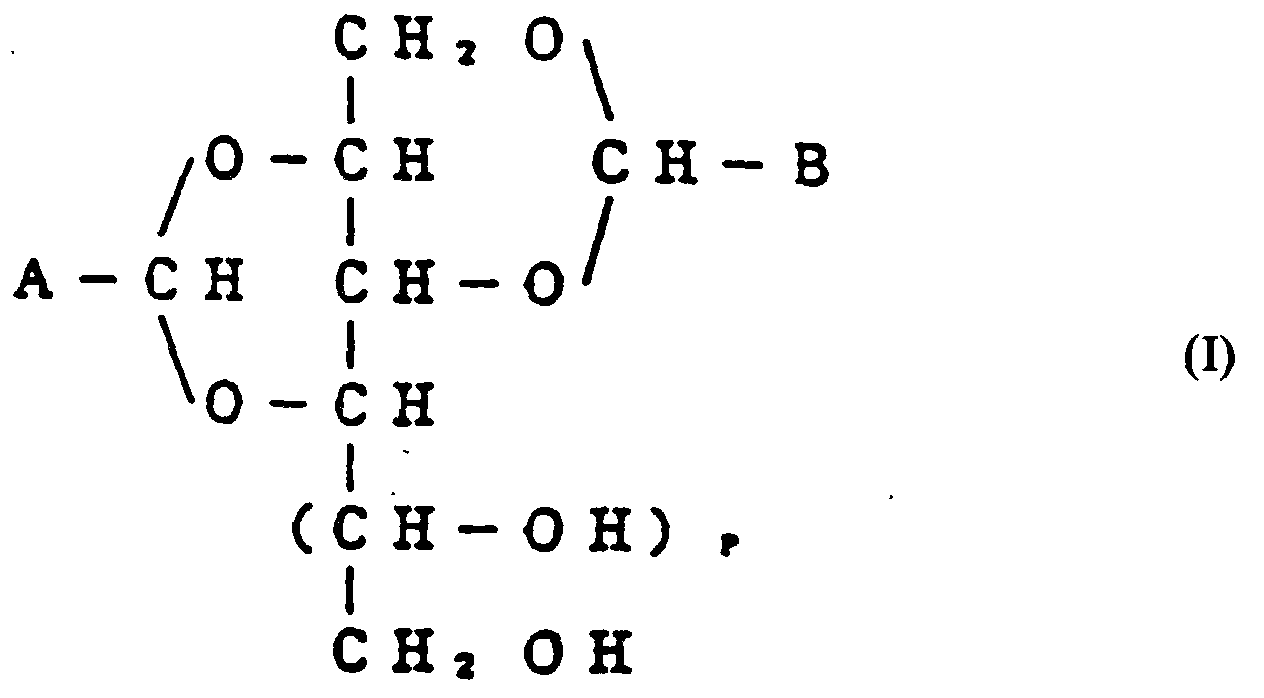 (A) wenigstens eine Aldehydverbindung der allgemeinen Formelund
A-CHO (II)
und der allgemeinen Formel
B-CHO (III)
wobei A und B wie vorstehend definiert sind,(B) ein mehrwertiger Alkohol, gewählt aus einem fünfwertigen Alkohol und einem sechswertigen Alkohol,in Gegenwart(C) eines Niederalkohols, gewählt aus der Gruppe, bestehend aus einem gesättigten, aliphatischen Alkohol mit 1 bis 4 Kohlenstoffatomen, Allylalkohol oder Furfurylalkohol,(D) eines hydrophoben organischen Lösungsmittels, das in keiner Weise ein Gel erzeugt oder mit der hergestellten Acetalverbindung der allgemeinen Formel (I) kein beständiges Gel erzeugt, wobei das Lösungsmittel als ein Dispersionsmedium verwendbar ist und einen Siedepunkt von etwa 40 bis etwa 200°C besitzt,und(E) eines sauren Katalysatorskondensiert wird,
wobei das Verfahren dadurch gekennzeichnet ist, daß der Arbeitsgang des Beladens mit Niederalkohol in den Reaktor und danach das Abziehen von mehr als einer halben Ladung des Niederalkohols aus dem Reaktionssystem gemeinsam mit Wasser während der Kondensation wenigstens dreimal wiederholt wird. - Herstellungsverfahren nach Anspruch 1, wobei die Aldehydverbindungen (A) der allgemeinen Formeln (II) und (III) Benzaldehyd mit oder ohne p-Methyl-, m-Methyl-, o-Methyl-, p-Ethyl-, p-Isopropyl-, p-Butyl-, p-Isobutyl-, p-Phenylgruppen, p-(C1-C12-Alkyl)phenyl-, p-halogeniertem Phenyl-, p-(C1-C12-Alkoxy)phenylresten, 2,4-Dimethyl-, 2,4,5-Trimethyl-, p-Chlor-, p-Methoxy-, p-Fluor-, p-Methoxycarbonyl-, p-Hexyloxycarbonyl-, p-Butyloxyethyloxycarbonyl- oder p-Methyloxyethyloxyethyloxycarbonyl-gruppen sowie unsubstituieren Tetrahydronaphthylaldehyd darstellen.
- Herstellungsverfahren nach Anspruch 1, wobei der mehrwertige Alkohol (B) einen Alkohol der allgemeinen Formel

- Herstellungsverfahren nach Anspruch 1, wobei der mehrwertige Alkohol (B) Sorbit oder Xylit ist.
- Herstellungsverfahren nach Anspruch 1, wobei das hydrophobe organische Lösungsmittel (D) Benzol das mit ein bis drei C1-C4-Alkylresten substituiert sein kann, Cyclohexan, das mit ein bis drei C1-C4-Alkylresten substituiert sein kann, oder einen gerad- oder verzweigtkettigen, gesättigten Kohlenwasserstoff mit 6 bis 16 Kohlenstoffatomen darstellt.
- Herstellungsverfahren nach Anspruch 1, wobei der Niederalkohol (C) Methanol ist.
- Herstellungsverfahren nach Anspruch 1, wobei der saure Katalysator (E) Schwefelsäure, Phosphorsäure, Salzsäure, p-Toluolsulfonsäure, m-Toluolsulfonsäure, eine Benzolsulfonsäure, die mit einem Alkylrest mit 2 bis 18 Kohlenstoffatomen substituiert ist, Naphthalinsulfonsäure, G-Säure, R-Säure oder Zinkchlorid ist.
- Herstellungsverfahren nach Anspruch 1, wobei die Aldehydverbindung (A) und der mehrwertige Alkohol (B) in den Reaktor in einem Molverhältnis von (A):(B) = etwa 1 bis 4:1 eingefüllt werden.
- Herstellungsverfahren nach Anspruch 1, wobei die Aldehydverbindung (A) und der mehrwertige Alkohol (B) in den Reaktor in einem Molverhältnis von (A):(B) = etwa 1,5 bis 3:1 eingefüllt werden.
- Herstellungsverfahren nach Anspruch 1, wobei die Aldehydverbindung (A) und der mehrwertige Alkohol (B) in den Reaktor in einem Molverhältnis von (A):(B) = etwa 1,8 bis 2,2:1 eingefüllt werden.
- Herstellungsverfahren nach Anspruch 1, wobei die Kondensation bei einer Substratkonzentration von etwa 5 bis etwa 90 Gew.-% durchgeführt wird.
- Herstellungsverfahren nach Anspruch 1, wobei die Kondensation bei einer Temperatur von etwa 40 bis etwa 200°C durchgeführt wird.
- Herstellungsverfahren nach Anspruch 1, wobei die Kondensation in einer Inertgasatmosphäre durchgeführt wird.
- Herstellungsverfahren nach Anspruch 1, wobei die Aldehydverbindung, der mehrwertige Alkohol, das hydrophobe organische Lösungsmittel der saure Katalysator und etwa 20 bis etwa 350 Gewichtsteile des Niederalkohols je 100 Gewichtsteile der Substrate zu Beginn der Umsetzung in den Reaktor eingefüllt werden, und mehr als die Hälfte der Menge an Niederalkohol gemeinsam mit Wasser abdestilliert wird, wobei jedes zweite und nachfolgende Beladen mit dem danach zuzugebenden Niederalkohol etwa 5 bis etwa 100 Gew.-%, bezogen auf die Anfangsbeladung der Substrate, beträgt.
- Herstellungsverfahren nach Anspruch 14, wobei jedes zweite und nachfolgende Beladen mit Niederalkohol etwa 10 bis etwa 30 Gew.-%, bezogen auf die Anfangsbeladung der Substrate, beträgt.
- Herstellungsverfahren nach Anspruch 1, wobei eine einheitliche Lösung oder Suspension, die durch Zusammenmischen der Aldehydverbindung, des mehrwertigen Alkohols, des Niederalkohols und, falls erforderlich, des sauren Katalysators bei Zimmertemperatur bis etwa 80°C erhalten wird, kontinuierlich oder diskontinuierlich gemeinsam mit dem hydrophoben organischen Lösungsmittel in den Reaktor eingefüllt wird, und mehr als die Hälfte der Menge an Niederalkohol abgezogen wird, wobei jedes zweite und nachfolgende Beladen mit dem danach zuzugebenden Niederalkohol im Bereich von etwa 5 bis etwa 100 Gew.-%, bezogen auf die Menge der eingefüllten Substrate liegt .
- Herstellungsverfahren nach Anspruch 1 und 16, wobei jedes zweite und nachfolgende Beladen mit Niederalkohol im Bereich von etwa 10 bis etwa 30 Gew.-%, bezogen auf die Menge der eingefüllten Substrate liegt.
- Herstellungsverfahren nach Anspruch 17, wobei der Niederalkohol in den Reaktor beim Unterbrechen des Beladens mit einem Vorreaktionsgemisch eingefüllt wird, nachdem mehr als die Hälfte der Menge an Niederalkohol abgezogen wurde oder nachdem mehr als die Hälfte der Menge an Niederalkohol abgezogen wurde, gefolgt vom Beenden des Beladens mit dem Vorreaktionsgemisch.
- Herstellungsverfahren nach Anspruch 1, wobei die nächste Ladung Niederalkohol dem System zugegeben wird, wenn etwa 60 bis etwa 95 Gew.-% des eingefüllten Niederalkohols aus dem Reaktionssystem abgezogen worden sind.
- Herstellungsverfahren nach Anspruch 19, wobei die nächste Ladung Niederalkohol zugegeben wird, wenn sich die Temperatur im Reaktionssystem der Siedetemperatur des hydrophoben organischen Lösungsmittels im Reaktionssystem nähert.
Applications Claiming Priority (1)
| Application Number | Priority Date | Filing Date | Title |
|---|---|---|---|
| PCT/JP1990/001086 WO1992003439A1 (fr) | 1990-08-27 | 1990-08-27 | Procede de production de composes d'acetal |
Publications (4)
| Publication Number | Publication Date |
|---|---|
| EP0497976A1 EP0497976A1 (de) | 1992-08-12 |
| EP0497976A4 EP0497976A4 (en) | 1992-09-02 |
| EP0497976B1 true EP0497976B1 (de) | 1996-09-11 |
| EP0497976B9 EP0497976B9 (de) | 2005-01-12 |
Family
ID=13986691
Family Applications (1)
| Application Number | Title | Priority Date | Filing Date |
|---|---|---|---|
| EP90912467A Expired - Lifetime EP0497976B9 (de) | 1990-08-27 | 1990-08-27 | Verfahren zur herstellung von acetalen |
Country Status (4)
| Country | Link |
|---|---|
| EP (1) | EP0497976B9 (de) |
| KR (1) | KR0142432B1 (de) |
| DE (1) | DE69028545T2 (de) |
| WO (1) | WO1992003439A1 (de) |
Families Citing this family (5)
| Publication number | Priority date | Publication date | Assignee | Title |
|---|---|---|---|---|
| US5731474A (en) * | 1997-01-31 | 1998-03-24 | Milliken Research Corporation | Method of making acetals |
| US5973043A (en) * | 1997-11-26 | 1999-10-26 | Milliken & Company | Carbamoyl substituted acetals and compositions containing the same |
| US20060079720A1 (en) * | 2004-10-13 | 2006-04-13 | Milliken & Company | Method for preparing acetal-containing compositions |
| KR102298667B1 (ko) * | 2014-10-16 | 2021-09-06 | 에스케이이노베이션 주식회사 | 무증발 촉매를 이용한 무수당 알코올의 제조방법 |
| WO2016071921A2 (en) * | 2014-11-07 | 2016-05-12 | Excell Industries Ltd. | A novel route for preparation of l,3:2,4-bis-(3,4- d im eth ylb enzylidene)so rb ito l |
Citations (1)
| Publication number | Priority date | Publication date | Assignee | Title |
|---|---|---|---|---|
| JPH0535163A (ja) * | 1991-07-26 | 1993-02-12 | Minolta Camera Co Ltd | 像保持部材 |
Family Cites Families (7)
| Publication number | Priority date | Publication date | Assignee | Title |
|---|---|---|---|---|
| JPS4843748B1 (de) * | 1969-10-06 | 1973-12-20 | New Japan Chem Co Ltd | |
| JPS5912702B2 (ja) * | 1973-07-24 | 1984-03-24 | イ−シ−化学工業 (株) | ゲル化剤の製造法 |
| JPS5822156B2 (ja) * | 1980-02-01 | 1983-05-06 | 新日本理化株式会社 | 1,3:2,4−ジベンジリデンソルビト−ル類又は(及び)1,3:2,4:5,6−トリベンジリデンソルビト−ル類の連続製造法 |
| JPS5822157B2 (ja) * | 1980-05-16 | 1983-05-06 | 新日本理化株式会社 | 1,3:2,4−ジベンジリデンソルビト−ル類及び1,3:2,4−ジベンジリデンキシルト−ル類の製造法 |
| JPS57185288A (en) * | 1981-05-11 | 1982-11-15 | Mitsui Toatsu Chem Inc | Preparation of bis(alkylbenzylidene)sorbitol |
| JPS58180488A (ja) * | 1982-04-19 | 1983-10-21 | Iic Kagaku Kogyo Kk | 多価アルコ−ル誘導体及びその製法 |
| JPH07107067B2 (ja) * | 1987-12-07 | 1995-11-15 | 新日本理化株式会社 | アセタール類の製造方法 |
-
1990
- 1990-08-27 EP EP90912467A patent/EP0497976B9/de not_active Expired - Lifetime
- 1990-08-27 WO PCT/JP1990/001086 patent/WO1992003439A1/ja not_active Ceased
- 1990-08-27 DE DE69028545T patent/DE69028545T2/de not_active Expired - Fee Related
-
1992
- 1992-04-27 KR KR92700979A patent/KR0142432B1/ko not_active Expired - Fee Related
Patent Citations (1)
| Publication number | Priority date | Publication date | Assignee | Title |
|---|---|---|---|---|
| JPH0535163A (ja) * | 1991-07-26 | 1993-02-12 | Minolta Camera Co Ltd | 像保持部材 |
Also Published As
| Publication number | Publication date |
|---|---|
| DE69028545D1 (de) | 1996-10-17 |
| EP0497976A1 (de) | 1992-08-12 |
| EP0497976A4 (en) | 1992-09-02 |
| DE69028545T2 (de) | 1997-04-30 |
| WO1992003439A1 (fr) | 1992-03-05 |
| EP0497976B9 (de) | 2005-01-12 |
| KR0142432B1 (en) | 1998-06-01 |
| KR927003601A (ko) | 1992-12-18 |
Similar Documents
| Publication | Publication Date | Title |
|---|---|---|
| US4902807A (en) | Process for batchwise acetal production | |
| EP0856515B1 (de) | Verfahren zur Herstellung von Acetalen | |
| US4429140A (en) | Process for preparing dibenzylidene sorbitols and dibenzylidene xylitols | |
| EP0497976B9 (de) | Verfahren zur herstellung von acetalen | |
| EP0421329B1 (de) | Verfahren zur Herstellung von Diacetal-Verbindungen | |
| JPH0899923A (ja) | 不飽和エーテルの製造方法 | |
| JP2711884B2 (ja) | アセタール類の製造方法 | |
| EP2243764B1 (de) | Verfahren zur Herstellung von substituierten 1,4-Chinonmethiden | |
| EP0051681B1 (de) | Verfahren zur herstellung eines dibenzylidensorbitols oder eines dibenzylidenxylitols | |
| JPS5822156B2 (ja) | 1,3:2,4−ジベンジリデンソルビト−ル類又は(及び)1,3:2,4:5,6−トリベンジリデンソルビト−ル類の連続製造法 | |
| DE3435003C2 (de) | Verfahren zur Herstellung von 2-Alkyliden-cyclohexanon | |
| US3825572A (en) | Epimeric mixtures of the lactone 3,6-dihydro-4,5-dimethyl-5-phenyl-alpha-pyrone | |
| US2678950A (en) | Process of producing acrolein | |
| EP0877023B1 (de) | Verfahren zur Herstellung von aromatischen Verbindungen die ein heterozyklisches System enthalten | |
| US4350833A (en) | Terephthaldialdehyde monoacetal and method for manufacture thereof | |
| JPH08113568A (ja) | 2−ビニル−1,3−ジオキソランの製法 | |
| JPS6241492B2 (de) | ||
| KR100475545B1 (ko) | 방향족 알데히드와 다가 알코올의 축합반응에 의한디아세탈의 제조방법 | |
| JP4045183B2 (ja) | 5−アルキル−γ−ブチロラクトンの製造方法 | |
| EP0088423A2 (de) | Fluoroketone und deren cyclische Kondensationsprodukte | |
| JPH0669984B2 (ja) | シクロペンテノン誘導体の製造法 | |
| SU1735274A1 (ru) | Способ получени 4,4 @ -динитробифенилоксида | |
| JPH0669985B2 (ja) | 2−シクロペンテノン誘導体の製造法 | |
| EP1097143A1 (de) | Verfahren zur herstellung von 5-(1-methylethyl) 6-(phenylmethyl)pyrimidin-2,4(1h,3h)-dione | |
| JPH09227526A (ja) | ヒダントイン化合物の製造方法 |
Legal Events
| Date | Code | Title | Description |
|---|---|---|---|
| PUAI | Public reference made under article 153(3) epc to a published international application that has entered the european phase |
Free format text: ORIGINAL CODE: 0009012 |
|
| 17P | Request for examination filed |
Effective date: 19920512 |
|
| AK | Designated contracting states |
Kind code of ref document: A1 Designated state(s): DE FR GB |
|
| A4 | Supplementary search report drawn up and despatched |
Effective date: 19920716 |
|
| AK | Designated contracting states |
Kind code of ref document: A4 Designated state(s): DE FR GB |
|
| 17Q | First examination report despatched |
Effective date: 19941219 |
|
| GRAH | Despatch of communication of intention to grant a patent |
Free format text: ORIGINAL CODE: EPIDOS IGRA |
|
| GRAA | (expected) grant |
Free format text: ORIGINAL CODE: 0009210 |
|
| GRAH | Despatch of communication of intention to grant a patent |
Free format text: ORIGINAL CODE: EPIDOS IGRA |
|
| AK | Designated contracting states |
Kind code of ref document: B1 Designated state(s): DE FR GB |
|
| REF | Corresponds to: |
Ref document number: 69028545 Country of ref document: DE Date of ref document: 19961017 |
|
| ET | Fr: translation filed | ||
| PLBQ | Unpublished change to opponent data |
Free format text: ORIGINAL CODE: EPIDOS OPPO |
|
| PLBI | Opposition filed |
Free format text: ORIGINAL CODE: 0009260 |
|
| 26 | Opposition filed |
Opponent name: MILLIKEN RESEARCH CORPORATION Effective date: 19970611 |
|
| PLBF | Reply of patent proprietor to notice(s) of opposition |
Free format text: ORIGINAL CODE: EPIDOS OBSO |
|
| PLBF | Reply of patent proprietor to notice(s) of opposition |
Free format text: ORIGINAL CODE: EPIDOS OBSO |
|
| PLBF | Reply of patent proprietor to notice(s) of opposition |
Free format text: ORIGINAL CODE: EPIDOS OBSO |
|
| PLBQ | Unpublished change to opponent data |
Free format text: ORIGINAL CODE: EPIDOS OPPO |
|
| PLAB | Opposition data, opponent's data or that of the opponent's representative modified |
Free format text: ORIGINAL CODE: 0009299OPPO |
|
| R26 | Opposition filed (corrected) |
Opponent name: MILLIKEN RESEARCH CORPORATION Effective date: 19970611 |
|
| RDAH | Patent revoked |
Free format text: ORIGINAL CODE: EPIDOS REVO |
|
| APAC | Appeal dossier modified |
Free format text: ORIGINAL CODE: EPIDOS NOAPO |
|
| APAE | Appeal reference modified |
Free format text: ORIGINAL CODE: EPIDOS REFNO |
|
| APAC | Appeal dossier modified |
Free format text: ORIGINAL CODE: EPIDOS NOAPO |
|
| REG | Reference to a national code |
Ref country code: GB Ref legal event code: IF02 |
|
| APBU | Appeal procedure closed |
Free format text: ORIGINAL CODE: EPIDOSNNOA9O |
|
| PLCK | Communication despatched that opposition was rejected |
Free format text: ORIGINAL CODE: EPIDOSNREJ1 |
|
| PLBN | Opposition rejected |
Free format text: ORIGINAL CODE: 0009273 |
|
| STAA | Information on the status of an ep patent application or granted ep patent |
Free format text: STATUS: OPPOSITION REJECTED |
|
| 27O | Opposition rejected |
Effective date: 20041015 |
|
| APAH | Appeal reference modified |
Free format text: ORIGINAL CODE: EPIDOSCREFNO |
|
| PGFP | Annual fee paid to national office [announced via postgrant information from national office to epo] |
Ref country code: FR Payment date: 20080730 Year of fee payment: 19 |
|
| PGFP | Annual fee paid to national office [announced via postgrant information from national office to epo] |
Ref country code: GB Payment date: 20080903 Year of fee payment: 19 |
|
| PGFP | Annual fee paid to national office [announced via postgrant information from national office to epo] |
Ref country code: DE Payment date: 20080930 Year of fee payment: 19 |
|
| GBPC | Gb: european patent ceased through non-payment of renewal fee |
Effective date: 20090827 |
|
| REG | Reference to a national code |
Ref country code: FR Ref legal event code: ST Effective date: 20100430 |
|
| PG25 | Lapsed in a contracting state [announced via postgrant information from national office to epo] |
Ref country code: FR Free format text: LAPSE BECAUSE OF NON-PAYMENT OF DUE FEES Effective date: 20090831 Ref country code: DE Free format text: LAPSE BECAUSE OF NON-PAYMENT OF DUE FEES Effective date: 20100302 |
|
| PG25 | Lapsed in a contracting state [announced via postgrant information from national office to epo] |
Ref country code: GB Free format text: LAPSE BECAUSE OF NON-PAYMENT OF DUE FEES Effective date: 20090827 |