EP0498246A2 - Verfahren zur Korrektur eines Fehlwinkels - Google Patents
Verfahren zur Korrektur eines Fehlwinkels Download PDFInfo
- Publication number
- EP0498246A2 EP0498246A2 EP92101241A EP92101241A EP0498246A2 EP 0498246 A2 EP0498246 A2 EP 0498246A2 EP 92101241 A EP92101241 A EP 92101241A EP 92101241 A EP92101241 A EP 92101241A EP 0498246 A2 EP0498246 A2 EP 0498246A2
- Authority
- EP
- European Patent Office
- Prior art keywords
- scanning head
- synchronous demodulator
- output signal
- synchronous
- control input
- Prior art date
- Legal status (The legal status is an assumption and is not a legal conclusion. Google has not performed a legal analysis and makes no representation as to the accuracy of the status listed.)
- Granted
Links
Images
Classifications
-
- G—PHYSICS
- G11—INFORMATION STORAGE
- G11B—INFORMATION STORAGE BASED ON RELATIVE MOVEMENT BETWEEN RECORD CARRIER AND TRANSDUCER
- G11B7/00—Recording or reproducing by optical means, e.g. recording using a thermal beam of optical radiation by modifying optical properties or the physical structure, reproducing using an optical beam at lower power by sensing optical properties; Record carriers therefor
- G11B7/08—Disposition or mounting of heads or light sources relatively to record carriers
- G11B7/09—Disposition or mounting of heads or light sources relatively to record carriers with provision for moving the light beam or focus plane for the purpose of maintaining alignment of the light beam relative to the record carrier during transducing operation, e.g. to compensate for surface irregularities of the latter or for track following
- G11B7/095—Disposition or mounting of heads or light sources relatively to record carriers with provision for moving the light beam or focus plane for the purpose of maintaining alignment of the light beam relative to the record carrier during transducing operation, e.g. to compensate for surface irregularities of the latter or for track following specially adapted for discs, e.g. for compensation of eccentricity or wobble
- G11B7/0956—Disposition or mounting of heads or light sources relatively to record carriers with provision for moving the light beam or focus plane for the purpose of maintaining alignment of the light beam relative to the record carrier during transducing operation, e.g. to compensate for surface irregularities of the latter or for track following specially adapted for discs, e.g. for compensation of eccentricity or wobble to compensate for tilt, skew, warp or inclination of the disc, i.e. maintain the optical axis at right angles to the disc
Definitions
- the object of the property right is a method for correcting an incorrect angle between the optical axis of the scanning head in a playback device for optical storage disks and the normal to the surface of the storage disk at the scanning point.
- the invention which also solves this problem, is characterized by the features of claim 1.
- the bits of the information to be stored in the optical storage disks are recorded by changing the reflection factor within the individual tracks.
- the respective track is illuminated by a laser diode and the reflected light is measured with a photo element.
- the laser diode and photo element are combined with a lens and other control elements in a scanning head which has an optical axis which, when the player is set up, with the normal established at the scanning point the surface of the storage disks should coincide. Deviations between the optical axis and the normal lead to error rates in the later recognition of the stored information due to the impairment of the reflection conditions.
- the scanning head When reading out the information, the scanning head must be kept at a predetermined distance from the surface of the disk. It is guided in a radial direction from the inside to the outside of the storage disks. In order to maintain the correct distance, the scanning head is adjustable in the playback device.
- the actuator receives a control signal from an assembly called a focus servo. If the optical disk has a vertical stroke - this means that the distance between the disk surface and a permanently installed scanning head would change periodically - then the focus servo supplies an AC voltage, the frequency of which corresponds to the speed.
- the inventor has now found that the high-frequency output voltage of the scanning head has a weak modulation when reading a disk with a vertical stroke, the frequency of which corresponds to the speed.
- This modulation is amplified if there is a misalignment between the optical axis of the scanning head and the normal to the surface of the disk at the scanning point. This modulation depends on the size of the misalignment.
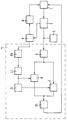
- the block diagram now shows the essential modules required for correcting the misalignment.
- the correction can be carried out manually or automatically using controlled actuators respectively.
- the correction values of the control signals for the actuators are then written into suitable memories and are therefore available for the operating time of the playback device with this scanning head. After repairs to the readhead, the memory values must be reset.
- the scanning head 1 supplies an output signal which is modulated at high frequency with the read information, which is amplified by a preamplifier 2 and processed further in the data decoder 3.
- the output signal of the preamplifier 2 is further amplified in a measuring stage 4 in an amplifier 5, which may show a low-pass behavior, and then fed as an input signal to two synchronous demodulators 6, 7 connected in parallel.
- the preamplifier 2 has a second signal output to which the focus servo 8 is connected.
- This focus servo 8 delivers a signal with which the scanning head is kept at a constant distance from the disk surface by means of the focus actuator 9. In the case of a storage disk with a vertical disk blow, the signal is superimposed on the AC voltage already mentioned.
- This AC voltage is fed via a low-pass filter 10 and a limiter amplifier 11 directly to the control input of the first synchronous demodulator 6 and to the control input of the second synchronous demodulator 7 via a 90 ° phase shifter 12.
- the output voltages of the two synchronous demodulators now correspond to two components of the misalignment which are offset by 90 ° from one another.
- an evaluation circuit 13 can be used to perform two swivel movements offset by 90 ° control in the bearing of the scanning head so that both components are at a minimum. These pivotal movements can, for. B. by 90 ° offset piezo elements in the bearing of the lens. If the correction value, ie the control voltages for the piezo elements, is stored, the measuring stage 4 can be set up as a separate part for the setting of the micro elements.
- the playback device must be equipped with an externally accessible tap for the RF-modulated output signal of the preamplifier and for the control signal for the focus actuator.
- the two output voltages can be displayed on a screen, where the minimization can be followed optically.
- the correction is expediently carried out in an iterative way, the direction of action of an adjustment made being checked.
- pivoting movements can, for. B. also be caused by 90 ° offset piezo elements in the bearing of the drive motor.
- One of the piezo elements is expediently arranged in one plane with the scanning head.
Landscapes
- Optical Recording Or Reproduction (AREA)
- Moving Of The Head For Recording And Reproducing By Optical Means (AREA)
Abstract
Description
- Gegenstand des Schutzrechts ist ein Verfahren zur Korrektur eines Fehlwinkels zwischen der optischen Achse des Abtastkopfes in einem Abspielgerät für optische Speicherplatten und der Normalen zur Oberfläche der Speicherplatte im Abtastpunkt.
- Derartige Verfahren sind bisher nicht bekannt geworden.
- Eine Korrektur des Fehlwinkels setzt die Lösung der Aufgabe voraus, ein Steuersignal verfügbar zu haben, dessen Größe eindeutig vom Fehlwinkel abhängt.
- Die Erfindung, die auch diese Aufgabe löst, ist durch die Merkmale des Anspruchs 1 gekennzeichnet.
- Die Erfindung läßt sich mit Hilfe eines Abspielgerätes verwirklichen, das durch die Merkmale des Anspruchs 2 gekennzeichnet ist.
- Figur 1
- zeigt die hier wesentlichen Teile des Abspielgerätes in Form eines Blockschaltbildes.
- Vor dessen Erläuterung wird zum besseren Verständnis vorausgeschickt, daß die Bits der zu speichernden Informationen in den optische Speicherplatten durch eine Veränderung des Reflektionsfaktors innerhalb der einzelnen Spuren aufgezeichnet werden. Bei Auslesen der Informationen wird die jeweilige Spur von einer Laserdiode beleuchtet und das reflektierte Licht mit einem Fotoelement gemessen. Laserdiode und Fotoelement sind zusammen mit einem Objektiv und weiteren der Regelung dienenden Elementen in einem Abtastkopf zusammengefaßt, der eine optische Achse besitzt, die bei dem Aufbau des Abspielgerätes mit der im Abtastpunkt errichteten Normalen auf der Oberfläche der Speicherplatten zusammenfallen soll. Abweichungen zwischen der optischen Achse und der Normalen führen wegen der Beeinträchtigung der Reflektionsverhältnisse zu Fehlerraten bei der späteren Erkennung der gespeicherten Informationen.
- Bei dem Auslesen der Informationen muß der Abtastkopf in einem vorgegebenen Abstand zur Plattenoberfläche gehalten werden. Er wird dabei in radialer Richtung über die Speicherplatten von innen nach außen geführt. Zur Einhaltung des richtigen Abstands ist der Abtastkopf im Abspielgerät verstellbar gelagert. Das Stellglied erhält ein Steuersignal von einer als Fokusservo bezeichneten Baugruppe. Hat die optische Speicherplatte einen vertikalen Schlag - das bedeutet, daß sich der Abstand zwischen der Plattenoberfläche und einem fest montierten Abtastkopf periodisch ändern würde - dann liefert der Fokusservo eine Wechselspannung, deren Frequenz der Drehzahl entspricht.
- Der Erfinder hat nun festgestellt, daß auch die hochfrequente Ausgangsspannung des Abtastkopfes beim Lesen einer Speicherplatte mit vertikalem Schlag eine schwache Modulation aufweist, deren Frequenz der Drehzahl entspricht. Diese Modulation wird verstärkt, wenn zwischen der optischen Achse des Abtastkopfes und der Normalen der Oberfläche der Speicherplatte im Abtastpunkt ein Fehlwinkel besteht. Diese Modulation ist also abhängig von der Größe des Fehlwinkels. Dies führte den Erfinder zu der Lehre, daß man zur Korrektur des Fehlwinkels bei der Justage des Abtastkopfes ein Minimum der Modulation einzustellen hat. Zur Erleichterung der Justage arbeitet man bei der Einstellung der Abtastkopf-Stellung mit einer Speicherplatte mit einem genormten vertikalen Plattenschlag.
- Das Blockschaltbild gibt nun die wesentlichen, für die Korrektur des Fehlwinkels erforderlichen Baugruppen wieder. Die Korrektur kann dabei manuell durchgeführt werden oder mittels gesteuerten Stellgliedern automatisch erfolgen. Die Korrekturwerte der Steuersignale für die Stellglieder werden dann in geeignete Speicher eingeschrieben und sind dadurch für die Betriebszeit des Abspielgerätes mit eben diesem Abtastkopf verfügbar. Nach einer Reparatur am Abtastkopf müssen die Speicherwerte neu eingestellt werden.
- Der Abtastkopf 1 liefert ein mit den ausgelesenen Informationen hochfrequent moduliertes Ausgangssignal, das von einem Vorverstärker 2 verstärkt wird und im Datendecoder 3 weiterverarbeitet wird.
- Das Ausgangssignal des Vorverstärkers 2 wird ferner in einer Meßstufe 4 erneut in einem Verstärker 5, der ein Tiefpaßverhalten zeigen kann, verstärkt und dann als Eingangssignal zwei parallelgeschalteten Synchron-Demodulatoren 6, 7 zugeführt.
- Der Vorverstärker 2 besitzt einen zweiten Signalausgang, an den der Fokusservo 8 angeschlossen ist. Dieser Fokusservo 8 liefert ein Signal, mit dem der Abtastkopf mittels des Fokusaktuators 9 auf gleichbleibenden Abstand zur Plattenoberfläche gehalten wird. Bei einer Speicherplatte mit einem vertikalen Plattenschlag ist dem Signal die bereits erwähnte Wechselspannung überlagert.
- Diese Wechselspannung wird über einen Tiefpaß 10 und einem Begrenzerverstärker 11 dem Steuereingang des ersten Synchron-Demodulators 6 direkt und dem Steuereingang des zweiten Synchron-Demodulators 7 über einen 90°-Phasenschieber 12 zugeführt.
- Die Ausgangsspannungen der beiden Synchron-Demodulatoren entsprechen nun zwei um 90° gegeneinander versetzten Komponenten des Fehlwinkels. Mit beiden Ausgangsspannungen lassen sich mittels einer Auswertschaltung 13 zwei um 90° gegeneinander versetzten Schwenkbewegungen im Lager des Abtastkopfes derart steuern, daß beide Komponenten zu einem Minimum werden. Diese Schwenkbewegungen können z. B. durch um 90° gegeneinander versetzte Piezoelemente im Lager des Objektivs bewirkt werden. Sieht man eine Speicherung des Korrekturwertes, d. h. der Steuerspannungen für die Piezoelemente, vor, so kann für die Einstellung der Microelemente die Meßstufe 4 als separater Teil aufgebaut werden. Dazu ist das Abspielgerät mit einem von außen zugänglichen Abgriff für das HF-modulierte Ausgangssignal des Vorverstärkers und für das Steuersignal für den Fokusaktuator auszurüsten.
- Bei einer manuellen Verschwenkung des Abtastkopfes können die beiden Ausgangsspannungen auf einem Bildschirm dargestellt werden, wo sich die Minimisierung optisch verfolgen läßt. Die Korrektur wird dabei zweckmäßiger Weise auf einem iterativen Weg erfolgen, wobei die Wirkungsrichtung einer vorgenommenen Verstellung kontrolliert wird.
- Diese erwähnten Schwenkbewegungen können z. B. auch durch um 90° gegeneinander versetzte Piezoelemente im Lager des Antriebsmotors bewirkt werden. Zweckmäßigerweise wird eines der Piezoelemente in einer Ebene mit dem Abtastkopf angeordnet.
Claims (8)
- Verfahren zur Korrektur eines Fehlwinkels zwischen der optischen Achse eines verstellbar gelagerten Abtastkopfes im einem Abspielgerät für optische Speicherplatten und der Normalen zur Oberfläche der Speicherplatte im Abtastpunkt,
dadurch gekennzeichnet,
daß durch Verschwenken des Abtastkopfes das Minimum der niederfrequenten Modulation der Ausgangsspannung des Abtastkopfes eingestellt wird. - Abspielgerät für optische Speicherplatten mit einem verstellbar gelagerten Abtastkopf, der ein Objektiv, eine Laserdiode und ein Fotoelement umfaßt, das ein hochfrequentes Ausgangssignal liefert, welches im Datendecoder entschlüsselt wird, sowie mit einem vom Fokusservo gesteuerten Fokusaktuator, mit dem der Abtastkopf in einem vorgegebenen Abstand zur Plattenoberfläche geführt wird,
dadurch gekennzeichnet,
daß dem Abtastkopf (1) mindestens ein Synchron-Demodulator (6) nachgeschaltet ist und daß das Ausgangssignal des Fokusservo (8) über einen Tiefpaß (10) dem Steuereingang des Synchron-Demodulators (6) zugeführt wird und der Ausgang des Synchron-Demodulators an eine Auswerteeinheit (3) angeschlossen ist. - Abspielgerät nach Anspruch 2,
dadurch gekennzeichnet, daß dem Abtastkopf (1) zwei Synchron-Demodulatoren (6, 7) parallel nachgeschaltet sind und daß das Ausgangssignal des Fokusservo (8) über einen Tiefpaß (10) dem Steuereingang des einen Synchron-Demodulators (6) direkt und dem Steuereingang des anderen Synchron-Demodulators (7) über einen 90°-Phasenschieber (12) zugeführt wird und daß die Ausgänge beider Synchron-Demodulatoren an eine Auswerteeinheit (13) angeschlossen sind. - Abspielgerät nach Anspruch 3,
dadurch gekennzeichnet,
daß das Lager des Objektivs im Abtastkopf (1) um 90° zueinander angeordnete Piezoelemente umfaßt, deren Steuereingänge an die Auswerteeinheit (13) angeschlossen sind. - Abtastkopf in einem Abspielgerät für optische Speicherplatten und der Normalen zur Oberfläche der Speicherplatte im Abtastpunkt,
dadurch gekennzeichnet,
daß der Motor des Abspielgerätes verschwenkbar gelagert wird und durch Verschwenken der Motorachse das Minimum der niederfrequenten Modulation der Ausgangsspannung des Abtastkopfes eingestellt wird. - Abspielgerät für optische Speicherplatten mit einem Abtastkopf, der ein Objektiv, eine Laserdiode und ein Fotoelement umfaßt, das ein hochfrequentes Ausgangssignal liefert, welches im Datendecoder entschlüsselt wird, sowie mit einem vom Fokusservo gesteuerten Fokusaktuator, mit dem der Abstastkopf in einem vorgegebenen Abstand zur Plattenoberfläche geführt wird,
dadurch gekennzeichnet,
daß dem Fotoelement (1) mindestens ein Synchron-Demodulator (6) nachgeschaltet ist und das Ausgangssignal des Fokusservo (8) über einen Tiefpaß (10) dem Steuereingang des Synchron-Demodulators zugeführt ist und daß das Ausgangssignal des Synchron-Demodulators Schwenkbewegungen in dem Motorlager steuert. - Abspielgerät nach Anspruch 6,
dadurch gekennzeichnet,
daß dem Fotoelement (1) zwei Synchron-Demodulatoren (6/7) parallel nachgeschaltet sind und daß das Ausgangssignal des Fokusservo (8) über einen Tiefpaß (10) dem Steuereingang des einen Synchron-Demodulators (6) direkt, dem Steuereingang des anderen Synchron-Demodulators (7) über einen 90°-Phasenverschieber (12) zugeführt wird und daß die Ausgänge beider Synchron-Demodulatoren über eine Auswerteeinheit (13) zwei um 90° versetzt angeordnete Stellglieder im Motorlager steuern. - Abspielgerät nach Anspruch 7,
dadurch gekennzeichnet,
daß das eine Stellelement in einer Ebene mit dem Abtastkopf (1) liegt.
Applications Claiming Priority (4)
| Application Number | Priority Date | Filing Date | Title |
|---|---|---|---|
| DE4103506 | 1991-02-06 | ||
| DE4103506 | 1991-02-06 | ||
| DE4103949 | 1991-02-09 | ||
| DE19914103949 DE4103949A1 (de) | 1991-02-09 | 1991-02-09 | Verfahren zur korrektur eines fehlwinkels in einem cd-player |
Publications (3)
| Publication Number | Publication Date |
|---|---|
| EP0498246A2 true EP0498246A2 (de) | 1992-08-12 |
| EP0498246A3 EP0498246A3 (en) | 1993-03-03 |
| EP0498246B1 EP0498246B1 (de) | 1997-01-02 |
Family
ID=25900792
Family Applications (1)
| Application Number | Title | Priority Date | Filing Date |
|---|---|---|---|
| EP92101241A Expired - Lifetime EP0498246B1 (de) | 1991-02-06 | 1992-01-27 | Verfahren zur Korrektur eines Fehlwinkels |
Country Status (4)
| Country | Link |
|---|---|
| EP (1) | EP0498246B1 (de) |
| JP (1) | JPH04315824A (de) |
| DE (1) | DE59207786D1 (de) |
| ES (1) | ES2095965T3 (de) |
Cited By (1)
| Publication number | Priority date | Publication date | Assignee | Title |
|---|---|---|---|---|
| CN1306500C (zh) * | 2004-02-12 | 2007-03-21 | 三洋电机株式会社 | 信息记录再生装置 |
Families Citing this family (1)
| Publication number | Priority date | Publication date | Assignee | Title |
|---|---|---|---|---|
| US6904177B2 (en) * | 2001-03-13 | 2005-06-07 | Canon Kabushiki Kaisha | Filter processing apparatus |
Family Cites Families (4)
| Publication number | Priority date | Publication date | Assignee | Title |
|---|---|---|---|---|
| JPS5911543A (ja) * | 1982-07-10 | 1984-01-21 | Sony Corp | 光学式デイスク再生装置 |
| JPS60143448A (ja) * | 1983-12-29 | 1985-07-29 | Sony Corp | スキユ−エラ−検出回路 |
| JP2911449B2 (ja) * | 1987-10-29 | 1999-06-23 | パイオニア株式会社 | 光学式情報読取装置 |
| JP2572842B2 (ja) * | 1989-05-10 | 1997-01-16 | パイオニア株式会社 | 光学的読取り信号のクロストーク量検出装置 |
-
1992
- 1992-01-27 EP EP92101241A patent/EP0498246B1/de not_active Expired - Lifetime
- 1992-01-27 ES ES92101241T patent/ES2095965T3/es not_active Expired - Lifetime
- 1992-01-27 DE DE59207786T patent/DE59207786D1/de not_active Expired - Fee Related
- 1992-02-04 JP JP4018836A patent/JPH04315824A/ja active Pending
Cited By (1)
| Publication number | Priority date | Publication date | Assignee | Title |
|---|---|---|---|---|
| CN1306500C (zh) * | 2004-02-12 | 2007-03-21 | 三洋电机株式会社 | 信息记录再生装置 |
Also Published As
| Publication number | Publication date |
|---|---|
| DE59207786D1 (de) | 1997-02-13 |
| JPH04315824A (ja) | 1992-11-06 |
| ES2095965T3 (es) | 1997-03-01 |
| EP0498246B1 (de) | 1997-01-02 |
| EP0498246A3 (en) | 1993-03-03 |
Similar Documents
| Publication | Publication Date | Title |
|---|---|---|
| DE3346114C2 (de) | Optisches Plattengerät | |
| DE3545996C2 (de) | ||
| DE2935250C2 (de) | Spurführungs-Steuereinrichtung für den Abtastlichtstrahl einer optischen Leseeinrichtung | |
| DE69807112T2 (de) | Optisches servosystem für bandantrieb | |
| DE69030017T2 (de) | Optischer Plattenantrieb | |
| DE69624763T2 (de) | Verfahren und Gerät zum Abtasten einer mehrschichtigen Platte | |
| DE3409588C2 (de) | Servosystem für die Spurverfolgung und/oder Fokussierung in einem Datenlesegerät | |
| DE2353127B2 (de) | Video-plattenspieler | |
| DE3602640A1 (de) | Optisches informations- aufzeichnungs-/wiedergabesystem | |
| DE69617799T2 (de) | Vorrichtung und Verfahren zur optischen Aufzeichnung/Wiedergabe von Informationen | |
| DE3887601T2 (de) | Informationsaufnahme- und/oder -wiedergabegerät mit Mitteln zur Feststellung aller Spurfolgefehler. | |
| DE69019248T2 (de) | Optisches Aufnahme- und/oder Wiedergabegerät. | |
| DE3730555C2 (de) | ||
| DE19515206A1 (de) | Verfahren und Apparat zur Fokussierungsregelung | |
| DE3873005T2 (de) | Optischer plattenspieler. | |
| DE68916273T2 (de) | Optisches Aufnahme/Wiedergabegerät. | |
| DE3831923A1 (de) | Optisches geraet zum fokussieren eines lichtstrahls auf ein objekt fuer datenaufzeichnung | |
| DE3501609C2 (de) | ||
| DE3503117A1 (de) | Abspielgeraet fuer aufgezeichnete daten | |
| EP0681290B1 (de) | Abtastgerät mit Adaptation | |
| DE68912149T2 (de) | Optisches Informationsverarbeitungsgerät. | |
| DE2607275C3 (de) | Lichtstrahl-Abtasteinrichtung | |
| EP0498246A2 (de) | Verfahren zur Korrektur eines Fehlwinkels | |
| DE69114433T2 (de) | Optische Platteneinheit. | |
| DE3612829C2 (de) |
Legal Events
| Date | Code | Title | Description |
|---|---|---|---|
| PUAI | Public reference made under article 153(3) epc to a published international application that has entered the european phase |
Free format text: ORIGINAL CODE: 0009012 |
|
| AK | Designated contracting states |
Kind code of ref document: A2 Designated state(s): DE ES FR IT |
|
| PUAL | Search report despatched |
Free format text: ORIGINAL CODE: 0009013 |
|
| AK | Designated contracting states |
Kind code of ref document: A3 Designated state(s): DE ES FR IT |
|
| 17P | Request for examination filed |
Effective date: 19930812 |
|
| 17Q | First examination report despatched |
Effective date: 19950814 |
|
| GRAG | Despatch of communication of intention to grant |
Free format text: ORIGINAL CODE: EPIDOS AGRA |
|
| GRAH | Despatch of communication of intention to grant a patent |
Free format text: ORIGINAL CODE: EPIDOS IGRA |
|
| GRAH | Despatch of communication of intention to grant a patent |
Free format text: ORIGINAL CODE: EPIDOS IGRA |
|
| GRAA | (expected) grant |
Free format text: ORIGINAL CODE: 0009210 |
|
| AK | Designated contracting states |
Kind code of ref document: B1 Designated state(s): DE ES FR IT |
|
| ET | Fr: translation filed | ||
| REF | Corresponds to: |
Ref document number: 59207786 Country of ref document: DE Date of ref document: 19970213 |
|
| REG | Reference to a national code |
Ref country code: ES Ref legal event code: FG2A Ref document number: 2095965 Country of ref document: ES Kind code of ref document: T3 |
|
| ITF | It: translation for a ep patent filed | ||
| PLBE | No opposition filed within time limit |
Free format text: ORIGINAL CODE: 0009261 |
|
| STAA | Information on the status of an ep patent application or granted ep patent |
Free format text: STATUS: NO OPPOSITION FILED WITHIN TIME LIMIT |
|
| 26N | No opposition filed | ||
| PGFP | Annual fee paid to national office [announced via postgrant information from national office to epo] |
Ref country code: DE Payment date: 20070313 Year of fee payment: 16 |
|
| PGFP | Annual fee paid to national office [announced via postgrant information from national office to epo] |
Ref country code: ES Payment date: 20080125 Year of fee payment: 17 |
|
| PGFP | Annual fee paid to national office [announced via postgrant information from national office to epo] |
Ref country code: IT Payment date: 20080124 Year of fee payment: 17 |
|
| PGFP | Annual fee paid to national office [announced via postgrant information from national office to epo] |
Ref country code: FR Payment date: 20080118 Year of fee payment: 17 |
|
| PG25 | Lapsed in a contracting state [announced via postgrant information from national office to epo] |
Ref country code: DE Free format text: LAPSE BECAUSE OF NON-PAYMENT OF DUE FEES Effective date: 20080801 |
|
| REG | Reference to a national code |
Ref country code: FR Ref legal event code: ST Effective date: 20091030 |
|
| REG | Reference to a national code |
Ref country code: ES Ref legal event code: FD2A Effective date: 20090128 |
|
| PG25 | Lapsed in a contracting state [announced via postgrant information from national office to epo] |
Ref country code: FR Free format text: LAPSE BECAUSE OF NON-PAYMENT OF DUE FEES Effective date: 20090202 Ref country code: ES Free format text: LAPSE BECAUSE OF NON-PAYMENT OF DUE FEES Effective date: 20090128 |
|
| PG25 | Lapsed in a contracting state [announced via postgrant information from national office to epo] |
Ref country code: IT Free format text: LAPSE BECAUSE OF NON-PAYMENT OF DUE FEES Effective date: 20090127 |