EP0498301A2 - Verfahren zur Herstellung eines wasserlöslichen (Form-)Aldehydharzes und dieses enthaltende Klebstoffzusammensetzung - Google Patents
Verfahren zur Herstellung eines wasserlöslichen (Form-)Aldehydharzes und dieses enthaltende Klebstoffzusammensetzung Download PDFInfo
- Publication number
- EP0498301A2 EP0498301A2 EP92101537A EP92101537A EP0498301A2 EP 0498301 A2 EP0498301 A2 EP 0498301A2 EP 92101537 A EP92101537 A EP 92101537A EP 92101537 A EP92101537 A EP 92101537A EP 0498301 A2 EP0498301 A2 EP 0498301A2
- Authority
- EP
- European Patent Office
- Prior art keywords
- urea
- monomer
- aldehyde
- formaldehyde
- acid
- Prior art date
- Legal status (The legal status is an assumption and is not a legal conclusion. Google has not performed a legal analysis and makes no representation as to the accuracy of the status listed.)
- Granted
Links
- 239000000853 adhesive Substances 0.000 title claims abstract description 43
- 230000001070 adhesive effect Effects 0.000 title claims abstract description 43
- 239000000203 mixture Substances 0.000 title claims abstract description 24
- RCHKEJKUUXXBSM-UHFFFAOYSA-N n-benzyl-2-(3-formylindol-1-yl)acetamide Chemical compound C12=CC=CC=C2C(C=O)=CN1CC(=O)NCC1=CC=CC=C1 RCHKEJKUUXXBSM-UHFFFAOYSA-N 0.000 title claims abstract description 11
- 238000004519 manufacturing process Methods 0.000 title claims description 10
- XSQUKJJJFZCRTK-UHFFFAOYSA-N Urea Chemical compound NC(N)=O XSQUKJJJFZCRTK-UHFFFAOYSA-N 0.000 claims abstract description 55
- 239000004202 carbamide Substances 0.000 claims abstract description 37
- IJGRMHOSHXDMSA-UHFFFAOYSA-N Atomic nitrogen Chemical compound N#N IJGRMHOSHXDMSA-UHFFFAOYSA-N 0.000 claims abstract description 28
- 238000000034 method Methods 0.000 claims abstract description 28
- 239000000178 monomer Substances 0.000 claims abstract description 28
- 150000001299 aldehydes Chemical class 0.000 claims abstract description 20
- 239000011541 reaction mixture Substances 0.000 claims abstract description 16
- 230000002378 acidificating effect Effects 0.000 claims abstract description 15
- 229910052757 nitrogen Inorganic materials 0.000 claims abstract description 15
- ISWSIDIOOBJBQZ-UHFFFAOYSA-N phenol group Chemical class C1(=CC=CC=C1)O ISWSIDIOOBJBQZ-UHFFFAOYSA-N 0.000 claims abstract description 13
- 239000007795 chemical reaction product Substances 0.000 claims abstract description 10
- 230000008569 process Effects 0.000 claims abstract description 10
- 125000002887 hydroxy group Chemical group [H]O* 0.000 claims abstract description 9
- 239000003054 catalyst Substances 0.000 claims abstract description 8
- 125000002915 carbonyl group Chemical group [*:2]C([*:1])=O 0.000 claims abstract description 7
- WSFSSNUMVMOOMR-NJFSPNSNSA-N methanone Chemical compound O=[14CH2] WSFSSNUMVMOOMR-NJFSPNSNSA-N 0.000 claims abstract description 7
- 150000003672 ureas Chemical class 0.000 claims abstract description 5
- 229910052799 carbon Inorganic materials 0.000 claims abstract description 4
- 125000004432 carbon atom Chemical group C* 0.000 claims abstract description 4
- WSFSSNUMVMOOMR-UHFFFAOYSA-N Formaldehyde Chemical compound O=C WSFSSNUMVMOOMR-UHFFFAOYSA-N 0.000 claims description 186
- 229920002472 Starch Polymers 0.000 claims description 37
- 239000008107 starch Substances 0.000 claims description 37
- 235000019698 starch Nutrition 0.000 claims description 36
- CSCPPACGZOOCGX-UHFFFAOYSA-N Acetone Chemical compound CC(C)=O CSCPPACGZOOCGX-UHFFFAOYSA-N 0.000 claims description 31
- 238000006243 chemical reaction Methods 0.000 claims description 28
- GHMLBKRAJCXXBS-UHFFFAOYSA-N resorcinol Chemical compound OC1=CC=CC(O)=C1 GHMLBKRAJCXXBS-UHFFFAOYSA-N 0.000 claims description 23
- 239000002585 base Substances 0.000 claims description 19
- QGZKDVFQNNGYKY-UHFFFAOYSA-N Ammonia Chemical group N QGZKDVFQNNGYKY-UHFFFAOYSA-N 0.000 claims description 14
- 229920002451 polyvinyl alcohol Polymers 0.000 claims description 14
- QTBSBXVTEAMEQO-UHFFFAOYSA-N Acetic acid Chemical compound CC(O)=O QTBSBXVTEAMEQO-UHFFFAOYSA-N 0.000 claims description 13
- XLYOFNOQVPJJNP-UHFFFAOYSA-N water Substances O XLYOFNOQVPJJNP-UHFFFAOYSA-N 0.000 claims description 13
- 239000004372 Polyvinyl alcohol Substances 0.000 claims description 12
- KRKNYBCHXYNGOX-UHFFFAOYSA-N citric acid Chemical compound OC(=O)CC(O)(C(O)=O)CC(O)=O KRKNYBCHXYNGOX-UHFFFAOYSA-N 0.000 claims description 12
- KGBXLFKZBHKPEV-UHFFFAOYSA-N boric acid Chemical compound OB(O)O KGBXLFKZBHKPEV-UHFFFAOYSA-N 0.000 claims description 10
- 239000001993 wax Substances 0.000 claims description 10
- 239000003377 acid catalyst Substances 0.000 claims description 8
- 229910021538 borax Inorganic materials 0.000 claims description 8
- 235000010338 boric acid Nutrition 0.000 claims description 8
- 229960002645 boric acid Drugs 0.000 claims description 8
- 150000002576 ketones Chemical class 0.000 claims description 8
- 235000010339 sodium tetraborate Nutrition 0.000 claims description 8
- 239000004328 sodium tetraborate Substances 0.000 claims description 8
- 239000002253 acid Substances 0.000 claims description 7
- 239000000047 product Substances 0.000 claims description 7
- ZWEHNKRNPOVVGH-UHFFFAOYSA-N 2-Butanone Chemical compound CCC(C)=O ZWEHNKRNPOVVGH-UHFFFAOYSA-N 0.000 claims description 6
- MUBZPKHOEPUJKR-UHFFFAOYSA-N Oxalic acid Chemical compound OC(=O)C(O)=O MUBZPKHOEPUJKR-UHFFFAOYSA-N 0.000 claims description 6
- 239000004327 boric acid Substances 0.000 claims description 6
- 239000001257 hydrogen Substances 0.000 claims description 6
- 229910052739 hydrogen Inorganic materials 0.000 claims description 6
- 229910021529 ammonia Inorganic materials 0.000 claims description 5
- KWOLFJPFCHCOCG-UHFFFAOYSA-N Acetophenone Chemical compound CC(=O)C1=CC=CC=C1 KWOLFJPFCHCOCG-UHFFFAOYSA-N 0.000 claims description 4
- ROSDSFDQCJNGOL-UHFFFAOYSA-N Dimethylamine Chemical compound CNC ROSDSFDQCJNGOL-UHFFFAOYSA-N 0.000 claims description 4
- QUSNBJAOOMFDIB-UHFFFAOYSA-N Ethylamine Chemical compound CCN QUSNBJAOOMFDIB-UHFFFAOYSA-N 0.000 claims description 4
- 229920000877 Melamine resin Chemical group 0.000 claims description 4
- BAVYZALUXZFZLV-UHFFFAOYSA-N Methylamine Chemical compound NC BAVYZALUXZFZLV-UHFFFAOYSA-N 0.000 claims description 4
- YNAVUWVOSKDBBP-UHFFFAOYSA-N Morpholine Chemical compound C1COCCN1 YNAVUWVOSKDBBP-UHFFFAOYSA-N 0.000 claims description 4
- NBIIXXVUZAFLBC-UHFFFAOYSA-N Phosphoric acid Chemical compound OP(O)(O)=O NBIIXXVUZAFLBC-UHFFFAOYSA-N 0.000 claims description 4
- 239000000654 additive Substances 0.000 claims description 4
- 229910052783 alkali metal Inorganic materials 0.000 claims description 4
- 150000001340 alkali metals Chemical class 0.000 claims description 4
- 239000007864 aqueous solution Substances 0.000 claims description 4
- JHIVVAPYMSGYDF-UHFFFAOYSA-N cyclohexanone Chemical compound O=C1CCCCC1 JHIVVAPYMSGYDF-UHFFFAOYSA-N 0.000 claims description 4
- PAFZNILMFXTMIY-UHFFFAOYSA-N cyclohexylamine Chemical compound NC1CCCCC1 PAFZNILMFXTMIY-UHFFFAOYSA-N 0.000 claims description 4
- VKYKSIONXSXAKP-UHFFFAOYSA-N hexamethylenetetramine Chemical compound C1N(C2)CN3CN1CN2C3 VKYKSIONXSXAKP-UHFFFAOYSA-N 0.000 claims description 4
- 150000002989 phenols Chemical class 0.000 claims description 4
- WGYKZJWCGVVSQN-UHFFFAOYSA-N propylamine Chemical compound CCCN WGYKZJWCGVVSQN-UHFFFAOYSA-N 0.000 claims description 4
- 150000003839 salts Chemical class 0.000 claims description 4
- HZAXFHJVJLSVMW-UHFFFAOYSA-N 2-Aminoethan-1-ol Chemical compound NCCO HZAXFHJVJLSVMW-UHFFFAOYSA-N 0.000 claims description 3
- ZBCBWPMODOFKDW-UHFFFAOYSA-N diethanolamine Chemical compound OCCNCCO ZBCBWPMODOFKDW-UHFFFAOYSA-N 0.000 claims description 3
- 239000000839 emulsion Substances 0.000 claims description 3
- 125000004435 hydrogen atom Chemical group [H]* 0.000 claims description 3
- 239000000123 paper Substances 0.000 claims description 3
- 238000002360 preparation method Methods 0.000 claims description 3
- BGJSXRVXTHVRSN-UHFFFAOYSA-N 1,3,5-trioxane Chemical group C1OCOCO1 BGJSXRVXTHVRSN-UHFFFAOYSA-N 0.000 claims description 2
- 150000005207 1,3-dihydroxybenzenes Chemical class 0.000 claims description 2
- BCLSJHWBDUYDTR-UHFFFAOYSA-N 2-(propylamino)ethanol Chemical compound CCCNCCO BCLSJHWBDUYDTR-UHFFFAOYSA-N 0.000 claims description 2
- CDAWCLOXVUBKRW-UHFFFAOYSA-N 2-aminophenol Chemical compound NC1=CC=CC=C1O CDAWCLOXVUBKRW-UHFFFAOYSA-N 0.000 claims description 2
- QTWJRLJHJPIABL-UHFFFAOYSA-N 2-methylphenol;3-methylphenol;4-methylphenol Chemical compound CC1=CC=C(O)C=C1.CC1=CC=CC(O)=C1.CC1=CC=CC=C1O QTWJRLJHJPIABL-UHFFFAOYSA-N 0.000 claims description 2
- XBPCUCUWBYBCDP-UHFFFAOYSA-N Dicyclohexylamine Chemical compound C1CCCCC1NC1CCCCC1 XBPCUCUWBYBCDP-UHFFFAOYSA-N 0.000 claims description 2
- PIICEJLVQHRZGT-UHFFFAOYSA-N Ethylenediamine Chemical compound NCCN PIICEJLVQHRZGT-UHFFFAOYSA-N 0.000 claims description 2
- 229930040373 Paraformaldehyde Natural products 0.000 claims description 2
- XTXRWKRVRITETP-UHFFFAOYSA-N Vinyl acetate Chemical compound CC(=O)OC=C XTXRWKRVRITETP-UHFFFAOYSA-N 0.000 claims description 2
- 125000001931 aliphatic group Chemical group 0.000 claims description 2
- 125000002877 alkyl aryl group Chemical group 0.000 claims description 2
- 125000000217 alkyl group Chemical group 0.000 claims description 2
- 229910000147 aluminium phosphate Inorganic materials 0.000 claims description 2
- 125000003118 aryl group Chemical group 0.000 claims description 2
- 235000013871 bee wax Nutrition 0.000 claims description 2
- 239000012166 beeswax Substances 0.000 claims description 2
- RWCCWEUUXYIKHB-UHFFFAOYSA-N benzophenone Chemical compound C=1C=CC=CC=1C(=O)C1=CC=CC=C1 RWCCWEUUXYIKHB-UHFFFAOYSA-N 0.000 claims description 2
- 239000004204 candelilla wax Substances 0.000 claims description 2
- 235000013868 candelilla wax Nutrition 0.000 claims description 2
- 239000010779 crude oil Substances 0.000 claims description 2
- 239000004312 hexamethylene tetramine Substances 0.000 claims description 2
- 235000010299 hexamethylene tetramine Nutrition 0.000 claims description 2
- 125000002768 hydroxyalkyl group Chemical group 0.000 claims description 2
- JDSHMPZPIAZGSV-UHFFFAOYSA-N melamine Chemical group NC1=NC(N)=NC(N)=N1 JDSHMPZPIAZGSV-UHFFFAOYSA-N 0.000 claims description 2
- 235000006408 oxalic acid Nutrition 0.000 claims description 2
- 229920002866 paraformaldehyde Polymers 0.000 claims description 2
- MIHINWMALJZIBX-UHFFFAOYSA-N cyclohexa-2,4-dien-1-ol Chemical compound OC1CC=CC=C1 MIHINWMALJZIBX-UHFFFAOYSA-N 0.000 claims 2
- 239000008346 aqueous phase Substances 0.000 claims 1
- 239000007900 aqueous suspension Substances 0.000 claims 1
- 125000003710 aryl alkyl group Chemical group 0.000 claims 1
- 229940073532 candelilla wax Drugs 0.000 claims 1
- BVKZGUZCCUSVTD-UHFFFAOYSA-N carbonic acid Chemical compound OC(O)=O BVKZGUZCCUSVTD-UHFFFAOYSA-N 0.000 claims 1
- 239000000470 constituent Substances 0.000 claims 1
- IUJAMGNYPWYUPM-UHFFFAOYSA-N hentriacontane Chemical compound CCCCCCCCCCCCCCCCCCCCCCCCCCCCCCC IUJAMGNYPWYUPM-UHFFFAOYSA-N 0.000 claims 1
- 230000004048 modification Effects 0.000 claims 1
- 238000012986 modification Methods 0.000 claims 1
- 150000003254 radicals Chemical class 0.000 claims 1
- 229920005989 resin Polymers 0.000 description 55
- 239000011347 resin Substances 0.000 description 55
- 235000013877 carbamide Nutrition 0.000 description 24
- YIBPLYRWHCQZEB-UHFFFAOYSA-N formaldehyde;propan-2-one Chemical compound O=C.CC(C)=O YIBPLYRWHCQZEB-UHFFFAOYSA-N 0.000 description 14
- 235000019422 polyvinyl alcohol Nutrition 0.000 description 12
- HEMHJVSKTPXQMS-UHFFFAOYSA-M Sodium hydroxide Chemical compound [OH-].[Na+] HEMHJVSKTPXQMS-UHFFFAOYSA-M 0.000 description 9
- VHUUQVKOLVNVRT-UHFFFAOYSA-N Ammonium hydroxide Chemical compound [NH4+].[OH-] VHUUQVKOLVNVRT-UHFFFAOYSA-N 0.000 description 6
- KWYUFKZDYYNOTN-UHFFFAOYSA-M Potassium hydroxide Chemical compound [OH-].[K+] KWYUFKZDYYNOTN-UHFFFAOYSA-M 0.000 description 6
- 235000011114 ammonium hydroxide Nutrition 0.000 description 6
- 229920001807 Urea-formaldehyde Polymers 0.000 description 4
- 229960000583 acetic acid Drugs 0.000 description 4
- 150000001412 amines Chemical class 0.000 description 4
- 238000009739 binding Methods 0.000 description 4
- 150000001875 compounds Chemical class 0.000 description 4
- 239000007787 solid Substances 0.000 description 4
- 239000000243 solution Substances 0.000 description 4
- 238000003756 stirring Methods 0.000 description 4
- DGXAGETVRDOQFP-UHFFFAOYSA-N 2,6-dihydroxybenzaldehyde Chemical compound OC1=CC=CC(O)=C1C=O DGXAGETVRDOQFP-UHFFFAOYSA-N 0.000 description 3
- CURLTUGMZLYLDI-UHFFFAOYSA-N Carbon dioxide Chemical compound O=C=O CURLTUGMZLYLDI-UHFFFAOYSA-N 0.000 description 3
- 238000001035 drying Methods 0.000 description 3
- 239000011521 glass Substances 0.000 description 3
- -1 monosubstituted urea Chemical class 0.000 description 3
- ATRRKUHOCOJYRX-UHFFFAOYSA-N Ammonium bicarbonate Chemical compound [NH4+].OC([O-])=O ATRRKUHOCOJYRX-UHFFFAOYSA-N 0.000 description 2
- NLXLAEXVIDQMFP-UHFFFAOYSA-N Ammonium chloride Substances [NH4+].[Cl-] NLXLAEXVIDQMFP-UHFFFAOYSA-N 0.000 description 2
- RTZKZFJDLAIYFH-UHFFFAOYSA-N Diethyl ether Chemical compound CCOCC RTZKZFJDLAIYFH-UHFFFAOYSA-N 0.000 description 2
- UFHFLCQGNIYNRP-UHFFFAOYSA-N Hydrogen Chemical compound [H][H] UFHFLCQGNIYNRP-UHFFFAOYSA-N 0.000 description 2
- CDBYLPFSWZWCQE-UHFFFAOYSA-L Sodium Carbonate Chemical compound [Na+].[Na+].[O-]C([O-])=O CDBYLPFSWZWCQE-UHFFFAOYSA-L 0.000 description 2
- 150000007513 acids Chemical class 0.000 description 2
- 239000001099 ammonium carbonate Substances 0.000 description 2
- 235000012501 ammonium carbonate Nutrition 0.000 description 2
- 239000012298 atmosphere Substances 0.000 description 2
- 230000008901 benefit Effects 0.000 description 2
- 238000004132 cross linking Methods 0.000 description 2
- 239000007789 gas Substances 0.000 description 2
- 238000001879 gelation Methods 0.000 description 2
- 239000012362 glacial acetic acid Substances 0.000 description 2
- 238000010438 heat treatment Methods 0.000 description 2
- 230000007062 hydrolysis Effects 0.000 description 2
- 238000006460 hydrolysis reaction Methods 0.000 description 2
- 150000007529 inorganic bases Chemical class 0.000 description 2
- 239000002245 particle Substances 0.000 description 2
- 229920001568 phenolic resin Polymers 0.000 description 2
- BWHMMNNQKKPAPP-UHFFFAOYSA-L potassium carbonate Chemical compound [K+].[K+].[O-]C([O-])=O BWHMMNNQKKPAPP-UHFFFAOYSA-L 0.000 description 2
- 239000000376 reactant Substances 0.000 description 2
- 230000009467 reduction Effects 0.000 description 2
- 238000003860 storage Methods 0.000 description 2
- LWIHDJKSTIGBAC-UHFFFAOYSA-K tripotassium phosphate Chemical compound [K+].[K+].[K+].[O-]P([O-])([O-])=O LWIHDJKSTIGBAC-UHFFFAOYSA-K 0.000 description 2
- KXGFMDJXCMQABM-UHFFFAOYSA-N 2-methoxy-6-methylphenol Chemical compound [CH]OC1=CC=CC([CH])=C1O KXGFMDJXCMQABM-UHFFFAOYSA-N 0.000 description 1
- 229920000856 Amylose Polymers 0.000 description 1
- ZOXJGFHDIHLPTG-UHFFFAOYSA-N Boron Chemical group [B] ZOXJGFHDIHLPTG-UHFFFAOYSA-N 0.000 description 1
- CFIQWEJBJNYPKW-UHFFFAOYSA-N C1(O)=CC(O)=CC=C1.NC(=O)N.C=O.CC(=O)C Chemical compound C1(O)=CC(O)=CC=C1.NC(=O)N.C=O.CC(=O)C CFIQWEJBJNYPKW-UHFFFAOYSA-N 0.000 description 1
- BMOUYZCTOOEOOS-UHFFFAOYSA-N C=O.N1=C(N)N=C(N)N=C1N.CC(=O)C Chemical compound C=O.N1=C(N)N=C(N)N=C1N.CC(=O)C BMOUYZCTOOEOOS-UHFFFAOYSA-N 0.000 description 1
- 235000008733 Citrus aurantifolia Nutrition 0.000 description 1
- 239000005696 Diammonium phosphate Substances 0.000 description 1
- 239000004640 Melamine resin Substances 0.000 description 1
- 229920000881 Modified starch Polymers 0.000 description 1
- 229910004835 Na2B4O7 Inorganic materials 0.000 description 1
- LSNNMFCWUKXFEE-UHFFFAOYSA-N Sulfurous acid Chemical compound OS(O)=O LSNNMFCWUKXFEE-UHFFFAOYSA-N 0.000 description 1
- 235000011941 Tilia x europaea Nutrition 0.000 description 1
- 230000000996 additive effect Effects 0.000 description 1
- GZCGUPFRVQAUEE-SLPGGIOYSA-N aldehydo-D-glucose Chemical compound OC[C@@H](O)[C@@H](O)[C@H](O)[C@@H](O)C=O GZCGUPFRVQAUEE-SLPGGIOYSA-N 0.000 description 1
- 150000008044 alkali metal hydroxides Chemical class 0.000 description 1
- 239000012670 alkaline solution Substances 0.000 description 1
- 239000000908 ammonium hydroxide Substances 0.000 description 1
- BFNBIHQBYMNNAN-UHFFFAOYSA-N ammonium sulfate Chemical compound N.N.OS(O)(=O)=O BFNBIHQBYMNNAN-UHFFFAOYSA-N 0.000 description 1
- 229910052921 ammonium sulfate Inorganic materials 0.000 description 1
- 235000011130 ammonium sulphate Nutrition 0.000 description 1
- 150000008064 anhydrides Chemical group 0.000 description 1
- 239000012300 argon atmosphere Substances 0.000 description 1
- 125000004429 atom Chemical group 0.000 description 1
- 229920005601 base polymer Polymers 0.000 description 1
- 230000015572 biosynthetic process Effects 0.000 description 1
- 229910052796 boron Inorganic materials 0.000 description 1
- 239000000872 buffer Substances 0.000 description 1
- CXTXXKXZRITJQH-UHFFFAOYSA-N butan-2-one;formaldehyde Chemical compound O=C.CCC(C)=O CXTXXKXZRITJQH-UHFFFAOYSA-N 0.000 description 1
- AXCZMVOFGPJBDE-UHFFFAOYSA-L calcium dihydroxide Chemical compound [OH-].[OH-].[Ca+2] AXCZMVOFGPJBDE-UHFFFAOYSA-L 0.000 description 1
- 239000000920 calcium hydroxide Substances 0.000 description 1
- 229910001861 calcium hydroxide Inorganic materials 0.000 description 1
- 239000001569 carbon dioxide Substances 0.000 description 1
- 229910002092 carbon dioxide Inorganic materials 0.000 description 1
- 150000001728 carbonyl compounds Chemical class 0.000 description 1
- 230000003197 catalytic effect Effects 0.000 description 1
- 239000003518 caustics Substances 0.000 description 1
- 239000003153 chemical reaction reagent Substances 0.000 description 1
- 239000007859 condensation product Substances 0.000 description 1
- 238000006482 condensation reaction Methods 0.000 description 1
- 238000001816 cooling Methods 0.000 description 1
- 230000001419 dependent effect Effects 0.000 description 1
- MNNHAPBLZZVQHP-UHFFFAOYSA-N diammonium hydrogen phosphate Chemical compound [NH4+].[NH4+].OP([O-])([O-])=O MNNHAPBLZZVQHP-UHFFFAOYSA-N 0.000 description 1
- 229910000388 diammonium phosphate Inorganic materials 0.000 description 1
- 235000019838 diammonium phosphate Nutrition 0.000 description 1
- HPNMFZURTQLUMO-UHFFFAOYSA-N diethylamine Chemical compound CCNCC HPNMFZURTQLUMO-UHFFFAOYSA-N 0.000 description 1
- UQGFMSUEHSUPRD-UHFFFAOYSA-N disodium;3,7-dioxido-2,4,6,8,9-pentaoxa-1,3,5,7-tetraborabicyclo[3.3.1]nonane Chemical compound [Na+].[Na+].O1B([O-])OB2OB([O-])OB1O2 UQGFMSUEHSUPRD-UHFFFAOYSA-N 0.000 description 1
- CDMADVZSLOHIFP-UHFFFAOYSA-N disodium;3,7-dioxido-2,4,6,8,9-pentaoxa-1,3,5,7-tetraborabicyclo[3.3.1]nonane;decahydrate Chemical compound O.O.O.O.O.O.O.O.O.O.[Na+].[Na+].O1B([O-])OB2OB([O-])OB1O2 CDMADVZSLOHIFP-UHFFFAOYSA-N 0.000 description 1
- 230000000694 effects Effects 0.000 description 1
- 238000002474 experimental method Methods 0.000 description 1
- NQQBZPIDICCLDG-UHFFFAOYSA-N formaldehyde;propan-2-one;urea Chemical compound O=C.CC(C)=O.NC(N)=O NQQBZPIDICCLDG-UHFFFAOYSA-N 0.000 description 1
- 229920001519 homopolymer Polymers 0.000 description 1
- 230000036571 hydration Effects 0.000 description 1
- 238000006703 hydration reaction Methods 0.000 description 1
- 150000002431 hydrogen Chemical class 0.000 description 1
- 230000002209 hydrophobic effect Effects 0.000 description 1
- 230000006872 improvement Effects 0.000 description 1
- 238000011065 in-situ storage Methods 0.000 description 1
- 239000003317 industrial substance Substances 0.000 description 1
- 239000003999 initiator Substances 0.000 description 1
- 230000035987 intoxication Effects 0.000 description 1
- 231100000566 intoxication Toxicity 0.000 description 1
- 229920006276 ketonic resin Polymers 0.000 description 1
- 239000004571 lime Substances 0.000 description 1
- VTHJTEIRLNZDEV-UHFFFAOYSA-L magnesium dihydroxide Chemical compound [OH-].[OH-].[Mg+2] VTHJTEIRLNZDEV-UHFFFAOYSA-L 0.000 description 1
- 239000000347 magnesium hydroxide Substances 0.000 description 1
- 229910001862 magnesium hydroxide Inorganic materials 0.000 description 1
- 239000004200 microcrystalline wax Substances 0.000 description 1
- 235000019808 microcrystalline wax Nutrition 0.000 description 1
- 229930014626 natural product Natural products 0.000 description 1
- 125000004433 nitrogen atom Chemical group N* 0.000 description 1
- 150000007530 organic bases Chemical class 0.000 description 1
- 239000012188 paraffin wax Substances 0.000 description 1
- 235000019809 paraffin wax Nutrition 0.000 description 1
- 235000019271 petrolatum Nutrition 0.000 description 1
- 238000006068 polycondensation reaction Methods 0.000 description 1
- 229920000570 polyether Polymers 0.000 description 1
- 229920001470 polyketone Polymers 0.000 description 1
- 229920000642 polymer Polymers 0.000 description 1
- 238000006116 polymerization reaction Methods 0.000 description 1
- 229920002689 polyvinyl acetate Polymers 0.000 description 1
- 239000011118 polyvinyl acetate Substances 0.000 description 1
- 229910000027 potassium carbonate Inorganic materials 0.000 description 1
- 235000011181 potassium carbonates Nutrition 0.000 description 1
- 239000002994 raw material Substances 0.000 description 1
- 230000035484 reaction time Effects 0.000 description 1
- 230000009257 reactivity Effects 0.000 description 1
- 238000004062 sedimentation Methods 0.000 description 1
- 238000000926 separation method Methods 0.000 description 1
- 239000002002 slurry Substances 0.000 description 1
- 229910000029 sodium carbonate Inorganic materials 0.000 description 1
- 235000017550 sodium carbonate Nutrition 0.000 description 1
- 239000001488 sodium phosphate Substances 0.000 description 1
- YBRBMKDOPFTVDT-UHFFFAOYSA-N tert-butylamine Chemical compound CC(C)(C)N YBRBMKDOPFTVDT-UHFFFAOYSA-N 0.000 description 1
- 238000004448 titration Methods 0.000 description 1
- YWYZEGXAUVWDED-UHFFFAOYSA-N triammonium citrate Chemical compound [NH4+].[NH4+].[NH4+].[O-]C(=O)CC(O)(CC([O-])=O)C([O-])=O YWYZEGXAUVWDED-UHFFFAOYSA-N 0.000 description 1
- 229910000404 tripotassium phosphate Inorganic materials 0.000 description 1
- 235000019798 tripotassium phosphate Nutrition 0.000 description 1
- RYFMWSXOAZQYPI-UHFFFAOYSA-K trisodium phosphate Chemical compound [Na+].[Na+].[Na+].[O-]P([O-])([O-])=O RYFMWSXOAZQYPI-UHFFFAOYSA-K 0.000 description 1
- 229910000406 trisodium phosphate Inorganic materials 0.000 description 1
- 235000019801 trisodium phosphate Nutrition 0.000 description 1
- 235000013311 vegetables Nutrition 0.000 description 1
- 229920003169 water-soluble polymer Polymers 0.000 description 1
Classifications
-
- C—CHEMISTRY; METALLURGY
- C09—DYES; PAINTS; POLISHES; NATURAL RESINS; ADHESIVES; COMPOSITIONS NOT OTHERWISE PROVIDED FOR; APPLICATIONS OF MATERIALS NOT OTHERWISE PROVIDED FOR
- C09J—ADHESIVES; NON-MECHANICAL ASPECTS OF ADHESIVE PROCESSES IN GENERAL; ADHESIVE PROCESSES NOT PROVIDED FOR ELSEWHERE; USE OF MATERIALS AS ADHESIVES
- C09J161/00—Adhesives based on condensation polymers of aldehydes or ketones; Adhesives based on derivatives of such polymers
- C09J161/34—Condensation polymers of aldehydes or ketones with monomers covered by at least two of the groups C09J161/04, C09J161/18 and C09J161/20
-
- C—CHEMISTRY; METALLURGY
- C08—ORGANIC MACROMOLECULAR COMPOUNDS; THEIR PREPARATION OR CHEMICAL WORKING-UP; COMPOSITIONS BASED THEREON
- C08G—MACROMOLECULAR COMPOUNDS OBTAINED OTHERWISE THAN BY REACTIONS ONLY INVOLVING UNSATURATED CARBON-TO-CARBON BONDS
- C08G12/00—Condensation polymers of aldehydes or ketones with only compounds containing hydrogen attached to nitrogen
- C08G12/02—Condensation polymers of aldehydes or ketones with only compounds containing hydrogen attached to nitrogen of aldehydes
- C08G12/04—Condensation polymers of aldehydes or ketones with only compounds containing hydrogen attached to nitrogen of aldehydes with acyclic or carbocyclic compounds
- C08G12/10—Condensation polymers of aldehydes or ketones with only compounds containing hydrogen attached to nitrogen of aldehydes with acyclic or carbocyclic compounds with acyclic compounds having the moiety X=C(—N<)2 in which X is O, S or —N
- C08G12/12—Ureas; Thioureas
-
- C—CHEMISTRY; METALLURGY
- C08—ORGANIC MACROMOLECULAR COMPOUNDS; THEIR PREPARATION OR CHEMICAL WORKING-UP; COMPOSITIONS BASED THEREON
- C08G—MACROMOLECULAR COMPOUNDS OBTAINED OTHERWISE THAN BY REACTIONS ONLY INVOLVING UNSATURATED CARBON-TO-CARBON BONDS
- C08G14/00—Condensation polymers of aldehydes or ketones with two or more other monomers covered by at least two of the groups C08G8/00 - C08G12/00
- C08G14/02—Condensation polymers of aldehydes or ketones with two or more other monomers covered by at least two of the groups C08G8/00 - C08G12/00 of aldehydes
- C08G14/04—Condensation polymers of aldehydes or ketones with two or more other monomers covered by at least two of the groups C08G8/00 - C08G12/00 of aldehydes with phenols
- C08G14/06—Condensation polymers of aldehydes or ketones with two or more other monomers covered by at least two of the groups C08G8/00 - C08G12/00 of aldehydes with phenols and monomers containing hydrogen attached to nitrogen
- C08G14/08—Ureas; Thioureas
-
- C—CHEMISTRY; METALLURGY
- C09—DYES; PAINTS; POLISHES; NATURAL RESINS; ADHESIVES; COMPOSITIONS NOT OTHERWISE PROVIDED FOR; APPLICATIONS OF MATERIALS NOT OTHERWISE PROVIDED FOR
- C09J—ADHESIVES; NON-MECHANICAL ASPECTS OF ADHESIVE PROCESSES IN GENERAL; ADHESIVE PROCESSES NOT PROVIDED FOR ELSEWHERE; USE OF MATERIALS AS ADHESIVES
- C09J161/00—Adhesives based on condensation polymers of aldehydes or ketones; Adhesives based on derivatives of such polymers
- C09J161/20—Condensation polymers of aldehydes or ketones with only compounds containing hydrogen attached to nitrogen
- C09J161/22—Condensation polymers of aldehydes or ketones with only compounds containing hydrogen attached to nitrogen of aldehydes with acyclic or carbocyclic compounds
- C09J161/24—Condensation polymers of aldehydes or ketones with only compounds containing hydrogen attached to nitrogen of aldehydes with acyclic or carbocyclic compounds with urea or thiourea
Definitions
- the invention relates to a process for producing a water-soluble aldehyde resin with a reduced content of free aldehyde, in particular formaldehyde, by reacting a reaction mixture which contains the aldehyde and a first copolymerizable monomer with at least one acidic proton, and reacting the free, unreacted with the monomer Aldehyde with at least one second monomer, which has an acidic proton.
- the invention further relates to an adhesive composition which contains such an aldehyde resin, in particular for the production of waterproof paper products such as, for example, corrugated cardboard.
- Starch-based adhesives have been used in the manufacture of corrugated cardboard for years.
- the corrugated cardboard is produced by means of an adhesive bond between at least one flat paper band and a sinusoidal wavy band.
- Starch-based adhesives generally contain starch in soluble or suspended form, sodium hydroxide, borax and other additives.
- the composition of such adhesives varies depending on the intended use. It has been found that a large number of (form) aldehyde resins are useful as an adhesive additive for the production of waterproof corrugated cardboard.
- US Pat. No. 2,650,205 describes an alkaline resin-starch adhesive which can be used to produce corrugated cardboard.
- ketone-aldehyde resins, resorcinol-aldehyde resins, phenol-aldehyde resins and other resins are mentioned. Numerous other patents describe the in-situ production of waterproof starch-based corrugated cardboard adhesives. Examples include US 2,884,389, 2,886,541, 4,009,311 and 4,116,740.
- a major disadvantage of these waterproof adhesives is that the resins they contain mostly release free formaldehyde.
- the concentration of excess, free formaldehyde can rise to up to 0.3 percent by weight during the manufacture, storage and use of the adhesive.
- formaldehyde is highly volatile, it is released quickly into the atmosphere, which can worsen working conditions and cause signs of intoxication.
- a large number of alternative systems for reducing the free formaldehyde content in corrugated cardboard adhesives have been developed.
- the main focus was on formaldehyde-free resins, which however lead to reduced water resistance of the adhesive.
- An advantage of the method according to the invention lies in the simple reduction of the free aldehyde content in resin, often to less than 0.1% by weight.
- Another advantage of the process according to the invention is the reduction in the gelling time ( ⁇ 50 minutes) of the reaction mixture with a correspondingly increased water resistance.
- the resins of the process according to the invention include those which are formed by the reaction of an aldehyde, in particular formaldehyde, with a carbonyl monomer which has an acidic proton on a carbon atom or nitrogen atom adjacent to the carbonyl group.
- Typical examples of such resins are ketone-formaldehyde resins (preferably acetone-formaldehyde resins), resorcinol-formaldehyde resins, phenol-formaldehyde resins and urea-formaldehyde resins.
- Such resins are prepared in an aqueous alkaline solution by reaction between formaldehyde and comonomer.
- Formaldehyde can be gaseous or in aqueous solution or in the form of trioxymethylene (C3H6O3), hexamethylenetetramine, paraformaldehyde, etc.
- the comonomers used to prepare the resins of the invention include ketones such as acetone, methyl ethyl ketone, phenyl methyl ketone, diphenyl ketone, cyclohexanone, etc .; Phenols such as phenol, methylphenol, aminophenol, etc .; Resorcinol and substituted resorcinols; Urea and nitrogen-substituted ureas.
- An acetone-formaldehyde resin is preferably used.
- the explanations below relate to formaldehyde for the sake of simplicity, but also apply correspondingly to higher aldehydes which are disruptive in the free form.
- These resins are usually prepared in an aqueous solution containing a basic catalyst at a reaction temperature of at least 38 ° C.
- the reaction is exothermic.
- the molar ratio of formaldehyde / comonomer is usually 1: 1 to 6: 1, preferably 2: 1 to 5: 1.
- the typical reaction schemes for the production of ketone-formaldehyde resin, urea-formaldehyde resin, phenol-formaldehyde resin, resorcinol-formaldehyde resin and other formaldehyde resins are known from the prior art.
- this reaction mixture can now be reacted with a nitrogen base and urea in the presence of an acidic catalyst, which preferably has a pKa value greater than 2, in order to bind the free formaldehyde.
- the reaction mixture can also contain one or more additional carbonyl component (s), in particular a urea, ketone, resorcinol and / or phenol component, under alkaline conditions, i.e. H. without an acid catalyst. In both cases, the concentration of free aldehyde is drastically reduced and the water resistance of the product is increased.
- the above reactants can be added to the reaction mixture before or after the polymerization of the formaldehyde and the comonomer, although the subsequent addition is preferred.
- nitrogen bases include ammonia, monosubstituted amines and disubstituted amines.
- monosubstituted amines are: methylamine, ethylamine, propylamine, hydroxyethylamine, tertiary butylamine, ethylenediamine, cyclohexylamine and others.
- disubstituted amines are: dimethylamine, diethylamine, diethanolamine, hydroxyethylpropylamine, morpholine, dicyclohexylamine and others.
- Urea and ammonia are known industrial chemicals. Ammonia can be obtained in the form of ammonia gas or ammonium hydroxide. Urea is sold in solid form or in the form of aqueous urea solutions. Unsubstituted urea is preferably used in the present process, but monosubstituted urea can be used if each urea molecule has at least one free hydrogen for the reaction in order to be able to bind free formaldehyde.
- the formaldehyde binding reaction which takes place according to the invention with the aid of an acid catalyst is preferably carried out using an acid catalyst which has a pKa value of greater than 2. Strong acids with a pKa value less than 1 are often unable to produce a catalytic effect in this reaction and at the same time hinder the complete binding of the free formaldehyde. Therefore, medium strength acids and their salts are preferred. Examples include: acetic acid, oxalic acid, citric acid, phosphoric acid, carbonic acid and salts such as ammonium carbonate, ammonium citrate and others.
- starch-based adhesives of the present invention can be defined as carrier adhesive, non-carrier adhesive or carrier / non-carrier adhesive.
- carrier adhesive implies the presence of a thin base of gelatinized starch, in which ungelatinized or non-hydrated starch particles are emulsified or suspended.
- non-carrier adhesive implies the complete absence of gelatinized or hydrated starch in the adhesive emulsion.
- carrier / non-carrier adhesive means that the separation between gelatinized starch and ungelatinized starch in the adhesive composition cannot be clearly made.
- carrier / non-carrier adhesives are produced in such a way that a not inconsiderable proportion of partially hydrated or partially gelatinized starch is formed. Significant amounts of starch remain ungelatinized and unhydrated, and these portions can interact with the adhesive components.
- the starch used both in the carrier phase and in the suspended phase is obtained from vegetable raw materials.
- the commercially available starch is supplied as pearl starch, powdered starch, starch with a high amylose content, pre-cooked or gelatinized starch.
- Pearl starch is preferably used to produce the carrier phase as well as in the starch phase suspended in the carrier.
- the adhesive composition according to the invention contains a strong base which promotes the formation of cross-linked resin and contributes to the drying of the adhesive.
- a strong base which promotes the formation of cross-linked resin and contributes to the drying of the adhesive.
- alkali metal hydroxides such as sodium hydroxide and potassium hydroxide are preferably used.
- the strong base also lowers the starch's gelling point, increasing the starch's rate of hydration during the drying of the adhesive line.
- the resins used in the adhesive composition according to the invention include resins which crosslink during heating in a basic environment and react crosslinkingly with the hydroxyl groups of the starch molecules.
- the crosslinking reduces the hydrophilic character and the water solubility of the starch molecules. This is done on the one hand by reducing the hydroxyl groups available for water and on the other hand by introducing aliphatic alkylene-like crosslinking groups.
- crosslinkable resins consists of known condensation products of a ketone and an aldehyde component. These resins are characterized as polyketone polyether polymers, but may contain a variety of other monomers such as urea, melamine, etc. They usually decompose in the presence of heat and a base, and products are formed that crosslink with the starch molecules.
- Acetone-formaldehyde resins, acetone-urea-formaldehyde resins, or acetone-melamine-formaldehyde resins composed of 15 to 30 percent by weight of acetone, about 5 to 50 percent by weight of formaldehyde and 0 to 15 percent by weight of the third monomer are preferably used.
- the adhesive composition according to the invention preferably further contains a boric acid component which interacts with the (gelatinized or non-gelatinized) starch during the heating and drying. This takes place through the reaction of the boric acid component with the available hydroxyl groups of the starch, a starch-borax complex being formed which supports the gelation of the carrier starch molecules and the suspended starch molecules. This reaction increases the adhesive strength of the adhesive.
- a boric acid component that has a free hydroxyl group on the boron atom can be used.
- boric acid orthoboric acid, H3BO3 and its hydrated Forms H3BO3 x H2O
- borax sodium tetraborate decahydrate, Na2B4O7 x 10H2O
- borax also buffers the caustic effect of the base used.
- polyvinyl alcohol is preferably contained in the reaction mixture according to the invention, since the properties of the resins are influenced by the molecular weight of the base polymer and the degree of hydrolysis.
- Polyvinyl alcohols are typically made with a molecular weight of 20,000 to 100,000 and are easily crosslinked and borated, which initiates gelation.
- polyvinyl alcohol consists of a polyhydroxy polymer, consisting of polymethylene chains with hydroxyl groups, produced by the hydrolysis of polyvinyl acetate. The theoretical monomer does not exist.
- Polyvinyl alcohol is one of the few commercially available water-soluble polymers with a high molecular weight.
- a preferred soluble polyvinyl alcohol composition for use in the process according to the invention is polyvinyl alcohol, which consists of a homopolymer or interpolymer of vinyl acetate which is partially (less than 91%) hydrolyzed.
- the preferred partially hydrolyzed polyvinyl alcohol is available with different molecular weights, these being characterized by the Brookfield viscosity of a 4% by weight aqueous solution at 20 ° C.
- the low molecular weight polyvinyl alcohols have a viscosity of 4 to 10 cP, those with medium molecular weight a viscosity of 15 to 30 cP and those with high molecular weight a viscosity of 35 to 60 cP.
- the particle size is chosen such that at least 99% of the polyvinyl alcohol falls through an 80 mesh sieve.
- waxes for use in waterproof corrugated cardboard adhesives according to the invention: crude oil waxes (for example microcrystalline waxes, lime waxes, paraffin waxes), candelilla waxes, beeswaxes and others.
- crude oil waxes for example microcrystalline waxes, lime waxes, paraffin waxes
- candelilla waxes candelilla waxes, beeswaxes and others.
- the crosslinkable formaldehyde resin preferred according to the invention is formed by reaction of formaldehyde and a monomer which has a carbonyl group and an acidic hydrogen on an adjacent atom, for example a nitrogen or carbon atom.
- the preparation of the resin typically involves a first reaction between the monomer and the formaldehyde, the molar ratio monomer / formaldehyde being 1: 1 to 1: 6, preferably 1: 3 to 1: 5 and the reaction under alkaline conditions at a temperature of 20 ° C to 100 ° C, preferably 30 ° C to 80 ° C, accrues. Strong organic and inorganic bases are used as alkaline catalysts.
- Preferred catalysts are inorganic bases based on alkali metals, such as, for example, sodium hydroxide, potassium hydroxide, calcium hydroxide, magnesium hydroxide and others.
- salts of the strong bases can also be used, such as sodium carbonate, potassium carbonate, trisodium phosphate, tripotassium phosphate and others.
- the reaction is normally carried out under atmospheric conditions, but can also be carried out in an inert atmosphere such as a nitrogen, carbon dioxide or argon atmosphere.
- Alkalinity and reaction temperature must be checked during the reaction.
- An insoluble, very strongly cross-linked reaction product is formed.
- the pH of the reaction mixture is typically kept greater than 7, with the pH of the mixture being between 7 and 8 at the end of the reaction.
- the reaction times mainly depend on the temperature, the alkalinity and the desired solids content of the product.
- the product typically contains 50 to 60 weight percent solids, 30% to 50% formaldehyde and 10% to 25% of the second monomer (the latter percentages refer to 100% solids).
- a reactor which has a condenser is filled with water, acetone and formaldehyde, the molar ratio between acetone and formaldehyde being approximately 1: 4.
- the addition of a base initiates an exothermic reaction, which makes it necessary to control the addition of the alkaline initiator in order not to allow the temperature to rise above about 65 ° C.
- the reaction product can be analyzed for free formaldehyde.
- the pH of the reaction mixture is lowered by adding an acid catalyst.
- the reaction temperature is kept above 20 ° C, usually between 30 ° C and 50 ° C.
- the reaction can continue until the content of free formaldehyde in the reaction mixture is reduced to below 3%, the content of free formaldehyde often opening up very quickly 0.5% to 2% drops.
- the formaldehyde concentration can vary over time, even after the complete reaction is complete. The formaldehyde concentration often drops to less than 0.1% after a certain period of inactivity.
- Table 1 shows advantageous amounts of reactants for binding free formaldehyde: Table 1 Content of components (in% by weight of the starting reaction product) useful prefers mostly preferred Nitrogen component 0.01-15 0.1-10 0.5-8 urea 0.1-10 0.25-8 0.5-5 acid 0.01-5 0.05-2 0.1-0.5
- Example II The experiment according to Example I was repeated with the following components: 100 g of Michemrez 400 (Wz) acetone-formaldehyde resin, 3.0 g of 26% strength aqueous ammonia, 0.5 g of citric acid; Heated and stirred at 50 ° C for 30 minutes, followed by the addition of 5 g of urea.
- the free formaldehyde content was: before treatment initially 24 hours 1 week 1.3% 0.17% 0.08% 0.08%
- Example II was repeated with acetone-formaldehyde resin Bordon WS-189-84 (Wz).
- the concentration of free formaldehyde was: before treatment initially 24 hours 1 week 1.55% 0.18% 0.10% 0.05%
- Example I mixture No. 18 (see Table 3) was repeated with 3.0 g of monoethanolamine, which replaces the aqueous ammonia, and 5.0 g of urea (instead of 2.5 g of urea).
- the concentration of free formaldehyde was: before treatment initially 24 hours 1 week 1.2% 0.22% 0.09% 0.15%
- Example IV was repeated, but now 5 g of diethanolamine were added.
- the concentration of free formaldehyde was: before treatment initially 24 hours 1 week 1.2% 0.67% 0.3% 0.65%
- aqueous acetone-formaldehyde resin In a small glass vessel, 75 g of an aqueous acetone-formaldehyde resin were placed, which was produced by the basic catalyzed condensation reaction of 4 moles of formaldehyde with one mole of acetone and contained 1.15% by weight of free formaldehyde. 1.88 g of aqueous (26% by weight) ammonia solution and 0.23 g of glacial acetic acid were then added to this aqueous resin. The reaction mixture was heated to 50 ° C for 30 minutes. Then 3.75 g of urea were added.
- Example VI was repeated, but with 1.88 g of aqueous (26% by weight) ammonia solution and 0.53 g of ammonium sulfate (instead of 0.23 g of glacial acetic acid).
- concentration of free formaldehyde was: initially 24 hours 48 hours 6 days 0.10% 0.16% 0.15% 0.13%
- the viscosity was 1000 mPa (Brookfield RVT, spindle 2, 20 rpm, 20 ° C.).
- the storage stability of the resin was particularly good. When stored at 50 ° C for one week, there was no sedimentation. The free formaldehyde content was 0.1%.
- the resin of this invention can be used for a variety of natural product-based adhesives, it is commonly used for starch-based corrugated cardboard adhesives.
- a starch slurry is heated with an alkali metal base in water in order to at least partially gelatinize the starch.
- the remaining components such as borax, wax, polyvinyl alcohol and aldehyde resin, can be added.
- borax borax, wax, polyvinyl alcohol and aldehyde resin
- Table 2 component useful prefers mostly preferred Strength 5-50 10-50 12-50 Alkali metal base 0.1-10 0.2-5 0.5-3 borax 0.1-5 0.2-4 0.3-3 Polyvinyl alcohol 0-5 0.1-4 0.2-3 resin 0.1-5 0.1-4 0.2-3 Wax emulsion 0-5 0.1-4 0.2-3
Landscapes
- Chemical & Material Sciences (AREA)
- Organic Chemistry (AREA)
- Health & Medical Sciences (AREA)
- Chemical Kinetics & Catalysis (AREA)
- Medicinal Chemistry (AREA)
- Polymers & Plastics (AREA)
- Phenolic Resins Or Amino Resins (AREA)
- Adhesives Or Adhesive Processes (AREA)
Abstract
Description
- Die Erfindung betrifft ein Verfahren zur Herstellung eines wasserlöslichen Aldehydharzes mit verringertem Gehalt an freiem Aldehyd, insbesondere Formaldehyd, durch Umsetzung eines Reaktionsgemisches, das den Aldehyd und ein erstes copolymerisierbares Monomeres mit mindestens einem aciden Proton enthält, und Umsetzung des freien, nicht mit dem Monomeren umgesetzten Aldehyds mit wenigstens einem zweiten Monomeren, welches ein acides Proton aufweist.
- Weiterhin betrifft die Erfindung eine Klebstoffzusammensetzung, die ein solches Aldehydharz enthält, insbesondere zur Herstellung von wasserfesten Papiererzeugnissen wie beispielsweise Wellpappe.
- Bei der Herstellung von Wellpappe werden seit Jahren Klebstoffe auf Stärkebasis verwendet. Die Wellpappe wird dabei mittels einer Klebebindung zwischen mindestens einem flachen Papierband und einem sinusförmig geformten welligen Band hergestellt.
- Klebstoffe auf Stärkebasis enthalten grundsätzlich Stärke in löslicher oder suspendierter Form, Natriumhydroxid, Borax und andere Additive. Derartige Klebstoffe variieren in ihrer Zusammensetzung je nach Verwendungszweck. Es stellte sich heraus, daß als Klebstoffzusatz für die Herstellung von wasserfester Wellpappe eine Vielzahl von (Form-)Aldehydharzen nützlich ist. So beschreibt die US-PS 2 650 205 einen alkalischen Harz-Stärke-Klebstoff, der zur Herstellung von Wellpappe verwendet werden kann. In Verbindung mit Stärke werden dabei Keton-Aldehyd-Harze, Resorcin-Aldehyd-Harze, Phenol-Aldehyd-Harze und andere Harze genannt. Zahlreiche andere Patente beschreiben die in situ Herstellung von wasserfesten Wellpappeklebstoffen auf Stärkebasis. Beispielhaft seien hier die US 2 884 389, 2 886 541, 4 009 311 und 4 116 740 angeführt.
- Ein großer Nachteil dieser wasserfesten Klebstoffe ist, daß die darin enthaltenen Harze meist freies Formaldehyd abgeben. Dabei kann während der Herstellung, der Lagerung und des Gebrauchs des Klebstoffes die Konzentration von überschüssigem, freiem Formaldehyd auf bis zu 0,3 Gewichtsprozent ansteigen. Da Formaldehyd stark flüchtig ist, wird es rasch in die Atmosphäre abgegeben, wodurch die Arbeitsbedingungen verschlechtert werden und Vergiftungserscheinungen auftreten können. Aus diesem Grund wurde eine Vielzahl von alternativen Systemen zur Reduzierung des freien Formaldehydgehaltes in Wellpappeklebstoffen entwickelt. Dabei wurde das Hauptaugenmerk auf formaldehydfreie Harze gerichtet, die jedoch zu verringerter Wasserfestigkeit des Klebstoffes führen. Des weiteren wurde versucht, wasserfeste Komponenten wie Wachse und andere hydrophobe Verbindungen für solche Klebstoffe zu verwenden.
- Eine andere Lösung des Formaldehydproblems beschreibt die US-PS 4 366 275, derzufolge durch Verwendung einer Dihydroryethylen-Harnstoff-Komponente der Gehalt an freiem Formaldehyd auf 0,1 bis 2 Gewichtsprozent reduziert werden kann. Nachteil des letztgenannten Verfahrens ist die große Schwankungsbreite der Konzentration des freien Formaldehyds.
- Ein weiterer Nachteil der nach all diesen bekannten Herstellungsverfahren produzierten Formaldehydharzen liegt in ihrer langen Gelierzeit (> 50 Minuten), und entsprechend eingeschränkter Eignung zur Verbesserung der Wasserfestigkeit von zum Beispiel Wellpappe.
- Aufgabe der vorliegenden Erfindung ist es, ein Verfahren zur Herstellung eines (Form-)Aldehydharzes und eine dieses enthaltende Klebstoffzusammensetzung der eingangs genannten Art zu schaffen, bei denen der Anteil von freiem (Form-)Aldehyd auf ein Minimum reduziert ist und keinen großen Schwankungsbreiten unterliegt und eine verringerte Gelierzeit mit entsprechend größerer Wasserfestigkeit des gebildeten (Form-)Aldehydharzes erreicht wird.
- Die Aufgabe wird durch die Merkmale der unabhängigen Ansprüche gelöst.
- Die Unteransprüche definieren vorteilhafte Ausgestaltungen der Erfindung.
- Ein Vorteil des erfindungsgemäßen Verfahrens liegt in der auf einfache Weise erreichten starken Verringerung des Gehaltes an freiem Aldehyd in Harz, oft bis auf weniger als 0,1 Gew.-%. Ein weiterer Vorteil des erfindungsgemäßen Verfahrens ist die Verminderung der Gelierzeit (< 50 Minuten) des Reaktionsgemisches bei entsprechend erhöhter Wasserfestigkeit.
- Die Harze des erfindungsgemäßen Verfahrens umfassen solche, die durch die Reaktion eines Aldehyds, insbesondere Formaldehyds, mit einem Carbonyl-Monomeren, welches ein saures Proton an einem der Carbonyl-Gruppe benachbarten Kohlenstoffatom oder Stickstoffatom aufweist, gebildet werden. Typische Beispiele für solche Harze sind Keton-Formaldehydharze (vorzugsweise Aceton-Formaldehydharze), Resorcin-Formaldehydharze, Phenol-Formaldehydharze und Harnstoff-Formaldehydharze. (Im Rahmen dieser Beschreibung werden Verbindungen mit phenolischen OH-Gruppen wie Phenol, Resorcin und dergleichen vereinfachend ebenfalls als "Carbonylverbindungen" bezeichnet.) Derartige Harze werden in einer wäßrigen alkalischen Lösung durch Reaktion zwischen Formaldehyd und Comonomerem hergestellt. Formaldehyd kann dabei gasförmig oder in wäßriger Lösung oder in Form von Trioxymethylen (C₃H₆O₃), Hexamethylentetramin, Paraformaldehyd usw. vorliegen.
- Die zur Herstellung der erfindungsgemäßen Harze verwendeten Comonomeren umfassen Ketone wie zum Beispiel Aceton, Methylethylketon, Phenylmethylketon, Diphenylketon, Cyclohexanon usw.; Phenole, wie zum Beispiel Phenol, Methylphenol, Aminophenol, usw.; Resorcin und substituierte Resorcine; Harnstoff und stickstoffsubstituierte Harnstoffe. Vorzugsweise wird ein Aceton-Formaldehydharz verwendet. Die nachstehenden Erläuterungen beziehen sich der Einfachheit wegen auf Formaldehyd, gelten aber entsprechend auch für höhere, in freier Form störende Aldehyde.
- Diese Harze werden üblicherweise in einer wäßrigen Lösung, welche einen basischen Katalysator enthält, bei einer Reaktionstemperatur von mindestens 38°C hergestellt.
- Die Reaktion verläuft exotherm. Das Molverhältnis Formaldehyd/Comonomer beträgt üblicherweise 1:1 bis 6:1, vorzugsweise 2:1 bis 5:1. Die typischen Reaktionsschemata zur Herstellung von Keton-Formaldehydharz, Harnstoff-Formaldehydharz, Phenol-Formaldehydharz, Resorcin-Formaldehydharz und anderen Formaldehydharzen sind aus dem Stand der Technik bekannt.
- Nach der Reaktion zwischen Formaldehyd und dem entsprechenden Comonomeren ergibt sich ein Reaktionsgleichgewicht, bei dem freies Formaldehyd vorliegt. Dieses Reaktionsgemisch kann nun gemäß einem Aspekt der Erfindung mit einer Stickstoffbase und Harnstoff in Gegenwart eines aciden Katalysators, welcher vorzugsweise einen pKa-Wert größer als 2 besitzt, umgesetzt werden, um das freie Formaldehyd zu binden. Das Reaktionsgemisch kann jedoch auch gemäß einem anderen Aspekt der Erfindung mit einer oder mehreren zusätzlichen Carbonylkomponente(n), insbesondere einer Harnstoff-, Keton-, Resorcin- und/oder Phenolkomponente, unter alkalischen Bedingungen, d. h. ohne Säurekatalysator, umgesetzt werden. In beiden Fällen wird die Konzentration freien Aldehyds drastisch verringert und die Wasserfestigkeit des Produkts gesteigert.
- Obige Reaktanden können dabei dem Reaktionsgemisch vor oder nach der Polymerisation des Formaldehyds und des Comonomers zugegeben werden, wobei allerdings die nachträgliche Zugabe bevorzugt wird.
- Als nützliche Stickstoffkomponente erwiesen sich für den ersten Aspekt der Erfindung Verbindungen der allgemeinen Formel
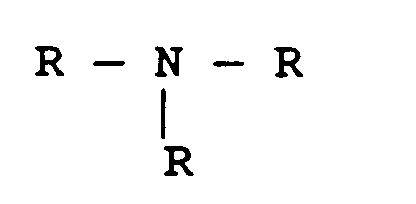
wobei R jeweils Wasserstoff, Alkyl, Hydroxylalkyl, Aryl, Alkaryl usw. sein kann, aber mindestens ein R Wasserstoff ist. Derartige Stickstoffbasen schließen Ammoniak, monosubstituierte Amine und disubstituierte Amine ein. Typische Beispiele für monosubstituierte Amine sind: Methylamin, Ethylamin, Propylamin, Hydroxyethylamin, tertiäres Butylamin, Ethylendiamin, Cyclohexylamin, u.a.. Als Beispiele für disubstituierte Amine seien genannt: Dimethylamin, Diethylamin, Diethanolamin, Hydroxyethylpropylamin, Morpholin, Dicyclohexylamin u.a.. - Harnstoff und Ammoniak sind bekannte Industriechemikalien. So kann Ammoniak in Form von Ammoniakgas oder Ammoniumhydroxyd bezogen werden. Harnstoff wird in fester Form oder in Form von wäßrigen Harnstofflösungen vertrieben. Vorzugsweise wird im vorliegenden Verfahren unsubstituierter Harnstoff verwendet, jedoch können monosubstituierte Harnstoffe verwendet werden, falls jedes Harnstoffmolekül mindestens einen freien Wasserstoff für die Reaktion besitzt, um damit freies Formaldehyd binden zu können.
- Die erfindungsgemäß mit Hilfe eines Säurekatalysators ablaufende Formaldehydbindungsreaktion erfolgt vorzugsweise mit einem Säurekatalysator, welcher einen pKa-Wert von größer als 2 aufweist. Starke Säuren mit einem pKa-Wert kleiner als 1 sind oft nicht in der Lage, bei dieser Reaktion einen katalytischen Effekt zu erzeugen und behindern gleichzeitig die komplette Bindung des freien Formaldehyds. Daher werden Säuren mit einer mittleren Stärke und ihre Salze vorgezogen. Als Beispiele hierfür seien genannt: Essigsäure, Oxalsäure, Zitronensäure, Phosphorsäure, Kohlensäure und Salze wie zum Beispiel Ammoniumcarbonat, Ammoniumcitrat und andere.
- Die Klebstoffe auf Stärkebasis nach vorliegender Erfindung können als Träger-Klebstoff, Nichtträger-Klebstoff oder Träger-/Nichtträger-Klebstoff definiert werden.
- Dabei impliziert der Begriff "Träger-Klebstoff" die Gegenwart einer dünnen Basis aus gelatinisierter Stärke, in welcher ungelatinisierte oder nicht hydratisierte Stärkepartikel emulgiert oder suspendiert vorliegen. Der Begriff "Nicht-Träger-Klebstoff" impliziert die völlige Abwesenheit von gelatinisierter oder hydratisierter Stärke in der Klebstoffemulsion. Der Begriff "Träger-/Nichtträger-Klebstoff" bedeutet, daß man die Trennung zwischen gelatinisierter Stärke und ungelatinisierter Stärke in der Klebstoffzusammensetzung nicht klar vollziehen kann. Im allgemeinen werden "Träger-/Nicht-träger-Klebstoffe" derartig hergestellt, daß ein nicht unbeträchtlicher Anteil von teilweise hydratisierter oder teilweise gelatinisierter Stärke gebildet wird. Erhebliche Stärkeanteile bleiben ungelatinisiert und unhydratisiert, wobei diese Anteile mit den Klebstoffkomponenten wechselwirken können.
- Die sowohl in der Trägerphase als auch in der suspendierten Phase verwendete Stärke wird aus pflanzlichen Rohstoffen gewonnen. Die im Handel vertriebene Stärke wird als Perlstärke, pulverisierte Stärke, Stärke mit hohem Amyloseanteil, vorgekochte oder gelatinisierte Stärke geliefert. Vorzugsweise wird Perlstärke zur Herstellung der Trägerphase wie auch in der in dem Träger suspendierten Stärkephase verwendet.
- Die erfindungsgemäße Klebstoffzusammensetzung enthält eine starke Base, welche die Bildung von vernetztem Harz fördert und zur Trocknung des Klebstoffes beiträgt. Grundsätzlich kann jede starke Base verwendet werden, wobei jedoch vorzugsweise Alkalimetallhydroxide wie etwa Natriumhydroxid und Kaliumhydroxid zum Einsatz kommen. Die starke Base erniedrigt gleichzeitig den Gelierpunkt der Stärke, wodurch die Hydratationsrate der Stärke während der Trocknung der Klebelinie ansteigt.
- Die in der erfindungsgemäßen Klebstoffzusammensetzung verwendeten Harze schließen Harze mit ein, die während der Erwärmung in basischer Umgebung vernetzen und mit den Hydroxylgruppen der Stärkemoleküle vernetzend reagieren. Die Vernetzung verringert den hydrophilen Charakter und die Wasserlöslichkeit der Stärkemoleküle. Dies geschieht einerseits durch die Verringerung der für Wasser verfügbaren Hydroxylgruppen und andererseits durch die Einbringung von aliphatischen alkylenartigen Vernetzungsgruppen.
- Die bevorzugte Gruppe von vernetzbaren Harzen besteht aus bekannten Kondensationsprodukten einer Keton- und einer Aldehydkomponente. Diese Harze sind als Polyketonpolyetherpolymere charakterisiert, wobei sie jedoch eine Vielzahl von anderen Monomeren, wie etwa Harnstoff, Melamin usw., enthalten können. In Gegenwart von Wärme und einer Base zersetzen sie sich für gewöhnlich und es entstehen Produkte, die mit den Stärkemolekülen vernetzen. Vorzugsweise werden Aceton-Formaldehydharze, Aceton-Harnstoff-Formaldehydharze, oder Aceton-Melamin-Formaldehydharze aus 15 bis 30 Gewichtsprozent Aceton, ca. 5 bis 50 Gewichtsprozent Formaldehyd und 0 bis 15 Gewichtsprozent des dritten Monomeren eingesetzt.
- Die erfindungsgemäße Klebstoffzusammensetzung enthält vorzugsweise des weiteren eine Borsäurekomponente, welche mit der (gelatinisierten bzw. nicht gelatinisierten) Stärke während der Erwärmung und Trocknung zusammenwirkt. Dies geschieht durch die Reaktion der Borsäure-Komponente mit den verfügbaren Hydroxylgruppen der Stärke, wobei ein Stärke-Borax-Komplex gebildet wird, der die Gelierung der Träger-Stärkemoleküle und der suspendierten Stärkemoleküle unterstützt. Diese Reaktion erhöht die Haftkraft des Klebstoffes. Grundsätzlich kann jede Borsäure-Komponente, die eine freie Hydroxylgruppe an dem Boratom aufweist, verwendet werden. Als Beispiele seien hier die Borsäure (Orthoborsäure, H₃BO₃ und deren hydratisierte Formen H₃BO₃ x H₂O) und Borax (Natriumtetraborat-dekahydrat, Na₂B₄O₇ x 10H₂O) und andere hydratisierte und anhydridische Formen genannt. Die Borsäure-Komponente erhöht die Haftung, Viskosität und kohäsive Stärke des Klebstoffes. Des weiteren puffert Borax die ätzende Wirkung der verwendeten Base.
- Als weiteres Reagens ist vorzugsweise in dem erfindungsgemäßen Reaktionsgemisch Polyvinylalkohol enthalten, da die Eigenschaften der Harze vom Molekulargewicht des Grundpolymers und dem Hydrolysegrad beeinflußt werden. Polyvinylalkohole werden normalerweise mit einem Molekulargewicht von 20.000 bis 100.000 hergestellt und lassen sich leicht vernetzen und boratisieren, wodurch Gelbildung eingeleitet wird. Bekanntermaßen besteht Polyvinylalkohol aus einem Polyhydroxypolymer, bestehend aus Polymethylenketten mit Hydroxylgruppen, hergestellt durch die Hydrolyse von Polyvinylacetat. Das theoretische Monomer

existiert nicht. Polyvinylalkohol ist eines der wenigen käuflichen wasserlöslichen Polymeren mit einem hohen Molekulargewicht. - Eine bevorzugte lösliche Polyvinylalkoholzusammensetzung für den Einsatz im erfindungsgemäßen Verfahren ist Polyvinylalkohol, welcher aus einem Homopolymer oder Interpolymer von Vinylacetat, welches teilweise (zu weniger als 91%) hydrolysiert ist, besteht. Der bevorzugt verwendete, teilweise hydrolysierte Polyvinylalkohol ist mit unterschiedlichen Molekulargewichten erhältlich, wobei diese durch die Brookfield-Viskosität einer 4 Gew.-% wäßrigen Lösung bei 20°C gekennzeichnet sind. Die Polyvinylalkohole mit geringem Molekulargewicht haben eine Viskosität von 4 bis 10 cP, die mit mittlerem Molekulargewicht eine Viskosität von 15 bis 30 cP und die mit hohem Molekulargewicht eine Viskosität von 35 bis 60 cP. Die Teilchengröße wird derart gewählt, daß mindestens 99 % des Polyvinylalkohols durch ein 80-mesh-Sieb fallen.
- Erfindungsgemäß bevorzugt sind jedoch auch im wesentlichen vollverseifte Polyvinylalkohollösungen einsetzbar.
- Besonders bevorzugte Wachse für den Einsatz in erfindungsgemäßen wasserfesten Wellpappeklebern sind folgende: Rohölwachse (zum Beispiel mikrokristalline Wachse, Kalkwachse, Paraffinwachse), Kandelillawachse, Bienenwachse u.a..
- Das erfindungsgemäß bevorzugte vernetzbare Formaldehydharz wird durch Reaktion von Formaldehyd und einem Monomeren, welches eine Carbonylgruppe und einen sauren Wasserstoff an einem benachbarten Atom, zum Beispiel einem Stickstoff- oder Kohlenstoffatom, aufweist, gebildet. Die Herstellung des Harzes umfaßt typischerweise eine erste Reaktion zwischen dem Monomer und dem Formaldehyd, wobei das Molverhältnis Monomer/Formaldehyd 1:1 bis 1:6, bevorzugterweise 1:3 bis 1:5 beträgt und die Reaktion unter alkalischen Bedingungen bei einer Temperatur von 20°C bis 100°C, vorzugsweise 30°C bis 80°C, aufläuft. Als alkalische Katalysatoren werden starke organische und anorganische Basen verwendet. Bevorzugte Katalysatoren sind anorganische Basen auf Alkalimetallbasis, wie zum Beispiel Natriumhydroxyd, Kaliumhydroxyd, Calciumhydroxyd, Magnesiumhydroxyd u.a. Des weiteren können auch Salze der starken Basen verwendet werden, wie etwa Natriumkarbonat, Kaliumkarbonat, Trinatriumphosphat, Trikaliumphosphat u.a.. Die Reaktion wird normalerweise unter atmosphärischen Bedingungen durchgeführt, kann aber ebenso in einer inerten Atmosphäre, wie etwa einer Stickstoff-, Kohlendioxyd-, oder Argon-Atmosphäre durchgeführt werden.
- Alkalinität und Reaktionstemperatur müssen während der Reaktion kontrolliert werden. Es entsteht ein unlösliches, sehr stark vernetztes Reaktionsprodukt. Typischerweise wird der pH-Wert der Reaktionsmischung größer als 7 gehalten, wobei am Ende der Reaktion der pH-Wert der Mischung zwischen 7 und 8 liegt. Die Reaktionszeiten sind hauptsächlich von der Temperatur, der Alkalinität und dem gewünschten Feststoffgehalt des Produktes abhängig. Das Produkt enthält normalerweise 50 bis 60 Gewichtsprozent Feststoffe, 30 % bis 50 % Formaldehyd und 10 % bis 25 % des zweiten Monomers (letztere Prozentangaben beziehen sich auf 100 % Feststoffgehalt).
- Zur Herstellung eines Aceton-Formaldehydharzes wird ein Reaktor, welcher einen Kondensator aufweist, mit Wasser, Aceton und Formaldehyd gefüllt, wobei das Molverhältnis zwischen Aceton und Formaldehyd ungefähr 1:4 beträgt. Nachdem Aceton, Formaldehyd und Wasser vollständig gemischt sind, wird durch die Zugabe einer Base eine exotherme Reaktion initiiert, welche die Kontrolle der Zugabe des alkalischen Initiators erforderlich macht, um die Temperatur nicht höher als ca. 65°C werden zu lassen. Nachdem die Reaktion vollständig abgelaufen ist, kann das Reaktionsprodukt auf freies Formaldehyd analysiert werden.
- Im folgenden wird die erfindungsgemäße Herstellung eines wasserlöslichen Formaldehydharzes unter Zugabe von Harnstoff, einer Stickstoffbase und eines Säurekatalysators näher beschrieben.
- Der pH-Wert des Reaktionsgemisches wird durch Zusatz eines Säurekatalysators erniedrigt. Die Reaktionstemperatur wird oberhalb 20°C, üblicherweise zwischen 30°C und 50°C gehalten. Die Reaktion kann solange ablaufen, bis der Gehalt an freiem Formaldehyd in dem Reaktionsgemisch unter 3 % reduziert ist, wobei der Gehalt an freiem Formaldehyd oft sehr schnell auf 0,5 % bis 2 % abfällt. Wie die folgenden Daten zeigen werden, kann die Formaldehydkonzentration mit der Zeit variieren, auch nachdem die vollständige Reaktion abgelaufen ist. Oft fällt die Formaldehydkonzentration nach einer gewissen Standzeit auf weniger 0,1 %.
- Tabelle 1 zeigt vorteilhafte Reaktandenmengen zur Bindung von freiem Formaldehyd:
Tabelle 1 Gehalt an Komponenten (in Gew.-% des Ausgangs-Reaktionsprodukts) nützlich bevorzugt meist bevorzugt Stickstoffkomponente 0,01-15 0,1-10 0,5-8 Harnstoff 0,1-10 0,25-8 0,5-5 Säure 0,01-5 0,05-2 0,1-0,5 - Die folgenden Beispiele illustrieren diesen Aspekt des erfindungsgemäßen Verfahrens.
- Eine Serie von verschiedenen Harzpräparationen (1 bis 23 in Tabelle 3) wurde hergestellt. Dazu gab man in kleine Glasbecher je 100g eines wäßrigen (56 Gew.-%) Aceton-Formaldehydharzes, sowie verschiedene Gehalte an Harnstoff, 26%-igem wäßrigen Ammoniak und Zitronensäure (siehe Tabelle 3). Das Reaktionsgemisch wurde erhitzt und mit einem Stab eine bestimmte Zeit lang gerührt. Der Formaldehydgehalt wurde ermittelt nachdem die Reaktion im Gleichgewicht war, 24 Stunden nach Einstellung des Gleichgewichtes und eine Woche später. Der Gehalt an freiem Formaldehyd kann der Tabelle 3 entnommen werden. Besonders bemerkenswert ist, daß unter bestimmten Bedingungen der Gehalt an freiem Formaldehyd eine Woche nach der Reaktion unter 0,1% liegt. Der Tabelle 3 ist ebenfalls zu entnehmen, daß beim Weglassen eines der Zusatzstoffe, wie der Säure, dem Ammoniak oder dem Harnstoff, die Gehalte an freiem Formaldehyd um mindestens das Doppelte ansteigen.
- Der Versuch gemäß Beispiel I wurde mit folgenden Komponenten wiederholt: 100g Aceton-Formaldehydharz Michemrez 400 (Wz), 3,0g 26%-iges wäßriges Ammoniak, 0,5g Zitronensäure; 30 Minuten erhitzt und gerührt bei 50°C, mit anschließender Zugabe von 5g Harnstoff. Der Gehalt an freiem Formaldehyd betrug:
vor Behandlung anfänglich 24 Stunden 1 Woche 1,3 % 0,17 % 0,08 % 0,08 % - Beispiel II wurde wiederholt mit Aceton-Formaldehydharz Bordon WS-189-84 (Wz). Die Konzentration an freiem Formaldehyd betrug:
vor Behandlung anfänglich 24 Stunden 1 Woche 1,55 % 0,18 % 0,10 % 0,05 % 
- Beispiel I, Mischung Nr. 18 (siehe Tabelle 3) wurde mit 3,0g Monoethanolamin, welches den wäßrigen Ammoniak ersetzt, und 5,0g Harnstoff (statt 2,5g Harnstoff) wiederholt. Die Konzentration an freiem Formaldehyd betrug:
vor Behandlung anfänglich 24 Stunden 1 Woche 1,2 % 0,22 % 0,09 % 0,15 % - Beispiel IV wurde wiederholt, wobei jedoch nunmehr 5g Diethanolamin zugegeben wurden. Die Konzentration an freiem Formaldehyd betrug:
vor Behandlung anfänglich 24 Stunden 1 Woche 1,2 % 0,67 % 0,3 % 0,65 % - In ein kleines Glasgefäß wurden 75g eines wäßrigen Aceton-Formaldehydharzes gegeben, welches durch die basisch katalysierte Kondensationsreaktion von 4 Mol Formaldehyd mit einem Mol Aceton hergestellt wurde und 1,15 Gew.-% freies Formaldehyd enthielt. Zu diesem wäßrigen Harz wurden nun 1,88g wäßrige (26 Gew.-%) Ammoniaklösung und 0,23g Eisessig gegeben. Das Reaktionsgemisch wurde 30 Minuten lang auf 50°C erhitzt. Anschließend wurden 3,75g Harnstoff zugesetzt. Nachdem sich der Harnstoff in der Mischung gelöst hatte, wurde auf Raumtemperatur abgekühlt und die Konzentration an freiem Formaldehyd mittels Sulfittitration bestimmt:
anfänglich 24 Stunden 48 Stunden 6 Tage 0,18 % 0,22 % 0,19 % 0,10 % - Das Beispiel VI wurde wiederholt, jedoch mit 1,88g wäßriger (26 Gew.-%) Ammoniaklösung und 0,53g Ammoniumsulfat (statt 0,23g Eisessig). Die Konzentration an freiem Formaldehyd betrug:
anfänglich 24 Stunden 48 Stunden 6 Tage 0,10 % 0,16 % 0,15 % 0,13 % - 50g eines wäßrigen Aceton-Formaldehydharzes mit 2,0 Gew.-% freiem Formaldehyd wurden in einen kleinen Glasbecher gegeben. Anschließend gab man unter Rühren 0,9g Ammoniumcarbonat und 2,5g Harnstoff hinzu. Nachdem Gasentwicklung einsetzte, erhitzte man das Reaktionsgemisch für eine Stunde in einem Wasserbad bei 55°C. Dabei trat weitere Gasentwicklung auf. Nach Abkühlung auf Raumtemperatur betrug die Konzentration an freiem Formaldehyd 0,15 Gewichtsprozent. Nach einer Standzeit von 3 Tagen fiel diese Konzentration auf 0,08%.
- Zu 348g eines wässrigen Aceton-Formaldehydharzes mit 1,3 Gew.-% freiem Formaldehyd gab man 7,5g Diammoniumphosphat. Das Gemisch wurde 3 Stunden lang bei Raumtemperatur gerührt. Nach 3 Stunden war der Gehalt an freiem Formaldehyd auf 0,32 % gefallen. Man ließ das Reaktionsgemisch über Nacht stehen und gab anschließend zu 300g dieses Gemisches 30g Harnstoff. Nach einer weiteren Standzeit von 2 Stunden beim Raumtemperatur betrug der Gehalt an freiem Formaldehyd 0,19 Gew.-%. Im folgenden wird anhand von Beispielen der zweite Aspekt des erfindungsgemäßen Verfahrens beschrieben, demgemäß die Bindung freien Aldehyds durch Umsetzung mit einer oder mehreren zusätzlichen Carbonylkomponenten, insbesondere Harnstoff-, Keton-, Resorcin- und/oder Phenolkomponenten, ohne Säurekatalysator erfolgt.
- 10,0 Gewichtsteile wasserlösliches Aceton-Formaldehydharz (Molverhältnis Formaldehyd:Aceton = 3:1) wurden mit 2,0 Gewichtsteilen Resorcin 10 Minuten bei Raumtemperatur gerührt, bis das Resorcin vollständig gelöst war. Der pH-Wert betrug 9,0. Die Mischung erhitzte man auf 50°C und kondensierte bei dieser Temperatur 30 Minuten, bis die Viskosität 300 mPa nach Brookfield (RVT, Spindel 1, 20 Upm, 25°C) betrug. Dann wurde das Harz auf 20°C abgekühlt. Der Gehalt an freiem Formaldehyd war mit 0,1% besonders niedrig.
- 10,0 Gewichtsteile wasserlösliches Aceton-Formaldehydharz (Molverhältnis Formaldehyd:Aceton = 4:1) wurden zunächst mit 0,5 Gewichtsteilen Harnstoff modifiziert. Das modifizierte Harz wurde dann mit 0,1 Gewichtsteilen Resorcin bei Raumtemperatur unter ständigem Rühren kondensiert. Der pH-Wert der Mischung betrug 9,0. Die alkalische Polykondensation wurde nach 15 Minuten durch Zugabe von 0,01 Gewichtsteilen Essigsäure (96 %) unterbrochen. Dem Aceton-Formaldehyd-Harnstoff-Resorcin-Polykondensat wurden 3,0 Gewichtsteile einer vorverkleisterten, kaltwasserlöslichen Stärke zugesetzt. Nach 20 Minuten Rühren betrug die Viskosität 1000 mPa (Brookfield RVT, Spindel 2, 20 Upm, 20°C). Die Lagerstabilität des Harzes war besonders gut. Bei Lagerung über eine Woche bei 50°C fand keine Sedimentation statt. Der Gehalt an freiem Formaldehyd betrug 0,1 %.
- 10 Gewichtsteile wasserlösliches Methylethylketon-Formaldehydharz (Molverhältnis Formaldehyd:Keton = 5:1) wurde mit 0,5 Gewichtsteilen Resorcin bei 50°C kondensiert. Nach 30 Minuten wurden die Reaktionsprodukte auf 20°C abgekühlt. Unter intensivem Rühren wurden 0,5 Gewichtsteile eines vorverkleisteren Stärkeäthers zugegeben. Die Viskosität der Mischung stieg auf 1200 mPa an (Brookfield RVt, Spindel 2, 20 Upm, 20°C). Der Gehalt an freiem Formaldehyd betrug 0,1 %.
- Die in den Beispielen X bis XII beschriebenen Produkte wurden hinsichtlich ihrer Gelierzeit verglichen (Bestimmung der Härtungszeit wäßriger Harnstoff- und Melaminharzlösungen bei 100°C, modifizierte Methode von Hoechst). Die Bestimmung wurde bei drei verschiedenen pH-Werten durchgeführt, weil die Reaktivität der Polykonsationsharze sehr stark pH-abhängig ist.
Tabelle 10 Gelierzeit (min) Harz (Einwaage 30g) pH 7-8 pH 10 pH11 nach Beispiel I 15 10 5 nach Beispiel II 30 20 15 nach Beispiel III 15 12 8 unmodifiziertes Aceton-Formaldehyd-Harz geliert nicht > 60 50 - Aus Tabelle 10 ist zu erkennen, daß die Gelierzeiten der nach den Beispielen X, XI und XII hergestellten, erfindungsgemäßen Formaldehydharze im Vergleich zu einem unmodifizierten Aceton-Formaldehydharz drastisch verkürzt sind. Dies bedeutet eine deutliche Verbesserung der Wasserfestigkeit von zum Beispiel Wellpappen, die mit den erfindungsgemäßen Formaldehydharzen behandelt werden.
- Obwohl das Harz gemäß dieser Erfindung für eine Vielzahl von Klebstoffen auf Naturproduktbasis verwendet werden kann, wird es gewöhnlich für Wellpappeklebstoffe auf Stärkebasis benutzt. Hierzu wird ein Stärkeschlamm mit einer Alkalimetallbase in Wasser erwärmt, um die Stärke zumindest teilweise zu gelatinisieren. Ist die Stärke im gewünschten Umfang gelatinisiert, können die übrigen Komponenten, wie etwa Borax, Wachs, Polyvinylalkohol und Aldehydharz, zugegeben werden. Die bevorzugten Anteile an einzelnen Komponenten können der Tabelle 2 entnommen werden.
Tabelle 2 Komponente nützlich bevorzugt meist bevorzugt Stärke 5-50 10-50 12-50 Alkalimetallbase 0,1-10 0,2-5 0,5-3 Borax 0,1-5 0,2-4 0,3-3 Polyvinylalkohol 0-5 0,1-4 0,2-3 Harz 0,1-5 0,1-4 0,2-3 Wachsemulsion 0-5 0,1-4 0,2-3 - Die Beispiele zeigen deutlich auf, daß durch die Erfindung die Konzentration an freiem Formaldehyd im Formaldehydharz auf weniger als 0,1 Gewichtsprozent (bezogen auf die wäßrige Harzverbindung) reduziert werden kann.
Claims (20)
- Verfahren zur Herstellung eines wasserlöslichen Aldehydharzes mit verringertem Gehalt an freiem Aldehyd, insbesondere Formaldehyd, durch Umsetzung eines ersten Reaktionsgemisches, das den Aldehyd und wenigstens ein erstes copolymerisierbaren Monomeres mit mindestens einem aciden Proton enthält, und Umsetzung des freien, nicht mit dem Monomeren umgesetzten Aldehyds mit wenigstens einem zweiten Monomeren, welches ein acides Proton aufweist,
dadurch gekennzeichnet,
daß das zweite Monomere das Umsetzungsprodukt von Harnstoff oder substituiertem, wenigstens ein reaktives Proton aufweisenden Harnstoff mit einer Stickstoffbase mit wenigstens einer NH-Gruppe in Gegenwart eines sauren Katalysators ist, oder das zweite Monomere das acide Proton an einem, einer Carbonylgruppe benachbarten Kohlenstoffatom oder in Form einer phenolischen Hydroxylgruppe aufweist. - Verfahren nach Anspruch 1,
dadurch gekennzeichnet,
däß das Aldehyd Formaldehyd, vorzugsweise in Form von gasförmigem oder in Wasser gelöstem HCHO oder als Trioxymethylen, Hexamethylentetramin oder Paraformaldehyd ist. - Verfahren nach Anspruch 1 oder 2,
dadurch gekennzeichnet,
daß das erste Monomere ist:a) ein Keton, insbesondere Aceton, Methylethylketon, Phenylmethylketon, Diphenylketon oder Cyclohexanon, besonders bevorzugt Aceton;b) ein einwertiges Phenol, insbesondere unsubstituiertes Phenol, Methylphenol oder Aminophenol, besonders bevorzugt unsubstituiertes Phenol;c) ein mehrwertiges Phenol, insbesondere Resorcin oder substituiertes Resorcin, besonders bevorzugt Resorcin; oderd) Harnstoff oder am Stickstoff substituierter Harnstoff, besonders bevorzugt Harnstoff. - Verfahren nach einem der Ansprüche 1 bis 3,
dadurch gekennzeichnet,
daß das zweite Monomere ein Umsetzungsprodukt von Harnstoff mit einer Stickstoffbase der allgemeinen Formel
- Verfahren nach Anspruch 4,
dadurch gekennzeichnet,
daß die Stickstoffbase Ammoniak, Methylamin, Ethylamin, Propylamin, e-Butylamin, Hydroxyethylamin, Ethylendiamin, Cyclohexylamin, Dimethylamin, Diethanolamin, Hydroxyethylpropylamin, Morpholin oder Dicyclohexylamin ist. - Verfahren nach Anspruch 4 oder 5,
dadurch gekennzeichnet,
daß der saure Katalysator einen pKa-Wert von wenigstens 2 aufweist. - Verfahren nach Anspruch 6,
dadurch gekennzeichnet,
daß der saure Katalysator eine Säure mittlerer Säurestärke, insbesondere Essigsäure, Oxalsäure, Zitronensäure, Phosphorsäure, Kohlensäure, und/oder ein Salz einer solchen Säure umfaßt. - Verfahren nach einem der Ansprüche 4 bis 7,
dadurch gekennzeichnet,
daß die Stickstoffbase mit unsubstituiertem Harnstoff umgesetzt wird. - Verfahren nach einem der Ansprüche 4 bis 7,
dadurch gekennzeichnet,
daß, bezogen auf das erste Reaktionsgemisch, eingesetzt werden:a) 0,01 bis 15,0 Gew.-%, insbesondere 0,1 bis 10 Gew.-% und besonders bevorzugt 0,5 bis 8,0 Gew.-% der Stickstoffbase,b) 0,1 bis 10,0 Gew.-%, insbesondere 0,25 bis 8,0 Gew.-% und besonders bevorzugt 0,5 bis 5,0 Gew.-% Harnstoff, undc) 0,01 bis 5.0 Gew.-%, insbesondere 0,05 bis 2,0 Gew.-% und besonders bevorzugt 0,1 bis 0,5 Gew.-% des sauren Katalysators. - Verfahren nach einem der Ansprüche 1 bis 3,
dadurch gekennzeichnet,
daß das zweite Monomere ist:a) ein Keton, insbesondere ein aliphatisches oder arylaliphatisches Keton, besonders bevorzugt Aceton;b) ein einwertiges Phenol, insbesondere unsubstituiertes Phenol;c) ein mehrwertiges Phenol, insbesondere Resorcin. - Verfahren nach Anspruch 10,
dadurch gekennzeichnet,
daß wenigstens zwei verschiedene zweite Monomere gleichzeitig oder nacheinander verwendet werden. - Verfahren nach Anspruch 10 oder 11,
dadurch gekennzeichnet,
daß das bzw. die zweite(n) Monomere(n) in einer Menge von 0,1 bis 50,0 Gew.-%, vorzugsweise 1,0 bis 20,0 Gew.-%, bezogen auf das Umsetzungsprodukt aus Aldehyd und erstem Monomeren, eingesetzt wird bzw. werden. - Verfahren nach einem der Ansprüche 10 bis 12,
dadurch gekennzeichnet,
daß das Umsetzungsprodukt aus Aldehyd und erstem Monomeren vor der Umsetzung mit dem zweiten Monomeren mit Harnstoff oder Melamin modifiziert wird. - Verfahren nach Anspruch 13,
dadurch gekennzeichnet,
daß die Modifizierung mit 1,0 bis 10,0 Gew.-% Harnstoff, vorzugsweise ungefähr 5,0 Gew.-% Harnstoff, bezogen auf das Umsetzungsprodukt, erfolgt. - Verfahren nach einem der vorstehenden Ansprüche,
dadurch gekennzeichnet,
daß die Umsetzungen in wäßriger Phase erfolgen, insbesondere bei einem pH-Wert zwischen 4 und 10 und besonders bevorzugt im alkalischen Bereich bis pH 10. - Klebstoffzusammensetzung, insbesondere zur Herstellung wasserfester Papiererzeugnisse wie Wellpappe und dergleichen, die Stärke, Aldehydharz und gegebenenfalls Additive in basischer wäßriger Lösung oder Suspension enthält,
gekennzeichnet durch
einen Gehalt an einem Aldehydharz erhältlich gemäß einem der Ansprüche 1 bis 15. - Klebstoffzusammensetzung nach Anspruch 16, weiterhin enthaltend eine Borsäure-Komponente, insbesondere Orthoborsäure und/oder Borax.
- Klebstoffzusammensetzung nach Anspruch 16 oder 17, weiterhin enthaltend eine Polyvinylalkohol-Komponente, insbesondere vollständig oder teilweise hydrolysiertes Vinylacetat-Homo- oder -Interpolymeres, bei dem weniger als 91 % der Hydroxylgruppen unverestert sind.
- Klebstoffzusammensetzung nach einem der Ansprüche 16 bis 18,
gekennzeichnet durch
einen Gehalt an einem Wachs, insbesondere Rohölwachs, Kandelillawachs oder Bienenwachs, vorzugsweise in Form einer Wachsemulsion. - Klebstoffzusammensetzung nach einem der Ansprüche 16 bis 19, enthaltend (in Gewichtsteilen) die folgenden Bestandteile:
Bestandteil Bereich bevorzugt besonders bevorzugt Stärke 5-50 10-50 12-50 Alkalimetallbase 0,1-10,0 0,2-5,0 0,5-3,0 Borax 0,1-5,0 0,2-4,0 0,3-3,0 Polyvinylalkohol 0-5,0 0,1-4,0 0,2-3,0 Aldehydharz 0,1-5,0 0,1-4,0 0,2-3,0 Wachs 0-5,0 0,1-4,0 0,2-3,0
Applications Claiming Priority (2)
| Application Number | Priority Date | Filing Date | Title |
|---|---|---|---|
| DE4103752 | 1991-02-07 | ||
| DE4103752A DE4103752A1 (de) | 1991-02-07 | 1991-02-07 | Verfahren zur herstellung eines wasserloeslichen (form)-aldehydharzes und dieses enthaltende klebstoffzusammensetzung |
Publications (3)
| Publication Number | Publication Date |
|---|---|
| EP0498301A2 true EP0498301A2 (de) | 1992-08-12 |
| EP0498301A3 EP0498301A3 (en) | 1992-11-25 |
| EP0498301B1 EP0498301B1 (de) | 1998-10-21 |
Family
ID=6424590
Family Applications (1)
| Application Number | Title | Priority Date | Filing Date |
|---|---|---|---|
| EP92101537A Expired - Lifetime EP0498301B1 (de) | 1991-02-07 | 1992-01-30 | Verfahren zur Herstellung eines wasserlöslichen (Form-)Aldehydharzes und dieses enthaltende Klebstoffzusammensetzung |
Country Status (4)
| Country | Link |
|---|---|
| EP (1) | EP0498301B1 (de) |
| AT (1) | ATE172474T1 (de) |
| DE (2) | DE4103752A1 (de) |
| ES (1) | ES2123522T3 (de) |
Cited By (1)
| Publication number | Priority date | Publication date | Assignee | Title |
|---|---|---|---|---|
| WO2006080331A1 (ja) | 2005-01-25 | 2006-08-03 | Hodogaya Chemical Co., Ltd. | ケトン変性レゾルシンホルマリン樹脂 |
Families Citing this family (1)
| Publication number | Priority date | Publication date | Assignee | Title |
|---|---|---|---|---|
| CN101245129B (zh) * | 2008-04-01 | 2010-06-02 | 河北大学 | 一种自升温生产脲醛树脂的方法 |
Family Cites Families (5)
| Publication number | Priority date | Publication date | Assignee | Title |
|---|---|---|---|---|
| DE2734638C2 (de) * | 1977-08-01 | 1982-12-30 | Th. Goldschmidt Ag, 4300 Essen | Verfahren zur Herstellung von Lösungen härtbarer Harnstoff-Formaldehydharze für die Tränkung und Beschichtung von Trägerbahnen zur Oberflächenvergütung von Holzwerkstoffplatten |
| EP0103131A3 (de) * | 1982-09-10 | 1985-11-06 | Borden, Inc. | Amin-Formaldehyd-Harze und ihre Verwendung in Holzfaserverbundstoffen |
| FR2558839B1 (fr) * | 1984-01-26 | 1986-11-21 | Charbonnages Ste Chimique | Procede de fabrication de resines aminoplastes |
| DE3741438A1 (de) * | 1987-12-08 | 1989-06-22 | Wolf Dietrich Dipl Schoellhorn | Harnstoff-formaldehyd-harz, seine herstellung und seine verwendung |
| DE3815724A1 (de) * | 1988-05-07 | 1989-11-16 | Basf Ag | Verfahren zur herstellung von waessrigen vliesbindemitteln mit geringer formaldehydemission beim haerten |
-
1991
- 1991-02-07 DE DE4103752A patent/DE4103752A1/de not_active Withdrawn
-
1992
- 1992-01-30 AT AT92101537T patent/ATE172474T1/de not_active IP Right Cessation
- 1992-01-30 EP EP92101537A patent/EP0498301B1/de not_active Expired - Lifetime
- 1992-01-30 ES ES92101537T patent/ES2123522T3/es not_active Expired - Lifetime
- 1992-01-30 DE DE59209529T patent/DE59209529D1/de not_active Expired - Fee Related
Cited By (2)
| Publication number | Priority date | Publication date | Assignee | Title |
|---|---|---|---|---|
| WO2006080331A1 (ja) | 2005-01-25 | 2006-08-03 | Hodogaya Chemical Co., Ltd. | ケトン変性レゾルシンホルマリン樹脂 |
| US7834124B2 (en) | 2005-01-25 | 2010-11-16 | Hodogaya Chemical Co., Ltd. | Ketone-modified resorcinol-formalin resin |
Also Published As
| Publication number | Publication date |
|---|---|
| EP0498301B1 (de) | 1998-10-21 |
| EP0498301A3 (en) | 1992-11-25 |
| ES2123522T3 (es) | 1999-01-16 |
| DE59209529D1 (de) | 1998-11-26 |
| ATE172474T1 (de) | 1998-11-15 |
| DE4103752A1 (de) | 1992-08-13 |
Similar Documents
| Publication | Publication Date | Title |
|---|---|---|
| US4558080A (en) | Stable tannin based polymer compound | |
| DE69902783T2 (de) | Stabilisierte, wässrige phenolharz-bindemittel für mineralwolle und verfahren zur herstellung von mineralwolleprodukten | |
| DE69021226T2 (de) | Wellpappenklebstoff auf Basis von Stärke mit einem Polyvinylalkoholbestandteil. | |
| EP0133451B1 (de) | Kondensationsharze auf Basis von Alkylarylketonen und Formaldehyd | |
| DE69632784T2 (de) | Stark basische tertiäre aminoalkohole als katalysatoren | |
| DE69521160T2 (de) | Aldehydharze mit einem niedrigen und stabilisierten Restgehalt an freiem Formaldehyd | |
| US5079067A (en) | Formaldehyde containing resins having a low free formaldehyde | |
| DE69612478T2 (de) | Wässrige phenolharzdispersionen | |
| DE102009045225B4 (de) | Furfurylalkohol-Formaldehyd-Harzkomposition | |
| EP0498301B1 (de) | Verfahren zur Herstellung eines wasserlöslichen (Form-)Aldehydharzes und dieses enthaltende Klebstoffzusammensetzung | |
| CH658218A5 (de) | Formaldehydbindendes mittel. | |
| DE2202189B2 (de) | Verfahren zur Herstellung von emulgatorfreien Polymerisatdispersionen | |
| DE102005022228A1 (de) | Melamin-Formaldehyd Harzlösung und Verfahren zu deren Herstellung | |
| DE69730221T2 (de) | Warmehärtbare Klebstoffe aus kondensierten Tanninen und Verwendung in der Holzindustrie | |
| DE1595544A1 (de) | Kationische Carbamoylpolymerisate | |
| DE69306586T2 (de) | Aminoharze und Verfahren zur Herstellung der Harze | |
| DE10314467A1 (de) | Harnstoff- und/oder Melamin-Formaldehyd-Phosphinat-Harze von hoher Temperaturbeständigkeit | |
| RU2062275C1 (ru) | Способ получения карбамидоформальдегидной смолы | |
| EP0538687B1 (de) | Flüssige Härtermischung für die Härtung von alkalischen Phenol-Resorcin-Formaldehyd-Harzen | |
| DE2455420A1 (de) | Verfahren zur herstellung von formaldehyd-harnstoff-melamin-kondensationsprodukten | |
| DE102004062456A1 (de) | Bindemittel für die Herstellung von Werkstoffen | |
| DE2347401C3 (de) | Harnstoff-Formaldehydharze, Verfahren zu deren Herstellung und deren Verwendung | |
| EP0100497B1 (de) | Verfahren zur Herstellung von Mischkondensaten und deren Verwendung | |
| CA1337776C (en) | Formaldehyde containing resins having low free formaldehyde | |
| DE3042813A1 (de) | Verfahren zur herstellung von aminoplastkondensaten |
Legal Events
| Date | Code | Title | Description |
|---|---|---|---|
| PUAI | Public reference made under article 153(3) epc to a published international application that has entered the european phase |
Free format text: ORIGINAL CODE: 0009012 |
|
| AK | Designated contracting states |
Kind code of ref document: A2 Designated state(s): AT BE CH DE DK ES FR GB GR IT LI LU MC NL PT SE |
|
| PUAL | Search report despatched |
Free format text: ORIGINAL CODE: 0009013 |
|
| AK | Designated contracting states |
Kind code of ref document: A3 Designated state(s): AT BE CH DE DK ES FR GB GR IT LI LU MC NL PT SE |
|
| 17P | Request for examination filed |
Effective date: 19930525 |
|
| 17Q | First examination report despatched |
Effective date: 19950323 |
|
| GRAG | Despatch of communication of intention to grant |
Free format text: ORIGINAL CODE: EPIDOS AGRA |
|
| GRAG | Despatch of communication of intention to grant |
Free format text: ORIGINAL CODE: EPIDOS AGRA |
|
| GRAG | Despatch of communication of intention to grant |
Free format text: ORIGINAL CODE: EPIDOS AGRA |
|
| GRAH | Despatch of communication of intention to grant a patent |
Free format text: ORIGINAL CODE: EPIDOS IGRA |
|
| RAP1 | Party data changed (applicant data changed or rights of an application transferred) |
Owner name: H.B. FULLER LICENSING & FINANCING, INC. |
|
| GRAH | Despatch of communication of intention to grant a patent |
Free format text: ORIGINAL CODE: EPIDOS IGRA |
|
| GRAA | (expected) grant |
Free format text: ORIGINAL CODE: 0009210 |
|
| AK | Designated contracting states |
Kind code of ref document: B1 Designated state(s): AT BE CH DE DK ES FR GB GR IT LI LU MC NL PT SE |
|
| PG25 | Lapsed in a contracting state [announced via postgrant information from national office to epo] |
Ref country code: GR Free format text: LAPSE BECAUSE OF NON-PAYMENT OF DUE FEES Effective date: 19981021 |
|
| REF | Corresponds to: |
Ref document number: 172474 Country of ref document: AT Date of ref document: 19981115 Kind code of ref document: T |
|
| REG | Reference to a national code |
Ref country code: CH Ref legal event code: EP |
|
| GBT | Gb: translation of ep patent filed (gb section 77(6)(a)/1977) |
Effective date: 19981022 |
|
| REF | Corresponds to: |
Ref document number: 59209529 Country of ref document: DE Date of ref document: 19981126 |
|
| ET | Fr: translation filed | ||
| REG | Reference to a national code |
Ref country code: CH Ref legal event code: NV Representative=s name: BOVARD AG PATENTANWAELTE |
|
| REG | Reference to a national code |
Ref country code: ES Ref legal event code: FG2A Ref document number: 2123522 Country of ref document: ES Kind code of ref document: T3 |
|
| PG25 | Lapsed in a contracting state [announced via postgrant information from national office to epo] |
Ref country code: DK Free format text: LAPSE BECAUSE OF FAILURE TO SUBMIT A TRANSLATION OF THE DESCRIPTION OR TO PAY THE FEE WITHIN THE PRESCRIBED TIME-LIMIT Effective date: 19990121 Ref country code: PT Free format text: LAPSE BECAUSE OF FAILURE TO SUBMIT A TRANSLATION OF THE DESCRIPTION OR TO PAY THE FEE WITHIN THE PRESCRIBED TIME-LIMIT Effective date: 19990121 |
|
| PG25 | Lapsed in a contracting state [announced via postgrant information from national office to epo] |
Ref country code: LU Free format text: LAPSE BECAUSE OF NON-PAYMENT OF DUE FEES Effective date: 19990130 |
|
| PG25 | Lapsed in a contracting state [announced via postgrant information from national office to epo] |
Ref country code: BE Free format text: LAPSE BECAUSE OF NON-PAYMENT OF DUE FEES Effective date: 19990131 |
|
| BERE | Be: lapsed |
Owner name: H.B. FULLER LICENSING & FINANCING INC. Effective date: 19990131 |
|
| PG25 | Lapsed in a contracting state [announced via postgrant information from national office to epo] |
Ref country code: MC Free format text: LAPSE BECAUSE OF NON-PAYMENT OF DUE FEES Effective date: 19990731 |
|
| PLBE | No opposition filed within time limit |
Free format text: ORIGINAL CODE: 0009261 |
|
| STAA | Information on the status of an ep patent application or granted ep patent |
Free format text: STATUS: NO OPPOSITION FILED WITHIN TIME LIMIT |
|
| REG | Reference to a national code |
Ref country code: CH Ref legal event code: PL |
|
| 26N | No opposition filed | ||
| REG | Reference to a national code |
Ref country code: CH Ref legal event code: AEN Free format text: DAS PATENT IST AUFGRUND DES WEITERBEHANDLUNGSANTRAGS VOM 29.10.1999 REAKTIVIERT WORDEN. |
|
| REG | Reference to a national code |
Ref country code: GB Ref legal event code: IF02 |
|
| PGFP | Annual fee paid to national office [announced via postgrant information from national office to epo] |
Ref country code: AT Payment date: 20090102 Year of fee payment: 18 Ref country code: ES Payment date: 20090126 Year of fee payment: 18 |
|
| PGFP | Annual fee paid to national office [announced via postgrant information from national office to epo] |
Ref country code: NL Payment date: 20090124 Year of fee payment: 18 Ref country code: DE Payment date: 20090302 Year of fee payment: 18 |
|
| PGFP | Annual fee paid to national office [announced via postgrant information from national office to epo] |
Ref country code: GB Payment date: 20090129 Year of fee payment: 18 Ref country code: CH Payment date: 20090126 Year of fee payment: 18 |
|
| PGFP | Annual fee paid to national office [announced via postgrant information from national office to epo] |
Ref country code: IT Payment date: 20090129 Year of fee payment: 18 Ref country code: SE Payment date: 20090128 Year of fee payment: 18 |
|
| PGFP | Annual fee paid to national office [announced via postgrant information from national office to epo] |
Ref country code: FR Payment date: 20090119 Year of fee payment: 18 |
|
| REG | Reference to a national code |
Ref country code: NL Ref legal event code: V1 Effective date: 20100801 |
|
| REG | Reference to a national code |
Ref country code: CH Ref legal event code: PL |
|
| GBPC | Gb: european patent ceased through non-payment of renewal fee |
Effective date: 20100130 |
|
| EUG | Se: european patent has lapsed | ||
| REG | Reference to a national code |
Ref country code: FR Ref legal event code: ST Effective date: 20100930 |
|
| PG25 | Lapsed in a contracting state [announced via postgrant information from national office to epo] |
Ref country code: NL Free format text: LAPSE BECAUSE OF NON-PAYMENT OF DUE FEES Effective date: 20100801 Ref country code: LI Free format text: LAPSE BECAUSE OF NON-PAYMENT OF DUE FEES Effective date: 20100131 Ref country code: CH Free format text: LAPSE BECAUSE OF NON-PAYMENT OF DUE FEES Effective date: 20100131 Ref country code: FR Free format text: LAPSE BECAUSE OF NON-PAYMENT OF DUE FEES Effective date: 20100201 |
|
| PG25 | Lapsed in a contracting state [announced via postgrant information from national office to epo] |
Ref country code: DE Free format text: LAPSE BECAUSE OF NON-PAYMENT OF DUE FEES Effective date: 20100803 Ref country code: AT Free format text: LAPSE BECAUSE OF NON-PAYMENT OF DUE FEES Effective date: 20100130 |
|
| PG25 | Lapsed in a contracting state [announced via postgrant information from national office to epo] |
Ref country code: GB Free format text: LAPSE BECAUSE OF NON-PAYMENT OF DUE FEES Effective date: 20100130 |
|
| REG | Reference to a national code |
Ref country code: ES Ref legal event code: FD2A Effective date: 20110307 |
|
| PG25 | Lapsed in a contracting state [announced via postgrant information from national office to epo] |
Ref country code: IT Free format text: LAPSE BECAUSE OF NON-PAYMENT OF DUE FEES Effective date: 20100130 |
|
| PG25 | Lapsed in a contracting state [announced via postgrant information from national office to epo] |
Ref country code: ES Free format text: LAPSE BECAUSE OF NON-PAYMENT OF DUE FEES Effective date: 20110304 |
|
| PG25 | Lapsed in a contracting state [announced via postgrant information from national office to epo] |
Ref country code: ES Free format text: LAPSE BECAUSE OF NON-PAYMENT OF DUE FEES Effective date: 20100131 |
|
| PG25 | Lapsed in a contracting state [announced via postgrant information from national office to epo] |
Ref country code: SE Free format text: LAPSE BECAUSE OF NON-PAYMENT OF DUE FEES Effective date: 20100131 |