EP0499823A2 - Imino-substituierte Phenylderivate, ihre Herstellung und diese enthaltende Fungizide - Google Patents
Imino-substituierte Phenylderivate, ihre Herstellung und diese enthaltende Fungizide Download PDFInfo
- Publication number
- EP0499823A2 EP0499823A2 EP92101121A EP92101121A EP0499823A2 EP 0499823 A2 EP0499823 A2 EP 0499823A2 EP 92101121 A EP92101121 A EP 92101121A EP 92101121 A EP92101121 A EP 92101121A EP 0499823 A2 EP0499823 A2 EP 0499823A2
- Authority
- EP
- European Patent Office
- Prior art keywords
- optionally substituted
- alkyl
- methyl
- hydrogen
- alkoxy
- Prior art date
- Legal status (The legal status is an assumption and is not a legal conclusion. Google has not performed a legal analysis and makes no representation as to the accuracy of the status listed.)
- Granted
Links
- 0 *C(C1=CCCCC1O)=O Chemical compound *C(C1=CCCCC1O)=O 0.000 description 5
- DBKOTIIZVWHFHX-ACCUITESSA-N CC(C1=CC=CCC1/C(/C(OC)=O)=N\OC)=O Chemical compound CC(C1=CC=CCC1/C(/C(OC)=O)=N\OC)=O DBKOTIIZVWHFHX-ACCUITESSA-N 0.000 description 1
Classifications
-
- C—CHEMISTRY; METALLURGY
- C07—ORGANIC CHEMISTRY
- C07C—ACYCLIC OR CARBOCYCLIC COMPOUNDS
- C07C251/00—Compounds containing nitrogen atoms doubly-bound to a carbon skeleton
- C07C251/02—Compounds containing nitrogen atoms doubly-bound to a carbon skeleton containing imino groups
- C07C251/24—Compounds containing nitrogen atoms doubly-bound to a carbon skeleton containing imino groups having carbon atoms of imino groups bound to carbon atoms of six-membered aromatic rings
-
- C—CHEMISTRY; METALLURGY
- C07—ORGANIC CHEMISTRY
- C07D—HETEROCYCLIC COMPOUNDS
- C07D213/00—Heterocyclic compounds containing six-membered rings, not condensed with other rings, with one nitrogen atom as the only ring hetero atom and three or more double bonds between ring members or between ring members and non-ring members
- C07D213/02—Heterocyclic compounds containing six-membered rings, not condensed with other rings, with one nitrogen atom as the only ring hetero atom and three or more double bonds between ring members or between ring members and non-ring members having three double bonds between ring members or between ring members and non-ring members
- C07D213/04—Heterocyclic compounds containing six-membered rings, not condensed with other rings, with one nitrogen atom as the only ring hetero atom and three or more double bonds between ring members or between ring members and non-ring members having three double bonds between ring members or between ring members and non-ring members having no bond between the ring nitrogen atom and a non-ring member or having only hydrogen or carbon atoms directly attached to the ring nitrogen atom
- C07D213/60—Heterocyclic compounds containing six-membered rings, not condensed with other rings, with one nitrogen atom as the only ring hetero atom and three or more double bonds between ring members or between ring members and non-ring members having three double bonds between ring members or between ring members and non-ring members having no bond between the ring nitrogen atom and a non-ring member or having only hydrogen or carbon atoms directly attached to the ring nitrogen atom with hetero atoms or with carbon atoms having three bonds to hetero atoms with at the most one bond to halogen, e.g. ester or nitrile radicals, directly attached to ring carbon atoms
- C07D213/72—Nitrogen atoms
- C07D213/76—Nitrogen atoms to which a second hetero atom is attached
- C07D213/77—Hydrazine radicals
-
- A—HUMAN NECESSITIES
- A01—AGRICULTURE; FORESTRY; ANIMAL HUSBANDRY; HUNTING; TRAPPING; FISHING
- A01N—PRESERVATION OF BODIES OF HUMANS OR ANIMALS OR PLANTS OR PARTS THEREOF; BIOCIDES, e.g. AS DISINFECTANTS, AS PESTICIDES OR AS HERBICIDES; PEST REPELLANTS OR ATTRACTANTS; PLANT GROWTH REGULATORS
- A01N37/00—Biocides, pest repellants or attractants, or plant growth regulators containing organic compounds containing a carbon atom having three bonds to hetero atoms with at the most two bonds to halogen, e.g. carboxylic acids
- A01N37/44—Biocides, pest repellants or attractants, or plant growth regulators containing organic compounds containing a carbon atom having three bonds to hetero atoms with at the most two bonds to halogen, e.g. carboxylic acids containing at least one carboxylic group or a thio analogue, or a derivative thereof, and a nitrogen atom attached to the same carbon skeleton by a single or double bond, this nitrogen atom not being a member of a derivative or of a thio analogue of a carboxylic group, e.g. amino-carboxylic acids
- A01N37/50—Biocides, pest repellants or attractants, or plant growth regulators containing organic compounds containing a carbon atom having three bonds to hetero atoms with at the most two bonds to halogen, e.g. carboxylic acids containing at least one carboxylic group or a thio analogue, or a derivative thereof, and a nitrogen atom attached to the same carbon skeleton by a single or double bond, this nitrogen atom not being a member of a derivative or of a thio analogue of a carboxylic group, e.g. amino-carboxylic acids the nitrogen atom being doubly bound to the carbon skeleton
-
- A—HUMAN NECESSITIES
- A01—AGRICULTURE; FORESTRY; ANIMAL HUSBANDRY; HUNTING; TRAPPING; FISHING
- A01N—PRESERVATION OF BODIES OF HUMANS OR ANIMALS OR PLANTS OR PARTS THEREOF; BIOCIDES, e.g. AS DISINFECTANTS, AS PESTICIDES OR AS HERBICIDES; PEST REPELLANTS OR ATTRACTANTS; PLANT GROWTH REGULATORS
- A01N43/00—Biocides, pest repellants or attractants, or plant growth regulators containing heterocyclic compounds
- A01N43/48—Biocides, pest repellants or attractants, or plant growth regulators containing heterocyclic compounds having rings with two nitrogen atoms as the only ring hetero atoms
- A01N43/54—1,3-Diazines; Hydrogenated 1,3-diazines
-
- A—HUMAN NECESSITIES
- A01—AGRICULTURE; FORESTRY; ANIMAL HUSBANDRY; HUNTING; TRAPPING; FISHING
- A01N—PRESERVATION OF BODIES OF HUMANS OR ANIMALS OR PLANTS OR PARTS THEREOF; BIOCIDES, e.g. AS DISINFECTANTS, AS PESTICIDES OR AS HERBICIDES; PEST REPELLANTS OR ATTRACTANTS; PLANT GROWTH REGULATORS
- A01N43/00—Biocides, pest repellants or attractants, or plant growth regulators containing heterocyclic compounds
- A01N43/48—Biocides, pest repellants or attractants, or plant growth regulators containing heterocyclic compounds having rings with two nitrogen atoms as the only ring hetero atoms
- A01N43/58—1,2-Diazines; Hydrogenated 1,2-diazines
-
- A—HUMAN NECESSITIES
- A01—AGRICULTURE; FORESTRY; ANIMAL HUSBANDRY; HUNTING; TRAPPING; FISHING
- A01N—PRESERVATION OF BODIES OF HUMANS OR ANIMALS OR PLANTS OR PARTS THEREOF; BIOCIDES, e.g. AS DISINFECTANTS, AS PESTICIDES OR AS HERBICIDES; PEST REPELLANTS OR ATTRACTANTS; PLANT GROWTH REGULATORS
- A01N43/00—Biocides, pest repellants or attractants, or plant growth regulators containing heterocyclic compounds
- A01N43/72—Biocides, pest repellants or attractants, or plant growth regulators containing heterocyclic compounds having rings with nitrogen atoms and oxygen or sulfur atoms as ring hetero atoms
- A01N43/74—Biocides, pest repellants or attractants, or plant growth regulators containing heterocyclic compounds having rings with nitrogen atoms and oxygen or sulfur atoms as ring hetero atoms five-membered rings with one nitrogen atom and either one oxygen atom or one sulfur atom in positions 1,3
- A01N43/76—1,3-Oxazoles; Hydrogenated 1,3-oxazoles
-
- C—CHEMISTRY; METALLURGY
- C07—ORGANIC CHEMISTRY
- C07C—ACYCLIC OR CARBOCYCLIC COMPOUNDS
- C07C251/00—Compounds containing nitrogen atoms doubly-bound to a carbon skeleton
- C07C251/32—Oximes
- C07C251/34—Oximes with oxygen atoms of oxyimino groups bound to hydrogen atoms or to carbon atoms of unsubstituted hydrocarbon radicals
- C07C251/48—Oximes with oxygen atoms of oxyimino groups bound to hydrogen atoms or to carbon atoms of unsubstituted hydrocarbon radicals with the carbon atom of at least one of the oxyimino groups bound to a carbon atom of a six-membered aromatic ring
-
- C—CHEMISTRY; METALLURGY
- C07—ORGANIC CHEMISTRY
- C07C—ACYCLIC OR CARBOCYCLIC COMPOUNDS
- C07C251/00—Compounds containing nitrogen atoms doubly-bound to a carbon skeleton
- C07C251/32—Oximes
- C07C251/50—Oximes having oxygen atoms of oxyimino groups bound to carbon atoms of substituted hydrocarbon radicals
- C07C251/52—Oximes having oxygen atoms of oxyimino groups bound to carbon atoms of substituted hydrocarbon radicals of hydrocarbon radicals substituted by halogen atoms or by nitro or nitroso groups
-
- C—CHEMISTRY; METALLURGY
- C07—ORGANIC CHEMISTRY
- C07C—ACYCLIC OR CARBOCYCLIC COMPOUNDS
- C07C251/00—Compounds containing nitrogen atoms doubly-bound to a carbon skeleton
- C07C251/32—Oximes
- C07C251/50—Oximes having oxygen atoms of oxyimino groups bound to carbon atoms of substituted hydrocarbon radicals
- C07C251/54—Oximes having oxygen atoms of oxyimino groups bound to carbon atoms of substituted hydrocarbon radicals of hydrocarbon radicals substituted by singly-bound oxygen atoms
-
- C—CHEMISTRY; METALLURGY
- C07—ORGANIC CHEMISTRY
- C07C—ACYCLIC OR CARBOCYCLIC COMPOUNDS
- C07C251/00—Compounds containing nitrogen atoms doubly-bound to a carbon skeleton
- C07C251/32—Oximes
- C07C251/50—Oximes having oxygen atoms of oxyimino groups bound to carbon atoms of substituted hydrocarbon radicals
- C07C251/58—Oximes having oxygen atoms of oxyimino groups bound to carbon atoms of substituted hydrocarbon radicals of hydrocarbon radicals substituted by nitrogen atoms not being part of nitro or nitroso groups
-
- C—CHEMISTRY; METALLURGY
- C07—ORGANIC CHEMISTRY
- C07C—ACYCLIC OR CARBOCYCLIC COMPOUNDS
- C07C251/00—Compounds containing nitrogen atoms doubly-bound to a carbon skeleton
- C07C251/32—Oximes
- C07C251/50—Oximes having oxygen atoms of oxyimino groups bound to carbon atoms of substituted hydrocarbon radicals
- C07C251/60—Oximes having oxygen atoms of oxyimino groups bound to carbon atoms of substituted hydrocarbon radicals of hydrocarbon radicals substituted by carboxyl groups
-
- C—CHEMISTRY; METALLURGY
- C07—ORGANIC CHEMISTRY
- C07C—ACYCLIC OR CARBOCYCLIC COMPOUNDS
- C07C251/00—Compounds containing nitrogen atoms doubly-bound to a carbon skeleton
- C07C251/72—Hydrazones
- C07C251/86—Hydrazones having doubly-bound carbon atoms of hydrazone groups bound to carbon atoms of six-membered aromatic rings
-
- C—CHEMISTRY; METALLURGY
- C07—ORGANIC CHEMISTRY
- C07C—ACYCLIC OR CARBOCYCLIC COMPOUNDS
- C07C255/00—Carboxylic acid nitriles
- C07C255/01—Carboxylic acid nitriles having cyano groups bound to acyclic carbon atoms
- C07C255/15—Carboxylic acid nitriles having cyano groups bound to acyclic carbon atoms containing cyano groups and singly-bound oxygen atoms bound to the same unsaturated acyclic carbon skeleton
-
- C—CHEMISTRY; METALLURGY
- C07—ORGANIC CHEMISTRY
- C07C—ACYCLIC OR CARBOCYCLIC COMPOUNDS
- C07C255/00—Carboxylic acid nitriles
- C07C255/49—Carboxylic acid nitriles having cyano groups bound to carbon atoms of six-membered aromatic rings of a carbon skeleton
- C07C255/57—Carboxylic acid nitriles having cyano groups bound to carbon atoms of six-membered aromatic rings of a carbon skeleton containing cyano groups and carboxyl groups, other than cyano groups, bound to the carbon skeleton
-
- C—CHEMISTRY; METALLURGY
- C07—ORGANIC CHEMISTRY
- C07C—ACYCLIC OR CARBOCYCLIC COMPOUNDS
- C07C255/00—Carboxylic acid nitriles
- C07C255/49—Carboxylic acid nitriles having cyano groups bound to carbon atoms of six-membered aromatic rings of a carbon skeleton
- C07C255/58—Carboxylic acid nitriles having cyano groups bound to carbon atoms of six-membered aromatic rings of a carbon skeleton containing cyano groups and singly-bound nitrogen atoms, not being further bound to other hetero atoms, bound to the carbon skeleton
-
- C—CHEMISTRY; METALLURGY
- C07—ORGANIC CHEMISTRY
- C07C—ACYCLIC OR CARBOCYCLIC COMPOUNDS
- C07C255/00—Carboxylic acid nitriles
- C07C255/62—Carboxylic acid nitriles containing cyano groups and oxygen atoms being part of oxyimino groups bound to the same carbon skeleton
-
- C—CHEMISTRY; METALLURGY
- C07—ORGANIC CHEMISTRY
- C07C—ACYCLIC OR CARBOCYCLIC COMPOUNDS
- C07C69/00—Esters of carboxylic acids; Esters of carbonic or haloformic acids
- C07C69/62—Halogen-containing esters
- C07C69/65—Halogen-containing esters of unsaturated acids
-
- C—CHEMISTRY; METALLURGY
- C07—ORGANIC CHEMISTRY
- C07C—ACYCLIC OR CARBOCYCLIC COMPOUNDS
- C07C69/00—Esters of carboxylic acids; Esters of carbonic or haloformic acids
- C07C69/66—Esters of carboxylic acids having esterified carboxylic groups bound to acyclic carbon atoms and having any of the groups OH, O—metal, —CHO, keto, ether, acyloxy, groups, groups, or in the acid moiety
- C07C69/73—Esters of carboxylic acids having esterified carboxylic groups bound to acyclic carbon atoms and having any of the groups OH, O—metal, —CHO, keto, ether, acyloxy, groups, groups, or in the acid moiety of unsaturated acids
- C07C69/734—Ethers
-
- C—CHEMISTRY; METALLURGY
- C07—ORGANIC CHEMISTRY
- C07C—ACYCLIC OR CARBOCYCLIC COMPOUNDS
- C07C69/00—Esters of carboxylic acids; Esters of carbonic or haloformic acids
- C07C69/66—Esters of carboxylic acids having esterified carboxylic groups bound to acyclic carbon atoms and having any of the groups OH, O—metal, —CHO, keto, ether, acyloxy, groups, groups, or in the acid moiety
- C07C69/73—Esters of carboxylic acids having esterified carboxylic groups bound to acyclic carbon atoms and having any of the groups OH, O—metal, —CHO, keto, ether, acyloxy, groups, groups, or in the acid moiety of unsaturated acids
- C07C69/738—Esters of keto-carboxylic acids or aldehydo-carboxylic acids
-
- C—CHEMISTRY; METALLURGY
- C07—ORGANIC CHEMISTRY
- C07D—HETEROCYCLIC COMPOUNDS
- C07D239/00—Heterocyclic compounds containing 1,3-diazine or hydrogenated 1,3-diazine rings
- C07D239/02—Heterocyclic compounds containing 1,3-diazine or hydrogenated 1,3-diazine rings not condensed with other rings
- C07D239/24—Heterocyclic compounds containing 1,3-diazine or hydrogenated 1,3-diazine rings not condensed with other rings having three or more double bonds between ring members or between ring members and non-ring members
- C07D239/28—Heterocyclic compounds containing 1,3-diazine or hydrogenated 1,3-diazine rings not condensed with other rings having three or more double bonds between ring members or between ring members and non-ring members with hetero atoms or with carbon atoms having three bonds to hetero atoms with at the most one bond to halogen, directly attached to ring carbon atoms
- C07D239/32—One oxygen, sulfur or nitrogen atom
- C07D239/42—One nitrogen atom
-
- C—CHEMISTRY; METALLURGY
- C07—ORGANIC CHEMISTRY
- C07D—HETEROCYCLIC COMPOUNDS
- C07D241/00—Heterocyclic compounds containing 1,4-diazine or hydrogenated 1,4-diazine rings
- C07D241/02—Heterocyclic compounds containing 1,4-diazine or hydrogenated 1,4-diazine rings not condensed with other rings
- C07D241/10—Heterocyclic compounds containing 1,4-diazine or hydrogenated 1,4-diazine rings not condensed with other rings having three double bonds between ring members or between ring members and non-ring members
- C07D241/14—Heterocyclic compounds containing 1,4-diazine or hydrogenated 1,4-diazine rings not condensed with other rings having three double bonds between ring members or between ring members and non-ring members with hetero atoms or with carbon atoms having three bonds to hetero atoms with at the most one bond to halogen, e.g. ester or nitrile radicals, directly attached to ring carbon atoms
- C07D241/20—Nitrogen atoms
-
- C—CHEMISTRY; METALLURGY
- C07—ORGANIC CHEMISTRY
- C07D—HETEROCYCLIC COMPOUNDS
- C07D263/00—Heterocyclic compounds containing 1,3-oxazole or hydrogenated 1,3-oxazole rings
- C07D263/02—Heterocyclic compounds containing 1,3-oxazole or hydrogenated 1,3-oxazole rings not condensed with other rings
- C07D263/30—Heterocyclic compounds containing 1,3-oxazole or hydrogenated 1,3-oxazole rings not condensed with other rings having two or three double bonds between ring members or between ring members and non-ring members
- C07D263/32—Heterocyclic compounds containing 1,3-oxazole or hydrogenated 1,3-oxazole rings not condensed with other rings having two or three double bonds between ring members or between ring members and non-ring members with only hydrogen atoms, hydrocarbon or substituted hydrocarbon radicals, directly attached to ring carbon atoms
-
- C—CHEMISTRY; METALLURGY
- C07—ORGANIC CHEMISTRY
- C07D—HETEROCYCLIC COMPOUNDS
- C07D333/00—Heterocyclic compounds containing five-membered rings having one sulfur atom as the only ring hetero atom
- C07D333/02—Heterocyclic compounds containing five-membered rings having one sulfur atom as the only ring hetero atom not condensed with other rings
- C07D333/04—Heterocyclic compounds containing five-membered rings having one sulfur atom as the only ring hetero atom not condensed with other rings not substituted on the ring sulphur atom
- C07D333/26—Heterocyclic compounds containing five-membered rings having one sulfur atom as the only ring hetero atom not condensed with other rings not substituted on the ring sulphur atom with hetero atoms or with carbon atoms having three bonds to hetero atoms with at the most one bond to halogen, e.g. ester or nitrile radicals, directly attached to ring carbon atoms
- C07D333/28—Halogen atoms
-
- C—CHEMISTRY; METALLURGY
- C07—ORGANIC CHEMISTRY
- C07C—ACYCLIC OR CARBOCYCLIC COMPOUNDS
- C07C2601/00—Systems containing only non-condensed rings
- C07C2601/02—Systems containing only non-condensed rings with a three-membered ring
-
- C—CHEMISTRY; METALLURGY
- C07—ORGANIC CHEMISTRY
- C07C—ACYCLIC OR CARBOCYCLIC COMPOUNDS
- C07C2601/00—Systems containing only non-condensed rings
- C07C2601/12—Systems containing only non-condensed rings with a six-membered ring
- C07C2601/14—The ring being saturated
-
- C—CHEMISTRY; METALLURGY
- C07—ORGANIC CHEMISTRY
- C07C—ACYCLIC OR CARBOCYCLIC COMPOUNDS
- C07C2603/00—Systems containing at least three condensed rings
- C07C2603/02—Ortho- or ortho- and peri-condensed systems
- C07C2603/04—Ortho- or ortho- and peri-condensed systems containing three rings
- C07C2603/22—Ortho- or ortho- and peri-condensed systems containing three rings containing only six-membered rings
- C07C2603/24—Anthracenes; Hydrogenated anthracenes
Definitions
- the present invention relates to new substituted oxime ethers, hydrazones and fungicides which contain these compounds.
- an alkylating agent such as alkyl iodide, dialkyl sulfate etc.
- a phenylacetic ester of the formula 8 or 9 with a base such as NaOMe, NaH, K-tert. Butylate, etc.
- a solvent such as diethyl ether, toluene, tert-butanol, etc.
- a suitable nitrosating agent such as, for example, methyl nitrite, amyl nitrite, tert-butyl nitrite, etc.
- the resulting oxime is alkylated with an alkylating agent (such as alkyl iodide, dialkyl sulfate).
- the intermediates of formulas 3 and 6 can be prepared from compounds 2 and 5 by halogenating them according to known methods, for example with chlorine, bromine, N-bromosuccinimide in an inert solvent (for example CCI 4 , cyclohexane) with exposure to, for example, a Mercury vapor lamp or with radical starters such as dibenzoyl peroxide.
- an inert solvent for example CCI 4 , cyclohexane
- radical starters such as dibenzoyl peroxide.
- the benzaldehydes of the formulas 4 and 8 can be prepared if the corresponding benzal halides are oxidized with an oxidizing agent such as silver nitrate in methanol or ethylene glycol monomethyl ether [cf. J. Am. Chem. Soc. 78, 1689 (1956)].
- the benzaldehydes 4 and 8 can be converted into the carboxylic acids 11 and 13 in a known manner [cf. Organikum 15th edition, 447B (1977)].
- the acid chlorides 12 and 14 can be prepared from the carboxylic acids 11 and 13 thus obtained in a manner known per se [cf. Organikum 15th edition, 526 fB (1977)].
- the acid chlorides 12 and 14 can also be obtained directly from the benzaldehydes 4 and 8 if they are treated, for example, with t-BuOCI in an inert solvent such as CC1 4 [cf. D. Ginsburg, J. Amer. Chem. Soc. 73: 702 (1951)].
- the ketones 7 and 9 are obtained, for example, from the acid chlorides 12 and 14 by reaction with organic zinc compounds of the ZnR 1 2 type analogously (Org. React. 1954, 8, 28).
- the intermediates of the formulas V-IX can be prepared from XIII by reaction with BCl 3 or BBr 3 in an inert solvent (for example CCI 4 , CH 2 CI 2 , cyclohexane) [cf. Synthesis, pp. 249f (1983)].
- an inert solvent for example CCI 4 , CH 2 CI 2 , cyclohexane
- the new compounds of the general formula I can be prepared by reacting the new carbonyl compounds of the formula 7 with a substituted hydroxylamine of the general formula 15 or hydrazine of the general formula 16 or with an acid addition salt (for example hydrochloride, hydrobromide) of 15 or 16 .
- an acid addition salt for example hydrochloride, hydrobromide
- the reaction can be carried out in an inert solvent or diluent (e.g. methanol, ethanol, toluene) or in a two-phase system (e.g. toluene / water). It may also be advantageous to add a base (e.g. triethylamine, sodium carbonate, potassium carbonate, sodium hydrogen carbonate, potassium hydrogen carbonate, sodium hydroxide, potassium hydroxide) to the reaction mixture.
- a base e.g. triethylamine, sodium carbonate, potassium carbonate, sodium hydrogen carbonate, potassium hydrogen carbonate, sodium hydroxide, potassium hydroxide
- the reaction can be carried out in an inert solvent or diluent (e.g. methanol, ethanol, toluene) or in a two-phase system (e.g. toluene / water). It may also be advantageous to add a base (e.g. triethylamine, sodium carbonate, potassium carbonate, sodium hydrogen carbonate, potassium hydrogen carbonate, sodium hydroxide, potassium hydroxide) to the reaction mixture.
- a base e.g. triethylamine, sodium carbonate, potassium carbonate, sodium hydrogen carbonate, potassium hydrogen carbonate, sodium hydroxide, potassium hydroxide
- a base such as NaOMe, NaH, KOtBu in a solvent such as diethyl ether, toluene, dimethylformamide etc.
- Hydroxylamines of the general formula 15 are either known or can be prepared analogously to Houben-Weyl X / 1, 1192, 1183 by known methods.
- Hydrazine derivatives of the general formula 16 are either known or can also be made using known methods analogous to Houben-Weyl X / 2, p. 271, 280, 740 can be produced.
- the ⁇ -keto sulfoxide 21 can be obtained by adding dimethyl sulfoxide in the presence of a strong base (such as NaOCH 3 , KOtBu) (cf. J. Amer. Chem. Soc. 88, 5498 (1966)) which, after bromination and subsequent boiling with an alcohol (such as methanol, ethanol) in the presence of an acid, give the alpha-keto esters 22 in a so-called "Pummerer rearrangement" (Synthesis, 47 (1982)).
- a strong base such as NaOCH 3 , KOtBu
- an alcohol such as methanol, ethanol
- the alpha-keto esters of the formula 22 can be obtained by using the so-called “Pinner reaction” for the acyl cyanides of the formula 26 (see S. Hünig et al. Ang. Chemie 94, 1 (1982)).
- the carboxylic acids 24 are converted into the acylcyanides 26 in a conventional manner known per se (cf. "Organikum”: 16th edition, Berlin 1986, p. 423f and JM Photis, Tetr. Lett. 21, 3539-3540 (1980) ).
- the new compounds are suitable as fungicides.
- the fungicidal compounds according to the invention or the compositions containing them can be sprayed, atomized, for example in the form of directly sprayable solutions, powders, suspensions, including high-strength aqueous, oily or other suspensions or dispersions, emulsions, oil dispersions, pastes, dusts, sprays or granules. Dusting, scattering or pouring can be used.
- the application forms depend on the purposes; in any case, they should ensure the finest possible distribution of the active compounds according to the invention.
- the plants are sprayed or dusted with the active ingredients or the seeds of the plants are treated with the active ingredients.
- the formulations are prepared in a known manner, e.g. by stretching the active ingredient with solvents and / or carriers, if desired using emulsifiers and dispersants, and in the case of water as diluent other organic solvents can also be used as auxiliary solvents.
- auxiliaries solvents such as aromatics (e.g. xylene), chlorinated aromatics (e.g. chlorobenzenes), paraffins (e.g. petroleum fractions), alcohols (e.g. methanol, butanol), ketones (e.g. cyclohexanone), amines (e.g. ethanolamine, dimethylformamide) ) and water;
- Carriers such as natural stone powder (e.g.
- Emulsifiers such as nonionic and anionic emulsifiers (e.g. polyoxyethylene fatty alcohol ethers, alkyl sulfonates and aryl sulfonates) and dispersants such as lignin sulfite liquors and methyl cellulose.
- nonionic and anionic emulsifiers e.g. polyoxyethylene fatty alcohol ethers, alkyl sulfonates and aryl sulfonates
- dispersants such as lignin sulfite liquors and methyl cellulose.
- alkali, alkaline earth, ammonium salts of aromatic sulfonic acids e.g. Lignin, phenol, naphthalene and dibutylnaphthalenesulfonic acid, as well as of fatty acids, alkyl and alkylarylsulfonates, alkyl, lauryl ether and fatty alcohol sulfates, as well as salts of sulfated hexa-, hepta- and octadecanols, and of fatty alcohol glycol ethers, condensation products of sulfonated naphthalene and its derivatives with formaldehyde, condensation products of naphthalene or naphthalenesulfonic acids with phenol and formaldehyde, polyoxyethylene octylphenol ether, ethoxylated isooctyl, octyl or nonylphenol, alkylphenol, tributylphenyl polyg
- Powders, materials for broadcasting and dusts can be prepared by mixing or grinding the active substances together with a solid carrier.
- Granules e.g. Coated, impregnated and homogeneous granules can be produced by binding the active ingredients to solid carriers.
- Solid carriers are mineral soils such as silica gel, silicas, silica gels, silicates, talc, kaolin, limestone, lime, chalk, bolus, loess, clay, dolomite, diatomaceous earth, calcium and magnesium sulfate, magnesium oxide, ground plastics, fertilizers such as ammonium sulfate, ammonium phosphate, Ammonium nitrate, ureas and vegetable products, such as corn flour, tree bark, wood and nutshell flour, cellulose powder or other solid carriers.
- the new compounds are distinguished by their outstanding activity against a broad spectrum of phytopathogenic fungi, in particular from the classes of the Ascomycetes and Basidiomy ceten, from. Some of them are systemically effective and can be used as foliar and soil fungicides.
- the compounds are applied by treating the fungi or the seeds, plants, materials or the soil to be protected against fungal attack with a fungicidally active amount of the active compounds.
- the new connections can also be used in material protection (wood protection), e.g. against Paecilomyces variotii.
- the fungicidal compositions generally contain between 0.1 and 95, preferably between 0.5 and 90% by weight of active ingredient.
- the application rates are between 0.02 and 3 kg of active ingredient per ha.
- active compound 0.001 to 50 g, preferably 0.01 to 10 g, per kg of seed are generally required.
- agents according to the invention can also be present in the use form as fungicides together with other active ingredients, which e.g. with herbicides, insecticides, growth regulators, fungicides or also with fertilizers.
- Spray liquor shows a better fungicidal action (80%) than the known comparative active ingredient A (30%).
- Leaves of pot vines of the "Müller Thurgau” variety were sprayed with an aqueous spray mixture which contained 80% active ingredient and 20% emulsifier in the dry matter.
- the plants were placed in the greenhouse for 8 days after the spray coating had dried on. Only then were the leaves infected with a zoospore suspension of Plasmopara viticola (vine peronospora).
- the vines were then placed for 48 hours in a steam-saturated chamber at 24 ° C and then for 5 days in a greenhouse at temperatures between 20 and 30 ° C. After this time, the plants were again placed in the moist chamber for 16 hours in order to accelerate the sporangium carrier outbreak. The extent of the fungal outbreak on the undersides of the leaves was then assessed.
Landscapes
- Chemical & Material Sciences (AREA)
- Organic Chemistry (AREA)
- Life Sciences & Earth Sciences (AREA)
- Dentistry (AREA)
- Pest Control & Pesticides (AREA)
- Plant Pathology (AREA)
- Health & Medical Sciences (AREA)
- Engineering & Computer Science (AREA)
- General Health & Medical Sciences (AREA)
- Wood Science & Technology (AREA)
- Zoology (AREA)
- Environmental Sciences (AREA)
- Agronomy & Crop Science (AREA)
- Agricultural Chemicals And Associated Chemicals (AREA)
- Organic Low-Molecular-Weight Compounds And Preparation Thereof (AREA)
- Pyridine Compounds (AREA)
- Heterocyclic Carbon Compounds Containing A Hetero Ring Having Nitrogen And Oxygen As The Only Ring Hetero Atoms (AREA)
- Nitrogen Condensed Heterocyclic Rings (AREA)
- Pharmaceuticals Containing Other Organic And Inorganic Compounds (AREA)
- Heterocyclic Compounds That Contain Two Or More Ring Oxygen Atoms (AREA)
- Heterocyclic Compounds Containing Sulfur Atoms (AREA)
- Quinoline Compounds (AREA)
- Thiazole And Isothizaole Compounds (AREA)
- Other In-Based Heterocyclic Compounds (AREA)
- Indole Compounds (AREA)
- Nitrogen- Or Sulfur-Containing Heterocyclic Ring Compounds With Rings Of Six Or More Members (AREA)
- Furan Compounds (AREA)
- Epoxy Compounds (AREA)
- Pyrane Compounds (AREA)
- Plural Heterocyclic Compounds (AREA)
Abstract

- R H, Alkyl
- R1 H, Alkyl, Halogenalkyl, Aryl
- Z1, Z2 H, Halogen, Alkoxy, Alkenyloxy, Cyano, Nitro, Halogenalkyl, Halogenalkenyloxy, Alkenyl, Halogenalkoxy, Alkyl, Alkinyl,
- Y O, NR3, wobei R3, H oder Alkyl bedeutet,
- R2 H, Alkyl, Cycloalkyl, Alkenyl, Aryl, Alkinyl, Cycloalkenyl, Arylalkyl, Aryloxyalkyl, Heteroaryl, Heteroarylalkyl, Heteroaryloxyalkyl, Acyl, Arylalkenyl, Heteroarylalkenyl, Heterocyclyl, Arylcarbonyl, Heteroarylcarbonyl, Alkoxycarbonylalkyl,
- Y und R2 können einen Ring bilden und
- X CH2, CH-Alkyl, CH-Alkoxy, CH-Alkylthio, N-Alkoxy oder NOH bedeutet und diese Verbindungen enthaltende Fungizide.
Description
- Die vorliegende Erfindung betrifft neue substituierte Oximether, Hydrazone und Fungizide, welche diese Verbindungen enthalten.
- Es ist bekannt, Phenylacrylsäureenolether als Fungizide (EP 370 629) zu verwenden. Ihre Wirkung ist jedoch unbefriedigend.
- Es wurde nun überraschend gefunden, daß substituierte Oximether und Hydrazone der allgemeinen Formel I

- R Wasserstoff, C1-C6-Alkyl;
- R1 Wasserstoff, C1-C4-Alkyl, C1-C4-Halogenalkyl, ggf. subst. Aryl
- Z1, Z2 gleich oder verschieden Wasserstoff, Halogen, C1-C4-Alkoxy, C2-C4-Alkenyloxy, Cyano, Nitro, C1-C4-Halogenalkyl, C2-C4-Halogenalkenyloxy, C2-C4-Alkenyl, C1-C4-Halogenalkoxy, C1-C6-Alkyl oder C2-C4-Alkinyl,
- Y Sauerstoff (-0-), Stickstoff (-NH-) oder ein durch C1-C6-Alkyl (R3) substituierter Stickstoff (-N(R3)-);
- R2 Wasserstoff, ggf. substituiertes Alkyl, ggf. substituiertes Cycloalkyl, ggf. substituiertes Alkenyl, ggf. substituiertes Aryl, ggf. substituiertes Alkinyl, ggf. substituiertes Cycloalkenyl, ggf. substituiertes Arylalkyl, ggf. substituiertes Aryloxyalkyl, ggf. substituiertes Heteroaryl, ggf.
- substituiertes Heteroarylalkyl, ggf. substituiertes Heteroaryloxyalkyl, ggf. substituiertes Acyl, ggf. substituiertes Arylalkenyl, ggf. substituiertes Heteroarylalkenyl, ggf. substituiertes Heterocyclyl, ggf. substituiertes Heterocyclyloxy, ggf. substituiertes Arylcarbonyl, ggf. substituiertes Heteroarylcarbonyl oder C1-C4-Alkoxycarbonyl-C1-C4-alkyl,
- wobei Y und R2 einen Ring bilden können, der ggf. substituiert sein kann sofern Y für -NH- oder -NR3- steht;
- X CH2, CH-C1-C4-Alkyl, CH-C1-C4-Alkoxy, CH-C1-C4-Alkylthio, N-C1-C4-Alkoxy oder NOH,
- eine gute fungizide Wirkung haben.
- Außerdem wurde gefunden, daß Verbindungen der Formel I eine gute insektizide, nematizide und akarizide Wirkung haben. Die fungizide Wirkung wird bevorzugt.
- Im Hinblick auf ihre biologische Wirksamkeit zur Bekämpfung von Schadpilzen kommen Verbindungen I in Betracht, in denen die Substituenten z.B. die folgende Bedeutung haben:
- X C1-C4-Alkyliden wie Methyliden, Ethyliden, n- oder iso-Propyliden, n-, iso- oder sec.-Butyliden; C1-C4-Alkoxymethyliden wie Methoxy-, Ethoxy-, n- oder iso-Propoxy-, n-, iso-, sec.- oder tert.-Butoxymethy- liden;
- C1-C4-Alkylthiomethyliden wie Methyl-, Ethyl-, n- oder iso-Propyl-, n-, iso-, sec.- oder tert.-Butylthiomethyli- den;
- C1-C4-Alkoxyimino wie Methoxy-, Ethoxy-, n- oder iso-Propoxy-, n-, iso-, sec.- oder tert.-Butoxyimino;
- Z1, Z2
- Halogen wie Fluor, Chlor, Brom und lod oder z.B. Methyl, Methoxy, Cyano und Nitro;
- R, R3
- Wasserstoff;
- C1-C6-Alkyl wie Methyl, Ethyl, Propyl, 1-Methylethyl, Butyl, 1-Methylpropyl, 2-Methylpropyl, 1,1-Dimethylethyl, Pentyl, 1-Methylbutyl, 2-Methylbutyl, 3-Methylbutyl, 2,2-Dimethylpropyl, 1-Ethylpropyl, Hexyl, 1,1-Dimethylpropyl, 1,2-Dimethylpropyl, 1-Methylpentyl, 2-Methylpentyl, 3-Methylpentyl, 4-Methylpentyl, 1,1-Dimethylbutyl, 1,2-Dimethylbutyl, 1,3-Dimethylbutyl, 2,2-Dimethylbutyl, 2,3-Dimethylbutyl, 3,3-Dimethylbutyl, 1-Ethylbutyl, 2-Ethylbutyl, 1,1,2-Trimethylpropyl, 1,2,2-Trimethylpropyl, 1-Ethyl-1-methylpropyl und 1-Ethyl-2-methylpropyl;
- R1 Wasserstoff;
- C1-C4-Alkyl wie Methyl, Ethyl, Propyl, 1-Methylethyl, Butyl, 1-Methylpropyl, 2-Methylpropyl und 1,1-Dimethylethyl;
- C1-C4-Halogenalkyl, besonders C1-C2-Halogenalkyl wie Chlormethyl, Dichlormethyl, Trichlormethyl, Fluormethyl, Difluormethyl, Trifluormethyl, Chlorfluormethyl, Dichlorfluormethyl, Chlordifluormethyl, 1-Fluorethyl, 2-Fluorethyl, 2,2-Difluorethyl, 2,2,2-Trifluorethyl, 2-Chlor-2-fluorethyl, 2-Chlor-2,2-difluorethyl, 2,2-Dichlor-2-fluorethyl, 2,2,2-Trichlorethyl und Pentafluorethyl;
- ggf. subst. Aryl wie Phenyl, Naphthyl und Anthryl, bevorzugt Phenyl und Naphthyl, insbesondere Phenyl; R2
- Wasserstoff;
- C1-C6-Alkyl wie vorstehend genannt;
- C1-C4-Halogenalkyl wie vorstehend genannt;
- ggf. subst. C3-C15-Alkenyl besonders C3-C6-Alkenyl wie 2-Propenyl, 2-Butenyl, 3-Butenyl, 1-Methyl-2-propenyl, 2-Methyl-2-propenyl, 2-Pentenyl, 3-Pentenyl, 4-Pentenyl, 1-Methyl-2-butenyl, 2-Methyl-2-butenyl, 3-Methyl-2-butenyl, 1-Methyl-3-butenyl, 2-Methyl-3-butenyl, 3-Methyl-3-butenyl, 1,1-Dimethyl-2-propenyl, 1,2-Dimethyl-2-propenyl, 1-Ethyl-2-propenyl, 2-Hexenyl, 3-Hexenyl, 4-Hexenyl, 5-Hexenyl, 1-Methyl-2-pentenyl, 2-Methyl-2-pentenyl, 3-Methyl-2-pentenyl, 4-Methyl-2-pentenyl, 1-Methyl-3-pentenyl, 2-Methyl-3-pentenyl, 3-Methyl-3-pentenyl, 4-Methyl-3-pentenyl, 1-Methyl-4-pentenyl, 2-Methyl-4-pentenyl, 3-Methyl-4-pentenyl, 4-Methyl-4-pentenyl, 1,1-Dimethyl-2-butenyl, 1,1-Dimethyl-3-butenyl, 1,2-Dimethyl-2-butenyl, 1,2-Dimethyl-3-butenyl, 1,3-Dimethyl-2-butenyl, 1,3-Dimethyl-3-butenyl, 2,2-Dimethyl-3-butenyl, 2,3-Dimethyl-2-butenyl, 2,3-Dimethyl-3-butenyl, 3,3-Dimethyl-2-butenyl, 1-Ethyl-2-butenyl, 1-Ethyl-3-butenyl, 2-Ethyl-2-butenyl, 2-Ethyl-3-butenyl, 1,1,2-Trimethyl-2-propenyl, 1-Ethyl-1-methyl-2-propenyl und 1-Ethyl-2-methyl-2-propenyl;
- ggf. subst. C3-C8-Alkinyl, besonders C3-C6-Alkinyl wie 2-Propinyl, 2-Butinyl, 3-Butinyl, 1-Methyl-2-propinyl, 2-Pentinyl, 3-Pentinyl, 4-Pentinyl, 1-Methyl-2-butinyl, 1-Methyl-3-butinyl, 2-Methyl-3-butinyl, 1,1-Dimethyl-2-propinyl, 1-Ethyl-2-propinyl, 2-Hexinyl, 3-Hexinyl, 4-Hexinyl, 5-Hexinyl, 1-Methyl-2-pentinyl, 1-Methyl-3-pentinyl, 1-Methyl-4-pentinyl, 2-Methyl-3-pentinyl, 2-Methyl-4-pentinyl, 3-Methyl-4-pentinyl, 4-Methyl-2-pentinyl, 1,1-Dimethyl-2-butinyl, 1,1-Dimethyl-3-butinyl, 1,2-Dimethyl-3-butinyl, 2,2-Dimethyl-3-butinyl, 1-Ethyl-2- butinyl, 1-Ethyl-3-butinyl, 2-Ethyl-3-butinyl und 1-Ethyl-1-methyl-2-propinyl;
- ggf. subst. C3-C8-Cycloalkyl wie Cyclopropyl, Cyclobutyl, Cyclopentyl, Cyclohexyl, Cycloheptyl und Cyclooctyl;
- C1-C4-Alkoxycarbonyl-C1-C4-Alkyl wie Methoxycarbonylmethyl, Ethoxycarbonylmethyl, Propyloxycarbonylmethyl, 1-Methylethyloxycarbonylmethyl, Butyloxycarbonylmethyl, 1-Methylpropyloxycarbonylmethyl und 1,1-Dimethylethyloxycarbonylmethyl;
- ggf. subst. C5-C8-Cycloalkenyl wie Cyclopent-1-enyl, Cyclopent-2-enyl, Cyclopent-3-enyl, Cyclohex-1-enyl, Cyclohex-2-enyl, Cyclohex-3-enyl, Cyclohept-1-enyl, Cyclohept-2-enyl, Cyclohept-3-enyl, Cyclohept-4-enyl, Cyclooct-1-enyl, Cyclooct-2-enyl, Cyclooct-3-enyl und Cyclooct-1-enyl;
- ggf. subst. Aryl (z.B. Phenyl, Naphthyl, Anthryl);
- ggf. subst. Aryl-Ci-C4-alkyl (z.B. Benzyl, 1-Phenethyl, 2-Phenethyl, 1-Phenylpropyl, 2-Phenylpropyl, 3-Phenpropyl, 2-Methyl-3-Phenylpropyl, 2-Methyl-2-Phenylpropyl, 4-Phenylbutyl);
- ggf. subst. Acyl, z.B. C1-C4-Alkylcarbonyl wie Acetyl, Propionyl, Butyryl, Phenylacetyl und Chloracetyl; ggf. subst. Arylcarbonyl wie Benzoyl und 2,4-Dichlorbenzoyl;
- ggf. subst. Heteroarylcarbonyl wie 2-Pyridylcarbonyl;
- ggf. subst. Aryl-C1-C4-alkenyl (z.B. Phenyl-1-ethenyl, 2-Phenyl-1-propenyl, 2,2-Diphenylethenyl, 1-Phenyl-1-propen-2-yl und 1-Phenylbutenyl);
- ggf. subst. Aryloxy-C1-C4-Alkyl wie Phenoxymethyl, Phenoxyethyl und Phenoxypropyl;
- ggf. subst. Heteroaryl (z.B. 2-Pyridyl, 3-Pyridyl, 4-Pyridyl, 3-Pyridazinyl, 4-Pyridazinyl, 1-Pyrazolyl, 3-Pyrazolyl, 4-Pyrazolyl, 2-Pyrazinyl, 2-Pyrimidinyl, 4-Pyrimidinyl, 5-Pyrimidinyl, 1-Indazolyl, 3-Indazolyl, 2-Furyl, 3-Furyl, 1-Pyrrolyl, 2-Pyrrolyl, 3-Pyrrolyl, 2-Thiophenyl, 3-Thiophenyl, 1-Imidazolyl, 2-Imidazolyl, 4-Imidazolyl, 5-Imidazolyl, 2-Isoindolyl, 1-Indolyl, 1-Indazolyl, 1,2-Benzothiazol-3-yl, 1,3-Benzothiazol-2-yl, 3-Isoaxazolyl, 4-Isoocazolyl, 5-Isoazolyl, 3-Isothiazolyl, 4-Isothiazolyl, 5-Isothiazolyl, 1,2-Benzooxazol-3-yl, 1,3-Benzoxazol-2-yl, 1,2,4-Triazolyl, 1,3,4-Triazolyl, 7-Purinyl, 2-Chinonyl, 3-Chinonyl, 4-Chinonyl, 1-Isochinolyl, 3-Isochinolyl, 4-Isochinolyl, 2-Benzofuranyl, 3-Benzofuranyl, 1-Isobenzofuranyl, 1,2,4-Triazin-3-yl und 1,3,5-Triazin-2-yl;
- ggf. subst. Heteroaryl-C1-C4-alkyl (z.B. 2-Pyridylmethyl, 3-Pyridylmethyl);
- ggf. subst. Heteroaryl-C2-C4-alkenyl (z.B. 2'-Furyl-2-ethenyl, 2'-Thienyl-2-ethenyl, 3'-Pyridyl-2-ethenyl); ggf. subst. Heterocyclyl (z.B. Oxiranyl, 1-Aziridinyl, 1-Azetidinyl, 1-Pyrrolidinyl, 2-Tetrahydrofuryl, 2-Tetrahydropyranyl, 3-Tetrahydropyranyl, 1-Piperidinyl, 1-Morpholinyl, 1-Piperazinyl, 1,3-Dioxanyl, 3-Tetrahydrothiopyranyl);
- Die mit "ggf. substituiert" bezeichneten Reste enthalten neben Wasserstoff z.B. die folgenden Reste: Halogen wie Fluor, Chlor, Brom und lod;
- C1-C6-Alkyl wie Methyl, Ethyl, Propyl, 1-Methylethyl, Butyl, 1-Methylpropyl, 2-Methylpropyl, 1,1-Dimethylethyl, Pentyl, 1-Methylbutyl, 2-Methylbutyl, 3-Methylbutyl, 2,2-Dimethylpropyl, 1-Ethylpropyl, Hexyl, 1,1-Dimethylpropyl, 1,2-Dimethylpropyl, 1-Methylpentyl, 2-Methylpentyl, 3-Methylpentyl, 4-Methylpentyl, 1,1-Dimethylbutyl, 1,2-Dimethylbutyl, 1,3-Dimethylbutyl, 2,2-Dimethylbutyl, 2,3-Dimethylbutyl, 3,3-Dimethylbutyl, 1-Ethylbutyl, 2-Ethylbutyl, 1,1,2-Trimethylpropyl, 1,2,2-Trimethylpropyl, 1-Ethyl-1-methylpropyl und 1-Ethyl-2-methylpropyl;
- Ci-C6-Alkyloxy wie Methyloxy, Ethyloxy, Propyloxy, 1-Methylethyloxy, Butyloxy, 1-Methyl-propyloxy, 2-Methylpropyloxy, 1,1-Dimethylethyloxy, Pentyloxy, 1-Methylbutyloxy, 2-Methylbutyloxy, 3-Methylbutyloxy, 1,1-Dimethylpropyloxy, 1,2-Dimethylpropyloxy, 2,2-Dimethylpropyloxy, 1-Ethylpropyloxy, Hexyloxy, 1-Methylpentyloxy, 2-Methylpentyloxy, 3-Methylpentyloxy, 4-Methylpentyloxy, 1,1-Dimethylbutyloxy, 1,2-Dimethylbutyloxy, 1,3-Dimethylbutyloxy, 2,2-Dimethylbutyloxy, 2,3-Dimethylbutyloxy, 3,3-Dimethylbutyloxy, 1-Ethylbutyloxy, 2-Ethylbutyloxy, 1,1,2-Trimethylpropyloxy, 1,2,2-Trimethylpropyloxy, 1-Ethyl-1-methylpropy- loxy und 1-Ethyl-2-methylpropyloxy;
- Ci-C6-Alkylthio wie Methylthio, Ethylthio, Propylthio, 1-Methylethylthio, Butylthio, 1-Methylpropylthio, 2-Methylpropylthio, 1,1-Dimethylethylthio, Pentylthio, 1-Methylbutylthio, 2-Methylbutylthio, 3-Methylbutylthio, 2,2-Di-methylpropylthio, 1-Ethylpropylthio, Hexylthio, 1,1-Dimethylpropylthio, 1,2-Dimethylpropylthio, 1-Methylpentylthio, 2-Methylpentylthio, 3-Methylpentylthio, 4-Methylpentylthio, 1,1-Dimethylbutylthio, 1,2-Dimethylbutylthio, 1,3-Dimethylbutylthio, 2,2-Dimethylbutylthio, 2,3-Dimethylbutylthio, 3,3-Dimethylbutylthio, 1-Ethylbutylthio, 2-Ethylbutylthio, 1,1,2-Trimethylpropylthio, 1,2,2-Trimethylpropylthio, 1-Ethyl-1-methylpropylthio und 1-Ethyl-2-methylpropylthio;
- C1-C4-Halogenalkyl, besonders C1-C2-Halogenalkyl wie Chlormethyl, Dichlormethyl, Trichlormethyl, Fluormethyl, Difluormethyl, Trifluormethyl, Chlorfluormethyl, Dichlorfluormethyl, Chlordifluormethyl, 1-Fluorethyl, 2-Fluorethyl, 2,2-Difluorethyl, 2,2,2-Trifluorethyl, 2-Chlor-2-fluorethyl, 2-Chlor-2,2-difluorethyl, 2,2-Dichlor-2-fluorethyl, 2,2,2-Trichlorethyl und Pentafluorethyl;
- C1-C4-Halogenalkoxy, besonders C1-C2-Halogenalkyloxy wie Chlormethyloxy, Dichlormethyloxy, Trichlormethyloxy, Fluormethyloxy, Difluormethyloxy, Trifluormethyloxy, Chlorfluormethyloxy, Dichlorfluormethyloxy, Chlordifluormethyloxy, 1-Fluorethyloxy, 2-Fluorethyloxy, 2,2-Difluorethyloxy, 2,2,2-Trifluorethyloxy, 2-Chlor-2-fluorethyloxy, 2-Chlor-2,2-difluorethyloxy, 2,2-Dichlor-2-fluorethyloxy, 2,2,2-Trichlorethyloxy und Pentafluorethyloxy;
- C2-C6-Alkenyloxy wie Ethenyloxy, 1-Propenyloxy, 2-Propenyloxy, 1-Methylethenyloxy, 1-Butenyloxy, 2-Butenyloxy, 3-Butenyloxy, 1-Methyl-1-propenyloxy, 2-Methyl-1-propenyloxy, 1-Methyl-2-propenyloxy, 2-Methyl-2-propenyloxy, 1-Pentenyloxy, 2-Pentenyloxy, 3-Pentenyloxy, 4-Pentenyloxy, 1-MethyI1-butenyloxy, 2-Methyl-1-butenyloxy, 3-Methyl-1-butenyloxy, 1-Methyl-2-butenyloxy, 2-Methyl-2-butenyloxy, 3-Methyl-2-butenyloxy, 1-Methyl-3-butenyloxy, 2-Methyl-3-butenyloxy, 3-Methyl-3-butenyloxy, 1,1-Dimethyl-2-propenyloxy, 1,2-Dimethyl-1-propenyloxy, 1,2-Dimethyl-2-propenyloxy, 1-Ethyl-1-propenyloxy, 1-Ethyl-2-propenyloxy, 1-Hexenyloxy, 2-Hexenyloxy, 3-Hexenyloxy, 4-Hexenyloxy, 5-Hexenyloxy, 1-Methyl-1-pentenyloxy, 2-Methyl-1-pentenyloxy, 3-Methyl-1-pentenyloxy, 4-Methyl-1-pentenyloxy, 1-Methyl-2-pentenyloxy, 2-Methyl-2-pentenyloxy, 3-Methyl-2-pentenyloxy, 4-Methyl-2-pentenyloxy, 1-Methyl-3-pentenyloxy, 2-Methyl-3-pentenyloxy, 3-Methyl-3-pentenyloxy, 4-Methyl-3-pentenyloxy, 1-Methyl-4-pentenyloxy, 2-Methyl-4-pentenyloxy, 3-Methyl-4-pentenyloxy, 4-Methyl-4-pentenyloxy, 1,1-Dimethyl-2-butenyloxy, 1,1-Dimethyl-3-butenyloxy;
- Cyano; Cyanato, Thiocyanato; Nitro; Amino; Hydroxy; Carboxyl;
- Ci-C6-Alkylamino wie Methylamino, Ethylamino, Propylamino, 1-Methylethylamino, Butylamino, 1-Methylpropylamino, 2-Methylpropylamino, 1,1-Dimethylethylamino, Pentylamino, 1-Methylbutylamino, 2-Methylbutylamino, 3-Methylbutylamino, 2,2-Dimethylpropylamino, 1-Ethylpropylamino, Hexylamino, 1,1-Dimethylpropylamino, 1,2-Dimethylpropylamino, 1-Methylpentylamino, 2-Methylpentylamino, 3-Methylpentylamino, 4-Methylpentylamino, 1,1-Dimethylbutylamino, 1,2-Dimethylbutylamino, 1,3-Dimethylbutylamino, 2,2-Dimethylbutylamino, 2,3-Dimethylbutylamino, 3,3-Dimethylbutylamino, 1-Ethylbutylamino, 2-Ethylbutylamino, 1,1,2-Trimethylpropylamino, 1,2,2-Trimethylpropylamino, 1-Ethyl-1-methylpropylamino und 1-Ethyl-2-methylpropylamino;
- Di-Ci -C6-alkylamino, besonders Di-C1-C4-alkylamino wie N,N-Dimethylamino, N,N-Diethylamino, N,N-Dipro- pylamino, N,N-Di-(1-methylethyl)amino, N,N-Dibutylamino, N,N-Di-(1-methylpropyl)amino, N,N-Di-(2-methylpropyl)amino, N,N-Di-(1,1-dimethylethyl)amino, N-Ethyl-N-methylamino, N-Methyl-N-propylamino, N-Methyl-N-(1-methylethyl)amino, N-Butyl-N-methylamino, N-Methyl-N-(1-methylpropyl)amino, N-Methyl-N-(2-methylpropyl)amino, N-(1,1-Dimethylethyl)-N-methylamino, N-Ethyl-N-propylamino, N-Ethyl-N-(1-methylethyl)-amino, N-Butyl-N-ethylamino, N-Ethyl-N-(1-methylpropyl)amino, N-Ethyl-N-(2-methylpropyl)amino, N-Ethyl-N-(1,1-dimethylethyl)amino, N-(1-Methylethyl)-N-propylamino, N-Butyl-N-propylamino, N-(1-Methylpropyl)-N-propylamino, N-(2-Methylpropyl)-N-propylamino, N-(1,1-Dimethylethyl)-N-propylamino, N-Butyl-N-(1-methylethyl)amino, N-(1-Methylethyl)-N-(1-methylpropyl)amino, N-(1-Methylethyl)-N-(2-methylpropyl)amino, N-(1,1-Di-methylethyl)-N-(1-methylethyl)amino, N-Butyl-N-(1-methyl-propyl)amino, N-Butyl-N-(2-methylpropyl)-amino, N-Butyl-N-(1,1-dimethylethyl)amino, N-(1-Methylpropyl)-N-(2-methyl-propyl)amino, N-(1,1-Dimethylethyl)-N-(1-methylpropyl)amino und N-(1,1-Dimethylethyl)-N-(2-methylpropyl)amino;
- Phenyl, Phenoxy, Phenylthio und Phenylamino,
- welche ihrerseits ein bis fünf Halogenatome wie vorstehend genannt;
- und/oder eine bis fünf C1-C6-Alkoxygruppen wie vorstehend genannt;
- und/oder eine bis fünf C1-C6-Alkylthiogruppen wie vorstehend genannt;
- und/oder eine bis fünf C1-C4-Halogenalkylgruppen wie vorstehend genannt;
- und/oder eine bis vier C1-C6-Alkoxyiminomethylgruppen wie Methoxyiminomethyl, Ethoxyiminomethyl, n-Propoxyiminomethyl, n-Butoxyiminomethyl, n-Pentoxyiminomethyl, n-Hexoxyiminomethyl, Allyloxyiminomethyl, Benzyloxyiminomethyl, iso-Propoxyiminomethyl, iso-Butoxyiminomethyl und tert.-Butoxyiminomethyl, und/oder eine bis vier Ci-C6-Alkoxyiminoethylgruppen wie Methoxyiminoethyl, Ethoxyimino-1-ethyl, n-Propoxyimino-1-ethyl, n-Butoxyimino-1-ethyl, n-Pentoxyimino-1-ethyl, n-Hexoxyimino-1-ethyl, Allyloxyimino-1-ethyl,Benzyloxyimino-1-ethyl; und/oder Phenyl, Phenoxy und Benzyloxy;
- und/oder eine C1-C4-Alkyliminomethylgruppe wie Methyliminomethyl und Ethyliminomethyl;
- und/oder eine bis vier C3-C6-Cycloalkylgruppen wie Cyclopropyl, Cyclobutyl, Cyclopentyl und Cyclohexyl, tragen können.
- Die neuen Verbindungen der allgemeinen Formel können bei der Herstellung aufgrund der C = C bzw. C=N-Doppelbindungen als E/Z-Isomerengemische anfallen. Diese können in üblicher Weise durch Kristallisation oder Chromatographie in die einzelnen Komponenten aufgetrennt werden.
- Sowohl die einzelnen Isomeren Verbindungen als auch ihre Gemische werden von der Erfindung umfaßt und sind als Fungizide brauchbar.
- Die Herstellung der Verbindungen der allgemeinen Formel 1 gemäß Anspruch 1 erfolgt beispielsweise wie in Schema 1 beschrieben (Z1, Z2 gleich H).
-

- Die Verbindungen der allgemeinen Formel I, in denen X=CH2, CH-Alkoxy ist, lassen sich beispielsweise aus den Ketoestern 1 durch Wittig- oder Wittig-Horner-Reaktion herstellen (vgl. EP 348766, DE 3705389, EP 178826).
- Die Verbindungen der Formel I mit X=N-O-Alkyl lassen sich aus 1 a) durch Umsetzung mit O-Alkylhydroxylaminhydrochlorid oder b) mit Hydroxylaminhydrochlorid und nachfolgender Alkylierung mit einem Alkylierungsmittel (wie z.B. Alkyljodid, Dialkylsulfat etc.) herstellen (vgl. DE 3623921).
- Ebenso kann analog zur Methode im EP 254 426 ein Phenylessigester der Formel 8 oder 9 mit einer Base (wie z.B. NaOMe, NaH, K-tert. Butylat, etc.) in einem Lösungsmittel (wie z.B. Diethylether, Toluol, tert.-Butanol etc.) in sein Anion überführt und mit einem geeigneten Nitrosierungsmittel (wie z.B. Methylnitrit, Amylnitrit, tert.-Butylnitrit etc.) oximiert werden. Das resultierende Oxim wird mit einem Alkylierungsmittel (wie z.B. Alkyliodid, Dialkylsulfat) alkyliert.
- Die Verbindungen der Formel mit X=CH2, CH-Alkyl lassen sich z.B. aus 8 oder 9 durch Kondensation mit Formaldehyd (X=CH2, vgl. DE 3317356) oder mit Aldehyden (X=CH-Alkyl vgl. D.M. Brown, J. Chem. Soc. 1948, 2147) herstellen.
- Für Verbindungen der Formel I in der X=CH-S-Alkyl ist kann die Herstellung nach den Methoden aus EP 244077 oder 310954 erfolgen.
- Die Zwischenprodukte der Formeln 3 und 6 lassen sich aus den Verbindungen 2 und 5 herstellen, indem man diese nach bekannten Methoden halogeniert, z.B. mit Chlor, Brom, N-Bromsuccinimid in einem inerten Lösungsmittel (z.B. CCI4, Cyclohexan) unter Belichtung mit z.B. einer Hg-Dampflampe oder mit Radikalstartern wie z.B. Dibenzoylperoxid.
- Benzaldehyde der Formeln 4 und 8 sind entweder bekannt (X=CHOCH3, vgl. EP 88 300 280) oder können durch Oxidation der Benzylhalogenide 3 oder 6 z.B. mit M-Methylmorpholin-N-Oxid in einem inerten Lösungsmittel wie z.B. CC14 oder Cyclohexan hergestellt werden. Außerdem kann man die Benzaldehyde der Formeln 4 und 8 herstellen, wenn man die entsprechenden Benzalhalogenide mit einem Oxidationsmittel wie z.B. Silbernitrat in Methanol oder Ethylenglykolmonomethylether [vgl. J. Am. Chem. Soc. 78, 1689 (1956)] behandelt.
- Die Herstellung der Verbindungen der allgemeinen Formeln 7 und 9 kann beispielsweise wie in Schema 2 beschrieben erfolgen.
-

- Die Benzaldehyde 4 und 8 können in bekannter Weise in die Carbonsäuren 11 und 13 umgewandelt werden [vgl. Organikum 15. Auflage, 447B (1977)].
- Aus den so erhaltenen Carbonsäuren 11 und 13 lassen sich in an sich bekannter Weise die Säurechloride 12 und 14 herstellen [vgl. Organikum 15. Auflage, 526 fB (1977)].
- Alternativ können die Säurechloride 12 und 14 auch direkt aus den Benzaldehyden 4 und 8 erhalten werden, wenn man sie beispielsweise mit t-BuOCI in einem inerten Lösungsmittel wie z.B. CC14 behandelt [vgl. D. Ginsburg, J. Amer. Chem. Soc. 73, 702 (1951)]. Die Ketone 7 und 9 erhält man beispielsweise aus den Säurechloriden 12 und 14 durch Umsetzung mit zinkorganischen Verbindungen vom Typ ZnR1 2 analog (Org. React. 1954, 8, 28).
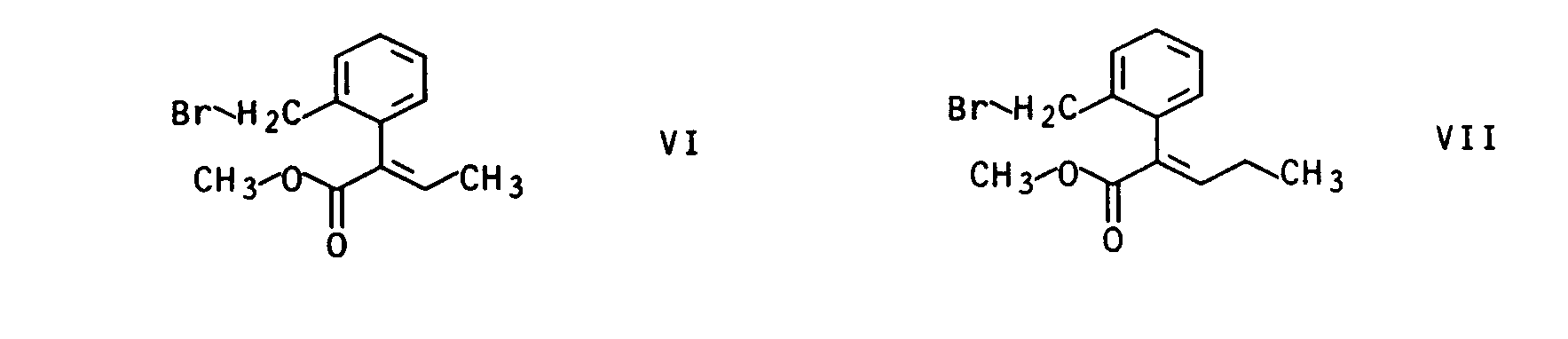
- Die Herstellung der erfindungsgemäßen Verbindungen der Formeln V, VI, VII, VIII, IX, X erfolgt beispielsweise wie in Schema 3 beschrieben.
-

- Die Zwischenprodukte der Formel XIII in der X=CH3, CH2CH3 ist, lassen sich aus den Ketoestern XII durch Wittig- oder Wittig-Horner-Reaktion herstellen (vgl. EP 348766).
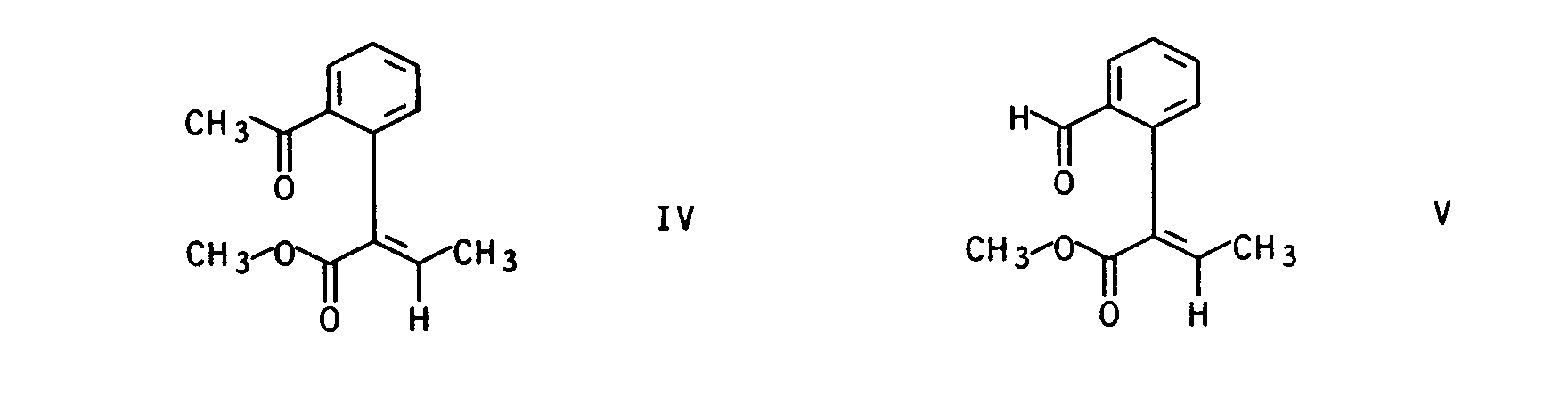
- Die Zwischenprodukte der Formeln V-IX lassen sich aus XIII durch Reaktion mit BCl3 oder BBr3 in einem inerten Lösungsmittel (z.B. CCI4, CH2CI2, Cyclohexan) herstellen [vgl. Synthesis, S. 249f (1983)].
- Die Darstellung der neuen Verbindungen der allgemeinen Formel I kann so erfolgen, daß man die neuen Carbonylverbindungen der Formel 7 mit einem substituierten Hydroxylamin der allgemeinen Formel 15 oder Hydrazin der allgemeinen Formel 16 oder mit einem Säureadditionssalz (z.B. Hydrochlorid, Hydrobromid) von 15 oder 16 umsetzt.

- Die Reaktion kann in einem inerten Lösungs- oder Verdünnungsmittel (z.B. Methanol, Ethanol, Toluol) oder in einem Zweiphasensystem (z.B. Toluol/Wasser) durchgeführt werden. Außerdem kann es von Vorteil sein, der Reaktionsmischung eine Base (z.B. Triethylamin, Natriumcarbonat, Kaliumcarbonat, Natriumhydrogencarbonat, Kaliumhydrogencarbonat, Natriumhydroxid, Kaliumhydroxid) zuzusetzen.
- Alternativ kann bei der Herstellung von auch wie folgt vorgegangen werden (Schema 4, Z1, Z2 = H) Schema 4 (Y=0)
-

- Die zur Herstellung der Verbindungen der allgemeinen Formel I (Y = 0) benötigten Oxime 18 und 19 (vgl. Schema 4) können aus den entsprechenden Carbonylverbindungen 7 und 9 in bekannter Weise (vgl. Houben-Weyl, Bd. 10/4 (1968)) durch Umsetzung mit dem Hydroxylamin 17 hergestellt werden.
- Die Reaktion kann in einem inerten Lösungs- oder Verdünnungsmittel (z.B. Methanol, Ethanol, Toluol) oder in einem Zweiphasensystem (z.B. Toluol/Wasser) durchgeführt werden. Außerdem kann es von Vorteil sein, der Reaktionsmischung eine Base (z.B. Triethylamin, Natriumcarbonat, Kaliumcarbonat, Natriumhydrogencarbonat, Kaliumhydrogencarbonat, Natriumhydroxid, Kaliumhydroxid) zuzusetzen.
- Die nachfolgende Alkylierung der Oxime 18 und 19 erfolgt in bekannter Weise mit einer Base (wie z.B. NaOMe, NaH, KOtBu in einem Lösungsmittel wie z.B. Diethylether, Toluol, Dimethylformamid etc.) (vgl. DE 3623921 ).
- Hydroxylamine der allgemeinen Formel 15 (H2N-OR2) sind entweder bekannt oder können nach bekannten Methoden analog Houben-Weyl X/1, 1192, 1183 hergestellt werden.
- Hydrazinderivate der allgemeinen Formel 16

- Ein weiterer Zugang zu den Verbindungen der allgemeinen Formel I wird in Schema 5 beschrieben (Z1, Z2 = H, R5 = Methyl, Ethyl).
-
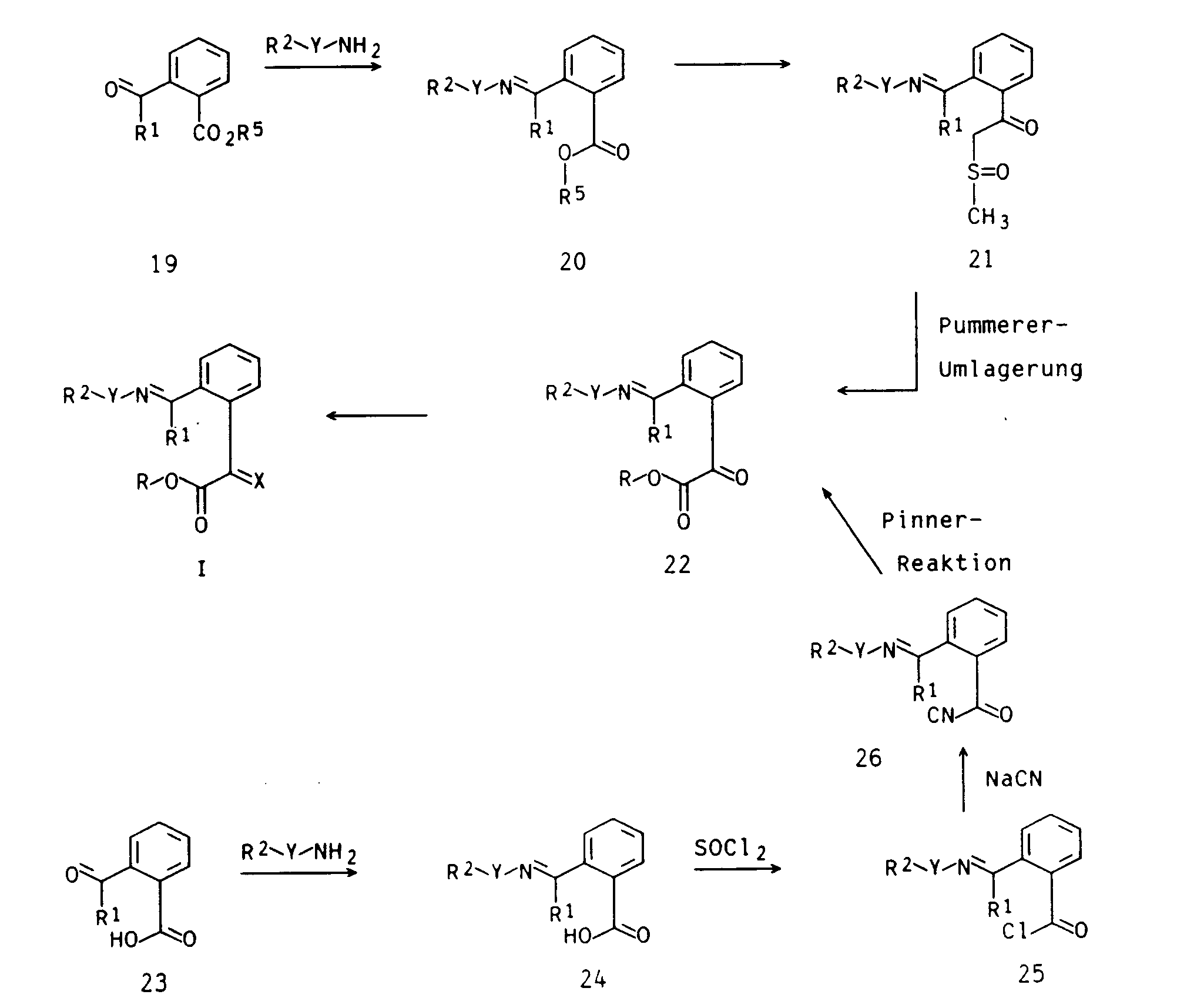
- Ausgehend von den Carbonsäureestern der Formel 20 kann man durch Anlagern von Dimethylsulfoxid in Anwesenheit einer starken Base (wie z.B. NaOCH3, KOtBu) die ß-Ketosulfoxide 21 erhalten (vgl. J. Amer. Chem. Soc. 88, 5498 (1966)), die nach Bromierung und anschließendem Verkochen mit einem Alkohol (wie z.B. Methanol, Ethanol) in Gegenwart einer Säure in einer sogenannten "Pummerer-Umlagerung" die alpha-Ketoester 22 ergeben (Synthesis, 47 (1982)).
- Alternativ kann man die alpha-Ketoester der Formel 22 durch Anwendung der sogenannten "Pinner-Reaktion" bei den Acylcyaniden der Formel 26 erhalten (vgl. S. Hünig et al. Ang. Chemie 94, 1 (1982)).
- Die Überführung der Carbonsäuren 24 in die Acylcyanide 26 erfolgt in üblicher, an sich bekannten Weise (vgl. "Organikum": 16. Auflage, Berlin 1986, S. 423f und J.M. Photis, Tetr. Lett. 21, 3539-3540 (1980)).
- Die Zwischenprodukte der allgemeinen Formel 19 kann man ausgehend von o-Hydroxyphenylketonen der Formel 27 analog Tetr. Letters, 6781 (1990) (Schema 6) herstellen.
-

- Die folgenden Vorschriften und Beispiele sollen die Herstellung der neuen Wirkstoffe und der neuen Zwischenprodukte erläutern.
- 35,5 g (0,125 mol) alpha-(2-Brommethylphenyl)-ß-methoxy-acrylsäuremethylester werden in 500 ml CC14 gelöst. Man gibt 43,4 g (0,321 mol) Methylmorpholin-N-oxid-monohydrat zu und erhitzt 20 Stunden unter Rückfluß. Der Feststoff wird abfiltriert und die CCI4-Phase mit Wasser, mit 2 N Salzsäure und wieder mit Wasser gewaschen, getrocknet und eingeengt. Man erhält 18,5 g (67 %) Produkt als rotbraunes Öl. 1 H-NMR (CDCl3): 3,7(s,3H); 3,8(s,3H); 7,2-7,6(m,4H); 7,9(m,1 H); 10,0 ppm (s,1 H).
- 20 g (0,070 mol) 2-(Brommethyl)-phenylglyoxylsäuremethylester-O-methyloxim, 32 g (0,237 mol) N-Methylmorpholin-N-oxid-monohydrat und 300 ml CC14 werden zusammengegeben und zum Rückfluß erhitzt. Nach 9 Stunden Rückfluß wird abfiltriert, die organische Phase mit Wasser sowie mit 2 N Salzsäure gewaschen, getrocknet und eingeengt. Der Rückstand wird aus Pentan umkristallisiert. Man erhält 9,0 g Produkt (58 %) als farblose Kristalle.
- 1H-NMR (CDCl3): 3,9(s,3H); 4,0(s,3H); 7,39-8,0(m,4H); 9,98 ppm (s,1H).
- 685 g (2,74 mol) o-Brombenzylbromid werden zusammen mit 2,74 mol einer 30 %igen Natriummethylat-Lösung in Methanol 15 Stunden unter Rückfluß erhitzt. Nach dem Abkühlen wird eingeengt, in Essigester aufgenommen und mit Wasser gewaschen. Nach dem Trocknen der organischen Phase über Natriumsulfat wird eingeengt. Man erhält 478,2 g (87 %) Produkt als farblose Flüssigkeit.
- 1H-NMR (CDCl3): 3,5(s,3H); 4,58(s,2H);7,08-7,6ppm (m,4H).
- Zu einer aus 12,0 g (0,46 mol) Magnesiumspänen und 99,5 g (0,5 mol) 1-Brom-2-methoxymethyl- benzol in 500 ml THF (Tetrahydrofuran) hergestellten Grignardlösung werden 500 ml etherische 1 N Zinkchloridlösung zugetropft. Anschließend wird 1 Stunde unter Rückfluß erhitzt und die Lösung von 61,2 g (0,5 mol) Oxalsäuremethylesterchlorid in 100 ml THF bei einer Innentemperatur von -10°C zugetropft. Man läßt auf Raumtemperatur (20°C) kommen, rührt noch 20 Stunden bei Raumtemperatur weiter und hydrolysiert mit Ammoniumchloridlösung. Nach dem Extrahieren mit Ether werden die vereinigten Etherphasen mit Wasser gewaschen, getrocknet und eingeengt. Man erhält 60 g Produkt (57,7 %) als eine leicht bewegliche Flüssigkeit.
- 1H-NMR (CDC!3): 3,38(s,3H); 3,98(s,3H);4,8(s,2H); 7,3-7,7 ppm (m,4H).
- 37,1 g (100 mmol) Ethyltriphenylphosphoniumbromid werden unter Stickstoff in 300 ml absolutem Tetrahydrofuran vorgelegt. Bei 5°C werden 11,2 g (0,1 mol) Kalium-t-butanolat zugegeben. Nach einer Stunde Rühren bei 5°C werden 20,8 g (100 mmol) 2-Methoxymethylphenylglyoxylsäuremethylester in 100 ml Tetrahydrofuran zugetropft. Man rührt eine Stunde bei 5°C und eine Stunde bei 25°C, versetzt mit 200 ml Wasser, extrahiert mit Methylenchlorid und wäscht die organischen Phasen mit Wasser. Nach dem Trocknen über Natriumsulfat wird das Lösungsmittel im Vakuum entfernt. Der Rückstand wird über eine Kieselgel-Säule (Methyl-tert.-butylether/n-Hexan = 1/2) chromatographisch gereinigt. Man erhält 17,2 g (78 %) des obengenannten Esters als Öl (Z/E-Isomer = 1/9).
- 1H-NMR (CDC!3): 1,8(d,3H); 3,3(s,3H); 3,7(s,3H); 4,3(d,2H); 7,05(m,1H); 7,2-7,6 ppm (m,4H).
- 31 g (140 mmol) 2-Methoxymethylphenyl-ß-methylacrylsäuremethylester in 500 ml Methylenchlorid werden bei 0°C tropfenweise mit 105,3 ml (140 mmol) einer 1,33 N Bortribromid-Lösung in Methylenchlorid versetzt und anschließend drei Stunden unter Rückfluß erhitzt. Danach versetzt mit 5 ml Methanol, rührt noch 5 Stunden bei Raumtemperatur weiter und hydrolysiert mit 3 %iger Natronlauge. Dann wäscht man die organischen Phasen mit Wasser, trocknet sie über Natriumsulfat und engt das Filtrat ein. Man erhält 31,0 g des oben genannten Benzylbromids als gelbliches Öl (Verbindung VI).
- 1H-NMR (CDCl3): 1,65(d,3H); 3,7(s,3H); 4,28(d,2H); 7,05(m,1H); 7,2-7,6 ppm(m,4H).
- Die Lösung von 6 g (27 mmol) 2-Formylphenyl-glyoxylsäuremethylester-O-methyloxim in 150 ml Methanol wird mit 4 g (29 mmol) 2-Methyl-O-benzylhydroxylamin versetzt und 8 Stunden bei 65°C gerührt. Anschließend läßt man auf Raumtemperatur abkühlen, nimmt das Reaktionsgemisch in Essigester auf und wäscht die organische Phase mit Wasser. Nach dem Trocknen über Natriumsulfat wird das Lösungsmittel entfernt und man erhält 9 g (98 %) des oben genannten Oximethers in Form gelblicher Kristalle (Verbindung Nr. 1.35, Tabelle I).
- Fp: 80-83°C 1H-NMR (CDCl3): 2,4(s,3H); 3,8(s,3H); 3,98(s,3H); 5,2(s,2H); 7,05-7,8(m,8H), 8,05 ppm(s,1H).
- Zu einer Lösung von 1,5 g (14 mmol) Phenylhydrazin in 20 ml Methanol tropft man bei 25°C die Lösung von 3,5 g (16 mmol) alpha-(2-Formylphenyl)-ß-methoxy-acrylsäuremethylester in 5 ml Methanol und rührt das Reaktionsgemisch 20 Stunden bei 25°C weiter. Dann wird das Produkt abgesaugt, mit Ether sorgfältig nachgewaschen und getrocknet. Man erhält 3,4 g (79 %) der obengenannten Verbindung in Form hellbeiger Kristalle (Verbindung Nr. 5.20, Tabelle V).
- Fp: 210°C (Zersetzung) 1H-NMR (DMSO): 3,65(s,3H); 3,85(s,3H); 7,8(s,1 H); 7,8(m,1 H); 6,75-7,95(m,9H); 10,45 ppm(s,1 H).
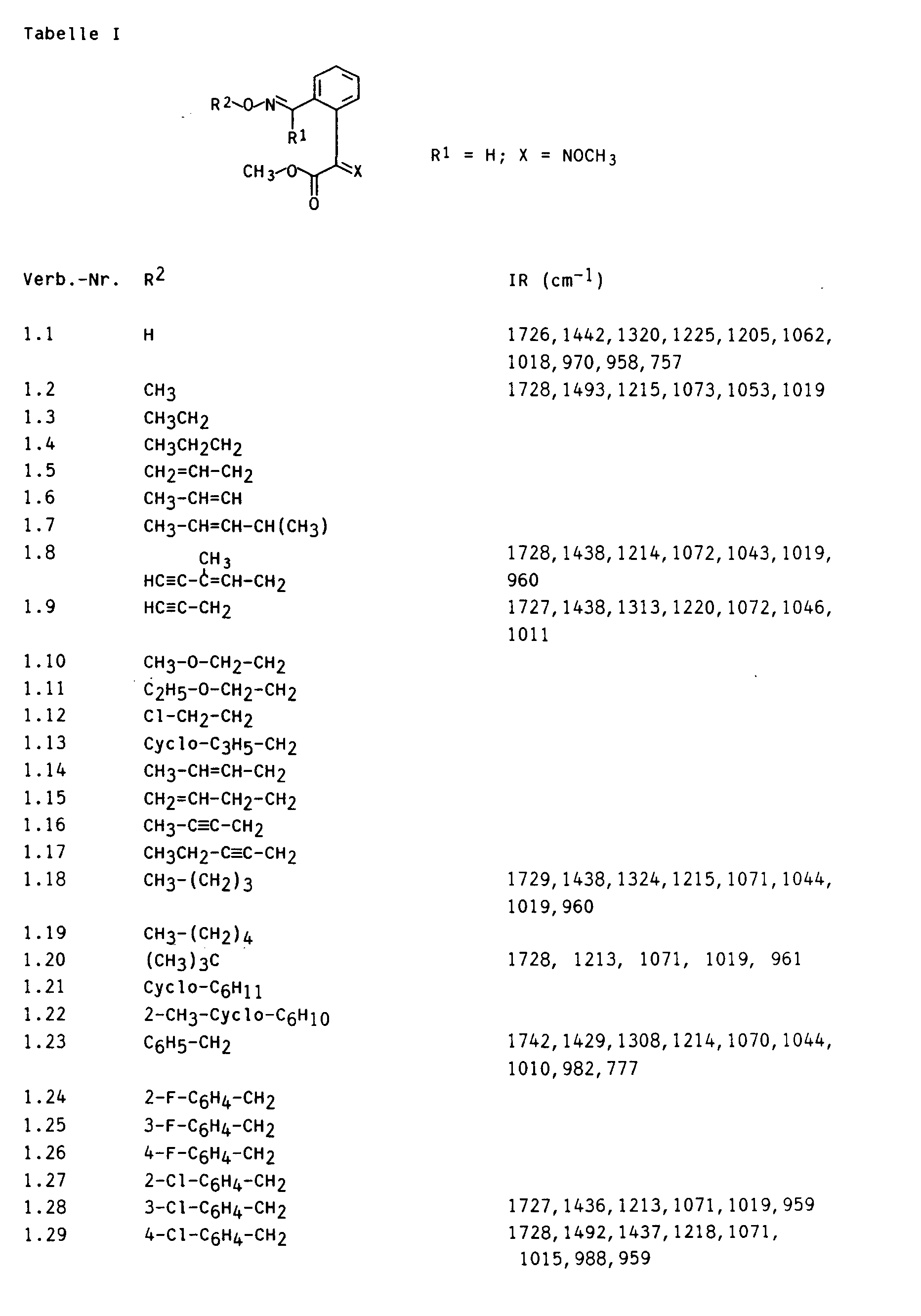
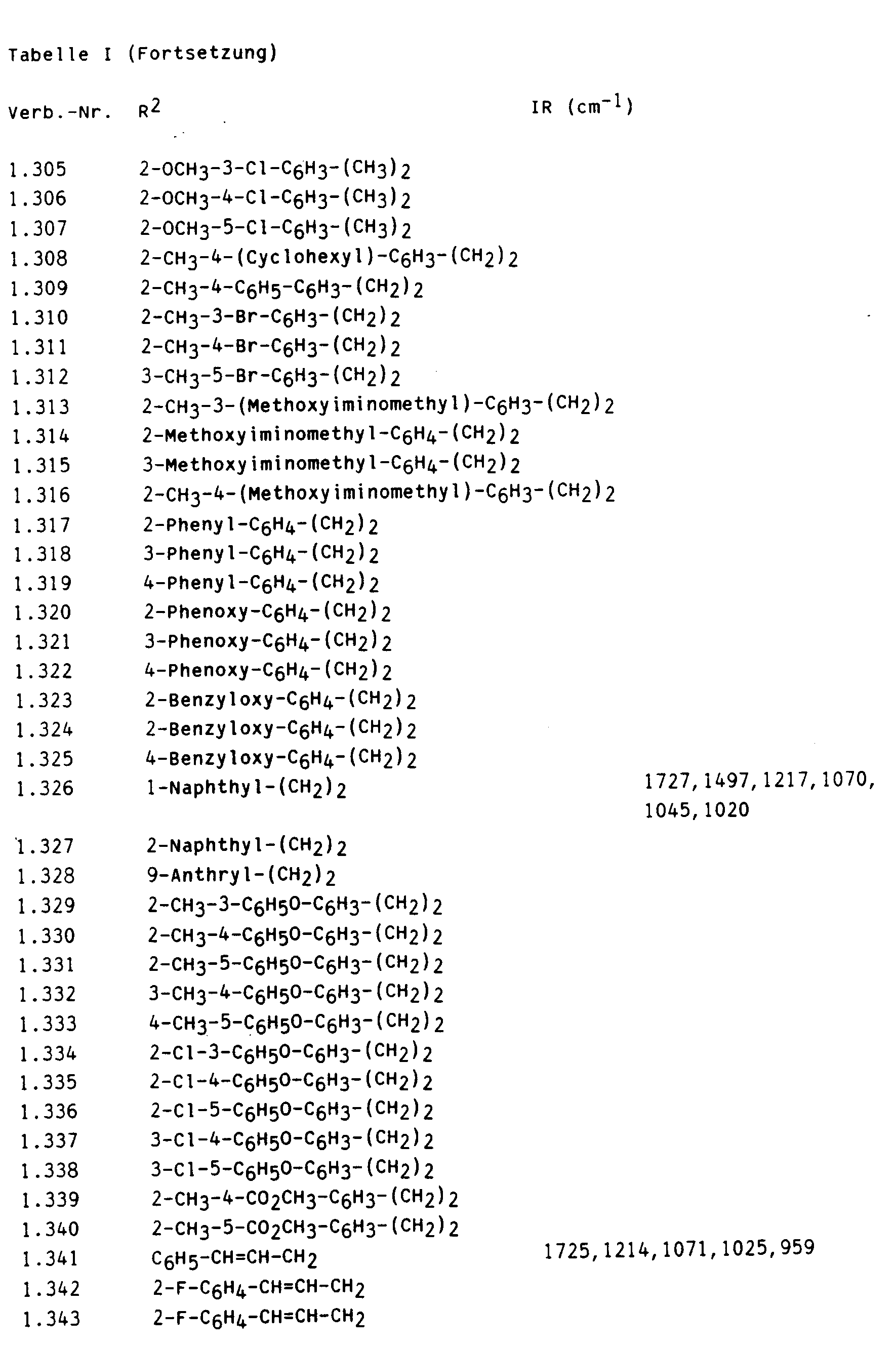
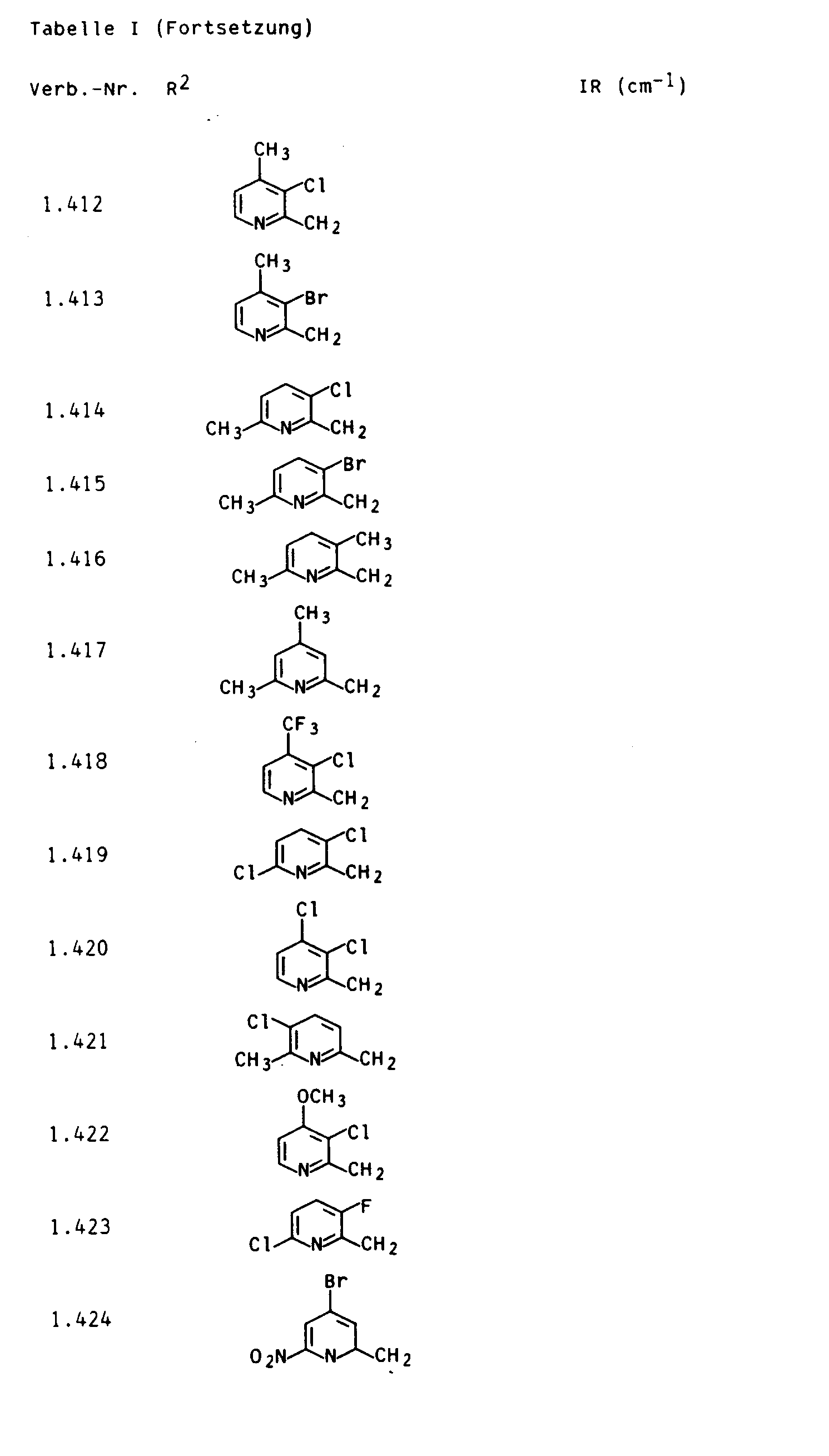
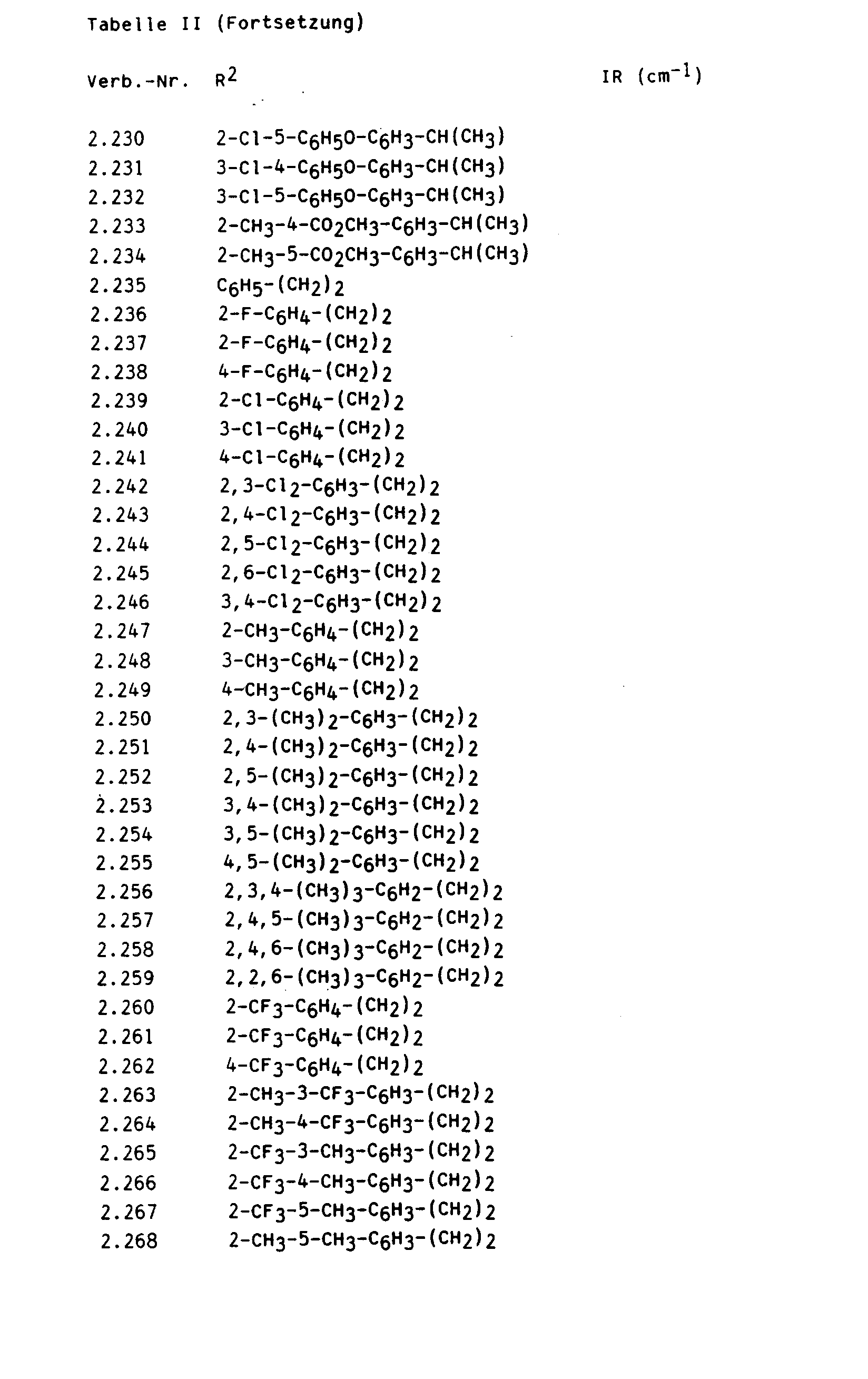
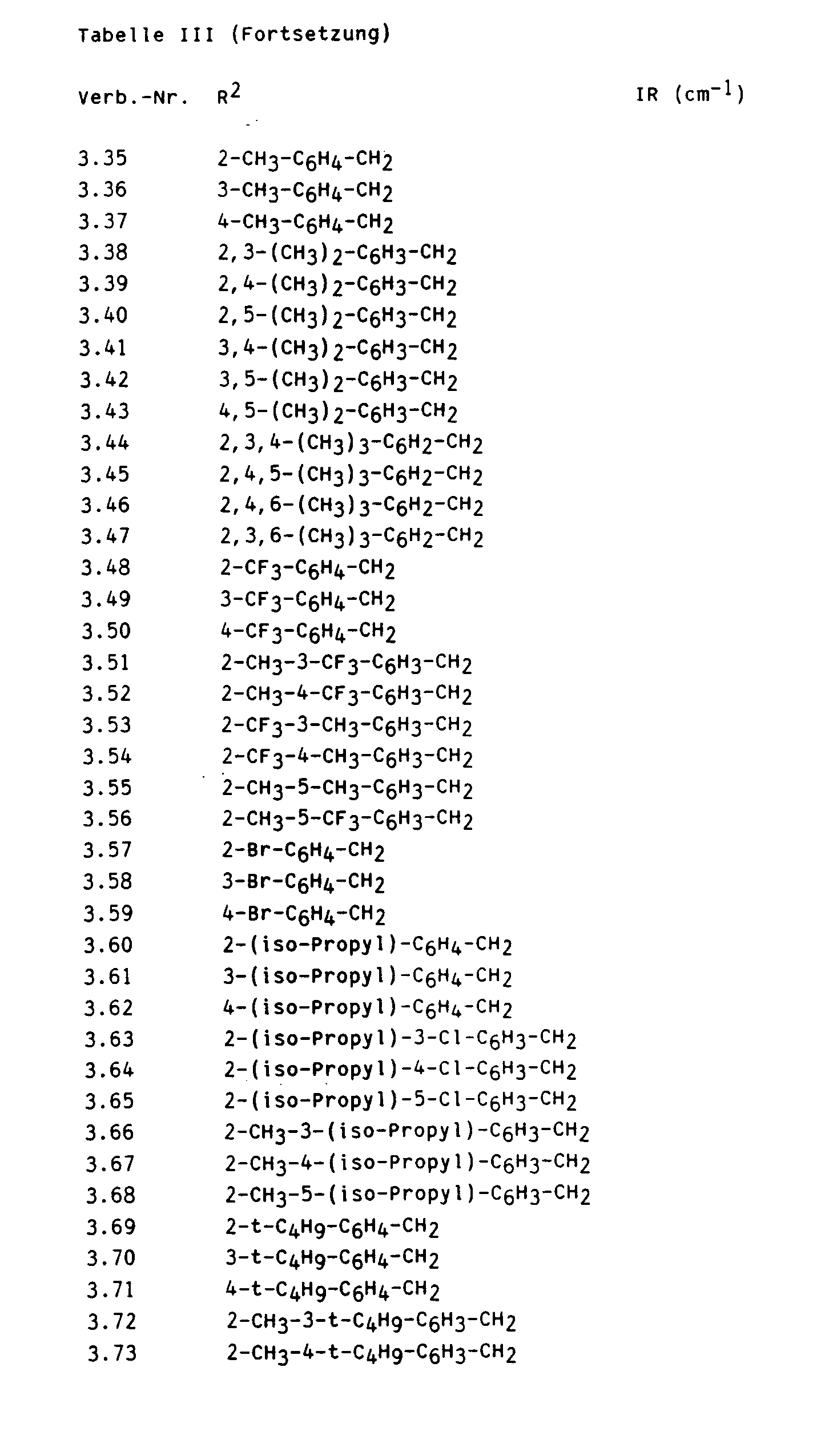
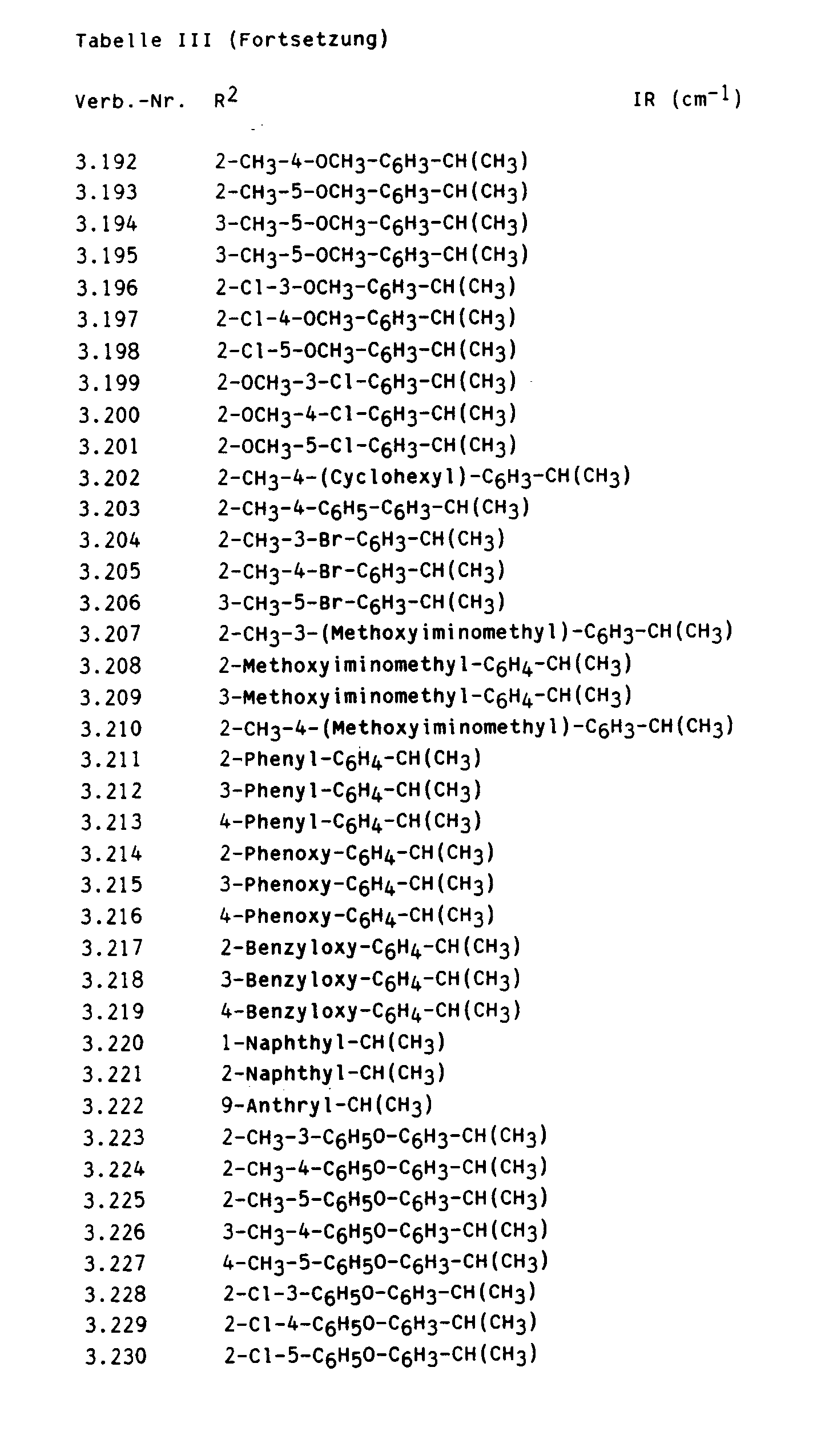
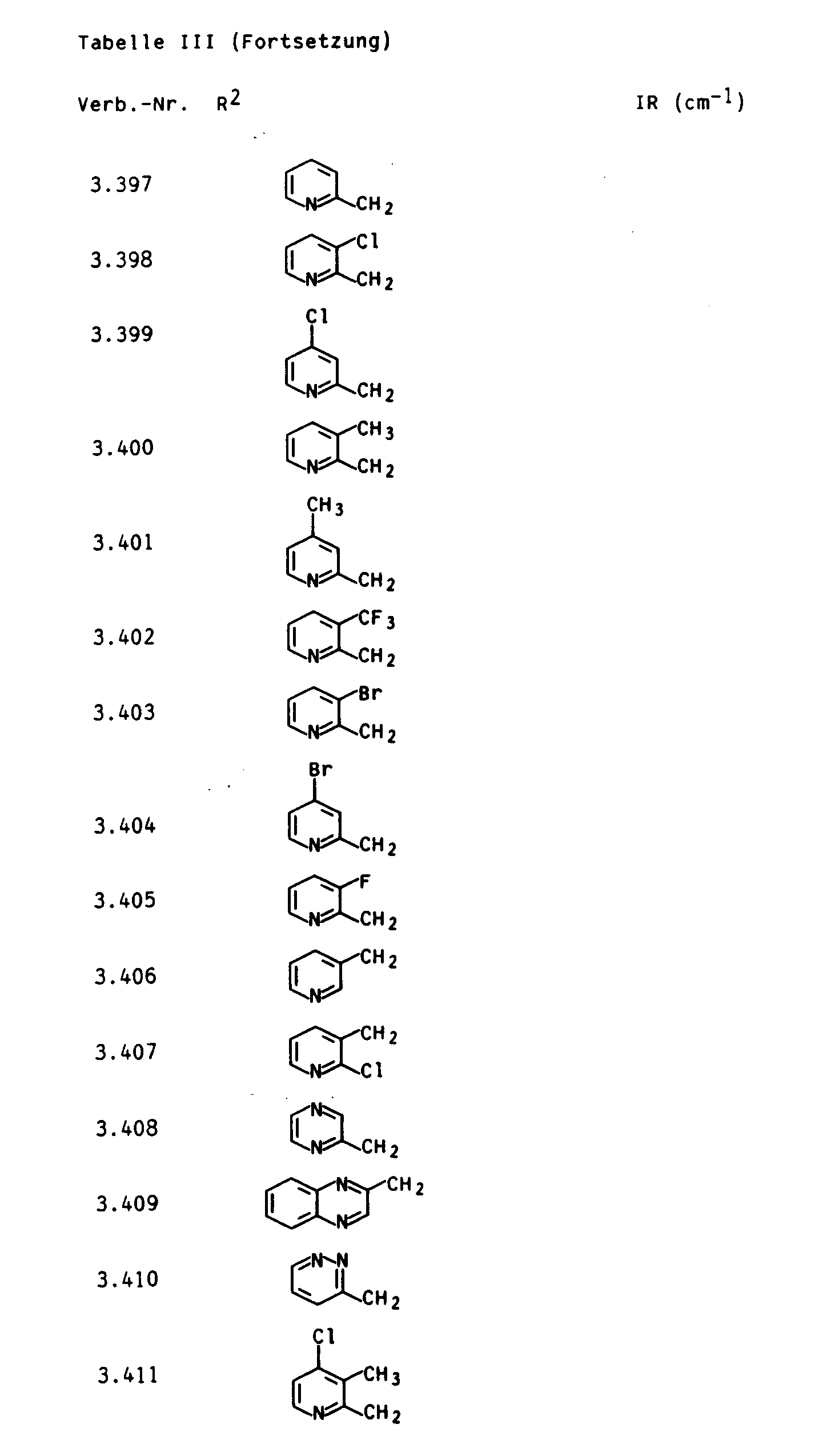
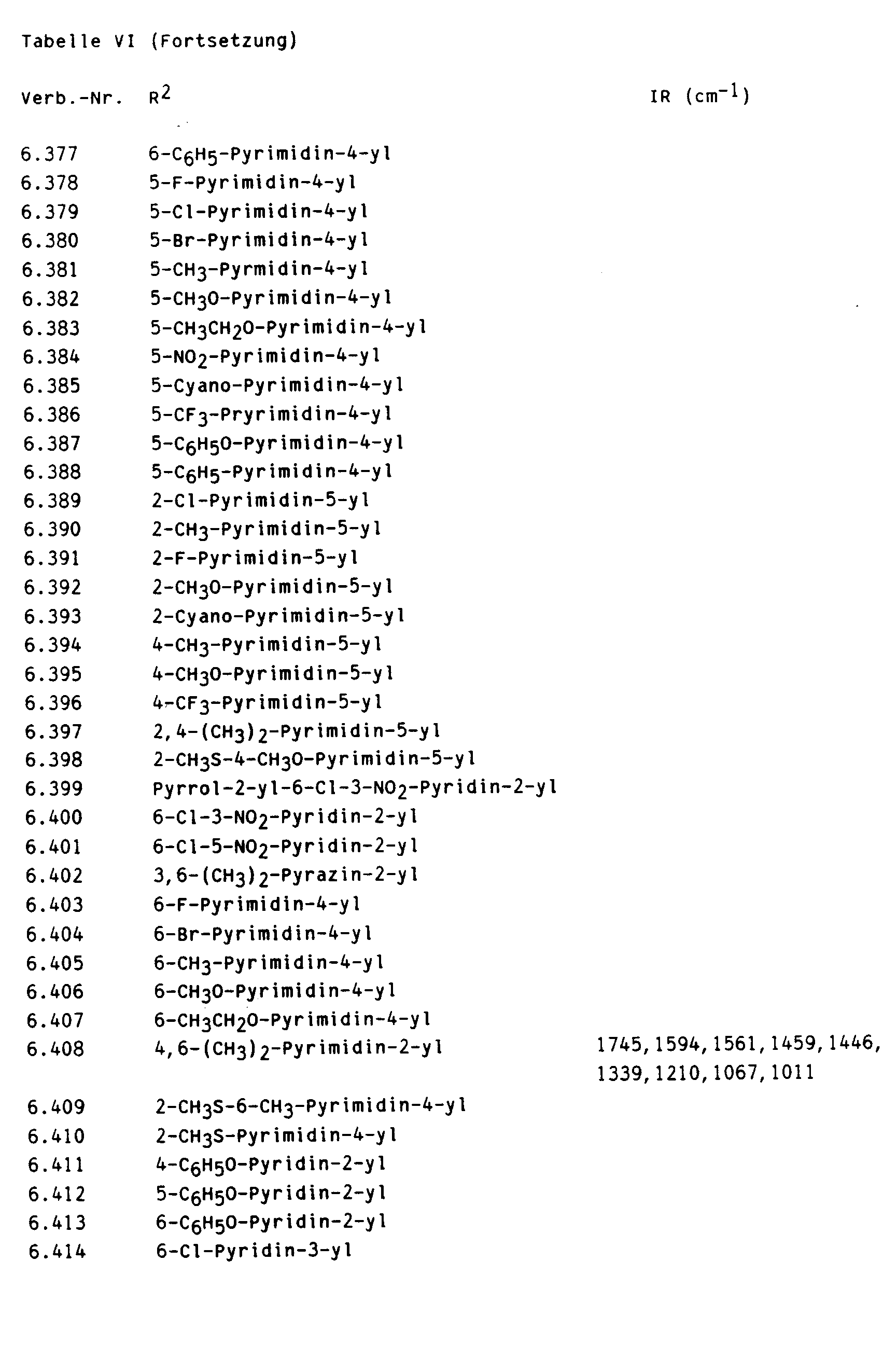
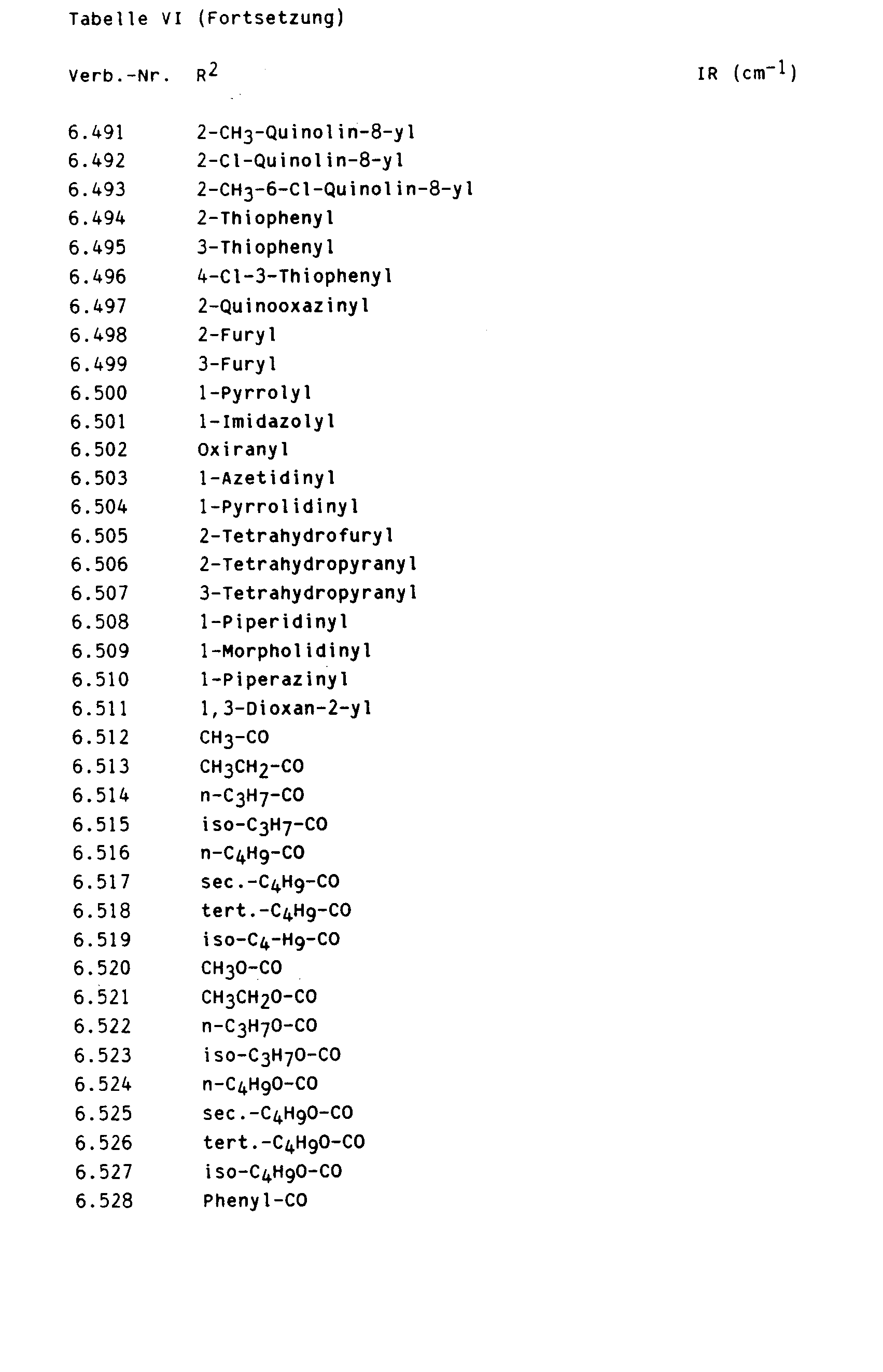
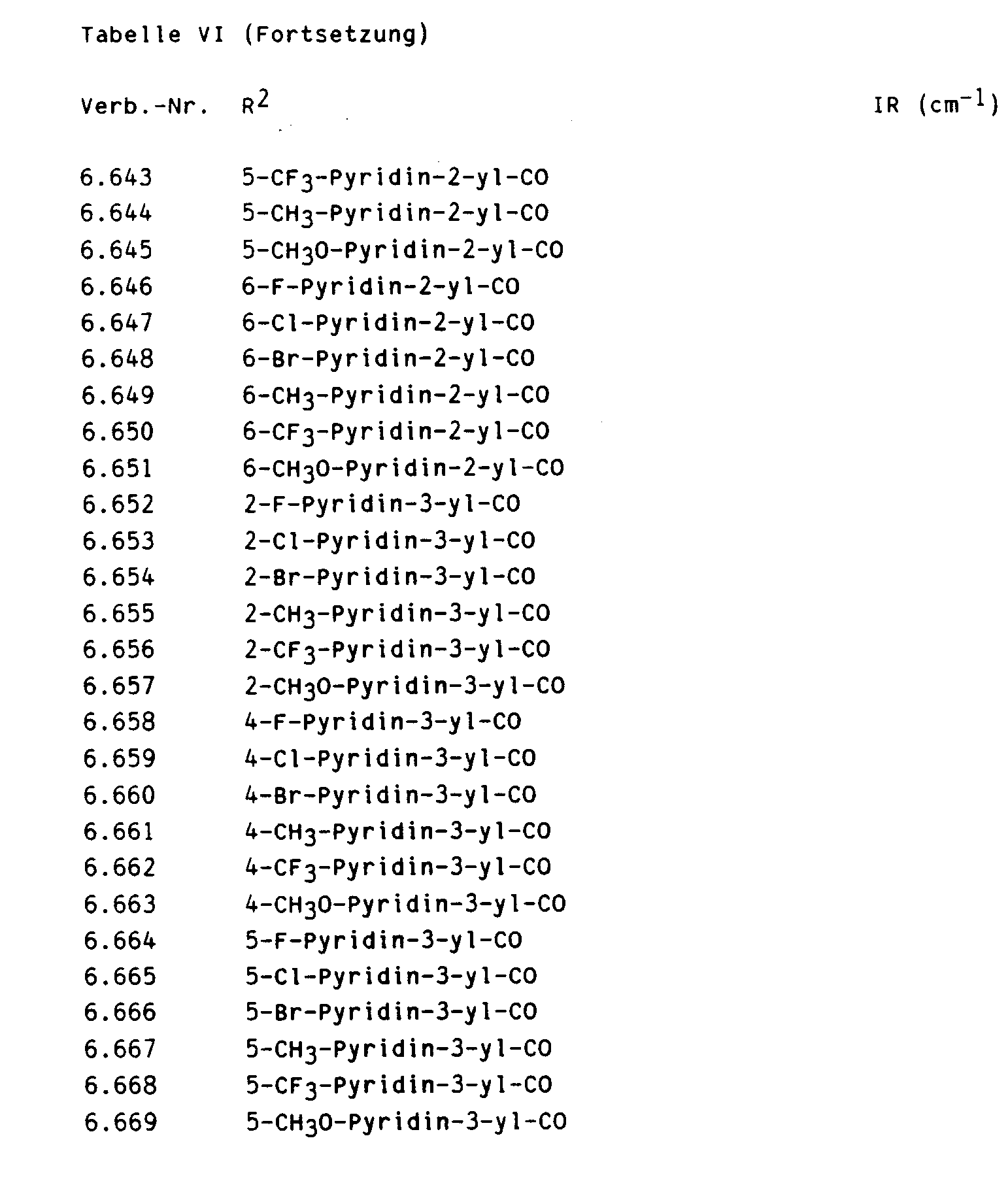
- In entsprechender Weise können die in den folgenden Tabellen aufgeführten Verbindungen hergestellt werden.
-














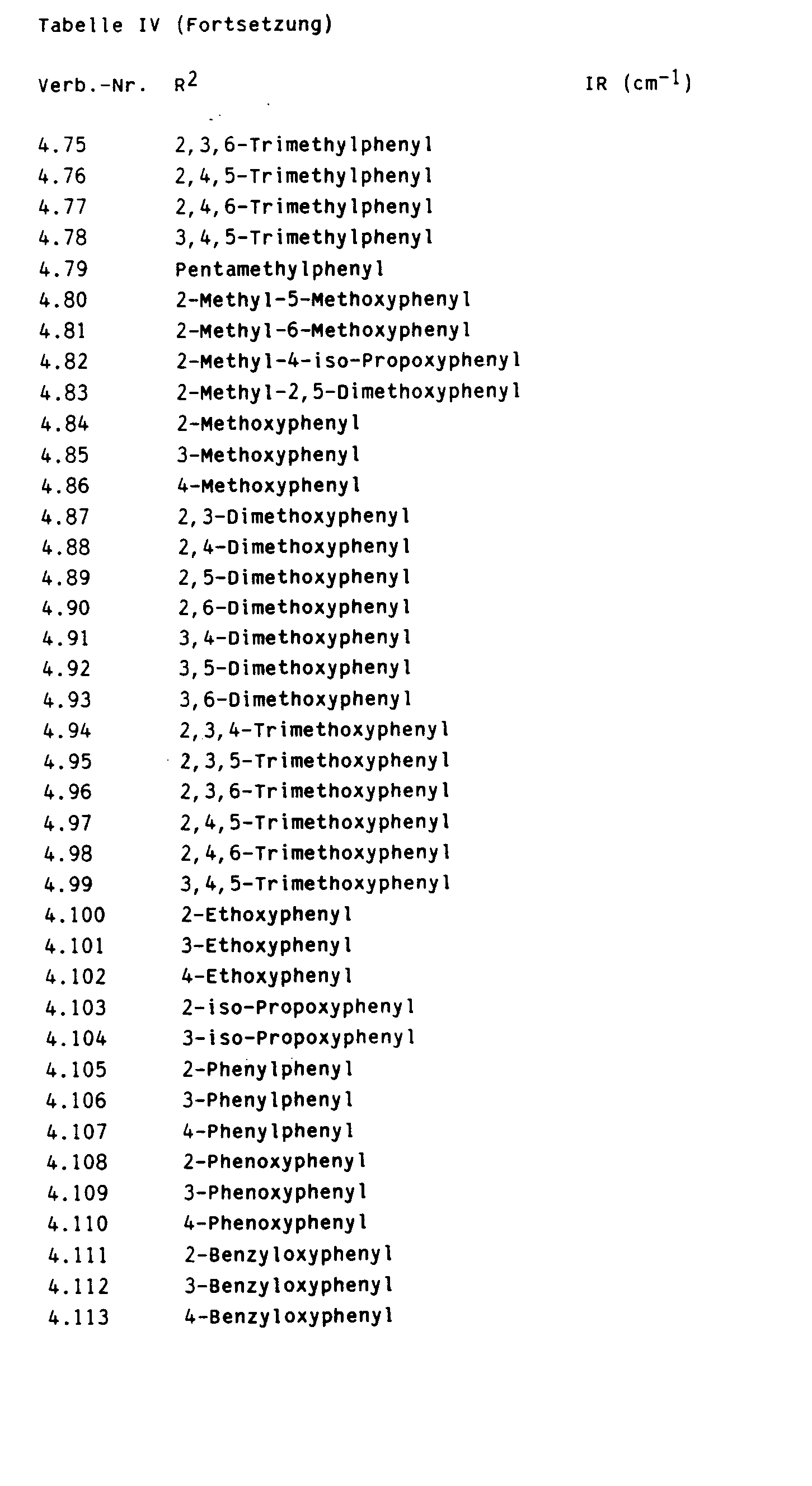
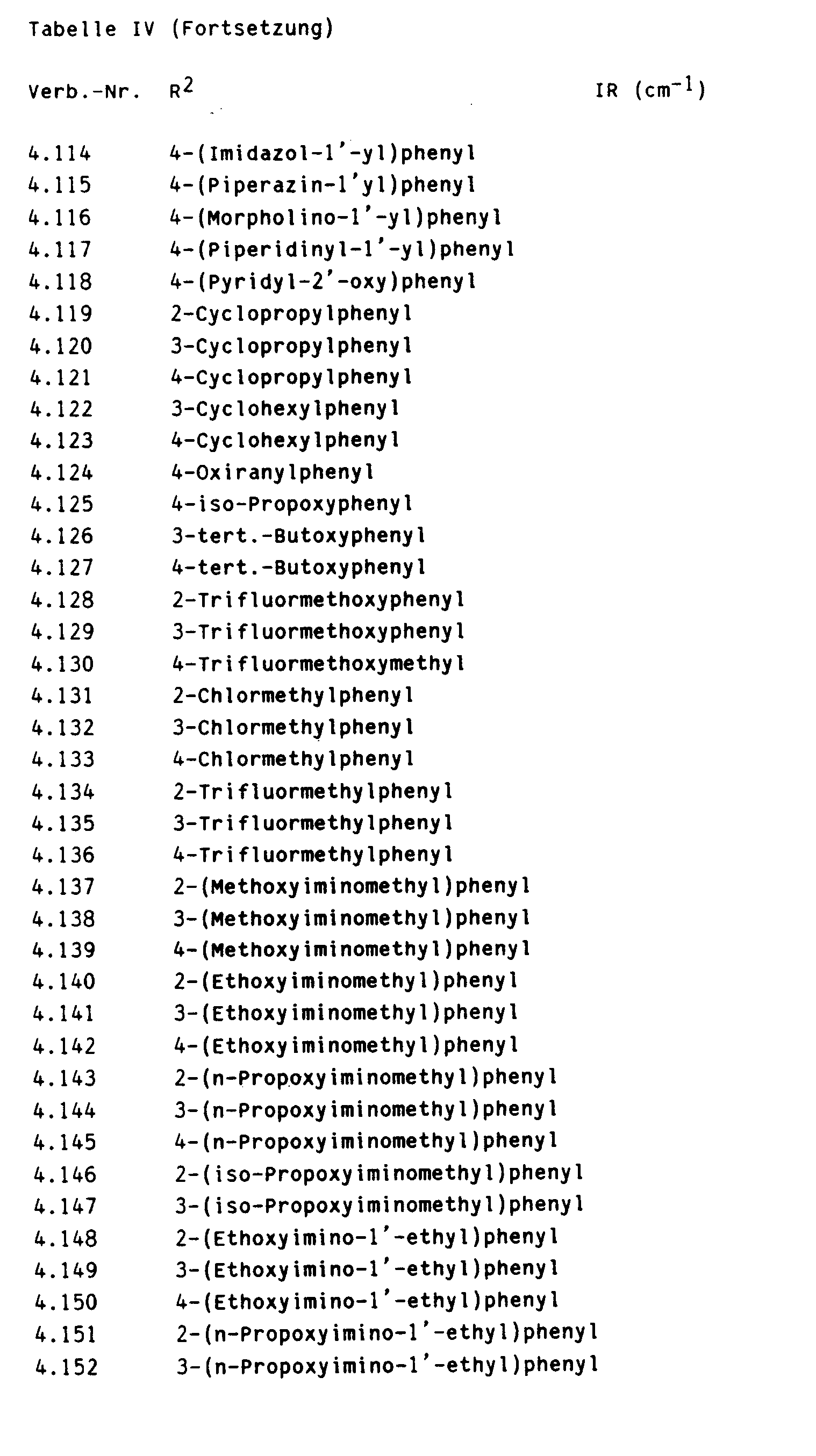


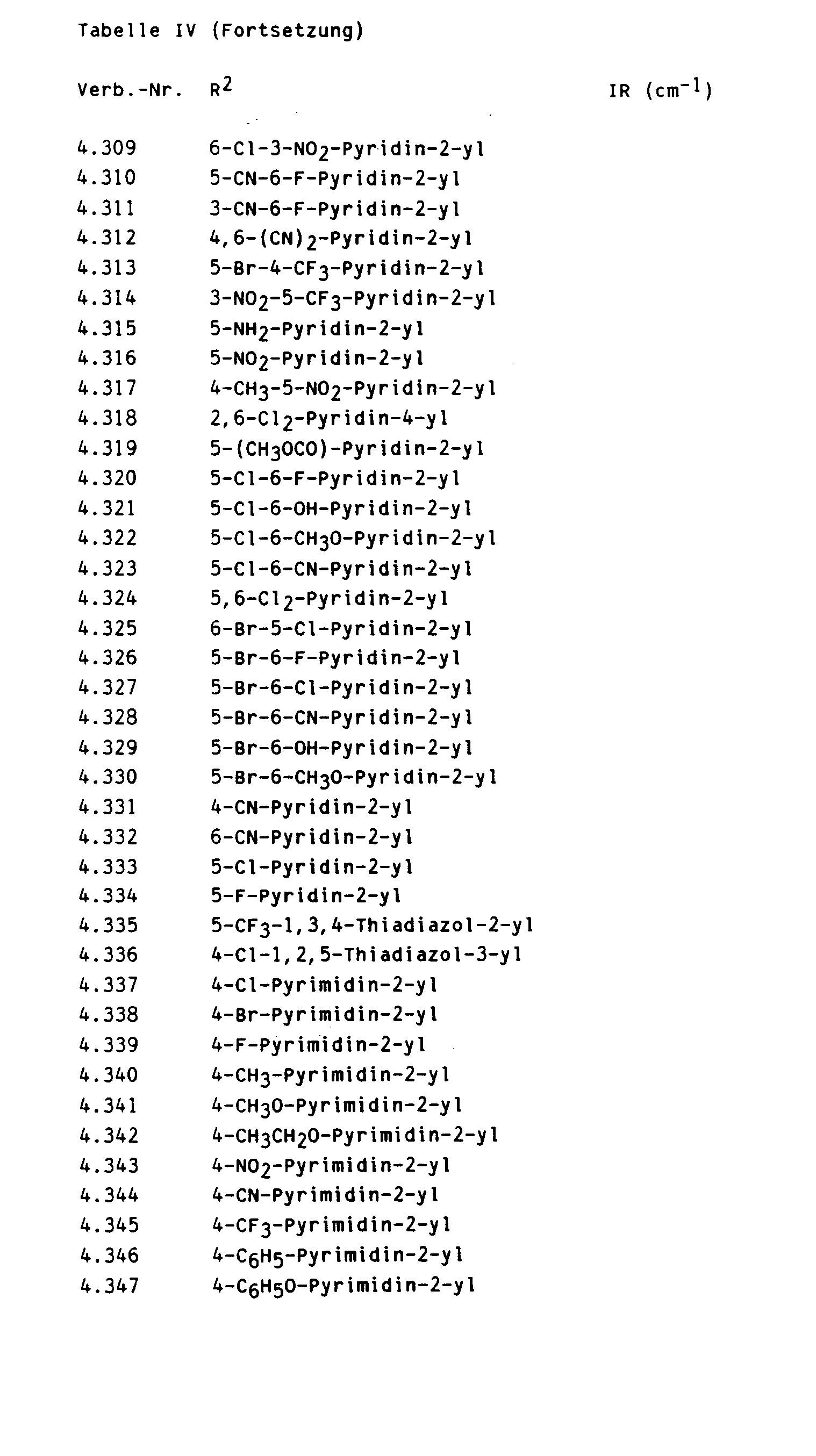


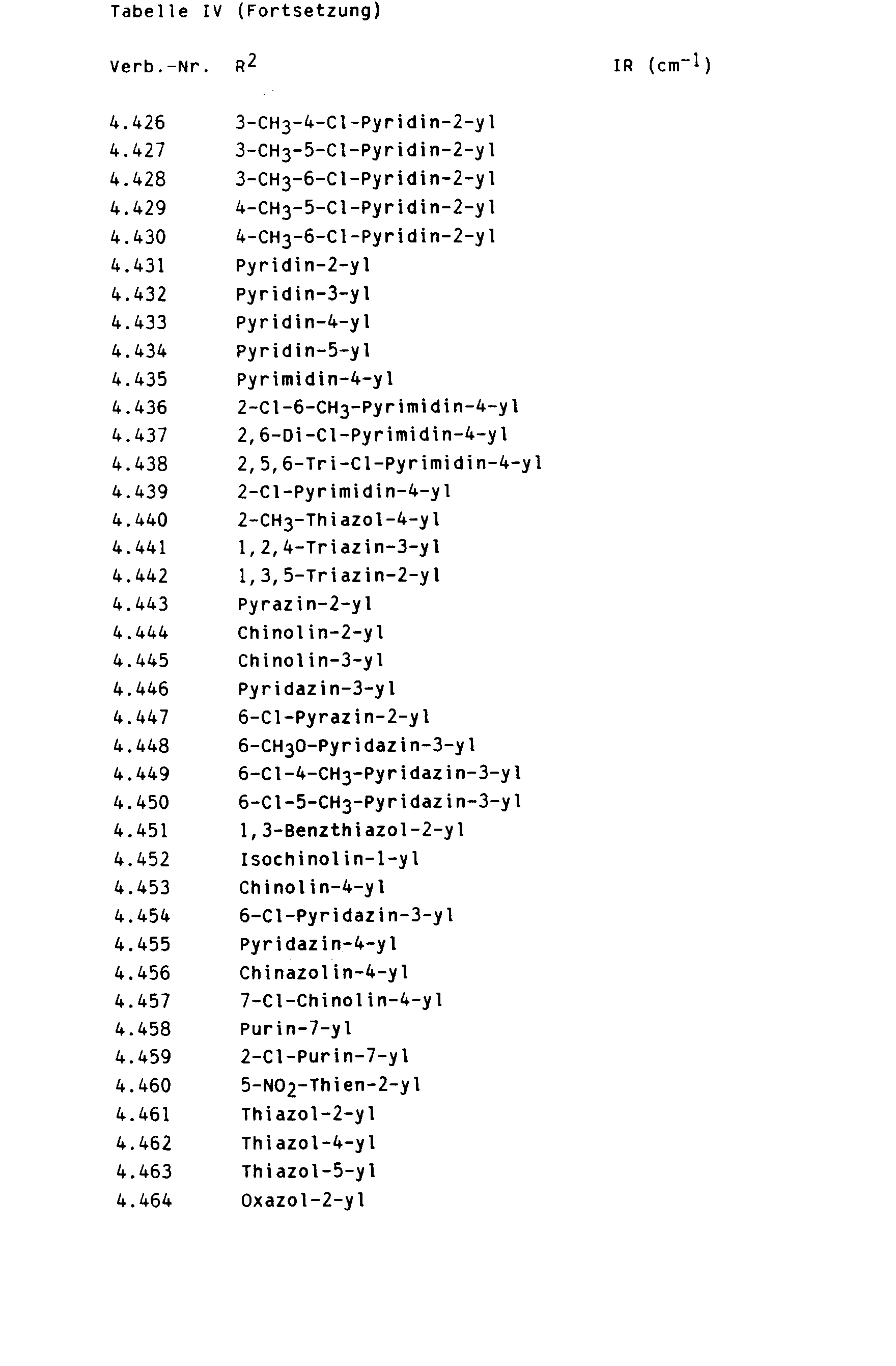


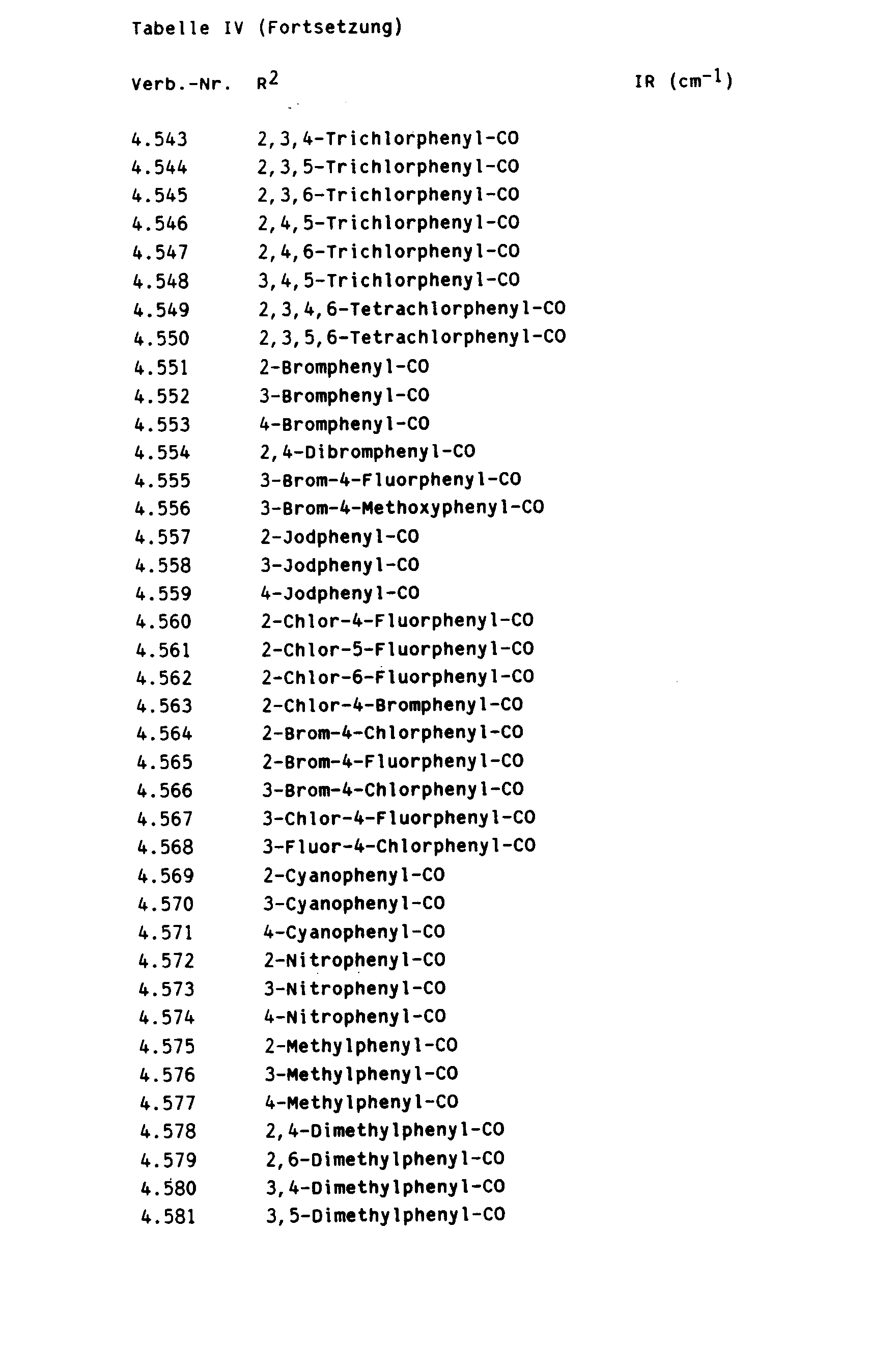


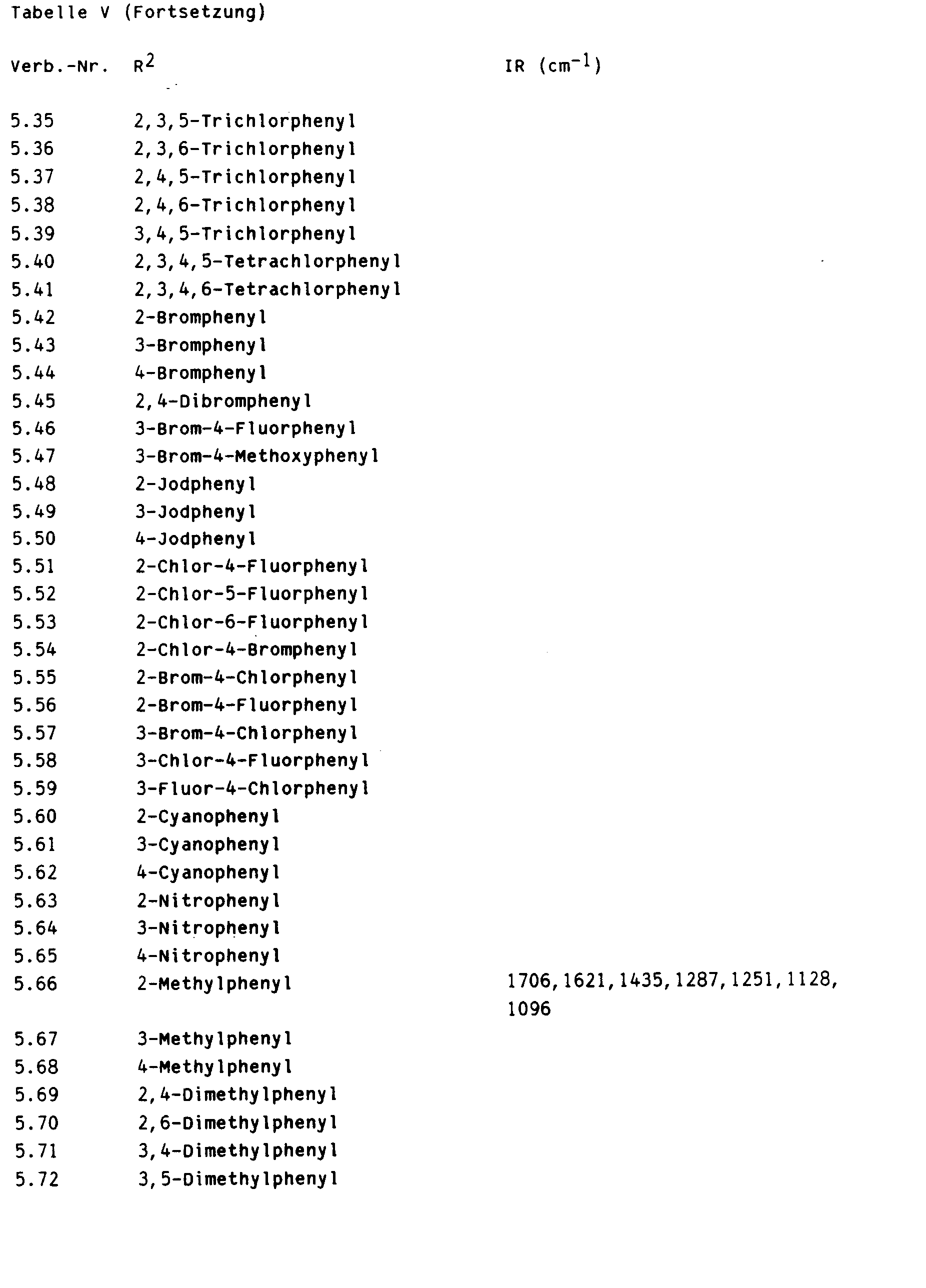


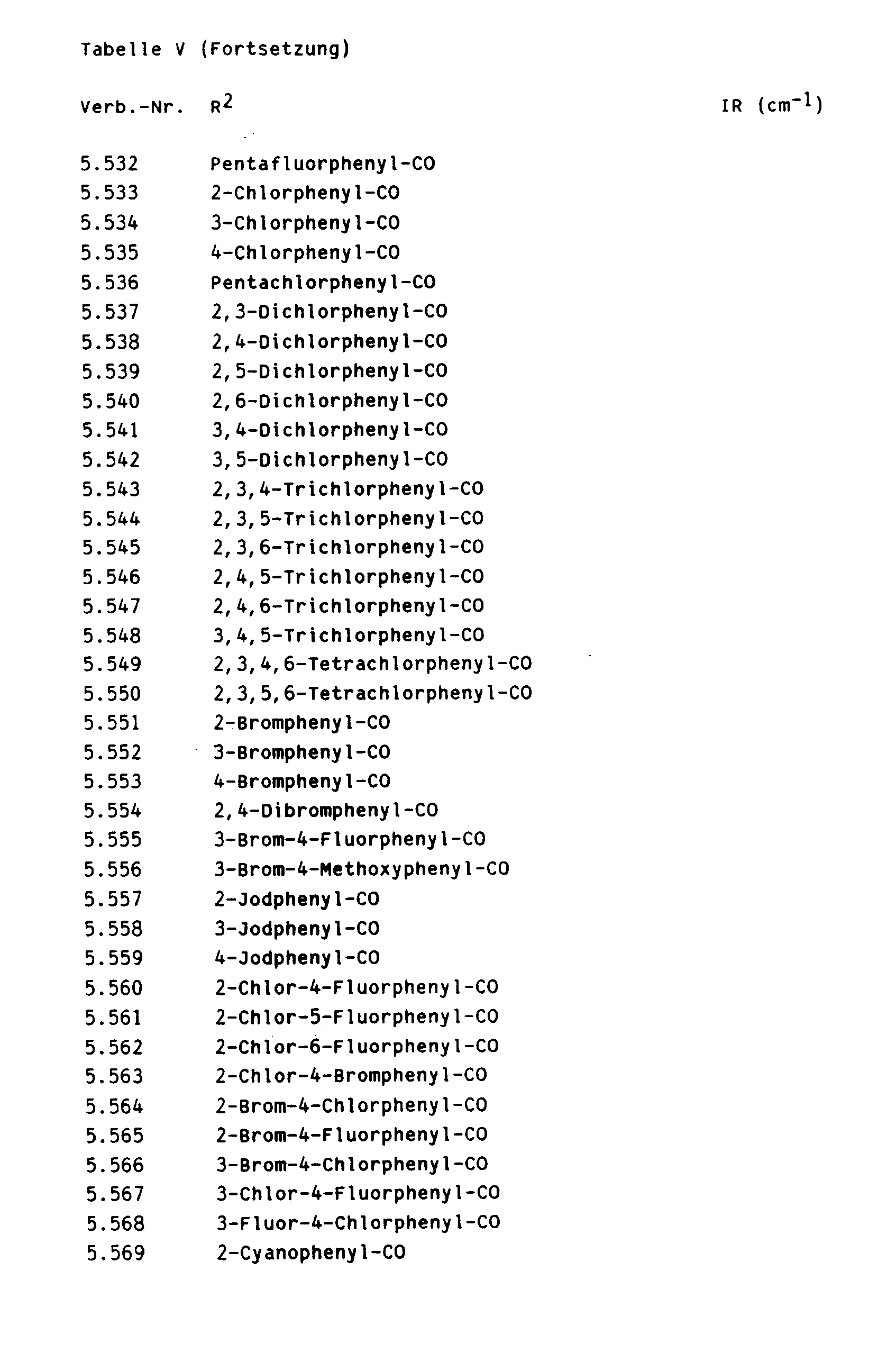


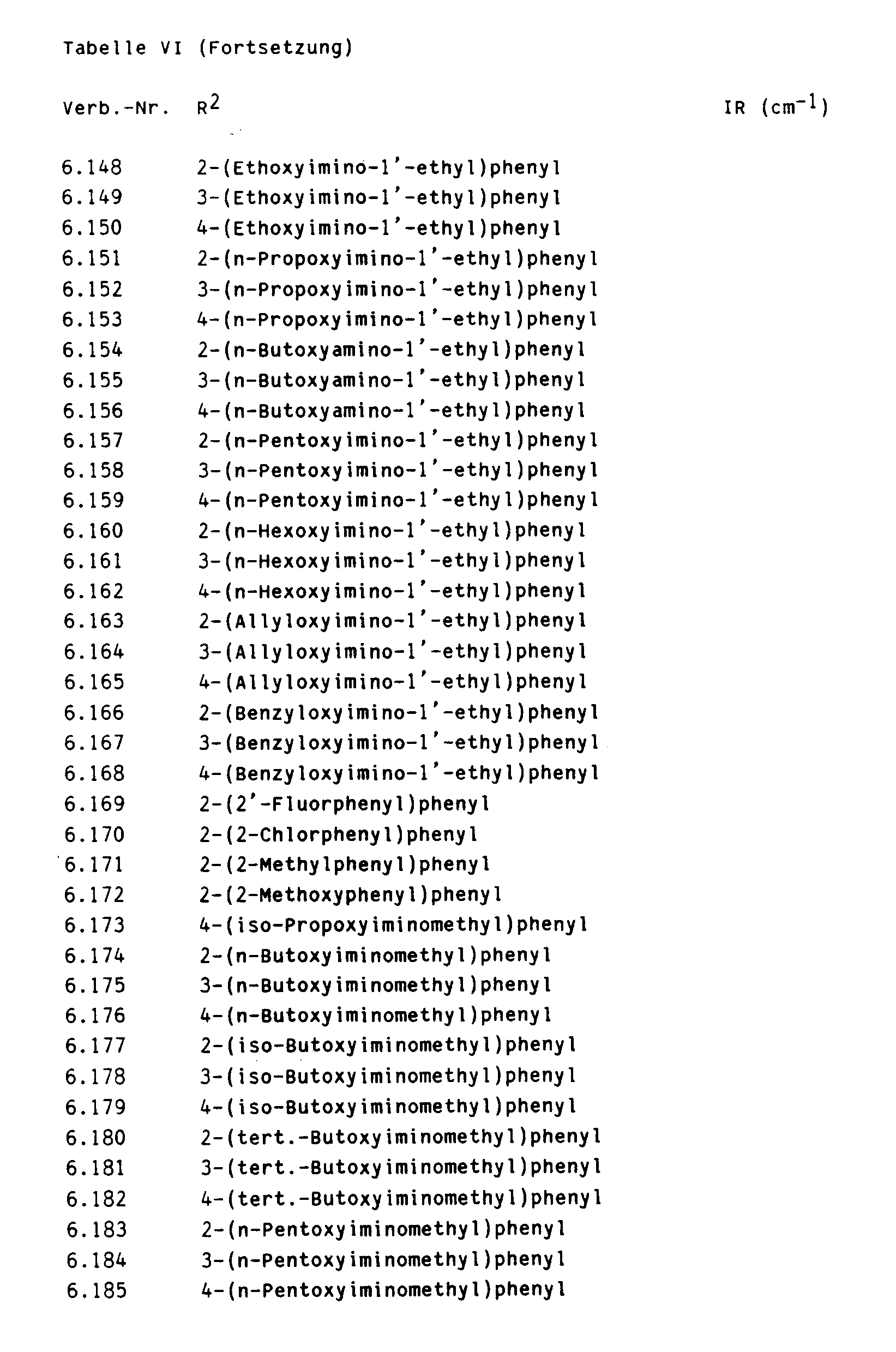







- Die erfindungsgemäßen fungiziden Verbindungen bzw. die sie enthaltenden Mittel können beispielsweise in Form von direkt versprühbaren Lösungen, Pulvern, Suspensionen, auch hochprozentigen wäßrigen, öligen oder sonstigen Suspensionen oder Dispersionen, Emulsionen, Öldispersionen, Pasten, Stäubemitteln, Streumitteln oder Granulaten durch Versprühen, Vernebeln, Verstäuben, Verstreuen oder Gießen angewendet werden. Die Anwendungformen richten sich nach den Verwendungszwecken; sie sollten in jedem Fall möglichst die feinste Verteilung der erfindungsgemäßen Wirkstoffe gewährleisten.
- Normalerweise werden die Pflanzen mit den Wirkstoffen besprüht oder bestäubt oder die Samen der Pflanzen mit den Wirkstoffen behandelt.
- Die Formulierungen werden in bekannter Weise hergestellt, z.B. durch Verstrecken des Wirkstoffs mit Lösungsmitteln und/oder Trägerstoffen, gewünschtenfalls unter Verwendung von Emulgiermitteln und Dispergiermitteln, wobei im Falle von Wasser als Verdünnungsmittel auch andere organische Lösungsmittel als Hilfslösungsmittel verwendet werden können. Als Hilfsstoffe kommen dafür im wesentlichen in Betracht: Lösungsmittel wie Aromaten (z.B. Xylol), chlorierte Aromaten (z.B. Chlorbenzole), Paraffine (z.B. Erdölfraktionen), Alkohole (z.B. Methanol, Butanol), Ketone (z.B. Cyclohexanon), Amine (z.B. Ethanolamin, Dimethylformamid) und Wasser; Trägerstoffe wie natürliche Gesteinsmehle (z.B. Kaoline, Tonerden, Talkum, Kreide) und synthetische Gesteinsmehle (z.B. hochdisperse Kieselsäure, Silikate); Emulgiermittel wie nichtionogene und anionische Emulgatoren (z.B. Polyoxyethylen-Fettalkohol-Ether, Alkylsulfonate und Arylsulfonate) und Dispergiermittel wie Ligninsulfitablaugen und Methylcellulose.
- Als oberflächenaktive Stoffe kommen die Alkali-, Erdalkali-, Ammoniumsalze von aromatischen Sulfonsäuren, z.B. Lignin-, Phenol-, Naphthalin- und Dibutylnaphthalinsulfonsäure, sowie von Fettsäuren, Alkyl-und Alkylarylsulfonaten, Alkyl-, Laurylether- und Fettalkoholsulfaten, sowie Salze sulfatierter Hexa-, Hepta-und Octadecanolen, sowie von Fettalkoholglykolether, Kondensationsprodukte von sulfoniertem Naphthalin und seiner Derivate mit Formaldehyd, Kondensationsprodukte des Naphthalins bzw. der Naphthalinsulfonsäuren mit Phenol und Formaldehyd, Polyoxyethylenoctylphenolether, ethoxyliertes Isooctyl-, Octyl- oder Nonylphenol, Alkylphenol-, Tributylphenylpolyglykolether, Alkylarylpolyetheralkohole, Isotridecylalkohol, Fettalkoholethylenoxid-Kondensate, ethoxyliertes Rizinusöl, Polyoxyethylenalkylether oder Polyoxypropylen, Laurylalkoholpolyglykoletheracetat, Sorbitester, Lignin-Sulfitablaugen oder Methylcellulose in Betracht.
- Pulver-, Streu- und Stäubemittel können durch Mischen oder gemeinsames Vermahlen der wirksamen Substanzen mit einem festen Trägerstoff hergestellt werden.
- Granulate, z.B. Umhüllungs-, Imprägnierungs- und Homogengranulate können durch Bindung der Wirkstoffe an feste Trägerstoffe hergestellt werden. Feste Trägerstoffe sind Mineralerden wie Silicagel, Kieselsäuren, Kieselgele, Silikate, Talkum, Kaolin, Kalkstein, Kalk, Kreide, Bolus, Löß, Ton, Dolomit, Diatomeenerde, Calcium- und Magnesiumsulfat, Magnesiumoxid, gemahlene Kunststoffe, Düngemittel, wie Ammoniumsulfat, Ammoniumphosphat, Ammoniumnitrat, Harnstoffe und pflanzliche Produkte, wie Getreidemehl, Baumrinden-, Holz- und Mußschalenmehl, Cellulosepulver oder andere feste Trägerstoffe.
- Beispiele für solche Zubereitungen sind:
- I. eine Lösung aus 90 Gew.-Teilen der Verbindung Nr. 1.35 und 10 Gew.-Teilen N-Methyl-a-pyrrolidon, die zur Anwendung in Form kleinster Tropfen geeignet ist;
- 11. eine Mischung aus 20 Gew.-Teilen der Verbindung Nr. 1.36, 80 Gew.-Teilen Xylol, 10 Gew.-Teilen des Anlagerungsproduktes von 8 bis 10 Mol Ethylenoxid an 1 Mol Ölsäure-N-monoethanolamid, 5 Gew.Teilen Calciumsalz der Dodecylbenzolsulfonsäure, 5 Gew.-Teilen des Anlagerungsproduktes und 40 Mol Ethylenoxid an 1 Mol Ricinusöl; durch feines Verteilen der Lösung in Wasser erhält man eine Dispersion.
- 111. eine wäßrige Dispersion aus 20 Gew.-Teilen der Verbindung Nr. 1.115, 40 Gew.-Teilen Cyclohexanon, 30 Gew.-Teilen Isobutanol, 20 Gew.-Teilen des Anlagerungsproduktes von 40 mol Ethylenoxid an 1 mol Ricinusöl;
- IV. eine wäßrige Dispersion aus 20 Gew.-Teilen der Verbindung Nr. 1.341, 25 Gew.-Teilen Cyclohexanol, 65 Gew.-Teilen einer Mineralölfraktion vom Siedepunkt 210 bis 280°C und 10 Gew.-Teilen des Anlagerungsproduktes von 40 mol Ethylenoxid an 1 mol Ricinusöl;
- V. eine in einer Hammermühle vermahlene Mischung aus 80 Gew.-Teilen der Verbindung Nr. 1.347, 3 Gew.-Teilen des Natriumsalzes der Diisobutylnaphtalin-a-sulfonsäure, 10 Gew.-Teilen des Natriumsalzes einer Ligninsulfonsäure aus einer Sulfitablauge und 7 Gew.-Teilen pulverförmigem Kieselsäuregel; durch feines Verteilen der Mischung in Wasser erhält man eine Spritzbrühe;
- Vl. eine innige Mischung aus 3 Gew.-Teilen der Verbindung Nr. 1.457 und 97 Gew.-Teilen feinteiligem Kaolin; dieses Stäubemittel enthält 3 Gew.-% Wirkstoff;
- VII. eine innige Mischung aus 30 Gew.-Teilen der Verbindung Nr. 1.35, 92 Gew.-Teilen pulverförmigem Kieselsäuregel und 8 Gew.-Teilen Paraffinöl, das auf die Oberfläche dieses Kieselsäuregels gesprüht wurde; diese Aufbereitung gibt dem Wirkstoff eine gute Haftfähigkeit;
- VIII. eine stabile wäßrige Dispersion aus 40 Gew.-Teilen der Verbindung Nr. 1.36, 10 Gew.-Teilen des Natriumsalzes eines Phenosulfonsäure-harnstoff-formaldehyd-Kondensates, 2 Gew.-Teilen Kieselgel und 48 Gew.-Teilen Wasser, die weiter verdünnt werden kann;
- IX. eine stabile ölige Dispersion aus 20 Gew.-Teilen der Verbindung Nr. 1.115, 2 Gew.-Teilen des Calciumsalzes der Dodecylbenzolsulfonsäure, 8 Gew.-Teilen Fettalkohol-polyglykolether, 20 Gew.-Teilen des Natriumsalzes eines Phenolsulfonsäure-harnstoff-formaldehydkondensates und 68 Gew.-Teilen eines paraffinischen Mineralöls.
- Die neuen Verbindungen zeichnen sich durch eine hervorragende Wirksamkeit gegen ein breites Spektrum von pflanzenpathogenen Pilzen, insbesondere aus der Klasse der Ascomyceten und Basidiomyceten, aus. Sie sind zum Teil systemisch wirksam und können als Blatt- und Bodenfungizide eingesetzt werden.
- Besondere Bedeutung haben sie für die Bekämpfung einer Vielzahl von Pilzen an verschiedenen Kulturpflanzen wie Weizen, Roggen, Gerste, Hafer, Reis, Mais, Gras, Baumwolle, Soja, Kaffee, Zuckerrohr, Wein, Obst- und Zierpflanzen und Gemüsepflanzen wie Gurken, Bohnen und Kürbisgewächsen, sowie an den Samen dieser Pflanzen.
- Die Verbindungen werden angewendet, indem man die Pilze oder die vor Pilzbefall zu schützenden Saatgüter, Pflanzen, Materialien oder den Erdboden mit einer fungizid wirksamen Menge der Wirkstoffe behandelt.
- Die Anwendung erfolgt vor oder nach der Infektion der Materialien, Pflanzen oder Samen durch die Pilze.
- Speziell eignen sich die Verbindungen 1 zur Bekämpfung folgender Pflanzenkrankheiten:
- Erysiphe graminis (echter Mehltau) in Getreide,
- Erysiphe cichoracearum und Sphaerotheca fuliginea an Kürbisgewächsen,
- Podosphaera leucotricha an Äpfeln,
- Uncinula necator an Reben,
- Puccinia-Arten an Getreide,
- Rhizoctonia-Arten an Baumwolle und Rasen,
- Ustilago-Arten an Getreide und Zuckerrohr,
- Venturia inaequalis (Schorf) an Äpfeln,
- Helminthosporium-Arten an Getreide,
- Septoria nodorum an Weizen,
- Botrytis cinerea (Grauschimmel) an Erdbeeren, Reben,
- Cercospora arachidicola an Erdnüssen,
- Pseudocercosporella herpotrichoides an Weizen, Gerste,
- Pyricularia oryzae an Reis,
- Phytophthora infestans an Kartoffeln und Tomaten,
- Fusarium- und Verticillium-Arten an verschiedenen Pflanzen,
- Plasmopara viticola an Reben,
- Alternaria-Arten an Gemüse und Obst.
- Die neuen Verbindungen können auch im Materialschutz (Holzschutz) eingesetzt werden, z.B. gegen Paecilomyces variotii.
- Die fungiziden Mittel enthalten im allgemeinen zwischen 0,1 und 95, vorzugsweise zwischen 0,5 und 90 Gew.% Wirkstoff.
- Die Aufwandmengen liegen je nach Art des gewünschten Effektes zwischen 0,02 und 3 kg Wirkstoff pro ha.
- Bei der Saatgutbehandlung werden im allgemeinen Wirkstoffmengen von 0,001 bis 50 g, vorzugsweise 0,01 bis 10 g je Kilogramm Saatgut benötigt.
- Die erfindungsgemäßen Mittel können in der Anwendungsform als Fungizide auch zusammen mit anderen Wirkstoffen vorliegen, der z.B. mit Herbiziden, Insektiziden, Wachstumsregulatoren, Fungiziden oder auch mit Düngemitteln.
- Beim Vermischen mit Fungiziden erhält man dabei in vielen Fällen eine Vergrößerung des fungiziden Wirkungsspektrums.
- Die folgende Liste von Fungiziden, mit denen die erfindungsgemäßen Verbindungen gemeinsam angewendet werden können, soll die Kombinationsmöglichkeiten erläutern, nicht aber einschränken:
- Schwefel,
- Dithiocarbamate und deren Derivate, wie
- Ferridimethyldithiocarbamat,
- Zinkdimethyldithiocarbamat,
- Zinkethylenbisdithiocarbamat,
- Manganethylenbisdithiocarbamat,
- Mangan-Zink-ethylendiamin-bis-dithiocarbamat,
- Tetramethylthiuramdisulfide,
- Ammoniak-Komplex von Zink-(N,N-ethylen-bis-dithiocarbamat),
- Ammoniak-Komplex von Zink-(N,N'-propylen-bis-dithiocarbamat),
- Zink-(N,N'-propylen-bis-dithiocarbamat),
- N,N'-Polypropylen-bis-(thiocarbamoyl)-disulfid;
- Nitroderivate, wie
- Dinitro-(1-methylheptyl)-phenylcrotonat,
- 2-sec-Butyl-4,6-dinitrophenyl-3,3-dimethylacrylat,
- 2-sec-Butyl-4,6-dinitrophenyl-isopropylcarbonat,
- 5-Nitro-isophthalsäure-di-isopropylester;
- heterocyclische Substanzen, wie
- 2-Heptadecyl-2-imidazolin-acetat,
- 2,4-Dichlor-6-(o-chloranilino)-s-triazin,
- 0,0-Diethyl-phthalimidophosphonothioat,
- 5-Amino-1-[bis-(dimethylamino)-phosphinyl]-3-phenyl-1,2,4-triazol,
- 2,3-Dicyano-1,4-dithioanthrachinon,
- 2-Thio-1,3-dithiolo[4,5-b]chinoxalin,
- 1-(Butylcarbamoyl)-2-benzimidazol-carbaminsäuremethylester,
- 2-Methoxycarbonylamino-benzimidazol,
- 2-(Furyl-(2))-benzimidazol,
- 2-(Thiazolyl-(4))-benzimidazol,
- N-(1,1,2,2-Tetrachlorethylthio)-tetrahydrophthalimid,
- N-Trichlormethylthio-tetrahydrophthalimid,
- N-Trichlormethylthio-phthalimid,
- N-Dichlorfluormethylthio-N',N'-dimethyl-N-phenyl-schwefelsäurediamid,
- 5-Ethoxy-3-trichlormethyl-1,2,3-thiadiazol,
- 2-Rhodanmethylthiobenzthiazol,
- 1,4-Dichlor-2,5-dimethoxybenzol,
- 4-(2-Chlorphenylhydrazono)-3-methyl-5-isoxazolon,
- Pyridin-2-thio-1-oxid,
- 8-Hydroxychinolin bzw. dessen Kupfersalz,
- 2,3-Dihydro-5-carboxanilido-6-methyl-1,4-oxathiin,
- 2,3-Dihydro-5-carboxanilido-6-methyl-1,4-oxathiin-4,4-dioxid,
- 2-Methyl-5,6-dihydro-4H-pyran-3-carbonsäure-anilid,
- 2-Methyl-furan-3-carbonsäureanilid,
- 2,5-Dimethyl-furan-3-carbonsäureanilid,
- 2,4,5-Trimethyl-furan-3-carbonsäureanilid,
- 2,5-Dimethyl-furan-3-carbonsäurecyclohexylamid,
- N-Cyclohexyl-N-methoxy-2,5-dimethyl-furan-3-carbonsäureamid,
- 2-Methyl-benzoesäure-anilid,
- 2-lod-benzoesäure-anilid,
- N-Formyl-N-morpholin-2,2,2-trichlorethylacetal,
- Piperazin-1,4-diylbis-(1-(2,2,2-trichlor-ethyl)-formamid,
- 1-(3,4-Dichloranilino)-1-formylamino-2,2,2-trichlorethan ,
- 2,6-Dimethyl-N-tridecyl-morpholin bzw. dessen Salze,
- 2,6-Dimethyl-N-cyclodedecyl-morpholin bzw. dessen Salze,
- N-[3-(p-tert.-Butylphenyl)-2-methylpropyl]-cis-2,6-dimethylmorpholin,
- N-[3-(p-tert.-Butylphenyl)-2-methylpropyl]-piperidin,
- 1-[2-(2,4-Dichlorphenyl)-4-ethyl-1,3-dioxolan-2-yl-ethyl]-1H-1 ,2,4-triazol
- 1-[2-(2,4-Dichlorphenyl)-4-n-propyl-1,3-dioxolan-2-yl-ethyl]-1 H-1,2,4-triazol,
- N-(n-Propyl)-N-(2,4,6-trichlorphenoxyethyl)-N'-imidazol-yl-harnstoff,
- 1-(4-Chlorphenoxy)-3,3-dimethyl-1-(1 H-1,2,4-triazol-1-yl)-2-butanon,
- 1-(4-Chlorphenoxy)-3,3-dimethyl-1-(1 H-1,2,4-triazol-1-yl)-2-butanol,
- a-(2-Chlorphenyl)-a-(4-chlorphenyl)-5-pyrimidin-methanol,
- 5-Butyl-2-dimethylamino-4-hydroxy-6-methyl-pyrimidin,
- Bis-(p-chlorphenyl)-3-pyridinmethanol,
- 1,2-Bis-(3-ethoxycarbonyl-2-thioureido)-benzol,
- 1,2-Bis-(3-methoxycarbonyl-2-thioureido)-benzol,
- sowie verschiedene Fungizide, wie
- Dodecylguanidinacetat,
- 3-[3-(3,5-Dimethyl-2-oxycyclohexyl)-2-hydroxyethyl]-glutarimid, Hexachlorbenzol,
- DL-Methyl-N-(2,6-dimethyl-phenyl)-N-furoyl(2)-alaninat,
- DL-N-(2,6-Dimethyl-phenyl)-N-(2'-methoxyacetyl)-alanin-methylester,
- N-(2,6-Dimethylphenyl)-N-chloracetyl-D,L-2-aminobutyrolacton,
- DL-N-(2,6-Dimethylphenyl)-N-(phenylacetyl)-alaninmethylester,
- 5-Methyl-5-vinyl-3-(3,5-dichlorphenyl)-2,4-dioxo-1,3-oxazolidin,
- 3-[3,5-Dichlorphenyl(-5-methyl-5-methoxymethyl]-1,3-oxazolidin-2,4-dion,
- 3-(3,5-Dichlorphenyl)-1-isopropylcarbamoylhydantoin,
- N-(3,5-Dichlorphenyl)-1,2-dimethylcyclopropan-1,2-dicarbonsäureimid,
- 2-Cyano-[N-(ethylaminocarbonyl)-2-methoximino]-acetamid,
- 1-[2-(2,4-Dichlorphenyl)-pentyl]-1 H-1,2,4-triazol,
- 2,4-Difluor-a-(1 H-1,2,4-triazolyl-1 -methyl)-benzhydrylalkohol,
- N-(3-Chlor-2,6-dinitro-4-trifluormethyl-phenyl)-5-trifluormethyl-3-chlor-2-aminopyridin, 1-((bis-(4-Fluorphenyl)-methylsilyl)-methyl)-1 H-1,2,4-triazol.
- Als Vergleichswirkstoffe wurden die Verbindung Nr. 4 aus EP 370 629 (A) und Verbindung Nr. 5 aus EP 370 629 (B) benutzt.
- Blätter von in Töpfen gewachsenen Weizensämlingen der Sorte "Frühgold" wurden mit Sporen des Braunrostes (Puccinia recondita) bestäubt. Danach wurden die Töpfe für 24 Stunden bei 20 bis 22°C in eine Kammer mit hoher Luftfeuchtigkeit (90 bis 95 %) gestellt. Während dieser Zeit keimten die Sporen aus und die Keimschläuche drangen in das Blattgewebe ein. Die infizierten Pflanzen wurden anschließend mit wäßrigen Spritzbrühen, die 80 % Wirkstoff und 20 % Emulgiermittel in der Trockensubstanz enthielten, tropfnaß gespritzt. Nach dem Antrocknen des Spritzbelages wurden die Versuchspflanzen im Gewächshaus bei Temperaturen zwischen 20 und 22°C und 65 bis 70 % relativer Luftfeuchte aufgestellt. Nach 8 Tagen wurde das Ausmaß der Rostpilzentwicklung auf den Blättern ermittelt.
- Das Ergebnis zeigt, daß der Wirkstoff 1.35 bei der Anwendung als 0,025 %ige (Gew.%) Spritzbrühe eine bessere fungizide Wirkung zeigt (80 %) als der bekannte Vergleichswirkstoff A (30 %).
- Blätter von in Töpfen gewachsenen Weizenkeimlingen der Sorte "Frühgold" wurden mit wäßriger Spritzbrühe, die 80 % Wirkstoff und 20 % Emulgiermittel in der Trockensubstanz enthielten, besprüht und 24 Stunden nach dem Antrocknen des Spritzbelages mit Oidien (Sporen) des Weizenmehltaus (Erysiphe graminis var. tritici) bestäubt. Die Versuchspflanzen wurden anschließend im Gewächshaus bei Temperaturen zwischen 20 und 22°C und 75 bis 80 % relativer Luftfeuchtigkeit aufgestellt. Nach 7 Tagen wurde das Ausmaß der Mehltauentwicklung ermittelt.
- Das Ergebnis zeigt, daß der Wirkstoff 1.36 bei der Anwendung als 0,0015 %ige (Gew.%) Spritzbrühe eine bessere fungizide Wirkung zeigt (90 %) als der bekannte Vergleichswirkstoff B (55 %).
- Blätter von Topfreben der Sorte "Müller Thurgau" wurden mit wäßriger Spritzbrühe, die 80 % Wirkstoff und 20 % Emulgiermittel in der Trockensubstanz enthielt, besprüht. Um die Wirkungsdauer der Wirkstoffe beurteilen zu können, wurden die Pflanzen nach dem Antrocknen des Spritzbelages 8 Tage im Gewächshaus aufgestellt. Erst dann wurden die Blätter mit einer Zoosporenaufschwemmung von Plasmopara viticola (Rebenperonospora) infiziert. Danach wurden die Reben zunächst für 48 Stunden in einer wasserdampfgesättigten Kammer bei 24°C und anschließend für 5 Tage in einem Gewächshaus bei Temperaturen zwischen 20 und 30°C aufgestellt. Nach dieser Zeit wurden die Pflanzen zur Beschleunigung des Sporangienträgerausbruchs abermals für 16 Stunden in der feuchten Kammer aufgestellt. Dann erfolgte die Beurteilung des Ausmaßes des Pilzausbruchs auf den Blattunterseiten.
- Das Ergebnis zeigt, daß die Wirkstoffe 1.35, 1.36, 1.115, 1.341, 1.347 und 1.457 bei der Anwendung als 0,025 %ige (Gew.%) Spritzbrühe eine sehr gute fungizide Wirkung zeigen (95 %).
Claims (8)




Priority Applications (3)
| Application Number | Priority Date | Filing Date | Title |
|---|---|---|---|
| EP95112355A EP0684225B1 (de) | 1991-02-20 | 1992-01-24 | Imino-substituierte Phenylderivate, ihre Herstellung und diese enthaltende Fungizide |
| EP95112356A EP0684226B1 (de) | 1991-02-20 | 1992-01-24 | Imino-substituierte Phenylderivate, ihre Herstellung und diese enthaltende Fungizide |
| GR970402166T GR3024523T3 (en) | 1991-02-20 | 1997-08-22 | Imino-substituted phenyl derivatives, their preparation and fungicides containing them. |
Applications Claiming Priority (2)
| Application Number | Priority Date | Filing Date | Title |
|---|---|---|---|
| DE4105160A DE4105160A1 (de) | 1991-02-20 | 1991-02-20 | Imino-substiuierte phenylderivate, ihre herstellung und diese enthaltende fungizide |
| DE4105160 | 1991-02-20 |
Related Child Applications (3)
| Application Number | Title | Priority Date | Filing Date |
|---|---|---|---|
| EP95112356.1 Division-Into | 1992-01-24 | ||
| EP95112356A Division EP0684226B1 (de) | 1991-02-20 | 1992-01-24 | Imino-substituierte Phenylderivate, ihre Herstellung und diese enthaltende Fungizide |
| EP95112355.3 Division-Into | 1992-01-24 |
Publications (3)
| Publication Number | Publication Date |
|---|---|
| EP0499823A2 true EP0499823A2 (de) | 1992-08-26 |
| EP0499823A3 EP0499823A3 (en) | 1993-01-27 |
| EP0499823B1 EP0499823B1 (de) | 1996-06-05 |
Family
ID=6425406
Family Applications (3)
| Application Number | Title | Priority Date | Filing Date |
|---|---|---|---|
| EP92101121A Expired - Lifetime EP0499823B1 (de) | 1991-02-20 | 1992-01-24 | Imino-substituierte Phenylderivate, ihre Herstellung und diese enthaltende Fungizide |
| EP95112356A Expired - Lifetime EP0684226B1 (de) | 1991-02-20 | 1992-01-24 | Imino-substituierte Phenylderivate, ihre Herstellung und diese enthaltende Fungizide |
| EP95112355A Expired - Lifetime EP0684225B1 (de) | 1991-02-20 | 1992-01-24 | Imino-substituierte Phenylderivate, ihre Herstellung und diese enthaltende Fungizide |
Family Applications After (2)
| Application Number | Title | Priority Date | Filing Date |
|---|---|---|---|
| EP95112356A Expired - Lifetime EP0684226B1 (de) | 1991-02-20 | 1992-01-24 | Imino-substituierte Phenylderivate, ihre Herstellung und diese enthaltende Fungizide |
| EP95112355A Expired - Lifetime EP0684225B1 (de) | 1991-02-20 | 1992-01-24 | Imino-substituierte Phenylderivate, ihre Herstellung und diese enthaltende Fungizide |
Country Status (17)
| Country | Link |
|---|---|
| US (1) | US5254717A (de) |
| EP (3) | EP0499823B1 (de) |
| JP (1) | JPH0625132A (de) |
| KR (1) | KR920016409A (de) |
| AT (3) | ATE155775T1 (de) |
| AU (1) | AU642810B2 (de) |
| CA (1) | CA2061407A1 (de) |
| CS (1) | CS43792A3 (de) |
| DE (4) | DE4105160A1 (de) |
| DK (3) | DK0499823T3 (de) |
| ES (3) | ES2105824T3 (de) |
| GR (2) | GR3020375T3 (de) |
| HU (1) | HU211107B (de) |
| IL (1) | IL100704A (de) |
| NZ (1) | NZ241638A (de) |
| TW (1) | TW227551B (de) |
| ZA (1) | ZA921186B (de) |
Cited By (10)
| Publication number | Priority date | Publication date | Assignee | Title |
|---|---|---|---|---|
| EP0596254A1 (de) * | 1992-10-02 | 1994-05-11 | Mitsubishi Chemical Corporation | Methoxyiminoessigsäure-Derivate und Fungizide für Landwirtschaft und Gartenbau, die diese als aktive Bestandteile enthalten |
| EP0611760A1 (de) * | 1993-02-05 | 1994-08-24 | Ministero Dell' Universita' E Della Ricerca Scientifica E Tecnologica | Aryl-Essigsäure Ester-Derivate mit hoher fungizider Wirkung |
| WO1994022812A1 (de) * | 1993-03-29 | 1994-10-13 | Basf Aktiengesellschaft | Imino-substituierte phenylessigsäureamide, ihre herstellung und diese enthaltende fungizide |
| EP0627411A1 (de) * | 1993-06-03 | 1994-12-07 | BASF Aktiengesellschaft | Azin-substituierte Phenylessigsäurederivate und diese enthaltende Fungizide |
| EP0622355A3 (de) * | 1993-04-30 | 1995-03-22 | Nihon Nohyaku Co Ltd | Benzylhydrazon Derivate, Verfahren zu ihrer Herstellung und landwirtschaftliche und gärtnerische Fungizide. |
| EP0702005A1 (de) | 1994-09-07 | 1996-03-20 | Sandoz Ltd. | Verfahren und Zwischenprodukte zur Herstellung von Pyrazolylessigsäurederivaten |
| US5668160A (en) * | 1993-04-07 | 1997-09-16 | Zeneca Limited | Fungicidal oxazolyl and oxadiazolyl derivatives |
| US5739140A (en) * | 1995-11-03 | 1998-04-14 | Monsanto Company | Selected novel aryl acrylics |
| WO1999050232A1 (en) * | 1998-03-27 | 1999-10-07 | Novartis Ag | Phenyl-methoxyimino-glyoxylic acid derivatives as pesticides |
| WO2005021507A1 (ja) * | 2003-09-01 | 2005-03-10 | Hokko Chemical Industry Co., Ltd. | アジン誘導体、農園芸用殺菌剤、およびその製造方法 |
Families Citing this family (8)
| Publication number | Priority date | Publication date | Assignee | Title |
|---|---|---|---|---|
| ATE150448T1 (de) * | 1993-04-13 | 1997-04-15 | Ciba Geigy Ag | Ornithine-decarboxylase hemmende cyclische aminooxy-verbindungen |
| JP3915063B2 (ja) * | 1995-05-31 | 2007-05-16 | 日本農薬株式会社 | N−メチル−メトキシイミノ酢酸アミド誘導体の製造方法およびその中間体 |
| EP0949243A4 (de) * | 1996-11-26 | 2000-12-27 | Mitsubishi Chem Corp | Optisch aktive methoxyiminoacetamide, verfahren zu ihrer herstellung, ihre zwischenprodukte und sie als aktive bestandteile enthaltende pestizide |
| RU2137750C1 (ru) * | 1998-05-19 | 1999-09-20 | Институт органического синтеза Уральского отделения РАН | Замещенные ди(формиларил)полиэфиры, или их координационные соединения, или их фармацевтически приемлемые аддитивные соли, способ их получения и фармацевтическая композиция на их основе |
| WO2000053585A1 (en) * | 1999-03-06 | 2000-09-14 | E.I. Du Pont De Nemours And Company | Amide and ester fungicides and arthropodicides |
| EP1164126A1 (de) * | 2000-06-16 | 2001-12-19 | Basf Aktiengesellschaft | Salicylsäurehydrazid-Derivate, Verfahren und Zwischenprodukte zu ihrer Herstellung, sie enthaltende Mittel und ihre Verwendung zur Bekämpfung von Schadpilzen |
| CN105418496B (zh) * | 2015-09-23 | 2018-05-29 | 浙江工业大学 | 一种3-氯-2-肼基吡啶衍生物及其制备方法与应用 |
| CN105541706B (zh) * | 2015-09-23 | 2018-07-06 | 浙江工业大学 | 一种3-氯-2-肼基-5-三氟甲基吡啶衍生物及其制备与应用 |
Family Cites Families (12)
| Publication number | Priority date | Publication date | Assignee | Title |
|---|---|---|---|---|
| DE3317356A1 (de) | 1982-05-14 | 1983-11-17 | Basf Ag, 6700 Ludwigshafen | Verfahren zur herstellung substituierter alpha-phenylacrylsaeureester |
| NZ213630A (en) | 1984-10-19 | 1990-02-26 | Ici Plc | Acrylic acid derivatives and fungicidal compositions |
| DE3623921A1 (de) * | 1986-07-16 | 1988-01-21 | Basf Ag | Oximether und diese enthaltende fungizide |
| GB8617648D0 (en) * | 1986-07-18 | 1986-08-28 | Ici Plc | Fungicides |
| EP0254126A3 (de) * | 1986-07-24 | 1989-03-29 | Siemens Aktiengesellschaft | Steckbaugruppe mit Sicherungen für Verteiler |
| DE3705389A1 (de) | 1987-02-20 | 1988-09-01 | Basf Ag | Substituierte crotonsaeureester und diese enthaltende fungizide |
| DE3806874A1 (de) * | 1988-03-03 | 1989-09-14 | Basf Ag | Substituierte hydrazone und diese enthaltende fungizide |
| DE3821503A1 (de) | 1988-06-25 | 1989-12-28 | Basf Ag | (alpha)-aryl-acrylsaeureester und diese enthaltende fungizide |
| DE68928783T2 (de) * | 1988-11-21 | 1998-12-24 | Zeneca Ltd., London | Zwischenverbindungen zur Herstellung von Fungiziden |
| DE3923093A1 (de) * | 1989-07-13 | 1991-01-24 | Basf Ag | Neue 3-methoximinopropionsaeureester und diese enthaltende fungizide |
| GB9016783D0 (en) * | 1989-09-01 | 1990-09-12 | Ici Plc | Agrochemical compositions |
| US5115866A (en) * | 1991-01-18 | 1992-05-26 | K N Energy, Inc. | Soil vapor well construction |
-
1991
- 1991-02-20 DE DE4105160A patent/DE4105160A1/de not_active Withdrawn
-
1992
- 1992-01-20 TW TW081100364A patent/TW227551B/zh active
- 1992-01-20 IL IL10070492A patent/IL100704A/en not_active IP Right Cessation
- 1992-01-24 AT AT95112355T patent/ATE155775T1/de active
- 1992-01-24 ES ES95112355T patent/ES2105824T3/es not_active Expired - Lifetime
- 1992-01-24 AT AT95112356T patent/ATE165813T1/de not_active IP Right Cessation
- 1992-01-24 DK DK92101121.9T patent/DK0499823T3/da active
- 1992-01-24 EP EP92101121A patent/EP0499823B1/de not_active Expired - Lifetime
- 1992-01-24 EP EP95112356A patent/EP0684226B1/de not_active Expired - Lifetime
- 1992-01-24 DE DE59208733T patent/DE59208733D1/de not_active Expired - Lifetime
- 1992-01-24 DE DE59206443T patent/DE59206443D1/de not_active Expired - Lifetime
- 1992-01-24 ES ES92101121T patent/ES2087321T3/es not_active Expired - Lifetime
- 1992-01-24 AT AT92101121T patent/ATE138906T1/de not_active IP Right Cessation
- 1992-01-24 EP EP95112355A patent/EP0684225B1/de not_active Expired - Lifetime
- 1992-01-24 US US07/825,378 patent/US5254717A/en not_active Expired - Fee Related
- 1992-01-24 DK DK95112355.3T patent/DK0684225T3/da active
- 1992-01-24 DE DE59209319T patent/DE59209319D1/de not_active Expired - Lifetime
- 1992-01-24 ES ES95112356T patent/ES2117337T3/es not_active Expired - Lifetime
- 1992-01-24 DK DK95112356.1T patent/DK0684226T3/da active
- 1992-02-13 CS CS92437A patent/CS43792A3/cs unknown
- 1992-02-17 JP JP4028746A patent/JPH0625132A/ja active Pending
- 1992-02-18 CA CA002061407A patent/CA2061407A1/en not_active Abandoned
- 1992-02-18 NZ NZ241638A patent/NZ241638A/xx unknown
- 1992-02-19 KR KR1019920002477A patent/KR920016409A/ko not_active Ceased
- 1992-02-19 ZA ZA921186A patent/ZA921186B/xx unknown
- 1992-02-19 AU AU11037/92A patent/AU642810B2/en not_active Ceased
- 1992-02-19 HU HU9200537A patent/HU211107B/hu not_active IP Right Cessation
-
1996
- 1996-06-27 GR GR960401746T patent/GR3020375T3/el unknown
-
1997
- 1997-08-22 GR GR970402166T patent/GR3024523T3/el unknown
Cited By (14)
| Publication number | Priority date | Publication date | Assignee | Title |
|---|---|---|---|---|
| EP0738708A1 (de) * | 1992-10-02 | 1996-10-23 | Mitsubishi Chemical Corporation | Methoxyiminoessigsäure-Derivate und Fungizide für Landwirtschaft und Gartenbau, die diese als aktive Bestandteile enthalten |
| US5407902A (en) * | 1992-10-02 | 1995-04-18 | Mitsubishi Kasei Corporation | Methoxyiminoacetic acid derivative and agricultural/horticultural fungicide containing the same as active ingredient |
| EP0596254A1 (de) * | 1992-10-02 | 1994-05-11 | Mitsubishi Chemical Corporation | Methoxyiminoessigsäure-Derivate und Fungizide für Landwirtschaft und Gartenbau, die diese als aktive Bestandteile enthalten |
| EP0611760A1 (de) * | 1993-02-05 | 1994-08-24 | Ministero Dell' Universita' E Della Ricerca Scientifica E Tecnologica | Aryl-Essigsäure Ester-Derivate mit hoher fungizider Wirkung |
| US5401763A (en) * | 1993-02-05 | 1995-03-28 | Ministero Dell `Universita` e Della Ricerca Scientifica e Technologica | Derivatives of arylacetic esters displaying high fungicidal activity |
| WO1994022812A1 (de) * | 1993-03-29 | 1994-10-13 | Basf Aktiengesellschaft | Imino-substituierte phenylessigsäureamide, ihre herstellung und diese enthaltende fungizide |
| US5668160A (en) * | 1993-04-07 | 1997-09-16 | Zeneca Limited | Fungicidal oxazolyl and oxadiazolyl derivatives |
| EP0622355A3 (de) * | 1993-04-30 | 1995-03-22 | Nihon Nohyaku Co Ltd | Benzylhydrazon Derivate, Verfahren zu ihrer Herstellung und landwirtschaftliche und gärtnerische Fungizide. |
| US5543433A (en) * | 1993-06-03 | 1996-08-06 | Basf Aktiengesellschaft | Azine-substituted phenylacetic acid derivatives and fungicides containing these |
| EP0627411A1 (de) * | 1993-06-03 | 1994-12-07 | BASF Aktiengesellschaft | Azin-substituierte Phenylessigsäurederivate und diese enthaltende Fungizide |
| EP0702005A1 (de) | 1994-09-07 | 1996-03-20 | Sandoz Ltd. | Verfahren und Zwischenprodukte zur Herstellung von Pyrazolylessigsäurederivaten |
| US5739140A (en) * | 1995-11-03 | 1998-04-14 | Monsanto Company | Selected novel aryl acrylics |
| WO1999050232A1 (en) * | 1998-03-27 | 1999-10-07 | Novartis Ag | Phenyl-methoxyimino-glyoxylic acid derivatives as pesticides |
| WO2005021507A1 (ja) * | 2003-09-01 | 2005-03-10 | Hokko Chemical Industry Co., Ltd. | アジン誘導体、農園芸用殺菌剤、およびその製造方法 |
Also Published As
Similar Documents
| Publication | Publication Date | Title |
|---|---|---|
| EP0499823B1 (de) | Imino-substituierte Phenylderivate, ihre Herstellung und diese enthaltende Fungizide | |
| EP0545099B1 (de) | Säureanilid-Derivate und ihre Verwendung zur Bekämpfung von Botrytis | |
| DE4103695A1 (de) | Oximether und diese enthaltende fungizide | |
| DE4142514A1 (de) | Verfahren zur bekaempfung von pilzen | |
| EP0348766B1 (de) | Alfa-Aryl-acrylsäureester und diese enthaltende Fungizide | |
| EP0354571B1 (de) | Oximether, Verfahren zu ihrer Herstellung und diese Verbindungen enthaltende Fungizide | |
| EP0691950B1 (de) | Imino-substituierte phenylessigsäureamide, ihre herstellung und diese enthaltende fungizide | |
| DE3733870A1 (de) | Orthosubstituierte carbonsaeure-benzylester und fungizide, die diese verbindungen enthalten | |
| DE3923093A1 (de) | Neue 3-methoximinopropionsaeureester und diese enthaltende fungizide | |
| EP0617891B1 (de) | Verfahren zur Schädlingsbekämpfung und 2-Anilinopyridine | |
| EP0336211B1 (de) | Ortho-substituierte Phenolether und Fungizide, die diese Verbindungen enthalten | |
| EP0413224A1 (de) | 1,2-Naphthochinone enthaltende fungizide Mittel | |
| EP0808102B1 (de) | Fungizides mittel | |
| EP0337211B1 (de) | Ortho-substituierte Carbonsäurebenzylester und diese enthaltende Fungizide | |
| DE4001618A1 (de) | Ungesaettigte cyclohexylessigsaeurederivate und diese enthaltende pflanzenschutzmittel | |
| DE3906160A1 (de) | Ortho-substituierte 1-naphthylether und diese enthaltende fungizide | |
| EP0657418A1 (de) | Acylamino-benzamide und sie enthaltende fungizide Mittel | |
| DE4020388A1 (de) | N-phthaloyl-o-benzyloximether und diese verbindungen enthaltende fungizide | |
| DE3923896A1 (de) | 1-aza-butadiene und diese verbindungen enthaltende fungizide | |
| EP0385371A1 (de) | 1-Hydroxy-1,2,4-triazolverbindungen und diese enthaltende Fungizide | |
| DE4017488A1 (de) | Ortho-substituierte benzylester von cyclopropancarbonsaeuren | |
| DE4418379A1 (de) | p-Hydroxyanilinderivate, Verfahren zu ihrer Herstellung und ihre Verwendung | |
| DE3941870A1 (de) | Perhydro(iso)chinolinomethyl-spiroheterocyclen und diese enthaltende fungizide | |
| DE3937457A1 (de) | Substituierte oximether und fungizide, die diese verbindungen enthalten |
Legal Events
| Date | Code | Title | Description |
|---|---|---|---|
| PUAI | Public reference made under article 153(3) epc to a published international application that has entered the european phase |
Free format text: ORIGINAL CODE: 0009012 |
|
| AK | Designated contracting states |
Kind code of ref document: A2 Designated state(s): AT BE CH DE DK ES FR GB GR IT LI NL SE |
|
| PUAL | Search report despatched |
Free format text: ORIGINAL CODE: 0009013 |
|
| AK | Designated contracting states |
Kind code of ref document: A3 Designated state(s): AT BE CH DE DK ES FR GB GR IT LI NL SE |
|
| 17P | Request for examination filed |
Effective date: 19921211 |
|
| 17Q | First examination report despatched |
Effective date: 19940330 |
|
| GRAH | Despatch of communication of intention to grant a patent |
Free format text: ORIGINAL CODE: EPIDOS IGRA |
|
| GRAA | (expected) grant |
Free format text: ORIGINAL CODE: 0009210 |
|
| AK | Designated contracting states |
Kind code of ref document: B1 Designated state(s): AT BE CH DE DK ES FR GB GR IT LI NL SE |
|
| REF | Corresponds to: |
Ref document number: 138906 Country of ref document: AT Date of ref document: 19960615 Kind code of ref document: T |
|
| XX | Miscellaneous (additional remarks) |
Free format text: TEILANMELDUNG 95112355.3 EINGEREICHT AM 05/08/95. |
|
| REG | Reference to a national code |
Ref country code: ES Ref legal event code: BA2A Ref document number: 2087321 Country of ref document: ES Kind code of ref document: T3 |
|
| REG | Reference to a national code |
Ref country code: DK Ref legal event code: T3 |
|
| REF | Corresponds to: |
Ref document number: 59206443 Country of ref document: DE Date of ref document: 19960711 |
|
| REG | Reference to a national code |
Ref country code: ES Ref legal event code: FG2A Ref document number: 2087321 Country of ref document: ES Kind code of ref document: T3 |
|
| GBT | Gb: translation of ep patent filed (gb section 77(6)(a)/1977) |
Effective date: 19960627 |
|
| ITF | It: translation for a ep patent filed | ||
| REG | Reference to a national code |
Ref country code: GR Ref legal event code: FG4A Free format text: 3020375 |
|
| ET | Fr: translation filed | ||
| PLBE | No opposition filed within time limit |
Free format text: ORIGINAL CODE: 0009261 |
|
| STAA | Information on the status of an ep patent application or granted ep patent |
Free format text: STATUS: NO OPPOSITION FILED WITHIN TIME LIMIT |
|
| 26N | No opposition filed | ||
| PGFP | Annual fee paid to national office [announced via postgrant information from national office to epo] |
Ref country code: SE Payment date: 19971211 Year of fee payment: 7 |
|
| PGFP | Annual fee paid to national office [announced via postgrant information from national office to epo] |
Ref country code: GR Payment date: 19971217 Year of fee payment: 7 |
|
| PGFP | Annual fee paid to national office [announced via postgrant information from national office to epo] |
Ref country code: DK Payment date: 19971218 Year of fee payment: 7 |
|
| PGFP | Annual fee paid to national office [announced via postgrant information from national office to epo] |
Ref country code: CH Payment date: 19971219 Year of fee payment: 7 |
|
| PGFP | Annual fee paid to national office [announced via postgrant information from national office to epo] |
Ref country code: AT Payment date: 19971222 Year of fee payment: 7 |
|
| PGFP | Annual fee paid to national office [announced via postgrant information from national office to epo] |
Ref country code: BE Payment date: 19980108 Year of fee payment: 7 |
|
| PGFP | Annual fee paid to national office [announced via postgrant information from national office to epo] |
Ref country code: ES Payment date: 19980115 Year of fee payment: 7 |
|
| PG25 | Lapsed in a contracting state [announced via postgrant information from national office to epo] |
Ref country code: AT Free format text: LAPSE BECAUSE OF NON-PAYMENT OF DUE FEES Effective date: 19990124 |
|
| PG25 | Lapsed in a contracting state [announced via postgrant information from national office to epo] |
Ref country code: SE Free format text: LAPSE BECAUSE OF NON-PAYMENT OF DUE FEES Effective date: 19990125 Ref country code: ES Free format text: LAPSE BECAUSE OF NON-PAYMENT OF DUE FEES Effective date: 19990125 |
|
| PG25 | Lapsed in a contracting state [announced via postgrant information from national office to epo] |
Ref country code: LI Free format text: LAPSE BECAUSE OF NON-PAYMENT OF DUE FEES Effective date: 19990131 Ref country code: GR Free format text: LAPSE BECAUSE OF NON-PAYMENT OF DUE FEES Effective date: 19990131 Ref country code: CH Free format text: LAPSE BECAUSE OF NON-PAYMENT OF DUE FEES Effective date: 19990131 Ref country code: BE Free format text: LAPSE BECAUSE OF NON-PAYMENT OF DUE FEES Effective date: 19990131 |
|
| PG25 | Lapsed in a contracting state [announced via postgrant information from national office to epo] |
Ref country code: DK Free format text: LAPSE BECAUSE OF NON-PAYMENT OF DUE FEES Effective date: 19990202 |
|
| BERE | Be: lapsed |
Owner name: BASF A.G. Effective date: 19990131 |
|
| REG | Reference to a national code |
Ref country code: CH Ref legal event code: PL |
|
| REG | Reference to a national code |
Ref country code: DK Ref legal event code: EBP |
|
| REG | Reference to a national code |
Ref country code: ES Ref legal event code: FD2A Effective date: 20010503 |
|
| REG | Reference to a national code |
Ref country code: GB Ref legal event code: IF02 |
|
| PGFP | Annual fee paid to national office [announced via postgrant information from national office to epo] |
Ref country code: FR Payment date: 20021212 Year of fee payment: 12 |
|
| PGFP | Annual fee paid to national office [announced via postgrant information from national office to epo] |
Ref country code: NL Payment date: 20021223 Year of fee payment: 12 |
|
| PGFP | Annual fee paid to national office [announced via postgrant information from national office to epo] |
Ref country code: GB Payment date: 20030121 Year of fee payment: 12 |
|
| PGFP | Annual fee paid to national office [announced via postgrant information from national office to epo] |
Ref country code: DE Payment date: 20030217 Year of fee payment: 12 |
|
| PG25 | Lapsed in a contracting state [announced via postgrant information from national office to epo] |
Ref country code: GB Free format text: LAPSE BECAUSE OF NON-PAYMENT OF DUE FEES Effective date: 20040124 |
|
| PG25 | Lapsed in a contracting state [announced via postgrant information from national office to epo] |
Ref country code: DE Free format text: LAPSE BECAUSE OF THE APPLICANT RENOUNCES Effective date: 20040213 |
|
| PG25 | Lapsed in a contracting state [announced via postgrant information from national office to epo] |
Ref country code: NL Free format text: LAPSE BECAUSE OF NON-PAYMENT OF DUE FEES Effective date: 20040801 |
|
| GBPC | Gb: european patent ceased through non-payment of renewal fee |
Effective date: 20040124 |
|
| PG25 | Lapsed in a contracting state [announced via postgrant information from national office to epo] |
Ref country code: FR Free format text: LAPSE BECAUSE OF NON-PAYMENT OF DUE FEES Effective date: 20040930 |
|
| NLV4 | Nl: lapsed or anulled due to non-payment of the annual fee |
Effective date: 20040801 |
|
| REG | Reference to a national code |
Ref country code: FR Ref legal event code: ST |
|
| PG25 | Lapsed in a contracting state [announced via postgrant information from national office to epo] |
Ref country code: IT Free format text: LAPSE BECAUSE OF NON-PAYMENT OF DUE FEES;WARNING: LAPSES OF ITALIAN PATENTS WITH EFFECTIVE DATE BEFORE 2007 MAY HAVE OCCURRED AT ANY TIME BEFORE 2007. THE CORRECT EFFECTIVE DATE MAY BE DIFFERENT FROM THE ONE RECORDED. Effective date: 20050124 |