EP0500629B1 - Agent edulcorant derivant de l'acide l-aspartique ou l-glutamique; son procede de preparation - Google Patents
Agent edulcorant derivant de l'acide l-aspartique ou l-glutamique; son procede de preparation Download PDFInfo
- Publication number
- EP0500629B1 EP0500629B1 EP90916313A EP90916313A EP0500629B1 EP 0500629 B1 EP0500629 B1 EP 0500629B1 EP 90916313 A EP90916313 A EP 90916313A EP 90916313 A EP90916313 A EP 90916313A EP 0500629 B1 EP0500629 B1 EP 0500629B1
- Authority
- EP
- European Patent Office
- Prior art keywords
- radical
- carbon atoms
- group
- formula
- sweetening agent
- Prior art date
- Legal status (The legal status is an assumption and is not a legal conclusion. Google has not performed a legal analysis and makes no representation as to the accuracy of the status listed.)
- Expired - Lifetime
Links
- WHUUTDBJXJRKMK-VKHMYHEASA-N L-glutamic acid Chemical compound OC(=O)[C@@H](N)CCC(O)=O WHUUTDBJXJRKMK-VKHMYHEASA-N 0.000 title claims abstract description 43
- 229960002989 glutamic acid Drugs 0.000 title claims abstract description 22
- CKLJMWTZIZZHCS-UHFFFAOYSA-N D-OH-Asp Natural products OC(=O)C(N)CC(O)=O CKLJMWTZIZZHCS-UHFFFAOYSA-N 0.000 title claims abstract description 20
- CKLJMWTZIZZHCS-UWTATZPHSA-N L-Aspartic acid Natural products OC(=O)[C@H](N)CC(O)=O CKLJMWTZIZZHCS-UWTATZPHSA-N 0.000 title claims abstract description 20
- 229960005261 aspartic acid Drugs 0.000 title claims abstract description 20
- CKLJMWTZIZZHCS-REOHCLBHSA-N L-aspartic acid Chemical compound OC(=O)[C@@H](N)CC(O)=O CKLJMWTZIZZHCS-REOHCLBHSA-N 0.000 title claims description 19
- 238000002360 preparation method Methods 0.000 title abstract description 10
- 125000002252 acyl group Chemical class 0.000 claims abstract description 13
- -1 methoxy, ethoxy Chemical group 0.000 claims description 63
- 235000003599 food sweetener Nutrition 0.000 claims description 55
- 239000003765 sweetening agent Substances 0.000 claims description 55
- 125000004432 carbon atom Chemical group C* 0.000 claims description 44
- 150000003254 radicals Chemical class 0.000 claims description 35
- 125000002496 methyl group Chemical group [H]C([H])([H])* 0.000 claims description 34
- 238000000034 method Methods 0.000 claims description 19
- 150000001412 amines Chemical class 0.000 claims description 16
- 229910052799 carbon Inorganic materials 0.000 claims description 16
- 125000000753 cycloalkyl group Chemical group 0.000 claims description 11
- 238000006243 chemical reaction Methods 0.000 claims description 10
- 239000011734 sodium Substances 0.000 claims description 10
- ZLMJMSJWJFRBEC-UHFFFAOYSA-N Potassium Chemical class [K] ZLMJMSJWJFRBEC-UHFFFAOYSA-N 0.000 claims description 8
- 239000002253 acid Substances 0.000 claims description 8
- 125000001997 phenyl group Chemical group [H]C1=C([H])C([H])=C(*)C([H])=C1[H] 0.000 claims description 8
- 239000011591 potassium Chemical class 0.000 claims description 8
- 229910052700 potassium Inorganic materials 0.000 claims description 8
- 229910052708 sodium Inorganic materials 0.000 claims description 8
- NGNBDVOYPDDBFK-UHFFFAOYSA-N 2-[2,4-di(pentan-2-yl)phenoxy]acetyl chloride Chemical compound CCCC(C)C1=CC=C(OCC(Cl)=O)C(C(C)CCC)=C1 NGNBDVOYPDDBFK-UHFFFAOYSA-N 0.000 claims description 6
- QGZKDVFQNNGYKY-UHFFFAOYSA-O Ammonium Chemical class [NH4+] QGZKDVFQNNGYKY-UHFFFAOYSA-O 0.000 claims description 6
- OYPRJOBELJOOCE-UHFFFAOYSA-N Calcium Chemical class [Ca] OYPRJOBELJOOCE-UHFFFAOYSA-N 0.000 claims description 6
- OKTJSMMVPCPJKN-UHFFFAOYSA-N Carbon Chemical compound [C] OKTJSMMVPCPJKN-UHFFFAOYSA-N 0.000 claims description 6
- DGAQECJNVWCQMB-PUAWFVPOSA-M Ilexoside XXIX Chemical compound C[C@@H]1CC[C@@]2(CC[C@@]3(C(=CC[C@H]4[C@]3(CC[C@@H]5[C@@]4(CC[C@@H](C5(C)C)OS(=O)(=O)[O-])C)C)[C@@H]2[C@]1(C)O)C)C(=O)O[C@H]6[C@@H]([C@H]([C@@H]([C@H](O6)CO)O)O)O.[Na+] DGAQECJNVWCQMB-PUAWFVPOSA-M 0.000 claims description 6
- 125000003545 alkoxy group Chemical group 0.000 claims description 6
- 125000000217 alkyl group Chemical group 0.000 claims description 6
- 239000011575 calcium Chemical class 0.000 claims description 6
- 229910052791 calcium Inorganic materials 0.000 claims description 6
- 150000001721 carbon Chemical group 0.000 claims description 6
- 125000001309 chloro group Chemical group Cl* 0.000 claims description 6
- QUPDWYMUPZLYJZ-UHFFFAOYSA-N ethyl Chemical group C[CH2] QUPDWYMUPZLYJZ-UHFFFAOYSA-N 0.000 claims description 6
- 125000001495 ethyl group Chemical group [H]C([H])([H])C([H])([H])* 0.000 claims description 6
- 125000004435 hydrogen atom Chemical group [H]* 0.000 claims description 6
- 150000003839 salts Chemical class 0.000 claims description 6
- 150000008064 anhydrides Chemical class 0.000 claims description 5
- 125000001559 cyclopropyl group Chemical group [H]C1([H])C([H])([H])C1([H])* 0.000 claims description 5
- 229910052760 oxygen Inorganic materials 0.000 claims description 5
- 125000002023 trifluoromethyl group Chemical group FC(F)(F)* 0.000 claims description 5
- CIUQDSCDWFSTQR-UHFFFAOYSA-N [C]1=CC=CC=C1 Chemical compound [C]1=CC=CC=C1 CIUQDSCDWFSTQR-UHFFFAOYSA-N 0.000 claims description 4
- WBLIXGSTEMXDSM-UHFFFAOYSA-N chloromethane Chemical group Cl[CH2] WBLIXGSTEMXDSM-UHFFFAOYSA-N 0.000 claims description 4
- 150000002148 esters Chemical class 0.000 claims description 4
- 159000000003 magnesium salts Chemical class 0.000 claims description 4
- GRVDJDISBSALJP-UHFFFAOYSA-N methyloxidanyl Chemical group [O]C GRVDJDISBSALJP-UHFFFAOYSA-N 0.000 claims description 4
- KHUXNRRPPZOJPT-UHFFFAOYSA-N phenoxy radical Chemical compound O=C1C=C[CH]C=C1 KHUXNRRPPZOJPT-UHFFFAOYSA-N 0.000 claims description 4
- QVGXLLKOCUKJST-UHFFFAOYSA-N atomic oxygen Chemical group [O] QVGXLLKOCUKJST-UHFFFAOYSA-N 0.000 claims description 3
- 125000001995 cyclobutyl group Chemical group [H]C1([H])C([H])([H])C([H])(*)C1([H])[H] 0.000 claims description 3
- 125000001511 cyclopentyl group Chemical group [H]C1([H])C([H])([H])C([H])([H])C([H])(*)C1([H])[H] 0.000 claims description 3
- 229910052739 hydrogen Inorganic materials 0.000 claims description 3
- 125000001449 isopropyl group Chemical group [H]C([H])([H])C([H])(*)C([H])([H])[H] 0.000 claims description 3
- 239000001301 oxygen Substances 0.000 claims description 3
- 125000000951 phenoxy group Chemical group [H]C1=C([H])C([H])=C(O*)C([H])=C1[H] 0.000 claims description 3
- 125000001436 propyl group Chemical group [H]C([*])([H])C([H])([H])C([H])([H])[H] 0.000 claims description 3
- 125000003917 carbamoyl group Chemical group [H]N([H])C(*)=O 0.000 claims description 2
- 125000004981 cycloalkylmethyl group Chemical group 0.000 claims description 2
- 229910052757 nitrogen Inorganic materials 0.000 claims description 2
- 125000000286 phenylethyl group Chemical group [H]C1=C([H])C([H])=C(C([H])=C1[H])C([H])([H])C([H])([H])* 0.000 claims description 2
- 125000000999 tert-butyl group Chemical group [H]C([H])([H])C(*)(C([H])([H])[H])C([H])([H])[H] 0.000 claims description 2
- 125000003277 amino group Chemical group 0.000 claims 1
- 125000004108 n-butyl group Chemical group [H]C([H])([H])C([H])([H])C([H])([H])C([H])([H])* 0.000 claims 1
- 150000003385 sodium Chemical class 0.000 claims 1
- 150000001875 compounds Chemical class 0.000 description 96
- 229930006000 Sucrose Natural products 0.000 description 34
- CZMRCDWAGMRECN-UGDNZRGBSA-N Sucrose Chemical compound O[C@H]1[C@H](O)[C@@H](CO)O[C@@]1(CO)O[C@@H]1[C@H](O)[C@@H](O)[C@H](O)[C@@H](CO)O1 CZMRCDWAGMRECN-UGDNZRGBSA-N 0.000 description 34
- 239000005720 sucrose Substances 0.000 description 34
- 239000000243 solution Substances 0.000 description 23
- 125000004429 atom Chemical group 0.000 description 21
- 239000000047 product Substances 0.000 description 15
- WYURNTSHIVDZCO-UHFFFAOYSA-N Tetrahydrofuran Chemical compound C1CCOC1 WYURNTSHIVDZCO-UHFFFAOYSA-N 0.000 description 10
- 239000007864 aqueous solution Substances 0.000 description 10
- 0 C[C@]1(*)C=CC(N*C(CC(O)=O)NC=O)=CC=C1 Chemical compound C[C@]1(*)C=CC(N*C(CC(O)=O)NC=O)=CC=C1 0.000 description 8
- IAOZJIPTCAWIRG-QWRGUYRKSA-N aspartame Chemical compound OC(=O)C[C@H](N)C(=O)N[C@H](C(=O)OC)CC1=CC=CC=C1 IAOZJIPTCAWIRG-QWRGUYRKSA-N 0.000 description 8
- 230000015572 biosynthetic process Effects 0.000 description 8
- 239000000203 mixture Substances 0.000 description 8
- 108010011485 Aspartame Proteins 0.000 description 6
- HEMHJVSKTPXQMS-UHFFFAOYSA-M Sodium hydroxide Chemical compound [OH-].[Na+] HEMHJVSKTPXQMS-UHFFFAOYSA-M 0.000 description 6
- 239000000605 aspartame Substances 0.000 description 6
- 235000010357 aspartame Nutrition 0.000 description 6
- 229960003438 aspartame Drugs 0.000 description 6
- 230000008018 melting Effects 0.000 description 6
- 238000002844 melting Methods 0.000 description 6
- VLKZOEOYAKHREP-UHFFFAOYSA-N n-Hexane Chemical compound CCCCCC VLKZOEOYAKHREP-UHFFFAOYSA-N 0.000 description 6
- 230000032683 aging Effects 0.000 description 5
- 150000001732 carboxylic acid derivatives Chemical class 0.000 description 5
- 235000013305 food Nutrition 0.000 description 5
- 238000003786 synthesis reaction Methods 0.000 description 5
- YLQBMQCUIZJEEH-UHFFFAOYSA-N tetrahydrofuran Natural products C=1C=COC=1 YLQBMQCUIZJEEH-UHFFFAOYSA-N 0.000 description 5
- VEXZGXHMUGYJMC-UHFFFAOYSA-N Hydrochloric acid Chemical compound Cl VEXZGXHMUGYJMC-UHFFFAOYSA-N 0.000 description 4
- 125000003178 carboxy group Chemical group [H]OC(*)=O 0.000 description 4
- YMWUJEATGCHHMB-UHFFFAOYSA-N Dichloromethane Chemical compound ClCCl YMWUJEATGCHHMB-UHFFFAOYSA-N 0.000 description 3
- XEKOWRVHYACXOJ-UHFFFAOYSA-N Ethyl acetate Chemical compound CCOC(C)=O XEKOWRVHYACXOJ-UHFFFAOYSA-N 0.000 description 3
- PEDCQBHIVMGVHV-UHFFFAOYSA-N Glycerine Chemical compound OCC(O)CO PEDCQBHIVMGVHV-UHFFFAOYSA-N 0.000 description 3
- 150000001408 amides Chemical class 0.000 description 3
- 239000004067 bulking agent Substances 0.000 description 3
- 125000000484 butyl group Chemical group [H]C([*])([H])C([H])([H])C([H])([H])C([H])([H])[H] 0.000 description 3
- 235000014171 carbonated beverage Nutrition 0.000 description 3
- 230000015556 catabolic process Effects 0.000 description 3
- 238000009833 condensation Methods 0.000 description 3
- 230000005494 condensation Effects 0.000 description 3
- 235000009508 confectionery Nutrition 0.000 description 3
- 238000006731 degradation reaction Methods 0.000 description 3
- 230000000694 effects Effects 0.000 description 3
- 238000001704 evaporation Methods 0.000 description 3
- 230000008020 evaporation Effects 0.000 description 3
- 239000002244 precipitate Substances 0.000 description 3
- 230000008569 process Effects 0.000 description 3
- 125000006239 protecting group Chemical group 0.000 description 3
- XLYOFNOQVPJJNP-UHFFFAOYSA-N water Substances O XLYOFNOQVPJJNP-UHFFFAOYSA-N 0.000 description 3
- WKEBLSOTVYFYKY-LURJTMIESA-N (2s)-2-methylhexanoyl chloride Chemical compound CCCC[C@H](C)C(Cl)=O WKEBLSOTVYFYKY-LURJTMIESA-N 0.000 description 2
- QGZKDVFQNNGYKY-UHFFFAOYSA-N Ammonia Chemical compound N QGZKDVFQNNGYKY-UHFFFAOYSA-N 0.000 description 2
- FBPFZTCFMRRESA-FSIIMWSLSA-N D-Glucitol Natural products OC[C@H](O)[C@H](O)[C@@H](O)[C@H](O)CO FBPFZTCFMRRESA-FSIIMWSLSA-N 0.000 description 2
- FBPFZTCFMRRESA-KVTDHHQDSA-N D-Mannitol Chemical compound OC[C@@H](O)[C@@H](O)[C@H](O)[C@H](O)CO FBPFZTCFMRRESA-KVTDHHQDSA-N 0.000 description 2
- FBPFZTCFMRRESA-JGWLITMVSA-N D-glucitol Chemical compound OC[C@H](O)[C@@H](O)[C@H](O)[C@H](O)CO FBPFZTCFMRRESA-JGWLITMVSA-N 0.000 description 2
- QOSSAOTZNIDXMA-UHFFFAOYSA-N Dicylcohexylcarbodiimide Chemical compound C1CCCCC1N=C=NC1CCCCC1 QOSSAOTZNIDXMA-UHFFFAOYSA-N 0.000 description 2
- 125000003338 L-glutaminyl group Chemical group O=C([*])[C@](N([H])[H])([H])C([H])([H])C([H])([H])C(=O)N([H])[H] 0.000 description 2
- 229930195725 Mannitol Natural products 0.000 description 2
- DLRVVLDZNNYCBX-UHFFFAOYSA-N Polydextrose Polymers OC1C(O)C(O)C(CO)OC1OCC1C(O)C(O)C(O)C(O)O1 DLRVVLDZNNYCBX-UHFFFAOYSA-N 0.000 description 2
- DTQVDTLACAAQTR-UHFFFAOYSA-N Trifluoroacetic acid Chemical compound OC(=O)C(F)(F)F DTQVDTLACAAQTR-UHFFFAOYSA-N 0.000 description 2
- 230000004913 activation Effects 0.000 description 2
- 125000000539 amino acid group Chemical group 0.000 description 2
- 159000000007 calcium salts Chemical class 0.000 description 2
- 239000001913 cellulose Substances 0.000 description 2
- 229920002678 cellulose Polymers 0.000 description 2
- 235000010980 cellulose Nutrition 0.000 description 2
- 239000003795 chemical substances by application Substances 0.000 description 2
- 238000001914 filtration Methods 0.000 description 2
- 239000000796 flavoring agent Substances 0.000 description 2
- 235000019634 flavors Nutrition 0.000 description 2
- 238000010438 heat treatment Methods 0.000 description 2
- 238000004128 high performance liquid chromatography Methods 0.000 description 2
- 239000000594 mannitol Substances 0.000 description 2
- 235000010355 mannitol Nutrition 0.000 description 2
- 229960001855 mannitol Drugs 0.000 description 2
- 238000004519 manufacturing process Methods 0.000 description 2
- 238000012986 modification Methods 0.000 description 2
- 230000004048 modification Effects 0.000 description 2
- UHZYTMXLRWXGPK-UHFFFAOYSA-N phosphorus pentachloride Chemical compound ClP(Cl)(Cl)(Cl)Cl UHZYTMXLRWXGPK-UHFFFAOYSA-N 0.000 description 2
- 238000001953 recrystallisation Methods 0.000 description 2
- 159000000000 sodium salts Chemical class 0.000 description 2
- 235000010356 sorbitol Nutrition 0.000 description 2
- 239000000600 sorbitol Substances 0.000 description 2
- 229960002920 sorbitol Drugs 0.000 description 2
- 238000003756 stirring Methods 0.000 description 2
- 235000000346 sugar Nutrition 0.000 description 2
- 150000008163 sugars Chemical class 0.000 description 2
- 238000012360 testing method Methods 0.000 description 2
- 230000009466 transformation Effects 0.000 description 2
- QAEDZJGFFMLHHQ-UHFFFAOYSA-N trifluoroacetic anhydride Chemical compound FC(F)(F)C(=O)OC(=O)C(F)(F)F QAEDZJGFFMLHHQ-UHFFFAOYSA-N 0.000 description 2
- 125000004953 trihalomethyl group Chemical group 0.000 description 2
- 238000001665 trituration Methods 0.000 description 2
- BDSSZTXPZHIYHM-SSDOTTSWSA-N (2r)-2-phenoxypropanoyl chloride Chemical compound ClC(=O)[C@@H](C)OC1=CC=CC=C1 BDSSZTXPZHIYHM-SSDOTTSWSA-N 0.000 description 1
- CVKMFSAVYPAZTQ-LURJTMIESA-N (2s)-2-methylhexanoic acid Chemical compound CCCC[C@H](C)C(O)=O CVKMFSAVYPAZTQ-LURJTMIESA-N 0.000 description 1
- SERLAGPUMNYUCK-BLEZHGCXSA-N (2xi)-6-O-alpha-D-glucopyranosyl-D-arabino-hexitol Chemical compound OCC(O)[C@@H](O)[C@H](O)[C@H](O)CO[C@H]1O[C@H](CO)[C@@H](O)[C@H](O)[C@H]1O SERLAGPUMNYUCK-BLEZHGCXSA-N 0.000 description 1
- NUFKRGBSZPCGQB-FLBSXDLDSA-N (3s)-3-amino-4-oxo-4-[[(2r)-1-oxo-1-[(2,2,4,4-tetramethylthietan-3-yl)amino]propan-2-yl]amino]butanoic acid;pentahydrate Chemical compound O.O.O.O.O.OC(=O)C[C@H](N)C(=O)N[C@H](C)C(=O)NC1C(C)(C)SC1(C)C.OC(=O)C[C@H](N)C(=O)N[C@H](C)C(=O)NC1C(C)(C)SC1(C)C NUFKRGBSZPCGQB-FLBSXDLDSA-N 0.000 description 1
- IXPNQXFRVYWDDI-UHFFFAOYSA-N 1-methyl-2,4-dioxo-1,3-diazinane-5-carboximidamide Chemical compound CN1CC(C(N)=N)C(=O)NC1=O IXPNQXFRVYWDDI-UHFFFAOYSA-N 0.000 description 1
- OWEGMIWEEQEYGQ-UHFFFAOYSA-N 100676-05-9 Natural products OC1C(O)C(O)C(CO)OC1OCC1C(O)C(O)C(O)C(OC2C(OC(O)C(O)C2O)CO)O1 OWEGMIWEEQEYGQ-UHFFFAOYSA-N 0.000 description 1
- YTTWDTVYXAEAJA-UHFFFAOYSA-N 2,2-dimethyl-hexanoic acid Chemical compound CCCCC(C)(C)C(O)=O YTTWDTVYXAEAJA-UHFFFAOYSA-N 0.000 description 1
- LXRVHVZBSDSSNG-UHFFFAOYSA-N 2,2-dimethylhexanoyl chloride Chemical compound CCCCC(C)(C)C(Cl)=O LXRVHVZBSDSSNG-UHFFFAOYSA-N 0.000 description 1
- YBAZINRZQSAIAY-UHFFFAOYSA-N 4-aminobenzonitrile Chemical compound NC1=CC=C(C#N)C=C1 YBAZINRZQSAIAY-UHFFFAOYSA-N 0.000 description 1
- 125000004801 4-cyanophenyl group Chemical group [H]C1=C([H])C(C#N)=C([H])C([H])=C1* 0.000 description 1
- BTJIUGUIPKRLHP-UHFFFAOYSA-N 4-nitrophenol Chemical compound OC1=CC=C([N+]([O-])=O)C=C1 BTJIUGUIPKRLHP-UHFFFAOYSA-N 0.000 description 1
- WBZFUFAFFUEMEI-UHFFFAOYSA-M Acesulfame k Chemical compound [K+].CC1=CC(=O)[N-]S(=O)(=O)O1 WBZFUFAFFUEMEI-UHFFFAOYSA-M 0.000 description 1
- 239000004377 Alitame Substances 0.000 description 1
- GUBGYTABKSRVRQ-XLOQQCSPSA-N Alpha-Lactose Chemical compound O[C@@H]1[C@@H](O)[C@@H](O)[C@@H](CO)O[C@H]1O[C@@H]1[C@@H](CO)O[C@H](O)[C@H](O)[C@H]1O GUBGYTABKSRVRQ-XLOQQCSPSA-N 0.000 description 1
- CABHXYNEFVKYDV-UHFFFAOYSA-N COCC(N(O)[O](C)C)I Chemical compound COCC(N(O)[O](C)C)I CABHXYNEFVKYDV-UHFFFAOYSA-N 0.000 description 1
- 229920002134 Carboxymethyl cellulose Polymers 0.000 description 1
- 239000001329 FEMA 3811 Substances 0.000 description 1
- 229930091371 Fructose Natural products 0.000 description 1
- 239000005715 Fructose Substances 0.000 description 1
- RFSUNEUAIZKAJO-ARQDHWQXSA-N Fructose Chemical compound OC[C@H]1O[C@](O)(CO)[C@@H](O)[C@@H]1O RFSUNEUAIZKAJO-ARQDHWQXSA-N 0.000 description 1
- WQZGKKKJIJFFOK-GASJEMHNSA-N Glucose Natural products OC[C@H]1OC(O)[C@H](O)[C@@H](O)[C@@H]1O WQZGKKKJIJFFOK-GASJEMHNSA-N 0.000 description 1
- 239000004378 Glycyrrhizin Substances 0.000 description 1
- 238000004566 IR spectroscopy Methods 0.000 description 1
- 125000000570 L-alpha-aspartyl group Chemical group [H]OC(=O)C([H])([H])[C@]([H])(N([H])[H])C(*)=O 0.000 description 1
- 150000008537 L-aspartic acids Chemical class 0.000 description 1
- 150000008539 L-glutamic acids Chemical class 0.000 description 1
- ROHFNLRQFUQHCH-YFKPBYRVSA-N L-leucine Chemical compound CC(C)C[C@H](N)C(O)=O ROHFNLRQFUQHCH-YFKPBYRVSA-N 0.000 description 1
- GUBGYTABKSRVRQ-QKKXKWKRSA-N Lactose Natural products OC[C@H]1O[C@@H](O[C@H]2[C@H](O)[C@@H](O)C(O)O[C@@H]2CO)[C@H](O)[C@@H](O)[C@H]1O GUBGYTABKSRVRQ-QKKXKWKRSA-N 0.000 description 1
- ROHFNLRQFUQHCH-UHFFFAOYSA-N Leucine Natural products CC(C)CC(N)C(O)=O ROHFNLRQFUQHCH-UHFFFAOYSA-N 0.000 description 1
- FYYHWMGAXLPEAU-UHFFFAOYSA-N Magnesium Chemical compound [Mg] FYYHWMGAXLPEAU-UHFFFAOYSA-N 0.000 description 1
- 229920002774 Maltodextrin Polymers 0.000 description 1
- GUBGYTABKSRVRQ-PICCSMPSSA-N Maltose Natural products O[C@@H]1[C@@H](O)[C@H](O)[C@@H](CO)O[C@@H]1O[C@@H]1[C@@H](CO)OC(O)[C@H](O)[C@H]1O GUBGYTABKSRVRQ-PICCSMPSSA-N 0.000 description 1
- 108050004114 Monellin Proteins 0.000 description 1
- NQTADLQHYWFPDB-UHFFFAOYSA-N N-Hydroxysuccinimide Chemical compound ON1C(=O)CCC1=O NQTADLQHYWFPDB-UHFFFAOYSA-N 0.000 description 1
- 238000005481 NMR spectroscopy Methods 0.000 description 1
- FXTTXRHGRZVUAG-UHFFFAOYSA-N P.Cl.Cl.Cl.Cl.Cl Chemical compound P.Cl.Cl.Cl.Cl.Cl FXTTXRHGRZVUAG-UHFFFAOYSA-N 0.000 description 1
- 229920001100 Polydextrose Polymers 0.000 description 1
- UIIMBOGNXHQVGW-DEQYMQKBSA-M Sodium bicarbonate-14C Chemical compound [Na+].O[14C]([O-])=O UIIMBOGNXHQVGW-DEQYMQKBSA-M 0.000 description 1
- 229920002472 Starch Polymers 0.000 description 1
- UEDUENGHJMELGK-HYDKPPNVSA-N Stevioside Chemical compound O([C@@H]1[C@@H](O)[C@H](O)[C@@H](CO)O[C@H]1O[C@]12C(=C)C[C@@]3(C1)CC[C@@H]1[C@@](C)(CCC[C@]1([C@@H]3CC2)C)C(=O)O[C@H]1[C@@H]([C@@H](O)[C@H](O)[C@@H](CO)O1)O)[C@@H]1O[C@H](CO)[C@@H](O)[C@H](O)[C@H]1O UEDUENGHJMELGK-HYDKPPNVSA-N 0.000 description 1
- 239000004376 Sucralose Substances 0.000 description 1
- QAOWNCQODCNURD-UHFFFAOYSA-L Sulfate Chemical compound [O-]S([O-])(=O)=O QAOWNCQODCNURD-UHFFFAOYSA-L 0.000 description 1
- TVXBFESIOXBWNM-UHFFFAOYSA-N Xylitol Natural products OCCC(O)C(O)C(O)CCO TVXBFESIOXBWNM-UHFFFAOYSA-N 0.000 description 1
- 240000008042 Zea mays Species 0.000 description 1
- 235000005824 Zea mays ssp. parviglumis Nutrition 0.000 description 1
- 235000002017 Zea mays subsp mays Nutrition 0.000 description 1
- 235000010358 acesulfame potassium Nutrition 0.000 description 1
- 239000000619 acesulfame-K Substances 0.000 description 1
- 230000002378 acidificating effect Effects 0.000 description 1
- 230000003213 activating effect Effects 0.000 description 1
- 125000002015 acyclic group Chemical group 0.000 description 1
- 235000019409 alitame Nutrition 0.000 description 1
- 108010009985 alitame Proteins 0.000 description 1
- 125000003342 alkenyl group Chemical group 0.000 description 1
- 230000004075 alteration Effects 0.000 description 1
- 229910021529 ammonia Inorganic materials 0.000 description 1
- 238000004458 analytical method Methods 0.000 description 1
- 125000003118 aryl group Chemical group 0.000 description 1
- 125000004104 aryloxy group Chemical group 0.000 description 1
- 150000001510 aspartic acids Chemical class 0.000 description 1
- 150000001540 azides Chemical class 0.000 description 1
- SRSXLGNVWSONIS-UHFFFAOYSA-M benzenesulfonate Chemical compound [O-]S(=O)(=O)C1=CC=CC=C1 SRSXLGNVWSONIS-UHFFFAOYSA-M 0.000 description 1
- WPYMKLBDIGXBTP-UHFFFAOYSA-N benzoic acid group Chemical group C(C1=CC=CC=C1)(=O)O WPYMKLBDIGXBTP-UHFFFAOYSA-N 0.000 description 1
- 125000001584 benzyloxycarbonyl group Chemical group C(=O)(OCC1=CC=CC=C1)* 0.000 description 1
- WQZGKKKJIJFFOK-VFUOTHLCSA-N beta-D-glucose Chemical compound OC[C@H]1O[C@@H](O)[C@H](O)[C@@H](O)[C@@H]1O WQZGKKKJIJFFOK-VFUOTHLCSA-N 0.000 description 1
- GUBGYTABKSRVRQ-QUYVBRFLSA-N beta-maltose Chemical compound OC[C@H]1O[C@H](O[C@H]2[C@H](O)[C@@H](O)[C@H](O)O[C@@H]2CO)[C@H](O)[C@@H](O)[C@@H]1O GUBGYTABKSRVRQ-QUYVBRFLSA-N 0.000 description 1
- 235000013361 beverage Nutrition 0.000 description 1
- 244000309464 bull Species 0.000 description 1
- 125000004369 butenyl group Chemical group C(=CCC)* 0.000 description 1
- 150000001718 carbodiimides Chemical class 0.000 description 1
- 125000006297 carbonyl amino group Chemical group [H]N([*:2])C([*:1])=O 0.000 description 1
- 239000001768 carboxy methyl cellulose Substances 0.000 description 1
- 235000010948 carboxy methyl cellulose Nutrition 0.000 description 1
- 239000008112 carboxymethyl-cellulose Substances 0.000 description 1
- 239000000969 carrier Substances 0.000 description 1
- 235000015218 chewing gum Nutrition 0.000 description 1
- 229940112822 chewing gum Drugs 0.000 description 1
- 238000004587 chromatography analysis Methods 0.000 description 1
- 230000000052 comparative effect Effects 0.000 description 1
- 239000000470 constituent Substances 0.000 description 1
- 238000007796 conventional method Methods 0.000 description 1
- 235000005822 corn Nutrition 0.000 description 1
- 239000002537 cosmetic Substances 0.000 description 1
- 239000000625 cyclamic acid and its Na and Ca salt Substances 0.000 description 1
- 125000004122 cyclic group Chemical group 0.000 description 1
- 125000000113 cyclohexyl group Chemical group [H]C1([H])C([H])([H])C([H])([H])C([H])(*)C([H])([H])C1([H])[H] 0.000 description 1
- HCAJEUSONLESMK-UHFFFAOYSA-N cyclohexylsulfamic acid Chemical compound OS(=O)(=O)NC1CCCCC1 HCAJEUSONLESMK-UHFFFAOYSA-N 0.000 description 1
- 239000012024 dehydrating agents Substances 0.000 description 1
- 238000004090 dissolution Methods 0.000 description 1
- 230000008030 elimination Effects 0.000 description 1
- 238000003379 elimination reaction Methods 0.000 description 1
- GCFHZZWXZLABBL-UHFFFAOYSA-N ethanol;hexane Chemical compound CCO.CCCCCC GCFHZZWXZLABBL-UHFFFAOYSA-N 0.000 description 1
- ZKQFHRVKCYFVCN-UHFFFAOYSA-N ethoxyethane;hexane Chemical compound CCOCC.CCCCCC ZKQFHRVKCYFVCN-UHFFFAOYSA-N 0.000 description 1
- 238000011156 evaluation Methods 0.000 description 1
- 239000008103 glucose Substances 0.000 description 1
- 235000001727 glucose Nutrition 0.000 description 1
- 235000011187 glycerol Nutrition 0.000 description 1
- LPLVUJXQOOQHMX-UHFFFAOYSA-N glycyrrhetinic acid glycoside Natural products C1CC(C2C(C3(CCC4(C)CCC(C)(CC4C3=CC2=O)C(O)=O)C)(C)CC2)(C)C2C(C)(C)C1OC1OC(C(O)=O)C(O)C(O)C1OC1OC(C(O)=O)C(O)C(O)C1O LPLVUJXQOOQHMX-UHFFFAOYSA-N 0.000 description 1
- 229960004949 glycyrrhizic acid Drugs 0.000 description 1
- UYRUBYNTXSDKQT-UHFFFAOYSA-N glycyrrhizic acid Natural products CC1(C)C(CCC2(C)C1CCC3(C)C2C(=O)C=C4C5CC(C)(CCC5(C)CCC34C)C(=O)O)OC6OC(C(O)C(O)C6OC7OC(O)C(O)C(O)C7C(=O)O)C(=O)O UYRUBYNTXSDKQT-UHFFFAOYSA-N 0.000 description 1
- 235000019410 glycyrrhizin Nutrition 0.000 description 1
- LPLVUJXQOOQHMX-QWBHMCJMSA-N glycyrrhizinic acid Chemical compound O([C@@H]1[C@@H](O)[C@H](O)[C@H](O[C@@H]1O[C@@H]1C([C@H]2[C@]([C@@H]3[C@@]([C@@]4(CC[C@@]5(C)CC[C@@](C)(C[C@H]5C4=CC3=O)C(O)=O)C)(C)CC2)(C)CC1)(C)C)C(O)=O)[C@@H]1O[C@H](C(O)=O)[C@@H](O)[C@H](O)[C@H]1O LPLVUJXQOOQHMX-QWBHMCJMSA-N 0.000 description 1
- 229910052736 halogen Inorganic materials 0.000 description 1
- 150000002367 halogens Chemical class 0.000 description 1
- 125000004051 hexyl group Chemical group [H]C([H])([H])C([H])([H])C([H])([H])C([H])([H])C([H])([H])C([H])([H])* 0.000 description 1
- 150000002430 hydrocarbons Chemical group 0.000 description 1
- 150000007529 inorganic bases Chemical class 0.000 description 1
- 125000004491 isohexyl group Chemical group C(CCC(C)C)* 0.000 description 1
- 125000001972 isopentyl group Chemical group [H]C([H])([H])C([H])(C([H])([H])[H])C([H])([H])C([H])([H])* 0.000 description 1
- 239000008101 lactose Substances 0.000 description 1
- 235000005772 leucine Nutrition 0.000 description 1
- 238000005259 measurement Methods 0.000 description 1
- HEBKCHPVOIAQTA-UHFFFAOYSA-N meso ribitol Natural products OCC(O)C(O)C(O)CO HEBKCHPVOIAQTA-UHFFFAOYSA-N 0.000 description 1
- 229920000609 methyl cellulose Polymers 0.000 description 1
- 239000001923 methylcellulose Substances 0.000 description 1
- ITVGXXMINPYUHD-CUVHLRMHSA-N neohesperidin dihydrochalcone Chemical compound C1=C(O)C(OC)=CC=C1CCC(=O)C(C(=C1)O)=C(O)C=C1O[C@H]1[C@H](O[C@H]2[C@@H]([C@H](O)[C@@H](O)[C@H](C)O2)O)[C@@H](O)[C@H](O)[C@@H](CO)O1 ITVGXXMINPYUHD-CUVHLRMHSA-N 0.000 description 1
- 229940089953 neohesperidin dihydrochalcone Drugs 0.000 description 1
- 235000010434 neohesperidine DC Nutrition 0.000 description 1
- 125000005244 neohexyl group Chemical group [H]C([H])([H])C(C([H])([H])[H])(C([H])([H])[H])C([H])([H])C([H])([H])* 0.000 description 1
- 125000004433 nitrogen atom Chemical group N* 0.000 description 1
- 150000007530 organic bases Chemical class 0.000 description 1
- BSCHIACBONPEOB-UHFFFAOYSA-N oxolane;hydrate Chemical compound O.C1CCOC1 BSCHIACBONPEOB-UHFFFAOYSA-N 0.000 description 1
- 101150093826 par1 gene Proteins 0.000 description 1
- 235000014594 pastries Nutrition 0.000 description 1
- 239000001814 pectin Substances 0.000 description 1
- 235000010987 pectin Nutrition 0.000 description 1
- 229920001277 pectin Polymers 0.000 description 1
- 125000001147 pentyl group Chemical group C(CCCC)* 0.000 description 1
- UYWQUFXKFGHYNT-UHFFFAOYSA-N phenylmethyl ester of formic acid Natural products O=COCC1=CC=CC=C1 UYWQUFXKFGHYNT-UHFFFAOYSA-N 0.000 description 1
- 239000008363 phosphate buffer Substances 0.000 description 1
- 239000001259 polydextrose Substances 0.000 description 1
- 235000013856 polydextrose Nutrition 0.000 description 1
- 229940035035 polydextrose Drugs 0.000 description 1
- 239000002243 precursor Substances 0.000 description 1
- 125000002924 primary amino group Chemical group [H]N([H])* 0.000 description 1
- 230000002035 prolonged effect Effects 0.000 description 1
- 150000004672 propanoic acids Chemical class 0.000 description 1
- 125000004368 propenyl group Chemical group C(=CC)* 0.000 description 1
- 235000019260 propionic acid Nutrition 0.000 description 1
- ZMRUPTIKESYGQW-UHFFFAOYSA-N propranolol hydrochloride Chemical compound [H+].[Cl-].C1=CC=C2C(OCC(O)CNC(C)C)=CC=CC2=C1 ZMRUPTIKESYGQW-UHFFFAOYSA-N 0.000 description 1
- 238000000746 purification Methods 0.000 description 1
- CVHZOJJKTDOEJC-UHFFFAOYSA-N saccharin Chemical compound C1=CC=C2C(=O)NS(=O)(=O)C2=C1 CVHZOJJKTDOEJC-UHFFFAOYSA-N 0.000 description 1
- 235000019204 saccharin Nutrition 0.000 description 1
- 229940081974 saccharin Drugs 0.000 description 1
- 239000000901 saccharin and its Na,K and Ca salt Substances 0.000 description 1
- 229920006395 saturated elastomer Polymers 0.000 description 1
- 230000001953 sensory effect Effects 0.000 description 1
- 239000000661 sodium alginate Substances 0.000 description 1
- 235000010413 sodium alginate Nutrition 0.000 description 1
- 229940005550 sodium alginate Drugs 0.000 description 1
- 239000007787 solid Substances 0.000 description 1
- 239000002904 solvent Substances 0.000 description 1
- WSWCOQWTEOXDQX-MQQKCMAXSA-N sorbic acid group Chemical group C(\C=C\C=C\C)(=O)O WSWCOQWTEOXDQX-MQQKCMAXSA-N 0.000 description 1
- 238000010561 standard procedure Methods 0.000 description 1
- 239000008107 starch Substances 0.000 description 1
- 235000019698 starch Nutrition 0.000 description 1
- 229940013618 stevioside Drugs 0.000 description 1
- OHHNJQXIOPOJSC-UHFFFAOYSA-N stevioside Natural products CC1(CCCC2(C)C3(C)CCC4(CC3(CCC12C)CC4=C)OC5OC(CO)C(O)C(O)C5OC6OC(CO)C(O)C(O)C6O)C(=O)OC7OC(CO)C(O)C(O)C7O OHHNJQXIOPOJSC-UHFFFAOYSA-N 0.000 description 1
- 235000019202 steviosides Nutrition 0.000 description 1
- 238000003860 storage Methods 0.000 description 1
- 235000019408 sucralose Nutrition 0.000 description 1
- BAQAVOSOZGMPRM-QBMZZYIRSA-N sucralose Chemical compound O[C@@H]1[C@@H](O)[C@@H](Cl)[C@@H](CO)O[C@@H]1O[C@@]1(CCl)[C@@H](O)[C@H](O)[C@@H](CCl)O1 BAQAVOSOZGMPRM-QBMZZYIRSA-N 0.000 description 1
- 229910021653 sulphate ion Inorganic materials 0.000 description 1
- 235000019605 sweet taste sensations Nutrition 0.000 description 1
- 239000006188 syrup Substances 0.000 description 1
- 235000020357 syrup Nutrition 0.000 description 1
- 125000005931 tert-butyloxycarbonyl group Chemical group [H]C([H])([H])C(OC(*)=O)(C([H])([H])[H])C([H])([H])[H] 0.000 description 1
- 239000000892 thaumatin Substances 0.000 description 1
- 235000010436 thaumatin Nutrition 0.000 description 1
- 238000004809 thin layer chromatography Methods 0.000 description 1
- 230000001131 transforming effect Effects 0.000 description 1
- 125000003866 trichloromethyl group Chemical group ClC(Cl)(Cl)* 0.000 description 1
- 125000004044 trifluoroacetyl group Chemical group FC(C(=O)*)(F)F 0.000 description 1
- 239000000811 xylitol Substances 0.000 description 1
- 235000010447 xylitol Nutrition 0.000 description 1
- HEBKCHPVOIAQTA-SCDXWVJYSA-N xylitol Chemical compound OC[C@H](O)[C@@H](O)[C@H](O)CO HEBKCHPVOIAQTA-SCDXWVJYSA-N 0.000 description 1
- 229960002675 xylitol Drugs 0.000 description 1
Images

Classifications
-
- A—HUMAN NECESSITIES
- A23—FOODS OR FOODSTUFFS; TREATMENT THEREOF, NOT COVERED BY OTHER CLASSES
- A23L—FOODS, FOODSTUFFS OR NON-ALCOHOLIC BEVERAGES, NOT OTHERWISE PROVIDED FOR; PREPARATION OR TREATMENT THEREOF
- A23L27/00—Spices; Flavouring agents or condiments; Artificial sweetening agents; Table salts; Dietetic salt substitutes; Preparation or treatment thereof
- A23L27/30—Artificial sweetening agents
- A23L27/33—Artificial sweetening agents containing sugars or derivatives
-
- A—HUMAN NECESSITIES
- A23—FOODS OR FOODSTUFFS; TREATMENT THEREOF, NOT COVERED BY OTHER CLASSES
- A23L—FOODS, FOODSTUFFS OR NON-ALCOHOLIC BEVERAGES, NOT OTHERWISE PROVIDED FOR; PREPARATION OR TREATMENT THEREOF
- A23L27/00—Spices; Flavouring agents or condiments; Artificial sweetening agents; Table salts; Dietetic salt substitutes; Preparation or treatment thereof
- A23L27/30—Artificial sweetening agents
- A23L27/31—Artificial sweetening agents containing amino acids, nucleotides, peptides or derivatives
- A23L27/32—Artificial sweetening agents containing amino acids, nucleotides, peptides or derivatives containing dipeptides or derivatives
Definitions
- the present invention relates to a new sweetening agent derived from L-aspartic acid or L-glutamic acid, as well as its preparation process.
- This new sweetening agent is particularly useful for sweetening various products, and in particular beverages, in particular carbonated drinks, foods, confectionery, pastries, chewing gum, hygiene products and toiletries, as well as cosmetic, pharmaceutical and veterinary products.
- a sweetening agent must have on the one hand an intense sweetening power, making it possible to limit the cost of use, and on the other hand, a satisfactory stability, that is to say ie compatible with the conditions of use.
- sweetening agents derived from L-aspartic acid of the following general formula, have been described: in which X is CF 3 or CC1 3 and in which Y is 4-CN-C 6 H 4 , 4-Cl-C 6 H 4 , 4-Br-C 6 H 4 , 4-FC 6 H 4 or C 6 H 5 .
- the sweetening power of some of these compounds has been evaluated (J. Med. Chem., 1973, 16 (2), p. 162-166).
- the document JP-A-87-132847 generally reveals sweetening agents of general formula: in which X is CN or N0 2 and n is equal to 1 or 2.
- the most active compound specifically described of formula: has a low sweetening power, evaluated at 40 times that of sucrose.
- JP-A-87-252754 generally reveals sweeteners of general formula: wherein X is CN or N0 2, R is H, or alkyl C 1 -C 1O, aromatic, alkoxy or aryloxy, n is 1 or 2 and wherein the asterisk indicates a configuration of the L or DL amino acid residue.
- 14 compounds are derivatives of aspartic acid and only one is a derivative of glutamic acid.
- the sweetening power (SP) of these compounds (by comparison with a 5% sucrose solution) is between 1 and 720 times that of sucrose.
- the compound having the highest sweetening power (720 times that of sucrose) derives from L-aspartic acid, and corresponds to the formula:
- the only compound described deriving from L-glutamic acid has a very low sweetening power, of the order of 2 times that of sucrose, which excludes any possibility of industrial application.
- the present invention aims to provide a new family of sweetening agents, derived from L-aspartic acid or L-glutamic acid, which have excellent taste qualities associated with a very high sweetening power, up to more than 20,000 times that of sucrose.
- the present invention also aims to provide a new family of sweetening agents having high stability, compatible with the requirements of industrial use.
- the invention includes within its scope, all the possible diastereoisomers of the compounds of formula (I) as well as their mixtures.
- a trihalomethyl group is preferably a trifluoromethyl or trichloromethyl group.
- alkyl, alkenyl or alkoxy groups can be straight or branched chain groups.
- alkyl radical having 3 to 11 carbon atoms is for example a propyl, isopropyl, butyl group, pentyl, isopentyl, hexyl, isohexyl, neohexyl, di-2,2-tertiobutylethyl or di-3,3-tertiobutylpropyl.
- alkenyl radical having 3 to 7 carbon atoms is for example a propenyl, butenyl, isopentenyl, isohexenyl, neoheptenyl group.
- An alkoxy radical having 3 to 10 carbon atoms is for example a propoxy, isopropoxy, butoxy, pentoxy, hexoxy, isohexoxy, neoheptoxy, ethylpropylmethoxy, dipropylmethoxy, di-tertiobutylmethoxy, di-tertiobutylethoxy group.
- a cycloalkyloxy radical having 3 to 6 carbon atoms and the two positions of which adjacent to carbon 1 attached to oxygen can each be substituted by 1 or 2 methyl groups is for example a cyclopropyl, cyclobutyl group, 2,2,4, 4-tetramethylcyclobutyl, cyclopentyl, 2,2,5,5-tetramethylcyclopentyl, cyclohexyl, 2,6-dimethylcyclohexyl or 2,2,6,6-tetramethylcyclohexyl.
- All the sweetening agents thus defined have a high sweetening power, generally at least equal to that of the compounds of the state of the art having the most intense sweetening powers.
- the invention is based on the completely unexpected discovery showing that the presence of a 2-substituted acyl group R, in compounds derived from L-aspartic acid or L-glutamic acid, led to a notable increase in the sweetening power. such compounds.
- the sweetening intensity of the compounds of the invention varies according to the configuration of the acyl group R (when R 1 ' R 2 and R 3 represent different radicals).
- R 1 represents a methyl group and R 2 a hydrogen atom
- R 3 represents a butyl group
- the sweetening power of the compounds, the acyl group of which has a configuration (S) is higher than that of the corresponding compounds whose acyl group has a configuration (R).
- R 3 represents a phenoxy group
- the sweetening power of the compounds whose acyl group has a configuration (R) is significantly higher than that of the corresponding compounds whose acyl group has a configuration (S).
- the sweetening agents of this class have extremely high sweetening powers, in particular when R 3 represents a butyl or phenoxy group.
- the currently preferred compounds of the invention are the following compounds: N - [(S) -2-methylhexanoyl] -alpha-L-glutamyl-5-amino-2-pyridinecarbonitrile of formula: N- (2,2-dimethylhexanoyl) -alpha-L-glutamyl-5-amino-2-pyridinecarbonitrile of formula: N - [(R) -2-phenoxypropanoyl] -alpha-L-glutamyl-5-amino-2-pyridinecarbonitrile of formula:
- the compounds of the invention are distinguished from those described in the prior art by a significantly higher sweetening power which can be up to more than 100 (one hundred) times greater.
- certain compounds of the invention have sweetening powers which can reach more than 20,000 times that of sucrose, much more intense than the compounds of the prior art whose sweetening powers are on average very much lower.
- the compound (1) described in documents US-A-3,725,453 and 3,775,460 has a sweetening power of 3000 times that of sucrose
- the compound (2) cited in the document JP-A-87- 132847 has a sweetening power of only 40
- the compounds (3) and (4) described in documents JP-A-87-252754 and EP-A-0.338.946 have a sweetening power of 720 and 1000 times that respectively sucrose.
- the stability of the compounds of the invention is very high and may in some cases be approximately three hundred times greater than that of the compounds of the prior art.
- the half-life of some compounds described in the prior art was evaluated under these same standard conditions.
- the compound (1) described in documents US-A-3,725,453 and 3,775,460 has a half-life of approximately 15 hours
- the compound (2) cited in the document JP-A- 87-132847 has a half-life of approximately 20 hours
- the compound (3) described in document JP-A-87-252754 has a half-life of approximately 8 hours
- the compound (4) described in EP-A-0.338.946 has a half-life of approximately 2 days.
- the stability of the characteristic compounds of the present invention is much higher with a half-life 30 to 300 times higher.
- the preferred compounds of the invention are more than 120 times more sweeteners but also up to 60 times more stable, the half-life of aspartame being only 1 day under these standard conditions.
- FIG. 1 shows the stability curves of the compounds (1) (2) (3) (4) of the state of the art, of two characteristic compounds of the invention (5) and (6) as well as aspartame (7).
- the presence in the sweetening agents of the invention of a 2-substituted acyl radical has the effect of dramatically increasing the sweetening power of compounds derived from L-aspartic acid or L-glutamic acid and therefore from significantly reduce their cost.
- enhanced stability in particular for the compounds of the invention containing L-glutamic acid.
- the introduction of an acyl group, substituted in position 2, or for the preferred compounds of the invention that the choice of L-glutamic acid leads to such a result since, as is known, any modification, even slight, in the molecular structure of a sweetening agent can lead to an alteration of both the sweetening activity and related properties such as stability.
- the sweetening agents of the present invention can be added to any edible product in which it is desired to provide a sweet taste, provided that they are added in sufficient proportions to reach the desired level of sweetness.
- the optimal concentration of use of the sweetening agent will depend on various factors such as, for example, the sweetening power of the sweetening agent, the conditions of storage and use of the products, the particular constituents of the products, the taste profile. edible products and the desired level of sweetness. Any qualified person can easily determine the optimal proportion of sweetening agent to be used to obtain an edible product by performing routine sensory analyzes.
- the sweetening agents of the present invention are, in general, added to the edible products in proportions ranging, depending on the sweetening power of the compound, from 10 mg to 500 mg of sweetening agent per kilogram or per liter of edible product.
- the concentrated products will obviously contain higher amounts of sweetening agent, and will then be diluted according to the final intentions of use.
- the sweetening agents of the present invention can be added in pure form to the products to be sweetened, but because of their high sweetening power, they are generally mixed with a carrier ("carrier”) or with a bulking agent (“bulking agent”). ) appropriate.
- the appropriate carriers or bulking agents are chosen from the group consisting of polydextrose, starch, maltodextrins, cellulose, methylcellulose, carboxymethylcellulose and other derivatives of cellulose, sodium alginate, pectins, gums, lactose, maltose, glucose, leucine, glycerol, mannitol, sorbitol, sodium bicarbonate, phosphoric, citric, tartaric, fumaric, benzoic, sorbic, propionic acids, and their sodium salts , potassium and calcium, and their equivalents.
- the present sweetening agents may, in an edible product, be used alone, as the sole sweetening agent, or in the form of mixtures of two or more sweetening agents of the present invention.
- the present sweetening agents can, in addition, be used in combination with other sweetening agents such as sugars (sucrose), corn syrup, fructose, sweet dipeptide derivatives (aspartame, alitame), neohesperidin dihydrochalcone , hydrogenated isomaltulose, stevioside, L sugars, glycyrrhizin, xylitol, sorbitol, mannitol, acesulfame-K, saccharin and its sodium, potassium, ammonium and calcium salts, cyclamic acid and its sodium, potassium and calcium salts, sucralose, monellin, thaumatin, and their equivalents.
- This process is therefore characterized in that it consists in the formation of an amide bond between an acid of formula: or its acid chloride; and an amine of formula: or in the formation of an amide bond between an acid of formula and an amine of formula: R 1 ' R 2 , R 3 , n and R' being in these formulas defined as above.
- amidic bonds are described in the literature. The order in which each of these links is created is up to the person skilled in the art and the particular techniques chosen.
- a suitable dehydrating agent such as carbodiimides with in particular N, N'-dicyclohexylcarbodiimide, or by activating one of the two amino or carboxylic partners.
- the activation of the carboxyl group can be carried out by various methods of which we can point out in particular those involving the synthesis of a mixed anhydride intermediate, acid chloride, azide or activated ester (such as for example an ester of para-nitrophenol or N-hydroxysuccinimide).
- this carboxyl group can nevertheless be avoided by forming an internal anhydride between on the one hand, the alpha carboxyl group, and on the other hand the beta or gamma-carboxyl groups of L-aspartic acid or L-glutamic following the reaction:
- the alpha-amino group can be either salified (in the form, for example, of hydrochloride, sulphate or benzenesulphonate) or protected by a protective group.
- a protective group for example, trifluoroacetyl, benzyloxycarbonyl or tert-butoxycarbonyl.
- the sweetening agents of the invention can also be salified with physiologically acceptable inorganic or organic bases, which has the effect of notably improving their speed of dissolution in aqueous solution.
- these compounds are salified in the form of sodium, potassium, ammonium, calcium or magnesium salts.
- the preparation of these salts can be carried out after concentration of an aqueous solution containing the compound of the invention and the basic agent chosen, such as for example NaOH or Na 2 CO 3 for the sodium salts.
- the purification of the compounds of the invention, in their acid or salified form, is carried out according to standard techniques such as recrystallization or chromatography. Their structure and purity have been controlled by conventional techniques (thin layer chromatography, high performance liquid chromatography, infrared spectrometry, nuclear magnetic resonance, elementary analysis).
- the sweetening power of the compounds described in the examples was evaluated by a group of eight experienced people. For this, the compounds, in aqueous solution at variable concentrations, are compared, in terms of taste, to a 2%, 5% or 10% sucrose control solution.
- the sweetening power of the test compound compared to sucrose then corresponds to the weight ratio that exists between the compound and sucrose at equal sweetening intensity, that is to say when the sweet flavors of the solution of the test compound and of the control solution of sucrose are considered, by a majority of people, to have the same sweetening intensity.
- the stability of the compounds of the prior art and of those of the invention is measured by measuring, by high performance liquid chromatography (HPLC), the amount of product remaining after accelerated aging in an acid medium (phosphate buffer at pH 3) and at high temperature (70 ° C). Under these experimental conditions, the measurement of the half-life (time corresponding to 50% degradation) makes it possible to evaluate the potential stability of the compounds thus tested.
- HPLC high performance liquid chromatography
- An unstable compound will have a very short half-life, only a few hours, while a very stable compound will have a half-life of several tens of days, as is the case for example for compounds (5) and (6 ) of the invention which have a half-life of approximately 60 days ( Figure 1).
- one of those preferred consists in condensing an amino derivative of formula: with a carboxylic acid, previously activated in the form of carboxylic acid chloride.
- the carboxylic acid is either commercial or prepared according to the methods described in the literature (for example J. Amer. Chem. Soc. 1970, 12, 1397).
- the amino derivative can advantageously be prepared according to the procedure described in J. Med. Chem. 1973, 16, 163 from L-aspartic or L-glutamic acid and an amine H 2 N-R ', the latter amine generally being of commercial origin or prepared according to the methods described in the literature (for example: Khim Geterotsikl. Soedin., 1974, 12, 1645; Khim. Geterotsikl. Soedin., 1982, _11, 1545; Collect. Czech. Chem. Commun., 1975, 40, 1384).
- the sweetening power of this compound corresponds approximately on a weight basis to 20,000 (twenty thousand) times that of sucrose by comparison with a 2% sucrose solution, to 15,000 (fifteen thousand) by comparison with a 5% sucrose solution and 10 000 (ten thousand) by comparison with a 10% sucrose solution, which amounts to saying that, under these conditions, an aqueous solution of 10 mg / I of the compound has an intense sweet flavor equivalent to that of a 10% sucrose solution, which corresponds to the sweetening intensities generally used in food preparations.
- This compound is obtained from 2,2-dimethylhexanoyl chloride (prepared by reaction of phosphorus pentachloride and 2,2-dimethylhexanoic acid obtained according to the procedure described in J. Amer. Chem. Soc. 1970, 12, 1397) and alpha-L-glutamyl-5-amino-2-pyridine carbonitrile according to the procedure described in the preceding example (yield 60%, melting point 138 ° C., in the amorphous state).
- the sweetening power of this compound corresponds approximately on a weight basis to 22,000 (twenty-two thousand) times that of sucrose by comparison with a 2% sucrose solution, to 15,000 (fifteen thousand) by comparison with a sucrose solution 5% and 14,000 (fourteen thousand) compared to a 10% sucrose solution.
- the stability of this compound is also excellent with a half-life evaluated under standard conditions (pH 3, 70 ° C) at around 70 days. As in the previous example, the use of this compound can therefore be considered in food preparations.
- This compound is obtained from (R) -2-phenoxypropanoyl chloride (obtained according to Nouv. J. Chim., 1982, 10, 685; Chem. Ber. 1984, 117, 3457; J. Chem. Soc. C. 1968, p 1317; Ark. Kemi 1952, 4, 325) and alpha-L-glutamyl-5-amino-2-pyridine carbonitrile according to the procedure described in the previous example (yield 40%, melting point 110 ° C, in an amorphous state).
- the sweetening power of this compound corresponds approximately on a weight basis to 25,000 (twenty-five thousand) times that of sucrose by comparison with a 2% sucrose solution. Its stability evaluated under the same standard experimental conditions (pH 3, 70 ° C) is also very high, around 60 days, which also makes it possible to envisage the very wide use of this compound in food preparations.
- the precipitate formed is filtered, washed with a few cm 3 of water and dried to yield 27 g (60% yield) of a mixture of alpha- and gamma-L-glutamyl-4-aminophenylcarbonitrile.
- the alpha isomer alone is obtained after recrystallization from an ethanol-hexane mixture (150-90). 15 g of N-trifluoroacetyl-L-glutamyl-alpha-4-aminophenylcarbonitrile are finally obtained (final yield 33%, melting point 197 ° C).
- the sweetening power of this compound is approximately, on a weight basis, 9,000 (nine thousand) times that of sucrose compared to a 2% sucrose solution.
- the stability of this compound is excellent. Its half-life, evaluated under the conditions described above (pH 3, 70 ° C), is greater than 60 days.
- Table 3 summary below gives, by way of example, the list of some compounds obtained according to experimental protocols similar to those described above and which the skilled person will easily find, as well as their relative sweetening power, evaluated on a weight basis, compared to sucrose in a 2% aqueous solution.
- R 1 ' R 2 and R 3 the configuration of the asymmetric carbon to which they are linked (carbon marked with an asterisk), is designated according to the classic rules of stereochemistry using the R / S system: R, S or when the two configurations coexist in the same compound, RS.
- FIG. 1 is given a comparative study of the degradation curves of some compounds of the prior art, of aspartame (the most used synthetic sweetener) and of other compounds of the invention; this study consisting of accelerated aging by heating to 70 ° C. of their solution in an acid medium (pH 3).
Landscapes
- Life Sciences & Earth Sciences (AREA)
- Proteomics, Peptides & Aminoacids (AREA)
- Food Science & Technology (AREA)
- Nutrition Science (AREA)
- Chemical & Material Sciences (AREA)
- Engineering & Computer Science (AREA)
- Health & Medical Sciences (AREA)
- Polymers & Plastics (AREA)
- Seasonings (AREA)
- Peptides Or Proteins (AREA)
- Organic Low-Molecular-Weight Compounds And Preparation Thereof (AREA)
- Saccharide Compounds (AREA)
- Pharmaceuticals Containing Other Organic And Inorganic Compounds (AREA)
Abstract
Description
- La présente invention a pour objet un nouvel agent édulcorant dérivant de l'acide L-aspartique ou L-glutamique, ainsi que son procédé de préparation.
- Ce nouvel agent édulcorant est particulièrement utile pour édulcorer des produits variés, et en particulier les boissons, notamment les boissons gazeuses, les aliments, les confiseries, les patisseries, chewing-gums, les produits d'hygiène et les articles de toilette, ainsi que les produits cosmétiques, pharmaceutiques et vétérinaires.
- On sait que, pour être utilisable à l'échelle industrielle, un agent édulcorant doit posséder d'une part un pouvoir sucrant intense, permettant de limiter le coût d'utilisation, et d'autre part, une stabilité satisfaisante, c'est-à-dire compatible avec les conditions d'utilisation.
- Dans le cas particulier des boissons gazeuses, qui représentent l'utilisation principale des agents édulcorants, il est très difficile d'obtenir une stabilité satisfaisante, d'autant plus que certaines de ces boissons ont la particularité d'être acides avec un pH généralement compris entre 2,5 et 3,5.
- Dans les documents US-A-3.725.453 et 3.775.460, il a été décrit des agents édulcorants dérivant de l'acide L-aspartique, de formule générale suivante :


- Les composés de formule générale (A), dans laquelle X = CF3 et Y = 4-Cl-C6H4, 4-Br-C6H4 ou C6H5, ont un pouvoir sucrant plus faible que celui du composé de formule (1), compris entre 12 et 120 fois celui du saccharose.
- Par ailleurs, il a été montré que le résidu L-aspartyl des composés précédents peut être remplacé par son homologue supérieur, le résidu L-glutamyle, sans modification appréciable des pouvoirs édulcorants (Na- turwissenschaften, 1981, 68, 143).
- Le document JP-A-87-132847 révéle généralement des agents édulcorants de formule générale :


- Le document JP-A-87-132863 révéle généralement des édulcorants de formule générale :

- Le document JP-A-87-252754 révèle généralement des édulcorants de formule générale :

- Sur les 15 exemples spécifiquement décrits (Tableau 1), 14 composés sont des dérivés de l'acide aspartique et un seul est un dérivé de l'acide glutamique. Le pouvoir sucrant (SP) de ces composés (par comparaison avec une solution de saccharose à 5 %) est compris entre 1 et 720 fois celui du saccharose.

- Parmi ceux-ci, le composé possédant le pouvoir édulcorant le plus élevé (720 fois celui du saccharose) dérive de l'acide L-aspartique, et répond à la formule :

- Le seul composé décrit dérivant de l'acide L-glutamique possède un pouvoir sucrant très faible, de l'ordre de 2 fois celui du saccharose, ce qui exclut toute possibilité d'application industrielle.
- Dans le document EP-A-0.338.946 il a été proposé une nouvelle famille d'agents édulcorants répondant à la formule générale :


- Ainsi, seul un nombre limité de composés décrits dans l'état de la technique présente un pouvoir édulcorant intéressant.
- En outre, tous ces composés ont l'inconvénient majeur, pour leur utilisation comme agent édulcorant, d'avoir une faible stabilité en solution aqueuse (c'est-à-dire dans les conditions habituelles d'utilisation des édulcorants de synthèse), ce qui limite considérablement, voire même rend impossible, leur application à l'échelle industrielle.
- Ainsi, la présente invention a pour but de fournir u ne nouvelle famille d'agents édulcorants, dérivés de l'acide L-aspartique ou L-glutamique, qui présentent d'excellentes qualités gustatives associées à un pouvoir édulcorant très élevé, jusqu'à plus de 20000 fois celui du saccharose.
- La présente invention a encore pour but de fournir une nouvelle famille d'agents édulcorants présentant une stabilité élevée, compatible avec les exigences d'utilisation industrielle.
- Ainsi, selon un premier aspect, la présente invention a pour objet un nouvel agent édulcorant, caractérisé en ce qu'il répond à la formule générale suivante :

- R est un groupe acyle de formule :

- R1 est un radical méthyle, éthyle, propyle, isopropyle, phényle, méthoxy, éthoxy, trihalogénométhyle, chloro ou chlorométhyle ;
- R2 est un atome d'hydrogène ou un radical méthyle, éthyle ou méthoxy ;
- ou bien dans laquelle R1 et R2 pris ensemble avec l'atome de carbone auquel ils sont liés forment un groupe cycloalkyle ayant de 3 à 6 atomes de carbone ;
- R3 est un radical alkyle ayant de 3 à 11 atomes de carbone, un radical alcényle ayant de 3 à 7 atomes de carbone, un radical cycloalkyle ayant de 3 à 7 atomes de carbone, un radical cycloalkylalkyle dont la partie cycloalkyle présente de 3 à 6 atomes de carbone et la partie alkyle présente de 1 à 3 atomes de carbone, un radical phényle, un radical phénylalkyle dont la partie alkyle présente de 1 à 3 atomes de carbone, un radical alcoxy ayant de 3 à 10 atomes de carbone, un radical cycloalkyloxy ayant de 3 à 6 atomes de carbone et dont les deux positions adjacentes au carbone 1 fixé à l'oxygène peuvent chacune être substituées par 1 ou 2 groupes méthyle, un radical cycloalkylalcoxy dont la partie cycloalkyle présente de 3 à 6 atomes de carbone et la partie alcoxy présente de 1 à 3 atomes de carbone, un radical phénoxy, un radical phénylalcoxy dont la partie alcoxy présente de 1 à 3 atomes de carbone ;
- n est égal à 1 ou 2 ;
- R' est un groupe de formule

- L'invention comprend dans son cadre, tous les diastéréoisomères possibles des composés de formule (I) ainsi que leurs mélanges.
- Dans la formule générale (I), un groupe trihalogénométhyle est de préférence un groupe trifluorométhyle ou trichlorométhyle.
- Par ailleurs, les groupes alkyle, alcényle ou alcoxy, peuvent être des groupes à chaîne droite ou ramifiée.
- Un radical alkyle ayant de 3 à 11 atomes de carbone est par exemple un groupe propyle, isopropyle, butyle, pentyle, isopentyle, hexyle, isohexyle, néohexyle, di-2,2-tertiobutyléthyle ou di-3,3-tertiobutylpropyle.
- Un radical alcényle ayant de 3 à 7 atomes de carbone est par exemple un groupe propényle, butényle, isopentényle, isohexényle, néoheptènyle.
- Un radical alcoxy ayant de 3 à 10 atomes de carbone est par exemple un groupe propoxy, isopropoxy, butoxy, pentoxy, hexoxy, isohexoxy, néoheptoxy, éthylpropylméthoxy, dipropylméthoxy, di-tertiobutylmé- thoxy, di-tertiobutyléthoxy.
- Un radical cycloalkyloxy ayant de 3 à 6 atomes de carbone et dont les deux positions adjacentes au carbone 1 fixé à l'oxygène peuvent chacune être substituées par 1 ou 2 groupes méthyle est par exemple un groupe cyclopropyle, cyclobutyle, 2,2,4,4-tétraméthylcyclobutyle, cyclopentyle, 2,2,5,5-tétraméthylcyclopentyle, cy- clohexyle, 2,6-diméthylcyclohexyle ou 2,2,6,6-tétraméthylcyclohexyle.
- Dans une forme de réalisation préférée :
- R1 est un radical méthyle, éthyle, phényle, méthoxy, éthoxy, trifluorométhyle, chloro ou chlorométhyle ;
- R2 est un atome d'hydrogène ou un radical méthyle ou éthyle ;
- ou bien dans laquelle R1 et R2 pris ensemble avec l'atome de carbone auquel ils sont liés forment un groupe cyclopropyle, cyclobutyle ou cyclopentyle ;
- R3 est un radical alkyle normal ayant de 3 à 5 atomes de carbone, un radical alkyle ramifié ayant de 3 à 7 atomes de carbone, un radical alcényle ayant de 3 à 7 atomes de carbone, un radical cycloalkyle ayant de 3 à 6 atomes de carbone, un radical cycloalkylméthyle ou cycloalkyléthyle dont la partie cycloalkyle présente de 3 à 6 atomes de carbone, un radical phényle, un radical phénylméthyle, un radical phényléthyle ou phénylisopropyle, un radical alcoxy ayant de 3 à 6 atomes de carbone, un radical cycloalkyloxy ayant de 3 à 6 atomes de carbone, un radical cycloalkylméthoxy dont la partie cycloalkyle présente de 3 à 6 atomes de carbone, un radical phénoxy, un radical phénylméthoxy ou phényléthoxy ;
- n et R' étant définis comme précédemment.
- De façon avantageuse, l'agent édulcorant selon l'invention, est caractérisé en ce que :
- R1 est choisi dans le groupe constitué par CH3, C2H5, C6H5 ou CH3O ;
- R2 est choisi dans le groupe constitué par H ou CH3 ;
- ou bien dans laquelle R1 et R2 pris ensemble avec l'atome de carbone auquel ils sont liés forment un groupe cyclopropyle ;
- R3 est choisi dans le groupe constitué par CH3(CH2)2, CH3(CH2)3, CH3(CH2)4, (CH3)2CH(CH2)2, c-C6H11, c-C6H11CH2, C6H5, C6H5CH2, c-C6H11O ou CsH50.
- De façon encore plus avantageuse, l'agent édulcorant selon l'invention, est caractérisé en ce que :
- R1 est choisi dans le groupe constitué par CH3, C2H5 ;
- R2 est H ou CH3 ;
- R3 est choisi dans le groupe constitué par CH3(CH2)3, CH3(CH2)4, c-C6H11O ou CsH50.
- Tous les agents édulcorants ainsi définis présentent un pouvoir édulcorant élevé, généralement au moins égal à celui des composés de l'état de la technique présentant les pouvoirs édulcorants les plus intenses.
- L'invention est fondée sur la découverte tout à fait inattendue montrant que la présence d'un groupe acyle 2-substitué R, dans des composés dérivant de l'acide L-aspartique ou L-glutamique, conduisait à un accroissement notable du pouvoir édulcorant de tels composés.
- Par ailleurs, il a été observé que l'intensité édulcorante des composés de l'invention variait suivant la configuration du groupe acyle R (lorsque R1' R2 et R3 représentent des radicaux différents).
- Par exemple, lorsque R1 représente un groupe méthyle et R2 un atome d'hydrogène, on constate, dans le cas où R3 représente un groupe butyle, que le pouvoir édulcorant des composés, dont le groupe acyle présente une configuration (S), est plus élevé que celui des composés correspondants dont le groupe acyle présente une configuration (R). Par contre, lorsque R3 représente un groupe phénoxy, le pouvoir édulcorant des composés dont le groupe acyle présente une configuration (R) est nettement plus élevé que celui des composés correspondants dont le groupe acyle présente une configuration (S).
- C'est pourquoi les composés de formule (I), dont le radical acyle R présente la configuration suivante :

- Il a en outre été observé que, parmi ces composés, ceux dérivant de l'acide L-glutamique présentaient une stabilité remarquable compatible avec les exigences industrielles les plus sévères, notamment celles de la fabrication des boissons gazeuses.
- Ainsi, Les dérivés de l'invention de formule (I), dans laquelle n est égal à 2, s'avèrent particulièrement intéressants et forment une sous-famille préférée de composés de l'invention.
- Il a également été observé que les composés de formule (I) dans laquelle le radical R' représente un groupe de formule :

- C'est pourquoi une autre classe préférée de composés de l'invention est représentée par la formule générale suivante :

- Les agents édulcorants de cette classe présentent des pouvoirs édulcorants extrêmement élevés, en particulier lorsque R3 représente un groupe butyle ou phénoxy.
- Ainsi, les composés actuellement préférés de l'invention sont les composés suivants : N-[(S)-2-méthylhexanoyl]-alpha-L-glutamyl-5-amino-2-pyridinecarbonitrile de formule :


- D'une façon générale, les composés de l'invention se distinguent de ceux décrits dans l'art antérieur par un pouvoir édulcorant nettement plus élevé qui peut être jusqu'à plus de 100 (cent) fois supérieur. Par exemple, certains composés de l'invention présentent des pouvoirs édulcorants pouvant atteindre plus de 20000 fois celui du saccharose, beaucoup plus intenses que les composés de l'art antérieur dont les pouvoirs édulcorants sont en moyenne très nettement plus faibles.
- Comme mentionné précédemment, le composé (1) décrit dans les documents US-A-3.725.453 et 3.775.460 présente un pouvoir édulcorant de 3000 fois celui du saccharose, le composé (2) cité dans le document JP-A-87-132847 présente un pouvoir sucrant de seulement 40, et les composés (3) et (4) décrits dans les documents JP-A-87-252754 et EP-A-0.338.946 présentent un pouvoir sucrant respectivement de 720 et de 1000 fois celui du saccharose.
- Ainsi, les composés de l'art antérieur les plus intéressants du point de vue de leur pouvoir sucrant sont 8 à 30 fois moins actifs que les composés préférés de l'invention.
- La stabilité des composés de l'invention, en particulier de ceux contenant le résidu L-glutamyle, est très élevée et peut être dans certains cas environ trois cents fois supérieure à celle des composés de l'art antérieur. C'est ainsi, par exemple, qu'on a pu constater par une étude de vieillissement accéléré (chauffage prolongé à 70 °C d'une solution aqueuse à pH 3) que deux composés caractéristiques de l'invention, les composés (5) et (6), présentent une demi-vie d'environ 60 (soixante) jours dans ces conditions de vieillissement accéléré.
- A titre de comparaison, la demi-vie de quelques composés décrits dans l'art antérieur a été évaluée dans ces mêmes conditions standards. C'est ainsi que le composé (1) décrit dans les documents US-A-3.725.453 et 3.775.460 présente une demi-vie d'environ 15 heures, que le composé (2) cité dans le document JP-A-87-132847 a une demi-vie d'environ 20 heures, que le composé (3) décrit dans le document JP-A-87-252754 a une demi-vie d'environ 8 heures et que le composé (4) décrit dans le document EP-A-0.338.946 a une demi-vie d'environ 2 jours. Dans tous les cas, la stabilité des composés caractéristiques de la présente invention est beaucoup plus élevée avec une demi-vie 30 à 300 fois plus élevée.
- Enfin, comparativement à l'édulcorant de synthèse actuellement le plus utilisé, l'aspartame (7) dont le pouvoir édulcorant est 180 fois celui du saccharose, les composés préférés de l'invention sont plus de 120 fois plus édulcorants mais aussi jusqu'à 60 fois plus stables, la demi-vie de l'aspartame n'étant que de 1 jour dans ces conditions standards.
- On a représenté à la figure 1, les courbes de stabilité des composés (1) (2) (3) (4) de l'etat de la technique, de deux composés caractéristiques de l'invention (5) et (6) ainsi que de l'aspartame (7).
- En conclusion, la présence dans les agents édulcorants de l'invention d'un radical acyle 2-substitué a pour effet d'augmenter de façon spectaculaire le pouvoir édulcorant des composés dérivant de l'acide L-aspartique ou L-glutamique et donc de réduire de façon notable leur coût de revient. A cela s'ajoute une stabilité renforcée, en particulier pour les composés de l'invention contenant l'acide L-glutamique. De prime abord, on ne pouvait pas spéculer que l'introduction d'un groupe acyle, substitué en position 2, ou pour les composés préférés de l'invention, que le choix de l'acide L-glutamique conduise à un tel résultat puisque, comme on le sait, toute modification, même légère, dans la structure moléculaire d'un agent édulcorant peut entraîner une altération à la fois de l'activité édulcorante et des propriétés connexes comme par exemple la stabilité.
- Les agents édulcorants de la présente invention peuvent être ajoutés à tout produit comestible dans lequel on désire apporter un goût sucré, à condition de les ajouter en proportions suffisantes pour atteindre le niveau de sucrosité désiré. La concentration optimale d'utilisation de l'agent édulcorant dépendra de facteurs divers tels que, par exemple, le pouvoir sucrant de l'agent édulcorant, les conditions de stockage et d'utilisation des produits, les constituants particuliers des produits, le profil gustatif des produits comestibles et le niveau de sucrosité désiré. Toute personne qualifiée peut facilement déterminer la proportion optimale d'agent édulcorant qui doit être employée pour l'obtention d'un produit comestible en réalisant des analyses sensorielles de routine. Les agents édulcorants de la présente invention sont, en général, ajoutés aux produits comestibles dans des proportions allant, suivant le pouvoir édulcorant du composé, de 10 mg à 500 mg d'agent édulcorant par kilogramme ou par litre de produit comestible. Les produits concentrés contiendront évidemment des quantités plus élevés d'agent édulcorant, et seront ensuite dilués suivant les intentions finales d'utilisation.
- Les agents édulcorants de la présente invention peuvent être ajoutés sous forme pure aux produits à édulcorer, mais en raison de leur pouvoir sucrant élevé, ils sont généralement mélangés à un support ("carrier") ou à un agent de charge ("bulking agent") approprié.
- Avantageusement, les supports ou agents de charge appropriés sont choisis dans le groupe constitué par le polydextrose, l'amidon, les maltodextrines, la cellulose, la méthylcellulose, la carboxyméthylcellulose et autres dérivés de la cellulose, l'alginate de sodium, les pectines, les gommes, le lactose, le maltose, le glucose, la leucine, le glycérol, le mannitol, le sorbitol, le bicarbonate de sodium, les acides phosphorique, citrique, tartrique, fumarique, benzoique, sorbique, propionique, et leurs sels de sodium, potassium et calcium, et leurs équivalents.
- Les présents agents édulcorants peuvent, dans un produit comestible, être employés seuls, comme unique agent édulcorant, ou sous forme de mélanges de deux ou plusieurs agents édulcorants de la présente invention. Les présents agents édulcorants peuvent, en outre, être utilisés en combinaison avec d'autres agents édulcorants tels que les sucres (saccharose), le sirop de maïs, le fructose, les dérivés dipeptidiques sucrés (as- partame, alitame), la néohespéridine dihydrochalcone, l'isomaltulose hydrogéné, le stévioside, les sucres L, la glycyrrhizine, le xylitol, le sorbitol, le mannitol, l'acésulfame-K, la saccharine et ses sels de sodium, potassium, ammonium et calcium, l'acide cyclamique et ses sels de sodium, potassium et calcium, le sucralose, la monelline, la thaumatine, et leurs équivalents.
- D'une façon générale, les composés de la présente invention peuvent être préparés par tout procédé permettant la formation de deux liaisons amidiques au niveau des groupes alpha-amino et alpha-carboxyle de l'acide L-aspartique (n = 1) ou L-glutamique (n = 2).
- Selon un second aspect, la présente invention a pour objet un procédé de préparation d'un agent édulcorant de formule (I) tel que défini précédemment, caractérisé en ce qu'il comprend la réaction, dans un ordre quelconque, entre :
- . d'une part, l'acide L-aspartique ou l'acide L-glutamique, dont respectivement le groupe bêta ou gamma-carboxyle est éventuellement protégé, et
- . d'autre part :
- - un acide de formule

- - et une amine de formule H2N-R' ;
- - R1' R2, R3 et R' étant tels que définis précédemment ; de façon à créer ainsi deux liaisons amidiques au niveau des groupes alpha-amino et alpha-carboxyle de l'acide L-aspartique ou de l'acide L-glutamique ; et la transformation éventuelle du produit ainsi obtenu en un sel physiologiquement acceptable, tel qu'un sel de sodium, potassium, ammonium, calcium ou magnésium.
- - un acide de formule
- Ce procédé se caractérise donc en ce qu'il consiste en la formation d'une liaison amidique entre un acide de formule :


- De nombreuses méthodes permettent de réaliser ces liaisons amidiques. Elles sont décrites dans la littérature. L'ordre dans lequel chacune de ces liaisons est créée relève du choix de l'homme de l'art et des techniques particulières choisies. Ainsi, la condensation amidique entre un acide carboxylique et une amine peut être effectuée soit en présence d'un agent déshydratant convenable, comme les carbodiimides avec notamment la N,N'-dicyclohexylcarbodiimide, soit en activant l'un des deux partenaires amino ou carboxylique. Dans ce cas, l'activation du groupe carboxyle peut être réalisée par diverses méthodes dont on peut signaler en particulier celles faisant intervenir la synthèse d'un intermédiaire anhydride mixte, chlorure d'acide, azide ou ester activé (comme par exemple un ester du para-nitrophénol ou du N-hydroxysuccinimide).
- Dans le cas particulier des acides L-aspartique ou L-glutamique, une protection préalable du groupe bêta ou gamma-carboxyle de la chaîne latérale peut parfois s'avérer nécessaire avant d'effectuer la condensation amidique. Pour cela, de nombreux groupes protecteurs du groupe carboxyle sont décrits dans la littérature. La protection sous forme d'un ester est la plus fréquente et plus particulièrement sous la forme d'un ester tert-butylique ou d'un ester benzylique.
- Dans certains cas, la protection de ce groupe carboxyle peut néanmoins être évitée en formant un anhydride interne entre d'une part, le groupe alpha carboxyle, et d'autre part les groupes bêta ou gamma-carboxyle de l'acide L-aspartique ou L-glutamique suivant la réaction :

- Le groupe alpha-amino pouvant être soit salifié (sous forme par exemple de chlorhydrate, de sulfate ou de benzènesulfonate) soit protégé par un groupe protecteur. Pour cela, de nombreux groupes protecteurs du groupe alpha-amino sont décrits dans la littérature comme par exemple, trifluoroacétyle, benzyloxycarbonyle ou tert-butoxycarbonyle.
- Une autre technique permettant d'éviter la protection de ce groupe bêta ou gamma-carboxyle consiste à efectuer la condensation amidique en solution aqueuse, l'activation est alors effectuée en transformant l'acide carboxylique (RlR2R3)CCOOH en chlorure d'acide carboxylique. La réaction est alors très avantageusement réalisée en milieu basique dans un mélange eau-tétrahydrofurane. L'agent basique est de préférence NaHC03, Na2CO3, NaOH ou KOH. On peut citer à titre d'exemples la réaction suivante permettant d'obtenir l'un des précurseurs des composés de l'invention :


- Les agents édulcorants de l'invention peuvent aussi être salifiés par des bases inorganiques ou organiques physiologiquement acceptables, ce qui a pour effet d'améliorer notablement leur vitesse de dissolution en solution aqueuse. Avantageusement, ces composés sont salifiés sous forme de sels de sodium, potassium, ammonium, calcium ou magnésium. La préparation de ces sels peut être effectuée après concentration d'une solution aqueuse contenant le composé de l'invention et l'agent basique choisi, comme par exemple NaOH ou Na2CO3 pour les sels de sodium.
- La purification des composés de l'invention, sous leur forme acide ou salifiée, est réalisée selon les techniques standards telles que la recristallisation ou la chromatographie. Leur structure et leur pureté ont été contrôlées par les techniques classiques (chromatographie sur couche mince, chromatographie liquide haute performance, spectrométrie infra-rouge, résonance magnétique nucléaire, analyse élémentaire).
- Le pouvoir édulcorant des composés décrits dans les exemples a été évalué par un groupe de huit personnes expérimentées. Pour cela, les composés, en solution aqueuse à des concentrations variables, sont comparés, sur le plan gustatif, à une solution témoin de saccharose à 2 %, à 5 % ou à 10 %. Le pouvoir édulcorant du composé testé par rapport au saccharose correspond alors au rapport pondéral qui existe entre le composé et le saccharose à égale intensité édulcorante, c'est-à-dire quand les saveurs sucrées de la solution du composé testé et de la solution témoin de saccharose sont considérées, par une majorité de personnes, avoir la même intensité édulcorante.
- La stabilité des composés de l'art antérieur et de ceux de l'invention est mesurée en dosant, par chromatographie liquide haute performance (HPLC), la quantité de produit restant après un vieillissmeent accéléré en milieu acide (tampon phosphate à pH 3) et à haute température (70 °C). Dans ces conditions expérimentales, la mesure de la demi-vie (temps correspondant à 50 % de dégradation) permet d'évaluer la stabilité potentielle des composés ainsi testés. Un composé peu stable présentera une demi-vie très courte, quelques heures seulement, alors qu'un composé très stable présentera une demi-vie de plusieurs dizaines de jours, comme cela est le cas par exemple pour les composés (5) et (6) de l'invention qui présentent une demi-vie d'environ 60 jours (Figure 1).
- La manière dont l'invention peut être réalisée et les avantages qui en découlent, ressortiront mieux des exemples de réalisation qui suivent.
- Parmi les différentes techniques de préparation possibles pour obtenir les composés de l'invention, l'une de celles préférées consiste à condenser un dérivé amino de formule :

- Le dérivé amino peut être avantageusement préparé suivant la procédure décrite dans J. Med. Chem. 1973, 16, 163 à partir d'acide L-aspartique ou L-glutamique et une amine H2N-R', cette dernière amine étant généralement d'origine commerciale ou préparée selon les procédés décrits dans la littérature (par exemple : Khim. Geterotsikl. Soedin., 1974,12,1645; Khim. Geterotsikl. Soedin., 1982, _11, 1545 ; Collect. Czech. Chem. Commun., 1975, 40, 1384).
- 1. Synthèse du N-[(S)-2-méthylhexanoyl]-alpha-L-glutamyl-5-amino-2-pyridinecarbonitrile :

- Le pouvoir édulcorant de ce composé correspond approximativement sur une base pondérale à 20 000 (vingt mille) fois celui du saccharose par comparaison avec une solution de saccharose à 2 %, à 15 000 (quinze mille) par comparaison avec une solution de saccharose à 5 % et à 10 000 (dix mille) par comparaison avec une solution de saccharose à 10 %, ce qui revient à dire que, dans ces conditions, une solution aqueuse de 10 mg/I du composé présente une saveur sucrée intense équivalente à celle d'une solution de saccharose à 10 %, ce qui correspond aux intensités édulcorantes généralement utilisées dans les préparations alimentaires.
- La stabilité de ce composé est excellente. Une évaluation effectuée par un vieillissement accéléré dans les conditions standards précédemment décrites (pH 3, 70 °C) indique que la demi-vie du composé dans ces conditions est d'environ 60 jours. Du fait de sa haute sucrosité et de sa grande stabilité, l'emploi le plus large de ce composé dans les préparations alimentaires peut donc être envisagé.
-

- Ce composé est obtenu à partir du chlorure de 2,2-diméthylhexanoyle (préparé par réaction du pentachlorure de phosphore et de l'acide 2,2-diméthylhexanoique obtenu selon la procédure décrite dans J. Amer. Chem. Soc. 1970, 12, 1397) et de l'alpha-L-glutamyl-5-amino-2-pyridine carbonitrile suivant la procédure décrite dans l'exemple précédent (rendement 60 %, point de fusion 138 °C, à l'état amorphe).
- Le pouvoir édulcorant de ce composé correspond approximativement sur une base pondérale à 22 000 (vingt-deux mille) fois celui du saccharose par comparaison avec une solution de saccharose à 2 %, à 15 000 (quinze mille) par comparaison avec une solution de saccharose à 5 % et à 14 000 (quatorze mille) par comparaison avec une solution de saccharose à 10 %.
- La stabilité de ce composé est aussi excellente avec une demi-vie évaluée dans les conditions standards (pH 3, 70 °C) à environ 70 jours. Comme dans l'exemple précédent, l'utilisation de ce composé peut donc être envisagée dans les préparations alimentaires.
-

- Ce composé est obtenu à partir du chlorure de (R)-2-phénoxypropanoyl (obtenu selon Nouv. J. Chim., 1982, 10, 685 ; Chem. Ber. 1984, 117, 3457 ; J. Chem. Soc. C. 1968, p 1317 ; Ark. Kemi 1952, 4, 325) et de l'alpha-L-glutamyl-5-amino-2-pyridine carbonitrile suivant la procédure décrite dans l'exemple précédent (rendement 40 %, point de fusion 110 °C, à l'état amorphe).
- Le pouvoir édulcorant de ce composé correspond approximativement sur une base pondérale à 25 000 (vingt-cinq mille) fois celui du saccharose par comparaison avec une solution de saccharose à 2 %. Sa stabilité évaluée dans les mêmes conditions expérimentales standards (pH 3, 70 °C) est également très grande, d'environ 60 jours, ce qui permet d'envisager aussi l'utilisation très large de ce composé dans les préparations alimentaires.
-

- Un mélange de 30 g (0,133 mole) de l'anhydride ainsi obtenu et de 15,6 g (0,133 mole) de 4-aminoben- zonitrile, dans 100 cm3 de tétrahydrofuranne, est agité durant 12 h à 40 °C . Après évaporation du solvant sous vide, le résidu est dissous dans 200 cm3 d'une solution à 5 % de Na2CO3 et la solution est lavée par le chlorure de méthylène (3 x 100 cm3) puis est acidifiée à pH 2-3 par une solution de HCI 6 N. Le précipité formé est filtré, lavé par quelques cm3 d'eau et séché pour conduire à l'obtention de 27 g (rendement 60 %) d'un mélange d'isomères alpha- et gamma-L-glutamyl-4-aminophénylcarbonitrile. L'isomère alpha seul est obtenu après recristallisation dans un mélange éthanol-hexane (150-90). On obtient finalement 15 g de N-trifluoroacétyl-L-glutamyl-alpha-4-aminophénylcarbonitrile (rendement final 33 %, point de fusion 197 °C).
- La solution de 2,5 g (7,28 mmoles) de ce composé dans 25 cm3 ammoniaque à 12,5 % est agitée durant 4 h à 20 °C. Après concentration à sec par évaporation sous vide, le résidu solide obtenu est lavé par l'acétate d'éthyle (2 x 50 cm3) puis est séché, ce qui conduit à l'obtention de 1,5 g d'alpha-L-glutamyl-4-aminophényl- carbonitrile (rendement 90 %, point de fusion 160 °C).
- Pour préparer le N-[(S)-2-méthylhexanoyl]-alpha-L-glutamyl-4-aminophénylcarbonitrile, 1,2 g (0,008 mole) de chlorure de (S)-2-méthylhexanoyle (préparé par réaction du pentachlorure de phosphore et de l'acide correspondant), en solution dans 30 cm3 de tétrahydrofuranne anhydre, est ajouté goutte à goutte à une solution de 1 g (0,004 mole) d'alpha-L-glutamyl-4-aminophénylcarbonitrile préparé suivant le protocole ci-dessus et de 3,3 g de NaHC03 dans 30 cm3 d'eau. Après 15 min d'agitation à 20 °C, le tétrahydrofuranne est éliminé sous vide et la solution aqueuse restante est acidifiée à pH 2-3 par une solution de HCI 6N, ce qui permet d'obtenir, après filtration et trituration dans l'hexane, un précipité de 1 g de N- (S)-2-méthylhexanoyl -alpha-L-glutamyl-4-aminophénylcarbonitrile (rendement 69 %, point de fusion 143 °C, à l'état amorphe).
- Le pouvoir édulcorant de ce composé est approximativement, sur une base pondérale, de 9 000 (neuf mille) fois celui du saccharose par comparaison avec une solution de saccharose à 2 %. La stabilité de ce composé est excellente. Sa demi-vie, évaluée dans les conditions précédemment décrites (pH 3, 70 °C), est supérieure à 60 jours.
- Le tableau 3 récapitulatif ci-dessous donne, à titre d'exemples, la liste de quelques composés obtenus suivant des protocoles expérimentaux similaires à ceux décrits ci-dessus et que l'homme de métier retrouvera facilement, ainsi que leur pouvoir édulcorant relatif, évalué sur une base pondérale, par rapport au saccharose en solution aqueuse à 2 %. Lorsque les groupes R1' R2 et R3 sont différents, la configuration du carbone asymétrique auquel ils sont liés (carbone marqué d'un astérisque), est désignée suivant les règles classiques de stéréochimie en utilisant le système R/S : R, S ou quand les deux configurations coexistent dans un même composé, RS.
- Dans la figure 1 annexée est donnée une étude comparative des courbes de dégradation de quelques composés de l'art antérieur, de l'aspartame (l'édulcorant de synthèse le plus utilisé) et de auelques composés de l'invention ; cette étude consistant en un vieillissement accéléré par chauffage à 70 °C de leur solution en milieu acide (pH 3).
- Les courbes (1) à (4) montrent la dégradation rapide dans ces conditions des composés de formule (1) à (4) décrits dans l'art antérieur précédemment cité. La courbe (5) et (6) est en revanche caractéristique de la grande stabilité des composés de l'invention, en particulier de ceux contenant l'acide L-glutamique. Enfin, la courbe (7) montre la stabilité relativement faible de l'aspartame, dont la demi-vie, dans ces mêmes conditions
- d'étude, n'est que d'environ 1 jour.


Claims (20)


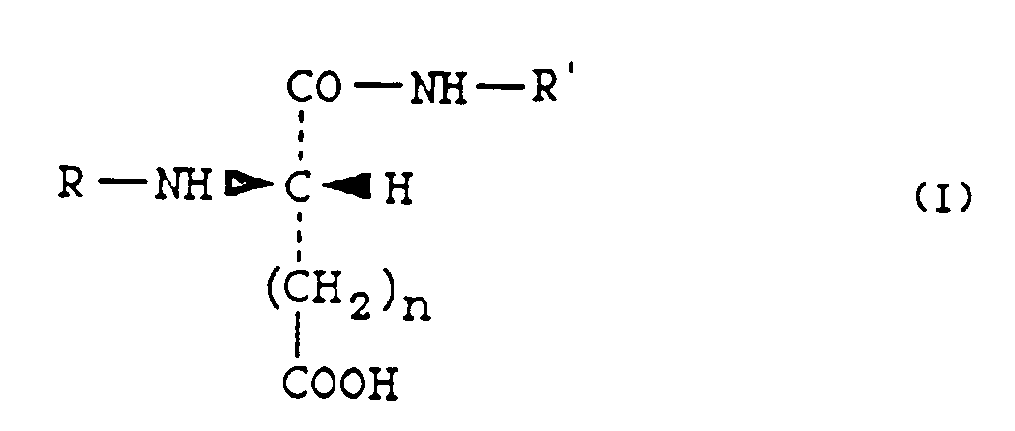


Priority Applications (1)
| Application Number | Priority Date | Filing Date | Title |
|---|---|---|---|
| AT90916313T ATE99886T1 (de) | 1989-10-24 | 1990-10-24 | Aus l-asparagine- oder l-glutaminesaeure abgeleiteter suesstoff und verfahren zur herstellung. |
Applications Claiming Priority (2)
| Application Number | Priority Date | Filing Date | Title |
|---|---|---|---|
| FR8914236A FR2653303B1 (fr) | 1989-10-24 | 1989-10-24 | Agents edulcorants de grande stabilite derivant des acides l-aspartique et l-glutamique n-hydrocarbones 1-oxo-2-ramifies. |
| FR8914236 | 1989-10-24 |
Publications (2)
| Publication Number | Publication Date |
|---|---|
| EP0500629A1 EP0500629A1 (fr) | 1992-09-02 |
| EP0500629B1 true EP0500629B1 (fr) | 1994-01-12 |
Family
ID=9386935
Family Applications (1)
| Application Number | Title | Priority Date | Filing Date |
|---|---|---|---|
| EP90916313A Expired - Lifetime EP0500629B1 (fr) | 1989-10-24 | 1990-10-24 | Agent edulcorant derivant de l'acide l-aspartique ou l-glutamique; son procede de preparation |
Country Status (22)
| Country | Link |
|---|---|
| US (4) | US5196540A (fr) |
| EP (1) | EP0500629B1 (fr) |
| JP (1) | JP2554961B2 (fr) |
| CN (1) | CN1027812C (fr) |
| AR (1) | AR246258A1 (fr) |
| AT (1) | ATE99886T1 (fr) |
| AU (1) | AU649243B2 (fr) |
| CA (1) | CA2070421C (fr) |
| DE (1) | DE69006037T2 (fr) |
| DK (1) | DK0500629T3 (fr) |
| ES (1) | ES2062566T3 (fr) |
| FR (1) | FR2653303B1 (fr) |
| IE (1) | IE64855B1 (fr) |
| IL (1) | IL96087A (fr) |
| LT (1) | LT3724B (fr) |
| MX (1) | MX22991A (fr) |
| NO (1) | NO304254B1 (fr) |
| NZ (1) | NZ235805A (fr) |
| PT (1) | PT95645B (fr) |
| RU (1) | RU2053239C1 (fr) |
| WO (1) | WO1991006224A1 (fr) |
| ZA (1) | ZA908472B (fr) |
Families Citing this family (14)
| Publication number | Priority date | Publication date | Assignee | Title |
|---|---|---|---|---|
| FR2653303B1 (fr) * | 1989-10-24 | 1992-09-18 | Noffre Claude | Agents edulcorants de grande stabilite derivant des acides l-aspartique et l-glutamique n-hydrocarbones 1-oxo-2-ramifies. |
| FR2675667B1 (fr) * | 1991-04-23 | 1993-08-20 | Claude Nofre | Agent edulcorant derivant a l'acide l-aspartique ou l-glutamique; son procede de preparation. |
| FR2690315B1 (fr) * | 1992-04-22 | 1994-07-22 | Nofre Claude | Agent edulcorant derivant de l'acide l-aspartique et son procede de preparation. |
| FR2697844B1 (fr) * | 1992-11-12 | 1995-01-27 | Claude Nofre | Nouveaux composés dérivés de dipeptides ou d'analogues dipeptidiques utiles comme agents édulcorants, leur procédé de préparation. |
| JPH11169132A (ja) * | 1997-12-15 | 1999-06-29 | Ajinomoto Co Inc | アスパルテームとアスパルテーム誘導体の混晶及びその製造方法 |
| JP3646497B2 (ja) * | 1997-12-22 | 2005-05-11 | 味の素株式会社 | 顆粒状甘味料 |
| JP3648959B2 (ja) * | 1997-12-22 | 2005-05-18 | 味の素株式会社 | 甘味料組成物 |
| KR100583547B1 (ko) * | 1998-04-09 | 2006-05-26 | 아지노모토 가부시키가이샤 | 아스파르틸 디펩타이드 에스테르 유도체, 이를 포함하는 감미제 및 당해 감미제를 포함하는 식품 |
| AU7822398A (en) * | 1998-06-05 | 1999-12-20 | Wm. Wrigley Jr. Company | Method of controlling release of n-substituted derivatives of aspartame in chewing gum and gum produced thereby |
| US6692778B2 (en) * | 1998-06-05 | 2004-02-17 | Wm. Wrigley Jr. Company | Method of controlling release of N-substituted derivatives of aspartame in chewing gum |
| IL139657A0 (en) * | 1998-06-26 | 2002-02-10 | Ajinomoto Kk | Novel aspartyl dipeptide ester derivatives and sweeteners |
| SK3682001A3 (en) * | 1998-09-18 | 2001-10-08 | Ajinomoto Kk | N-alkylaspartyldipeptide ester derivatives and sweeteners |
| DE60133928D1 (de) * | 2000-11-17 | 2008-06-19 | Tate & Lyle Technology Ltd | Schmelzbare sucralosezusammensetzung |
| AU2006215703A1 (en) * | 2005-02-17 | 2006-08-24 | Instituto Del Metabolismo Celular, S.L. | L-aspartic acid for the treatment of problems in connection with the fat or glucose metabolism |
Family Cites Families (16)
| Publication number | Priority date | Publication date | Assignee | Title |
|---|---|---|---|---|
| US3775460A (en) * | 1970-10-16 | 1973-11-27 | American Home Prod | L-3-amino-4'-cyanosuccinanilic acid |
| US3818077A (en) * | 1970-10-16 | 1974-06-18 | American Home Prod | L-aspartic acid derivatives |
| US3725453A (en) * | 1970-10-16 | 1973-04-03 | American Home Prod | L-4{40 -cyano-3-(2,2,2-trihaloacetamido) succinanilic acids |
| US3814747A (en) * | 1970-10-16 | 1974-06-04 | American Home Prod | N-trihaloacetyl aspartic acid dipeptide ester sweetening agents |
| US3769333A (en) * | 1972-08-07 | 1973-10-30 | American Home Prod | L-aspartic acid derivatives |
| FR2533210A1 (fr) * | 1982-09-17 | 1984-03-23 | Lyon I Universite Claude | Edulcorants de synthese |
| FR2579201B1 (fr) * | 1985-03-19 | 1987-05-07 | Bernard Lyon I Universite Clau | Composes chimiques perfectionnes, utilisation comme agents edulcorants et compositions contenant de tels agents |
| JPS62132847A (ja) * | 1985-12-03 | 1987-06-16 | Ajinomoto Co Inc | 新規アミノ酸誘導体および甘味剤組成物 |
| JPS62132863A (ja) * | 1985-12-03 | 1987-06-16 | Ajinomoto Co Inc | 新規アミノ酸誘導体および甘味剤 |
| JPS62252754A (ja) * | 1986-04-24 | 1987-11-04 | Ajinomoto Co Inc | 新規アミノ酸誘導体および甘味剤組成物 |
| US4820506A (en) * | 1987-05-01 | 1989-04-11 | Research Foundation, State University Of New York | Salivary stimulant |
| FR2624698A1 (fr) * | 1987-12-18 | 1989-06-23 | Bernard Lyon I Universite Clau | Derives heterocycliques de n-carbamoyl-, n-thiocarbamoyl- ou n-amidino-aminomalonyl ou aminosuccinyl amides utiles comme agents edulcorants |
| FR2624699B1 (fr) * | 1987-12-18 | 1990-04-13 | Bernard Lyon I Universite Clau | Derives heterocycliques de n-carbamoyl-, n-thiocarbamoyl- ou n-amidino-glycine ou beta-alanine utiles comme agents edulcorants |
| FR2630304B1 (fr) * | 1988-04-22 | 1990-08-31 | Bernard Lyon I Universite Clau | Derives n-hydrocarbones des acides aspartique et glutamique alpha-monoamides utiles comme agents edulcorants |
| JPH0688418B2 (ja) | 1988-08-16 | 1994-11-09 | 富士通株式会社 | ムービングコイル式印字ヘッド |
| FR2653303B1 (fr) * | 1989-10-24 | 1992-09-18 | Noffre Claude | Agents edulcorants de grande stabilite derivant des acides l-aspartique et l-glutamique n-hydrocarbones 1-oxo-2-ramifies. |
-
1989
- 1989-10-24 FR FR8914236A patent/FR2653303B1/fr not_active Expired - Lifetime
-
1990
- 1990-10-22 PT PT95645A patent/PT95645B/pt not_active IP Right Cessation
- 1990-10-23 ZA ZA908472A patent/ZA908472B/xx unknown
- 1990-10-23 AR AR90318160A patent/AR246258A1/es active
- 1990-10-23 IE IE381290A patent/IE64855B1/en not_active IP Right Cessation
- 1990-10-23 IL IL9608790A patent/IL96087A/en not_active IP Right Cessation
- 1990-10-23 US US07/601,623 patent/US5196540A/en not_active Expired - Fee Related
- 1990-10-24 EP EP90916313A patent/EP0500629B1/fr not_active Expired - Lifetime
- 1990-10-24 RU SU905011983A patent/RU2053239C1/ru active
- 1990-10-24 AU AU70401/91A patent/AU649243B2/en not_active Ceased
- 1990-10-24 MX MX2299190A patent/MX22991A/es unknown
- 1990-10-24 AT AT90916313T patent/ATE99886T1/de active
- 1990-10-24 JP JP2515171A patent/JP2554961B2/ja not_active Expired - Lifetime
- 1990-10-24 WO PCT/FR1990/000765 patent/WO1991006224A1/fr not_active Ceased
- 1990-10-24 CA CA002070421A patent/CA2070421C/fr not_active Expired - Fee Related
- 1990-10-24 NZ NZ235805A patent/NZ235805A/xx unknown
- 1990-10-24 ES ES90916313T patent/ES2062566T3/es not_active Expired - Lifetime
- 1990-10-24 DK DK90916313.1T patent/DK0500629T3/da active
- 1990-10-24 DE DE90916313T patent/DE69006037T2/de not_active Expired - Fee Related
- 1990-10-24 CN CN90108611A patent/CN1027812C/zh not_active Expired - Fee Related
-
1992
- 1992-04-23 NO NO921580A patent/NO304254B1/no not_active IP Right Cessation
-
1993
- 1993-01-11 US US08/002,975 patent/US5310908A/en not_active Expired - Fee Related
- 1993-01-11 US US08/002,987 patent/US5374733A/en not_active Expired - Fee Related
- 1993-10-15 LT LTIP1406A patent/LT3724B/lt not_active IP Right Cessation
-
1994
- 1994-03-15 US US08/212,982 patent/US5430182A/en not_active Expired - Fee Related
Non-Patent Citations (1)
| Title |
|---|
| PATENT ABSTRACTS OF JAPAN, vol.11, no. 361 (C-459)(2808), 25 November 1987, & JP-A-62 132847 * |
Also Published As
Similar Documents
| Publication | Publication Date | Title |
|---|---|---|
| EP0669935B1 (fr) | Composes utiles comme agents edulcorants, leur procede de preparation | |
| CA1244007A (fr) | Procede pour la preparation d'edulcorants de preparation synthese, les edulcorants ainsi obtenus ainsi que leurs applications a la preparation de substances consommables sucrees | |
| EP0195731B1 (fr) | Nouveaux agents édulcorants, procédé pour édulcorer des produits divers et compositions contenant de tels agents édulcorants | |
| FR2624699A1 (fr) | Derives heterocycliques de n-carbamoyl-, n-thiocarbamoyl- ou n-amidino-glycine ou beta-alanine utiles comme agents edulcorants | |
| WO1991006224A1 (fr) | Agent edulcorant derivant de l'acide l-aspartique ou l-glutamique; son procede de preparation | |
| CA1263404A (fr) | PROCEDE POUR LA PREPARATION DE EDULCORANTS DERIVANT DE LA GLYCINE ET DE LA .beta.-ALANINE ET PROCEDE POUR EDULCORER DES PRODUITS DIVERS AVEC DE TELS AGENTS EDULCORANTS | |
| EP0321368A1 (fr) | Edulcorants dérivés hétérocycliques de N-carbamoyl-, N-thiocarbamoyl- ou N-amidino-aminomalonyl ou aminosuccinyl amides | |
| EP0338946B1 (fr) | Agents édulcorants dérivant des acides L-aspartique et L-glutamique N-hydrocarbonés | |
| FR2675667A1 (fr) | Agent edulcorant derivant a l'acide l-aspartique ou l-glutamique; son procede de preparation. | |
| FR2719591A1 (fr) | Nouveau composé utile comme agent édulcorant, son procédé de préparation. | |
| EP0879243B1 (fr) | Acide n-(3,3-dimethylbutyl)-l-aspartyl-d-alpha-aminoalcanoique n-(s)-1-phenyl-1-alcanamide utile comme agent edulcorant | |
| FR2719592A1 (fr) | Nouveaux dérivés dipeptidiques utiles comme agents édulcorants. | |
| EP0805799A1 (fr) | NOUVEAUX AGENTS EDULCORANTS DERIVANT DES ACIDES N-(4-CYANOPHENYLCARBAMOYL OU 2-CYANOPYRID-5-YLCARBAMOYL)-L-ASPARTIQUE OU L-GLUTAMIQUE $g(a)-BENZENAMIDES 3,4-DISUBSTITUES | |
| FR2690315A1 (fr) | Agent édulcorant dérivant de l'acide L-aspartique et son procédé de préparation. | |
| WO1997027178A1 (fr) | NOUVEAUX AGENTS EDULCORANTS DERIVANT DE L'ACIDE N-(4-CYANOPHENYLCARBAMOYL OU 2-CYANOPYRID-5-YLCARBAMOYL)-L-ASPARTIQUE α-BENZENAMIDE 3-MONOSUBSTITUE | |
| FR2597096A1 (fr) | Nouveaux composes chimiques derivant de l'acide phenylguanidinoacetique et leur utilisation comme agents edulcorants | |
| FR2608379A1 (fr) | Agents edulcorants derives des acides n-phenylguanidinoacetique et n-phenylethanamidinoacetique, procede pour edulcorer des produits divers, et compositions contenant de tels agents edulcorants |
Legal Events
| Date | Code | Title | Description |
|---|---|---|---|
| PUAI | Public reference made under article 153(3) epc to a published international application that has entered the european phase |
Free format text: ORIGINAL CODE: 0009012 |
|
| 17P | Request for examination filed |
Effective date: 19920408 |
|
| AK | Designated contracting states |
Kind code of ref document: A1 Designated state(s): AT BE CH DE DK ES FR GB GR IT LI LU NL SE |
|
| 17Q | First examination report despatched |
Effective date: 19930218 |
|
| GRAA | (expected) grant |
Free format text: ORIGINAL CODE: 0009210 |
|
| AK | Designated contracting states |
Kind code of ref document: B1 Designated state(s): AT BE CH DE DK ES FR GB GR IT LI LU NL SE |
|
| REF | Corresponds to: |
Ref document number: 99886 Country of ref document: AT Date of ref document: 19940115 Kind code of ref document: T |
|
| ITF | It: translation for a ep patent filed | ||
| GBT | Gb: translation of ep patent filed (gb section 77(6)(a)/1977) |
Effective date: 19940125 |
|
| REF | Corresponds to: |
Ref document number: 69006037 Country of ref document: DE Date of ref document: 19940224 |
|
| REG | Reference to a national code |
Ref country code: DK Ref legal event code: T3 |
|
| REG | Reference to a national code |
Ref country code: GR Ref legal event code: FG4A Free format text: 3011403 |
|
| PLBE | No opposition filed within time limit |
Free format text: ORIGINAL CODE: 0009261 |
|
| STAA | Information on the status of an ep patent application or granted ep patent |
Free format text: STATUS: NO OPPOSITION FILED WITHIN TIME LIMIT |
|
| REG | Reference to a national code |
Ref country code: ES Ref legal event code: FG2A Ref document number: 2062566 Country of ref document: ES Kind code of ref document: T3 |
|
| 26N | No opposition filed | ||
| EAL | Se: european patent in force in sweden |
Ref document number: 90916313.1 |
|
| PGFP | Annual fee paid to national office [announced via postgrant information from national office to epo] |
Ref country code: NL Payment date: 20000918 Year of fee payment: 11 Ref country code: DK Payment date: 20000918 Year of fee payment: 11 Ref country code: AT Payment date: 20000918 Year of fee payment: 11 |
|
| PGFP | Annual fee paid to national office [announced via postgrant information from national office to epo] |
Ref country code: SE Payment date: 20000919 Year of fee payment: 11 |
|
| PGFP | Annual fee paid to national office [announced via postgrant information from national office to epo] |
Ref country code: DE Payment date: 20001014 Year of fee payment: 11 |
|
| PGFP | Annual fee paid to national office [announced via postgrant information from national office to epo] |
Ref country code: ES Payment date: 20001016 Year of fee payment: 11 |
|
| PGFP | Annual fee paid to national office [announced via postgrant information from national office to epo] |
Ref country code: GB Payment date: 20001017 Year of fee payment: 11 |
|
| PGFP | Annual fee paid to national office [announced via postgrant information from national office to epo] |
Ref country code: CH Payment date: 20001018 Year of fee payment: 11 |
|
| PGFP | Annual fee paid to national office [announced via postgrant information from national office to epo] |
Ref country code: GR Payment date: 20001023 Year of fee payment: 11 |
|
| PGFP | Annual fee paid to national office [announced via postgrant information from national office to epo] |
Ref country code: LU Payment date: 20001027 Year of fee payment: 11 |
|
| PGFP | Annual fee paid to national office [announced via postgrant information from national office to epo] |
Ref country code: FR Payment date: 20001031 Year of fee payment: 11 |
|
| PGFP | Annual fee paid to national office [announced via postgrant information from national office to epo] |
Ref country code: BE Payment date: 20001108 Year of fee payment: 11 |
|
| PG25 | Lapsed in a contracting state [announced via postgrant information from national office to epo] |
Ref country code: LU Free format text: LAPSE BECAUSE OF NON-PAYMENT OF DUE FEES Effective date: 20011024 Ref country code: GB Free format text: LAPSE BECAUSE OF NON-PAYMENT OF DUE FEES Effective date: 20011024 Ref country code: DK Free format text: LAPSE BECAUSE OF NON-PAYMENT OF DUE FEES Effective date: 20011024 Ref country code: AT Free format text: LAPSE BECAUSE OF NON-PAYMENT OF DUE FEES Effective date: 20011024 |
|
| PG25 | Lapsed in a contracting state [announced via postgrant information from national office to epo] |
Ref country code: SE Free format text: LAPSE BECAUSE OF NON-PAYMENT OF DUE FEES Effective date: 20011025 Ref country code: ES Free format text: LAPSE BECAUSE OF NON-PAYMENT OF DUE FEES Effective date: 20011025 |
|
| PG25 | Lapsed in a contracting state [announced via postgrant information from national office to epo] |
Ref country code: LI Free format text: LAPSE BECAUSE OF NON-PAYMENT OF DUE FEES Effective date: 20011031 Ref country code: GR Free format text: LAPSE BECAUSE OF NON-PAYMENT OF DUE FEES Effective date: 20011031 Ref country code: CH Free format text: LAPSE BECAUSE OF NON-PAYMENT OF DUE FEES Effective date: 20011031 Ref country code: BE Free format text: LAPSE BECAUSE OF NON-PAYMENT OF DUE FEES Effective date: 20011031 |
|
| REG | Reference to a national code |
Ref country code: GB Ref legal event code: IF02 |
|
| BERE | Be: lapsed |
Owner name: CLAUDE Effective date: 20011031 |
|
| PG25 | Lapsed in a contracting state [announced via postgrant information from national office to epo] |
Ref country code: NL Free format text: LAPSE BECAUSE OF NON-PAYMENT OF DUE FEES Effective date: 20020501 |
|
| EUG | Se: european patent has lapsed |
Ref document number: 90916313.1 |
|
| GBPC | Gb: european patent ceased through non-payment of renewal fee |
Effective date: 20011024 |
|
| REG | Reference to a national code |
Ref country code: CH Ref legal event code: PL |
|
| REG | Reference to a national code |
Ref country code: DK Ref legal event code: EBP |
|
| PG25 | Lapsed in a contracting state [announced via postgrant information from national office to epo] |
Ref country code: FR Free format text: LAPSE BECAUSE OF NON-PAYMENT OF DUE FEES Effective date: 20020628 |
|
| NLV4 | Nl: lapsed or anulled due to non-payment of the annual fee |
Effective date: 20020501 |
|
| PG25 | Lapsed in a contracting state [announced via postgrant information from national office to epo] |
Ref country code: DE Free format text: LAPSE BECAUSE OF NON-PAYMENT OF DUE FEES Effective date: 20020702 |
|
| REG | Reference to a national code |
Ref country code: FR Ref legal event code: ST |
|
| REG | Reference to a national code |
Ref country code: ES Ref legal event code: FD2A Effective date: 20021113 |
|
| PG25 | Lapsed in a contracting state [announced via postgrant information from national office to epo] |
Ref country code: IT Free format text: LAPSE BECAUSE OF NON-PAYMENT OF DUE FEES;WARNING: LAPSES OF ITALIAN PATENTS WITH EFFECTIVE DATE BEFORE 2007 MAY HAVE OCCURRED AT ANY TIME BEFORE 2007. THE CORRECT EFFECTIVE DATE MAY BE DIFFERENT FROM THE ONE RECORDED. Effective date: 20051024 |