EP0501708B1 - Méthode pour l'enlèvement combiné et la destruction d'ions nitrate - Google Patents
Méthode pour l'enlèvement combiné et la destruction d'ions nitrate Download PDFInfo
- Publication number
- EP0501708B1 EP0501708B1 EP92301500A EP92301500A EP0501708B1 EP 0501708 B1 EP0501708 B1 EP 0501708B1 EP 92301500 A EP92301500 A EP 92301500A EP 92301500 A EP92301500 A EP 92301500A EP 0501708 B1 EP0501708 B1 EP 0501708B1
- Authority
- EP
- European Patent Office
- Prior art keywords
- compartment
- nitrate
- cell
- nitrate ions
- anode
- Prior art date
- Legal status (The legal status is an assumption and is not a legal conclusion. Google has not performed a legal analysis and makes no representation as to the accuracy of the status listed.)
- Expired - Lifetime
Links
Images

Classifications
-
- C—CHEMISTRY; METALLURGY
- C02—TREATMENT OF WATER, WASTE WATER, SEWAGE, OR SLUDGE
- C02F—TREATMENT OF WATER, WASTE WATER, SEWAGE, OR SLUDGE
- C02F1/00—Treatment of water, waste water, or sewage
- C02F1/46—Treatment of water, waste water, or sewage by electrochemical methods
- C02F1/461—Treatment of water, waste water, or sewage by electrochemical methods by electrolysis
- C02F1/467—Treatment of water, waste water, or sewage by electrochemical methods by electrolysis by electrochemical disinfection; by electrooxydation or by electroreduction
-
- B—PERFORMING OPERATIONS; TRANSPORTING
- B01—PHYSICAL OR CHEMICAL PROCESSES OR APPARATUS IN GENERAL
- B01J—CHEMICAL OR PHYSICAL PROCESSES, e.g. CATALYSIS OR COLLOID CHEMISTRY; THEIR RELEVANT APPARATUS
- B01J47/00—Ion-exchange processes in general; Apparatus therefor
- B01J47/02—Column or bed processes
- B01J47/06—Column or bed processes during which the ion-exchange material is subjected to a physical treatment, e.g. heat, electric current, irradiation or vibration
- B01J47/08—Column or bed processes during which the ion-exchange material is subjected to a physical treatment, e.g. heat, electric current, irradiation or vibration subjected to a direct electric current
-
- B—PERFORMING OPERATIONS; TRANSPORTING
- B01—PHYSICAL OR CHEMICAL PROCESSES OR APPARATUS IN GENERAL
- B01J—CHEMICAL OR PHYSICAL PROCESSES, e.g. CATALYSIS OR COLLOID CHEMISTRY; THEIR RELEVANT APPARATUS
- B01J49/00—Regeneration or reactivation of ion-exchangers; Apparatus therefor
- B01J49/30—Electrical regeneration
-
- C—CHEMISTRY; METALLURGY
- C02—TREATMENT OF WATER, WASTE WATER, SEWAGE, OR SLUDGE
- C02F—TREATMENT OF WATER, WASTE WATER, SEWAGE, OR SLUDGE
- C02F1/00—Treatment of water, waste water, or sewage
- C02F1/42—Treatment of water, waste water, or sewage by ion-exchange
-
- C—CHEMISTRY; METALLURGY
- C02—TREATMENT OF WATER, WASTE WATER, SEWAGE, OR SLUDGE
- C02F—TREATMENT OF WATER, WASTE WATER, SEWAGE, OR SLUDGE
- C02F1/00—Treatment of water, waste water, or sewage
- C02F1/46—Treatment of water, waste water, or sewage by electrochemical methods
- C02F1/461—Treatment of water, waste water, or sewage by electrochemical methods by electrolysis
- C02F1/467—Treatment of water, waste water, or sewage by electrochemical methods by electrolysis by electrochemical disinfection; by electrooxydation or by electroreduction
- C02F1/4676—Treatment of water, waste water, or sewage by electrochemical methods by electrolysis by electrochemical disinfection; by electrooxydation or by electroreduction by electroreduction
-
- C—CHEMISTRY; METALLURGY
- C02—TREATMENT OF WATER, WASTE WATER, SEWAGE, OR SLUDGE
- C02F—TREATMENT OF WATER, WASTE WATER, SEWAGE, OR SLUDGE
- C02F2101/00—Nature of the contaminant
- C02F2101/10—Inorganic compounds
- C02F2101/16—Nitrogen compounds, e.g. ammonia
- C02F2101/163—Nitrates
-
- C—CHEMISTRY; METALLURGY
- C02—TREATMENT OF WATER, WASTE WATER, SEWAGE, OR SLUDGE
- C02F—TREATMENT OF WATER, WASTE WATER, SEWAGE, OR SLUDGE
- C02F2201/00—Apparatus for treatment of water, waste water or sewage
- C02F2201/46—Apparatus for electrochemical processes
- C02F2201/461—Electrolysis apparatus
- C02F2201/46105—Details relating to the electrolytic devices
- C02F2201/46115—Electrolytic cell with membranes or diaphragms
-
- C—CHEMISTRY; METALLURGY
- C02—TREATMENT OF WATER, WASTE WATER, SEWAGE, OR SLUDGE
- C02F—TREATMENT OF WATER, WASTE WATER, SEWAGE, OR SLUDGE
- C02F2201/00—Apparatus for treatment of water, waste water or sewage
- C02F2201/46—Apparatus for electrochemical processes
- C02F2201/461—Electrolysis apparatus
- C02F2201/46105—Details relating to the electrolytic devices
- C02F2201/4612—Controlling or monitoring
- C02F2201/46145—Fluid flow
Definitions
- the present invention relates to a method for the combined removal and destruction of nitrate ions, and, in particular, to a method in which the removal and destruction of nitrate ions from aqueous solutions is carried out by electrochemical ion exchange.
- Nitrate is an increasingly important species in water, particularly in cases where the water is extracted for human consumption. High nitrate levels, particularly in excess of 50ppm, in drinking water have been thought to be responsible for the incidence of "Blue Baby Syndrome” and more speculatively, for increased incidence of stomach cancer. As a result interest is focusing on finding methods of removing nitrate from water, particularly for the treatment of potable water sources.
- nitrate ions are removed from the water on an anion exchange resin, which is periodically regenerated with appropriate chemicals, most notably brine (sodium chloride).
- appropriate chemicals most notably brine (sodium chloride).
- brine sodium chloride
- nitrate selective ion exchange resins which have special functional groups e.g. quaternary ethyl ammonium.
- An example of such a resin is Purolite A 520.
- Nitrate ions are capable of being destroyed by electrochemical processes, because nitrate can be converted by oxidative and reductive processes into harmless constituents such as water, nitrogen and oxygen as described in US-A-3,542,657. It is also known that anions migrate through anion-selective membranes under the influence of an electric current. The process of migrating ions through membranes into a separate compartment in which electrode reactions are taking place is termed "electrodialysis".
- electrodialysis the disadvantage of electrodialysis is that the percentage of unwanted ions removed on any pass through the cell is usually quite low, which leads to the requirement for recirculation, complexity of equipment and poor economics.
- one aspect of the present invention provides a method for the combined removal and destruction of nitrate ions in an electrochemical cell which comprises an anode compartment containing electrolyte and an anode, a cathode compartment containing electrolyte and a cathode and a central compartment containing an anion exchange resin, the central compartment being separated from the anode compartment and the cathode compartment by an anion permeable membrane, which method comprises the steps of
- the aqueous solution containing the nitrate ions is passed through the anion exchange resin where the nitrate ions are removed from the solution.
- Any anion exchange resin may be used in the method of the invention but preferably a strong base type anion exchange resin or a nitrate selective resin in used.
- An example of a strong base type anion exchange resin is Amberlite IRA-400, whilst an example of a nitrate selective resin is Purolite A520.
- Other anion exchange resins for use in the method of the invention are well known to those skilled in the art.
- step (i)(b) a spent ion exchange resin loaded with nitrate ions is passed through the central compartment of the electrochemical cell in a continuous manner with the treated resin being removed from the bottom of the cell.
- step (ii) of the method of the invention an electric current is passed through the cell in order to cause the nitrate ions which have been captured on the anion exchange resin to migrate into the anode compartment of the cell by electrodialysis.
- step (iii) of the method of the invention the nitrate ions in the electrolyte are destroyed by subjecting them to reduction and oxidation reactions to form nitrogen and water.
- the nitrate ions migrate into the anode compartment of the cell, whilst the first step in the destruction of the nitrate ions is the reduction to nitrogen or ammonia.
- the solution containing the nitrate ions must thus be subjected to cathodic reduction. Any ammonia which is produced must be oxidised at the anode to form nitrogen according to one of the equations detailed above.
- the most preferred method of operating the present invention is in relation to the treatment of an aqueous solution containing nitrate ions and the following description is specifically directed to this embodiment of the invention.
- on-line There are two main ways of operating an electrochemical cell in accordance with the method of the invention and these will be referred to as “on-line” and “off-line”.
- On-line operation the aqueous solution containing nitrate ions flows through the central compartment of the electrolytic cell and an electric current flows between the anode and the cathode, which causes the nitrate ions collected on the anion exchange resin to migrate through the anion permeable membrane into the anode compartment.
- the electrolyte in the anode and cathode compartments is preferably recirculated so that the collected nitrate is then subject to the reduction and oxidation reactions detailed above until the nitrogen escapes in the form of a gaseous product.
- anions in the water collect in the anode and cathode compartments and build up to the point where they are in chemical balance.
- An alternative to recirculating the anode and cathode compartment solutions is to place an auxiliary cathode in the anode compartment. This auxiliary cathode effects the first stage reduction of the nitrate ions which migrate into the anode compartment by electrodialysis and the ammonia so produced is then subjected to anodic oxidation to form nitrogen.
- Efficient reduction may be achieved by the passage of the solution along a tortuous path through one or more bipolar cells, for example as described in US-A-3542657.
- a cell for such reduction can be placed in the recirculating anode solution or in a system which recirculates the anolyte and the catholyte.
- the nitrate is collected during a loading cycle in which the aqueous solution passes through the central compartment of the electrolytic cell without the passage of electric current. Subsequently, the nitrate is removed in a regeneration cycle in which no aqueous solution passes through the central compartment of the cell but an electric current is passed through the cell in order to cause the collected nitrate ions to migrate from the anion exchange resin into the anode compartment of the cell. The destruction of the nitrate ion is effected in the manner as previously described.
- the main advantage of the method of the present invention is that it produces no waste requiring disposal. Furthermore, the "on-line" system requires less operator attention than a batch treatment technology and, because there is no collection of nitrate in the system, there is no possibility of an elution band due to maloperation, which in conventional systems can lead to nitrate levels in the outlet water massively exceeding the input nitrate levels for a period of time.
- regenerant solutions from conventional ion exchange treatment An important use for this invention is the treatment of regenerant solutions from conventional ion exchange treatment.
- a conventional anion exchange resin is used to treat the raw water, and when fully loaded with nitrate ions the resin is regenerated, for example with brine or sodium bicarbonate.
- the regenerant solution is then treated by the process of the present invention to remove and destroy nitrate.
- the regenerant is then recycled for further regeneration duty.
- Another application of the process is the direct treatment of nitrate-loaded ion exchange resin.
- the ion exchange resin rather than an aqueous solution, passes through the central compartment of the electrochemical cell.
- the regenerated resin is then recovered from the bottom outlet of the cell.
- the electrochemical cell used in the present invention may be fabricated according to techniques well known in the art.
- the cathode may be any material which is a good cathode material for the reduction of nitrogen, such as copper, stainless steel or nickel.
- the anode may be a precious metal such as platinum or a more standard anode such as ruthenium dioxide coated titanium.
- anion permeable membrane may be used to separate the central compartment containing the anion exchange membrane from the cathode and anode compartments of the cell.
- the anion exchange membrane is preferably a fluorinated anion exchange membrane such as that which is available from Tosoh Corporation of Japan under the name TOSFLEX.
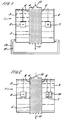
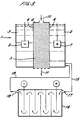
- an electrochemical cell is generally illustrated at 1.
- the electrochemical cell comprises an anode compartment 2, a cathode compartment 3 and a central compartment 4.
- the central compartment 4 is filled with an anionic exchange resin 5 and separated from the anode and cathode compartments by an anion permeable membrane 6.
- An anode 7 is positioned in the anode compartment and a cathode 8 in the cathode compartment.
- the aqueous solution containing the nitrate ions which is to be treated is fed to the central compartment containing the anion exchange membrane via an inlet 10.
- an anion exchange resin loaded with nitrate as may be fed into the central compartment via inlet 10.
- the treated solution or treated anion exchange resin exits via the bottom of the central compartment as shown at 11.
- the electrolyte in the cathode compartment and the electrolyte in the anode compartment are recirculated, a recirculation pipe 12 taking electrolyte from the cathode compartment to the anode compartment and a recirculation pipe 13 taking electrolyte from the anode compartment to the cathode compartment.
- a recirculation pipe 12 taking electrolyte from the cathode compartment to the anode compartment
- a recirculation pipe 13 taking electrolyte from the anode compartment to the cathode compartment.
- an auxiliary cathode 14 is positioned in the anode compartment.
- the auxiliary cathode is thus able to effect the electrolytic reduction of the nitrate ion, whilst the anode effects the oxidation of the ammonia produced in the reduction reaction to form nitrogen.
- the electrolyte from the anode compartment is passed via line 15 into a bipolar cell 16 through inlet 17.
- the anolyte is then caused to travel along the tortuous path as indicated by the arrows and exits via outlet 18.
- the anolyte is then recirculated to the anode compartment of the cell via line 19.
- the electrolyte from the anode compartment is passed via line 15 into a bipolar cell 16 through inlet 17.
- the electrolyte is then caused to travel along the tortuous path as indicated by the arrows and exits via outlet 18.
- the electrolyte is returned to the cathode compartment 3 of the cell via line 20.
- the anode and cathode compartments of a cell as illustrated in Figure 1 were filled with 1M sodium carbonate/bicarbonate buffer solution adjusted to a pH of 8.4 to 8.9.
- the central compartment of the cell contained 40 ml of an anion exchange resin (Amberlite IRA-400) having 0.875 meq/ml measured capacity for nitrate. Repeated use of this resin had reduced the capacity slightly below the manufacturer's stated value (about 1 meq/ml).
- Sodium nitrate solution (10.4 litres, 0.01M) was passed through the central compartment of the cell at 650 ml/h. A current of 1.2 A was passed through the cell during the experiment (about 16 hours) with recirculation of the anode and cathode compartment solutions. Analysis of the fractions was by ion chromatography and selective ion electrode. The analysis was as follows:
- the resin removed 2.73 times its chemical capacity for nitrate in this experiment.
- nitrate was not extensively destroyed in this experiment because the cell was not optimised for destruction, and this also compromised efficiency because nitrate ions could pass out of the cathode compartment back into the resin.
- a cathode was placed in one half of a cell divided by a cation permeable membrane (to simulate the conditions in the cathode compartment, but to prevent escape of the nitrate), and a solution of sodium hydroxide and sodium nitrate (0.1M each) placed in the cathode compartment.
- the solution was electrolysed at 7 amps current for 1.5 hours. Analysis revealed that about two thirds of the nitrate had disappeared, and ammonia was detected in the final solution.
- the central compartment of a cell as described in Example 1 was loaded with 62 ml Purolite A 520 nitrate selective resin in place of the Amberlite IRA-400 resin.
- the Purolite resin had a stated capacity for nitrate of 1.0 meg/ml.
- a loading solution of 10 litres 0.01 M sodium nitrate was passed through the resin at 1.2L per hour. During loading the resin removed its full capacity of nitrate.
- After loading the resin was regenerated with 1.1A current for 4.5 hours using a sodium carbonate/bicarbonate buffer in the anode and cathode compartments as described in Example 1. There was no mixing of cathode and anode solutions in this experiment, and hence no nitrate destruction.
- the analysis was as follows:
Landscapes
- Chemical & Material Sciences (AREA)
- Chemical Kinetics & Catalysis (AREA)
- Organic Chemistry (AREA)
- General Chemical & Material Sciences (AREA)
- Life Sciences & Earth Sciences (AREA)
- Hydrology & Water Resources (AREA)
- Engineering & Computer Science (AREA)
- Environmental & Geological Engineering (AREA)
- Water Supply & Treatment (AREA)
- Electrochemistry (AREA)
- Water Treatment By Electricity Or Magnetism (AREA)
- Organic Low-Molecular-Weight Compounds And Preparation Thereof (AREA)
- Electrolytic Production Of Non-Metals, Compounds, Apparatuses Therefor (AREA)
- Solid-Sorbent Or Filter-Aiding Compositions (AREA)
- Electrical Discharge Machining, Electrochemical Machining, And Combined Machining (AREA)
Claims (10)
- Procédé pour le retrait et la destruction combinés des ions nitrate dans une cellule électrochimique qui comprend un compartiment anode contenant de l'électrolyte et une anode, un compartiment cathode contenant de l'électrolyte et une cathode et un compartiment central contenant une résine d'échange d'anions, le compartiment central étant séparé du compartiment anode et du compartiment cathode par une membrane perméable aux anions, lequel procédé comprend les étapes de(i) (a) soit le passage d'une solution aqueuse contenant des ions nitrate à travers la résine d'échange dons dans le compartiment central de la cellule, ou bien(i) (b) le passage d'une résine d'échange d'anions chargée d'ions nitrate à travers le compartiment central de la cellule électrochimique,(ii) le passage d'un courant électrique à travers la cellule afin que les ions nitrate capturés sur la résine d'échange d'anions migrent dans le compartiment anode de la cellule, et(iii) la destruction des ions nitrate en les soumettant aux réactions de réduction et d'oxydation pour former de l'azote et de l'oxygène ou de l'eau.
- Procédé comme revendiqué dans la revendication 1 où les étapes (i) (a) ou (i) (b) et (ii) du procédé sont réalisées simultanément.
- Procédé comme revendiqué dans la revendication 1 où les étapes (i) (a) ou (i) (b) et (ii) du procédé sont réalisées séquentiellement.
- Procédé comme revendiqué dans une quelconque des revendications précédentes où on fait recirculer l'électrolyte dans le compartiment anode et l'électrolyte dans le compartiment cathode afin de soumettre les ions nitrate aux réactions de réduction et d'oxydation.
- Procédé comme revendiqué dans une quelconque des revendications 1 à 3 où une cathode auxiliaire est incluse dans le compartiment anode afin de réaliser la réduction cathodique des ions nitrate.
- Procédé comme revendiqué dans une quelconque des revendications 1 à 3 où la réduction des ions nitrate est effectuée en faisant passer l'électrolyte contenant les ions nitrate par une cellule bipolaire.
- Procédé comme revendiqué dans une quelconque des revendications précédentes où la solution aqueuse traitée est de l'eau potable.
- Procédé comme revendiqué dans une quelconque des revendications 1 à 6 où la solution aqueuse traitée est la solution régénérante provenant d'une résine d'échange d'ions.
- Procédé comme revendiqué dans une quelconque des revendications précédentes où la cathode est faite de cuivre ou d'acier inoxydable.
- Procédé comme revendiqué dans une quelconque des revendications précédentes où l'anode est du titane recouvert de dioxyde de platine ou de ruthénium.
Applications Claiming Priority (2)
| Application Number | Priority Date | Filing Date | Title |
|---|---|---|---|
| GB9103851 | 1991-02-25 | ||
| GB919103851A GB9103851D0 (en) | 1991-02-25 | 1991-02-25 | Method for the combined removal and destruction of nitrate ions |
Publications (2)
| Publication Number | Publication Date |
|---|---|
| EP0501708A1 EP0501708A1 (fr) | 1992-09-02 |
| EP0501708B1 true EP0501708B1 (fr) | 1994-11-02 |
Family
ID=10690501
Family Applications (1)
| Application Number | Title | Priority Date | Filing Date |
|---|---|---|---|
| EP92301500A Expired - Lifetime EP0501708B1 (fr) | 1991-02-25 | 1992-02-24 | Méthode pour l'enlèvement combiné et la destruction d'ions nitrate |
Country Status (8)
| Country | Link |
|---|---|
| US (1) | US5306400A (fr) |
| EP (1) | EP0501708B1 (fr) |
| AT (1) | ATE113503T1 (fr) |
| CA (1) | CA2061723A1 (fr) |
| DE (1) | DE69200595T2 (fr) |
| DK (1) | DK0501708T3 (fr) |
| ES (1) | ES2065129T3 (fr) |
| GB (1) | GB9103851D0 (fr) |
Families Citing this family (24)
| Publication number | Priority date | Publication date | Assignee | Title |
|---|---|---|---|---|
| US5391268A (en) * | 1994-07-20 | 1995-02-21 | Olin Corporation | Electrochemical process for the removal of residual nitric acid from aqueous hydroxylammonium nitrate |
| WO1996038384A1 (fr) * | 1995-06-01 | 1996-12-05 | Upscale Technologies, Inc. | Procede et appareil pour eliminer les nitrates contenus dans l'eau |
| US5958196A (en) * | 1995-06-01 | 1999-09-28 | Upscale Water Technologies, Inc. | Planar carbon fiber and noble metal oxide electrodes and methods of making the same |
| JP3169831B2 (ja) * | 1995-11-30 | 2001-05-28 | 株式会社荏原製作所 | 水中の陰イオンの検出装置 |
| US6030520A (en) * | 1997-04-23 | 2000-02-29 | The Regents Of The University Of California | Nitrate reduction |
| GB2348209B (en) * | 1999-03-24 | 2001-05-09 | Ionex Ltd | Water purification process |
| US6281255B1 (en) * | 2000-06-06 | 2001-08-28 | Graver Technologies, Inc. | Methods for regeneration of weakly basic anion exchange resins with a combination of an alkali metal carbonate and an alkali metal bicarbonate |
| KR20030023640A (ko) | 2000-06-30 | 2003-03-19 | 허니웰 인터내셔널 인코포레이티드 | 금속처리방법, 그 방법에 사용되는 장치 및 그로부터제조된 금속 |
| ES2173035B2 (es) * | 2000-09-25 | 2003-09-16 | Emp Mun De Aguas Y Saneamiento | Procedimiento para la eliminacion y destruccion de nitrato del agua. |
| SE0004202L (sv) * | 2000-11-14 | 2002-05-07 | Vattenfall Ab | Förfarande och anordning för avlägsnande och destruktion av nitrater |
| JP3768128B2 (ja) * | 2001-09-04 | 2006-04-19 | 三洋電機株式会社 | 水処理装置 |
| JP3691461B2 (ja) * | 2002-02-13 | 2005-09-07 | 三洋電機株式会社 | 水浄化システム及び水浄化方法 |
| ES2266443T3 (es) * | 2002-03-01 | 2007-03-01 | Vattenfall Ab | Eliminacion de nitrato. |
| AU2004314343B2 (en) * | 2004-01-09 | 2008-06-26 | Applied Intellectual Capital Limited | Electrochemical nitrate destruction |
| JP4344668B2 (ja) | 2004-09-21 | 2009-10-14 | 株式会社 伊藤園 | 水性液の硝酸除去方法及び飲料の製造方法 |
| US7572369B2 (en) | 2007-02-16 | 2009-08-11 | Opencel Llc | System for supporting denitrification |
| GB201021701D0 (en) | 2010-12-22 | 2011-02-02 | Future Environmental Technologies Ltd | Carbon capture of greenhouse gases |
| GB201100475D0 (en) | 2011-01-12 | 2011-02-23 | Future Environmental Technologies Ltd | Conditioning cell |
| EP2675758B1 (fr) | 2011-02-14 | 2017-12-27 | Council of Scientific & Industrial Research | Procédé de coagulation électrochimique amélioré pour l'élimination des nitrates de l'eau potable |
| WO2016123443A1 (fr) | 2015-01-29 | 2016-08-04 | Trustees Of Boston University | Procédé et composition permettant de réduire les nitrates, les nitrites et/ou l'hydroxylamine dans l'eau à l'aide d'un complexe catalyseur homogène et réduit de ligand pinacolate fluoré tétrasubstitué par le cuivre |
| CN108751536B (zh) * | 2018-07-04 | 2021-05-04 | 南京大学 | 一种树脂与电化学集成脱除硝酸盐氮的废水深度处理装置 |
| CN108862472A (zh) * | 2018-07-04 | 2018-11-23 | 南京大学 | 一种离子交换树脂与电化学集成脱除硝酸盐氮的废水深度处理方法 |
| CN109761322B (zh) * | 2019-03-04 | 2021-11-09 | 杭州新坐标科技股份有限公司 | 一种水处理复合杀菌方法及其装置 |
| EP4165233A4 (fr) * | 2020-06-12 | 2024-06-12 | Pani Clean, Inc. | Systèmes et processus d'électrodialyse et d'électrolyse hybrides |
Family Cites Families (9)
| Publication number | Priority date | Publication date | Assignee | Title |
|---|---|---|---|---|
| GB776469A (en) * | 1953-12-17 | 1957-06-05 | Tno | Process and apparatus for the electrolytic deionisation of salt-containing liquids |
| GB815154A (en) * | 1956-02-20 | 1959-06-17 | Permutit Co Ltd | Improvements relating to electrodialysis processes |
| NL214802A (fr) * | 1956-02-22 | |||
| BE639843A (fr) * | 1963-04-30 | |||
| FR1547493A (fr) * | 1967-07-25 | 1968-11-29 | Perfectionnements apportés aux moyens pour enlever des ions d'une solution | |
| US3542657A (en) * | 1968-04-16 | 1970-11-24 | Hydronics Corp | Electrolytic reduction of nitrate from solutions of alkali metal hydroxides |
| US3893901A (en) * | 1973-12-04 | 1975-07-08 | Vast Associates Inc J | System for softening and dealkalizing water by electrodialysis |
| US4983267A (en) * | 1988-10-18 | 1991-01-08 | Innova/Pure Water, Inc. | Water deionization and contaminants removal or degradation |
| DE4027526A1 (de) * | 1990-08-31 | 1992-03-05 | K D Pharma Gmbh | Verfahren zum vermindern der konzentration einer loesung an einem bestimmten ion oder einer bestimmten gruppe von ionen |
-
1991
- 1991-02-25 GB GB919103851A patent/GB9103851D0/en active Pending
-
1992
- 1992-02-24 AT AT92301500T patent/ATE113503T1/de not_active IP Right Cessation
- 1992-02-24 DK DK92301500.2T patent/DK0501708T3/da active
- 1992-02-24 US US07/839,435 patent/US5306400A/en not_active Expired - Fee Related
- 1992-02-24 EP EP92301500A patent/EP0501708B1/fr not_active Expired - Lifetime
- 1992-02-24 DE DE69200595T patent/DE69200595T2/de not_active Expired - Fee Related
- 1992-02-24 CA CA002061723A patent/CA2061723A1/fr not_active Abandoned
- 1992-02-24 ES ES92301500T patent/ES2065129T3/es not_active Expired - Lifetime
Also Published As
| Publication number | Publication date |
|---|---|
| HK1005436A1 (en) | 1999-01-08 |
| US5306400A (en) | 1994-04-26 |
| ES2065129T3 (es) | 1995-02-01 |
| DK0501708T3 (da) | 1995-01-30 |
| EP0501708A1 (fr) | 1992-09-02 |
| CA2061723A1 (fr) | 1992-08-26 |
| ATE113503T1 (de) | 1994-11-15 |
| GB9103851D0 (en) | 1991-04-10 |
| DE69200595T2 (de) | 1995-05-04 |
| DE69200595D1 (de) | 1994-12-08 |
Similar Documents
| Publication | Publication Date | Title |
|---|---|---|
| US5306400A (en) | Method for the combined removal and destruction of nitrate ions | |
| EP0246070B1 (fr) | Procédé et appareil pour récupérer une composition de métal précieux | |
| US6896814B2 (en) | Fractional deionization process | |
| US5162076A (en) | Method for purification of acids from materials comprising acid and salt | |
| US5091070A (en) | Method of continuously removing and obtaining ethylene diamine tetracetic acid (edta) from the process water of electroless copper plating | |
| EP2949630B1 (fr) | Dispositif de récupération d'eau pour espace à système fermé | |
| US5804057A (en) | Method of removing metal salts from solution by electrolysis an electrode closely associated with an ion exchange resin | |
| AU2013284339A1 (en) | Process and apparatus for generating or recovering hydrochloric acid from metal salt solutions | |
| JP5386215B2 (ja) | 放射性廃液の処理方法および処理装置 | |
| GB2267290A (en) | A Process for the electrolytic destruction of nitrate in aqueous liquids | |
| US3766049A (en) | Recovery of metal from rinse solutions | |
| EP0474936A1 (fr) | Procédé électrochimique pour la purification des déchets contenant du chrome | |
| AU2004314343B2 (en) | Electrochemical nitrate destruction | |
| HUT71990A (en) | Method for electrochemical reduction of nitrate | |
| EP1480913B1 (fr) | Elimination de nitrates | |
| US3788960A (en) | Recycling of ion exchange regenerant chemicals | |
| US5832393A (en) | Method of treating chelating agent solution containing radioactive contaminants | |
| HK1005436B (en) | Method for the combined removal and destruction of nitrate ions | |
| EP0093435B1 (fr) | Purification et reconcentration électrolytique des solutions de soude caustique provenant de la régénération de résines d'échangeur d'ions par lavage et rinçage | |
| JPH08966A (ja) | 電気透析精製法 | |
| JP2003326264A (ja) | 有害物質の濃縮分解方法 | |
| JP3420697B2 (ja) | エタノールアミン含有水の処理方法 | |
| RU2650959C2 (ru) | Способ регенерации свободного цианида селективным окислением тиоцианатов | |
| JPH05261369A (ja) | 排超純水中の過酸化水素の除去方法 | |
| CA2026612A1 (fr) | Epuration electrochimique des dechets contenant du chrome |
Legal Events
| Date | Code | Title | Description |
|---|---|---|---|
| PUAI | Public reference made under article 153(3) epc to a published international application that has entered the european phase |
Free format text: ORIGINAL CODE: 0009012 |
|
| AK | Designated contracting states |
Kind code of ref document: A1 Designated state(s): AT BE CH DE DK ES FR GB GR IT LI LU NL PT SE |
|
| 17P | Request for examination filed |
Effective date: 19930210 |
|
| 17Q | First examination report despatched |
Effective date: 19940117 |
|
| GRAA | (expected) grant |
Free format text: ORIGINAL CODE: 0009210 |
|
| AK | Designated contracting states |
Kind code of ref document: B1 Designated state(s): AT BE CH DE DK ES FR GB GR IT LI LU NL PT SE |
|
| REF | Corresponds to: |
Ref document number: 113503 Country of ref document: AT Date of ref document: 19941115 Kind code of ref document: T |
|
| REF | Corresponds to: |
Ref document number: 69200595 Country of ref document: DE Date of ref document: 19941208 |
|
| ITF | It: translation for a ep patent filed | ||
| ET | Fr: translation filed | ||
| REG | Reference to a national code |
Ref country code: DK Ref legal event code: T3 |
|
| EAL | Se: european patent in force in sweden |
Ref document number: 92301500.2 |
|
| REG | Reference to a national code |
Ref country code: ES Ref legal event code: FG2A Ref document number: 2065129 Country of ref document: ES Kind code of ref document: T3 |
|
| REG | Reference to a national code |
Ref country code: GR Ref legal event code: FG4A Free format text: 3014622 |
|
| SC4A | Pt: translation is available |
Free format text: 941102 AVAILABILITY OF NATIONAL TRANSLATION |
|
| PLBE | No opposition filed within time limit |
Free format text: ORIGINAL CODE: 0009261 |
|
| 26N | No opposition filed | ||
| REG | Reference to a national code |
Ref country code: GB Ref legal event code: IF02 |
|
| PGFP | Annual fee paid to national office [announced via postgrant information from national office to epo] |
Ref country code: DK Payment date: 20040123 Year of fee payment: 13 |
|
| PGFP | Annual fee paid to national office [announced via postgrant information from national office to epo] |
Ref country code: BE Payment date: 20040205 Year of fee payment: 13 |
|
| PGFP | Annual fee paid to national office [announced via postgrant information from national office to epo] |
Ref country code: GB Payment date: 20040210 Year of fee payment: 13 |
|
| PGFP | Annual fee paid to national office [announced via postgrant information from national office to epo] |
Ref country code: CH Payment date: 20040213 Year of fee payment: 13 |
|
| PGFP | Annual fee paid to national office [announced via postgrant information from national office to epo] |
Ref country code: SE Payment date: 20040216 Year of fee payment: 13 Ref country code: NL Payment date: 20040216 Year of fee payment: 13 |
|
| PGFP | Annual fee paid to national office [announced via postgrant information from national office to epo] |
Ref country code: AT Payment date: 20040223 Year of fee payment: 13 |
|
| PGFP | Annual fee paid to national office [announced via postgrant information from national office to epo] |
Ref country code: PT Payment date: 20050120 Year of fee payment: 14 |
|
| PGFP | Annual fee paid to national office [announced via postgrant information from national office to epo] |
Ref country code: GR Payment date: 20050124 Year of fee payment: 14 Ref country code: FR Payment date: 20050124 Year of fee payment: 14 |
|
| PGFP | Annual fee paid to national office [announced via postgrant information from national office to epo] |
Ref country code: DE Payment date: 20050126 Year of fee payment: 14 |
|
| PGFP | Annual fee paid to national office [announced via postgrant information from national office to epo] |
Ref country code: ES Payment date: 20050209 Year of fee payment: 14 |
|
| PGFP | Annual fee paid to national office [announced via postgrant information from national office to epo] |
Ref country code: LU Payment date: 20050217 Year of fee payment: 14 |
|
| PG25 | Lapsed in a contracting state [announced via postgrant information from national office to epo] |
Ref country code: IT Free format text: LAPSE BECAUSE OF NON-PAYMENT OF DUE FEES;WARNING: LAPSES OF ITALIAN PATENTS WITH EFFECTIVE DATE BEFORE 2007 MAY HAVE OCCURRED AT ANY TIME BEFORE 2007. THE CORRECT EFFECTIVE DATE MAY BE DIFFERENT FROM THE ONE RECORDED. Effective date: 20050224 Ref country code: GB Free format text: LAPSE BECAUSE OF NON-PAYMENT OF DUE FEES Effective date: 20050224 Ref country code: AT Free format text: LAPSE BECAUSE OF NON-PAYMENT OF DUE FEES Effective date: 20050224 |
|
| PG25 | Lapsed in a contracting state [announced via postgrant information from national office to epo] |
Ref country code: SE Free format text: LAPSE BECAUSE OF NON-PAYMENT OF DUE FEES Effective date: 20050225 |
|
| PG25 | Lapsed in a contracting state [announced via postgrant information from national office to epo] |
Ref country code: LI Free format text: LAPSE BECAUSE OF NON-PAYMENT OF DUE FEES Effective date: 20050228 Ref country code: DK Free format text: LAPSE BECAUSE OF NON-PAYMENT OF DUE FEES Effective date: 20050228 Ref country code: CH Free format text: LAPSE BECAUSE OF NON-PAYMENT OF DUE FEES Effective date: 20050228 Ref country code: BE Free format text: LAPSE BECAUSE OF NON-PAYMENT OF DUE FEES Effective date: 20050228 |
|
| BERE | Be: lapsed |
Owner name: *BRADTEC LTD Effective date: 20050228 |
|
| PG25 | Lapsed in a contracting state [announced via postgrant information from national office to epo] |
Ref country code: NL Free format text: LAPSE BECAUSE OF NON-PAYMENT OF DUE FEES Effective date: 20050901 |
|
| PG25 | Lapsed in a contracting state [announced via postgrant information from national office to epo] |
Ref country code: GR Free format text: LAPSE BECAUSE OF NON-PAYMENT OF DUE FEES Effective date: 20050905 |
|
| REG | Reference to a national code |
Ref country code: DK Ref legal event code: EBP |
|
| EUG | Se: european patent has lapsed | ||
| GBPC | Gb: european patent ceased through non-payment of renewal fee |
Effective date: 20050223 |
|
| REG | Reference to a national code |
Ref country code: CH Ref legal event code: PL |
|
| NLV4 | Nl: lapsed or anulled due to non-payment of the annual fee |
Effective date: 20050901 |
|
| PG25 | Lapsed in a contracting state [announced via postgrant information from national office to epo] |
Ref country code: ES Free format text: LAPSE BECAUSE OF NON-PAYMENT OF DUE FEES Effective date: 20060225 |
|
| PG25 | Lapsed in a contracting state [announced via postgrant information from national office to epo] |
Ref country code: LU Free format text: LAPSE BECAUSE OF NON-PAYMENT OF DUE FEES Effective date: 20060228 |
|
| PG25 | Lapsed in a contracting state [announced via postgrant information from national office to epo] |
Ref country code: PT Free format text: LAPSE BECAUSE OF NON-PAYMENT OF DUE FEES Effective date: 20060824 |
|
| PG25 | Lapsed in a contracting state [announced via postgrant information from national office to epo] |
Ref country code: DE Free format text: LAPSE BECAUSE OF NON-PAYMENT OF DUE FEES Effective date: 20060901 |
|
| REG | Reference to a national code |
Ref country code: PT Ref legal event code: MM4A Effective date: 20060824 |
|
| REG | Reference to a national code |
Ref country code: FR Ref legal event code: ST Effective date: 20061031 |
|
| REG | Reference to a national code |
Ref country code: ES Ref legal event code: FD2A Effective date: 20060225 |
|
| BERE | Be: lapsed |
Owner name: *BRADTEC LTD Effective date: 20050228 |
|
| PG25 | Lapsed in a contracting state [announced via postgrant information from national office to epo] |
Ref country code: FR Free format text: LAPSE BECAUSE OF NON-PAYMENT OF DUE FEES Effective date: 20060228 |