EP0502400B1 - Composition pour photoréserve de type positif, résistante à la chaleur, substrat photosensible, et procédé pour préparer un motif positif résistant à la chaleur - Google Patents
Composition pour photoréserve de type positif, résistante à la chaleur, substrat photosensible, et procédé pour préparer un motif positif résistant à la chaleur Download PDFInfo
- Publication number
- EP0502400B1 EP0502400B1 EP19920103100 EP92103100A EP0502400B1 EP 0502400 B1 EP0502400 B1 EP 0502400B1 EP 19920103100 EP19920103100 EP 19920103100 EP 92103100 A EP92103100 A EP 92103100A EP 0502400 B1 EP0502400 B1 EP 0502400B1
- Authority
- EP
- European Patent Office
- Prior art keywords
- group
- heat
- photoresist composition
- formula
- resistant positive
- Prior art date
- Legal status (The legal status is an assumption and is not a legal conclusion. Google has not performed a legal analysis and makes no representation as to the accuracy of the status listed.)
- Expired - Lifetime
Links
- 229920002120 photoresistant polymer Polymers 0.000 title claims description 75
- 239000000203 mixture Substances 0.000 title claims description 70
- 238000004519 manufacturing process Methods 0.000 title claims description 8
- 239000000758 substrate Substances 0.000 title claims description 7
- 229920001721 polyimide Polymers 0.000 claims description 99
- 239000004642 Polyimide Substances 0.000 claims description 97
- 239000002243 precursor Substances 0.000 claims description 64
- 150000001875 compounds Chemical class 0.000 claims description 38
- -1 phthalimidomethyl Chemical group 0.000 claims description 35
- 125000006239 protecting group Chemical group 0.000 claims description 35
- 238000010438 heat treatment Methods 0.000 claims description 19
- USIUVYZYUHIAEV-UHFFFAOYSA-N diphenyl ether Chemical group C=1C=CC=CC=1OC1=CC=CC=C1 USIUVYZYUHIAEV-UHFFFAOYSA-N 0.000 claims description 18
- KZTYYGOKRVBIMI-UHFFFAOYSA-N diphenyl sulfone Chemical group C=1C=CC=CC=1S(=O)(=O)C1=CC=CC=C1 KZTYYGOKRVBIMI-UHFFFAOYSA-N 0.000 claims description 18
- 125000002887 hydroxy group Chemical group [H]O* 0.000 claims description 16
- 150000001338 aliphatic hydrocarbons Chemical group 0.000 claims description 15
- 150000004945 aromatic hydrocarbons Chemical class 0.000 claims description 14
- RWCCWEUUXYIKHB-UHFFFAOYSA-N benzophenone Chemical group C=1C=CC=CC=1C(=O)C1=CC=CC=C1 RWCCWEUUXYIKHB-UHFFFAOYSA-N 0.000 claims description 14
- 125000001412 tetrahydropyranyl group Chemical group 0.000 claims description 13
- 238000003379 elimination reaction Methods 0.000 claims description 12
- JUJWROOIHBZHMG-UHFFFAOYSA-N Pyridine Chemical group C1=CC=NC=C1 JUJWROOIHBZHMG-UHFFFAOYSA-N 0.000 claims description 11
- 230000002378 acidificating effect Effects 0.000 claims description 11
- 230000001939 inductive effect Effects 0.000 claims description 11
- UHOVQNZJYSORNB-UHFFFAOYSA-N monobenzene Natural products C1=CC=CC=C1 UHOVQNZJYSORNB-UHFFFAOYSA-N 0.000 claims description 11
- 125000004435 hydrogen atom Chemical group [H]* 0.000 claims description 9
- CFTSORNHIUMCGF-UHFFFAOYSA-N (1,1,1,3,3,3-hexafluoro-2-phenylpropan-2-yl)benzene Chemical group C=1C=CC=CC=1C(C(F)(F)F)(C(F)(F)F)C1=CC=CC=C1 CFTSORNHIUMCGF-UHFFFAOYSA-N 0.000 claims description 8
- 150000003839 salts Chemical class 0.000 claims description 8
- 125000000999 tert-butyl group Chemical group [H]C([H])([H])C(*)(C([H])([H])[H])C([H])([H])[H] 0.000 claims description 8
- 125000003178 carboxy group Chemical group [H]OC(*)=O 0.000 claims description 7
- 125000004184 methoxymethyl group Chemical group [H]C([H])([H])OC([H])([H])* 0.000 claims description 7
- 125000006503 p-nitrobenzyl group Chemical group [H]C1=C([H])C(=C([H])C([H])=C1[N+]([O-])=O)C([H])([H])* 0.000 claims description 7
- ZUOUZKKEUPVFJK-UHFFFAOYSA-N phenylbenzene Chemical group C1=CC=CC=C1C1=CC=CC=C1 ZUOUZKKEUPVFJK-UHFFFAOYSA-N 0.000 claims description 7
- 125000002221 trityl group Chemical group [H]C1=C([H])C([H])=C([H])C([H])=C1C([*])(C1=C(C(=C(C(=C1[H])[H])[H])[H])[H])C1=C([H])C([H])=C([H])C([H])=C1[H] 0.000 claims description 7
- JJHHIJFTHRNPIK-UHFFFAOYSA-N Diphenyl sulfoxide Chemical group C=1C=CC=CC=1S(=O)C1=CC=CC=C1 JJHHIJFTHRNPIK-UHFFFAOYSA-N 0.000 claims description 6
- LTYMSROWYAPPGB-UHFFFAOYSA-N diphenyl sulfide Chemical group C=1C=CC=CC=1SC1=CC=CC=C1 LTYMSROWYAPPGB-UHFFFAOYSA-N 0.000 claims description 6
- 239000004305 biphenyl Chemical group 0.000 claims description 5
- 235000010290 biphenyl Nutrition 0.000 claims description 5
- VCFRAMZVMJTSDM-UHFFFAOYSA-N (1,2,2,3,3,3-hexafluoro-1-phenylpropyl)benzene Chemical group C=1C=CC=CC=1C(F)(C(F)(F)C(F)(F)F)C1=CC=CC=C1 VCFRAMZVMJTSDM-UHFFFAOYSA-N 0.000 claims description 4
- BUZMJVBOGDBMGI-UHFFFAOYSA-N 1-phenylpropylbenzene Chemical group C=1C=CC=CC=1C(CC)C1=CC=CC=C1 BUZMJVBOGDBMGI-UHFFFAOYSA-N 0.000 claims description 4
- UFWIBTONFRDIAS-UHFFFAOYSA-N Naphthalene Chemical group C1=CC=CC2=CC=CC=C21 UFWIBTONFRDIAS-UHFFFAOYSA-N 0.000 claims description 4
- 239000012965 benzophenone Chemical group 0.000 claims description 4
- 239000011248 coating agent Substances 0.000 claims description 4
- 238000000576 coating method Methods 0.000 claims description 4
- 125000006267 biphenyl group Chemical group 0.000 claims description 3
- 230000001678 irradiating effect Effects 0.000 claims description 3
- 125000001160 methoxycarbonyl group Chemical group [H]C([H])([H])OC(*)=O 0.000 claims description 3
- UMJSCPRVCHMLSP-UHFFFAOYSA-N pyridine Chemical group COC1=CC=CN=C1 UMJSCPRVCHMLSP-UHFFFAOYSA-N 0.000 claims description 3
- RMZQSAMHIQBMLW-UHFFFAOYSA-N 2,6-dimethyl-4-(2-nitrophenyl)-1,4-dihydropyridine-3,5-dicarboxylic acid Chemical class OC(=O)C1=C(C)NC(C)=C(C(O)=O)C1C1=CC=CC=C1[N+]([O-])=O RMZQSAMHIQBMLW-UHFFFAOYSA-N 0.000 claims description 2
- PMPVIKIVABFJJI-UHFFFAOYSA-N Cyclobutane Chemical group C1CCC1 PMPVIKIVABFJJI-UHFFFAOYSA-N 0.000 claims description 2
- 125000003705 anilinocarbonyl group Chemical group O=C([*])N([H])C1=C([H])C([H])=C([H])C([H])=C1[H] 0.000 claims description 2
- 125000001584 benzyloxycarbonyl group Chemical group C(=O)(OCC1=CC=CC=C1)* 0.000 claims description 2
- 239000001273 butane Chemical group 0.000 claims description 2
- 125000004744 butyloxycarbonyl group Chemical group 0.000 claims description 2
- 125000004093 cyano group Chemical group *C#N 0.000 claims description 2
- CZZYITDELCSZES-UHFFFAOYSA-N diphenylmethane Chemical group C=1C=CC=CC=1CC1=CC=CC=C1 CZZYITDELCSZES-UHFFFAOYSA-N 0.000 claims description 2
- 125000003754 ethoxycarbonyl group Chemical group C(=O)(OCC)* 0.000 claims description 2
- 125000004674 methylcarbonyl group Chemical group CC(=O)* 0.000 claims description 2
- IJDNQMDRQITEOD-UHFFFAOYSA-N n-butane Chemical group CCCC IJDNQMDRQITEOD-UHFFFAOYSA-N 0.000 claims description 2
- OFBQJSOFQDEBGM-UHFFFAOYSA-N n-pentane Chemical group CCCCC OFBQJSOFQDEBGM-UHFFFAOYSA-N 0.000 claims description 2
- 125000006502 nitrobenzyl group Chemical group 0.000 claims description 2
- 125000002080 perylenyl group Chemical group C1(=CC=C2C=CC=C3C4=CC=CC5=CC=CC(C1=C23)=C45)* 0.000 claims description 2
- CSHWQDPOILHKBI-UHFFFAOYSA-N peryrene Chemical group C1=CC(C2=CC=CC=3C2=C2C=CC=3)=C3C2=CC=CC3=C1 CSHWQDPOILHKBI-UHFFFAOYSA-N 0.000 claims description 2
- 125000001997 phenyl group Chemical group [H]C1=C([H])C([H])=C(*)C([H])=C1[H] 0.000 claims description 2
- 125000004742 propyloxycarbonyl group Chemical group 0.000 claims description 2
- 239000000243 solution Substances 0.000 description 37
- 229920000642 polymer Polymers 0.000 description 26
- OKKJLVBELUTLKV-UHFFFAOYSA-N Methanol Chemical compound OC OKKJLVBELUTLKV-UHFFFAOYSA-N 0.000 description 16
- SECXISVLQFMRJM-UHFFFAOYSA-N N-Methylpyrrolidone Chemical compound CN1CCCC1=O SECXISVLQFMRJM-UHFFFAOYSA-N 0.000 description 16
- WGTYBPLFGIVFAS-UHFFFAOYSA-M tetramethylammonium hydroxide Chemical compound [OH-].C[N+](C)(C)C WGTYBPLFGIVFAS-UHFFFAOYSA-M 0.000 description 14
- XLYOFNOQVPJJNP-UHFFFAOYSA-N water Substances O XLYOFNOQVPJJNP-UHFFFAOYSA-N 0.000 description 13
- 238000006243 chemical reaction Methods 0.000 description 11
- SBZXBUIDTXKZTM-UHFFFAOYSA-N diglyme Chemical compound COCCOCCOC SBZXBUIDTXKZTM-UHFFFAOYSA-N 0.000 description 11
- 238000000034 method Methods 0.000 description 11
- 239000007787 solid Substances 0.000 description 10
- 230000015572 biosynthetic process Effects 0.000 description 9
- 230000000052 comparative effect Effects 0.000 description 9
- 239000007788 liquid Substances 0.000 description 9
- IVSZLXZYQVIEFR-UHFFFAOYSA-N m-xylene Chemical group CC1=CC=CC(C)=C1 IVSZLXZYQVIEFR-UHFFFAOYSA-N 0.000 description 8
- 101000962088 Homo sapiens NBAS subunit of NRZ tethering complex Proteins 0.000 description 7
- 102100039210 NBAS subunit of NRZ tethering complex Human genes 0.000 description 7
- 239000012265 solid product Substances 0.000 description 7
- 0 CC(CC1)CC(*)C1*=O Chemical compound CC(CC1)CC(*)C1*=O 0.000 description 6
- 125000003118 aryl group Chemical group 0.000 description 6
- 150000003949 imides Chemical class 0.000 description 6
- JOXIMZWYDAKGHI-UHFFFAOYSA-N toluene-4-sulfonic acid Chemical compound CC1=CC=C(S(O)(=O)=O)C=C1 JOXIMZWYDAKGHI-UHFFFAOYSA-N 0.000 description 6
- IJGRMHOSHXDMSA-UHFFFAOYSA-N Atomic nitrogen Chemical compound N#N IJGRMHOSHXDMSA-UHFFFAOYSA-N 0.000 description 5
- XUIMIQQOPSSXEZ-UHFFFAOYSA-N Silicon Chemical compound [Si] XUIMIQQOPSSXEZ-UHFFFAOYSA-N 0.000 description 5
- GTDPSWPPOUPBNX-UHFFFAOYSA-N ac1mqpva Chemical compound CC12C(=O)OC(=O)C1(C)C1(C)C2(C)C(=O)OC1=O GTDPSWPPOUPBNX-UHFFFAOYSA-N 0.000 description 5
- 238000009833 condensation Methods 0.000 description 5
- 230000005494 condensation Effects 0.000 description 5
- 239000011521 glass Substances 0.000 description 5
- 239000003960 organic solvent Substances 0.000 description 5
- 230000035945 sensitivity Effects 0.000 description 5
- 229910052710 silicon Inorganic materials 0.000 description 5
- 239000010703 silicon Substances 0.000 description 5
- 125000006158 tetracarboxylic acid group Chemical group 0.000 description 5
- CMWKITSNTDAEDT-UHFFFAOYSA-N 2-nitrobenzaldehyde Chemical compound [O-][N+](=O)C1=CC=CC=C1C=O CMWKITSNTDAEDT-UHFFFAOYSA-N 0.000 description 4
- VEXZGXHMUGYJMC-UHFFFAOYSA-N Hydrochloric acid Chemical compound Cl VEXZGXHMUGYJMC-UHFFFAOYSA-N 0.000 description 4
- FXHOOIRPVKKKFG-UHFFFAOYSA-N N,N-Dimethylacetamide Chemical compound CN(C)C(C)=O FXHOOIRPVKKKFG-UHFFFAOYSA-N 0.000 description 4
- 239000003513 alkali Substances 0.000 description 4
- 230000018109 developmental process Effects 0.000 description 4
- 150000004985 diamines Chemical class 0.000 description 4
- 150000002430 hydrocarbons Chemical group 0.000 description 4
- QSHDDOUJBYECFT-UHFFFAOYSA-N mercury Chemical compound [Hg] QSHDDOUJBYECFT-UHFFFAOYSA-N 0.000 description 4
- 229910052753 mercury Inorganic materials 0.000 description 4
- 239000003223 protective agent Substances 0.000 description 4
- 238000006798 ring closing metathesis reaction Methods 0.000 description 4
- 239000000126 substance Substances 0.000 description 4
- WFDIJRYMOXRFFG-UHFFFAOYSA-N Acetic anhydride Chemical compound CC(=O)OC(C)=O WFDIJRYMOXRFFG-UHFFFAOYSA-N 0.000 description 3
- GMIPBHAVYNXXAK-UHFFFAOYSA-N CCCN1C=C(C(C(=C1C)C(=O)O)C1=C(C=CC=C1)[N+](=O)[O-])C(=O)O Chemical compound CCCN1C=C(C(C(=C1C)C(=O)O)C1=C(C=CC=C1)[N+](=O)[O-])C(=O)O GMIPBHAVYNXXAK-UHFFFAOYSA-N 0.000 description 3
- ZMXDDKWLCZADIW-UHFFFAOYSA-N N,N-Dimethylformamide Chemical compound CN(C)C=O ZMXDDKWLCZADIW-UHFFFAOYSA-N 0.000 description 3
- KWYUFKZDYYNOTN-UHFFFAOYSA-M Potassium hydroxide Chemical compound [OH-].[K+] KWYUFKZDYYNOTN-UHFFFAOYSA-M 0.000 description 3
- HEMHJVSKTPXQMS-UHFFFAOYSA-M Sodium hydroxide Chemical compound [OH-].[Na+] HEMHJVSKTPXQMS-UHFFFAOYSA-M 0.000 description 3
- 239000012670 alkaline solution Substances 0.000 description 3
- QGZKDVFQNNGYKY-UHFFFAOYSA-N ammonia Natural products N QGZKDVFQNNGYKY-UHFFFAOYSA-N 0.000 description 3
- 239000007864 aqueous solution Substances 0.000 description 3
- 239000007795 chemical reaction product Substances 0.000 description 3
- 239000012535 impurity Substances 0.000 description 3
- 229910052757 nitrogen Inorganic materials 0.000 description 3
- 239000000047 product Substances 0.000 description 3
- 230000009467 reduction Effects 0.000 description 3
- 238000002834 transmittance Methods 0.000 description 3
- 230000004304 visual acuity Effects 0.000 description 3
- QIISVVZPESYTOH-UHFFFAOYSA-N 2-[5-(carboxymethyl)-2,6-dimethyl-4-(2-nitrophenyl)-1,4-dihydropyridin-3-yl]acetic acid Chemical compound OC(=O)CC1=C(C)NC(C)=C(CC(O)=O)C1C1=CC=CC=C1[N+]([O-])=O QIISVVZPESYTOH-UHFFFAOYSA-N 0.000 description 2
- IAZDPXIOMUYVGZ-UHFFFAOYSA-N Dimethylsulphoxide Chemical compound CS(C)=O IAZDPXIOMUYVGZ-UHFFFAOYSA-N 0.000 description 2
- LFQSCWFLJHTTHZ-UHFFFAOYSA-N Ethanol Chemical compound CCO LFQSCWFLJHTTHZ-UHFFFAOYSA-N 0.000 description 2
- QAOWNCQODCNURD-UHFFFAOYSA-N Sulfuric acid Chemical compound OS(O)(=O)=O QAOWNCQODCNURD-UHFFFAOYSA-N 0.000 description 2
- 125000004423 acyloxy group Chemical group 0.000 description 2
- 230000002411 adverse Effects 0.000 description 2
- 125000001931 aliphatic group Chemical group 0.000 description 2
- HQABUPZFAYXKJW-UHFFFAOYSA-N butan-1-amine Chemical compound CCCCN HQABUPZFAYXKJW-UHFFFAOYSA-N 0.000 description 2
- 230000008030 elimination Effects 0.000 description 2
- 238000002156 mixing Methods 0.000 description 2
- QVEIBLDXZNGPHR-UHFFFAOYSA-N naphthalene-1,4-dione;diazide Chemical compound [N-]=[N+]=[N-].[N-]=[N+]=[N-].C1=CC=C2C(=O)C=CC(=O)C2=C1 QVEIBLDXZNGPHR-UHFFFAOYSA-N 0.000 description 2
- 229920005575 poly(amic acid) Polymers 0.000 description 2
- 239000009719 polyimide resin Substances 0.000 description 2
- 238000002360 preparation method Methods 0.000 description 2
- 230000008569 process Effects 0.000 description 2
- WGYKZJWCGVVSQN-UHFFFAOYSA-N propylamine Chemical compound CCCN WGYKZJWCGVVSQN-UHFFFAOYSA-N 0.000 description 2
- 239000011541 reaction mixture Substances 0.000 description 2
- 238000006462 rearrangement reaction Methods 0.000 description 2
- 230000007261 regionalization Effects 0.000 description 2
- 239000011347 resin Substances 0.000 description 2
- 229920005989 resin Polymers 0.000 description 2
- 238000003860 storage Methods 0.000 description 2
- CUHCLROITCDERO-UHFFFAOYSA-N (4-nitrophenyl)methyl 9,10-dimethoxyanthracene-2-sulfonate Chemical compound C=1C=C2C(OC)=C3C=CC=CC3=C(OC)C2=CC=1S(=O)(=O)OCC1=CC=C([N+]([O-])=O)C=C1 CUHCLROITCDERO-UHFFFAOYSA-N 0.000 description 1
- HZAXFHJVJLSVMW-UHFFFAOYSA-N 2-Aminoethan-1-ol Chemical compound NCCO HZAXFHJVJLSVMW-UHFFFAOYSA-N 0.000 description 1
- MSTZGVRUOMBULC-UHFFFAOYSA-N 2-amino-4-[2-(3-amino-4-hydroxyphenyl)-1,1,1,3,3,3-hexafluoropropan-2-yl]phenol Chemical compound C1=C(O)C(N)=CC(C(C=2C=C(N)C(O)=CC=2)(C(F)(F)F)C(F)(F)F)=C1 MSTZGVRUOMBULC-UHFFFAOYSA-N 0.000 description 1
- VQVIHDPBMFABCQ-UHFFFAOYSA-N 5-(1,3-dioxo-2-benzofuran-5-carbonyl)-2-benzofuran-1,3-dione Chemical compound C1=C2C(=O)OC(=O)C2=CC(C(C=2C=C3C(=O)OC(=O)C3=CC=2)=O)=C1 VQVIHDPBMFABCQ-UHFFFAOYSA-N 0.000 description 1
- NLXLAEXVIDQMFP-UHFFFAOYSA-N Ammonium chloride Substances [NH4+].[Cl-] NLXLAEXVIDQMFP-UHFFFAOYSA-N 0.000 description 1
- VHUUQVKOLVNVRT-UHFFFAOYSA-N Ammonium hydroxide Chemical compound [NH4+].[OH-] VHUUQVKOLVNVRT-UHFFFAOYSA-N 0.000 description 1
- MQXVMEZAAVKSHA-UHFFFAOYSA-N Cc(cc1)ccc1Oc1ccc(C(C(F)(F)F)(C(F)(F)F)c(cc2)ccc2Oc2ccc(C)cc2)cc1 Chemical compound Cc(cc1)ccc1Oc1ccc(C(C(F)(F)F)(C(F)(F)F)c(cc2)ccc2Oc2ccc(C)cc2)cc1 MQXVMEZAAVKSHA-UHFFFAOYSA-N 0.000 description 1
- URLKBWYHVLBVBO-UHFFFAOYSA-N Cc1ccc(C)cc1 Chemical compound Cc1ccc(C)cc1 URLKBWYHVLBVBO-UHFFFAOYSA-N 0.000 description 1
- VQTUBCCKSQIDNK-UHFFFAOYSA-N Isobutene Chemical group CC(C)=C VQTUBCCKSQIDNK-UHFFFAOYSA-N 0.000 description 1
- WRQNANDWMGAFTP-UHFFFAOYSA-N Methylacetoacetic acid Chemical compound COC(=O)CC(C)=O WRQNANDWMGAFTP-UHFFFAOYSA-N 0.000 description 1
- UQRJLFZCBHXXSZ-UHFFFAOYSA-N OC(CC1)CCC1[NH+]=[O-] Chemical compound OC(CC1)CCC1[NH+]=[O-] UQRJLFZCBHXXSZ-UHFFFAOYSA-N 0.000 description 1
- 206010034972 Photosensitivity reaction Diseases 0.000 description 1
- 238000010521 absorption reaction Methods 0.000 description 1
- 239000002253 acid Substances 0.000 description 1
- 239000003377 acid catalyst Substances 0.000 description 1
- 150000001336 alkenes Chemical class 0.000 description 1
- 125000000217 alkyl group Chemical group 0.000 description 1
- 229910021529 ammonia Inorganic materials 0.000 description 1
- 235000011114 ammonium hydroxide Nutrition 0.000 description 1
- 239000002585 base Substances 0.000 description 1
- 150000007514 bases Chemical class 0.000 description 1
- 230000008901 benefit Effects 0.000 description 1
- 239000003054 catalyst Substances 0.000 description 1
- 230000008859 change Effects 0.000 description 1
- 239000007809 chemical reaction catalyst Substances 0.000 description 1
- OEYIOHPDSNJKLS-UHFFFAOYSA-N choline Chemical compound C[N+](C)(C)CCO OEYIOHPDSNJKLS-UHFFFAOYSA-N 0.000 description 1
- 229960001231 choline Drugs 0.000 description 1
- 238000004440 column chromatography Methods 0.000 description 1
- 229910001873 dinitrogen Inorganic materials 0.000 description 1
- 238000004090 dissolution Methods 0.000 description 1
- XYIBRDXRRQCHLP-UHFFFAOYSA-N ethyl acetoacetate Chemical compound CCOC(=O)CC(C)=O XYIBRDXRRQCHLP-UHFFFAOYSA-N 0.000 description 1
- 238000007654 immersion Methods 0.000 description 1
- 230000000977 initiatory effect Effects 0.000 description 1
- 150000007529 inorganic bases Chemical class 0.000 description 1
- 230000003993 interaction Effects 0.000 description 1
- 229920002521 macromolecule Polymers 0.000 description 1
- 239000000463 material Substances 0.000 description 1
- 238000012986 modification Methods 0.000 description 1
- 230000004048 modification Effects 0.000 description 1
- 239000000178 monomer Substances 0.000 description 1
- DISPOJHKKXSCLS-UHFFFAOYSA-N n-diaminophosphorylmethanamine Chemical compound CNP(N)(N)=O DISPOJHKKXSCLS-UHFFFAOYSA-N 0.000 description 1
- 125000004433 nitrogen atom Chemical group N* 0.000 description 1
- JRZJOMJEPLMPRA-UHFFFAOYSA-N olefin Natural products CCCCCCCC=C JRZJOMJEPLMPRA-UHFFFAOYSA-N 0.000 description 1
- 150000007530 organic bases Chemical class 0.000 description 1
- 150000002894 organic compounds Chemical class 0.000 description 1
- 125000000962 organic group Chemical group 0.000 description 1
- 230000036211 photosensitivity Effects 0.000 description 1
- 239000003504 photosensitizing agent Substances 0.000 description 1
- 229920002577 polybenzoxazole Polymers 0.000 description 1
- 239000002244 precipitate Substances 0.000 description 1
- 230000001681 protective effect Effects 0.000 description 1
- 238000000425 proton nuclear magnetic resonance spectrum Methods 0.000 description 1
- 238000000746 purification Methods 0.000 description 1
- 125000004309 pyranyl group Chemical group O1C(C=CC=C1)* 0.000 description 1
- 230000008707 rearrangement Effects 0.000 description 1
- 238000001953 recrystallisation Methods 0.000 description 1
- 239000004065 semiconductor Substances 0.000 description 1
- 238000004528 spin coating Methods 0.000 description 1
- 238000005507 spraying Methods 0.000 description 1
- 239000007858 starting material Substances 0.000 description 1
- 238000003756 stirring Methods 0.000 description 1
- 239000004094 surface-active agent Substances 0.000 description 1
- 238000003786 synthesis reaction Methods 0.000 description 1
- 230000002194 synthesizing effect Effects 0.000 description 1
- 238000005292 vacuum distillation Methods 0.000 description 1
Classifications
-
- G—PHYSICS
- G03—PHOTOGRAPHY; CINEMATOGRAPHY; ANALOGOUS TECHNIQUES USING WAVES OTHER THAN OPTICAL WAVES; ELECTROGRAPHY; HOLOGRAPHY
- G03F—PHOTOMECHANICAL PRODUCTION OF TEXTURED OR PATTERNED SURFACES, e.g. FOR PRINTING, FOR PROCESSING OF SEMICONDUCTOR DEVICES; MATERIALS THEREFOR; ORIGINALS THEREFOR; APPARATUS SPECIALLY ADAPTED THEREFOR
- G03F7/00—Photomechanical, e.g. photolithographic, production of textured or patterned surfaces, e.g. printing surfaces; Materials therefor, e.g. comprising photoresists; Apparatus specially adapted therefor
- G03F7/004—Photosensitive materials
- G03F7/038—Macromolecular compounds which are rendered insoluble or differentially wettable
- G03F7/0387—Polyamides or polyimides
-
- C—CHEMISTRY; METALLURGY
- C08—ORGANIC MACROMOLECULAR COMPOUNDS; THEIR PREPARATION OR CHEMICAL WORKING-UP; COMPOSITIONS BASED THEREON
- C08G—MACROMOLECULAR COMPOUNDS OBTAINED OTHERWISE THAN BY REACTIONS ONLY INVOLVING UNSATURATED CARBON-TO-CARBON BONDS
- C08G73/00—Macromolecular compounds obtained by reactions forming a linkage containing nitrogen with or without oxygen or carbon in the main chain of the macromolecule, not provided for in groups C08G12/00 - C08G71/00
- C08G73/06—Polycondensates having nitrogen-containing heterocyclic rings in the main chain of the macromolecule
- C08G73/10—Polyimides; Polyester-imides; Polyamide-imides; Polyamide acids or similar polyimide precursors
-
- C—CHEMISTRY; METALLURGY
- C08—ORGANIC MACROMOLECULAR COMPOUNDS; THEIR PREPARATION OR CHEMICAL WORKING-UP; COMPOSITIONS BASED THEREON
- C08G—MACROMOLECULAR COMPOUNDS OBTAINED OTHERWISE THAN BY REACTIONS ONLY INVOLVING UNSATURATED CARBON-TO-CARBON BONDS
- C08G73/00—Macromolecular compounds obtained by reactions forming a linkage containing nitrogen with or without oxygen or carbon in the main chain of the macromolecule, not provided for in groups C08G12/00 - C08G71/00
- C08G73/06—Polycondensates having nitrogen-containing heterocyclic rings in the main chain of the macromolecule
- C08G73/10—Polyimides; Polyester-imides; Polyamide-imides; Polyamide acids or similar polyimide precursors
- C08G73/1003—Preparatory processes
- C08G73/1007—Preparatory processes from tetracarboxylic acids or derivatives and diamines
- C08G73/1025—Preparatory processes from tetracarboxylic acids or derivatives and diamines polymerised by radiations
-
- C—CHEMISTRY; METALLURGY
- C08—ORGANIC MACROMOLECULAR COMPOUNDS; THEIR PREPARATION OR CHEMICAL WORKING-UP; COMPOSITIONS BASED THEREON
- C08G—MACROMOLECULAR COMPOUNDS OBTAINED OTHERWISE THAN BY REACTIONS ONLY INVOLVING UNSATURATED CARBON-TO-CARBON BONDS
- C08G73/00—Macromolecular compounds obtained by reactions forming a linkage containing nitrogen with or without oxygen or carbon in the main chain of the macromolecule, not provided for in groups C08G12/00 - C08G71/00
- C08G73/06—Polycondensates having nitrogen-containing heterocyclic rings in the main chain of the macromolecule
- C08G73/10—Polyimides; Polyester-imides; Polyamide-imides; Polyamide acids or similar polyimide precursors
- C08G73/1039—Polyimides; Polyester-imides; Polyamide-imides; Polyamide acids or similar polyimide precursors comprising halogen-containing substituents
-
- C—CHEMISTRY; METALLURGY
- C08—ORGANIC MACROMOLECULAR COMPOUNDS; THEIR PREPARATION OR CHEMICAL WORKING-UP; COMPOSITIONS BASED THEREON
- C08G—MACROMOLECULAR COMPOUNDS OBTAINED OTHERWISE THAN BY REACTIONS ONLY INVOLVING UNSATURATED CARBON-TO-CARBON BONDS
- C08G73/00—Macromolecular compounds obtained by reactions forming a linkage containing nitrogen with or without oxygen or carbon in the main chain of the macromolecule, not provided for in groups C08G12/00 - C08G71/00
- C08G73/06—Polycondensates having nitrogen-containing heterocyclic rings in the main chain of the macromolecule
- C08G73/10—Polyimides; Polyester-imides; Polyamide-imides; Polyamide acids or similar polyimide precursors
- C08G73/1067—Wholly aromatic polyimides, i.e. having both tetracarboxylic and diamino moieties aromatically bound
-
- G—PHYSICS
- G03—PHOTOGRAPHY; CINEMATOGRAPHY; ANALOGOUS TECHNIQUES USING WAVES OTHER THAN OPTICAL WAVES; ELECTROGRAPHY; HOLOGRAPHY
- G03F—PHOTOMECHANICAL PRODUCTION OF TEXTURED OR PATTERNED SURFACES, e.g. FOR PRINTING, FOR PROCESSING OF SEMICONDUCTOR DEVICES; MATERIALS THEREFOR; ORIGINALS THEREFOR; APPARATUS SPECIALLY ADAPTED THEREFOR
- G03F7/00—Photomechanical, e.g. photolithographic, production of textured or patterned surfaces, e.g. printing surfaces; Materials therefor, e.g. comprising photoresists; Apparatus specially adapted therefor
- G03F7/004—Photosensitive materials
- G03F7/0045—Photosensitive materials with organic non-macromolecular light-sensitive compounds not otherwise provided for, e.g. dissolution inhibitors
-
- G—PHYSICS
- G03—PHOTOGRAPHY; CINEMATOGRAPHY; ANALOGOUS TECHNIQUES USING WAVES OTHER THAN OPTICAL WAVES; ELECTROGRAPHY; HOLOGRAPHY
- G03F—PHOTOMECHANICAL PRODUCTION OF TEXTURED OR PATTERNED SURFACES, e.g. FOR PRINTING, FOR PROCESSING OF SEMICONDUCTOR DEVICES; MATERIALS THEREFOR; ORIGINALS THEREFOR; APPARATUS SPECIALLY ADAPTED THEREFOR
- G03F7/00—Photomechanical, e.g. photolithographic, production of textured or patterned surfaces, e.g. printing surfaces; Materials therefor, e.g. comprising photoresists; Apparatus specially adapted therefor
- G03F7/004—Photosensitive materials
- G03F7/0046—Photosensitive materials with perfluoro compounds, e.g. for dry lithography
-
- G—PHYSICS
- G03—PHOTOGRAPHY; CINEMATOGRAPHY; ANALOGOUS TECHNIQUES USING WAVES OTHER THAN OPTICAL WAVES; ELECTROGRAPHY; HOLOGRAPHY
- G03F—PHOTOMECHANICAL PRODUCTION OF TEXTURED OR PATTERNED SURFACES, e.g. FOR PRINTING, FOR PROCESSING OF SEMICONDUCTOR DEVICES; MATERIALS THEREFOR; ORIGINALS THEREFOR; APPARATUS SPECIALLY ADAPTED THEREFOR
- G03F7/00—Photomechanical, e.g. photolithographic, production of textured or patterned surfaces, e.g. printing surfaces; Materials therefor, e.g. comprising photoresists; Apparatus specially adapted therefor
- G03F7/004—Photosensitive materials
- G03F7/039—Macromolecular compounds which are photodegradable, e.g. positive electron resists
-
- G—PHYSICS
- G03—PHOTOGRAPHY; CINEMATOGRAPHY; ANALOGOUS TECHNIQUES USING WAVES OTHER THAN OPTICAL WAVES; ELECTROGRAPHY; HOLOGRAPHY
- G03F—PHOTOMECHANICAL PRODUCTION OF TEXTURED OR PATTERNED SURFACES, e.g. FOR PRINTING, FOR PROCESSING OF SEMICONDUCTOR DEVICES; MATERIALS THEREFOR; ORIGINALS THEREFOR; APPARATUS SPECIALLY ADAPTED THEREFOR
- G03F7/00—Photomechanical, e.g. photolithographic, production of textured or patterned surfaces, e.g. printing surfaces; Materials therefor, e.g. comprising photoresists; Apparatus specially adapted therefor
- G03F7/004—Photosensitive materials
- G03F7/075—Silicon-containing compounds
- G03F7/0757—Macromolecular compounds containing Si-O, Si-C or Si-N bonds
Definitions
- the present invention relates to a heat-resistant positive photoresist composition, a photosensitive substrate obtained using the composition, and a process for preparing a heat-resistant positive pattern.
- negative photoresists conventionally proposed include:
- examples of positive photoresists conventionally proposed include:
- photoresists (2), (3), and (4) above are disadvantageous in that they are not suitable for use as a multipurpose photoresist since polymers which can be used therein are limited in structure and, hence, the properties of coating films finally obtained therefrom are limited.
- the conventional positive photoresists also have the problem of poor sensitivity and resolution as in photoresist (5) above, which are attributable to an absorption wavelength for a photosensitizer, while photoresists (6), (7), and (8) also have the same problems as in photoresists (2), (3), and (4) above because polymers or polymer precursors used therein are also limited in structure.
- photoresist (9) above has a problem of film thickness reduction (to an initial thickness) in high temperature treatment conducted after pattern formation, so that it has not yet been put to practical use.
- EP-A-378 156 discloses a positive photoresist composition
- a positive photoresist composition comprising the polyimides of formulae (II) and (III) of the present application.
- the composition may further contain a photo decomposable proton generator in an amount of 1 to 50% by weight based on the amount of the polyimide.
- EP-A-262 446 discloses a polyimide precursor having a structural unit represented by formula (I) of the present application.
- EP-A-300 326 discloses polyimides of formula (II) of the present application.
- the polyimides are used for the preparation of heat resistant photoresists and can be admixed with compounds which are sensitive to actinic rays, thereby forming an acid.
- This photoresist composition is disadvantageous in that since the hydroxyl-protecting group thereof is limited to acyloxy group, ionic impurities contaminate into the polyimide resin during synthesis of the resin, and purification of the product for removing these impurities necessitates much time and cost.
- a photoresist composition which overcomes the problems of the conventional photoresists can be obtained by blending a specific polyimide precursor or polyimide containing a protecting group capable of being eliminative under acidic or basic conditions and a compound capable of inducing an elimination reaction of the protecting group in the polyimide precursor or polyimide upon irradiation with actinic rays, or by blending the polyimide precursor and a compound which becomes basic upon irradiation with actinic rays.
- the present invention has been completed based on this finding.
- One object of the present invention is to provide a heat-resistant positive photoresist composition showing good sensitivity and resolving power in which the polyimide precursor or polyimide which imparts photosensitivity can have any polymeric structure in the starting material thereof, which overcomes the problems of the conventional photoresists.
- Another object of the present invention is to provide a photosensitive substrate employing the above heat-resistant positive photoresist composition.
- Still another object of the present invention is to provide a process for preparing a heat-resistant positive pattern using the above heat-resistant positive photoresist composition.
- a first heat resistant positive photoresist composition which comprises either a polyimide precursor having a structural unit represented by formula (I): wherein
- a second heat-resistant positive photoresist composition comprising a polyimide having a structural unit represented by formula (II): wherein
- a photosensitive substrate which is obtained by coating a surface of a support with any one of the above described heat-resistant positive photoresist compositions.
- a process for preparing a heat-resistant positive pattern comprises irradiating a film obtained from the heat-resistant positive photoresist composition of any of claims 1 to 6 with actinic rays through a photomask, followed by heat treatment, and then removing the irradiated areas of the resulting film by development with an alkaline developing solution, provided that the heat-resistant positive photoresist composition comprises a polyimide precursor having a structural unit represented by formula (I).
- R 1 in the structural units represented by the formula (I) described above include tetravalent aromatic or aliphatic hydrocarbon residues having a skeleton such as benzene, naphthalene, perylene, diphenyl, diphenylpropane, butane and cyclobutane ; as well as diphenyl ether, diphenyl sulfone, diphenylhexafluoropropane and benzophenone.
- Preferred examples of R 1 are tetravalent residues having diphenyl or benzophenone skeleton. In all the structural units represented by the formula (I), it is not necessary for R 1 to be the same, and if required and necessary, two or more different R 1 can be included.
- R 2 in the structural units represented by the formula (I) include divalent aromatic or aliphatic hydrocarbon residues having a skeleton such as diphenylmethane, diphenylpropane, biphenyl and benzene; as well as diphenyl ether, diphenyl thioether, benzophenone, diphenylhexafluoropropane, diphenyl sulfoxide, diphenyl sulfone and pyridine.
- Preferred examples of R 2 are divalent residues having diphenyl ether, diphenyl sulfone or benzene skeleton. In all the structural units represented by the formula (I), it is not necessary for R 2 to be the same, and if required and necessary, two or more different R 2 can be included.
- polyimide precursor containing a structural unit represented by the formula (I) include those having the following structural units:
- R 3 and R 4 each represents hydrogen atom or an organic group which is bonded to the carboxyl group to protect it.
- This organic protecting group should be one which can be eliminated under acidic or basic conditions, thereby providing the corrsponding carboxyl group.
- the protecting group include tetrahydropyranyl group, phthalimidomethyl group, p-nitrobenzyl group, p-methoxybenzyl group, t-butyl group, methoxymethyl group, triphenylmethyl group, 2-thiolanyl group, tetrahydro-2-thiopyranyl group, and the like. Of these, tetrahydropyranyl group is preferred.
- R 3 or R 4 is the organic protecting group as described above, the other is not necessary to be an organic protecting group and may be hydrogen atom.
- the proportion of protecting the carboxyl groups in the formula (I) with R 3 and R 4 as an organic protecting group is 20% or more, and preferably 70% or more.
- R 1 is the same as defined in the formula (I), and R 5 is an aromatic or aliphatic hydrocarbon residue having a valence of (2+n).
- R 5 include the following groups, but R 5 is not limited to these.
- R 5 has at least one hydroxyl group protected by an organic protecting group (R 6 ) which can be eliminated under acidic or basic conditions.
- organic protecting group of R 6 include the same groups as in the formula (I). Of those groups, tetrahydropyranyl group and t-butyl group are preferred.
- examples of R 1 and R 2 include the same residues as in the formula (I).
- examples of R 1 and R 6 include the same residues as in. the formula (II).
- the polyimide precursor having a structural unit represented by the formula (I) can be obtained by, for example, the following method.
- An aromatic or aliphatic tetracarboxylic dianhydride containing R 1 in the molecule thereof and an aromatic or aliphatic diamine containing R 2 in the molecule thereof are reacted in almost equimolar amounts in an organic solvent such as N-methyl-2-pyrrolidone, dimethylacetamide, dimethylformamide, dimethyl sulfoxide, methylphosphoramide, or the like.
- a carboxyl-protecting agent having R 3 and R 4 and, if required and necessary, a reaction catalyst are added to the polyimide precursor obtained by the above reaction.
- the protecting agent is then reacted with the polyimide precursor at a temperature between room temperature and about 80°C to obtain a polyimide precursor having the desired structural unit.
- the polyimide having a structural unit represented by the formula (II) can be obtained by, for example, the following method.
- An aromatic or aliphatic tetracarboxylic dianhydride having R 1 in the molecule thereof and an aromatic or aliphatic diamine having in the molecule thereof R 5 containing at least one hydroxyl group are reacted in almost equimolar amounts in the same organic solvent as used in the above-described polyimide precursor preparation, thereby obtaining a polyimide precursor having a hydroxyl group.
- This polyimide precursor is then converted to an imide by a chemical imide-forming method or a heat-solution imide-forming method, thereby obtaining a polymer comprising imide structural units or a polymer comprising imide precursor structural units and imide structural units.
- the polymer thus obtained shows high solubility in organic solvents.
- this polymer is dissolved in an aqueous alkali solution, an alcohol, or a mixture thereof. Subsequently, the hydroxyl groups present in the molecule of this polymer are protected by a protecting agent having an organic protecting group of R 6 to obtain a polyimide having the desired structural unit.
- the polyimide having a structural unit represented by the formula (III) can be easily obtained by a method in which a polyimide precursor is prepared using a diamine component having no hydroxyl group and this polyimide precursor is converted to an imide.
- the first heat-resistant positive photoresist composition of the present invention which comprises the above-described polyimide precursor or polyimide containing an organic protecting group in the structural unit as shown in the formula (I) or (II) further contains a compound capable of inducing an elimination reaction of the organic protecting group upon irradiation with actinic ray such as ultraviolet ray or visible ray.
- a compound capable of inducing an elimination reaction of the organic protecting group upon irradiation with actinic ray such as ultraviolet ray or visible ray.
- examples of such compound include diallylsulfonium salts, triallylsulfonium salts, dialkylphenacylsulfonium salts, allyldiazonium salts, aromatic tetracarboxylic acid esters, aromatic sulfonic acid esters, nitrobenzyl esters, aromatic sulfamides, and the like.
- Such compounds may be used in combination of two or more thereof or in combination with other sensitizer if required and necessary.
- This compound capable of inducing an elimination reaction of the organic protecting group is added to the photoresist composition in an amount of from 5 to 50 parts by weight, preferably from 10 to 20 parts by weight, per 100 parts by weight of the polyimide precursor or polyimide having a structural unit of the formula (I) or (II). If the amount of the compound added is too small, the elimination rate for the protecting group becomes so low that the sensitivity of the resulting photoresist composition deteriorates. If the amount thereof is too large, there are cases where the storage stability of the resulting photoresist solution and the image-forming properties thereof are adversely affected.
- the photoresist composition comprising a polyimide precursor having a structural unit represented by formula (I) in which at least one of R 3 and R 4 is hydrogen atom further contains a compound which becomes basic upon irradiation with actinic ray such as ultraviolet ray or visible rays.
- Preferred examples of such compound include 2,6-dimethyl-3,5-dicarboxy-4-(2'-nitrophenyl)-1,4-dihydropyridine derivatives represented by the structural formula wherein R 7 and R 8 each is methylcarbonyl group, methoxycarbonyl group, ethoxycarbonyl group, propoxycarbonyl group, butoxycarbonyl group, anilinocarbonyl group, o-toluidinocarbonyl group, benzyloxycarbonyl group, cyano group, or the like, and preferably is methoxycarbonyl group.
- the compounds represented by the above structural formula can be obtained by, for example, a condensation method proposed by Hinkel et al. (J. Chem. Soc., 1931, 1835, 1931). If required and necessary, the above compounds can be added to the polyimide precursor having a structural unit represented by the formula (I) as a mixture of two or more thereof or in combination with a conventional sensitizer.
- the addition amount of the compound which becomes basic upon irradiation with actinic ray is from 5 to 50 parts by weight, preferably from 10 to 25 parts by weight, per 100 parts by weight of the polyimide precursor.
- photosensitive films obtained from the resulting photoresist composition tend to show poor solubility contrast (difference on dissolution rate to an alkali between exposed portion and unexposed portion). If the amount thereof is too large, there are cases that the storage stability of the resulting photoresist solution and the image-forming properties thereof are adversely affected, and that the film thickness reduction becomes large when the patterned films are subjected to heat treatment after the pattern formation.
- a good pattern can be obtained because the polyimide precursor or polyimide having organic protecting groups undergoes the elimination of the organic protecting groups therefrom upon irradiation with actinic ray to thereby show improved alkali solubility.
- films obtained from this composition come to show improved alkali solubility, because the compound, when irradiated with actinic ray, undergoes intramolecular rearrangement to change its structure to a structure containing a pyridine skeleton and to become basic, and some interaction takes place between the resulting basic compound and the polyimide precursor.
- a polyimide precursor having a structural unit represented by the formula (I) in which the carboxyl group is protected or a polyimide having a structural unit represented by the formula (II) in which the hydroxyl group is protected is dissolved in the above-described organic solvent together with a compound capable of inducing an elimination reaction of the protecting groups present in the polyimide precursor or polyimide upon irradiation with actinic ray, thereby to prepare a photosensitive liquid.
- this polyimide precursor is used in combination with a compound which becomes basic upon irradiation with actinic rays in place of the compound capable of inducing a protecting group-eliminating reaction, thereby to prepare a photosensitive liquid.
- the photosensitive liquid thus prepared is then coated on a suitable substrate at a dry thickness of from 1 to 30 ⁇ m, preferably from 3 to 10 ⁇ m.
- the resulting coating film is dried and then exposed to light through an ordinary photomask.
- post-heating is conducted, for example, at a temperature of from 80 to 160°C, followed by developing treatment in which the irradiated areas are removed by means of a developing solution using an immersion or spraying method or other technique.
- the heating step may be conducted prior to the exposure step.
- the developing solution for use in the developing treatment solutions capable of completely dissolving and removing the exposed areas of the film within a suitable period of time are preferably used.
- Examples of such developing solutions include aqueous alkaline solutions of inorganic bases such as sodium hydroxide, potassium hydroxide, and the like and aqueous alkaline solutions of organic bases such as propylamine, butylamine, monoethanolamine, tetramethylammonium hydroxide (hereinafter referred to as TMAH), choline, and the like. These bases may be used alone or in combination of two or more thereof.
- TMAH tetramethylammonium hydroxide
- choline choline
- organic bases such as propylamine, butylamine, monoethanolamine, tetramethylammonium hydroxide (hereinafter referred to as TMAH), choline, and the like.
- organic bases such as propylamine, butylamine, monoethanolamine, tetramethylammonium hydroxide (hereinafter referred to as TMAH), choline, and the like.
- an organic solvent such as an alcohol or a surfactant selected from various kinds
- the resulting film is washed with a rinsing liquid to obtain an image having the desired pattern.
- the thus-obtained image-bearing film is subjected to a final high-temperature heat treatment (about 200 to 400°C), thereby to give an image-bearing polyimide resist having heat resistance.
- the heat-resistant positive photoresist composition of the present invention employs a polyimide precursor or polyimide having a specific structure
- irradiation of the composition with actinic ray yields a carboxyl or hydroxyl group in the structural unit and, as a result, the polymer component in the photoresist composition becomes alkali-soluble and the photoresist composition shows high sensitivity and high resolving power which have not been attained with conventional heat-resistant positive photoresist compositions.
- actinic ray such as ultraviolet ray
- both the protecting agent for forming an organic protecting group and the compound becoming basic upon irradiation with actinic ray are ordinary organic compounds, inclusion of ionic impurities from these compounds into the photoresist composition hardly occurs and, hence, the number of steps necessary for the production of a heat-resistant positive photoresist and the cost for the production thereof can be reduced, which has not been attained by conventional processes.
- a further advantage of the present invention is that since the polyimide resist finally obtained through high-temperature heat treatment has excellent heat resistance, electrical properties, and mechanical properties, it can be advantageously used in the semiconductor industry as a protective film for solid elements or circuit substrates or as a material for forming insulating films.
- Tetracarboxylic dianhydrides respectively having the hydrocarbon residues R 1 shown in Table 1 and diamines respectively having the hydrocarbon residues R 2 shown in Table 1 were reacted in almost equimolar amounts at room temperature in N-methyl-2-pyrrolidone (hereinafter referred to as "NMP"), thereby obtaining polyimide precursor solutions 1 to 5 in which the polyimide precursors had a structural unit represented by the formula (I) described hereinabove.
- NMP N-methyl-2-pyrrolidone
- NBAS p-nitrobenzyl-9,10-dimethoxyanthracene-2-sulfonate
- Each of the resulting solutions was spin-coated on a silicon wafer and dried to form a film having a thickness of from 3 to 5 ⁇ m.
- the film was then exposed through a glass mask to light emitted by a 250W super-high-pressure mercury lamp placed at a distance of 30 cm from the film, for 3 minutes by means of vacuum contact exposure.
- each resulting film was heated at 110°C for 10 minutes, developed with the developing solution shown in Table 2, and then rinsed with water.
- the resolution of each of the thus-prepared patterned films and the ratio of the remaining film thickness to the initial film thickness after high temperature heating (320°C/1 hr) are shown in Table 2.
- Table 2 Precursor No.
- a photosensitive liquid was prepared in the same manner as in Example 1 except that the pyranyl group-introducing reaction was conducted using hydrochloric acid in place of the acid catalyst and that after the reaction, the excess 3,4-dihydro- ⁇ -pyran and hydrochloric acid were removed by vacuum distillation and NBAS was added directly to the resulting solution.
- a photosensitive liquid was prepared in the same manner as in Example 1 except that the amount of NBAS added was changed to 2.5% by weight. Spin-coating, exposure, and development were then conducted in the same manner as in Example 1.
- a photosensitive liquid was prepared in the same manner as in Example 1 except that the amount of NBAS added was changed to 60% by weight.
- This photosensitive liquid gave a film which was not uniform and showed considerable film thickness reduction in high-temperature heat treatment for imide formation. Thus, a good relief image could not be reproduced.
- Tetracarboxylic dianhydrides respectively having the hydrocarbon residues R 1 shown in Table 3 and diamines respectively having the hydrocarbon residues R 2 shown in Table 3 were reacted in almost equimolar amounts at room temperature for 24 hours in dimethylacetamide, thereby obtaining polyimide precursor solutions 6 to 10 having a structural unit represented by the above-described formula (I) wherein R 3 and R 4 each was hydrogen atom.
- 2-nitrobenzaldehyde was mixed with methyl acetoacetate (or ethyl acetoacetate) in an amount of 2.2 times the mole of the 2-nitrobenzaldehyde.
- Methyl alcohol having a temperature of -10°C was added thereto in an amount of 5 - 6 times the weight of 2-nitrobenzaldehyde, and the resulting mixture was stirred for several minutes.
- 25 wt% Aqueous ammonia solution was added to the solution with stirring in an amount such that the amount of ammonia became 1.5 times the mole of 2-nitrobenzaldehyde. This mixture was refluxed with heating for 5 hours, and the resulting reaction product was separated and purified by recrystallization or column chromatography.
- Each of the resulting solutions was spin-coated on a silicon wafer and dried at 80°C to form a film having a thickness of from 3 to 5 ⁇ m.
- the film was then exposed through a glass mask to light emitted by a 250W super-high-pressure mercury lamp placed at a distance of 30 cm from the film, for 3 minutes by means of vacuum contact exposure.
- each resulting film was heated at 150°C for 10 minutes, developed for 3 minutes with a 1.5 wt% aqueous solution of tetramethylammonium hydroxide, and then rinsed with water.
- the resolution of each of the thus-prepared patterned films and the ratio of remaining film thickness thereof to initial film thickness after high-temperature heating (350°C/1 hr) are shown in Table 4. These five patterned films according to the present invention all showed values on or above practical levels.
- polyimide precursor solution 7 shown in Table 3 image formation was conducted in the same manner as in Example 3 except that the heating step was conducted prior to the exposure step.
- Tetracarboxylic dianhydrides and diamines having structural units represented by formulae (II) to (IV) wherein R 1 , R 5 , and R 2 are groups as shown in Table 5 were reacted in almost equimolar amounts at room temperature in N-methyl-2-pyrrolidone to obtain poly(amic acid) solutions.
- To each of the solutions was then added m-xylene in a molar amount five times the theoretical molar amount of condensation water to be formed.
- the resulting mixtures were subjected to ring closure imide-forming reaction with heating at 150°C for 2 hours in a nitrogen stream, while removing the condensation water by a Deane-Stark trap. Thereafter, the resulting mixtures were heated to 170°C, and the m-xylene was removed over 30 minutes.
- the resulting reaction mixtures were poured into water, and the solid products were sufficiently washed with water and then dried at 80°C under a reduced pressure of 13,3 Pa (0.1 Torr). Each of these dried products was dissolved in diglyme at a solid concentration of 30% by weight, and dimethylacetamide was further added thereto in an amount of 1/20 part by weight per part by weight of the diglyme.
- each of the resulting solutions was spin-coated on a silicon wafer and dried to form a film having a thickness of from 3 to 5 ⁇ m.
- the film was then exposed through a glass mask to light emitted by a 250W super-high-pressure mercury lamp placed at a distance of 30 cm from the film, for 2 minutes by vacuum contact exposure. After the exposure, each resulting film was heated at 110°C for 10 minutes, developed with the developing solution shown in Table 6, and then rinsed with water.
- Table 6 The resolution of each of the thus-prepared patterned films and the percentage of residual film thickness thereof after high-temperature heating at 320°C for 1 hour are shown in Table 6.
- Example 5 The polymer obtained in Example 5 and that obtained in Example 9 were redissolved in diglyme at a solid concentration of 30% by weight, respectively. Each solution was spin-coated on a silicon wafer and dried to form a film having a thickness of from 3 to 5 ⁇ m. The films thus obtained were heat-treated at 200°C and then subjected to a crosscut peeling test. As a result, the number of squares peeled off was zero in the film obtained from the polymer of Example 5, whereas in the case of the film obtained from the polymer of Example 9, 74 squares in the 100 squares were peeled off. Further, the same films were formed on a glass plate, peeled therefrom, and then examined for mechanical, electrical, and thermal properties. As a result, there was no difference between both films.
- Films of the polymer obtained in Example 5 and of the polymer obtained in Example 8 were obtained in the same manner as in Comparative Example 6, and were examined for transmittance and dielectric characteristics.
- the polymer of Example 8 which had been produced using an aliphatic tetracarboxylic acid showed a light transmittance curve shifted by about 10 nm to the shorter-wavelength side based on the transmittance curve for the polymer of Example 5. That is, the polymer of Example 8 had higher transparency than that of Example 5, and its dielectric constant at 1 MHz was lower by about 0.3 than that of the polymer of Example 5.
- Benzophenonetetracarboxylic dianhydride and 2,2-bis(3-amino-4-hydroxyphenyl)hexafluoropropane were reacted at room temperature in almost equimolar amounts in N-methyl-2-pyrrolidone, thereby obtaining a poly(amic acid) solution.
- m-xylene in a molar amount five times the theoretical molar amount of condensation water to be formed.
- the resulting mixture was subjected to ring closure imide-forming reaction with heating at 120°C for 1 hour in a nitrogen stream, while removing the condensation water by a Deane-Stark trap.
- the dried solid product was redissolved in diglyme.
- NBAS which is a photo-decomposable proton generator, in an amount of 10% by weight based on the weight of the solid polymer.
- the resulting solution was spin-coated on a silicon wafer and dried to form a film having a thickness of from 3 to 5 ⁇ m. This film was then exposed through a glass mask to light emitted by a 250W super-high-pressure mercury lamp placed at a distance of 30 cm from the film, for 3 minutes by vacuum contact exposure.
- the resulting film was heated at 110°C for 10 minutes, developed at 23°C with a developing solution which was a 1:1 (by volume) mixture-of water and a 1 wt% aqueous solution of tetramethylammonium hydroxide, and then rinsed with water.
- a developing solution which was a 1:1 (by volume) mixture-of water and a 1 wt% aqueous solution of tetramethylammonium hydroxide, and then rinsed with water.
- a relief image having an aspect ratio of about 1.0 was obtained.
- the ratio of remaining film thickness to initial film thickness after high-temperature heating at 320°C for 1 hour was about 70%.
- Example 5 The polymer obtained in Example 5 which had undergone imide-forming reaction with heating was redissolved in diglyme at a solid concentration of 20% by weight. To the solution was added sulfuric acid in an amount of 0.5% by weight based on the weight of the diglyme. Isobutylene was blown into the above solution in a molar amount about 1.5 times the molar amount of the hydroxyl groups present in the polymer, and reaction was conducted overnight at room temperature. Using the resulting polymer, image formation was conducted in the same manner as in Example 5. As a result, an image having an aspect ratio of 0.8 was obtained.
Landscapes
- Physics & Mathematics (AREA)
- Chemical & Material Sciences (AREA)
- General Physics & Mathematics (AREA)
- Medicinal Chemistry (AREA)
- Health & Medical Sciences (AREA)
- Chemical Kinetics & Catalysis (AREA)
- Spectroscopy & Molecular Physics (AREA)
- Polymers & Plastics (AREA)
- Organic Chemistry (AREA)
- Materials For Photolithography (AREA)
- Exposure And Positioning Against Photoresist Photosensitive Materials (AREA)
- Macromolecular Compounds Obtained By Forming Nitrogen-Containing Linkages In General (AREA)
- Polymers With Sulfur, Phosphorus Or Metals In The Main Chain (AREA)
Claims (11)
- Composition pour photorésist du type positif résistant à la chaleur, qui comprend soit un précurseur de polyimide ayant le motif structural représenté par la formule (I) :
 les groupes -COOR3 et -COOR4 doivent toujours être en positions ortho ou adjacentes par rapport aux liaisons -CONH- ;R1 représente un reste hydrocarboné tétravalent aromatique ou aliphatique ou un groupe éther diphénylique, un groupe diphénylsulfone, un groupe benzophénone ou un groupe diphénylhexafluoropropane ; R2 représente un reste hydrocarboné divalent aromatique ou aliphatique ou un groupe éther diphénylique, un groupe thioéther diphénylique, un groupe benzophénone, un groupe diphénylhexafluoropropane, un groupe diphénylsulfoxyde, un groupe diphénylsulfone ou un groupe pyridine ; et R3 et R4 représentent chacun un atome d'hydrogène ou un groupe organique protecteur choisi parmi le tétrahydropyrannyle, le phtalimidométhyle, le p-nitrobenzyle, le p-méthoxybenzyle, le t-benzyle, le méthoxyméthyle, le triphénylméthyle et le tétrahydro-2-thiopyrannyle qui peut être éliminé en milieux acides ou basiques, avec ainsi formation du groupe carboxyle correspondant ; soit un polyimide ayant le motif structural représenté par la formule (II):
et comprend en outre un composé, capable d'induire la réaction d'élimination des groupes organiques protecteurs dans le polyimide ou le précurseur de polyimide sous l'effet d'une irradiation par des rayons actiniques, en une quantité de 5 à 50 parties en masse pour 100 parties en masse du précurseur de polyimide ou du polyimide ayant le motif structural représenté par les formules (I) ou (II) ;
et/ou dans le cas où la composition contient un précurseur de polyimide ayant le motif structural représenté par la formule (I), dans laquelle au moins un des R3 et R4 est un atome d'hydrogène, un composé qui devient basique sous l'effet d'une irradiation par des rayons actiniques est présent en outre dans la composition en une quantité de 5 à 50 parties en masse pour 100 parties en masse de précurseur de polyimide. - Composition pour photorésist du type positif résistant à la chaleur selon la revendication 1, dans laquelle R1 est choisi dans le groupe constitué par le benzène, le naphtalène, le pérylène, le diphényle, l'éther diphénylique, la diphénylsulfone, le diphénylpropane, le diphénylhexafluoropropane, la benzophénone, le butane et le cyclobutane.
- Composition pour photorésist du type positif résistant à la chaleur selon la revendication 1, dans laquelle R2 est choisi dans le groupe constitué par l'éther diphénylique, le thioéther diphénylique, la benzophénone, le diphénylméthane, le diphénylpropane, le diphénylhexafluoropropane, le diphénylsulfoxyde, la diphénylsulfone, le biphényle, la pyridine et le benzène.
- Composition pour photorésist du type positif résistant à la chaleur selon la revendication 1, dans laquelle R5 est

- Composition pour photorésist du type positif résistant à la chaleur selon la revendication 1, dans laquelle ledit composé capable d'induire la réaction d'élimination des groupes organiques protecteurs est au moins un élément choisi dans le groupe constitué par les sels de diallylsulfonium, les sels de triallylsulfonium les sels de dialkylphénacylsulfonium, les sels d'allyldiazonium, les esters d'acides tétracarboxyliques aromatiques, les esters d'acides sulfoniques aromatiques, les esters de nitrobenzyle et les sulfamides aromatiques.
- Composition pour photorésist du type positif résistant à la chaleur selon la revendication 1, dans laquelle ledit composé qui devient basique sous l'effet d'une irradiation par des rayons actiniques est choisi parmi les dérivés de la 2,6-diméthyl-3,5-dicarboxy-4-(2'-nitrophényl)-1,4-dihydropyridine représentés par la formule développée

- Composition pour photorésist du type positif résistant à la chaleur comprenant un polyimide ayant le motif structural représenté par la formule (II) :
 représente un reste hydrocarboné tétravalent aromatique ou aliphatique ou un groupe éther diphénylique, un groupe diphénylsulfone, un groupe benzophénone ou un groupe diphénylhexafluoropropane; R6 représente un groupe organique protecteur choisi parmi le tétrahydropyrannyle, le phtalimidométhyle, le p-nitrobenzyle, le p-méthoxybenzyle, le t-butyle, le méthoxyméthyle, le triphénylméthyle et le tétrahydro-2-thiopyrannyle, qui peut être éliminé en milieux acides ou basiques, avec ainsi formation d'un groupe hydroxyle ;R5 représente un reste hydrocarboné aromatique ou aliphatique ayant une valence de (2 + n) et contenant au moins un groupe hydroxyle protégé par le groupe organique protecteur de R6; et n est un entier de 1 à 5; et contenant en outre le motif structural représenté par la formule (III) :
et/ou le motif structural représenté par la formule (IV):
ladite composition pour photorésist du type positif résistant à la chaleur comprenant en outre un composé capable d'induire la réaction d'élimination des groupes organiques protecteurs dans le polyimide sous l'effet d'une irradiation par des rayons actiniques. - Composition pour photorésist du type positif résistant à la chaleur comprenant un polyimide ayant le motif structural représenté par la formule (II):


dans laquelle R6 est le tétrahydropyrannyle et R1, R5 et R2 sont des motifs représentés par les formules

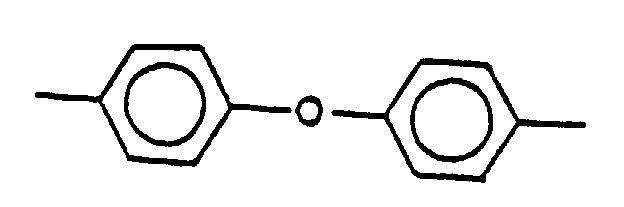

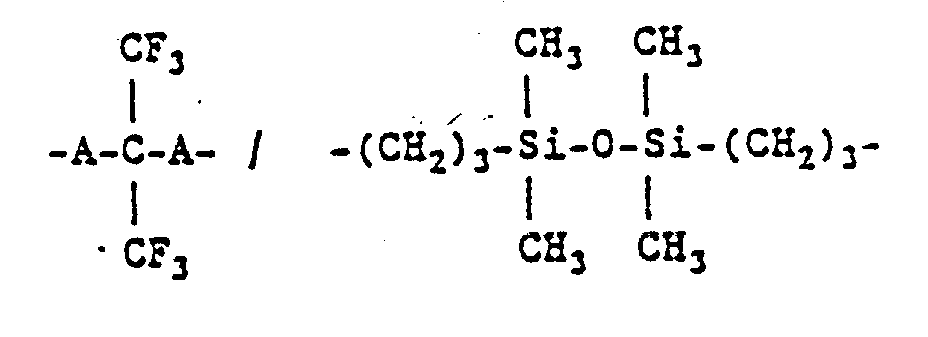
dans laquelle R6 est le tétrahydropyrannyle et R1, R5 et R2 sont des motifs représentés par les formules

la dite composition pour photorésist du type positif résistant à la chaleur contenant en outre un composé capable d'induire la réaction d'élimination des groupes organiques protecteurs dans le polyimide sous l'effet d'une irradiation par des rayons actiniques. - Substrat photosensible obtenu en recouvrant la surface d'un support par la composition pour photorésist du type positif résistant à la chaleur selon une quelconque des revendications 1 à 8.
- Procédé pour la préparation d'un motif du type positif résistant à la chaleur, comprenant l'irradiation d'un film obtenu à partir d'une composition pour photorésist du type positif résistant à la chaleur selon une quelconque des revendications 1 à 8 par des rayons actiniques au travers d'un photomasque, suivie d'un traitement thermique, et ensuite l'élimination des zones du film obtenu irradiées par développement par une solution de développement basique, sous réserve que la composition pour photorésist du type positif résistant à la chaleur contienne un précurseur de polyimide ayant un motif structural représenté par la formule (I).
- Procédé pour la préparation d'un motif du type positif résistant à la chaleur, comprenant l'irradiation d'un film obtenu à partir d'une composition pour photorésist du type positif résistant à la chaleur selon une quelconque des revendications 1 à 8 par des rayons actiniques au travers d'un photomasque, et ensuite l'élimination des zones du film obtenu irradiées par développement par une solution de développement basique, sous réserve que la composition pour photorésist du type positif résistant à la chaleur contienne un précurseur de polyimide ayant un motif structural représenté par la formule (II).
Applications Claiming Priority (6)
| Application Number | Priority Date | Filing Date | Title |
|---|---|---|---|
| JP65634/91 | 1991-03-05 | ||
| JP3065634A JPH055992A (ja) | 1991-03-05 | 1991-03-05 | 耐熱性ポジ型フオトレジスト組成物 |
| JP71767/91 | 1991-04-04 | ||
| JP3071767A JPH04363361A (ja) | 1991-04-04 | 1991-04-04 | 耐熱性ポジ型フオトレジスト組成物 |
| JP111163/91 | 1991-04-15 | ||
| JP11116391 | 1991-04-15 |
Publications (2)
| Publication Number | Publication Date |
|---|---|
| EP0502400A1 EP0502400A1 (fr) | 1992-09-09 |
| EP0502400B1 true EP0502400B1 (fr) | 1997-09-17 |
Family
ID=27298856
Family Applications (1)
| Application Number | Title | Priority Date | Filing Date |
|---|---|---|---|
| EP19920103100 Expired - Lifetime EP0502400B1 (fr) | 1991-03-05 | 1992-02-24 | Composition pour photoréserve de type positif, résistante à la chaleur, substrat photosensible, et procédé pour préparer un motif positif résistant à la chaleur |
Country Status (2)
| Country | Link |
|---|---|
| EP (1) | EP0502400B1 (fr) |
| DE (1) | DE69222203T2 (fr) |
Families Citing this family (12)
| Publication number | Priority date | Publication date | Assignee | Title |
|---|---|---|---|---|
| JP3093055B2 (ja) * | 1992-07-07 | 2000-10-03 | 日東電工株式会社 | 耐熱性ネガ型フォトレジスト組成物および感光性基材、ならびにネガ型パターン形成方法 |
| US5851736A (en) * | 1991-03-05 | 1998-12-22 | Nitto Denko Corporation | Heat-resistant photoresist composition, photosensitive substrate, and process for forming heat-resistant positive or negative pattern |
| JP2635901B2 (ja) * | 1992-03-13 | 1997-07-30 | インターナショナル・ビジネス・マシーンズ・コーポレイション | ポリイミドのネガティブ像形成方法 |
| US5317082A (en) * | 1992-12-22 | 1994-05-31 | Amoco Corporation | Photodefinable optical waveguides |
| EP0622682B1 (fr) * | 1993-04-28 | 1998-03-04 | Hitachi Chemical Co., Ltd. | Composition à base de résine photosensible |
| JPH06318038A (ja) * | 1993-05-07 | 1994-11-15 | Nitto Denko Corp | 個体識別ラベル |
| JP3709997B2 (ja) * | 1994-03-29 | 2005-10-26 | 日東電工株式会社 | 耐熱性ネガ型フォトレジスト組成物および感光性基材、ならびにネガ型パターン形成方法 |
| US5886136A (en) * | 1995-09-12 | 1999-03-23 | Nippon Zeon Co., Ltd. | Pattern forming process |
| JPH1039510A (ja) * | 1996-07-29 | 1998-02-13 | Nitto Denko Corp | ネガ型フォトレジスト組成物及びその利用 |
| US6160081A (en) * | 1997-10-31 | 2000-12-12 | Nippon Zeon Co., Ltd. | Photosensitive polyimide resin composition |
| US6582879B2 (en) | 2001-03-27 | 2003-06-24 | Korea Research Institute Of Chemical Technology | Reactive photo acid-generating agent and heat-resistant photoresist composition with polyamide precursor |
| JP4564439B2 (ja) | 2005-03-07 | 2010-10-20 | 日東電工株式会社 | ポジ型感光性樹脂組成物 |
Family Cites Families (4)
| Publication number | Priority date | Publication date | Assignee | Title |
|---|---|---|---|---|
| CA1334466C (fr) * | 1986-09-04 | 1995-02-14 | Masakazu Uekita | Polymeres a chaine longue amphiphiles photosensibles, et procede pour leur production |
| US4927736A (en) * | 1987-07-21 | 1990-05-22 | Hoechst Celanese Corporation | Hydroxy polyimides and high temperature positive photoresists therefrom |
| EP0378156A3 (fr) * | 1989-01-09 | 1992-02-26 | Nitto Denko Corporation | Composition polyimide photosensible positive |
| US5114826A (en) * | 1989-12-28 | 1992-05-19 | Ibm Corporation | Photosensitive polyimide compositions |
-
1992
- 1992-02-24 EP EP19920103100 patent/EP0502400B1/fr not_active Expired - Lifetime
- 1992-02-24 DE DE1992622203 patent/DE69222203T2/de not_active Expired - Fee Related
Also Published As
| Publication number | Publication date |
|---|---|
| DE69222203D1 (de) | 1997-10-23 |
| DE69222203T2 (de) | 1998-01-15 |
| EP0502400A1 (fr) | 1992-09-09 |
Similar Documents
| Publication | Publication Date | Title |
|---|---|---|
| JP2935994B2 (ja) | ヒドロキシポリイミドとそれから得られた高温ポジ型フォトレジスト | |
| US5037720A (en) | Hydroxylated aromatic polyamide polymer containing bound naphthoquinone diazide photosensitizer, method of making and use | |
| US7648815B2 (en) | Negative photosensitive polyimide composition and method for forming image the same | |
| JP2931143B2 (ja) | 耐熱性ポジ型フォトレジスト組成物およびそれを用いた感光性基材ならびにパターン形成方法 | |
| EP1046958B1 (fr) | Utilisation d'une composition pour film empechant la reflexion de fond | |
| JP4547087B2 (ja) | ポジ型感光性ポリイミド組成物 | |
| EP2077291B1 (fr) | Dérivé de bis(aminophénol), procédé de production de celui-ci, résine de polyamide, compositions de résine photosensible positive, film protecteur, diélectrique intercouches, dispositif semi-conducteur et élément d'affichage | |
| JP3321548B2 (ja) | 感光性ポリイミド前駆体組成物、およびそれを用いたパターン形成方法 | |
| HK47293A (en) | Polyamides with hexafluoroisopropylidene groups, positively acting photosensitive compositions, and recording materials using them | |
| EP0502400B1 (fr) | Composition pour photoréserve de type positif, résistante à la chaleur, substrat photosensible, et procédé pour préparer un motif positif résistant à la chaleur | |
| EP2113810A1 (fr) | Composition de resine photosensible, film durci, film protecteur, film isolant et dispositif semi-conducteur utilisant le film isolant, et dispositif d'affichage | |
| EP1923742A1 (fr) | Composition de résine photosensible positive | |
| US5399460A (en) | Negative photoresists containing aminoacrylate salts | |
| JP3709997B2 (ja) | 耐熱性ネガ型フォトレジスト組成物および感光性基材、ならびにネガ型パターン形成方法 | |
| JP2003121998A (ja) | 感光性重合体組成物及びパターン製造法及び電子部品 | |
| US5851736A (en) | Heat-resistant photoresist composition, photosensitive substrate, and process for forming heat-resistant positive or negative pattern | |
| JP2000273172A (ja) | ポリアミド酸エステル、その製造法、感光性樹脂組成物、それを用いたパターン製造法及び電子部品 | |
| JP3093055B2 (ja) | 耐熱性ネガ型フォトレジスト組成物および感光性基材、ならびにネガ型パターン形成方法 | |
| WO2021029019A1 (fr) | Composition de résine photosensible, procédé de fabrication de film durci à motifs, film durci, film isolant intercouche, couche de revêtement de couverture, film de protection de surface et composant électronique | |
| JP3363580B2 (ja) | 感光性樹脂組成物及びレリーフパターンの製造法 | |
| JPH05281717A (ja) | 感光性物質、およびそれを含有する耐熱性ポジ型フォトレジスト組成物と感光性基材、ならびにパターン形成方法 | |
| JPH06161110A (ja) | 耐熱性ポジ型フォトレジスト組成物およびそれを用いた感光性基材ならびにパターン形成方法 | |
| JPH04363361A (ja) | 耐熱性ポジ型フオトレジスト組成物 | |
| JPH0733874A (ja) | ポリイミド前駆体の製造方法 | |
| JP3953759B2 (ja) | 半導体装置 |
Legal Events
| Date | Code | Title | Description |
|---|---|---|---|
| PUAI | Public reference made under article 153(3) epc to a published international application that has entered the european phase |
Free format text: ORIGINAL CODE: 0009012 |
|
| AK | Designated contracting states |
Kind code of ref document: A1 Designated state(s): BE DE FR GB |
|
| 17P | Request for examination filed |
Effective date: 19921120 |
|
| 17Q | First examination report despatched |
Effective date: 19950601 |
|
| GRAG | Despatch of communication of intention to grant |
Free format text: ORIGINAL CODE: EPIDOS AGRA |
|
| GRAH | Despatch of communication of intention to grant a patent |
Free format text: ORIGINAL CODE: EPIDOS IGRA |
|
| GRAH | Despatch of communication of intention to grant a patent |
Free format text: ORIGINAL CODE: EPIDOS IGRA |
|
| GRAA | (expected) grant |
Free format text: ORIGINAL CODE: 0009210 |
|
| AK | Designated contracting states |
Kind code of ref document: B1 Designated state(s): BE DE FR GB |
|
| REF | Corresponds to: |
Ref document number: 69222203 Country of ref document: DE Date of ref document: 19971023 |
|
| ET | Fr: translation filed | ||
| PGFP | Annual fee paid to national office [announced via postgrant information from national office to epo] |
Ref country code: FR Payment date: 19980210 Year of fee payment: 7 |
|
| PGFP | Annual fee paid to national office [announced via postgrant information from national office to epo] |
Ref country code: GB Payment date: 19980216 Year of fee payment: 7 |
|
| PGFP | Annual fee paid to national office [announced via postgrant information from national office to epo] |
Ref country code: DE Payment date: 19980302 Year of fee payment: 7 |
|
| PGFP | Annual fee paid to national office [announced via postgrant information from national office to epo] |
Ref country code: BE Payment date: 19980417 Year of fee payment: 7 |
|
| PLBE | No opposition filed within time limit |
Free format text: ORIGINAL CODE: 0009261 |
|
| STAA | Information on the status of an ep patent application or granted ep patent |
Free format text: STATUS: NO OPPOSITION FILED WITHIN TIME LIMIT |
|
| 26N | No opposition filed | ||
| PG25 | Lapsed in a contracting state [announced via postgrant information from national office to epo] |
Ref country code: GB Free format text: LAPSE BECAUSE OF NON-PAYMENT OF DUE FEES Effective date: 19990224 |
|
| PG25 | Lapsed in a contracting state [announced via postgrant information from national office to epo] |
Ref country code: BE Free format text: LAPSE BECAUSE OF NON-PAYMENT OF DUE FEES Effective date: 19990228 |
|
| BERE | Be: lapsed |
Owner name: NITTO DENKO CORP. Effective date: 19990228 |
|
| GBPC | Gb: european patent ceased through non-payment of renewal fee |
Effective date: 19990224 |
|
| PG25 | Lapsed in a contracting state [announced via postgrant information from national office to epo] |
Ref country code: FR Free format text: LAPSE BECAUSE OF NON-PAYMENT OF DUE FEES Effective date: 19991029 |
|
| PG25 | Lapsed in a contracting state [announced via postgrant information from national office to epo] |
Ref country code: DE Free format text: LAPSE BECAUSE OF NON-PAYMENT OF DUE FEES Effective date: 19991201 |
|
| REG | Reference to a national code |
Ref country code: FR Ref legal event code: ST |