EP0502852B1 - Chauffage par deplacement dans les lessiveurs en continu - Google Patents
Chauffage par deplacement dans les lessiveurs en continu Download PDFInfo
- Publication number
- EP0502852B1 EP0502852B1 EP90914988A EP90914988A EP0502852B1 EP 0502852 B1 EP0502852 B1 EP 0502852B1 EP 90914988 A EP90914988 A EP 90914988A EP 90914988 A EP90914988 A EP 90914988A EP 0502852 B1 EP0502852 B1 EP 0502852B1
- Authority
- EP
- European Patent Office
- Prior art keywords
- liquor
- chips
- chamber
- temperature
- digester
- Prior art date
- Legal status (The legal status is an assumption and is not a legal conclusion. Google has not performed a legal analysis and makes no representation as to the accuracy of the status listed.)
- Expired - Lifetime
Links
- 238000010438 heat treatment Methods 0.000 title abstract description 5
- 238000006073 displacement reaction Methods 0.000 title description 2
- 238000000034 method Methods 0.000 claims abstract description 48
- 230000008569 process Effects 0.000 claims abstract description 40
- 238000010411 cooking Methods 0.000 claims abstract description 39
- 239000002023 wood Substances 0.000 claims abstract description 18
- 230000029087 digestion Effects 0.000 claims abstract description 17
- 230000003134 recirculating effect Effects 0.000 claims description 14
- 239000000126 substance Substances 0.000 claims description 12
- 239000000706 filtrate Substances 0.000 claims description 9
- 239000002657 fibrous material Substances 0.000 claims description 8
- 230000007246 mechanism Effects 0.000 claims description 4
- 230000000694 effects Effects 0.000 claims description 3
- 238000010924 continuous production Methods 0.000 claims 6
- 239000007788 liquid Substances 0.000 claims 2
- 238000012958 reprocessing Methods 0.000 claims 1
- 238000005406 washing Methods 0.000 abstract description 3
- 239000003518 caustics Substances 0.000 abstract 1
- XLYOFNOQVPJJNP-UHFFFAOYSA-M hydroxide Chemical compound [OH-] XLYOFNOQVPJJNP-UHFFFAOYSA-M 0.000 abstract 1
- HEMHJVSKTPXQMS-UHFFFAOYSA-M Sodium hydroxide Chemical compound [OH-].[Na+] HEMHJVSKTPXQMS-UHFFFAOYSA-M 0.000 description 15
- UCKMPCXJQFINFW-UHFFFAOYSA-N Sulphide Chemical compound [S-2] UCKMPCXJQFINFW-UHFFFAOYSA-N 0.000 description 8
- 238000000605 extraction Methods 0.000 description 7
- 235000011121 sodium hydroxide Nutrition 0.000 description 5
- 239000000835 fiber Substances 0.000 description 3
- 238000010790 dilution Methods 0.000 description 2
- 239000012895 dilution Substances 0.000 description 2
- 230000006872 improvement Effects 0.000 description 2
- 239000002655 kraft paper Substances 0.000 description 2
- 239000000463 material Substances 0.000 description 2
- 230000004048 modification Effects 0.000 description 2
- 238000012986 modification Methods 0.000 description 2
- GRVFOGOEDUUMBP-UHFFFAOYSA-N sodium sulfide (anhydrous) Chemical compound [Na+].[Na+].[S-2] GRVFOGOEDUUMBP-UHFFFAOYSA-N 0.000 description 2
- GEHJYWRUCIMESM-UHFFFAOYSA-L sodium sulfite Chemical compound [Na+].[Na+].[O-]S([O-])=O GEHJYWRUCIMESM-UHFFFAOYSA-L 0.000 description 2
- 229920001131 Pulp (paper) Polymers 0.000 description 1
- CDBYLPFSWZWCQE-UHFFFAOYSA-L Sodium Carbonate Chemical compound [Na+].[Na+].[O-]C([O-])=O CDBYLPFSWZWCQE-UHFFFAOYSA-L 0.000 description 1
- QAOWNCQODCNURD-UHFFFAOYSA-L Sulfate Chemical compound [O-]S([O-])(=O)=O QAOWNCQODCNURD-UHFFFAOYSA-L 0.000 description 1
- 230000006866 deterioration Effects 0.000 description 1
- 238000004134 energy conservation Methods 0.000 description 1
- 238000001704 evaporation Methods 0.000 description 1
- 230000008020 evaporation Effects 0.000 description 1
- 239000013072 incoming material Substances 0.000 description 1
- 238000004537 pulping Methods 0.000 description 1
- 229910052979 sodium sulfide Inorganic materials 0.000 description 1
- 235000010265 sodium sulphite Nutrition 0.000 description 1
- 229910021653 sulphate ion Inorganic materials 0.000 description 1
- -1 sulphide ions Chemical class 0.000 description 1
- 238000011144 upstream manufacturing Methods 0.000 description 1
- XLYOFNOQVPJJNP-UHFFFAOYSA-N water Substances O XLYOFNOQVPJJNP-UHFFFAOYSA-N 0.000 description 1
Images

Classifications
-
- D—TEXTILES; PAPER
- D21—PAPER-MAKING; PRODUCTION OF CELLULOSE
- D21C—PRODUCTION OF CELLULOSE BY REMOVING NON-CELLULOSE SUBSTANCES FROM CELLULOSE-CONTAINING MATERIALS; REGENERATION OF PULPING LIQUORS; APPARATUS THEREFOR
- D21C7/00—Digesters
- D21C7/14—Means for circulating the lye
-
- D—TEXTILES; PAPER
- D21—PAPER-MAKING; PRODUCTION OF CELLULOSE
- D21C—PRODUCTION OF CELLULOSE BY REMOVING NON-CELLULOSE SUBSTANCES FROM CELLULOSE-CONTAINING MATERIALS; REGENERATION OF PULPING LIQUORS; APPARATUS THEREFOR
- D21C7/00—Digesters
Definitions
- the present invention relates to improvements in apparatus and methods for the fiber liberating digestion of continuously fed comminuted cellulosic fiber material by cooking liquor and subsequent washing of the liberated fiber material. More particularly, the invention relates to an improved apparatus and process utilizing spent black liquor for heating the chips to effect savings in thermal energy, and for accomplishing high sulfidity cooking without changes to the overall sulfide balance of the system to accomplish a pulp having improved mechanical characteristics, to improve pulp yield, and to achieve extended delignification.
- the first is batch cooking in which the chips are placed in a digester, liquor is added, the temperature and pressure are raised and the "batch" is maintained at the elevated temperature and pressure to reach the desired stage of delignification.
- the digester is then emptied, and a subsequent fill is started for another batch.
- a chip column continuously moves through the digester with hot liquor circulating therethrough. Process conditions are controlled such that the desired stage of delignification has occurred when the chips flow out of the digester.
- the spent liquor is allowed to flash and steam is generated.
- the steam is normally utilized to pre-steam the chips and to generate hot water.
- the heat and cooking chemicals could be utilized more efficiently if the spent liquors were used to preheat and precondition the chips and to preheat the cooking chemicals such as white liquor in kraft processes which enters the process.
- a further object of the invention is to provide a continuous digestion process wherein the used black cooking liquors and the white liquors are utilized in a unique manner in the process so as to obtain a saving in thermal energy, and to effect an improvement in the resultant qualities of the pulp which is produced.
- Yet another object of the present invention is to provide a process for achieving high sulfidity cooking without significant changes to the overall sulfide balance of the cooking system, and for achieving extended delignification in a continuous digesting system while improving pulp yield over existing continuous digesting systems.
- a feature of the invention is the provision of a continuous digestion process wherein a plurality of containers are used in sequence, with the first container receiving preconditioned chips and the chips being preimpregnated and heated in the first container with a low temperature black liquor. Further heating of the chips is accomplished with higher temperature liquors in the second and subsequent containers, and after the chips are brought up to the desired elevated temperature, a white liquor is circulated through the chips at the digestion temperature and pressure.
- the chips are continuously fed from the last of the preimpregnation containers to the digester for cooking.
- the cooked delignified chips are removed as pulp from the bottom of the digester and circulated to final washing.
- the wash liquor from the washer is utilized in two or more stages to displace from the digester the free liquor and liquor within the chips.
- the hot spent liquor is utilized to heat the incoming materials for the continuous digester.
- the spent liquor having been extracted from the digester, is accumulated in pressure vessels substantially at digester temperature. Lower temperature liquors from final displacement stages are also accumulated.
- the incoming chips are first exposed to the lower temperature liquors and then the higher temperature liquors.
- the white liquor is preheated in a heat exchanger, utilizing a portion of hot spent liquor.
- the white liquor can be stored in a hot white liquor accumulator whereas the hot spent liquor, after having given energy to the white liquor, goes to the low temperature accumulator.
- the process can be accomplished wherein a first initial chamber or vessel is utilized, being fed by a screw conveyor feeder to press the chips downwardly.
- the vessel may be employed with an extraction screen at the top and with a recirculation screen further down the vessel, with the recycled liquor flowing through a central pipe ending at the screen level.
- Low temperature liquor is fed from a low temperature tank to a circulation pump, and the liquor is evenly spread over the vessel area.
- the amount of liquor extracted from the top screen is an amount that generally corresponds to the white liquor charge, wood moisture and the dilution factor.
- the extracted liquor goes to the evaporators.
- the remaining part of the liquor goes with the chips downwardly in the chamber.
- the treatment with hot spent liquor takes place in a vessel at principally digester pressure.
- this high pressure vessel is located underneath the first vessel, and the transfer of material takes place in utilizing a high pressure feeder.
- the arrangement for heat exchange is, in principal, essentially the same as in the first lower temperature vessel.
- the hot spent liquor is introduced in a recirculation circuit, and a portion of the liquor flows countercurrent to the chips, being extracted from a top screen.
- the low temperature liquor is being displaced and substituted by a hot spent liquor.
- the low temperature liquor which leaves the top screen is conveyed back to the low temperature tank.
- a portion of the hot spent liquor is utilized to preheat the white liquor that is introduced in the bottom of the high pressure vessel.
- white liquor should be added after that mechanical device to avoid pulp deterioration. This can be done by utilizing a vessel which forms part of the continuous digester and is integrated into the digester apparatus itself.
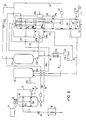
- Figure 1 is a schematic drawing of a process for operating in accordance with the principles of the present invention.
- Figure 2 is a schematic drawing of a modification of the process shown in Figure 1, wherein the high pressure preimpregnation vessel forms a part of the continuous digester.
- wood chips are delivered to a first chamber or container 10 through a screw delivery mechanism 11.
- the chips may be preconditioned, such as by being heated by steam, in a supply container 12.
- the preheating occurs by a supply of low temperature black liquor supplied from a low temperature black liquor tank 13 through a supply line 14.
- the black liquor is circulated through the chips through a recirculating mechanism including a recirculating line 15 and a recirculating pump 16.
- preheated wood chips are forcibly conveyed downwardly to a second container 21, which is a hot liquor preimpregnator in which the wood chips are subjected to liquor for a predetermined time at a higher temperature and high pressure than in the first container.
- a mechanism such as a rotary delivery valve 20 is employed.
- Such valves are well-known to those skilled in the art and will not be described further herein.
- hot black liquor is delivered to the second container by line 23, which receives hot black liquor from a hot black liquor tank 22 delivered by a pressure pump 22a.
- the hot black liquor is recirculated through the moving chips by recirculation line 24, with the liquor being circulated by a pump 24a.
- a portion of the liquor is removed through a line 24b, controlled by a valve 24c, to be delivered back to the low temperature black liquor tank 13, preferably upstream of a delivery pump 13a which pumps the low temperature black liquor to the first container 10.
- screens 21a, 21b, and 21c Arranged in the second container 21 are screens 21a, 21b, and 21c, which allow for the removal of the liquor, with the screen 21a facilitating the removal of the excess black liquor through the line 24b, and the screens 21b and 21c facilitating the recirculation of the high temperature black liquor in two recirculation paths.
- white liquor is delivered to the second container 21 through a line 25.
- the white liquor can be supplied through a line 25a, shown by dotted line in Figure 1, as the chips leave the second container.
- the white liquor is obtained from a high temperature white liquor tank 27, being delivered therefrom by a pump 27a.
- the white liquor is preheated before delivery to the second container 21 in a heat exchanger 28, with the white liquor being supplied to the heat exchanger from a supply source not shown and a supply line 29.
- the heat exchanger is heated by hot black liquor supplied through a line 30 leading from the high temperature black liquor tank 22, and, after passing through the heat exchanger, the black liquor flows through a line 31 to the low temperature black liquor tank 13.
- Cooking liquor is recirculated at the top of the digester through a circuit 34 having a recirculation pump 34a and extraction screen 34b therein. Temperature adjustment of the cooking liquor may be achieved with a trim heat exchanger 34c heated by steam from a steam source 34d.
- a portion of the cooking liquor is removed from the digester through a line 38 by a pump 38a, and is delivered through a line 39 to the location where the chips exit the second container. This recirculated cooking liquor further dilutes the chips and liquor exiting the second container to facilitate transport of the chips to the digester.
- the chips move continuously downward, and are cooked to the desired level of delignification.
- Recirculation takes place through an extraction line 35, an extraction screen 35a, a recirculation line 36, and a pump 36a.
- a portion of the recirculated liquor is directed to the hot liquor tank 22, controlled by a valve 36b.
- washer filtrate from a line 50 is recirculated through a circuit 52 by a pump 54, to eliminate temperature and spent liquor concentration gradients.
- the filtrate is added between an extraction screen 56 and the pump 54, so that the extracted liquor volume is less than the flow into the digester through circuit 52, causing an upward flow of filtrate in the bottom of the digester.
- a second recirculation circuit 60 including a pump 62, is provided to extract a portion of the upward flowing filtrate at an extraction screen 64, together with remaining hot spent black liquor.
- a portion of the extracted filtrate and liquor is directed to the low temperature tank 13, through line 66 controlled by a valve 68.
- a blow line 80 is provided for removing pulp from the digester to a washer.
- the manner in which the pulp is moved from the digester, including any secondary dilution, is well-known in the art of continuous digesters and will not be described further herein.
- preconditioned pulp is delivered via a screw conveyor 11 into a first chip preheating container 10 where it is heated by low temperature black liquor obtained from a low temperature black liquor tank 13.
- the preheated chips pass downwardly through a rotary delivery valve 20 to a second chamber 21, where the chips are further preheated by high temperature black liquor received from a high temperature black liquor tank 22.
- the high temperature and low temperature black liquors are obtained from the pulp washer with the high temperature liquor also being utilized for heating the white liquor through the heat exchanger 28.
- White liquor delivered through the screen 21c from a white liquor supply line 25, is added to the chips before the chips enter digester 33.
- the region of the countercurrent flow between screen 64 and screen 35a should be sufficiently long that the filtrate is heated by the chips substantially to cooking temperature, and the liquor and filtrate removed through line 35a are at or near cooking temperature.
- Figure 2 illustrates, in schematic format, a process in which the second chamber 21 is continguous with the digester. Corresponding parts of the process depicted in Figure 2 have been numbered similarly to Figure 1.
- the various extraction screens, recirculation circuits, pumps, and the like for both the high pressure preimpregnation process and the final digestion process are contained in the combined preimpregnation and digester vessel.
Landscapes
- Paper (AREA)
- Chemical And Physical Treatments For Wood And The Like (AREA)
Abstract
Claims (12)
- Appareil de lessiveur pour la libération de matière fibreuse cellulosique pour de la pâte de fabrication du papier en utilisant de la liqueur de cuisson à une pression élevée et à une température élevée dans un procédé en continu, comprenant, en combinaison :
une première chambre (10);
un moyen d'alimentation (11) pour acheminer des copeaux de bois cellulosiques à ladite première chambre (10);
une cuve (13) pour la liqueur à basse température reliée à la première chambre (10) pour la mise en circulation de liqueur noire à basse température à travers les copeaux dans ladite première chambre (10) en vue d'un échange d'énergie thermique pour élever la température des copeaux et pour véhiculer des produits chimiques résiduels en direction des copeaux;
une seconde chambre (21) qui y est reliée pour recevoir des copeaux préchauffés par ladite liqueur à basse température provenant de la première chambre (10);
un mécanisme d'alimentation (20) relié entre lesdites chambres (10, 21) pour acheminer les copeaux à la seconde chambre (21);
une cuve (22) pour liqueur à température élevée reliée à ladite seconde chambre (21) pour la mise en circulation d'une liqueur noire à température élevée à travers les copeaux pour un échange d'énergie thermique dans le but d'amener la température des copeaux à proximité de la température de lessivage et pour véhiculer les produits chimiques résiduels en direction des copeaux;
un moyen de sortie (32) conduisant de la seconde chambre (21) pour une alimentation continue de copeaux préchauffés à un lessiveur (33);
des moyens (25, 25a, 27, 27a) pour acheminer de la liqueur blanche aux copeaux préchauffés dans ladite seconde chambre pour poursuivre la délignification des copeaux dans le lessiveur;
un moyen de remise en circulation (35, 35a, 36, 36a) dans la portion supérieure du lessiveur pour la remise en circulation de liqueur chaude dans le lessiveur, et englobant un moyen de détournement (36b) pour diriger une portion de la liqueur chaude de remise en circulation vers la cuve (22) pour la liqueur à température élevée;
un premier moyen de remise en circulation (52, 54, 56) dans la portion inférieure du lessiveur pour la remise en circulation de la liqueur dans la portion inférieure, englobant un moyen (50) pour ajouter du filtrat de laveur à la liqueur de remise en circulation;
un second moyen de remise en circulation (60, 62, 64) dans la portion inférieure du lessiveur englobant un moyen d'extraction (66, 68) pour diriger la liqueur vers la cuve (13) pour la liqueur à basse température; et
une connexion (80) entre le lessiveur et le laveur de pâte pour transférer la pâte délignifiée. - Appareil de lessiveur pour la libération de matière fibreuse cellulosique pour la pâte de fabrication du papier en utilisant de la liqueur de cuisson sous une pression élevée et à une température élevée dans un procédé en continu, construit conformément à la revendication 1 :
englobant un moyen de remise en circulation (14, 15, 16) pour la première chambre (10) dans laquelle vient se loger la liqueur à basse température provenant de ladite cuve (13) à basse température et pour la remise en circulation de la liqueur à travers les copeaux dans la première chambre (10) à contre-courant au mouvement en continu des copeaux à travers ladite première chambre (10). - Appareil de lessiveur pour la libération de la matière fibreuse cellulosique pour la pâte de fabrication du papier en utilisant de la liqueur de cuisson sous une pression élevée et à une température élevée dans un procédé en continu, construit conformément à la revendication 1 :
englobant un moyen de remise en circulation (23, 24, 24a) pour la seconde chambre (21) qui y est reliée pour que vienne s'y loger la liqueur provenant de la cuve (22) à température élevée, pour la remise en circulation de la liqueur à température élevée à travers la seconde cuve (21) à contre-courant au mouvement continu des copeaux qui la traversent pour élever la température des copeaux qui y sont contenus. - Appareil de lessiveur pour la libération de la matière fibreuse cellulosique pour la pâte de fabrication du papier en utilisant de la liqueur de cuisson sous une pression élevée et à une température élevée dans un procédé en continu, construit conformément à la revendication 1 :
englobant un moyen de remise en circulation de liqueur blanche (34, 34a, 34b, 38, 38a, 39) relié au lessiveur (33) pour la remise en circulation de la liqueur blanche à contre-courant au mouvement des copeaux au cours du procédé de lessivage. - Appareil de lessiveur pour la libération de la matière fibreuse cellulosique pour la pâte de fabrication du papier en utilisant de la liqueur de cuisson sous une pression élevée et à une température élevée dans un procédé en continu, construit conformément à la revendication 1 :
englobant un échangeur de chaleur (28) relié à la cuve (22) pour la liqueur à température élevée et relié au récipient (27) pour la liqueur blanche afin d'élever la température de la liqueur blanche en utilisant l'énergie thermique dans la liqueur dans ladite cuve (22) pour la liqueur à température élevée. - Appareil de lessiveur pour la libération de la matière fibreuse cellulosique pour la pâte de fabrication du papier en utilisant de la liqueur de cuisson sous une pression élevée et à une température élevée dans un procédé en continu, construit conformément à la revendication 1 :
englobant un conduit d'élimination de liqueur (17) relié à la première chambre (10) pour éliminer la liqueur à basse température. - Procédé de lessivage en continu pour traiter du bois réduit en copeaux, comprenant les étapes consistant à :
acheminer les copeaux de bois à une première chambre (10);
déplacer lesdits copeaux en continu à travers ladite chambre (10);
mettre en circulation une liqueur noire à travers eux à des températures modérées dans ladite première chambre (10) pour chauffer les copeaux et remettre en circulation les produits chimiques résiduels;
alimenter en continu les copeaux préchauffés et chimiquement préconditionnés, et la liqueur à température modérée à une seconde chambre (21) à température et à pression plus élevées;
déplacer la liqueur noire à température modérée avec la liqueur noire chaude;
mettre en circulation la liqueur noire chaude à travers les copeaux dans la seconde chambre (21) pour élever davantage la température des copeaux et pour remettre davantage en circulation les produits chimiques résiduels;
acheminer de la liqueur blanche aux copeaux chauds pour déplacer la liqueur noire chaude;
transporter lesdits copeaux dans un courant en continu à un lessiveur (33);
déplacer lesdits copeaux à travers ledit lessiveur (33) à un débit, à une température et à une pression pour compléter la délignification désirée, tandis que lesdits copeaux se trouvent dans ledit lessiveur (33);
remettre en circulation la liqueur noire chaude dans le lessiveur et dévier une portion de ce dernier pour l'utiliser ultérieurement dans ladite seconde chambre (21);
déplacer la liqueur de la pâte lessivée en utilisant un liquide à basse température et acheminer ladite liqueur à ladite première chambre (10);
récolter séparément les liqueurs à température modérée et à température élevée déplacées dans le procédé, de même que celles déviées au cours des étapes de mise en circulation de la liqueur; et
éliminer la pâte lessivée du lessiveur (33) après avoir été soumise à l'effet de la liqueur blanche pendant un temps prédéterminé. - Procédé de traitement de copeaux de bois cellulosiques dans un processus de lessivage en continu sous haute pression à température élevée pour la libération de pâte conformément aux étapes de la revendication 7 :
englobant le fait d'acheminer la pâte lessivée à un laveur et le fait d'utiliser la liqueur de lavage comme ledit liquide à basse température. - Procédé de traitement de copeaux de bois cellulosiques dans un processus de lessivage en continu sous haute pression à température élevée pour la libération de pâte conformément aux étapes de la revendication 7 :
englobant la remise en circulation de la liqueur noire dans ladite première chambre (10) pendant un laps de temps prédéterminé pour préchauffer et préconditionner chimiquement les copeaux. - Procédé de traitement de copeaux de bois cellulosiques dans un processus de lessivage en continu sous haute pression à température élevée pour la libération de pâte conformément aux étapes de la revendication 7 :
englobant le fait d'utiliser la liqueur noire chaude pour préchauffer la liqueur blanche. - Procédé de traitement de copeaux de bois cellulosiques dans un processus de lessivage en continu sous haute pression à température élevée pour la libération de pâte conformément aux étapes de la revendication 7 :
englobant le fait d'éliminer la liqueur noire de la première chambre (10) pour retraiter la liqueur. - Procédé de traitement de copeaux de bois cellulosiques dans un processus de lessivage en continu sous haute pression à température élevée pour la libération de pâte conformément aux étapes de la revendication 7 :
englobant la remise en circulation de la liqueur noire chaude dans la seconde chambre (21).
Applications Claiming Priority (2)
| Application Number | Priority Date | Filing Date | Title |
|---|---|---|---|
| US41392089A | 1989-09-28 | 1989-09-28 | |
| US413920 | 1989-09-28 |
Publications (2)
| Publication Number | Publication Date |
|---|---|
| EP0502852A1 EP0502852A1 (fr) | 1992-09-16 |
| EP0502852B1 true EP0502852B1 (fr) | 1993-11-03 |
Family
ID=23639200
Family Applications (1)
| Application Number | Title | Priority Date | Filing Date |
|---|---|---|---|
| EP90914988A Expired - Lifetime EP0502852B1 (fr) | 1989-09-28 | 1990-09-25 | Chauffage par deplacement dans les lessiveurs en continu |
Country Status (10)
| Country | Link |
|---|---|
| EP (1) | EP0502852B1 (fr) |
| JP (1) | JPH0674557B2 (fr) |
| KR (1) | KR0171423B1 (fr) |
| CN (1) | CN1021980C (fr) |
| CA (1) | CA2066181C (fr) |
| DE (1) | DE69004438T2 (fr) |
| ES (1) | ES2045948T3 (fr) |
| FI (1) | FI921373A7 (fr) |
| NO (1) | NO179016C (fr) |
| WO (1) | WO1991005103A2 (fr) |
Families Citing this family (22)
| Publication number | Priority date | Publication date | Assignee | Title |
|---|---|---|---|---|
| DE69111165T2 (de) * | 1990-09-20 | 1995-11-16 | Kvaerner Pulping Tech | Tränkung mit Schwarzlauge vor der Zufuhr der Weisslauge. |
| US5302247A (en) * | 1992-11-02 | 1994-04-12 | Kamyr, Inc. | Top circulation line cooling for a modified cook digester |
| CN1071997C (zh) * | 1993-06-18 | 2001-10-03 | 叶隆清 | 植物促长剂及制造方法 |
| US5824187A (en) * | 1993-12-29 | 1998-10-20 | Kvaerner Pulping Ab | Method for the continuous cooking of pulp |
| SE502039C2 (sv) * | 1993-12-29 | 1995-07-24 | Kvaerner Pulping Tech | Sätt och anordning för kontinuerlig kokning av massa |
| US6248208B1 (en) | 1995-06-02 | 2001-06-19 | Andritz-Ahlstrom Inc. | Pretreatment of chips before cooking |
| AT403301B (de) * | 1996-04-04 | 1998-01-26 | Impco Voest Alpine Pulp Tech | Kontinuierliche flüssigkeitsführung |
| US6159336A (en) * | 1997-08-07 | 2000-12-12 | Kvaerner Pulping Ab | Method and device for the continuous cooking of pulp |
| SE0104272L (sv) | 2001-12-17 | 2002-11-12 | Kvaerner Pulping Tech | Förfarande och arrangemang vid impregnering av flis |
| SE518957C2 (sv) * | 2002-01-24 | 2002-12-10 | Kvaerner Pulping Tech | Förfarande för att öka värmeekonomin i kokarsystemet vid kontinuerlig kokning |
| SE527058C2 (sv) * | 2004-02-09 | 2005-12-13 | Kvaerner Pulping Tech | Kontinuerlig kokprocess med förbättrad värmeekonomi |
| CN103080417A (zh) * | 2010-07-07 | 2013-05-01 | 斯托拉恩索公司 | 由黑液制造沉淀木质素的方法和通过这种方法制造的沉淀木质素 |
| CN101906730B (zh) * | 2010-07-15 | 2013-01-23 | 轻工业杭州机电设计研究院 | 非木纤维连续蒸煮方法及其装置 |
| CN102154398A (zh) * | 2010-12-28 | 2011-08-17 | 国润金华(北京)国际能源投资有限公司佛山高明分公司 | 一种高温高压纤维素转糖工艺 |
| CN103597139B (zh) * | 2011-03-25 | 2016-03-30 | S·L·凯斯瓦尼 | 用于自横管式连续蒸煮器提取黑液的方法和系统 |
| CN102154874B (zh) * | 2011-04-29 | 2012-11-21 | 白福安 | 一种置换蒸煮制浆方法 |
| CN102797189A (zh) * | 2012-08-11 | 2012-11-28 | 李肥生 | 两段式自加热螺旋结构蒸煮分离器 |
| US9644317B2 (en) * | 2014-11-26 | 2017-05-09 | International Paper Company | Continuous digester and feeding system |
| FR3039567A1 (fr) | 2015-07-31 | 2017-02-03 | Commissariat Energie Atomique | Dispositif et procede de traitement de la liqueur noire provenant de la preparation de pate a papier par liquefaction hydrothermale |
| CN108867131A (zh) * | 2016-12-20 | 2018-11-23 | 常州爱上学教育科技有限公司 | 用于制浆造纸的木、竹原料节能环保置换蒸煮工艺 |
| KR102295018B1 (ko) | 2019-09-11 | 2021-08-30 | 한병엽 | 포장용기 자동 주문발주 장치 |
| KR102490233B1 (ko) | 2020-11-24 | 2023-01-18 | 한병엽 | 포스 장치, 포스 장치의 주문 정보 처리방법, 기록매체 |
Family Cites Families (5)
| Publication number | Priority date | Publication date | Assignee | Title |
|---|---|---|---|---|
| FI63610C (fi) * | 1981-12-31 | 1983-07-11 | Ekono Oy | Foerfarande foer kontinuerlig uppslutning av finfoerdelat material |
| SE452482B (sv) * | 1982-04-28 | 1987-11-30 | Sunds Defibrator | Forfarande for satsvis framstellning av sulfatmassa med hog delignifieringsgrad |
| JPS6059189A (ja) * | 1983-08-24 | 1985-04-05 | ベロイト コ−ポレ−ション | 多段式木材チツプ蒸解法 |
| FI71176C (fi) * | 1983-11-30 | 1991-12-03 | Ekono Oy | Foerfarande foer framstaellning av cellulosa med satsvis kokning. |
| JP6347836B2 (ja) | 2014-07-10 | 2018-06-27 | 国立大学法人大阪大学 | 脚相移行タイミング判定方法、脚相移行タイミング判定装置、歩行支援制御方法及び歩行支援装置 |
-
1990
- 1990-09-25 KR KR1019920700696A patent/KR0171423B1/ko not_active Expired - Fee Related
- 1990-09-25 CA CA002066181A patent/CA2066181C/fr not_active Expired - Fee Related
- 1990-09-25 ES ES90914988T patent/ES2045948T3/es not_active Expired - Lifetime
- 1990-09-25 EP EP90914988A patent/EP0502852B1/fr not_active Expired - Lifetime
- 1990-09-25 WO PCT/US1990/005443 patent/WO1991005103A2/fr not_active Ceased
- 1990-09-25 DE DE90914988T patent/DE69004438T2/de not_active Expired - Fee Related
- 1990-09-25 JP JP2514062A patent/JPH0674557B2/ja not_active Expired - Lifetime
- 1990-09-28 CN CN90108125A patent/CN1021980C/zh not_active Expired - Fee Related
-
1992
- 1992-02-18 NO NO920630A patent/NO179016C/no unknown
- 1992-03-27 FI FI921373A patent/FI921373A7/fi not_active Application Discontinuation
Also Published As
| Publication number | Publication date |
|---|---|
| EP0502852A1 (fr) | 1992-09-16 |
| FI921373A0 (fi) | 1992-03-27 |
| CN1050579A (zh) | 1991-04-10 |
| JPH0674557B2 (ja) | 1994-09-21 |
| NO920630L (no) | 1992-02-18 |
| CN1021980C (zh) | 1993-09-01 |
| NO179016C (no) | 1996-07-17 |
| CA2066181C (fr) | 1995-09-26 |
| FI921373A7 (fi) | 1992-03-27 |
| CA2066181A1 (fr) | 1991-03-29 |
| WO1991005103A3 (fr) | 1991-05-16 |
| JPH05503739A (ja) | 1993-06-17 |
| DE69004438D1 (de) | 1993-12-09 |
| KR0171423B1 (ko) | 1999-05-01 |
| ES2045948T3 (es) | 1994-01-16 |
| NO920630D0 (no) | 1992-02-18 |
| NO179016B (no) | 1996-04-09 |
| KR920703920A (ko) | 1992-12-18 |
| WO1991005103A2 (fr) | 1991-04-18 |
| DE69004438T2 (de) | 1994-05-11 |
Similar Documents
| Publication | Publication Date | Title |
|---|---|---|
| EP0502852B1 (fr) | Chauffage par deplacement dans les lessiveurs en continu | |
| US5080755A (en) | Process for the continuous digestion of cellulosic fiber material | |
| CA1245011A (fr) | Hydrolyse acide a contre-courant | |
| US5779856A (en) | Cooking cellulose material using high alkali concentrations and/or high pH near the end of the cook | |
| US5849151A (en) | Continuous digester having means for implementing low dissolved solids profiling | |
| EP0527294B1 (fr) | Traitement des copeaux de bois avec de la liqueur noire | |
| US7976675B2 (en) | Continuous digester system | |
| EP0477059B1 (fr) | Imprégnation avec liqueur noire avant l'introduction de la liqueur blanche | |
| US5256255A (en) | Displacement heating in continuous digesters | |
| US4849052A (en) | Batch digester multi-stage pulping process | |
| US6123807A (en) | Method for the continuous cooking of pulp | |
| WO1997029236A1 (fr) | Procede de cuisson en continu de materiau fibreux contenant de la cellulose | |
| JP4280636B2 (ja) | セルロースパルプの製造方法 | |
| JP3447264B2 (ja) | 低温浸透とdom制御を有する連続蒸解方法 | |
| US5885414A (en) | Method of producing pulp with high alkali cooking in the last cooking stage | |
| US5643410A (en) | Batch process for preparing kraft pulp in a batch digesting process | |
| US5192396A (en) | Process for the continuous digestion of cellulosic fiber material | |
| EP0135461B1 (fr) | Procédé de mise en pâte à lessiveur de charge multi-étape | |
| US6280567B1 (en) | System and method for treatment of cellulose-containing material prior to pulp digestion | |
| US7351306B2 (en) | Cooking of cellulose pulp in a cooking liquor containing pre-evaporated black liquor | |
| EP0837965B1 (fr) | Impregnation d'un materiau fibreux | |
| WO1998035090A1 (fr) | Procede continu de production de pate avec impregnation de liqueur residuaire | |
| US20040089430A1 (en) | Method for alkaline cooking of fiber material | |
| JPH04240282A (ja) | 亜硫酸パルプ化によるセルロースパルプ製造方法及び装置 |
Legal Events
| Date | Code | Title | Description |
|---|---|---|---|
| PUAI | Public reference made under article 153(3) epc to a published international application that has entered the european phase |
Free format text: ORIGINAL CODE: 0009012 |
|
| 17P | Request for examination filed |
Effective date: 19920213 |
|
| AK | Designated contracting states |
Kind code of ref document: A1 Designated state(s): DE ES FR GB SE |
|
| 17Q | First examination report despatched |
Effective date: 19930203 |
|
| GRAA | (expected) grant |
Free format text: ORIGINAL CODE: 0009210 |
|
| AK | Designated contracting states |
Kind code of ref document: B1 Designated state(s): DE ES FR GB SE |
|
| REF | Corresponds to: |
Ref document number: 69004438 Country of ref document: DE Date of ref document: 19931209 |
|
| REG | Reference to a national code |
Ref country code: ES Ref legal event code: FG2A Ref document number: 2045948 Country of ref document: ES Kind code of ref document: T3 |
|
| ET | Fr: translation filed | ||
| PLBE | No opposition filed within time limit |
Free format text: ORIGINAL CODE: 0009261 |
|
| STAA | Information on the status of an ep patent application or granted ep patent |
Free format text: STATUS: NO OPPOSITION FILED WITHIN TIME LIMIT |
|
| 26N | No opposition filed | ||
| EAL | Se: european patent in force in sweden |
Ref document number: 90914988.2 |
|
| PGFP | Annual fee paid to national office [announced via postgrant information from national office to epo] |
Ref country code: GB Payment date: 19980814 Year of fee payment: 9 |
|
| PGFP | Annual fee paid to national office [announced via postgrant information from national office to epo] |
Ref country code: FR Payment date: 19980821 Year of fee payment: 9 Ref country code: DE Payment date: 19980821 Year of fee payment: 9 |
|
| PGFP | Annual fee paid to national office [announced via postgrant information from national office to epo] |
Ref country code: SE Payment date: 19980824 Year of fee payment: 9 |
|
| PGFP | Annual fee paid to national office [announced via postgrant information from national office to epo] |
Ref country code: ES Payment date: 19980925 Year of fee payment: 9 |
|
| PG25 | Lapsed in a contracting state [announced via postgrant information from national office to epo] |
Ref country code: GB Free format text: LAPSE BECAUSE OF NON-PAYMENT OF DUE FEES Effective date: 19990925 |
|
| PG25 | Lapsed in a contracting state [announced via postgrant information from national office to epo] |
Ref country code: ES Free format text: LAPSE BECAUSE OF NON-PAYMENT OF DUE FEES Effective date: 19990926 |
|
| PG25 | Lapsed in a contracting state [announced via postgrant information from national office to epo] |
Ref country code: SE Free format text: THE PATENT HAS BEEN ANNULLED BY A DECISION OF A NATIONAL AUTHORITY Effective date: 19990929 |
|
| EUG | Se: european patent has lapsed |
Ref document number: 90914988.2 |
|
| GBPC | Gb: european patent ceased through non-payment of renewal fee |
Effective date: 19990925 |
|
| PG25 | Lapsed in a contracting state [announced via postgrant information from national office to epo] |
Ref country code: FR Free format text: LAPSE BECAUSE OF NON-PAYMENT OF DUE FEES Effective date: 20000531 |
|
| PG25 | Lapsed in a contracting state [announced via postgrant information from national office to epo] |
Ref country code: DE Free format text: LAPSE BECAUSE OF NON-PAYMENT OF DUE FEES Effective date: 20000701 |
|
| REG | Reference to a national code |
Ref country code: FR Ref legal event code: ST |
|
| REG | Reference to a national code |
Ref country code: ES Ref legal event code: FD2A Effective date: 20001013 |