EP0502864B1 - Flexible zusammensetzung auf der basis eines bindemittels und mindestens eines füllstoffes - Google Patents
Flexible zusammensetzung auf der basis eines bindemittels und mindestens eines füllstoffes Download PDFInfo
- Publication number
- EP0502864B1 EP0502864B1 EP90916440A EP90916440A EP0502864B1 EP 0502864 B1 EP0502864 B1 EP 0502864B1 EP 90916440 A EP90916440 A EP 90916440A EP 90916440 A EP90916440 A EP 90916440A EP 0502864 B1 EP0502864 B1 EP 0502864B1
- Authority
- EP
- European Patent Office
- Prior art keywords
- composition
- expanded
- polymerparts
- binder
- use according
- Prior art date
- Legal status (The legal status is an assumption and is not a legal conclusion. Google has not performed a legal analysis and makes no representation as to the accuracy of the status listed.)
- Expired - Lifetime
Links
- 239000000203 mixture Substances 0.000 title claims abstract description 75
- 239000000945 filler Substances 0.000 title claims abstract description 37
- 239000011230 binding agent Substances 0.000 title claims abstract description 28
- 239000004814 polyurethane Substances 0.000 claims abstract description 36
- 229920002635 polyurethane Polymers 0.000 claims abstract description 36
- 239000004005 microsphere Substances 0.000 claims description 27
- 229920000642 polymer Polymers 0.000 claims description 10
- 229920001577 copolymer Polymers 0.000 claims description 8
- 229920001730 Moisture cure polyurethane Polymers 0.000 claims description 3
- 230000009477 glass transition Effects 0.000 claims description 3
- 239000000049 pigment Substances 0.000 description 18
- 239000000758 substrate Substances 0.000 description 11
- 230000007423 decrease Effects 0.000 description 9
- 239000012764 mineral filler Substances 0.000 description 8
- 229920001228 polyisocyanate Polymers 0.000 description 8
- 239000005056 polyisocyanate Substances 0.000 description 8
- 239000007788 liquid Substances 0.000 description 7
- 239000000454 talc Substances 0.000 description 7
- 229910052623 talc Inorganic materials 0.000 description 7
- XLYOFNOQVPJJNP-UHFFFAOYSA-N water Substances O XLYOFNOQVPJJNP-UHFFFAOYSA-N 0.000 description 7
- TZCXTZWJZNENPQ-UHFFFAOYSA-L barium sulfate Chemical compound [Ba+2].[O-]S([O-])(=O)=O TZCXTZWJZNENPQ-UHFFFAOYSA-L 0.000 description 6
- 238000000576 coating method Methods 0.000 description 6
- 238000001723 curing Methods 0.000 description 6
- 239000004014 plasticizer Substances 0.000 description 6
- 239000000565 sealant Substances 0.000 description 6
- 239000002904 solvent Substances 0.000 description 6
- 125000001931 aliphatic group Chemical group 0.000 description 5
- 239000007795 chemical reaction product Substances 0.000 description 5
- 239000000047 product Substances 0.000 description 5
- VYPSYNLAJGMNEJ-UHFFFAOYSA-N Silicium dioxide Chemical compound O=[Si]=O VYPSYNLAJGMNEJ-UHFFFAOYSA-N 0.000 description 4
- 239000011248 coating agent Substances 0.000 description 4
- 150000001875 compounds Chemical class 0.000 description 4
- 238000005260 corrosion Methods 0.000 description 4
- 238000010586 diagram Methods 0.000 description 4
- 239000011521 glass Substances 0.000 description 4
- 229910052500 inorganic mineral Inorganic materials 0.000 description 4
- 239000012948 isocyanate Substances 0.000 description 4
- 150000002513 isocyanates Chemical class 0.000 description 4
- 239000000463 material Substances 0.000 description 4
- 239000011707 mineral Substances 0.000 description 4
- 239000011253 protective coating Substances 0.000 description 4
- 239000000654 additive Substances 0.000 description 3
- 230000015572 biosynthetic process Effects 0.000 description 3
- 230000000052 comparative effect Effects 0.000 description 3
- 230000007797 corrosion Effects 0.000 description 3
- 230000003247 decreasing effect Effects 0.000 description 3
- 239000003085 diluting agent Substances 0.000 description 3
- 125000002887 hydroxy group Chemical group [H]O* 0.000 description 3
- 239000010410 layer Substances 0.000 description 3
- 238000005259 measurement Methods 0.000 description 3
- 229910052751 metal Inorganic materials 0.000 description 3
- 239000002184 metal Substances 0.000 description 3
- 238000002156 mixing Methods 0.000 description 3
- 229920005862 polyol Polymers 0.000 description 3
- 150000003077 polyols Chemical class 0.000 description 3
- KAKZBPTYRLMSJV-UHFFFAOYSA-N Butadiene Chemical compound C=CC=C KAKZBPTYRLMSJV-UHFFFAOYSA-N 0.000 description 2
- LYCAIKOWRPUZTN-UHFFFAOYSA-N Ethylene glycol Chemical compound OCCO LYCAIKOWRPUZTN-UHFFFAOYSA-N 0.000 description 2
- PEDCQBHIVMGVHV-UHFFFAOYSA-N Glycerine Chemical compound OCC(O)CO PEDCQBHIVMGVHV-UHFFFAOYSA-N 0.000 description 2
- 239000013032 Hydrocarbon resin Substances 0.000 description 2
- GWEVSGVZZGPLCZ-UHFFFAOYSA-N Titan oxide Chemical compound O=[Ti]=O GWEVSGVZZGPLCZ-UHFFFAOYSA-N 0.000 description 2
- 239000000853 adhesive Substances 0.000 description 2
- 230000001070 adhesive effect Effects 0.000 description 2
- 125000002947 alkylene group Chemical group 0.000 description 2
- 125000003118 aryl group Chemical group 0.000 description 2
- 239000006229 carbon black Substances 0.000 description 2
- 235000019241 carbon black Nutrition 0.000 description 2
- 239000003054 catalyst Substances 0.000 description 2
- 230000000694 effects Effects 0.000 description 2
- 238000001704 evaporation Methods 0.000 description 2
- 230000008020 evaporation Effects 0.000 description 2
- 239000004615 ingredient Substances 0.000 description 2
- NNPPMTNAJDCUHE-UHFFFAOYSA-N isobutane Chemical compound CC(C)C NNPPMTNAJDCUHE-UHFFFAOYSA-N 0.000 description 2
- 238000013008 moisture curing Methods 0.000 description 2
- 230000035699 permeability Effects 0.000 description 2
- 229920001281 polyalkylene Polymers 0.000 description 2
- 239000004848 polyfunctional curative Substances 0.000 description 2
- 239000011347 resin Substances 0.000 description 2
- 229920005989 resin Polymers 0.000 description 2
- 150000004760 silicates Chemical class 0.000 description 2
- 239000000377 silicon dioxide Substances 0.000 description 2
- 229920002994 synthetic fiber Polymers 0.000 description 2
- 150000003568 thioethers Chemical class 0.000 description 2
- FDYWJVHETVDSRA-UHFFFAOYSA-N 1,1-diisocyanatobutane Chemical compound CCCC(N=C=O)N=C=O FDYWJVHETVDSRA-UHFFFAOYSA-N 0.000 description 1
- WOGVOIWHWZWYOZ-UHFFFAOYSA-N 1,1-diisocyanatoethane Chemical compound O=C=NC(C)N=C=O WOGVOIWHWZWYOZ-UHFFFAOYSA-N 0.000 description 1
- ZTNJGMFHJYGMDR-UHFFFAOYSA-N 1,2-diisocyanatoethane Chemical compound O=C=NCCN=C=O ZTNJGMFHJYGMDR-UHFFFAOYSA-N 0.000 description 1
- IKYNWXNXXHWHLL-UHFFFAOYSA-N 1,3-diisocyanatopropane Chemical compound O=C=NCCCN=C=O IKYNWXNXXHWHLL-UHFFFAOYSA-N 0.000 description 1
- QSAMQSXFHVHODR-UHFFFAOYSA-N Cl.C=CC#N Chemical compound Cl.C=CC#N QSAMQSXFHVHODR-UHFFFAOYSA-N 0.000 description 1
- UFHFLCQGNIYNRP-UHFFFAOYSA-N Hydrogen Chemical compound [H][H] UFHFLCQGNIYNRP-UHFFFAOYSA-N 0.000 description 1
- 239000004721 Polyphenylene oxide Substances 0.000 description 1
- 229920001328 Polyvinylidene chloride Polymers 0.000 description 1
- 239000002253 acid Substances 0.000 description 1
- 239000002318 adhesion promoter Substances 0.000 description 1
- 239000003963 antioxidant agent Substances 0.000 description 1
- 235000006708 antioxidants Nutrition 0.000 description 1
- 239000010692 aromatic oil Substances 0.000 description 1
- 239000010425 asbestos Substances 0.000 description 1
- QVGXLLKOCUKJST-UHFFFAOYSA-N atomic oxygen Chemical compound [O] QVGXLLKOCUKJST-UHFFFAOYSA-N 0.000 description 1
- 235000012216 bentonite Nutrition 0.000 description 1
- HIFVAOIJYDXIJG-UHFFFAOYSA-N benzylbenzene;isocyanic acid Chemical class N=C=O.N=C=O.C=1C=CC=CC=1CC1=CC=CC=C1 HIFVAOIJYDXIJG-UHFFFAOYSA-N 0.000 description 1
- 230000001588 bifunctional effect Effects 0.000 description 1
- 125000004432 carbon atom Chemical group C* 0.000 description 1
- 239000000919 ceramic Substances 0.000 description 1
- 230000008859 change Effects 0.000 description 1
- 239000003795 chemical substances by application Substances 0.000 description 1
- 150000008280 chlorinated hydrocarbons Chemical class 0.000 description 1
- 239000003245 coal Substances 0.000 description 1
- 239000007859 condensation product Substances 0.000 description 1
- 150000001993 dienes Chemical class 0.000 description 1
- 150000005690 diesters Chemical class 0.000 description 1
- 125000005442 diisocyanate group Chemical group 0.000 description 1
- 239000002270 dispersing agent Substances 0.000 description 1
- 238000001035 drying Methods 0.000 description 1
- 230000003628 erosive effect Effects 0.000 description 1
- 150000002170 ethers Chemical class 0.000 description 1
- 230000002349 favourable effect Effects 0.000 description 1
- 239000012467 final product Substances 0.000 description 1
- 229920005570 flexible polymer Polymers 0.000 description 1
- 230000008014 freezing Effects 0.000 description 1
- 238000007710 freezing Methods 0.000 description 1
- 230000006870 function Effects 0.000 description 1
- 239000007789 gas Substances 0.000 description 1
- 235000011187 glycerol Nutrition 0.000 description 1
- 229920001519 homopolymer Polymers 0.000 description 1
- 239000001257 hydrogen Substances 0.000 description 1
- 229910052739 hydrogen Inorganic materials 0.000 description 1
- 125000004435 hydrogen atom Chemical group [H]* 0.000 description 1
- 230000002209 hydrophobic effect Effects 0.000 description 1
- WGCNASOHLSPBMP-UHFFFAOYSA-N hydroxyacetaldehyde Natural products OCC=O WGCNASOHLSPBMP-UHFFFAOYSA-N 0.000 description 1
- 238000011065 in-situ storage Methods 0.000 description 1
- 238000009413 insulation Methods 0.000 description 1
- 239000001282 iso-butane Substances 0.000 description 1
- IQPQWNKOIGAROB-UHFFFAOYSA-N isocyanate group Chemical group [N-]=C=O IQPQWNKOIGAROB-UHFFFAOYSA-N 0.000 description 1
- 238000004519 manufacturing process Methods 0.000 description 1
- 150000002739 metals Chemical class 0.000 description 1
- 239000000178 monomer Substances 0.000 description 1
- 230000001590 oxidative effect Effects 0.000 description 1
- 239000001301 oxygen Substances 0.000 description 1
- 229910052760 oxygen Inorganic materials 0.000 description 1
- 239000003973 paint Substances 0.000 description 1
- 238000005192 partition Methods 0.000 description 1
- 229910001562 pearlite Inorganic materials 0.000 description 1
- 239000003208 petroleum Substances 0.000 description 1
- 125000005498 phthalate group Chemical class 0.000 description 1
- 230000019612 pigmentation Effects 0.000 description 1
- 229920003023 plastic Polymers 0.000 description 1
- 239000004033 plastic Substances 0.000 description 1
- 229920001083 polybutene Polymers 0.000 description 1
- 229920000728 polyester Polymers 0.000 description 1
- 229920001225 polyester resin Polymers 0.000 description 1
- 239000004645 polyester resin Substances 0.000 description 1
- 229920000570 polyether Polymers 0.000 description 1
- 229920005596 polymer binder Polymers 0.000 description 1
- 239000002491 polymer binding agent Substances 0.000 description 1
- 239000005033 polyvinylidene chloride Substances 0.000 description 1
- 239000011148 porous material Substances 0.000 description 1
- 239000000843 powder Substances 0.000 description 1
- 230000009993 protective function Effects 0.000 description 1
- 239000011241 protective layer Substances 0.000 description 1
- 230000009467 reduction Effects 0.000 description 1
- 229910052895 riebeckite Inorganic materials 0.000 description 1
- 238000007789 sealing Methods 0.000 description 1
- 230000035945 sensitivity Effects 0.000 description 1
- 150000004756 silanes Chemical class 0.000 description 1
- 150000005846 sugar alcohols Polymers 0.000 description 1
- 239000013008 thixotropic agent Substances 0.000 description 1
- 239000004408 titanium dioxide Substances 0.000 description 1
- DVKJHBMWWAPEIU-UHFFFAOYSA-N toluene 2,4-diisocyanate Chemical class CC1=CC=C(N=C=O)C=C1N=C=O DVKJHBMWWAPEIU-UHFFFAOYSA-N 0.000 description 1
- 231100000331 toxic Toxicity 0.000 description 1
- 230000002588 toxic effect Effects 0.000 description 1
Images
Classifications
-
- C—CHEMISTRY; METALLURGY
- C08—ORGANIC MACROMOLECULAR COMPOUNDS; THEIR PREPARATION OR CHEMICAL WORKING-UP; COMPOSITIONS BASED THEREON
- C08J—WORKING-UP; GENERAL PROCESSES OF COMPOUNDING; AFTER-TREATMENT NOT COVERED BY SUBCLASSES C08B, C08C, C08F, C08G or C08H
- C08J9/00—Working-up of macromolecular substances to porous or cellular articles or materials; After-treatment thereof
- C08J9/32—Working-up of macromolecular substances to porous or cellular articles or materials; After-treatment thereof from compositions containing microballoons, e.g. syntactic foams
-
- C—CHEMISTRY; METALLURGY
- C09—DYES; PAINTS; POLISHES; NATURAL RESINS; ADHESIVES; COMPOSITIONS NOT OTHERWISE PROVIDED FOR; APPLICATIONS OF MATERIALS NOT OTHERWISE PROVIDED FOR
- C09D—COATING COMPOSITIONS, e.g. PAINTS, VARNISHES OR LACQUERS; FILLING PASTES; CHEMICAL PAINT OR INK REMOVERS; INKS; CORRECTING FLUIDS; WOODSTAINS; PASTES OR SOLIDS FOR COLOURING OR PRINTING; USE OF MATERIALS THEREFOR
- C09D5/00—Coating compositions, e.g. paints, varnishes or lacquers, characterised by their physical nature or the effects produced; Filling pastes
- C09D5/34—Filling pastes
-
- C—CHEMISTRY; METALLURGY
- C09—DYES; PAINTS; POLISHES; NATURAL RESINS; ADHESIVES; COMPOSITIONS NOT OTHERWISE PROVIDED FOR; APPLICATIONS OF MATERIALS NOT OTHERWISE PROVIDED FOR
- C09K—MATERIALS FOR MISCELLANEOUS APPLICATIONS, NOT PROVIDED FOR ELSEWHERE
- C09K3/00—Materials not provided for elsewhere
- C09K3/10—Materials in mouldable or extrudable form for sealing or packing joints or covers
- C09K3/1006—Materials in mouldable or extrudable form for sealing or packing joints or covers characterised by the chemical nature of one of its constituents
- C09K3/1021—Polyurethanes or derivatives thereof
-
- C—CHEMISTRY; METALLURGY
- C08—ORGANIC MACROMOLECULAR COMPOUNDS; THEIR PREPARATION OR CHEMICAL WORKING-UP; COMPOSITIONS BASED THEREON
- C08J—WORKING-UP; GENERAL PROCESSES OF COMPOUNDING; AFTER-TREATMENT NOT COVERED BY SUBCLASSES C08B, C08C, C08F, C08G or C08H
- C08J2375/00—Characterised by the use of polyureas or polyurethanes; Derivatives of such polymers
- C08J2375/04—Polyurethanes
-
- C—CHEMISTRY; METALLURGY
- C09—DYES; PAINTS; POLISHES; NATURAL RESINS; ADHESIVES; COMPOSITIONS NOT OTHERWISE PROVIDED FOR; APPLICATIONS OF MATERIALS NOT OTHERWISE PROVIDED FOR
- C09K—MATERIALS FOR MISCELLANEOUS APPLICATIONS, NOT PROVIDED FOR ELSEWHERE
- C09K2200/00—Chemical nature of materials in mouldable or extrudable form for sealing or packing joints or covers
- C09K2200/06—Macromolecular organic compounds, e.g. prepolymers
- C09K2200/0615—Macromolecular organic compounds, e.g. prepolymers obtained by reactions only involving carbon-to-carbon unsaturated bonds
- C09K2200/063—Polyacrylonitriles
-
- C—CHEMISTRY; METALLURGY
- C09—DYES; PAINTS; POLISHES; NATURAL RESINS; ADHESIVES; COMPOSITIONS NOT OTHERWISE PROVIDED FOR; APPLICATIONS OF MATERIALS NOT OTHERWISE PROVIDED FOR
- C09K—MATERIALS FOR MISCELLANEOUS APPLICATIONS, NOT PROVIDED FOR ELSEWHERE
- C09K2200/00—Chemical nature of materials in mouldable or extrudable form for sealing or packing joints or covers
- C09K2200/06—Macromolecular organic compounds, e.g. prepolymers
- C09K2200/0615—Macromolecular organic compounds, e.g. prepolymers obtained by reactions only involving carbon-to-carbon unsaturated bonds
- C09K2200/0635—Halogen-containing polymers, e.g. PVC
Definitions
- the present invention concerns the use as a roofcoating or jointfiller of a flexible polyurethane composition which after curing has a possible elongation at break at ambient temperature of at least 50% and which comprises a soft polyurethane binder with a low modulus, a molecular weight above 2000 and a low glass transition temperature and which is sticky at room temperature and has after curing a Shore A hardness of maximum 45 and a great elongation at break under a low tensile strength.
- compositions are usually commercialized and applied in a liquid form and harden in situ.
- the soft polyurethane binders are characterised by a great elongation at break under a low tensile strength, e.g. 1000% at 3 N/mm2 and a low glass transition temperature e.g. Tg ⁇ 0 degrees Celsius. Therefore these binders are sticky at room temperatures and flexible at low temperatures, manifest a low internal stress, have good adhesion, and have a maximum deformability (cohesion) with a minimum of influence on the adhesion.
- Soft, low modulus polyurethane polymers or polymer compositions should be preferred above the hard polyurethanes for many applications.
- Hard polyurethanes are strongly ramificated and therefore form hard films. These hard types with a strong ramificated polymer network are mostly used as anti-corrosion protection for metals. Corrosion is caused by water and oxygen; a strong ramification limits their permeability and therefore the corrosion. The lack of flexibility is no problem by these metal substrates.
- Flexible polyurethanes are normally linear, have a great molecular weight (>2000), a great elongation (250% or more) and result in soft final products.
- mineral and organic powders such as silicates, titanium dioxide, and polymers in powder-form
- fibres such as synthetic fibres, expanded mineral fillers or mineral microspheres, such as ceramic microspheres.
- fibres as filler results in a rough and not attractive surface of the applied compostion.
- Expanded mineral fillers such as expanded pearlite are used almost exclusively in not elastic compositions for thermal and acoustic insulation.
- Hollow microspheres as fillers are used mainly in order to decrease the density of the composition and to improve its applicability.
- the object of the present invention is to remedy these disadvantages and to develop the use as roofcoating or jointfiller of a flexible composition of the meant type that is relatively cheap and stickfree thanks to the filler, that has a higher tear resistance and a better applicability, but of which the Shore A hardness, the modulus, the elongation and the internal stress are fewly higher that when the filler would not be present.
- a flexible composition is used as roofcoating or jointfiller which contains besides the above mentioned binder 0.1 to 10 wt% expanded polymerparts with a size of 2 to 300 micrometer.
- These expanded organic microspheres are used exclusively in water-based compositions such as decorative water-thinable interior housepaints.
- the intention is mainly to reduce the price and the density and to improve the applicability.
- the exteriorly use of these microspheres is not recommended because of the sensitivity to U.V.-light.
- microspheres as fillers in flexible polyurethane compositions.
- disadvantages can be expected as manifest themselves with other microspheres, namely the formation of capillar spaces in the composition.
- the inventor has surprisingly found that not only the use of such organic microparts in a flexible composition is possible, but also that thes microparts improve moreover the mechanical properties amongst others increase the tear resistance and cause a lower internal stress and are moreover without a significant influence on the softness and elasticity of the binder.
- JP-A-63 191 856 discloses the use of polyurethane compositions containing expanded hollow microballoons, for example of polyvinylidene chloride acrylonitrile copolymer, as sealing compositions for porous materials.
- the expanded parts in the composition would improve the adhesion on pourous materials.
- the application field is completely different from roofcoatings and jointfillers.
- the polyurethane composition is not a soft flexible composition as according to the invention and plasticizer has to be used to obtain some possible elongation.
- the expanded polymerparts are microspheres, particularly hollow microspheres.
- the composition contains 0,2 to 6 wt% expanded polymerparts.
- polymerparts are from vinylidene chloride-acrylonitrile copolymer.
- the flexible composition preferably has a possible elongation of at least 100% and preferably more than 200%.
- the flexible composition is very useful as a protective coating, for example as a roofcoating.
- the flexible composition is as a jointfiller, caucking or sealant.
- composition can be applied in liquid form, which cures afterwards to the wanted hardness.
- a protective coating or a jointfiller, caucking or sealant, according to the invention with, after curing, a possible elongation at ambient temperature of at least 50%, preferably 100%, but most preferably more than 200%, contains mainly a suitable polyurethane binder, 0.1 to 10 wt% expanded polymerparts with a size of 2 to 300 micrometer as filler and possibly other additives.
- the usual polyurethane binders can be used as binder for such coatings and sealants.
- the binder needs to be or to become liquid before or during their fabrication in order to be able to mix the filler and the other additives with it, after which this binder will cure after application.
- the composition is commercialized with the binder in liquid or partially liquid form and is applied in this form on substrate if the composition has to form a protective coating or adhesive masses or in a hole or joint if the composition has to form a jointfiller, caucking or sealant.
- the binders are polyurethanes obtained by reaction of an organic polyisocyanate or ony material which contains two or more free -NCO groups in the molecule and a polyol; or any material containing a plurality of hydroxyl groups.
- Aliphatic polyurethane binders have a good elasticity, outside resistance, adhesion and water-resistance.
- compositions which contain solvents or diluents and which harden, for example, through physical or oxidative drying or through coalescention usually provide less good properties.
- Solvents and diluents are generally expensive, toxic, environmentally polluting an inflammable and can affect the underlaying substrates in many cases.
- Water does not have these disadvantages as a solvent but because of the slow evaporation of water, the composition stays sensitive for a very a long time to humid weather-circumstances.
- Polyurethanes can be applied without solvents, for example as one-component moisture-cured prepolymers. Two-component polyurethanes have the same properties but need to be mixed before use which makes the application more difficult.
- the polyisocyanate may be aliphatic or aromatic.
- this is a high molecular weight reaction product obtained through reaction of a polyfunctional compound containing active hydrogen in an excess of polyisocyanate.
- Aliphatic polyisocyanates which may be used are amongst others: alkylene diisocyanates such as ethylene diisocyanate, trimethylene diisocyanate and the like; also alkylidene diisocyanates such as ethylidene diisocyanate, butylidene diisocyanate and the like; and furthermore cycloalkylene diisocyanates such as cyclopentylene-1,3-diisocyanate, cyclohexane-1,6-dissocyanate, 3,5,5,-trimethylene cyclohexane-1-isocyanate-3-methylene-isocyanate and the like.
- alkylene diisocyanates such as ethylene diisocyanate, trimethylene diisocyanate and the like
- alkylidene diisocyanates such as ethylidene diisocyanate, butylidene diisocyanate and the like
- cycloalkylene diisocyanates
- aromatic polyisocyanates examples include toluene diisocyanates, naphtylene diisocyanates, xylylene diisocyanates, also m-, p-, methylene- and diphenylene diisocyanates and diphenylmethane diisocyanates.
- the isocyanate may be used in amounts ranging from 95 to 200wt% calculated on the stochiometric content of polyol.
- hydroxyl polyesters obtained by reaction of a polycarboxylic acid and a polyhydric alcohol
- polyhydric polyalkylene ethers obtained as condensation products of an alkylene oxide with a small amount of a compound containing active hydrogen groups such as water, a glycol or glycerine
- polyhydric polyalkylene thioethers obtained through the reaction of alkylene oxides with a polyhydric thioether and hydroxyl-terminated diene polymers preferably with about 6 carbon-atoms, eventually substituted in the 2-, and/or 3-positions.
- Suitable polyurethanes can also be obtained using hydroxyl-terminated homopolymers and copolymers of butadiene.
- the cured polyurethane of the composition can also be prepared from a prepolymer which is a reaction product of polyisocyanate and a polyhydroxy compound such as a hydroxyl-terminated polyester resin, a hydroxyl-terminated polyether or a hydroxyl-terminated polydiene resin.
- a prepolymer which is a reaction product of polyisocyanate and a polyhydroxy compound such as a hydroxyl-terminated polyester resin, a hydroxyl-terminated polyether or a hydroxyl-terminated polydiene resin.
- an excess of polyisocyanate reacts with the polyhydroxy compound which has a molecular weight of, for example, 200 to 10,000.
- the reaction product or prepolymer contains then at least two free isocyanate groups per molecule.
- Such prepolymers contain a multiplicity of free -NCO groups which are capable of reacting in order to harden the composition amongst others under the effect of air moisture.
- the expanded polymerparts added as filler to the binder, according to the invention are preferably microspheres with a diameter of 2 up to 300 micrometer.
- the composition contains from 0,2 to 6 wt% of such microspheres.
- a larger amount than 6 wt% can, if the expanded microspheres have a low density, for example in the range of 0.06, result in a porous composition.
- a very useful polymer for these expanded parts is vinylidene chloride-acrylonitrile copolymer with isobutane as the expanding agent.
- the usual additives for flexible compositions such as plasticizers, pigments, other fillers, catalysts, products for improving the adhesion, anti-oxidants, hardeners, viscosity modifying products and even possibly solvents and dispersing agents may be added to the binder.
- plasticizers such as phthalates and chlorinated hydro-carbons, diesters and aromatic oils may be used as plasticizers.
- Resins and polymers with a relatively high molecular weight such as coaltars, asphalts, - for example the type used for roofcoatings - polybutenes, hydro-carbon resins and modified hydro-carbon resins, amongst others with derivates and monomers of coal, pinetree or petroleum may be used as plasticizer.
- plasticizers should of course be free of elements which can react with the free -NCO groups of the prepolymer or isocyanate.
- Suitable fillers to be added to the polyurethane are amongst others those which are described in "The Development and Use of Polyurethane Products" by E.N. Doyle, published by McGraw-Hill in 1971.
- fillers In so much as fillers are used they should preferably be hydrophobic.
- a suitable filler is for instance talc.
- the composition may contain 0.5 to 2.5 wt% adhesion promoters, such as for example silanes. They are useful when the composition is applied on smooth substrates such as glass or metal.
- composition is generally commercialized and applied on a substrate as a liquid it can contain thixotropic agents, such as very fine asbestos fibres, colloidal silicates, and certain clays such as bentonites, in order to improve its applicability.
- thixotropic agents such as very fine asbestos fibres, colloidal silicates, and certain clays such as bentonites, in order to improve its applicability.
- composition is liquid because the polymerbinder is not completely polymerized, as it is present in the composition in the form of two-components or a prepolymer, it can be useful to add hardener catalysts to the composition.
- composition consists of a two-component polyurethane
- the expanded polymerparts and all other fillers and additional ingredients will be added to the polyol component.
- a diluent may possibly be added.
- Prepolymer A consisting of a solventless bifunctional moisture-curing aliphatic polyurethane prepolymer, reaction product obtained by reacting a polyetherpolyol in an excess of isophoron diisocyanate containing 3.1 wt% free -NCO groups.
- this binder To 600 gr. (85.23 wt%) of this binder is added 4 gr. (0.57 wt%) of hollow expanded microspheres of vinylidene chloride-acrylonitrile copolymer, on the market under the trade mark Expancel 551DE20, 50 gr. (7.10 wt%) carbon-black and 50 gr. (7.10 wt%) of highly dispersed silica. These composition is mixed in the mixing vessel of a disperser of the Cowles type. Mixing is performed during 30 minutes at high revolution number under vacuum. The amount of microspheres correspond to a pigment volume concentration of 10%.
- composition is applied with a filmograph on a not adhesive substrate in a dry layer of about 1.5 mm. After a curing-time of at least two weeks the film is removed from the substrate and Shore A hardness is measured in accordance with DIN 53505, the tensile strength and the elongation at break in accordance with DIN 53455 and the tear resistance in accordance with DIN 53507. The results are given in the following TABLE 1.
- Example 1 is repeated but 13 gr. hollow expanded microspheres are added, this is a three times higher volume concentration.
- the pigment volume concentration amounts to 30%.
- the concentration by weight of the poolymerspheres in relation to the complete composition is 1.83 wt%.
- the results of the measurement of the obtained composition are also represented in TABLE 1.
- Example 2 is repeated but to 600 gr. (81.08 wt%) of "Prepolymer A" 40 gr. (5.4 wt%) of Expancell 551DE20 is added.
- the results of the measurements are represented in following TABLE 1.
- example 1 is repeated but instead of hollow spheres conventional fillers are added.
- testresults of the composition with pure "Prepolymer” (ref.1) and with the conventional fillers (ref.2) which are not according with the invention are also represented in TABLE 1.
- the mineral filler barium-sulphate from reference example 2 causes an increase of the Shore A hardness and the tensile strength (composition less flexible) and a decrease of the elongation at break and tear resistance (composition weaker).
- Example 1 with the same volume concentration filler as reference example 2, but using hollow polymerparts instead of mineral fillers gives little difference in properties with respect to the pure prepolymer from reference example 1; the tear resistance increases enormously.
- Example 2 shows that the properties remain almost unchanged when using a three times higher volume concentration of polymerparts.
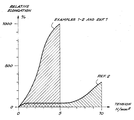
- composition according to the examples 1 and 2 and reference examples 1 and 2 are represented in the figure showing the classical tension/elongation diagram and giving thus the tension in function of the relative length change.
- the mineral filler from reference example 2 makes the tear resistance increase enormously as opposed to a reduction of the elongation; the composition becomes harder and less deformable.
- the shaded areas form the total powersurface which the composition fulfills, or, in other words, they form the total energy necessary to damage the cured composition.
- reaction product prepared of a polyetherpolyol in an excess of isophoron diisocyanate containing 2.8 wt% free -NCO groups, are successively added increasing volume percentages of hollow expanded microspheres of vinylidene chloride-acrylonitrile copolymer (Expancel). Mixing is performed during 30 minutes at high revolution number under vacuum. Samples are applied with the fimlograph on strips of PVC-folio (Lenatafolio) of 300 micrometer thick, 215 mm long and 82 mm wide in a dry layer thickness of 500 micrometer. After 24 hours curing the strips are cut to a length of 210 mm and a width of 78 mm. The curing happens at 20 degrees Celsius and 55 % relative humidity, lying loose on a glass plate.
- the internal stress is measured as follows.
- the comparative tests are executed in relation to the kind of mineral filler which causes the lowest internal stress, namely talc.
- the organic microsperes are the filler which causes the lowest internal stress for a same pigment volume concentration.
- the critical pigment volume concentration in this composition lies at 48%, the highest internal stress can be expected at a pigment volume concentration of 45%. Above the critical pigment volume concentration the compositions become porous. This is the reason why in both cases the internal stress decreases at a pigment volume concentration of 55% which for the microspheres corresponds to 6 wt% microspheres calculated on the cured composition.
- the talc causes a tension angle of 24.1 degrees and the microspheres an angle of only 11 degrees.
- the maximum quantity of the microspheres Expancel® 551DE20 which can be added without causing a porous final product is about 6 wt%.
Landscapes
- Chemical & Material Sciences (AREA)
- Organic Chemistry (AREA)
- Engineering & Computer Science (AREA)
- Materials Engineering (AREA)
- Life Sciences & Earth Sciences (AREA)
- Medicinal Chemistry (AREA)
- Polymers & Plastics (AREA)
- Chemical Kinetics & Catalysis (AREA)
- Health & Medical Sciences (AREA)
- Wood Science & Technology (AREA)
- Compositions Of Macromolecular Compounds (AREA)
- Adhesives Or Adhesive Processes (AREA)
- Non-Metallic Protective Coatings For Printed Circuits (AREA)
- Dental Preparations (AREA)
- Materials For Medical Uses (AREA)
- Die Bonding (AREA)
- Paints Or Removers (AREA)
- Manufacture Of Porous Articles, And Recovery And Treatment Of Waste Products (AREA)
- Sealing Material Composition (AREA)
Claims (8)
- Verwendung einer flexiblen Zusammensetzung als Dachbelag oder Fugenfüller, welche Zusammensetzung nach dem Aushärten eine Dehnungseigenschaft bis zum Bruch bei Umgebungstemperatur von zumindest 50% hat und welche einen weichen Polyurethanbinder mit einem niedrigen Modul, einem Molekulargewicht über 2000 und einer niedrigen Glasumwandlungstemperatur umfaßt und die bei Zimmertemperatur klebrig ist und nach dem Aushärten eine Shore A - Härte von maximal 45 und eine große Dehnung bis zum Bruch unter einer geringen Zugstärke und zumindest 0,1 bis 10 Gewichtsprozent expandierter Polymerpartikel mit einer Größe von 2 bis 300 Mikrometer als Füllstoff hat.
- Verwendung gemäß Anspruch 1, dadurch gekennzeichnet, daß die expandierten Polymerpartikel Mikrokügelchen sind.
- Verwendung gemäß Anspruch 2, dadurch gekennzeichnet, daß die expandierten Polymerpartikel hohle Mikrokügelchen sind.
- Verwendung gemäß irgendeinem der vorangehenden Ansprüche, dadurch gekennzeichnet, daß die Zusammensetzung 0,2 bis etwa 6 Gewichtsprozent expandierter Polymerpartikel enthält.
- Verwendung gemäß irgendeinem der vorangehenden Ansprüche, dadurch gekennzeichnet, daß die Polymerpartikel aus Vinylidenchlorid-Acrylonitril-Copolymer hergestellt sind.
- Verwendung gemäß irgendeinem der vorangehenden Ansprüche, dadurch gekennzeichnet, daß die Zusammensetzung eine mögliche Dehnung bei Umgebungstemperatur von zumindest 100% hat.
- Verwendung gemäß irgendeinem der vorangehenden Ansprüche, dadurch gekennzeichnet, daß der Binder ein Polyurethanpolymer ist.
- Verwendung gemäß irgendeinem der Ansprüche 1 bis 6, dadurch gekennzeichnet, daß der Binder ein Polyurethanpräpolymer ist.
Applications Claiming Priority (3)
| Application Number | Priority Date | Filing Date | Title |
|---|---|---|---|
| BE8901257 | 1989-11-24 | ||
| BE8901257A BE1003652A3 (nl) | 1989-11-24 | 1989-11-24 | Flexibele samenstelling op basis van een bindmiddel en ten minste een vulstof. |
| PCT/BE1990/000065 WO1991008253A1 (en) | 1989-11-24 | 1990-11-19 | Flexible composition on the basis of a binder and at least one filler |
Publications (2)
| Publication Number | Publication Date |
|---|---|
| EP0502864A1 EP0502864A1 (de) | 1992-09-16 |
| EP0502864B1 true EP0502864B1 (de) | 1995-07-12 |
Family
ID=3884404
Family Applications (1)
| Application Number | Title | Priority Date | Filing Date |
|---|---|---|---|
| EP90916440A Expired - Lifetime EP0502864B1 (de) | 1989-11-24 | 1990-11-19 | Flexible zusammensetzung auf der basis eines bindemittels und mindestens eines füllstoffes |
Country Status (8)
| Country | Link |
|---|---|
| EP (1) | EP0502864B1 (de) |
| JP (1) | JPH05506256A (de) |
| AT (1) | ATE124973T1 (de) |
| AU (1) | AU635586B2 (de) |
| BE (1) | BE1003652A3 (de) |
| CA (1) | CA2068990A1 (de) |
| DE (1) | DE69020905T2 (de) |
| WO (1) | WO1991008253A1 (de) |
Families Citing this family (6)
| Publication number | Priority date | Publication date | Assignee | Title |
|---|---|---|---|---|
| JP3632227B2 (ja) * | 1994-11-11 | 2005-03-23 | ヤマハ株式会社 | 穴埋め用樹脂組成物を用いた穴埋め方法 |
| NL1000712C2 (nl) * | 1995-06-30 | 1996-12-31 | Nooren Frans Bv | Toepassing van een preparaat voor isolatie-afdichting en bekledings- doeleinden alsmede werkwijze voor het afdichten van mangatdeksels. |
| US6919111B2 (en) | 1997-02-26 | 2005-07-19 | Fort James Corporation | Coated paperboards and paperboard containers having improved tactile and bulk insulation properties |
| FR2782521B1 (fr) * | 1998-08-18 | 2000-11-10 | Protectogrele | Materiau pour la protection de surface notamment metallique et procede d'application d'un tel materiau |
| GB2380483B (en) * | 2001-09-15 | 2004-02-25 | Kevin Griff George | Material for filling cracks or gaps and methods of applying same |
| JP2018522711A (ja) * | 2015-05-15 | 2018-08-16 | ダウ グローバル テクノロジーズ エルエルシー | ラミネータへの材料送達システム |
Family Cites Families (4)
| Publication number | Priority date | Publication date | Assignee | Title |
|---|---|---|---|---|
| JPS60224511A (ja) * | 1984-04-23 | 1985-11-08 | Mazda Motor Corp | 合成樹脂部材の製造法 |
| EP0331214B1 (de) * | 1984-10-06 | 1991-10-16 | J. H. Benecke AG | Mit einer Zurichtung versehenes Spaltleder oder Lederfaserwerkstoff |
| JPS63191856A (ja) * | 1987-02-03 | 1988-08-09 | Mitsui Toatsu Chem Inc | ポリウレタンシ−リング材組成物 |
| JPH0660260B2 (ja) * | 1987-10-16 | 1994-08-10 | 第一工業製薬株式会社 | ポリウレタン発泡体の製造方法 |
-
1989
- 1989-11-24 BE BE8901257A patent/BE1003652A3/nl not_active IP Right Cessation
-
1990
- 1990-11-19 EP EP90916440A patent/EP0502864B1/de not_active Expired - Lifetime
- 1990-11-19 JP JP90515257A patent/JPH05506256A/ja active Pending
- 1990-11-19 DE DE69020905T patent/DE69020905T2/de not_active Expired - Fee Related
- 1990-11-19 AU AU67161/90A patent/AU635586B2/en not_active Ceased
- 1990-11-19 WO PCT/BE1990/000065 patent/WO1991008253A1/en not_active Ceased
- 1990-11-19 AT AT90916440T patent/ATE124973T1/de not_active IP Right Cessation
- 1990-11-19 CA CA002068990A patent/CA2068990A1/en not_active Abandoned
Also Published As
| Publication number | Publication date |
|---|---|
| BE1003652A3 (nl) | 1992-05-12 |
| JPH05506256A (ja) | 1993-09-16 |
| DE69020905D1 (de) | 1995-08-17 |
| WO1991008253A1 (en) | 1991-06-13 |
| CA2068990A1 (en) | 1991-05-25 |
| DE69020905T2 (de) | 1996-03-07 |
| AU6716190A (en) | 1991-06-26 |
| AU635586B2 (en) | 1993-03-25 |
| EP0502864A1 (de) | 1992-09-16 |
| ATE124973T1 (de) | 1995-07-15 |
Similar Documents
| Publication | Publication Date | Title |
|---|---|---|
| CA2041532C (en) | Urethane sealant having improved sag properties | |
| EP0326704B1 (de) | Polymermischungen | |
| KR0162486B1 (ko) | 폴리프로필렌옥사이드와 유기-실리콘 블록공중합체에 기초한 폴리올 중간체의 블렌드로 만든 폴리우레탄 | |
| PT97332A (pt) | Processo de preparacao de um adesivo a base de poliuretana-poliester linear, poliolefina halogenada e de resina fenolica e de ligacao de um elastomero termoplastico a um substrato | |
| CA2072751A1 (en) | Moisture-curing polyurethane sealing compounds | |
| CA2442563A1 (en) | Low-density sealing mass, ground mass and method for producing the same and the use thereof | |
| AU635586B2 (en) | Flexible composition on the basis of a binder and at least one filler | |
| JPS6244784B2 (de) | ||
| US3951898A (en) | Blends of polysulfide polymer latices with urethane prepolymers to produce an improved sealant and caulking composition | |
| KR970065579A (ko) | 습기 경화성 1액형 폴리우레탄 조성물 및 이의 제조 방법 | |
| Patri et al. | A novel polyurethane sealant based on hydroxy‐terminated polybutadiene | |
| JP2612122B2 (ja) | 補修用樹脂組成物 | |
| CA1220627A (en) | Thixotropic flame inhibitors for rocket propellant grains | |
| US4987204A (en) | Coating composition | |
| JPS602355A (ja) | 金属塗装物 | |
| Feldman | Polyurethane and polyblend sealants | |
| JP2000226424A (ja) | ウレタンプレポリマー組成物 | |
| JP5563812B2 (ja) | ポリサルファイド系二液混合型シーリング材組成物 | |
| JP2719081B2 (ja) | 一液型揺変性ポリウレタン組成物 | |
| JPH06306134A (ja) | 硬化性ポリウレタン組成物 | |
| CA1039881A (en) | Urethane-base sealing material | |
| JP2001335741A (ja) | 二液型ポリウレタン系防水材 | |
| JPS63191856A (ja) | ポリウレタンシ−リング材組成物 | |
| JPH0320376A (ja) | 塗料組成物 | |
| JPH0436351A (ja) | 二液性ポリウレタン組成物 |
Legal Events
| Date | Code | Title | Description |
|---|---|---|---|
| PUAI | Public reference made under article 153(3) epc to a published international application that has entered the european phase |
Free format text: ORIGINAL CODE: 0009012 |
|
| 17P | Request for examination filed |
Effective date: 19920513 |
|
| AK | Designated contracting states |
Kind code of ref document: A1 Designated state(s): AT BE CH DE DK ES FR GB GR IT LI LU NL SE |
|
| 17Q | First examination report despatched |
Effective date: 19930603 |
|
| GRAA | (expected) grant |
Free format text: ORIGINAL CODE: 0009210 |
|
| AK | Designated contracting states |
Kind code of ref document: B1 Designated state(s): AT BE CH DE DK ES FR GB GR IT LI LU NL SE |
|
| PG25 | Lapsed in a contracting state [announced via postgrant information from national office to epo] |
Ref country code: GR Free format text: LAPSE BECAUSE OF FAILURE TO SUBMIT A TRANSLATION OF THE DESCRIPTION OR TO PAY THE FEE WITHIN THE PRESCRIBED TIME-LIMIT Effective date: 19950712 Ref country code: ES Free format text: THE PATENT HAS BEEN ANNULLED BY A DECISION OF A NATIONAL AUTHORITY Effective date: 19950712 Ref country code: DK Effective date: 19950712 |
|
| REF | Corresponds to: |
Ref document number: 124973 Country of ref document: AT Date of ref document: 19950715 Kind code of ref document: T |
|
| REF | Corresponds to: |
Ref document number: 69020905 Country of ref document: DE Date of ref document: 19950817 |
|
| ITF | It: translation for a ep patent filed | ||
| ET | Fr: translation filed | ||
| PG25 | Lapsed in a contracting state [announced via postgrant information from national office to epo] |
Ref country code: SE Effective date: 19951012 |
|
| PGFP | Annual fee paid to national office [announced via postgrant information from national office to epo] |
Ref country code: BE Payment date: 19951113 Year of fee payment: 6 |
|
| PGFP | Annual fee paid to national office [announced via postgrant information from national office to epo] |
Ref country code: CH Payment date: 19951114 Year of fee payment: 6 |
|
| PGFP | Annual fee paid to national office [announced via postgrant information from national office to epo] |
Ref country code: GB Payment date: 19951117 Year of fee payment: 6 |
|
| PGFP | Annual fee paid to national office [announced via postgrant information from national office to epo] |
Ref country code: AT Payment date: 19951124 Year of fee payment: 6 |
|
| PGFP | Annual fee paid to national office [announced via postgrant information from national office to epo] |
Ref country code: NL Payment date: 19951128 Year of fee payment: 6 |
|
| PGFP | Annual fee paid to national office [announced via postgrant information from national office to epo] |
Ref country code: FR Payment date: 19951129 Year of fee payment: 6 |
|
| PGFP | Annual fee paid to national office [announced via postgrant information from national office to epo] |
Ref country code: LU Payment date: 19960101 Year of fee payment: 6 |
|
| PGFP | Annual fee paid to national office [announced via postgrant information from national office to epo] |
Ref country code: DE Payment date: 19960105 Year of fee payment: 6 |
|
| PLBE | No opposition filed within time limit |
Free format text: ORIGINAL CODE: 0009261 |
|
| STAA | Information on the status of an ep patent application or granted ep patent |
Free format text: STATUS: NO OPPOSITION FILED WITHIN TIME LIMIT |
|
| 26N | No opposition filed | ||
| PG25 | Lapsed in a contracting state [announced via postgrant information from national office to epo] |
Ref country code: LU Free format text: LAPSE BECAUSE OF NON-PAYMENT OF DUE FEES Effective date: 19961119 Ref country code: GB Effective date: 19961119 Ref country code: AT Effective date: 19961119 |
|
| PG25 | Lapsed in a contracting state [announced via postgrant information from national office to epo] |
Ref country code: LI Effective date: 19961130 Ref country code: CH Effective date: 19961130 Ref country code: BE Effective date: 19961130 |
|
| BERE | Be: lapsed |
Owner name: GEHA N.V. Effective date: 19961130 |
|
| PG25 | Lapsed in a contracting state [announced via postgrant information from national office to epo] |
Ref country code: NL Effective date: 19970601 |
|
| GBPC | Gb: european patent ceased through non-payment of renewal fee |
Effective date: 19961119 |
|
| REG | Reference to a national code |
Ref country code: CH Ref legal event code: PL |
|
| PG25 | Lapsed in a contracting state [announced via postgrant information from national office to epo] |
Ref country code: FR Effective date: 19970731 |
|
| NLV4 | Nl: lapsed or anulled due to non-payment of the annual fee |
Effective date: 19970601 |
|
| PG25 | Lapsed in a contracting state [announced via postgrant information from national office to epo] |
Ref country code: DE Effective date: 19970902 |
|
| REG | Reference to a national code |
Ref country code: FR Ref legal event code: ST |
|
| PG25 | Lapsed in a contracting state [announced via postgrant information from national office to epo] |
Ref country code: IT Free format text: LAPSE BECAUSE OF NON-PAYMENT OF DUE FEES;WARNING: LAPSES OF ITALIAN PATENTS WITH EFFECTIVE DATE BEFORE 2007 MAY HAVE OCCURRED AT ANY TIME BEFORE 2007. THE CORRECT EFFECTIVE DATE MAY BE DIFFERENT FROM THE ONE RECORDED. Effective date: 20051119 |