EP0503422A1 - Verfahren zur Herstellung chemisch einheitlicher Cycloolefincopolymere - Google Patents
Verfahren zur Herstellung chemisch einheitlicher Cycloolefincopolymere Download PDFInfo
- Publication number
- EP0503422A1 EP0503422A1 EP19920103538 EP92103538A EP0503422A1 EP 0503422 A1 EP0503422 A1 EP 0503422A1 EP 19920103538 EP19920103538 EP 19920103538 EP 92103538 A EP92103538 A EP 92103538A EP 0503422 A1 EP0503422 A1 EP 0503422A1
- Authority
- EP
- European Patent Office
- Prior art keywords
- zirconium dichloride
- group
- meso
- bis
- cyclopentadienyl
- Prior art date
- Legal status (The legal status is an assumption and is not a legal conclusion. Google has not performed a legal analysis and makes no representation as to the accuracy of the status listed.)
- Granted
Links
- 229920001577 copolymer Polymers 0.000 title claims abstract description 29
- 238000000034 method Methods 0.000 title claims description 19
- 230000008569 process Effects 0.000 title claims description 14
- 238000002360 preparation method Methods 0.000 title claims description 6
- -1 polycyclic olefins Chemical class 0.000 claims abstract description 66
- 239000003054 catalyst Substances 0.000 claims abstract description 14
- 150000001925 cycloalkenes Chemical class 0.000 claims abstract description 13
- JFNLZVQOOSMTJK-KNVOCYPGSA-N norbornene Chemical compound C1[C@@H]2CC[C@H]1C=C2 JFNLZVQOOSMTJK-KNVOCYPGSA-N 0.000 claims abstract description 11
- XOJVVFBFDXDTEG-UHFFFAOYSA-N pristane Chemical compound CC(C)CCCC(C)CCCC(C)CCCC(C)C XOJVVFBFDXDTEG-UHFFFAOYSA-N 0.000 claims abstract description 9
- 125000001424 substituent group Chemical group 0.000 claims abstract description 5
- XBFJAVXCNXDMBH-UHFFFAOYSA-N tetracyclo[6.2.1.1(3,6).0(2,7)]dodec-4-ene Chemical compound C1C(C23)C=CC1C3C1CC2CC1 XBFJAVXCNXDMBH-UHFFFAOYSA-N 0.000 claims abstract description 5
- VPGLGRNSAYHXPY-UHFFFAOYSA-L zirconium(2+);dichloride Chemical compound Cl[Zr]Cl VPGLGRNSAYHXPY-UHFFFAOYSA-L 0.000 claims description 26
- 238000006116 polymerization reaction Methods 0.000 claims description 22
- VGGSQFUCUMXWEO-UHFFFAOYSA-N Ethene Chemical compound C=C VGGSQFUCUMXWEO-UHFFFAOYSA-N 0.000 claims description 20
- 239000005977 Ethylene Substances 0.000 claims description 20
- 239000000178 monomer Substances 0.000 claims description 16
- JRZJOMJEPLMPRA-UHFFFAOYSA-N olefin Natural products CCCCCCCC=C JRZJOMJEPLMPRA-UHFFFAOYSA-N 0.000 claims description 16
- 125000004435 hydrogen atom Chemical group [H]* 0.000 claims description 13
- 150000003254 radicals Chemical class 0.000 claims description 11
- UCIKZESDXASJNG-UHFFFAOYSA-L [Cl-].[Cl-].C1=CC=C2C([Zr+2])C=CC2=C1 Chemical compound [Cl-].[Cl-].C1=CC=C2C([Zr+2])C=CC2=C1 UCIKZESDXASJNG-UHFFFAOYSA-L 0.000 claims description 8
- 125000005843 halogen group Chemical group 0.000 claims description 8
- 125000004429 atom Chemical group 0.000 claims description 7
- 239000000203 mixture Substances 0.000 claims description 7
- 125000003118 aryl group Chemical group 0.000 claims description 6
- 125000000027 (C1-C10) alkoxy group Chemical group 0.000 claims description 5
- 125000000008 (C1-C10) alkyl group Chemical group 0.000 claims description 5
- JPSHILHGDRCOQO-UHFFFAOYSA-L C1=CC=C2C([Hf](Cl)Cl)C=CC2=C1 Chemical compound C1=CC=C2C([Hf](Cl)Cl)C=CC2=C1 JPSHILHGDRCOQO-UHFFFAOYSA-L 0.000 claims description 5
- 125000000041 C6-C10 aryl group Chemical group 0.000 claims description 5
- XUIMIQQOPSSXEZ-UHFFFAOYSA-N Silicon Chemical compound [Si] XUIMIQQOPSSXEZ-UHFFFAOYSA-N 0.000 claims description 5
- 229910052732 germanium Inorganic materials 0.000 claims description 5
- GNPVGFCGXDBREM-UHFFFAOYSA-N germanium atom Chemical compound [Ge] GNPVGFCGXDBREM-UHFFFAOYSA-N 0.000 claims description 5
- 229910052735 hafnium Inorganic materials 0.000 claims description 5
- VBJZVLUMGGDVMO-UHFFFAOYSA-N hafnium atom Chemical compound [Hf] VBJZVLUMGGDVMO-UHFFFAOYSA-N 0.000 claims description 5
- 229930195733 hydrocarbon Natural products 0.000 claims description 5
- 125000004805 propylene group Chemical group [H]C([H])([H])C([H])([*:1])C([H])([H])[*:2] 0.000 claims description 5
- 229910052710 silicon Inorganic materials 0.000 claims description 5
- 125000006374 C2-C10 alkenyl group Chemical group 0.000 claims description 4
- 239000004215 Carbon black (E152) Substances 0.000 claims description 4
- ATJFFYVFTNAWJD-UHFFFAOYSA-N Tin Chemical compound [Sn] ATJFFYVFTNAWJD-UHFFFAOYSA-N 0.000 claims description 4
- RTAQQCXQSZGOHL-UHFFFAOYSA-N Titanium Chemical compound [Ti] RTAQQCXQSZGOHL-UHFFFAOYSA-N 0.000 claims description 4
- QCWXUUIWCKQGHC-UHFFFAOYSA-N Zirconium Chemical compound [Zr] QCWXUUIWCKQGHC-UHFFFAOYSA-N 0.000 claims description 4
- 125000004122 cyclic group Chemical group 0.000 claims description 4
- 239000007788 liquid Substances 0.000 claims description 4
- GUCVJGMIXFAOAE-UHFFFAOYSA-N niobium atom Chemical compound [Nb] GUCVJGMIXFAOAE-UHFFFAOYSA-N 0.000 claims description 4
- 239000010703 silicon Substances 0.000 claims description 4
- GUVRBAGPIYLISA-UHFFFAOYSA-N tantalum atom Chemical compound [Ta] GUVRBAGPIYLISA-UHFFFAOYSA-N 0.000 claims description 4
- 229910052718 tin Inorganic materials 0.000 claims description 4
- 229910052720 vanadium Inorganic materials 0.000 claims description 4
- 229910052726 zirconium Inorganic materials 0.000 claims description 4
- 125000004169 (C1-C6) alkyl group Chemical group 0.000 claims description 3
- 125000001797 benzyl group Chemical group [H]C1=C([H])C([H])=C(C([H])=C1[H])C([H])([H])* 0.000 claims description 3
- 125000003709 fluoroalkyl group Chemical group 0.000 claims description 3
- 229910052758 niobium Inorganic materials 0.000 claims description 3
- 239000010955 niobium Substances 0.000 claims description 3
- 125000001997 phenyl group Chemical group [H]C1=C([H])C([H])=C(*)C([H])=C1[H] 0.000 claims description 3
- 229910052715 tantalum Inorganic materials 0.000 claims description 3
- 229910052719 titanium Inorganic materials 0.000 claims description 3
- 239000010936 titanium Substances 0.000 claims description 3
- KUNZSLJMPCDOGI-UHFFFAOYSA-L [Cl-].[Cl-].[Hf+2] Chemical compound [Cl-].[Cl-].[Hf+2] KUNZSLJMPCDOGI-UHFFFAOYSA-L 0.000 claims description 2
- 125000004407 fluoroaryl group Chemical group 0.000 claims description 2
- FMSGEJIFDJSPCE-UHFFFAOYSA-L dichlorozirconium;1-(2-inden-1-ylethyl)indene Chemical compound Cl[Zr]Cl.[CH]1[CH][C]2C=CC=C[C]2[C]1CC[C]1[C]2C=CC=C[C]2[CH][CH]1 FMSGEJIFDJSPCE-UHFFFAOYSA-L 0.000 claims 1
- LEONUFNNVUYDNQ-UHFFFAOYSA-N vanadium atom Chemical compound [V] LEONUFNNVUYDNQ-UHFFFAOYSA-N 0.000 claims 1
- 150000001875 compounds Chemical class 0.000 abstract description 6
- 238000007142 ring opening reaction Methods 0.000 abstract description 3
- YXFVVABEGXRONW-UHFFFAOYSA-N Toluene Chemical compound CC1=CC=CC=C1 YXFVVABEGXRONW-UHFFFAOYSA-N 0.000 description 24
- 229920000642 polymer Polymers 0.000 description 19
- 239000000243 solution Substances 0.000 description 17
- 150000001336 alkenes Chemical class 0.000 description 14
- 238000006243 chemical reaction Methods 0.000 description 13
- 230000009477 glass transition Effects 0.000 description 9
- 239000012968 metallocene catalyst Substances 0.000 description 8
- CSCPPACGZOOCGX-UHFFFAOYSA-N Acetone Chemical compound CC(C)=O CSCPPACGZOOCGX-UHFFFAOYSA-N 0.000 description 6
- 238000010348 incorporation Methods 0.000 description 6
- 239000000047 product Substances 0.000 description 6
- ZSWFCLXCOIISFI-UHFFFAOYSA-N endo-cyclopentadiene Natural products C1C=CC=C1 ZSWFCLXCOIISFI-UHFFFAOYSA-N 0.000 description 5
- 239000011521 glass Substances 0.000 description 5
- 239000000463 material Substances 0.000 description 5
- 238000002844 melting Methods 0.000 description 5
- 230000008018 melting Effects 0.000 description 5
- 125000000217 alkyl group Chemical group 0.000 description 4
- 239000000956 alloy Substances 0.000 description 4
- 229910045601 alloy Inorganic materials 0.000 description 4
- 229910052782 aluminium Inorganic materials 0.000 description 4
- 125000000058 cyclopentadienyl group Chemical group C1(=CC=CC1)* 0.000 description 4
- 238000000113 differential scanning calorimetry Methods 0.000 description 4
- 238000004519 manufacturing process Methods 0.000 description 4
- CPOFMOWDMVWCLF-UHFFFAOYSA-N methyl(oxo)alumane Chemical compound C[Al]=O CPOFMOWDMVWCLF-UHFFFAOYSA-N 0.000 description 4
- 239000000126 substance Substances 0.000 description 4
- XLYOFNOQVPJJNP-UHFFFAOYSA-N water Substances O XLYOFNOQVPJJNP-UHFFFAOYSA-N 0.000 description 4
- XAGFODPZIPBFFR-UHFFFAOYSA-N aluminium Chemical compound [Al] XAGFODPZIPBFFR-UHFFFAOYSA-N 0.000 description 3
- 239000007795 chemical reaction product Substances 0.000 description 3
- 238000002425 crystallisation Methods 0.000 description 3
- 230000008025 crystallization Effects 0.000 description 3
- 239000011888 foil Substances 0.000 description 3
- 150000002430 hydrocarbons Chemical class 0.000 description 3
- 238000009434 installation Methods 0.000 description 3
- 239000003446 ligand Substances 0.000 description 3
- 230000003287 optical effect Effects 0.000 description 3
- 230000004044 response Effects 0.000 description 3
- 239000007787 solid Substances 0.000 description 3
- 229910052723 transition metal Inorganic materials 0.000 description 3
- 150000003624 transition metals Chemical class 0.000 description 3
- GPPXJZIENCGNKB-UHFFFAOYSA-N vanadium Chemical compound [V]#[V] GPPXJZIENCGNKB-UHFFFAOYSA-N 0.000 description 3
- RFFLAFLAYFXFSW-UHFFFAOYSA-N 1,2-dichlorobenzene Chemical compound ClC1=CC=CC=C1Cl RFFLAFLAYFXFSW-UHFFFAOYSA-N 0.000 description 2
- PCBPVYHMZBWMAZ-UHFFFAOYSA-N 5-methylbicyclo[2.2.1]hept-2-ene Chemical compound C1C2C(C)CC1C=C2 PCBPVYHMZBWMAZ-UHFFFAOYSA-N 0.000 description 2
- IJGRMHOSHXDMSA-UHFFFAOYSA-N Atomic nitrogen Chemical compound N#N IJGRMHOSHXDMSA-UHFFFAOYSA-N 0.000 description 2
- VEXZGXHMUGYJMC-UHFFFAOYSA-N Hydrochloric acid Chemical compound Cl VEXZGXHMUGYJMC-UHFFFAOYSA-N 0.000 description 2
- VYPSYNLAJGMNEJ-UHFFFAOYSA-N Silicium dioxide Chemical compound O=[Si]=O VYPSYNLAJGMNEJ-UHFFFAOYSA-N 0.000 description 2
- 239000012876 carrier material Substances 0.000 description 2
- 230000000052 comparative effect Effects 0.000 description 2
- LPIQUOYDBNQMRZ-UHFFFAOYSA-N cyclopentene Chemical compound C1CC=CC1 LPIQUOYDBNQMRZ-UHFFFAOYSA-N 0.000 description 2
- 238000001125 extrusion Methods 0.000 description 2
- 239000000835 fiber Substances 0.000 description 2
- 238000010438 heat treatment Methods 0.000 description 2
- 239000001257 hydrogen Substances 0.000 description 2
- 229910052739 hydrogen Inorganic materials 0.000 description 2
- 239000012442 inert solvent Substances 0.000 description 2
- 238000002347 injection Methods 0.000 description 2
- 239000007924 injection Substances 0.000 description 2
- 238000001746 injection moulding Methods 0.000 description 2
- 125000002496 methyl group Chemical group [H]C([H])([H])* 0.000 description 2
- 238000000655 nuclear magnetic resonance spectrum Methods 0.000 description 2
- 125000006273 (C1-C3) alkyl group Chemical group 0.000 description 1
- 125000006274 (C1-C3)alkoxy group Chemical group 0.000 description 1
- 125000004178 (C1-C4) alkyl group Chemical group 0.000 description 1
- 125000006656 (C2-C4) alkenyl group Chemical group 0.000 description 1
- 238000001644 13C nuclear magnetic resonance spectroscopy Methods 0.000 description 1
- YBYIRNPNPLQARY-UHFFFAOYSA-N 1H-indene Natural products C1=CC=C2CC=CC2=C1 YBYIRNPNPLQARY-UHFFFAOYSA-N 0.000 description 1
- MUZDXNQOSGWMJJ-UHFFFAOYSA-N 2-methylprop-2-enoic acid;prop-2-enoic acid Chemical compound OC(=O)C=C.CC(=C)C(O)=O MUZDXNQOSGWMJJ-UHFFFAOYSA-N 0.000 description 1
- 101100058670 Aeromonas hydrophila subsp. hydrophila (strain ATCC 7966 / DSM 30187 / BCRC 13018 / CCUG 14551 / JCM 1027 / KCTC 2358 / NCIMB 9240 / NCTC 8049) bsr gene Proteins 0.000 description 1
- PNEYBMLMFCGWSK-UHFFFAOYSA-N Alumina Chemical class [O-2].[O-2].[O-2].[Al+3].[Al+3] PNEYBMLMFCGWSK-UHFFFAOYSA-N 0.000 description 1
- ZAMOUSCENKQFHK-UHFFFAOYSA-N Chlorine atom Chemical compound [Cl] ZAMOUSCENKQFHK-UHFFFAOYSA-N 0.000 description 1
- 244000043261 Hevea brasiliensis Species 0.000 description 1
- UFHFLCQGNIYNRP-UHFFFAOYSA-N Hydrogen Chemical compound [H][H] UFHFLCQGNIYNRP-UHFFFAOYSA-N 0.000 description 1
- 238000005481 NMR spectroscopy Methods 0.000 description 1
- 229920002292 Nylon 6 Polymers 0.000 description 1
- 229920002302 Nylon 6,6 Polymers 0.000 description 1
- 239000002033 PVDF binder Substances 0.000 description 1
- 229930040373 Paraformaldehyde Natural products 0.000 description 1
- 229920003171 Poly (ethylene oxide) Polymers 0.000 description 1
- 239000004698 Polyethylene Substances 0.000 description 1
- 229920002367 Polyisobutene Polymers 0.000 description 1
- 239000004743 Polypropylene Substances 0.000 description 1
- 239000004793 Polystyrene Substances 0.000 description 1
- YVAJTQPCQNUSIG-UHFFFAOYSA-L [Cl-].[Cl-].C1=CC2=CC=CC=C2C1[Hf+2]C1C2=CC=CC=C2C=C1 Chemical compound [Cl-].[Cl-].C1=CC2=CC=CC=C2C1[Hf+2]C1C2=CC=CC=C2C=C1 YVAJTQPCQNUSIG-UHFFFAOYSA-L 0.000 description 1
- FJMJPZLXUXRLLD-UHFFFAOYSA-L [Cl-].[Cl-].C1=CC2=CC=CC=C2C1[Zr+2]([SiH](C)C)C1C2=CC=CC=C2C=C1 Chemical compound [Cl-].[Cl-].C1=CC2=CC=CC=C2C1[Zr+2]([SiH](C)C)C1C2=CC=CC=C2C=C1 FJMJPZLXUXRLLD-UHFFFAOYSA-L 0.000 description 1
- QSZGOMRHQRFORD-UHFFFAOYSA-L [Cl-].[Cl-].C=C.C1=CC2=CC=CC=C2C1[Zr+2]C1C2=CC=CC=C2C=C1 Chemical compound [Cl-].[Cl-].C=C.C1=CC2=CC=CC=C2C1[Zr+2]C1C2=CC=CC=C2C=C1 QSZGOMRHQRFORD-UHFFFAOYSA-L 0.000 description 1
- 125000001931 aliphatic group Chemical group 0.000 description 1
- 150000001338 aliphatic hydrocarbons Chemical class 0.000 description 1
- 229920005603 alternating copolymer Polymers 0.000 description 1
- 150000004945 aromatic hydrocarbons Chemical class 0.000 description 1
- 229920003235 aromatic polyamide Polymers 0.000 description 1
- 125000005018 aryl alkenyl group Chemical group 0.000 description 1
- 125000003710 aryl alkyl group Chemical group 0.000 description 1
- 125000004104 aryloxy group Chemical group 0.000 description 1
- 230000005540 biological transmission Effects 0.000 description 1
- 229920000402 bisphenol A polycarbonate polymer Polymers 0.000 description 1
- 125000000484 butyl group Chemical group [H]C([*])([H])C([H])([H])C([H])([H])C([H])([H])[H] 0.000 description 1
- 238000001460 carbon-13 nuclear magnetic resonance spectrum Methods 0.000 description 1
- 150000004649 carbonic acid derivatives Chemical class 0.000 description 1
- 239000000969 carrier Substances 0.000 description 1
- 238000006555 catalytic reaction Methods 0.000 description 1
- 230000008859 change Effects 0.000 description 1
- 229910052801 chlorine Inorganic materials 0.000 description 1
- 239000000460 chlorine Substances 0.000 description 1
- 238000004132 cross linking Methods 0.000 description 1
- QRUYYSPCOGSZGQ-UHFFFAOYSA-L cyclopentane;dichlorozirconium Chemical compound Cl[Zr]Cl.[CH]1[CH][CH][CH][CH]1.[CH]1[CH][CH][CH][CH]1 QRUYYSPCOGSZGQ-UHFFFAOYSA-L 0.000 description 1
- 238000013500 data storage Methods 0.000 description 1
- 230000001419 dependent effect Effects 0.000 description 1
- IVTQDRJBWSBJQM-UHFFFAOYSA-L dichlorozirconium;indene Chemical compound C1=CC2=CC=CC=C2C1[Zr](Cl)(Cl)C1C2=CC=CC=C2C=C1 IVTQDRJBWSBJQM-UHFFFAOYSA-L 0.000 description 1
- 239000002283 diesel fuel Substances 0.000 description 1
- 230000004069 differentiation Effects 0.000 description 1
- 238000009792 diffusion process Methods 0.000 description 1
- 238000009826 distribution Methods 0.000 description 1
- HQQADJVZYDDRJT-UHFFFAOYSA-N ethene;prop-1-ene Chemical group C=C.CC=C HQQADJVZYDDRJT-UHFFFAOYSA-N 0.000 description 1
- 125000001495 ethyl group Chemical group [H]C([H])([H])C([H])([H])* 0.000 description 1
- 229920001038 ethylene copolymer Polymers 0.000 description 1
- 238000002474 experimental method Methods 0.000 description 1
- 230000002349 favourable effect Effects 0.000 description 1
- 239000000499 gel Substances 0.000 description 1
- 229920001519 homopolymer Polymers 0.000 description 1
- 125000003454 indenyl group Chemical group C1(C=CC2=CC=CC=C12)* 0.000 description 1
- 230000003993 interaction Effects 0.000 description 1
- 125000000959 isobutyl group Chemical group [H]C([H])([H])C([H])(C([H])([H])[H])C([H])([H])* 0.000 description 1
- 125000001449 isopropyl group Chemical group [H]C([H])([H])C([H])(*)C([H])([H])[H] 0.000 description 1
- 239000000155 melt Substances 0.000 description 1
- 229910052751 metal Inorganic materials 0.000 description 1
- 239000002184 metal Substances 0.000 description 1
- 229920003052 natural elastomer Polymers 0.000 description 1
- 229920001194 natural rubber Polymers 0.000 description 1
- 125000001971 neopentyl group Chemical group [H]C([*])([H])C(C([H])([H])[H])(C([H])([H])[H])C([H])([H])[H] 0.000 description 1
- 230000007935 neutral effect Effects 0.000 description 1
- 229910052757 nitrogen Inorganic materials 0.000 description 1
- 239000013307 optical fiber Substances 0.000 description 1
- 125000002524 organometallic group Chemical group 0.000 description 1
- RGSFGYAAUTVSQA-UHFFFAOYSA-N pentamethylene Natural products C1CCCC1 RGSFGYAAUTVSQA-UHFFFAOYSA-N 0.000 description 1
- 229920001643 poly(ether ketone) Polymers 0.000 description 1
- 229920003229 poly(methyl methacrylate) Polymers 0.000 description 1
- 229920002285 poly(styrene-co-acrylonitrile) Polymers 0.000 description 1
- 229920002492 poly(sulfone) Polymers 0.000 description 1
- 229920000058 polyacrylate Polymers 0.000 description 1
- 229920002647 polyamide Polymers 0.000 description 1
- 229920001230 polyarylate Polymers 0.000 description 1
- 229920001748 polybutylene Polymers 0.000 description 1
- 229920001707 polybutylene terephthalate Polymers 0.000 description 1
- 229920000515 polycarbonate Polymers 0.000 description 1
- 239000004417 polycarbonate Substances 0.000 description 1
- 125000003367 polycyclic group Chemical group 0.000 description 1
- 229920000728 polyester Polymers 0.000 description 1
- 229920006393 polyether sulfone Polymers 0.000 description 1
- 229920000573 polyethylene Polymers 0.000 description 1
- 229920000139 polyethylene terephthalate Polymers 0.000 description 1
- 239000005020 polyethylene terephthalate Substances 0.000 description 1
- 229920001195 polyisoprene Polymers 0.000 description 1
- 230000037048 polymerization activity Effects 0.000 description 1
- 229920000193 polymethacrylate Polymers 0.000 description 1
- 239000004926 polymethyl methacrylate Substances 0.000 description 1
- 229920000306 polymethylpentene Polymers 0.000 description 1
- 239000011116 polymethylpentene Substances 0.000 description 1
- 229920000098 polyolefin Polymers 0.000 description 1
- 229920006324 polyoxymethylene Polymers 0.000 description 1
- 229920001155 polypropylene Polymers 0.000 description 1
- 229920002223 polystyrene Polymers 0.000 description 1
- 229920002635 polyurethane Polymers 0.000 description 1
- 239000004814 polyurethane Substances 0.000 description 1
- 229920002981 polyvinylidene fluoride Polymers 0.000 description 1
- 239000000843 powder Substances 0.000 description 1
- 238000003825 pressing Methods 0.000 description 1
- QQONPFPTGQHPMA-UHFFFAOYSA-N propylene Natural products CC=C QQONPFPTGQHPMA-UHFFFAOYSA-N 0.000 description 1
- 239000012429 reaction media Substances 0.000 description 1
- 239000011541 reaction mixture Substances 0.000 description 1
- 238000001953 recrystallisation Methods 0.000 description 1
- 238000007151 ring opening polymerisation reaction Methods 0.000 description 1
- 229920006395 saturated elastomer Polymers 0.000 description 1
- 230000035945 sensitivity Effects 0.000 description 1
- 239000000377 silicon dioxide Substances 0.000 description 1
- 239000002904 solvent Substances 0.000 description 1
- 239000007858 starting material Substances 0.000 description 1
- 229920006301 statistical copolymer Polymers 0.000 description 1
- 238000003756 stirring Methods 0.000 description 1
- 150000003623 transition metal compounds Chemical class 0.000 description 1
- 239000002699 waste material Substances 0.000 description 1
- 238000004260 weight control Methods 0.000 description 1
- 229910052845 zircon Inorganic materials 0.000 description 1
- GFQYVLUOOAAOGM-UHFFFAOYSA-N zirconium(iv) silicate Chemical compound [Zr+4].[O-][Si]([O-])([O-])[O-] GFQYVLUOOAAOGM-UHFFFAOYSA-N 0.000 description 1
Images


Classifications
-
- C—CHEMISTRY; METALLURGY
- C08—ORGANIC MACROMOLECULAR COMPOUNDS; THEIR PREPARATION OR CHEMICAL WORKING-UP; COMPOSITIONS BASED THEREON
- C08F—MACROMOLECULAR COMPOUNDS OBTAINED BY REACTIONS ONLY INVOLVING CARBON-TO-CARBON UNSATURATED BONDS
- C08F232/00—Copolymers of cyclic compounds containing no unsaturated aliphatic radicals in a side chain, and having one or more carbon-to-carbon double bonds in a carbocyclic ring system
- C08F232/08—Copolymers of cyclic compounds containing no unsaturated aliphatic radicals in a side chain, and having one or more carbon-to-carbon double bonds in a carbocyclic ring system having condensed rings
-
- C—CHEMISTRY; METALLURGY
- C07—ORGANIC CHEMISTRY
- C07F—ACYCLIC, CARBOCYCLIC OR HETEROCYCLIC COMPOUNDS CONTAINING ELEMENTS OTHER THAN CARBON, HYDROGEN, HALOGEN, OXYGEN, NITROGEN, SULFUR, SELENIUM OR TELLURIUM
- C07F17/00—Metallocenes
-
- C—CHEMISTRY; METALLURGY
- C08—ORGANIC MACROMOLECULAR COMPOUNDS; THEIR PREPARATION OR CHEMICAL WORKING-UP; COMPOSITIONS BASED THEREON
- C08F—MACROMOLECULAR COMPOUNDS OBTAINED BY REACTIONS ONLY INVOLVING CARBON-TO-CARBON UNSATURATED BONDS
- C08F10/00—Homopolymers and copolymers of unsaturated aliphatic hydrocarbons having only one carbon-to-carbon double bond
-
- C—CHEMISTRY; METALLURGY
- C08—ORGANIC MACROMOLECULAR COMPOUNDS; THEIR PREPARATION OR CHEMICAL WORKING-UP; COMPOSITIONS BASED THEREON
- C08F—MACROMOLECULAR COMPOUNDS OBTAINED BY REACTIONS ONLY INVOLVING CARBON-TO-CARBON UNSATURATED BONDS
- C08F210/00—Copolymers of unsaturated aliphatic hydrocarbons having only one carbon-to-carbon double bond
- C08F210/02—Ethene
-
- C—CHEMISTRY; METALLURGY
- C08—ORGANIC MACROMOLECULAR COMPOUNDS; THEIR PREPARATION OR CHEMICAL WORKING-UP; COMPOSITIONS BASED THEREON
- C08F—MACROMOLECULAR COMPOUNDS OBTAINED BY REACTIONS ONLY INVOLVING CARBON-TO-CARBON UNSATURATED BONDS
- C08F4/00—Polymerisation catalysts
- C08F4/42—Metals; Metal hydrides; Metallo-organic compounds; Use thereof as catalyst precursors
- C08F4/44—Metals; Metal hydrides; Metallo-organic compounds; Use thereof as catalyst precursors selected from light metals, zinc, cadmium, mercury, copper, silver, gold, boron, gallium, indium, thallium, rare earths or actinides
- C08F4/60—Metals; Metal hydrides; Metallo-organic compounds; Use thereof as catalyst precursors selected from light metals, zinc, cadmium, mercury, copper, silver, gold, boron, gallium, indium, thallium, rare earths or actinides together with refractory metals, iron group metals, platinum group metals, manganese, rhenium technetium or compounds thereof
- C08F4/62—Refractory metals or compounds thereof
- C08F4/639—Component covered by group C08F4/62 containing a transition metal-carbon bond
- C08F4/63908—Component covered by group C08F4/62 containing a transition metal-carbon bond in combination with an ionising compound other than alumoxane, e.g. (C6F5)4B-X+
-
- C—CHEMISTRY; METALLURGY
- C08—ORGANIC MACROMOLECULAR COMPOUNDS; THEIR PREPARATION OR CHEMICAL WORKING-UP; COMPOSITIONS BASED THEREON
- C08F—MACROMOLECULAR COMPOUNDS OBTAINED BY REACTIONS ONLY INVOLVING CARBON-TO-CARBON UNSATURATED BONDS
- C08F4/00—Polymerisation catalysts
- C08F4/42—Metals; Metal hydrides; Metallo-organic compounds; Use thereof as catalyst precursors
- C08F4/44—Metals; Metal hydrides; Metallo-organic compounds; Use thereof as catalyst precursors selected from light metals, zinc, cadmium, mercury, copper, silver, gold, boron, gallium, indium, thallium, rare earths or actinides
- C08F4/60—Metals; Metal hydrides; Metallo-organic compounds; Use thereof as catalyst precursors selected from light metals, zinc, cadmium, mercury, copper, silver, gold, boron, gallium, indium, thallium, rare earths or actinides together with refractory metals, iron group metals, platinum group metals, manganese, rhenium technetium or compounds thereof
- C08F4/62—Refractory metals or compounds thereof
- C08F4/639—Component covered by group C08F4/62 containing a transition metal-carbon bond
- C08F4/63912—Component covered by group C08F4/62 containing a transition metal-carbon bond in combination with an organoaluminium compound
-
- C—CHEMISTRY; METALLURGY
- C08—ORGANIC MACROMOLECULAR COMPOUNDS; THEIR PREPARATION OR CHEMICAL WORKING-UP; COMPOSITIONS BASED THEREON
- C08F—MACROMOLECULAR COMPOUNDS OBTAINED BY REACTIONS ONLY INVOLVING CARBON-TO-CARBON UNSATURATED BONDS
- C08F4/00—Polymerisation catalysts
- C08F4/42—Metals; Metal hydrides; Metallo-organic compounds; Use thereof as catalyst precursors
- C08F4/44—Metals; Metal hydrides; Metallo-organic compounds; Use thereof as catalyst precursors selected from light metals, zinc, cadmium, mercury, copper, silver, gold, boron, gallium, indium, thallium, rare earths or actinides
- C08F4/60—Metals; Metal hydrides; Metallo-organic compounds; Use thereof as catalyst precursors selected from light metals, zinc, cadmium, mercury, copper, silver, gold, boron, gallium, indium, thallium, rare earths or actinides together with refractory metals, iron group metals, platinum group metals, manganese, rhenium technetium or compounds thereof
- C08F4/62—Refractory metals or compounds thereof
- C08F4/639—Component covered by group C08F4/62 containing a transition metal-carbon bond
- C08F4/63916—Component covered by group C08F4/62 containing a transition metal-carbon bond supported on a carrier, e.g. silica, MgCl2, polymer
-
- C—CHEMISTRY; METALLURGY
- C08—ORGANIC MACROMOLECULAR COMPOUNDS; THEIR PREPARATION OR CHEMICAL WORKING-UP; COMPOSITIONS BASED THEREON
- C08F—MACROMOLECULAR COMPOUNDS OBTAINED BY REACTIONS ONLY INVOLVING CARBON-TO-CARBON UNSATURATED BONDS
- C08F4/00—Polymerisation catalysts
- C08F4/42—Metals; Metal hydrides; Metallo-organic compounds; Use thereof as catalyst precursors
- C08F4/44—Metals; Metal hydrides; Metallo-organic compounds; Use thereof as catalyst precursors selected from light metals, zinc, cadmium, mercury, copper, silver, gold, boron, gallium, indium, thallium, rare earths or actinides
- C08F4/60—Metals; Metal hydrides; Metallo-organic compounds; Use thereof as catalyst precursors selected from light metals, zinc, cadmium, mercury, copper, silver, gold, boron, gallium, indium, thallium, rare earths or actinides together with refractory metals, iron group metals, platinum group metals, manganese, rhenium technetium or compounds thereof
- C08F4/62—Refractory metals or compounds thereof
- C08F4/639—Component covered by group C08F4/62 containing a transition metal-carbon bond
- C08F4/6392—Component covered by group C08F4/62 containing a transition metal-carbon bond containing at least one cyclopentadienyl ring, condensed or not, e.g. an indenyl or a fluorenyl ring
- C08F4/63922—Component covered by group C08F4/62 containing a transition metal-carbon bond containing at least one cyclopentadienyl ring, condensed or not, e.g. an indenyl or a fluorenyl ring containing at least two cyclopentadienyl rings, fused or not
- C08F4/63927—Component covered by group C08F4/62 containing a transition metal-carbon bond containing at least one cyclopentadienyl ring, condensed or not, e.g. an indenyl or a fluorenyl ring containing at least two cyclopentadienyl rings, fused or not two cyclopentadienyl rings being mutually bridged
-
- C—CHEMISTRY; METALLURGY
- C08—ORGANIC MACROMOLECULAR COMPOUNDS; THEIR PREPARATION OR CHEMICAL WORKING-UP; COMPOSITIONS BASED THEREON
- C08F—MACROMOLECULAR COMPOUNDS OBTAINED BY REACTIONS ONLY INVOLVING CARBON-TO-CARBON UNSATURATED BONDS
- C08F4/00—Polymerisation catalysts
- C08F4/42—Metals; Metal hydrides; Metallo-organic compounds; Use thereof as catalyst precursors
- C08F4/44—Metals; Metal hydrides; Metallo-organic compounds; Use thereof as catalyst precursors selected from light metals, zinc, cadmium, mercury, copper, silver, gold, boron, gallium, indium, thallium, rare earths or actinides
- C08F4/60—Metals; Metal hydrides; Metallo-organic compounds; Use thereof as catalyst precursors selected from light metals, zinc, cadmium, mercury, copper, silver, gold, boron, gallium, indium, thallium, rare earths or actinides together with refractory metals, iron group metals, platinum group metals, manganese, rhenium technetium or compounds thereof
- C08F4/62—Refractory metals or compounds thereof
- C08F4/64—Titanium, zirconium, hafnium or compounds thereof
- C08F4/659—Component covered by group C08F4/64 containing a transition metal-carbon bond
- C08F4/65912—Component covered by group C08F4/64 containing a transition metal-carbon bond in combination with an organoaluminium compound
-
- Y—GENERAL TAGGING OF NEW TECHNOLOGICAL DEVELOPMENTS; GENERAL TAGGING OF CROSS-SECTIONAL TECHNOLOGIES SPANNING OVER SEVERAL SECTIONS OF THE IPC; TECHNICAL SUBJECTS COVERED BY FORMER USPC CROSS-REFERENCE ART COLLECTIONS [XRACs] AND DIGESTS
- Y10—TECHNICAL SUBJECTS COVERED BY FORMER USPC
- Y10S—TECHNICAL SUBJECTS COVERED BY FORMER USPC CROSS-REFERENCE ART COLLECTIONS [XRACs] AND DIGESTS
- Y10S526/00—Synthetic resins or natural rubbers -- part of the class 520 series
- Y10S526/943—Polymerization with metallocene catalysts
Definitions
- the invention relates to a process for the preparation of copolymers of polycyclic olefins, wherein there is no ring opening.
- polycyclic olefins can be polymerized using various Ziegler catalysts. Depending on the catalyst, the polymerization proceeds via ring opening (cf. US 4 178 424) or opening of the double bond (cf. EP-A 156 464, EP-A 283 164, EP-A-203 799).
- the disadvantage of a ring-opening polymerization is that the polymer obtained contains double bonds which can lead to chain crosslinking and thus considerably restrict the processability of the material by extrusion or injection molding.
- the polymerization with the opening of the double bond leads to a relatively low polymerization rate (conversion rate) in the case of cyclic olefins.
- a stereorigid chiral metallocene compound such as, for example, ethylene bis (indenyl) zirconium dichloride (cf. EP-A 283164) or dimethylsilyl bis (indenyl) zirconium dichloride (cf. ZA 90/5308) can be used as the catalyst, with the polymerization under Received the ring.
- the glass transition temperature of amorphous copolymers correlates with the incorporation rates of the comonomers in the polymer.
- the glass transition temperature of norbornene / ethylene copolymers per mole percent of norbornene in the polymer increases by 4 to 5 Kelvin.
- the glass transition temperature is an indirect measure of the heat resistance.
- Statistical copolymers are characterized by a statistical distribution of the comonomer units in the polymer chain. This results in a higher fluctuation in the density of the material than is the case with homopolymers or alternating copolymers. However, density fluctuations increase the amount of scattered light and reduce transparency. Applications in which, as with optical waveguides, the highest demands are placed on the light transmission are thereby restricted. Here too, chemically uniform products are highly desirable.
- Chemical uniformity means an almost constant incorporation ratio of the monomers into the copolymer - over the respective polymer chain as well as over the total number of chains formed (over the polymerization time).
- the chemical uniformity increases as the copolymers approach in their structure from a statistical to an alternating monomer sequence.
- the object was therefore to find a process for the preparation of cycloolefin copolymers which, based on the polymerization via the double bond, gives chemically uniform copolymers with a high space-time yield, while at the same time changes in the reaction parameters to the chemical uniformity of the products are less Have an influence than in known methods.
- Alkyl stands for straight-chain or branched alkyl.
- the monocyclic olefin VII can also be substituted (e.g. by aryl or alkyl radicals) for the purposes of the invention.
- Polymerization is preferably carried out in the liquid cycloolefin monomer, cycloolefin monomer mixture or in concentrated solutions.
- At least one polycyclic olefin of the formulas I, II, III, IV, V or VI preferably a cycloolefin of the formulas I or III, in which R1, R2, R3, R4, R5, R6, R7 and R8 are the same or different are and represent a hydrogen atom or a C1-C8-alkyl radical, where the same radicals in the different formulas can have different meanings.
- a monocyclic olefin of the formula VII in which n is a number from 2 to 10, is also used.
- Another comonomer is an acyclic olefin of the formula VIII, in which R9, R10, R11 and R12 are identical or different and denote a hydrogen atom or a C1-C8-alkyl radical. Ethylene or propylene are preferred.
- copolymers of polycyclic olefins preferably of the formulas I and III, are produced with the acyclic olefins VIII.
- cycloolefins are norbornene and tetracyclododecene, which can be substituted by (C1-C6) alkyl. They are preferably copolymerized with ethylene; ethylene / norbornene copolymers are particularly important.
- Installation ratios of comonomers VII and / or VIII in the copolymer from 20:80 to 80:20 are preferred. In particular, installation ratios of 40:60 to 60:40 are preferred.
- the polycyclic olefin (I to VI) is in an amount of 0.1 to 99.9% by weight and the monocyclic olefin (VII) in an amount of 0.1 to 99.9% by weight, in each case based on the total amount of monomers used.
- the concentration of the open-chain olefin results from the solubility of the open-chain olefin in the reaction medium at a given pressure and temperature.
- olefins of the respective type are also to be understood as polycyclic olefins, monocyclic olefins and open-chain olefins.
- polycyclic bicopolymers in addition to polycyclic bicopolymers, ter- and multicopolymers can also be produced by the process according to the invention.
- Copolymers of cycloolefins VII with acyclic olefins VIII can also advantageously be obtained by the process described.
- cycloolefins VII cyclopentene, which may be substituted, is preferred.
- the catalyst to be used for the process according to the invention consists of an aluminum oxane and at least one metallocene (transition metal component) of the formula XI
- M1 is a metal from the group consisting of titanium, zirconium, hafnium, vanadium, niobium and tantalum, preferably zirconium and hafnium. Is particularly preferred Zircon used.
- R14 and R15 are the same or different and represent a hydrogen atom, a C1-C10-, preferably C1-C3-alkyl group, a C1-C10-, preferably C1-C3-alkoxy group, a C6-C10-, preferably C6-C8-aryl group , a C6-C10-, preferably C6-C8-aryloxy group, a C2-C10, preferably C2-C4-alkenyl group, a C7-C40-, preferably C7-C10-arylalkyl group, a C7-C40-, preferably C7-C12 -Alkylaryl group, a C8-C40-, preferably C8-C12-arylalkenyl group or a halogen atom, preferably chlorine.
- R16 fluorenyl and R17 cyclopentadienyl where these radicals can be substituted (in the case of C1 symmetry), or both radicals are the same and mean (subst.) Indenyl or substituted cyclopentadienyl (meso form).
- R18 is preferably a radical and particularly preferred
- M2 is silicon, germanium or tin, preferably silicon or germanium.
- the bridged metallocenes can be prepared according to the following known reaction scheme: or H2R16 + ButylLi ⁇ HR16Li
- meso form means that the substituents R16 and R17 can be converted into one another by a mirror plane between R16 and R17, in which the central atom M1 is located (cf. K. Mislow, "Einf. In die Stereochemie” , P. 83).
- ligand systems (R16 - R18) which can exert a different steric interaction on the ligands R14 and R15.
- the nature of the ligands R14 and R15 is irrelevant.
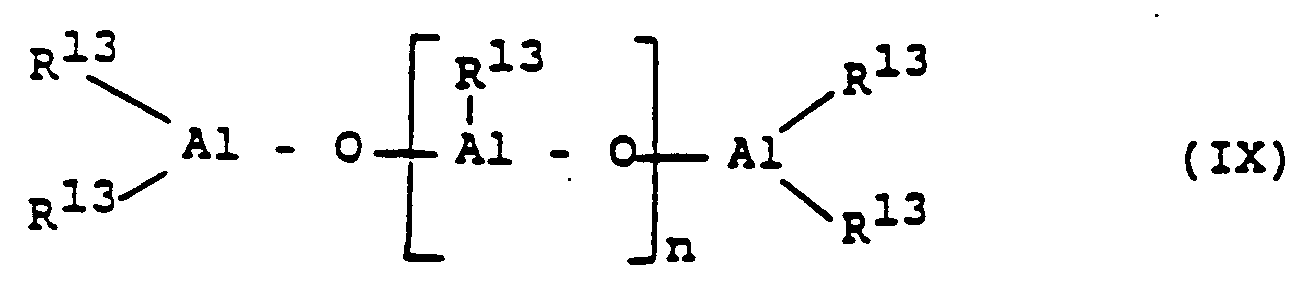
- the cocatalyst is (preferably) an aluminoxane of the formula IX and / or of the formula X.
- the radicals R 13 can be identical or different and mean a C 1 -C 4 alkyl group, preferably methyl, ethyl or isobutyl, Butyl or neopentyl, or phenyl or benzyl. Methyl is particularly preferred.
- n is an integer from 0 to 50, preferably 5 to 40.
- the aluminoxane can be prepared in various ways by known methods.
- One of the methods is, for example, that an aluminum hydrocarbon compound and / or a hydridoaluminum hydrocarbon compound is reacted with water (gaseous, solid, liquid or bound - for example as water of crystallization) in an inert solvent (such as toluene).
- an inert solvent such as toluene
- To produce an aluminoxane with different alkyl groups R13 two different aluminum trialkyls (AlR3 + AlR'3) are reacted with water according to the desired composition (see S. Pasynkiewicz, Polyhedron 9 (1990) 429 and EP-A 302 424).
- the transition metal compound is preactivated in solution.
- the metallocene is preferably dissolved in a solution of the aluminoxane in an inert hydrocarbon.
- An aliphatic or aromatic hydrocarbon is suitable as the inert hydrocarbon.
- Toluene is preferably used.
- the concentration of the aluminoxane in the solution is in the range from about 1% by weight to the saturation limit, preferably from 5 to 30% by weight, based in each case on the total solution.
- the metallocene can be in the same concentration are used, but it is preferably used in an amount of 10 ⁇ 4 - 1 mol per mol of aluminoxane.
- the preactivation time is 5 minutes to 60 hours, preferably 5 to 60 minutes. One works at a temperature of -78 ° C to 100 ° C, preferably 0 to 70 ° C.
- the metallocene can also be prepolymerized or applied to a support.
- the prepolymerization is preferably carried out using the (or one of the) olefin (s) used in the polymerization.
- Suitable carriers are, for example, silica gels, aluminum oxides, solid aluminoxane or other inorganic carrier materials.
- a suitable carrier material is also a polyolefin powder in finely divided form.
- a salt-like compound of the formula R x NH 4-x BR'4 or the formula R3PHBR'4 is used as cocatalyst.
- X 1, 2 or 3
- R alkyl or aryl, the same or different
- R ' aryl, which can also be fluorinated or partially fluorinated.
- the catalyst consists of the reaction product of a metallocene with one of the compounds mentioned (cf. EP-A 277 004).
- solvent is added to the reaction mixture, then it is common inert solvents such as e.g. aliphatic or cycloaliphatic hydrocarbons, gasoline or hydrogenated diesel oil fractions or toluene.
- the metallocene compound is used in a concentration, based on the transition metal, of 10 ⁇ 3 to 10 ⁇ 8, preferably 10 ⁇ 4 to 10 ⁇ 7 mol transition metal per dm3 reactor volume.
- the aluminoxane is used in a concentration of 10 ⁇ 4 to 10 ⁇ 1, preferably 10 ⁇ 4 to 2 ⁇ 10 ⁇ 2 mol per dm3 reactor volume, based on the aluminum content. In principle, however, higher concentrations are also possible.
- the molar ratios of the polycyclic olefin to the open-chain olefin used can be varied within a wide range. Molar ratios of 3: 1 to 100: 1 cycloolefin to open-chain olefin are preferably used.
- the rate of comonomer incorporation can be controlled almost as desired. Incorporation rates between 20 and 80 mol% of the cyclic components are preferred, and incorporation rates between 40 and 60 mol% of the cyclic components are particularly preferred.
- the average molecular weight of the copolymer formed can be controlled in a known manner by metering in hydrogen, varying the catalyst concentration or varying the temperature.
- the polydispersity M w / M n of the copolymers is quite narrow with values between 2.0 and 3.5. This results in a property profile of the polymers, which makes them particularly suitable for injection molding.
- the materials produced according to the invention are particularly suitable for the production of extrusion parts such as foils, hoses, tubes, rods and fibers as well as for the production of injection molded articles of any shape and size.
- the polymers according to the invention can also be used for the production of polymer alloys.
- the alloys can be made in the melt or in solution.
- the alloys each have a favorable combination of properties of the components for certain applications.
- the following polymers can be used for alloys with the polymers according to the invention: Polyethylene, polypropylene, (ethylene-propylene) copolymers, polybutylene, poly- (4-methyl-1-pentene), polyisoprene, polyisobutylene, natural rubber, poly (methyl methacrylate), other polymethacrylates, polyacrylates, (acrylate-methacrylate) copolymers, Polystyrene, (styrene-acrylonitrile) copolymers, bisphenol A polycarbonate, other polycarbonates, aromatic polyester carbonates, polyethylene terephthalate, polybutylene terephthalate, amorphous polyarylates, nylon-6, nylon-66, other polyamides, polyaramides, polyether ketones, polyoxy
- Tg glass transition temperatures
- a 1.5 dm3 reactor was filled with ethylene and filled with 600 cm3 of an 85 weight percent solution of norbornene in toluene.
- the solution was saturated with ethylene by pressing ethylene (6 bar) several times.
- a pressure of 0.5 bar was set, 5 cm 3 of toluene methylaluminoxane solution (10.1% by weight of methylaluminoxane with a molecular weight of 1300 g / mol after cryoscopic determination) were added to the reactor and the mixture was stirred at 70 ° C. for 15 minutes.
- the mixture was polymerized for one hour at 70 ° C. with stirring (750 rpm), the ethylene pressure being kept at 0.5 bar by further metering.
- reaction solution was drained into a vessel and quickly dropped in 5 dm3 of acetone, stirred for 10 min and then filtered.
- the solid obtained was washed several times with 10% hydrochloric acid and acetone alternately. It was washed neutral and stirred again with acetone. The polymer again filtered was dried at 80 ° C. and a pressure of 0.2 bar for 15 hours.
- Example 1 The polymerizations were carried out analogously to Example 1.
- the metallocene used was isopropylene (9-fluorenyl) (cyclopentadienyl) zirconium dichloride. This metallocene does not meet the requirements of the symmetry according to the invention in the molecular part which is formed by M1 and R16-R17, since there are others Elements of symmetry, such as vertical mirror plane, occur.
- the reaction conditions listed in Table 3 were chosen. Table 3 Example No.
- Amount of metallocene (mg) Overpressure ethylene (bar) Response time (min) Yield (g) VZ (cm3 / g) Tg (° C) 10th 1 0.5 60 44 110 200 11 1 1 60 39 93 192 12 0.5 2nd 60 29 117 180 13 10th 3rd 60 21st 132 162 14 1 6 15 43 130 153 15 2nd 6 10th 29 124 151 16 10th 10th 30th 22 118 119
- the polymerization was carried out according to Example 1. An 85 percent by weight solution of tetracyclododecene in toluene was used and with 1 mg of isopropylene- (9-fluorenyl) - (1- (3-methyl) -cyclopentadienyl) zirconium dichloride at 70 ° C. and 10 bar Polymerized ethylene over one hour.
- Liquid norbornene was used instead of a norbornene solution, and polymerisation was carried out at 0.5 bar ethylene pressure with 10 mg of mesodimethylsilylbis (1- (2,4-dimethyl) cyclopentadienyl) zirconium dichloride. 5.6 g of copolymer were obtained. The glass temperature was 102 ° C.
- the polymerization was carried out analogously to Example 1. An 85% by weight solution of tetracyclododecene in toluene was used and 10 mg of methylphenylmethylene (9-fluorenyl) [1- (3-methyl) cyclopentadienyl] zirconium dichloride at 70 ° C. and 1 bar ethylene pressure (gauge pressure) polymerized for one hour. 18.2 g of copolymer were obtained. A sample was melted under nitrogen at 350 ° C and then quenched. A glass transition temperature of 192 ° C., a crystallization temperature of 253 ° C. and a melting temperature of 335 ° C. were measured.
- the polymerization was carried out analogously to Example 1. 500 cm 3 of 5-methylnorborn-2-ene were used and two hours with 2 mg of isopropenyl (9-fluorenyl) [1- (3-methyl) -cyclopentadienyl] zirconium dichloride and 60 ml of methylaluminoxane polymerized at 70 ° C and 4 bar ethylene pressure (positive pressure). 21.3 g of polymer were obtained. The solution viscosity was 104 cm3 / g and the glass temperature was 117 ° C. No crystallization and no melting temperature were found in the DSC. According to 13 C-NMR, 41 mol% of 5-methylnorbornene are contained in the copolymer.
- the polymerization was carried out analogously to Example 1. 12 mg of isopropenyl- (9-fluorenyl) - [1- (3-isopropyl) cyclopentadienyl] zirconium dichloride were used and the mixture was polymerized for one hour at 40 ° C. and 3 bar ethylene pressure. 17.9 g of polymer were obtained. The melting temperature was 286 ° C.
- the polymerization was carried out analogously to Example 5. 5 mg of diphenylmethylene (9-fluorenyl) - [1- (3-methyl) cyclopentadienyl] zirconium dichloride were used. 43 g of polymer were obtained. The glass transition temperature was 124 ° C and the melting temperature 275 ° C.
- Fig. 1 shows the 13 C-NMR spectra of the polymers which according to Example 1 (inventive metallocene catalyst with C1 symmetry in the part of the metallocene molecule which is formed by M1 and R16-R17) and Example 14 (conventional metallocene catalyst; cf. the Comments on comparative examples 10 to 16) were obtained. The differences in the microstructure can be clearly seen.
Landscapes
- Chemical & Material Sciences (AREA)
- Organic Chemistry (AREA)
- Health & Medical Sciences (AREA)
- Chemical Kinetics & Catalysis (AREA)
- Medicinal Chemistry (AREA)
- Polymers & Plastics (AREA)
- Transition And Organic Metals Composition Catalysts For Addition Polymerization (AREA)
- Addition Polymer Or Copolymer, Post-Treatments, Or Chemical Modifications (AREA)
- Polyoxymethylene Polymers And Polymers With Carbon-To-Carbon Bonds (AREA)
Abstract
Description
- Die Erfindung bezieht sich auf ein Verfahren zur Herstellung von Copolymeren von polycyclischen Olefinen, wobei keine Ringöffnung erfolgt.
- Es ist bekannt, daß polycyclische Olefine mittels verschiedener Ziegler-Katalysatoren polymerisiert werden können. Die Polymerisation verläuft in Abhängigkeit vom Katalysator über Ringöffnung (vgl. US 4 178 424) oder Öffnung der Doppelbindung (vgl. EP-A 156 464, EP-A 283 164, EP-A-203 799).
- Der Nachteil einer ringöffnenden Polymerisation besteht darin, daß das erhaltene Polymerisat Doppelbindungen enthält, die zu Kettenvernetzungen führen können und damit die Verarbeitbarkeit des Materials durch Extrudieren oder Spritzgießen erheblich einschränken.
- Die Polymerisation unter Öffnung der Doppelbindung führt bei cyclischen Olefinen zu einer relativ niederen Polymerisationsgeschwindigkeit (Umsatzrate).
- Eine gewisse Erhöhung der Reaktionsgeschwindigkeit wurde durch die Verwendung löslicher Metallocenverbindungen wie Bis-(Cyclopentadienyl)zirkoniumdichlorid erreicht (vgl. JP 61-221206).
- Als Katalysator läßt sich bei cyclischen Olefinen eine stereorigide chirale Metallocenverbindung wie z.B. Ethylen-bis(indenyl)zirkoniumdichlorid (vgl. EP-A 283164) oder Dimethylsilyl-bis(indenyl)zirkoniumdichlorid (vgl. ZA 90/5308) verwenden, wobei die Polymerisation unter Erhalt des Ringes erfolgt.
- Die Glastemperatur amorpher Copolymere korreliert mit den Einbauraten der Comonomere in das Polymer. Beispielsweise erhöht sich die Glastemperatur von Norbornen/Ethylen-Copolymeren pro Molprozent Norbornen im Polymer um 4 bis 5 Kelvin. Die Glastemperatur ist ein indirektes Maß für die Wärmeformbeständigkeit.
- Versuche haben gezeigt, daß die erzielten Einbauverhältnisse bei Verwendung herkömmlicher Metallocenkatalysatoren sehr empfindlich durch die Reaktionsparameter wie Monomerkonzentration, Druck und Temperatur beeinflußt werden.
- Bei diskontinuierlicher Polymerisation ist die chemische Einheitlichkeit der Produkte stark umsatzabhängig.
- Bei kontinuierlichem Betrieb ist eine relativ lange Anfahrperiode notwendig, um zu stationären Reaktionsbedingungen zu kommen. Die in dieser Phase entstandenen chemisch uneinheitlichen Produkte liegen in der Regel außerhalb der für Handelsprodukte geforderten Spezifikationen.
- In beiden Fällen ist eine geringere Empfindlichkeit der Katalyse auf Veränderungen der Reaktionsparameter wünschenswert, um Zeit und Abfall einzusparen und um höhere Raum-Zeit-Ausbeuten zu erzielen.
- Statistische Copolymere sind durch eine statistische Verteilung der Comonomereinheiten in der Polymerkette gekennzeichnet. Dies hat eine höhere Fluktuation der Dichte des Materials zur Folge als dies bei Homopolymeren oder alternierenden Copolymeren gegeben ist. Dichtefluktuationen erhöhen jedoch den Streulichtanteil und mindern die Transparenz. Anwendungen, bei denen, wie bei Lichtwellenleitern, höchste Anforderungen an die Lichtdurchlässigkeit gestellt werden, sind dadurch eingeschränkt. Auch hier sind daher in hohem Maß chemisch einheitliche Produkte wünschenswert.
- Unter chemischer Einheitlichkeit wird ein nahezu konstantes Einbauverhältnis der Monomeren in das Copolymer - über die jeweilige Polymerkette als auch über die Gesamtzahl der gebildeten Ketten (über die Polymerisationszeit) - verstanden. So steigt die chemische Einheitlichkeit in dem Maße wie sich die Copolymeren in ihrem Aufbau von einer statistischen zu einer alternierenden Monomerabfolge nähern.
- Es bestand daher die Aufgabe, ein Verfahren zur Herstellung von Cycloolefincopolymeren zu finden, das, basierend auf der Polymerisation über die Doppelbindung, bei hoher Raum-Zeit-Ausbeute chemisch einheitliche Copolymere liefert, wobei gleichzeitig Veränderungen der Reaktionsparameter auf die chemische Einheitlichkeit der Produkte einen geringeren Einfluß haben als bei bekannten Verfahren.
- Es wurde gefunden, daß mit speziellen Metallocenkatalysatoren diese Aufgabe gelöst werden kann.
- Die Erfindung betrifft daher ein Verfahren zur Herstellung eines Cycloolefincopolymers durch Polymerisation von 0,1 bis 99,9 Gew.-%, bezogen auf die Gesamtmenge der Monomeren, mindestens eines Monomers der Formeln I, II, III, IV, V oder VI


worin R¹, R², R³, R⁴, R⁵, R⁶, R⁷ und R⁸ gleich oder verschieden sind und ein Wasserstoffatom, einen C₆-C₁₆-Aryl- oder einen C₁-C₈-Alkylrest bedeuten, wobei gleiche Reste in den verschiedenen Formeln eine unterschiedliche Bedeutung haben können,
0 bis 99,9 Gew.-%, bezogen auf die Gesamtmenge der Monomeren, eines Cycloolefins der Formel VII
worin n eine Zahl von 2 bis 10 ist, und
0 bis 99,9 Gew.-%, bezogen auf die Gesamtmenge der Monomeren, mindestens eines acyclischen Olefins der Formel VIII
worin R⁹, R¹⁰, R¹¹ und R¹² gleich oder verschieden sind und ein Wasserstoffatom oder einen C₁-C₈-Alkylrest bedeuten, bei Temperaturen von -78 bis 150°C und einem Druck von 0,01 bis 64 bar, in Gegenwart eines Katalysators, welcher aus einem Aluminoxan der Formel IX
für den linearen Typ und/oder der Formel X
für den cyclischen Typ, wobei in den Formeln IX und X die Reste R¹³ gleich oder verschieden sind und eine C₁-C₆-Alkylgruppe oder Phenyl oder Benzyl bedeuten und n eine ganze Zahl von 0 bis 50 ist, und einem Metallocen der Formel XI
besteht, worin - M¹
- Titan, Zirkon, Hafnium, Vanadium, Niob oder Tantal ist,
- R¹⁴ und R¹⁵
- gleich oder verschieden sind und ein Wasserstoffatom, ein Halogenatom, eine C₁-C₁₀-Alkylgruppe, eine C₁-C₁₀-Alkoxygruppe, eine C₆-C₁₀-Arylgruppe, eine C₆-6₁₀-Aryloxygruppe, eine C₂-C₁₀-Alkenylgruppe, eine C₇-C₄₀-Arylalkylgruppe, eine C₇-C₄₀-Alkylarylgruppe oder eine C₈-C₄₀-Arylalkenylgruppe bedeuten,
- R¹⁶ und R¹⁷
- gleich oder verschieden sind und einen ein- oder mehrkernigen Kohlenwasserstoffrest, welcher mit dem Zentralatom M¹ eine Sandwichstruktur bilden kann, bedeuten,
- R¹⁸
-

= CO, = PR¹⁹ oder = P(O)R¹⁹ ist, wobei R¹⁹, R²⁰ und R²¹
gleich oder verschieden sind und ein Wasserstoffatom, ein Halogenatom, eine C₁-C₁₀-Alkylgruppe, eine C₁-C₁₀-Fluoralkylgruppe, eine C₆-C₁₀-Fluorarylgruppe, eine C₆-C₁₀-Arylgruppe, eine C₁-C₁₀-Alkoxygruppe, eine C₂-C₁₀-Alkenylgruppe, eine C₇-C₄₀-Arylalkylgruppe, eine C₈-C₄₀ Arylalkenylgruppe oder eine C₇-C₄₀-Alkylarylgruppe bedeuten oder R¹⁹ und R²⁰ oder R¹⁹ und R²¹ jeweils mit den sie verbindenden Atomen einen Ring bilden, und - M²
- Silizium, Germanium oder Zinn ist, dadurch gekennzeichnet, daß der Teil des Metallocenmoleküls, der durch M¹ und die Substituenten R¹⁶-R¹⁷ gebildet wird, C₁-Symmetrie aufweist oder, falls R¹⁶ und R¹⁷ gleich sind, in der meso-Form vorliegt.
- Dabei steht Alkyl für geradkettiges oder verzweigtes Alkyl.
- Das monocyclische Olefin VII kann für die Zwecke der Erfindung auch substituiert sein (z.B. durch Aryl- oder Alkylreste).
- Bevorzugt wird im flüssigen Cycloolefinmonomer, Cycloolefinmonomergemisch oder in konzentrierten Lösungen polymerisiert.
- Im erfindungsgemäßen Verfahren wird mindestens ein polycyclisches Olefin der Formeln I, II, III, IV, V oder VI, vorzugsweise ein Cycloolefin der Formeln I oder III, worin R¹, R², R³, R⁴, R⁵, R⁶, R⁷ und R⁸ gleich oder verschieden sind und ein Wasserstoffatom oder einen C₁-C₈-Alkylrest bedeuten, wobei gleiche Reste in den verschiedenen Formeln eine unterschiedliche Bedeutung haben können, polymerisiert.
Gegebebenenfalls wird auch ein monocyclisches Olefin der Formel VII, worin n eine Zahl von 2 bis 10 ist, verwendet. Ein anderes Comonomer ist ein acyclisches Olefin der Formel VIII, worin R⁹, R¹⁰, R¹¹ und R¹² gleich oder verschieden sind und ein Wasserstoffatom oder einen C₁-C₈-Alkylrest bedeuten. Bevorzugt sind Ethylen oder Propylen. - Insbesondere werden Copolymere von polycyclischen Olefinen, vorzugsweise der Formeln I und III, mit den acyclischen Olefinen VIII hergestellt.
- Besonders bevorzugte Cycloolefine sind Norbornen und Tetracyclododecen, wobei diese durch (C₁-C₆)-Alkyl substituiert sein können. Sie werden vorzugsweise mit Ethylen copolymerisiert; besondere Bedeutung besitzen Ethylen/Norbornen-Copolymere.
- Bevorzugt werden Einbauverhältnisse der Comonomeren VII und/oder VIII in das Copolymer von 20:80 bis 80:20. Insbesondere werden Einbauverhältnisse von 40:60 bis 60:40 bevorzugt.
- Das polycyclische Olefin (I bis VI) wird in einer Menge von 0,1 bis 99,9 Gew.-% und das monocyclische Olefin (VII) in einer Menge von 0,1 bis 99,9 Gew.-%, jeweils bezogen auf die Gesamtmenge der Monomeren, eingesetzt.
- Die Konzentration des offenkettigen Olefins ergibt sich aus der Löslichkeit des offenkettigen Olefins in dem Reaktionsmedium bei gegebenem Druck und gegebener Temperatur.
- Als polycyclische Olefine, monocyclische Olefine und offenkettige Olefine sind auch Gemische zweier oder mehrerer Olefine des jeweiligen Typs zu verstehen. Das heißt, es können neben polycyclischen Bicopolymeren auch Ter- und Multicopolymere nach dem erfindungsgemäßen Verfahren hergestellt werden. Auch Copolymere der Cycloolefine VII mit den acyclischen Olefinen VIII lassen sich vorteilhaft nach dem beschriebenen Verfahren erhalten. Von den Cycloolefinen VII ist Cyclopenten, das substituiert sein kann, bevorzugt.
- Der für das erfindungsgemäße Verfahren zu verwendende Katalysator besteht aus einem Aluminiumoxan und mindestens einem Metallocen (Übergangsmetallkomponente) der Formel XI

- In Formel XI ist M¹ ein Metall aus der Gruppe Titan, Zirkon, Hafnium, Vanadium, Niob und Tantal, vorzugsweise Zirkon und Hafnium. Besonders bevorzugt wird Zirkon verwendet.
- R¹⁴ und R¹⁵ sind gleich oder verschieden und bedeuten ein Wasserstoffatom, eine C₁-C₁₀-, vorzugsweise C₁-C₃-Alkylgruppe, eine C₁-C₁₀-, vorzugsweise C₁-C₃-Alkoxygruppe, eine C₆-C₁₀-, vorzugsweise C₆-C₈-Arylgruppe, eine C₆-C₁₀-, vorzugsweise C₆-C₈-Aryloxygruppe, eine C₂-C₁₀-, vorzugsweise C₂-C₄-Alkenylgruppe, eine C₇-C₄₀-, vorzugsweise C₇-C₁₀-Arylalkylgruppe, eine C₇-C₄₀-, vorzugsweise C₇-C₁₂-Alkylarylgruppe, eine C₈-C₄₀-, vorzugsweise C₈-C₁₂-Arylalkenylgruppe oder ein Halogenatom, vorzugsweise Chlor.
- Bevorzugt ist R¹⁶ Fluorenyl und R¹⁷ Cyclopentadienyl, wobei diese Reste substituiert sein können (im Fall der C₁-Symmetrie), oder beide Reste sind gleich und bedeuten (subst.) Indenyl oder substituiertes Cyclopentadienyl (meso-Form).
- R¹⁸ ist eine ein- oder mehrgliedrige Brücke, welche die Reste R¹⁶ und R¹⁷ verknüpft und bedeutet vorzugsweise

= BR¹⁹, = AlR¹⁹, -Ge-, -Sn-, -O-, -S-, = SO, = SO₂, = NR¹⁹,
= CO, = PR¹⁹ oder = P(O)R¹⁹, wobei R¹⁹, R²⁰ und R²¹
gleich oder verschieden sind und ein Wasserstoffatom, ein Halogenatom, eine C₁-C₁₀-Alkylgruppe, eine C₁-C₁₀-Fluoralkylgruppe, eine C₆-C₁₀-Arylgruppe, eine C₁-C₁₀-Alkoxygruppe, eine C₂-G₁₀-Alkenylgruppe, eine C₇-C₄₀-Arylalkylgruppe, eine C₈-C₄₀-Arylalkenylgruppe oder eine C₇-C₄₀-Alkylarylgruppe bedeuten, oder R¹⁹ und R²⁰ oder R¹⁹ und R²¹ bilden jeweils zusammen mit den sie verbindenden Atomen einen Ring. - Bevorzugt ist R¹⁸ ein Rest

und besonders bevorzugt
- Von den Resten R¹⁹-M²-R²⁰ ist insbesondere Dimethylsilyl von Bedeutung.
- M² ist Silizium, Germanium oder Zinn, bevorzugt Silizium oder Germanium.
- Die verbrückten Metallocene können nach folgendem bekannten Reaktionsschema hergestellt werden:

oder
H₂R¹⁶ + ButylLi → HR¹⁶Li
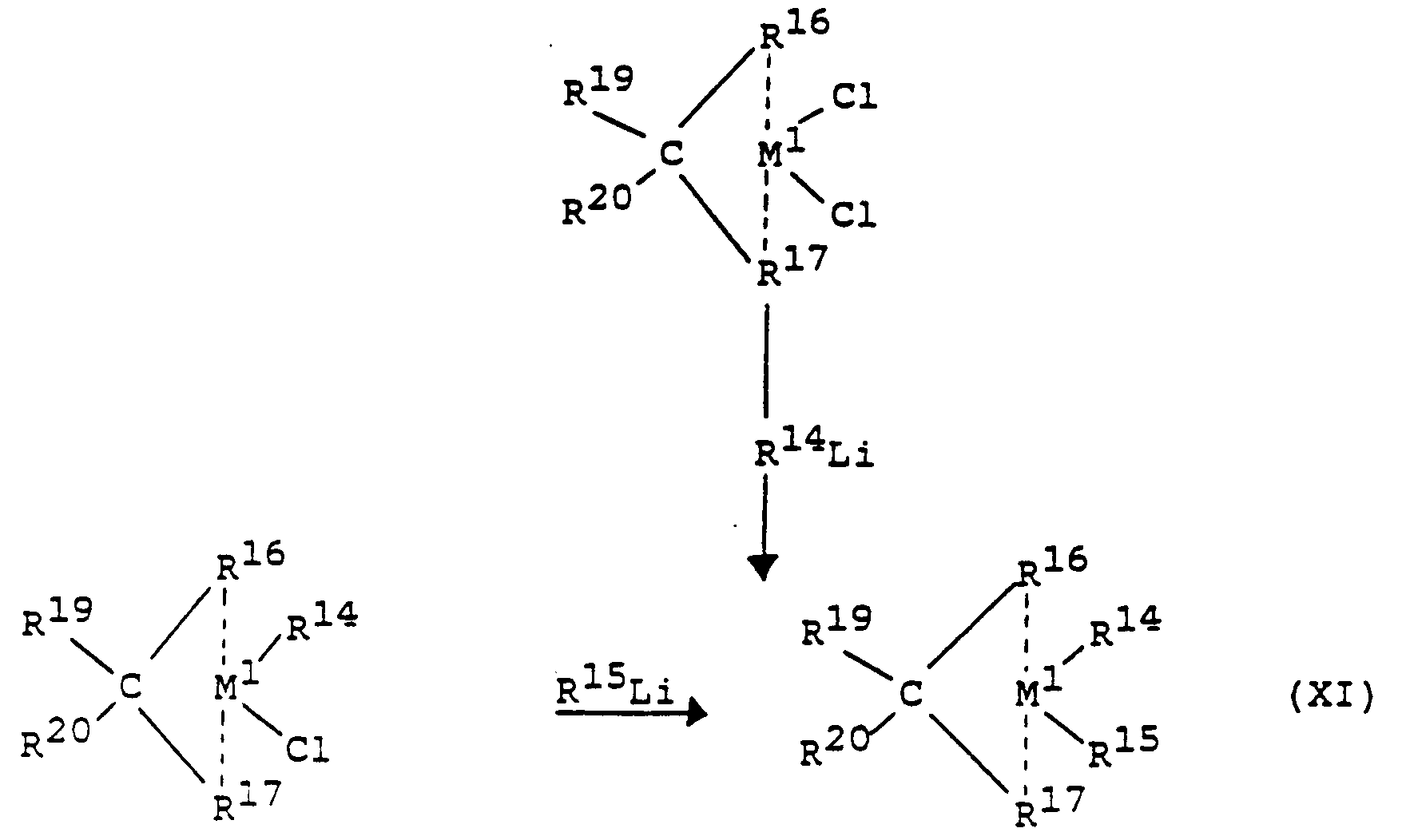
- Das obige Reaktionsschema gilt auch für die Fälle R¹⁹ = R²⁰ und/oder R¹⁴ = R¹⁵ (vgl. Journal of Organometallic Chem. 288 (1985) 63-67 und EP-A 320 762).
- Von den erfindungsgemäßen Metallocenen XI, welche in dem Teil des Moleküls, der durch das Zentralatom M¹ und die Substituenten R¹⁶-R¹⁷ gebildet wird, C₁-Symmetrie aufweisen (d.h. dieser Molekülteil weist keinerlei höhere Symmetrieelemente auf und ist nur durch eine Drehung um 360° - einzählige Achse - mit sich selbst zur Deckung zu bringen), sind besonders zu nennen:
Isopropylen-(9-fluorenyl)(1-(3-isopropyl)cyclopentadienyl)-zirkondichlorid,
Isopropylen-(9-fluorenyl)(1-(3-methyl)cyclopentadienyl)-zirkondichlorid,
Diphenylmethylen-(9-fluorenyl)(1-(3-methyl)cyclopentadienyl)-zirkondichlorid,
Methylphenylmethylen-(9-fluorenyl)(1-(3-methyl)cyclopentadienyl)-zirkondichlorid,
Dimethylsilyl-(9-fluorenyl)(1-(3-methyl)cyclopentadienyl)-zirkondichlorid,
Diphenylsilyl-(9-fluorenyl)(1-(3-methyl)cyclopentadienyl)-zirkondichlorid,
Diphenylmethylen-(9-fluorenyl)(1-(3-tert.-butyl)cyclopentadienyl)-zirkondichlorid und
Isopropylen-(9-fluorenyl)(1-(3-tert.-butyl)cyclopentadienyl)-zirkondichlorid und die entsprechenden Hafniumdichloride. - Zur Bedeutung des Begriffs C₁-Symmetrie vgl. K. Mislow "Einführung in die Stereochemie, Verlag Chemie, 1. Auflage 1967, S. 23 f..
- Von den Metallocenen, deren Molekülteil M¹, R¹⁶, R¹⁷ in einer meso-Form vorliegt, sind insbesondere zu nennen:
meso-Dimethylsilyl-bis(1-(3-methyl)cyclopentadienyl)-zirkondichlorid,
meso-Dimethylsilyl-bis(1-(2,4-dimethyl)cyclopentadienyl)-zirkondichlorid,
meso-Dimethylsilyl-bis(1-indenyl)-zirkondichlorid,
meso-Diphenylsilyl-bis(1-indenyl)-zirkondichlorid,
meso-Isopropylen-bis(1-indenyl)-zirkondichlorid,
meso-Diphenylmethylen-bis(1-indenyl)-zirkondichlorid,
meso-Methylphenylmethylen-bis(1-indenyl)-zirkondichlorid,
meso-Diphenylsilyl- bis(1-indenyl)-hafniumdichlorid,
meso-Dimethylsilyl-bis(1-indenyl)-hafniumdichlorid,
meso-1,2-Ethylen-bis(1-indenyl)-zirkondichlorid und
meso-1,2-Ethylen-bis(1-indenyl)-hafniumdichlorid. - Meso-Form bedeutet für die Zwecke der vorliegenden Erfindung, daß man die Substituenten R¹⁶ und R¹⁷ durch eine Spiegelebene zwischen R¹⁶ und R¹⁷, in der das Zentralatom M¹ liegt, ineinander überführen kann (vgl. K. Mislow, "Einf. in die Stereochemie", S. 83).
- Allgemein bevorzugt sind Ligandsysteme (R¹⁶ - R¹⁸), die eine unterschiedliche sterische Wechselwirkung auf die Liganden R¹⁴ und R¹⁵ ausüben können. Die Natur der Liganden R¹⁴ und R¹⁵ ist dabei ohne Bedeutung.
- Der Cokatalysator ist (bevorzugt) ein Aluminoxan der Formel IX und/oder der Formel X. In diesen Formeln können die Reste R¹³ gleich oder verschieden sein und bedeuten eine C₁-C₆-Alkylgruppe, vorzugsweise Methyl, Ethyl oder Isobutyl, Butyl oder Neopentyl, oder Phenyl oder Benzyl. Besonders bevorzugt ist Methyl. n ist eine ganze Zahl von 0 bis 50, bevorzugt 5 bis 40.
- Das Aluminoxan kann auf verschiedene Arten nach bekannten Verfahren hergestellt werden. Eine der Methoden ist beispielsweise, daß eine Aluminiumkohlenwasserstoffverbindung und/oder eine Hydridoaluminiumkohlenwasserstoffverbindung mit Wasser (gasförmig, fest, flüssig oder gebunden - beispielsweise als Kristallwasser) in einem inerten Lösungsmittel (wie z.B. Toluol) umgesetzt wird. Zur Herstellung eines Aluminoxans mit verschiedenen Alkylgruppen R¹³ werden entsprechend der gewünschten Zusammensetzung zwei verschiedene Aluminiumtrialkyle (AlR₃ + AlR'₃) mit Wasser umgesetzt (vgl. S. Pasynkiewicz, Polyhedron 9 (1990) 429 und EP-A 302 424).
- Die genaue Struktur der Aluminoxane ist nicht bekannt.
- Unabhängig von der Art der Herstellung ist allen Aluminoxanlösungen ein wechselnder Gehalt an nicht umgesetzter Aluminiumausgangsverbindung, die in freier Form oder als Addukt vorliegt, gemeinsam.
- Es ist möglich, das Metallocen vor dem Einsatz in der Polymerisationsreaktion mit einem Aluminoxan der Formel (IX) und/oder (X) vorzuaktivieren. Dadurch wird die Polymerisationsaktivität deutlich erhöht.
- Die Voraktivierung der Übergangsmetallverbindung wird in Lösung vorgenommen. Bevorzugt wird dabei das Metallocen in einer Lösung des Aluminoxans in einem inerten Kohlenwasserstoff aufgelöst. Als inerter Kohlenwasserstoff eignet sich ein aliphatischer oder aromatischer Kohlenwasserstoff. Bevorzugt wird Toluol verwendet.
- Die Konzentration des Aluminoxans in der Lösung liegt im Bereich von ca. 1 Gew.-% bis zur Sättigungsgrenze, vorzugsweise von 5 bis 30 Gew.-%, jeweils bezogen auf die Gesamtlösung. Das Metallocen kann in der gleichen Konzentration eingesetzt werden, vorzugsweise wird es jedoch in einer Menge von 10⁻⁴ - 1 mol pro mol Aluminoxan eingesetzt. Die Voraktivierungszeit beträgt 5 Minuten bis 60 Stunden, vorzugsweise 5 bis 60 Minuten. Man arbeitet bei einer Temperatur von -78°C bis 100°C, vorzugsweise 0 bis 70°C.
- Das Metallocen kann auch vorpolymerisiert oder auf einen Träger aufgebracht werden. Zur Vorpolymerisation wird bevorzugt das (oder eines der) in der Polymerisation eingesetzte(n) Olefin(e) verwendet.
- Geeignete Träger sind beispielsweise Silikagele, Aluminiumoxide, festes Aluminoxan oder andere anorganische Trägermaterialien. Ein geeignetes Trägermaterial ist auch ein Polyolefinpulver in feinverteilter Form.
- Eine weitere mögliche Ausgestaltung des erfindungsgemäßen Verfahrens besteht darin, daß man an Stelle oder neben eines Aluminoxans eine salzartige Verbindung der Formel RxNH4-xBR'₄ oder der Formel R₃PHBR'₄ als Cokatalysator verwendet. Dabei sind x = 1, 2 oder 3, R = Alkyl oder Aryl, gleich oder verschieden, und R' = Aryl, das auch fluoriert oder teilfluoriert sein kann. In diesem Fall besteht der Katalysator aus dem Reaktionsprodukt eines Metallocens mit einer der genannten Verbindungen (vgl. EP-A 277 004).
- Falls dem Reaktionsgemisch Lösemittel zugesetzt wird, dann handelt es sich um gebräuchliche inerte Lösemittel wie z.B. aliphatische oder cycloaliphatische Kohlenwasserstoffe, Benzin- bzw. hydrierte Dieselölfraktionen oder Toluol.
- Die Metallocenverbindung wird in einer Konzentration, bezogen auf das Übergangsmetall, von 10⁻³ bis 10⁻⁸, vorzugsweise 10⁻⁴ bis 10⁻⁷ mol Übergangsmetall pro dm³ Reaktorvolumen angewendet. Das Aluminoxan wird in einer Konzentration von 10⁻⁴ bis 10⁻¹, vorzugsweise 10⁻⁴ bis 2 · 10⁻² mol pro dm³ Reaktorvolumen verwendet, bezogen auf den Gehalt an Aluminium. Prinzipiell sind aber auch höhere Konzentrationen möglich.
- Bei der Herstellung von Copolymerisaten kann die Variation der Molverhältnisse des polycyclischen Olefins zum eingesetzten offenkettigen Olefin in einem weiten Bereich erfolgen. Bevorzugt werden molare Verhältnisse von 3:1 bis 100:1 Cycloolefin zu offenkettigem Olefin eingesetzt. Durch die Wahl der Polymerisationstemperatur, durch die Konzentration der Katalysatorkomponenten und das eingesetzte Molverhältnis bzw. den Druck des gasförmigen, offenkettigen Olefins läßt sich die Einbaurate an Comonomer beinahe beliebig steuern. Bevorzugt werden Einbauraten zwischen 20 und 80 Mol-% der cyclischen Komponenten und besonders bevorzugt werden Einbauraten zwischen 40 und 60 Mol-% der cyclischen Komponenten.
- Die mittlere Molmasse des gebildeten Copolymers läßt sich durch Wasserstoff-Dosierung, Variation der Katalysatorkonzentration oder Variation der Temperatur in bekannter Weise steuern.
- Die Polydispersität Mw/Mn der Copolymeren ist mit Werten zwischen 2,0 - 3,5 recht eng. Dadurch resultiert ein Eigenschaftbild der Polymerisate, das diese für das Spritzgießen besonders geeignet macht.
- Weiterhin wurde anhand von NMR-Spektren festgestellt, daß sich diese Cycloolefincopolymere auch in ihrer Mikrostruktur deutlich von denen unterscheiden, die mit herkömmlichen Metallocenkatalysatoren hergestellt worden sind (vgl. Fig. 1). Dieser Unterschied könnte damit erklärt werden, daß die erfindungsgemäßen Katalysatoren aufgrund ihrer speziellen Symmetrie alternierend polymerisieren. Nach heutigem Kenntnisstand ist anzunehmen, daß die erfindungsgemäßen Cycloolefincopolymere alternierende Cycloolefinsequenzen enthalten, die eine strukturelle Differenzierbarkeit nach NMR ermöglichen (vgl. Figur 1).
- Die erfindungsgemäß hergestellten Materialien eignen sich besonders zur Herstellung von Extrusionsteilen wie Folien, Schläuchen, Rohren, Stangen und Fasern als auch zur Herstellung von Spritzgußartikeln beliebiger Form und Größe.
- Eine wichtige Eigenschaft der erfindungsgemäßen Materialien ist ihre Transparenz. Dadurch kommt besonders den optischen Anwendungen der extrudierten oder spritzgegossenen Teile aus diesen Materialien eine große Bedeutung zu. Der mit einem Abbe-Refraktometer und Mischlicht bestimmte Brechungsindex der in den nachfolgenden Beispielen beschriebenen Reaktionsprodukte liegt im Bereich zwischen 1,520 und 1,555. Nach dem der Brechungsindex sehr nahe an dem von Kronglas (n = 1,51) liegt, können die erfindungsgemäßen Produkte als Glasersatz verschiedene Anwendungen finden wie beispielsweise Linsen, Prismen, Trägerplatten und -folien für optische Datenspeicher, für Videoplatten, für Compact Disks, als Deck- und Fokussierscheiben für Solarzellen, als Deck- und Streuscheiben für Leistungsoptiken, als Lichtwellenleiter in der Form von Fasern oder Folien.
- Die erfindungsgemäßen Polymeren sind auch für die Herstellung von Polymerlegierungen einsetzbar. Die Legierungen können in der Schmelze oder in Lösung hergestellt werden. Die Legierungen weisen jeweils eine für bestimmte Anwendungen günstige Eigenschaftskombination der Komponenten auf. Für Legierungen mit den erfindungsgemäßen Polymeren sind folgende Polymere einsetzbar:
Polyethylen, Polypropylen, (Ethylen-Propylen)-Copolymere, Polybutylen, Poly-(4-methyl-1-penten), Polyisopren, Polyisobutylen, Naturkautschuk, Poly(methylmethacrylat), weitere Polymethacrylate, Polyacrylate, (Acrylat-Methacrylat)-Copolymere, Polystyrol, (Styrol-Acrylnitril)-Copolymere, Bisphenol-A-Polycarbonat, weitere Polycarbonate, aromatische Polyestercarbonate, Polyethylenterephthalat, Polybutylenterephthalat, amorphe Polyarylate, Nylon-6, Nylon-66, weitere Polyamide, Polyaramide, Polyetherketone, Polyoxymethylen, Polyoxyethylen, Polyurethane, Polysulfone, Polyethersulfone, Polyvinylidenfluorid. - Die in den folgenden Beispielen angegebenen Glastemperaturen (Tg) wurden mittels DSC (Differential Scanning Calorimetry) bei einer Aufheizrate von 20°C/min bestimmt. Die angegebenen Viskositätszahlen wurden gemäß DIN 53 728 ermittelt.
- Ein 1,5-dm³-Reaktor wurde mit Ethylen gefüllt und mit 600 cm³ einer 85 gewichtsprozentigen Lösung von Norbornen in Toluol gefüllt. Durch mehrfaches Aufdrücken von Ethylen (6 bar) wurde die Lösung mit Ethylen gesättigt. Es wurde ein Druck von 0,5 bar (Überdruck) eingestellt, 5 cm³ toluolische Methylaluminoxanlösung (10,1 Gew.-% Methylaluminoxan der Molmasse 1300 g/Mol nach kryoskopischer Bestimmung) in den Reaktor gegeben und 15 min bei 70°C gerührt. Eine Lösung von 10 mg Isopropylen-(9-fluorenyl)(1-(3-methyl)-cyclopentadienyl)zirkondichlorid in 5 cm³ toluolischer Methylaluminoxanlösung wurde nach 15 minütiger Voraktivierung zugegeben. (Zur Molekulargewichtsregelung kann Wasserstoff vor der Katalysatorzugabe zugegeben werden).
- Unter Rühren (750 UPM) wurde eine Stunde bei 70°C polymerisiert, wobei der Ethylendruck durch Nachdosieren bei 0,5 bar gehalten wurde.
- Die Reaktionslösung wurde in ein Gefäß abgelassen und schnell in 5 dm³ Aceton eingetropft, 10 min gerührt und anschließend filtriert.
- Der erhaltene Feststoff wurde mehrfach mit 10 %iger Salzsäure und Aceton im Wechsel gewaschen. Es wurde neutral gewaschen und nochmals mit Aceton gerührt. Das erneut filtrierte Polymer wurde bei 80°C und einem Druck von 0,2 bar 15 Stunden getrocknet.
- Es wurden 18 g eines farblosen Polymers erhalten. Es wurde eine Viskositätszahl von 32 cm³/g und eine Glastemperatur (Tg) von 145°C gemessen. Das Norbornen/Ethylen-Einbauverhältnis ist gemäß NMR-Spektrum ca. 50 Mol-% Norbornen zu 50 Mol-% Ethylen.
- Die Polymerisationen wurden analog Beispiel 1 durchgeführt, wobei die Ethylenüberdrucke gemäß Tabelle 1 variiert wurden.
Tabelle 1 Bsp. Nr. Menge Katalysator (mg) Überdruck Ethylen (bar) Reaktionszeit (min) Ausbeute (g) VZ (cm³/g) Tg (°C) 1 10 0,5 15 18 32 145 2 11 1 60 11 47 146 3 10 2 15 44 55 140 4 5 4 15 50 79* 132 5 10 6 30 29 96* 120 6 0,7 10 45 10 144 93 * gemessen in o-Dichlorbenzol - Die Polymerisationen wurden analog Beispiel 1 durchgeführt, wobei einige, in Tabelle 2 zusammengefaßte Bedingungen geändert wurden.
Tabelle 2 Bsp. Nr. Menge Katalysator (mg) Überdruck Ethylen (bar) Reaktionszeit (min) Reaktionstemp. (°C) Ausbeute (g) Tg (°C) 7 61 0,5 60 40 7 144 8 61 1 60 40 9 133 9 120 0 30 25 17 139 - Die Polymerisationen wurden analog Beispiel 1 durchgeführt. Das eingesetzte Metallocen war Isopropylen-(9-fluorenyl)(cyclopentadienyl)zirkondichlorid. Dieses Metallocen entspricht nicht den erfindungsgemäßen Anforderungen an die Symmetrie im Molekülteil, der durch M¹ und R¹⁶-R¹⁷ gebildet wird, da hier weitere Symmetrieelemente, wie z.B. vertikale Spiegelebene, auftreten. Es wurden die in Tabelle 3 aufgeführten Reaktionsbedingungen gewählt.
Tabelle 3 Bsp. Nr. Menge Metallocen (mg) Überdruck Ethylen (bar) Reaktionszeit (min) Ausbeute (g) VZ (cm³/g) Tg (°C) 10 1 0,5 60 44 110 200 11 1 1 60 39 93 192 12 0,5 2 60 29 117 180 13 10 3 60 21 132 162 14 1 6 15 43 130 153 15 2 6 10 29 124 151 16 10 10 30 22 118 119 - Die Polymerisation erfolgte gemäß Beispiel 1. Es wurde eine 85 gewichtsprozentige Lösung von Tetracyclododecen in Toluol eingesetzt und mit 1 mg Isopropylen-(9-fluorenyl)-(1-(3-methyl)-cyclopentadienyl)-zirkondichlorid bei 70°C und 10 bar Ethylenüberdruck eine Stunde polymerisiert.
- Es wurden 3,2 g Copolymer erhalten. Die Glastemperatur betrug 159°C.
- Anstatt einer Norbornenlösung wurde flüssiges Norbornen eingesetzt und bei 0,5 bar Ethylendruck wurde mit 10 mg meso-Dimethylsilyl-bis(1-(2,4-dimethyl)cyclopentadienyl)-zirkondichlorid polymerisiert.
Es wurden 5,6 g Copolymer erhalten. Die Glastemperatur betrug 102°C. - Von den nach Beispiel 1 bis 6 erhaltenen Polymeren wurden in einer Filmpresse aus je 3 g Polymer bei 300°C Platten gepreßt (Durchmesser 6 cm). Anschließend wurde sofort in kaltem Wasser abgeschreckt.
Proben dieser Preßplatten wurden erneut in der DSC untersucht. Die beim ersten Aufheizen gefundenen Glastemperaturen (Tg), Rekristallisationstemperaturen (Ter) und Schmelztemperaturen (Tm) sind in Tabelle 4 aufgeführt.Tabelle 4 Polymer gemäß Beispiel Tg/°C Ter/°C Tm/°C 1 143 - 244 2 140 214 258 3 136 216 271 4 130 226 276 5 118 211 264 6 108 167 235 - Die Polymerisation erfolgte analog Beispiel 1. Es wurde eine 85 gew.-%ige Lösung von Tetracyclododecen in Toluol eingesetzt und mit 10 mg Methylphenylmethylen-(9-fluorenyl)[1-(3-methyl)cyclopentadienyl]zirkondichlorid bei 70°C und 1 bar Ethylendruck (Überdruck) eine Stunde polymerisiert. Es wurden 18,2 g Copolymer erhalten. Eine Probe wurde unter Stickstoff bei 350°C geschmolzen und anschließend abgeschreckt. Es wurde eine Glastemperatur von 192°C, eine Kristallisationstemperatur von 253°C und eine Schmelztemperatur von 335°C gemessen.
- Die Polymerisation wurde analog Beispiel 1 ausgeführt. Es wurden 500 cm³ 5-Methylnorborn-2-en eingesetzt und mit 2 mg Isopropenyl (9-fluorenyl)[1-(3-methyl)-cyclopentadienyl]zirkondichlorid und 60 ml Methylaluminoxan zwei Stunden bei 70°C und 4 bar Ethylendruck (Überdruck) polymerisiert. Es wurden 21,3 g Polymer erhalten. Die Lösungsviskosität betrug 104 cm³/g und die Glastemperatur betrug 117°C. In der DSC konnte keine Kristallisation und keine Schmelztemperatur gefunden werden. Laut ¹³C-NMR sind 41 Mol-% 5-Methylnorbornen im Copolymer enthalten.
- Es wurde analog Beispiel 1 polymerisiert. Es wurden 12 mg Isopropenyl-(9-fluorenyl)-[1-(3-isopropyl)cyclopentadienyl]zirkondichlorid eingesetzt und eine Stunde bei 40°C und 3 bar Ethylenüberdruck polymerisiert. Es wurden 17,9 g Polymer erhalten. Die Schmelztemperatur betrug 286°C.
- Die Polymerisation wurde analog Beispiel 5 durchgeführt. Es wurden 5 mg Diphenylmethylen-(9-fluorenyl)-[1-(3-methyl)cyclopentadienyl]zirkondichlorid eingesetzt. Es wurden 43 g Polymer erhalten. Die Glastemperatur betrug 124°C und die Schmelztemperatur 275°C.
- Erläuterungen zu den Abbildungen:
Fig. 1 zeigt die ¹³C-NMR-Spektren der Polymere, die gemäß Beispiel 1 (erfindungsgemäßer Metallocenkatalysator mit C₁-Symmetrie in dem Teil des Metallocenmoleküls, der durch M¹ und R¹⁶-R¹⁷ gebildet wird) und Beispiel 14 (herkömmlicher Metallocenkatalysator; vgl. die Ausführungen zu den Vergleichsbeispielen 10 bis 16) erhalten wurden. Die Unterschiede in der Mikrostruktur sind deutlich zu erkennen. - Fig. 2 zeigt den unterschiedlichen Verlauf der Abhängigkeit der Glastemperatur (Tg) vom Ethylendruck bei der Verwendung von
- a) herkömmlichen Metallocenkatalysatoren ohne C₁-Symmetrie bzw. keine meso-Form im genannten Molekülteil des Metallocens (obere Kurve, aufgenommen mit den Daten gemäß Tabelle 3) und
- b) bei der Verwendung von erfindungsgemäßen Metallocenkatalysatoren (untere Kurve, aufgenommen mit den Daten gemäß Tabelle 1).
- Neben den stark unterschiedlichen Kurvenverläufen, ist insbesondere die weitaus geringere Abhängigkeit der Glastemperatur (Tg) des erhaltenen Copolymers vom Ethylendruck (Veränderung der Reaktionsparameter) bei Verwendung der erfindungsgemäßen Metallocenkatalysatoren hervorzuheben. Dieser geringere Einfluß der Reaktionsparameter auf das Reaktionsprodukt führt zwangsläufig zu chemisch einheitlichen Copolymeren.
Claims (7)
- Verfahren zur Herstellung eines Cycloolefincopolymers durch Polymerisation von 0,1 bis 99,9 Gew.-%, bezogen auf die Gesamtmenge der Monomeren, mindestens eines Monomers der Formeln I, II, III, IV, V oder VI


0 bis 99,9 Gew.-%, bezogen auf die Gesamtmenge der Monomeren, eines Cycloolefins der Formel VII
0 bis 99,9 Gew.-%, bezogen auf die Gesamtmenge der Monomeren, mindestens eines acyclischen Olefins der Formel VIII

 M¹ Titan, Zirkon, Hafnium, Vanadium, Niob oder Tantal ist,R¹⁴ und R¹⁵ gleich oder verschieden sind und ein Wasserstoffatom, ein Halogenatom, eine C₁-C₁₀-Alkylgruppe, eine C₁-C₁₀-Alkoxygruppe, eine C₆-C₁₀-Arylgruppe, eine C₆-C₁₀-Arylorygruppe, eine C₂-C₁₀-Alkenylgruppe, eine C₇-C₄₀-Arylalkylgruppe, eine C₇-C₄₀-Alkylarylgruppe oder eine C₈-C₄₀-Arylalkenylgruppe bedeuten,R¹⁶ und R¹⁷ gleich oder verschieden sind und einen ein- oder mehrkernigen Kohlenwasserstoffrest, welcher mit dem Zentralatom M¹ eine Sandwichstruktur bilden kann, bedeuten,R¹⁸gleich oder verschieden sind und ein Wasserstoffatom, ein Halogenatom, eine C₁-C₁₀-Alkylgruppe, eine C₁-C₁₀-Fluoralkylgruppe, eine C₆-C₁₀-Fluorarylgruppe, eine C₆-C₁₀-Arylgruppe, eine C₁-C₁₀-Alkoxygruppe, eine C₂-C₁₀-Alkenylgruppe, eine C₇-C₄₀-Arylalkylgruppe, eine C₈-C₄₀-Arylalkenylgruppe oder eine C₇-C₄₀-Alkylarylgruppe bedeuten oder R¹⁹ und R²⁰ oder R¹⁹ und R²¹ jeweils mit den sie verbindenden Atomen einen Ring bilden, und
= CO, = PR¹⁹ oder = P(O)R¹⁹ ist, wobei R¹⁹, R²⁰ und R²¹
M² Silizium, Germanium oder Zinn ist, dadurch gekennzeichnet, daß der Teil des Metallocenmoleküls, der durch M¹ und die Substituenten R¹⁶-R¹⁷ gebildet wird, C₁-Symmetrie aufweist oder, falls R¹⁶ und R¹⁷ gleich sind, in der meso-Form vorliegt. - Verfahren gemäß Anspruch 1, dadurch gekennzeichnet, daß im flüssigen Cycloolefinmonomer, Cycloolefinmonomergemisch oder in konzentrierten Lösungen polymerisiert wird.
- Verfahren gemäß Anspruch 1 oder 2, dadurch gekennzeichnet, daß als Metallocen der Formel XI Isopropylen-(9-fluorenyl)(1-(3-isopropyl)cyclopentadienyl)-zirkondichlorid, Isopropylen-(9-fluorenyl)(1-(3-methyl)cyclopentadienyl)-zirkondichlorid, Diphenylmethylen-(9-fluorenyl)(1-(3-methyl)cyclopentadienyl)-zirkondichlorid, Methylphenylmethylen-(9-fluorenyl)(1-(3-methyl)cyclopentadienyl)-zirkondichlorid, Dimethylsilyl-(9-fluorenyl)(1-(3-methyl)cyclopentadienyl)-zirkondichlorid, Diphenylsilyl-(9-fluorenyl)(1-(3-methyl)cyclopentadienyl)-zirkondichlorid, Diphenylmethylen-(9-fluorenyl)(1-(3-tert.-butyl)cyclopentadienyl)-zirkondichlorid, Isopropylen-(9-fluorenyl)(1-(3-tert.-butyl)cyclopentadienyl)-zirkondichlorid oder ein entsprechendes Hafniumdichlorid verwendet wird.
- Verfahren gemäß Anspruch 1 oder 2, dadurch gekennzeichnet, daß als Metallocen der Formel XI meso-Dimethylsilyl-bis(1-(3-methyl)cyclopentadienyl)-zirkondichlorid, meso-Dimethylsilyl-bis(1-(2,4-dimethyl)cyclopentadienyl)-zirkondichlorid, meso-Dimethylsilyl-bis(1-indenyl)-zirkondichlorid, meso-Diphenylsilyl-bis(1-indenyl)-zirkondichlorid, meso-Isopropylen-bis(1-indenyl)-zirkondichlorid, meso-Diphenylmethylen-bis(1-indenyl)-zirkondichlorid, meso-Methylphenylmethylen-bis(1-indenyl)-zirkondichlorid, meso-Diphenylsilyl-bis(1-indenyl)-hafniumdichlorid, meso-Dimethylsilyl-bis(1-indenyl)-hafniumdichlorid, meso-1,2-Ethylen-bis(1-indenyl)-zirkondichlorid oder meso-1,2-Ethylen-bis(1-indenyl)-hafniumdichlorid verwendet wird.
- Verfahren gemäß einem oder mehreren der Ansprüche 1 bis 4, dadurch gekennzeichnet, daß das polycyclische Olefin Norbornen oder Tetracyclododecen ist.
- Verfahren gemäß einem oder mehreren der Ansprüche 1 bis 5, dadurch gekennzeichnet, daß ein Copolymer aus Norbornen und Ethylen hergestellt wird.
- Cycloolefincopolymer, herstellbar nach dem Verfahren gemäß einem oder mehreren der Ansprüche 1 bis 6.
Priority Applications (1)
| Application Number | Priority Date | Filing Date | Title |
|---|---|---|---|
| EP96108898A EP0729977B1 (de) | 1991-03-09 | 1992-03-02 | Metallocen und Katalysator |
Applications Claiming Priority (2)
| Application Number | Priority Date | Filing Date | Title |
|---|---|---|---|
| DE4107682 | 1991-03-09 | ||
| DE4107682 | 1991-03-09 |
Related Child Applications (1)
| Application Number | Title | Priority Date | Filing Date |
|---|---|---|---|
| EP96108898A Division EP0729977B1 (de) | 1991-03-09 | 1992-03-02 | Metallocen und Katalysator |
Publications (2)
| Publication Number | Publication Date |
|---|---|
| EP0503422A1 true EP0503422A1 (de) | 1992-09-16 |
| EP0503422B1 EP0503422B1 (de) | 1998-06-03 |
Family
ID=6426934
Family Applications (2)
| Application Number | Title | Priority Date | Filing Date |
|---|---|---|---|
| EP96108898A Expired - Lifetime EP0729977B1 (de) | 1991-03-09 | 1992-03-02 | Metallocen und Katalysator |
| EP92103538A Expired - Lifetime EP0503422B1 (de) | 1991-03-09 | 1992-03-02 | Verfahren zur Herstellung chemisch einheitlicher Cycloolefincopolymere |
Family Applications Before (1)
| Application Number | Title | Priority Date | Filing Date |
|---|---|---|---|
| EP96108898A Expired - Lifetime EP0729977B1 (de) | 1991-03-09 | 1992-03-02 | Metallocen und Katalysator |
Country Status (9)
| Country | Link |
|---|---|
| US (2) | US5324801A (de) |
| EP (2) | EP0729977B1 (de) |
| JP (2) | JP3773545B2 (de) |
| AT (2) | ATE223440T1 (de) |
| AU (1) | AU648389B2 (de) |
| CA (1) | CA2062201C (de) |
| DE (2) | DE59209354D1 (de) |
| ES (2) | ES2116301T3 (de) |
| ZA (1) | ZA921686B (de) |
Cited By (63)
| Publication number | Priority date | Publication date | Assignee | Title |
|---|---|---|---|---|
| EP0610852A1 (de) * | 1993-02-12 | 1994-08-17 | Hoechst Aktiengesellschaft | Verfahren zur Herstellung von Cycloolefincopolymeren |
| EP0610847A1 (de) | 1993-02-12 | 1994-08-17 | Hoechst Aktiengesellschaft | Fasern aus Cycloolefincopolymeren |
| EP0610850A1 (de) * | 1993-02-12 | 1994-08-17 | Hoechst Aktiengesellschaft | Verfahren zur Herstellung von Cycloolefinpolymeren |
| EP0610843A1 (de) * | 1993-02-12 | 1994-08-17 | Hoechst Aktiengesellschaft | Verfahren zur Herstellung von Cycloolefinpolymeren |
| EP0610851A1 (de) * | 1993-02-12 | 1994-08-17 | Hoechst Aktiengesellschaft | Verfahren zur Herstellung von Cycloolefincopolymeren |
| WO1994018252A1 (de) * | 1993-02-12 | 1994-08-18 | Hoechst Aktiengesellschaft | Cycloolefincopolymere mit hoher reissfestigkeit und niedriger optischer dämpfung |
| DE4304311A1 (de) * | 1993-02-12 | 1994-08-18 | Hoechst Ag | Material aus einem Cycloolefin-Copolymer und Verfahren zu seiner Herstellung |
| WO1994018251A1 (de) * | 1993-02-12 | 1994-08-18 | Hoechst Aktiengesellschaft | Cycloolefincopolymere mit niedriger schmelzeviskosität und niedriger optischer dämpfung |
| EP0608760A3 (de) * | 1993-01-29 | 1994-11-17 | Hoechst Ag | Faserverstärktes Cycloolefincopolymer-Material, Verfahren zu seiner Herstellung und Formkörper aus dem Material. |
| US5401817A (en) * | 1991-05-09 | 1995-03-28 | Phillips Petroleum Company | Olefin polymerization using silyl-bridged metallocenes |
| WO1995018161A1 (de) * | 1993-12-24 | 1995-07-06 | Herberts Gesellschaft mit beschränkter Haftung | Bindemittel auf der basis cycloolefinischer, gegebenenfalls peroxigenierter copolymerer, deren herstellung, diese enthaltende überzugsmittel und deren verwendung |
| EP0610816A3 (en) * | 1993-02-12 | 1995-10-11 | Hoechst Ag | Rigid foil based on cyclo-olefin copolymer. |
| EP0610814A3 (en) * | 1993-02-12 | 1995-10-11 | Hoechst Ag | Semi-crystalline sheet of cyclo-olefin copolymer. |
| EP0678530A1 (de) * | 1994-04-22 | 1995-10-25 | Mitsui Petrochemical Industries, Ltd. | Verfahren zur Herstellung von cyclischen Olefincopolymeren und danach hergestellte Copolymere |
| EP0688801A1 (de) * | 1994-06-24 | 1995-12-27 | Hoechst Aktiengesellschaft | Verfahren zur Herstellung von Cycloolefincopolymeren |
| EP0693368A1 (de) | 1994-07-23 | 1996-01-24 | Hoechst Aktiengesellschaft | Nicht siegelfähige orientierte Polyolefin-Mehrschichtfolie, Verfahren zu ihrer Herstellung und ihre Verwendung |
| EP0693369A1 (de) | 1994-07-23 | 1996-01-24 | Hoechst Aktiengesellschaft | Siegelfähige orientierte Polyolefin-Mehrschichtfolie, Verfahren zu ihrer Herstellung und ihre Verwendung |
| EP0695778A2 (de) | 1994-08-03 | 1996-02-07 | Hoechst Aktiengesellschaft | Orientierte Folie aus thermoplastischem Polymer mit partikelförmigen Hohlkörpern, Verfahren zu ihrer Herstellung und ihre Verwendung |
| EP0677553A3 (de) * | 1994-03-26 | 1996-05-15 | Hoechst Ag | Orientierte Polyolefinfolie mit amorphem Polymer, Verfahren zu ihrer Herstellung und ihre Verwendung. |
| US5583192A (en) * | 1993-02-12 | 1996-12-10 | Hoechst Aktiengesellschaft | Flexible cycloolefin copolymer film and method of preparing same |
| US5595796A (en) * | 1994-03-04 | 1997-01-21 | Hoechst Aktiengesellschaft | Foodstuff casing based on cellulose hydrate with improved peelability |
| EP0719803A3 (de) * | 1994-12-28 | 1997-02-19 | Mitsui Petrochemical Ind | Verfahren zur Herstellung eines statistischen Cycloolefincopolymer |
| US5635573A (en) * | 1992-12-01 | 1997-06-03 | Exxon Chemical Patents Inc. | Method for preparing alpha-olefin/cycloolefin copolymers |
| EP0786466A1 (de) * | 1996-01-25 | 1997-07-30 | Tosoh Corporation | Übergangsmetallverbindung, diese enthaltende Olefinpolymerisationskatalysator und Verfahren zum Polymerisieren |
| US5672668A (en) * | 1992-08-15 | 1997-09-30 | Hoechst Aktiengesellschaft | Process for the preparation of polyolefins |
| WO1998050395A1 (de) * | 1997-05-06 | 1998-11-12 | Targor Gmbh | Stereorigide metallocenverbindung |
| US5837787A (en) * | 1993-01-19 | 1998-11-17 | Exxon Chemical Patents, Inc. | Process for producing elastic thermoplastic α-olefin/cyclic olefin copolymers |
| US6214951B1 (en) | 1993-02-12 | 2001-04-10 | Hoechst Aktiengesellschaft | Cycloolefin copolymers having high tear strength and low optical attenuation |
| US6326431B1 (en) | 2000-03-13 | 2001-12-04 | Mitsubishi Polyester Film Gmbh | Biaxially oriented polyester film comprising a cycloolefin copolymer, its use and process for its production |
| EP1138687A4 (de) * | 1999-10-08 | 2002-02-27 | Mitsui Chemicals Inc | Metallocenverbindung, ein verfahren zur herstellung einer metallocenverbindung, olefin polymerisationskatalysator, ein verfahren zur herstellung von polyolefinen und polyolefine |
| US6551653B1 (en) | 1995-10-20 | 2003-04-22 | Ticona Gmbh | Metalized polyolefin film |
| DE10152146A1 (de) * | 2001-10-25 | 2003-05-22 | Ticona Gmbh | Verfahren zur Reduzierung der Zähigkeit mechanisch zu bearbeitender Formteile aus Kunststoff sowie deren Verwendung |
| US6767966B2 (en) | 2000-03-01 | 2004-07-27 | Ticona Gmbh | Polymer mixture containing an amorphous polyolefin which contain cycloaliphatic olefins |
| US6794050B2 (en) | 2002-05-28 | 2004-09-21 | Mitsubishi Polyester Film Gmbh | Transparent polyester film with enhanced water vapor barrier, its production and use |
| US6794051B2 (en) | 2002-05-28 | 2004-09-21 | Mitsubishi Polyester Film Gmbh | Transparent polyester film with enhanced water vapor barrier, its production and use |
| US6844059B2 (en) | 2001-08-07 | 2005-01-18 | Ticona Gmbh | Long-fiber-reinforced polyolefin structure, process for its production, and moldings produced therefrom |
| US6893706B2 (en) | 2000-05-11 | 2005-05-17 | Mitsubishi Polyester Film Gmbh | White, biaxially-oriented polyester film with cycloolefin copolymer (COC), which is matt on at least one side, method for production and use thereof |
| US6916548B2 (en) | 2000-05-26 | 2005-07-12 | Mitsubishi Polyester Film Gmbh | White, high-gloss, polyester film containing cyclo-olefin copolymers (COC), a method for the production thereof and the use of the same |
| US7026401B1 (en) | 1999-06-30 | 2006-04-11 | Ticona Gmbh | Method of producing amorphous polyolefins with a wide mole weight distribution |
| USRE39156E1 (en) * | 1992-08-15 | 2006-07-04 | Basell Polyolefine Gmbh | Process for the preparation of polyolefins |
| US7141293B2 (en) | 2003-04-22 | 2006-11-28 | Mitsubishi Polyester Film Gmbh | Coextruded, hot-sealable and peelable polyester film having high peeling resistance, process for its production and its use |
| US7144615B2 (en) | 2003-04-22 | 2006-12-05 | Mitsubishi Polyester Film Gmbh | Coextruded, hot-sealable and peelable polyester film, process for its production and its use |
| US7186452B2 (en) | 2003-04-22 | 2007-03-06 | Mitsubishi Polyester Film Gmbh | Coextruded, hot-sealable and peelable polyester film having high peeling resistance, process for its production and its use |
| US7205040B2 (en) | 2003-11-10 | 2007-04-17 | Mitsubishi Polyester Film Gmbh | Peelable polyester film having improved oxygen barrier, process for its production and its use |
| US7211306B2 (en) | 2003-11-10 | 2007-05-01 | Mitsubishi Polyester Film Gmbh | Peelable polyester film with self-venting, process for its production and its use |
| US7223459B2 (en) | 2003-04-22 | 2007-05-29 | Mitsubishi Polyester Film Gmbh | Coextruded, hot-sealable and peelable polyester film, process for its production and its use |
| US7288312B2 (en) | 2003-04-22 | 2007-10-30 | Mitsubishi Polyester Film Gmbh | Coextruded, hot-sealable and peelable polyester film having low peeling resistance, process for its production and its use |
| KR100786742B1 (ko) * | 1999-10-08 | 2007-12-18 | 미쓰이 가가쿠 가부시키가이샤 | 폴리올레핀 |
| US7329453B2 (en) | 2003-11-10 | 2008-02-12 | Mitsubishi Polyester Film Gmbh | White, heatsealable, peelable polyester film, process for its production and its use |
| WO2008040646A1 (de) | 2006-10-05 | 2008-04-10 | Treofan Germany Gmbh & Co. Kg | Simultan verstreckte opake folie aus pla |
| US7396578B2 (en) | 2003-11-10 | 2008-07-08 | Mitsubishi Polyester Film Gmbh | Adhesion-promoted , heatsealable and peelable polyester film, process for its production and its use |
| US7442427B2 (en) | 2003-04-22 | 2008-10-28 | Mitsubishi Polyester Film Gmbh | Coextruded, hot-sealable and peelable polyester film, process for its production and its use |
| EP2062726A1 (de) | 2007-11-21 | 2009-05-27 | Mitsubishi Polyester Film GmbH | Niedrigsiegelnde Polyesterfolie fuer polare Substrate |
| WO2010096593A2 (en) | 2009-02-18 | 2010-08-26 | Northwestern University | Beam pen lithography |
| US7829633B2 (en) | 2002-09-13 | 2010-11-09 | Ticona Gmbh | Method for the production of a packaging made of thermoformable film having high thermal stability and a vapour barrier |
| US8063163B2 (en) | 2005-11-24 | 2011-11-22 | Polypastics Co., Ltd. | Cycloolefin copolymer |
| WO2012015531A1 (en) | 2010-07-27 | 2012-02-02 | Exxonmobil Oil Corporation | Film composition and method of making the same |
| WO2018022839A1 (en) | 2016-07-28 | 2018-02-01 | Dow Global Technologies Llc | Multilayer structures, multilayer films, and packages formed therefrom |
| EP3623154A1 (de) | 2018-09-11 | 2020-03-18 | Mitsubishi Polyester Film GmbH | Heisssiegelbare polyesterfolie für die herstellung von menüschalen, verfahren zu ihrer herstellung und ihre verwendung |
| EP3680104A1 (de) | 2019-01-14 | 2020-07-15 | Mitsubishi Polyester Film GmbH | Packung aus polyester mit einer thermoformbaren unterfolie und einer siegel- und peelbaren oberfolie, verfahren zu ihrer herstellung und ihre verwendung |
| DE102023100500A1 (de) | 2023-01-11 | 2024-07-11 | Mitsubishi Polyester Film Gmbh | Polyesterverpackung bestehend aus thermoformbarer Unterfolie und peelfähiger Oberfolie, Verfahren zu ihrer Herstellung und ihre Verwendung |
| DE102023100507A1 (de) | 2023-01-11 | 2024-07-11 | Mitsubishi Polyester Film Gmbh | Koextrudierte, heißsiegelbare und peelfähige Polyesterfolie, Verfahren zu ihrer Herstellung und ihre Verwendung |
| WO2024208813A1 (de) | 2023-04-05 | 2024-10-10 | Mitsubishi Polyester Film Gmbh | MEHRSCHICHTIGE, COEXTRUDIERTE POLYESTERFOLIE MIT VERRINGERTER DURCHSTOßFESTIGKEIT ZUR VERWENDUNG ALS BLISTERABDECKFOLIE |
Families Citing this family (49)
| Publication number | Priority date | Publication date | Assignee | Title |
|---|---|---|---|---|
| US5466766A (en) * | 1991-05-09 | 1995-11-14 | Phillips Petroleum Company | Metallocenes and processes therefor and therewith |
| US5494969A (en) * | 1993-01-29 | 1996-02-27 | Mitsui Petrochemical Industries, Ltd. | Cycloolefin polymer composition |
| IT1271406B (it) * | 1993-09-13 | 1997-05-28 | Spherilene Srl | Procedimento per la preparazione di polimeri dell'etilene e prodotti ottenuti |
| DE59408507D1 (de) * | 1993-10-06 | 1999-08-26 | Ticona Gmbh | Modifiziertes Cycloolefincopolymer |
| US6964798B2 (en) | 1993-11-16 | 2005-11-15 | Baxter International Inc. | Multi-layered polymer based thin film structure for medical grade products |
| EP0661308B1 (de) * | 1993-12-24 | 1999-06-02 | Ticona GmbH | Cycloolefincopolymere und Verfahren zu ihrer Herstellung |
| US5552489A (en) * | 1994-07-22 | 1996-09-03 | Exxon Chemical Patents Inc. | Tackifiers and a process to obtain tackifiers |
| US5621054A (en) * | 1995-06-07 | 1997-04-15 | Exxon Chemical Patents Inc. | Copolymerization process for the preparation of crystalline copolymers of olefins and cyclic olefins |
| KR100441335B1 (ko) * | 1995-12-07 | 2004-10-25 | 엑손모빌 케미칼 패턴츠 인코포레이티드 | 점착부여제및점착부여제의제조방법 |
| DE19546500A1 (de) * | 1995-12-13 | 1997-06-19 | Hoechst Ag | Verfahren zur Herstellung eines Cycloolefincopolymeren |
| DE19714751B4 (de) * | 1996-04-12 | 2004-02-12 | Vacuflex Gmbh | Kunststoff-Wellschlauch |
| DE19652340A1 (de) * | 1996-12-17 | 1998-06-18 | Hoechst Ag | Verfahren zur Herstellung von Cycloolefincopolymers |
| US6180736B1 (en) | 1996-12-20 | 2001-01-30 | Exxon Chemical Patents Inc | High activity metallocene polymerization process |
| US6111019A (en) * | 1997-03-31 | 2000-08-29 | Exxon Chemical Patents, Inc. | LLDPE blends with an ethylene-norbornene copolymer for resins of improved toughness and processibility for film production |
| US5942587A (en) * | 1997-11-21 | 1999-08-24 | Exxon Chemical Patents Inc. | Ethylene polymers with a norbornene comonomer for LLDPE like resins of improved toughness and processibility for film production |
| EP0965614B1 (de) | 1998-06-16 | 2006-03-15 | Ticona GmbH | Schlagzähe Cycloolefin-Copolymer-Legierung |
| US6340651B1 (en) * | 1999-04-26 | 2002-01-22 | Phillips Petroleum Company | Multicyclic metallocycle metallocenes and their use |
| US6291382B1 (en) | 1999-05-24 | 2001-09-18 | Phillips Petroleum Company | Metallocenes, polymerization catalyst systems, their preparation, and use |
| US6497676B1 (en) * | 2000-02-10 | 2002-12-24 | Baxter International | Method and apparatus for monitoring and controlling peritoneal dialysis therapy |
| US6875719B2 (en) * | 2000-04-27 | 2005-04-05 | Industrial Technology Research Institute | Catalyst composition for preparing olefin polymers |
| US7078164B1 (en) | 2000-06-19 | 2006-07-18 | Symyx Technologies, Inc. | High throughput screen for identifying polymerization catalysts from potential catalysts |
| DE10035328A1 (de) | 2000-07-20 | 2002-01-31 | Mitsubishi Polyester Film Gmbh | Opake Polyesterfolie enthaltend Cycloolefincopolymer (COC) mit guter Oberflächenhaftung, Verfahren zu ihrer Herstellung und ihre Verwendung |
| US6538087B2 (en) | 2000-07-28 | 2003-03-25 | Promerus, Llc | Polymeric compositions for forming optical waveguides; optical waveguides formed therefrom; and methods for making same |
| US6372848B1 (en) | 2000-10-10 | 2002-04-16 | Baxter International Inc. | Blend of ethylene and α-olefin copolymers obtained using a metallocene catalyst for fabricating medical films and tubings |
| CA2447769C (en) | 2001-06-13 | 2011-07-26 | Energy & Environmental International, L.C. | Bulk polymerization reactors and methods for polymerization |
| US20030130452A1 (en) * | 2001-10-12 | 2003-07-10 | Johnson Lynda Kaye | Copolymers of ethylene with various norbornene derivatives |
| US20030077466A1 (en) * | 2001-10-19 | 2003-04-24 | Smith Sidney T. | Multilayered polymer structure |
| US6713582B2 (en) | 2001-12-14 | 2004-03-30 | Uniroyal Chemical Company, Inc. | Process for the oligomerization of α-olefins having low unsaturation, the resulting polymers, and lubricants containing same |
| US20030125662A1 (en) * | 2002-01-03 | 2003-07-03 | Tuan Bui | Method and apparatus for providing medical treatment therapy based on calculated demand |
| US7238164B2 (en) * | 2002-07-19 | 2007-07-03 | Baxter International Inc. | Systems, methods and apparatuses for pumping cassette-based therapies |
| DE10238516A1 (de) * | 2002-08-21 | 2004-03-04 | Ticona Gmbh | Polyolefin-Mehrschichtfolie, Verfahren zu ihrer Herstellung und ihre Verwendung |
| US7101654B2 (en) * | 2004-01-14 | 2006-09-05 | Promerus Llc | Norbornene-type monomers and polymers containing pendent lactone or sultone groups |
| US20050209563A1 (en) * | 2004-03-19 | 2005-09-22 | Peter Hopping | Cassette-based dialysis medical fluid therapy systems, apparatuses and methods |
| AU2005240969A1 (en) | 2004-04-27 | 2005-11-17 | Baxter Healthcare S.A. | Stirred-tank reactor system |
| EP1791005A1 (de) * | 2004-09-15 | 2007-05-30 | Teijin Limited | Retardierungsfilm |
| WO2007100117A1 (ja) | 2006-02-28 | 2007-09-07 | Teijin Limited | 積層偏光フィルム、位相差フィルム、および液晶表示装置 |
| US8148472B1 (en) | 2006-08-04 | 2012-04-03 | Exxonmobil Research And Engineering Company | Polymer compositions comprising cyclic olefin polymers, polyolefin modifiers and non-functionalized plasticizers |
| US20080221275A1 (en) * | 2006-11-30 | 2008-09-11 | Baugh Lisa S | Ethylene/dicyclopentadiene/norbornene terpolymer materials having desirable structural and thermal properties |
| US8870812B2 (en) * | 2007-02-15 | 2014-10-28 | Baxter International Inc. | Dialysis system having video display with ambient light adjustment |
| US7998115B2 (en) * | 2007-02-15 | 2011-08-16 | Baxter International Inc. | Dialysis system having optical flowrate detection |
| US7731689B2 (en) | 2007-02-15 | 2010-06-08 | Baxter International Inc. | Dialysis system having inductive heating |
| US8558964B2 (en) | 2007-02-15 | 2013-10-15 | Baxter International Inc. | Dialysis system having display with electromagnetic compliance (“EMC”) seal |
| US8361023B2 (en) * | 2007-02-15 | 2013-01-29 | Baxter International Inc. | Dialysis system with efficient battery back-up |
| US20090208685A1 (en) * | 2008-02-20 | 2009-08-20 | Sealed Air Corporation (Us) | Packaging film and method of decreasing scalping of polar cyclic compounds |
| JP6099907B2 (ja) * | 2012-09-13 | 2017-03-22 | 昭和電工株式会社 | 極性基含有ノルボルネン系共重合体の製造方法 |
| JP2020516695A (ja) | 2017-04-12 | 2020-06-11 | ウリゲン ファーマシューティカルズ、インコーポレイテッド | 改善された安定性を備えた注射器中に局所麻酔薬、緩衝液、およびグルコサミノグリカンを含む製品 |
| US11179516B2 (en) | 2017-06-22 | 2021-11-23 | Baxter International Inc. | Systems and methods for incorporating patient pressure into medical fluid delivery |
| US20200172715A1 (en) * | 2018-11-30 | 2020-06-04 | Exxonmobil Chemical Patents Inc. | Blends of Cyclic Olefin Copolymers and Films Prepared Therefrom |
| CN112745431B (zh) * | 2020-12-23 | 2023-04-21 | 广东华锦达新材科技有限公司 | 一种环烯烃共聚物及其制备方法 |
Citations (3)
| Publication number | Priority date | Publication date | Assignee | Title |
|---|---|---|---|---|
| DE3835044A1 (de) * | 1988-10-14 | 1990-04-19 | Hoechst Ag | Verfahren zur herstellung von cycloolefinpolymeren |
| EP0283164B1 (de) * | 1987-03-02 | 1995-05-24 | Mitsui Petrochemical Industries, Ltd. | Zyklisch-olefinische statische Copolymere, olefinische statische Copolymere und Verfahren zur Herstellung von zyklisch-olefinischen statischen Copolymeren |
| EP0407870B1 (de) * | 1989-07-08 | 1997-12-10 | Hoechst Aktiengesellschaft | Verfahren zur Herstellung von Cycloolefinpolymeren |
Family Cites Families (35)
| Publication number | Priority date | Publication date | Assignee | Title |
|---|---|---|---|---|
| IT649768A (de) * | 1961-04-26 | |||
| US3305538A (en) | 1961-11-22 | 1967-02-21 | Montedison Spa | Polymerization process |
| US3268627A (en) | 1963-05-16 | 1966-08-23 | Standard Oil Co | Blends of isotactic and syndiotactic polypropylene |
| US3364190A (en) | 1964-04-27 | 1968-01-16 | Standard Oil Co | Process for polymerizing propylene to syndiotactic polypropylene |
| WO1987000299A1 (en) | 1985-06-24 | 1987-01-15 | Leonard Bronstein | Contact lens |
| JPS5473842A (en) | 1977-11-25 | 1979-06-13 | Mitsubishi Petrochem Co Ltd | Polyolefin resin composition |
| US4178424A (en) * | 1977-12-05 | 1979-12-11 | The Bf Goodrich Company | Cycloolefin copolymers |
| US4411821A (en) | 1981-02-23 | 1983-10-25 | E. I. Du Pont De Nemours And Company | 1-Olefin polymerization catalyst |
| US4497906A (en) | 1982-02-16 | 1985-02-05 | Sumitomo Chemical Company, Limited | Solid catalyst component for olefin polymerization |
| CA1231702A (en) | 1983-06-06 | 1988-01-19 | John A. Ewen | Process and catalyst for producing reactor blend polyolefins |
| ZA844157B (en) | 1983-06-06 | 1986-01-29 | Exxon Research Engineering Co | Process and catalyst for polyolefin density and molecular weight control |
| US4530914A (en) | 1983-06-06 | 1985-07-23 | Exxon Research & Engineering Co. | Process and catalyst for producing polyethylene having a broad molecular weight distribution |
| US4614778A (en) * | 1984-02-03 | 1986-09-30 | Hirokazu Kajiura | Random copolymer |
| JPH0713084B2 (ja) * | 1985-03-26 | 1995-02-15 | 三井石油化学工業株式会社 | 環状オレフイン系共重合体の製法 |
| CA1278899C (en) * | 1985-05-24 | 1991-01-08 | Mitsui Chemicals, Inc. | Random copolymer, and process for production thereof |
| DE3524535A1 (de) | 1985-07-10 | 1987-01-22 | Hoechst Ag | Verfahren zur herstellung von perylen-3,4,9,10-tetracarbonsaeure-n,n'- dimethylimid in hochdeckender pigmentform |
| US4701432A (en) | 1985-11-15 | 1987-10-20 | Exxon Chemical Patents Inc. | Supported polymerization catalyst |
| IL80888A (en) | 1985-12-12 | 1991-12-12 | Exxon Chemical Patents Inc | Olefin polymerization catalysts,their preparation and use thereof |
| US4658078A (en) | 1986-08-15 | 1987-04-14 | Shell Oil Company | Vinylidene olefin process |
| DE3640924A1 (de) | 1986-11-29 | 1988-06-01 | Hoechst Ag | 1-olefin-stereoblockpolymer und verfahren zu seiner herstellung |
| US4794096A (en) | 1987-04-03 | 1988-12-27 | Fina Technology, Inc. | Hafnium metallocene catalyst for the polymerization of olefins |
| US4948856A (en) * | 1987-05-22 | 1990-08-14 | B. F. Goodrich Company | Homogeneous addition copolymers of ethylene and cycloolefin monomers and method for producing same |
| DE3718180A1 (de) | 1987-05-29 | 1988-12-15 | Hoechst Ag | Wasserloesliche monoazo-naphtholcarbonsaeure-verbindungen, verfahren zu ihrer herstellung und ihre verwendung als farbstoffe |
| US5176941A (en) | 1987-11-07 | 1993-01-05 | Hoechst Aktiengesellschaft | Process of producing a ceramic/fiber composite using a molten polysilazone |
| US4931417A (en) | 1987-11-09 | 1990-06-05 | Chisso Corporation | Transition-metal compound having a bis-substituted-cyclopentadienyl ligand of bridged structure |
| US5017714A (en) | 1988-03-21 | 1991-05-21 | Exxon Chemical Patents Inc. | Silicon-bridged transition metal compounds |
| IL89525A0 (en) | 1988-03-21 | 1989-09-10 | Exxon Chemical Patents Inc | Silicon-bridged transition metal compounds |
| US4892851A (en) | 1988-07-15 | 1990-01-09 | Fina Technology, Inc. | Process and catalyst for producing syndiotactic polyolefins |
| US5162278A (en) | 1988-07-15 | 1992-11-10 | Fina Technology, Inc. | Non-bridged syndiospecific metallocene catalysts and polymerization process |
| DE3836059A1 (de) * | 1988-10-22 | 1990-05-03 | Hoechst Ag | Verfahren zur herstellung eines ethylen-propylen-copolymers |
| DE3916553A1 (de) * | 1989-05-20 | 1990-11-22 | Hoechst Ag | Syndio- isoblockpolymer und verfahren zu seiner herstellung |
| US5036034A (en) * | 1989-10-10 | 1991-07-30 | Fina Technology, Inc. | Catalyst for producing hemiisotactic polypropylene |
| US5436305A (en) | 1991-05-09 | 1995-07-25 | Phillips Petroleum Company | Organometallic fluorenyl compounds, preparation, and use |
| US5451649A (en) | 1991-05-09 | 1995-09-19 | Phillips Petroleum Company | Organometallic fluorenyl compounds, preparation, and use |
| US5416228A (en) * | 1991-10-07 | 1995-05-16 | Fina Technology, Inc. | Process and catalyst for producing isotactic polyolefins |
-
1992
- 1992-03-02 DE DE59209354T patent/DE59209354D1/de not_active Expired - Lifetime
- 1992-03-02 ES ES92103538T patent/ES2116301T3/es not_active Expired - Lifetime
- 1992-03-02 DE DE59209964T patent/DE59209964D1/de not_active Expired - Lifetime
- 1992-03-02 EP EP96108898A patent/EP0729977B1/de not_active Expired - Lifetime
- 1992-03-02 ES ES96108898T patent/ES2182929T3/es not_active Expired - Lifetime
- 1992-03-02 AT AT96108898T patent/ATE223440T1/de not_active IP Right Cessation
- 1992-03-02 AT AT92103538T patent/ATE166895T1/de not_active IP Right Cessation
- 1992-03-02 EP EP92103538A patent/EP0503422B1/de not_active Expired - Lifetime
- 1992-03-06 CA CA002062201A patent/CA2062201C/en not_active Expired - Fee Related
- 1992-03-06 ZA ZA921686A patent/ZA921686B/xx unknown
- 1992-03-06 AU AU11465/92A patent/AU648389B2/en not_active Ceased
- 1992-03-09 JP JP05054392A patent/JP3773545B2/ja not_active Expired - Fee Related
-
1993
- 1993-08-09 US US08/103,823 patent/US5324801A/en not_active Expired - Lifetime
-
1997
- 1997-04-14 US US08/840,255 patent/US6169052B1/en not_active Expired - Lifetime
-
2005
- 2005-08-04 JP JP2005226689A patent/JP4044947B2/ja not_active Expired - Fee Related
Patent Citations (3)
| Publication number | Priority date | Publication date | Assignee | Title |
|---|---|---|---|---|
| EP0283164B1 (de) * | 1987-03-02 | 1995-05-24 | Mitsui Petrochemical Industries, Ltd. | Zyklisch-olefinische statische Copolymere, olefinische statische Copolymere und Verfahren zur Herstellung von zyklisch-olefinischen statischen Copolymeren |
| DE3835044A1 (de) * | 1988-10-14 | 1990-04-19 | Hoechst Ag | Verfahren zur herstellung von cycloolefinpolymeren |
| EP0407870B1 (de) * | 1989-07-08 | 1997-12-10 | Hoechst Aktiengesellschaft | Verfahren zur Herstellung von Cycloolefinpolymeren |
Non-Patent Citations (1)
| Title |
|---|
| PATENT ABSTRACTS OF JAPAN vol. 11, no. 60 (C-405)(2507) 24. Februar 1987 & JP-A-61 221 206 ( MITSUI PETROCHEMICAL INDUSTRIES ) 1. Oktober 1986 * |
Cited By (96)
| Publication number | Priority date | Publication date | Assignee | Title |
|---|---|---|---|---|
| US5401817A (en) * | 1991-05-09 | 1995-03-28 | Phillips Petroleum Company | Olefin polymerization using silyl-bridged metallocenes |
| US5693836A (en) * | 1992-08-15 | 1997-12-02 | Hoechst Aktiengesellschaft | Process for the preparation of polyolefins |
| US5672668A (en) * | 1992-08-15 | 1997-09-30 | Hoechst Aktiengesellschaft | Process for the preparation of polyolefins |
| US6028152A (en) * | 1992-08-15 | 2000-02-22 | Targor Gmbh | Process for the preparation of polyolefins |
| US6359095B1 (en) | 1992-08-15 | 2002-03-19 | Basell Polyolefine Gmbh | Process for the preparation of polyolefins |
| USRE39156E1 (en) * | 1992-08-15 | 2006-07-04 | Basell Polyolefine Gmbh | Process for the preparation of polyolefins |
| US5635573A (en) * | 1992-12-01 | 1997-06-03 | Exxon Chemical Patents Inc. | Method for preparing alpha-olefin/cycloolefin copolymers |
| US5837787A (en) * | 1993-01-19 | 1998-11-17 | Exxon Chemical Patents, Inc. | Process for producing elastic thermoplastic α-olefin/cyclic olefin copolymers |
| EP0608760A3 (de) * | 1993-01-29 | 1994-11-17 | Hoechst Ag | Faserverstärktes Cycloolefincopolymer-Material, Verfahren zu seiner Herstellung und Formkörper aus dem Material. |
| US5498677A (en) * | 1993-02-12 | 1996-03-12 | Hoechst Aktiengesellschaft | Process for preparation and purification of material of a cycloolefin copolymer |
| US5552504A (en) * | 1993-02-12 | 1996-09-03 | Hoechst Aktiengesellschaft | Semi-crystalline cycloolefin copolymer film |
| EP0610816A3 (en) * | 1993-02-12 | 1995-10-11 | Hoechst Ag | Rigid foil based on cyclo-olefin copolymer. |
| EP0610814A3 (en) * | 1993-02-12 | 1995-10-11 | Hoechst Ag | Semi-crystalline sheet of cyclo-olefin copolymer. |
| WO1994018251A1 (de) * | 1993-02-12 | 1994-08-18 | Hoechst Aktiengesellschaft | Cycloolefincopolymere mit niedriger schmelzeviskosität und niedriger optischer dämpfung |
| US6593452B2 (en) | 1993-02-12 | 2003-07-15 | Ticona Gmbh | Fibers made of cycloolefin copolymers |
| US6458919B1 (en) * | 1993-02-12 | 2002-10-01 | Ticona Gmbh | Fibers made of cycloolefin copolymers |
| DE4304311A1 (de) * | 1993-02-12 | 1994-08-18 | Hoechst Ag | Material aus einem Cycloolefin-Copolymer und Verfahren zu seiner Herstellung |
| KR100312666B1 (ko) * | 1993-02-12 | 2001-12-28 | 훽스트 악티엔게젤샤프트 | 사이클로올레핀중합체의제조방법 |
| DE4304311C2 (de) * | 1993-02-12 | 1998-08-06 | Hoechst Ag | Cycloolefin-Copolymere für Extrusions- und Spritzgußartikel und Verfahren zur Herstellung eines Cycloolefin-Copolymers |
| KR100306351B1 (ko) * | 1993-02-12 | 2001-11-30 | 아울미히 게., 렌트파이 테. | 용융점도및광감쇠도가낮은사이클로올레핀공중합체의제조방법 |
| US5534606A (en) * | 1993-02-12 | 1996-07-09 | Hoechst Aktiengesellschaft | Rigid cycloolefin copolymer film |
| US5545829A (en) * | 1993-02-12 | 1996-08-13 | Hoechst Aktiengesellschaft | Process for preparing cycloolefin copolymers |
| EP0610813B1 (de) * | 1993-02-12 | 1998-05-06 | Ticona GmbH | Material aus einem Cycloolefin-Copolymer und Verfahren zu seiner Herstellung |
| US6214951B1 (en) | 1993-02-12 | 2001-04-10 | Hoechst Aktiengesellschaft | Cycloolefin copolymers having high tear strength and low optical attenuation |
| EP0610852A1 (de) * | 1993-02-12 | 1994-08-17 | Hoechst Aktiengesellschaft | Verfahren zur Herstellung von Cycloolefincopolymeren |
| US5583192A (en) * | 1993-02-12 | 1996-12-10 | Hoechst Aktiengesellschaft | Flexible cycloolefin copolymer film and method of preparing same |
| US5733991A (en) * | 1993-02-12 | 1998-03-31 | Hoechst Aktiengesellschaft | Process for preparing cycloolefin polymer |
| US5602219A (en) * | 1993-02-12 | 1997-02-11 | Hoechst Aktiengesellschaft | Process for preparing cycloolefin copolymers |
| CN1052252C (zh) * | 1993-02-12 | 2000-05-10 | 赫彻斯特股份公司 | 部分结晶的环烯共聚物薄膜 |
| WO1994018252A1 (de) * | 1993-02-12 | 1994-08-18 | Hoechst Aktiengesellschaft | Cycloolefincopolymere mit hoher reissfestigkeit und niedriger optischer dämpfung |
| US5637400A (en) * | 1993-02-12 | 1997-06-10 | Hoechst Aktiengesellschaft | Cycloolefin copolymers having low melt viscosity and low optical attenuation |
| EP0610851A1 (de) * | 1993-02-12 | 1994-08-17 | Hoechst Aktiengesellschaft | Verfahren zur Herstellung von Cycloolefincopolymeren |
| EP0610843A1 (de) * | 1993-02-12 | 1994-08-17 | Hoechst Aktiengesellschaft | Verfahren zur Herstellung von Cycloolefinpolymeren |
| EP0610850A1 (de) * | 1993-02-12 | 1994-08-17 | Hoechst Aktiengesellschaft | Verfahren zur Herstellung von Cycloolefinpolymeren |
| EP0610847A1 (de) | 1993-02-12 | 1994-08-17 | Hoechst Aktiengesellschaft | Fasern aus Cycloolefincopolymeren |
| WO1995018161A1 (de) * | 1993-12-24 | 1995-07-06 | Herberts Gesellschaft mit beschränkter Haftung | Bindemittel auf der basis cycloolefinischer, gegebenenfalls peroxigenierter copolymerer, deren herstellung, diese enthaltende überzugsmittel und deren verwendung |
| US5595796A (en) * | 1994-03-04 | 1997-01-21 | Hoechst Aktiengesellschaft | Foodstuff casing based on cellulose hydrate with improved peelability |
| US5573717A (en) * | 1994-03-26 | 1996-11-12 | Hoechst Aktiengesellschaft | Oriented polyolefin film with amorphous polymer, a process for its production and its use |
| US5885704A (en) * | 1994-03-26 | 1999-03-23 | Ticona Gmbh | Oriented polyolefin film with amorphous polymer, a process for its production and its use |
| EP0677553A3 (de) * | 1994-03-26 | 1996-05-15 | Hoechst Ag | Orientierte Polyolefinfolie mit amorphem Polymer, Verfahren zu ihrer Herstellung und ihre Verwendung. |
| EP0678530A1 (de) * | 1994-04-22 | 1995-10-25 | Mitsui Petrochemical Industries, Ltd. | Verfahren zur Herstellung von cyclischen Olefincopolymeren und danach hergestellte Copolymere |
| US5559199A (en) * | 1994-04-22 | 1996-09-24 | Mitsui Petrochemical Industries, Ltd. | Process for production of ethylene-cyclic olefin copolymer |
| US5698645A (en) * | 1994-06-24 | 1997-12-16 | Hoechst Aktiengesellschaft | Process for preparing cycloolefin copolymers |
| CN1116324C (zh) * | 1994-06-24 | 2003-07-30 | 赫彻斯特股份公司 | 环烯烃共聚物的制备方法 |
| EP0688801A1 (de) * | 1994-06-24 | 1995-12-27 | Hoechst Aktiengesellschaft | Verfahren zur Herstellung von Cycloolefincopolymeren |
| EP0693369A1 (de) | 1994-07-23 | 1996-01-24 | Hoechst Aktiengesellschaft | Siegelfähige orientierte Polyolefin-Mehrschichtfolie, Verfahren zu ihrer Herstellung und ihre Verwendung |
| EP0693368A1 (de) | 1994-07-23 | 1996-01-24 | Hoechst Aktiengesellschaft | Nicht siegelfähige orientierte Polyolefin-Mehrschichtfolie, Verfahren zu ihrer Herstellung und ihre Verwendung |
| EP0695778A2 (de) | 1994-08-03 | 1996-02-07 | Hoechst Aktiengesellschaft | Orientierte Folie aus thermoplastischem Polymer mit partikelförmigen Hohlkörpern, Verfahren zu ihrer Herstellung und ihre Verwendung |
| EP0719803A3 (de) * | 1994-12-28 | 1997-02-19 | Mitsui Petrochemical Ind | Verfahren zur Herstellung eines statistischen Cycloolefincopolymer |
| US6551653B1 (en) | 1995-10-20 | 2003-04-22 | Ticona Gmbh | Metalized polyolefin film |
| US6316558B1 (en) | 1996-01-25 | 2001-11-13 | Tosoh Corporation | Transition metal compound, olefin polymerization catalyst comprising the compound, and process for production of olefin polymer |
| EP0786466A1 (de) * | 1996-01-25 | 1997-07-30 | Tosoh Corporation | Übergangsmetallverbindung, diese enthaltende Olefinpolymerisationskatalysator und Verfahren zum Polymerisieren |
| US6410661B1 (en) | 1997-05-06 | 2002-06-25 | Basell Polyolefine Gmbh | Stereorigid metallocene compounds |
| WO1998050395A1 (de) * | 1997-05-06 | 1998-11-12 | Targor Gmbh | Stereorigide metallocenverbindung |
| US7026401B1 (en) | 1999-06-30 | 2006-04-11 | Ticona Gmbh | Method of producing amorphous polyolefins with a wide mole weight distribution |
| US6939928B1 (en) | 1999-10-08 | 2005-09-06 | Mitsui Chemicals, Inc. | Metallocene compound, process for producing metallocene compound, olefin polymerization catalyst, process for producing polyolefin, and polyolefin |
| EP1138687A4 (de) * | 1999-10-08 | 2002-02-27 | Mitsui Chemicals Inc | Metallocenverbindung, ein verfahren zur herstellung einer metallocenverbindung, olefin polymerisationskatalysator, ein verfahren zur herstellung von polyolefinen und polyolefine |
| KR100786742B1 (ko) * | 1999-10-08 | 2007-12-18 | 미쓰이 가가쿠 가부시키가이샤 | 폴리올레핀 |
| US7449533B2 (en) | 1999-10-08 | 2008-11-11 | Mitsui Chemicals, Inc. | Metallocene compound, process for preparing metallocene compound, olefin polymerization catalyst, process for preparing polyolefin, and polyolefin |
| CN100434433C (zh) * | 1999-10-08 | 2008-11-19 | 三井化学株式会社 | 茂金属化合物及制备方法、烯烃聚合催化剂、聚烯烃及制备方法 |
| US6767966B2 (en) | 2000-03-01 | 2004-07-27 | Ticona Gmbh | Polymer mixture containing an amorphous polyolefin which contain cycloaliphatic olefins |
| US6326431B1 (en) | 2000-03-13 | 2001-12-04 | Mitsubishi Polyester Film Gmbh | Biaxially oriented polyester film comprising a cycloolefin copolymer, its use and process for its production |
| US6893706B2 (en) | 2000-05-11 | 2005-05-17 | Mitsubishi Polyester Film Gmbh | White, biaxially-oriented polyester film with cycloolefin copolymer (COC), which is matt on at least one side, method for production and use thereof |
| US6916548B2 (en) | 2000-05-26 | 2005-07-12 | Mitsubishi Polyester Film Gmbh | White, high-gloss, polyester film containing cyclo-olefin copolymers (COC), a method for the production thereof and the use of the same |
| US6844059B2 (en) | 2001-08-07 | 2005-01-18 | Ticona Gmbh | Long-fiber-reinforced polyolefin structure, process for its production, and moldings produced therefrom |
| DE10152146A1 (de) * | 2001-10-25 | 2003-05-22 | Ticona Gmbh | Verfahren zur Reduzierung der Zähigkeit mechanisch zu bearbeitender Formteile aus Kunststoff sowie deren Verwendung |
| US6794051B2 (en) | 2002-05-28 | 2004-09-21 | Mitsubishi Polyester Film Gmbh | Transparent polyester film with enhanced water vapor barrier, its production and use |
| US6794050B2 (en) | 2002-05-28 | 2004-09-21 | Mitsubishi Polyester Film Gmbh | Transparent polyester film with enhanced water vapor barrier, its production and use |
| US7829633B2 (en) | 2002-09-13 | 2010-11-09 | Ticona Gmbh | Method for the production of a packaging made of thermoformable film having high thermal stability and a vapour barrier |
| US7144615B2 (en) | 2003-04-22 | 2006-12-05 | Mitsubishi Polyester Film Gmbh | Coextruded, hot-sealable and peelable polyester film, process for its production and its use |
| US7141293B2 (en) | 2003-04-22 | 2006-11-28 | Mitsubishi Polyester Film Gmbh | Coextruded, hot-sealable and peelable polyester film having high peeling resistance, process for its production and its use |
| US7288312B2 (en) | 2003-04-22 | 2007-10-30 | Mitsubishi Polyester Film Gmbh | Coextruded, hot-sealable and peelable polyester film having low peeling resistance, process for its production and its use |
| US7223459B2 (en) | 2003-04-22 | 2007-05-29 | Mitsubishi Polyester Film Gmbh | Coextruded, hot-sealable and peelable polyester film, process for its production and its use |
| US7186452B2 (en) | 2003-04-22 | 2007-03-06 | Mitsubishi Polyester Film Gmbh | Coextruded, hot-sealable and peelable polyester film having high peeling resistance, process for its production and its use |
| US7442427B2 (en) | 2003-04-22 | 2008-10-28 | Mitsubishi Polyester Film Gmbh | Coextruded, hot-sealable and peelable polyester film, process for its production and its use |
| US7396578B2 (en) | 2003-11-10 | 2008-07-08 | Mitsubishi Polyester Film Gmbh | Adhesion-promoted , heatsealable and peelable polyester film, process for its production and its use |
| US7205040B2 (en) | 2003-11-10 | 2007-04-17 | Mitsubishi Polyester Film Gmbh | Peelable polyester film having improved oxygen barrier, process for its production and its use |
| US7329453B2 (en) | 2003-11-10 | 2008-02-12 | Mitsubishi Polyester Film Gmbh | White, heatsealable, peelable polyester film, process for its production and its use |
| US7211306B2 (en) | 2003-11-10 | 2007-05-01 | Mitsubishi Polyester Film Gmbh | Peelable polyester film with self-venting, process for its production and its use |
| US8063163B2 (en) | 2005-11-24 | 2011-11-22 | Polypastics Co., Ltd. | Cycloolefin copolymer |
| WO2008040646A1 (de) | 2006-10-05 | 2008-04-10 | Treofan Germany Gmbh & Co. Kg | Simultan verstreckte opake folie aus pla |
| EP2062726A1 (de) | 2007-11-21 | 2009-05-27 | Mitsubishi Polyester Film GmbH | Niedrigsiegelnde Polyesterfolie fuer polare Substrate |
| DE102007055491A1 (de) | 2007-11-21 | 2009-06-04 | Mitsubishi Polyester Film Gmbh | Niedrigsiegelnde Polyesterfolie für polare Substrate |
| WO2010096593A2 (en) | 2009-02-18 | 2010-08-26 | Northwestern University | Beam pen lithography |
| WO2012015531A1 (en) | 2010-07-27 | 2012-02-02 | Exxonmobil Oil Corporation | Film composition and method of making the same |
| WO2018022839A1 (en) | 2016-07-28 | 2018-02-01 | Dow Global Technologies Llc | Multilayer structures, multilayer films, and packages formed therefrom |
| EP3623154A1 (de) | 2018-09-11 | 2020-03-18 | Mitsubishi Polyester Film GmbH | Heisssiegelbare polyesterfolie für die herstellung von menüschalen, verfahren zu ihrer herstellung und ihre verwendung |
| EP3680104A1 (de) | 2019-01-14 | 2020-07-15 | Mitsubishi Polyester Film GmbH | Packung aus polyester mit einer thermoformbaren unterfolie und einer siegel- und peelbaren oberfolie, verfahren zu ihrer herstellung und ihre verwendung |
| DE102019200365A1 (de) | 2019-01-14 | 2020-07-16 | Mitsubishi Polyester Film Gmbh | Packung aus Polyester mit einer thermoformbaren Unterfolie und einer siegel- und peelbaren Oberfolie, Verfahren zu ihrer Herstellung und ihre Verwendung |
| US11136175B2 (en) | 2019-01-14 | 2021-10-05 | Mitsubishi Polyester Film Gmbh | Pack made of polyester with a thermoformable lower film and a sealable and peelable upper film, use thereof, and process for its production |
| DE102023100500A1 (de) | 2023-01-11 | 2024-07-11 | Mitsubishi Polyester Film Gmbh | Polyesterverpackung bestehend aus thermoformbarer Unterfolie und peelfähiger Oberfolie, Verfahren zu ihrer Herstellung und ihre Verwendung |
| DE102023100507A1 (de) | 2023-01-11 | 2024-07-11 | Mitsubishi Polyester Film Gmbh | Koextrudierte, heißsiegelbare und peelfähige Polyesterfolie, Verfahren zu ihrer Herstellung und ihre Verwendung |
| EP4400309A1 (de) | 2023-01-11 | 2024-07-17 | Mitsubishi Polyester Film GmbH | Polyesterverpackung bestehend aus thermoformbarer unterfolie und peelfähiger oberfolie, verfahren zu ihrer herstellung und ihre verwendung |
| EP4400310A1 (de) | 2023-01-11 | 2024-07-17 | Mitsubishi Polyester Film GmbH | Koextrudierte, heisssiegelbare und peelfähige polyesterfolie, verfahren zu ihrer herstellung und ihre verwendung |
| WO2024208813A1 (de) | 2023-04-05 | 2024-10-10 | Mitsubishi Polyester Film Gmbh | MEHRSCHICHTIGE, COEXTRUDIERTE POLYESTERFOLIE MIT VERRINGERTER DURCHSTOßFESTIGKEIT ZUR VERWENDUNG ALS BLISTERABDECKFOLIE |
| DE102023108752A1 (de) | 2023-04-05 | 2024-10-10 | Mitsubishi Polyester Film Gmbh | Mehrschichtige, coextrudierte Polyesterfolie mit verringerter Durchstossfestigkeit zur Verwendung als Blisterabdeckfolie |
Also Published As
| Publication number | Publication date |
|---|---|
| JP4044947B2 (ja) | 2008-02-06 |
| ZA921686B (en) | 1992-10-28 |
| DE59209964D1 (de) | 2002-10-10 |
| EP0729977B1 (de) | 2002-09-04 |
| EP0729977A3 (de) | 1997-12-03 |
| CA2062201A1 (en) | 1992-09-10 |
| JP2006016403A (ja) | 2006-01-19 |
| ATE223440T1 (de) | 2002-09-15 |
| ES2182929T3 (es) | 2003-03-16 |
| US6169052B1 (en) | 2001-01-02 |
| ES2116301T3 (es) | 1998-07-16 |
| AU1146592A (en) | 1992-09-10 |
| US5324801A (en) | 1994-06-28 |
| EP0503422B1 (de) | 1998-06-03 |
| JP3773545B2 (ja) | 2006-05-10 |
| AU648389B2 (en) | 1994-04-21 |
| EP0729977A2 (de) | 1996-09-04 |
| CA2062201C (en) | 2005-02-08 |
| JPH0517526A (ja) | 1993-01-26 |
| ATE166895T1 (de) | 1998-06-15 |
| DE59209354D1 (de) | 1998-07-09 |
Similar Documents
| Publication | Publication Date | Title |
|---|---|---|
| EP0503422B1 (de) | Verfahren zur Herstellung chemisch einheitlicher Cycloolefincopolymere | |
| EP0485893B1 (de) | Massepolymerisation mit speziellen Metallocenkatalysatoren zur Herstellung von Cycloolefinpolymeren | |
| EP0501370B1 (de) | Verfahren zur Herstellung von Cycloolefin(co)polymeren mit enger Molekulargewichtsverteilung | |
| EP0610851B1 (de) | Verfahren zur Herstellung von Cycloolefincopolymeren | |
| EP0791611B1 (de) | Verfahren zur Herstellung von Cycloolefinpolymeren | |
| EP0610843B1 (de) | Verfahren zur Herstellung von Cycloolefinpolymeren | |
| EP0688801B1 (de) | Verfahren zur Herstellung von Cycloolefincopolymeren | |
| EP0779306B1 (de) | Verfahren zur Herstellung eines Cycloolefincopolymeren | |
| EP0659758B1 (de) | Metallocene und ihre Verwendung als Katalysatoren | |
| EP0683797B1 (de) | Verfahren zur herstellung von cycloolefincopolymeren mit niedriger schmelzeviskosität und niedriger optischer dämpfung | |
| EP0946618B1 (de) | Cycloolefincopolymere, ihre verwendung und daraus hergestellte formkörper | |
| EP0560090B1 (de) | Cycloolefinblockcopolymere und Verfahren zu ihrer Herstellung | |
| EP0946616B1 (de) | Verfahren zur herstellung eines cycloolefincopolymers | |
| EP0610847A1 (de) | Fasern aus Cycloolefincopolymeren | |
| EP0610850A1 (de) | Verfahren zur Herstellung von Cycloolefinpolymeren | |
| DE19522106A1 (de) | Verfahren zur Herstellung von Cycloolefincopolymeren | |
| DE4344631A1 (de) | Verfahren zur Herstellung von Cycloolefincopolymeren | |
| DE4432617A1 (de) | Metallocene und ihre Verwendung als Katalysatoren |
Legal Events
| Date | Code | Title | Description |
|---|---|---|---|
| PUAI | Public reference made under article 153(3) epc to a published international application that has entered the european phase |
Free format text: ORIGINAL CODE: 0009012 |
|
| AK | Designated contracting states |
Kind code of ref document: A1 Designated state(s): AT BE CH DE ES FR GB GR IT LI NL SE |
|
| RIN1 | Information on inventor provided before grant (corrected) |
Inventor name: BREKNER, MICHAEL-JOACHIM, DR. Inventor name: ANTBERG, MARTIN, DR. Inventor name: ROHRMANN, JUERGEN, DR. Inventor name: OSAN, FRANK, DR. |
|
| 17P | Request for examination filed |
Effective date: 19921120 |
|
| 17Q | First examination report despatched |
Effective date: 19941202 |
|
| GRAG | Despatch of communication of intention to grant |
Free format text: ORIGINAL CODE: EPIDOS AGRA |
|
| GRAG | Despatch of communication of intention to grant |
Free format text: ORIGINAL CODE: EPIDOS AGRA |
|
| GRAH | Despatch of communication of intention to grant a patent |
Free format text: ORIGINAL CODE: EPIDOS IGRA |
|
| RAP1 | Party data changed (applicant data changed or rights of an application transferred) |
Owner name: TARGOR GMBH |
|
| GRAH | Despatch of communication of intention to grant a patent |
Free format text: ORIGINAL CODE: EPIDOS IGRA |
|
| GRAA | (expected) grant |
Free format text: ORIGINAL CODE: 0009210 |
|
| AK | Designated contracting states |
Kind code of ref document: B1 Designated state(s): AT BE CH DE ES FR GB GR IT LI NL SE |
|
| DX | Miscellaneous (deleted) | ||
| REF | Corresponds to: |
Ref document number: 166895 Country of ref document: AT Date of ref document: 19980615 Kind code of ref document: T |
|
| REG | Reference to a national code |
Ref country code: CH Ref legal event code: EP |
|
| REF | Corresponds to: |
Ref document number: 59209354 Country of ref document: DE Date of ref document: 19980709 |
|
| GBT | Gb: translation of ep patent filed (gb section 77(6)(a)/1977) |
Effective date: 19980622 |
|
| REG | Reference to a national code |
Ref country code: ES Ref legal event code: FG2A Ref document number: 2116301 Country of ref document: ES Kind code of ref document: T3 |
|
| ITF | It: translation for a ep patent filed | ||
| ET | Fr: translation filed | ||
| PLBE | No opposition filed within time limit |
Free format text: ORIGINAL CODE: 0009261 |
|
| STAA | Information on the status of an ep patent application or granted ep patent |
Free format text: STATUS: NO OPPOSITION FILED WITHIN TIME LIMIT |
|
| 26N | No opposition filed | ||
| PGFP | Annual fee paid to national office [announced via postgrant information from national office to epo] |
Ref country code: GR Payment date: 20010228 Year of fee payment: 10 |
|
| REG | Reference to a national code |
Ref country code: GB Ref legal event code: IF02 |
|
| PGFP | Annual fee paid to national office [announced via postgrant information from national office to epo] |
Ref country code: SE Payment date: 20020215 Year of fee payment: 11 |
|
| PGFP | Annual fee paid to national office [announced via postgrant information from national office to epo] |
Ref country code: AT Payment date: 20020221 Year of fee payment: 11 |
|
| PGFP | Annual fee paid to national office [announced via postgrant information from national office to epo] |
Ref country code: CH Payment date: 20020222 Year of fee payment: 11 |
|
| PG25 | Lapsed in a contracting state [announced via postgrant information from national office to epo] |
Ref country code: GR Free format text: LAPSE BECAUSE OF NON-PAYMENT OF DUE FEES Effective date: 20021007 |
|
| BECH | Be: change of holder |
Owner name: *TICONA G.M.B.H. Effective date: 20021217 |
|
| PG25 | Lapsed in a contracting state [announced via postgrant information from national office to epo] |
Ref country code: AT Free format text: LAPSE BECAUSE OF NON-PAYMENT OF DUE FEES Effective date: 20030302 |
|
| NLS | Nl: assignments of ep-patents |
Owner name: TICONA GMBH |
|
| NLT1 | Nl: modifications of names registered in virtue of documents presented to the patent office pursuant to art. 16 a, paragraph 1 |
Owner name: BASELL POLYPROPYLEN GMBH |
|
| PG25 | Lapsed in a contracting state [announced via postgrant information from national office to epo] |
Ref country code: SE Free format text: LAPSE BECAUSE OF NON-PAYMENT OF DUE FEES Effective date: 20030303 |
|
| PG25 | Lapsed in a contracting state [announced via postgrant information from national office to epo] |
Ref country code: LI Free format text: LAPSE BECAUSE OF NON-PAYMENT OF DUE FEES Effective date: 20030331 Ref country code: CH Free format text: LAPSE BECAUSE OF NON-PAYMENT OF DUE FEES Effective date: 20030331 |
|
| EUG | Se: european patent has lapsed | ||
| REG | Reference to a national code |
Ref country code: CH Ref legal event code: PL |
|
| PGFP | Annual fee paid to national office [announced via postgrant information from national office to epo] |
Ref country code: ES Payment date: 20060327 Year of fee payment: 15 |
|
| REG | Reference to a national code |
Ref country code: ES Ref legal event code: FD2A Effective date: 20070303 |
|
| PG25 | Lapsed in a contracting state [announced via postgrant information from national office to epo] |
Ref country code: ES Free format text: LAPSE BECAUSE OF NON-PAYMENT OF DUE FEES Effective date: 20070303 |
|
| PGFP | Annual fee paid to national office [announced via postgrant information from national office to epo] |
Ref country code: NL Payment date: 20090317 Year of fee payment: 18 |
|
| PGFP | Annual fee paid to national office [announced via postgrant information from national office to epo] |
Ref country code: BE Payment date: 20090430 Year of fee payment: 18 |
|
| PGFP | Annual fee paid to national office [announced via postgrant information from national office to epo] |
Ref country code: FR Payment date: 20100406 Year of fee payment: 19 |
|
| PGFP | Annual fee paid to national office [announced via postgrant information from national office to epo] |
Ref country code: GB Payment date: 20100326 Year of fee payment: 19 |
|
| PGFP | Annual fee paid to national office [announced via postgrant information from national office to epo] |
Ref country code: DE Payment date: 20100320 Year of fee payment: 19 Ref country code: IT Payment date: 20100329 Year of fee payment: 19 |
|
| BERE | Be: lapsed |
Owner name: *TICONA G.M.B.H. Effective date: 20100331 |
|
| REG | Reference to a national code |
Ref country code: NL Ref legal event code: V1 Effective date: 20101001 |
|
| PG25 | Lapsed in a contracting state [announced via postgrant information from national office to epo] |
Ref country code: NL Free format text: LAPSE BECAUSE OF NON-PAYMENT OF DUE FEES Effective date: 20101001 |
|
| PG25 | Lapsed in a contracting state [announced via postgrant information from national office to epo] |
Ref country code: BE Free format text: LAPSE BECAUSE OF NON-PAYMENT OF DUE FEES Effective date: 20100331 |
|
| GBPC | Gb: european patent ceased through non-payment of renewal fee |
Effective date: 20110302 |
|
| REG | Reference to a national code |
Ref country code: FR Ref legal event code: ST Effective date: 20111130 |
|
| PG25 | Lapsed in a contracting state [announced via postgrant information from national office to epo] |
Ref country code: FR Free format text: LAPSE BECAUSE OF NON-PAYMENT OF DUE FEES Effective date: 20110331 Ref country code: DE Free format text: LAPSE BECAUSE OF NON-PAYMENT OF DUE FEES Effective date: 20111001 |
|
| REG | Reference to a national code |
Ref country code: DE Ref legal event code: R119 Ref document number: 59209354 Country of ref document: DE Effective date: 20111001 |
|
| PG25 | Lapsed in a contracting state [announced via postgrant information from national office to epo] |
Ref country code: GB Free format text: LAPSE BECAUSE OF NON-PAYMENT OF DUE FEES Effective date: 20110302 Ref country code: IT Free format text: LAPSE BECAUSE OF NON-PAYMENT OF DUE FEES Effective date: 20110302 |