EP0503776A1 - Matériaux vitreux de scellement pour batteries sodium-soufre et batteries fabriqués avec ces matériaux - Google Patents
Matériaux vitreux de scellement pour batteries sodium-soufre et batteries fabriqués avec ces matériaux Download PDFInfo
- Publication number
- EP0503776A1 EP0503776A1 EP92301278A EP92301278A EP0503776A1 EP 0503776 A1 EP0503776 A1 EP 0503776A1 EP 92301278 A EP92301278 A EP 92301278A EP 92301278 A EP92301278 A EP 92301278A EP 0503776 A1 EP0503776 A1 EP 0503776A1
- Authority
- EP
- European Patent Office
- Prior art keywords
- glass
- sodium
- mole
- separator
- sulfur
- Prior art date
- Legal status (The legal status is an assumption and is not a legal conclusion. Google has not performed a legal analysis and makes no representation as to the accuracy of the status listed.)
- Granted
Links
Images


Classifications
-
- C—CHEMISTRY; METALLURGY
- C03—GLASS; MINERAL OR SLAG WOOL
- C03C—CHEMICAL COMPOSITION OF GLASSES, GLAZES OR VITREOUS ENAMELS; SURFACE TREATMENT OF GLASS; SURFACE TREATMENT OF FIBRES OR FILAMENTS MADE FROM GLASS, MINERALS OR SLAGS; JOINING GLASS TO GLASS OR OTHER MATERIALS
- C03C3/00—Glass compositions
- C03C3/12—Silica-free oxide glass compositions
- C03C3/14—Silica-free oxide glass compositions containing boron
-
- C—CHEMISTRY; METALLURGY
- C03—GLASS; MINERAL OR SLAG WOOL
- C03C—CHEMICAL COMPOSITION OF GLASSES, GLAZES OR VITREOUS ENAMELS; SURFACE TREATMENT OF GLASS; SURFACE TREATMENT OF FIBRES OR FILAMENTS MADE FROM GLASS, MINERALS OR SLAGS; JOINING GLASS TO GLASS OR OTHER MATERIALS
- C03C8/00—Enamels; Glazes; Fusion seal compositions being frit compositions having non-frit additions
- C03C8/24—Fusion seal compositions being frit compositions having non-frit additions, i.e. for use as seals between dissimilar materials, e.g. glass and metal; Glass solders
-
- H—ELECTRICITY
- H01—ELECTRIC ELEMENTS
- H01M—PROCESSES OR MEANS, e.g. BATTERIES, FOR THE DIRECT CONVERSION OF CHEMICAL ENERGY INTO ELECTRICAL ENERGY
- H01M10/00—Secondary cells; Manufacture thereof
- H01M10/36—Accumulators not provided for in groups H01M10/05-H01M10/34
- H01M10/39—Accumulators not provided for in groups H01M10/05-H01M10/34 working at high temperature
- H01M10/3909—Sodium-sulfur cells
-
- H—ELECTRICITY
- H01—ELECTRIC ELEMENTS
- H01M—PROCESSES OR MEANS, e.g. BATTERIES, FOR THE DIRECT CONVERSION OF CHEMICAL ENERGY INTO ELECTRICAL ENERGY
- H01M50/00—Constructional details or processes of manufacture of the non-active parts of electrochemical cells other than fuel cells, e.g. hybrid cells
- H01M50/10—Primary casings; Jackets or wrappings
- H01M50/183—Sealing members
- H01M50/19—Sealing members characterised by the material
- H01M50/191—Inorganic material
-
- Y—GENERAL TAGGING OF NEW TECHNOLOGICAL DEVELOPMENTS; GENERAL TAGGING OF CROSS-SECTIONAL TECHNOLOGIES SPANNING OVER SEVERAL SECTIONS OF THE IPC; TECHNICAL SUBJECTS COVERED BY FORMER USPC CROSS-REFERENCE ART COLLECTIONS [XRACs] AND DIGESTS
- Y02—TECHNOLOGIES OR APPLICATIONS FOR MITIGATION OR ADAPTATION AGAINST CLIMATE CHANGE
- Y02E—REDUCTION OF GREENHOUSE GAS [GHG] EMISSIONS, RELATED TO ENERGY GENERATION, TRANSMISSION OR DISTRIBUTION
- Y02E60/00—Enabling technologies; Technologies with a potential or indirect contribution to GHG emissions mitigation
- Y02E60/10—Energy storage using batteries
-
- Y—GENERAL TAGGING OF NEW TECHNOLOGICAL DEVELOPMENTS; GENERAL TAGGING OF CROSS-SECTIONAL TECHNOLOGIES SPANNING OVER SEVERAL SECTIONS OF THE IPC; TECHNICAL SUBJECTS COVERED BY FORMER USPC CROSS-REFERENCE ART COLLECTIONS [XRACs] AND DIGESTS
- Y10—TECHNICAL SUBJECTS COVERED BY FORMER USPC
- Y10T—TECHNICAL SUBJECTS COVERED BY FORMER US CLASSIFICATION
- Y10T29/00—Metal working
- Y10T29/49—Method of mechanical manufacture
- Y10T29/49002—Electrical device making
- Y10T29/49108—Electric battery cell making
- Y10T29/4911—Electric battery cell making including sealing
Definitions
- the present invention relates generally to advanced technology thermal battery systems. More particularly, the present invention relates to sodium-sulfur thermal batteries for use in providing a high-power density electrical energy source and most particularly it relates to improved glass sealing systems used in such batteries.
- the sodium-sulfur battery was first introduced in the mid 1960's. Since that time, there has been a great deal of interest in developing cell designs which are suitable for a wide variety of applications. Batteries which have been under development include those for use in automobiles and train locomotives. One such battery is described by Frank A. Ludwig in U.S. Patent 4,977,044, the teachings of which are incorporated herein in its entirety. Cell designs have also been investigated for producing batteries for storage of electricity for delayed use in order to level out the production rate of electricity and for space systems requiring high energy density. The sodium-sulfur battery is used as a secondary, that is, rechargeable battery.
- Sodium-sulfur thermal batteries typically include a molten sodium electrode, a molten sulfur electrode and a relatively thin sheet of a solid ceramic sodium ion conducting electrolyte which serves as a separator between the sodium and sulfur electrodes.
- the electrolytic reaction occurs when sodium ions diffuse through the separator to react with the molten sulfur. Consequently, an important requirement for the separator is that it has a sufficiently high rate of diffusion for sodium ions to allow, during initial operation of the thermal battery, the formation of a sodium polysulfide electrolyte within the separator.
- an underlying support plate comprised of a porous material such as graphite or fused titania.
- the sodium-sulfur cell usually operates at a relatively high temperature (300-400°C) in order to maintain not only the sulfur and sodium, but also their reaction products, in a molten state. It is believed that the migration of sulfur and sodium into the porous separator occurs when the cell is heated to operating temperatures for the first time to produce a polysulfide gradient.
- This polysulfide gradient is composed of sodium sulfides having the formula Na2S x wherein x is approximately five or less but greater than or equal to one.
- the composition of the gradient is believed to be: Na2S/Na2S2/Na2S3/Na2S4/Na2S5 Na2S is a solid at temperatures below 1000° C.
- the solid Na2S acts as a barrier which prevents migration of liquid sulfur or sodium through the entire porous separator.
- the remainder of the polysulfide gradient provides levels of ionic conductivity which are not possible with the previous solid ceramic materials.
- the use of a porous separator in combination with a polysulfide gradient provides suitable liquid electrode separation while also providing high rates of ionic conduction and resulting high electrical power output.
- the porous support structure by supporting the ceramic separator, allows the use of a separator sheet that would otherwise be too thin to survive the thermal and mechanical stress generated during operation of the cell.
- the porous separator permits sodium to diffuse therethrough and contact the inner side surface of the alumina, so that the cell reaction can occur.
- the solid electrolyte is a critical part of the cell configuration because it must provide separation of the liquid sodium from the liquid sulfur in order to prevent catastrophic cell failure.
- One widely used solid electrolyte in sodium-sulfur batteries is beta''-(double prime) alumina.
- one or more glass compositions may be used to join the two materials and seal the edges of the bond line. To be effective, the glass must be able to wet both of the materials and be chemically compatible with the corrosive and high temperature environment of the cell.
- the present invention is a glass composition that joins and seals a very thin sheet of beta''-Al203 solid ion-conducting electrolyte to a porous supporting plate.
- This glass composition which is chemically compatible with the corrosive and high temperature environment in a cell of a sodium-sulfur battery has a composition comprising between about 18 and about 23 moles % Na2O, about 3 to about 7 mole % Cs2O, with the balance being B2O3.
- Glass compositions according to this formula may be readily fine tuned to provide close to an exact match to the thermal expansion coefficient of the thin and fragile beta''-Al203 electrolyte.
- These glass compositions also have viscosities that are low enough so that they can be fused to the beta''-Al203 and the porous support at a relatively low processing temperatures, and melting points high enough to resist deformation over the lifetime of the cell at high temperature.
- the glass compositions of the present invention make it possible to construct a very high power density battery.
- the total savings in the cost and weight of an electric vehicle's battery system may make electric vehicles viable in the market place.
- other applications of this battery system where battery size and weight are important will be benefited.
- Figs. 1 and 2 show side and top views of an exemplary sodium-sulfur battery 10 constructed using the glass sealing composition of the present invention.
- the cell 10 includes a metal wick anode 12 which is impregnated with metallic sodium and a carbon graphite felt cathode 14 which is impregnated with sulfur.
- the anode 12 and cathode 14 are separated by a porous oxide separator 16.
- Current collectors 18 and 20 are provided at the anode 12 and cathode 14, respectively, for allowing removal of electrical energy from the cell 10. Bonded to the sodium side of the separator 16 is porous support plate 22.
- the material used to form the metallic wick anode 12 may be any known material that preferentially wets sodium metal. These materials include nickel, steel, or any other suitable metallic material.
- the wick anode 12 is made from nickel felt which is commercially available. The pore size and surface area of the nickel felt may be varied provided that sufficient wetting and impregnation with sodium metal is possible in order to form a suitable liquid electrode. Nickel felt suitable for this application is marketed under the trade name Fibrex by the National Standard Company, Niles, Michigan.
- the wick anode 12 or felt cathode 14 utilized to support the liquid sulfur may be any conductive fibers, powders or felt materials which are preferentially wet by molten sulfur.
- Commercially available graphite felts are the materials of choice in state-of-the-art sodium-sulfur battery technology. Any of the felts used in these batteries is adequate for the purposes of the present invention. An adequate felt is SGF available from Stackpole Corp., St. Marys, Pennsylvania.
- the porous material used for the separator 16 should have sufficient porosity to allow preliminary migration of fluid (liquid or gaseous) sodium metal and fluid (liquid or gaseous) sulfur therethrough during initial operation of the battery to form the initial polysulfide electrolyte gradient.
- preliminary migration is used to denote that migration which occurs upon initial operation of the cell, in order to establish the polysulfide electrolyte gradient across the solid electrolyte. Once this gradient is established, there is no longer a free flow of the fluids; however, the gradient established is sufficient to promote diffusion through the separator 16.
- the porous separator 16 can be made from a ceramic material such as silica fibers sintered into a porous mat such as is available from Lockheed Corp., Sunnyvale, California as FRCI-12 or HTP-12.
- a ceramic material such as silica fibers sintered into a porous mat such as is available from Lockheed Corp., Sunnyvale, California as FRCI-12 or HTP-12.
- suitable porous ceramic materials include zirconia or alumina felt and paper available from Zircar Products, Inc., Florida, New York, with Zircar alumina felt and paper APA-1, APA-2 and APA-3 being preferred.
- beta '' alumina which is available from Ceramatec (USA), Brown-Boveri (Switzerland) or NKG (Japan).
- the assembly of the separator 16 with the porous support plate 22 is typically accomplished by the use of a sealing glass 24 which, in the preferred embodiment performs two separate functions and is in two different places.
- the glass forms a plurality of short supporting seal glass pedestals 26 which, in a subsequent fusion process, melt and form a mechanically strong bond between the ceramic top separator 16 and the underlying graphite support plate 22 below.
- the glass is formed as a continuous band 28 around the circumference of the battery 10. Sealing and bonding occur when the glass is heated beyond its fusion temperature, as will be described herein below.
- the porous support plate 22 supports the separator 16 while allowing sodium ions to diffuse through it to come in contact with the inner surface thereof.
- Any thermally stable porous material able to resist the environment of an operating sodium-sulfur cell may be used for this purpose.
- Typical support materials used for this purpose are graphite and fused titania.
- the glass 24 used to bond the separator 16 to the graphite support plate 22 must have a thermal expansion coefficient, viscosity, and overall chemical inertness which closely match those of the ceramic separator.
- the present invention is a glass composition that can be fine tuned to closely match the thermal expansion coefficient of a solid, thin beta''-Al203 electrolyte.
- the value of the thermal expansion coefficient for this material is about 7.8 x 10 ⁇ 6 cm/cm/°C. It has been found that glass compositions comprising Na2O ⁇ Cs2O and B203, wherein the glass comprises between about 18 and about 23 mole % Na2O, about 3 to about 7 mole % Cs2O, with the balance being B2O3, have the necessary chemical resistance to the hostile cell environment and, further, offer the ability to fine tune the thermal expansion coefficient of the glass to a desired value, as discussed above.
- the glass comprises between about 19 and about 21 mole % Na2O and about 4 to about 6 mole % Cs2O, with the B2O3 being 75 mole % of the total glass composition.
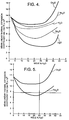
- the viscosity of borate glasses having a general composition as defined above varies monotonically, and approximately linearly, with A2O, the total alkali oxide content (in mole %), wherein A is LI, Na, K, Rb, Cs or Fr, of the finished glass.
- the thermal expansion coefficient varies with composition in a complex way, as shown in Fig. 4 which is taken from a paper written by D. R. Uhlman and R. R. Shaw published in the Journal of Non-Crystalline Solids (1, 347 (1969)). Fig. 4.
- a glass with the optimum viscosity for processing and use contains 25 mole% alkali oxide.
- the glass composition has been designed specifically so that the percentages of the two alkali oxide constituents can be varied to provide a more-or-less an exact match to the thermal expansion coefficient of beta''-Al203.
- the glass also has a sufficiently high viscosity at about 350°C that it will not flow or creep during the lifetime of the cell.
- thermal expansion coefficient that is intermediate between those of beta''-Al203 and TiO2 is desired, this can be achieved by altering the Na20 to Cs20 ratio as described above, while maintaining constant viscosity by holding the total alkali oxide content of the glass (Na20 + Cs20) constant. If a higher or lower viscosity is desired this can be achieved by altering the total alkali oxide content of the glass, while maintaining a constant thermal expansion coefficient by holding the Na20 to Cs20 ratio constant.
- the ability to fine tune the glass to provide the optimum expansion coefficient, while retaining the desired viscosity, is a desirable feature of this invention.
- the glass composition may be prepared by mixing powders of sodium metaborate, boric acid, sodium carbonate, and cesium carbonate in the correct ratios to obtain the above composition, melting the mixture in a glass-making muffle furnace at high temperature using a platinum or zirconium crucible. Homogenization is achieved by occasional stirring or by bubbling O2 through the melt using a platinum tube. The glass is then poured out onto graphite to cool. Particularly for application to fused titania, it is most convenient to use standard screen printing techniques to apply the glass in a pattern as shown in Figure 2.
- the glass is ground into a powder of suitable particle size distribution, and made into a paste using an anhydrous organic liquid such as cumene, toluene or benzene as a vehicle, and a polymeric or high molecular weight organic material such as alpha methyl polystyrene as a binder.
- anhydrous organic liquid such as cumene, toluene or benzene as a vehicle
- a polymeric or high molecular weight organic material such as alpha methyl polystyrene as a binder.
- Suitable materials include those that do not absorb appreciable water from the atmosphere, and those that burn off cleanly during the process of fusing the glass powder to make the seal. A number of these materials are well known to those skilled in screen printing of glass powders or glass-containing metallizations. Since all borate glasses are highly hygroscopic, the glass should be prepared, ground, and subsequently handled under controlled and reduced humidity conditions. But, because beta''-Al203 is also hygroscopic, this condition should pose no special requirements on the battery assembly process.
- the beta''-Al203 sheet is placed upon the glass, and the assembly is fired in a vacuum furnace to volatilize the organic species, melt and fuse the glass powder, and form a tight seal between the beta''-Al203 and the TiO2.
- the structure should be cooled from fusing temperature to room temperature gradually, preferably at a rate of around 1°C/min for the temperature range between the softening point and the strain point of the glass. At lower temperatures, it may be cooled at faster rates.
Landscapes
- Chemical & Material Sciences (AREA)
- General Chemical & Material Sciences (AREA)
- Chemical Kinetics & Catalysis (AREA)
- Engineering & Computer Science (AREA)
- Electrochemistry (AREA)
- Life Sciences & Earth Sciences (AREA)
- Geochemistry & Mineralogy (AREA)
- Materials Engineering (AREA)
- Organic Chemistry (AREA)
- Inorganic Chemistry (AREA)
- Manufacturing & Machinery (AREA)
- Secondary Cells (AREA)
- Glass Compositions (AREA)
- Sealing Battery Cases Or Jackets (AREA)
- Cell Separators (AREA)
Applications Claiming Priority (2)
| Application Number | Priority Date | Filing Date | Title |
|---|---|---|---|
| US07/667,157 US5158840A (en) | 1991-03-11 | 1991-03-11 | Glass sealing materials for sodium-sulfur batteries and batteries made therewith |
| US667157 | 1991-03-11 |
Publications (2)
| Publication Number | Publication Date |
|---|---|
| EP0503776A1 true EP0503776A1 (fr) | 1992-09-16 |
| EP0503776B1 EP0503776B1 (fr) | 1995-09-06 |
Family
ID=24677042
Family Applications (1)
| Application Number | Title | Priority Date | Filing Date |
|---|---|---|---|
| EP92301278A Expired - Lifetime EP0503776B1 (fr) | 1991-03-11 | 1992-02-17 | Matériaux vitreux de scellement pour batteries sodium-soufre et batteries fabriqués avec ces matériaux |
Country Status (4)
| Country | Link |
|---|---|
| US (1) | US5158840A (fr) |
| EP (1) | EP0503776B1 (fr) |
| JP (1) | JP2558035B2 (fr) |
| DE (1) | DE69204502T2 (fr) |
Cited By (1)
| Publication number | Priority date | Publication date | Assignee | Title |
|---|---|---|---|---|
| US6656625B1 (en) | 1998-04-16 | 2003-12-02 | Alstom Uk Ltd. | Glass-ceramic coatings and sealing arrangements and their use in fuel cells |
Families Citing this family (15)
| Publication number | Priority date | Publication date | Assignee | Title |
|---|---|---|---|---|
| US8603659B2 (en) * | 2008-10-03 | 2013-12-10 | General Electric Company | Sealing glass composition and article |
| US8043986B2 (en) * | 2008-11-13 | 2011-10-25 | General Electric Company | Sealing glass composition, method and article |
| KR20110139197A (ko) * | 2009-03-16 | 2011-12-28 | 세라마테크, 인코오포레이티드 | 실질적으로 비다공성 멤브레인을 구비한 나트륨-황 배터리 및 개선된 캐소드 활용방법 |
| CN101531473B (zh) * | 2009-04-03 | 2010-09-29 | 西安华泰有色金属实业有限责任公司 | 一种金属-玻璃封接工艺 |
| JP5158008B2 (ja) * | 2009-04-28 | 2013-03-06 | トヨタ自動車株式会社 | 全固体電池 |
| US8865361B2 (en) * | 2009-07-29 | 2014-10-21 | The Invention Science Fund I, Llc | Instrumented fluid-surfaced electrode |
| US20110027638A1 (en) * | 2009-07-29 | 2011-02-03 | Searete Llc, A Limited Liability Corporation Of The State Of Delaware | Fluid-surfaced electrode |
| US10074879B2 (en) | 2009-07-29 | 2018-09-11 | Deep Science, Llc | Instrumented fluid-surfaced electrode |
| US20110027637A1 (en) * | 2009-07-29 | 2011-02-03 | Searete Llc, A Limited Liability Corporation Of The State Of Delaware | Fluid-surfaced electrode |
| US8460814B2 (en) * | 2009-07-29 | 2013-06-11 | The Invention Science Fund I, Llc | Fluid-surfaced electrode |
| US8889312B2 (en) | 2009-07-29 | 2014-11-18 | The Invention Science Fund I, Llc | Instrumented fluid-surfaced electrode |
| KR101115397B1 (ko) * | 2009-10-27 | 2012-02-16 | 경상대학교산학협력단 | 고체 나트륨 전지 및 그의 제조 방법 |
| US9067818B2 (en) | 2012-01-19 | 2015-06-30 | General Electric Company | Sealing glass composition and article |
| KR101895566B1 (ko) * | 2012-03-30 | 2018-09-07 | 한국기계연구원 | 나트륨계 고체전해질 구조체, 그 제조방법 및 나트륨계 전지 |
| WO2013177088A1 (fr) * | 2012-05-23 | 2013-11-28 | Materials And Systems Research, Inc. | Électrolyte à l'état solide, conducteur d'ions sodium, sous forme de film mince supporté par un métal poreux |
Citations (5)
| Publication number | Priority date | Publication date | Assignee | Title |
|---|---|---|---|---|
| DE2647299A1 (de) * | 1976-10-20 | 1978-04-27 | Battelle Institut E V | Galvanisches element |
| US4311772A (en) * | 1980-10-09 | 1982-01-19 | Corning Glass Works | Sealing glasses for electrochemical, electrical, electronic and optical applications |
| GB2178589A (en) * | 1985-05-21 | 1987-02-11 | Chloride Silent Power Ltd | Composite ceramic structure for use in a sodium sulphur cell |
| US4977044A (en) * | 1989-10-03 | 1990-12-11 | Hughes Aircraft Company | Sodium-sulfur thermal battery |
| EP0453796A2 (fr) * | 1990-04-20 | 1991-10-30 | Hughes Aircraft Company | Corps d'électrolyte composite conducteur d'ions |
Family Cites Families (4)
| Publication number | Priority date | Publication date | Assignee | Title |
|---|---|---|---|---|
| EP0018190A1 (fr) * | 1979-04-19 | 1980-10-29 | Chloride Silent Power Limited | Joints d'étanchéité en verre pour sceller le bêta-alumine dans des cellules électrochimiques ou autres dispositifs de conversion d'énergie, verres utilisables pour ces joints et cellules ou autres dispositifs de conversion d'énergie comportant de tels scellements |
| DE3114348A1 (de) * | 1981-04-09 | 1982-11-04 | Brown, Boveri & Cie Ag, 6800 Mannheim | "wiederaufladbare galvanische einzelzelle" |
| DE3412206A1 (de) * | 1984-04-02 | 1985-10-10 | Brown, Boveri & Cie Ag, 6800 Mannheim | Elektrochemische speicherzelle |
| JP2620238B2 (ja) * | 1987-05-27 | 1997-06-11 | 東京電力株式会社 | ナトリウム−硫黄電池 |
-
1991
- 1991-03-11 US US07/667,157 patent/US5158840A/en not_active Expired - Lifetime
-
1992
- 1992-02-17 DE DE69204502T patent/DE69204502T2/de not_active Expired - Fee Related
- 1992-02-17 EP EP92301278A patent/EP0503776B1/fr not_active Expired - Lifetime
- 1992-03-06 JP JP4050011A patent/JP2558035B2/ja not_active Expired - Lifetime
Patent Citations (5)
| Publication number | Priority date | Publication date | Assignee | Title |
|---|---|---|---|---|
| DE2647299A1 (de) * | 1976-10-20 | 1978-04-27 | Battelle Institut E V | Galvanisches element |
| US4311772A (en) * | 1980-10-09 | 1982-01-19 | Corning Glass Works | Sealing glasses for electrochemical, electrical, electronic and optical applications |
| GB2178589A (en) * | 1985-05-21 | 1987-02-11 | Chloride Silent Power Ltd | Composite ceramic structure for use in a sodium sulphur cell |
| US4977044A (en) * | 1989-10-03 | 1990-12-11 | Hughes Aircraft Company | Sodium-sulfur thermal battery |
| EP0453796A2 (fr) * | 1990-04-20 | 1991-10-30 | Hughes Aircraft Company | Corps d'électrolyte composite conducteur d'ions |
Cited By (1)
| Publication number | Priority date | Publication date | Assignee | Title |
|---|---|---|---|---|
| US6656625B1 (en) | 1998-04-16 | 2003-12-02 | Alstom Uk Ltd. | Glass-ceramic coatings and sealing arrangements and their use in fuel cells |
Also Published As
| Publication number | Publication date |
|---|---|
| US5158840A (en) | 1992-10-27 |
| JPH05109432A (ja) | 1993-04-30 |
| DE69204502T2 (de) | 1996-04-18 |
| DE69204502D1 (de) | 1995-10-12 |
| JP2558035B2 (ja) | 1996-11-27 |
| EP0503776B1 (fr) | 1995-09-06 |
Similar Documents
| Publication | Publication Date | Title |
|---|---|---|
| US5158840A (en) | Glass sealing materials for sodium-sulfur batteries and batteries made therewith | |
| US5134044A (en) | Glass-graphite bonding system for sodium-sulphur batteries and batteries made therefrom | |
| US3404036A (en) | Energy conversion device comprising a solid crystalline electrolyte and a solid reaction zone separator | |
| US5162172A (en) | Bipolar battery | |
| US6430966B1 (en) | Glass-ceramic material and method of making | |
| CN102471135B (zh) | 用于在高温下运行的装置的密封垫的玻璃组合物及利用它们的装配方法 | |
| US4977044A (en) | Sodium-sulfur thermal battery | |
| US3966492A (en) | Sodium sulfur battery or cell with improved ampere-hour capacity | |
| US3841912A (en) | Sodium sulfur storage battery | |
| GB2131416A (en) | Ionic conductive glass | |
| US3985576A (en) | Seal for energy conversion devices | |
| US3829331A (en) | Sodium borate glass compositions and batteries containing same | |
| WO1994020246A1 (fr) | Materiaux ceramiques resistant a la corrosion | |
| KR20200036971A (ko) | 고체전해질, 이를 포함하는 리튬이온전지 및 이의 제조방법 | |
| JPH03179677A (ja) | ナトリウム・硫黄熱電池 | |
| US4968568A (en) | Thermal battery with composite anode | |
| US4347295A (en) | Sealing glasses for electrochemical, electrical, electronic, and optical applications | |
| US4311772A (en) | Sealing glasses for electrochemical, electrical, electronic and optical applications | |
| JPH0352187B2 (fr) | ||
| US9708212B2 (en) | Sodium-resistant joining glass and the use thereof | |
| JP2619061B2 (ja) | ナトリウム一硫黄電池形成用接合ガラスおよびそれを用いた有底円筒状固体電解質と絶縁体リングの接合方法 | |
| CA1193621A (fr) | Verres conducteurs aux lions de sodium, et accumulateurs qui renferment ces verres | |
| JP3205851B2 (ja) | ナトリウム−硫黄電池及びその製法 | |
| CA1156682A (fr) | Verres de scellement pour appareils electro-chimiques, electriques, electroniques et optiques | |
| Sudworth | High temperature batteries |
Legal Events
| Date | Code | Title | Description |
|---|---|---|---|
| PUAI | Public reference made under article 153(3) epc to a published international application that has entered the european phase |
Free format text: ORIGINAL CODE: 0009012 |
|
| AK | Designated contracting states |
Kind code of ref document: A1 Designated state(s): DE FR GB SE |
|
| 17P | Request for examination filed |
Effective date: 19930224 |
|
| 17Q | First examination report despatched |
Effective date: 19940303 |
|
| GRAA | (expected) grant |
Free format text: ORIGINAL CODE: 0009210 |
|
| AK | Designated contracting states |
Kind code of ref document: B1 Designated state(s): DE FR GB SE |
|
| REF | Corresponds to: |
Ref document number: 69204502 Country of ref document: DE Date of ref document: 19951012 |
|
| ET | Fr: translation filed | ||
| PLBE | No opposition filed within time limit |
Free format text: ORIGINAL CODE: 0009261 |
|
| 26N | No opposition filed | ||
| REG | Reference to a national code |
Ref country code: GB Ref legal event code: 732E |
|
| REG | Reference to a national code |
Ref country code: FR Ref legal event code: TP Ref country code: FR Ref legal event code: CA Ref country code: FR Ref legal event code: CD |
|
| REG | Reference to a national code |
Ref country code: GB Ref legal event code: IF02 |
|
| PGFP | Annual fee paid to national office [announced via postgrant information from national office to epo] |
Ref country code: SE Payment date: 20070227 Year of fee payment: 16 |
|
| EUG | Se: european patent has lapsed | ||
| PG25 | Lapsed in a contracting state [announced via postgrant information from national office to epo] |
Ref country code: SE Free format text: LAPSE BECAUSE OF NON-PAYMENT OF DUE FEES Effective date: 20080218 |
|
| PGFP | Annual fee paid to national office [announced via postgrant information from national office to epo] |
Ref country code: GB Payment date: 20090227 Year of fee payment: 18 |
|
| PGFP | Annual fee paid to national office [announced via postgrant information from national office to epo] |
Ref country code: DE Payment date: 20090331 Year of fee payment: 18 |
|
| PGFP | Annual fee paid to national office [announced via postgrant information from national office to epo] |
Ref country code: FR Payment date: 20090217 Year of fee payment: 18 |
|
| GBPC | Gb: european patent ceased through non-payment of renewal fee |
Effective date: 20100217 |
|
| REG | Reference to a national code |
Ref country code: FR Ref legal event code: ST Effective date: 20101029 |
|
| PG25 | Lapsed in a contracting state [announced via postgrant information from national office to epo] |
Ref country code: FR Free format text: LAPSE BECAUSE OF NON-PAYMENT OF DUE FEES Effective date: 20100301 |
|
| PG25 | Lapsed in a contracting state [announced via postgrant information from national office to epo] |
Ref country code: DE Free format text: LAPSE BECAUSE OF NON-PAYMENT OF DUE FEES Effective date: 20100901 |
|
| PG25 | Lapsed in a contracting state [announced via postgrant information from national office to epo] |
Ref country code: GB Free format text: LAPSE BECAUSE OF NON-PAYMENT OF DUE FEES Effective date: 20100217 |