EP0503797A1 - Methacrylimidgruppen enthaltende Polymere - Google Patents
Methacrylimidgruppen enthaltende Polymere Download PDFInfo
- Publication number
- EP0503797A1 EP0503797A1 EP92301592A EP92301592A EP0503797A1 EP 0503797 A1 EP0503797 A1 EP 0503797A1 EP 92301592 A EP92301592 A EP 92301592A EP 92301592 A EP92301592 A EP 92301592A EP 0503797 A1 EP0503797 A1 EP 0503797A1
- Authority
- EP
- European Patent Office
- Prior art keywords
- group
- polymer
- containing polymer
- methacrylimide
- carbon atoms
- Prior art date
- Legal status (The legal status is an assumption and is not a legal conclusion. Google has not performed a legal analysis and makes no representation as to the accuracy of the status listed.)
- Withdrawn
Links
Images
Classifications
-
- C—CHEMISTRY; METALLURGY
- C08—ORGANIC MACROMOLECULAR COMPOUNDS; THEIR PREPARATION OR CHEMICAL WORKING-UP; COMPOSITIONS BASED THEREON
- C08G—MACROMOLECULAR COMPOUNDS OBTAINED OTHERWISE THAN BY REACTIONS ONLY INVOLVING UNSATURATED CARBON-TO-CARBON BONDS
- C08G73/00—Macromolecular compounds obtained by reactions forming a linkage containing nitrogen with or without oxygen or carbon in the main chain of the macromolecule, not provided for in groups C08G12/00 - C08G71/00
-
- C—CHEMISTRY; METALLURGY
- C08—ORGANIC MACROMOLECULAR COMPOUNDS; THEIR PREPARATION OR CHEMICAL WORKING-UP; COMPOSITIONS BASED THEREON
- C08F—MACROMOLECULAR COMPOUNDS OBTAINED BY REACTIONS ONLY INVOLVING CARBON-TO-CARBON UNSATURATED BONDS
- C08F8/00—Chemical modification by after-treatment
- C08F8/48—Isomerisation; Cyclisation
Definitions
- the present invention relates to a methacrylimide group-containing polymer having an excellent heat resistance, formability and thermal stability, and an excellent balance of these physical properties.
- Methyl methacrylate polymers are widely used, due to their excellent transparency, weather resistance and mechanical properties, in various fields of industry such as the automobile, electrical or electronic industry, and building material.
- the thermal deformation temperature of a methyl methacrylate polymer is as low as about 100°C, it is difficult to use this polymer in an atmosphere at a temperature higher than about 100°C.
- a polycarbonate has been used as a resin having transparency and heat resistance.
- the temperature under which the polycarbonate is practically heat resistant is lower than 140°C. Therefore, the polycarbonate is not always satisfactory with regard to its application.
- a process for improving the heat resistance of a methyl methacrylate polymer is known, involving imidizing the methyl methacrylate polymer by utilizing the side chain reaction of methyl methacrylate polymer.
- Processes for the imidization of a methyl methacrylate polymer have been proposed including a process for subjecting a methyl methacrylate polymer to a thermal decomposition condensation reaction with a primary amine as disclosed in US Patent No. 2,146,209; a process for reacting a methyl methacrylate polymer with a water-soluble ammonium salt or water-soluble N-alkyl ammonium salt as disclosed in U.S. Patent No. 3,244,679; and a process for reacting a methyl methacrylate polymer with ammonia or a primary amine in an extruder as disclosed in U.S. Patent No. 4,246,374.
- the imidized polymers have only one kind of methacrylimide structure. Accordingly, the polymer which is imidized with methylamine or ammonia has a low fluidity and the formability thereof is very poor.
- a polymer with a low methacrylimide group content in which the imidization degree is lowered to improve the fluidity, has a low thermal stability, and the polymer decomposes in a high temperature atmosphere due to units of methacrylic ester and its residual derivatives remaining or existing in the polymer.
- a polymer is not satisfactory for practical use as a heat resistant molding material.
- Example 45 of the U.S. Patent No. 4,246,374 discloses the use of a mixture of 5% ammonia and 95% butylamine as the imidizing agent, there is no specific description or suggestion of what proportion of the repeating units of methacrylimide groups and butyl methacrylimide groups formed by such imidizing agents gives the polymer an excellent heat resistance, formability and thermal stability, and a good balance of these physical properties.
- the present invention relates to a methacrylimide group-containing polymer comprising the repeating units represented by the following general formulas (I), (II), and (III), the proportions of the repeating unit represented by the general formula (I), that of the repeating unit represented by the general formula (II), and that of the repeating unit represented by the general formula (III) being 30 to 98% by weight, 2 to 70% by weight, and 0 to 20% by weight, respectively, based on the weight of the polymer.
- R1 and R2 are different from each other, and represent a hydrogen atom, or an aliphatic, aromatic, or alicyclic hydrocarbon radical with 1 to 18 carbon atoms, respectively, and R3 represents a member selected from the group consisting of carboxyl group, an aliphatic ester group with 1 to 6 carbon atoms, and aliphatic, aromatic or alicyclic amide group with 1 to 18 carbon atoms.
- the methacrylimide group-containing polymer of the present invention has excellent physical properties such as heat resistance, formability and thermal stability, and a good balance of these physical properties, due to the fact that the present polymer contains at least two different kinds of methacrylimide structural units (I) and (II) as indispensable repeating units in specific proportions, respectively.
- substituents R1, R2 and R3 in the repeating units (I), (II) and (III) there may be mentioned the substituents selected from a hydrogen atom, and aliphatic, aromatic or alicyclic hydrocarbon radicals with 1 to 18 carbon atoms, with the condition that R1 and R2 are different from each other.
- R1 in the general formula (I) is preferably selected from a hydrogen atom, and methyl, ethyl, propyl, or cyclohexyl groups, and in this case, R2 is preferably selected from other alkyl groups with 3 to 18 carbon atoms.
- R1 is a methyl group and R2 is selected from alkyl groups with 3 to 18 carbon atoms.
- R1 in the general formula (I) and R2 in the general formula (II), in which R1 is a phenyl group and R2 is a butyl group, is particularly preferable.
- repeating unit having a methacrylimide structure and the substituent which forms a harder segment in a polymer is assumed to be the repeating unit (I)
- repeating unit having another methacrylimide structure and containing the substituent which forms a softer segment in a polymer is assumed to be the repeating unit (II).
- the proportions of the repeating units (I) and (II) are preferably within the ranges of from 30 to 98% by weight of from 2 to 70% by weight, respectively, and the total amount of the repeating units (I) and (II) are preferably within the range of from 90 to 100% by weight.
- the above total amount is smaller than 90% by weight, it is difficult to obtain a practically satisfactory heat resistance and thermal stability.
- the repeating unit (I) contributes greatly to the heat resistance of the methacrylimide group-containing polymer as compared with the repeating unit (II).
- the proportion of the repeating unit (I) is less than 30% by weight, it becomes difficult for this unit to contribute to the improvement of heat resistance.
- this proportion exceeds 98% by weight, the proportion of another repeating unit (II) reaches zero or substantially zero, and the methacrylimide group-containing polymer has a poor melt fluidity, despite having an excellent heat resistance.
- the substituent R3 of the repeating unit (III) is the residue of the unreacted unit or intermediate unit produced in obtaining the methacrylimide group containing polymer, and the lower the content of the repeating unit (III) the higher the thermal stability of the obtained polymer.
- the R3 substituent is a carboxyl group, an aliphatic ester group with 1 to 6 carbon atoms or one kind of group selected from aliphatic, aromatic and alicyclic amide groups with 1 to 18 carbon atoms, wherein the amide groups correspond to R1 and R2 of the general formulas (I) and (II) respectively.
- R3 is preferably a carboxyl group or an aliphatic ester group with 1 to 6 carbon atoms.
- the repeating unit (III) may contain two or more different R3 groups simultaneously.
- the proportion of the repeating unit (III) of the methacrylimide group-containing polymer of the present invention is from 0 to 20% by weight, preferably 5% by weight or less, and more preferably 2% by weight or less of the polymer.
- this proportion exceeds 20% by weight, a disadvantage arises in that the thermal stability of the methacrylimide group-containing polymer is lowered, and the molding temperature range is narrowed when the polymer is used as moulding material.
- the methacrylimide group-containing polymer of the present invention preferably has a melt index (measured under the conditions: 265°C/lO kg load) of 1.5 g/lO min or more. When the melt index is below 1.5 g/lO min, insufficient fluidity is obtained for the polymer to be used as injection molding material.
- R1-NH2 V
- R1 is a hydrogen atom, or an aliphatic, aromatic or alicyclic hydrocarbon radical with 1 to 18 carbon atoms
- R1 is different from R2, for example, methylamine
- Volatile substances and/or unreacted imidizing agent for example methyl amine
- Volatile substances and/or unreacted imidizing agent for example methyl amine
- a methacrylimide group-containing polymer comprising two different kinds of methacrylimides such as the repeating units (I) and (II), eg., N-methyl methacrylimide and N-butyl methacrylimide, is produced.
- the methacrylimide group-containing polymer thus produced displays an excellent thermal stability, heat resistance, and transparency.
- the starting polymer for obtaining the methacrylimide group-containing polymer may include a methyl methacrylate polymer, methacrylic acid polymer, copolymers of methyl methacrylate or methacrylic acid with another vinyl monomer polmyerizable therewith, and polymer blends thereof.
- the intrinsic viscosity of these starting polmyers is too low, the mechanical strengths of the methcrylimide group-containing polmyers to be obtained are low even though they have an excellent fluidity, and it comes difficult to obtain good methacrylimide group containing polmyers for molding. Therefore, it is preferable to use a starting polymer with an intrinsic viscosity of 0.25 or more, preferably 0.3 or more.
- the vinyl monomer copolymerizable with methyl methacrylate or methacrylic acid includes styrene; a styrene derivative such as chlorostyrene; an olefin such as ethylene and propylene; a vinyl cyanide derivative such as acrylonitrile; a vinyl halide such as vinyl chloride; and a vinylidene halide such as vinylidene chloride.
- Use of these vinyl monomers give additional properties (e.g., chemical resistance, ozone resistance, flame retardance, fluidity, film-forming properties, etc.) to the methacrylimide group-containing polmyer.
- the proportion of the unit derived from the copolmyerizable vinyl monomer is preferably 0 to 5% by weight of the polymer as part of the 0 to 20% proportion of the repeating unit represented by the above formula (III).
- the proportion of vinyl monomer exceeds 5% by weight of the polymer, the thermal stability of the methacrylimide group-containing polymer is lowered.
- the methacrylimide group-containing polymer of the present invention can be used as such as a raw material for various forming processes such as injection molding, press molding, and extrusion molding.
- the present methacrylimide group-containing polymer may be blended with one or more other resins, e.g., ABS resin, a polyester resin such as polybutylene terephthalate, a polyamide resin such as 6-nylon and 4,6-nylon to improve the impact resistance, chemicals resistance, and heat resistance thereof.
- fillers such as glass fibres, carbon fibres, talcs and calcium carbonate powders may be compounded into the methacrylimide group-containing polymer.
- Other additives such as a lubricant, releasing agent, thermal stabilizer, flame retardant, coloring agent, and ultraviolet absorber may also be blended with the methacrylimide group-containing polymer with the condition at the additive will not inhibit the properties of the polymer.
- the methacrylimide group-containing polymer of the present invention is formed into desired molded articles by subjecting it to various molding methods such as injection molding, extrusion molding, press molding, blow molding, and calender molding. It may be used in fields where the excellent heat resistance and mechanical properties of this polymer can be efficiently utilized. In particular, due to the characteristics of the polymer, i.e. its excellent melt fluidity and thermal stability, the molding of the polymer may be advantageously carried out in terms of the ranges of the processing conditions e.g., the size and shape of a molded article, or molding temperature and molding cycle.
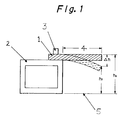
- Fig. 1 illustrates the fixture used in the heat resistance test in the Examples and Comparative Examples and shows how the heat resistance is determined, and is further described in the text relating to that test.
- Melt index was determined according to ASTM D-1238. The measurement was carried out at a barrel temperature of 265°C and an extrusion load of 10 kg weight.
- a polymer sample was inserted between two press plates heated to a temperature of 330°C and 350°C, respectively, and kept for 30 min in the pressurized state. Subsequently, this sample was cooled to an ambient temperature together with the press plates, the pressed sample was taken out, and it was visually observed whether or not foaming had occurred in the plate thus obtained.
- the test piece 1 (150 mm in length, 10 mm in width, and 4 mm in thickness) prepared in 2) above was fixed at one end to a fixture 2 (made of stainless steel) with a clamp 3 in such a way that the overhang 4 was 100 mm.
- the height h o of the test piece from a reference plane 5 was measured with a height gauge.
- IR spectra was measured within the range of from 800 cm ⁇ 1 to 4000 cm ⁇ 1 according to the KBr method.
- the nitrogen atom content (% by weight) of each polymer was determined with a CHN coder.
- a resin polymer sample was granulated (pelletized) by a devolatilization type extruder in a heated condition, and the granulated sample was formed into a box-shaped molded article (top plate: 150 mm in length, 120 mm in width, and 2.5 mm in thickness; side plate: 50 mm in width and 2.0 mm in thickness) using an injection molding machine (IS-lOO EN made by Toshiba Machine Co., Ltd.).
- the injection molding was conducted under the following conditions: set cylinder temperature of 310°C, mold heating medium temperature of 80°C, and set injection rate of 90%.
- a reactor having an internal volume of 1.5l and equipped with a reagent injection vessel and jacket heater were introduced 100 parts of a methyl methacrylate polymer (intrinsic viscosity 0.32), 150 parts of toluene, 70 parts of methanol, and 3 parts of n-butylamine.
- the air in the reactor was purged with nitrogen, and then the contents of the reactor were heated to 230°C while being stirred to dissolve the polymer. Then, the contents were allowed to react for 1 hour at a temperature of 230°C, and after the reaction was completed (completion of the first stage reaction), extremely small quantities of the reactants were taken out.
- the polymers thus obtained were extruded by a devolatilization type shaping device at a barrel temperature of from 280°C to 320°C to obtain a transparent strand-shaped polymer.
- a devolatilization type shaping device at a barrel temperature of from 280°C to 320°C to obtain a transparent strand-shaped polymer.
- the strand-shaped polymer of the white powdered polymer obtained after the completion of the second stage reaction it was confirmed by an IR absorption spectrum that an absorption attributable to an imide structure existed. Further, it was found from the elemental analysis that the polymer contained about 95% by weight of the structural unit of N-methyl methacrylimide and about 5% by weight of the structural unit of N-butyl methacrylimide. The melt index of the strand-shaped polymer obtained was 2.5 g/lO min. Also, when this polymer was subjected to the thermal stability test by a press molding machine mentioned above, foaming did not occur even at temperatures of 330°C or 350°C.
- Example 1 was repeated several times to obtain about 800 g of the reaction product.
- the reaction product thus obtained was extruded into a strand-shaped polymer by a devolatilization type screw extruder comprising a barrel, a screw, vents and a die, and the polymer obtained was shaped into pellets (granular polymers) by a cutter.
- Example 1 The same procedure as in Example 1 was conducted except that the kinds of amines used as imidizing agent were varied as set forth in Table 1.
- the reaction conditions, results of the composition analysis, and test results in Examples 2 to 4 are summarized in Table 1.
- a reactor with an internal volume of 1.5l and equipped with a reagent injection vessel and jacket heater were introduced 100 parts of a methyl methacrylate polymer (intrinsic viscosity 0.32), 150 parts of toluene, 70 parts of methanol, 200 parts of aniline and 50 parts of n-butylamine.
- the air in the reactor was purged with nitrogen, and then the contents of the reactor were heated to 230°C while being stirred to dissolve the polymer, and the contents were allowed to react for 2 hours at a temperature of 250°C. After the reaction was completed, the reaction product was recovered and purified to obtain white powdered polymers.
- the polymers thus obtained were extruded at a barrel temperature of from 280°C to 320°C by a devolatilization type shaping device comprising a barrel, piston and die to obtain a transparent strand-shaped polymer.
- a methacrylimide structure was identified. Also, it was found by the elemental analysis that this polymer contained 55% by weight of an N-phenyl methacrylimide structure and 45% by weight of an N-butyl methacrylimide structure.
- the melt index of the strand-shaped polymer was 10 g/lO min.
- the polymers thus obtained were extruded at a barrel temperature of from 280°C to 320°C by a devolatilization type shaping device comprising a barrel, piston and die to obtain a transparent strand-shaped polymer.
- a devolatilization type shaping device comprising a barrel, piston and die to obtain a transparent strand-shaped polymer.
- a methacrylimide structure was identified. Also, it was found by the elemental analysis that this polymer contained about 100% by weight of the structural unit of N-methyl methacrylimide.
- the melt index of the polymer obtained was 1.3 g/lO min.
- Comparative Example 1 was repeated except that the kind and amount introduced of the amine used as imidizing agent were varied as set forth in Table 1.
- Comparative Example 1 was repeated several times to obtain about 800 g of a reaction product.
- This reaction product was extruded into strand-shaped polymer by a devolatilization type screw extruder comprising a barrel, a screw, vents, and a die, and the strand-shaped polymer was shaped into pellets by a cutter.
- the polymers thus obtained were extruded at a barrel temperature of from 280°C to 320°C by a devolatilization type shaping device comprising a barrel, piston and die to obtain a transparent strand-shaped polymer.
- a devolatilization type shaping device comprising a barrel, piston and die to obtain a transparent strand-shaped polymer.
- a methacrylimide structure was identified. Also, it was found by the elemental analysis that this polymer contained about 100% by weight of the structural unit of methyl methacrylimide.
- the melt index of the obtained polymer was 2.2 g/lO min.
Landscapes
- Chemical & Material Sciences (AREA)
- Health & Medical Sciences (AREA)
- Chemical Kinetics & Catalysis (AREA)
- Medicinal Chemistry (AREA)
- Polymers & Plastics (AREA)
- Organic Chemistry (AREA)
- General Chemical & Material Sciences (AREA)
- Addition Polymer Or Copolymer, Post-Treatments, Or Chemical Modifications (AREA)
Applications Claiming Priority (2)
| Application Number | Priority Date | Filing Date | Title |
|---|---|---|---|
| JP04495591A JP3176944B2 (ja) | 1991-03-11 | 1991-03-11 | メタクリルイミド基含有重合体 |
| JP44955/91 | 1991-03-11 |
Publications (1)
| Publication Number | Publication Date |
|---|---|
| EP0503797A1 true EP0503797A1 (de) | 1992-09-16 |
Family
ID=12705911
Family Applications (1)
| Application Number | Title | Priority Date | Filing Date |
|---|---|---|---|
| EP92301592A Withdrawn EP0503797A1 (de) | 1991-03-11 | 1992-02-26 | Methacrylimidgruppen enthaltende Polymere |
Country Status (5)
| Country | Link |
|---|---|
| US (1) | US5225496A (de) |
| EP (1) | EP0503797A1 (de) |
| JP (1) | JP3176944B2 (de) |
| KR (1) | KR920018111A (de) |
| CA (1) | CA2061235A1 (de) |
Cited By (3)
| Publication number | Priority date | Publication date | Assignee | Title |
|---|---|---|---|---|
| EP0548657A1 (de) * | 1991-12-21 | 1993-06-30 | BASF Aktiengesellschaft | Poly(meth)acrylimide mit unterschiedlicher N-Substitution |
| EP0776910A3 (de) * | 1995-11-29 | 1998-02-11 | Röhm Gmbh | Verfahren zur Herstellung eines imidierten Polymerisats von Alkylestern |
| US6858672B2 (en) | 2002-06-20 | 2005-02-22 | Basell Poliolefine Italia S.P.A. | Safe process for making polymers containing N-phenylimide groups |
Families Citing this family (12)
| Publication number | Priority date | Publication date | Assignee | Title |
|---|---|---|---|---|
| EP0461224B1 (de) * | 1989-12-29 | 1996-09-11 | Lucky Ltd. | Verfahren zur herstellung von hitzebeständigem und transparentem acrylharz |
| US5393343A (en) * | 1993-09-29 | 1995-02-28 | W. R. Grace & Co.-Conn. | Cement and cement composition having improved rheological properties |
| WO2001023449A1 (en) | 1999-09-27 | 2001-04-05 | Mitsubishi Rayon Co., Ltd. | Graft copolymer and thermoplastic resin composition containing the same |
| US6764766B2 (en) | 2001-03-15 | 2004-07-20 | Mitsubishi Rayon Co., Ltd. | Acrylic resin film, method of producing the same, and laminate using the same |
| US7632916B2 (en) * | 2002-08-02 | 2009-12-15 | 3M Innovative Properties Company | Process to modify polymeric materials and resulting compositions |
| US7157283B2 (en) * | 2002-08-02 | 2007-01-02 | 3M Innovative Properties Company | Continuous process for the production of combinatorial libraries of modified materials |
| US7691932B2 (en) * | 2004-09-27 | 2010-04-06 | 3M Innovative Properties Company | Method of making a composition and nanocomposites therefrom |
| US8193270B2 (en) * | 2004-12-14 | 2012-06-05 | 3M Innovative Properties Company | Method of making composites and nanocomposites |
| JP5400296B2 (ja) * | 2005-05-30 | 2014-01-29 | 株式会社カネカ | 樹脂組成物 |
| DE102009015040A1 (de) * | 2009-03-26 | 2010-09-30 | Bayer Materialscience Ag | (Co)polycarbonate mit verbesserten optischen Eigenschaften |
| US20190240868A1 (en) | 2016-07-12 | 2019-08-08 | Sabic Global Technologies B.V. | Method of making an extruded thin film, thin film so produced and its use |
| JP7803889B2 (ja) * | 2021-02-05 | 2026-01-21 | 株式会社カネカ | イミド構造含有アクリル系樹脂の製造方法 |
Citations (4)
| Publication number | Priority date | Publication date | Assignee | Title |
|---|---|---|---|---|
| FR2393818A1 (fr) * | 1977-06-09 | 1979-01-05 | Gaf Corp | Procede de preparation de polyimides cycliques lineaires |
| EP0216505A2 (de) * | 1985-08-27 | 1987-04-01 | Rohm And Haas Company | Polyimide, Herstellung von Polyimiden und Polyimidzusammensetzungen |
| EP0358093A2 (de) * | 1988-08-30 | 1990-03-14 | Mitsubishi Rayon Co., Ltd | Verfahren zur Herstellung von Methacrylimidgruppen enthaltenden Polymeren und lichtdurchlässigen Fasern aus nach dem Verfahren hergestellten Polymeren |
| EP0376747A2 (de) * | 1988-12-29 | 1990-07-04 | Mitsubishi Rayon Co., Ltd. | Methacrylimid enthaltendes Polymer und dieses Polymer enthaltende Harz-Zusammensetzung |
Family Cites Families (4)
| Publication number | Priority date | Publication date | Assignee | Title |
|---|---|---|---|---|
| US4246374A (en) * | 1979-04-23 | 1981-01-20 | Rohm And Haas Company | Imidized acrylic polymers |
| US4954574A (en) * | 1985-08-27 | 1990-09-04 | Rohm And Haas Company | Imide polymers |
| DE4002904A1 (de) * | 1990-02-01 | 1991-08-08 | Roehm Gmbh | Verfahren zum imidieren eines methacrylester-polymerisats |
| WO2016060081A1 (ja) | 2014-10-17 | 2016-04-21 | オリンパス株式会社 | 内視鏡 |
-
1991
- 1991-03-11 JP JP04495591A patent/JP3176944B2/ja not_active Expired - Fee Related
-
1992
- 1992-02-12 US US07/834,203 patent/US5225496A/en not_active Expired - Fee Related
- 1992-02-14 CA CA002061235A patent/CA2061235A1/en not_active Abandoned
- 1992-02-26 EP EP92301592A patent/EP0503797A1/de not_active Withdrawn
- 1992-03-09 KR KR1019920003859A patent/KR920018111A/ko not_active Withdrawn
Patent Citations (4)
| Publication number | Priority date | Publication date | Assignee | Title |
|---|---|---|---|---|
| FR2393818A1 (fr) * | 1977-06-09 | 1979-01-05 | Gaf Corp | Procede de preparation de polyimides cycliques lineaires |
| EP0216505A2 (de) * | 1985-08-27 | 1987-04-01 | Rohm And Haas Company | Polyimide, Herstellung von Polyimiden und Polyimidzusammensetzungen |
| EP0358093A2 (de) * | 1988-08-30 | 1990-03-14 | Mitsubishi Rayon Co., Ltd | Verfahren zur Herstellung von Methacrylimidgruppen enthaltenden Polymeren und lichtdurchlässigen Fasern aus nach dem Verfahren hergestellten Polymeren |
| EP0376747A2 (de) * | 1988-12-29 | 1990-07-04 | Mitsubishi Rayon Co., Ltd. | Methacrylimid enthaltendes Polymer und dieses Polymer enthaltende Harz-Zusammensetzung |
Cited By (4)
| Publication number | Priority date | Publication date | Assignee | Title |
|---|---|---|---|---|
| EP0548657A1 (de) * | 1991-12-21 | 1993-06-30 | BASF Aktiengesellschaft | Poly(meth)acrylimide mit unterschiedlicher N-Substitution |
| US5350808A (en) * | 1991-12-21 | 1994-09-27 | Basf Aktiengesellschaft | Poly(meth)acrylimides with different n-substitutes |
| EP0776910A3 (de) * | 1995-11-29 | 1998-02-11 | Röhm Gmbh | Verfahren zur Herstellung eines imidierten Polymerisats von Alkylestern |
| US6858672B2 (en) | 2002-06-20 | 2005-02-22 | Basell Poliolefine Italia S.P.A. | Safe process for making polymers containing N-phenylimide groups |
Also Published As
| Publication number | Publication date |
|---|---|
| KR920018111A (ko) | 1992-10-21 |
| CA2061235A1 (en) | 1992-09-12 |
| JP3176944B2 (ja) | 2001-06-18 |
| US5225496A (en) | 1993-07-06 |
| JPH04283204A (ja) | 1992-10-08 |
Similar Documents
| Publication | Publication Date | Title |
|---|---|---|
| US5225496A (en) | Methacrylimide group-containing polymer | |
| US4246374A (en) | Imidized acrylic polymers | |
| EP0234726B1 (de) | Methacrylatharz-Zusammensetzung und Verfahren zu deren Herstellung | |
| EP0391336B1 (de) | Flammenhemmende Polypropenharzzusammensetzung | |
| US8242207B2 (en) | Styrene/anhydride polymeric material and graft having enhanced properties | |
| WO2012049690A1 (en) | A process for preparing high melt strength propylene polymers | |
| GB1559132A (en) | Imidized polymers | |
| CA1298023C (en) | Process for producing improved polyphenylene sulfide resin | |
| JPS6340786B2 (de) | ||
| KR101106735B1 (ko) | 폴리프로필렌계 수지 조성물 및 이를 이용한 자동차 부품 | |
| DE68922962T2 (de) | Thermoplastische Formmasse und Verfahren zu deren Herstellung. | |
| EP0365234B1 (de) | Verfahren zur Herstellung von ethylenischen Pfropfcopolymeren | |
| JPH0749502B2 (ja) | 芳香族アルケニルポリマーを含む耐火性が改善された熱可塑性組成物 | |
| JPH05222119A (ja) | メタクリルイミド基含有重合体 | |
| EP3491048B1 (de) | Zusammensetzungen mit polyacrylat-polysilan-blockcopolymeren | |
| US12617901B2 (en) | Compositions containing oxamide-functional siloxanes | |
| US5159025A (en) | Styrene-based copolymer and process for production thereof | |
| Abdel‐Naby et al. | Use of N‐(N′‐arylamino) maleimides to improve the thermal properties of poly (vinyl chloride) through chemical modification and graft copolymerization | |
| JP3375691B2 (ja) | 熱可塑性樹脂組成物 | |
| WO1992004386A1 (en) | Single solvent process for preparation of glutarimide containing polymers | |
| KR100199102B1 (ko) | 난연 폴리에스테르수지 조성물 | |
| JPH03152146A (ja) | ブロー成形用硬質塩素化塩化ビニル樹脂組成物 | |
| JPH03149244A (ja) | 硬質塩化ビニル系樹脂組成物 | |
| KR930006081B1 (ko) | 내열성 투명 아크릴계 수지의 제조방법 | |
| KR930005998B1 (ko) | 내열성 투명 아크릴계 수지의 제조방법 |
Legal Events
| Date | Code | Title | Description |
|---|---|---|---|
| PUAI | Public reference made under article 153(3) epc to a published international application that has entered the european phase |
Free format text: ORIGINAL CODE: 0009012 |
|
| AK | Designated contracting states |
Kind code of ref document: A1 Designated state(s): DE FR GB |
|
| 17P | Request for examination filed |
Effective date: 19930312 |
|
| 18W | Application withdrawn |
Withdrawal date: 19941206 |