EP0506488A1 - Alliages à mémoire de forme, du type fer-chrome-nickel-silicium et présentant une excellente résistance à la corrosion fissurante sous contraintes - Google Patents
Alliages à mémoire de forme, du type fer-chrome-nickel-silicium et présentant une excellente résistance à la corrosion fissurante sous contraintes Download PDFInfo
- Publication number
- EP0506488A1 EP0506488A1 EP92302793A EP92302793A EP0506488A1 EP 0506488 A1 EP0506488 A1 EP 0506488A1 EP 92302793 A EP92302793 A EP 92302793A EP 92302793 A EP92302793 A EP 92302793A EP 0506488 A1 EP0506488 A1 EP 0506488A1
- Authority
- EP
- European Patent Office
- Prior art keywords
- content
- shape
- stress corrosion
- corrosion cracking
- alloys
- Prior art date
- Legal status (The legal status is an assumption and is not a legal conclusion. Google has not performed a legal analysis and makes no representation as to the accuracy of the status listed.)
- Granted
Links
Images




Classifications
-
- C—CHEMISTRY; METALLURGY
- C22—METALLURGY; FERROUS OR NON-FERROUS ALLOYS; TREATMENT OF ALLOYS OR NON-FERROUS METALS
- C22C—ALLOYS
- C22C38/00—Ferrous alloys, e.g. steel alloys
- C22C38/18—Ferrous alloys, e.g. steel alloys containing chromium
- C22C38/40—Ferrous alloys, e.g. steel alloys containing chromium with nickel
-
- C—CHEMISTRY; METALLURGY
- C22—METALLURGY; FERROUS OR NON-FERROUS ALLOYS; TREATMENT OF ALLOYS OR NON-FERROUS METALS
- C22C—ALLOYS
- C22C38/00—Ferrous alloys, e.g. steel alloys
- C22C38/18—Ferrous alloys, e.g. steel alloys containing chromium
- C22C38/34—Ferrous alloys, e.g. steel alloys containing chromium with more than 1.5% by weight of silicon
Definitions
- This invention concerns Fe-Cr-Ni-Si shape memory alloys with excellent stress corrosion cracking resistance, and in particular, relates to the Fe-Cr-Ni-Si shape memory alloys with excellent stress corrosion cracking resistance, having good shape-memorizing properties, corrosion resistance and intergranular corrosion resistance in high-temperature, high-pressure water for the nuclear power field or in nitric acid for nuclear fuel reprocessing plants.
- a ferrous-group shape memory alloy features the property of being restored to its shape prior to plastic deformation when the alloy is subjected to plastic deformation at a specified temperature close to the martensite transformation temperature and then the alloy is heated to a specified temperature over the inverse transformation temperature to its base phase.
- this shape memory alloy By giving plastic deformation to this shape memory alloy at a specified temperature, the crystalline structure is transformed from its base phase into martensite.
- Ni-Ti and Cu shape memory alloys are already being put to practical use. Tube joints, clothing, medical instruments and actuators are manufactured by employing these non-ferrous shape memory alloys. In recent years, technological development has progressed to a point where these shape memory alloys are now applied to a variety of industrial uses.
- Ni-Ti shape memory alloys are used in high-temperature water. Accordingly, they have been unsuitable for such an environment.
- Cu-Zn-Al shape memory alloys have insufficient corrosion resistance.
- these non-ferrous shape memory alloys are expensive, and from an economical viewpoint, their use is limited.
- ferrous-group shape memory alloys which are less expensive than non-ferrous shape memory alloys are being developed.
- a more extensive scope of application is envisaged for the ferrous-group shape memory alloys as opposed to the non-ferrous shape memory alloys which are restricted in use due to their prohibitive cost.
- the martensite to which a ferrous-group shape memory alloy is transformed from its base phase by undergoing plastic deformation can be roughly divided into fct (face-centered tetragonal structure), bct (body-centered cubic structure) and hcp (dense hexagonal structure) from the viewpoint of crystalline structure.
- the alloys based on the first prior art contain Cr: 5.0 - 20.0 wt°%, Si: 2.0 - 8.0 wt%, at least one element selected in the group comprising Mn: 0.1 - 14.8 wt%, Ni: 0.1 - 20.0 wt%, Co: 0.1 - 30.0 wt°%, Cu; 0.1 - 0.3 wt°%, N: 0.001 - 0.400 wt%, and have excellent shape-memorizing properties and corrosion resistance.
- JP,A No. 2-301514 alloys containing Cr: 10 - 17 wt%, Si; 3.0 - 6.0 wt°%, Mn: 6.0 - 25.0 wt%, Ni; 7.0 wt°% or less, Co: 2.0 - 10.0 wt% and Ti, Zr, V, Nb, Mo, Cu, etc. are proposed as high Mn shape memory alloys with a high Cr content and improved corrosion resistance (hereinafter referred to as "the second prior art").
- the shape memory alloys that are used in nitric acid for nuclear fuel reprocessing plants and in high-temperature water (primary cooling water) for light-water reactors must have excellent shape-memorizing properties, intergranular corrosion resistance and stress corrosion cracking resistance.
- primary cooling water primary cooling water
- the ferrous-group shape memory alloys disclosed in the said first prior art are ferrous-group alloys to which Cr and Si elements are added to improve the shape-memorizing properties and corrosion resistance and also to which at least one element of Mn, Ni, Co and N is added.
- these alloys have the following problems.
- the shape memory alloys show excellent corrosion resistance, this corrosion resistance was evaluated at an atmospheric exposure test over a period of two years and the said intergranular corrosion resistance in nitric acid and stress corrosion cracking resistance in high-temperature water are not always sufficient.
- the basic alloy types can be roughly divided into the Fe-13Cr-6Si type and the Fe-18Cr-2Si type.
- the alloys of the former contain an addition of 15.1 wt°% or less of Cr and the alloys of the latter contain an addition of 2.8 wt°% or less of Si. Accordingly, the improvement in the intergranular corrosion resistance in nitric acid and stress corrosion cracking resistance in high-temperature water envisaged as an effect of the addition of Cr and Si is inadequate.
- the C and N content is limited to 0.1 wt% or less.
- thermomechanical treatment indispensable to raise their shape-memorizing properties for example, thermomechanical treatment of heating to 500 -700°C after deformation is given at ambient temperature
- the intergranular corrosion resistance in nitric acid and the stress corrosion cracking resistance in high-temperature water are deteriorated by the lack of Cr from the grain boundary due to the precipitation of Cr carbide or Cr nitride at the grain boundary or the segregation of C or N at the grain boundary even if the said precipitated phases do not exist.
- Co is added as an optional element.
- the Co content is 1.0 wt°% or more. Accordingly, the application to high-temperature water (primary cooling water) in the nuclear power field is unsuitable from the viewpoint of activation and the applicable scope is limited.
- the ferrous-group shape memory alloys disclosed in the second prior art contain a higher Cr content with the purpose of improving corrosion resistance and the addition of Ti, Zr, V and Nb, and also high Mn content with the purpose of raising the shape-memorizing properties.
- This second prior art has the following problems. That is, firstly, though the Cr content is set at 10 - 17 wt°%, the Cr content in the working example is less than 16 wt%. Accordingly, improvement in the intergranular corrosion resistance in nitric acid and the stress corrosion cracking resistance in high-temperature water expected as an effect of the addition of Cr are inadequate.
- the Mn content is set at 6.0 wt°% or more, the stress corrosion cracking resistance in high-temperature water is deteriorated by an increase of non-metal inclusions and the intergranular corrosion resistance in nitric acid is also deteriorated.
- the Co content is set at 2.0 wt% or more, the alloy is unsuitable from the viewpoint of activation for application to high-temperature water (primary cooling water) in the nuclear power field and its applicable scope is limited.
- the alloys disclosed in the third prior art show excellent properties of stress corrosion cracking resistance. However, they can be roughly divided into alloys with an Si content of 2.9 wt% or less and alloys with an Si content of 3.8 wt% or more. Regarding the former, the intergranular corrosion resistance and stress corrosion cracking resistance in the said environment are inadequate because the Si content is 2.9 wt% or less. Regarding the latter, the shape memorizing property is inadequate because the ratio of the total content of austenite-forming elements to the total content of ferrite-forming elements is not appropriate.
- ferrous-group shape memory alloys with excellent shape-memorizing properties, intergranular corrosion resistance and stress corrosion cracking resistance that permit their application to nitric acid for nuclear fuel reprocessing plants and high-temperature water (primary cooling water) for light-water reactors is strongly desired.
- ferrous-group shape memory alloys have not yet been achieved.
- a more detailed object of this invention is to provide ferrous-group shape-memory alloys that have excellent shape-memorizing properties, corrosion resistance and stress corrosion cracking resistance and that are useable in the high-temperature, high-pressure deionized water (primary cooling water), typical of the nuclear power field.
- the phase of the said alloy is transformed from its base phase of austenite to ⁇ martensite.
- the base phase of which has been transformed to ⁇ martensite is heated at a temperature above the austenite transformation temperature (hereinafter referred to as the" Af point") and close to the Af point, the ⁇ martensite is inversely transformed to its base phase of austenite.
- the said alloy that underwent plastic deformation is restored to its original shape prior to the plastic deformation.
- ferrous-group shape-memory alloy For the ferrous-group shape-memory alloy to have excellent shape-memorizing properties, the following conditions must be satisfied.
- ferrous-group shape-memory alloys that are useable in nitric acid and high-temperature, high-pressure water and which particularly show excellent shape-memorizing properties, corrosion resistance and stress corrosion cracking resistance
- ferrous-group shape memory alloys containing Cr: 16.0 - 21.0 wt%, Si: 3.0 - 7.0 wt% and Ni: 11.0 - 21.0 wt%, satisfying Ni wt% ⁇ ⁇ 0.67 (Cr + 1.2 Si) - 3 ⁇ wt% and (Cr + Si) wt% ⁇ 20 wt%, and having a residue of Fe and inevitable impurities.
- ferrous-group shape-memory alloys that are useable in nitric acid and high-temperature, high-pressure water and which particularly show excellent intergranular corrosion resistance and stress corrosion cracking resistance
- ferrous-group shape memory alloys containing Cr: 16.0 - 21.0 wt%, Si: 3.0 - 7.0 wt% and Ni: 11.0 - 21.0 wt%, with an addition of one or more elements selected from among Ti: 0.01 - 1.0 wt%, Zr: 0.01 - 2.0 wt%, Hf: 0.01 - 2.0 wt%, V: 0.01 - 1.0 wt%.
- Nb 0.01 - 2.0 wt% and Ta: 0.01 - 2.0 wt%, satisfying Ni wt% ⁇ 10.67 ⁇ Cr + 1.2 (Si + Ti + Zr + Hf + V+ Nb+ Ta) ⁇ - 3] wt°% and 0.02 wt% ⁇ ⁇ Ti + V + 0.5 (Zr + Nb) + 0.25 (Hf + Ta) ⁇ ⁇ 2.0 wt%, and having a residue of Fe and inevitable impurities.
- the numeral 1 indicates a test-piece
- the numeral 2 a strain gauge
- the numeral 3 a holder
- the numeral 4 a clamping bolt
- Cr acts to reduce the stacking fault energy of austenite and raise the yield strength of austenite, resulting in an improvement of shape-memorizing properties. Cr also acts to improve the intergranular corrosion resistance and stress corrosion cracking resistance of alloys. With a Cr content below 16.0 wt%, desired results cannot be obtained from the said actions. For this reason, the lower limit is specified as 16.0 wt%. On the other hand, if the Cr content exceeds 21.0 wt°%, an economic disadvantage results. Thus, the Cr content should be limited within the range of 16.0 - 21.0 wt%.
- Si acts to reduce the stacking fault energy of austenite and raise the yield strength of austenite, resulting in an improvement of shape-memorizing properties. Si also acts to increase the intergranular corrosion resistance and stress corrosion cracking resistance. However, with an Si content below 3.0 wt%, desired results cannot be obtained from the said actions. On the other hand, when the Si content exceeds 7.0 wt%, the ductility of the alloy is remarkably lowered, resulting in a marked deterioration in hot workability and cold workability. Accordingly, the Si content should be limited within the range of 3.0 - 7.0 wt%.
- Ni is a strong element for the formation of austenite. Ni has the action of forming the base phase of the alloy prior to plastic deformation into mainly austenite. If the Ni content is less than 11.0 wt%, the desired effect of the said action cannot be obtained. Thus, the lower limit is specified as 11.0 wt%. On the other hand, if the Ni content exceeds 21.0 wt%, the ⁇ martensite transformation temperature (hereinafter referred to as the "Ms point”) is considerably shifted to the lower temperature area, thereby lowering the temperature at which the alloy undergoes plastic deformation and deteriorating the shape-memorizing properties. Thus, the upper limit is specified as 21.0 wt%. Accordingly, the Ni content must be limited within the range of 11.0 - 21.0 wt%.
- At least one of the following elements can be added in addition to the said Cr, Si and Ni.
- Mn is a strong element for the formation of austenite and has the action of forming the base phase of the alloy prior to plastic deformation into mainly austenite.
- the Mn content is less than 0.1 wt%, this action cannot be properly attained.
- the Mn content exceeds 5.0 wt%, the intergranular corrosion resistance is deteriorated and the formation of a phase is greatly facilitated, thereby leading to a deterioration in the shape-memorizing properties. So the upper limit is specified as 5.0 wt%. That is, the Mn content must be limited within the range of 0.1 - 5.0 wt%.
- Cu is an austenite-forming element, and has the action of forming the base phase of the alloy prior to plastic deformation into mainly austenite.
- a slight addition of Cu has the action of improving the resistance of the alloy to pitting by corrosion.
- the Cu content is less than 0.1 wt%, the desired effects of the said actions cannot be obtained.
- the Cu content exceeds 1.0 wt%, the formation of ⁇ martensite is checked, thereby deteriorating the shape-memorizing properties. The reason for this is that Cu acts to raise the stacking fault energy of austenite. Accordingly, the Cu content should be limited within the range of 0.1 - 1.0 wt%.
- N is an austenite-forming element, and has the action of forming the base phase of the alloy prior to plastic deformation into mainly austenite.
- a slight addition of N improves the resistance of the alloy to pitting by corrosion and raises the yield strength of austenite.
- the N content is less than 0.001 wt%, the said actions cannot be properly attained.
- the N content exceeds 0.100 wt%, nitrides of Cr and Si are easily formed, thereby the shape-memorizing properties of the alloy are deteriorated. Also, the intergranular corrosion resistance in nitric acid and the stress corrosion cracking resistance in high-temperature water are lowered. Even if the Ti, Zr, Hf, V, Nb and Ta to be described later are added within the range of this invention, satisfactory improvement cannot be obtained. Accordingly, the N content is limited within the range of 0.001 - 0.100 wt%.
- Mo is an effective element for improving the intergranular corrosion resistance and stress corrosion cracking resistance. With a Mo content below 0.1 wt%, said effects are inadequate. Thus, the lower limit is specified as 0.1 wt%. However, an addition of more than 3.0 wt% deteriorates the shape-memorizing properties. Accordingly, the upper limit is specified as 3.0 wt%.
- W is an effective element for improving the intergranular corrosion resistance and stress corrosion cracking resistance. With a W content below 0.1 wt%, the effect is inadequate. Also, the addition of more than 3.0 wt% deteriorates the shape-memorizing properties. Accordingly, the range is specified as 0.1 - 3.0 wt%. All of Ti, Zr, Hf, V, Nb and Ta are strong C and N stabilizing elements. By suppressing the precipitation of Cr carbide or Cr nitride at the crystalline boundary, the effect can be obtained of checking the deterioration of intergranular corrosion resistance and stress corrosion cracking resistance.
- thermomechanical treatment to increase the shape-memorizing properties (for example, thermomechanical treatment of heating to 500 - 700°C after deformation at ambient temperature) even if the total content of the said elements is low enough (for example, 0.02 wt%) and no precipitation of Cr carbide and Cr nitride is found, and that addition of C and N stabilizing elements is effective against the deterioration of these characteristics.
- the addition of 0.01 wt% or more of each element is required and 0.02 wt% ⁇ ⁇ Ti+V+0.5(Zr+Nb)+0.25(Hf+Ta) ⁇ wt% ⁇ 2.0 wt% must be satisfied.
- the upper limit for Ti and V is specified as 1.0 wt% and the upper limit for the other elements is specified as 2.0 wt%.
- the content of each element must be 0.1 wt% or less.
- C being an impurity
- the intergranular corrosion resistance in nitric acid and the stress corrosion cracking resistance in high-temperature water cannot be satisfactorily improved even if the aforementioned Ti, Zr, Hf, V, Nb and Ta are added within the range of this invention.
- the C content must be 0.1 wt% or less.
- N its content must be limited to 0.1 wt% or less for the same reason as C when it is present as an impurity.
- Co being an impurity, a content of 0.1 wt% or less is desirable considering the problem of activation in the environment of high-temperature deionized water (primary cooling water) of the nuclear power field.
- the base phase of the alloy prior to subjecting the alloy to plastic deformation at a specified temperature must absolutely be composed mainly of austenite. Accordingly, in this invention, the following expression must be satisfied in addition to the foregoing limitation for the chemical composition.
- the base phase of the alloy prior to plastic deformation at a specified temperature can be formed into mainly austenite.
- the present invention relates to those alloys that are excellent not only in shape-memorizing properties, corrosion resistance and intergranular corrosion resistance but also in stress corrosion cracking resistance.
- the following expression for the total content of Cr content and Si content must be absolutely satisfied in addition to the foregoing limitation.
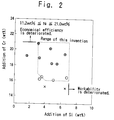
- the abscissa indicates the Si content (wt%) and the ordinate indicates the Cr content (wt%).
- the range enclosed by the dotted line shows that the Cr content and Si content are within the range of this invention.
- the mark o denotes that the shape-recovery rate is 70% or more
- the mark ⁇ denotes that the shape-recovery rate is not less than 30% and less than 70%
- the mark ⁇ denotes that the shape-recovery rate is less than 30%.
- Comparative specimen "23" having 1.6 wt% Si out of the range of this invention has only very low shape-recovery properties.
- comparative specimens "20", “21” and “22” out of the range of this invention resulted in the mark o but are inferior in corrosion resistance and stress corrosion cracking resistance as described later.
- the criteria for the occurrence of cracking in the said stress corrosion cracking test are as follows.
- the specimens having a Ni content within the range of 11.0 - 21.0 wt%, and the specimens having a Cr content within the range of 16.0 - 21.0 wt% and a Si content within the range of 3.0 -7.0 wt°% show excellent stress corrosion cracking resistance.
- the tensile test conditions for each said test-piece are as shown in the following Table 3 and the times to failure obtained by these tests were evaluated.
- this inventor and others melted the steel alloy (No. 31 - 50) based on this invention and the comparative steel alloy (No. 51 - 61) with chemical compositions out of the range of this invention, shown in the following Table 4, in a smelting furnace under vacuum and cast them into ingot.
- the ingot thus obtained were heated to 1100 - 1200°C and then hot rolled to a thickness of 12 mm to provide specimens.
- the shape-memorizing properties, intergranular corrosion resistance and stress corrosion cracking resistance were checked in the following tests. The results of these tests are shown together in Table 4.
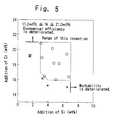
- the abscissa indicates the Si content (wt%) and the ordinate indicates the Cr content (wt%).
- the range enclosed by the dotted line shows that the Cr content and Si content are within the range of this invention.
- the evaluation of the shape-recovery rate is the same as that for the preceding working example in Figure 1.
- the specimen alloys having an Ni content within the range of 11.0 - 21.0 wt%, a Cr content within the range of 16.0 - 21.0 wt% and an Si content within the range of 3.0 - 7.0 wt% show excellent shape-memorizing properties.
- the comparative alloy "53" containing 1.8 wt% Si which is out of the range of this invention has only very low shape-memorizing properties.
- the comparative alloy "54” containing 2.6 wt% Si shows shape-memorizing properties belonging to this mark " ⁇ " but is inferior to the evaluation of the alloys of the invention and also inferior in the intergranular corrosion resistance and stress corrosion cracking resistance as described later.
- the comparative alloys "51" and "52" which are out of the range of this invention also show sufficient shape-memorizing properties but are inferior in intergranular corrosion resistance and stress corrosion cracking resistance as described later.
- the alloys having an Ni content within the range of 11.0 - 21 wt%, a Cr content within the range of 16.0 - 21.0 wt% and a Si content within the range of 3.0 - 7.0 wt% show excellent intergranular corrosion resistance.
- the comparative alloy "54” with a Si content of 2.6 wt% is evaluated as mark “ ⁇ " but is inferior in stress corrosion cracking resistance as described later.
- the comparative alloys "59” and “60” with an addition of 3.0 wt% or more Mo and W show excellent intergranular corrosion resistance but are inadequate in shape-memorizing properties.
- yield stress The strain corresponding to a specified stress (yield stress) was given, and the test-piece was dipped under the same stress corrosion cracking test conditions as shown in the working example in Table 2. After a period of 3000 h, the surface of the test-piece was checked for cracking. Thus, the stress corrosion cracking resistance of each alloy was evaluated.
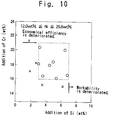
- Figure 10 shows the effect of the Cr and Si content on stress corrosion cracking resistance of Fe-Cr-Ni-Si shape memory alloys in the working examples of this invention.
- the abscissa shows the Si content (wt%) and the ordinate shows the Cr content (wt%).
- the range enclosed by the dotted line shows that the Cr and Si content are within the range of this invention.
- the mark " ⁇ " denotes that no cracking was observed and the mark " ⁇ " denotes that cracking was observed.
- the alloys having an Ni content within the range of 11.0 - 21.0 wt%, a Cr content within the range of 16.0 - 21.0 wt% and a Si content within the range of 3.0 - 7.0 wt% show excellent stress corrosion cracking resistance.
- the comparative alloys "51" and “52” containing less than 16.0 wt% Si which is out of the range of this invention the comparative alloy “53” containing 1.8 wt% Si, the comparative alloy “54” containing 2.6 wt% Si, the comparative alloys "55", "56” and “57” with insufficient addition or no addition of C and N stabilizing elements such as Ti, and the comparative alloy "58" with an addition of Mn exceeding 5.0 wt% are inferior in stress corrosion cracking resistance.
- the comparative alloys "59” and “60” with addition of 3.0 wt% or more Mo and W show excellent stress corrosion cracking resistance but are inadequate in shape-memorizing properties.
Landscapes
- Chemical & Material Sciences (AREA)
- Engineering & Computer Science (AREA)
- Materials Engineering (AREA)
- Mechanical Engineering (AREA)
- Metallurgy (AREA)
- Organic Chemistry (AREA)
- Heat Treatment Of Steel (AREA)
Applications Claiming Priority (4)
| Application Number | Priority Date | Filing Date | Title |
|---|---|---|---|
| JP89206/91 | 1991-03-29 | ||
| JP8920691A JPH04301051A (ja) | 1991-03-29 | 1991-03-29 | 形状記憶特性、耐食性および耐応力腐食割れ性に優れたFe−Cr−Ni−Si系形状記憶合金 |
| JP78502/92 | 1992-02-28 | ||
| JP7850292A JP2767169B2 (ja) | 1992-02-28 | 1992-02-28 | 耐粒界腐食性および耐応力腐食割れ性に優れたFe−Cr−Ni−Si系形状記憶合金 |
Publications (2)
| Publication Number | Publication Date |
|---|---|
| EP0506488A1 true EP0506488A1 (fr) | 1992-09-30 |
| EP0506488B1 EP0506488B1 (fr) | 1996-01-31 |
Family
ID=26419557
Family Applications (1)
| Application Number | Title | Priority Date | Filing Date |
|---|---|---|---|
| EP92302793A Expired - Lifetime EP0506488B1 (fr) | 1991-03-29 | 1992-03-30 | Alliages à mémoire de forme, du type fer-chrome-nickel-silicium et présentant une excellente résistance à la corrosion fissurante sous contraintes |
Country Status (3)
| Country | Link |
|---|---|
| US (1) | US5244513A (fr) |
| EP (1) | EP0506488B1 (fr) |
| DE (1) | DE69207935T2 (fr) |
Cited By (2)
| Publication number | Priority date | Publication date | Assignee | Title |
|---|---|---|---|---|
| WO2006076220A3 (fr) * | 2005-01-10 | 2006-09-08 | Swagelok Co | Carburation d'alliages a memoire de forme a base ferreuse |
| CN100395370C (zh) * | 2006-01-05 | 2008-06-18 | 同济大学 | 一种铁路用记忆合金鱼尾螺栓紧固件材料及其制备方法 |
Families Citing this family (4)
| Publication number | Priority date | Publication date | Assignee | Title |
|---|---|---|---|---|
| GB9506677D0 (en) * | 1995-03-31 | 1995-05-24 | Rolls Royce & Ass | A stainless steel alloy |
| CN1128244C (zh) * | 2000-10-26 | 2003-11-19 | 艾默生电气(中国)投资有限公司 | 含Cr和N铁锰硅基形状记忆合金及其训练方法 |
| CN110484836B (zh) * | 2019-09-24 | 2021-01-05 | 南京佑天金属科技有限公司 | 一种铪锆钛钼增强奥氏体不锈钢及其制备方法 |
| CN113061802B (zh) * | 2021-02-07 | 2022-05-31 | 中国科学院金属研究所 | 一种耐含氧化性离子浓硝酸腐蚀的高强度奥氏体时效不锈钢及其制备方法 |
Citations (1)
| Publication number | Priority date | Publication date | Assignee | Title |
|---|---|---|---|---|
| EP0336175A1 (fr) * | 1988-04-05 | 1989-10-11 | Nkk Corporation | Alliage à mémoire de forme à base de fer et présentant d'excellentes caractériqus de mémoire de forme, de résistance à la corrosion et de résistance à l'oxydation aux températures élevées |
Family Cites Families (4)
| Publication number | Priority date | Publication date | Assignee | Title |
|---|---|---|---|---|
| JPS5970751A (ja) * | 1982-10-14 | 1984-04-21 | Sumitomo Metal Ind Ltd | 超電導材料 |
| JPS62112720A (ja) * | 1985-11-09 | 1987-05-23 | Nippon Steel Corp | Fe−Mn−Si系形状記憶合金の特性向上方法 |
| JPH0277554A (ja) * | 1988-04-05 | 1990-03-16 | Nkk Corp | 形状記憶特性、耐食性および耐高温酸化性に優れた鉄基形状記憶合金 |
| JPH02301514A (ja) * | 1989-05-15 | 1990-12-13 | Nisshin Steel Co Ltd | 形状記憶ステンレス鋼の形状記憶方法 |
-
1992
- 1992-03-27 US US07/858,553 patent/US5244513A/en not_active Expired - Fee Related
- 1992-03-30 DE DE69207935T patent/DE69207935T2/de not_active Expired - Fee Related
- 1992-03-30 EP EP92302793A patent/EP0506488B1/fr not_active Expired - Lifetime
Patent Citations (1)
| Publication number | Priority date | Publication date | Assignee | Title |
|---|---|---|---|---|
| EP0336175A1 (fr) * | 1988-04-05 | 1989-10-11 | Nkk Corporation | Alliage à mémoire de forme à base de fer et présentant d'excellentes caractériqus de mémoire de forme, de résistance à la corrosion et de résistance à l'oxydation aux températures élevées |
Non-Patent Citations (1)
| Title |
|---|
| C.W.WEGST 'STAHLSCHLÜSSEL, 15.Auflage' , VERLAG STAHLSCHLüSSEL WEGST GMBH. * |
Cited By (2)
| Publication number | Priority date | Publication date | Assignee | Title |
|---|---|---|---|---|
| WO2006076220A3 (fr) * | 2005-01-10 | 2006-09-08 | Swagelok Co | Carburation d'alliages a memoire de forme a base ferreuse |
| CN100395370C (zh) * | 2006-01-05 | 2008-06-18 | 同济大学 | 一种铁路用记忆合金鱼尾螺栓紧固件材料及其制备方法 |
Also Published As
| Publication number | Publication date |
|---|---|
| US5244513A (en) | 1993-09-14 |
| DE69207935D1 (de) | 1996-03-14 |
| DE69207935T2 (de) | 1996-09-05 |
| EP0506488B1 (fr) | 1996-01-31 |
Similar Documents
| Publication | Publication Date | Title |
|---|---|---|
| EP0336157B1 (fr) | Alliage à mémoire de forme, à base de fer et présentant d'excellentes caractéristiques de mémoire de forme et de résistance à la corrosion | |
| EP0427301B1 (fr) | Acier ferritique réfractaire à teneur élevée en chrome, à haute résistance mécanique | |
| MX2010010435A (es) | Acero inoxidable usado para material tubular destinado a pozos petroleros. | |
| Liou et al. | Effects of alloying elements on the mechanical properties and corrosion behaviors of 2205 duplex stainless steels | |
| EP0565117B1 (fr) | Acier inoxydable martensitique pour puits à pétrole | |
| GB1595707A (en) | Ferrous alloys | |
| US3556776A (en) | Stainless steel | |
| EP0336175B1 (fr) | Alliage à mémoire de forme à base de fer et présentant d'excellentes caractériqus de mémoire de forme, de résistance à la corrosion et de résistance à l'oxydation aux températures élevées | |
| EP0260022A2 (fr) | Acier inoxydable ayant une bonne résistance à la corrosion en général et en particulier à l'eau de mer et procédé pour sa fabrication | |
| JP2005336599A (ja) | 耐食性に優れたラインパイプ用高強度ステンレス鋼管およびその製造方法 | |
| JPH10503809A (ja) | 熱間加工性に優れた耐硫化物応力割れ性を有するマルテンサイト系ステンレス鋼 | |
| EP0506488B1 (fr) | Alliages à mémoire de forme, du type fer-chrome-nickel-silicium et présentant une excellente résistance à la corrosion fissurante sous contraintes | |
| JP5675958B2 (ja) | 蒸気発生器用伝熱管、蒸気発生器及び原子力プラント | |
| JPS58210158A (ja) | 耐食性の優れた油井管用高強度合金 | |
| US4808371A (en) | Exterior protective member made of austenitic stainless steel for a sheathing heater element | |
| JP3501573B2 (ja) | 耐二次加工割れ性に優れたフェライト系ステンレス鋼パイプおよびその製造方法 | |
| Succop et al. | EFFECTS OF WARM OVERSTRESSING ON PRESSURE-VESSEL STEEL PROPERTIES | |
| JPS586927A (ja) | 耐応力腐食割れ性に優れた高強度油井管の製造法 | |
| JP4059156B2 (ja) | 原子力用ステンレス鋼 | |
| US4861550A (en) | Corrosion-resistant nickel-base alloy having high resistance to stress corrosion cracking | |
| JP2767169B2 (ja) | 耐粒界腐食性および耐応力腐食割れ性に優れたFe−Cr−Ni−Si系形状記憶合金 | |
| JPH07150251A (ja) | 熱間加工性および耐食性に優れた高靭性マルテンサイト系ステンレス鋼継目無鋼管の製造法 | |
| JP3844662B2 (ja) | マルテンサイト系ステンレス鋼板およびその製造方法 | |
| JPH04301051A (ja) | 形状記憶特性、耐食性および耐応力腐食割れ性に優れたFe−Cr−Ni−Si系形状記憶合金 | |
| JPH0230734A (ja) | 形状記憶特性および耐食性に優れた鉄基形状記憶合金 |
Legal Events
| Date | Code | Title | Description |
|---|---|---|---|
| PUAI | Public reference made under article 153(3) epc to a published international application that has entered the european phase |
Free format text: ORIGINAL CODE: 0009012 |
|
| AK | Designated contracting states |
Kind code of ref document: A1 Designated state(s): DE FR GB |
|
| 17P | Request for examination filed |
Effective date: 19921214 |
|
| 17Q | First examination report despatched |
Effective date: 19950405 |
|
| GRAA | (expected) grant |
Free format text: ORIGINAL CODE: 0009210 |
|
| AK | Designated contracting states |
Kind code of ref document: B1 Designated state(s): DE FR GB |
|
| REF | Corresponds to: |
Ref document number: 69207935 Country of ref document: DE Date of ref document: 19960314 |
|
| ET | Fr: translation filed | ||
| PLBE | No opposition filed within time limit |
Free format text: ORIGINAL CODE: 0009261 |
|
| STAA | Information on the status of an ep patent application or granted ep patent |
Free format text: STATUS: NO OPPOSITION FILED WITHIN TIME LIMIT |
|
| 26N | No opposition filed | ||
| PGFP | Annual fee paid to national office [announced via postgrant information from national office to epo] |
Ref country code: GB Payment date: 19970326 Year of fee payment: 6 |
|
| PGFP | Annual fee paid to national office [announced via postgrant information from national office to epo] |
Ref country code: FR Payment date: 19970328 Year of fee payment: 6 |
|
| PGFP | Annual fee paid to national office [announced via postgrant information from national office to epo] |
Ref country code: DE Payment date: 19970404 Year of fee payment: 6 |
|
| PG25 | Lapsed in a contracting state [announced via postgrant information from national office to epo] |
Ref country code: GB Free format text: LAPSE BECAUSE OF NON-PAYMENT OF DUE FEES Effective date: 19980330 |
|
| PG25 | Lapsed in a contracting state [announced via postgrant information from national office to epo] |
Ref country code: FR Free format text: THE PATENT HAS BEEN ANNULLED BY A DECISION OF A NATIONAL AUTHORITY Effective date: 19980331 |
|
| GBPC | Gb: european patent ceased through non-payment of renewal fee |
Effective date: 19980330 |
|
| PG25 | Lapsed in a contracting state [announced via postgrant information from national office to epo] |
Ref country code: DE Free format text: LAPSE BECAUSE OF NON-PAYMENT OF DUE FEES Effective date: 19981201 |
|
| REG | Reference to a national code |
Ref country code: FR Ref legal event code: ST |