EP0507577A1 - Entrelacement flexible de mémoire à N-accès - Google Patents
Entrelacement flexible de mémoire à N-accès Download PDFInfo
- Publication number
- EP0507577A1 EP0507577A1 EP92302895A EP92302895A EP0507577A1 EP 0507577 A1 EP0507577 A1 EP 0507577A1 EP 92302895 A EP92302895 A EP 92302895A EP 92302895 A EP92302895 A EP 92302895A EP 0507577 A1 EP0507577 A1 EP 0507577A1
- Authority
- EP
- European Patent Office
- Prior art keywords
- bits
- sum
- address
- memory
- translated
- Prior art date
- Legal status (The legal status is an assumption and is not a legal conclusion. Google has not performed a legal analysis and makes no representation as to the accuracy of the status listed.)
- Granted
Links
Images

Classifications
-
- G—PHYSICS
- G06—COMPUTING OR CALCULATING; COUNTING
- G06F—ELECTRIC DIGITAL DATA PROCESSING
- G06F12/00—Accessing, addressing or allocating within memory systems or architectures
- G06F12/02—Addressing or allocation; Relocation
-
- G—PHYSICS
- G06—COMPUTING OR CALCULATING; COUNTING
- G06F—ELECTRIC DIGITAL DATA PROCESSING
- G06F12/00—Accessing, addressing or allocating within memory systems or architectures
- G06F12/02—Addressing or allocation; Relocation
- G06F12/06—Addressing a physical block of locations, e.g. base addressing, module addressing, memory dedication
- G06F12/0607—Interleaved addressing
Definitions
- the present invention relates generally to the field of memory addressing. More particularly, the invention relates to a method and apparatus for carrying out block memory addressing in an interleaved fashion, with a variety of block sizes.
- Computers and computer systems typically have two busses, an address bus and a data bus.
- the address bus used for addressing and control, is usually of a fixed width, and carries the necessary signals to initiate transactions between the computer's internal memory and peripheral devices. Data is typically transferred over the data bus. In some cases the address bus and data bus are multiplexed for transferring addresses and data.
- Interleaved memory can allow two or more memory blocks to be accessed at a fraction of a cycle apart, thereby significantly reducing cycle time and improving memory speed.
- the simplest interleave procedure assigns sequential line addresses within a group or list of addresses to sequentially numbered memory blocks. However, this typically requires a large "modulo arithmetic" operation to determine the block number for a given address.
- An alternative to the above "bit shift" interleave method for interleaving a power of 2 memory cards, employs an address bit to activate the cards. For example, consider a typical, non-interleaved, byte-addressed system. Assume each memory card supplies 32 bits (4 bytes) per access. Assume further that the address space is 20 bits, and that memory cards are each 64 Kbytes. The address space may then be arranged as follows:
- the offset bits are shifted one bit to the left and the LSB (bit 17) of the original offset bits is used as a fourth card select bit, or an interleave bit.
- This method and variations of it are in common use. It can be extended easily for systems with memory blocks in powers of 2. However, this method, like the above bit shift method, is too inflexible when adding incremental memory.
- an object of the present invention is to provide a practical system for carrying out memory interleaving with an arbitrary number of memory blocks.
- a further object of the present invention is to provide a method and corresponding apparatus whereby the memory blocks can be connected to the address bus and a block identification number provided which the respective blocks can use to select themselves. The present invention achieves these goals.
- One embodiment of the invention provides a method of interleaving a plurality of N memory blocks, each of the N blocks being of a size S (bytes).
- M-bit data addresses are translated into corresponding addresses of interleaved memory blocks, each block having S bytes grouped into lines of size L (bytes).
- the method comprises the steps of, first, identifying a first group of bits ( B bits) of an address being translated, and then identifying a second group of bits (I_bits) defining an interleave index corresponding to the address being translated.
- B_bits is then defined as the B MSBs of the address being translated.
- the A LSBs (“A_bits") of the address being translated are then identified.
- I_bits is then defined as the I LSBs of A_bits after first stripping away the log 2 (L) LSBs of A_bits. According A_bits defines an offset within the block defined by B_bits.
- SUM B_bits + I_bits
- ADJ_SUM B_bits + I_bits -N.
- a block number corresponding to the address being translated is defined, the block number being a function of at least one of the values of SUM or ADJ_SUM.
- the block number selected is the value of SUM when ADJ_SUM is less than zero, and the value of ADJ_SUM when ADJ_SUM is greater than or equal to zero.
- Another embodiment of the invention provides a restricted range modulo-N adder for summing first and second input values and computing a result within a range of 0 to N-1, the actual sum of the input values being within the range of 0 to 2N-1.
- the restricted range modulo-N adder according to the invention comprises means for computing a first sum of the first and second input values, means for computing a second sum of the first and second input values and subtracting a third input value corresponding to N, and means for testing whether the second sum is negative and for selecting the result from one of the first and second sums, the selection being of the first sum when the second sum is less than zero, and the selection being of the second sum when the second sum is greater than or equal to zero.
- Another embodiment of the invention provides a digital system comprising a computer, N memory blocks coupled to the computer, and addressing means for reading/writing data values from/to the memory in an interleaved fashion.
- the addressing means comprises means for carrying out the method described above, including the restricted range modulo-N adder.
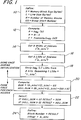
- Figure 1 is a simplified flowchart of a method of translating memory addresses into corresponding interleaved block addresses, in accordance with the present invention.
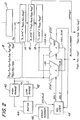
- Figure 2 is a block diagram of a restricted range modulo-N adder in accordance with the present invention.
- FIG. 3 is a block diagram of a computer system incorporating interleaved block memory, in accordance with the present invention.
- the preferred embodiments of the invention include a method and corresponding apparatus for translating the respective addresses of memory locations into corresponding interleaved block addresses and offsets within each block, and a computer system comprising interleaved memory blocks.
- the preferred method employs a restricted range modulo-N adder (described below) to add the upper address bits that are unused by the memory blocks, referred to herein as the "B_bits," to the I least significant line address bits, referred to herein as the "I_bits.”
- I and B represent integers
- B_bits and I_bits represent a particular grouping or subset of neighboring address bits.
- a “line” refers to the group of bytes (typically 16 or 32 in a cache-based system) transferred with each memory access.
- a "line address” is the address of the first byte in a particular line.
- the sum of B_bits and I_bits (referred to as the "unadjusted sum") is computed in parallel with the sum of B_bits and I_bits - N, N being the number of blocks being interleaved.
- N the number of blocks being interleaved.
- the beginning address of the group (denominated "GS" herein, for Group Start) is also subtracted from B_bits. If the blocks are not organized into groups, GS would be set to zero.
- the "adjusted sum" of B_bits and I_bits - (GS + N) is computed.
- either the adjusted sum or unadjusted sum is used to define a block number identifying a particular memory block corresponding to the address being translated.
- the determination of whether the adjusted sum or unadjusted sum is used is based upon whether the adjusted sum is negative, zero or positive.
- step 10 is to define the parameters "S,” "L,” “N” and "GS".
- S represents the size, in bytes, of a memory block in a particular group. (Within a group all blocks are required to be of the same size.)
- L represents the size, in bytes, of a line in a block.
- N and GS represent the number of blocks in a particular group and the particular group's starting address number, respectively.
- Steps 14, 16 and 18 involve the identification of "B_bits,” “A_bits” and I_bits,” respectively.
- B_bits is defined by the B most significant bits (MSBs) of the address being translated;
- A_bits is defined by the A remaining least significant bits (LSBs) of the address;
- I_bits is defined by the I LSBs of the line address, the line address being defined by the remaining bits of A_bits after stripping away the bits necessary to identify a particular byte within a line.
- I_bits is defined by the I_LSBs remaining of A_bits after stripping away the log 2 (L) LSBs of A_bits.
- the address is broken up as follows: Note that the subscripts (e.g., k0, k1, k2, etc.) are used to indicate a particular address and bit number; e.g., bit 0 of the kth address in a list of addresses would be represented as b k0 .
- I_bits, A_bits and B_bits corresponding to a particular address are defined as follows (dropping the subscript k):
- steps 10-18 need only be performed once, during system configuration (startup).
- steps 20-24 are performed with each memory access,
- SUM B_bits + I_bits - GS
- ADJ_SUM B_bits + I_bits - (GS + N).
- step 22 the adjusted sum (ADJ_SUM) is selected as the correct result (RESULT) if it is greater than or equal to zero. If not, the unadjusted sum (SUM) is selected as the correct result.
- step 24 is to define the block number and offset corresponding to the address being translated.
- the block number is simply set equal to RESULT, and the offset address is defined by A bits.
- the following table shows a list of internal addresses and corresponding translated external bus addresses, the bus addresses comprising a block number ("blk” in the table) and offset address ("offset" in the table).
- blk block number
- offset offset address
- each "interleave group” comprises blocks of the same size, and if a group start number (GS), indicating the starting B_bits value for the group, is subtracted from B_bits.
- GS group start number
- the resulting block number sent over the bus may need to have GS added back in. Note that there is no requirement that block numbers be consecutive, so that some of the bits of B_bits can be used to identify the interleave group.
- a system supports 4 sizes of DRAM cards.
- Any combination of the differently-sized memory cards can be supported at once, by assigning all cards of size A with a hexadecimal block number of 0x0?, where "?” may range from 0 to f, assigning cards of size B with a block number of 0x1?, assigning size C cards with block number 0x2?, and assigning size D cards with a block number of 0x3?.
- Configuration software determines the value for ? based on how many cards of that size are in the system, numbering them sequentially from 0 to the number of cards in that group. The address range for the largest size cards is then determined. Next, its GS number is set to 0. Then, for the next largest group, the same is done, beginning at the end of the previous group, and so on.
- a restricted range modulo-N adder (there is preferably one for each group of cards) in accordance with the invention comprises a pair of three term adders 20a′, 20b′ and means for selecting the correct result, i.e., SUM or ADJ_SUM, that is between 0 and N-1.
- the means for selecting the correct result comprises a logic circuit 48 that provides select signals "SEL 1", "SEL 2" to the respective adders 20a′, 20b′. As shown in the drawing, the computations of SUM and ADJ_SUM are performed in parallel.
- the sign bit, denominated “NEG” in the drawing, is employed by select circuit 48 to select SUM when ADJ_SUM is less than zero, and ADJ_SUM when ADJ_SUM is zero or greater than zero.
- select circuit 48 To determine the group-delineating bits (e.g., the upper two bits of B_bits), a pair of range comparators 40, 42 may be employed for each group. The outputs of comparators 40, 42 are employed by match circuit 44 which provides an enable signal ("ENABLE") to the select circuit 48.
- a predefined group number register 46 may also be provided to provide a group number input to select circuit 48.
- the low range comparator 42 may be shared by the preceding group as the preceding group's high range comparator
- the high range comparator 40 may be shared by a succeeding group as the succeeding group's low range comparator.
- the list 8 of addresses A 1 , A 2 . . . A k , . . . is translated into a corresponding list of block numbers ("Block_No") and offset addresses within a block (“OFFSET").
- a computer system comprises block memory 34A, 34B, . . . 34N and addressing means 32 for interleaving the block memory.
- a computer 30 having an internal list 8 of addresses A 1 , A 2 , A 3 . . . , is coupled to memory blocks or cards 34A-34N via addressing means 32.
- the addressing means 32 and/or the cards 34N-34N need not be separate devices, but can be integrated into the computer 30.
- the addressing means 32 comprises the code and circuitry described above for addressing the respective blocks in an interleaved fashion.
Landscapes
- Engineering & Computer Science (AREA)
- Theoretical Computer Science (AREA)
- Physics & Mathematics (AREA)
- General Engineering & Computer Science (AREA)
- General Physics & Mathematics (AREA)
- Error Detection And Correction (AREA)
- Memory System (AREA)
- Dram (AREA)
Applications Claiming Priority (2)
| Application Number | Priority Date | Filing Date | Title |
|---|---|---|---|
| US07/679,868 US5293607A (en) | 1991-04-03 | 1991-04-03 | Flexible N-way memory interleaving |
| US679868 | 1996-07-15 |
Publications (2)
| Publication Number | Publication Date |
|---|---|
| EP0507577A1 true EP0507577A1 (fr) | 1992-10-07 |
| EP0507577B1 EP0507577B1 (fr) | 1997-08-06 |
Family
ID=24728701
Family Applications (1)
| Application Number | Title | Priority Date | Filing Date |
|---|---|---|---|
| EP92302895A Expired - Lifetime EP0507577B1 (fr) | 1991-04-03 | 1992-04-02 | Entrelacement flexible de mémoire à N-accès |
Country Status (5)
| Country | Link |
|---|---|
| US (1) | US5293607A (fr) |
| EP (1) | EP0507577B1 (fr) |
| JP (1) | JP3599352B2 (fr) |
| KR (1) | KR920020321A (fr) |
| DE (1) | DE69221356T2 (fr) |
Cited By (3)
| Publication number | Priority date | Publication date | Assignee | Title |
|---|---|---|---|---|
| EP1030454A3 (fr) * | 1999-02-19 | 2000-10-25 | Fujitsu Limited | Circuit d'entrelacement de bits et circuit de désentrelacement de bits |
| EP1060564A4 (fr) * | 1998-12-21 | 2006-06-28 | Samsung Electronics Co Ltd | Dispositif et procede d'entrelacement/de desentrelacement pour systeme de communication |
| EP3226423A1 (fr) * | 1998-12-26 | 2017-10-04 | Samsung Electronics Co., Ltd. | Dispositif et procédé d'entrelacement/de desentrelacement pour système de communication |
Families Citing this family (32)
| Publication number | Priority date | Publication date | Assignee | Title |
|---|---|---|---|---|
| US5644732A (en) * | 1990-07-13 | 1997-07-01 | Sun Microsystems, Inc. | Method and apparatus for assigning addresses to a computer system's three dimensional packing arrangement |
| US5572692A (en) * | 1991-12-24 | 1996-11-05 | Intel Corporation | Memory configuration decoding system having automatic row base address generation mechanism for variable memory devices with row access interleaving |
| JPH06139182A (ja) * | 1992-10-27 | 1994-05-20 | Sony Corp | 情報処理装置、拡張基板、および拡張筐体システム |
| EP0615190A1 (fr) * | 1993-03-11 | 1994-09-14 | Data General Corporation | Mémoire extensible pour un ordinateur numérique |
| US5530837A (en) * | 1994-03-28 | 1996-06-25 | Hewlett-Packard Co. | Methods and apparatus for interleaving memory transactions into an arbitrary number of banks |
| US5765182A (en) * | 1995-04-13 | 1998-06-09 | Lsi Logic Corporation | Interleaving memory on separate boards |
| US5745118A (en) * | 1995-06-06 | 1998-04-28 | Hewlett-Packard Company | 3D bypass for download of textures |
| EP0747825B1 (fr) * | 1995-06-06 | 2001-09-19 | Hewlett-Packard Company, A Delaware Corporation | Système et procédé d'affectation de données de SDRAM |
| US5778412A (en) * | 1995-09-29 | 1998-07-07 | Intel Corporation | Method and apparatus for interfacing a data bus to a plurality of memory devices |
| US5924111A (en) * | 1995-10-17 | 1999-07-13 | Huang; Chu-Kai | Method and system for interleaving data in multiple memory bank partitions |
| US5761732A (en) * | 1996-06-28 | 1998-06-02 | Intel Corporation | Interleaving for memory cards |
| US5960462A (en) * | 1996-09-26 | 1999-09-28 | Intel Corporation | Method and apparatus for analyzing a main memory configuration to program a memory controller |
| EP0931290A1 (fr) * | 1997-03-21 | 1999-07-28 | International Business Machines Corporation | Mappage d'adresses pour systeme memoire |
| US6233662B1 (en) | 1999-04-26 | 2001-05-15 | Hewlett-Packard Company | Method and apparatus for interleaving memory across computer memory banks |
| US6775800B2 (en) * | 2000-01-03 | 2004-08-10 | Icoding Technology, Inc. | System and method for high speed processing of turbo codes |
| US7302621B2 (en) * | 2000-01-03 | 2007-11-27 | Icoding Technology, Inc. | High spread highly randomized generatable interleavers |
| US6480943B1 (en) | 2000-04-29 | 2002-11-12 | Hewlett-Packard Company | Memory address interleaving and offset bits for cell interleaving of memory |
| US6807602B1 (en) * | 2000-10-30 | 2004-10-19 | Hewlett-Packard Development Company, L.P. | System and method for mapping bus addresses to memory locations utilizing access keys and checksums |
| US6874070B2 (en) | 2002-02-22 | 2005-03-29 | Hewlett-Packard Development Company, L.P. | System and method for memory interleaving using cell map with entry grouping for higher-way interleaving |
| US6807603B2 (en) | 2002-02-22 | 2004-10-19 | Hewlett-Packard Development Company, L.P. | System and method for input/output module virtualization and memory interleaving using cell map |
| US7103728B2 (en) * | 2002-07-23 | 2006-09-05 | Hewlett-Packard Development Company, L.P. | System and method for memory migration in distributed-memory multi-processor systems |
| US6987470B2 (en) * | 2003-11-21 | 2006-01-17 | Qualcomm Incorporated | Method to efficiently generate the row and column index for half rate interleaver in GSM |
| JP2006018489A (ja) * | 2004-06-30 | 2006-01-19 | Hitachi Ltd | 複数ノード間のメモリインターリーブシステム |
| US8190809B2 (en) * | 2004-11-23 | 2012-05-29 | Efficient Memory Technology | Shunted interleave for accessing plural memory banks, particularly those having partially accessed cells containing data for cache lines |
| CN101069211A (zh) * | 2004-11-23 | 2007-11-07 | 高效存储技术公司 | 分页存储器及其智能存储器区段的交错寻址的多次缩略的方法和装置 |
| US8560795B2 (en) * | 2005-06-30 | 2013-10-15 | Imec | Memory arrangement for multi-processor systems including a memory queue |
| ATE520086T1 (de) * | 2005-06-30 | 2011-08-15 | Imec | Speicheranordnung für mehrprozessorsysteme |
| US20070022261A1 (en) * | 2005-07-19 | 2007-01-25 | Gateway Inc. | Method of interleaving asymmetric memory arrays |
| US8464009B2 (en) * | 2008-06-04 | 2013-06-11 | Oracle America, Inc. | Method for memory interleave support with a ceiling mask |
| US8886898B2 (en) * | 2009-08-19 | 2014-11-11 | Oracle America, Inc. | Efficient interleaving between a non-power-of-two number of entities |
| US9323662B2 (en) | 2012-12-31 | 2016-04-26 | SanDisk Technologies, Inc. | Flash memory using virtual physical addresses |
| US10491667B1 (en) * | 2015-03-16 | 2019-11-26 | Amazon Technologies, Inc. | Customized memory modules in multi-tenant service provider systems |
Citations (1)
| Publication number | Priority date | Publication date | Assignee | Title |
|---|---|---|---|---|
| WO1990004576A2 (fr) * | 1988-10-27 | 1990-05-03 | Unisys Corporation | Systeme d'imbrication de memoire automatiquement variable |
Family Cites Families (10)
| Publication number | Priority date | Publication date | Assignee | Title |
|---|---|---|---|---|
| US3980874A (en) * | 1975-05-09 | 1976-09-14 | Burroughs Corporation | Binary to modulo M translation |
| US4189767A (en) * | 1978-06-05 | 1980-02-19 | Bell Telephone Laboratories, Incorporated | Accessing arrangement for interleaved modular memories |
| US4254463A (en) * | 1978-12-14 | 1981-03-03 | Rockwell International Corporation | Data processing system with address translation |
| US4598266A (en) * | 1984-09-24 | 1986-07-01 | Gte Communications Systems Corporation | Modulo adder |
| US4584562A (en) * | 1984-09-24 | 1986-04-22 | Gte Communication Systems Corporation | Method of residue to analog conversion |
| US4722067A (en) * | 1985-03-25 | 1988-01-26 | Motorola, Inc. | Method and apparatus for implementing modulo arithmetic calculations |
| EP0308963A3 (fr) * | 1987-09-25 | 1990-04-25 | Kabushiki Kaisha Toshiba | Méthode et dispositif de calcul de reste |
| US5111389A (en) * | 1987-10-29 | 1992-05-05 | International Business Machines Corporation | Aperiodic mapping system using power-of-two stride access to interleaved devices |
| GB2217882B (en) * | 1988-04-29 | 1992-06-10 | Philips Electronic Associated | Arithmetic apparatus |
| US5119486A (en) * | 1989-01-17 | 1992-06-02 | Prime Computer | Memory board selection method and apparatus |
-
1991
- 1991-04-03 US US07/679,868 patent/US5293607A/en not_active Expired - Lifetime
-
1992
- 1992-04-02 EP EP92302895A patent/EP0507577B1/fr not_active Expired - Lifetime
- 1992-04-02 KR KR1019920005525A patent/KR920020321A/ko not_active Withdrawn
- 1992-04-02 DE DE69221356T patent/DE69221356T2/de not_active Expired - Lifetime
- 1992-04-03 JP JP8215592A patent/JP3599352B2/ja not_active Expired - Fee Related
Patent Citations (1)
| Publication number | Priority date | Publication date | Assignee | Title |
|---|---|---|---|---|
| WO1990004576A2 (fr) * | 1988-10-27 | 1990-05-03 | Unisys Corporation | Systeme d'imbrication de memoire automatiquement variable |
Non-Patent Citations (1)
| Title |
|---|
| IBM TECHNICAL DISCLOSURE BULLETIN. vol. 32, no. 7, December 1989, NEW YORK US pages 212 - 213; 'Programmable variable memory configuration control' * |
Cited By (3)
| Publication number | Priority date | Publication date | Assignee | Title |
|---|---|---|---|---|
| EP1060564A4 (fr) * | 1998-12-21 | 2006-06-28 | Samsung Electronics Co Ltd | Dispositif et procede d'entrelacement/de desentrelacement pour systeme de communication |
| EP3226423A1 (fr) * | 1998-12-26 | 2017-10-04 | Samsung Electronics Co., Ltd. | Dispositif et procédé d'entrelacement/de desentrelacement pour système de communication |
| EP1030454A3 (fr) * | 1999-02-19 | 2000-10-25 | Fujitsu Limited | Circuit d'entrelacement de bits et circuit de désentrelacement de bits |
Also Published As
| Publication number | Publication date |
|---|---|
| EP0507577B1 (fr) | 1997-08-06 |
| DE69221356D1 (de) | 1997-09-11 |
| JP3599352B2 (ja) | 2004-12-08 |
| JPH05113930A (ja) | 1993-05-07 |
| KR920020321A (ko) | 1992-11-21 |
| DE69221356T2 (de) | 1997-11-20 |
| US5293607A (en) | 1994-03-08 |
Similar Documents
| Publication | Publication Date | Title |
|---|---|---|
| EP0507577B1 (fr) | Entrelacement flexible de mémoire à N-accès | |
| US6381668B1 (en) | Address mapping for system memory | |
| US5371864A (en) | Apparatus for concurrent multiple instruction decode in variable length instruction set computer | |
| KR910007026B1 (ko) | 벡터 프로세서내의 메모리를 정폭 억세스시키는 장치 및 방법 | |
| US6430672B1 (en) | Method for performing address mapping using two lookup tables | |
| EP0503770A1 (fr) | Système de mémoire entrelacée pour multiprocesseur | |
| EP0483424A1 (fr) | Codage à clef d'accès dans des systèmes de traitement de données | |
| US4254463A (en) | Data processing system with address translation | |
| EP0124799B1 (fr) | Dispositif d'accès à une mémoire dans un système de traitement de données | |
| CA1170775A (fr) | Processeur de donnees avec dispositif pour controler la selection des chiffres decimaux d'un operande lors de l'execution d'instructions arithmetiques decimales | |
| US4499551A (en) | Rapid generation of discrete random variates from general distributions | |
| US4001786A (en) | Automatic configuration of main storage addressing ranges | |
| CA1170774A (fr) | Processeur de donnees utilisant des memoires mortes pour optimiser l'acces a la memoire principale et identifier la position de depart d'un operande | |
| JPH033262B2 (fr) | ||
| US4800535A (en) | Interleaved memory addressing system and method using a parity signal | |
| CN109710309B (zh) | 减少存储体冲突的方法 | |
| US3943347A (en) | Data processor reorder random access memory | |
| CA1270955A (fr) | Methode et circuit d'addition de nombres en virgule flottante | |
| US7392276B2 (en) | Efficient multiplication sequence for large integer operands wider than the multiplier hardware | |
| CA1170773A (fr) | Processeur de donnees utilisant une memoire morte pour choisir une section d'un registre o sont enregistrees des donnees | |
| EP0367995A2 (fr) | Circuit de commande pour le transfert des données de vecteur | |
| GB2274181A (en) | Summation unit. | |
| US5506747A (en) | Provision of FIFO buffer in RAM | |
| US3219982A (en) | High order mark system | |
| US3293420A (en) | Computer with compatible multiplication and division |
Legal Events
| Date | Code | Title | Description |
|---|---|---|---|
| PUAI | Public reference made under article 153(3) epc to a published international application that has entered the european phase |
Free format text: ORIGINAL CODE: 0009012 |
|
| AK | Designated contracting states |
Kind code of ref document: A1 Designated state(s): DE FR GB |
|
| 17P | Request for examination filed |
Effective date: 19930112 |
|
| 17Q | First examination report despatched |
Effective date: 19951107 |
|
| GRAG | Despatch of communication of intention to grant |
Free format text: ORIGINAL CODE: EPIDOS AGRA |
|
| GRAH | Despatch of communication of intention to grant a patent |
Free format text: ORIGINAL CODE: EPIDOS IGRA |
|
| GRAH | Despatch of communication of intention to grant a patent |
Free format text: ORIGINAL CODE: EPIDOS IGRA |
|
| GRAA | (expected) grant |
Free format text: ORIGINAL CODE: 0009210 |
|
| AK | Designated contracting states |
Kind code of ref document: B1 Designated state(s): DE FR GB |
|
| REF | Corresponds to: |
Ref document number: 69221356 Country of ref document: DE Date of ref document: 19970911 |
|
| ET | Fr: translation filed | ||
| PLBE | No opposition filed within time limit |
Free format text: ORIGINAL CODE: 0009261 |
|
| STAA | Information on the status of an ep patent application or granted ep patent |
Free format text: STATUS: NO OPPOSITION FILED WITHIN TIME LIMIT |
|
| 26N | No opposition filed | ||
| REG | Reference to a national code |
Ref country code: GB Ref legal event code: 732E |
|
| REG | Reference to a national code |
Ref country code: FR Ref legal event code: TP |
|
| REG | Reference to a national code |
Ref country code: GB Ref legal event code: IF02 |
|
| PGFP | Annual fee paid to national office [announced via postgrant information from national office to epo] |
Ref country code: FR Payment date: 20080417 Year of fee payment: 17 |
|
| PGFP | Annual fee paid to national office [announced via postgrant information from national office to epo] |
Ref country code: GB Payment date: 20080429 Year of fee payment: 17 |
|
| GBPC | Gb: european patent ceased through non-payment of renewal fee |
Effective date: 20090402 |
|
| REG | Reference to a national code |
Ref country code: FR Ref legal event code: ST Effective date: 20091231 |
|
| PG25 | Lapsed in a contracting state [announced via postgrant information from national office to epo] |
Ref country code: GB Free format text: LAPSE BECAUSE OF NON-PAYMENT OF DUE FEES Effective date: 20090402 Ref country code: FR Free format text: LAPSE BECAUSE OF NON-PAYMENT OF DUE FEES Effective date: 20091222 |
|
| PGFP | Annual fee paid to national office [announced via postgrant information from national office to epo] |
Ref country code: DE Payment date: 20110427 Year of fee payment: 20 |
|
| REG | Reference to a national code |
Ref country code: DE Ref legal event code: R071 Ref document number: 69221356 Country of ref document: DE |
|
| REG | Reference to a national code |
Ref country code: DE Ref legal event code: R071 Ref document number: 69221356 Country of ref document: DE |
|
| PG25 | Lapsed in a contracting state [announced via postgrant information from national office to epo] |
Ref country code: DE Free format text: LAPSE BECAUSE OF EXPIRATION OF PROTECTION Effective date: 20120403 |