EP0507736A1 - Heterozyklische Amidinderivate und ihre Verwendung als Schädlingsbekämpfungsmittel - Google Patents
Heterozyklische Amidinderivate und ihre Verwendung als Schädlingsbekämpfungsmittel Download PDFInfo
- Publication number
- EP0507736A1 EP0507736A1 EP92810225A EP92810225A EP0507736A1 EP 0507736 A1 EP0507736 A1 EP 0507736A1 EP 92810225 A EP92810225 A EP 92810225A EP 92810225 A EP92810225 A EP 92810225A EP 0507736 A1 EP0507736 A1 EP 0507736A1
- Authority
- EP
- European Patent Office
- Prior art keywords
- formula
- spp
- nitro
- alkyl
- methyl
- Prior art date
- Legal status (The legal status is an assumption and is not a legal conclusion. Google has not performed a legal analysis and makes no representation as to the accuracy of the status listed.)
- Withdrawn
Links
- 0 *N(C=CN1C=N2)C1=NC2=O Chemical compound *N(C=CN1C=N2)C1=NC2=O 0.000 description 4
- ZRFURWMFNBOPKK-UHFFFAOYSA-N CN1C=NC=NC1 Chemical compound CN1C=NC=NC1 ZRFURWMFNBOPKK-UHFFFAOYSA-N 0.000 description 1
- JBSKWKSUTHQQHU-UHFFFAOYSA-N O=C1N=C2OC=CN2C=N1 Chemical compound O=C1N=C2OC=CN2C=N1 JBSKWKSUTHQQHU-UHFFFAOYSA-N 0.000 description 1
- WNGKSDIWIXOMCC-UHFFFAOYSA-N O=C1N=C2SC=CN2C=N1 Chemical compound O=C1N=C2SC=CN2C=N1 WNGKSDIWIXOMCC-UHFFFAOYSA-N 0.000 description 1
- QPDUQKTYZRXRBC-UHFFFAOYSA-N S=C1N=NN=C1 Chemical compound S=C1N=NN=C1 QPDUQKTYZRXRBC-UHFFFAOYSA-N 0.000 description 1
- HZPMICJXCMDBNE-UHFFFAOYSA-N c1c[o]c2c1ncc(S(C=N1)c3c1nccc3)c2 Chemical compound c1c[o]c2c1ncc(S(C=N1)c3c1nccc3)c2 HZPMICJXCMDBNE-UHFFFAOYSA-N 0.000 description 1
- JUJWROOIHBZHMG-UHFFFAOYSA-N c1ccncc1 Chemical compound c1ccncc1 JUJWROOIHBZHMG-UHFFFAOYSA-N 0.000 description 1
- PBMFSQRYOILNGV-UHFFFAOYSA-N c1ccnnc1 Chemical compound c1ccnnc1 PBMFSQRYOILNGV-UHFFFAOYSA-N 0.000 description 1
- JYDSAONLTGCYCW-UHFFFAOYSA-N c1cnc2[o]cc[n]12 Chemical compound c1cnc2[o]cc[n]12 JYDSAONLTGCYCW-UHFFFAOYSA-N 0.000 description 1
- CZPWVGJYEJSRLH-UHFFFAOYSA-N c1cncnc1 Chemical compound c1cncnc1 CZPWVGJYEJSRLH-UHFFFAOYSA-N 0.000 description 1
- KYQCOXFCLRTKLS-UHFFFAOYSA-N c1nccnc1 Chemical compound c1nccnc1 KYQCOXFCLRTKLS-UHFFFAOYSA-N 0.000 description 1
- FYADHXFMURLYQI-UHFFFAOYSA-N c1ncnnc1 Chemical compound c1ncnnc1 FYADHXFMURLYQI-UHFFFAOYSA-N 0.000 description 1
Classifications
-
- C—CHEMISTRY; METALLURGY
- C07—ORGANIC CHEMISTRY
- C07D—HETEROCYCLIC COMPOUNDS
- C07D213/00—Heterocyclic compounds containing six-membered rings, not condensed with other rings, with one nitrogen atom as the only ring hetero atom and three or more double bonds between ring members or between ring members and non-ring members
- C07D213/02—Heterocyclic compounds containing six-membered rings, not condensed with other rings, with one nitrogen atom as the only ring hetero atom and three or more double bonds between ring members or between ring members and non-ring members having three double bonds between ring members or between ring members and non-ring members
- C07D213/04—Heterocyclic compounds containing six-membered rings, not condensed with other rings, with one nitrogen atom as the only ring hetero atom and three or more double bonds between ring members or between ring members and non-ring members having three double bonds between ring members or between ring members and non-ring members having no bond between the ring nitrogen atom and a non-ring member or having only hydrogen or carbon atoms directly attached to the ring nitrogen atom
- C07D213/24—Heterocyclic compounds containing six-membered rings, not condensed with other rings, with one nitrogen atom as the only ring hetero atom and three or more double bonds between ring members or between ring members and non-ring members having three double bonds between ring members or between ring members and non-ring members having no bond between the ring nitrogen atom and a non-ring member or having only hydrogen or carbon atoms directly attached to the ring nitrogen atom with substituted hydrocarbon radicals attached to ring carbon atoms
- C07D213/26—Radicals substituted by halogen atoms or nitro radicals
-
- C—CHEMISTRY; METALLURGY
- C07—ORGANIC CHEMISTRY
- C07D—HETEROCYCLIC COMPOUNDS
- C07D213/00—Heterocyclic compounds containing six-membered rings, not condensed with other rings, with one nitrogen atom as the only ring hetero atom and three or more double bonds between ring members or between ring members and non-ring members
- C07D213/02—Heterocyclic compounds containing six-membered rings, not condensed with other rings, with one nitrogen atom as the only ring hetero atom and three or more double bonds between ring members or between ring members and non-ring members having three double bonds between ring members or between ring members and non-ring members
- C07D213/04—Heterocyclic compounds containing six-membered rings, not condensed with other rings, with one nitrogen atom as the only ring hetero atom and three or more double bonds between ring members or between ring members and non-ring members having three double bonds between ring members or between ring members and non-ring members having no bond between the ring nitrogen atom and a non-ring member or having only hydrogen or carbon atoms directly attached to the ring nitrogen atom
- C07D213/24—Heterocyclic compounds containing six-membered rings, not condensed with other rings, with one nitrogen atom as the only ring hetero atom and three or more double bonds between ring members or between ring members and non-ring members having three double bonds between ring members or between ring members and non-ring members having no bond between the ring nitrogen atom and a non-ring member or having only hydrogen or carbon atoms directly attached to the ring nitrogen atom with substituted hydrocarbon radicals attached to ring carbon atoms
- C07D213/36—Radicals substituted by singly-bound nitrogen atoms
- C07D213/40—Acylated substituent nitrogen atom
-
- A—HUMAN NECESSITIES
- A01—AGRICULTURE; FORESTRY; ANIMAL HUSBANDRY; HUNTING; TRAPPING; FISHING
- A01N—PRESERVATION OF BODIES OF HUMANS OR ANIMALS OR PLANTS OR PARTS THEREOF; BIOCIDES, e.g. AS DISINFECTANTS, AS PESTICIDES OR AS HERBICIDES; PEST REPELLANTS OR ATTRACTANTS; PLANT GROWTH REGULATORS
- A01N43/00—Biocides, pest repellants or attractants, or plant growth regulators containing heterocyclic compounds
- A01N43/34—Biocides, pest repellants or attractants, or plant growth regulators containing heterocyclic compounds having rings with one nitrogen atom as the only ring hetero atom
- A01N43/40—Biocides, pest repellants or attractants, or plant growth regulators containing heterocyclic compounds having rings with one nitrogen atom as the only ring hetero atom six-membered rings
-
- A—HUMAN NECESSITIES
- A01—AGRICULTURE; FORESTRY; ANIMAL HUSBANDRY; HUNTING; TRAPPING; FISHING
- A01N—PRESERVATION OF BODIES OF HUMANS OR ANIMALS OR PLANTS OR PARTS THEREOF; BIOCIDES, e.g. AS DISINFECTANTS, AS PESTICIDES OR AS HERBICIDES; PEST REPELLANTS OR ATTRACTANTS; PLANT GROWTH REGULATORS
- A01N43/00—Biocides, pest repellants or attractants, or plant growth regulators containing heterocyclic compounds
- A01N43/72—Biocides, pest repellants or attractants, or plant growth regulators containing heterocyclic compounds having rings with nitrogen atoms and oxygen or sulfur atoms as ring hetero atoms
- A01N43/74—Biocides, pest repellants or attractants, or plant growth regulators containing heterocyclic compounds having rings with nitrogen atoms and oxygen or sulfur atoms as ring hetero atoms five-membered rings with one nitrogen atom and either one oxygen atom or one sulfur atom in positions 1,3
- A01N43/78—1,3-Thiazoles; Hydrogenated 1,3-thiazoles
-
- A—HUMAN NECESSITIES
- A01—AGRICULTURE; FORESTRY; ANIMAL HUSBANDRY; HUNTING; TRAPPING; FISHING
- A01N—PRESERVATION OF BODIES OF HUMANS OR ANIMALS OR PLANTS OR PARTS THEREOF; BIOCIDES, e.g. AS DISINFECTANTS, AS PESTICIDES OR AS HERBICIDES; PEST REPELLANTS OR ATTRACTANTS; PLANT GROWTH REGULATORS
- A01N47/00—Biocides, pest repellants or attractants, or plant growth regulators containing organic compounds containing a carbon atom not being member of a ring and having no bond to a carbon or hydrogen atom, e.g. derivatives of carbonic acid
- A01N47/40—Biocides, pest repellants or attractants, or plant growth regulators containing organic compounds containing a carbon atom not being member of a ring and having no bond to a carbon or hydrogen atom, e.g. derivatives of carbonic acid the carbon atom having a double or triple bond to nitrogen, e.g. cyanates, cyanamides
- A01N47/42—Biocides, pest repellants or attractants, or plant growth regulators containing organic compounds containing a carbon atom not being member of a ring and having no bond to a carbon or hydrogen atom, e.g. derivatives of carbonic acid the carbon atom having a double or triple bond to nitrogen, e.g. cyanates, cyanamides containing —N=CX2 groups, e.g. isothiourea
- A01N47/44—Guanidine; Derivatives thereof
-
- A—HUMAN NECESSITIES
- A01—AGRICULTURE; FORESTRY; ANIMAL HUSBANDRY; HUNTING; TRAPPING; FISHING
- A01N—PRESERVATION OF BODIES OF HUMANS OR ANIMALS OR PLANTS OR PARTS THEREOF; BIOCIDES, e.g. AS DISINFECTANTS, AS PESTICIDES OR AS HERBICIDES; PEST REPELLANTS OR ATTRACTANTS; PLANT GROWTH REGULATORS
- A01N51/00—Biocides, pest repellants or attractants, or plant growth regulators containing organic compounds having the sequences of atoms O—N—S, X—O—S, N—N—S, O—N—N or O-halogen, regardless of the number of bonds each atom has and with no atom of these sequences forming part of a heterocyclic ring
-
- C—CHEMISTRY; METALLURGY
- C07—ORGANIC CHEMISTRY
- C07D—HETEROCYCLIC COMPOUNDS
- C07D213/00—Heterocyclic compounds containing six-membered rings, not condensed with other rings, with one nitrogen atom as the only ring hetero atom and three or more double bonds between ring members or between ring members and non-ring members
- C07D213/02—Heterocyclic compounds containing six-membered rings, not condensed with other rings, with one nitrogen atom as the only ring hetero atom and three or more double bonds between ring members or between ring members and non-ring members having three double bonds between ring members or between ring members and non-ring members
- C07D213/04—Heterocyclic compounds containing six-membered rings, not condensed with other rings, with one nitrogen atom as the only ring hetero atom and three or more double bonds between ring members or between ring members and non-ring members having three double bonds between ring members or between ring members and non-ring members having no bond between the ring nitrogen atom and a non-ring member or having only hydrogen or carbon atoms directly attached to the ring nitrogen atom
- C07D213/60—Heterocyclic compounds containing six-membered rings, not condensed with other rings, with one nitrogen atom as the only ring hetero atom and three or more double bonds between ring members or between ring members and non-ring members having three double bonds between ring members or between ring members and non-ring members having no bond between the ring nitrogen atom and a non-ring member or having only hydrogen or carbon atoms directly attached to the ring nitrogen atom with hetero atoms or with carbon atoms having three bonds to hetero atoms with at the most one bond to halogen, e.g. ester or nitrile radicals, directly attached to ring carbon atoms
- C07D213/61—Halogen atoms or nitro radicals
-
- C—CHEMISTRY; METALLURGY
- C07—ORGANIC CHEMISTRY
- C07D—HETEROCYCLIC COMPOUNDS
- C07D213/00—Heterocyclic compounds containing six-membered rings, not condensed with other rings, with one nitrogen atom as the only ring hetero atom and three or more double bonds between ring members or between ring members and non-ring members
- C07D213/02—Heterocyclic compounds containing six-membered rings, not condensed with other rings, with one nitrogen atom as the only ring hetero atom and three or more double bonds between ring members or between ring members and non-ring members having three double bonds between ring members or between ring members and non-ring members
- C07D213/89—Heterocyclic compounds containing six-membered rings, not condensed with other rings, with one nitrogen atom as the only ring hetero atom and three or more double bonds between ring members or between ring members and non-ring members having three double bonds between ring members or between ring members and non-ring members with hetero atoms directly attached to the ring nitrogen atom
-
- C—CHEMISTRY; METALLURGY
- C07—ORGANIC CHEMISTRY
- C07D—HETEROCYCLIC COMPOUNDS
- C07D277/00—Heterocyclic compounds containing 1,3-thiazole or hydrogenated 1,3-thiazole rings
- C07D277/02—Heterocyclic compounds containing 1,3-thiazole or hydrogenated 1,3-thiazole rings not condensed with other rings
- C07D277/20—Heterocyclic compounds containing 1,3-thiazole or hydrogenated 1,3-thiazole rings not condensed with other rings having two or three double bonds between ring members or between ring members and non-ring members
- C07D277/32—Heterocyclic compounds containing 1,3-thiazole or hydrogenated 1,3-thiazole rings not condensed with other rings having two or three double bonds between ring members or between ring members and non-ring members with hetero atoms or with carbon atoms having three bonds to hetero atoms with at the most one bond to halogen, e.g. ester or nitrile radicals, directly attached to ring carbon atoms
Definitions
- the present invention relates to new derivatives of amidines, processes for their preparation, pesticides which contain these compounds and their use in the control of pests.
- EP-A 0 383 091 describes analogous compounds with insecticidal activity, the meanings of the radicals Z 'and R' 1 to R ' 6 being expanded or generalized.
- the compounds 1 according to the invention have an alkylidene radical substituted with an amino group on one of the nitrogen atoms of the guanidine or enamine basic structure.
- the a-unsaturated amines of the formula described in EP-A 0 302 389 an insecticidal-acaricidal activity, where A "as a heterocyclic radical or cyclic hydrocarbon radical, R" 1 as a “group bound via a nitrogen atom”, R “ 2 as hydrogen or” a group bound via a carbon, nitrogen or oxygen atom " , one of the radicals X “and X” 2 as an electron-attracting group, the other of the radicals X " 1 and X” 2 as a hydrogen or electron-attracting group and n as 0, 1 or 2.
- Compounds with an amidine structure as those according to the invention Compounds I have, but are not described in EP-A 0 302 389.
- the compounds I according to the invention also include, in particular agrochemically compatible, acid addition salts.
- suitable (inorganic or organic) acids are hydrochloric acid, hydrobromic acid, sulfuric acid, phosphoric acid, nitric acid, acids with the same central atom and higher or lower oxidation state, such as perchloric acid, nitrous acid or phosphorous acid, acetic acid and succinic acid.
- the ring systems included in the definition of the heterocyclic radical A contain at least one heteroatom as the ring member; at least one of the atoms forming the underlying annular base body is therefore different from carbon. Basically, those atoms of the periodic system of the elements are able to function as ring members other than carbon, which can form at least two covalent bonds.
- the heterocyclic radical A is preferably unsaturated and bonded via a carbon ring member to the carbon atom of the formula bearing the radical R 2 .
- Unsaturated ring systems A contain one or more double bonds; such ring systems A are preferably polyunsaturated and generally have an aromatic character. Ring systems A which contain at least one nitrogen atom are preferred.
- Such rings usually contain A up to three heteroatoms from the group consisting of oxygen, sulfur and nitrogen, in each case at most one of the heteroatoms being an oxygen or a sulfur atom.
- Ring systems A are preferred which contain one to three heteroatoms from the group consisting of oxygen, sulfur and nitrogen, where at least one nitrogen atom is always present in A and at most one of the optionally further heteroatoms contained in A is an oxygen atom or a sulfur atom.
- heterocycles A according to the invention can be found in the group consisting of the basic bodies
- heterocycles A are preferably unsubstituted or they carry one or two substituents selected from the group consisting of halogen, C 1 -C 3 alkyl, C 1 -C 3 haloalkyl, C 1 -C 3 haloalkoxy and C 1 - C 3 alkoxy.
- Very particularly preferred groups A are derived from pyridine and thiazole, such as pyrid-3-yl, 2-halopyrid-5-yl, 2,3-dihalopyrid-5-yl, 2-halo-1-oxido-5-pyridinio and 2-halothiazol-5-yl, especially 2-chloropyrid-5-yl.
- cycloalkyl radicals are cyclopropyl, cyclobutyl, cyclopentyl and cyclohexyl.
- Alkenyl and alkynyl groups contain an unsaturated carbon-carbon bond. Typical representatives are allyl and propargyl, but also vinyl and ethynyl.
- the reaction is carried out in an inert aprotic solvent, such as a hydrocarbon, a chlorinated hydrocarbon, an ether, a nitrile or an amide, at 20 to 150 ° C. and under atmospheric pressure.
- aprotic solvent such as a hydrocarbon, a chlorinated hydrocarbon, an ether, a nitrile or an amide.
- the reaction is particularly preferably carried out at 50-120 ° C. in tetrahydrofuran, dioxane or toluene as the solvent.
- a preferred embodiment of process variant b) consists in carrying out the reaction in the presence of sodium hydride, sodium amide, potassium carbonate, triethylamine or diethylaniline as acid acceptor and in N, N-dimethylformamide, 1-methylpyrrolidone, dimethyl sulfoxide, sulfolane, tetrahydrorane or acetonitrile as solvent .
- the reaction with sodium hydride or sodium amide as acid acceptor is particularly preferably carried out at -10 to +30 ° C.
- the compounds of the formulas II, 111, IV and V are known or can be prepared analogously to known processes.
- the compounds of formula V are new and are also an object of the invention; they can be prepared in analogy to known processes, e.g. as described in the manufacturing examples or by analogous methods.
- Preferred compounds V are those in which the variables have the same meanings as in the preferred compounds I.
- the compounds according to the invention are valuable active ingredients in the field of pest control, while being well tolerated by warm-blooded animals, fish and plants.
- the active compounds according to the invention act against insects and arachnids, as they occur on useful and ornamental plants in agriculture and horticulture, in particular in rice, cotton, vegetable and fruit plantations, and in the forest.
- Further areas of application of the active compounds according to the invention are the protection of stored goods and materials, and in the hygiene sector in particular the protection of domestic and farm animals.
- the compounds are active against all or individual stages of development of normally sensitive, but also of resistant types of pests. Their effect can e.g. in killing of the pests, which occurs immediately or only after some time, for example when molting, or in a reduced oviposition and / or hatching rate.
- the good pesticidal activity of the compounds I according to the invention corresponds to a mortality rate of at least 50-60% of the pests mentioned.
- the compounds I are used in unchanged form or preferably together with the auxiliaries customary in formulation technology and can therefore, for example, form emulsifiable concentrates, directly sprayable or dilutable solutions, diluted emulsions, wettable powders, soluble powders, dusts and granules, and also encapsulations in polymers Fabrics to be processed in a known manner.
- the application methods such as spraying, atomizing, dusting, scattering or pouring, as well as the means, are chosen in accordance with the desired goals and the given conditions.
- the compounds are also suitable for use in the treatment of seeds. Both the seed can be treated or treated with the active ingredient or a formulation containing the active ingredient before sowing, and the active ingredient can be applied to the seed furrow during sowing.
- compositions, preparations or compositions comprising the active ingredient of the formula or a combination of this active ingredient with other insecticides, and optionally solid or liquid auxiliaries, are prepared in a known manner, for example by intimately mixing and / or grinding the active ingredient Extenders, such as solvents, solid carriers and optionally surface-active compounds (surfactants).
- Extenders such as solvents, solid carriers and optionally surface-active compounds (surfactants).
- Possible solvents are: aromatic hydrocarbons, preferably the fractions C 8 to C 12 of alkylbenzenes, such as xylene mixtures or alkylated naphthalenes, aliphatic or cycloaliphatic hydrocarbons, such as cyclohexane, paraffins or tetrahydronaphthalene, alcohols such as ethanol, Pro panol or butanol, glycols and their ethers and esters such as propylene glycol, dipropylene glycol ether, ethylene glycol, ethylene glycol monomethyl or ethyl ether, ketones such as cyclohexanone, isophorone or diacetanol alcohol, strongly polar solvents such as N-methyl-2-pyrrolidone, dimethyl sulfoxide or N, N-dimethylformamide, water and vegetable oils such as rapeseed, castor, coconut or soybean oil; possibly also silicone oils.
- aromatic hydrocarbons preferably the fractions C 8
- Natural rock flours such as calcite, talc, kaolin, montmorillonite or attapulgite, are generally used as solid carriers, for example for dusts and dispersible powders.
- highly disperse silicas or highly disperse absorbent polymers can also be added.
- Porous types such as pumice, broken brick, sepiolite or bentonite are suitable as granular, adsorptive granule carriers, and calcite or sand are suitable as non-sorptive carrier materials.
- a large number of granulated materials of inorganic or organic nature, in particular dolomite or comminuted plant residues can be used.
- nonionic, cationic and / or anionic surfactants with good emulsifying, dispersing and wetting properties are suitable as surface-active compounds.
- surfactants are also to be understood as mixtures of surfactants.
- Suitable anionic surfactants can be both so-called water-soluble soaps and water-soluble synthetic surface-active compounds.
- Suitable soaps are the alkali, alkaline earth or optionally substituted ammonium salts of higher fatty acids (C 10 -C 22 , such as the sodium or potassium salts of oleic or stearic acid or of natural fatty acid mixtures obtained, for example, from coconut or tall oil
- the fatty acid methyl taurine salts should also be mentioned as surfactants.
- fatty sulfonates are generally in the form of alkali, alkaline earth or optionally substituted ammonium salts and generally have an alkyl radical having 8 to 22 carbon atoms, alkyl also including the alkyl part of acyl radicals; the sodium or calcium salt of lignosulfonic acid, dodecylsulfuric acid ester or a fatty alcohol sulfate mixture made from natural fatty acids may be mentioned as examples.
- This subheading also includes the salts of sulfuric acid and sulfonic acids from fatty alcohol-ethylene oxide adducts.
- the sulfonated benzimidazole derivatives preferably contain 2 sulfonic acid groups and a fatty acid residue with about 8-22 carbon atoms.
- alkylarylsulfonates are the sodium, calcium or triethanolammonium salts of dodecylbenzenesulfonic acid, dibutylnaphthalenesulfonic acid or a naphthalenesulfonic acid / formaldehyde condensation product.
- Corresponding phosphates such as salts of the phosphoric acid ester of a p-nonylphenol (4-14) ethylene oxide adduct or phospholipids, are also suitable.
- Suitable nonionic surfactants are primarily polyglycol ether derivatives of aliphatic or cycloaliphatic alcohols, saturated or unsaturated fatty acids and alkylphenols, which can contain 3 to 30 glycol ether groups and 8 to 20 carbon atoms in the (aliphatic) hydrocarbon radical and 6 to 18 carbon atoms in the alkyl radical of the alkylphenols.
- nonionic surfactants are the water-soluble 20 to 250 ethylene glycol ether groups and 10 to 100 propylene glycol ether groups containing polyethylene oxide adducts with polypropylene glycol, ethylenediaminopolypropylene glycol and alkylpolypropylene glycol with 1 to 10 carbon atoms in the alkyl chain.
- the compounds mentioned usually contain 1 to 5 ethylene glycol units per propylene glycol unit.
- nonionic surfactants are nonylphenol polyethoxyethanols, castor oil polyglycol ethers, polypropylene / polyethylene oxide adducts, tributylphenoxypolyethoxyethanol, polyethylene glycol and octylphenoxypolyethoxyethanol.
- Fatty acid esters of polyoxyethylene sorbitan, such as polyoxyethylene sorbitan trioleate, are also suitable.
- the cationic surfactants are primarily quaternary ammonium salts which contain at least one alkyl radical having 8 to 22 carbon atoms as N substituents and have lower, optionally halogenated alkyl, benzyl or lower hydroxyalkyl radicals as further substituents.
- the salts are preferably in the form of halides, methyl sulfates or ethyl sulfates, examples being stearyltrimethylammonium chloride or benzyldi (2-chloroethyl) ethylammonium bromide.
- the pesticidal preparations generally contain 0.1 to 99%, in particular 0.1 to 95% active ingredient of the formula or the combination of this active ingredient with other insecticides, 1 to 99.9% of a solid or liquid auxiliary tunnels and 0 to 25%, in particular 0.1 to 25%, of a surfactant. While concentrated products are preferred as a commercial product, the end user generally uses diluted preparations which have significantly lower active substance concentrations. Typical application concentrations are between 0.1 and 1000 ppm, preferably between 0.1 and 500 ppm. The application rates per hectare are generally 1 to 1000 g of active ingredient per hectare, preferably 25 to 500 g / ha.
- Emulsifiable concentrates are:
- the agents can also contain other additives such as stabilizers, e.g. optionally epoxidized vegetable oils (e.g. epoxidized coconut oil, rapeseed oil or soybean oil), defoamers, e.g. Contain silicone oil, preservatives, viscosity regulators, binders, adhesives as well as fertilizers or other active ingredients to achieve special effects.
- stabilizers e.g. optionally epoxidized vegetable oils (e.g. epoxidized coconut oil, rapeseed oil or soybean oil), defoamers, e.g. Contain silicone oil, preservatives, viscosity regulators, binders, adhesives as well as fertilizers or other active ingredients to achieve special effects.
- epoxidized vegetable oils e.g. epoxidized coconut oil, rapeseed oil or soybean oil
- defoamers e.g. Contain silicone oil, preservatives, viscosity regulators, bind
- Example 1 N- (2-Chloropyrid-5-ylmethyl) -N-methyl-N '- (N, N-dimethylaminomethylene) -N "-nitro-guanidine (Table 1, Compound No. 1.001).
- Variant a 1.5 g of N, N-dimethylformamide diethyl acetal are added to 2.43 g of N- (2-chloropyrid-5-ylmethyl) -N-methyl-N'-nitro-guanidine in 75 ml of dioxane. The mixture is heated to 130 ° C for 45 minutes and then freed from solvent on a rotary evaporator. The crude product is chromatographed on silica gel first with ethyl acetate and then with ethyl acetate / ethanol (5: 1). The result is a viscous oil which, after being mixed with hexane, gives crystals of the desired product (mp: 85-89 ° C.).
- Variant b) 0.6 g of sodium hydride (80%, in mineral oil) are added to 3.46 g of N- (N, N-dimethylaminomethylene) -N'-methyl-N "-nitro-guanidine in small portions under a nitrogen atmosphere 35 ml of absolute N, N-dimethylformamide were added and after stirring for 1 hour at 5 ° C., a solution of 3.24 g of 2-chloro-5-chloromethyl-pydine in 10 ml of N, N-dimethylformamide was added dropwise and the reaction mixture was left overnight at 20 ° C. After filtering off, the filtrate is concentrated in a high vacuum and the oil obtained is purified by column chromatography (Si0 2 / ethyl acetate) The desired product is a white powder (mp: 90-94 ° C.).
- Example 2 1- [N- (2-chloropyrid-5-ylmethyl) -N-methylamino] -1- (N, N-dimethylaminomethyleneamino) -2-nitro-ether (Table 5, compound No. 5.001 ).
- Variant a A mixture of 0.9 g of 1-amino-1- [N- (2-chloropyrid-5-ylmethyl) -N-methylamino] -2-nitro-ether, 0.68 ml of N, N-dimethylformamide diethyl acetal and 20 ml of 1,3-dioxane is refluxed for 10 hours under an argon atmosphere. After the solvent has been distilled off, the residue is mixed with diethyl ether and the crystalline product is filtered off (mp: 108-110 ° C.).
- Variant b1) To a mixture of 1.0 g of 1- (N, N-dimethylaminomethylene amino) -1- (N-methylamino) -2-nitro-ether, 1.13 g of 2-chloro-5-chloromethyl-pyridine and 10 ml of N, N-dimethylformamide are added to 2.01 g of potassium carbonate. The reaction mixture is then stirred at 50 ° C. for 2 days. After filtering off, the filtrate is concentrated in a high vacuum and the crude product obtained by column chromatography [Si0 2 ; CH 2 CI 2 / MeOH (10: 1)]. The desired product is obtained, which melts at 107-110 ° C.
- Variant b2) To a suspension of 1.0 g of 1- (N, N-dimethylaminomethyleneamino) -1- (N-methylamino) -2-nitro-ether in 20 ml of N, N-dimethylformamide, add 0.19 g of sodium hydride ( 80%, in mineral oil) added. After stirring for six hours at room temperature, 1.13 g of 2-chloro-5-chloromethyl-pyridine are added. The reaction mixture is then stirred overnight at room temperature. After filtering off, the filtrate is concentrated in a high vacuum and the crude product obtained by column chromatography [Si0 2 ; CH 2 Cl 2 / MeOH (10: 1)]. The desired product is obtained, which melts at 108-110 ° C.
- Example 4 1- (N, N-dimethylaminomethyleneamino) -1- (N-methylamino) -2-nitroethene (preparation example for compounds of the formula V).
- Emulsions of any desired concentration can be prepared from such concentrates by dilution with water.
- the solutions are suitable for use in the form of tiny drops.
- the active ingredient is dissolved in methylene chloride, sprayed onto the carrier and the solvent is then evaporated off in vacuo.
- Ready-to-use dusts are obtained by intimately mixing the carrier substances with the active ingredient.
- the active ingredient or combination of active ingredients is mixed with the additives and ground well in a suitable mill.
- Spray powder is obtained which can be diluted with water to form suspensions of any desired concentration.
- Example F6 Emulsion concentrate
- Emulsions of any desired concentration can be prepared from this concentrate by dilution with water.
- Ready-to-use dusts are obtained by mixing the active ingredient with the carrier and grinding it in a suitable mill.
- Example F8 extruder granules
- the active ingredient or combination of active ingredients is mixed with the additives, ground and moistened with water. This mixture is extruded, granulated and then dried in an air stream.
- Example F9 coated granules
- the finely ground active ingredient or combination of active ingredients is evenly applied in a mixer to the kaolin moistened with polyethylene glycol. In this way, dust-free coating granules are obtained.
- the finely ground active ingredient or combination of active ingredients is intimately mixed with the additives. This gives a suspension concentrate from which suspensions of any desired concentration can be prepared by dilution with water.
- Example B1 Action against Nilaparvata lugens
- Rice plants are treated with an aqueous emulsion spray mixture which contains 400 ppm of the active ingredient. After the spray coating has dried on, the rice plants are planted with cicada larvae of the 2nd and 3rd Stage populated. Evaluation takes place 21 days later. The percentage reduction in the population (% action) is determined by comparing the number of surviving cicadas on the treated plants with those on the untreated plants. Compounds in Tables 1 to 13 show good activity against Nilaparvata lugens in this test. Compounds 1,001, 1,022, 1,038, 5,001 and 9,001 in particular show an effect of over 80%.
- Example B2 Action against Nephotettix cincticeps
- Rice plants are treated with an aqueous emulsion spray mixture which contains 400 ppm of the active ingredient. After the spray coating has dried on, the rice plants are populated with 2nd and 3rd stage cicada larvae. Evaluation takes place 21 days later. The percentage reduction in the population (% action) is determined by comparing the number of surviving cicadas on the treated plants with those on the untreated plants. Compounds in Tables 1 to 13 show good activity against Nephotettix cincticeps in this test. Compounds 1,001, 1,022 and 5,001 in particular show an activity of over 80%.
- Bush bean plants are placed in gauze cages and populated with adults from Bemisia tabaci (white fly). After the eggs have been laid, the adults are removed and 10 days later the plants and the nymphs on them are treated with an aqueous emulsion spray mixture of the active compounds to be tested (concentration 400 ppm). The evaluation is carried out 14 days after the active ingredient application for% hatching in comparison to the untreated control batches.
- Compounds according to Tables 1 to 13 show good activity against Bemisia tabaci in this test.
- Compounds 1,001 and 5,001 in particular show an activity of over 80%.
- Example B4 Action against Aphis craccivora
- Pea seedlings are infected with Aphis craccivora and then sprayed with a spray mixture containing 400 ppm of the active ingredient and incubated at 20 ° C. Evaluation is carried out 3 and 6 days later. The percentage reduction in the population (% activity) is determined by comparing the number of dead aphids on the treated plants with those on the untreated plants.
- Compounds in Tables 1 to 13 show good activity against Aphis craccivora in this test. In particular, the compounds 1,001, 1,003, 1,012, 1,022, 1,038, 5,001 and 9.00 1 show an activity of over 80%.
- Pea seedlings are infected with Myzus persicae and then sprayed with a spray mixture containing 400 ppm of the active ingredient and incubated at 20 ° C. Evaluation is carried out 3 and 6 days later. The percentage reduction in the population (% activity) is determined by comparing the number of dead aphids on the treated plants with those on the untreated plants. Compounds in Tables 1 to 13 show a good connection against Myzus persicae in this test. Compounds 1,001 and 1,022 in particular show an activity of over 80%.
- Example B6 Systemic action against Myzus persicae
- Pea seedlings are infected with Myzus persicae, then placed with the roots in a spray mixture containing 400 ppm of the active ingredient and incubated at 20 ° C. Evaluation is carried out 3 and 6 days later. The percentage reduction in the population (% activity) is determined by comparing the number of dead aphids on the treated plants with those on the untreated plants. Compounds in Tables 1 to 13 show good activity against Myzus persicae in this test. Compounds 1,001, 1,003, 1,012, 1,022, 1,038 and 5,001 in particular show an effect of over 80%.
- Example B7 Systemic action against Nilaparvata lugens
- Pots of rice plants are placed in an aqueous emulsion solution containing 400 ppm of the active ingredient.
- the rice plants are then populated with 2nd and 3rd stage larvae. Evaluation takes place 6 days later. From the comparison of the number of cicadas on the treated to those on the the percentage reduction in population (% action) is determined for untreated plants.
- Compounds in Tables 1 to 13 show good activity against Nilaparvata lugens in this test. In particular, the compounds 1,001, 1,012, 1,022, 1,038, 3,001, 5,001 and 9,001 show an effect over 80%.
- Example B8 Systemic action against Nephotettix cincticeps
- Pots of rice plants are placed in an aqueous emulsion solution containing 400 ppm of the active ingredient.
- the rice plants are then populated with 2nd and 3rd stage larvae. Evaluation takes place 6 days later.
- the percentage reduction in the population is determined by comparing the number of cicadas on the treated plants with those on the untreated plants.
- Compounds in Tables 1 to 13 show good activity against Nephotettix cincticeps in this test.
- Compounds 1,001, 1,012, 1,022, 3,001, 5,001 and 9,001 in particular show an effect of over 80%.
- Example B9 Eating action against Ctenocephalides felis (systemic)
- the compounds of Tables 1 to 13 show a good activity against Ctenocephalides felis in this test.
- the compounds 1,001 and 5,001 show an activity of over 80%.
Landscapes
- Organic Chemistry (AREA)
- Chemical & Material Sciences (AREA)
- Life Sciences & Earth Sciences (AREA)
- Health & Medical Sciences (AREA)
- Plant Pathology (AREA)
- Engineering & Computer Science (AREA)
- Dentistry (AREA)
- General Health & Medical Sciences (AREA)
- Wood Science & Technology (AREA)
- Zoology (AREA)
- Environmental Sciences (AREA)
- Pest Control & Pesticides (AREA)
- Agronomy & Crop Science (AREA)
- Agricultural Chemicals And Associated Chemicals (AREA)
- Pyridine Compounds (AREA)
- Thiazole And Isothizaole Compounds (AREA)
Abstract
Verbindungen der Formel <IMAGE> worin R1 für Wasserstoff, C1-C4-Alkyl oder C3-C6-Cycloalkyl, R2 für Wasserstoff oder C1-C4-Alkyl, R3 für Wasserstoff, C1-C4-Alkyl oder C3-C6-Cycloalkyl und R4 für C1-C4-Alkyl, C3-C6-Cycloalkyl oder -CH2CH2COOR7 oder R3 und R4 gemeinsam für -(CH2)4- oder -(CH2)5-, R5 für Wasserstoff, C1-C4-Alkyl, <IMAGE> -CH2OCH3, -CN, -COOR7 oder <IMAGE> R6 für Wasserstoff, Chlor, Methyl oder Nitro, R7 und R8 für Methyl oder Ethyl, A für einen unsubstituierten oder ein- bis vierfach substituierten, aromatischen oder nicht-aromatischen, monocyclischen oder bicyclischen, heterocyclischen Rest, wobei ein bis zwei Substituenten aus der Gruppe, bestehend aus C1-C3-Halogenalkyl, Cyclopropyl, Halogencyclopropyl, C2-C3-Alkenyl, C2-C3-Alkinyl, C2-C3-Halogenalkenyl, C2-C3-Halogenalkinyl, C1-C3-Halogenalkoxy, C1-C3-Alkylthio, C1-C3-Halogenalkylthio, Allyloxy, Propargyloxy, Allylthio, Propargylthio, Halogenallyloxy, Halogenallylthio, Cyano und Nitro, und ein bis vier Substituenten aus der Gruppe, bestehend aus C1-C3-Alkyl, C1-C3-Alkoxy und Halogen, ausgewählt sind, und =X für =N-NO2, =CH-NO2 =N-CN oder =CH-CO-CF3 stehen, in freier Form oder in Säureadditionssalzform, können als agrochemische Wirkstoffe verwendet werden und sind in an sich bekannter Weise herstellbar.
Description
- Die vorliegende Erfindung betrifft neue Derivate von Amidinen, Verfahren zu ihrer Herstellung, Schädlingsbekämpfungsmittel, welche diese Verbindungen enthalten, sowie ihre Verwendung bei der Kontrolle von Schädlingen.
- Die erfindungsgemässen Amidinderivate entsprechen der Formel

worin - R1 für Wasserstoff, C1-C4-Alkyl oder C3-C6-Cycloalkyl,
- R2 für Wasserstoff oder C1-C4-Alkyl,
- R3 für Wasserstoff, C1-C4-Alkyl oder C3-C6-Cycloalkyl und
- R4 für C1-C4-Alkyl, C3-Cs-Cycloalkyl oder -CH2CH2COOR7 oder
- R3 und R4 gemeinsam für -(CH2)4- oder -(CH2)5-,
- R5 für Wasserstoff, C1-C4-Alkyl,

- -CH2OCH3, -CN, -COOR7 oder

- R6 für Wasserstoff, Chlor, Methyl oder Nitro,
- R7 und R8 für Methyl oder Ethyl,
- A für einen unsubstituierten oder ein- bis vierfach substituierten, aromatischen oder nicht-aromatischen, monocyclischen oder bicyclischen, heterocyclischen Rest, wobei ein bis zwei Substituenten aus der Gruppe, bestehend aus C1-C3-Halogenalkyl, Cyclopropyl, Halogencyclopropyl, C2-C3-Alkenyl, C2-C3-Alkinyl, C2-C3-Halogenalkenyl, C2-C3-Halogenalkinyl, C1-C3-Halogenalkoxy, C1-C3-Alkylthio, C1-C3-Halogenalkylthio, Allyloxy, Propargyloxy, Allylthio, Propargylthio, Halogenallyloxy, Halogenallylthio, Cyano und Nitro, und ein bis vier Substituenten aus der Gruppe, bestehend aus C1-C3-Alkyl, C1-C3-Alkoxy und Halogen, ausgewählt sind, und =X für =N-N02, =CH-N02, =N-CN oder =CH-CO-CF3 stehen.
- -CH2OCH3, -CN, -COOR7 oder
- Aus der Literatur sind insektizid wirksame heterocyclische Verbindungen mit verschiedenen zusätzlichen Strukturmerkmalen bekannt. In EP-A 0 375 907 werden einfach ungesättigte insektizide Aktivsubstanzen der Formel

worin Y' CH oder N, Z' einen gegebenenfalls C1-C4-alkyl- oder halogensubstituierten heterocyclischen Rest, R'1 und R'2 Wasserstoff oder C1-C4-Alkyl, R'3 -SR'4 oder
- R'4 C1-C4-Alkyl und R'5 und R'6 Wasserstoff oder C1-C4-Alkyl bedeuten, beschrieben.
- In EP-A 0 383 091 sind analoge Verbindungen mit insektizider Aktivität beschrieben, wobei die Bedeutungen der Reste Z' und R'1 bis R'6 erweitert bzw. verallgemeinert sind.
- Die in EP-A 0 376 279 beschriebenen Guanidinderivate der Formel

worin R'1 einen gegebenenfalls substituierten Heterocyclus, n'O oder 1, R'2 Wasserstoff oder einen gegebenenfalls substituierten Kohlenwasserstoffrest, R'3 eine Aminogruppe und X' Cyano bedeutet, sind ebenfalls insektizid wirksam. - Im Unterschied zu den vorstehend erläuterten literaturbekannten Strukturen weisen die erfindungsgemässen Verbindungen 1 einen mit einer Aminogruppe substituierten Alkylidenrest an einem der Stickstoffatome der Guanidin- oder Enamin-Grundstruktur auf.
- Schliesslich weisen die in EP-A 0 302 389 beschriebenen a-ungesättigten Amine der Formel

eine insektizide-akarizide Wirksamkeit auf, wobei A" als heterocyclischer Rest oder cyclischer Kohlenwasserstoffrest, R"1 als eine "über ein Stickstoffatom gebundene Gruppe", R"2 als Wasserstoff oder "eine über ein Kohlenstoff-, Stickstoff- oder Sauerstoffatom gebundene Gruppe", einer der Reste X" und X"2 als elektronenanziehende Gruppe, der andere der Reste X"1 und X"2 als Wasserstoff oder elekronenanziehende Gruppe und n als 0, 1 oder 2 definiert werden. Verbindungen mit einer Amidinstruktur, wie sie die erfindungsgemässen Verbindungen I aufweisen, werden jedoch in EP-A 0 302 389 nicht beschrieben. - Die biologischen Eigenschaften der in den vorstehend erwähnten Patentanmeldungen beschriebenen Verbindungen vermögen auf dem Gebiet der Schädlingsbekämpfung nicht voll zu befriedigen, weshalb das Bedürfnis besteht, weitere Verbindungen mit schädlingsbekämpfenden Eigenschaften zur Verfügung zu stehen, wobei diese Aufgabe erfindungsgemäss durch die Bereitstellung der vorliegenden Verbindungen I gelöst wird.
- Die erfindungsgemässen Verbindungen I schliessen auch, insbesondere agrochemisch verträgliche, Säureadditionssalze ein. Beispiele geeigneter (anorganischer oder organischer) Säuren sind Salzsäure, Bromwasserstoffsäure, Schwefelsäure, Phosphorsäure, Salpetersäure, Säuren mit gleichem Zentralatom und höherer oder niedrigerer Oxidationsstufe, wie Perchlorsäure, salpetrige Säure oder phosphorige Säure, Essigsäure und Bernsteinsäure.
- Die in der Definition des heterocyclischen Restes A eingeschlossenen Ringsysteme enthalten als Ringglied mindestens ein Heteroatom; mindestens eines der den zugrundeliegenden ringförmigen Grundkörper bildenden Atome ist also von Kohlenstoff verschieden. Grundsätzlich sind diejenigen Atome des periodischen Systems der Elemente befähigt, als von Kohlenstoff verschiedene Ringglieder zu fungieren, die mindestens zwei kovalente Bindungen bilden können. Der heterocyclische Rest A ist dabei bevorzugt ungesättigt und über ein Kohlenstoff-Ringglied an das den Rest R2 tragende Kohlenstoffatom der Formel gebunden. Ungesättigte Ringsysteme A enthalten eine oder mehrere Doppelbindungen; vorzugsweise sind derartige Ringsysteme A mehrfach ungesättigt und weisen im allgemeinen einen aromatischen Charakter auf. Bevorzugt sind solche Ringsysteme A, welche mindestens ein Stickstoffatom enthalten. Üblicherweise enthalten solche Ringe A ein bis drei Heteroatome aus der Gruppe, bestehend aus Sauerstoff, Schwefel und Stickstoff, wobei jeweils höchstens eines der Heteroatome ein Sauerstoff- oder ein Schwefelatom ist. Bevorzugt sind Ringsysteme A, die ein bis drei Heteroatome aus der Gruppe, bestehend aus Sauerstoff, Schwefel und Stickstoff, enthalten, wobei stets mindestens ein Stickstoffatom in A enthalten ist und höchstens eines der gegebenenfalls weiteren in A enthaltenen Heteroatome ein Sauerstoffatom oder ein Schwefelatom ist. Insbesondere finden sich Beispiele für erfindungsgemässe Heterocyclen A in der Gruppe, bestehend aus den Grundkörpern
-


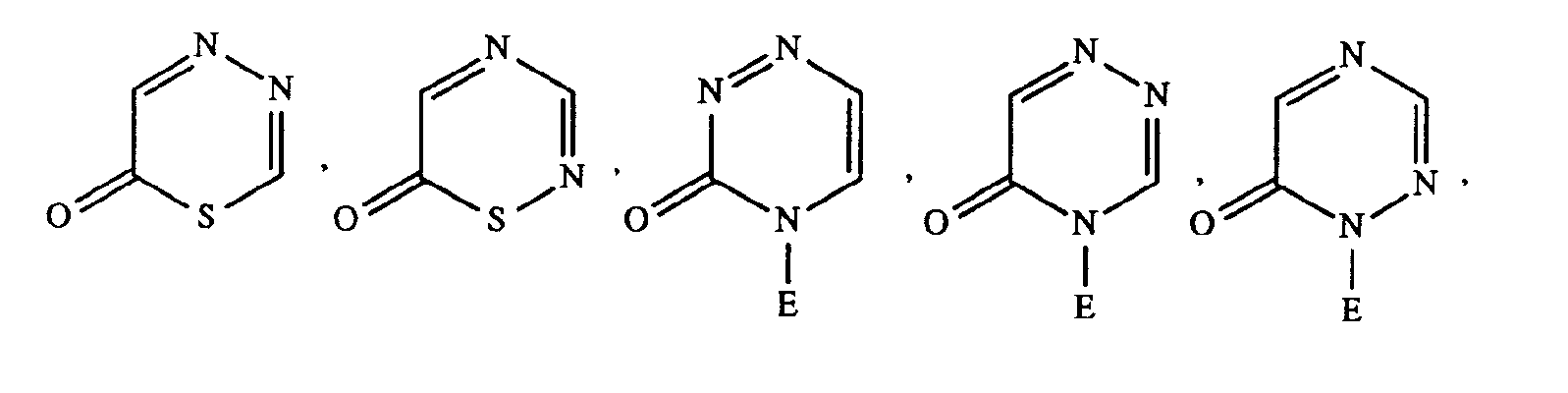


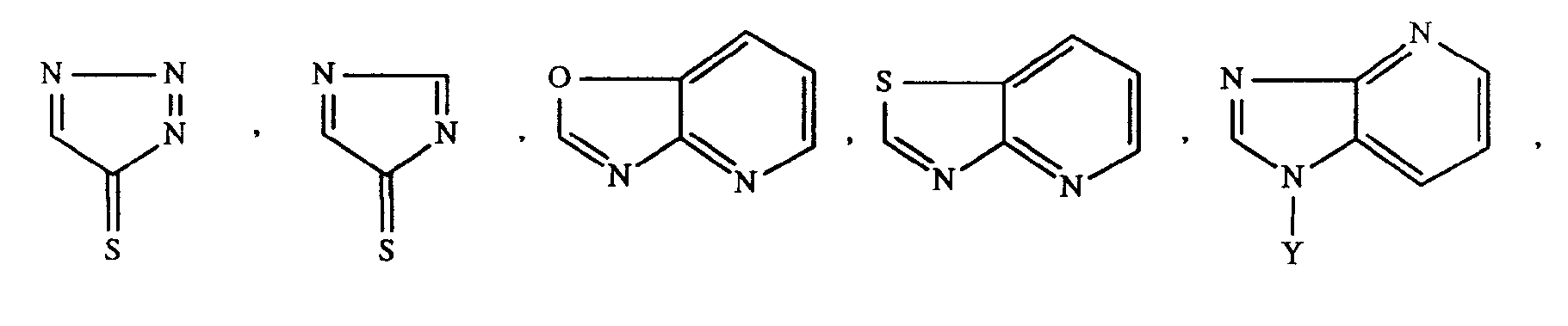


und
welche unsubstituiert sind oder je nach den Substitutionsmöglichkeiten des Ringsystems bis zu vier der in Anspruch 1 definierten Substituenten tragen, worin E für C1-C3-Alkyl und Y für Wasserstoff, C1-C3-Alkyl oder Cyclopropyl stehen und welche über ein Kohlenstoffatom des Heterocyclus an das den Rest R2 tragende Kohlenstoffatom der Formel gebunden sind. - Bevorzugt sind diese Heterocyclen A unsubstituiert oder sie tragen ein oder zwei Substituenten, ausgewählt aus der Gruppe, bestehend aus Halogen, C1-C3-Alkyl, C1-C3-Halogenalkyl, C1-C3-Halogenalkoxy und C1-C3-Alkoxy. Ganz besonders bevorzugte Gruppen A leiten sich von Pyridin und Thiazol ab, wie Pyrid-3-yl, 2-Halogenpyrid-5-yl, 2,3-Dihalogenpyrid-5-yl, 2-Halogen-1-oxido-5-pyridinio und 2-Halogenthiazol-5-yl, insbesondere 2-Chlorpyrid-5-yl.
- Von den Verbindungen I werden jene bevorzugt, in welchen =X für =N-N02, =N-CN oder =CH-N02 steht.
- Von diesen Verbindungen I sind jene hervorzuheben, in welchen
- R1 für Wasserstoff, C1-C3-Alkyl oder Cyclopropyl,
- R2 für Wasserstoff oder Methyl,
- R3 für C1-C3-Alkyl und
- R4 für C1-C3-Alkyl oder Ethoxycarbonylethyl oder
- R3 und R4 gemeinsam für -(CH2)4- oder -(CH2)5- und
- R5 für Wasserstoff, Methyl, Ethyl, Phenyl -CH2OCH3, -CN, -COOC2H5 oder
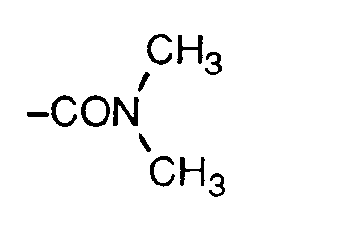
stehen. Von letzteren werden jene bevorzugt, in welchen - R1 für Methyl, Ethyl oder Cyclopropyl,
- R2 für Wasserstoff,
- R3 für Methyl,
- R4 für Methyl und
- R5 für Wasserstoff oder Methyl stehen. Insbesondere werden von diesen Verbindungen jene bevorzugt, in welchen =X für =N-NO2 oder =CH-N02 steht, vor allem jene, in welchen =X für =N-NO2 steht.
- Als bevorzugte Einzelverbindungen der Formel sind zu nennen:
- (a) N-(2-Chlorpyrid-5-ylmethyl)-N-methyl-N'-(N,N-dimethylaminomethylen)-N"-nitro-guanidin,
- (b) N-(2-Chlorpyrid-5-ylmethyl)-N-methyl-N'-[1-(N,N-dimethylamino)ethyliden]-N"-nitro-guanidin,
- (c) N-Pyrid-3-ylmethyl-N-methyl-N'-(N,N-dimethylaminomethylen)-N"-nitro-guanidin,
- (d) N-(2-Chlorpyrid-5-ylmethyl)-N-methyl-N'-(N,N-dimethylaminomethylen)-N"-cyano-guanidin,
- (e) 1-[N-(2-Chlorpyrid-5-ylmethyl)-N-methyl-amino]-1-(N,N-dimethylaminomethylenamino)-2-nitro-äthen,
- (f) 1-[N-(2-Chlorpyrid-5-ylmethyl)-N-ethyl-amino]-1-(N,N-dimethylaminomethylenamino)-2-nitro-äthen,
- (g) 1-[N-(2-Chlorpyrid-5-ylmethyl)-N-cyclopropyl-amino]-1-(N,N-dimethylaminomethylenamino)-2-nitro-ät- hen,
- (h) 1-[N-(2-Chlorthiazol-5-ylmethyl)-N-methyl-amino]-1-(N,N-dimethylaminomethylenamino)-2-nitro-ät- hen,
- (i) 1-[N-(2-Chlorthiazol-5-ylmethyl)-N-ethyl-amino]-1-(N,N-dimethylaminomethylenamino)-2-nitro-äthen, (j) 1-[N-(2-Chlorthiazol-5-ylmethyl)-N-cyclopropyl-amino]-1-(N,N-dimethylaminomethylenamino)-2-nitro- äthen,
- (k) 1-[N-(2-Chlor-1-oxido-5-pyridiniomethyl)-N-methyl-amino]-1-(N,N-dimethylaminomethylenamino)-2-nitro-äthen,
- (I) 1-[N-(2-Chlor-1-oxido-5-pyridimomethyl)-N-ethyl-amino]-1-(N,N-dimethylaminomethylenamino)-2-nitro-äthen,
- (m) 1-[N-(2-Chlor-1-oxido-5-pyridiniomethyl)-N-cyclopropyl-amino]-1-(N,N-dimethylaminomethylenami- no)-2-nitro-äthen,
- (n) N-(2-Chlorthiazol-5-ylmethyl)-N-methyl-N'-(N,N-dimethylaminomethylen)-N"-nitro-guanidin,
- (o) N-(2-Chlorthiazol-5-ylmethyl)-N-ethyl-N'-(N,N-dimethylamiomethylen)-N"-nitro-guanidin,
- (p) N-(2-Chlorthiazol-5-ylmethyl)-N-cyclopropyl-N'-(N,N-dimethylaminomethylen)-N"-nitro-guanidin,
- (q) N-(2-Chlorpyrid-5-ylmethyl)-N-ethyl-N'-(N,N-dimethylaminomethylen)-N"-nitro-guanidin und
- (r) N-(2-Chlorpyrid-5-ylmethyl)-N-cyclopropyl-N'-(N,N-dimethylaminomethylen)-N"-nitro-guanidin.
- In der Definition der erfindungsgemässen Formel I sollen die einzelnen generischen Begriffe wie folgt verstanden werden:
- Bei den als Substituenten in Betracht kommenden Halogenatomen handelt es sich sowohl um Fluor und Chlor als auch um Brom und lod, wobei Fluor, Chlor und Brom bevorzugt sind. Halogen ist dabei als selbständiger Substituent oder als Teil eines Substituenten zu verstehen, wie in Halogenalkyl, Halogenalkylthio, Halogenalkoxy, Halogencyclopropyl, Halogenalkenyl, Halogenalkinyl, Halogenalkyloxy oder Halogenallylthio. Die als Substituenten in Betracht kommenden (Halogen)Alkyl-, (Halogen)Alkylthio-, (Halogen)Alkenyl-, (Halogen)AI- kinyl- und (Halogen)Alkoxyreste können geradkettig oder verzweigt sein. Als Beispiele solcher Alkylreste seien Methyl, Aethyl, Propyl, Isopropyl, Butyl, Isobutyl, sek.-Butyl und tert.-Butyl genannt. Als geeignete Alkoxyreste seien genannt: Methoxy, Aethoxy, Propoxy und Isopropoxy. Alkylthio steht für Methylthio, Aethylthio, Isopropylthio und Propylthio. Halogensubstituierte Gruppen, wie Halogenalkyl, können teilweise halogeniert oder perhalogeniert sein. Beispiele der Alkylelemente dieser halogensubstituierten Gruppen sind das ein- bis dreifach durch Fluor, Chlor und/oder Brom substituierte Methyl, wie CHF2 oder CF3; das ein- bis fünffach durch Fluor, Chlor und/oder Brom substituierte Aethyl, wie CH2CF3, CF2CF3, CF2CCI3, CF2CHCl2, CF2CHF2, CF2CFCI2, CF 2CHBr2, CF2CHClF, CF2CHBrF oder CCIFCHCIF; das ein- bis siebenfach durch Fluor, Chlor und/oder Brom substituierte Propyl oder Isopropyl, wie CH2CHBrCH2Br, CF2CHFCF3, CH2CF2CF3 oder CH(CF3)2; das ein- bis neunfach durch Fluor, Chlor und/oder Brom substituierte Butyl oder eines seiner Isomeren, wie CF(CF3- )CHFCF3 oder CH2(CF2)2CF3. Weiterhin seien beispielhaft erwähnt: 2-Chlorcyclopropyl, 2,2-Difluorcyclopropyl, 2,2-Difluorvinyl, 2,2-Dichlorvinyl, 2-Chlorallyl, 2,3-Dichlorallyl und 2,3-Dibromallyl.
- Bei den Cycloalkylresten handelt es sich um Cyclopropyl, Cyclobutyl, Cyclopentyl und Cyclohexyl. Alkenyl-und Alkinylgruppen enthalten eine ungesättigte Kohlenstoff-Kohlenstoff-Bindung. Typische Vertreter sind Allyl und Propargyl, aber auch Vinyl und Äthinyl.
- Die erfindungsgemässen Verbindungen der Formel I können in Analogie zu bekannten Verfahren hergestellt werden, beispielsweise indem man
- a) eine Verbindung der Formel
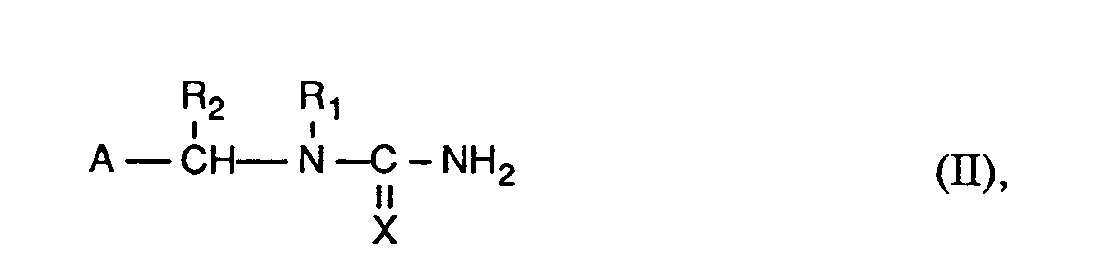
- worin R1, R2, A und X die für die Formel angegebenen Bedeutungen haben, in einem inerten aprotischen Lösungsmittel mit einer Verbindung der Formel
-

- b) eine Verbindung der Formel

- worin R2 und A die für die Formel angegebenen Bedeuningen haben und Hal für Chlor, Brom oder lod steht, in Gegenwart eines Säureakzeptors in einem Lösungsmittel bei -20 bis +120°C mit einer Verbindung der Formel
-

- Nach einer bevorzugten Ausführungsform der Verfahrensvariante a) wird die Umsetzung in einem inerten aprotischen Lösungsmittel, wie einem Kohlenwasserstoff, einem chlorierten Kohlenwasserstoff, einem Aether, einem Nitril oder einem Amid, bei 20 bis 150°C und unter atmosphärischem Druck ausgeführt. Insbesondere bevorzugt wird die Reaktion bei 50- 120°C in Tetrahydrofuran, Dioxan oder Toluol als Lösungsmittel durchgeführt.
- Eine bevorzugte Ausführungsform der Verfahrensvariante b) besteht darin, dass man die Umsetzung in Gegenwart von Natriumhydrid, Natriumamid, Kaliumcarbonat, Triäthylamin oder Diäthylanilin als Säureakzeptor und in N,N-Dimethylformamid, 1-Methylpyrrolidon, Dimethylsulfoxid, Sulfolan, Tetrahydroran oder Acetonitril als Lösungsmittel durchführt. Insbesondere bevorzugt wird die Reaktion mit Natriumhydrid oder Natriumamid als Säureakzeptor bei -10 bis +30°C durchgeführt.
- Die Verbindungen der Formeln II, 111, IV und V sind bekannt oder können in Analogie zu bekannten Verfahren hergestellt werden. Die Verbindungen der Formel V sind neu und sind auch ein Gegenstand der Erfindung; sie können in Analoge zu bekannten Verfahren hergestelltwerden, z.B. wie in den Herstellungsbeispielen beschrieben oder nach analogen Methoden. Bevorzugt sind diejenigen Verbindungen V, in denen die Variablen dieselben Bedeutungen haben wie in den bevorzugten Verbindungen I.
- Die erfindungsgemässen Verbindungen sind bei günstiger Warmblüter-, Fisch- und Pflanzenverträglichkeit wertvolle Wirkstoffe auf dem Gebiet der Schädlingsbekämpfung. Insbesondere wirken die erfindungsgemässen Wirkstoffe gegen Insekten und Spinnentiere, wie sie an Nutz- und Zierpflanzen in der Landwirtschaft und im Gartenbau, insbesondere in Reis-, Baumwoll-, Gemüse- und Obstpflanzungen, und im Forst vorkommen. Weitere Anwendungsgebiete der erfindungsgemässen Wirkstoffe sind der Vorrats- und Materialschutz sowie im Hygienesektor insbesondere der Schutz von Haus- und Nutztieren. Die Verbindungen sind gegen alle oder einzelne Entwicklungsstadien von normal sensiblen, aber auch von resistenten Arten von Schädlingen wirksam. Dabei kann sich ihre Wirkung z.B. in einer Abtötung der Schädlinge, welche unmittelbar oder erst nach einiger Zeit, beispielsweise bei einer Häutung, eintritt, oder in einer verminderten Eiablage und/oder Schlupfrate zeigen.
- Zu den oben erwähnten Schädlingen gehören:
- aus der Ordnung Lepidoptera zum Beispiel
- Acleris spp., Adoxophyes spp., Aegeria spp., Agrotis spp., Alabama argillaceae, Amylois spp., Anticarsia gemmatalis, Archips spp., Argyrotaenia spp., Autographa spp., Busseola fusca, Cadra cautella, Carposina nipponensis, Chilo spp., Choristoneura spp., Clysia ambiguella, Cnaphalocrocis spp., Cnephasia spp., Cochylis spp., Coleophora spp., Crocidolomia binotalis, Cryptophlebia leucotreta, Cydia spp., Diatraea spp., Diparopsis castanea, Earias spp., Ephestia spp., Eucosma spp., Eupoecilia ambiguella, Euproctis spp., Euxoa spp., Grapholita spp., Hedya nubiferana, Heliothis spp., Hellula undalis, Hyphantria cunea, Keiferia lycopersicella, Leucoptera scitella, Lithocollethis spp., Lobesia botrana, Lymantria spp., Lyonetia spp., Malacosoma spp., Mamestra brassicae, Manduca sexta, Operophtera spp., Ostrinia nubilalis, Pammene spp., Pandemis spp., Panolis flammea, Pectinophora gossypiella, Phthorimaea operculella, Pieris rapae, Pieris spp., Plutella xylostella, Prays spp., Scirpophaga spp., Sesamia spp., Sparganothis spp., Spodoptera spp., Synanthedon spp., Thaumetopoea spp., Tortrix spp., Trichoplusia ni und Yponomeuta spp.;
- aus der Ordnung Coleoptera zum Beispiel
- Agriotes spp., Anthonomus spp., Atomaria linearis, Chaetocnema tibialis, Cosmopolites spp., Curculio spp., Dermestes spp., Diabrotica spp., Epilachna spp., Eremnus spp., Leptinotarsa decemlineata, Lissorhoptrus spp., Melolontha spp., Orycaephilus spp., Otiorhynchus spp., Phlyctinus spp., Popillia spp., Psylliodes spp., Rhizopertha spp., Scarabeidae, Sitophilus spp., Sitotroga spp., Tenebrio spp., Tribolium spp. und Trogoderma spp.;
- aus der Ordnung Orthoptera zum Beispiel
- Blatta spp., Blattella spp., Gryllotalpa spp., Leucophaea maderae, Locusta spp., Periplaneta spp. und Schistocerca spp.;
- aus der Ordnung Isoptera zum Beispiel
- Reticulitermes spp.;
- aus der Ordnung Psocoptera zum Beispiel
- Liposcelis spp.;
- aus der Ordnung Anoplura zum Beispiel
- Haematopinus spp., Linognathus spp., Pediculus spp., Pemphigus spp. und Phylloxera spp.;
- aus der Ordnung Mallophaga zum Beispiel
- Damalinea spp. und Trichodectes spp.;
- aus der Ordnung Thysanoptera zum Beispiel
- Frankliniella spp., Hercinothrips spp., Taeniothrips spp., Thrips palmi, Thrips tabaci und Scirtothrips aurantii: aus der Ordnung Heteroptera zum Beispiel
- Cimex spp., Distantiella theobroma, Dysdercus spp., Euchistus spp. Eurygaster spp. Leptocorisa spp., Nezara spp., Piesma spp., Rhodnius spp., Sahlbergella singularis, Scotinophara spp. und Triatoma spp.;
- aus der Ordnung Homoptera zum Beispiel
- Aleurothrixus floccosus, Aleyrodes brassicae, Aonidiella spp., Aphididae, Aphis spp., Aspidiotus spp., Bemisia tabaci, Ceroplaster spp., Chrysomphalus aonidium, Chrysomphalus dictyospermi, Coccus hesperidum, Empoasca spp., Eriosoma larigerum, Erythroneura spp., Gascardia spp., Laodelphax spp., Lecanium corni, Lepidosaphes spp., Macrosiphus spp., Myzus spp., Nephotettix spp., Nilaparvata spp., Paratoria spp., Pemphigus spp., Planococcus spp., Pseudaulacaspis spp., Pseudococcus spp., Psylla spp., Pulvinaria aethiopica, Quadraspidiotus spp., Rhopalosiphum spp., Saissetia spp., Scaphoideus spp., Schizaphis spp., Sitobion spp., Trialeurodes vaporariorum, Trioza erytreae und Unaspis citri;
- aus der Ordnung Hymenoptera zum Beispiel
- Acromyrmex, Atta spp., Cephus spp., Diprion spp., Diprionidae, Gilpinia polytoma, Hoplocampa spp., Lasius spp., Monomorium pharaonis, Neodiprion spp., Solenopsis spp.
- und Vespa spp.;
- aus der Ordnung Diptera zum Beispiel
- Aedes spp., Antherigona soccata, Bibio hortulanus, Calliphora erythrocephala, Ceratitis spp., Chrysomyia spp., Culex spp., Cuterebra spp., Dacus spp., Drosophila melanogaster, Fannia spp., Gastrophilus spp., Glossina spp., Hypoderma spp., Hyppobosca spp., Liriomyza spp., Lucilia spp., Melanagromyza spp., Musca spp., Oestrus spp., Orseolia spp., Oscinella frit, Pegomyia hyoscyami, Phorbia spp., Rhagoletis pomonella, Sciara spp., Stomoxys spp., Tabanus spp., Tannia spp. und Tipula spp.;
- aus der Ordnung Siphonaptera zum Beispiel
- Ceratophyllus spp. und Xenopsylla cheopis und
- aus der Ordnung Thysanura zum Beispiel
- Lepisma saccharina.
- Die gute pestizide Wirkung der erfindungsgemässen Verbindungen I entspricht einer Abtötungsrate (Mortalität) von mindestens 50-60 % der erwähnten Schädlinge.
- Die Wirkung der erfindungsgemässen Verbindungen und der sie enthaltenden Mittel lässt sich durch Zusatz von anderen Insektiziden wesentlich verbreitem und an gegebene Umstände anpassen. Als Zusätze kommen zum Beispiel Vertreter der folgenden Wirkstoffklassen in Betracht: Organische Phosphorverbindungen, Nitrophenole und Derivate, Formamidine, Harnstoffe, Carbamate, Pyrethroide, chlorierte Kohlenwasserstoffe-und Bacillus thuringiensis-Präparate.
- Die Verbindungen I werden in unveränderter Form oder vorzugsweise zusammen mit den in der Formulierungstechnik üblichen Hilfsmitteln eingesetzt und können daher beispielsweise zu emulgierbaren Konzentraten, direkt versprüh- oder verdünnbaren Lösungen, verdünnten Emulsionen, Spritzpulvern, löslichen Pulvern, Stäubemitteln und Granulaten, auch zu Verkapselungen in polymeren Stoffen, in bekannter Weise verarbeitet werden. Die Anwendungsverfahren, wie Versprühen, Vernebeln, Verstäuben, Verstreuen oder Giessen, werden ebenso wie die Mittel den angestrebten Zielen und den gegebenen Verhältnissen entsprechend gewählt. Ferner eignen sich die Verbindungen auch für den Einsatz bei der Behandlung von Saatgut Dabei kann sowohl das Saatgut vor dem Säen mit dem Wirkstoff oder einer den Wirkstoff enthaltenden Formulierung behandelt odergebeiztwerden, als auch der Wirkstoff beim Säen in die Saatfurche appliziert werden.
- Die Formulierungen, das heisst die den Wirkstoff der Formel beziehungsweise eine Kombination dieses Wirkstoffs mit anderen Insektiziden, und gegebenenfalls feste oder flüssige Hilfsstoffe enthaltenden Mittel, Zubereitungen oder Zusammensetzungen, werden in bekannter Weise hergestellt, zum Beispiel durch inniges Vermischen und/oder Vermahlen des Wirkstoffs mit Streckmitteln, wie Lösungsmitteln, festen Trägerstoffen und gegebenenfalls oberflächenaktiven Verbindungen (Tensiden).
- Als Lösungsmittel können in Frage kommen: Aromatische Kohlenwasserstoffe, bevorzugt die Fraktionen C8 bis C12 von Alkylbenzolen, wie Xylolgemische oder alkylierte Naphthaline, aliphatische oder cycloaliphatische Kohlenwasserstoffe, wie Cyclohexan, Paraffine oder Tetrahydronaphthalin, Alkohole wie Aethanol, Propanol oder Butanol, Glykole sowie deren Aether und Ester, wie Propylenglykol, Dipropylenglykoläther, Aethylenglykol, Aethylenglykolmonomethyl- oder -äthyläther, Ketone, wie Cyclohexanon, Isophoron oder Diacetanolalkohol, stark polare Lösungsmittel, wie N-Methyl-2-pyrrolidon, Dimethylsulfoxid oder N,N-Dimethylformamid, Wasser sowie Pflanzenöle, wie Raps-, Rizinus-, kokosnuss- oder Sojaöl; gegebenenfalls auch Silikonöle.
- Als feste Trägerstoffe, beispielsweise für Stäubemittel und dispergerbare Pulver, werden in der Regel natürliche Gesteinsmehle verwendet, wie Calcit, Talkum, Kaolin, Montmorillonit oder Attapulgt. Zur Verbesserung der physikalischen Eigenschaften können auch hochdisperse Kieselsäuren oder hochdisperse saugfähige Polymerisate zugesetzt werden. Als gekörnte, adsorptive Granulatträger kommen poröse Typen, wie Bimsstein, Ziegelbruch, Sepiolit oder Bentonit, als nicht sorptive Trägermaterialien Calcit oder Sand in Frage. Darüberhinaus kann eine Vielzahl von granulierten Materialien anorganischer oder organischer Natur, insbesondere Dolomit oder zerkleinerte Pflanzenrückstände, verwendet werden.
- Als oberflächenaktive Verbindungen kommen je nach Art des zu formulierenden Wirkstoffes der Formel I oder der Kombination dieses Wirkstoffs mit anderen Insektiziden nichtionogene, kation- und/oder anionaktive Tenside mit guten Emulgier-, Dispergier- und Netzeigenschaften in Betracht. Unter Tensiden sind auch Tensidgemische zu verstehen.
- Geeignete anionische Tenside können sowohl sogenannte wasserlösliche Seifen als auch wasserlösliche synthetische oberflächenaktive Verbindungen sein.
- Als Seifen eignen sich die Alkali-, Erdalkali- oder gegebenenfalls substituierten Ammoniumsalze von höheren Fettsäuren (C1O-C22, wie die Natrium- oder Kalium-Salze der Oel- oder Stearinsäure oder von natürlichen Fettsäuregemischen, die beispielsweise aus Kokosnuss- oder Tallöl gewonnen werden können. Ferner sind als Tenside auch die Fettsäuremethyl-taurin-salze zu erwähnen.
- Häufiger werden jedoch sogenannte synthetische Tenside verwendet, insbesondere Fettsulfonate, Fettsulfate, sulfonierte Benzimidazolderivate oder Alkylarylsulfonate. Die Fettsulfonate oder -sulfate liegen in der Regel als Alkali-, Erdalkali- oder gegebenenfalls substituierte Ammoniumsalze vor und weisen im allgemeinen einen Alkyrest mit 8 bis 22 C-Atomen auf, wobei Alkyl auch den Alkylteil von Acylresten einschliesst; beispielhaft genannt seien das Natrium- oder Calcium-Salz der Ligninsulfonsäure, des Dodecylschwefelsäureesters oder eines aus natürlichen Fettsäuren hergestellten Fettalkoholsulfatgemisches. Hierhergehören auch die Salze der Schwefelsäureester und Sulfonsäuren von Fettalkohol-Aethylenoxid-Addukten. Die sulfonierten Benzimidazolderivate enthalten vorzugsweise 2 Sulfonsäuregruppen und einen Fettsäurerest mit etwa 8-22 C-Atomen. Alkylarylsulfonate sind zum Beispiel die Natrium-, Calcium- oder Triäthanolammoniumsalze der Dodecylbenzolsulfonsäure, der Dibutylnaphthalinsulfonsäure oder eines Naphthalinsulfonsäure-Formaldehydkondensationsproduktes. Ferner kommen auch entsprechende Phosphate, wie Salze des Phosphorsäureesters eines p-Nonylphenol-(4-14)-Aethylenoxid-Adduktes oder Phospholipide, in Frage.
- Als nichtionische Tenside kommen in erster Linie Polyglykolätherderivate von aliphatischen oder cycloaliphatischen Alkoholen, gesättigten oder ungesättigten Fettsäuren und Alkylphenolen in Frage, die 3 bis 30 Glykoläthergruppen und 8 bis 20 Kohlenstoffatome im (aliphatischen) Kohlenwasserstoffrest und 6 bis 18 Kohlenstoffatome im Alkylrest der Alkylphenole enthalten können. Weiterhin geeignete nichtionische Tenside sind die wasserlöslichen 20 bis 250 Aethylenglykoläthergruppen und 10 bis 100 Propylenglykoläthergruppen enthaltenden Polyäthylenoxid-Addukte an Polypropylenglykol, Aethylendiaminopolypropylenglykol und Alkylpolypropylenglykol mit 1 bis 10 Kohlenstoffatomen in der Alkylkette. Die genannten Verbindungen enthalten üblicherweise pro Propylenglykol-Einheit 1 bis 5 Aethylenglykol-Einheiten.
- Als Beispiele nichtionischer Tenside seien Nonylphenolpolyäthoxyäthanole, Ricinusölpolyglykoläther, Polypropylen-Polyäthylenoxid-Addukte, Tributylphenoxypolyäthoxyäthanol, Polyäthylenglykol und Octylphenoxypolyäthoxyäthanol erwähnt. Ferner kommen auch Fettsäureester von Polyoxyäthylensorbitan, wie das Polyoxyäthylensorbitan-trioleat, in Betracht.
- Bei den kationischen Tensiden handelt es sich vor allem um quarternäre Ammoniumsalze, welche als N-Substituenten mindestens einen Alkylrest mit 8 bis 22 C-Atomen enthalten und als weitere Substituenten niedrige, gegebenenfalls halogenierte Alkyl-, Benzyl- oder niedrige Hydroxyalkylreste aufweisen. Die Salze liegen vorzugsweise als Halogenide, Methylsulfate oder Aethylsulfate vor, Beispiele sind das Stearyltrimethylammoniumchlorid oder das Benzyl-di-(2-chloräthyl)-äthylammoniumbromid.
- Die in der Formulierungstechnik gebräuchlichen Tenside sind beispielsweise in folgenden Publikationen beschrieben:
- "Mc Cutcheon's Detergents and Emulsifiers Annual", Mc Publishing Corp., Glen Rock, NJ, USA, 1988"; H. Stache, "Tensid-Taschenbuch", 2. Aufl., C. Hanser Verlag, München, Wien, 1981 und M. and J. Ash. "Encyclopedia of Surfactants", Vol. 1-111, Chemical Publishing Co., New York, 1980- 1981.
- Die pestiziden Zubereitungen enthalten in der Regel 0,1 bis 99 %, insbesondere 0,1 bis 95 % Wirkstoff der Formel oder der Kombination dieses Wirkstoffs mit anderen Insektiziden, 1 bis 99,9 % eines festen oder flüssigen Hilfsstolles und 0 bis 25 %, insbesondere 0,1 bis 25 %, eines Tensides. Während als Handelsware eher konzentrierte Mittel bevorzugt werden, verwendet der Endverbraucher in der Regel verdünnte Zubereitungen, die wesentlich geringere Wirkstoffkonzentrationen aufweisen. Typische Anwendungskonzentrationen liegen zwischen 0,1 und 1000 ppm, vorzugsweise zwischen 0,1 und 500 ppm. Die Aufwandmengen pro Hektar betragen im allgemeinen 1 bis 1000 g Wirkstoff pro Hektar, vorzugsweise 25 bis 500 g/ha.
- Insbesondere setzen sich bevorzugte Formulierungen folgendermassen zusammen (% = Gewichtsprozent):
-

-

-

-

-

- Die Mittel können auch weitere Zusätze, wie Stabilisatoren, z.B. gegebenenfalls epoxidierte Pflanzenöle (z.B. epoxidiertes Kokosnussöl, Rapsöl oder Sojaöl), Entschäumer, z.B. Silikonöl, Konservierungsmittel, Viskositätsregulatoren, Bindemittel, Haftmittel sowie Dünger oder andere Wirkstoffe zur Erzielung spezieller Effekte enthalten.
- Die folgenden Beispiele dienen der Erläuterung der Erfindung. Sie schränken die Erfindung nicht ein. Temperaturen sind in Grad Celsius angegeben.
- Beispiel 1: N-(2-Chlorpyrid-5-ylmethyl)-N-methyl-N'-(N,N-dimethylaminomethylen)-N"-nitro-guanidin (Tabelle 1, Verbindung Nr. 1.001).

- Variante a): Zu 2,43 g N-(2-Chlorpyrid-5-ylmethyl)-N-methyl-N'-nitro-guanidin in 75 ml Dioxan werden 1,5 g N,N-Dimethylformamiddiäthylacetal zugegeben. Das Gemisch wird 45 Minuten auf 130°C erhitzt und dann am Rotationsverdampfer vom Lösungsmittel befreit. Das Rohprodukt wird an Kieselgel zuerst mit Aethylacetat und dann mit Aethylacetat/Aethanol (5:1) chromatographiert. Es resultiert ein zähes Oel, das nach Versetzen mit Hexan Kristalle des gewünschten Produkts (Smp.: 85-89°C) liefert.
- Variante b): 0,6 g Natriumhydrid (80 %ig, in Mineralöl) werden unter Stickstoffatmosphäre in kleinen Portionen zu 3,46 g N-(N,N-Dimethylaminomethylen)-N'-methyl-N"-nitro-guanidin in 35 ml absolutem N,N-Dimethylformamid zugefügt. Nach einstündigem Rühren bei 5°C wird eine Lösung von 3,24 g 2-Chlor-5-chlormethyl-pydin in 10 ml N,N-Dimethylformamid zugetropft und das Reakionsgemisch über Nacht bei 20°C gerührt. Nach dem Abfiltrieren wird das Filtrat im Hochvakuum eingeengt und das erhaltene Oel durch Säulenchromatographie (Si02/Aethylacetat) gereinigt. Das gewünschte Produkt ist ein weisses Pulver (Smp.: 90-94°C).
- Beispiel 2: 1-[N-(2-Chlorpyrid-5-ylmethyl)-N-methyl-amino]-1-(N,N-dimethylaminomethylenamino)-2-nitro-ät- hen (Tabelle 5, Verbindung Nr. 5.001).

- Variante a): Ein Gemisch aus 0,9 g 1-Amino-1-[N-(2-chlorpyrid-5-ylmethyl)-N-methylamino]-2-nitro-äthen, 0,68 ml N,N-Dimethylformamiddiäthylacetal und 20 ml 1,3-Dioxan wird unter einer Argonatmosphäre 10 Stunden unter Rückfluss erhitzt. Nach Abdestillieren des Lösungsmittels wird der Rückstand mit Diäthyläther versetzt und das kristalline Produkt abfiltriert (Smp.: 108-110°C).
- Variante b1): Zu einem Gemisch aus 1,0 g 1-(N,N-Dimethylaminomethylenamino)-1-(N-methylamino)-2-nitro-äthen, 1,13 g 2-Chlor-5-chlormethyl-pyridin und 10 ml N,N-Dimethylformamid werden 2,01 g Kaliumcarbonat zugegeben. Anschliessend wird das Reaktionsgemisch 2 Tage bei 50°C gerührt. Nach dem Abfiltrieren wird das Filtrat im Hochvakuum eingeengt und das erhaltene Rohprodukt durch Säulenchromatographie [Si02; CH2CI2/MeOH (10:1)] gereinigt. Man erhält das gewünschte Produkt, das bei 107-110°C schmilzt.
- Variante b2): Zu einer Suspension von 1,0 g 1-(N,N-Dimethylaminomethylenamino)-1-(N-methylamino)-2-nitro-äthen in 20 ml N,N-Dimethylformamid werden 0,19 g Natriumhydrid (80%ig, in Mineralöl) zugegeben. Nach sechsstündigem Rühren bei Raumtemperatur werden 1,13 g 2-Chlor-5-chlormethyl-pyridin zugegeben. Das Reaktionsgemisch wird anschliessend über Nacht bei Raumtemperaturgerührt. Nach dem Abfiltrieren wird das Filtrat im Hochvakuum eingeengt und das erhaltene Rohprodukt durch Säulenchromatographie [Si02; CH2Cl2/MeOH (10:1)] gereinigt. Man erhält das gewünschte Produkt, das bei 108-110°C schmilzt.
- Beispiel 3: N-Cyclopropyl-N'-(N,N-dimethylaminomethylen)-N"-nitro-guanidin (Herstellungsbeispiel für Verbindungen der Formel V).

- a) 140 g S-Methylisothioharnstoffsulfat werden bei -10°C in Portionen innerhalb einer Stunde zu einem Gemisch von 140 ml rauchender Salpetersäure und 420 ml konzentrierter Schwefelsäure gegeben. Nach Ausrühren des Reaktionsgemisches während einer Stunde bei 0°C wird auf 21 Eis/Wasser gegossen und das weisse Produkt abgesaugt. Der Filterkuchen wird mit 250 ml Wasser, 100 ml kaltem Aethanol und 150 ml Diäthyläther gewaschen und im Vakuum bei Raumtemperatur getrocknet. Man erhält so den S-Methyl-N-nitro-isothioharnstoff (Smp.: 162- 164°C).
- b) 27 g S-Methyl-N-nitro-isothioharnstoff werden im Gemisch mit 12,6 g Cyclopropylamin und 15 ml Aethanol 3,5 Stunden unter Rückfluss erhitzt. Dann wird das Reaktionsgemisch auf-5°C gekühlt und das Produkt abfiltriert und mit wenig kaltem Aethanol und Diäthyläther gewaschen. Man erhält so das N-Cyclopropyl-N'-nitro-guanidin (Smp.: 127- 130°C).
- c) 14,4 g N-Cyclopropyl-N'-nitro-guanidin werden zu 14,7 g N,N-Dimethylformamiddiäthylacetal zugegeben. Nach 1,5-stündigem Rühren bei 70-75°C wird das Gemisch abgekühlt und am Rotationsverdampfer eingeengt. Das Rohprodukt wird in Diäthyläther verrührt, abfiltriert und mit weiterem Diäthyläther gewaschen. Man erhält so das N-Cyclopropyl-N'-(N,N-dimethylaminomethylen)-N"-nitro-guanidin (Smp.: 120-122°C).
- In analoger Weise kann man herstellen
- N-Aethyl-N'-(N,N-dimethylaminomethylen)-N"-nitro-guanidin (Smp.: 93-96°C),
- N-(N,N-Dimethylaminomethylen)-N'-methyl-N"-nitro-guanidin (Smp.: 141-143°C),
- N-Cyclopropyl-N'-[1-(N,N-dimethylamino)ethyliden]-N"-nitro-guanidin (Smp.: 92-94°C) und
- N-Aethyl-N'-[1-(N,N-dimethylamino)ethyliden]-N"-nitro-guanidin (Smp.: 74-77°C).
- Beispiel 4: 1-(N,N-Dimethylaminomethylenamino)-1-(N-methylamino)-2-nitro-aethen (Herstellungsbeispiel für Verbindungen der Formel V).

- Zu 20 g 1-Amino-1-(N-methylamino)-2-nitro-aethen in 100 ml Dioxan werden 32,2 ml N,N-Dimethylforma- middiaethylacetal zugegeben. Das Reaktionsgemisch wird 16 Stunden auf 50°C erhitzt. Die erhaltenen Kristalle werden abfiltriert und mit Diäthyläther gewaschen. Man erhält so das gesuchte Produkt, das bei 219°C schmilzt.
- In analoger Weise kann man herstellen:
- 1-(N-Aethylamino)-1-(N,N-dimethylaminomethylenamino)-2-nitro-aethen (ausgehend von 1-(N-Aethylamino)-1-amino-2-nitro-aethen) und
- 1-(N-Cyclopropylamino)-1-(N,N-dimethylaminomethylenamino)-2-nitro-aethen (ausgehend von 1-Amino-1-(N-cyclopropylam ino)-2-nitro-aethen).
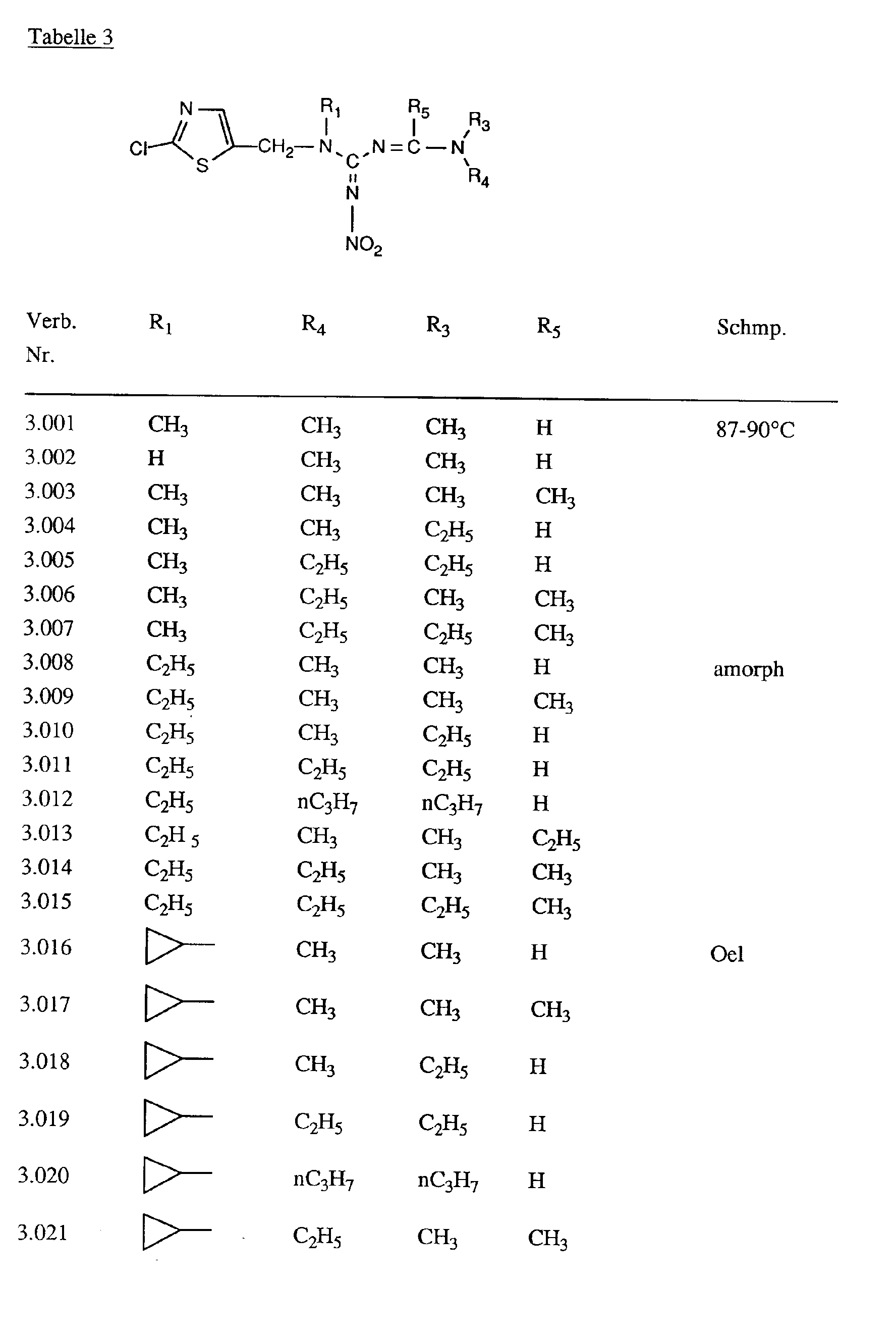
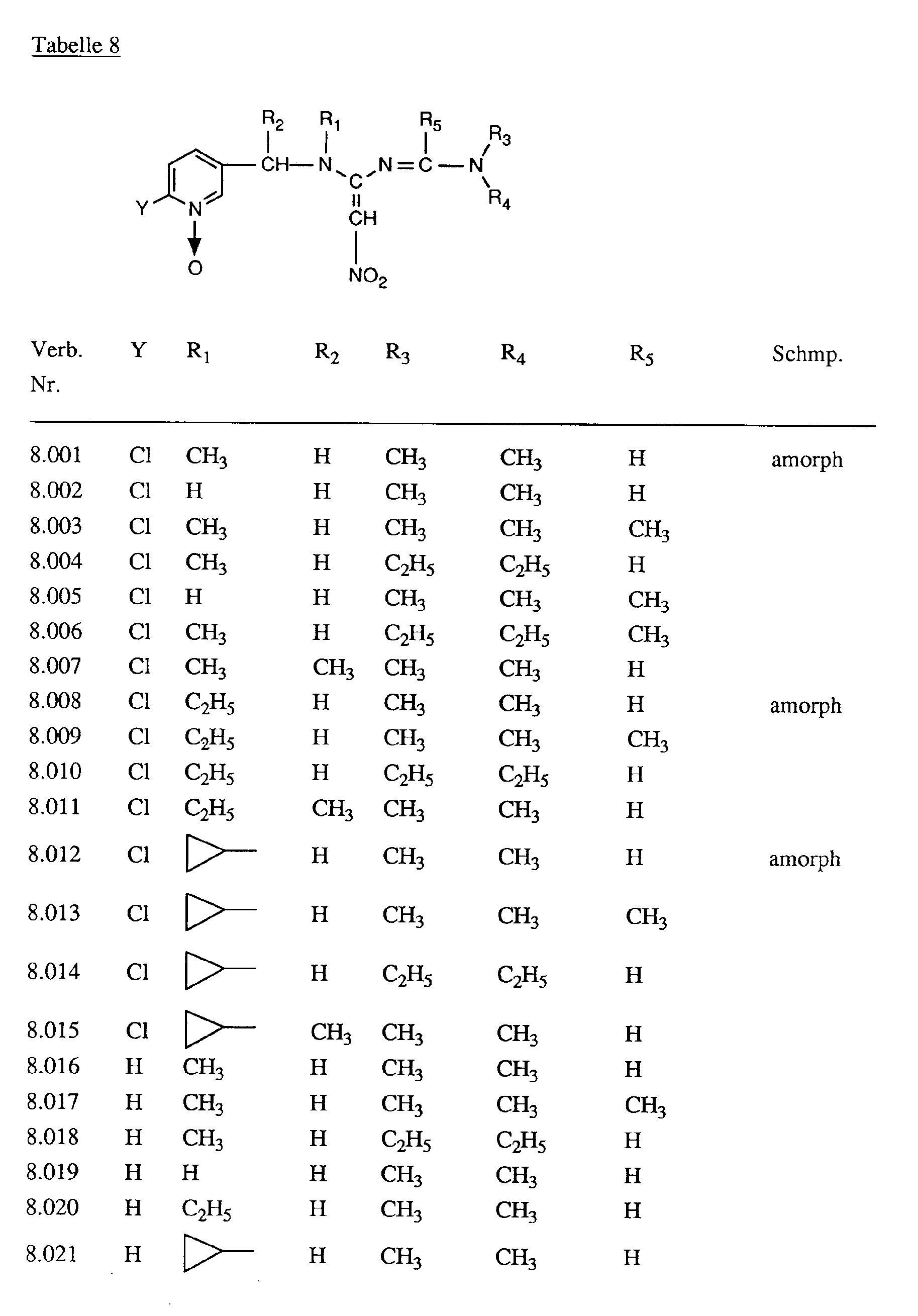
- In analoger Weise wie in den Beispielen 1 bis 4 beschrieben können auch die anderen in den folgenden Tabellen 1 bis 13 aufgeführten Verbindungen der Formel hergestellt werden. In der Spalte "Schmp." dieser Tabellen bezeichnen die angegebenen Temperaturen jeweils den Schmelzpunkt der betreffenden Verbindung. Gegebenenfalls sind in dieser Spalte "Schmp. " auch andere physikalische Daten aufgeführt, so steht beispielsweise npT für den Brechungsindex der betreffenden Verbindung bei der Temperatur T°C.
-






-

- Aus solchen Konzentraten können durch Verdünnen mit Wasser Emulsionen jeder gewünschten Konzentration hergestellt werden.
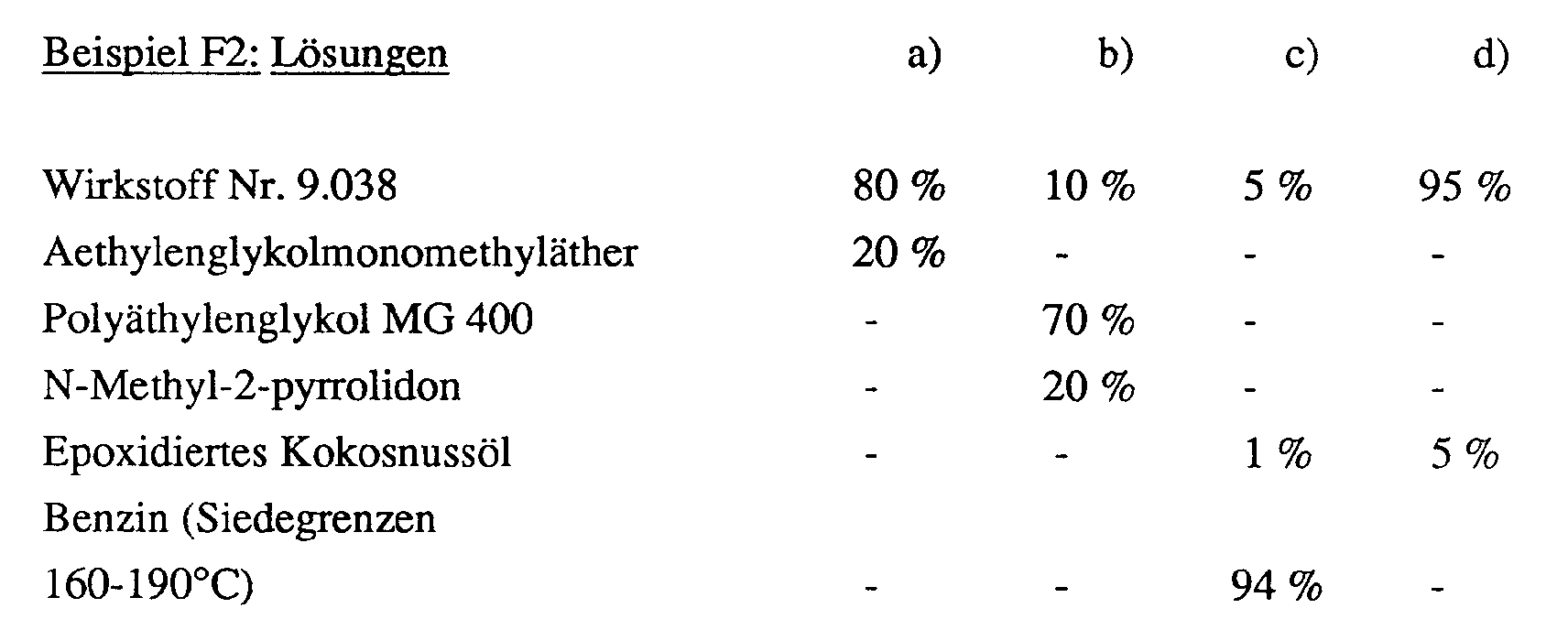
- Die Lösungen sind zur Anwendung in Form kleinster Tropfen geeignet.
-

- Der Wirkstoff wird in Methylenchlorid gelöst, auf den Träger aufgesprüht und das Lösungsmittel anschliessend im Vakuum abgedampft.

- Durch inniges Vermischen der Trägerstoffe mit dem Wirkstoff erhält man gebrauchsfertige Stäubemittel.
-

- Der Wirkstoff oder die Wirkstoffkombination wird mit den Zusatzstoffen vermischt und in einer geeigneten Mühle gut vermahlen. Man erhält Spritzpulver, die sich mit Wasser zu Suspensionen jeder gewünschten Konzentration verdünnen lassen.
-

- Aus diesem Konzentrat können durch Verdünnen mit Wasser Emulsionen jeder gewünschten Konzentration hergestellt werden.

- Man erhält anwendungsfertige Stäubemittel, indem der Wirkstoff mit dem Träger vermischt und auf einer geeigneten Mühle vermahlen wird.
-

- Der Wirkstoff oder die Wirkstoffkombination wird mit den Zusatzstoffen vermischt, vermahlen und mit Wasser angefeuchtet. Dieses Gemisch wird extrudiert, granuliert und anschliessend im Luftstrom getrocknet.
-

- Der fein gemahlene Wirkstoff oder die Wirkstoffkombination wird in einem Mischer auf das mit Polyäthylenglykol angefeuchtete Kaolin gleichmässig aufgetragen. Auf diese Weise erhält man staubfreie UmhüllungsGranulate.
-

- Der fein gemahlene Wirkstoff oder die Wirkstoffkombination wird mit den Zusatzstoffen innig vermischt. Man erhält so ein Suspensions-konzentrat, aus welchem durch Verdünnen mit Wasser Suspensionen jeder gewünschten Konzentration hergestellt werden können.
- Reispflanzen werden mit einer wässrigen Emulsions-Spritzbrühe, die 400 ppm des Wirkstoffes enthält, behandelt. Nach dem Antrocknen des Spritzbelages werden die Reispflanzen mit Zikadenlarven des 2. und 3. Stadiums besiedelt. 21 Tage später erfolgt die Auswertung. Aus dem Vergleich der Anzahl überlebender Zikaden auf den behandelten zu denjenigen auf den unbehandelten Pflanzen wird die prozentuale Reduktion der Population (% Wirkung) bestimmt. Verbindungen der Tabellen 1 bis 13 zeigen eine gute Wirkung gegen Nilaparvata lugens in diesem Test. Insbesondere die Verbindungen 1.001, 1.022, 1.038, 5.001 und 9.001 zeigen eine Wirkung über 80 %.
- Reispflanzen werden mit einer wässrigen Emulsions-Spritzbrühe, die 400 ppm des Wirkstoffes enthält, behandelt. Nach dem Antrocknen des Spritzbelages werden die Reispflanzen mit Zikadenlarven des 2. und 3. Stadiums besiedelt. 21 Tage später erfolgt die Auswertung. Aus dem Vergleich der Anzahl überlebender Zikaden auf den behandelten zu denjenigen auf den unbehandelten Pflanzen wird die prozentuale Reduktion der Population (% Wirkung) bestimmt. Verbindungen der Tabellen 1 bis 13 zeigen eine gute Wirkung gegen Nephotettix cincticeps in diesem Test. Insbesondere die Verbindungen 1.001, 1.022 und 5.001 zeigen eine Wirkung über 80 %.
- Buschbohnen-Pflanzen werden in Gazekäfige gestellt und mit Adulten von Bemisia tabaci (Weisse Fliege) besiedelt. Nach erfolgter Eiablage werden die Adulten entfernt und 10 Tage später die Pflanzen mit den darauf befindenden Nymphen mit einer wässrigen Emulsions-Spritzbrühe der zu prüfenden Wirkstoffe (Konzentration 400 ppm) behandelt. Die Auswertung erfolgt 14 Tage nach der Wirkstoff-Applikation auf %-Schlupf im Vergleich zu den unbehandelten Kontrollansätzen. Verbindungen gemäss Tabellen 1 bis 13 zeigen in diesem Test gute Wirkung gegen Bemisia tabaci. Insbesondere die Verbindungen 1.001 und 5.001 zeigen eine Wirkung über 80 %.
- Erbsenkeimlinge werden mit Aphis craccivora infiziert und anschliessend mit einer Spritzbrühe, die 400 ppm des Wirkstoffes enthält, besprüht und bei 20°C inkubiert. 3 und 6 Tage später erfolgt die Auswertung. Aus dem Vergleich der Anzahl toter Blattläuse auf den behandelten zu denjenigen auf den unbehandelten Pflanzen wird die prozentuale Reduktion der Population (% Wirkung) bestimmt. Verbindungen der Tabellen 1 bis 13 zeigen eine gute Wirkung gegen Aphis craccivora in diesem Test. Insbesondere die Verbindungen 1.001, 1.003, 1.012, 1.022, 1.038, 5.001 und 9.00 1 zeigen eine Wirkung über 80 %.
- Erbsenkeimlinge werden mit Myzus persicae infiziert und anschliessend mit einer Spritzbrühe, die 400 ppm des Wirkstoffes enthält, besprüht und bei 20°C inkubiert. 3 und 6 Tage später erfolgt die Auswertung. Aus dem Vergleich der Anzahl toter Blattläuse auf den behandelten zu denjenigen auf den unbehandelten Pfanzen wird die prozentuale Reduktion der Population (% Wirkung) bestimmt. Verbindungen der Tabellen 1 bis 13 zeigen eine gute Verbindung gegen Myzus persicae in diesem Test. Insbesondere die Verbindungen 1.001 und 1.022 zeigen eine Wirkung über 80 %.
- Erbsenkeimlinge werden mit Myzus persicae infiziert, anschliessend mit den Wurzeln in eine Spritzbrühe, die 400 ppm des Wirkstoffes enthält, gestellt und bei 20°C inkubiert. 3 und 6 Tage später erfolgt die Auswertung. Aus dem Vergleich der Anzahl toter Blattläuse auf den behandelten zu denjenigen auf den unbehandelten Pflanzen wird die prozentuale Reduktion der Population (% Wirkung) bestimmt. Verbindungen der Tabellen 1 bis 13 zeigen eine gute Wirkung gegen Myzus persicae in diesem Test. Insbesondere die Verbindungen 1.001, 1.003, 1.012, 1.022, 1.038 und 5.001 zeigen eine Wirkung über 80 %.
- Töpfe mit Reispflanzen werden in eine wässrige Emulsions-Lösung, die 400 ppm des Wirkstoffes enthält, gestellt. Anschliessend werden die Reispflanzen mit Larven des 2. und 3. Stadiums besiedelt. 6 Tage später erfolgt die Auswertung. Aus dem Vergleich der Anzahl Zikaden auf den behandelten zu denjenigen auf den unbehandelten Pflanzen wird die prozentuale Reduktion der Population (% Wirkung) bestimmt. Verbindungen der Tabellen 1 bis 13 zeigen eine gute Wirkung gegen Nilaparvata lugens in diesem Test. Insbesondere die Verbindungen 1.001, 1.012, 1.022, 1.038, 3.001, 5.001 und 9.001 zeigen eine Wirkung über 80 %.
- Töpfe mit Reispflanzen werden in eine wässrige Emulsions-Lösung, die 400 ppm des Wirkstoffes enthält, gestellt. Anschliessend werden die Reispflanzen mit Larven des 2. und 3. Stadiums besiedelt. 6 Tage später erfolgt die Auswertung. Aus dem Vergleich der Anzahl Zikaden auf den behandelten zu denjenigen auf den unbehandelten Pflanzen wird die prozentuale Reduktion der Population (% Wirkung) bestimmt. Verbindungen der Tabellen 1 bis 13 zeigen eine gute Wirkung gegen Nephotettix cincticeps in diesem Test. Insbesondere die Verbindungen 1.001, 1.012, 1.022, 3.001, 5.001 und 9.001 zeigen eine Wirkung über 80%.
- 20 adulte Flöhe der Art Ctenocephalides felis werden in einen flachen runden Käfig gegeben, der auf beiden Seiten mit Gaze verschlossen ist. Auf diesen Käfig wird nun ein Gefäss gestellt, das auf der unteren Seite mit einer Parafilmmembran verschlossen ist. Das Gefäss enthält Blut, das 50 ppm des Wirkstoffs enthält und konstant auf 37°C erwärmt wird. Die Flöhe nehmen das Blut durch die Membran auf. 24 und 48 Stunden nach Ansatz erfolgt die Auswertung. Aus dem Vergleich der Anzahl toter Flöhe mit behandeltem Blut zu denjenigen mit unbehandeltem Blutwird die prozentuale Reduktion der Population (% Wirkung) bestimmt. 24 Stunden nach Behandlung wird das Blut durch neues ebenfalls behandeltes ersetzt.
- Die Verbindungen der Tabellen 1 bis 13 zeigen eine gute Wirkung gegen Ctenocephalides felis in diesem Test. Insbesondere zeigen die Verbindungen 1.001 und 5.001 eine Wirkung über 80 %.
Claims (37)
1. Eine Verbindung der Formel

worin
worin
R1 für Wasserstoff, C1-C4-Alkyl oder C3-Cs-Cycloalkyl,
R2 für Wasserstoff oder C1-C4-Alkyl,
R3 für Wasserstoff, C1-C4-Alkyl oder C3-Cs-Cycloalkyl und
R4 für C1-C4-Alkyl, C3-Cs-Cycloalkyl oder -CH2CH2COOR7 oder
R3 und R4 gemeinsam für -(CH2)4- oder -(CH2)5-,
R5 für Wasserstoff, C1-C4-Alkyl,

-CH20CH3, -CN, -COOR7 oder

R6 für Wasserstoff, Chlor, Methyl oder Nitro,
R7 und R8 für Methyl oder Ethyl,
A für einen unsubstituierten oder ein- bis vierfach substituierten, aromatischen oder nicht-aromatischen, monocyclischen oder bicyclischen, heterocyclischen Rest, wobei ein bis zwei Substituenten aus der Gruppe, bestehend aus C1-C3-Halogenalkyl, Cyclopropyl, Halogencyclopropyl, C2-C3-Alkenyl, C2-C3-Alkinyl, C2-C3-Halogenalkenyl, C2-C3-Halogenalkinyl, C1-C3-Halogenalkoxy, C1-C3-Alkylthio, C1-C3-Halogenalkylthio, Allyloxy, Propargyloxy, Allylthio, Propargylthio, Halogenallyloxy, Halogenallylthio, Cyano und Nitro, und ein bis vier Substituenten aus der Gruppe, bestehend aus C1-C3-Alkyl, C1-C3-Alkoxy und Halogen, ausgewählt sind, und =X für =N-N02, =CH-N02, =N-CN oder =CH-CO-CF3 stehen,
in freier Form oder in Säureadditionssalzform.
2. Eine Verbindung gemäss Anspruch 1 der Formel I in freier Form.
3. Eine Verbindung gemäss Anspruch 2 der Formel worin der Rest A ungesättigt und über ein Kohlenstoff-Ringglied an das den Rest R2 tragende Kohlenstoffatom der Formel gebunden ist.
4. Eine Verbindung gemäss Anspruch 3 der Formel worin der Rest A aromatischen Charakter aufweist.
5. Eine Verbindung gemäss Anspruch 4 der Formel worin der RestA mindestens ein Stickstoffatom enthält.
6. Eine Verbindung gemäss Anspruch 4 der Formel worin der Rest A ein bis drei Heteroatome aus der Gruppe, bestehend aus Sauerstoff, Schwefel und Stickstoff, enthält, wobei jeweils höchstens eines der Heteroatome ein Sauerstoff- oder ein Schwefelatom ist.
7. Eine Verbindung gemäss Anspruch 5 der Formel worin der Rest A ein bis drei Heteroatome aus der Gruppe, bestehend aus Sauerstoff, Schwefel und Stickstoff, enthält, wobei stets mindestens ein Stickstoffatom in A enthalten ist und höchstens eines der gegebenenfalls weiteren in A enthaltenen Heteroatome ein Sauerstoffatom oder ein Schwefelatom ist
8. Eine Verbindung gemäss Anspruch 4 der Formel worin der Rest A ausgewählt ist aus der Gruppe, bestehend aus den Grundkörpern
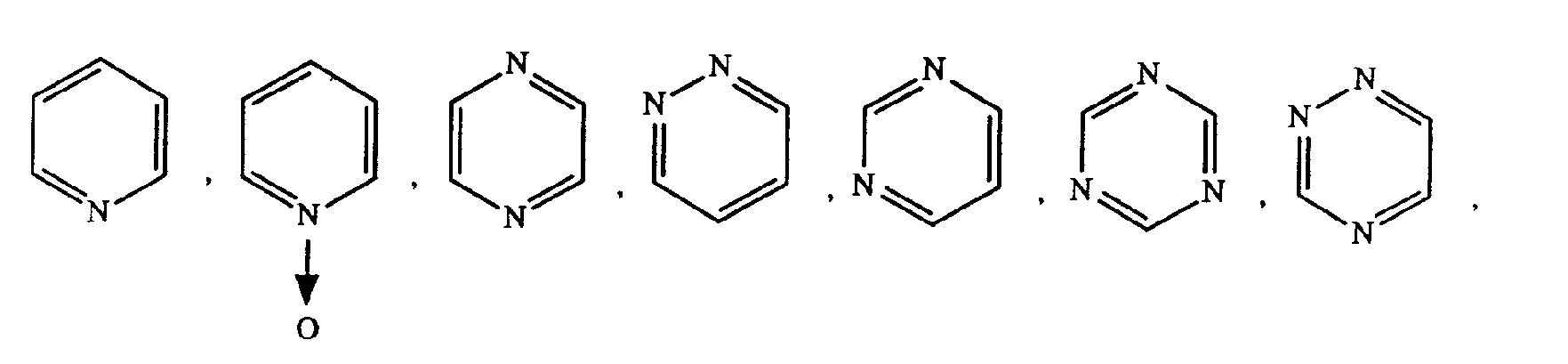





und

welche unsubstituiert sind oder je nach den Substitutionsmöglichkeiten des Ringsystems bis zu vier der in Anspruch 1 definierten Substituenten tragen, worin E für C1-C3-Alkyl und Y für Wasserstoff, C1-C3-Alkyl oder Cyclopropyl stehen und welche über ein Kohlenstoffatom des Heterocyclus an das den Rest R2 tragende Kohlenstoffatom der Formel gebunden sind.
9. Eine Verbindung gemäss Anspruch 8 der Formel worin der Rest A unsubstituiert ist oder einen oder zwei Substituenten, ausgewählt aus der Gruppe, bestehend aus Halogen, C1-C3-Alkyl, C1-C3-Halogenalkyl, C1-C3-Halogenalkoxy und C1-C3-Alkoxy, trägt.
10. Eine Verbindung gemäss Anspruch 9 der Formel I, worin der Rest A ein von Pyridin oder Thiazol abgeleiteter Rest ist.
11. Eine Verbindung gemäss Anspruch 10 der Formel worin der Rest A Pyrid-3-yl, 2-Halogenpyrid-5-yl, 2,3-Dihalogenpyrid-5-yl, 2-Halogen-1-oxido-5-pyridinio oder 2-Halogenthiazol-5-yl ist.
12. Eine Verbindung gemäss Anspruch 11 der Formel worin =X für =N-N02, =N-CN oder =CH-N02 steht.
13. Eine Verbindung gemäss Anspruch 12 der Formel worin
stehen.
R1 für Wasserstoff, C1-C3-Alkyl oder Cyclopropyl,
R2 für Wasserstoff oder Methyl,
R3 für C1-C3-Alkyl und
R4 für C1-C3-Alkyl oder Ethoxycarbonylethyl oder
R3 und R4 gemeinsam für -(CH2)4- oder -(CH2)5- und
R5 für Wasserstoff, Methyl, Ethyl, Phenyl -CH2OCH3, -CN, -COOC2H5 oder

stehen.
14. Eine Verbindung gemäss Anspruch 13 der Formel worin
R1 für Methyl, Ethyl oder Cyclopropyl,
R2 für Wasserstoff,
R3 für Methyl,
R4 für Methyl und
R5 für Wasserstoff oder Methyl stehen.
15. Eine Verbindung gemäss Anspruch 14 der Formel worin der Rest A 2-Chlorpyrid-5-yl ist.
16. Eine Verbindung gemäss Anspruch 15 der Formel worin =X für =N-NO2 oder =CH-N02 steht.
17. N-(2-Chlorpyrid-5-ylmethyl)-N-methyl-N'-(N,N-dimethylaminomethylen)-N"-nitro-guanidin gemäss Anspruch 1.
18. 1-[N-(2-Chlorpyrid-5-ylmethyl)-N-methyl-amino]-1-(N,N-dimethylaminomethylenamino)-2-nitro-äthen gemäss Anspruch 1.
19. N-(2-Chlorpyrid-5-ylmethyl)-N-cyclopropyl-N'-(N,N-dimethylaminomethylen)-N"-nitro-guanidin gemäss Anspruch 1.
20. Eine Verbindung gemäss Anspruch 1 der Formel I, ausgewählt aus der Gruppe, bestehend aus den Verbindungen
(b) N-(2-Chlorpyrid-5-ylmethyl)-N-methyl-N'-[1-(N,N-dimethylamino)ethyliden]-N"-nitro-guanidin,
(c) N-Pyrid-3-ylmethyl-N-methyl-N'-(N,N-dimethylaminomethylen)-N"-nitro-guanidin,
(d) N-(2-Chlorpyrid-5-ylmethyl)-N-methyl-N'-(N,N-dimethylaminomethylen)-N"-nitro-guanidin,
(f) 1-[N-(2-Chlorpyrid-5-ylmethyl)-N-ethyl-amino]-1-(N,N-dimethylaminomethylenamino)-2-nitro-äthen,
(g) 1-[N-(2-Chlorpyrid-5-ylmethyl)-N-cyclopropyl-amino]-1-(N,N-dimethylaminomethylenamino)-2-nitro- äthen,
(h) 1-[N-(2-Chlorthiazol-5-ylmethyl)-N-methyl-amino]-1-(N,N-dimethylaminomethylenamino)-2-nitro-äthen,
(i) 1-[N-(2-Chlorthiazol-5-ylmethyl)-N-ethyl-amino]-1-(N,N-dimethylaminomethylenamino)-2-nitro-äthen,
(j)) 1-[N-(2-Chlorthiazol-5-ylmethyl)-N-cyclopropyl-amino]-1-(N,N-dimethylaminomethylenamino)-2-nitro-äthen,
(k) 1-[N-(2-Chlor-1-oxido-5-pyridiniomethyl)-N-methyl-amino]-1-(N,N-dimethylaminomethylenamino)-2-nitro-äthen,
(I) 1-[N-(2-Chlor-1-oxido-5-pyridiniomethyl)-N-ethyl-amino]-1-(N,N-dimethylaminomethylenamino)-2-nitro- äthen,
(m) 1-[N-(2-Chlor-1-oxido-5-pyridiniomethyl)-N-cyclopropyl-amino]-1-(N,N-dimethylaminomethylenami- no)-2-nitro-äthen,
(n) N-(2-Chlorthiazol-5-ylmethyl)-N-methyl-N'-(N,N-dimethylaminomethylen)-N"-nitro-guanidin,
(o) N-(2-Chlorthiazol-5-ylmethyl)-N-ethyl-N'-(N,N-dimethylaminomethylen)-N"-nitro-guanidin,
(p) N-(2-Chlorthiazol-5-ylmethyl)-N-cyclopropyl-N'-(N,N-dimethylaminomethylen)-N"-nitro-guanidin und
(q) N-(2-Chlorpyrid-5-ylmethyl)-N-ethyl-N'-(N,N-dimethylaminomethylen)-N"-nitro-guanidin.
21. Verfahren zur Herstellung einer Verbindung gemäss Anspruch 1 der Formel I, in freier Form oder in Säureadditionssalzform, dadurch gekennzeichnet, dass man
und jeweils die entstehende Verbindung der Formel isoliert oder in ein Säureadditionssalz überführt und dieses isoliert.
a) eine Verbindung der Formel


worin R3, R4 und R5 die für die Formel angegebenen Bedeutungen haben und Rg C1-C4-Alkyl ist, umsetzt oder
worin R1, R2, A und X die für die Formel 1 angegebenen Bedeutungen haben, in einem inerten aprotischen Lösungsmittel mit einer Verbindung der Formel
b) eine Verbindung der Formel

worin R2 und A die für die Formel 1 angegebenen Bedeutungen haben und Hal für Chlor, Brom oder lod steht, in Gegenwart eines Säureakzeptors in einem Lösungsmittel bei -20 bis +120°C mit einer Verbindung der Formel

worin Ri, R3, R4, R5 und X die für die Formel angegebenen Bedeutungen haben, umsetzt
und jeweils die entstehende Verbindung der Formel isoliert oder in ein Säureadditionssalz überführt und dieses isoliert.
22. Schädlingsbekämpfungsmittel, dadurch gekennzeichnet, dass es mindestens eine Verbindung gemäss Anspruch 1 der Formel in freier Form oder in agrochemisch verwendbarer Säureadditionssalzform, als Wirkstoff und mindestens einen Hilfsstoff enthält.
23. Mittel gemäss Anspruch 22 zur Bekämpfung von Insekten und/oder Spinnentieren.
24. Verfahren zur Herstellung eines Mittels gemäss Anspruch 22 oder 23, dadurch gekennzeichnet, dass man den Wirkstoff mit dem (den) Hilfsstoff(en) innig vermischt.
25. Verwendung einer Verbindung gemäss Anspruch 1 der Formel in freier Form oder in agrochemisch verwendbarer Säureadditionssalzform, oder eines Mittels gemäss Anspruch 22 zur Bekämpfung von Schädlingen.
26. Verwendung gemäss Anspruch 25 zur Bekämpfung von Insekten und/oder Spinnentieren.
27. Verwendung gemäss Anspruch 25 zur Behandlung von Saatgut.
28. Verwendung einer Verbindung gemäss Anspruch 1 der Formel in freier Form oder in agrochemisch verwendbarer Säureadditionssalzform, zur Herstellung eines Mittels gemäss Anspruch 22 oder 23.
29. Verfahren zur Bekämpfung von Schädlingen, dadurch gekennzeichnet, dass man eine Verbindung gemäss Anspruch 1 der Formel in freier Form oder in agrochemisch verwendbarer Säureadditionssalzform, oder ein Mittel gemäss Anspruch 22 oder 23 auf die Schädlinge und/oder ihren Lebensraum appliziert.
30. Verfahren gemäss Anspruch 29 zur Bekämpfung von Insekten und/oder Spinnentieren.
31. Verfahren gemäss Anspruch 29 zum Schutz von Saatgut, dadurch gekennzeichnet, dass man das Saatgut oder die Saatfurche behandelt.
32. Saatgut, behandelt gemäss dem in Anspruch 31 beschriebenen Verfahren.

worin Ri, R3, R4, R5 und X die in Anspruch 1 für die Formel angegebenen Bedeutungen haben.
worin Ri, R3, R4, R5 und X die in Anspruch 1 für die Formel angegebenen Bedeutungen haben.
33. Eine Verbindung gemäss Anspruch 33 der Formel V, ausgewählt aus der Gruppe, bestehend aus den Verbindungen
N-Cyclopropyl-N'-(N,N-dimethylaminomethylen)-N"-nitro-guanidin,
N-(N,N-Dimethylaminomethylen)-N'-methyl-N"-nitro-guanidin und
1-(N,N-Dimethylaminomethylenamino)-1-(N-methylamino)-2-nitro-aethen.
Applications Claiming Priority (2)
| Application Number | Priority Date | Filing Date | Title |
|---|---|---|---|
| CH100491 | 1991-04-04 | ||
| CH1004/91 | 1991-04-04 |
Publications (1)
| Publication Number | Publication Date |
|---|---|
| EP0507736A1 true EP0507736A1 (de) | 1992-10-07 |
Family
ID=4200213
Family Applications (1)
| Application Number | Title | Priority Date | Filing Date |
|---|---|---|---|
| EP92810225A Withdrawn EP0507736A1 (de) | 1991-04-04 | 1992-03-26 | Heterozyklische Amidinderivate und ihre Verwendung als Schädlingsbekämpfungsmittel |
Country Status (17)
| Country | Link |
|---|---|
| US (1) | US5223520A (de) |
| EP (1) | EP0507736A1 (de) |
| JP (1) | JPH05117237A (de) |
| KR (1) | KR920019753A (de) |
| CN (1) | CN1065456A (de) |
| AU (1) | AU1403692A (de) |
| BG (1) | BG96179A (de) |
| BR (1) | BR9201197A (de) |
| CA (1) | CA2064920A1 (de) |
| CS (1) | CS99892A3 (de) |
| HU (1) | HUT60721A (de) |
| IE (1) | IE921080A1 (de) |
| IL (1) | IL101383A0 (de) |
| MX (1) | MX9201540A (de) |
| TR (1) | TR25812A (de) |
| TW (1) | TW202434B (de) |
| ZA (1) | ZA922450B (de) |
Families Citing this family (3)
| Publication number | Priority date | Publication date | Assignee | Title |
|---|---|---|---|---|
| US6436972B1 (en) | 2000-04-10 | 2002-08-20 | Dalhousie University | Pyridones and their use as modulators of serine hydrolase enzymes |
| US7781650B2 (en) * | 2007-04-30 | 2010-08-24 | Monsanto Technology Llc | Plants and seeds of corn variety CV202909 |
| US10542709B2 (en) | 2018-05-29 | 2020-01-28 | Monsanto Technology Llc | Plants and seeds of hybrid corn variety CH672558 |
Citations (4)
| Publication number | Priority date | Publication date | Assignee | Title |
|---|---|---|---|---|
| EP0254859A2 (de) * | 1986-07-01 | 1988-02-03 | Nihon Tokushu Noyaku Seizo K.K. | Alkylendiamine |
| EP0375907A1 (de) * | 1988-11-29 | 1990-07-04 | Nihon Bayer Agrochem K.K. | Nitroverbindungen als Insektizide |
| EP0376279A2 (de) * | 1988-12-27 | 1990-07-04 | Takeda Chemical Industries, Ltd. | Guanidin-Derivate, ihre Herstellung und Insektizide |
| EP0418199A2 (de) * | 1989-09-13 | 1991-03-20 | Ciba-Geigy Ag | Guanidinderivate |
Family Cites Families (2)
| Publication number | Priority date | Publication date | Assignee | Title |
|---|---|---|---|---|
| DE3886467T2 (de) * | 1987-08-01 | 1994-06-01 | Takeda Chemical Industries Ltd | Alpha-ungesättigte Amine, ihre Herstellung und Verwendung. |
| DK0383091T3 (da) * | 1989-02-13 | 1994-02-07 | Bayer Agrochem Kk | Insecticidt virksomme nitroforbindelser |
-
1992
- 1992-03-24 TW TW081102203A patent/TW202434B/zh active
- 1992-03-26 IL IL101383A patent/IL101383A0/xx unknown
- 1992-03-26 EP EP92810225A patent/EP0507736A1/de not_active Withdrawn
- 1992-03-27 US US07/858,910 patent/US5223520A/en not_active Expired - Fee Related
- 1992-04-02 CA CA002064920A patent/CA2064920A1/en not_active Abandoned
- 1992-04-02 JP JP4109199A patent/JPH05117237A/ja active Pending
- 1992-04-02 CS CS92998A patent/CS99892A3/cs unknown
- 1992-04-02 KR KR1019920005526A patent/KR920019753A/ko not_active Withdrawn
- 1992-04-03 CN CN92102347A patent/CN1065456A/zh active Pending
- 1992-04-03 BG BG096179A patent/BG96179A/bg unknown
- 1992-04-03 TR TR92/0294A patent/TR25812A/xx unknown
- 1992-04-03 IE IE108092A patent/IE921080A1/en unknown
- 1992-04-03 HU HU9201140A patent/HUT60721A/hu unknown
- 1992-04-03 BR BR929201197A patent/BR9201197A/pt not_active Application Discontinuation
- 1992-04-03 MX MX9201540A patent/MX9201540A/es unknown
- 1992-04-03 ZA ZA922450A patent/ZA922450B/xx unknown
- 1992-04-03 AU AU14036/92A patent/AU1403692A/en not_active Abandoned
Patent Citations (4)
| Publication number | Priority date | Publication date | Assignee | Title |
|---|---|---|---|---|
| EP0254859A2 (de) * | 1986-07-01 | 1988-02-03 | Nihon Tokushu Noyaku Seizo K.K. | Alkylendiamine |
| EP0375907A1 (de) * | 1988-11-29 | 1990-07-04 | Nihon Bayer Agrochem K.K. | Nitroverbindungen als Insektizide |
| EP0376279A2 (de) * | 1988-12-27 | 1990-07-04 | Takeda Chemical Industries, Ltd. | Guanidin-Derivate, ihre Herstellung und Insektizide |
| EP0418199A2 (de) * | 1989-09-13 | 1991-03-20 | Ciba-Geigy Ag | Guanidinderivate |
Also Published As
| Publication number | Publication date |
|---|---|
| JPH05117237A (ja) | 1993-05-14 |
| TW202434B (de) | 1993-03-21 |
| BG96179A (bg) | 1993-12-24 |
| IE921080A1 (en) | 1992-10-07 |
| ZA922450B (en) | 1993-04-05 |
| CS99892A3 (en) | 1992-10-14 |
| AU1403692A (en) | 1992-10-08 |
| CN1065456A (zh) | 1992-10-21 |
| TR25812A (tr) | 1993-09-01 |
| HU9201140D0 (en) | 1992-06-29 |
| BR9201197A (pt) | 1992-12-01 |
| HUT60721A (en) | 1992-10-28 |
| MX9201540A (es) | 1992-10-01 |
| KR920019753A (ko) | 1992-11-19 |
| US5223520A (en) | 1993-06-29 |
| CA2064920A1 (en) | 1992-10-05 |
| IL101383A0 (en) | 1992-11-15 |
Similar Documents
| Publication | Publication Date | Title |
|---|---|---|
| EP0580553B1 (de) | Oxadiazinderivate | |
| DE19511269A1 (de) | Pyrazole | |
| EP0483055A1 (de) | Triazacyclohexanderivate | |
| EP0423072A2 (de) | Thienylthioharnstoffe, -isothioharnstoffe und -carbodiimide | |
| EP0483052B1 (de) | Picolinoxide | |
| EP0581725A1 (de) | Benzophenonhydrazone | |
| EP0467840A2 (de) | Cyclopropylessigsäurederivate | |
| EP0418199A2 (de) | Guanidinderivate | |
| EP0577555B1 (de) | Carbonsäurederivate | |
| EP0540472B1 (de) | Buttersäurederivate, Verfahren zu ihrer Herstellung und ihre Verwendung als Schädlingsbekämpfung | |
| EP0413666B1 (de) | Buttersäurederivate | |
| EP0406163A1 (de) | Thioxotetrazoline | |
| EP0662472B1 (de) | Hydrazonderivate als Schädlingsbekämpfungsmittel | |
| EP0559612B1 (de) | Dioxolanderivate als Schädlingsbekämpfungsmittel | |
| EP0394191B1 (de) | Sulfenylierte Carbaminsäureester | |
| DE69427225T2 (de) | 2-nitromethyliden/2-cyanimino/2-nitroimino-pyrrolidine und piperidine, zwischenprodukte und ihre verwendung als pesticide | |
| EP0404720B1 (de) | Pestizides Mittel | |
| EP0566534A1 (de) | Benzophenonderivate | |
| US5223520A (en) | Pyridine compounds which are useful as pesticides | |
| EP0472497A1 (de) | Thiobuttersäurederivate | |
| EP0407346A2 (de) | Aminopyridine | |
| EP0395582A2 (de) | Bisacyläthylamine | |
| DE4139849A1 (de) | Pyrazolylphosphorverbindungen | |
| AU640999B2 (en) | Nitroenamine derivatives | |
| DE4236126A1 (de) | Cyclische buttersaeureamide |
Legal Events
| Date | Code | Title | Description |
|---|---|---|---|
| PUAI | Public reference made under article 153(3) epc to a published international application that has entered the european phase |
Free format text: ORIGINAL CODE: 0009012 |
|
| AK | Designated contracting states |
Kind code of ref document: A1 Designated state(s): AT BE CH DE DK ES FR GB GR IT LI LU NL PT |
|
| 17P | Request for examination filed |
Effective date: 19930301 |
|
| 18D | Application deemed to be withdrawn |
Effective date: 19951003 |