EP0507748A1 - Elastifiziertes Kunstleder - Google Patents
Elastifiziertes Kunstleder Download PDFInfo
- Publication number
- EP0507748A1 EP0507748A1 EP92830157A EP92830157A EP0507748A1 EP 0507748 A1 EP0507748 A1 EP 0507748A1 EP 92830157 A EP92830157 A EP 92830157A EP 92830157 A EP92830157 A EP 92830157A EP 0507748 A1 EP0507748 A1 EP 0507748A1
- Authority
- EP
- European Patent Office
- Prior art keywords
- elasticized
- fibers
- woven
- artificial leather
- synthetic polymer
- Prior art date
- Legal status (The legal status is an assumption and is not a legal conclusion. Google has not performed a legal analysis and makes no representation as to the accuracy of the status listed.)
- Granted
Links
Images


Classifications
-
- D—TEXTILES; PAPER
- D06—TREATMENT OF TEXTILES OR THE LIKE; LAUNDERING; FLEXIBLE MATERIALS NOT OTHERWISE PROVIDED FOR
- D06N—WALL, FLOOR, OR LIKE COVERING MATERIALS, e.g. LINOLEUM, OILCLOTH, ARTIFICIAL LEATHER, ROOFING FELT, CONSISTING OF A FIBROUS WEB COATED WITH A LAYER OF MACROMOLECULAR MATERIAL; FLEXIBLE SHEET MATERIAL NOT OTHERWISE PROVIDED FOR
- D06N3/00—Artificial leather, oilcloth or other material obtained by covering fibrous webs with macromolecular material, e.g. resins, rubber or derivatives thereof
- D06N3/12—Artificial leather, oilcloth or other material obtained by covering fibrous webs with macromolecular material, e.g. resins, rubber or derivatives thereof with macromolecular compounds obtained otherwise than by reactions only involving carbon-to-carbon unsaturated bonds, e.g. gelatine proteins
- D06N3/14—Artificial leather, oilcloth or other material obtained by covering fibrous webs with macromolecular material, e.g. resins, rubber or derivatives thereof with macromolecular compounds obtained otherwise than by reactions only involving carbon-to-carbon unsaturated bonds, e.g. gelatine proteins with polyurethanes
-
- D—TEXTILES; PAPER
- D06—TREATMENT OF TEXTILES OR THE LIKE; LAUNDERING; FLEXIBLE MATERIALS NOT OTHERWISE PROVIDED FOR
- D06N—WALL, FLOOR, OR LIKE COVERING MATERIALS, e.g. LINOLEUM, OILCLOTH, ARTIFICIAL LEATHER, ROOFING FELT, CONSISTING OF A FIBROUS WEB COATED WITH A LAYER OF MACROMOLECULAR MATERIAL; FLEXIBLE SHEET MATERIAL NOT OTHERWISE PROVIDED FOR
- D06N3/00—Artificial leather, oilcloth or other material obtained by covering fibrous webs with macromolecular material, e.g. resins, rubber or derivatives thereof
- D06N3/0002—Artificial leather, oilcloth or other material obtained by covering fibrous webs with macromolecular material, e.g. resins, rubber or derivatives thereof characterised by the substrate
- D06N3/0015—Artificial leather, oilcloth or other material obtained by covering fibrous webs with macromolecular material, e.g. resins, rubber or derivatives thereof characterised by the substrate using fibres of specified chemical or physical nature, e.g. natural silk
- D06N3/0025—Rubber threads; Elastomeric fibres; Stretchable, bulked or crimped fibres; Retractable, crimpable fibres; Shrinking or stretching of fibres during manufacture; Obliquely threaded fabrics
- D06N3/0027—Rubber or elastomeric fibres
-
- D—TEXTILES; PAPER
- D06—TREATMENT OF TEXTILES OR THE LIKE; LAUNDERING; FLEXIBLE MATERIALS NOT OTHERWISE PROVIDED FOR
- D06N—WALL, FLOOR, OR LIKE COVERING MATERIALS, e.g. LINOLEUM, OILCLOTH, ARTIFICIAL LEATHER, ROOFING FELT, CONSISTING OF A FIBROUS WEB COATED WITH A LAYER OF MACROMOLECULAR MATERIAL; FLEXIBLE SHEET MATERIAL NOT OTHERWISE PROVIDED FOR
- D06N3/00—Artificial leather, oilcloth or other material obtained by covering fibrous webs with macromolecular material, e.g. resins, rubber or derivatives thereof
- D06N3/0002—Artificial leather, oilcloth or other material obtained by covering fibrous webs with macromolecular material, e.g. resins, rubber or derivatives thereof characterised by the substrate
- D06N3/0015—Artificial leather, oilcloth or other material obtained by covering fibrous webs with macromolecular material, e.g. resins, rubber or derivatives thereof characterised by the substrate using fibres of specified chemical or physical nature, e.g. natural silk
- D06N3/0025—Rubber threads; Elastomeric fibres; Stretchable, bulked or crimped fibres; Retractable, crimpable fibres; Shrinking or stretching of fibres during manufacture; Obliquely threaded fabrics
- D06N3/0029—Stretchable fibres; Stretching of fibres during manufacture
-
- Y—GENERAL TAGGING OF NEW TECHNOLOGICAL DEVELOPMENTS; GENERAL TAGGING OF CROSS-SECTIONAL TECHNOLOGIES SPANNING OVER SEVERAL SECTIONS OF THE IPC; TECHNICAL SUBJECTS COVERED BY FORMER USPC CROSS-REFERENCE ART COLLECTIONS [XRACs] AND DIGESTS
- Y10—TECHNICAL SUBJECTS COVERED BY FORMER USPC
- Y10S—TECHNICAL SUBJECTS COVERED BY FORMER USPC CROSS-REFERENCE ART COLLECTIONS [XRACs] AND DIGESTS
- Y10S428/00—Stock material or miscellaneous articles
- Y10S428/904—Artificial leather
-
- Y—GENERAL TAGGING OF NEW TECHNOLOGICAL DEVELOPMENTS; GENERAL TAGGING OF CROSS-SECTIONAL TECHNOLOGIES SPANNING OVER SEVERAL SECTIONS OF THE IPC; TECHNICAL SUBJECTS COVERED BY FORMER USPC CROSS-REFERENCE ART COLLECTIONS [XRACs] AND DIGESTS
- Y10—TECHNICAL SUBJECTS COVERED BY FORMER USPC
- Y10T—TECHNICAL SUBJECTS COVERED BY FORMER US CLASSIFICATION
- Y10T428/00—Stock material or miscellaneous articles
- Y10T428/249921—Web or sheet containing structurally defined element or component
- Y10T428/249953—Composite having voids in a component [e.g., porous, cellular, etc.]
- Y10T428/249978—Voids specified as micro
- Y10T428/249979—Specified thickness of void-containing component [absolute or relative] or numerical cell dimension
-
- Y—GENERAL TAGGING OF NEW TECHNOLOGICAL DEVELOPMENTS; GENERAL TAGGING OF CROSS-SECTIONAL TECHNOLOGIES SPANNING OVER SEVERAL SECTIONS OF THE IPC; TECHNICAL SUBJECTS COVERED BY FORMER USPC CROSS-REFERENCE ART COLLECTIONS [XRACs] AND DIGESTS
- Y10—TECHNICAL SUBJECTS COVERED BY FORMER USPC
- Y10T—TECHNICAL SUBJECTS COVERED BY FORMER US CLASSIFICATION
- Y10T428/00—Stock material or miscellaneous articles
- Y10T428/29—Coated or structually defined flake, particle, cell, strand, strand portion, rod, filament, macroscopic fiber or mass thereof
- Y10T428/2913—Rod, strand, filament or fiber
- Y10T428/2933—Coated or with bond, impregnation or core
- Y10T428/2936—Wound or wrapped core or coating [i.e., spiral or helical]
-
- Y—GENERAL TAGGING OF NEW TECHNOLOGICAL DEVELOPMENTS; GENERAL TAGGING OF CROSS-SECTIONAL TECHNOLOGIES SPANNING OVER SEVERAL SECTIONS OF THE IPC; TECHNICAL SUBJECTS COVERED BY FORMER USPC CROSS-REFERENCE ART COLLECTIONS [XRACs] AND DIGESTS
- Y10—TECHNICAL SUBJECTS COVERED BY FORMER USPC
- Y10T—TECHNICAL SUBJECTS COVERED BY FORMER US CLASSIFICATION
- Y10T428/00—Stock material or miscellaneous articles
- Y10T428/31504—Composite [nonstructural laminate]
- Y10T428/31551—Of polyamidoester [polyurethane, polyisocyanate, polycarbamate, etc.]
-
- Y—GENERAL TAGGING OF NEW TECHNOLOGICAL DEVELOPMENTS; GENERAL TAGGING OF CROSS-SECTIONAL TECHNOLOGIES SPANNING OVER SEVERAL SECTIONS OF THE IPC; TECHNICAL SUBJECTS COVERED BY FORMER USPC CROSS-REFERENCE ART COLLECTIONS [XRACs] AND DIGESTS
- Y10—TECHNICAL SUBJECTS COVERED BY FORMER USPC
- Y10T—TECHNICAL SUBJECTS COVERED BY FORMER US CLASSIFICATION
- Y10T428/00—Stock material or miscellaneous articles
- Y10T428/31504—Composite [nonstructural laminate]
- Y10T428/31551—Of polyamidoester [polyurethane, polyisocyanate, polycarbamate, etc.]
- Y10T428/31565—Next to polyester [polyethylene terephthalate, etc.]
-
- Y—GENERAL TAGGING OF NEW TECHNOLOGICAL DEVELOPMENTS; GENERAL TAGGING OF CROSS-SECTIONAL TECHNOLOGIES SPANNING OVER SEVERAL SECTIONS OF THE IPC; TECHNICAL SUBJECTS COVERED BY FORMER USPC CROSS-REFERENCE ART COLLECTIONS [XRACs] AND DIGESTS
- Y10—TECHNICAL SUBJECTS COVERED BY FORMER USPC
- Y10T—TECHNICAL SUBJECTS COVERED BY FORMER US CLASSIFICATION
- Y10T428/00—Stock material or miscellaneous articles
- Y10T428/31504—Composite [nonstructural laminate]
- Y10T428/31551—Of polyamidoester [polyurethane, polyisocyanate, polycarbamate, etc.]
- Y10T428/31591—Next to cellulosic
-
- Y—GENERAL TAGGING OF NEW TECHNOLOGICAL DEVELOPMENTS; GENERAL TAGGING OF CROSS-SECTIONAL TECHNOLOGIES SPANNING OVER SEVERAL SECTIONS OF THE IPC; TECHNICAL SUBJECTS COVERED BY FORMER USPC CROSS-REFERENCE ART COLLECTIONS [XRACs] AND DIGESTS
- Y10—TECHNICAL SUBJECTS COVERED BY FORMER USPC
- Y10T—TECHNICAL SUBJECTS COVERED BY FORMER US CLASSIFICATION
- Y10T428/00—Stock material or miscellaneous articles
- Y10T428/31504—Composite [nonstructural laminate]
- Y10T428/31725—Of polyamide
- Y10T428/31779—Next to cellulosic
-
- Y—GENERAL TAGGING OF NEW TECHNOLOGICAL DEVELOPMENTS; GENERAL TAGGING OF CROSS-SECTIONAL TECHNOLOGIES SPANNING OVER SEVERAL SECTIONS OF THE IPC; TECHNICAL SUBJECTS COVERED BY FORMER USPC CROSS-REFERENCE ART COLLECTIONS [XRACs] AND DIGESTS
- Y10—TECHNICAL SUBJECTS COVERED BY FORMER USPC
- Y10T—TECHNICAL SUBJECTS COVERED BY FORMER US CLASSIFICATION
- Y10T442/00—Fabric [woven, knitted, or nonwoven textile or cloth, etc.]
- Y10T442/20—Coated or impregnated woven, knit, or nonwoven fabric which is not [a] associated with another preformed layer or fiber layer or, [b] with respect to woven and knit, characterized, respectively, by a particular or differential weave or knit, wherein the coating or impregnation is neither a foamed material nor a free metal or alloy layer
- Y10T442/2033—Coating or impregnation formed in situ [e.g., by interfacial condensation, coagulation, precipitation, etc.]
-
- Y—GENERAL TAGGING OF NEW TECHNOLOGICAL DEVELOPMENTS; GENERAL TAGGING OF CROSS-SECTIONAL TECHNOLOGIES SPANNING OVER SEVERAL SECTIONS OF THE IPC; TECHNICAL SUBJECTS COVERED BY FORMER USPC CROSS-REFERENCE ART COLLECTIONS [XRACs] AND DIGESTS
- Y10—TECHNICAL SUBJECTS COVERED BY FORMER USPC
- Y10T—TECHNICAL SUBJECTS COVERED BY FORMER US CLASSIFICATION
- Y10T442/00—Fabric [woven, knitted, or nonwoven textile or cloth, etc.]
- Y10T442/20—Coated or impregnated woven, knit, or nonwoven fabric which is not [a] associated with another preformed layer or fiber layer or, [b] with respect to woven and knit, characterized, respectively, by a particular or differential weave or knit, wherein the coating or impregnation is neither a foamed material nor a free metal or alloy layer
- Y10T442/2041—Two or more non-extruded coatings or impregnations
- Y10T442/2098—At least two coatings or impregnations of different chemical composition
-
- Y—GENERAL TAGGING OF NEW TECHNOLOGICAL DEVELOPMENTS; GENERAL TAGGING OF CROSS-SECTIONAL TECHNOLOGIES SPANNING OVER SEVERAL SECTIONS OF THE IPC; TECHNICAL SUBJECTS COVERED BY FORMER USPC CROSS-REFERENCE ART COLLECTIONS [XRACs] AND DIGESTS
- Y10—TECHNICAL SUBJECTS COVERED BY FORMER USPC
- Y10T—TECHNICAL SUBJECTS COVERED BY FORMER US CLASSIFICATION
- Y10T442/00—Fabric [woven, knitted, or nonwoven textile or cloth, etc.]
- Y10T442/20—Coated or impregnated woven, knit, or nonwoven fabric which is not [a] associated with another preformed layer or fiber layer or, [b] with respect to woven and knit, characterized, respectively, by a particular or differential weave or knit, wherein the coating or impregnation is neither a foamed material nor a free metal or alloy layer
- Y10T442/2369—Coating or impregnation improves elasticity, bendability, resiliency, flexibility, or shape retention of the fabric
- Y10T442/2377—Improves elasticity
Definitions
- the present invention relates to a new elasticized artificial leather and a process for its production.
- an artificial leather made from a woven material in which at least the threads of the weft are made of an elastomeric fiber, makes it possible to obtain a product which, as well as looking exceptionally like natural leather from an aesthetic point of view, is more modellable than the artificial leathers known from the prior art, and has a much greater elasticity than that of natural leathers.
- Object of the present invention is therefore an elasticized artificial leather characterized in that it is made of a woven support material comprising warp threads and weft threads, coated on at least one of its two sides with a layer of synthetic polymer, the weft threads in said woven material being formed by elasticized yarn produced using elastomeric fibers.
- a further object of the present invention is a process for the production of elasticized artificial leather, including the operations of:
- the elasticized artificial leather according to the present invention is formed by a woven support material, which is then coated on at least one side by at least one layer of synthetic polymer.
- the woven material has the threads forming its warp made of cellulose fibers, such as cotton or the like, alone or mixed with polyester fibers (used to increase strength).
- the polyester fibers are present in a quantity ranging from 0 to 70%, with reference to the total amount of fibers employed for production of the warp.
- the weft of the support material is made of elasticized yarn.
- a particularly preferred embodiment uses threads based on segmented polyurethane, such as Lycra (segmented polyurethane elastofiber produced by Du Pont).
- the elasticized thread forming the weft of the woven support material is coated with two layers of fiber material.
- the first layer is made up of polyamide fibers to regulate the elasticity of the finished product; said polyamide fibers are then covered, during twisting, with a cellulose fiber thread or with a thread of mixed cellulose-polyester fiber.
- the polyester thread content can be substantially of up to 50%.
- the woven support material for the elasticized leather according to the present invention is covered on at least one of its two sides with at least one layer of synthetic polymer.
- Said synthetic polymer is chosen from the class formed by polyurethanes, dissolved in their solvents.
- monocomponent polyurethanes with a sequential structure are used, which alternate rigid segments and soft segments, with a strictly linear structure, obtained by polymerization from:
- the coating of synthetic polymer can take place on one or on both sides of the woven material; it is possible to coat a double layer of the same or different synthetic polymer on both sides of the support material. Coagulation of the synthetic polymer applied onto the woven support material, which will be better described here below, gives the finished elasticized leather a porosity very similar to that of natural leather.
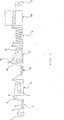
- Figure 4 shows the elasticized leather 17 according to the invention.
- the warp threads 19 are made of cellulose fibers or mixed cellulose/polyester fibers.
- the weft threads 20 are made of an elasticized yarn 21 (made of segmented polyurethane) coated with an inner layer of polyamide fibers and then covered an outer layer of cellulose threads. Both these layers are not shown separately but are indicated together with 22.
- two layers of polyurethane have been applied, indicated with and 23 and 24, respectively, have been applied.
- the pores obtained have a diameter comprised between 10 and 80 ⁇ m, preferably between 30 and 50 ⁇ m.
- the elasticized leather according to the present invention has a number of advantages with respect to the products belonging to the prior art, said advantages being essentially provided by its elastic structure due to the elastomeric fiber forming the weft of the woven support material.
- the product obtained is a material having the appearance of natural leather, which is also capable of stretching when put under traction, returning immediately to its original size. This characteristic renders the articles made therefrom more modellable and more resistant. In fact the characteristic of elasticity makes it possible to prevent the stress loads of the manufactured article itself from discharging into limited areas, causing wear and consequently breakage more rapidly than is seen in articles made of natural leather.
- the elasticized leather according to the present invention can be finished by means of subsequent operations similar to those used for natural finished leathers.
- the great similarity of this material to natural leather is in fact due to its internal structure, which gives a particularly faithful reproduction of the flesh side of natural leather.
- the elasticized leather object of the present invention can undergo a large number of different treatments to give it a wide variety of appearances, to name but a few suede, calf, patent leather, reptile skin etc., according to the requirements of the final user.
- a process for production of elasticized leather will now be described as a non-limiting example.
- the woven support material in which it is assumed that the warp is made of cotton or other cellulose fibers, optionally mixed with polyester fibers, and the weft is made of elasticized yarn, after having been coated with substantially non-extensible materials, such as polyamides, for example, and covered during the twisting stage with a thread of cellulose fiber such as cotton or a mixed cellulose/polyester fiber, has to undergo further treatments before the synthetic polymer is applied and then coagulated.
- the treatments which the woven support material has to undergo are the following:
- the synthetic polymer is applied and then coagulated.
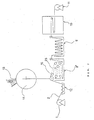
- FIG. 1 there is shown schematically a plant performing the process according to the present invention.
- a feeding roller 1 which contains woven support material that has undergone the heat fixing process described above, the material 2 is unwound and immersed in a bath 3 containing the synthetic polymer to be applied, dissolved in its solvent.
- the polymers to be applied it is possible to mention, for example, polyurethanes, preferably those having a molecular weight of between 50.000 and 150.000.
- the content in dry synthetic polymer is of between 7 and 12% by weight of the solution, and it is pigmented with the desired colour.
- the solution must have a viscosity of between 200 and 300 cps.
- rollers 4 define the route taken by the material 2.
- the material 2 then crosses rollers 5 and 6 which control the thickness of the layer of synthetic polymer applied onto the material itself, causing any excess solution taken up by the material 2 to fall back into the bath 3.
- figure 2 is shown an alternative version of the process according to the present invention, in which the material 2 enters the bath 12 and passes over the roller 14, application by means of direct spreading being controlled by means of the doctor blade 15 which controls the thickness, cooperating with the roller 14, said detail being shown in an enlarged scale in said figure.
- the material 2, held up by rollers 16, is then fed into the bath 8.
- the content in synthetic polymer of the solution will be of 12-20% by weight with respect to the solvent, and the final viscosity will be between 600 and 1000 cps.
- FIG 3 is shown another alternative version of the process according to the present invention, according to which it is possible to apply a first layer of synthetic polymer by means of impregnation in the bath 4 and a second layer by means of spreading controlled by the wiping blade 15.
- the two layers of coating on the support material can be either the same or different.
- the support material 2 after leaving the calibrating rollers 5 and 6, enters the bath 8 supported by rollers 7.
- the bath 8 there is a mixture of a solvent of the coating polymer and a non-solvent of the same polymer, said solvent and said non-solvent being totally or largely miscible one with the other.
- the composition of the solvent/non-solvent mixture is the following: non-solvent 65 - 80%, solvent 20 - 35%.
- the combined action of the solvent and of the non-solvent on the synthetic polymer causes the coating to harden and form an open-cell microporous structure having a size (diameter) of between 10 and 80 ⁇ m, preferably of between 30 and 50 ⁇ m.
- the coagulation process takes place within the bath 8 at room temperature.
- the woven support material, onto which the synthetic polymer has been applied and coagulated is immersed in the bath 9 where it is washed using the non-solvent, so as to remove any residual solvent in the pores which have formed and so as to complete the coagulation process.
- the preferred solvents can be mentioned, for example, dimethylformamide, and among the non-solvents, water.
- the woven support material coated with completely coagulated synthetic polymer after leaving the bath 9, enters the oven 10 in which it is dried, held up by a clip arrangement. The temperature of the oven is adjusted so as to obtain optimum drying without damaging the product (up to a maximum temperature of around 140°C). Finally, the elasticized leather leaving the oven 10 is rolled up on the collection roller 11.
- the elasticized leather manufactured according to the process of the present invention can be further treated to give it the appearance and decorations required by the final user.
- these treatments the following can be mentioned:
- a material having the following characteristics was used: 30 warp threads per cm 17 weft threads per cm Yarn used for warp: mixed (50% cotton - 50% polyester) count NE16.
- Yarn used for the weft 420 decitex elastomer Lycra covered with elasticized 6/6 nylon and twisted with two strands of mixed yarn (50% cotton - 50% polyester) count NE 30.
- the operation of twisting with the two strands of cotton/polyester (450 turns per meter with "S" twisting) is performed after having steam fixed the "S" twist into the nylon.
- the raw material was desized and bleached using stabilized hydrogen peroxide. After drying in the "rameuse" it was passed twice along a raising line; this raising line is made up of 8 raisers on the right side plus two trimmers and of 4 raisers on the back side plus one trimmer. Following the raising operation, the material was heat fixed in the rameuse at 190°C for 1 minute, bringing its height to 155 cm.
- the material prepared for coagulation had the following characteristics: weight 280 g/m 2 ; thickness 0,7 mm; elasticity 40%.
- Coating with polymer was performed by means of spreading (with reference to figure 2) using a solution of polyurethane having a dry content of 12%, coloured black and additioned with 2% of powdered cellulose (ARBOCELL BE 600/30 produced by J. RETTENMAIER & SOHNE - Germany) so as to obtain a viscosity of 600 centipoise.
- ARBOCELL BE 600/30 produced by J. RETTENMAIER & SOHNE - Germany
- a solution of H 2 O/DMF with 30% DMF was used, and during this operation the material was kept slightly stretched (in a transversal direction) using the clip arrangement. After washing and drying, the coagulate was spread with three layers of polyurethane coloured black using a transfer card with "calf" grain.
- the product thus obtained had a weight of 500 g/m 2 , a thickness of 1,1 mm and a residual elasticity of 20%.
- a support having the following characteristics was used: 30 warp threads per cm., 24 weft threads per cm.
- Yarn used for warp pure cotton, count NE16.
- Yarn used for the weft 150 decitex elastomer Lycra covered with 6/6 nylon elasticized and twisted with two strands of pure cotton, count NE 36.
- the operation of twisting is exactly the same as that given in example 1.
- Reinforcement cloth raw height: 240 cm.
- the raw material was desized and bleached, dried in the "rameuse” and passed once along the raising line (as described above in example 1). Following this, the material was heat fixed in the rameuse at 185°C for 1 minute, bringing its height to 150 cm.
- Coating with polymer was performed by means of impregnation (with reference to figure 1), using a solution of polyurethane having a dry content of 10% and a viscosity of 220 centipoise, coloured brown.
- a solution of H 2 O/DMF with 25% DMF was used, and during this operation the material was kept slightly stretched (in a transversal direction) using the clip arrangement. After washing and drying, the coagulate was spread with two layers of polyurethane coloured brown using a transfer card with "soft leather” grain. Following this, the material was print finished with darker brown spotting and a nitrocellulose varnish additioned with wax.
- the product thus obtained had a weight of 280 g/m 2 , a thickness of 0,75 mm and a residual elasticity of 35%.
Landscapes
- Engineering & Computer Science (AREA)
- Textile Engineering (AREA)
- Chemical & Material Sciences (AREA)
- Chemical Kinetics & Catalysis (AREA)
- Dispersion Chemistry (AREA)
- Synthetic Leather, Interior Materials Or Flexible Sheet Materials (AREA)
- Treatment Of Fiber Materials (AREA)
- Polyesters Or Polycarbonates (AREA)
- Treatments Of Macromolecular Shaped Articles (AREA)
- Laminated Bodies (AREA)
- Woven Fabrics (AREA)
- Gloves (AREA)
Applications Claiming Priority (2)
| Application Number | Priority Date | Filing Date | Title |
|---|---|---|---|
| ITRM910227 | 1991-04-05 | ||
| ITRM910227A IT1244503B (it) | 1991-04-05 | 1991-04-05 | Pelle artificiale elasticizzata e procedimento per la sua produzione. |
Publications (2)
| Publication Number | Publication Date |
|---|---|
| EP0507748A1 true EP0507748A1 (de) | 1992-10-07 |
| EP0507748B1 EP0507748B1 (de) | 1996-09-18 |
Family
ID=11400049
Family Applications (1)
| Application Number | Title | Priority Date | Filing Date |
|---|---|---|---|
| EP92830157A Revoked EP0507748B1 (de) | 1991-04-05 | 1992-04-01 | Elastifiziertes Kunstleder |
Country Status (8)
| Country | Link |
|---|---|
| US (1) | US5413846A (de) |
| EP (1) | EP0507748B1 (de) |
| JP (1) | JP3034120B2 (de) |
| AT (1) | ATE143069T1 (de) |
| CA (1) | CA2064496C (de) |
| DE (1) | DE69213799T2 (de) |
| ES (1) | ES2092669T3 (de) |
| IT (1) | IT1244503B (de) |
Cited By (3)
| Publication number | Priority date | Publication date | Assignee | Title |
|---|---|---|---|---|
| GB2311035A (en) * | 1996-03-12 | 1997-09-17 | Fii Footwear Management Ltd | Material for footwear upper |
| ITMI20090898A1 (it) * | 2009-05-21 | 2010-11-22 | Jaked S R L | Membrana in particolare per indumenti da nuoto |
| EP2593299B1 (de) | 2010-07-14 | 2015-10-21 | TRW Automotive Safety Systems GmbH | Lenkrad mit überzug und verfahren zu dessen herstellung |
Families Citing this family (7)
| Publication number | Priority date | Publication date | Assignee | Title |
|---|---|---|---|---|
| JP3014355U (ja) * | 1995-02-03 | 1995-08-08 | 株式会社鈴寅 | 合成皮革および該合成皮革を用いた革靴 |
| JPH1060782A (ja) * | 1996-08-20 | 1998-03-03 | Asahi Chem Ind Co Ltd | 合成皮革 |
| US5784806A (en) * | 1996-08-20 | 1998-07-28 | Wendt; Lydia | Flexible foot gear |
| US20070248787A1 (en) * | 2006-04-24 | 2007-10-25 | Chou Su J | Artificial leather |
| KR101873354B1 (ko) * | 2016-12-19 | 2018-08-02 | 코오롱글로텍주식회사 | 시트용 인조가죽 및 이의 제조방법 |
| US11172725B2 (en) | 2018-10-10 | 2021-11-16 | Tingley Rubber Corporation | Boots with polymeric foam shell and exposed sock liner |
| US12305327B2 (en) * | 2021-04-01 | 2025-05-20 | von Holzhausen | Plant-based biodegradable synthetic leather |
Citations (6)
| Publication number | Priority date | Publication date | Assignee | Title |
|---|---|---|---|---|
| GB620390A (en) * | 1940-06-20 | 1949-03-24 | Sylvania Ind Corp | Process for producing a coated elastic fabric and the product produced |
| US3544357A (en) * | 1966-05-27 | 1970-12-01 | Kuraray Co | Method of manufacturing soft and flexible sheet materials |
| GB1262823A (en) * | 1963-04-01 | 1972-02-09 | Robert Taylor Dawes | Elastically-stretchable leather-like material and method of making the same |
| FR2108839A1 (en) * | 1970-10-12 | 1972-05-26 | Dmr | Imitation leather - with polyurethane layers applied on stretched fabric |
| US4217381A (en) * | 1972-12-28 | 1980-08-12 | Kanebo Ltd. | Leather-like sheet material comprising a urethane elastomer produced from polydipropylene adipate and the process of producing said material |
| USRE32594E (en) * | 1974-06-14 | 1987-02-09 | Krall & Roth Weberei, Kg | Bi-elastic textile fabric |
Family Cites Families (12)
| Publication number | Priority date | Publication date | Assignee | Title |
|---|---|---|---|---|
| US2031375A (en) * | 1933-12-23 | 1936-02-18 | American Mills Company | Noncreep elastic strands for elastic fabrics |
| NL296361A (de) * | 1962-08-13 | 1900-01-01 | ||
| US3199548A (en) * | 1963-05-02 | 1965-08-10 | United Elastic Corp | Elastic fabrics |
| US3524792A (en) * | 1966-11-07 | 1970-08-18 | Robert T Dawes | Elastically-stretchable,leather-like material and method of making the same |
| US3438842A (en) * | 1967-10-20 | 1969-04-15 | Johnson & Johnson | Woven stretch fabric and methods of manufacturing the same |
| CS184491B1 (en) * | 1975-08-29 | 1978-08-31 | Eduard Mueck | Ambroz,ludvik,cs |
| JPS5571876A (en) * | 1978-11-20 | 1980-05-30 | Daiichi Lace Kk | Production of simulated leather |
| DE3040088A1 (de) * | 1980-10-24 | 1982-06-16 | Bayer Ag, 5090 Leverkusen | Elastisches rauhgewebe mit wildlederaehnlicher optik und verfahren zu seiner herstellung |
| DE3316266A1 (de) * | 1983-05-04 | 1984-11-08 | Bayer Ag, 5090 Leverkusen | Elastisches flachgewebe und seine herstellung |
| US4563386A (en) * | 1984-09-19 | 1986-01-07 | Cercasbest Corp. | Friction element comprised of heat resistant heterogeneous thermosetting friction material |
| US4640858A (en) * | 1984-10-29 | 1987-02-03 | M. Lowenstein Corporation | Synthetic leather sheet material products |
| JPH0527883Y2 (de) * | 1987-04-09 | 1993-07-16 |
-
1991
- 1991-04-05 IT ITRM910227A patent/IT1244503B/it active IP Right Grant
-
1992
- 1992-03-31 CA CA002064496A patent/CA2064496C/en not_active Expired - Fee Related
- 1992-04-01 EP EP92830157A patent/EP0507748B1/de not_active Revoked
- 1992-04-01 DE DE69213799T patent/DE69213799T2/de not_active Expired - Fee Related
- 1992-04-01 AT AT92830157T patent/ATE143069T1/de not_active IP Right Cessation
- 1992-04-01 ES ES92830157T patent/ES2092669T3/es not_active Expired - Lifetime
- 1992-04-06 JP JP4083685A patent/JP3034120B2/ja not_active Expired - Fee Related
-
1994
- 1994-02-17 US US08/197,542 patent/US5413846A/en not_active Expired - Fee Related
Patent Citations (6)
| Publication number | Priority date | Publication date | Assignee | Title |
|---|---|---|---|---|
| GB620390A (en) * | 1940-06-20 | 1949-03-24 | Sylvania Ind Corp | Process for producing a coated elastic fabric and the product produced |
| GB1262823A (en) * | 1963-04-01 | 1972-02-09 | Robert Taylor Dawes | Elastically-stretchable leather-like material and method of making the same |
| US3544357A (en) * | 1966-05-27 | 1970-12-01 | Kuraray Co | Method of manufacturing soft and flexible sheet materials |
| FR2108839A1 (en) * | 1970-10-12 | 1972-05-26 | Dmr | Imitation leather - with polyurethane layers applied on stretched fabric |
| US4217381A (en) * | 1972-12-28 | 1980-08-12 | Kanebo Ltd. | Leather-like sheet material comprising a urethane elastomer produced from polydipropylene adipate and the process of producing said material |
| USRE32594E (en) * | 1974-06-14 | 1987-02-09 | Krall & Roth Weberei, Kg | Bi-elastic textile fabric |
Cited By (4)
| Publication number | Priority date | Publication date | Assignee | Title |
|---|---|---|---|---|
| GB2311035A (en) * | 1996-03-12 | 1997-09-17 | Fii Footwear Management Ltd | Material for footwear upper |
| ITMI20090898A1 (it) * | 2009-05-21 | 2010-11-22 | Jaked S R L | Membrana in particolare per indumenti da nuoto |
| EP2593299B1 (de) | 2010-07-14 | 2015-10-21 | TRW Automotive Safety Systems GmbH | Lenkrad mit überzug und verfahren zu dessen herstellung |
| EP2593299B2 (de) † | 2010-07-14 | 2019-01-30 | TRW Automotive Safety Systems GmbH | Lenkrad mit überzug und verfahren zu dessen herstellung |
Also Published As
| Publication number | Publication date |
|---|---|
| US5413846A (en) | 1995-05-09 |
| CA2064496A1 (en) | 1992-10-06 |
| ITRM910227A1 (it) | 1992-10-05 |
| CA2064496C (en) | 2001-07-03 |
| IT1244503B (it) | 1994-07-15 |
| ITRM910227A0 (it) | 1991-04-05 |
| DE69213799T2 (de) | 1997-03-27 |
| EP0507748B1 (de) | 1996-09-18 |
| ATE143069T1 (de) | 1996-10-15 |
| ES2092669T3 (es) | 1996-12-01 |
| DE69213799D1 (de) | 1996-10-24 |
| JP3034120B2 (ja) | 2000-04-17 |
| JPH0593372A (ja) | 1993-04-16 |
Similar Documents
| Publication | Publication Date | Title |
|---|---|---|
| FR2472051A1 (fr) | Article limitant le cuir de daim | |
| US5413846A (en) | Elasticized artificial leather and process for its production | |
| DE1760260A1 (de) | Verfahren zur Herstellung von mit Polyurethanen beschichteten Textilien | |
| DE2638792B2 (de) | Verfahren zur Herstellung von Kunstleder | |
| KR102034033B1 (ko) | 천연섬유원단을 이용한 가죽 질감을 갖는 섬유원단의 제조방법 및 이에 의해 제조된 가죽 질감을 갖는 섬유원단 | |
| CH639159A5 (de) | Verfahren zur herstellung eines wildlederartigen stoffs. | |
| US3690911A (en) | Process for preparing synthetic suede sheets | |
| KR101970598B1 (ko) | 폴리에스테르-에테르 블록공중합체의 원사를 이용한 투명성이 강화된 원단 및 그 제조방법 | |
| DE2858059C2 (de) | Verfahren zur Herstellung eines wildlederartigen Kunstleders | |
| US3524792A (en) | Elastically-stretchable,leather-like material and method of making the same | |
| JPH11256484A (ja) | 光沢のある植毛シートの製造方法 | |
| JP3181639B2 (ja) | ナイロン66編織物 | |
| WO1983000709A1 (fr) | Tricot et piece de vetement en tricot, obtenu sur metier de tricotage circulaire | |
| DE2741527C3 (de) | Wollartiger imprägnierter Textilstoff und Verfahren zu dessen Herstellung | |
| KR910009655B1 (ko) | 은면조(銀面調) 인공피혁의 제조방법 | |
| JPH0120273B2 (de) | ||
| KR101261507B1 (ko) | 연속식 고밀도 수축 시스템 및 이를 포함하는 무 우레탄 고밀도 편물의 제조 방법 | |
| JPH0860557A (ja) | ヌバック調外観を有する皮革様シートおよびその製造方法 | |
| JPH11117181A (ja) | 合成皮革の製造方法 | |
| JPH1060782A (ja) | 合成皮革 | |
| JPS6017872B2 (ja) | 皮革様シ−ト物質の製造法 | |
| JPS63145443A (ja) | 偏平状意匠糸 | |
| TW467984B (en) | Method for producing elastic synthetic leather | |
| JPS60224880A (ja) | 擬革の製造法 | |
| EP0111132A2 (de) | Verfahren und Gerät für die Herstellung von Kunstleder oder Lederfutter und Leder oder Lederfutter auf diese Weise erhalten |
Legal Events
| Date | Code | Title | Description |
|---|---|---|---|
| PUAI | Public reference made under article 153(3) epc to a published international application that has entered the european phase |
Free format text: ORIGINAL CODE: 0009012 |
|
| AK | Designated contracting states |
Kind code of ref document: A1 Designated state(s): AT BE CH DE DK ES FR GB GR IT LI NL PT SE |
|
| 17P | Request for examination filed |
Effective date: 19930114 |
|
| 17Q | First examination report despatched |
Effective date: 19940721 |
|
| GRAG | Despatch of communication of intention to grant |
Free format text: ORIGINAL CODE: EPIDOS AGRA |
|
| GRAH | Despatch of communication of intention to grant a patent |
Free format text: ORIGINAL CODE: EPIDOS IGRA |
|
| GRAH | Despatch of communication of intention to grant a patent |
Free format text: ORIGINAL CODE: EPIDOS IGRA |
|
| GRAA | (expected) grant |
Free format text: ORIGINAL CODE: 0009210 |
|
| AK | Designated contracting states |
Kind code of ref document: B1 Designated state(s): AT BE CH DE DK ES FR GB GR IT LI NL PT SE |
|
| PG25 | Lapsed in a contracting state [announced via postgrant information from national office to epo] |
Ref country code: NL Free format text: LAPSE BECAUSE OF FAILURE TO SUBMIT A TRANSLATION OF THE DESCRIPTION OR TO PAY THE FEE WITHIN THE PRESCRIBED TIME-LIMIT Effective date: 19960918 Ref country code: LI Effective date: 19960918 Ref country code: IT Free format text: LAPSE BECAUSE OF FAILURE TO SUBMIT A TRANSLATION OF THE DESCRIPTION OR TO PAY THE FEE WITHIN THE PRE;WARNING: LAPSES OF ITALIAN PATENTS WITH EFFECTIVE DATE BEFORE 2007 MAY HAVE OCCURRED AT ANY TIME BEFORE 2007. THE CORRECT EFFECTIVE DATE MAY BE DIFFERENT FROM THE ONE RECORDED.SCRIBED TIME-LIMIT Effective date: 19960918 Ref country code: GR Free format text: LAPSE BECAUSE OF FAILURE TO SUBMIT A TRANSLATION OF THE DESCRIPTION OR TO PAY THE FEE WITHIN THE PRESCRIBED TIME-LIMIT Effective date: 19960918 Ref country code: DK Effective date: 19960918 Ref country code: CH Effective date: 19960918 Ref country code: BE Effective date: 19960918 Ref country code: AT Effective date: 19960918 |
|
| REF | Corresponds to: |
Ref document number: 143069 Country of ref document: AT Date of ref document: 19961015 Kind code of ref document: T |
|
| REF | Corresponds to: |
Ref document number: 69213799 Country of ref document: DE Date of ref document: 19961024 |
|
| ET | Fr: translation filed | ||
| REG | Reference to a national code |
Ref country code: ES Ref legal event code: FG2A Ref document number: 2092669 Country of ref document: ES Kind code of ref document: T3 |
|
| PG25 | Lapsed in a contracting state [announced via postgrant information from national office to epo] |
Ref country code: SE Effective date: 19961218 |
|
| REG | Reference to a national code |
Ref country code: PT Ref legal event code: SC4A Free format text: AVAILABILITY OF NATIONAL TRANSLATION Effective date: 19961106 |
|
| NLV1 | Nl: lapsed or annulled due to failure to fulfill the requirements of art. 29p and 29m of the patents act | ||
| REG | Reference to a national code |
Ref country code: CH Ref legal event code: PL |
|
| PLBQ | Unpublished change to opponent data |
Free format text: ORIGINAL CODE: EPIDOS OPPO |
|
| PLBI | Opposition filed |
Free format text: ORIGINAL CODE: 0009260 |
|
| PLBF | Reply of patent proprietor to notice(s) of opposition |
Free format text: ORIGINAL CODE: EPIDOS OBSO |
|
| 26 | Opposition filed |
Opponent name: S.I.S.A. S.P.A. Effective date: 19970610 |
|
| PLBF | Reply of patent proprietor to notice(s) of opposition |
Free format text: ORIGINAL CODE: EPIDOS OBSO |
|
| PLAW | Interlocutory decision in opposition |
Free format text: ORIGINAL CODE: EPIDOS IDOP |
|
| APAC | Appeal dossier modified |
Free format text: ORIGINAL CODE: EPIDOS NOAPO |
|
| APAE | Appeal reference modified |
Free format text: ORIGINAL CODE: EPIDOS REFNO |
|
| APAC | Appeal dossier modified |
Free format text: ORIGINAL CODE: EPIDOS NOAPO |
|
| APAE | Appeal reference modified |
Free format text: ORIGINAL CODE: EPIDOS REFNO |
|
| REG | Reference to a national code |
Ref country code: GB Ref legal event code: IF02 |
|
| PGFP | Annual fee paid to national office [announced via postgrant information from national office to epo] |
Ref country code: GB Payment date: 20030326 Year of fee payment: 12 |
|
| PGFP | Annual fee paid to national office [announced via postgrant information from national office to epo] |
Ref country code: PT Payment date: 20030331 Year of fee payment: 12 |
|
| PGFP | Annual fee paid to national office [announced via postgrant information from national office to epo] |
Ref country code: FR Payment date: 20030411 Year of fee payment: 12 Ref country code: ES Payment date: 20030411 Year of fee payment: 12 |
|
| PGFP | Annual fee paid to national office [announced via postgrant information from national office to epo] |
Ref country code: DE Payment date: 20030528 Year of fee payment: 12 |
|
| PG25 | Lapsed in a contracting state [announced via postgrant information from national office to epo] |
Ref country code: GB Free format text: LAPSE BECAUSE OF NON-PAYMENT OF DUE FEES Effective date: 20040401 |
|
| APBU | Appeal procedure closed |
Free format text: ORIGINAL CODE: EPIDOSNNOA9O |
|
| PG25 | Lapsed in a contracting state [announced via postgrant information from national office to epo] |
Ref country code: PT Free format text: LAPSE BECAUSE OF NON-PAYMENT OF DUE FEES Effective date: 20041015 |
|
| PG25 | Lapsed in a contracting state [announced via postgrant information from national office to epo] |
Ref country code: DE Free format text: LAPSE BECAUSE OF NON-PAYMENT OF DUE FEES Effective date: 20041103 |
|
| GBPC | Gb: european patent ceased through non-payment of renewal fee | ||
| PG25 | Lapsed in a contracting state [announced via postgrant information from national office to epo] |
Ref country code: FR Free format text: LAPSE BECAUSE OF NON-PAYMENT OF DUE FEES Effective date: 20041231 |
|
| REG | Reference to a national code |
Ref country code: FR Ref legal event code: ST |
|
| RDAF | Communication despatched that patent is revoked |
Free format text: ORIGINAL CODE: EPIDOSNREV1 |
|
| RDAG | Patent revoked |
Free format text: ORIGINAL CODE: 0009271 |
|
| REG | Reference to a national code |
Ref country code: ES Ref legal event code: FD2A Effective date: 20040402 |
|
| 27W | Patent revoked |
Effective date: 20050313 |
|
| REG | Reference to a national code |
Ref country code: PT Ref legal event code: MP4A Effective date: 20050803 |
|
| APAH | Appeal reference modified |
Free format text: ORIGINAL CODE: EPIDOSCREFNO |