EP0507936B1 - Tete d'impression optique multicanal - Google Patents
Tete d'impression optique multicanal Download PDFInfo
- Publication number
- EP0507936B1 EP0507936B1 EP92900075A EP92900075A EP0507936B1 EP 0507936 B1 EP0507936 B1 EP 0507936B1 EP 92900075 A EP92900075 A EP 92900075A EP 92900075 A EP92900075 A EP 92900075A EP 0507936 B1 EP0507936 B1 EP 0507936B1
- Authority
- EP
- European Patent Office
- Prior art keywords
- fibers
- waveguides
- print head
- output ends
- input
- Prior art date
- Legal status (The legal status is an assumption and is not a legal conclusion. Google has not performed a legal analysis and makes no representation as to the accuracy of the status listed.)
- Expired - Lifetime
Links
- 230000003287 optical effect Effects 0.000 title claims description 15
- 239000000835 fiber Substances 0.000 claims abstract description 52
- 239000000758 substrate Substances 0.000 claims abstract description 19
- 239000013307 optical fiber Substances 0.000 claims abstract description 16
- 239000011521 glass Substances 0.000 claims description 7
- 238000005342 ion exchange Methods 0.000 claims description 5
- XUIMIQQOPSSXEZ-UHFFFAOYSA-N Silicon Chemical compound [Si] XUIMIQQOPSSXEZ-UHFFFAOYSA-N 0.000 description 10
- 229910052710 silicon Inorganic materials 0.000 description 10
- 239000010703 silicon Substances 0.000 description 10
- 239000000853 adhesive Substances 0.000 description 9
- 230000001070 adhesive effect Effects 0.000 description 9
- 238000000034 method Methods 0.000 description 5
- 238000005253 cladding Methods 0.000 description 4
- 108091008695 photoreceptors Proteins 0.000 description 4
- 239000000463 material Substances 0.000 description 3
- 229920002120 photoresistant polymer Polymers 0.000 description 3
- XAGFODPZIPBFFR-UHFFFAOYSA-N aluminium Chemical compound [Al] XAGFODPZIPBFFR-UHFFFAOYSA-N 0.000 description 2
- 229910052782 aluminium Inorganic materials 0.000 description 2
- YCIMNLLNPGFGHC-UHFFFAOYSA-N catechol Chemical compound OC1=CC=CC=C1O YCIMNLLNPGFGHC-UHFFFAOYSA-N 0.000 description 2
- 230000001186 cumulative effect Effects 0.000 description 2
- 238000010894 electron beam technology Methods 0.000 description 2
- 230000001678 irradiating effect Effects 0.000 description 2
- 238000000059 patterning Methods 0.000 description 2
- 229910052709 silver Inorganic materials 0.000 description 2
- 239000004332 silver Substances 0.000 description 2
- -1 silver ions Chemical class 0.000 description 2
- SQGYOTSLMSWVJD-UHFFFAOYSA-N silver(1+) nitrate Chemical compound [Ag+].[O-]N(=O)=O SQGYOTSLMSWVJD-UHFFFAOYSA-N 0.000 description 2
- WVKNYBCYDZQHOC-UHFFFAOYSA-N 2-(1,2-benzothiazol-3-yl)-4-(dimethylamino)-2-phenylbutanamide;hydrochloride Chemical compound Cl.N=1SC2=CC=CC=C2C=1C(C(N)=O)(CCN(C)C)C1=CC=CC=C1 WVKNYBCYDZQHOC-UHFFFAOYSA-N 0.000 description 1
- 241000258957 Asteroidea Species 0.000 description 1
- 229920002799 BoPET Polymers 0.000 description 1
- VYZAMTAEIAYCRO-UHFFFAOYSA-N Chromium Chemical compound [Cr] VYZAMTAEIAYCRO-UHFFFAOYSA-N 0.000 description 1
- PIICEJLVQHRZGT-UHFFFAOYSA-N Ethylenediamine Chemical compound NCCN PIICEJLVQHRZGT-UHFFFAOYSA-N 0.000 description 1
- XPDWGBQVDMORPB-UHFFFAOYSA-N Fluoroform Chemical compound FC(F)F XPDWGBQVDMORPB-UHFFFAOYSA-N 0.000 description 1
- 229910003327 LiNbO3 Inorganic materials 0.000 description 1
- 239000005041 Mylar™ Substances 0.000 description 1
- FOIXSVOLVBLSDH-UHFFFAOYSA-N Silver ion Chemical group [Ag+] FOIXSVOLVBLSDH-UHFFFAOYSA-N 0.000 description 1
- PNEYBMLMFCGWSK-UHFFFAOYSA-N aluminium oxide Inorganic materials [O-2].[O-2].[O-2].[Al+3].[Al+3] PNEYBMLMFCGWSK-UHFFFAOYSA-N 0.000 description 1
- 238000003486 chemical etching Methods 0.000 description 1
- 229910003460 diamond Inorganic materials 0.000 description 1
- 239000010432 diamond Substances 0.000 description 1
- 230000000694 effects Effects 0.000 description 1
- 238000005530 etching Methods 0.000 description 1
- 238000001704 evaporation Methods 0.000 description 1
- 210000001503 joint Anatomy 0.000 description 1
- 239000005304 optical glass Substances 0.000 description 1
- 238000012856 packing Methods 0.000 description 1
- 238000000206 photolithography Methods 0.000 description 1
- 238000001020 plasma etching Methods 0.000 description 1
- 238000005498 polishing Methods 0.000 description 1
- 239000004065 semiconductor Substances 0.000 description 1
- 229910001961 silver nitrate Inorganic materials 0.000 description 1
- 229910001415 sodium ion Inorganic materials 0.000 description 1
- XLYOFNOQVPJJNP-UHFFFAOYSA-N water Substances O XLYOFNOQVPJJNP-UHFFFAOYSA-N 0.000 description 1
Images
Classifications
-
- B—PERFORMING OPERATIONS; TRANSPORTING
- B41—PRINTING; LINING MACHINES; TYPEWRITERS; STAMPS
- B41J—TYPEWRITERS; SELECTIVE PRINTING MECHANISMS, i.e. MECHANISMS PRINTING OTHERWISE THAN FROM A FORME; CORRECTION OF TYPOGRAPHICAL ERRORS
- B41J19/00—Character- or line-spacing mechanisms
- B41J19/18—Character-spacing or back-spacing mechanisms; Carriage return or release devices therefor
- B41J19/20—Positive-feed character-spacing mechanisms
-
- B—PERFORMING OPERATIONS; TRANSPORTING
- B41—PRINTING; LINING MACHINES; TYPEWRITERS; STAMPS
- B41J—TYPEWRITERS; SELECTIVE PRINTING MECHANISMS, i.e. MECHANISMS PRINTING OTHERWISE THAN FROM A FORME; CORRECTION OF TYPOGRAPHICAL ERRORS
- B41J2/00—Typewriters or selective printing mechanisms characterised by the printing or marking process for which they are designed
- B41J2/435—Typewriters or selective printing mechanisms characterised by the printing or marking process for which they are designed characterised by selective application of radiation to a printing material or impression-transfer material
- B41J2/447—Typewriters or selective printing mechanisms characterised by the printing or marking process for which they are designed characterised by selective application of radiation to a printing material or impression-transfer material using arrays of radiation sources
- B41J2/46—Typewriters or selective printing mechanisms characterised by the printing or marking process for which they are designed characterised by selective application of radiation to a printing material or impression-transfer material using arrays of radiation sources characterised by using glass fibres
-
- G—PHYSICS
- G02—OPTICS
- G02B—OPTICAL ELEMENTS, SYSTEMS OR APPARATUS
- G02B6/00—Light guides; Structural details of arrangements comprising light guides and other optical elements, e.g. couplings
- G02B6/10—Light guides; Structural details of arrangements comprising light guides and other optical elements, e.g. couplings of the optical waveguide type
- G02B6/12—Light guides; Structural details of arrangements comprising light guides and other optical elements, e.g. couplings of the optical waveguide type of the integrated circuit kind
- G02B6/13—Integrated optical circuits characterised by the manufacturing method
- G02B6/134—Integrated optical circuits characterised by the manufacturing method by substitution by dopant atoms
- G02B6/1345—Integrated optical circuits characterised by the manufacturing method by substitution by dopant atoms using ion exchange
-
- G—PHYSICS
- G02—OPTICS
- G02B—OPTICAL ELEMENTS, SYSTEMS OR APPARATUS
- G02B6/00—Light guides; Structural details of arrangements comprising light guides and other optical elements, e.g. couplings
- G02B6/24—Coupling light guides
- G02B6/26—Optical coupling means
- G02B6/30—Optical coupling means for use between fibre and thin-film device
-
- G—PHYSICS
- G02—OPTICS
- G02B—OPTICAL ELEMENTS, SYSTEMS OR APPARATUS
- G02B6/00—Light guides; Structural details of arrangements comprising light guides and other optical elements, e.g. couplings
- G02B6/24—Coupling light guides
- G02B6/36—Mechanical coupling means
- G02B6/3628—Mechanical coupling means for mounting fibres to supporting carriers
- G02B6/368—Mechanical coupling means for mounting fibres to supporting carriers with pitch conversion between input and output plane, e.g. for increasing packing density
-
- G—PHYSICS
- G02—OPTICS
- G02B—OPTICAL ELEMENTS, SYSTEMS OR APPARATUS
- G02B6/00—Light guides; Structural details of arrangements comprising light guides and other optical elements, e.g. couplings
- G02B6/24—Coupling light guides
- G02B6/42—Coupling light guides with opto-electronic elements
- G02B6/4201—Packages, e.g. shape, construction, internal or external details
- G02B6/4249—Packages, e.g. shape, construction, internal or external details comprising arrays of active devices and fibres
-
- G—PHYSICS
- G02—OPTICS
- G02B—OPTICAL ELEMENTS, SYSTEMS OR APPARATUS
- G02B6/00—Light guides; Structural details of arrangements comprising light guides and other optical elements, e.g. couplings
- G02B6/24—Coupling light guides
- G02B6/36—Mechanical coupling means
- G02B6/3628—Mechanical coupling means for mounting fibres to supporting carriers
- G02B6/3648—Supporting carriers of a microbench type, i.e. with micromachined additional mechanical structures
- G02B6/3652—Supporting carriers of a microbench type, i.e. with micromachined additional mechanical structures the additional structures being prepositioning mounting areas, allowing only movement in one dimension, e.g. grooves, trenches or vias in the microbench surface, i.e. self aligning supporting carriers
Definitions
- the present invention is directed to an optical printhead of the type that utilizes a plurality of light sources coupled to a corresponding plurality of optical fibers positioned to produce an array of light spots to record images and text onto a recording medium, and more particularly to an improved optical print head which closely positions the light spots for improving the resolution of recording.
- Print heads of the type described are well known.
- U.S. patent US-A- 4,389,655 describes various configurations of fiber optic print heads in which an in-line array of optical fibers are held in grooves etched into a silicon plate.
- Each optical fiber has an independently modulatable laser diode optically coupled to its input end and the head is positioned with the fiber output ends closely adjacent to the photoreceptor surface so that, as the head is translated along the surface, the several modulated light beams exiting the fibers simultaneously write a corresponding number of parallel image scan lines.
- the need for high resolution image writing dictates that the center-to-center spacing between adjacent beam spots on the photoreceptor surface be very close e.g. closer than the typical 50 to 125 ⁇ m diameter of the fibers.
- a resolution of 2800 pixels per inch requires a spacing of 9.07 microns.
- Conventional, unmodified single-mode fibers are presently available with an 80 micron diameter and can be mounted on a substrate with a center-to-center spacing of 90 microns. If the light beams are projected directly onto the photoreceptor, as is described in the above patent, such a line head would write a comparatively low resolution image of about 280 pixels per inch.
- Multi-mode fibers are available with a diameter of 50 microns but even these would give a relatively low cross-scan resolution on the order of only 420 pixels per inch.
- the concentricity of the core to the cladding is 1 ⁇ m or better.
- the ovality of the fiber is better than 2%, which could represent a 1.6 ⁇ m asymmetry in the concentricity of the core for 80 ⁇ m diameter fibers.
- an error of 1/20 of a pixel is acceptable.
- the acceptable error is 0.6 ⁇ m or less. From this example, it can be seen that optical fibers placed in silicon v-grooves cannot routinely meet this criteria.
- the objects are achieved according to the present invention by providing a substrate having formed therein a plurality of optical channel waveguides.
- the waveguides are formed in a fanned out pattern.
- the optical fibers are each mounted in a v-groove that is etched into another substrate.
- the center of each of the v-grooves corresponds to the center of each of the respective channel waveguides.
- the two substrates are butted to each other and affixed in place with an adhesive to form an integrated print head.
- the fibers are 80 ⁇ m diameter single-mode fibers placed into v-grooves on the second substrate at 90 ⁇ m centers.
- the channel waveguide is a glass substrate with the waveguides formed by silver ion exchange.
- the output spacing of the fan shaped pattern of waveguides is 12 ⁇ m.
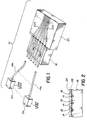
- Figure 1 is a perspective view of an optical print head according to the present invention.
- Figure 2 is a partial cross sectional view taken along line 2-2 in Figure 1.
- an optical print head is generally designated 10.
- the print head includes a plurality of individually modulatable high intensity light sources, such as laser diodes 12 a-n.
- the output of each laser is coupled into an optical fiber 14 a-n.
- the optical fibers 14 a-n are held in spaced apart relation by a substrate 16 defining v-grooves 18 (see Fig. 2) in which the fibers 14 are positioned.
- a second substrate 20 defines a plurality of channel waveguides 22 a-n.
- the channel waveguides define a fanned out pattern having a widely spaced end and a narrowly spaced end.
- the widely spaced end of the channel waveguides is butted against the ends of the spaced apart fibers 14 a-n in the first substrate 16 such that each fiber is aligned with one of the channel waveguides.
- the fan shaped waveguide pattern 22 a-n receives the light emerging from the ends of spaced apart fibers 14 a-n and emits the light in a more narrowly spaced pattern at the narrow spaced end of the waveguide.
- the light from the narrowly spaced end of the channel waveguide is employed to expose or activate a photosensitive receiver to produce an image.
- the print head may be employed in a drum scanner with the print head in close proximity to a photosensitive medium carried on the drum. As the drum rotates, the light from the narrow end of the channel waveguide pattern simultaneously exposes a plurality of pixel modulated lines on the photosensitive medium.
- a carriage mechanism not shown, translates the write head in a direction parallel to the axis of rotation of the drum scanner to expose a two-dimensional image on the photosensitive medium. Since the fibers 14 a-n can be gathered into a flexible bundle, the only portion of the print head that needs to be translated is the portion including substrate 16 and 20, thereby resulting in the need to accelerate only a relatively low mass.
- a drum scanner such as the Eikonix Designmaster'" (sold by Eastman Kodak Company, Rochester, New York) laser beam recorder which is used to expose photographic film can be modified to expose either film or an electrophotographic photoreceptor
- the laser diodes are Seastar Optics Model 300 pig tailed laser diodes with a wavelength of approximately 790 nm and a peak power of 8 milliwatts
- the single-mode optical fibers are Corning Flexcor-850TM with a cladding diameter of 80 microns
- the substrate is 0.040" thick silicon with v-grooves formed on 90 micron centers by using the process of patterning a native oxide etch mask on the (100) silicon wafer and photolithographically patterning the grooves in photoresist with a electron beam generated photomask such that the grooves are parallel to the (110) axis.
- a CHF3 plasma is then used to remove the native oxide by reactive ion etching through these openings in the photoresist.
- the silicon wafer is then etched in an etchant consisting of 8 ml water, 17 ml ethylenediamine, and 3 grams of pyrocatechol. This etchant was used at an elevated temperature. This etchant rapidly etches silicon except along the (111) axis where the etch rate is much less than that of silicon of other orientations and the native oxide used as the etch mask. This forms precise v-grooves formed by the (111) silicon planes.
- the fibers are secured in the v-grooves by placing a thin glass plate 24 on top of the fibers and then allowing capillary action to fill the gap between the glass plate and the wafer with an adhesive 26 such as Epo-Tek 301 adhesive.
- the fibers are clamped in place and the adhesive cured at 65°C for one hour.
- a semiconductor dicing saw is then used to trim and true and end of the head.
- the head is then hand polished in a lapping fixture by using successively finer grits of mylar backed alumina lapping films to finish up on 0.3 micron grit size to produce a polished surface.
- the glass waveguides are formed by using an ion exchange process to exchange the sodium ions in standard BK-7 optical glass with silver ions.
- the silver ions increase the index of refraction of the glass.
- Waveguides are formed through selective ion exchange.
- a pattern is formed on the polished BK-7 substrate by first evaporating an aluminum layer 0.14 micron in thickness. Openings are formed in the aluminum by using conventional photoresist, photolithography, and chemical etching processes.
- the patterned substrate is preheated to 330°C then slowly immersed in a 330°C bath of 5 molar % silver nitrate for 40 seconds.
- the waveguides are then annealed at 500°C in air for 10 minutes and slowly cooled.
- the waveguides are cut to final size on a diamond saw and polished one Logitech PM2A polishing system which insure sharp corners on the edge of the waveguides.
- the waveguides are attached to the fiber array.
- a Dymax 628T ⁇ v cure adhesive is used.
- a thin (0.040 micron) film of chrome is evaporated onto the non-active areas of the waveguide and a fiber array.
- the fiber array then held in a six axis micropositioner.
- a thin layer of the adhesive is applied to the waveguide and the waveguide is actively aligned with the fiber array by powering the lasers and observing the light emitted from the waveguide.
- the relative position of the filter optic array and the waveguide are adjusted in the micropositioners until the output power from the waveguide is optimized.
- the adhesive is cured by irradiating it with a Dymax Light-Welder TM .
- the fan shape pattern consist of precise stripes of a width between 4 and 5 microns of 90 micron centers at the wide end and 12.8 micron centers at the narrow end.
- the mask used to pattern these waveguides is an electron beam generated mask which provides a non-cumulative registration tolerance of 0.05 microns.
- the optical print head described above is designed to be used inclined at a 45° angle to print at 2800 DPI. 2800 DPI printing is also achievable without inclining the head at 45° by providing a spacing of 9.07 microns between the output channels in the waveguide. By simply changing the output spacing of the photomask used to pattern the waveguide other spacings are possible such as 10.6, 14.1, and 21.2 microns to produce 2400, 1800, and 1200 DPI (dots per inch), respectively.
- the non-cumulative registration tolerance for these spacings is 0.05 microns. For the highest resolution of 2800 dots per inch, this represents 0.05/9.07 or 0.55% or 1/200 th of a pixel. This is a factor a ten better the 1/20 th of a pixel which is typically specified for such a drum writer.
- This invention is readily extendable to multi-mode fibers coupled to multi-mode waveguides.
- the fiber array is assemble in the same manner except that fibers with larger core diameters are used.
- 125 micron diameter fibers with 50 micron cores are assemble in a fiber array on 150 micron centers.
- a fan pattern waveguide fabricated by using a field assisted ion exchange process to provide channel waveguide with core diameters of 50 x 50 microns or greater in order to match their core of the fibers. The fan pattern can then provide an output spacing of 65 microns.
- the multi-mode fibers 14 a-n provide the additional advantage of mixing the modes from the lasers 12 a-n so that a more uniform light output is produced by the print head.
- the channel waveguides 20 may be formed of diffused areas of Ti and the substrate 14 may be formed from a Z-cut of LiNbO3 material.
- the channels are formed photolithographically using approximately 400 to 500 angstrons of Ti that is diffused at approximately 1025°C for approximately 8 hours.
- Optical print heads according to the present invention are useful in the field of optical printing, and are advantageous in that the print heads produce spots having very narrow uniform spacing and the optical print heads may be easily fabricated.
Landscapes
- Physics & Mathematics (AREA)
- General Physics & Mathematics (AREA)
- Optics & Photonics (AREA)
- Health & Medical Sciences (AREA)
- General Health & Medical Sciences (AREA)
- Toxicology (AREA)
- Engineering & Computer Science (AREA)
- Microelectronics & Electronic Packaging (AREA)
- Optical Couplings Of Light Guides (AREA)
- Printers Or Recording Devices Using Electromagnetic And Radiation Means (AREA)
- Lock And Its Accessories (AREA)
- Battery Mounting, Suspending (AREA)
Abstract
Claims (7)
- Tête d'impression multicanal comprenant : une pluralité de sources lumineuses (12) ; une pluralité correspondante de fibres optiques (14) définissant des extrémités d'entrée et de sortie, chacune desdites sources lumineuses étant couplée à l'extrémité d'entrée de l'une desdites fibres ; un premier substrat (16) définissant des rainures destinées à maintenir les extrémités de sortie desdites fibres espacées les unes des autres ; caractérisée par : un second substrat (20) ayant une pluralité correspondante de canaux guides d'ondes (22), chaque guide d'ondes ayant des extrémités d'entrée et de sortie, les extrémités d'entrée étant espacées les unes des autres de la même manière que lesdites extrémités de sortie desdites fibres, et lesdites extrémités de sortie desdits guides d'ondes étant espacées les unes des autres par une distance inférieure à celle séparant lesdites extrémités d'entrée ; et lesdites extrémités de sortie desdites fibres et ladite entrée desdits canaux guides d'ondes étant fixées bout à bout de sorte que lesdites fibres optiques sont alignées et optiquement couplées avec les fibres respectives desdits canaux guides d'ondes .
- Tête d'impression multicanal selon la revendication 1, dans laquelle ledit second substrat est en verre, lesdits guides d'ondes étant constitués à partir d'un échange d'ions d'argent (Ag) et de sodium (Na).
- Tête d'impression multicanal selon la revendication 1, dans laquelle lesdites sources lumineuses sont des diodes laser.
- Tête d'impression multicanal selon la revendication 1, dans laquelle lesdites fibres optiques sont des fibres monomodes et lesdits guides d'ondes sont des guides d'ondes monomodes.
- Tête d'impression multicanal selon la revendication 4, dans laquelle lesdites fibres optiques monomodes ont un diamètre de 80 µm, et lesdits guides d'ondes sont des bandes ayant une largeur comprise entre 4 et 5 µm, un espacement de 90 µm au niveau de l'extrémité d'entrée et un espacement de 12,8 µm au niveau des extrémités de sortie.
- Tête d'impression multicanal selon la revendication 1, dans laquelle lesdites fibres optiques sont des fibres multimodes et lesdits guides d'ondes sont des guides d'ondes multimodes.
- Tête d'impression multicanal selon la revendication 6, dans laquelle lesdites fibres multimodes sont des fibres de 125 µm de diamètre ayant un coeur de 50 µm de diamètre, et lesdits guides d'ondes multimodes sont des canaux guides d'ondes ayant une section transversale de 50 x 50 µm, un espacement de 150 µm sur l'extrémité d'entrée, et un espacement de 65 µm sur l'extrémité de sortie.
Applications Claiming Priority (3)
| Application Number | Priority Date | Filing Date | Title |
|---|---|---|---|
| US60335690A | 1990-10-26 | 1990-10-26 | |
| US603356 | 1990-10-26 | ||
| PCT/US1991/007661 WO1992008313A1 (fr) | 1990-10-26 | 1991-10-22 | Tete d'impression optique multicanal |
Publications (2)
| Publication Number | Publication Date |
|---|---|
| EP0507936A1 EP0507936A1 (fr) | 1992-10-14 |
| EP0507936B1 true EP0507936B1 (fr) | 1996-01-10 |
Family
ID=24415080
Family Applications (1)
| Application Number | Title | Priority Date | Filing Date |
|---|---|---|---|
| EP92900075A Expired - Lifetime EP0507936B1 (fr) | 1990-10-26 | 1991-10-22 | Tete d'impression optique multicanal |
Country Status (4)
| Country | Link |
|---|---|
| EP (1) | EP0507936B1 (fr) |
| JP (1) | JPH05503261A (fr) |
| DE (1) | DE69116340T2 (fr) |
| WO (1) | WO1992008313A1 (fr) |
Families Citing this family (4)
| Publication number | Priority date | Publication date | Assignee | Title |
|---|---|---|---|---|
| ES2140341B1 (es) * | 1998-03-17 | 2000-10-16 | Macsa Id Sa | Sistema de marcaje laser. |
| WO2002052343A2 (fr) * | 2000-12-26 | 2002-07-04 | Creoscitex Corporation Ltd. | Tete d'imagerie comportant des diodes laser avec fibre amorce et conduit de lumiere micro-usine, et reseaux de ceux-ci |
| DE102008030868A1 (de) * | 2008-06-30 | 2009-12-31 | Krones Ag | Vorrichtung zum Beschriften von Behältnissen |
| JP5536711B2 (ja) * | 2011-05-16 | 2014-07-02 | パナソニック株式会社 | 画像記録装置 |
Family Cites Families (4)
| Publication number | Priority date | Publication date | Assignee | Title |
|---|---|---|---|---|
| DE2938301A1 (de) * | 1979-09-21 | 1981-04-09 | Siemens AG, 1000 Berlin und 8000 München | Optische vorrichtung zum beruehrungslosen schreiben, insbesondere zur faksimilewiedergabe von bildern und text |
| DE3321346C2 (de) * | 1983-06-13 | 1987-04-09 | Philips Patentverwaltung Gmbh, 2000 Hamburg | Optischer Druckkopf |
| US4923275A (en) * | 1988-10-07 | 1990-05-08 | Eastman Kodak Company | Fiber optic array |
| US4911526A (en) * | 1988-10-07 | 1990-03-27 | Eastman Kodak Company | Fiber optic array |
-
1991
- 1991-10-22 WO PCT/US1991/007661 patent/WO1992008313A1/fr not_active Ceased
- 1991-10-22 JP JP4500733A patent/JPH05503261A/ja active Pending
- 1991-10-22 DE DE69116340T patent/DE69116340T2/de not_active Expired - Fee Related
- 1991-10-22 EP EP92900075A patent/EP0507936B1/fr not_active Expired - Lifetime
Also Published As
| Publication number | Publication date |
|---|---|
| WO1992008313A1 (fr) | 1992-05-14 |
| DE69116340T2 (de) | 1996-08-01 |
| JPH05503261A (ja) | 1993-06-03 |
| DE69116340D1 (de) | 1996-02-22 |
| EP0507936A1 (fr) | 1992-10-14 |
Similar Documents
| Publication | Publication Date | Title |
|---|---|---|
| JP2801329B2 (ja) | 光ファイバーアレーを製造する方法 | |
| JP2933663B2 (ja) | 光ファイバアレー | |
| JPH05281423A (ja) | サーマルプリンタ用光ファイバーアレイ | |
| JP2999784B2 (ja) | ファイバ光学アレイの製造方法 | |
| US5006201A (en) | Method of making a fiber optic array | |
| CA1246911A (fr) | Tete d'ecriture a fibres optiques | |
| EP0379704B1 (fr) | Tête d'impression optique à structure intégrée | |
| US4991930A (en) | Fiber optic array | |
| JPH09113832A (ja) | 光走査装置 | |
| EP0507936B1 (fr) | Tete d'impression optique multicanal | |
| JP3622800B2 (ja) | 光記録装置 | |
| JP2003255249A (ja) | 光記録装置用光ファイバアレイ及びそれを用いた画像形成装置 | |
| JP3894262B2 (ja) | 光ファイバアレイ素子を用いた光走査装置 | |
| JP4880901B2 (ja) | 光導波路アレイを用いた光記録装置 | |
| JP4098918B2 (ja) | 画像記録装置 | |
| JP3663614B2 (ja) | マルチビームを用いた光記録装置 | |
| JP4051565B2 (ja) | 光導波路型光記録装置の光導波路モジュール | |
| JP3707068B2 (ja) | マルチビームを用いた光記録装置 | |
| JP2003114397A (ja) | 光導波路アレイを用いた光記録装置 | |
| JPH0593878A (ja) | 多ビームによる光記録装置 | |
| US20040061770A1 (en) | Imaging head with pigtailed laser diodes and micromachined light-pipe and arrays thereof | |
| JP4288970B2 (ja) | 光ファイバアレイの製造方法 | |
| JP2004258566A (ja) | マルチビーム光記録装置 | |
| Haas et al. | Single-mode fiber printheads and scanline interleaving for high-resolution laser printing | |
| JPH10161047A (ja) | 光走査装置 |
Legal Events
| Date | Code | Title | Description |
|---|---|---|---|
| PUAI | Public reference made under article 153(3) epc to a published international application that has entered the european phase |
Free format text: ORIGINAL CODE: 0009012 |
|
| AK | Designated contracting states |
Kind code of ref document: A1 Designated state(s): DE FR GB |
|
| 17P | Request for examination filed |
Effective date: 19921016 |
|
| 17Q | First examination report despatched |
Effective date: 19950407 |
|
| GRAA | (expected) grant |
Free format text: ORIGINAL CODE: 0009210 |
|
| AK | Designated contracting states |
Kind code of ref document: B1 Designated state(s): DE FR GB |
|
| REF | Corresponds to: |
Ref document number: 69116340 Country of ref document: DE Date of ref document: 19960222 |
|
| ET | Fr: translation filed | ||
| PLBE | No opposition filed within time limit |
Free format text: ORIGINAL CODE: 0009261 |
|
| STAA | Information on the status of an ep patent application or granted ep patent |
Free format text: STATUS: NO OPPOSITION FILED WITHIN TIME LIMIT |
|
| 26N | No opposition filed | ||
| PGFP | Annual fee paid to national office [announced via postgrant information from national office to epo] |
Ref country code: GB Payment date: 19970917 Year of fee payment: 7 |
|
| PGFP | Annual fee paid to national office [announced via postgrant information from national office to epo] |
Ref country code: FR Payment date: 19971007 Year of fee payment: 7 |
|
| PG25 | Lapsed in a contracting state [announced via postgrant information from national office to epo] |
Ref country code: GB Free format text: LAPSE BECAUSE OF NON-PAYMENT OF DUE FEES Effective date: 19981022 |
|
| PGFP | Annual fee paid to national office [announced via postgrant information from national office to epo] |
Ref country code: DE Payment date: 19981028 Year of fee payment: 8 |
|
| GBPC | Gb: european patent ceased through non-payment of renewal fee |
Effective date: 19981022 |
|
| PG25 | Lapsed in a contracting state [announced via postgrant information from national office to epo] |
Ref country code: FR Free format text: LAPSE BECAUSE OF NON-PAYMENT OF DUE FEES Effective date: 19990630 |
|
| REG | Reference to a national code |
Ref country code: FR Ref legal event code: ST |
|
| PG25 | Lapsed in a contracting state [announced via postgrant information from national office to epo] |
Ref country code: DE Free format text: LAPSE BECAUSE OF NON-PAYMENT OF DUE FEES Effective date: 20000801 |