EP0510249B1 - Kaltverformtes und nichtalterndes Tiefziehblech aus Stahl und Herstellungsverfahren - Google Patents
Kaltverformtes und nichtalterndes Tiefziehblech aus Stahl und Herstellungsverfahren Download PDFInfo
- Publication number
- EP0510249B1 EP0510249B1 EP91114828A EP91114828A EP0510249B1 EP 0510249 B1 EP0510249 B1 EP 0510249B1 EP 91114828 A EP91114828 A EP 91114828A EP 91114828 A EP91114828 A EP 91114828A EP 0510249 B1 EP0510249 B1 EP 0510249B1
- Authority
- EP
- European Patent Office
- Prior art keywords
- aluminum
- slab
- sheet
- temperature
- nitrogen
- Prior art date
- Legal status (The legal status is an assumption and is not a legal conclusion. Google has not performed a legal analysis and makes no representation as to the accuracy of the status listed.)
- Revoked
Links
Images




Classifications
-
- C—CHEMISTRY; METALLURGY
- C21—METALLURGY OF IRON
- C21D—MODIFYING THE PHYSICAL STRUCTURE OF FERROUS METALS; GENERAL DEVICES FOR HEAT TREATMENT OF FERROUS OR NON-FERROUS METALS OR ALLOYS; MAKING METAL MALLEABLE, e.g. BY DECARBURISATION OR TEMPERING
- C21D8/00—Modifying the physical properties of ferrous metals or ferrous alloys by deformation combined with, or followed by, heat treatment
- C21D8/02—Modifying the physical properties of ferrous metals or ferrous alloys by deformation combined with, or followed by, heat treatment during manufacturing of plates or strips
- C21D8/04—Modifying the physical properties of ferrous metals or ferrous alloys by deformation combined with, or followed by, heat treatment during manufacturing of plates or strips to produce plates or strips for drawing, e.g. for deep-drawing
- C21D8/0421—Modifying the physical properties of ferrous metals or ferrous alloys by deformation combined with, or followed by, heat treatment during manufacturing of plates or strips to produce plates or strips for drawing, e.g. for deep-drawing characterised by the working steps
- C21D8/0426—Hot rolling
Definitions
- the steel has an r m value of at least 2.0 after being annealed at a temperature of 538-649°C, consists of manganese ⁇ 0.16%, acid sol. aluminum 0.05-0.06%, total nitrogen 0.004-0.006% wherein % acid sol. aluminum x % total nitrogen is within the range of 2 x 10 -4 to 4 x 10 -4 and is produced from a continuously cast slab hot rolled from a temperature less than about 1175°C.
- Such a non-aging, cold reduced, recrystallization batch annealed steel sheet can have an elongated grain structure and an r m value of at least 2.0 consisting of ⁇ 0.05% carbon, 0.02-0.1 % acid sol. aluminum, ⁇ 0.20% manganese, all percentages by weight, the balance iron and unavoidable impurities, the sheet having been produced from a continuously cast slab hot rolled from a temperature less than about 1175°C to a sheet having nitrogen in solution.
- the method of producing a steel sheet include the steps of providing a melt consisting of ⁇ 0.05% carbon, 0.02-0.1% acid sol. aluminum, ⁇ 0.20% manganese, all percentages by weight, the balance iron and unavoidable impurities, casting the melt into a slab, hot rolling the slab having a temperature less than about 1175°C to a sheet having nitrogen in solution, descaling the hot rolled sheet, cold reducing the descaled sheet, recrystallization batch annealing the cold reduced sheet wherein the annealed sheet is non-aging, characterized by an elongated grain structure and has an r m value of at least 2.0.
- the method of producing a steel sheet include the steps of providing a slab consisting of ⁇ 008% carbon, ⁇ 0.2% manganese, ⁇ 0.01 acid sol. wt.% aluminum and nitrogen as an impurity, wherein the product of % acid sol.
- the method of producing a steel sheet includes the steps of providing a melt consisting of ⁇ 0.05% carbon, 0.05-0.06% acid sol. aluminum, 0.004-0.006% total nitrogen, ⁇ 0.16% manganese, wherein the product of % acid sol.
- the chemical composition of the steel in accordance with the present invention consists of ⁇ 0.08% carbon, ⁇ 0.1% acid sol. aluminum ⁇ 0.2% manganese, all percentages by weight and the balance of the composition being iron and unavoidable impurities.
- Manganese should be at least 0.05 wt.% to prevent hot shortness due to sulfur during hot rolling. If manganese is not low and exceeds about 0.24 wt.%, insufficient nitrogen would be retained in solution in hot rolled sheet produced from slabs having the reduced temperatures of the invention. To minimize slab and batch annealing temperatures and to maximize r m values, manganese preferably should be ⁇ 0.20 wt.% and most preferably ⁇ 0.16 wt.%.
- acid sol. aluminum For an aluminum killed steel, at least 0.01 wt.% acid sol. aluminum is required to deoxidize the melt with the ratio of acid sol. aluminum to total nitrogen being at least 2:1. Maintaining this ratio insures that residual nitrogen exists as aluminum nitride so that recrystallization batch annealed steel is non-aging. For this reason, the acid sol. aluminum preferably should be at least 0.02 wt.%. Acid sol. aluminum should not exceed 0.1 wt.% because the annealed steel would have excessive hardness, diminished drawability and excess alloy cost. To minimize slab and batch annealing temperatures, to increase the elapsed times possible for hot rolling and to maximize r m values, acid sol. aluminum should be ⁇ 0.08 wt.%. More preferably, acid sol. aluminum should be 0.03-0.08 wt.% and most preferably should be 0.05-0.06 wt.%.
- total nitrogen preferably should be ⁇ 0.008 wt.%. More preferably, total nitrogen should be 0.003-0.007 wt.% and most preferably should be ⁇ 0.004-0.006 wt.%.
- Carbon should not exceed 0.08 wt.% because the batch annealed steel would have excessive hardness.
- carbon is 0.03-0.05 wt.%.
- non-aging, cold reduced, batch annealed, aluminum killed steel is characterized by a grain structure having an elongation of 2.0 or more. Such a grain elongation is indicative that aluminum nitride precipitated during the slow heatup prior to the onset of recrystallization during annealing. It also is known the solution temperature of aluminum nitride is a function of the product of the weight percentages of nitrogen and aluminum in the steel.
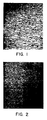
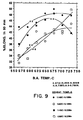
- FIG. 1 shows a highly elongated grain structure for steel B having the r m value of 2.38 for the sheet that was cold reduced and batch annealed at 649°C for four hours. The sheet was produced from the slab reheated to 1149°C and having a simulated coiling temperature of 566°C after hot rolling.
- FIG. 2 shows an equiaxed grain structure for steel B having the r m value of 1.26 and having the same processing as steel B in FIG.
- the remaining steels A, C and D having reduced slab temperatures of 1149°C and 1204°C had similar grain elongations to that shown in FIG. 1.
- Steels A, C and D having a reduced slab temperature of 1093°C had grain structures similar to that shown in FIG. 2.
- Steels A, C and D having a conventional slab temperature of 1260°C had grain elongations similar to that shown in FIG. 1.
- Leslie et al teach steels A-D should not have had sufficient solute nitrogen in sheets hot rolled from slabs at the reduced temperatures of 1149°C and 1204°C, particularly 1149°C, to produce an elongated grain structure and high r m values after cold reduction and batch annealing.
- the r m values in Tables 1 and 2 are graphically shown in FIG. 5.
- Upper curve 10 shows the low manganese steels A-D having r m values well above 1.8 when cold reduced and batch annealed from sheet produced from slabs hot rolled at the reduced temperature of 1149°C and having a coiling temperature of 566°C.
- the r m value for steel E having identical processing dropped to 1.44.
- the slab temperature for steel E was increased to the conventional temperature of 1260°C
- the r m value was increased to 1.79.
- the slabs for steels A-E were heated to 1149°C but had the simulated coiling temperature increased to 704°C, the r m values dropped to 1.28 or less as shown in curve 12.
- all r m values were 1.30 or less as shown in bottom curve 14.
- Curve 26 for steels L and M hot rolled with a conventional slab temperature of 1260°C had improved r m values demonstrating the beneficial effect of very low manganese of .12 wt.%.
- Curve 24 for steels J and K had good r m values, i.e., ⁇ 2.0, when hot rolled with a reduced slab temperature of 1149°C. Even more surprising was that the r m values for steels J and K hot rolled with a lower slab temperature were substantially higher than the r m values for steels L and M of the same composition but hot rolled from 1260°C.
- Aluminum killed steels having conventional manganese compositions and hot rolled from slab temperatures of 1260°C or more generally require batch annealing temperatures in excess of 649°C to develop conventional r m values and mechanical properties. Equally surprising was that steels J and K also had good r m values for an annealing temperature as low as 566°C. In addition to improving drawability and reducing energy costs during hot rolling, the invention can save energy cost and time during batch annealing as well.
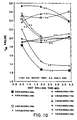
- Preferred tensile strength for deep drawing steel is no greater than about 313.9N/mm 2 (32 kg/mm 2 ) with about 284.5-313.9N/mm 2 (29-32 kg/mm 2 ) being the most preferred.
- Curves 32 and 34 in FIG. 8 are for steels J,K and N,O respectively having the reduced slab temperature of 1149°C.
- the annealing temperature preferably should be less than about 650°C to obtain the desired tensile strength.
- curves 36 and 38 for steels L,M and P,Q respectively having the conventional slab temperature of 1260°C had increased tensile strengths at all annealing temperatures compared to those steels hot rolled from the slab temperature of 1149°C.
- Curves 32 and 34 illustrate that batch annealing temperature can be reduced for steels hot rolled from reduced slab temperatures.
- Curve 50 for steel T had a composition similar to steel S except nitrogen was substantially reduced. Steel T had greatly improved r m values at all hot rolling times and were about 2.0 at times of two minutes or more. Curve 52 for steel U had a composition and r m values similar to steel T at hot rolling times of 0.5 and 2 minutes. Remaining steels V-Z and BB (curves 54-64 respectively) had low aluminum, nitrogen and manganese except steel Y had 0.23 wt.% manganese and steel Z had 0.07 wt.% acid sol. aluminum. Steels V-Z and BB had good r m values at all hot rolling times.
- the relationship between aluminum and nitrogen to r m values also can be expressed as a function of the aluminum nitrogen product, i.e., wt.% acid sol. Al x wt.% total N.
- Steels C, H, I, J, S, T, U, V, W, X, Z, AA and BB all had low manganese of 0.11-0.13 wt.%.
- Two samples of each of these steels, except steels C, H, I and J, were hot rolled at times of about 0.5 and 2 minutes and batch annealed at 649°C for four hours. Steels C, H, I and J were hot rolled only at a time of about 0.5 minute.
- the r m values as a function of the aluminum nitrogen product are illustrated in FIG. 11.
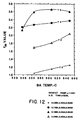
- Steels R-BB hot rolled for four minutes from slabs reheated to 1149°C were batch annealed at temperatures of 649°C, 607°C and 566°C.
- Steels V, W and X also were batch annealed at 538°C.
- the r m values as a function of annealing temperature for steels R, V, X and Y are illustrated in FIG. 12. It does not appear steel R (curve 70) having relatively high concentrations for nitrogen, aluminum and manganese will develop good r m values at any annealing temperature when a long hot rolling time of four minutes is required.
- Steel Y (curve 72) having low nitrogen and aluminum but relatively high manganese of 0.23 wt.% developed good r m values at annealing temperatures of about 600°C and higher for the four minute rolling time.
- Steels V and X (curves 74 and 76 respectively) having low nitrogen, aluminum and manganese developed excellent r m values at all annealing temperatures.
- Steels V and X surprisingly had excellent r m values at an annealing temperature of only 566°C for the four minute rolling time.
- Steels V, W and X also were batch annealed at 538°C for 8 hours instead of 4 hours.
- Steels V, W and X had acceptable r m values when batch annealed at 538°C with steels V and X still having excellent r m values and mechanical properties.
- Steel W was not quite fully recrystallized after batch annealing at 538°C. While it had a good rm value of 1.8, the tensile properties of steel W were unaceptable.
- Table 7 was constructed by grouping steels at the two manganese compositions according to values of aluminum nitrogen product as close as possible to one another over the above cited range. The results are graphically illustrated in FIG. 13. Curve 78 Steel Mn Al (acid sol.) N(total) [%Al][%N] x 10,000 H. R.Time 0.5 min. r m Value H. R.Time 2 min.
- Curve 82 further demonstrates for the rolling time of about 0.5 minute, regardless of the manganese composition when the aluminum nitrogen was about 1.4 x 10 -4 , the r m values are very high and essentially the same, e.g., 2.3. Comparing curve 84 for relatively high 0.22-0.23 wt.% Mn and the 2 minute rolling time to curve 82 for the same manganese but a 0.5 minute rolling time demonstrates there was little influence of rolling time on the r m values when the manganese was relatively high, i.e., ⁇ 0.20 wt%.
- r m values were determined for a steel CC having optimum aluminum and nitrogen content of 0.05 wt.% and 0.005 wt.% respectively, optimum aluminum nitrogen product of about 2.5 x 10 -4 , a conventional total hot rolling time of about four minutes and a low manganese composition of 0.11 wt.%.
- the r m values of steel CC are compared to the r m values of a steel DD having the same optimum composition except for relatively high manganese of 0.21 wt.%.
- Steels CC and DD were cast into slab ingots, hot rolled to sheets, pickled, cold reduced, batch annealed and then temper rolled in a manner identical to that for the example reported in Table 6 except only a hot rolling time of 4 minutes was used for slab reheat temperatures of 1149°C, 1204°C and 1260°C. Samples for each steel were batch annealed at temperatures of 649°C, 607°C and 566°C for four hours. The results are shown in Table 8 and demonstrate r m value was not adversely effected using reduced slab reheat temperature or reduced annealing temperature.
- r m values for the reduced slab reheat temperature of 1149°C generally equaled or exceeded the r m values for the conventional reheat temperature of 1260°C for steels CC and DD.
- the r m values were slightly less than the r m values for the annealing temperature of 649°C.
- Table 7 there is a clear interdependence between manganese and r m values.
- the r m values of low manganese steel CC exceeded the r m values for relatively high manganese steel DD at all annealing temperatures.
- the r m values were still good, i.e., at least 1.8, using a reduced slab reheat temperature of 1149°C and a reduced annealing temperature of 566°C when aluminum, nitrogen and the aluminum nitrogen product all were carefully controlled.
- slabs having conventional thicknesses of 150-250 mm need an initial temperature of 1200°C or more to be hot rolled to a thickness of about 2.5 mm and have a finishing temperature of at least 870°C.
- the most preferred slab temperature of the invention of no more than about 1149°C has practical application for thin continuously cast slabs having thicknesses of 25-50 mm. Additional cost savings are possible by casting a melt into thin slabs rather than thick slabs having a conventional thickness of 150 mm or more. By casting into a thin slab, time and energy for hot rolling to a sheet would be minimized. For example, a thin slab would require no or only minimal reduction using roughing stands.
- the steel of the invention can be produced from continuously cast thin or thick slabs as well as thick slabs produced from ingots.
- Various reduced slab temperatures can be used so long as the hot rolling finishing temperature is above Ar 3 and the coiling temperature is below 593°C. The limits of the invention are determined from the appended claims.
Landscapes
- Chemical & Material Sciences (AREA)
- Engineering & Computer Science (AREA)
- Physics & Mathematics (AREA)
- Thermal Sciences (AREA)
- Crystallography & Structural Chemistry (AREA)
- Mechanical Engineering (AREA)
- Materials Engineering (AREA)
- Metallurgy (AREA)
- Organic Chemistry (AREA)
- Heat Treatment Of Sheet Steel (AREA)
Claims (12)
- Verfahren zur Herstellung von aluminiumberuhigtem Stahl, das umfaßt:Bereitstellen eines Flachguts mit 0,03 bis 0,08 Gew.% Kohlenstoff, ≤ 0,24 Gew.% Mangan, ≥ 0,01 Gew.% säurelöslichem Aluminium und Stickstoff als eine Verunreinigung, wobei das Produkt aus dem Prozentgehalt an säurelöslichem Aluminium und dem Prozentgehalt an Gesamtstickstoff nicht größer ist als 5 x 10⁻⁴ und der Restgehalt aus Eisen und unvermeidbaren Verunreinigungen besteht,Abkühlen des Flachguts auf eine Temperatur kleiner als Ar3 zur Ausscheidung von Aluminiumnitrid,Wiedererhitzen des Flachguts auf eine Temperatur kleiner als 1260 °C vor dem Warmwalzen, um das Aluminiumnitrid wieder zu lösen,Warmwalzen des eine Warmwalztemperatur von weniger als ungefähr 1260 °C aufweisenden Flachguts zu einem Stickstoff in Lösung enthaltenden Blech,Aufwickeln des warmgewalzten Blechs in einem Temperaturbereich von größer als 500 bis 593 °C,Entzundern des warmgewalzten Blechs,Kaltreduzieren des entzunderten Blechs,Rekristallisations-Chargenglühen ohne Entkohlung des kaltreduzierten Blechs, wobei das geglühte Blech alterungsbeständig ist und eine langgestreckte Kornstruktur und einen rm-Wert von wenigstens 1,8 aufweist.
- Verfahren nach Anspruch 1, dadurch gekennzeichnet, daß das Chargenglühen bei einer Temperatur nicht höher als 649 °C stattfindet.
- Verfahren nach Anspruch 1, dadurch gekennzeichnet, daß das Chargenglühen bei einer Temperatur von wenigstens 538 °C stattfindet.
- Verfahren nach einem der Ansprüche 1 bis 3, dadurch gekennzeichnet, daß das Flachgut 0,03 bis 0,08 Gew.% an säurelöslichem Aluminium enthält und der rm-Wert wenigstens 2,0 beträgt.
- Verfahren nach einem der vorstehenden Ansprüche 1 bis 4, dadurch gekennzeichnet, daß das Flachgut 0,003 bis 0,007 Gew.% Gesamtstickstoff enthält und der rm-Wert wenigstens 2,0 beträgt.
- Verfahren nach einem der Ansprüche 1 bis 5, dadurch gekennzeichnet, daß das Flachgut < 0,20 Gew.% Mangan enthält und der rm-Wert wenigstens 2,0 beträgt.
- Verfahren nach einem der vorstehenden Ansprüche 1 bis 6, dadurch gekennzeichnet, daß das Flachgut 0,05 bis 0,06 Gew.% säurelösliches Aluminium und 0,004 bis 0,006 Gew.% Gesamtstickstoff enthält und das Produkt aus dem Prozentgehalt an säurelöslichem Aluminium und dem Prozentgehalt an Gesamtstickstoff im Bereich von 2 x 10⁻⁴ bis 4 x 10⁻⁴ liegt und der rm-Wert wenigstens 2,0 beträgt.
- Verfahren nach einem der vorstehenden Ansprüche 1 bis 7, dadurch gekennzeichnet, daß das chargengeglühte Blech eine Zugfestigkeit von 284,5 bis 313,9 N/mm2 (29 bis 32 kg/mm2) und eine Gesamtdehnung von wenigstens 42 % aufweist.
- Verfahren nach einem der Ansprüche 1 bis 8, dadurch gekennzeichnet, daß das Flachgut kontinuierlich bis zu einer Dicke von 25 bis 50 mm vergossen wird.
- Verfahren nach Anspruch 9, dadurch gekennzeichnet, daßeine Schmelze zum Gießen des Flachguts ≤ 0,05 Gew.% Kohlenstoff, ≤ 0,03 bis 0,08 Gew.% säurelösliches Aluminium, 0,003 bis 0,007 Gew.% Gesamtstickstoff und ≤ 0,24 Gew.% Mangan enthält, wobei das Produkt aus dem Prozentgehalt an säurelöslichem Aluminium und dem Prozentgehalt an Gesamtstickstoff nicht größer ist als 5 x 10⁻⁴, und der Restgehalt aus Eisen und unvermeidbaren Verunreinigungen besteht,das Flachgut nach dem Abkühlen des gegossenen Flachguts auf eine Temperatur unterhalb Ar3 wieder auf eine Temperatur kleiner als 1175 °C erhitzt wird, um das Aluminiumnitrid wieder zu lösen.
- Verfahren nach Anspruch 10, dadurch gekennzeichnet, daß die Schmelze ≤ 0 05 Gew.% Kohlenstoff, 0,05 bis 0,06 Gew.% säurelösliches Aluminium, 0,004 bis 0,006 Gew.% Gesamtstickstoff und ≤ 0,24 Gew.% Mangan enthält, wobei das Produkt aus dem Prozentgehalt an säurelöslichem Aluminium und dem Prozentgehalt an Gesamtstickstoff innerhalb des Bereichs von 2 x 10⁻⁴ bis 4 x 10⁻⁴ liegt, der Restgehalt aus Eisen und unvermeidbaren Verunreinigungen besteht, der Schritt des Warmwalzens des Flachguts zu einem Blech eine Endbearbeitungstemperatur aufweist, die wenigstens gleich Ar3 ist, und der Schritt des Rekristallisations-Chargenglühens ohne Entkohlung des kaltreduzierten Blechs im Bereich von 538 bis 649 °C stattfindet.
- Verfahren nach Anspruch 1, dadurch gekennzeichnet, daß eine Schmelze bereitgestellt wird, die 0,03 bis 0,08 Gew.% Kohlenstoff, ≤ 0,24 Gew.% Mangan, ≥ 0 01 Gew.% säurelösliches Aluminium und Stickstoff als eine Verunreinigung aufweist, wobei das Produkt aus dem Prozentgehalt an säurelöslichem Aluminium und dem Prozentgehalt an Gesamtstickstoff nicht größer als 5 x 10⁻⁴ ist und der Restgehalt aus Eisen und unvermeidbaren Verunreinigungen besteht,diese Schmelze kontinuierlich zu einem Flachgut mit einer Dicke von 25 bis 50 mm vergossen wird, das Flachgut auf eine Temperatur kleiner als Ar3 abgekühlt wird, um Aluminiumnitrid auszuscheiden, das Flachgut wieder auf eine Temperatur kleiner als 1175 °C erhitzt wird, um das Aluminiumnitrid wieder zu lösen,das Flachgut zu einem Blech warmgewalzt wird, das Stickstoff in Lösung aufweist, undnach dem Aufwickeln des warmgewalzten Blechs Entzundern des warmgewalzten Blechs, Kaltreduzieren des entzunderten Blechs und Rekristallisations-Chargenglühen ohne Entkohlung des kaltreduzierten Blechs, das geglühte Blech ist alterungsbeständig und weist eine langgestreckte Kornstruktur und einen rm-Wert von wenigstens 2,0 auf.
Applications Claiming Priority (4)
| Application Number | Priority Date | Filing Date | Title |
|---|---|---|---|
| US07/690,142 US5102472A (en) | 1989-10-02 | 1991-04-23 | Cold reduced non-aging deep drawing steel and method for producing |
| US690142 | 1991-04-23 | ||
| US07/720,966 US5123971A (en) | 1989-10-02 | 1991-06-25 | Cold reduced non-aging deep drawing steel and method for producing |
| US720966 | 1991-06-25 |
Publications (3)
| Publication Number | Publication Date |
|---|---|
| EP0510249A2 EP0510249A2 (de) | 1992-10-28 |
| EP0510249A3 EP0510249A3 (en) | 1993-09-08 |
| EP0510249B1 true EP0510249B1 (de) | 2000-03-08 |
Family
ID=27104547
Family Applications (1)
| Application Number | Title | Priority Date | Filing Date |
|---|---|---|---|
| EP91114828A Revoked EP0510249B1 (de) | 1991-04-23 | 1991-09-03 | Kaltverformtes und nichtalterndes Tiefziehblech aus Stahl und Herstellungsverfahren |
Country Status (4)
| Country | Link |
|---|---|
| EP (1) | EP0510249B1 (de) |
| AT (1) | ATE190359T1 (de) |
| DE (1) | DE69132028T2 (de) |
| ES (1) | ES2144396T3 (de) |
Family Cites Families (8)
| Publication number | Priority date | Publication date | Assignee | Title |
|---|---|---|---|---|
| US3959029A (en) * | 1970-11-21 | 1976-05-25 | Nippon Kokan Kabushiki Kaisha | Process of making cold reduced Al-stabilized steel having high drawability |
| JPS516610B1 (de) * | 1971-04-27 | 1976-03-01 | ||
| US4145235A (en) * | 1972-12-28 | 1979-03-20 | Nippon Steel Corporation | Process for producing cold rolled steel sheet and strip having improved cold formabilities |
| AU505774B2 (en) * | 1977-09-09 | 1979-11-29 | Nippon Steel Corporation | A method for treating continuously cast steel slabs |
| EP0075292B2 (de) * | 1981-09-18 | 1993-11-24 | Nippon Steel Corporation | Verfahren zur Herstellung eines kaltgewalzten Stahlbleches |
| JPS58136721A (ja) * | 1982-02-09 | 1983-08-13 | Nippon Steel Corp | 加工性のすぐれた冷間圧延鋼板の製造方法 |
| US4473411A (en) * | 1983-07-20 | 1984-09-25 | Armco Inc. | Process of making aluminum killed low manganese deep drawing steel |
| US4698102A (en) * | 1984-07-09 | 1987-10-06 | Nippon Steel Corporation | Process for producing, by continuous annealing, soft blackplate for surface treatment |
-
1991
- 1991-09-03 AT AT91114828T patent/ATE190359T1/de not_active IP Right Cessation
- 1991-09-03 DE DE69132028T patent/DE69132028T2/de not_active Expired - Fee Related
- 1991-09-03 ES ES91114828T patent/ES2144396T3/es not_active Expired - Lifetime
- 1991-09-03 EP EP91114828A patent/EP0510249B1/de not_active Revoked
Also Published As
| Publication number | Publication date |
|---|---|
| EP0510249A3 (en) | 1993-09-08 |
| DE69132028D1 (de) | 2000-04-13 |
| ATE190359T1 (de) | 2000-03-15 |
| EP0510249A2 (de) | 1992-10-28 |
| DE69132028T2 (de) | 2000-09-28 |
| ES2144396T3 (es) | 2000-06-16 |
Similar Documents
| Publication | Publication Date | Title |
|---|---|---|
| US5634991A (en) | Alloy and method for making continuously cast aluminum alloy can stock | |
| EP0319590B1 (de) | KALTGEWALZTER FEINBLECHSTAHL MIT HOHEM r-WERT UND VERFAHREN ZU SEINER HERSTELLUNG | |
| JPH0140895B2 (de) | ||
| US5123971A (en) | Cold reduced non-aging deep drawing steel and method for producing | |
| EP0510249A2 (de) | Kaltverformtes und nichtalterndes Tiefziehblech aus Stahl und Herstellungsverfahren | |
| US5102472A (en) | Cold reduced non-aging deep drawing steel and method for producing | |
| AU651370B2 (en) | Cold reduced non-aging deep drawing steel and method for producing | |
| JP2581887B2 (ja) | 冷間加工性に優れた高強度冷延鋼板およびその製造方法 | |
| JPH01184227A (ja) | 絞り用合金化溶融亜鉛めっき鋼板の製造方法 | |
| JP3142975B2 (ja) | 深絞り性に優れた高強度冷延鋼板の製造方法 | |
| JP2631437B2 (ja) | 加工性および焼付硬化性、時効性に優れた冷延鋼板およびその製造方法 | |
| JPS5913030A (ja) | 深絞り性の優れたAlキルド冷延鋼板の製造法 | |
| JPH058257B2 (de) | ||
| JPH05331553A (ja) | 遅時効性に優れた深絞り用焼付硬化性鋼板の製造方法 | |
| JPH01177322A (ja) | 極めて深絞り性に優れる冷延鋼板の製造方法 | |
| JPH0369967B2 (de) | ||
| JPS5857491B2 (ja) | 熱硬化性を有する深絞り用冷延鋼板の製造方法 | |
| KR930002739B1 (ko) | 성형성이 우수한 Al-킬드 냉연강판의 제조방법 | |
| JPH06271932A (ja) | 高靭性鋼の製造法 | |
| JPH0218363B2 (de) | ||
| JPS6119739A (ja) | 連続焼鈍による絞り性の良好な高張力鋼板の製造方法 | |
| JPH0772306B2 (ja) | 深絞り用冷延鋼板の製造方法 | |
| JPH05279821A (ja) | 高成形性アルミニウム合金板の製造方法 | |
| JPH01177321A (ja) | 深絞り性に優れた冷延鋼板の製造方法 | |
| JPH04365814A (ja) | 焼付硬化性に優れた高強度冷延鋼板の製造方法 |
Legal Events
| Date | Code | Title | Description |
|---|---|---|---|
| PUAI | Public reference made under article 153(3) epc to a published international application that has entered the european phase |
Free format text: ORIGINAL CODE: 0009012 |
|
| AK | Designated contracting states |
Kind code of ref document: A2 Designated state(s): AT BE DE ES FR GB IT NL SE |
|
| PUAL | Search report despatched |
Free format text: ORIGINAL CODE: 0009013 |
|
| AK | Designated contracting states |
Kind code of ref document: A3 Designated state(s): AT BE DE ES FR GB IT NL SE |
|
| 17P | Request for examination filed |
Effective date: 19940225 |
|
| RAP1 | Party data changed (applicant data changed or rights of an application transferred) |
Owner name: AK STEEL CORPORATION |
|
| 17Q | First examination report despatched |
Effective date: 19950925 |
|
| GRAG | Despatch of communication of intention to grant |
Free format text: ORIGINAL CODE: EPIDOS AGRA |
|
| GRAG | Despatch of communication of intention to grant |
Free format text: ORIGINAL CODE: EPIDOS AGRA |
|
| GRAH | Despatch of communication of intention to grant a patent |
Free format text: ORIGINAL CODE: EPIDOS IGRA |
|
| GRAH | Despatch of communication of intention to grant a patent |
Free format text: ORIGINAL CODE: EPIDOS IGRA |
|
| GRAA | (expected) grant |
Free format text: ORIGINAL CODE: 0009210 |
|
| AK | Designated contracting states |
Kind code of ref document: B1 Designated state(s): AT BE DE ES FR GB IT NL SE |
|
| REF | Corresponds to: |
Ref document number: 190359 Country of ref document: AT Date of ref document: 20000315 Kind code of ref document: T |
|
| REF | Corresponds to: |
Ref document number: 69132028 Country of ref document: DE Date of ref document: 20000413 |
|
| ITF | It: translation for a ep patent filed | ||
| REG | Reference to a national code |
Ref country code: ES Ref legal event code: FG2A Ref document number: 2144396 Country of ref document: ES Kind code of ref document: T3 |
|
| ET | Fr: translation filed | ||
| PGFP | Annual fee paid to national office [announced via postgrant information from national office to epo] |
Ref country code: FR Payment date: 20000822 Year of fee payment: 10 |
|
| PGFP | Annual fee paid to national office [announced via postgrant information from national office to epo] |
Ref country code: SE Payment date: 20000823 Year of fee payment: 10 |
|
| PGFP | Annual fee paid to national office [announced via postgrant information from national office to epo] |
Ref country code: NL Payment date: 20000824 Year of fee payment: 10 Ref country code: AT Payment date: 20000824 Year of fee payment: 10 |
|
| PGFP | Annual fee paid to national office [announced via postgrant information from national office to epo] |
Ref country code: GB Payment date: 20000825 Year of fee payment: 10 |
|
| PGFP | Annual fee paid to national office [announced via postgrant information from national office to epo] |
Ref country code: DE Payment date: 20000828 Year of fee payment: 10 |
|
| PGFP | Annual fee paid to national office [announced via postgrant information from national office to epo] |
Ref country code: BE Payment date: 20000908 Year of fee payment: 10 |
|
| PGFP | Annual fee paid to national office [announced via postgrant information from national office to epo] |
Ref country code: ES Payment date: 20001006 Year of fee payment: 10 |
|
| PLBQ | Unpublished change to opponent data |
Free format text: ORIGINAL CODE: EPIDOS OPPO |
|
| PLBI | Opposition filed |
Free format text: ORIGINAL CODE: 0009260 |
|
| PLBF | Reply of patent proprietor to notice(s) of opposition |
Free format text: ORIGINAL CODE: EPIDOS OBSO |
|
| 26 | Opposition filed |
Opponent name: THYSSEN KRUPP STAHL AG Effective date: 20001208 Opponent name: CORUS STAAL BV Effective date: 20001208 |
|
| NLR1 | Nl: opposition has been filed with the epo |
Opponent name: THYSSEN KRUPP STAHL AG Opponent name: CORUS STAAL BV |
|
| PLBF | Reply of patent proprietor to notice(s) of opposition |
Free format text: ORIGINAL CODE: EPIDOS OBSO |
|
| PLBF | Reply of patent proprietor to notice(s) of opposition |
Free format text: ORIGINAL CODE: EPIDOS OBSO |
|
| PG25 | Lapsed in a contracting state [announced via postgrant information from national office to epo] |
Ref country code: GB Free format text: LAPSE BECAUSE OF NON-PAYMENT OF DUE FEES Effective date: 20010903 Ref country code: AT Free format text: LAPSE BECAUSE OF NON-PAYMENT OF DUE FEES Effective date: 20010903 |
|
| PG25 | Lapsed in a contracting state [announced via postgrant information from national office to epo] |
Ref country code: SE Free format text: LAPSE BECAUSE OF NON-PAYMENT OF DUE FEES Effective date: 20010904 Ref country code: ES Free format text: LAPSE BECAUSE OF NON-PAYMENT OF DUE FEES Effective date: 20010904 |
|
| PG25 | Lapsed in a contracting state [announced via postgrant information from national office to epo] |
Ref country code: BE Free format text: LAPSE BECAUSE OF NON-PAYMENT OF DUE FEES Effective date: 20010930 |
|
| BERE | Be: lapsed |
Owner name: AK STEEL CORP. Effective date: 20010930 |
|
| PG25 | Lapsed in a contracting state [announced via postgrant information from national office to epo] |
Ref country code: NL Free format text: LAPSE BECAUSE OF NON-PAYMENT OF DUE FEES Effective date: 20020401 |
|
| PG25 | Lapsed in a contracting state [announced via postgrant information from national office to epo] |
Ref country code: DE Free format text: LAPSE BECAUSE OF NON-PAYMENT OF DUE FEES Effective date: 20020501 |
|
| EUG | Se: european patent has lapsed |
Ref document number: 91114828.6 |
|
| PG25 | Lapsed in a contracting state [announced via postgrant information from national office to epo] |
Ref country code: FR Free format text: LAPSE BECAUSE OF NON-PAYMENT OF DUE FEES Effective date: 20020531 |
|
| NLV4 | Nl: lapsed or anulled due to non-payment of the annual fee |
Effective date: 20020401 |
|
| REG | Reference to a national code |
Ref country code: FR Ref legal event code: ST |
|
| RDAH | Patent revoked |
Free format text: ORIGINAL CODE: EPIDOS REVO |
|
| NLV4 | Nl: lapsed or anulled due to non-payment of the annual fee |
Effective date: 20020401 |
|
| RDAG | Patent revoked |
Free format text: ORIGINAL CODE: 0009271 |
|
| STAA | Information on the status of an ep patent application or granted ep patent |
Free format text: STATUS: PATENT REVOKED |
|
| 27W | Patent revoked |
Effective date: 20030318 |