EP0510510B1 - Method and device for interfacing liquid chromatography or supercritical fluid chromatography with a mass spectrometer (LC-SFC/MS) - Google Patents
Method and device for interfacing liquid chromatography or supercritical fluid chromatography with a mass spectrometer (LC-SFC/MS) Download PDFInfo
- Publication number
- EP0510510B1 EP0510510B1 EP92106517A EP92106517A EP0510510B1 EP 0510510 B1 EP0510510 B1 EP 0510510B1 EP 92106517 A EP92106517 A EP 92106517A EP 92106517 A EP92106517 A EP 92106517A EP 0510510 B1 EP0510510 B1 EP 0510510B1
- Authority
- EP
- European Patent Office
- Prior art keywords
- conductive element
- ion source
- column end
- mass spectrometer
- column
- Prior art date
- Legal status (The legal status is an assumption and is not a legal conclusion. Google has not performed a legal analysis and makes no representation as to the accuracy of the status listed.)
- Expired - Lifetime
Links
- 238000000034 method Methods 0.000 title claims description 26
- 238000004811 liquid chromatography Methods 0.000 title description 10
- 238000004808 supercritical fluid chromatography Methods 0.000 title description 10
- 239000003480 eluent Substances 0.000 claims description 18
- 239000000523 sample Substances 0.000 claims description 13
- 230000005686 electrostatic field Effects 0.000 claims description 8
- 239000002184 metal Substances 0.000 claims description 7
- 229910052751 metal Inorganic materials 0.000 claims description 7
- 238000004458 analytical method Methods 0.000 claims description 5
- 238000004895 liquid chromatography mass spectrometry Methods 0.000 claims description 5
- 239000007921 spray Substances 0.000 claims description 5
- PCHJSUWPFVWCPO-UHFFFAOYSA-N gold Chemical compound [Au] PCHJSUWPFVWCPO-UHFFFAOYSA-N 0.000 claims description 3
- 239000010931 gold Substances 0.000 claims description 3
- 229910052737 gold Inorganic materials 0.000 claims description 3
- 238000010438 heat treatment Methods 0.000 claims description 3
- 238000011144 upstream manufacturing Methods 0.000 claims description 3
- 238000001816 cooling Methods 0.000 claims description 2
- 238000007747 plating Methods 0.000 claims description 2
- 150000002500 ions Chemical class 0.000 description 37
- 239000007788 liquid Substances 0.000 description 4
- BBEAQIROQSPTKN-UHFFFAOYSA-N pyrene Chemical compound C1=CC=C2C=CC3=CC=CC4=CC=C1C2=C43 BBEAQIROQSPTKN-UHFFFAOYSA-N 0.000 description 4
- OKKJLVBELUTLKV-UHFFFAOYSA-N Methanol Chemical compound OC OKKJLVBELUTLKV-UHFFFAOYSA-N 0.000 description 3
- 239000004809 Teflon Substances 0.000 description 3
- 229920006362 Teflon® Polymers 0.000 description 3
- 238000000451 chemical ionisation Methods 0.000 description 3
- 239000011521 glass Substances 0.000 description 3
- 239000012212 insulator Substances 0.000 description 3
- 239000000203 mixture Substances 0.000 description 3
- 238000012986 modification Methods 0.000 description 3
- 230000004048 modification Effects 0.000 description 3
- 238000001228 spectrum Methods 0.000 description 3
- 238000004587 chromatography analysis Methods 0.000 description 2
- 150000001875 compounds Chemical class 0.000 description 2
- 238000001704 evaporation Methods 0.000 description 2
- 230000008020 evaporation Effects 0.000 description 2
- GVEPBJHOBDJJJI-UHFFFAOYSA-N fluoranthrene Natural products C1=CC(C2=CC=CC=C22)=C3C2=CC=CC3=C1 GVEPBJHOBDJJJI-UHFFFAOYSA-N 0.000 description 2
- 239000011810 insulating material Substances 0.000 description 2
- 125000005575 polycyclic aromatic hydrocarbon group Chemical group 0.000 description 2
- 238000000926 separation method Methods 0.000 description 2
- 239000002904 solvent Substances 0.000 description 2
- VYPSYNLAJGMNEJ-UHFFFAOYSA-N Silicium dioxide Chemical compound O=[Si]=O VYPSYNLAJGMNEJ-UHFFFAOYSA-N 0.000 description 1
- 238000000889 atomisation Methods 0.000 description 1
- 238000000170 chemical ionisation mass spectrum Methods 0.000 description 1
- 230000008878 coupling Effects 0.000 description 1
- 238000010168 coupling process Methods 0.000 description 1
- 238000005859 coupling reaction Methods 0.000 description 1
- 230000007423 decrease Effects 0.000 description 1
- 230000000694 effects Effects 0.000 description 1
- 230000005684 electric field Effects 0.000 description 1
- 239000005350 fused silica glass Substances 0.000 description 1
- 238000004128 high performance liquid chromatography Methods 0.000 description 1
- 238000001819 mass spectrum Methods 0.000 description 1
- 239000000463 material Substances 0.000 description 1
- 238000009834 vaporization Methods 0.000 description 1
- 230000008016 vaporization Effects 0.000 description 1
- 238000004804 winding Methods 0.000 description 1
Images


Classifications
-
- H—ELECTRICITY
- H01—ELECTRIC ELEMENTS
- H01J—ELECTRIC DISCHARGE TUBES OR DISCHARGE LAMPS
- H01J49/00—Particle spectrometers or separator tubes
- H01J49/02—Details
- H01J49/10—Ion sources; Ion guns
- H01J49/16—Ion sources; Ion guns using surface ionisation, e.g. field-, thermionic- or photo-emission
- H01J49/165—Electrospray ionisation
-
- G—PHYSICS
- G01—MEASURING; TESTING
- G01N—INVESTIGATING OR ANALYSING MATERIALS BY DETERMINING THEIR CHEMICAL OR PHYSICAL PROPERTIES
- G01N30/00—Investigating or analysing materials by separation into components using adsorption, absorption or similar phenomena or using ion-exchange, e.g. chromatography or field flow fractionation
- G01N30/02—Column chromatography
- G01N30/62—Detectors specially adapted therefor
- G01N30/72—Mass spectrometers
- G01N30/7233—Mass spectrometers interfaced to liquid or supercritical fluid chromatograph
- G01N30/724—Nebulising, aerosol formation or ionisation
- G01N30/7266—Nebulising, aerosol formation or ionisation by electric field, e.g. electrospray
Definitions
- the present invention relates to a method and a device for interfacing chromatographic equipment with a mass spectrometer.
- the present invention relates to a method and a device for interfacing an LC (liquid chromatography) equipment or an SFC (supercritical fluid chromatography) equipment with a Mass Spectrometer (MS) in order that classical electron impact and chemical ionisation mass spectra can be obtained.
- LC liquid chromatography
- SFC supercritical fluid chromatography
- the main problem to be solved when coupling an LC (or SFC) equipment to a mass spectrometer is to provide eluent to the ion source in a vaporized condition.
- the eluent exiting the column end of the chromatographic apparatus is heated to provide the required vaporization.
- thermolabile compounds that it is clearly unsuitable for thermolabile compounds and that it is very difficult to obtain a localized heating at the column tip only, i.e. without affecting the eluent within the upper portion of the column.
- thermospray TS
- AIPE atmospheric pressure ion evaporation
- ES electrospray
- nebulisation occurs by passing the sample liquid through a small bore tube whose walls are hot enough to vaporise most of the solvent, while in APIE, the sample is nebulized by a jet of air in the vicinity of a polarizing electrode at high pressure.
- ES produces atomization by charging.
- the sample liquid is injected into a chamber at high pressure through a metal hypodermic needle at a potential of several kilovolts, relative to the surrounding chamber wall. Charge is therefore deposited on the surface of the emerging liquid and disperses the liquid into a fine spray.
- eluent is nebulized into a fine spray by means of an electrostatic field generated between the column tip and the ion source, that is kept at a high positive voltage, namely about 5 kV.
- an extra focusing plate was provided between the column end and the ion source. This plate is held at an intermediate (positive) voltage, e.g. 4 Kv.
- an intermediate (positive) voltage e.g. 4 Kv.
- the position of the column end with respect to the focusing plate has to be manually adjusted: to this purpose a glass "window" is located at one side of the mass spectrometer to visually control said adjustment and obtain an optimal conformation of the spray generated through the electrostatic field. This is obviously a time consuming and antieconomical operation.
- An object of the present invention is therefore to solve the above listed drawbacks by means of a method for interfacing LC or SFC chromatography equipment with a mass spectrometer that requires no modifications or very limited modifications of existing spectrometers and may be implemented on different types of spectrometers, besides the magnetic sector one, provided with classical electron impact or chemical ionization.
- Another object of the invention is to provide a device for carrying out said method, that is simple and economical to build and is suitable to be used with different types of mass spectrometers.
- the invention also provides a device for interfacing an LC or SFC chromatographic equipment with a mass spectrometer, comprising means to generate an electrostatic field between said column end and the spectrometer ion source to nebulise the eluent exiting the column end, characterized in that it is further comprising:
- said conductive element is located around the chromatographic column outlet and preferably consist of a thin layer of metal directly deposited on the column end.
- Said insulating means such as teflon or machinable glass, and guide tube housing the end portion of the chromatographic column are advantageously part of a probe that is insertable as a whole unit in the mass spectrometer to act as interfacing means.
- the actual interface comprises also a focusing plate that is positioned between the column end tip and the ion source.
- This plate is held at a voltage that has an intermediate value between the conductive element value and the ion source value.
- the eluent may be nebulised directly into the evacuated ion source.
- the peculiar configuration of the invention device enables its use with different kinds of mass spectrometers.
- the conductive element is grounded and the ion source of the MS is held at a high, usually positive, voltage (e.g. 5 kV).
- a high, usually positive, voltage e.g. 5 kV.
- the MS ion source is grounded or kept at a low potential with respect to the conductive element to which is applied a high, usually positive voltage (e.g. 4 kV).
- column indicates the actual column of the LC or SEC equipment, or a transfer line connected to said actual column.
- conductive element indicates any element to which a high voltage may be applied, or that may be grounded in a way known in the art, “Grounding” means that the element is actually grounded or held at a very low voltage.
- the invention device essentially comprises at least one electrically conductive element 2 positioned close to the end of the column 1.
- Element 2 is provided with a connector cable 3 or similar connecting means to either ground the conductive element 2 or to connect it to a source of d.c. high voltage (not shown).
- Element 2 is partially housed within insulating means 4, usually made of teflon, machinable glass or similar insulating material.
- insulating means 4 are located at the end of a guide tube 5, that is housing column 1 end portion.
- Insulating means 4 are provided with a duct 6 housing column 1; preferably column 1 is also housed within an insulating sheath 6a that extends from means 4 inside guide tube 5.
- a further duct which houses connector cable 3, with an insulating sheath 7, e.g. in teflon, to insulate connector 3 from guide tubes is also provided at upstream means 4.
- Conductive element 2 is usually positioned around the actual tip of the column end, that also protrudes from a wide bore portion 9 of insulator 4, i.e. the portion partially housing column 1 end portion and conductive element 2.
- feeding means are provided in the form of a tube 17 that connects portion 9 of insulator 4 with a source of make-up gas, to help in transporting sample into the ion source 11.
- insulating means 4, guide tube 5 and element 2 are all part of a probe unit 8 that can be interchangeably located at the interface of the MS equipment.
- probe 8 is inserted through a known vacuum lock 10 and is positioned near ion source 11 in the evacuated area of the MS.
- the column 1 end is protruding into the ion source inlet, and the exiting eluent is nebulised directly into the ion source.
- the invention device may also contain a focusing plate 13 located between the end of column 1 and the ion source 11 and preferably mounted onto insulating means 4 by supporting arms 18 thus being part of probe unit 8 (figures 3 and 4). Note that supporting arms 18 prevent the focusing plate touching the source block when it is pushed through the probe lock (see fig. 3 and 4).
- Plate 13 is provided with a sheathed cable, 19, 20 to connect it with a d.c. power source in order to apply to the said plate 13 a voltage that has a value intermediate between the voltage values of element 2 and of ion source 11.
- Supporting arms 18 are preferably made of insulating material, e.g. integral with insulator 4.
- the invention device is suitable for interfacing LC and SFC equipments to a MS spectrometer.
- heating means are preferably provided to neutralize the cooling effect of the eluent expansion at its exit from the column restriction.
- FIGS 5-7 are schematically disclosed several different embodiments of the conductive element 2.
- element 2 may consist of a plurality of windings 2a (fig. 5), obviously interconnected, wound around an insulating support 14.
- element 2 may comprise a plurality of interconnected spikes 2b (fig. 6) partially housed in supporting means 14b, or finally a circular plate 15 and several tangential plates 15a (fig. 7).
- the conductive element 2 consists of a metal plating, i.e. of a thin layer of metal directly deposited on the column end.
- the metal used for the conductive element is gold.
- the position of the column end will be substantially the same as that shown in fig. 1, i.e. the column is slightly protruding from the conductive elment(s) and from insulating means 4.
- the peculiar configuration of the invention device enables a great flexibility of its use.
- the method for interfacing LC or SFC equipment with a mass spectrometer is comprising the steps of positioning at least one conductive element adjacent the column end, locating said column end and the adjacent conductive element 2 at preselected distance from the ion source of the spectrometer, and connecting conductive element 2 to a high voltage source while grounding the ion source 11, or viceversa, to generate the required electrostatic field.
- the conductive element 2 is, as above disclosed, usually positioned around and slightly upstream the column end, and the distance of the column end-conductive element from the ion source is preferably very small.
- the interface device as a probe is positioned very near the ion source.
- the column end is protruding into the ion source inlet, and the eluent exiting the column end is nebulized directly into the ion source.
- a focusing plate 13 is preferably positioned between column end and ion source. This plate is held at an intermediate voltage between element 2 and ion source 11 voltage values, to focus the spray of nebulised eluent into the ion source inlet.
- the electrostatic field is generated either by applying a high voltage to the conductive element 2 and grounding ion source 11 (at least, but preferably the whole equipment is grounded) or, viceversa, by grounding element 2 and applying said high voltage to ion source 11.
- the first operating mode is schematically disclosed in fig. 3, and is implemented when interfacing to a quadrupole spectrometer is required.
- Element 2 potential is preferably about 4 kV.
- ion source 11 is preferably held at 4-5 kV, while element 2 is grounded or held at a very low voltage.
- ionization may be obtained by classical and widely used techniques of electron impact or chemical ionization.
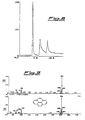
- EI mass spectrum (A) of third eluting component obtained from acquisition shown in fig. 1 (pyrene), and comparison with EI library spectrum of pyrene (B) are shown in fig. 9. This was the first spectrum selected on performing library searching of NIST Electron Impact library of 50000 compounds with a search score of 897/1000.
Landscapes
- Chemical & Material Sciences (AREA)
- Physics & Mathematics (AREA)
- Analytical Chemistry (AREA)
- Health & Medical Sciences (AREA)
- Plasma & Fusion (AREA)
- Dispersion Chemistry (AREA)
- Engineering & Computer Science (AREA)
- Life Sciences & Earth Sciences (AREA)
- Biochemistry (AREA)
- General Health & Medical Sciences (AREA)
- General Physics & Mathematics (AREA)
- Immunology (AREA)
- Pathology (AREA)
- Other Investigation Or Analysis Of Materials By Electrical Means (AREA)
Applications Claiming Priority (2)
| Application Number | Priority Date | Filing Date | Title |
|---|---|---|---|
| ITMI911139A IT1247521B (it) | 1991-04-24 | 1991-04-24 | Metodo e dispositivo per interfacciare uno spettometro di massa |
| ITMI911139 | 1991-04-24 |
Publications (3)
| Publication Number | Publication Date |
|---|---|
| EP0510510A2 EP0510510A2 (en) | 1992-10-28 |
| EP0510510A3 EP0510510A3 (en) | 1993-01-20 |
| EP0510510B1 true EP0510510B1 (en) | 1996-06-26 |
Family
ID=11359778
Family Applications (1)
| Application Number | Title | Priority Date | Filing Date |
|---|---|---|---|
| EP92106517A Expired - Lifetime EP0510510B1 (en) | 1991-04-24 | 1992-04-15 | Method and device for interfacing liquid chromatography or supercritical fluid chromatography with a mass spectrometer (LC-SFC/MS) |
Country Status (4)
| Country | Link |
|---|---|
| US (1) | US5376789A (it) |
| EP (1) | EP0510510B1 (it) |
| DE (1) | DE69211755T2 (it) |
| IT (1) | IT1247521B (it) |
Families Citing this family (14)
| Publication number | Priority date | Publication date | Assignee | Title |
|---|---|---|---|---|
| US6147347A (en) * | 1994-03-15 | 2000-11-14 | Hitachi, Ltd. | Ion source and mass spectrometer instrument using the same |
| IT1270203B (it) * | 1994-06-09 | 1997-04-29 | Fisons Instr Spa | Procedimento e dispositivo per l'introduzione di liquidi in spettrometri di massa mediante nebulizzazione elettrostatica |
| US5750988A (en) * | 1994-07-11 | 1998-05-12 | Hewlett-Packard Company | Orthogonal ion sampling for APCI mass spectrometry |
| US5495108A (en) * | 1994-07-11 | 1996-02-27 | Hewlett-Packard Company | Orthogonal ion sampling for electrospray LC/MS |
| JP3353561B2 (ja) * | 1995-09-07 | 2002-12-03 | 株式会社日立製作所 | 溶液の質量分析に関する方法と装置 |
| US5756995A (en) * | 1997-07-09 | 1998-05-26 | The United States Of America As Represented By The Secretary Of The Army | Ion interface for mass spectrometer |
| US6902937B2 (en) | 2001-07-13 | 2005-06-07 | Air Liquide America, L.P. | Method for the determination of low-concentration anions in the presence of an excess of another anion |
| DE102004054620A1 (de) * | 2004-11-11 | 2006-06-08 | Henkel Kgaa | Geranonitril-Substitut |
| JP6352047B2 (ja) * | 2014-05-13 | 2018-07-04 | 株式会社島津製作所 | 異なる極性をもつ化合物を含む試料の一斉分析方法 |
| CN105304452B (zh) * | 2015-10-23 | 2017-10-27 | 浙江好创生物技术有限公司 | 激光电喷雾离子源 |
| GB2567793B (en) * | 2017-04-13 | 2023-03-22 | Micromass Ltd | A method of fragmenting and charge reducing biomolecules |
| CN108828118B (zh) * | 2018-03-05 | 2020-04-17 | 杭州师范大学钱江学院 | 一种纳流色谱分离和等离子体质谱检测的联用系统 |
| WO2019200388A1 (en) * | 2018-04-13 | 2019-10-17 | Waters Technologies Corporation | Mass spectrometer ion source with integrated column |
| FR3149312B1 (fr) * | 2023-05-30 | 2025-06-20 | Airbus Operations Sas | Interface amelioree de controle et de neutralisation d’une ligne d’alimentation electrique d’un aeronef et aeronef comprenant une telle interface. |
Family Cites Families (8)
| Publication number | Priority date | Publication date | Assignee | Title |
|---|---|---|---|---|
| US4641541A (en) * | 1986-02-11 | 1987-02-10 | Daryl Sharp | Internal mass spectrometer interface to a gas chromatograph |
| US4885076A (en) * | 1987-04-06 | 1989-12-05 | Battelle Memorial Institute | Combined electrophoresis-electrospray interface and method |
| JP2834136B2 (ja) * | 1988-04-27 | 1998-12-09 | 株式会社日立製作所 | 質量分析計 |
| US5130538A (en) * | 1989-05-19 | 1992-07-14 | John B. Fenn | Method of producing multiply charged ions and for determining molecular weights of molecules by use of the multiply charged ions of molecules |
| US4999493A (en) * | 1990-04-24 | 1991-03-12 | Vestec Corporation | Electrospray ionization interface and method for mass spectrometry |
| US5170053A (en) * | 1990-08-30 | 1992-12-08 | Finnigan Corporation | Electrospray ion source and interface apparatus and method |
| JP2598566B2 (ja) * | 1990-10-26 | 1997-04-09 | 株式会社日立製作所 | 質量分析計 |
| US5164593A (en) * | 1991-02-28 | 1992-11-17 | Kratos Analytical Limited | Mass spectrometer system including an ion source operable under high pressure conditions, and a two-stage pumping arrangement |
-
1991
- 1991-04-24 IT ITMI911139A patent/IT1247521B/it active IP Right Grant
-
1992
- 1992-04-15 DE DE69211755T patent/DE69211755T2/de not_active Expired - Fee Related
- 1992-04-15 EP EP92106517A patent/EP0510510B1/en not_active Expired - Lifetime
- 1992-04-23 US US07/872,280 patent/US5376789A/en not_active Expired - Fee Related
Also Published As
| Publication number | Publication date |
|---|---|
| DE69211755D1 (de) | 1996-08-01 |
| IT1247521B (it) | 1994-12-17 |
| EP0510510A2 (en) | 1992-10-28 |
| ITMI911139A1 (it) | 1992-10-24 |
| EP0510510A3 (en) | 1993-01-20 |
| US5376789A (en) | 1994-12-27 |
| ITMI911139A0 (it) | 1991-04-24 |
| DE69211755T2 (de) | 1997-01-23 |
Similar Documents
| Publication | Publication Date | Title |
|---|---|---|
| US5376789A (en) | Method and device for LC-SFC/MS interfacing | |
| EP2260503B1 (en) | Electrospray ion sources for improved ionization | |
| EP0566022B1 (en) | Insulated needle for forming an electrospray | |
| US7960711B1 (en) | Field-free electrospray nebulizer | |
| Wittmer et al. | Electrospray ionization ion mobility spectrometry | |
| US5349186A (en) | Electrospray interface for mass spectrometer and method of supplying analyte to a mass spectrometer | |
| US6326616B1 (en) | Curved introduction for mass spectrometry | |
| US4999493A (en) | Electrospray ionization interface and method for mass spectrometry | |
| US4647772A (en) | Mass spectrometers | |
| CA1340133C (en) | Combined electrophoresis-electrospray interface and method | |
| US5304798A (en) | Housing for converting an electrospray to an ion stream | |
| US7041966B2 (en) | Apparatus for delivering ions from a grounded electrospray assembly to a vacuum chamber | |
| US4667100A (en) | Methods and apparatus for mass spectrometric analysis of fluids | |
| CN108369889A (zh) | 用于使esi操作期间的放电最小化的系统 | |
| EP2297769A1 (en) | Single and multiple operating mode ion sources with atmospheric pressure chemical ionization | |
| JP2778689B2 (ja) | 放電イオン化質量分析計 | |
| US7189977B2 (en) | Electrospray mass spectrometer and ion source | |
| US7112786B2 (en) | Atmospheric pressure ion source high pass ion filter | |
| US10978287B2 (en) | ESI sprayer and ionizer | |
| GB2441601A (en) | Ionizing apparatus | |
| JP3424376B2 (ja) | 液体クロマトグラフ質量分析装置 | |
| CN114667589A (zh) | 离子源 | |
| US5235186A (en) | Probe-based electrospray adapter for thermospray equipped quadrupole based LC/MS systems | |
| JP3379989B2 (ja) | 電気噴霧をイオン流に変換するためのハウジング | |
| JP7294535B2 (ja) | イオン分析装置 |
Legal Events
| Date | Code | Title | Description |
|---|---|---|---|
| PUAI | Public reference made under article 153(3) epc to a published international application that has entered the european phase |
Free format text: ORIGINAL CODE: 0009012 |
|
| AK | Designated contracting states |
Kind code of ref document: A2 Designated state(s): DE FR GB NL |
|
| PUAL | Search report despatched |
Free format text: ORIGINAL CODE: 0009013 |
|
| AK | Designated contracting states |
Kind code of ref document: A3 Designated state(s): DE FR GB NL |
|
| 17P | Request for examination filed |
Effective date: 19930712 |
|
| 17Q | First examination report despatched |
Effective date: 19950518 |
|
| GRAH | Despatch of communication of intention to grant a patent |
Free format text: ORIGINAL CODE: EPIDOS IGRA |
|
| RAP1 | Party data changed (applicant data changed or rights of an application transferred) |
Owner name: FISONS INSTRUMENTS S.P.A. |
|
| GRAA | (expected) grant |
Free format text: ORIGINAL CODE: 0009210 |
|
| AK | Designated contracting states |
Kind code of ref document: B1 Designated state(s): DE FR GB NL |
|
| PG25 | Lapsed in a contracting state [announced via postgrant information from national office to epo] |
Ref country code: NL Free format text: LAPSE BECAUSE OF FAILURE TO SUBMIT A TRANSLATION OF THE DESCRIPTION OR TO PAY THE FEE WITHIN THE PRESCRIBED TIME-LIMIT Effective date: 19960626 Ref country code: FR Effective date: 19960626 |
|
| REF | Corresponds to: |
Ref document number: 69211755 Country of ref document: DE Date of ref document: 19960801 |
|
| EN | Fr: translation not filed | ||
| NLV1 | Nl: lapsed or annulled due to failure to fulfill the requirements of art. 29p and 29m of the patents act | ||
| PG25 | Lapsed in a contracting state [announced via postgrant information from national office to epo] |
Ref country code: GB Effective date: 19970415 |
|
| PLBE | No opposition filed within time limit |
Free format text: ORIGINAL CODE: 0009261 |
|
| STAA | Information on the status of an ep patent application or granted ep patent |
Free format text: STATUS: NO OPPOSITION FILED WITHIN TIME LIMIT |
|
| 26N | No opposition filed | ||
| GBPC | Gb: european patent ceased through non-payment of renewal fee |
Effective date: 19970415 |
|
| PG25 | Lapsed in a contracting state [announced via postgrant information from national office to epo] |
Ref country code: DE Free format text: LAPSE BECAUSE OF NON-PAYMENT OF DUE FEES Effective date: 19980101 |