EP0510577A2 - Automatische Vorrichtung zum Liefern von Manschetten oder Rippstücken zu Wirkmaschinen vom Typ-Cotton zur Herstellung von Strickwaren - Google Patents
Automatische Vorrichtung zum Liefern von Manschetten oder Rippstücken zu Wirkmaschinen vom Typ-Cotton zur Herstellung von Strickwaren Download PDFInfo
- Publication number
- EP0510577A2 EP0510577A2 EP92106790A EP92106790A EP0510577A2 EP 0510577 A2 EP0510577 A2 EP 0510577A2 EP 92106790 A EP92106790 A EP 92106790A EP 92106790 A EP92106790 A EP 92106790A EP 0510577 A2 EP0510577 A2 EP 0510577A2
- Authority
- EP
- European Patent Office
- Prior art keywords
- comb
- selection
- feeding
- rib
- automatic equipment
- Prior art date
- Legal status (The legal status is an assumption and is not a legal conclusion. Google has not performed a legal analysis and makes no representation as to the accuracy of the status listed.)
- Withdrawn
Links
Images








Classifications
-
- D—TEXTILES; PAPER
- D04—BRAIDING; LACE-MAKING; KNITTING; TRIMMINGS; NON-WOVEN FABRICS
- D04B—KNITTING
- D04B11/00—Straight-bar knitting machines with fixed needles
- D04B11/24—Straight-bar knitting machines with fixed needles with provision for transfer of knitted goods from one machine to another
Definitions
- the invention relates to an automatic equipment for feeding cuffs and ribs to loom of Cotton type, for production of knitted fabric, i.e. a transfer device which delivers a knitted item, more commonly known as ribs, to the various sinker bars of the machine from which the fabric to make up the sleeve, the front or the back of the finished item is then produced: delivery and feeding that taking place without manual intervention of the operator.
- a transfer device which delivers a knitted item, more commonly known as ribs, to the various sinker bars of the machine from which the fabric to make up the sleeve, the front or the back of the finished item is then produced: delivery and feeding that taking place without manual intervention of the operator.
- the state of the art comprises semiautomatic rib transfer devices which require the presence of the operator to manually making the transfer from the storage comb to the feeding comb. Poor results have been obtained from the conveyor type device, which transfers the feeding combs successively by a conveying chain to a single manual transfer position of the ribs, mainly because of inherent mechanical imprecision due to the length of the chain.
- the manual carriage type device most commonly used, instead, requires the movement of the feeding combs from their housing positions and their alignment on the carriage, with the storage comb, followed by manual transfer, first working on the rib, then controlling the complete transfer of the stitches one by one.
- the present invention solves the above-mentioned technical problem by adopting: a carriage moving on guides along the loom, equipped with means of motion and clamping registered to the sinker bar, bearing the storage comb on supports rotating or oscillating on an axle longitudinal to the loom, thus matching the feeding comb; means of selection of the rib from the pack, connected to the said supports; the said means of selection are equipped with rib grips, as wide at least as the rib itself; a pusher comb with fine teeth which are intercalable with the needles of both the storage comb and feeding comb, both of which are matched to the pivoting/swinging of the said supports: the pusher comb is driven upward/downward and forward/backward by lifting and pushing actuators; the single feeding comb is coupled to means of rotation, which are cross-running to be able to approach the sinker bar, driven by pushing actuators and one or more rotation actuators.
- Adopting in a preferred embodiment: said means of selection consisting of a pivoting selection hanger, in order to set at least its "engagement" and “selection” positions of the rib; this selection hanger has one or more strips of gripping material of the rib and/or a plurality of retractable hooks, coupled in rotation to the hanger, which stand out in the gripping-area of the rib to transfer.
- said means of selection consisting of a shifting selection pusher, to set at least the "engagement" and “selection” positions of the rib; this selection pusher has one o more strips of gripping material of the rib and/or a plurality of retractable hooks, coupled in rotation to the pusher, which stand out in the gripping-area of the rib to transfer.
- supporting means for the selection hanger or the selection pusher rotating on a longitudinal axle that does or does not coinciding with the oscillation/rotation axle of the storage comb, driven by rotation actuator means; pneumatic cylinders, in two parts, for rotating the said selection hanger to set three characteristic "engagement”, “selection” and “disengagement” positions, adjustable on the said supporting means; pneumatic cylinders for shifting the said pusher, coupled to the said supporting means.
- Adopting for the coupling of the storage combs and the feeding combs means of advancing and/or swinging the supports of the above storage comb towards the feeding comb; also means guiding of the needles of the said combs during the coupling; the means of advance/swing for the supports of the storage comb in two parts which are independently operated, to set a half-way position of reduced swing/advance from the comb matching; said means of guiding the needles consisting of the flat dents of the pusher comb, or consisting of a mobile spacer section of the needles of the storage comb, to press the opposite side of the rib pack of the comb.
- Adopting for the handling of the pusher comb means of control consisting of four-bar linkage levers driven to lose one's shape by actuators acting upon the rotation and/or the length of the rods; also some cams or some pairs of cams, as means of rotating the rods, acting through rockers upon the said four-bar linkage; alternatively, pneumatic cylinders acting upon the leverage rods or even replacing the rods.
- Adopting for working with rib of different length, in the case of the selection hanger: said supports of the above selection hanger in form of a pair of wings, with slots in which the selection hanger pivots run and can be secured in a chosed position by ring nuts; a flat spacer of the selection hanger pivot and its rotation cylinder/s reaction pin.
- Adopting in addition to one or more of the previous features: pneumatic cylinders to make up the said push and rotation actuators of the arms bearing the feeding combs: the pneumatic cylinders for rotating the arms are in two parts to set a half-way sub-horizontal "approach” position and the "end” position that matches the sinker bar; a transmission of the relative rotation motion of the arms with respect to the loom, which is amplified and rotates the feeding comb by a wider angle than the one covered by the cylindrical bar and by the arms; alternatively, as a means of relative rotation of the feeding combs on the said arms, a belt coupled to a shaft driven by an electric motor synchronously for all the feeding combs; some ball sliding blocks, as means of guiding and sliding the said arms on the loom frame.
- the advantages accomplished by the present invention are: the operator is relieved from working manually as the ribs are delivered and, consequently, the surveillance time of the operation is reduced; a longer time is then available for a direct check on the running of the loom as well as on the quality of the production and, moreover, a single operator will be able to survey two looms at a time; also, the expected operative controls avoid frequent and expensive repairs of damaged sinker bar needles, thus a more reliable running of the loom is achieved, thereby saving a great deal of money on maintenance and avoiding break in production.
- the storage comb needles which are damaged more easily during the continual production movement, are driven in a more direct and safer way.
- the presence of retractable hooks allows the machine to work safely on very smooth yarns, even on worsted ones.
- the equipment can be fitted, in an advantageous manner, on many different makes of existing Cotton type looms as well as, of course, on new machines.
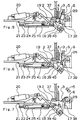
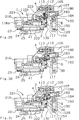
- Figure 1 shows a schematic cross section of the automatic delivery device, according to the invention, positioned to select the rib during the transfer to a feeding comb
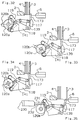
- Figure 2 shows a schematic transversal view of the rotation device of the storage comb, with the comb just loaded
- Figure 3 is a schematic view, like Figure 2, with the comb turned to the pick-up position of the rib
- Figure 4 is a view like Figure 3, with the selection hanger break down the rib from the pack
- Figure 5 is a schematic transversal view of the levers which handle the pusher comb, with the latter inserted into the storage comb
- Figure 6 is similar to the previous view, with the pusher comb working
- Figure 7 is a schematic view of the operating levers of the pusher comb in the "end transfer" position of the rib
- Figure 8 is the magnified partial longitudinal section, VIII-VIII of Figure 2, of the setting device for the selection hang
- Figure 27 is a schematic cross section of the automatic delivery equimpent while a rib is transferred to a feeding comb
- Figure 28 is a partial rear view of the selection pusher and the retractable hooks
- Figure 29 represents a schematic transversal view of the selection and swing device of the storage comb, when the selection starts
- Figure 30 is a schematic view like Figure 29, with the retractable hooks turned to a rib-grip position
- Figure 31 is a view like Figure 29, with the selection pusher break down the rib from the pack, against the dents of the pusher comb
- Figure 32 is a magnified schematic transversal view of the double cam and of the levers that handle the pusher comb, with the latter coupled to the feeding comb
- Figure 33 is similar to the previous view, with the pusher comb moving to the push position, behind the rib
- Figure 34 is similar to the previous view, with the pusher comb in a push position
- Figure 35 is similar to the previous view, with the pusher comb
- 1 ( Figure 1) is the automatic loading carriage bearing the storage comb 2; 3 is a single rib being breaked down of the pack 4 of ribs, which, if they are exceedingly long, are retained by spring pushers 4p; 5 is the selection hanger; 6 is the feeding comb aligned to the storage comb; 7 is a pneumatic cylinder actuator operating on the adjustable control lever 8 of the selection hanger, which pivots around the longitudinal axle 9; 10 is another pneumatic cylinder actuator rigidly connected to the former one, which operates on the adjustable pin 11; 12 are two wings with a setting slot 13; 14 are wing pivots on axle 15, driven by the double pneumatic cylinder actuator 16 consisting of two parts 16a and 16b; 17 is a pusher comb placed under the previous combs 2 and 6 in pivotal connection both to the lifting lever 18 and to the pneumatic push-actuator cylinder; 20 is the pneumatic cylinder operating on the pair of lifting levers; 21 is the baseplate of the carriage 1 running longitudinally on the frame 22 of the
- 34 is a turn-over lever driven by the said pneumatic double cylinders 32; 35 ( Figure 2) is the join hanger of the cylinders 7 and 10, which work successively to set three operative positions for the selection hanger 5, kept by short pivots 36, materializing the said axle 9; 37 is a plate for joining the wings 12 and supporting the rib pack 4; 38 is a spacer and a support for the feeding comb 6 during the transfer; 39 ( Figure 5) are a pair of supports for the pusher comb 17, which swing on the joining bar 40 of the side lifting levers 18; 41 is the oscillation fulcrum of the levers 18; 42 ( Figure 8) is a spacing plate between the short pivot 36 and the adjustable pin 11; 43 are ring nuts of the pin 11 and of the bush 44, wherein the short pivots 36 spin inside anti-friction elements 45; 46 is a strip of gripping material for the rib 3, provided with many tiny hooks of synthetic material (Velcro type); 47 is a section bar joining the upper edges of the
- 7V, 10V, 19V, 20V, 33V and 66V are pneumatic valves, provided with single solenoid control and spring reversal of the pneumatic cylinders 7, 10, 19, 20 and at least a pair of cylinders 33 and 66;
- 10S is a one-way flow control valve to regulate the back stroke of the cylinder 10;
- 16aV, 16bV, 32aV and 32bV are pneumatic valves, again provided with single solenoid control and spring reversal, to regulate respectively the first parts 16a and 32a and the second parts 16b and 32b of the double cylinders 16 and 32 working at least in pair together;
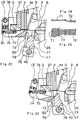
- 71 (Figure 18) is a needle of the storage comb 2, matching the corresponding needle 72 of the feeding comb 6;
- 73 (Figure 19) is a spacer section of the said needles 71;
- 74 ( Figure 20) is a pair of side squares supporting the said spacer section 73, in pivotal connection on the axle 15 and retained by a pair
- 105 ( Figure 27) is the selection pusher moving along the wings 112 in the slots 113, driven by a pair of pneumatic cylinder actuators 107; 115 is the rotation axle of the said wings 112; 186 is a pair of pneumatic cylinder actuators controlling the retractable hooks 184 and connected to each support carrier of the said pusher, such hooks being locked to a flat bar 183 rotating on an axle 193 made out of two short pivots at the ends of the said bar which are connected to the corresponding supports of the pusher 105 as shown in Figure 28; 185 is the lever connecting the said cylinders 186 to the flat bar 183; 116a is a pair of pneumatic cylinders actuating a cross advance of the pair of transversal carriers 221, whose function is to bring closer the storage comb 2 and the feeding comb 6: the said carriers 221 slide on ball sliding blocks 222 and are coupled to the swinging supports 176 of the comb 2 and to the wings 112
- 117 is the pusher comb provided with flat dents 173; 139 is a pair of side swing-supports of the pusher comb 117; 118 is the pair of lifting rockers of the said comb; 119 is the pair of push rockers of the said comb; 141 is the oscillation axle of the said rockers, driven via rolls or bearings by a pair of double cams, where 120a are lifting cams and 120b are push cams; 216 is a pair of pneumatic cylinders, actuating the rotation of the wings 112, set to a "selection" or "transfer” position.
- 130 are ball sliding blocks for the cross-slide guide of the pair of arms 129 supporting and rotating the feeding comb 6;
- 150 is a toothed belt connected via some pulleys to the shaft 154 and to the comb 6, driven via the said shaft 154 by an electric motor not shown;
- 230 ( Figure 35) is a pair of pneumatic cylinders actuating the double cams 120a-120b via a rack-and-gear coupling 231-232;
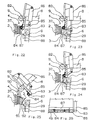
- 224 ( Figure 36) is the rotation axle of the clamp locking the comb 2;
- 225 are grub screws adjusting the comb 2 with respect to the support 176 and to the clamp;
- 227 ( Figure 37) is a rack operating on the wings 112 by means of their sector gear 228 and driven by the cylinder 216;
- 215 are two short segments of shaft locked to the said supports 176 and coupled by bearings to the wings 112 and to the vertical lugs 214 of the carriers 221;
- 241 are manual shutters for locking the said clamp
- the equimpent works in the following way: the operator loads the storage comb 2 in its housing on the wings 12 and starts the automatic delivery cycle (Figure 2), the carriage 1 being ready at the first sinker bar of the loom: the fine alignment is previously secured by a pair of shutters 67 frusto-conical within the corresponding holes in the jig locator 68 and actuated by the pneumatic cylinders 66; the delivery cycle only starts when all the feeding combs 6 are in the transfer position, as shown in Figures 1-7; so the selection hanger 5 comes from the outer position down to the inner position to press the rib pack 4, by a combined successive extension of the pneumatic cylinders 7 and 10; at the same time the wings rotate by 90 degrees ( Figure 3) driven by the combined action of the two parts of the double cylinder 16; the storage comb needles 2 are thus matched to the feeding comb needles 6, which are driven and supported by the spacing bar 38; then, the reverse action of the sole cylinder 10 is driven via a pneumatic valve 10V, which
- the delivery cycle can in this way resume, as described above, for each active sinker bar of the loom: when empty the carriage returns automatically to the loading station of the next storage comb, with a new pack of ribs, or to the first sinker bar if there is not enough room for a separate station; the operator, after substitution of the empty storage comb with the full one, signals the start of the delivery cycle which doesn't begin until the loom has finished the old fabric panel and commenced the new one, thereby emptying the feeding combs.
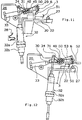
- the feeding comb therefore makes a rotational angle greater than 180°, finishing the first phase of the rotation as shown in Figure 11; the next approach takes place as the cylindrical bar 31 runs horizontally along the slots 30, driven by at least a pair of pneumatic cylinders 33 which are controlled via the pneumatic valve 33V, until reaching the sub-horizontal intermediate position 53 as shown by the dotted line in Figure 12.
- the loom which is obviously ready to align the feeding combs 6 with the needles of the respective sinker bars 27, starts the production after the shorter second part 32b of the double cylinders 32, extending, has aligned the said feeding combs with said needles, and after the sinkers 52, retaining the stitches of the rib 3, have allowed the loom to knit the first stitch of the new fabric panel 28.
- the rib 3, during the alignement rotation of the feeding comb is held by pulling hooks 51.
- the needles 71 of the storage comb 2 are guided and well spaced during the matching phase with the needles 72 of the feeding comb 6: the spoon shape of the former eases and subsequently keeps the matching when, in the following steps, there is no further guiding by the said section: furthermore, the pusher comb 17 is kept in a resting position, from underneath by the extended pneumatic cylinder 20, and from the front by the extended cylinder 19, their position being controlled by the magnetic detector of the end of stroke: once the rib 3 is selected, the cylinder 19 is retracted and contemporarily the pusher comb rotates acting, via the platens 79 pressing the curved surfaces 80, upon the squares 74 and therefore also upon the section 73, pulling it off the storage comb 2; the retraction of cylinder 20 following retraction of cylinder 19 causes the comb 17 to be inserted between the needles 71, and is controlled by magnetic detection of the end of stroke, said comb pushing the stitches of the rib 3
- the screw 81 double in order to secure the locking of the position, allows the length of the run of section 73 to be set to avoid banging against needles 71 of the storage comb 2 as the squares 74 are released.
- the connecting pipes of valve 19V, controlling cylinder 19, must be inverted, like cylinder 20 in the pneumatic scheme of Figure 17: said arrangement allows the extension of cylinder 19 when in the resting position or in the case of loss of electricity to the valve.
- the spring presser 90 of the rib pack 4 is provided with a longitudinal tube 91, fed by compressed air: this tube has a series of small holes in rows which shoot jets of compressed air 92 against rib 3 as it leaves the selection hanger.
- the pair of wings 112, bearing the guiding slots 113 of the selection presser 105 rotate into the position indicated in Figure 27 so as not to obstruct the area of combs 2 and 6 during the transfer of the rib 3; the selection, as shown in Figures 29-31, takes place with said wings 112 in a horizontal or sub-horizontal position, in such a way that the side of the presser pushes against the rib pack 4, present on the storage comb 2; the rotation of these is driven by pneumatic cylinders 216, acting via a rack (227) sector gear (228) coupling ( Figures 37-38); the run of the presser along the slots 113 is driven by cylinders 107 and guided by means of a pair of wheeled carriages (drawn but not numbered) which in turn support cylinders 186 actuating retractable hooks 184; the end of the presser is thus positioned near the gripping area of the ribs 3, an ideal situation for the selection of any type of rib.
- the flat bar 183, bearing retractable hooks 184, is forced to rotate around the axle 193 which is close to said end of presser 105, by cylinders 186 acting via levers 185: the hooks 184 are always extended and retracted through a constant angle, gripping in a uniform way from the first to the last rib in the pack; said hooks ( Figures 29-31) are rotated as selection begins and grip the outer rib 3 of the pack 4; subsequently cylinder 107 retracts and the rib is separated from the pack up against the flat dents 173 of the pusher comb 117; said separation takes place with the storage comb at a distance from the feeding comb: this renders the selection process possible even when carriage 1 moves from one station to the next; said retractable hooks 184 are withdrawn before the matching of the two combs 2 and 6, in order to allow wings 112 and presser 105 to rotate as shown in Figure 27.
- the transversal carrier is forced to advance in order to bring the needles of the storage comb closer to those of the feeding comb ( Figures 32 and 71-72, Figures 18-19), caused by the action of the pneumatic cylinders 116a; the small lowering rotation of needles 71 is obtained oscillating supports 176 ( Figure 36) on axle 115, caused by the action of cylinders 116b, controlled in the throw and/or bleed, to adjust the matching strength of the needles; the flat dents 173, fixed to the ends of the needles 71, guide them and overshooting their points, also guide the corresponding needles 72 of the feeding comb during the alignement and the matching, whilst the transversal carrier advances, whilst the supports 176 oscillate downwards, lowering said needles 71 of the storage comb 2 against the corresponding needles 72 of the feeding comb 6.
- the pusher comb 117 ( Figures 32-35), is then moved downwards to be transferred from the coupling position to the pushing position, behind the selected rib 3; side supports 139 making part of a four-bar linkage along with rockers 118 and 119, are driven by a pair of double cams 120a and 120b as shown in the said figures: the lifting/lowering is driven by cams 120a, acting on rockers 118, whereas advance/retraction is driven by cams 120b, acting on rockers 119; the cams rotate on the same shaft and, after the adjustment, are rigidly connected together; their rotation is driven by a pair of pneumatic cylinders 230, acting via rack-and-gear coupling 231, 232 ( Figures 35 and 38).
- the comb 2 is locked on the said swinging side supports 176 by clamp 223, against a projecting section 271 of said supports 176; comb 2 is also set by screws 225 having lock nuts, because the storage combs may have different bed dimensions even with the same fineness of weave (Figure 36); moreover comb 2 is set longitudinally via the matching of the broken needles 171 to the corresponding holes in said projecting section 271; said clamp rotates around axle 224 to replace comb 2, and is locked by shutters 241 which is manually operated (Figure 37).
- the arms 129 work in a similar way to arms 29 and working takes place as described above: the rotation of the feeding comb 6 is no longer driven by a mechanical connection to the rotation of the cylindrical bar 31, i.e. of said arms, but by action of an electric motor that rotates shaft 154, which is as long as the loom and acts on said comb 6 via pulleys and toothed belt 150; the run towards sinker bars 27, arms 129, and comb 6 takes place by extending cylinder 33 which acts on the cylindrical bar 31 on guides 130, which being low friction type, assure a uniform advancement along the length of the loom.
- the detection of the end of stroke of the pneumatic cylinders may be extended to all the cylinders present in the equimpent beside those already indicated above.
- the means of gripping the rib in the case of the selection presser, may be also or only made from strips of gripping material (Velcro type) beside the said retractable hooks.
Landscapes
- Engineering & Computer Science (AREA)
- Textile Engineering (AREA)
- Looms (AREA)
- Treatment Of Fiber Materials (AREA)
Applications Claiming Priority (2)
| Application Number | Priority Date | Filing Date | Title |
|---|---|---|---|
| ITMO910059 | 1991-04-22 | ||
| ITMO910059A IT1246541B (it) | 1991-04-22 | 1991-04-22 | Attrezzatura automatica di alimentazione di polsini e fondi al telaio di tipo cotton, per la produzione di tessuto a maglia. |
Publications (2)
| Publication Number | Publication Date |
|---|---|
| EP0510577A2 true EP0510577A2 (de) | 1992-10-28 |
| EP0510577A3 EP0510577A3 (en) | 1992-12-09 |
Family
ID=11384948
Family Applications (1)
| Application Number | Title | Priority Date | Filing Date |
|---|---|---|---|
| EP19920106790 Withdrawn EP0510577A3 (en) | 1991-04-22 | 1992-04-21 | Automatic equipment for feeding cuffs or ribs to loom of cotton type, for production of knitted fabric |
Country Status (2)
| Country | Link |
|---|---|
| EP (1) | EP0510577A3 (de) |
| IT (1) | IT1246541B (de) |
Cited By (2)
| Publication number | Priority date | Publication date | Assignee | Title |
|---|---|---|---|---|
| DE4332240A1 (de) * | 1993-09-23 | 1995-03-30 | Wirkbau Textilmasch Gmbh | Verfahren zur Übertragung von auf Ränderstrickautomaten hergestellten Rändern und Ränderstrickautomat zur Durchführung des Verfahrens |
| EP0902112A3 (de) * | 1997-09-09 | 2000-04-05 | Tecnotessile S.r.l. | Vorrichtung zum Übertragen von an einen Magazinrechen herangebrachten Strickränder zur Nadelbarre einer Cottonmaschine |
Family Cites Families (4)
| Publication number | Priority date | Publication date | Assignee | Title |
|---|---|---|---|---|
| GB1195698A (en) * | 1966-12-08 | 1970-06-17 | Cotton Ltd W | Improvements in or relating to Straight Bar Knitting Machines |
| GB1229788A (de) * | 1967-09-01 | 1971-04-28 | ||
| GB1260518A (en) * | 1969-06-03 | 1972-01-19 | Wirkmaschinenbau Karl Marx Veb | Improvements in or relating to devices for transferring pre-fabricated portions of knitted goods |
| GB9018902D0 (en) * | 1990-08-30 | 1990-10-17 | Monk W M Cotton Sales & Servic | Straight bar knitting machines |
-
1991
- 1991-04-22 IT ITMO910059A patent/IT1246541B/it active IP Right Grant
-
1992
- 1992-04-21 EP EP19920106790 patent/EP0510577A3/en not_active Withdrawn
Cited By (3)
| Publication number | Priority date | Publication date | Assignee | Title |
|---|---|---|---|---|
| DE4332240A1 (de) * | 1993-09-23 | 1995-03-30 | Wirkbau Textilmasch Gmbh | Verfahren zur Übertragung von auf Ränderstrickautomaten hergestellten Rändern und Ränderstrickautomat zur Durchführung des Verfahrens |
| DE4332240C2 (de) * | 1993-09-23 | 1998-03-26 | Malimo Maschinenbau | Verfahren zur Übertragung von auf Ränderstrickautomaten hergestellten Rändern und Ränderstrickautomat zur Durchführung des Verfahrens |
| EP0902112A3 (de) * | 1997-09-09 | 2000-04-05 | Tecnotessile S.r.l. | Vorrichtung zum Übertragen von an einen Magazinrechen herangebrachten Strickränder zur Nadelbarre einer Cottonmaschine |
Also Published As
| Publication number | Publication date |
|---|---|
| ITMO910059A1 (it) | 1992-10-22 |
| ITMO910059A0 (it) | 1991-04-22 |
| IT1246541B (it) | 1994-11-24 |
| EP0510577A3 (en) | 1992-12-09 |
Similar Documents
| Publication | Publication Date | Title |
|---|---|---|
| EP0508014B1 (de) | Materialhandhabungssystem | |
| EP2946034B1 (de) | Verfahren und vorrichtung zum automatischen verschluss eines axialen endes eines röhrenförmigen fertigproduktes und zur entladung dieses in umgekehrter weise | |
| US4586326A (en) | Spinning machine with roving-bobbin feeder | |
| US3523432A (en) | Apparatus for forming a system of weft threads | |
| CN209144405U (zh) | 一种自动罗纹机的翻卷装置 | |
| EP0236601B2 (de) | Automatische Maschine zum Verbinden zweier Enden eines Bandes | |
| CN105035810A (zh) | 一种接布方法 | |
| US4757679A (en) | Method and apparatus for automatically doffing cops and replacing them with empty tube in a roving frame | |
| EP0026160B1 (de) | Verfahren zur aufwicklung und montage von spulen und vorrichtung zur ausführung des verfahrens | |
| US4383490A (en) | Hosiery toe closing machine | |
| US3563063A (en) | Straight bar knitting machines | |
| GB2112423A (en) | Method and means for joining a selected yarn to a yarn being knitted | |
| CN110203766B (zh) | 一种棉纱换芯机 | |
| CN209508583U (zh) | 一种自动罗纹机 | |
| US4573419A (en) | Device for threading knit articles onto the pin holder ring of a linking machine | |
| EP0473317A2 (de) | Flachwirkmaschine | |
| EP0010982B1 (de) | Verfahren und Vorrichtung zum Übertragen von Strickwaren von einer Strickmaschine zu einer Magazinbarre | |
| US3765160A (en) | Mechanized bobbin handler | |
| US2905366A (en) | Apparatus for feeding hosiery onto a receiving member | |
| US2647357A (en) | Ring spinning machine for spinning fibrous material | |
| CN214168353U (zh) | 一种缝纫机的送料机构 | |
| US3426408A (en) | Method and apparatus for skein winding of yarns | |
| US4369638A (en) | Method and apparatus for knitting hollow articles | |
| US4253498A (en) | Travelling wave shedding looms relative to the shuttle loading system | |
| CN116495272B (zh) | 立式服装套袋设备 |
Legal Events
| Date | Code | Title | Description |
|---|---|---|---|
| PUAI | Public reference made under article 153(3) epc to a published international application that has entered the european phase |
Free format text: ORIGINAL CODE: 0009012 |
|
| PUAL | Search report despatched |
Free format text: ORIGINAL CODE: 0009013 |
|
| AK | Designated contracting states |
Kind code of ref document: A2 Designated state(s): DE ES FR GB IT PT |
|
| AK | Designated contracting states |
Kind code of ref document: A3 Designated state(s): DE ES FR GB IT PT |
|
| 17P | Request for examination filed |
Effective date: 19930601 |
|
| 17Q | First examination report despatched |
Effective date: 19950102 |
|
| STAA | Information on the status of an ep patent application or granted ep patent |
Free format text: STATUS: THE APPLICATION IS DEEMED TO BE WITHDRAWN |
|
| 18D | Application deemed to be withdrawn |
Effective date: 19950513 |