EP0510976B1 - Egalisateur de câble automatique, indépendant du niveau de signal - Google Patents
Egalisateur de câble automatique, indépendant du niveau de signal Download PDFInfo
- Publication number
- EP0510976B1 EP0510976B1 EP92303664A EP92303664A EP0510976B1 EP 0510976 B1 EP0510976 B1 EP 0510976B1 EP 92303664 A EP92303664 A EP 92303664A EP 92303664 A EP92303664 A EP 92303664A EP 0510976 B1 EP0510976 B1 EP 0510976B1
- Authority
- EP
- European Patent Office
- Prior art keywords
- input
- output
- signal
- coupled
- equalizer
- Prior art date
- Legal status (The legal status is an assumption and is not a legal conclusion. Google has not performed a legal analysis and makes no representation as to the accuracy of the status listed.)
- Expired - Lifetime
Links
Images






Classifications
-
- H—ELECTRICITY
- H03—ELECTRONIC CIRCUITRY
- H03G—CONTROL OF AMPLIFICATION
- H03G3/00—Gain control in amplifiers or frequency changers
- H03G3/20—Automatic control
- H03G3/30—Automatic control in amplifiers having semiconductor devices
- H03G3/3052—Automatic control in amplifiers having semiconductor devices in bandpass amplifiers (H.F. or I.F.) or in frequency-changers used in a (super)heterodyne receiver
- H03G3/3068—Circuits generating control signals for both R.F. and I.F. stages
-
- H—ELECTRICITY
- H04—ELECTRIC COMMUNICATION TECHNIQUE
- H04B—TRANSMISSION
- H04B3/00—Line transmission systems
- H04B3/02—Details
- H04B3/04—Control of transmission; Equalising
- H04B3/14—Control of transmission; Equalising characterised by the equalising network used
- H04B3/141—Control of transmission; Equalising characterised by the equalising network used using multiequalisers, e.g. bump, cosine, Bode
-
- H—ELECTRICITY
- H04—ELECTRIC COMMUNICATION TECHNIQUE
- H04L—TRANSMISSION OF DIGITAL INFORMATION, e.g. TELEGRAPHIC COMMUNICATION
- H04L25/00—Baseband systems
- H04L25/02—Details ; arrangements for supplying electrical power along data transmission lines
- H04L25/06—DC level restoring means; Bias distortion correction ; Decision circuits providing symbol by symbol detection
- H04L25/061—DC level restoring means; Bias distortion correction ; Decision circuits providing symbol by symbol detection providing hard decisions only; arrangements for tracking or suppressing unwanted low frequency components, e.g. removal of DC offset
- H04L25/063—Setting decision thresholds using feedback techniques only
-
- H—ELECTRICITY
- H04—ELECTRIC COMMUNICATION TECHNIQUE
- H04L—TRANSMISSION OF DIGITAL INFORMATION, e.g. TELEGRAPHIC COMMUNICATION
- H04L25/00—Baseband systems
- H04L25/02—Details ; arrangements for supplying electrical power along data transmission lines
- H04L25/06—DC level restoring means; Bias distortion correction ; Decision circuits providing symbol by symbol detection
- H04L25/061—DC level restoring means; Bias distortion correction ; Decision circuits providing symbol by symbol detection providing hard decisions only; arrangements for tracking or suppressing unwanted low frequency components, e.g. removal of DC offset
- H04L25/065—Binary decisions
-
- H—ELECTRICITY
- H04—ELECTRIC COMMUNICATION TECHNIQUE
- H04L—TRANSMISSION OF DIGITAL INFORMATION, e.g. TELEGRAPHIC COMMUNICATION
- H04L25/00—Baseband systems
- H04L25/02—Details ; arrangements for supplying electrical power along data transmission lines
- H04L25/08—Modifications for reducing interference; Modifications for reducing effects due to line faults ; Receiver end arrangements for detecting or overcoming line faults
Definitions
- This invention relates to automatic cable equalization, and more particularly to an improved "walking limiter" type of automatic cable equalizer.
- digital television signal equipment may be connected by cables with differing lengths and signal qualities as the systems and their interconnections are reconfigured for different applications. Since the digital signals carried by these cables degrade over longer distances, cable equalizers are used to compensate for these variations. These cable equalizers should be able to compensate for the losses created by 300 meters of cable, with a gain of 30 dB at the high frequencies needed for edge shaping and 6 dB at the lower frequencies of the NRZ (non-return-to-zero) data itself.
- NTSC D2 PAL D2 and component DI
- clock frequencies 143 MHz, 177 MHz and 270 MHz, respectively, are involved.
- the NRZ data for each of these data rates has a theoretical minimum bandwidth of half of these frequencies.
- walking limiter equalizer One type of cable equalizer is known as a "walking limiter" equalizer.
- Such an equalizer comprises multiple equalizer stages.
- a walking limiter cable equalizer When a walking limiter cable equalizer is presented with an input signal that is degraded to the maximum capability of the equalizer, all of the stages operate linearly to restore the signal as much as possible.
- the stage or stages closest to the output go into limiting, so that the output signal is not amplified beyond the desired level.
- AGC automatic gain control
- IC integrated circuit
- an automatic cable equalizer as claimed in claim 1 herein.
- a multiple section cable equalizer with a signal level detector that produces a clipping control signal for amplifiers in each equalizer section, so that a variable level input signal is restored to an equalized output signal that is undistorted and free of bit errors.
- a fixed reference clipping stage after the last equalizing stage produces a signal clipped to a final output level.
- a feedback path limits DC drift in the presence of excess data in either state.
- a test output stage permits monitoring of the operation of the equalizer stages.
- the signal level detector contains (in series) a differential amplifier with low pass filtering, a balanced modulator detector, a voltage amplifier, a comparator and peak detector, a transconductance amplifier and a plurality of current mirrors operatively connected to determine a difference current from the output of the transconductance amplifier and convert this to a clipping control signal voltage level.
- a defeat comparator monitors the output of the comparator and peak detector and replaces the variable difference current with a fixed reference current when an external capacitor used by the peak detector appears to be shorted.
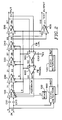
- a differential input signal or a single-ended input signal and ground, are applied across DC blocking capacitors CXl and CX2 to the plus and minus inputs of input differential amplifier 100.
- Input differential amplifier 100 also receives a fixed reference signal REF from fixed reference circuitry 140, a BIAS signal from bias circuit 120 and plus and minus sides of a feedback signal.
- the differential amplifier stage 100 serves to convert any single-ended inputs into differential signals before they reach the first equalizer stage 200. Node numbers, such as 5 and 6 on the input to the input differential amplifier 100, can largely be ignored temporarily in the block level discussion which follows immediately, but will prove very useful in tying together the schematic level discussion which follows further below.
- the outputs of differential amplifier 100 are applied to the first of three identical equalizer stages 200, 220 and 240.
- Each equalizer stage 200, 220 and 240 clips its output to a level determined by VREF, a variable reference signal produced by level detection circuitry 900.
- the differential outputs of the third equalizer stage 240 are applied to the plus and minus inputs of both limiting differential stage 300 and test output stage 400.
- Limiting stage 300 and test output stage 400 both receive the fixed reference signal REF, but not the variable reference signal VREF.
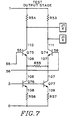
- the test output stage 400 has unity gain and its outputs provide a view for test purposes into the behavior of the equalizer stages 200, 220 and 240 before their output-is affected by the limiting stage 300.
- the output of limiting stage 300 is limited to the full output signal level, regardless of the level of variable limiting that the equalizer stages 200, 220 and 240 have performed in response to the level of VREF.
- the differential outputs of the limiting stage 300 are also monitored by feedback limiting stage 500 which operates in response to VREF to limit to the same level as the equalizer stages 200, 220 and 240 have.
- the differential outputs of the feedback limiting stage 500 are applied to the plus and minus inputs of feedback transconductance amplifier 600, which produces feedback currents that are then supplied to the unity gain differential amplifier stage 100.
- the differential amplifier stage 100 sums these currents into its output to maintain a suitable DC level in the presence of data containing significantly more of one logic state than another. (This type of feedback circuitry has also sometimes been called "quantized feedback circuitry".)
- the variable reference signal VREF is produced by the level detection circuitry 900, which is shown in detail in FIG. 3.
- FIG. 3 illustrates a lowpass filtering differential amplifier 700 whose inputs are DC coupled to the input signals at nodes 5 and 6.
- the outputs of lowpass filtering differential amplifier 700 are applied to the inputs of a balanced modulator detector 710.
- the balanced modulator detector 710 full-wave rectifies both sides of the signal on its inputs and produces two levels whose difference represents the amplitude of the low frequency component of the input signal.
- Low frequency as used in connection with this invention refers to frequencies below 50 MHz, since this is the highest frequency that is not significantly affected by cable losses.
- the output levels from the balanced modulator detector 710 are applied to differential inputs of voltage amplifier 720, which produces a single output voltage that is proportional to the difference in the output levels of the balanced modulator detector 710. This voltage is applied to a comparator and peak detector 730.
- the comparator portion of the comparator and peak detector 730 provides a fast charging path for the peak detector portion. The peak detection is very fast, but the relaxation of the detected value is relatively very slow.
- the output of the comparator and peak detector 730 (node 37) is applied to the input of a transconductance amplifier 740.
- the transconductance amplifier 740 converts this voltage to a pair of differential currents (nodes 49 and 48). Each of these output currents from the transconductance amplifier 740 is applied to a current mirror, node 49 to current mirror 750 and node 48 to current mirror 760.
- the summer portion of current mirror and summer 770 sums the current from its internal current mirror, reflecting the current from current mirror 760, with the current from current mirror 750 to produce an output current at node 59 that is equivalent to the difference between the pair of differential currents at the output of the trans-conductance amplifier 740.
- variable reference voltage output circuitry 800 The output of current mirror and summer 770, node 59, is an input to variable reference voltage output circuitry 800.
- the variable reference voltage output circuitry 800 produces a final output voltage VREF that is proportional to the current from the output of the current mirror and summer 770 (node 59). This reference voltage is proportional to the amplitude of the low frequency content of the input signal.
- Fixed voltage generator 780 produces at node 99 a reference voltage required by current mirrors 750 and 760 and by the variable reference voltage output circuitry 800.
- the output of the comparator and peak detector 730 (node 37) is also applied to one of the inputs of defeat comparator 790.
- the other input to the defeat comparator 790 is a reference voltage (node 96) that is generated by a reference voltage generator that is internal to the transconductance amplifier 740. From these two inputs the defeat comparator 790 ascertains whether or not the comparator and peak detector 730 appears to be working properly.
- the defeat comparator 790 shuts off the output (node 59) of the current mirror and summer 770 (via node 50) and causes the variable reference voltage output circuitry 800 (via node 51) to produce a default variable reference VREF that is equal to the fixed reference REF.
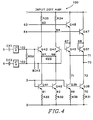
- the input signal is AC coupled through the external capacitors CXl and CX2, and applied to the inputs of a differential amplifier comprising transistors Q42 and Q43.
- the value of R29 in conjunction with values of the collector resistors R35 and R34 establishes the gain to be approximately unity.
- the bases of the differential pair Q42 and Q43 are biased to 2.75 Volts by BIAS signals on nodes 102 and 103, as shown in the Table above.
- 3510 Ohm resistor R58 in parallel with two 18000 Ohm bias source resistors (not shown) and an external 76.8 Ohm resistor (not shown) produces a termination resistance of 75 Ohms for the input signal.
- the fixed reference signal REF on node 3 establishes the maximum current available to the emitters of differential amplifier pair Q42,Q43.
- the currents on nodes 63 and 64 which are produced by the feedback transconductance amplifier 600, are summed with the currents from the collectors of Q42 and Q43, respectively, by the collector resistors R35 and R34, to produce the actual output voltages of the differential pair.
- the currents supplied to nodes 63 and 64 are equal and they have no net effect.
- the DC level starts to drift towards zero as a result of AC coupling with a long string of data that has a disproportionate number of ones or zeros, these currents become unequal and restore the DC level of the differential signal.
- the output voltages at nodes 63 and 64 are then buffered and level shifted downward by two base-emitter voltage drops through Q48,Q45 and Q47,Q37, respectively, to produce the outputs of the input differential amplifier stage 100 at nodes 71 and 72.
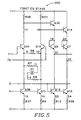
- FIG. 5 a schematic diagram of the first equalizer stage 200, the outputs from the differential amplifier stage 100 appearing on nodes 71 and 72 are applied to another differential pair, Q34 and Ql0.
- the differential pair Q34,Ql0 has approximately unity gain at low frequencies where Cl in the RC network connecting the two emitters presents a very high impedance and the resistance between the two emitters is effectively established by R6.
- the decreasing impedance of the path through R7, Cl and R8 begins to appear lower than the resistance through R6, and the gain of the equalizer stage 200 is significantly increased, becoming about 10 dB at frequencies around 135 MHz; 135 MHz being the theoretical minimum bandwidth for DI. (DI is the fastest of the current video standards.)
- the maximum current available to the transistors Q34,Ql0 of the differential pair, and therefore the maximum output voltages that can be developed across the collector resistors R25 and R24, is determined by the variable reference voltage, VREF.
- the output voltages from the differential pair Q34,Q10 are buffered and level shifted down two base-emitter voltage drops by Q33,Q9 and Q14,Q7, respectively, to produce the final output of the equalizer stage 200.
- the second and third equalizer stages 220 and 240 are identical to the first equalizer stage 200.
- the overall equalizer with three stages provides up to 30 dB of high frequency signal boosting, capable of compensating for the high frequency losses due to 300 meters of cable.
- the output of the third equalizer stage 240 is presented to the limiting stage 300 at nodes 55 and 56.
- the emitters of the transistors Q58 and Q5l of the differential amplifier in the limiting stage 300 are directly coupled together, so that these transistors operate as a switch to switch the current from Q49 between the collector resistors R40 and R39 to produce an output that has minimum rise and fall times.
- Q49 is controlled by the fixed reference voltage REF on node 3, and the relative values of its emitter resistor R37 and the collector resistors R40 and R39 of transistors Q59 and Q5l are selected to produce the desired ECL output level swing of the final output of the overall cable equalizer.
- the output voltage swings of this differential amplifier are then buffered and level shifted down two base-emitter voltage drops by Q52,Q54 and Q59,Q55 to produce the output signals at nodes 87 and 88.
- the peak-to-peak differential output between nodes 87 and 88 is 400 millivolts.
- the output of the third equalizer stage 240 is also presented to the test output stage 400 at nodes 55 and 56.
- the transistors of differential amplifier Q75,Q74 are relatively large, are biased at a high current, and are loaded with low impedance load resistors. This low impedance output is suitable for driving a low impedance load, including a high level of pad and cable capacitance.
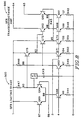
- the output of the limiting stage 300, at nodes 87 and 88, is monitored by the feedback limiting stage 500.
- Nodes 87 and 88 are connected to the bases of transistors Q69 and Q64, another differential pair.
- Transistors Q69 and Q64 share the current from the current source formed by Q65 and R44. This current source is controlled by the variable reference signal VREF.
- the collector of Q64 is connected to external capacitor CX3, resistor R47 and the base of emitter follower Q73.
- a second current source formed by Q63 and R65 is controlled by the variable reference signal VREF.
- the voltage developed across R46 by the current from the latter current source is applied to the base of another emitter follower Q72.
- the emitters of Q73 and Q72 are connected to the bases of a differential pair of transistors Q62 and Q60, respectively, which form the feedback transconductance amplifier 600. Note that R45 is twice as large as R44.
- the average current through Q64 will differ from the current through Q63, and the charge on CX3 and the voltage on the base of Q73 will become different from the constant voltage on the base of Q72.
- the resulting voltage difference of the bases of Q62 and Q60 will cause a difference in the currents being supplied to nodes 64 and 63, and net steering of the DC level from the output of the input differential amplifier 100 occurs.
- the difference current supplied by the feedback transconductance amplifier 600 restores any DC component lost by AC coupling through coupling capacitors CX1 and CX2 at the input of the input differential amplifier 100.
- the time constant of CX3 and R47 should be equal to the time constant associated with CX1, CX2, R58 (FIG. 4) and the two 18000 Ohm bias source resistors (not shown), and the loop gain through the feedback path should be near unity.
- the time constants of both of these circuits correspond to a frequency of about 2 MHz and the loop gain is about 0.9.
- the loop gain is determined by the selection of the value of R43 between the emitters of Q62 and Q60.
- FIGS. 9 through 14 illustrate in schematic diagrams the circuitry shown in block diagram form in FIG. 3, all of which is shown as block 900 in FIG. 2.
- the node numbers in FIGS. 9 through 14 in many cases duplicate the node numbers used in FIGS. 4 through 8, but they are different and should not be confused with their counterparts in the other set of schematics.
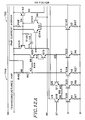
- the input low-pass filtering differential amplifier stage 700 is DC coupled to the input signal on nodes 5 and 6.
- the low-pass filtering characteristic of this stage is determined by the RC network consisting of R22, C3 and R18.
- the time constant of this network is chosen to correspond to a cut-off of around 50 MHz.
- the differential amplifier consisting of Q50 and Q49 has about unity gain, its main function being to ensure for the circuitry downstream that the input signal is differential in the event that the input is being driven by a single-ended signal.
- the outputs of this stage are buffered and dropped one base-emitter voltage by Q55 and Q54 and input (at nodes 15 and 16) to the upper portion of the balanced modulator detector 710, consisting of switching differential pairs Q36,Q37 and Q38,Q39.
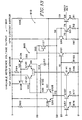
- the outputs of the balanced modulator detector 710, nodes 77 and 80 are applied to the inputs of voltage amplifier 720 on the bases of transistors Q70 and Q68.
- the voltage amplifier develops its output across resistor R36.
- the voltage developed across the 4K resistor R36 is applied to the base of transistor Q77 through 50K resistor R42.
- Emitter follower transistor Q77 buffers this signal and drops it by one base-emitter voltage drop and applies it to the base of transistor Q60, one side of the comparator portion of comparator and peak detector 730.
- Node 36 is the emitter of emitter follower transistor Q53 whose base is connected to V CC through a 50K resistor R43 and a 4K resistor R12. Note that these resistors on the base of Q53 have the same values as the resistors on the base of Q77. The matching of these resistors within the same IC process ensures that even in the presence of process and temperature variations, the relative resistance in the base circuits of transistors Q53 and Q77 will remain equivalent.
- the comparator Q60,Q61 is then monitoring and comparing the output of the voltage amplifier at node 79 with the charge on the external 200 pF capacitor CX4 at node 32 in the peak detector.
- Q60 conducts and Q6l does not.
- node 66 is lower than node 67, and these relative voltages, after they are buffered and dropped two base-emitter voltage drops through emitter followers Q58 and Q57 and diode connected transistors Q59 and Q56, cause Q30 to be shut off and the current from Q29 to go through Q3l, and the charge on CX4 to remain approximately the same.
- the discharge path for CX4 through the 54K resistance path of resistors R43 and R12 is quite slow compared with the data being monitored.
- the RC time of this 200 pF, 54K Ohm discharge path is 10.8 microseconds, compared with the incoming data rate of about 100 MHz (10 ns).
- Transistors Q29 and Q30 each have a large emitter area and therefore have a low emitter resistance. Consequently, the RC time of the charging path of CX4 is determined by the 700 Ohm emitter resistor of Q29 and is about 140 ns.
- the peak detector is fast attack and slow release.
- the node 77 and node 80 inputs to the voltage amplifier 720 are in balance and the current available to Q70 is determined by REF on node 3. Recalling that REF is 0.6 Volts plus one base-emitter voltage, the voltage across R38 on the emitter of transistor Q72 is 0.6 Volts and the current that flows is about 214 uA. That current produces a voltage drop of about 0.86 Volts across R36 with its 4K Ohm value. The comparator and peak detector 730 then ensure that that voltage is also maintained on CX4.
- the fixed voltage generator 780 produces a reference voltage from current source transistor Q131 and its emitter resistor R93 that is two base-emitter voltage drops down from V CC as a result of diode connected transistors Q128 and Q147.
- Capacitor C2 provides some decoupling to ground. This reference voltage is supplied to current mirrors 750 and 760 and to the variable reference voltage output circuitry 800 which also contains a current mirror.
- the node 37 output of the comparator and peak detector 730 is the input to transconductance amplifier 740 on the base of Q18.
- the other side of differential pair Q18,Q17, the base of transistor Q17, receives a locally derived reference voltage generated by the application of the current from transistor Q24 and its emitter resistor R27 to the 4K collector path consisting of the two 2K resistors R48 and R5, after it has been buffered and dropped two base-emitter voltage drops by emitter follower Q22 and diode connected transistor Q15.
- the circuit composed of transistor Q24, emitter resistor R27, collector resistors R5 and R48 and emitter follower Q22 with its base resistor R44 closely matches, with respect to resistance values and emitter areas, the circuit in the voltage amplifier 720 (FIG. 10) composed of transistors Q70 and Q72, emitter resistor R38, collector resistor R36 and emitter follower Q77 with its base resistor R42. Therefore, when produced within the same IC and process these two circuits will be well matched, even in the presence of process and temperature variations.
- nodes 37 and 45 will be at the same voltage.
- the two current outputs of the transconductance amplifier 740 are balanced.
- node 43 will be at the same voltage level as node 86, or -0.86 V relative to V CC
- node 96 will be at -0.43 V relative to V CC .
- the voltage on node 37 will vary in proportion to the level of the low frequency component of that signal, as described above, and the other node 45 of the transconductance amplifier 740 will remain fixed at the level that was present in the absence of a signal. Accordingly, the current output on node 49 to PNP current mirror 750 will increase, while the current output on node 48 to PNP current mirror 760 decreases by the same amount.
- both Ql40 on the right side of PNP current mirror 750 and Ql36 on the right side of PNP current mirror 760 are connected to the output of the fixed voltage generator 780 on node 99.
- the differential pair Q144 and Q140 operates to increase conduction through Q142 causing both of the PNP transistors, Q143 and Q142, to turn on to hold node 49 at the same voltage as the reference on node 99.
- the output current through node 60 increases, mirroring the current in node 49.
- the output of the first PNP current mirror 750 is one input to the NPN current mirror 770.
- this change is transmitted by the emitter following action of Q34 to the base of transistor Q8, which in response alters its conduction to permit the new amount of current to flow.
- the base of transistor Q7 is tied to the same node (29) as the base of transistor Q8 and both transistors have the same emitter areas, a current is produced through Q7 that is the same as the current through Q8.
- the second PNP current mirror 760 operates in the same way as the first PNP current mirror 750, producing a current at node 58 that is the same as the current at node 48.
- the output of the second PNP current mirror 760 is applied to node 58, where it is partially cancelled by the current from the NPN current mirror output transistor Q7.
- the difference in these two currents is supplied by a diode connected transistor Q135, since transistor Q152 is normally off.
- the node 59 current that flows through Ql35 is the difference between the two current outputs of the transconductance amplifier 740, and provides the input to the variable reference voltage output circuitry 800.
- PNP transistors can best be implemented as lateral PNP transistors.
- lateral PNP transistors are typically slow and have low beta values.
- a beta of 20 was achieved, but the low speed of the lateral PNP transistors tended to cause oscillations.
- current mirror 750 includes a pole-zero compensation network consisting of R105 and C4. The exact optimum values used for this network depend on process details and the exact type of NPN transistors being employed.
- Resistor R98 provides a path for the collector current of Q142 so that the currents through the differential pair Q144 and Q140 are more closely matched.
- R98 also contributes to the stability of the circuit's operation, and thereby assists the compensation network of R105 and C4 in preventing oscillations.
- the node 59 input to the variable reference voltage output circuitry 800 is applied to one side of an amplifying NPN current mirror 810 that produces the variable reference voltage output VREF.
- This current flows through transistor Q5 under the control of feedback through emitter follower transistor Q65 and a current 25% larger flows through transistor Q6 due to the relationship between the values of resistors R2 and Rl.
- the VREF output which is the voltage on the bases of the NPN current mirror transistors Q5 and Q6, appears on node 75.
- the output voltage VREF is the voltage developed across R2 by the difference current on node 59 plus one V BE .
- variable reference voltage output circuitry 800 also includes a PNP current mirror 805, the operation of which will be described in connection with the discussion of FIG. 14.
- the defeat comparator 790 compares the voltage on node 37 with that on node 111, which is the voltage level on node 96 dropped two base-emitter voltage drops by emitter follower transistor Q78 and diode connected transistor Q79.
- Node 37 is the peak detector output at node 32 (see FIG. 10) dropped two base-emitter voltage drops.
- a comparison between nodes 37 and 111 is really a comparison between nodes 96 and 32.
- node 37 is more negative than node 111, which will always be the case in normal operation, Q80 will conduct and Q81 will not.
- the higher voltage on the base of Q149 causes it to shut off, while the lower voltage on the base of Q150 causes it to conduct. With Q149 off, the voltage on node 50 goes low, while with Q150 on, the voltage on node 51 goes high.
- the low voltage level on node 50 keeps Q152 off and current flows through Q135 and node 59 normally, as described above.
- the high voltage level on node 51 keeps Q151 turned on and the output of the PNP current mirror 805 in the variable voltage output circuitry 800 is shunted to node 0, V EE .
- node 50 goes high and node 51 goes low.
- a high on node 50 causes Q152 to conduct causing the summed currents from the three current mirrors 750, 760 and 770 to be shunted to V EE .
- a low on node 51 shuts off Q151 eliminating the shunt path for the current from the PNP current mirror 805. With this shunt path eliminated, the current being produced by Q134 in the PNP current mirror flows through diode connected transistor Q127.
- the base of Q87 is biased with the fixed reference voltage REF at 0.6 Volts plus one base-emitter drop voltage. That causes the emitter of Q87 to produce 0.6 Volts, which causes 125 uA to flow through R76, the 4800 Ohm emitter resistor. The flow of this 125 uA through the 20K Ohm collector resistor R62 provides a bias voltage on the base of Q93 that is -2.5 Volt relative to V CC .
- the base of Ql08, the other side of that differential pair is tied to the collector of output transistor Q6, which is identical in its size and its emitter and collector resistor values with Q87. Thus, the differential pair Q93 and Q108 will only be in balance when the current through Q6 equals the current through Q87.
- the output of the differential pair Q93 and Q108 regulates the current through Q6 necessary to achieve this balance via the output of the PNP current mirror consisting of transistors Q133, Q132, Q138 and Q134 and its output path through diode connected transistor Q127 and the other side of the amplifying NPN current mirror 810 that Q6 is part of.
- this PNP current mirror 805 causes the variable reference voltage VREF to go to the same voltage level as the fixed voltage reference REF, i.e., 0.6 Volts plus one base-emitter voltage drop.
- the automatic cable equalizer of the present invention is able to accept a variable input signal and produce an equalized output signal that is free of distortion and attendant bit errors.
Landscapes
- Engineering & Computer Science (AREA)
- Computer Networks & Wireless Communication (AREA)
- Signal Processing (AREA)
- Power Engineering (AREA)
- Amplifiers (AREA)
- Picture Signal Circuits (AREA)
- Details Of Television Systems (AREA)
- Two-Way Televisions, Distribution Of Moving Picture Or The Like (AREA)
- Cable Transmission Systems, Equalization Of Radio And Reduction Of Echo (AREA)
- Networks Using Active Elements (AREA)
Claims (10)
- Égalisateur automatique de câble pour la compensation d'un signal d'entrée de niveau variable (5, 6) avec des temps de montée et de chute probablement dégradés, égalisateur automatique de câble étant du type ayant plusieurs étages d'égalisateur (200, 220, 240), dans lequel :- chaque étage d'égalisateur (200, 220, 240) possède une entrée et une sortie, l'entrée étant couplée à la sortie de l'étage d'égalisateur précédent, l'entrée du premier étage d'égalisateur (200) étant couplée pour recevoir le signal d'entrée de niveau variables et la sortie du dernier étage d'égalisateur (240) fournissant un signal d'égalisateur pour le signal d'entrée de niveau variable, chaque étage d'égalisateur comprenant, de plus, un moyen d'amplification (Q34, Q10), un moyen d'amplification du gain à haute fréquence (R7 , C1, R8) et un moyen d'écrétage possédant une entrée de commande d'écrétage (4) couplé pour recevoir un signal de commande d'écrétage ; et- des moyens de détection de niveau de signal (700 à 800) sont couplés pour contrôler le signal d'entrée de niveau variable et pour produire le signal de commande d'écrétage, le signal de commande d'écrétage étant proportionnel au niveau de pic de la partie redressée à basse fréquence du signal d'entrée de niveau variable (5, 6).
- Égalisateur automatique de câble selon la revendication 1, comprenant, de plus :- un compensateur de couplage A.C. (CX1, CX2) couplé à l'entrée d'égalisateur (5, 6); et- un moyen de rétroaction (500, 600, CX3) possédant une entrée et une sortie, l'entrée (87, 88) étant couplée pour recevoir la sortie de la section d'égalisateur et la sortie (64, 63) étant couplée pour restaurer la composante D.C. perdue par le couplage A.C.
- Égalisateur automatique de câble selon la revendication 2, dans lequel une constante de temps RC (CX1, R58, R49, R50, CX2) associée au condensateur de couplage A.C. est à peu près égale à une constante de temps RC(R47, CX3) associé au moyen de rétroaction (500, 600, CX3).
- Égalisateur automatique de câble selon la revendication 1, comprenant, de plus, une section de limitation (300) possédant une entrée et une sortie, l'entrée étant couplée pour recevoir la sortie (21, 22) de la section d'égalisateur (200), la section de limitation limitant à un niveau d'écrétage fixé (3).
- Égalisateur automatique de câble selon la revendication 1, comprenant, de plus, un étage de sortie de test (400) possédant un gain de tension pratiquement unitaire, une entrée à haute intendance et une sortie à basse intendance, l'entrée étant couplée à la sortie de égalisateur (21,22).
- Égalisateur automatique de câble selon la revendication 1, dans lequel le moyen de détection de niveau de signal (700 à 800)comprend :- un moyen de filtre passe-bas (700) couplé pour recevoir le signal d'entrée de niveau variable (5, 6) et pour produire un signal à basse fréquence (13, 14);- un moyen de redressement (710, 720) couplé pour recevoir le signal à basse fréquence (13, 14) et pour produire un signal redressé à basse fréquence (87);- un moyen de maintien de pic (730, CX4) couplé pour recevoir le signal redressé à basse fréquence (87) et pour produire un signal maximum à basse fréquence (37); et- un moyen de proportionnalité (740 à 800) couplé pour recevoir le signal maximum à basse fréquence (37) et pour produire le signal de commande d'écrétage (4) proportionnellement au signal maximum à basse fréquence (37).
- Égalisateur automatique de câble selon l'art revendication 6, dans lequel le moyen de maintien de pic (730) comprend :- un moyen de stockage de charge (CX4) pour le maintien d'une charge de pic ;- un moyen de compensateur (Q60, Q61) possédant une première entrée (87), une seconde entrée (36)et une sortie (70, 71), la première entrée (87) étant couplée pour recevoir le signal redressé à basse fréquence et la seconde entrée étant couplée pour recevoir une indication de la charge de pic (32), la sortie (70, 71) indiquant le moment où la première entrée est plus grande que la seconde entrée ; et- un moyen d'addition de charge (Q31, Q30) recevant la sortie (70, 71) du moyen de comparateur (Q60, Q61) pour ajouter à la charge de pic (CX4) lorsque le signal redressé à basse fréquence (87) dépasse la présente charge de pic.
- Égalisateur automatique de câble selon la revendication 6, dans lequel le moyen de proportionnalité (740 à 800) comprend :- un moyen d'amplification de transconductance (740 à 770) possédant une entrée et une sortie, l'entrée étant couplée pour recevoir le signal maximum à basse fréquence (37)et la sortie (59) étant un courant proportionnel à l'amplitude du signal maximum à basse fréquence (37); et- un moyen de production de signal (800) pour recevoir le courant de sortie (59) de l'amplificateur à transconductance (740) et pour produire le signal de commande d'écrétage (4) de façon proportionnelle au courant de sortie reçu (59).
- Égalisateur automatique de câble selon la revendication 8, dans lequel le moyen d'amplification à transconductance (750 à 770) comprend:- un amplificateur à transconductance (740) possédant une entrée et de sortie, l'entrée étant couplée pour recevoir le signal maximum à basse fréquence (37) et les sorties (48, 49) étant des courants dont la différence est proportionnelle à l'amplitude du signal maximum à basse fréquence (37); et- une pluralité de miroirs de courant (750, 760, 770)recevant les courants de sortie (48, 49) de l'amplificateur à transconductance (740) raccordé, de façon fonctionnelle (60, 58), pour établir le courant de différence (59).
- Égalisateur automatique de câble selon la revendication 8, dans lequel le moyen de proportionnalité comprend, de plus, un moyen de comparateur de défaut possédant une première et une seconde entrées et une sortie, la première entrée étant couplée pour recevoir le signal maximum à basse fréquence (37) et la seconde entrée étant couplée pour recevoir un signal de référence (96), et pour la production sur la sortie d'un signal de section (50, 51) sélectionnant le courant de différence (59) 11 ou un courant fixe (800) comme base pour l'établissement du niveau du signal de commande d'écrétage (4).
Applications Claiming Priority (2)
| Application Number | Priority Date | Filing Date | Title |
|---|---|---|---|
| US07/691,898 US5124673A (en) | 1991-04-26 | 1991-04-26 | Level independent automatic cable equalizer |
| US691898 | 2000-10-19 |
Publications (3)
| Publication Number | Publication Date |
|---|---|
| EP0510976A2 EP0510976A2 (fr) | 1992-10-28 |
| EP0510976A3 EP0510976A3 (en) | 1993-07-07 |
| EP0510976B1 true EP0510976B1 (fr) | 1997-05-28 |
Family
ID=24778417
Family Applications (1)
| Application Number | Title | Priority Date | Filing Date |
|---|---|---|---|
| EP92303664A Expired - Lifetime EP0510976B1 (fr) | 1991-04-26 | 1992-04-23 | Egalisateur de câble automatique, indépendant du niveau de signal |
Country Status (5)
| Country | Link |
|---|---|
| US (1) | US5124673A (fr) |
| EP (1) | EP0510976B1 (fr) |
| JP (1) | JPH0662273A (fr) |
| CA (1) | CA2063350A1 (fr) |
| DE (1) | DE69219947T2 (fr) |
Families Citing this family (28)
| Publication number | Priority date | Publication date | Assignee | Title |
|---|---|---|---|---|
| US5483552A (en) * | 1992-10-27 | 1996-01-09 | Matsushita Electric Industrial Co., Ltd. | Adaptive equalizing apparatus for controlling the input signal level of quantized feedback |
| KR0157711B1 (ko) * | 1995-07-12 | 1998-11-16 | 김광호 | 데이타 통신단말장치에서 등화방법 |
| US5978417A (en) * | 1996-02-23 | 1999-11-02 | National Semiconductor Corporation | Adaptive cable equalizer |
| US5708389A (en) * | 1996-03-15 | 1998-01-13 | Lucent Technologies Inc. | Integrated circuit employing quantized feedback |
| US6150875A (en) * | 1998-04-17 | 2000-11-21 | Advanced Micro Devices, Inc. | Apparatus and method for equalizing received network signals using a transconductance controlled single zero single pole filter |
| JP3948116B2 (ja) | 1998-05-11 | 2007-07-25 | ソニー株式会社 | 直流リカバリ回路 |
| US6259302B1 (en) * | 1998-10-22 | 2001-07-10 | National Semiconductor Corporation | Gain control signal generator that tracks operating variations due to variations in manufacturing processes and operating conditions by tracking variations in DC biasing |
| US6466626B1 (en) | 1999-02-23 | 2002-10-15 | International Business Machines Corporation | Driver with in-situ variable compensation for cable attenuation |
| EP1169753B1 (fr) * | 1999-04-06 | 2003-05-14 | ADC Telecommunications, Inc | Module dsx a fiche amovible |
| US7031420B1 (en) * | 1999-12-30 | 2006-04-18 | Silicon Graphics, Inc. | System and method for adaptively deskewing parallel data signals relative to a clock |
| US6956905B1 (en) * | 2000-03-23 | 2005-10-18 | Xilinx, Inc. | Peak detector circuit |
| US6490466B1 (en) * | 2000-09-21 | 2002-12-03 | Mallinckrodt Inc. | Interconnect circuit between non-compatible oximeter and sensor |
| DE10142612A1 (de) * | 2001-08-31 | 2003-04-03 | Siemens Ag | Verfahren und Vorrichtung zur einadrigen, lokalen Übertragung von PCM-Signalen ohne Übertrager |
| US20030099307A1 (en) * | 2001-11-13 | 2003-05-29 | Narad Networks, Inc. | Differential slicer circuit for data communication |
| US6784698B1 (en) * | 2003-06-11 | 2004-08-31 | Agere Systems Inc. | Sense amplifier with improved common mode rejection |
| US7620121B1 (en) * | 2004-12-09 | 2009-11-17 | Xilinx, Inc. | DC balance compensation for AC-coupled circuits |
| US7961817B2 (en) * | 2006-09-08 | 2011-06-14 | Lsi Corporation | AC coupling circuit integrated with receiver with hybrid stable common-mode voltage generation and baseline wander compensation |
| US8213638B2 (en) * | 2007-02-20 | 2012-07-03 | Texas Instruments Incorporated | Equalizer |
| US8085839B2 (en) * | 2007-08-01 | 2011-12-27 | Gennum Corporation | Adaptive equalization system and method having a lock-up-free quantized feedback DC restoration circuit |
| US8184723B2 (en) * | 2008-02-29 | 2012-05-22 | Analog Devices, Inc. | Feedback system and apparatus for video compensation |
| US8335249B1 (en) * | 2009-11-25 | 2012-12-18 | Altera Corporation | Receiver equalizer circuitry with offset voltage compensation for use on integrated circuits |
| US8295336B2 (en) * | 2010-03-16 | 2012-10-23 | Micrel Inc. | High bandwidth programmable transmission line pre-emphasis method and circuit |
| US8379701B2 (en) * | 2010-03-16 | 2013-02-19 | Micrel, Inc. | High bandwidth dual programmable transmission line pre-emphasis method and circuit |
| US8379702B2 (en) * | 2010-03-16 | 2013-02-19 | Micrel, Inc. | High bandwidth programmable transmission line pre-emphasis method and circuit |
| US8817863B2 (en) * | 2011-02-09 | 2014-08-26 | Rambus Inc. | Linear equalizer with passive network and embedded level shifter |
| US9661248B2 (en) * | 2013-12-13 | 2017-05-23 | Cista System Corp. | Integrated circuit having flexible reference |
| JP6226945B2 (ja) * | 2015-12-11 | 2017-11-08 | アンリツ株式会社 | マルチバンドイコライザ、それを用いた誤り率測定システム、誤り率測定装置、及び経路選択方法 |
| US10063253B1 (en) * | 2017-06-22 | 2018-08-28 | Intel Corporation | Summer circuit including linearized load |
Citations (1)
| Publication number | Priority date | Publication date | Assignee | Title |
|---|---|---|---|---|
| US534016A (en) * | 1895-02-12 | smithley |
Family Cites Families (8)
| Publication number | Priority date | Publication date | Assignee | Title |
|---|---|---|---|---|
| US3529244A (en) * | 1967-03-13 | 1970-09-15 | Columbia Broadcasting Syst Inc | Method and apparatus for frequency sensitive amplitude limiting |
| US3568100A (en) * | 1967-12-26 | 1971-03-02 | Bell Telephone Labor Inc | Automatic equalizer for digital transmission systems |
| JPS5313927B2 (fr) * | 1971-12-31 | 1978-05-13 | ||
| US3983381A (en) * | 1974-12-18 | 1976-09-28 | International Business Machines Corporation | Digital automatic gain control circuit |
| FR2520174A1 (fr) * | 1982-01-15 | 1983-07-22 | Lignes Telegraph Telephon | Systeme de transmission de signaux numeriques sur fibre optique |
| US4606043A (en) * | 1984-10-09 | 1986-08-12 | At&T Bell Laboratories | Programmable automatic cable equalizer |
| JPS63316571A (ja) * | 1987-06-19 | 1988-12-23 | Sony Corp | 映像信号処理回路 |
| US5016205A (en) * | 1989-04-27 | 1991-05-14 | Motorola, Inc. | Digital signal processor based AGC |
-
1991
- 1991-04-26 US US07/691,898 patent/US5124673A/en not_active Expired - Lifetime
-
1992
- 1992-03-18 CA CA002063350A patent/CA2063350A1/fr not_active Abandoned
- 1992-04-23 EP EP92303664A patent/EP0510976B1/fr not_active Expired - Lifetime
- 1992-04-23 DE DE69219947T patent/DE69219947T2/de not_active Expired - Fee Related
- 1992-04-25 JP JP4131876A patent/JPH0662273A/ja active Pending
Patent Citations (1)
| Publication number | Priority date | Publication date | Assignee | Title |
|---|---|---|---|---|
| US534016A (en) * | 1895-02-12 | smithley |
Also Published As
| Publication number | Publication date |
|---|---|
| CA2063350A1 (fr) | 1992-10-27 |
| EP0510976A3 (en) | 1993-07-07 |
| JPH0662273A (ja) | 1994-03-04 |
| DE69219947D1 (de) | 1997-07-03 |
| US5124673A (en) | 1992-06-23 |
| EP0510976A2 (fr) | 1992-10-28 |
| DE69219947T2 (de) | 1997-11-20 |
Similar Documents
| Publication | Publication Date | Title |
|---|---|---|
| EP0510976B1 (fr) | Egalisateur de câble automatique, indépendant du niveau de signal | |
| US6501792B2 (en) | Serial digital data communications receiver with improved automatic cable equalizer, AGC system, and DC restorer | |
| EP0611509B1 (fr) | Amplificateur a gain variable | |
| US4459698A (en) | Variable equalizer | |
| US5699386A (en) | System and method for data signal communication using a high-pass function before a low-pass function with quantized feedback technique | |
| US4200889A (en) | Complementary pre-emphasis and de-emphasis circuits for a video signal transfer channel | |
| KR0183114B1 (ko) | 모놀리식 집적회로내에서 구현되는 제2검파기 및 중간 주파수 증폭기 | |
| EP0656164B1 (fr) | Récepteur de télévision | |
| US5337091A (en) | Video IF amplifier with auxiliary IF amplifier for intercarrier sound & AFT | |
| GB2264829A (en) | Rf receiver agc incorporating time domain equalizer circuitry | |
| US5717716A (en) | Quasi-adaptive analog equalization method and apparatus | |
| US4348692A (en) | VTR With equalizer | |
| US3205442A (en) | Automatic adjustable equalizer for signal amplitude variations | |
| US4156854A (en) | Differential amplifier balancing system | |
| US3829626A (en) | Telephone line equalizer | |
| EP0640256B1 (fr) | Amplificateur de reseau local pour lignes de paires torsadees | |
| US7769057B2 (en) | High speed serial link output stage having self adaptation for various impairments | |
| US4388648A (en) | Frequency selective DC coupled video signal control system insensitive to video signal DC components | |
| US4306256A (en) | Preemphasis and clipping apparatus for reducing distortions | |
| US4388647A (en) | Predictably biased DC coupled video signal peaking control system | |
| JP2813128B2 (ja) | 伝送路損失補償回路 | |
| GB2044587A (en) | Preemphasis and clipping apparatus for reducing distortions | |
| CA2283916A1 (fr) | Recepteur pour communications de donnees numeriques serie equipe d'un egaliseur de cable automatique perfectionne, d'une commande automatique de gain et d'un circuit de retablissement de composante continue | |
| JPS589415A (ja) | 自動等化器 | |
| JPH02217014A (ja) | 自動等化回路 |
Legal Events
| Date | Code | Title | Description |
|---|---|---|---|
| PUAI | Public reference made under article 153(3) epc to a published international application that has entered the european phase |
Free format text: ORIGINAL CODE: 0009012 |
|
| AK | Designated contracting states |
Kind code of ref document: A2 Designated state(s): DE ES FR GB |
|
| PUAL | Search report despatched |
Free format text: ORIGINAL CODE: 0009013 |
|
| AK | Designated contracting states |
Kind code of ref document: A3 Designated state(s): DE ES FR GB |
|
| 17P | Request for examination filed |
Effective date: 19930621 |
|
| 17Q | First examination report despatched |
Effective date: 19960115 |
|
| GRAG | Despatch of communication of intention to grant |
Free format text: ORIGINAL CODE: EPIDOS AGRA |
|
| GRAH | Despatch of communication of intention to grant a patent |
Free format text: ORIGINAL CODE: EPIDOS IGRA |
|
| GRAH | Despatch of communication of intention to grant a patent |
Free format text: ORIGINAL CODE: EPIDOS IGRA |
|
| GRAA | (expected) grant |
Free format text: ORIGINAL CODE: 0009210 |
|
| AK | Designated contracting states |
Kind code of ref document: B1 Designated state(s): DE ES FR GB |
|
| PG25 | Lapsed in a contracting state [announced via postgrant information from national office to epo] |
Ref country code: FR Effective date: 19970528 Ref country code: ES Free format text: THE PATENT HAS BEEN ANNULLED BY A DECISION OF A NATIONAL AUTHORITY Effective date: 19970528 |
|
| REF | Corresponds to: |
Ref document number: 69219947 Country of ref document: DE Date of ref document: 19970703 |
|
| EN | Fr: translation not filed | ||
| PLBE | No opposition filed within time limit |
Free format text: ORIGINAL CODE: 0009261 |
|
| STAA | Information on the status of an ep patent application or granted ep patent |
Free format text: STATUS: NO OPPOSITION FILED WITHIN TIME LIMIT |
|
| 26N | No opposition filed | ||
| PGFP | Annual fee paid to national office [announced via postgrant information from national office to epo] |
Ref country code: GB Payment date: 19990323 Year of fee payment: 8 |
|
| PGFP | Annual fee paid to national office [announced via postgrant information from national office to epo] |
Ref country code: DE Payment date: 19990326 Year of fee payment: 8 |
|
| PG25 | Lapsed in a contracting state [announced via postgrant information from national office to epo] |
Ref country code: GB Free format text: LAPSE BECAUSE OF NON-PAYMENT OF DUE FEES Effective date: 20000423 |
|
| GBPC | Gb: european patent ceased through non-payment of renewal fee |
Effective date: 20000423 |
|
| PG25 | Lapsed in a contracting state [announced via postgrant information from national office to epo] |
Ref country code: DE Free format text: LAPSE BECAUSE OF NON-PAYMENT OF DUE FEES Effective date: 20010201 |