EP0511099A1 - Legierung für Spinnkopf zur Herstellung von Glassfasern - Google Patents
Legierung für Spinnkopf zur Herstellung von Glassfasern Download PDFInfo
- Publication number
- EP0511099A1 EP0511099A1 EP92401149A EP92401149A EP0511099A1 EP 0511099 A1 EP0511099 A1 EP 0511099A1 EP 92401149 A EP92401149 A EP 92401149A EP 92401149 A EP92401149 A EP 92401149A EP 0511099 A1 EP0511099 A1 EP 0511099A1
- Authority
- EP
- European Patent Office
- Prior art keywords
- carbides
- alloy
- temperature
- heat treatment
- centrifuge
- Prior art date
- Legal status (The legal status is an assumption and is not a legal conclusion. Google has not performed a legal analysis and makes no representation as to the accuracy of the status listed.)
- Granted
Links
Images


Classifications
-
- C—CHEMISTRY; METALLURGY
- C03—GLASS; MINERAL OR SLAG WOOL
- C03B—MANUFACTURE, SHAPING, OR SUPPLEMENTARY PROCESSES
- C03B37/00—Manufacture or treatment of flakes, fibres, or filaments from softened glass, minerals, or slags
- C03B37/01—Manufacture of glass fibres or filaments
- C03B37/04—Manufacture of glass fibres or filaments by using centrifugal force, e.g. spinning through radial orifices; Construction of the spinner cups therefor
- C03B37/047—Selection of materials for the spinner cups
-
- C—CHEMISTRY; METALLURGY
- C22—METALLURGY; FERROUS OR NON-FERROUS ALLOYS; TREATMENT OF ALLOYS OR NON-FERROUS METALS
- C22C—ALLOYS
- C22C19/00—Alloys based on nickel or cobalt
- C22C19/03—Alloys based on nickel or cobalt based on nickel
- C22C19/05—Alloys based on nickel or cobalt based on nickel with chromium
-
- C—CHEMISTRY; METALLURGY
- C22—METALLURGY; FERROUS OR NON-FERROUS ALLOYS; TREATMENT OF ALLOYS OR NON-FERROUS METALS
- C22C—ALLOYS
- C22C19/00—Alloys based on nickel or cobalt
- C22C19/03—Alloys based on nickel or cobalt based on nickel
- C22C19/05—Alloys based on nickel or cobalt based on nickel with chromium
- C22C19/051—Alloys based on nickel or cobalt based on nickel with chromium and Mo or W
- C22C19/055—Alloys based on nickel or cobalt based on nickel with chromium and Mo or W with the maximum Cr content being at least 20% but less than 30%
-
- C—CHEMISTRY; METALLURGY
- C22—METALLURGY; FERROUS OR NON-FERROUS ALLOYS; TREATMENT OF ALLOYS OR NON-FERROUS METALS
- C22F—CHANGING THE PHYSICAL STRUCTURE OF NON-FERROUS METALS AND NON-FERROUS ALLOYS
- C22F1/00—Changing the physical structure of non-ferrous metals or alloys by heat treatment or by hot or cold working
- C22F1/10—Changing the physical structure of non-ferrous metals or alloys by heat treatment or by hot or cold working of nickel or cobalt or alloys based thereon
Definitions
- the present invention relates to an alloy for use in the manufacture of centrifuges.
- This alloy is particularly suitable for the production of centrifuges producing glass fibers.
- Such a centrifuge rotates around its vertical axis at a speed of the order of 800 to 4000 revolutions / min.
- On its peripheral wall is formed a multitude of orifices.
- An annular combustion chamber adjacent to the centrifuge produces a downward stream of gas, running along the peripheral wall of the centrifuge and which stretches the glass filaments exiting the orifices to produce a small glass fiber.
- Molten glass is introduced into the centrifuge and is. projected, under the action of centrifugal force, towards the internal face of the peripheral wall of the centrifuge.
- the molten glass passes through the orifices of this wall.
- the glass fillets produced outside the centrifuge are then drawn under the action of the gas stream.
- the centrifugal forces are of three types: thermal shock during start-up and shutdown, hot creep due to centrifugal forces, corrosion by the glass of the fiberizing orifices.
- the operational temperatures are of the order of 1000-1200 ° C. These temperatures are those for which the glass has a suitable viscosity.
- centrifuges deteriorate in use a more or less long time. These centrifuges may need to be replaced for different reasons. These are: deformation of the fiber strip, the appearance of horizontal or vertical cracks, significant wear of the orifices.
- centrifuges formed in the prior alloy have, on the whole, exhibited improved properties. Overall, these centrifuges have satisfactory lifetimes. Nevertheless, centrifuges among those meeting the characteristics of this document have shown lifetimes much lower than the average lifespan, without nothing being able to explain and therefore predict the reasons for these incidents.
- the inventors looked for a solution making it possible to systematically end up with centrifuges having the desired longevity qualities. In other words, the inventors tried to eliminate any risk of seeing a centrifuge put out of use prematurely.
- the inventors obtained this result by highlighting particularities concerning the structure of the alloy and, in particular, the nature and the morphology of the carbides present in the alloy.
- the inventors have also determined characteristics enabling this result to be achieved and which relate to the composition of the alloy and the metallurgical treatments used during the manufacture of the centrifuge.
- the inventors have in fact shown by metallurgical studies, which will be discussed in more detail with respect to the examples, that the qualities of the centrifuges and in particular their resistance to creep were linked to the presence of carbides of well defined nature and morphology. Having identified these structural elements of the alloy of the centrifuges, the inventors have also been able to highlight the conditions which determine, or at least favor, the formation of these structural elements.
- the carbides must be present in a proportion as high as possible in the form M23C6, M being Cr or an equivalent metal (W, Si, Zr) from the point of view of the structure.
- the inventors' studies have shown the complexity of the mechanisms leading to these particular carbides. They are due to the diversity of the phases which appear during the solidification of the molten alloy and during any subsequent heat treatments.
- the centrifuges are obtained by molding from the molten alloy.
- the molded centrifuge is usually subjected to heat treatment for a rearrangement of the structure, an arrangement which solidification during molding does not allow to reach directly.
- the heat treatment undergone by the alloy mainly influences the appearance and the distribution of carbides in the matrix.
- primary carbides and “secondary carbides” denote respectively the carbides which appear after the casting on the one hand and after the heat treatment on the other hand.
- the invention provides an alloy composition comprising a proportion of specific chromium and tungsten such that the alloy has, in its final crystalline structure, carbides of the M23C6 type, carbides which for the reasons that we will see, are essentially secondary and distributed homogeneously in the matrix.
- the equivalent chromium content does not exceed 38% and, advantageously is at most equal to 37% to promote the formation of secondary carbides M23C6.
- the equivalent chromium content is preferably not less than 35% and, advantageously, is not less than 35.5%.
- the chromium content in order to improve the corrosion resistance at high temperature and the creep resistance, is between 27.5 and 29.5% and, preferably, between 27.5 and 28 , 5%.
- Tungsten contributes to the hardness of the alloy and to the creep resistance. Its content is between 6.5 and 7.8% and preferably between 7.2 and 7.6%.
- Carbon is an essential element for the formation of carbides. Its content is between 0.69 and 0.73%.
- Iron is used in the composition of the alloy in small proportion. It improves resistance to sulfurization, nickel-based alloys being very sensitive to the sulfur contained in the glasses used. Its content is advantageously between 7 and 10%.
- low-grade silicon 0.6 to 0.9%, increases the hardness and the creep resistance of the alloy.
- an adequate heat treatment makes it possible to obtain a homogeneous distribution of the secondary carbides in the metal matrix, obstructing the propagation of dislocation in the matrix.
- the inventors have shown that it is advantageous to have a large number of very fine secondary carbides, distributed homogeneously.
- the inventors have found that it is preferable for the temperature rise of the raw solidification structure of the alloy to take place quickly. Indeed, the inventors have found that a slow rise in temperature leads to a germination step spaced over time. The first germs created grow and can coalesce at the same time as the appearance of the last germs. A faster rate of temperature rise makes it possible to avoid the simultaneous existence of the germination mechanisms and a coalescence of the secondary carbides. Then, maintaining, for a given time, at a relatively high temperature mainly promotes the growth of these carbides. A high number of germs prevents the formation of excessively large carbides.
- the temperature of the heat treatment below 1000 ° C. and, preferably, below 900 ° C.
- the duration of the heat treatment is, under these conditions, at least 5 h and, preferably, at least 8 h.
- the inventors by an image analysis technique, have discovered that after heat treatment of the alloys of composition similar to that of patent FR 2 459 783 have secondary carbides of the M23C6 type. However, the nature of these carbides differs from one alloy to another. Some alloys have fine M23C6 carbides. Other alloys have fine M23C6 carbides and M23C6 carbides in Chinese writing. Sometimes, only M23C6 carbides in Chinese writing have been observed.
- the alloys with an equivalent chromium composition of the order of 38% consist of carbide obtained from heat treatment (secondary carbides) of the essentially fine M6C6 type.
- the equivalent chromium content therefore has a direct influence on the nature of the secondary carbides.
- the inventors have, moreover, analyzed the nature of the primary carbides (before the heat treatment) according to the composition of the alloy, and especially according to the equivalent chromium content. They found that the alloys with a composition similar to that of patent FR 2 459 783, whose equivalent chromium content is greater than 38%, have both primary carbides of the M23C6 type in Chinese writing and carbides of the M7C3 type in spearhead. The alloys, the equivalent chromium content of which is around 38%, have primary carbides of the M7C3 type with a spearhead morphology.
- the equivalent chromium content therefore indirectly conditions, through the nature of the primary carbides, the nature of the secondary carbides.
- the critical equivalent chromium content is 38%. Beyond this proportion, in addition to the primary carbides of the M7C3 type in spearhead, primary carbides of the M23C6 type are formed in Chinese writing.
- FIG. 1 a pseudo-binary Ni-Cr-C diagram at 0.7% C from 90 experimental flows.
- the basic composition of the alloy is that, except for the nickel and chromium content, of patent FR 2 459 783. To do this, the TSD technique was used.
- This technique consists in placing a rod of the alloy studied in an alumina tube.
- An inductor locally melts an area of 4-5 cm.
- a thermocouple is placed at this level to control the temperature.
- the alumina tube plus sample assembly is drawn at constant speed. Leaving the field of action of the inductor, the liquid begins to solidify under a known gradient independent of the speed of traction.
- the assembly is cooled to 70 ° C / s in a water box. The liquid areas before this brutal cooling are frozen with a very fine structure easily distinguishing them from the parts already solid before this brutal cooling.
- This diagram makes it possible to give a qualitative indication as to the nature of the phases present in the alloy as a function of the chromium, nickel content and the temperature of the alloy.
- the gross solidification structure has primary carbides of type M7C3 and of type M23C6.
- the raw solidification structure has primary carbides essentially of the M7C3 type (Cr6 (Fe, Ni) 0.8 W 0.2 C3).
- the chromium content of the alloy studied plays a key role in the nature and morphology of primary carbides.
- equivalent chromium mainly comprise chromium and metals known as equivalent to chromium.
- equivalent metals such as tungsten
- the inventors have highlighted the occasional presence of a few zones richer in chromium or tungsten inside the structure of the alloy treated. Segregation then appears causing the precipitation of primary carbides of the M23C6 type. The inventors explain this inhomogeneity in chromium or tungsten by an enrichment during the solidification of the residual liquid in these elements. Also, we limit the chromium content, preferably, to 28.5% to be sure not to precipitate primary M23C6 carbides.
- the subsequent heat treatment does not modify the morphology of the primary carbides.
- the production conditions such as the rate of solidification conditioned, for example, by the casting temperature, can affect, in addition to the composition of the alloy, the nature and the morphology of the primary carbides.
- the inventors have carried out various tests in order to correlate their observations as to the nature and the morphology of the primary and secondary carbides with the creep behavior of the alloy, a significant test of the lifetime of a centrifuge.
- the inventors have found that the nature of the secondary carbides has a very marked influence on the creep resistance of the alloy.
- Fine secondary carbides distributed homogeneously in the alloy matrix will therefore give better creep resistance than larger carbides, distributed in an inhomogeneous manner.
- the inventors then sought to optimize the heat treatment undergone by the alloys.
- the primary carbides are transformed, during the heat treatment, into secondary carbides.
- the inventors have demonstrated the influence, on the one hand, of the rate of temperature rise on the germination of secondary carbides and, on the other hand, the influence of time and of the plateau temperature on the growth of these secondary carbides.
- a relatively high temperature rise rate avoids the simultaneous presence of the germination phases and a coalescence of the secondary carbides.
- the growth of the latter is facilitated by a lower bearing temperature.
- the temperature maintenance time is all the longer the lower the bearing temperature. It is necessary to find a compromise between these two parameters.
- Example 1 illustrates the influence of the composition of the alloy on the creep content.
- Examples 2 to 5 show the influence of time and temperature parameters on the distribution of carbides in the matrix.
- test pieces Three series of test pieces were developed in order to test their resistance to creep. These test pieces are subjected to a tensile force of 35 MPa at 1000 ° C, their deformation is measured as a function of time. These three series respectively have three different equivalent chromium contents. They underwent a heat treatment of 10 h at 850 ° C.
- FIG. 2 establishes the correlation between the equivalent chromium content and the creep behavior of the alloy.
- the abscissa axis corresponds to time in hours; the ordinate axis represents the deformation of the specimen in percentage.
- This creep (time-deformation) curve is a practical means of quantifying the lifetime test of a centrifuge made of an alloy of a given composition.
- a beam is obtained delimited by two curves corresponding to the resistance to creep of test pieces of a given composition.
- the beams delimited by curves 1, 2 and 3 correspond, respectively, to an equivalent chromium content of: 38%, 39.2% and 41.1%.
- the rate of temperature rise is varied, respectively by 6 ° C / min and 1 ° C / min, up to a temperature of 1000 ° C. At this temperature, the test pieces undergo brutal cooling. The carbides are then analyzed by image analysis.
- the inventors have demonstrated the germination of secondary carbides during this rise in temperature.
- the speed of 6 ° C / min promotes more evenly distributed germination.
- Coalescence of carbides is detrimental to creep resistance; they are then no longer homogeneously dispersed in the matrix. They pile up here and there, easily bypassed by dislocations.
- the influence of the temperature holding time is studied.
- the holding temperature is 1000 ° C.
- composition of the test pieces is that of Example 2.
- a holding time of less than 2 h is more conducive to good creep resistance than a time of more than this value for a temperature of 1000 ° C. In fact, the more this time increases, the more the coalescing secondary carbides no longer obstruct the propagation of the dislocations, cause of a certain creep.
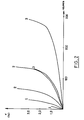
- FIG. 3 shows the creep behavior of two series of test pieces having undergone different heat treatments.
- Curve 1 corresponds to a heat treatment of 10 h at 850 ° C; less deformation is obtained compared to test pieces having undergone a heat treatment of 4 h at 1000 ° C (curve 2).
- a lower bearing temperature gives better results.
- the beam corresponding to the 10 h treatment at 850 ° C is shifted towards the most important times for deformations less.
- the influence of the bearing temperature on the creep resistance is greater than the influence of the duration of maintenance at this temperature (examples 3 and 4). It is better to operate at a lower temperature for a longer time.
Landscapes
- Chemical & Material Sciences (AREA)
- Engineering & Computer Science (AREA)
- Materials Engineering (AREA)
- Organic Chemistry (AREA)
- Mechanical Engineering (AREA)
- Metallurgy (AREA)
- Life Sciences & Earth Sciences (AREA)
- General Life Sciences & Earth Sciences (AREA)
- Geochemistry & Mineralogy (AREA)
- Manufacturing & Machinery (AREA)
- Physics & Mathematics (AREA)
- Thermal Sciences (AREA)
- Crystallography & Structural Chemistry (AREA)
- Manufacture, Treatment Of Glass Fibers (AREA)
- Manufacture Of Alloys Or Alloy Compounds (AREA)
- Centrifugal Separators (AREA)
- Inorganic Fibers (AREA)
- Spinning Methods And Devices For Manufacturing Artificial Fibers (AREA)
- Heat Treatment Of Articles (AREA)
- Forging (AREA)
- Glass Compositions (AREA)
- Turbine Rotor Nozzle Sealing (AREA)
- Powder Metallurgy (AREA)
- Carbon And Carbon Compounds (AREA)
- Valve-Gear Or Valve Arrangements (AREA)
- Braking Arrangements (AREA)
- Absorbent Articles And Supports Therefor (AREA)
- Laminated Bodies (AREA)
- Moulds For Moulding Plastics Or The Like (AREA)
Applications Claiming Priority (2)
| Application Number | Priority Date | Filing Date | Title |
|---|---|---|---|
| FR9105097 | 1991-04-25 | ||
| FR9105097A FR2675818B1 (fr) | 1991-04-25 | 1991-04-25 | Alliage pour centrifugeur de fibres de verre. |
Publications (2)
| Publication Number | Publication Date |
|---|---|
| EP0511099A1 true EP0511099A1 (de) | 1992-10-28 |
| EP0511099B1 EP0511099B1 (de) | 1995-09-27 |
Family
ID=9412236
Family Applications (1)
| Application Number | Title | Priority Date | Filing Date |
|---|---|---|---|
| EP92401149A Expired - Lifetime EP0511099B1 (de) | 1991-04-25 | 1992-04-23 | Legierung für Spinnkopf zur Herstellung von Glassfasern |
Country Status (21)
| Country | Link |
|---|---|
| US (2) | US5330591A (de) |
| EP (1) | EP0511099B1 (de) |
| JP (1) | JP3352466B2 (de) |
| KR (1) | KR100260980B1 (de) |
| AT (1) | ATE128491T1 (de) |
| AU (1) | AU648878B2 (de) |
| BR (1) | BR9201517A (de) |
| CA (1) | CA2066984C (de) |
| CZ (1) | CZ282817B6 (de) |
| DE (1) | DE69205053T2 (de) |
| DK (1) | DK0511099T3 (de) |
| ES (1) | ES2080456T3 (de) |
| FI (1) | FI103415B1 (de) |
| FR (1) | FR2675818B1 (de) |
| HU (1) | HU215994B (de) |
| IE (1) | IE74164B1 (de) |
| NO (1) | NO180168C (de) |
| PL (1) | PL174857B1 (de) |
| SK (1) | SK281434B6 (de) |
| TR (1) | TR25977A (de) |
| YU (1) | YU48281B (de) |
Cited By (1)
| Publication number | Priority date | Publication date | Assignee | Title |
|---|---|---|---|---|
| WO2019012211A1 (fr) | 2017-07-11 | 2019-01-17 | Saint-Gobain Isover | Assiette de fibrage |
Families Citing this family (21)
| Publication number | Priority date | Publication date | Assignee | Title |
|---|---|---|---|---|
| CA2133061A1 (en) * | 1993-02-05 | 1994-08-18 | Jean L. Bernard | Spinnner for producing fibers by centrifugation of molten mineral material shaped as a single crystal coating and process for its manufacture |
| US7690043B2 (en) | 1994-12-19 | 2010-03-30 | Legal Igaming, Inc. | System and method for connecting gaming devices to a network for remote play |
| DE19524234C1 (de) * | 1995-07-04 | 1997-08-28 | Krupp Vdm Gmbh | Knetbare Nickellegierung |
| US5914439A (en) * | 1997-05-08 | 1999-06-22 | Owens Corning Fiberglas Technology, Inc. | Diffusion barrier for bores of glass fiber spinners providing high corrosion and oxidative resistance at high temperatures |
| US9865126B2 (en) | 2002-10-09 | 2018-01-09 | Zynga Inc. | System and method for connecting gaming devices to a network for remote play |
| US7837812B2 (en) | 2004-05-21 | 2010-11-23 | Ati Properties, Inc. | Metastable beta-titanium alloys and methods of processing the same by direct aging |
| CN101603152B (zh) * | 2009-01-20 | 2011-06-22 | 无锡益通机械科技有限公司 | 一种用于玻璃棉生产的离心器高温合金 |
| US9255316B2 (en) | 2010-07-19 | 2016-02-09 | Ati Properties, Inc. | Processing of α+β titanium alloys |
| US8613818B2 (en) | 2010-09-15 | 2013-12-24 | Ati Properties, Inc. | Processing routes for titanium and titanium alloys |
| US10513755B2 (en) | 2010-09-23 | 2019-12-24 | Ati Properties Llc | High strength alpha/beta titanium alloy fasteners and fastener stock |
| US8652400B2 (en) | 2011-06-01 | 2014-02-18 | Ati Properties, Inc. | Thermo-mechanical processing of nickel-base alloys |
| US9869003B2 (en) | 2013-02-26 | 2018-01-16 | Ati Properties Llc | Methods for processing alloys |
| US9192981B2 (en) | 2013-03-11 | 2015-11-24 | Ati Properties, Inc. | Thermomechanical processing of high strength non-magnetic corrosion resistant material |
| US9777361B2 (en) | 2013-03-15 | 2017-10-03 | Ati Properties Llc | Thermomechanical processing of alpha-beta titanium alloys |
| US11111552B2 (en) | 2013-11-12 | 2021-09-07 | Ati Properties Llc | Methods for processing metal alloys |
| US10094003B2 (en) | 2015-01-12 | 2018-10-09 | Ati Properties Llc | Titanium alloy |
| US10502252B2 (en) | 2015-11-23 | 2019-12-10 | Ati Properties Llc | Processing of alpha-beta titanium alloys |
| JP6990249B2 (ja) | 2017-02-28 | 2022-01-12 | サン-ゴバン セバ | 繊維形成用プレートのための合金 |
| FR3085966B1 (fr) | 2018-09-13 | 2023-03-24 | Saint Gobain Isover | Alliage pour assiette de fibrage |
| CN110607470B (zh) * | 2019-10-11 | 2021-11-09 | 中国科学院金属研究所 | 一种抗氧化镍基合金 |
| US12344918B2 (en) | 2023-07-12 | 2025-07-01 | Ati Properties Llc | Titanium alloys |
Citations (3)
| Publication number | Priority date | Publication date | Assignee | Title |
|---|---|---|---|---|
| FR2459783A1 (fr) * | 1979-06-22 | 1981-01-16 | Saint Gobain | Centrifugeur creux pour le fibrage de matieres thermoplastiques, notamment de verre |
| EP0235075A2 (de) * | 1986-01-20 | 1987-09-02 | Mitsubishi Jukogyo Kabushiki Kaisha | Legierung auf Nickelbasis und Verfahren zu ihrer Herstellung |
| EP0398761A1 (de) * | 1989-05-19 | 1990-11-22 | Inco Alloys International, Inc. | Wärmebehandlungsverfahren zur Reduzierung der Spannungsrisskorrosion in Gegenwart von Polythiosäure |
Family Cites Families (3)
| Publication number | Priority date | Publication date | Assignee | Title |
|---|---|---|---|---|
| DE2954306C2 (de) * | 1978-12-08 | 1987-10-29 | Spafi - Societe Anonyme De Participations Financieres Et Industrielles, Courbevoie, Fr | |
| JPS5732348A (en) * | 1980-08-01 | 1982-02-22 | Hitachi Ltd | Nozzle for gas turbine and its heat treatment |
| US4798633A (en) * | 1986-09-25 | 1989-01-17 | Inco Alloys International, Inc. | Nickel-base alloy heat treatment |
-
1991
- 1991-04-25 FR FR9105097A patent/FR2675818B1/fr not_active Expired - Fee Related
-
1992
- 1992-03-09 IE IE920764A patent/IE74164B1/en not_active IP Right Cessation
- 1992-03-16 AU AU12920/92A patent/AU648878B2/en not_active Ceased
- 1992-03-17 NO NO921027A patent/NO180168C/no not_active IP Right Cessation
- 1992-03-30 YU YU32492A patent/YU48281B/sh unknown
- 1992-04-06 US US07/864,339 patent/US5330591A/en not_active Expired - Lifetime
- 1992-04-13 TR TR92/0330A patent/TR25977A/xx unknown
- 1992-04-22 CZ CS921226A patent/CZ282817B6/cs not_active IP Right Cessation
- 1992-04-22 SK SK1226-92A patent/SK281434B6/sk not_active IP Right Cessation
- 1992-04-23 PL PL92294305A patent/PL174857B1/pl unknown
- 1992-04-23 DK DK92401149.7T patent/DK0511099T3/da active
- 1992-04-23 ES ES92401149T patent/ES2080456T3/es not_active Expired - Lifetime
- 1992-04-23 KR KR1019920006841A patent/KR100260980B1/ko not_active Expired - Lifetime
- 1992-04-23 EP EP92401149A patent/EP0511099B1/de not_active Expired - Lifetime
- 1992-04-23 AT AT92401149T patent/ATE128491T1/de not_active IP Right Cessation
- 1992-04-23 DE DE69205053T patent/DE69205053T2/de not_active Expired - Lifetime
- 1992-04-24 CA CA002066984A patent/CA2066984C/fr not_active Expired - Lifetime
- 1992-04-24 JP JP10687392A patent/JP3352466B2/ja not_active Expired - Lifetime
- 1992-04-24 BR BR929201517A patent/BR9201517A/pt not_active IP Right Cessation
- 1992-04-24 HU HU9201387A patent/HU215994B/hu not_active IP Right Cessation
- 1992-04-24 FI FI921841A patent/FI103415B1/fi not_active IP Right Cessation
-
1994
- 1994-04-12 US US08/226,333 patent/US5460664A/en not_active Expired - Lifetime
Patent Citations (3)
| Publication number | Priority date | Publication date | Assignee | Title |
|---|---|---|---|---|
| FR2459783A1 (fr) * | 1979-06-22 | 1981-01-16 | Saint Gobain | Centrifugeur creux pour le fibrage de matieres thermoplastiques, notamment de verre |
| EP0235075A2 (de) * | 1986-01-20 | 1987-09-02 | Mitsubishi Jukogyo Kabushiki Kaisha | Legierung auf Nickelbasis und Verfahren zu ihrer Herstellung |
| EP0398761A1 (de) * | 1989-05-19 | 1990-11-22 | Inco Alloys International, Inc. | Wärmebehandlungsverfahren zur Reduzierung der Spannungsrisskorrosion in Gegenwart von Polythiosäure |
Non-Patent Citations (1)
| Title |
|---|
| E.F.BRADLEY 'SUPERALLOYS A TECHNICAL GUIDE' 1988 , ASM INTERNATIONAL , METALS PARK OHIO, US * |
Cited By (1)
| Publication number | Priority date | Publication date | Assignee | Title |
|---|---|---|---|---|
| WO2019012211A1 (fr) | 2017-07-11 | 2019-01-17 | Saint-Gobain Isover | Assiette de fibrage |
Also Published As
Similar Documents
| Publication | Publication Date | Title |
|---|---|---|
| EP0511099B1 (de) | Legierung für Spinnkopf zur Herstellung von Glassfasern | |
| CA2452629C (fr) | Procede de fabrication d`une piece forgee en acier et piece ainsi obtenue | |
| CA2612718C (fr) | Composition d'acier inoxydable martensitique, procede de fabrication d'une piece mecanique a partir de cet acier et piece ainsi obtenue | |
| EP0813613B1 (de) | Verfahren zur herstellung von stahldrähten, verstärkungsdrähte und verwendung in biegsamen rohrleitungen | |
| EP0971041B1 (de) | Monokristalline Superlegierung auf Nickelbasis mit hoher Gamma-prime-phase | |
| FR2557598A1 (fr) | Alliage monocristallin a matrice a base de nickel | |
| WO2010023405A2 (fr) | Procédé de préparation d'une pièce en superalliage base nickel et pièce ainsi obtenue | |
| EP0925380A1 (de) | Verfahren zur herstellung von drähten aus selbstaushärtendem stahl, von profildrähten und verwendung für biegsame röhrleitungen | |
| CA3108810A1 (fr) | Alliage pour assiette de fibrage | |
| CH650480A5 (fr) | Procede de production de microbilles de mesocarbone ayant une granulometrie uniforme. | |
| WO2018158509A1 (fr) | Alliage pour assiette de fibrageid50000077372917 pub copy null | |
| FR2935395A1 (fr) | Procede de preparation d'une piece en superalliage base nickel et piece ainsi preparee | |
| CA2423273A1 (fr) | Carbures de tungstene fondu et methode de fabrication | |
| FR2494722A1 (fr) | Article en alliage d'aluminium durci par precipitation et procede de fabrication | |
| CA3021321A1 (fr) | Procede de traitement d'un acier | |
| FR3093654A1 (fr) | Procédé et dispositif pour recycler des cordages | |
| FR2567910A1 (fr) | Acier pour les coquilles des cylindres des machines de coulee en continu d'aluminium | |
| EP2488671A1 (de) | Wärmebehandlung von martensitischem edelstahl nach dem umschmelzen unter einer schlackeschicht | |
| TW202012654A (zh) | 熔融鍍鋅鋼板之製造方法及合金化熔融鍍鋅鋼板之製造方法 | |
| WO2011045513A1 (fr) | Homogeneisation d'aciers martensitiques inoxydables apres refusion sous laitier | |
| EP0018425B1 (de) | Baustahl mit hoher Ermüdungsfestigkeit | |
| CA2214012C (fr) | Procede de fabrication de fils en acier - fils de forme et application a une conduite flexible | |
| FR2918908A1 (fr) | Procede de fabrication d'une piece en fonte bainitique | |
| FR2636548A1 (fr) | Element formant marbre de refroidissement en materiau refractaire | |
| FR2740143A1 (fr) | Procede de traitement thermique d'un produit en feuillard d'alliage de nickel, et produit obtenu |
Legal Events
| Date | Code | Title | Description |
|---|---|---|---|
| PUAI | Public reference made under article 153(3) epc to a published international application that has entered the european phase |
Free format text: ORIGINAL CODE: 0009012 |
|
| AK | Designated contracting states |
Kind code of ref document: A1 Designated state(s): AT BE CH DE DK ES FR GB IT LI NL SE |
|
| 17P | Request for examination filed |
Effective date: 19921112 |
|
| 17Q | First examination report despatched |
Effective date: 19941026 |
|
| GRAA | (expected) grant |
Free format text: ORIGINAL CODE: 0009210 |
|
| AK | Designated contracting states |
Kind code of ref document: B1 Designated state(s): AT BE CH DE DK ES FR GB IT LI NL SE |
|
| REF | Corresponds to: |
Ref document number: 128491 Country of ref document: AT Date of ref document: 19951015 Kind code of ref document: T |
|
| REF | Corresponds to: |
Ref document number: 69205053 Country of ref document: DE Date of ref document: 19951102 |
|
| ITF | It: translation for a ep patent filed | ||
| REG | Reference to a national code |
Ref country code: CH Ref legal event code: NV Representative=s name: KIRKER & CIE SA |
|
| REG | Reference to a national code |
Ref country code: ES Ref legal event code: FG2A Ref document number: 2080456 Country of ref document: ES Kind code of ref document: T3 |
|
| GBT | Gb: translation of ep patent filed (gb section 77(6)(a)/1977) |
Effective date: 19960106 |
|
| REG | Reference to a national code |
Ref country code: DK Ref legal event code: T3 |
|
| PLBE | No opposition filed within time limit |
Free format text: ORIGINAL CODE: 0009261 |
|
| STAA | Information on the status of an ep patent application or granted ep patent |
Free format text: STATUS: NO OPPOSITION FILED WITHIN TIME LIMIT |
|
| 26N | No opposition filed | ||
| REG | Reference to a national code |
Ref country code: GB Ref legal event code: IF02 |
|
| PGFP | Annual fee paid to national office [announced via postgrant information from national office to epo] |
Ref country code: IT Payment date: 20090423 Year of fee payment: 18 Ref country code: AT Payment date: 20090415 Year of fee payment: 18 |
|
| PGFP | Annual fee paid to national office [announced via postgrant information from national office to epo] |
Ref country code: CH Payment date: 20090416 Year of fee payment: 18 |
|
| REG | Reference to a national code |
Ref country code: CH Ref legal event code: PL |
|
| PG25 | Lapsed in a contracting state [announced via postgrant information from national office to epo] |
Ref country code: AT Free format text: LAPSE BECAUSE OF NON-PAYMENT OF DUE FEES Effective date: 20100423 |
|
| PG25 | Lapsed in a contracting state [announced via postgrant information from national office to epo] |
Ref country code: LI Free format text: LAPSE BECAUSE OF NON-PAYMENT OF DUE FEES Effective date: 20100430 Ref country code: CH Free format text: LAPSE BECAUSE OF NON-PAYMENT OF DUE FEES Effective date: 20100430 |
|
| PG25 | Lapsed in a contracting state [announced via postgrant information from national office to epo] |
Ref country code: IT Free format text: LAPSE BECAUSE OF NON-PAYMENT OF DUE FEES Effective date: 20100423 |
|
| PGFP | Annual fee paid to national office [announced via postgrant information from national office to epo] |
Ref country code: ES Payment date: 20110518 Year of fee payment: 20 Ref country code: SE Payment date: 20110412 Year of fee payment: 20 |
|
| PGFP | Annual fee paid to national office [announced via postgrant information from national office to epo] |
Ref country code: NL Payment date: 20110420 Year of fee payment: 20 Ref country code: DK Payment date: 20110412 Year of fee payment: 20 Ref country code: BE Payment date: 20110419 Year of fee payment: 20 Ref country code: GB Payment date: 20110420 Year of fee payment: 20 |
|
| PGFP | Annual fee paid to national office [announced via postgrant information from national office to epo] |
Ref country code: DE Payment date: 20110502 Year of fee payment: 20 |
|
| PGFP | Annual fee paid to national office [announced via postgrant information from national office to epo] |
Ref country code: FR Payment date: 20110902 Year of fee payment: 20 |
|
| REG | Reference to a national code |
Ref country code: DE Ref legal event code: R071 Ref document number: 69205053 Country of ref document: DE |
|
| REG | Reference to a national code |
Ref country code: DE Ref legal event code: R071 Ref document number: 69205053 Country of ref document: DE |
|
| BE20 | Be: patent expired |
Owner name: *ISOVER SAINT-GOBAIN Effective date: 20120423 |
|
| REG | Reference to a national code |
Ref country code: NL Ref legal event code: V4 Effective date: 20120423 |
|
| REG | Reference to a national code |
Ref country code: DK Ref legal event code: EUP |
|
| REG | Reference to a national code |
Ref country code: GB Ref legal event code: PE20 Expiry date: 20120422 |
|
| REG | Reference to a national code |
Ref country code: SE Ref legal event code: EUG |
|
| REG | Reference to a national code |
Ref country code: ES Ref legal event code: FD2A Effective date: 20120717 |
|
| PG25 | Lapsed in a contracting state [announced via postgrant information from national office to epo] |
Ref country code: ES Free format text: LAPSE BECAUSE OF EXPIRATION OF PROTECTION Effective date: 20120424 Ref country code: DE Free format text: LAPSE BECAUSE OF EXPIRATION OF PROTECTION Effective date: 20120424 |
|
| PG25 | Lapsed in a contracting state [announced via postgrant information from national office to epo] |
Ref country code: GB Free format text: LAPSE BECAUSE OF EXPIRATION OF PROTECTION Effective date: 20120422 |