EP0511156A2 - Unsymmetrische Aryl-phosphite - Google Patents
Unsymmetrische Aryl-phosphite Download PDFInfo
- Publication number
- EP0511156A2 EP0511156A2 EP92810195A EP92810195A EP0511156A2 EP 0511156 A2 EP0511156 A2 EP 0511156A2 EP 92810195 A EP92810195 A EP 92810195A EP 92810195 A EP92810195 A EP 92810195A EP 0511156 A2 EP0511156 A2 EP 0511156A2
- Authority
- EP
- European Patent Office
- Prior art keywords
- alkyl
- phenyl
- formula
- substituted
- radical
- Prior art date
- Legal status (The legal status is an assumption and is not a legal conclusion. Google has not performed a legal analysis and makes no representation as to the accuracy of the status listed.)
- Granted
Links
- 0 CC1CC(C)(C)N(*)C(C)(C)C1 Chemical compound CC1CC(C)(C)N(*)C(C)(C)C1 0.000 description 8
- JAFCUTBRLUNMSM-UHFFFAOYSA-N CC1(CCc2c(C)cc(C)cc2CC1)PCl Chemical compound CC1(CCc2c(C)cc(C)cc2CC1)PCl JAFCUTBRLUNMSM-UHFFFAOYSA-N 0.000 description 1
- BPRYUXCVCCNUFE-UHFFFAOYSA-N Cc(cc1C)cc(C)c1O Chemical compound Cc(cc1C)cc(C)c1O BPRYUXCVCCNUFE-UHFFFAOYSA-N 0.000 description 1
Classifications
-
- C—CHEMISTRY; METALLURGY
- C07—ORGANIC CHEMISTRY
- C07F—ACYCLIC, CARBOCYCLIC OR HETEROCYCLIC COMPOUNDS CONTAINING ELEMENTS OTHER THAN CARBON, HYDROGEN, HALOGEN, OXYGEN, NITROGEN, SULFUR, SELENIUM OR TELLURIUM
- C07F9/00—Compounds containing elements of Groups 5 or 15 of the Periodic Table
- C07F9/02—Phosphorus compounds
- C07F9/06—Phosphorus compounds without P—C bonds
- C07F9/08—Esters of oxyacids of phosphorus
- C07F9/09—Esters of phosphoric acids
- C07F9/14—Esters of phosphoric acids containing P(=O)-halide groups
-
- C—CHEMISTRY; METALLURGY
- C08—ORGANIC MACROMOLECULAR COMPOUNDS; THEIR PREPARATION OR CHEMICAL WORKING-UP; COMPOSITIONS BASED THEREON
- C08K—Use of inorganic or non-macromolecular organic substances as compounding ingredients
- C08K5/00—Use of organic ingredients
- C08K5/49—Phosphorus-containing compounds
- C08K5/51—Phosphorus bound to oxygen
- C08K5/52—Phosphorus bound to oxygen only
- C08K5/524—Esters of phosphorous acids, e.g. of H3PO3
- C08K5/526—Esters of phosphorous acids, e.g. of H3PO3 with hydroxyaryl compounds
-
- C—CHEMISTRY; METALLURGY
- C07—ORGANIC CHEMISTRY
- C07F—ACYCLIC, CARBOCYCLIC OR HETEROCYCLIC COMPOUNDS CONTAINING ELEMENTS OTHER THAN CARBON, HYDROGEN, HALOGEN, OXYGEN, NITROGEN, SULFUR, SELENIUM OR TELLURIUM
- C07F9/00—Compounds containing elements of Groups 5 or 15 of the Periodic Table
- C07F9/02—Phosphorus compounds
- C07F9/06—Phosphorus compounds without P—C bonds
- C07F9/08—Esters of oxyacids of phosphorus
- C07F9/141—Esters of phosphorous acids
- C07F9/145—Esters of phosphorous acids with hydroxyaryl compounds
-
- C—CHEMISTRY; METALLURGY
- C07—ORGANIC CHEMISTRY
- C07F—ACYCLIC, CARBOCYCLIC OR HETEROCYCLIC COMPOUNDS CONTAINING ELEMENTS OTHER THAN CARBON, HYDROGEN, HALOGEN, OXYGEN, NITROGEN, SULFUR, SELENIUM OR TELLURIUM
- C07F9/00—Compounds containing elements of Groups 5 or 15 of the Periodic Table
- C07F9/02—Phosphorus compounds
- C07F9/06—Phosphorus compounds without P—C bonds
- C07F9/08—Esters of oxyacids of phosphorus
- C07F9/141—Esters of phosphorous acids
- C07F9/146—Esters of phosphorous acids containing P-halide groups
-
- C—CHEMISTRY; METALLURGY
- C07—ORGANIC CHEMISTRY
- C07F—ACYCLIC, CARBOCYCLIC OR HETEROCYCLIC COMPOUNDS CONTAINING ELEMENTS OTHER THAN CARBON, HYDROGEN, HALOGEN, OXYGEN, NITROGEN, SULFUR, SELENIUM OR TELLURIUM
- C07F9/00—Compounds containing elements of Groups 5 or 15 of the Periodic Table
- C07F9/02—Phosphorus compounds
- C07F9/547—Heterocyclic compounds, e.g. containing phosphorus as a ring hetero atom
- C07F9/553—Heterocyclic compounds, e.g. containing phosphorus as a ring hetero atom having one nitrogen atom as the only ring hetero atom
- C07F9/576—Six-membered rings
- C07F9/59—Hydrogenated pyridine rings
Definitions
- the invention relates to new phosphites, their use as stabilizers, a new phosphorochloridite as an intermediate, and compositions containing the said phosphites.
- JP-A-54 039 455, JP-A-54 036 363, JP-A-54 055 043, JP-A-62 086 036 mainly symmetrical substituted triaryl phosphites are known as stabilizers, in which JP-A- 54 041 948 such phosphites can be used together with other stabilizers in synthetic resin compositions. Specifically, tris (2,4-di-tert-butyl-6-methylphenyl) phosphite is described there, among other things.
- Phosphites with at least one aryl radical are known from JP-A-55 005 927, JP-A-54 163 938, US-A-4,348,308 and US-A-3,558,554.
- the aryl radical is preferably p-cresyl substituted with tert-butyl.
- U.S.-A-4,444,929 compounds such as e.g.
- R 1 is C 1 -C 12 -alkyl which is unsubstituted or substituted by halogen, -COOR 2 , -CN or -NR 3 R 4 , by -NR 5- , -O- or -S- interrupted C 1 -C 12 alkyl, phenyl C 1 -C 4 alkyl or C 5 -C 7 cycloalkyl.
- Preferred compounds are furthermore compounds of the formula 1 in which R 1 is C 1 -C 4 alkyl.
- R 1 has the abovementioned possible meanings, but does not represent phenyl or naphthyl which is unsubstituted or substituted by C 1 -C 12 alkyl, halogen or C 1 -C 4 alkoxy.
- R 1 is C 1 -C 18 alkyl, C 5 -C 7 cycloalkyl or phenyl-C 1 -C 4 alkyl, especially C 1 -C 18 alkyl.
- the compounds of the formula can be obtained by processes known per se in chemistry.
- DE-A-29 50 694 describes a process for the preparation of corresponding compounds by reacting a phosphorus trihalide, phosphoric acid monoester dihalide or a phosphoric acid diester halide with a phenol in the presence of an alkali metal or alkaline earth metal hydroxide.
- the compounds according to the invention can accordingly be prepared by substituting the chlorine in the diaryl phosphorochloridite with alcohols or phenols in the presence of a base.
- R 1 has the meaning given above.
- the corresponding polyols are used to prepare dimeric and trimeric compounds of the formula.
- Organic bases or inorganic bases can be used as bases.
- organic bases z.
- suitable inorganic bases are alkali metal hydroxides, for example sodium hydroxide or potassium hydroxide, or alkali metal carbonates, for example sodium or potassium carbonate.
- reaction temperatures of the substitution are e.g. between -30 ° C and +150 ° C, preferably between - 10 ° C and + 70 ° C.
- Aliphatic and aromatic, optionally halogenated, hydrocarbons or ethers can be used as solvents.
- Suitable aromatic hydrocarbons are e.g. Benzene, toluene, xylene or as a chlorinated aromatic hydrocarbon, for example chlorobenzene.
- Aliphatic hydrocarbons that can be used as solvents are, for example, hexane, pentane or other petroleum ether fractions.
- Suitable halogenated aliphatic hydrocarbons e.g. Methylene chloride or chloroform.
- ethers e.g. Diethyl ether, dibutyl ether or tetrahydrofuran in question.
- diaryl phosphorochloridite (11) and the alcohol R 1 OH are expediently used in equivalent amounts. However, it is also possible, for example, to use an excess of alcohol, for example 1.05-1.2 equivalents.
- Another possibility for the preparation of compounds according to the invention is the condensation of 2 equivalents of 2,4-di-tert-butyl-6-methylphenol with an equivalent of a phosphorus compound R 1 O-PCl 2 in the presence of an organic base.
- the invention also relates to the compound of the formula II and their use for the preparation of compounds of formula I.
- Bis (2,4-di-tert-butyl-6-methyl) -phosphorochloridite can also be produced directly in the melt without a solvent. This enables the preparation of the phosphites of the formula without isolation of the intermediate.
- the organic materials to be protected are preferably natural, semi-synthetic or preferably synthetic organic materials.
- Thermoplastic polymers in particular PVC or polyolefins, for example polyethylene and polypropylene (PP), are particularly preferred.
- the compounds of the formula are advantageously contained in the compositions according to the invention in an amount of 0.01 to 10, for example 0.05 to 5, preferably 0.05 to 3, but in particular 0.11 to 2% by weight. It can be one or more of the compounds of the formula and the weight percentages relate to the total amount of these compounds.
- the basis for the calculation is the total weight of the organic material without the compounds of the formula 1.
- the incorporation into the materials can be carried out, for example, by mixing or applying the compounds of the formula and, if appropriate, further additives by the methods customary in industry. If they are polymers, in particular synthetic polymers, they can be incorporated before or during shaping, or by applying the dissolved or dispersed compounds to the polymer, optionally with subsequent evaporation of the solvent.
- elastomers these can also be stabilized as latices.
- Another way of incorporating the compounds of the formula into polymers is to add them before, during or immediately after the polymerization of the corresponding monomers or before crosslinking.
- the compounds of the formula can be added as such, but also in encapsulated form (e.g. in waxes, oils or polymers).
- the compounds of the formula can also act as regulators for the chain length of the polymers (chain terminators).
- the compounds of the formula or mixtures thereof can also be added to the plastics to be stabilized in the form of a masterbatch which contains these compounds, for example in a concentration of 2.5 to 25% by weight.
- Polymer compositions according to the invention can be used in various forms or processed into different products, e.g. as (to) films, fibers, tapes, molding compounds, profiles, or as binders for paints, adhesives or putties.
- the organic materials to be protected are organic, preferably synthetic, polymers.
- Thermoplastic materials in particular polyolefins, are particularly advantageously protected.
- processing stabilizers heat stabilizers
- they are advantageously added to the polymer before or during processing.
- polymers e.g. elastomers
- lubricants or hydraulic fluids can also be protected against degradation, e.g. light-induced and / or thermooxidative degradation can be stabilized.
- Elastomers can be found in the list of possible organic materials above.
- the lubricants and hydraulic fluids in question are based, for example, on mineral or synthetic oils or mixtures thereof.
- the lubricants are familiar to the person skilled in the art and are found in the relevant specialist literature, for example in Dieter Klamann, "Lubricants and Related Products” (Verlag Chemie, Weinheim, 1982), in Schewe-Kobek, "The Lubricant Pocket Book” (Dr. Alfred Hüthig- Verlag, Heidelberg, 1974) and in "Ullmann's Encyclopedia of Technical Chemistry", Vol. 13, pages 85-94 (Verlag Chemie, Weinheim, 1977).
- the invention also relates to a method for protecting organic material against oxidative, thermal and / or actinic degradation, characterized in that compounds of the formula are added to or applied to this material as stabilizers,
- compositions according to the invention in particular if they contain organic, preferably synthetic, polymers, can also contain other customary additives.
- additives are:
- Alkylated monophenols e.g. 2,6-di-tert-butyl-4-methylphenol, 2-tert-butyl-4,6-dimethylphenol, 2,6-di-tert-butyl-4-ethylphenol, 2,6- Di-tert-butyl-4-n-butylphenol, 2,6-di-tert-butyl-4-i-butylphenol, 2,6-di-cyclopentyl-4-methylphenol, 2- (a-methylcyclohexyl) -4, 6-dimethylphenol, 2,6-di-octadecyl-4-methylphenol, 2,4,6- Tri-cyclohexylphenol, 2,6-di-tert-butyl-4-methoxymethylphenol, 2,6-di-nonyl-4-methylphenol.
- 2,6-di-tert-butyl-4-methylphenol 2-tert-butyl-4,6-dimethylphenol, 2,6-di-tert-
- Alkylated hydroquinones e.g. 2,6-di-tert-butyl-4-methoxyphenol, 2,5-di-tert-butylhydroquinone, 2,5-di-tert.amyl-hydroquinone, 2,6-diphenyl-4-octadecyloxyphenol.
- Hydroxylated thiodiphenyl ethers e.g. 2,2'-thio-bis- (6-tert-butyl-4-methylphenol), 2,2'-thio-bis- (4-octylphenol), 4,4'-thio-bis- (6-tert .butyl-3-methylphenol), 4,4'-thio-bis- (6-tert.butyl-2-methylphenol).
- Alkylidene bisphenols e.g. 2,2'-methylene-bis- (6-tert-butyl-4-methylphenol), 2,2'-methylene-bis- (6-tert-butyl-4-ethylphenol), 2,2'-methylene-bis - [4-methyl-6- (a-methyl-cyclohexyl) phenol], 2,2'-methylene-bis- (4-methyl-6-cyclohexylphenol), 2,2'-methylene-bis- (6- nonyl-4-methylphenol), 2,2'-methylene-bis- (4,6-di-tert-butylphenol), 2,2'-ethylidene-bis- (4,6-di-tert-butylphenol), 2 , 2'-ethylidene-bis- (6-tert-butyl-4-isobutylphenol), 2,2'-methylene-bis- [6- (a-methylbenzyl) 4-nonylphenol], 2,2'-methylene-bis
- benzyl compounds e.g. 1,3,5-tris (3,5-di-tert-butyl-4-hydroxy-benzyl) -2,4,6-tri-methylbenzene, bis (3,5-di-tert-butyl-4 -hydroxybenzyl) sulfide, isooctyl 3,5-di-tert-butyl-4-hydroxybenzyl-mercaptoacetic acid, bis- (4-tert-butyl-3-hydroxy-2,6-dimethylbenzyl) dithiol terephthalate, 1,3, 5-tris (3,5-di-tert-butyl-4-hydroxybenzyl) isocyanurate, 1,3,5-tris (4-tert-butyl-3-hydroxy-2,6-dimethylbenzyl) isocyanurate, 3,5-di-tert.butyl-4-hydroxybenzylphosphonic acid dioctadecyl ester, Ca salt of 3,5-di-tert.but
- Acylaminophenols e.g. 4-hydroxy lauric anilide, 4-hydroxystearic anilide, 2,4-bis- (octylmercapto) -6- (3,5-di-tert-butyl-4-hydroxyanilino) -s-triazine, N- (3,5 -di-tert-butyl-4-hydroxyphenyl) carbamic acid octyl ester.
- esters of ⁇ - (3,5-di-tert-butyl-4-hydroxyphenyl) propionic acid with mono- or polyhydric alcohols e.g. with methanol, octa-decanol, 1,6-hexanediol, neopentyl glycol, thiodiethylene glycol, diethylene glycol, triethylene glycol, pentaerythritol, tris (hydroxyethyl) isocyanurate, N, N'-bis (hydroxyethyl) oxalic acid diamide.
- esters of ⁇ - (5-tert-butyl-4-hydroxy-3-methylphenyl) propionic acid with mono- or polyhydric alcohols e.g. with methanol, octadecanol, 1,6-hexanediol, neopentyl glycol, thiodiethylene glycol, diethylene glycol, triethylene glycol, pentaerythritol, tris (hydroxy) ethyl isocyanurate, N, N'-bis (hydroxyethyl) oxalic acid diamide.
- Esters of ⁇ - (3,5-dicyclohexyl-4-hydroxyphenyl) propionic acid with mono- or polyhydric alcohols e.g. with methanol, octadecanol, 1,6-hexanediol, neopentyl glycol, thiodiethylene glycol, diethylene glycol, triethylene glycol, pentaerythritol, tris (hydroxy) ethyl isocyanurate, N, N'-bis (hydroxyethyl) oxalic acid diamide.
- Amides of ⁇ - (3,5-di-tert-butyl-4-hydroxyphenyl) propionic acid e.g. N, N'-bis (3,5-di-tert-butyl-4-hydroxyphenylpropionyl) hexamethylene diamine, N, N'-bis (3,5-di-tert-butyi-4-hydroxyphenyipropionyi) trime - thylenediamine, N, N'-bis (3,5-di-tert-butyl-4-hydroxyphenylpropionyl) hydrazine.
- 2-hydroxybenzophenones e.g. the 4-hydroxy, 4-methoxy, 4-octoxy, 4-decyloxy, 4-dodecyloxy, 4-benzyloxy, 4,2 ', 4'-trihydroxy, 2'-hydroxy-4,4 '-dimethoxy derivative.
- Esters of optionally substituted benzoic acids e.g. 4-tert-butylphenyl salicylate, phenyl salicylate, octylphenyl salicylate, dibenzoylresorcinol, bis- (4-tert.butyl-benzoyl) -resorcinol, benzoylresorcinol, 3,5-di-tert-butyl-4-hydroxybenzoic acid-2, 4-di-tert-butylphenyl ester, 3,5-di-tert-buti-4-hydroxybenzoic acid hexadecyl ester.
- benzoic acids e.g. 4-tert-butylphenyl salicylate, phenyl salicylate, octylphenyl salicylate, dibenzoylresorcinol, bis- (4-tert.butyl-benzoyl) -resorcinol, benzoylresorcinol, 3,5-d
- Acrylates such as ⁇ -cyano-ß, ß-diphenylacrylic acid, ethyl or isooctyl ester, a-carbomethoxy cinnamic acid methyl ester, a-cyano-ß-methyl-p-methoxy-cinnamic acid methyl ester or -butyl ester, a-carbomethoxy-p-methoxy-cinnamic acid methyl ester, N- (ß-carbomethoxy-ß-cyanovinyl) -2-methyl-indoline.
- Nickel compounds e.g. Nickel complexes of 2,2'-thio-bis- [4- (1,1,3,3-tetramethylbutyl) phenol], such as the 1: 1 or the 1: 2 complex, optionally with additional ligands, such as n -Butylamine, triethanolamine or N-cyclohexyl-diethanolamine, nickel dibutyldithiocarbamate, nickel salts of 4-hydroxy-3,5-di-tert-butylbenzylphosphonic acid monoalkyl esters, such as methyl or ethyl ester, nickel complexes of ketoximes, such as 2-hydroxy 4-methyl-phenyl-undecyl ketoxime, nickel complexes of 1-phenyl-4-lauroyl-5-hydroxy-pyrazole, optionally with additional ligands.
- additional ligands such as n -Butylamine, triethanolamine or N-cyclohexyl-diethanolamine, nickel dibutyld
- Sterically hindered amines e.g. Bis (2,2,6,6-tetramethylpiperidyl) sebacate, bis (1,2,2,6,6-pentamethylpiperidyl) sebacate, n-butyl-3,5-di-tert.butyl- 4-hydroxybenzyl-malonic acid bis (1,2, 2,6,6-pentamethylpiperidyl) ester, condensation product from 1-hydroxyethyl-2,2,6,6-tetramethyl-4-hydroxypiperidine and succinic acid, condensation product from N, N '-Bis- (2,2,6,6-tetramethyl-4-piperidyl) hexamethylenediamine and 4-tert-octylamino-2,6-dichloro-1,3,5-s-triazine, tris- (2.2 , 6,6-tetramethyl-4-piperidyl) nitrilotriacetate, tetrakis (2,2,6,6-tetramethyl)
- Oxalic acid diamides e.g. 4,4'-di-octyloxy-oxanilide, 2,2'-di-octyloxy-5,5'-di-tert-butyl-oxanilide, 2,2'-di-dodecyloxy-5,5'di-tert .butyl-oxanilide, 2-ethoxy-2'-ethyl-oxanilide, N, N'-bis (3-dimethylaminopropyl) oxalamide, 2-ethoxy-5-tert-butyl-2'-ethyloxanilide and its mixture with 2-ethoxy-2'-ethyl-5,4'-di-tert.butyl-oxanilide, mixtures of o- and p-methoxy- and of o- and p-ethoxy-di-substituted oxanilides.
- Triphenylphosphite diphenylalkylphosphite, phenyldialkylphosphite, tris- (nonylphenyl) -phosphite, trilaurylphosphite, trioctadecylphosphite, distearyl-pentaerythritol-diphosphite, tris- (2,4-di-tert.butylphenyl) -phosphite, diisodhritol-diisodhritol-diphosphite -tert.butylphenyl) pentaerythritol diphosphite, tristearyl sorbitol triphosphite, tetrakis (2,4-di-tert.butylphenyl) 4,4'-biphenylene diphosphonite, 3,9-bis (2,4-di-tert.butylphe
- Esters of ⁇ -thio-dipropionic acid for example the lauryl, stearyl, myristyl or tridecyl ester, mercaptobenzimidazole, the zinc salt of 2-mercaptobenzimidazole, zinc dibutyl dithiocarbamate, dioctadecyl disulfide, pentaerythritol-tetrakodetrakodetrakod propionate.
- Copper salts in combination with iodides and / or phosphorus compounds and salts of divalent manganese such as. Copper salts in combination with iodides and / or phosphorus compounds and salts of divalent manganese.
- Calcium carbonate such as. Calcium carbonate, silicates, glass fibers, asbestos, talc, kaolin, mica, barium sulfate, metal oxides and hydroxides, carbon black, graphite.
- Plasticizers such as. Plasticizers, lubricants, emulsifiers, pigments, optical brighteners, flame retardants, antistatic agents, blowing agents.
- the compounds of Examples 34-36 are prepared analogously to the compound of Example 2 using the polyol corresponding to the substituent R 1 .
- R 1 the polyol corresponding to the substituent R 1 .
- the substituents and analytical data are shown in Table 2 below.
Landscapes
- Chemical & Material Sciences (AREA)
- Organic Chemistry (AREA)
- Health & Medical Sciences (AREA)
- Life Sciences & Earth Sciences (AREA)
- Biochemistry (AREA)
- General Health & Medical Sciences (AREA)
- Molecular Biology (AREA)
- Medicinal Chemistry (AREA)
- Chemical Kinetics & Catalysis (AREA)
- Polymers & Plastics (AREA)
- Compositions Of Macromolecular Compounds (AREA)
- Catalysts (AREA)
- Transition And Organic Metals Composition Catalysts For Addition Polymerization (AREA)
- Ceramic Products (AREA)
- Inorganic Compounds Of Heavy Metals (AREA)
- Organic Low-Molecular-Weight Compounds And Preparation Thereof (AREA)
- Hydrogenated Pyridines (AREA)
Abstract
Description
- Die Erfindung betrifft neue Phosphite, deren Verwendung als Stabilisatoren, ein neues Phosphorchloridit als Zwischenprodukt, sowie Zusammensetzungen enthaltend die genannten Phosphite.
- Aus einer Reihe von Patentanmeldungen, wie z.B. den japanischen Patentanmeldungen JP-A-54 039 455, JP-A-54 036 363, JP-A-54 055 043, JP-A-62 086 036 sind hauptsächlich symmetrische substituierte Triarylphosphite als Stabilisatoren bekannt, wobei in der JP-A-54 041 948 solche Phosphite zusammen mit anderen Stabilisatoren in synthetischen Harzzusammensetzungen verwendet werden. Konkret ist dort unter anderem das Tris(2,4-di-tert-butyl-6-methylphenyl)phosphit beschrieben.
- Phosphite mit mindestens einem Aryl-Rest sind aus JP-A-55 005 927, JP-A-54 163 938, US-A-4,348,308 und US-A-3,558,554 bekannt. In der US-A-3,558,554 handelt es sich bei dem Aryl-Rest bevorzugt um mit tert-Butyl substituiertes p-Cresyl. Aus der US-A-4,348,308 kennt man beispielsweise Verbindungen wie Bis(2,4-di-tert-butylphenyl)-cyclohexylphosphit oder Bis(2-tert-butylphenyl)-isodecylphosphit. In der US-A-4,444,929 werden Verbindungen wie z.B. Bis(2-tert-butyl-4-methylphenyl)-2,6-di-tert-butyl-4-methylphenylphosphit in Stabilisatormischungen eingesetzt. Analoga des Zwischenproduktes zur Herstellung der erfindungsgemässen Verbindungen sind in der Literatur vorbekannt. So ist in der US-A-4,584,146 und US-A-4,444,929 Bis(2,6-di-tert-butyl-4-methylphenyl)-phosphorchloridit als Zwischenprodukt bei der Herstellung von Phosphiten offenbart. In der US-A-4,233,208 werden Bis(2,6-di-tert-butyl-4-methylphenyl)-phosphorchloridit und ähnliche Chloride und Hydroxide als Stabilisatoren verwendet.
- Es besteht weiterhin ein Bedarf an wirksamen Stabilisatoren für organische Materialien, die gegen lichtinduzierten und/oder thermooxidativen Abbau empfindlich sind. Gegenstand der Erfindung sind Verbindungen der Formel I

- worin x 1, 2 oder 3 ist, und
- wenn x=1 ist, R1 für C1-C30-Alkyl, mit Halogen, -COOR2, -CN, -NR3R4 oder -CONR3R4 substituiertes C1-C18-Alkyl, durch -NR5-, -O- oder -S- unterbrochenes C2-C18-Alkyl, C3-C18-Alkenyl, C5-C12-Cycloalkyl, Phenyl-C1-C4-alkyl, unsubstituiertes oder mit C1-C12-Alkyl, Halogen, Phenyl-C1-C4-alkyl oder/und C1-C4-Alkoxy substituiertes Phenyl, Naphthyl, einen Rest der Formel


- R2, R3, R4 und R5 unabhängig voneinander Wasserstoff, C1-C18-Alkyl, C5-C12-Cycloalkyl oder Phenyl-C1-C4-Alkyl bedeuten,
- R6 Wasserstoff, Methyl, Allyl oder Benzyl ist,
- R7 Wasserstoff oder -OR9 bedeutet,
- R8 Wasserstoff oder Methyl ist,
- R9 für Wasserstoff oder C1-C30-Alkyl steht,
- R10 und R11unabhängig voneinander Wasserstoff oder C1-C8-Alkyl bedeuten und
- n für 3-6 steht,
- mit der Massgabe, dass R1 keinen Phenyl-Rest darstellt, der in beiden ortho-Positionen zum C-Atom, welches an das O-Atom gebunden ist, substituiert ist,
- wenn x=3 ist, R1 C4-C12-Alkantriyl oder eine Gruppe,

- worin m 1-4 ist, darstellt.
- R1 als C1-C30-Alkyl kann linear oder verzweigt sein und bedeutet beispielsweise Methyl, Ethyl, Isomere von Propyl, Butyl, Pentyl, Hexyl, Heptyl, Octyl, Nonyl, Decyl, Dodecyl, Tetradecyl, Heptadecyl, Octadecyl, Icosyl, Tetracosyl oder Triacontyl. Insbesondere bedeutet R1 als Alkyl C1-C24-Alkyl, ganz besonders C1-C18-Alkyl, bevorzugt C1-C12-Alkyl, z.B. C1-C4-Alkyl.
- R2, R3, R4 und R5 als C1-C18-Alkyl können linear oder verzweigt sein und haben z.B. die für R1 als C1-C30-Alkyl angegebenen Bedeutungen bis zur entsprechenden Anzahl der C-Atome. Bevorzugt ist dabei C1-C12-, insbesondere C1-C4-Alkyl.
- R1 als mit Halogen substituiertes C1-C18-Alkyl kann linear oder verzweigt sein und ein- oder mehrfach, z.B. ein bis 3-fach, insbesondere ein- oder zweifach substituiert sein und bedeutetz.B. Chlormethyl, Dichlormethyl, Trichlormethyl, Chlorethyl, Dichlorethyl, Chlorpropyl, Fluormethyl, Trifluormethyl, Trifluorethyl, Trifluorpropyl usw.
- R1 als mit -COOR2 substituiertes C1-C18-Alkyl bedeutet beispielsweise mit Methoxycarbonyl, Ethoxycarbonyl, Isomeren von Propoxycarbonyl, Butoxycarbonyl, Pentoxycarbonyl, Hexyloxycarbonyl, Heptyloxycarbonyl, Ethylhexyloxycarbonyl, Decyloxycarbonyl, Dodecyloxycarbonyl, Cyclohexyloxycarbonyl, Tolyloxycarbonyl, insbesondere Methoxy- und Ethoxycarbonyl, substituiertes Methyl, Ethyl, Propyl, Butyl, Pentyl, Hexyl, Heptyl, Octyl, Nonyl, Decyl, Dodecyl oder Octadecyl, bevorzugt mit Methoxycarbonyl, Ethoxycarbonyl oder insbesondere Butoxycarbonyl substituiertes Methyl und Ethyl, insbesondere Methyl.
- R1 als mit -CONR3R4 substituiertes C1-C18-Alkyl steht z.B. für mit Dimethylaminocarbonyl, Diethylaminocarbonyl, Dibutylaminocarbonyl oder Ethylmethylaminocarbonyl, insbesondere Dimethyl- und Diethylaminocarbonyl substituiertes Methyl, Ethyl, Propyl, Butyl, Pentyl, Hexyl, Heptyl, Octyl, Nonyl, Decyl, Dodecyl oder Octadecyl, bevorzugt mit Dimethylaminocarbonyl oder Diethylaminocarbonyl substituiertes Methyl, Ethyl und Propyl, insbesondere mit Dimethylaminocarbonyl substituiertes Propyl.
- R1 als mit-CN substituiertes C1-C8-Alkyl bedeutet beispielsweise Cyanomethyl, Cyanoethyl, Cyanopropyl, Cyanobutyl, Cyanopentyl, Cyanohexyl, Cyanooctyl, Cyanodecyl, Cyanododecyl oder Cyanooctadecyl, insbesondere Cyanoethyl.
- Ist R1 als C2-C18-Alkyl durch -O-, -S- oder-NR5-Einheiten unterbrochen, so finden sich darin z.B. die Struktureinheiten -CH2-CH2-O-, -CH2-CH2-S- oder-CH2-CH2-NR5-. Die Gruppen -NR5-, -O- bzw. -S- können dabei ein- oder mehrmals in der Kette vorkommen. Andere Beispiele für R1 als durch -O-, -S- oder -NR5-Einheiten unterbrochenes C2-C18-Alkyl sind mit Methoxy, Ethoxy, Propyloxy, Butoxy, Methylthio, Ethylthio, Propylthio, Butylthio, Dimethylamino, Diethylamino, Dipropylamino usw., insbesondere Methoxy und Ethoxy substituiertes Methyl, Ethyl, Propyl, Butyl, Pentyl, Hexyl, Heptyl, Octyl, Nonyl, Decyl, Dodecyl oder Octadecyl, bevorzugt mit Methoxy substituiertes Ethyl.
- R1, R2, R3, R4 und R5 als C5-C12-Cycloalkyl können z.B. Cyclopentyl, Cyclohexyl, Cycloheptyl, Cyclooctyl, Cyclodecyl oder Cyclododecyl, bevorzugt Cyclopentyl und Cyclohexyl, besonders Cyclohexyl, bedeuten.
- R1, R2, R3, R4 und R5 als Phenyl-C1-C4-Alkyl sind z.B. Benzyl, 1-Phenylethyl, 2-Phenylethyl, 3-Phenylpropyl, a-Methylbenzyl, a,a-Dimethylbenzyl usw., bevorzugt Benzyl und 1-Phenylethyl.
- R1 als aromatischer Rest ist vorzugsweise Phenyl.
- R1 als substituiertes Phenyl enthält vorzugsweise 1 bis 3 Substituenten, insbesondere 1 oder 2, und ist z.B. Chlorphenyl, Dichlorphenyl, Trichlorphenyl, Fluorphenyl, Difluorphenyl, Tolyl, Dimethylphenyl, Mesityl, Ethylphenyl, Diethylphenyl, Isopropylphenyl, tert-Butylphenyl, Benzylphenyl, Phenylethylphenyl, Di-t-butylphenyl, Methyl-di-tert-butylphenyl, Dodecylphenyl, Methoxyphenyl, Dimethoxyphenyl, Ethoxyphenyl, Hexyloxyphenyl, Methoxyethylphenyl oder Ethoxymethylphenyl, insbesondere p-tertButyl-phenyl. Alkyl und Alkoxy als Arylsubstituenten haben vorzugsweise 1 - 4 C-Atome und sind insbesondere Methyl, tert-Butyl oder Methoxy, bevorzugt tert-Butyl.
- Insbesondere ist R1 als aromatischer Rest unsubstituiertes oder mit einer Alkylgruppe substituiertes Phenyl.
- Halogen bedeutet insbesondere Chlor, Brom oder Fluor.
- Von besonderem Interesse sind Verbindungen der Formel I, worin, wenn x=1 ist, R1 für C1-C30-Alkyl, mit Halogen, -COOR2, -CN, -NR3R4 oder -CONR3R4 substituiertes C1-C18-Alkyl, durch -NR5-, -O- oder -S- unterbrochenes C2-C18-Alkyl, C3-C18-Alkenyl, C5-C12-Cycloalkyl, Phenyl-C1-C4-alkyl, unsubstituiertes oder mit C1-C12-Alkyl, Halogen, Phenyl-C1-C4-alkyl oder/und C1-C4-Alkoxy substituiertes Phenyl, Naphthyl, einen Rest der Formel


steht, wenn x=2 ist, R1 für C2-C18-Alkylen, durch-NR5-,-O-oder-S-unterbrochenes C2-C18-Alkylen oder einen Rest
steht und, wenn x=3 ist, R1 C4-C12-Alkantriyl oder eine Gruppe
worin m 1-4 ist, darstellt. - Andere besonders interessante Verbindungen der Formel I sind solche, worin, wenn x= 1 ist, R1 für C1-C24-Alkyl, mit Halogen, -COOR2, -CN, -NR3R4 oder -CONR3R4 substituiertes C1-C12-Alkyl, durch -NR5-, -O-oder-S- unterbrochenes C2-C18-Alkyl, C3-C18-Alkenyl, C5-C12-Cycloalkyl, Phenyl-C1-C4-alkyl, unsubstituiertes oder mit C1-C12-Alkyl, Halogen, Phenyl-C1-C4-alkyl oder/und C1-C4-Alkoxy substituiertes Phenyl, Naphthyl, einen Rest der Formel

oder
steht, wenn x=2 ist, R1 für C2-C12-Alkylen, durch-NR5-,-O-oder-S-unterbrochenes C2-C12-Alkylen oder einen Rest
steht und R10 und R11 unabhängig voneinander Wasserstoff oder C1-C4-Alkyl bedeuten und, wenn x=3 ist, R1 C4-C12-Alkantriyl oder eine Gruppe
worin m 1-4 ist, darstellt. - Bevorzugte Verbindungen sind Verbindungen der Formel I, worin, wenn x=1 ist, R1 für C1-C20-Alkyl, mit Halogen, -COOR2, -CN oder-NR3R4 substituiertes C1-C8-Alkyl, durch -O- oder-S- unterbrochenes C2-C8-Alkyl, C3-C8-Alkenyl, C5-C8-Cycloalkyl, unsubstituiertes oder mit C1-C12-Alkyl oder Phenyl C1-C4-alkyl substituiertes Phenyl, Naphthyl, einen Rest der Formel

oder
steht, - R6 Wasserstoff oder Methyl ist,
- R8 und R9 Wasserstoff darstellen,
- Weiterhin interessante Verbindungen der Formel I sind solche, worin, wenn x=1 ist, R1 unsubstituiertes oder mit Halogen, -COOR2, -CN oder-NR3R4 substituiertes C1-C18-Alkyl, durch -NR5-, -O- oder-S- unterbrochenes C2-C18-Alkyl, C3-C6-Alkenyl, C5-C8-Cycloalkyl, Phenyl-C1-C4-alkyl, einen Rest der Formel


steht, wenn x=2 ist, R1 für C2-C12-Alkylen, durch-NR5-,-O-oder-S-unterbrochenes C2-C12-Alkylen oder einen Rest
steht und, wenn x=3 ist, R1 C4-C12-Alkantriyl oder eine Gruppe
darstellt. - Bevorzugt sind Verbindungen der Formel I, worin x= 1 ist, R1 unsubstituiertes oder mit Halogen, -COOR2, -CN oder -NR3R4 substituiertes C1-C12-Alkyl, durch -NR5-, -O- oder -S- unterbrochenes C1-C12-Alkyl, Phenyl-C1-C4-alkyl oder C5-C7-Cycloalkyl bedeutet.
- Bevorzugte Verbindungen sind weiterhin Verbindungen der Formel 1, worin R1 C1-C4-Alkyl bedeutet.
- Hervorzuheben sind auch jene Verbindungen der Formel worin R1 die oben angegebenen Bedeutungsmöglichkeiten besitzt, aber nicht für unsubstituiertes oder mit C1-C12-Alkyl, Halogen oder C1-C4-Alkoxy substituiertes Phenyl oder Naphtyl steht.
- Besonders erwähnenswert sind auch jene Verbindungen der Formel worin R1 C1-C18-Alkyl, C5-C7-Cycloalkyl oder Phenyl-C1-C4-Alkyl, vor allem C1-C18-Alkyl bedeutet.
- Die Verbindungen der Formel können durch in der Chemie an sich bekannte Verfahren erhalten werden. In der DE-A-29 50 694 wird ein Verfahren zur Herstellung von entsprechenden Verbindungen durch Umsetzung eines Phosphortrihalogenids, Phosphorigsäuremonoesterdihalogenids oder eines Phosphorigsäurediesterhalogenids mit einem Phenol in Gegenwart eines Alkali- oder Erdalkalihydroxides beschrieben. Die erfindungsgemässen Verbindungen lassen sich dementsprechend durch Substitution des Chlors im Diarylphosphorchloridit mit Alkoholen bzw. Phenolen in Gegenwart einer Base herstellen.
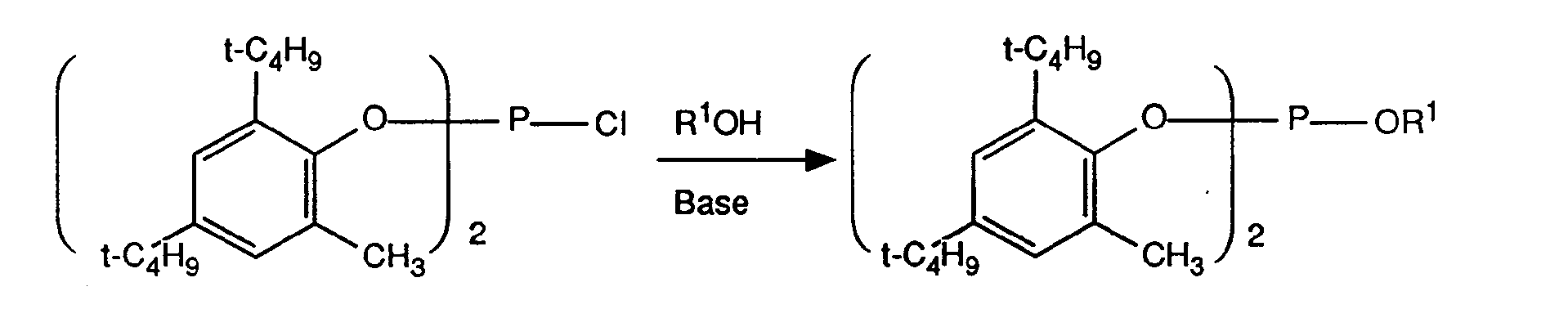
- R1 hat die zuvor angegebene Bedeutung.
- Zur Herstellung von dimeren und trimeren Verbindungen der Formel werden die entsprechenden Polyole verwendet.
- Als Basen können organische Basen oder anorganische Basen verwendet werden. Als organische Basen sind z. B. tertiäre Amine wie z.B. Trimethylamin, Triethylamin, N,N-Dimethylanilin oder N,N-Diethylanilin oder Pyridin zu nennen. Als anorganische Basen kommen beispielsweise Alkalihydroxide, etwa Natriumhydroxid oder Kaliumhydroxid oder Alkalicarbonate, etwa Natrium- oder Kaliumcarbonat in Frage.
- Die Reaktionstemperaturen der Substitution liegen z.B. zwischen -30 °C und +150 °C, vorzugsweise zwischen - 10°Cund+70°C.
- Als Lösungsmittel können aliphatische und aromatische, gegebenenfalls halogenierte, Kohlenwasserstoffe oder Ether eingesetzt werden. Geeignete aromatische Kohlenwasserstoffe sind z.B. Benzol, Toluol, Xylol oder als chlorierter aromatischer Kohlenwasserstoff beispielsweise Chlorbenzol. Aliphatische Kohlenwasserstoffe, die als Lösungsmittel verwendet werden können, sind beispielsweise Hexan, Pentan oder weitere Petroletherfraktionen. Als halogenierte aliphatische Kohlenwasserstoffe eignen sich z.B. Methylenchlorid oder Chloroform. Als Ether kommen z.B. Diethylether, Dibutylether oder Tetrahydrofuran in Frage.
- Das Diarylphosphorchloridit (11) und der Alkohol R1OH werden zweckmässig in äquivalenten Mengen eingesetzt. Es ist aber z.B. auch möglich, einen Ueberschuss an Alkohol einzusetzen, beispielsweise 1,05- 1,2 Aequivalente.
- Eine weitere Möglichkeit zur Herstellung von erfindungsgemässen Verbindungen ist die Kondensation von 2 Aequivalenten 2,4-Di-tert-butyl-6-methylphenol mit einem Aeqiuvalent einer Phosphorverbindung R1O-PCl2 in Gegenwart einer organischen Base.
- Gegenstand der Erfindung ist auch die Verbindung der Formel II

und deren Verwendung zur Herstellung von Verbindungen der Formel I. - Die Herstellung von Phosphorchloriditen ist dem Fachmann bekannt und in zahlreichen Veröffentlichungen beschrieben. Das neue Phosphorchloridit der Formel II kann nach analogen Verfahren hergestellt werden. So beschreiben H. G. Cook et al. im J. Chem. Soc. 1949, IV, 2921-2927 und A. J. Razumov et al. in Chemical Abstracts 60, 1571g (1964) die Herstellung entsprechender Chloride durch Umsetzung von Phosphortrichlorid mit Alkanolen in Gegenwart von N,N-Dimethylanilin oder N,N-Diethylanilin als Säureakzeptor. J. Michalski et al. veröffentlichen im J. Chem. Soc. 1961,4904 eine Variante dieses Verfahrens, worin als Säureakzeptor ein Pyridin/Diethylanilin-Gemisch eingesetzt wird. Umsetzungen von Phosphortrichlorid mit gehinderten Phenolen sind aus den US-A-3,281,506 und US-A-4,584,146 bekannt. H. G. Cook et al. zeigen im J. Chem. Soc. 1949, IV, 2921-2927 eine weitere Methode zur Herstellung von zur Formel 11 analogen Phosphorchloriditen. Sie setzen Phosphortrichlorid mit symmetrischen Trialkylphosphiten um. Eine Variante dieses Verfahrens ist im US-A-4,079, 103 beschrieben.
- Die Herstellung von Bis(2,4-di-tert-butyl-6-methyl)-phosphorchloridit kann auch ohne Lösungsmittel direkt in der Schmelze erfolgen. Dies ermöglicht die Herstellung der Phosphite der Formel ohne Isolierung der Zwischenstufe.
- Die Verbindungen der Formel eignen sich hervorragend zum Stabilisieren von organischen Materialien gegen lichtinduzierten, thermischen oder/und oxidativen Abbau. Gegenstand der Erfindung sind daher auch Zusammensetzungen enthaltend ein gegen solche Abbaureaktionen empfindliches organisches Material und mindestens eine Verbindung der Formel bzw. die Verwendung von Verbindungen der Formel als Stabilisatoren für organische Materialien gegen die genannten Abbauarten. Beispiele für solche Materialien sind:
- 1. Polymere von Mono- und Diolefinen, beispielsweise Polypropylen, Polyisobutylen, Polybuten- 1, Polymethylpenten- 1, Polyisopren oder Polybutadien sowie Polymerisate von Cycloolefinen wie z.B. von Cyclopenten oder Norbornen; ferner Polyethylen (das gegebenenfalls vemetzt sein kann), z.B. Polyethylen hoher Dichte (HDPE), Polyethylen niederer Dichte (LDPE), lineares Polyethylen niederer Dichte (LLDPE).
- 2. Mischungen der unter 1) genannten Polymeren, z.B. Mischungen von Polypropylen mit Polyisobutylen, Polypropylen mit Polyethylen (z.B. PP/HDPE, PP/LDPE) und Mischungen verschiedener Polyethylentypen (z.B. LDPE/HDPE).
- 3. Copolymere von Mono- und Diolefinen untereinander oder mit anderen Vinylmonomeren, wie z.B. Ethylen-Propylen-Copolymere, lineares Polyethylen niederer Dichte (LLDPE) und Mischungen desselben mit Polyethylen niederer Dichte (LDPE), Propylen--Buten- 1-Copolymere, Propylen-Isobutylen-Copolymere, Ethylen-Buten- 1-Copolymere, Ethylen-Hexen-Copolymere, Ethylen-Methylpenten-Copolymere, Ethylen-Hepten-Copolymere, Ethylen-Octen-Copolymere, Propylen-Butadien-Copolymere, Isobutylen-Isopren-Copolymere, Ethylen-Alkylacrylat-Copolymere, Ethylen-Alkylmethacrylat-Copolymere, Ethylen-Vinylacetat-Copolymere oder Ethylen-Acrylsäure-Copolymere und deren Salze (lonomere), sowie Terpolymere von Ethylen mit Propylen und einem Dien, wie Hexadien, Dicyclopentadien oder Ethylidennorbornen; ferner Mischungen solcher Copolymere untereinander und mit unter 1) genannten Polymeren, z.B. Polypropylen-/Ethylen-Propylen-Copolymere, LDPE/Ethylen-Vinylacetat-Copolymere, LDPE/Ethylen-Acrylsäure-Copolymere, LLDPE/Ethylen-Vinylacetat-Copolymere und LLDPE/Ethylen-Acrylsäure-Copolymere. 3a. Kohlenwasserstoffharze (z.B. C5-C9) inklusive hydrierte Modifikationen davon (z.B. Klebrigmacherharze).
- 4. Polystyrol, Poly-(p-methylstyrol), Poly-(a-methylstyrol).
- 5. Copolymere von Styrol oder a-Methylstyrol mit Dienen oder Acrylderivaten, wie z.B. Styrol-Butadien, Styrol-Acrylnitril, Styrol-Alkylmethacrylat, Styrol-Butadien-Alkylacrylat, Styrol-Maleinsäureanhydrid, Styrol-Acrylnitril-Methylacrylat; Mischungen von hoher Schlagzähigkeit aus Styrol-Copolymeren und einem anderen Polymer, wie z.B. einem Polyacrylat, einem Dien-Polymeren oder einem Ethylen-Propylen-Dien-Terpolymeren; sowie Block-Copolymere des Styrols, wie z.B. Styrol-Butadien-Styrol, Styrol-Isopren-Styrol, Styrol-Ethylen/Butylen-Styrol oder Styrol-Ethylen/Propylen-Styrol.
- 6. Pfropfcopolymere von Styrol oder a-Methylstyrol, wie z.B. Styrol auf Polybutadien, Styrol auf Polybutadien-Styrol- oder Polybutadien-Acrylnitril-Copolymere, Styrol und Acrylnitril (bzw. Methacrylnitril) auf Polybutadien; Styrol, Acrylnitril und Methylmethacrylat auf Polybutadien; Styrol und Maleinsäureanhydrid auf Polybutadien; Styrol, Acrylnitril und Maleinsäureanhydrid oder Maleinsäureimid auf Polybutadien; Styrol und Maleinsäureimid auf Polybutadien, Styrol und Alkylacrylate bzw. Alkylmethacrylate auf Polybutadien, Styrol und Acrylnitril auf Ethylen-Propylen-Dien-Terpolymeren, Styrol und Acrylnitril auf Polyalkylacrylaten oder Polyalkylmethacrylaten, Styrol und Acrylnitril auf Acrylat-Butadien-Copolymeren, sowie deren Mischungen mit den unter 5) genannten Copolymeren, wie sie z.B. als sogenannte ABS-, MBS-, ASA- oder AES-Polymere bekannt sind.
- 7. Halogenhaltige Polymere, wie z.B. Polychloropren, Chlorkautschuk, chloriertes oder chlorsulfoniertes Polyethylen, Copolymere von Ethylen und chloriertem Ethylen, Epi-chlorhydrinhomo- und -copolymere, insbesondere Polymere aus halogenhaltigen Vinylverbindungen, wie z.B. Polyvinylchlorid, Polyvinylidenchlorid, Polyvinylfluorid, Poly-vinylidenfluorid; sowie deren Copolymere, wie Vinylchlorid-Vinylidenchlorid, Vinylchlorid-Vinylacetat oder Vinylidenchlorid-Vinylacetat.
- 8. Polymere, die sich von a,ß-ungesättigten Säuren und deren Derivaten ableiten, wie Polyacrylate und Polymethacrylate, Polyacrylamide und Polyacrylnitrile.
- 9. Copolymere der unter 8) genannten Monomeren untereinander oder mit anderen ungesättigten Monomeren, wie z.B. Acrylnitril-Butadien-Copolymere, Acrylnitril-Alkyl-acrylat-Copolymere, Acrylnitril-Alkoxyalkylacrylat-Copolymere, Acrylnitril-Vinylhalogenid-Copolymere oder Acrylnitril-Alkylmethacrylat-Butadien-Terpolymere.
- 10. Polymere, die sich von ungesättigten Alkoholen und Aminen bzw. deren Acylderivaten oder Acetalen ableiten, wie Polyvinylalkohol, Polyvinylacetat, -stearat, -benzoat, -maleat, Polyvinylbutyral, Polyallylphthalat, Polyallylmelamin; sowie deren Copolymere mit in Punkt 1 genannten Olefinen.
- 11. Homo- und Copolymere von cyclischen Ethern, wie Polyalkylenglykole, Polyethylenoxyd, Polypropylenoxyd oder deren Copolymere mit Bisglycidylethern.
- 12. Polyacetale, wie Polyoxymethylen, sowie solche Polyoxymethylene, die Comonomere, wie z.B. Ethylenoxid, enthalten; Polyacetale, die mit thermoplastischen Polyurethanen, Acrylaten oder MBS modifiziert sind.
- 13. Polyphenylenoxide und -sulfide und deren Mischungen mit Styrolpolymeren oder Polyamiden.
- 14. Polyurethane, die sich von Polyethern, Polyestern und Polybutadienen mitendständigen Hydroxylgruppen einerseits und aliphatischen oder aromatischen Polyisocyanaten andererseits ableiten, sowie deren Vorprodukte.
- 15. Polyamide und Copolyamide, die sich von Diaminen und Dicarbonsäuren und/oder von Aminocarbonsäuren oder den entsprechenden Lactamen ableiten, wie Polyamid 4, Polyamid 6, Polyamid 6/6, 6/10, 6/9, 6/12,4/6, Polyamid 11, Polyamid 12, aromatische Polyamide ausgehend von m-Xylol, Diamin und Adipinsäure; Polyamide, hergestellt aus Hexamethylendiamin und Iso- und/oder Terephthalsäure und gegebenenfalls einem Elastomer als Modifikator, z.B. Poly-2,4,4-trimethylhexamethylenterephthalamid, Poly-m-phenylen-isophthalamid. Block-Copolymere der vorstehend genannten Polyamide mit Polyolefinen, Olefin-Copolymeren, lonomeren oder chemisch gebundenen oder gepfropften Elastomeren; oder mit Polyethern, wie z.B. mit Polyethylenglykol, Polypropylenglykol oder Polytetramethylenglykol. Ferner mit EPDM oderABS modifizierte Polyamide oder Copolyamide; sowie während der Verarbeitung kondensierte Polyamide ("RIM-Polyamid-systeme").
- 16. Polyharnstoffe, Polyimide, Polyamid-imide und Polybenzimidazole.
- 17. Polyester, die sich von Dicarbonsäuren und Dialkoholen und/odervon Hydroxycarbonsäuren oder den entsprechenden Lactonen ableiten, wie Polyethylenterephthalat, Polybutylenterephthalat, Poly- 1,4-dimethylolcyclohexanterephthalat, Polyhydroxybenzoate, sowie Block-Polyether-ester, die sich von Polyethern mit Hydroxylendgruppen ableiten; ferner mit Polycarbonaten oder MBS modifizierte Polyester.
- 18. Polycarbonate und Polyestercarbonate.
- 19. Polysulfone, Polyethersulfone und Polyetherketone.
- 20. Vernetzte Polymere, die sich von Aldehyden einerseits und Phenolen, Harnstoff oder Melamin ändererseits ableiten, wie Phenol-Formaldehyd-, Harnstoff-Formaldehyd- und Melamin-Formaldehydharze.
- 21. Trocknende und nicht-trocknende Alkydharze.
- 22. Ungesättigte Polyesterharze, die sich von Copolyestern gesättigter und ungesättigter Dicarbonsäuren mit mehrwertigen Alkoholen, sowie Vinylverbindungen als Vernetzungsmittel ableiten, wie auch deren halogenhaltige, schwerbrennbare Modifikationen.
- 23. Vernetzbare Acrylharze, die sich von substituierten Acrylsäureestem ableiten, wie z.B. von Epoxyacrylaten, Urethan-acrylaten oder Polyester-acrylaten.
- 24. Alkydharze, Polyesterharze und Acrylatharze, die mit Melaminharzen, Harnstoffharzen, Polyisocyanaten oder Epoxidharzen vernetzt sind.
- 25. Vernetzte Epoxidharze, die sich von Polyepoxiden ableiten, z.B. von Bis-glycidylethern oder von cycloaliphatischen Diepoxiden.
- 26. Natürliche Polymere, wie Cellulose, Naturkautschuk, Gelatine, sowie deren polymerhomolog chemisch abgewandelte Derivate, wie Celluloseacetate, -propionate und -butyrate, bzw. die Celluloseether, wie Methylcellulose; sowie Kolophoniumharze und Derivate.
- 27. Mischungen (Polyblends) der vorgenannten Polymeren, wie z.B. PP/EPDM, Polyamid/EPDM oder ABS, PVC/EVA, PVC/ABS, PVC/MBS, PC/ABS, PBTP/ABS, PC/ASA, PC/PBT, PVC/CPE, PVC/Acrylate, POM/thermoplastisches PUR, PC/thermoplastisches PUR, POM/Acrylat, POM/MBS, PPO/HIPS, PPO/PA 6.6 und Copolymere, PA/HDPE, PA/PP, PA/PPO.
- 28. Natürliche und synthetische organische Stoffe, die reine monomere Verbindungen oder Mischungen von solchen darstellen, beispielsweise Mineralöle, tierische oder pflanzliche Fette, Oele und Wachse, oder Oele, Wachse und Fette auf Basis synthetischer Ester (z.B. Phthalate, Adipate, Phosphate oder Trimellitate), sowie Abmischungen synthetischer Ester mit Mineralölen in beliebigen Gewichtsverhältnissen, wie sie z.B. als Spinnpräparationen Anwendung finden, sowie deren wässrige Emulsionen.
- 29. Wässrige Emulsionen natürlicher oder synthetischer Kautschuke, wie z.B. Naturkautschuk-Latex oder Latices von carboxylierten Styrol-Butadien-Copolymeren.
- Vorzugsweise handelt es sich bei den zu schützenden organischen Materialien um natürliche, halbsynthetische oder bevorzugt synthetische organische Materialien. Besonders bevorzugt sind thermoplastische Polymere, insbesondere PVC oder Polyolefine, beispielsweise Polyethylen und Polypropylen (PP).
- In den erfindungsgemässen Zusammensetzungen sind die Verbindungen der Formel zweckmässig zu 0.01 bis 10, beispielsweise zu 0.05 bis 5, vorzugsweise zu 0.05 bis 3, insbesondere jedoch zu 0.11 bis 2 Gew.-% enthalten. Es kann sich dabei um eine oder mehrere der Verbindungen der Formel handeln, und die Gewichtsprozentangaben beziehen sich auf die gesamte Menge dieser Verbindungen. Berechnungsgrundlage ist dabei das Gesamtgewicht des organischen Materials ohne die Verbindungen der Formel 1. Die Einarbeitung in die Materialien kann beispielsweise durch Einmischen oder Aufbringen der Verbindungen der Formel und gegebenenfalls weiterer Additive nach den in der Technik üblichen Methoden erfolgen. Handelt es sich um Polymere, insbesondere synthetische Polymere, kann die Einarbeitung vor oder während der Formgebung, oder durch Aufbringen der gelösten oder dispergierten Verbindungen auf das Polymere, gegebenenfalls unter nachträglichem Verdunsten des Lösungsmittels erfolgen. Im Fall von Elastomeren können diese auch als Latices stabilisiert werden. Eine weitere Möglichkeit der Einarbeitung der Verbindungen der Formel in Polymere besteht in deren Zugabe vor, während oder unmittelbar nach der Polymerisation der entsprechenden Monomeren bzw. vor der Vernetzung. Die Verbindungen der Formel können dabei als solche, aber auch in encapsulierter Form (z.B in Wachsen, Ölen oder Polymeren) zugesetzt werden. Im Falle der Zugabe vor oder während der Polymerisation können die Verbindungen der Formel auch als Regulatoren für die Kettenlänge der Polymeren (Kettenabbrecher) wirken.
- Die Verbindungen der Formel oder Mischungen davon können auch in Form eines Masterbatches, der diese Verbindungen beispielsweise in einer Konzentration von 2,5 bis 25 Gew.-% enthält, den zu stabilisierenden Kunststoffen zugesetzt werden.
- Zweckmässig kann die Einarbeitung der Verbindungen der Formel nach folgenden Methoden erfolgen:
- - als Emulsion oder Dispersion (z.B. zu Latices oder Emulsionspolymeren)
- - Als Trockenmischung während des Vermischens von Zusatzkomponenten oder Polymermischungen
- - durch direktes Zugeben in die Verarbeitungsapparatur (z.B. Extruder, Innenmischer usw.)
- - als Lösung oder Schmelze.
- Erfindungsgemässe Polymerzusammensetzungen können in verschiedener Form angewendet bzw. zu verschiedenen Produkten verarbeitet werden, z.B. als (zu) Folien, Fasern, Bändchen, Formmassen, Profilen, oder als Bindemittel für Lacke, Klebstoffe oder Kitte.
- Wie bereits erwähnt, handelt es sich bei den zu schützenden organischen Materialien um organische, vorzugsweise synthetische, Polymere. Besonders vorteilhaft werden dabei thermoplastische Materialien geschützt, insbesondere Polyolefine. Vor allem ist dabei die ausgezeichnete Wirksamkeit der Verbindungen der Formel als Verarbeitungsstabilisatoren (Hitzestabilisatoren) hervorzuheben. Zu diesemZweckwerden sie vorteilhaft vor oder während der Verarbeitung des Polymeren diesem zugesetzt.
- Aber auch weitere Polymere (z.B. Elastomere) oder Schmierstoffe bzw. Hydraulikflüssigkeiten können gegen Abbau, z.B. lichtinduzierten oder/und thermooxidativen Abbau stabilisiert werden. Elastomere sind der obigen Aufzählung von möglichen organischen Materialien zu entnehmen.
- Die in Frage kommenden Schmierstoffe und Hydraulikflüssigkeiten basieren beispielsweise auf mineralischen oder synthetischen Ölen oder Mischungen davon. Die Schmierstoffe sind dem Fachmann geläufig und in der einschlägigen Fachliteratur, wie beispielsweise in Dieter Klamann, "Schmierstoffe und verwandte Produkte" (Verlag Chemie, Weinheim, 1982), in Schewe-Kobek, "Das Schmiermittel-Taschenbuch" (Dr. Alfred Hüthig-Verlag, Heidelberg, 1974) und in "Ullmanns Enzyklopädie der technischen Chemie", Bd. 13, Seiten 85-94 (Verlag Chemie, Weinheim, 1977) beschrieben.
- Die Erfindung betrifft auch ein Verfahren zum Schützen von organischem Material gegen oxidativen, thermischen und/oder actinischen Abbau, dadurch gekennzeichnet, dass man diesem Material als Stabilisatoren Verbindungen der Formel zusetzt bzw. auf dieses aufbringt,
- Zusätzlich zu den erfindungsgemässen Verbindungen können die erfindungsgemässen Zusammensetzungen, insbesondere wenn sie organische, vorzugsweise synthetische, Polymere enthalten, noch weitere übliche Additive enthalten. Beispiele für solche Additive sind:
- 1.1. Alkylierte Monophenole, z.B. 2,6-Di-tert.butyl-4-methylphenol, 2-Tert.butyl-4,6-di-methylphenol, 2,6-Di-tert.butyl-4-ethylphenol, 2,6-Di-tert.butyl-4-n-butylphenol, 2,6-Di-tert.butyl-4-i-butylphenol, 2,6-Di-cyclopentyl-4-methylphenol, 2-(a-Methylcyclohexyl)-4,6-dimethylphenol, 2,6-Di-octadecyl-4-methylphenol, 2,4,6-Tri-cyclohexylphenol, 2,6-Di-tert.butyl-4-methoxymethylphenol, 2,6-Di-nonyl-4-methylphenol.
- 1.2. Alkylierte Hydrochinone, z.B. 2,6-Di-tert.butyl-4-methoxyphenol, 2,5-Di-tert.butylhydrochinon, 2,5-Di-tert.amyl-hydrochinon, 2,6-Diphenyl-4-octadecyloxyphenol.
- 1.3. Hydroxylierte Thiodiphenylether, z.B. 2,2'-Thio-bis-(6-tert.-butyl-4-methylphenol), 2,2'-Thio-bis-(4-octylphenol), 4,4'-Thio-bis-(6-tert.butyl-3-methylphenol), 4,4'-Thio-bis-(6-tert.butyl-2-methylphenol).
- 1.4. Alkyliden-Bisphenole, z.B. 2,2'-Methylen-bis-(6-tert.butyl-4-methylphenol), 2,2'-Methylen-bis-(6-tert.butyl-4-ethylphenol), 2,2'-Methylen-bis-[4-methyl-6-(a-methyl-cyclohexyl)-phenol], 2,2'-Methylen-bis-(4-methyl-6-cyclohexylphenol), 2,2'-Methylen-bis-(6-nonyl-4-methylphenol), 2,2'-Methylen-bis-(4,6-di-tert.butylphenol), 2,2'-Ethyliden-bis-(4,6-di-tert.butylphenol), 2,2'-Ethyliden-bis-(6-tert.butyl-4-isobutylphenol), 2,2'-Methylen-bis-[6-(a-methylbenzyl)4-nonylphenol], 2,2'-Methylen-bis-[6-(a,a-dimethylbenzyl-)-4-nonylphenol], 4,4'-Methylen-bis-(2,6-di-tert.-butylphenol), 4,4'-Methylen-bis-(6-tert.butyl-2-methylphenol), 1,1-Bis-(5-tert.butyl-4-hydroxy-2-methylphenyl)-butan, 2,6-Bis-(3-tert.butyl-5-methyl-2-hydroxybenzyl)4-methylphenol, 1, 1,3-Tris-(5-tert.butyl-4-hydroxy-2-methylphenyl)-butan, 1,1 -Bis-(5-tert.butyl-4-hydroxy-2-methyl-phenyl)-3-n-dodecylmercaptobutan, Ethylenglycol-bis-[3,3-bis-(3'-tert.-butyl-4'-hydroxyphenyl)-butyrat], Bis-(3-tert.butyl-4-hydroxy-5-methyl-phenyl)-dicyclopentadien, Bis-[2-(3'-ter.butyl-2'-hydroxy-5'-methyl-benzyl)-6-tert.Butyl-4-methyl-phenyl]-terephthalat.
- 1.5 Benzylverbindungen, z.B. 1,3,5-Tris-(3,5-di-tert.butyl-4-hydroxy-benzyl)-2,4,6-tri-methylbenzol, Bis-(3,5-di-tert.butyl-4-hydroxybenzyl)-sulfid, 3,5-Di-tert.butyl-4-hydroxybenzyl-mercaptoessigsäure-isooctylester, Bis-(4-tert.butyl-3-hydroxy-2,6 dimethylbenzyl)dithiol-terephthalat, 1,3,5-Tris-(3,5-di-tert.butyl-4-hydroxybenzyl)-isocyanurat, 1,3,5-Tris-(4-tert.butyl-3-hydroxy-2,6-dimethylbenzyl)-isocyanurat, 3,5-Di-tert.butyl-4-hydroxybenzyl-phosphonsäure-dioctadecylester, Ca-Salz des 3,5-Di-tert.butyl-4-hydroxybenzyl- phosphonsäure-monoethylester, 1,3,5-Tris-(3,5-dicyclohexyl-4-hydroxybenzyl)isocyanurat...
- 1.6. Acylaminophenole, z.B. 4-Hydroxy-laurinsäureanilid, 4-Hydroxystearinsäureanilid, 2,4-Bis-(octylmer- capto)-6-(3,5-di-tert.butyl-4-hydroxyanilino )-s-triazin, N-(3,5-di-tert.-butyl-4-hydroxyphenyl)-carbaminsäure- octylester.
- 1.7. Ester der β-(3,5-Di-tert.butyl-4-hydroxyphenyl)-propionsäure mit ein- oder mehrwertigen Alkoholen, wie z.B. mit Methanol, Octa- decanol, 1,6-Hexandiol, Neopentylglycol, Thiodiethylenglycol, Diethylenglycol, Triethylenglycol, Pentaerythrit, Tris-(hydroxyethyl)-isocyanurat, N,N'-Bis-(hydroxyethyl)-oxalsäurediamid.
- 1.8. Ester der β-(5-tert.Butyl-4-hydroxy-3-methylphenyl)-propionsäure mit ein- oder mehrwertigen Alkoholen, wie z.B. mit Methanol, Octadecanol, 1,6-Hexandiol, Neopentylglycol, Thiodiethylenglycol, Diethylenglycol, Triethylenglycol, Pentaerythrit, Tris-(hydroxy)ethyl-isocyanurat, N,N'-Bis-(hydroxyethyl)-oxalsäurediamid.
- 1.9. Ester der β-(3,5-Dicyclohexyl-4-hydroxyphenyl)-propionsäure mit ein- oder mehrwertigen Alkoholen, wie z.B. mit Methanol, Octadecanol, 1,6-Hexandiol, Neopentylglycol, Thiodiethylenglycol, Diethylenglycol, Triethylenglycol, Pentaerythrit, Tris-(hydroxy)ethyl-isocyanurat, N,N'-Bis-(hydroxyethyl)-oxalsäurediamid.
- 1.10. Amide der β-(3,5-Di-tert.butyl-4-hydroxyphenyl)-propionsäure, wie z.B. N,N'-Bis-(3,5-di-tert.butyl-4-hydroxyphenylpropionyl)-hexamethylendiamin, N,N'-Bis-(3,5-di-tert.-butyi-4-hydroxyphenyipropionyi)-trime- thylendiamin, N,N'-Bis-(3,5-di-tert.butyl-4-hydroxyphenylpropionyl)-hydrazin.
- 2.1. 2-(2'-Hydroxyphenyl)-benztriazole, wie z.B. das 5'-Methyl-, 3',5'-Di-tert.butyl-, 5'-tert.Butyl-, 5'-(1,1,3,3-Tetramethylbutyl)-, 5-Chlor-3',5'-di-tert.butyl-, 5-Chlor-3'-tert.-butyl-5'-methyl-, 3'-sec.Butyl-5'-tert.butyl, 4'-Octoxy-, 3',5'-Di-tert.amyl-, 3',5'-Bis-(a,a-dimethylbenzyl)-Derivat.
- 2.2. 2-Hydroxybenzophenone, wie z.B. das 4-Hydroxy-, 4-Methoxy-, 4-Octoxy-, 4-Decyloxy-, 4-Dodecyloxy-, 4-Benzyloxy-, 4,2',4'-Trihydroxy-, 2'-Hydroxy-4,4'-dimethoxy-Derivat.
- 2.3. Ester von gegebenenfalls substituierten Benzoesäuren, wie z.B. 4-tert.Butyl-phenyl-salicylat, Phenylsalicylat, Octylphenyl-salicylat, Dibenzoylresorcin, Bis-(4-tert.butyl-benzoyl)-resorcin, Benzoylresorcin, 3,5-Di-tert.butyl-4-hydroxybenzoesäure-2,4-di-tert.-butylphenylester, 3,5-Di-tert.butyi-4-hydroxybenzoesäurehexa- decylester.
- 2.4. Acrylate, wie z.B. a-Cyan-ß,ß-diphenylacrylsäure-ethylester bzw. -isooctylester, a-Carbomethoxyzimtsäuremethylester, a-Cyano-ß-methyl-p-methoxy-zimtsäuremethylester bzw. -butylester, a-Carbomethoxy-p-methoxy-zimtsäure-methylester, N-(ß-Carbomethoxy-ß-cyanovinyl)-2-methyl-indolin.
- 2.5. Nickelverbindungen, wie z.B. Nickelkomplexe des 2,2'-Thio-bis-[4-(1,1,3,3-tetramethylbutyl)-phenols], wie der 1:1-oder der 1:2-Komplex, gegebenenfalls mit zusätzlichen Liganden, wie n-Butylamin, Triethanolamin oder N-Cyclohexyl-diethanolamin, Nickeldibutyldithiocarbamat, Nickelsalze von 4-Hydroxy-3,5-di-tert.butylbenzyl-phosphonsäure-monoalkylestern, wie vom Methyl- oder Ethylester, Nickelkomplexe von Ketoximen, wie von 2-Hydroxy-4-methyl-phenyl-undecylketoxim, Nickelkomplexe des 1-Phenyl-4-lauroyl-5-hydroxy-pyrazols, gegebenenfalls mit zusätzlichen Liganden.
- 2.6. Sterisch gehinderte Amine, wie z.B. Bis-(2,2,6,6-tetramethyl-piperidyl)-sebacat, Bis-(1,2,2,6,6-pentamethylpiperidyl)-sebacat, n-Butyl-3,5-di-tert.butyl-4-hydroxybenzyl-malonsäure-bis(1,2, 2,6,6-pentamethylpiperidyl)-ester, Kondensationsprodukt aus 1-Hydroxyethyl-2,2,6,6-tetramethyl-4-hydroxypiperidin und Bernsteinsäure, Kondensationsprodukt aus N,N'-Bis-(2,2,6,6-Tetramethyl-4-piperidyl)-hexamethylendiamin und 4-tert.Octylamino-2,6-dichlor- 1,3,5-s-triazin, Tris-(2,2,6,6-tetramethyl- 4-piperidyl)-nitrilotriacetat, Tetrakis-(2,2,6,6-tetramethyl-4-piperidyl)-1,2,3,4-butantetraoat, 1,1'-(1,2-Ethandiyl)-bis-(3,3,5,5-tetramethyl- piperazinon).
- 2.7. Oxalsäurediamide, wie z.B. 4,4'-Di-octyloxy-oxanilid, 2,2'-Di-octyloxy-5,5'-di-tert.-Butyl-oxanilid, 2,2'-Di-dodecyloxy-5,5'di-tert.butyl-oxanilid, 2-Ethoxy-2'-ethyl-oxanilid, N,N'-Bis-(3-dimethylaminopropyl)-oxal- amid, 2-Ethoxy-5-tert.butyl-2'-ethyloxanilid und dessen Gemisch mit 2-Ethoxy-2'-ethyl-5,4'-di-tert.butyl- oxanilid, Gemische von o- und p-Methoxy- sowie von o- und p-Ethoxy-di-substituierten Oxaniliden.
- 2.8.2-(2-Hydroxyphenyl)-1,3,5-triazine, wie z.B. 2,4,6-Tris(2-hydroxy-4-octyloxyphenyl)- 1,3,5-triazin, 2-(2-Hydroxy-4-octyloxyphenyl)-4,6bis-(2,4-dimethylphenyl)-1,3,5-triazin, 2-(2,4-Dihydroxyphenyl)-4,6-bis(2,4-dimethylphenyl)-1,3,5-triazin, 2,4-Bis-(2-hydroxy-4-propyloxyphenyl)-6(2,4-dimethylphenyl)- 1,3,5-triazin, 2-(2-Hydroxy-4-octyloxyphenyl)-4,6-bis(4-methylphenyl)- 1,3,5-triazin, 2-(2-Hydroxy-4-dodecyloxyphenyl)-4,6- bis(2,4-dimethylphenyl)- 1,3,5-triazin.
- wie z.B. N,N'-Diphenyloxalsäurediamid, N-Salicylal-N'-salicyloylhydrazin, N,N'-Bis-(salicyloyl)-hydrazin, N,N'-Bis-(3,5-di-tert.butyl-4-hydroxyphenylpropionyl)-hydrazin, 3-Salicyloylamino- 1,2,4-triazol, Bis-(benzyliden)-oxalsäuredihydrazid.
- wie z.B. Triphenylphosphit, Diphenylalkylphosphite, Phenyldialkylphosphite, Tris-(nonylphenyl)-phosphit, Trilaurylphosphit, Trioctadecylphosphit, Distearyl-pentaerythritdiphosphit, Tris-(2,4-di-tert.butylphenyl)-phosphit, Diisodecylpentaerythrit-diphosphit, Bis-(2,4-di-tert.butylphenyl)-pentaerythritdiphosphit, Tristearylsorbit-triphosphit, Tetrakis-(2,4-di-tert.butylphenyl)4,4'-biphenylen-diphosphonit, 3,9-Bis-(2,4-di-tert.butylphe- noxy)-2,4,8, 10-tetraoxa-3,9-diphosphaspiro[5.5]undecan.
- wie z.B. Ester der β-Thio-dipropionsäure, beispiels-weise der Lauryl-, Stearyl-, Myristyl- oder Tridecylester, Mercaptobenzimidazol, das Zinksalz des 2-Mercaptobenzimidazols, Zink-dibutyl-dithiocarbamat, Dioctadecyldisulfid, Pentaerythrit-tetrakis-(ß-dodecylmercapto)-propionat.
- wie sie z.B. in der WO-A 80/01566 und EP-A 415 887 beschrieben werden.
- wie z.B. Kupfersalze in Kombination mit Jodiden und/oder Phosphorverbindungen und Salze des zweiwertigen Mangans.
- wie z.B. Melamin, Polyvinylpyrrolidon, Dicyandiamid, Tri-allylcyanurat, Harnstoff-Derivate, Hydrazin-Derivate, Amine, Polyamide, Polyurethane, Alkali- und Erdalkalisalze höherer Fettsäuren, beispielsweise Ca-Stearat, Zn-Stearat, Mg-Stearat, Na-Ricinoleat, K-Palmitat, Antimonbrenzcatechinat oder Zinnbrenzcatechinat.
- wie z.B. 4-tert.Butylbenzoesäure, Adipinsäure, Diphenylessigsäure.
- wie z.B. Calciumcarbonat, Silikate, Glasfasern, Asbest, Talk, Kaolin, Glimmer, Bariumsulfat, Metalloxide und -hydroxide, Ruß, Graphit.
- wie z.B. Weichmacher, Gleitmittel, Emulgatoren, Pigmente, Optische Aufheller, Flammschutzmittel, Antistatika, Treibmittel.
- Die nachfolgenden Beispiele erläutern die Erfindung weiter. Angaben in Teilen oder Prozenten beziehen sich, ebenso wie in den Patentansprüchen und der übrigen Beschreibung, auf das Gewicht, sofern nichts anderes angegeben ist.
- In einem mit Stickstoff inertisierten und mit Thermometer, Tropftrichter, Rückflusskühler und Destillationsaufsatz versehenen Vierhalskolben werden 890,3 g (4 Mol) 2,4-Di-tert-butyl-6-methylphenol, 4,2 g Dimethylformamid und 170,0 g Xylol vorgelegt. Bei einer Temperatur von 50 °C werden innerhalb von 1,5 h 274,9 g (2 Mol) Phosphortrichlorid unter Rühren zugetropft. Die Reaktionsmischung wird auf 130 °C erwärmt und bei dieser Temperatur 1 h am Rückfluss erhitzt. Bei einem Vakuum von 0, 15 bar wird das Reaktionsgemisch 1 h bei 120 °C gehalten. Anschliessend wird bei erhöhtem Vakuum das Xylol abdestilliert. Nach dem Brechen des Vakuums mit Stickstoff erhält man 959,5 g (1,9 Mol) der Titelverbindung als unterkühlte, gelb-orange, klare Schmelze.
- Reinheit: 98 % (bestimmt mit 31P-NMR)
- Reinigung: Destillation bei 204 °C/0,0002 bar.
- Herstellung von Bis(2,4-di-tert-butyl-6-methylphenyl)-methylphosphit
- In einem 1500 ml Sulfierkolben mit Thermometer, Rührer und Rückflusskühler werden 300 g (1,36 Mol) 2,4-Di-tert-butyl-6-methylphenol vorgelegt und der Reaktor mit Stickstoff inertisiert. Zum Schmelzen des Phenols wird auf 55 °C erwärmt und zur Schmelze 1,5 g Dimethylformamid zugegeben. Bei gleicher Temperatur werden innerhalb von 1,5 h 102,7 g (0,75 Mol) Phosphortrichlorid zugetropft. Das entstehende Salzsäuregas wird durch eine 30%ige wässrige Natriumhydroxid-Lösung neutralisiert. Nach Ende der Zugabe wird die Reaktionsmischung innerhalb 4 h auf 140 °C erhitzt und eine weitere Stunde bei dieser Temperatur gerührt. Dann wird ein leichtes Vakuum angelegt (0,55 bar) und weitere 4 h bei 130 °C gerührt. Danach lässt man die erhaltene klare gelb-orange Schmelze (= Bis(2,4-di-tert-butyl-6-methyl)-phosphorchloridit) in einer Stickstoffatmosphäre auf etwa 80 °C abkühlen und verdünnt mit 500 ml Siedegrenzebenzin (80-100 °C). Nach dem Abkühlen der Lösung auf -5 °C werden innerhalb von 15 min 89,3 g (0,884 Mol) Triethylamin zugegeben. Innerhalb einer Stunde werden nun 32,8 g (1,02 Mol) Methanol zugetropft, wobei die Temperatur auf +5 °C ansteigt und das Triethylaminhydrochlorid ausfällt. Dieses Gemisch wird unter Rühren langsam (ca. 1 h) auf Raumtemperatur erwärmen gelassen. Nach dem Abfiltrieren des Niederschlags und Eindampfen des Filtrats erhält man 328 g Phosphit als gelbes Oel. (Reinheit bestimmt mit "High Pressure Liquid Chromatography" [HPLC]: 94 %). Umkristallisieren des Rohproduktes aus Ethanol ergibt 262 g (77 % d. Theorie) der Titelverbindung in Form eines weissen Pulvers mit einem Schmelzpunkt von 75-78 °C.
- Elementaranalyse: P ber.: 6,19 % gef.: 6,19 %
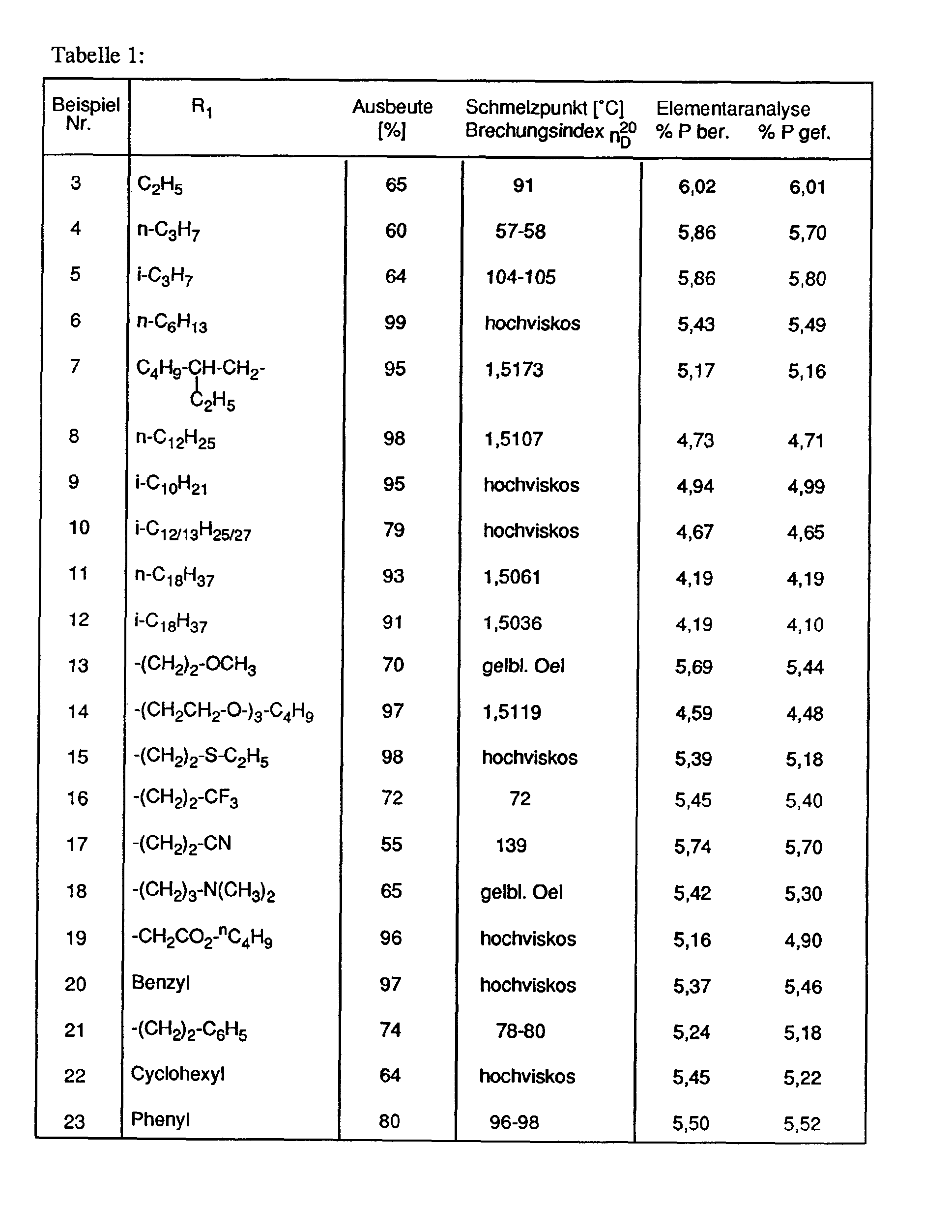
- Die Verbindungen der Beispiele 3 - 33 werden analog zu der Verbindung des Beispiels 2 unter Verwendung des dem Substituenten R1 entsprechenden Alkohols bzw. Phenols hergestellt. Die Substituenten und analytischen Daten sind in der folgenden Tabelle 1 wiedergegeben.


-
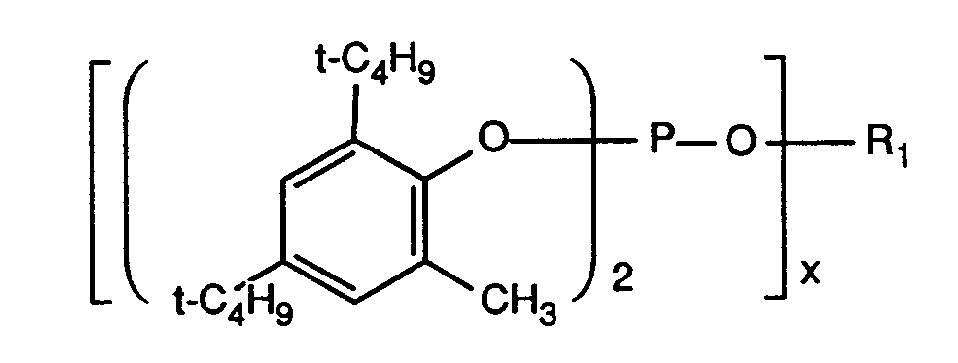
- Die Verbindungen der Beispiele 34-36 werden analog zu derVerbindung des Beispiels 2 unter Verwendung des dem Substituenten R1 entsprechenden Polyols hergestellt. Für die Verbindungen mit x=2 werden jeweils zwei Aequivalente Bis(2,4-di-tert-butyl-6-methyl)-phosphorchloridit und Base verwendet, bei der trimeren Verbindung (x=3) entsprechend drei Aequivalente Bis(2,4-di-tert-butyl-6-methyl)-phosphorchloridit und drei Aequivalente Base. Die Substituenten und analytischen Daten sind in der folgenden Tabelle 2 wiedergegeben.

- 1,3 kg Polypropylenpulver (Schmelzindex 3,2 g/10 min, gemessen bei 230 °C/2,16 kg) werden mit 0,05 % Calciumstearat, 0,05 % Tetrakis[3,5-di-tert-butyl-4-hydroxyphenylpropionyloximethyl]methan und 0,05 % des in der Tabelle 3 angegebenen Stabilisators vermischt. Diese Mischung wird in einem Extruder mit einem Zylinderdurchmesservon 20 mm und einer Länge von 400 mm bei 100 Umdrehungen pro Minute extrudiert, wobei die 3 Heizzonen auf 260 °C, 270 °C und 280 °C eingestellt sind. Das Extrudat wird zur Kühlung durch ein Wasserbad gezogen und anschliessend granuliert. Das erhaltene Granulat wird ein zweites und drittes Mal extrudiert. Nach diesen drei Extrusionen wird der Schmelzindex bei 230 °C/2,16 kg gemessen. Kleine Werte bedeuten eine gute Stabilisierung. Die Ergebnisse sind in der Tabelle 3 wiedergegeben.

- 100 Teile unstabilisiertes Polyethylen hoher Dichte mit einem Molekulargewicht von ca. 500 000 in Pulverform werden mit 0,05 Teilen Tetrakis[3,5-di-tert-butyl-4-hydroxyphenylpropionyloxymethyl] methan und 0,1 Teilen des in Tabelle 4 angegebenen Stabilisators trocken gemischt.Die Mischungen werden 50 Minuten lang in einem Brabender-Plastographen bei 220 °C und 50 UpM geknetet. Während dieser Zeit wird der Knetwiderstand als Drehmoment kontinuierlich registriert. Infolge der Vernetzung des Polymeren erfolgt im Laufe der Knetzeit nach anfänglicher Konstanz eine rasche Zunahme des Drehmoments. Die Wirksamkeit der Stabilisatoren äussert sich in einer Verlängerung der Zeit bis zum Anstieg des Drehmoments. Die erhaltenen Werte sind der Tabelle 4 zu entnehmen.

wenn x=2 ist, R1 für C2-C18-Alkylen, durch -NR5-, -O- oder -S- unterbrochenes C2-C18-Alkylen oder einen Rest

steht, und,
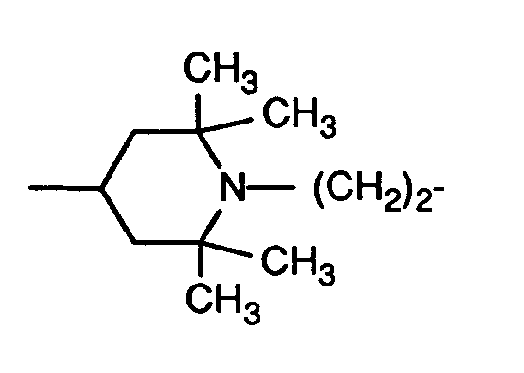
wenn x=2 ist, R1 für C2-C8-Alkylen oder durch -NR5- oder -O- unterbrochenes C2-C8-Alkylen steht und, wenn x=3 ist R1 für einen Rest

steht.
Claims (31)


steht, wenn x=2 ist, R1 für C2-C18-Alkylen, durch -NR5-, -O- oder -S- unterbrochenes C2-C18-Alkylen oder einen Rest

steht und, wenn x=3 ist, R1 C4-C12-Alkantriyl oder eine Gruppe

worin m 1-4 ist, darstellt.


wenn x=2 ist, R1 für C2-C12-Alkylen, durch -NR5-, -O- oder-S- unterbrochenes C2-C12-Alkylen oder einen Rest

steht und R10 und R11 unabhängig voneinander Wasserstoff oder C1-C4-Alkyl bedeuten und, wenn x=3 ist, R1 C4-C12-Alkantriyl oder eine Gruppe
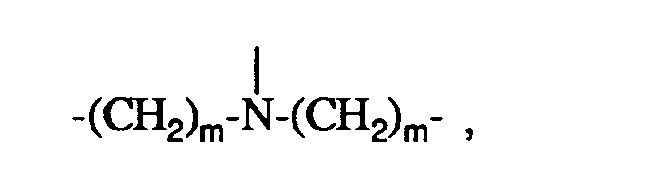
worin m 1-4 ist, darstellt.


steht,

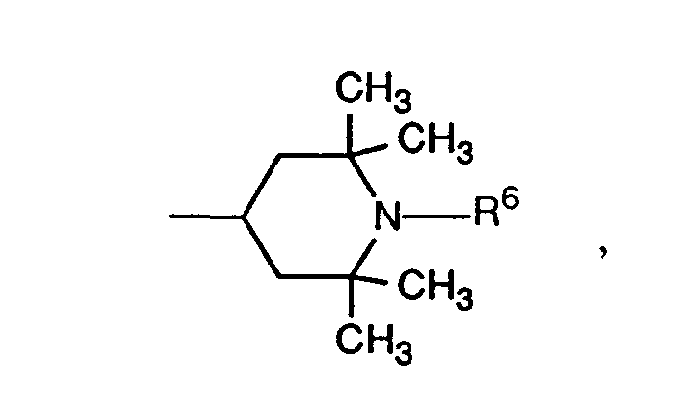


steht und,

darstellt.


worin x 1, 2 oder 3 ist, und
wenn x=1 ist, R1 für C1-C30-Alkyl, mit Halogen, -COOR2, -CN, -NR3R4 oder-CONR3R4 substituiertes C1-C18-Alkyl, durch -NR5-, -O- oder-S- unterbrochenes C2-C18-Alkyl, C3-C18-Alkenyl, C5-C12-Cycloalkyl, Phenyl-C1-C4-alkyl, unsubstituiertes oder mit C1-C12-Alkyl Halogen, Phenyl-C1-C4-alkyl oder/und C1-C4-Alkoxy substituiertes Phenyl, Naphthyl, einen Rest der Formel

oder

steht,

steht, und,


steht,

steht und,

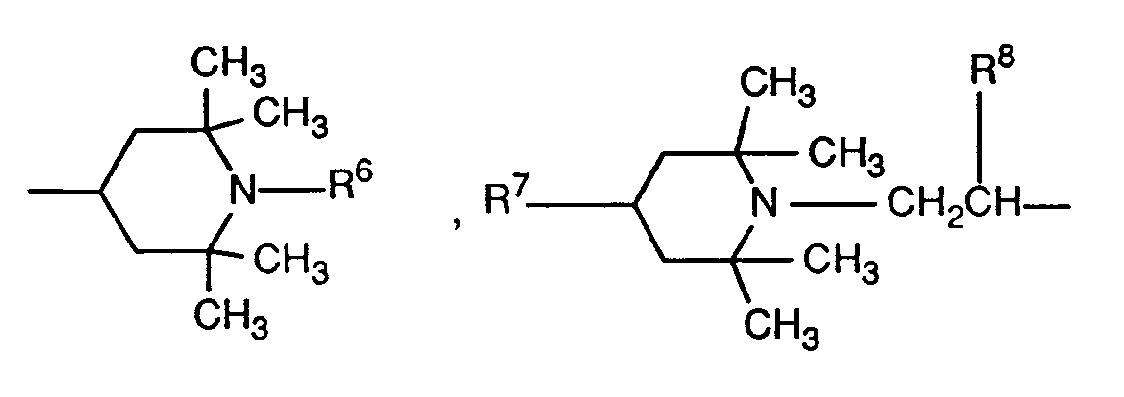



steht,

steht und,

darstellt.
Applications Claiming Priority (2)
| Application Number | Priority Date | Filing Date | Title |
|---|---|---|---|
| CH91391 | 1991-03-26 | ||
| CH913/91 | 1991-03-26 |
Publications (3)
| Publication Number | Publication Date |
|---|---|
| EP0511156A2 true EP0511156A2 (de) | 1992-10-28 |
| EP0511156A3 EP0511156A3 (en) | 1993-01-27 |
| EP0511156B1 EP0511156B1 (de) | 1997-07-09 |
Family
ID=4198094
Family Applications (1)
| Application Number | Title | Priority Date | Filing Date |
|---|---|---|---|
| EP92810195A Expired - Lifetime EP0511156B1 (de) | 1991-03-26 | 1992-03-18 | Unsymmetrische Aryl-phosphite |
Country Status (17)
| Country | Link |
|---|---|
| US (2) | US5322871A (de) |
| EP (1) | EP0511156B1 (de) |
| JP (1) | JP2920445B2 (de) |
| KR (1) | KR100225353B1 (de) |
| CN (1) | CN1040760C (de) |
| AT (1) | ATE155138T1 (de) |
| BR (1) | BR9201040A (de) |
| CA (1) | CA2063852C (de) |
| CZ (1) | CZ289085B6 (de) |
| DE (1) | DE59208672D1 (de) |
| ES (1) | ES2106159T3 (de) |
| MX (1) | MX9201299A (de) |
| RU (1) | RU2071478C1 (de) |
| SG (1) | SG44792A1 (de) |
| SK (1) | SK279131B6 (de) |
| TW (1) | TW198038B (de) |
| ZA (1) | ZA922169B (de) |
Cited By (5)
| Publication number | Priority date | Publication date | Assignee | Title |
|---|---|---|---|---|
| EP0601973A1 (de) * | 1992-12-04 | 1994-06-15 | Ciba-Geigy Ag | Oligomere HALS-Phosphite und HALS-Phosphonite als Stabilisatoren |
| FR2718742A1 (fr) * | 1994-04-13 | 1995-10-20 | Ciba Geigy Ag | Phosphites et phosphoramides de composés stabilisants à la lumière de type amine encombrée utilisables comme stabilisants. |
| FR2720745A1 (fr) * | 1994-06-06 | 1995-12-08 | Ciba Geigy Ag | Composés stabilisants, composition les contenant et leur utilisation pour stabiliser des matières organiques. |
| EP0911339A1 (de) * | 1995-01-27 | 1999-04-28 | E.I. Du Pont De Nemours And Company | Verfahren zur Herstellung von Phosphorochloriditen |
| US6541549B2 (en) | 1999-11-01 | 2003-04-01 | Crompton Corporation | Non-xenoestrogenic stabilizers for organic materials |
Families Citing this family (19)
| Publication number | Priority date | Publication date | Assignee | Title |
|---|---|---|---|---|
| US5616636A (en) * | 1992-03-11 | 1997-04-01 | Sandoz Ltd. | Phosphonite-hals and phosphite-hals compounds as stabilizers |
| TW297822B (de) * | 1994-04-13 | 1997-02-11 | Ciba Geigy Ag | |
| US5532401A (en) * | 1995-01-19 | 1996-07-02 | Dover Chemical Corporation | Process for production of tris(nonylphenyl) phosphite |
| US6031120A (en) * | 1997-07-29 | 2000-02-29 | E. I. Du Pont De Nemours And Company | Selective synthesis of organodiphosphite compounds |
| US6696510B2 (en) | 2001-12-10 | 2004-02-24 | Ticona Llc | Stabilized resin compositions |
| ES2390090T3 (es) * | 2005-07-21 | 2012-11-06 | Basf Se | Estabilizador de poliolefinas con fosfitos de tris-(mono-alquil)fenilo líquidos |
| US20100076131A1 (en) * | 2006-06-20 | 2010-03-25 | Chemtura Corporation | Liquid butylaryl phosphite compositions and alkylate compositions for manufacturing same |
| US8178005B2 (en) * | 2006-06-20 | 2012-05-15 | Chemtura Corporation | Liquid phosphite compositions having different alkyl groups |
| US7947769B2 (en) * | 2006-06-20 | 2011-05-24 | Chemtura Corporation | Liquid amylaryl phosphite compositions and alkylate compositions for manufacturing same |
| US8008384B2 (en) | 2006-06-20 | 2011-08-30 | Chemtura Corporation | Liquid butylaryl phosphite compositions |
| US8183311B2 (en) * | 2006-06-20 | 2012-05-22 | Chemtura Corporation | Liquid phosphite composition derived from cresols |
| US8008383B2 (en) | 2006-06-20 | 2011-08-30 | Chemtura Corporation | Liquid amylaryl phosphite compositions |
| US8188170B2 (en) * | 2006-06-20 | 2012-05-29 | Chemtura Corporation | Polymers with low gel content and enhanced gas-fading |
| US7888414B2 (en) * | 2006-06-20 | 2011-02-15 | Chemtura Corporation | Liquid phosphite blends as stabilizers |
| US20090012853A1 (en) * | 2007-07-03 | 2009-01-08 | Right Media, Inc. | Inferring legitimacy of advertisement calls |
| ES2390411T3 (es) * | 2008-07-11 | 2012-11-12 | Basf Se | Mezclas líquidas de éster bis y tris fosfito con puente de oxialquileno |
| CN108707164A (zh) * | 2018-07-05 | 2018-10-26 | 营口风光新材料股份有限公司 | 一种亚磷酸酯类抗氧剂38的合成方法 |
| CN114478623B (zh) * | 2021-12-29 | 2024-04-09 | 浙江华正新材料股份有限公司 | 抗氧化剂及其制备方法和应用 |
| CN115043875B (zh) * | 2022-05-27 | 2024-03-19 | 山东三丰新材料有限公司 | 一种双亚磷酸酯类抗氧剂及其制备方法 |
Citations (1)
| Publication number | Priority date | Publication date | Assignee | Title |
|---|---|---|---|---|
| DE2950694A1 (de) | 1979-12-17 | 1981-06-25 | Bayer Ag, 5090 Leverkusen | Verfahren zur herstellung neutraler phosphorigsaeurearylester |
Family Cites Families (22)
| Publication number | Priority date | Publication date | Assignee | Title |
|---|---|---|---|---|
| US2866807A (en) * | 1954-04-15 | 1958-12-30 | Virginia Carolina Chem Corp | Aliphatic aryl phosphites |
| US2877259A (en) * | 1954-09-10 | 1959-03-10 | Us Rubber Co | Di-(alkyl)-mono-(alkylphenyl)-phosphites |
| US2841607A (en) * | 1956-05-21 | 1958-07-01 | Shea Chemical Corp | Process of preparing alkanolamine phosphites |
| US3281506A (en) | 1962-08-31 | 1966-10-25 | Hooker Chemical Corp | Secondary phosphites and process for manufacture thereof |
| US3558554A (en) * | 1966-06-09 | 1971-01-26 | Yoshitomi Pharmaceutical | Oxidatively stable polyolefin composition |
| GB1555791A (en) * | 1975-09-29 | 1979-11-14 | Ciba Geigy Ag | Process for the production of phophite cholides |
| JPS6045226B2 (ja) * | 1977-08-12 | 1985-10-08 | アデカ・ア−ガス化学株式会社 | 安定化合成樹脂組成物 |
| JPS5441948A (en) * | 1977-09-08 | 1979-04-03 | Adeka Argus Chem Co Ltd | Improved synthetic resin composition |
| JPS6021627B2 (ja) * | 1977-09-14 | 1985-05-28 | アデカ・ア−ガス化学株式会社 | 安定化された合成樹脂組成物 |
| JPS55747A (en) * | 1978-06-20 | 1980-01-07 | Adeka Argus Chem Co Ltd | Halogen-containing resin composition |
| US4233208A (en) * | 1978-07-12 | 1980-11-11 | Ciba-Geigy Corporation | Polymer compositions stabilized with hindered phenyl secondary phosphites |
| DE2929993A1 (de) * | 1978-07-27 | 1980-02-07 | Ciba Geigy Ag | Neue stabilisatoren |
| US4276233A (en) * | 1978-11-02 | 1981-06-30 | General Electric Company | Hindered phenol phosphites |
| US4444929A (en) * | 1982-11-24 | 1984-04-24 | The B. F. Goodrich Company | Unsymmetrical phosphite-phenolic isocyanurate stabilizer combinations |
| US4584146A (en) * | 1983-10-20 | 1986-04-22 | The B. F. Goodrich Company | Tetrakis(2,6-di-t-butyl-4-substituted phenyl)4,4'-bisphenyl diphosphites |
| US4707509A (en) * | 1984-07-05 | 1987-11-17 | Argus Chemical Corporation | Tris-organophosphite compositions having improved hydrolytic stability |
| US4739000A (en) * | 1986-07-22 | 1988-04-19 | Ethyl Corporation | Antioxidant aromatic tetraphosphites |
| US4814367A (en) * | 1987-07-30 | 1989-03-21 | Argus Chemical Corporation | Stabilizing high density polyethylene containing chromium catalyst residues with 2,2'-ethylidene-bis(4,6-di-t-butylphenol), a solid polyol having five to six carbon atoms, and a tris(alkylaryl) phosphite |
| US5021481A (en) * | 1989-03-21 | 1991-06-04 | Ciba-Geigy Corporation | N-hydrocarbyloxy hindered amine light stabilizers with phosphorus moieties |
| JP2592677B2 (ja) * | 1989-06-22 | 1997-03-19 | 富士写真フイルム株式会社 | ハロゲン化銀カラー写真感光材料 |
| US5254709A (en) * | 1989-12-08 | 1993-10-19 | Uniroyal Chemical Company, Inc. | Method for preparing stearically hindered aryl phosphites |
| GB9205308D0 (en) * | 1992-03-11 | 1992-04-22 | Sandoz Ltd | Improvements in or relating to organic compounds |
-
1992
- 1992-01-31 RU SU925010860A patent/RU2071478C1/ru active
- 1992-03-18 SG SG1996007689A patent/SG44792A1/en unknown
- 1992-03-18 DE DE59208672T patent/DE59208672D1/de not_active Expired - Lifetime
- 1992-03-18 ES ES92810195T patent/ES2106159T3/es not_active Expired - Lifetime
- 1992-03-18 EP EP92810195A patent/EP0511156B1/de not_active Expired - Lifetime
- 1992-03-18 AT AT92810195T patent/ATE155138T1/de not_active IP Right Cessation
- 1992-03-24 CZ CS1992888A patent/CZ289085B6/cs not_active IP Right Cessation
- 1992-03-24 MX MX9201299A patent/MX9201299A/es unknown
- 1992-03-24 CA CA002063852A patent/CA2063852C/en not_active Expired - Lifetime
- 1992-03-24 SK SK888-92A patent/SK279131B6/sk unknown
- 1992-03-25 BR BR929201040A patent/BR9201040A/pt not_active IP Right Cessation
- 1992-03-25 ZA ZA922169A patent/ZA922169B/xx unknown
- 1992-03-25 CN CN92102037A patent/CN1040760C/zh not_active Expired - Fee Related
- 1992-03-25 KR KR1019920004945A patent/KR100225353B1/ko not_active Expired - Fee Related
- 1992-03-25 JP JP4098956A patent/JP2920445B2/ja not_active Expired - Fee Related
- 1992-03-27 TW TW081102352A patent/TW198038B/zh not_active IP Right Cessation
-
1993
- 1993-04-20 US US08/049,647 patent/US5322871A/en not_active Expired - Lifetime
-
1994
- 1994-03-11 US US08/212,756 patent/US5401845A/en not_active Expired - Lifetime
Patent Citations (1)
| Publication number | Priority date | Publication date | Assignee | Title |
|---|---|---|---|---|
| DE2950694A1 (de) | 1979-12-17 | 1981-06-25 | Bayer Ag, 5090 Leverkusen | Verfahren zur herstellung neutraler phosphorigsaeurearylester |
Cited By (12)
| Publication number | Priority date | Publication date | Assignee | Title |
|---|---|---|---|---|
| EP0601973A1 (de) * | 1992-12-04 | 1994-06-15 | Ciba-Geigy Ag | Oligomere HALS-Phosphite und HALS-Phosphonite als Stabilisatoren |
| US5405891A (en) * | 1992-12-04 | 1995-04-11 | Ciba-Geigy Corporation | Oligomeric HALS phosphites and HALS phosphonites as stabilisers |
| FR2718742A1 (fr) * | 1994-04-13 | 1995-10-20 | Ciba Geigy Ag | Phosphites et phosphoramides de composés stabilisants à la lumière de type amine encombrée utilisables comme stabilisants. |
| NL1000133C2 (nl) * | 1994-04-13 | 1996-05-13 | Ciba Geigy | HALS-fosfieten en HALS-fosforamiden als stabiliseermiddelen. |
| BE1008991A3 (fr) * | 1994-04-13 | 1996-10-01 | Ciba Geigy Ag | Phosphites et phosphoramides de composes stabilisants a la lumiere de type amine encombree utilisables comme stabilisants. |
| FR2720745A1 (fr) * | 1994-06-06 | 1995-12-08 | Ciba Geigy Ag | Composés stabilisants, composition les contenant et leur utilisation pour stabiliser des matières organiques. |
| GB2290083A (en) * | 1994-06-06 | 1995-12-13 | Ciba Geigy Ag | Alkanolamine esters of acyclic phosphites |
| GB2290083B (en) * | 1994-06-06 | 1998-04-15 | Ciba Geigy Ag | Alkanolamine esters of acyclic phosphites |
| EP0911339A1 (de) * | 1995-01-27 | 1999-04-28 | E.I. Du Pont De Nemours And Company | Verfahren zur Herstellung von Phosphorochloriditen |
| US6541549B2 (en) | 1999-11-01 | 2003-04-01 | Crompton Corporation | Non-xenoestrogenic stabilizers for organic materials |
| US6858662B2 (en) | 1999-11-01 | 2005-02-22 | Crompton Corporation | Non-xenoestrogenic stabilizers for organic materials |
| US7199170B2 (en) | 1999-11-01 | 2007-04-03 | Crompton Corporation | Non-xenoestrogenic stabilizers for organic materials |
Also Published As
| Publication number | Publication date |
|---|---|
| DE59208672D1 (de) | 1997-08-14 |
| CA2063852C (en) | 2002-10-08 |
| SK279131B6 (sk) | 1998-07-08 |
| CA2063852A1 (en) | 1992-09-27 |
| RU2071478C1 (ru) | 1997-01-10 |
| US5322871A (en) | 1994-06-21 |
| ES2106159T3 (es) | 1997-11-01 |
| TW198038B (de) | 1993-01-11 |
| KR920018064A (ko) | 1992-10-21 |
| CS88892A3 (en) | 1992-10-14 |
| EP0511156A3 (en) | 1993-01-27 |
| KR100225353B1 (ko) | 1999-10-15 |
| CN1040760C (zh) | 1998-11-18 |
| ZA922169B (en) | 1992-11-25 |
| US5401845A (en) | 1995-03-28 |
| EP0511156B1 (de) | 1997-07-09 |
| MX9201299A (es) | 1992-10-01 |
| BR9201040A (pt) | 1992-11-24 |
| CZ289085B6 (cs) | 2001-10-17 |
| SG44792A1 (en) | 1997-12-19 |
| ATE155138T1 (de) | 1997-07-15 |
| JP2920445B2 (ja) | 1999-07-19 |
| HK1001090A1 (en) | 1998-05-22 |
| CN1065273A (zh) | 1992-10-14 |
| JPH05117285A (ja) | 1993-05-14 |
Similar Documents
| Publication | Publication Date | Title |
|---|---|---|
| EP0511156B1 (de) | Unsymmetrische Aryl-phosphite | |
| EP0250367A2 (de) | Neue Stabilisatoren für organische Polymere | |
| EP0224442A1 (de) | Substituierte Phenole als Stabilisatoren | |
| EP0186628B1 (de) | Pentaerythritdiphosphite, Verfahren zu deren Herstellung und deren Verwendung als Stabilisatoren | |
| DE3713375A1 (de) | 1,3,2-oxazaphospholidin-stabilisatoren | |
| EP0244362B1 (de) | Mit Aminoxysilanen stabilisierte Zusammensetzungen | |
| DE3877508T2 (de) | Aliphatische ester 1,3,2-oxazaphospholidinen. | |
| EP0140297A2 (de) | Thiocarbamat Stabilisatoren | |
| EP0246189A2 (de) | Mit Aminoxyalkylaminen stabilisierte Zusammensetzungen | |
| EP0406169A1 (de) | 2,4-Dimethyl-6-s-alkylphenole | |
| EP0366040B1 (de) | Phenolgruppenhaltige Verbindungen als Antioxidantien in organischen Materialien | |
| EP0594539A1 (de) | Phenylphosphite als Stabilisatoren für organische Materialien | |
| EP0466640A1 (de) | Alpha-Carbonylphenylacetonitrilderivate als Stabilisatoren für organische Materialien | |
| EP0421932A1 (de) | Stabilisiertes organisches Material | |
| EP0244355B1 (de) | Mit substituierten Aminocarbamaten stabilisierte Zusammensetzungen und neue substituierte Aminocarbamate | |
| EP0497735A1 (de) | Hydrochinolinverbindungen | |
| EP0553059B1 (de) | Neue Cycloalkyliden-bisphenol-phosphite | |
| EP0252003B1 (de) | Substituierte Aminoxysuccinate und deren Verwendung als Stabilisatoren | |
| EP0240463B1 (de) | Substituierte Aminoxypropionamide | |
| EP0473549B1 (de) | Sulfoxide von Alkylthiomethylphenolen | |
| EP0421928B1 (de) | Hydroxyphenylcarbonsäureester als Stabilisatoren | |
| EP0246190B1 (de) | Isocyanursäurederivate | |
| EP0514332B1 (de) | Bisphosphite | |
| DE3541234A1 (de) | Substituierte (4-hydroxyphenylthioalkyl)-derivate | |
| EP0249577A2 (de) | Langketten-(4-Hydroxyphenyl)propionat-Derivate als Stabilisatoren |
Legal Events
| Date | Code | Title | Description |
|---|---|---|---|
| PUAI | Public reference made under article 153(3) epc to a published international application that has entered the european phase |
Free format text: ORIGINAL CODE: 0009012 |
|
| AK | Designated contracting states |
Kind code of ref document: A2 Designated state(s): AT BE DE ES FR GB IT NL SE |
|
| PUAL | Search report despatched |
Free format text: ORIGINAL CODE: 0009013 |
|
| AK | Designated contracting states |
Kind code of ref document: A3 Designated state(s): AT BE DE ES FR GB IT NL SE |
|
| 17P | Request for examination filed |
Effective date: 19930624 |
|
| 17Q | First examination report despatched |
Effective date: 19950908 |
|
| GRAG | Despatch of communication of intention to grant |
Free format text: ORIGINAL CODE: EPIDOS AGRA |
|
| RAP1 | Party data changed (applicant data changed or rights of an application transferred) |
Owner name: CIBA SC HOLDING AG |
|
| GRAH | Despatch of communication of intention to grant a patent |
Free format text: ORIGINAL CODE: EPIDOS IGRA |
|
| RAP3 | Party data changed (applicant data changed or rights of an application transferred) |
Owner name: CIBA SPECIALTY CHEMICALS HOLDING INC. |
|
| GRAH | Despatch of communication of intention to grant a patent |
Free format text: ORIGINAL CODE: EPIDOS IGRA |
|
| GRAA | (expected) grant |
Free format text: ORIGINAL CODE: 0009210 |
|
| AK | Designated contracting states |
Kind code of ref document: B1 Designated state(s): AT BE DE ES FR GB IT NL SE |
|
| REF | Corresponds to: |
Ref document number: 155138 Country of ref document: AT Date of ref document: 19970715 Kind code of ref document: T |
|
| REF | Corresponds to: |
Ref document number: 59208672 Country of ref document: DE Date of ref document: 19970814 |
|
| ITF | It: translation for a ep patent filed | ||
| GBT | Gb: translation of ep patent filed (gb section 77(6)(a)/1977) |
Effective date: 19971008 |
|
| ET | Fr: translation filed | ||
| REG | Reference to a national code |
Ref country code: ES Ref legal event code: FG2A Ref document number: 2106159 Country of ref document: ES Kind code of ref document: T3 |
|
| PLBE | No opposition filed within time limit |
Free format text: ORIGINAL CODE: 0009261 |
|
| 26N | No opposition filed | ||
| REG | Reference to a national code |
Ref country code: GB Ref legal event code: IF02 |
|
| PGFP | Annual fee paid to national office [announced via postgrant information from national office to epo] |
Ref country code: AT Payment date: 20020327 Year of fee payment: 11 |
|
| PG25 | Lapsed in a contracting state [announced via postgrant information from national office to epo] |
Ref country code: AT Free format text: LAPSE BECAUSE OF NON-PAYMENT OF DUE FEES Effective date: 20030318 |
|
| PGFP | Annual fee paid to national office [announced via postgrant information from national office to epo] |
Ref country code: SE Payment date: 20080221 Year of fee payment: 17 |
|
| EUG | Se: european patent has lapsed | ||
| PGFP | Annual fee paid to national office [announced via postgrant information from national office to epo] |
Ref country code: GB Payment date: 20100330 Year of fee payment: 19 |
|
| PGFP | Annual fee paid to national office [announced via postgrant information from national office to epo] |
Ref country code: FR Payment date: 20100419 Year of fee payment: 19 Ref country code: ES Payment date: 20100409 Year of fee payment: 19 |
|
| PGFP | Annual fee paid to national office [announced via postgrant information from national office to epo] |
Ref country code: NL Payment date: 20100325 Year of fee payment: 19 Ref country code: IT Payment date: 20100330 Year of fee payment: 19 Ref country code: DE Payment date: 20100531 Year of fee payment: 19 |
|
| PGFP | Annual fee paid to national office [announced via postgrant information from national office to epo] |
Ref country code: BE Payment date: 20100519 Year of fee payment: 19 |
|
| PG25 | Lapsed in a contracting state [announced via postgrant information from national office to epo] |
Ref country code: SE Free format text: LAPSE BECAUSE OF NON-PAYMENT OF DUE FEES Effective date: 20090319 |
|
| BERE | Be: lapsed |
Owner name: *CIBA SPECIALTY CHEMICALS HOLDING INC. Effective date: 20110331 |
|
| REG | Reference to a national code |
Ref country code: NL Ref legal event code: V1 Effective date: 20111001 |
|
| GBPC | Gb: european patent ceased through non-payment of renewal fee |
Effective date: 20110318 |
|
| REG | Reference to a national code |
Ref country code: FR Ref legal event code: ST Effective date: 20111130 |
|
| PG25 | Lapsed in a contracting state [announced via postgrant information from national office to epo] |
Ref country code: BE Free format text: LAPSE BECAUSE OF NON-PAYMENT OF DUE FEES Effective date: 20110331 |
|
| PG25 | Lapsed in a contracting state [announced via postgrant information from national office to epo] |
Ref country code: DE Free format text: LAPSE BECAUSE OF NON-PAYMENT OF DUE FEES Effective date: 20111001 Ref country code: FR Free format text: LAPSE BECAUSE OF NON-PAYMENT OF DUE FEES Effective date: 20110331 Ref country code: NL Free format text: LAPSE BECAUSE OF NON-PAYMENT OF DUE FEES Effective date: 20111001 |
|
| REG | Reference to a national code |
Ref country code: DE Ref legal event code: R119 Ref document number: 59208672 Country of ref document: DE Effective date: 20111001 |
|
| PG25 | Lapsed in a contracting state [announced via postgrant information from national office to epo] |
Ref country code: IT Free format text: LAPSE BECAUSE OF NON-PAYMENT OF DUE FEES Effective date: 20110318 Ref country code: GB Free format text: LAPSE BECAUSE OF NON-PAYMENT OF DUE FEES Effective date: 20110318 |
|
| REG | Reference to a national code |
Ref country code: ES Ref legal event code: FD2A Effective date: 20120424 |
|
| PG25 | Lapsed in a contracting state [announced via postgrant information from national office to epo] |
Ref country code: ES Free format text: LAPSE BECAUSE OF NON-PAYMENT OF DUE FEES Effective date: 20110319 |