EP0186628B1 - Pentaerythritdiphosphite, Verfahren zu deren Herstellung und deren Verwendung als Stabilisatoren - Google Patents
Pentaerythritdiphosphite, Verfahren zu deren Herstellung und deren Verwendung als Stabilisatoren Download PDFInfo
- Publication number
- EP0186628B1 EP0186628B1 EP19850810606 EP85810606A EP0186628B1 EP 0186628 B1 EP0186628 B1 EP 0186628B1 EP 19850810606 EP19850810606 EP 19850810606 EP 85810606 A EP85810606 A EP 85810606A EP 0186628 B1 EP0186628 B1 EP 0186628B1
- Authority
- EP
- European Patent Office
- Prior art keywords
- tert
- butyl
- alkyl
- bis
- carbon atoms
- Prior art date
- Legal status (The legal status is an assumption and is not a legal conclusion. Google has not performed a legal analysis and makes no representation as to the accuracy of the status listed.)
- Expired
Links
Classifications
-
- C—CHEMISTRY; METALLURGY
- C07—ORGANIC CHEMISTRY
- C07F—ACYCLIC, CARBOCYCLIC OR HETEROCYCLIC COMPOUNDS CONTAINING ELEMENTS OTHER THAN CARBON, HYDROGEN, HALOGEN, OXYGEN, NITROGEN, SULFUR, SELENIUM OR TELLURIUM
- C07F9/00—Compounds containing elements of Groups 5 or 15 of the Periodic Table
- C07F9/02—Phosphorus compounds
- C07F9/547—Heterocyclic compounds, e.g. containing phosphorus as a ring hetero atom
- C07F9/6564—Heterocyclic compounds, e.g. containing phosphorus as a ring hetero atom having phosphorus atoms, with or without nitrogen, oxygen, sulfur, selenium or tellurium atoms, as ring hetero atoms
- C07F9/6571—Heterocyclic compounds, e.g. containing phosphorus as a ring hetero atom having phosphorus atoms, with or without nitrogen, oxygen, sulfur, selenium or tellurium atoms, as ring hetero atoms having phosphorus and oxygen atoms as the only ring hetero atoms
- C07F9/6574—Esters of oxyacids of phosphorus
- C07F9/65746—Esters of oxyacids of phosphorus the molecule containing more than one cyclic phosphorus atom
-
- C—CHEMISTRY; METALLURGY
- C08—ORGANIC MACROMOLECULAR COMPOUNDS; THEIR PREPARATION OR CHEMICAL WORKING-UP; COMPOSITIONS BASED THEREON
- C08K—Use of inorganic or non-macromolecular organic substances as compounding ingredients
- C08K5/00—Use of organic ingredients
- C08K5/49—Phosphorus-containing compounds
- C08K5/51—Phosphorus bound to oxygen
- C08K5/52—Phosphorus bound to oxygen only
- C08K5/527—Cyclic esters
-
- C—CHEMISTRY; METALLURGY
- C09—DYES; PAINTS; POLISHES; NATURAL RESINS; ADHESIVES; COMPOSITIONS NOT OTHERWISE PROVIDED FOR; APPLICATIONS OF MATERIALS NOT OTHERWISE PROVIDED FOR
- C09K—MATERIALS FOR MISCELLANEOUS APPLICATIONS, NOT PROVIDED FOR ELSEWHERE
- C09K15/00—Anti-oxidant compositions; Compositions inhibiting chemical change
- C09K15/04—Anti-oxidant compositions; Compositions inhibiting chemical change containing organic compounds
- C09K15/32—Anti-oxidant compositions; Compositions inhibiting chemical change containing organic compounds containing two or more of boron, silicon, phosphorus, selenium, tellurium or a metal
- C09K15/322—Anti-oxidant compositions; Compositions inhibiting chemical change containing organic compounds containing two or more of boron, silicon, phosphorus, selenium, tellurium or a metal containing only phosphorus
Definitions
- Polymeric organic materials such as plastics and resins are subject to thermal, oxidative and light degradation.
- stabilizers are known from the prior art for stabilizing a number of substrates. Their effectiveness varies depending on the causes of the degradation and the stabilized substrate. In general, it is difficult to predict which stabilizer will be the most effective and economical for a particular application. For example, the effectiveness of a stabilizer in reducing volatility may depend on whether bond cleavage in the substrate molecule is prevented. Reducing embrittlement and maintaining elasticity in a polymer may make it necessary to prevent excessive crosslinking and / or chain splitting. To prevent discoloration, it may be necessary to inhibit reactions that provide new chromophores or color bodies in the substrate or stabilizer. Processing stability and incompatibility issues should also be considered.
- the primary object of this invention is to find and provide a selected class of bis (ester-phenyl) pentaerythritol diphosphites which have a wide range of stabilizing properties.
- Yet another object is to develop an economical and effective process for the preparation of pentaerythritol diphosphites, including the compounds according to the invention.
- the bis (ester-phenyl) pentaerythritol diphosphites with either C 1 or Ct 2 ds ester substituents have a number of desirable properties which make them particularly effective and useful stabilizers in a wide variety of substrates. Above all, these compounds have an excellent activity as an antioxidant in various substrates, give a longer duration of action in their longer presence in the substrate and have increased resistance to hydrolysis. The latter property is particularly important in view of the hot and humid storage conditions to which commercial chemical compounds are often subject. From these points of view in particular, the compounds according to the invention show improved properties compared to the monoesters disclosed in US Pat. No. 4,180,498.
- R 1 and R 2 independently of one another are alkyl having 1 to 8 carbon atoms, Rs A-COOR 4 , A is a direct bond, methylene or ethylene and R 4 is methyl or alkyl having 12 to 18 carbon atoms.
- the groups R 1 and R 2 are preferably straight-chain or branched alkyl having 4 to 8 carbon atoms, such as n-butyl, sec-butyl, tert-butyl, tert-pentyl, 2-ethylhexyl, n-octyl and tert. -Octyl.
- the groups tert-butyl, tert-pentyl and tert-octyl are particularly preferred.
- A is preferably ethylene and R 4 is methyl, or dodecyl or octadecyl.
- the compounds according to the invention are preferably prepared by reacting the corresponding 2,6-disubstituted phenol with 3,9-dichloro-2,4,8,10-tetraoxa-3,9-diphosphaspiro [5,5] undecan .
- this process gives only moderate yields, even if the phenol is reacted as the phenolate anion in the presence of a polar aprotic solvent such as tetrahydrofuran.
- a polar aprotic solvent such as tetrahydrofuran.
- higher activity is required if the phenolic groups are strongly hindered by two ortho-alkyl groups such as tertiary alkyl groups.
- Another object of this invention is accordingly an improved production method for pentaerythritol diphosphites in general and the present diphosphites in particular, the above reactants being reacted in the presence of at least a catalytically effective amount of a mono- or polyalkylene glycol ether catalyst which increases the reactivity of the phenolate anion and complexes with counterions forms.
- reaction can be seen by the equation represent in which Z represents alkyl, alkenyl, cycloalkyl, aryl alkylaryl, aralkyl or alkanoyl-substituted aryl, these groups in each case optionally being substituted by hydroxyl, alkoxy or halogen, and M denotes hydrogen or an alkali or alkaline earth metal, an alkali metal being preferred .
- Z-OM preferably means wherein R 1 and R 2 independently of one another are alkyl having 1 to 8 carbon atoms, Rs-A-COOR4, A is a direct bond, methylene or ethylene and R 4 is methyl or alkyl having 12 to 18 carbon atoms.
- Aryl is preferably phenyl or naphthyl, especially phenyl.
- Alkyl groups have, for example, 1 to 22, in particular 1-18, carbon atoms, alkenyl groups, for example, 2-18, carbon atoms.
- Preferred aralkyl is benzyl.
- alkanoyl groups are those of the formula -A-COOR 4 .
- Alkoxy is, for example, C i -Ca, in particular GC 4 alkoxy.
- Typical addition to the novel compounds can be produced include Diphenylpentaerythritdiphosphit, di-p-tolylpentaerythritdipliosphit, Methylstearylpentaerythritdiphosphit, di-2,4-xylenylpentaerythritdiphosphit, di-t-butylphenyl pentaerythrityl diphosphite, Methyloleylpentaerythritdiphosphit, Dimethylpentaerythritdiphosphit, Diäthylpentaerythritdiphosphit, phenyl-p-nonylphenylpentaerythritdiphosphit, Dihexylpentaerythritdiphosphit, Dicyclohexylpentaerythritdiphosphit, phenyl-o-dodecylphenylpentaerythritdiphosphit
- the preparation of the dichloro reaction partner is known from the prior art and generally takes place by reacting pentaerythritol and phosphorus trichloride in a molar ratio of 1: 2 to 1: 3 in the presence of an inert nonpolar solvent and, if appropriate, an amide catalyst.
- Typical solvents include aromatic hydrocarbons such as benzene, toluene, xylene and the like, while dimethylformamide, dimethylacetamide and 1-methyl-2-pyrrolidone are examples of typical amides.
- the process according to the invention is carried out, for example, in such a way that a solution of the Z-OM reactant is formed, a strong base and the mono- or polyalkylene glycol ether are added, the solution is kept at room temperature or at most heated to a temperature of 40-60.degree Dichlorpentaerythritol diphosphite is generally added in dissolved form (isolation of the material is unnecessary), the reaction is carried out at a temperature of about 25 to 50 ° C. for a period of generally about 1 to 16 hours and the product is isolated.
- the reactants are generally in approximately stoichiometric amounts.
- the glycol ether catalyst is expediently used in amounts in the range from 1 to 30 mol%, based on the phenol reactant, and preferably 5 to 20 mol%.
- Suitable catalysts are, for example, mono- and polyalkylene glycol ethers which have the formula correspond in which Rs, Rs and R 7 independently of one another are hydrogen or alkyl having 1 to 8 carbon atoms, with the proviso that at most one of the symbols R s and R 7 is hydrogen, and n is 0, 1 or 2 and m is a number from 1 to 9, preferably 2 to 5.
- Suitable mono- and polyalkylene glycol ethers are, for example, ethylene glycol monoethyl ether, ethylene glycol dimethyl ether, diethylene glycol diethyl ether, triethylene glycol dibutyl ether, tripropylene glycol dimethyl ether, tetraethylene glycol dimethyl ether, tetraethylene glycol ether and pentiethyl ethyl ether.
- ethylene glycol monoethyl ether ethylene glycol dimethyl ether
- diethylene glycol diethyl ether diethylene glycol diethyl ether
- triethylene glycol dibutyl ether triethylene glycol dibutyl ether
- tripropylene glycol dimethyl ether tetraethylene glycol dimethyl ether
- tetraethylene glycol dimethyl ether tetraethylene glycol ether
- pentiethyl ethyl ether pentiethyl ethyl ether.
- solvents examples include aromatic hydrocarbons such as benzene, toluene, xylene and the like or heterocyclic ethers such as tetrahydrofuran in question.
- Compounds according to the invention are particularly effective for stabilizing organic materials such as plastics, polymers and resins as well as mineral and synthetic liquids such as lubricating oils, circulating oils, etc.
- Substrates in which the compounds according to the invention are particularly useful include polyolefins such as polyethylene and polypropylene, polystyrene, in particular including impact-resistant polystyrene, ABS resin and elastomers such as butadiene rubber, EPM, EPDM, SBR and nitrile rubber.
- the stabilizers according to the invention are used in amounts of about 0.01 to about 5% by weight of the stabilized composition, but this varies depending on the particular substrate and the intended use.
- An advantageous range extends from approximately 0.5 to approximately 2% and in particular from 0.1 to approximately 1%.
- the stabilizers according to the invention can easily be incorporated into the organic polymers by conventional methods in any expedient stage before the production of molded articles therefrom.
- the stabilizer can be mixed with the polymer in dry powder form, or a suspension or emulsion of the stabilizer can be mixed with a solution, suspension or emulsion of the polymer.
- the stabilized polymer compositions of the present invention may also contain various conventional additives such as the following.
- Alkalized monophenols such as 2,6-di-tert-butyl-4-methylphenol, 2-tert-butyl-4,6-dimethylphenol, 2,6-di-tert-butyl-4-ethylphenol, 2, 6-di-tert-butyl-4-n-butyl-phenol, 2,6-di-tert-butyl-4-isobutylphenol, 2,6-di-cyclopentyl-4-methylphenol, 2- (a-methylcyclohexyl ) -4,6-dimethylphenol, 2,6-dioctadecyl-4-methylphenol, 2,4,6-tricyclohexylphenol and 2,6-di-tert-butyl-4-methoxymethylphenol.
- Alkylated hydroquinones such as 2,6-di-tert: butyl-4-methoxyphenol, 2,5-di-tert: butylhydroquinone, 2,5-di-tert.-amyl-hydroquinone and 2,6-diphenyl-4- octadecyloxyphenol.
- Alkylidene bisphenols such as, for example, 2,2'-methylene-bis- (6-tert-butyl-4-methylphenol), 2,2'-methylene-bis- (6-tert-butyl-4-ethylphenol), 2,2'-methylene-bis- [4-methyl-6- (a-methylcyclohexyl) phenol], 2,2'-methylene-bis- (4-methyl-6-cyclohexylphenol), 2,2'-methylene -bis- (6-nonyl-4-methylphenol), 2,2'-methylene-bis- [6- (a-methylbenzyl) -4-nonylphenol], 2,2'-methylene-bis- [6- (a, a-dimethylbenzyl) -4-nonylphenol], 2,2'-methylene-bis- (4,6-di-tert-butylphenol), 2,2'-ethylidene-bis- (4,6-di -tert-butylphenol), 2,2'-e
- Benzyl compounds such as 1,3,5-tri- (3,5-di-tert-butyl-4-hydroxybenzyl) -2,4,6-trimethylbenzene, di- (3,5-di-tert-butyl -4-hydroxybenzyl) sulfide, 3,5-di-tert-butyl-4-hydroxybenzylmercapto-acetic acid isooctyl ester, bis- (4-tert-butyl-3-hydroxy-2,6-dimethylbenzyl) dithiol terephthalate, 1.3 , 5-tris (3,5-di-tert-butyl-4-hydroxybenzyl) isocyanurate, 1,3,5-tris (4-tert-butyl-3-hydroxy-2,6-dimethylbenzyl) - isocyanurate, 3,5-di-tert-butyl-4-hydroxybenzylphosphonic acid dioctadecyl ester and the calcium salt of 3,5-di-tert
- esters of ⁇ - (3,5-di-tert: butvl-4-hvdroxyohenyl-propionic acid with monohydric or polyhydric alcohols such as, for example, with methanol, octadecanol, 1,6-hexanediol, neopentyl glycol, thiodiethylene glycol, diethylene glycol, triethylene glycol, pentaerythritol, tris-hydroxyethyl and dihydroxyethyl oxalic acid diamide.
- esters of ⁇ - (5-tert-butyl-4-hydroxy-3-methylhenyl) propionic acid with monohydric or polyhydric alcohols such as, for example, methanol, octadecanol, 1,6-hexanediol, neopentyl glycol, thiodiethylene glycol, diethylene glycol, triethylene glycol, pentaerythritol, Trishydroxyethyl isocyanurate and Dihydroxyäthyloxalklad.
- 2-Hvdroxv-benzoDhenone such as the 4-hydroxy, 4-methoxy, 4-octoxy, 4-decyloxy, 4-dodecyloxy, 4-benzyloxy, 4,2 ', 4'-trihydroxy and 2'-hydroxy-4,4'-dimethoxy derivative.
- Esters of also substituted benzoic acids such as phenyl salicylate, 4-tert-butyl-phenyl salicylate, octylphenyl salicylate, dibenzoyl resorcinol, bis (4-tert-butyl-benzoyl) resorcinol, benzoyl resorcinol, 3,5-di-tert-butyl 2-4-hydroxybenzoic acid, 4-di-tert-butyl-phenyl ester and 3,5-di-tert-butyl-4-hydroxybenzoic acid hexadecyl ester.
- benzoic acids such as phenyl salicylate, 4-tert-butyl-phenyl salicylate, octylphenyl salicylate, dibenzoyl resorcinol, bis (4-tert-butyl-benzoyl) resorcinol, benzoyl resorcinol, 3,5-di-ter
- Acrylates such as, for example, a-cyan-ß, ß-diphenylacrylic acid ethyl ester or isooctyl ester, a-carbomethoxycinnamic acid methyl ester, a-cyan-ß-methyl-p-methoxycinnamic acid methyl ester or -butyl ester, a-carbomethoxy-p-methoxycinnamic acid methyl methoxy ester -ß-cyanvinyl) -2-methylindoline.
- Nickel compounds such as, for example, nickel complexes of 2,2'-thio-bis- [4- (1,1,3,3-tetramethylbutyl) phenol] such as the 1: 1 or 1: 2 complex, optionally with further ligands such as n -Butylamine, triethanolamine or N-cyclohexyl-diethanolamine, nickel-dibutyldithiocarbamate, nickel salts of 4-hydroxy-3,5-di-tert-butylbenzylphosphonic acid monoalkyl esters such as the methyl, ethyl or butyl ester, nickel complexes of ketoximes 4 such as 2-hydroxy -methylphenyl-undecylketoxime and nickel complexes of 1-phenyl-4-lauroyl-5-hydroxypyrazole, optionally with further ligands.
- nickel complexes of 2,2'-thio-bis- [4- (1,1,3,3-tetramethylbutyl) phenol] such as
- Sterically hindered amines such as bis (2, 2,6,6-tetramethylpiperidyl) sebacinate, bis (1,2,2,6,6-pentamethylpiperidyl) sebacinate, n-butyl-3,5-di- tert-butyl-4-hydroxybenzylmalonic acid bis (1,2,2,6,6-pentamethylpiperidyl) ester, the condensation products of 1-hydroxyethyl-2,2,6,6-tetramethyl-4-hydroxypiperidine with succinic acid and des N, N '- (2,2,6,6-tetramethylpiperidyl) hexamethylene diamine with 4-tert-octylamino-2,6-dichloro-1,3,5-s-triazine, tris- (2, 2,6,6-tetramethylpiperidyl) nitrilotriacetate, tetrakis (2,2,6,6-tetramethyl-4-piperidyl) -1,2,3,4-
- Oxalic acid diamides such as 4,4'-dioctyloxy oxanilide, 2,2'-dioctyloxy-5,5'-di-tert-butyl-oxanilide, 2,2'-didodecyloxy-5,5'-di-tert.- butyl-oxanilide, 2-ethoxy-2'-ethyl-oxanilide, N, N'-bis (3-dimethyl-aminopropyl) -oxalamide, 2-ethoxy-5-tert-butyl-2'-ethyl-oxanilide and its mixture with 2-ethoxy-2'-ethyl-5,4'-di-tert-butyl-oxanilide and mixtures of o- and p-methoxy- and o- and p-ethoxy-disubstituted oxanilides.
- Metal deactivators such as N, N'-diphenyloxalic acid diamide, N-salicylal-N'-salicylolhydrazine, N, N'-bis-salicyloylhydrazine, N, N'-bis- (3,5-di-tert-butyl -4-hydroxyphenylpropionyl) hydrazine, 3-salicyloylamino-1,2,4-triazole, bis-benzylidene oxalic acid dihydrazide.
- phosphites and phosphonites such as triphenyl phosphite, diphenyl alkyl phosphite, phenyl dialkyl phosphite, tri (nonylphenyl) phosphite, trilauryl phosphite, trioctadecyl phosphite, distearyl pentaerythritol diphosphite, tris (2,4-di-tert.-butylphenyl) -phosphite Di- (2,4-di-tert-butylphenyl) pentaerythritol diphosphite, tristearyl sorbitol triphosphite and tetrakis (2,4-di-tert-butylphenyl) -4,4'-diphenylene diphosphonite.
- Peroxvd-destroying compounds such as, for example, esters of ⁇ -thiodipropionic acid, such as, for example, the lauryl, stearyl, myristyl or tridecyl esters, mercaptobenzimidazole or the zinc salt of 2-mercaptobenzimidazole, zinc-dibutyl-dithio-carbamate, dioctadetacyl disulfide and dioctadecyl disulfide -ß-dodecyimercapto) propionate.
- esters of ⁇ -thiodipropionic acid such as, for example, the lauryl, stearyl, myristyl or tridecyl esters, mercaptobenzimidazole or the zinc salt of 2-mercaptobenzimidazole, zinc-dibutyl-dithio-carbamate, dioctadetacyl disulfide and dioctadecyl
- Polyamide stabilizers such as copper salts combined with iodides and / or phosphorus compounds and divalent manganese salts.
- Basic costabilizers such as melamine, polyvinylpyrrolidone, dicyandiamide, triallyl cyanurate, urea derivatives, hydrazine derivatives, amines, polyamides, polyurethanes and alkali and alkaline earth metal salts of higher fatty acids such as Ca stearate, Zn stearate, Mg stearate, Na ricinoleate and K-palmitate and antimony or zinc catecholate.
- Basic costabilizers such as melamine, polyvinylpyrrolidone, dicyandiamide, triallyl cyanurate, urea derivatives, hydrazine derivatives, amines, polyamides, polyurethanes and alkali and alkaline earth metal salts of higher fatty acids such as Ca stearate, Zn stearate, Mg stearate, Na ricinoleate and K-palmitate and antimony or zinc catecholate.
- Nucleating agents such as 4-tert-butylbenzoic acid, adipic acid or diphenylacetic acid.
- Fillers and reinforcing agents such as calcium carbonate, silicates, glass fibers, asbestos, talc, kaolin, mica, barium sulfate, metal oxides and hydroxides, carbon black and graphite.
- additives such as plasticizers, lubricants, emulsifiers, pigments, optical brighteners, flame retardants, antistatic agents, blowing agents and thiosynergists such as dilauryl thio dipropionate or distearyl thio dipropionate.
- the intermediate (A) is added dropwise to the intermediate (B) at 5-10 ° C. over the course of 20 minutes.
- the mixture is stirred for two hours at room temperature, acidified with 1.6 g of acetic acid and washed three times with 50 ml of cold water.
- the deposited organic layer is dried with sodium sulfate and the isolated residue is dissolved in 400 ml of isopropanol and allowed to crystallize in an ice water bath.
- the crystal slurry is filtered and the filter cake is washed with cold isopropanol. After drying for 4 hours at 50-60 ° C and 5-10 mm Hg, 45 g of white crystalline powder with a melting point of 86-89 ° C are obtained.
- Example 2 The procedure is as described in Example 1, but using the 3,5-di-tert-butyl-4-hydroxyhydrocinnamic acid methyl ester instead of the octadecyl analogue in Example 1.
- the product from Example 2 is white, melting at 235 to 240 ° C Won crystals.
- Example 3 The procedure is as described in Example 1, but using the 3,5-di-tert-butyl-4-hydroxyhydrocinnamic acid n-dodecyl ester instead of the octadecyl analog in Example 1.
- the product from Example 3 is obtained by crystallization from acetonitrile as white crystalline product of melting point 78-81 ° C.
- Example 2 The procedure is as described in Example 1, but using the 3,5-di-tert-butyl-4-hydroxybenzoic acid n-octadecyl ester instead of the n-octadecyl compound in Example 1.
- the product is obtained as white crystals with a melting point of 84-99 ° C won.
- Example 2 The procedure is as described in Example 1, but using the 3,5-di-tert-butyl-4-hydroxybenzoic acid methyl ester instead of the n-octadecyl compound in Example 1.
- the product is obtained as white crystals with a melting point of 225-229 ° C won.
- Example 1 In an analogous manner as described in Example 1, an equivalent amount of 2-chloro-5,5-dimethyl-1,3,2-dioxaphosphorinane (0.07 mol) is added to a toluene dispersion of 3,5-di-tert-butyl-4 -hydroxyhy- drocinnamic acid n-octadecyl ester sodium salt (Example 1 B). A further 70 ml of toluene are required to obtain a mixture which can be stirred at 10 ° C. and which is then allowed to react overnight at room temperature.
- Example 7 The procedure is analogous to that for the product in Example 6, but using the 3,5-di-tert-butyl-4-hydroxyhydrocinnamic acid methyl ester instead of the octadecyl analog in the procedure according to Example 6.
- the product from Example 7 is of white melting point Obtained 134-136 ° C.
- Example 1 B The procedure is analogous to the procedure of Example 1C by reacting 2-chloro-1,3,2-dioxa-phospholane with a toluene dispersion of the 3,5-di-tert-butyl-4-hydroxyhydrocinnamic acid n-octadecyl ester sodium salt (Example 1 B). After recrystallization from acetone, the compound from this example is obtained as white crystals melting at 54-56 ° C.
- the oxidative induction time is determined according to ASTM D-3895-80, modified by using an aluminum pan instead of a copper pan.
- Unstabilized polypropylene powder (Hercules Profax 6501) is thoroughly mixed with 0.3% by weight of the various diphosphites and according to ASTM method D-3895-80 by heating in an oxygen atmosphere at an oxygen flow rate of 50 ml / minute and a temperature of 200 ° C tested for oxidative stability using a DuPont R-90 thermal analyzer equipped with a DSC module. The time to failure is determined using the oxidative induction time.
- a 10 mg sample of stabilizer is placed in an open platinum boat and the temperature (0 ° C.) is determined for each sample for 10% weight loss under a nitrogen atmosphere in a DuPont 951 thermogravimetric analyzer.
- the oxidation stability is determined on a further substrate by adding 60 g of the basic formulation described below, as modified by the additives indicated, to a Brabender and mixes at 180 ° C.
- the time to increase torque is noted as the breakdown time, with higher numbers indicating better performance.
- the test data are listed in the table below:
- the hydrolytic stability is determined by means of thin layer chromatography and, if necessary, infrared spectroscopy.
- a 200 mg sample is weighed into a Petri dish and exposed to an atmosphere with 80% relative humidity at room temperature (approx. 25 ° C). After a weight gain of about 0.5% bus 1% has occurred, a sample is taken, dissolved in carbon tetrachloride to a concentration of 1% and examined by thin-layer chromatography and infrared spectroscopy to determine the amount of stabilizer still present.
- connection according to the invention thus proves to be advantageous in a further area which is important for a commercial stabilizer connection.
Landscapes
- Chemical & Material Sciences (AREA)
- Organic Chemistry (AREA)
- Health & Medical Sciences (AREA)
- Molecular Biology (AREA)
- Materials Engineering (AREA)
- Life Sciences & Earth Sciences (AREA)
- Biochemistry (AREA)
- General Health & Medical Sciences (AREA)
- Engineering & Computer Science (AREA)
- Chemical Kinetics & Catalysis (AREA)
- Medicinal Chemistry (AREA)
- Polymers & Plastics (AREA)
- Compositions Of Macromolecular Compounds (AREA)
- Catalysts (AREA)
- Anti-Oxidant Or Stabilizer Compositions (AREA)
- Low-Molecular Organic Synthesis Reactions Using Catalysts (AREA)
Description
- Polymere organische Materialien wie Kunststoffe und Harze unterliegen thermischem, oxydativem und Lichtabbau. Die verschiedensten Stabilisatoren sind aus dem Stand der Technik zur Stabilisierung einer Reihe von Substraten bekannt. Deren Wirksamkeit variiert je nach den Ursachen des Abbaus und dem stabilisierten Substrat. Im allgemeinen ist es schwierig vorauszusagen, welcher Stabilisator am wirksamsten und wirtschaftlichsten für ein bestimmtes Anwendungsgebiet ist. Beispielsweise kann die Wirksamkeit eines Stabilisators bei der Verringerung der Flüchtigkeit davon abhängen, ob eine Spaltung von Bindungen im Substratmolekül verhindert wird. Eine Reduzierung der Versprödung und Beibehaltung der Elastizität in einem Polymeren kann es erforderlich machen, übermässige Vernetzung und/oder Kettenspaltung zu verhüten. Um Verfärbung zu verhindern, kann es nötig sein, Reaktionen zu hemmen, die neue Chromophore oder Farbkörper im Substrat oder Stabilisator liefern. Ebenfalls sind Verarbeitungsstabilitäts- und Unverträglichkeitsprobleme in Betracht zu ziehen.
- Verschiedene Pentaerythritdiphosphitstabilisatoren sind aus dem Stand der Technik bekannt. Bis-(phenyl)-pentaerythritdiphosphite wurden in frühen Patenten wie dem U.S. Patent 2 847 443 und dem britischen Patent 1 180 398 offenbart. Eine Zusammenfassung solcher Diphosphite findet sich in U.S. Patenten 4 302 383 und 4 305 866, wo verschiedene Bis-(alkyl)-, -(phenyl)-und-(alkylphenyl)-pentaerythritdiphosphite angegeben sind.
- Im U.S. Patent 4 180 498 sind Bis-(ester-phenyl)-pentaerythritdiphosphite gattungsmässig offenbart und beansprucht. Die Estergruppierung wird durch die Bezeichnung "-(A)q-COOR4" beschrieben, worin A für Ct-Cs-Alkylen, q für 0 oder 1 und R4 für Ci-C24-alkyl-, phenyl- oder alkylsubstituiertes Phenyl stehen. Es werden keine speziellen Beispiele für solche Verbindungen gegeben, und die Monoesterverbindungen sind die nächstliegenden konkret offenbarten Verbindungen. Es wird angegeben, dass diese Verbindungen fähig sind, organische Materialien gegen thermischen, oxydativen und UV-Licht-Abbau zu stabilisieren.Die Monoester zeigen zwar eine solche Aktivität, doch verlangen industrielle Anforderungen eine verbesserte Leistung bezüglich der Aktivität als Antioxydans und der durch andauernde Gegenwart und hydrolytische Beständigkeit des Stabilisators bedingten Langzeitwirkung.
- Dementsprechend ist es die Hauptaufgabe dieser Erfindung, eine ausgewählte Klasse von Bis-(ester- phenyl)-pentaerythritdiphosphiten aufzufinden und zur Verfügung zu stellen, welche einen weiten Bereich stabilisierender Eigenschaften aufweisen.
- Noch eine weitere Aufgabe besteht darin, ein wirtschaftliches und wirksames Verfahren zur Herstellung von Pentaerythritdiphosphiten einschliesslich der erfindungsgemässen Verbindungen zu entwickeln.
- Verschiedene weitere Aufgaben und Vorteile dieser Erfindung sind aus deren nachstehender Beschreibung ersichtlich.
- Es wurde gefunden, dass die Bis-(ester-phenyl)-pentaerythritdiphosphite mit entweder C1 - oder Ct2- ds-Estersubstituenten eine Reihe wünschenswerter Eigenschaften aufweisen, welche sie zu besonders wirksamen und nützlichen Stabilisatoren in den verschiedensten Substraten machen. Vor allem besitzen diese Verbindungen eine ausgezeichnete Aktivität als Antioxydans in verschiedenen Substraten, ergeben in ihrer länger andauernden Gegenwart im Substrat eine verlängerte Wirkungsdauer und weisen erhöhte Hydrolysebeständigkeit auf. Die letztere Eigenschaft ist besonders bedeutsam in Anbetracht der heissen und feuchten Lagerungsbedingungen, denen im Handel befindliche chemische Verbindungen häufig unterliegen. Besonders unter diesen Gesichtspunkten zeigen die erfindungsgemässen Verbindungen verbesserte Eigenschaften, verglichen mit den im U.S. Patent 4 180 498 offenbarten Monoestern.
- Ferner wurde gefunden, dass die Gegenwart katalytischer Mengen an Mono- oder Polyalkylenglykoläthern als Komplexbildner während der Umsetzung des entsprechenden Alkohols oder Phenols mit 3,9-Dichlor-2,4,8,10-tetraoxa-3,9-diphosphaspiro15,5]undecan zu Pentaerythritdiphosphiten zu einem verbesserten Herstellungsverfahren führt. Die Produktausbeuten werden dabei erhöht. Das Verfahren ist deshalb ebenfalls zweckmässig für die glatte Umsetzung phenolischer, durch ortho-Alkylgruppen stark gehinderter Gruppen.
- Die erfindungsgemässen Verbindungen entsprechen der Formel

- Die Gruppen R1 und R2 sind vorzugsweise geradkettiges oder verzweigtes Alkyl mit 4 bis 8 Kohlenstoffatomen wie n-Butyl, sek.-Butyl, tert.-Butyl, tert.-Pentyl, 2-Aethyl-hexyl, n-Octyl und tert.-Octyl. Die Gruppen tert.-Butyl, tert.-Pentyl und tert.-Octyl werden dabei besonders bevorzugt.
- Vorzugsweise ist A Aethylen und R4 Methyl, bzw. Dodecyl oder Octadecyl.
- Die erfindungsgemässen Verbindungen werden vorzugsweise dadurch hergestellt, dass man das entsprechende, 2,6-disubstituierte Phenol mit 3,9-Dichlor-2,4,8,10-tetraoxa-3,9-diphosphaspiro[5,5]unde- can umsetzt. Es hat sich aber gezeigt, dass man bei diesem Verfahren nur mässige Ausbeuten erhält, selbst wenn das Phenol als Phenolatanion in Gegenwart eines polaren aprotischen Lösungsmittels wie Tetrahydrofuran umgesetzt wird. Ferner ist eine höhere Aktivität erforderlich, wenn die phenolischen Gruppen durch zwei ortho-Alkylgruppen wie tertiäre Alkylgruppen stark gehindert sind.
- Ein weiterer Gegenstand dieser Erfindung ist dementsprechend eine verbesserte Herstellungsweise für Pentaerythritdiphosphite im allgemeinen und die vorliegenden Diphosphite im besonderen, wobei die obigen Reaktionspartner in Gegenwart mindestens einer katalytisch wirksamen Menge eines Mono-oder Polyalkylenglykolätherkatalysators umgesetzt werden, der die Reaktionsfähigkeit des Phenolatanions erhöht und mit Gegenionen Komplexe bildet.
- Die Reaktion lässt sich durch die Gleichung

- Das erfindungsgemässe Verfahren zur Herstellung von Pentaerythritdiphosphiten der Formel

- Z-OM bedeutet vorzugsweise

- Aryl bedeutet dabei vorzugsweise Phenyl oder Naphthyl, insbesondere Phenyl. Alkylgruppen weisen z.B. 1 bis 22, insbesondere 1-18 C-Atome, Alkenylgruppen z.B. 2-18 C-Atome auf. Bevorzugtes Aralkyl ist Benzyl. Beispiele für Alkanoylgruppen sind solche der Formel -A-COOR4. Alkoxy ist z.B. Ci-Ca, insbesondere G-C4-Alkoxy.
- Typische, neben den erfindungsgemässen herstellbare Verbindungen sind unter anderem Diphenylpentaerythritdiphosphit, Di-p-tolylpentaerythritdipliosphit, Methylstearylpentaerythritdiphosphit, Di-2,4-xylenylpentaerythritdiphosphit, Di-t-butylphenylpentaerythritdiphosphit, Methyloleylpentaerythritdiphosphit, Dimethylpentaerythritdiphosphit, Diäthylpentaerythritdiphosphit, Phenyl-p-nonylphenylpentaerythritdiphosphit, Dihexylpentaerythritdiphosphit, Dicyclohexylpentaerythritdiphosphit, Phenyl-o-dodecylphenylpentaerythritdiphosphit, Didecylpentaerythritdiphosphit, Diisodecylpentaerythritdiphosphit, Methyleikosanylpentaerythritdiphosphit, Methyloctylpentaerythritdiphosphit, Di-2-chloräthylpentaery- thritdiphosphit, Phenyl-2,4-di-(nonyl)-phenyl-pentaerythritdiphosphit, Di-2-chloropropylpentaerythrit- diphosphit, Di-(4-chiorpheny))-pentaerythritdiphosphit, Di-(3-chlorphenyl)-pentaerythritdiphosphit, Di-(2-chlorphenyl)-pentaerythritdiphosphit, Diallylpentaerythritdiphosphit, Di-(2-decenyl)-pentaerythritdi- phosphit und Di-(2,4-dibutyl-phenyl)-pentaerythritdiphosphit.
- Die Herstellung des Dichlorreaktionspartners ist aus dem Stand der Technik bakannt und verläuft im allgemeinen durch Umsetzung von Pentaerythrit und Phosphortrichlorid im Molverhältnis 1:2 bis 1:3 in Gegenwart eines inerten unpolaren Lösungsmittels sowie gegebenenfalls eines Amidkatalysators. Zu typischen Lösungsmitteln gehören aromatische Kohlenwasserstoffe wie Benzol, Toluol, Xylol und dergleichen, während Dimethylformamid, Dimethylacetamid und 1-Methyl-2-pyrrolidon Beispiele typischer Amide darstellen.
- Das erfindungsgemässe Verfahren wird beispielsweise so durchgeführt, dass man eine Lösung des Z-OM-Reaktionspartners bildet, eine starke Base und den Mono- oder Polyalkylenglykoläther zusetzt, die Lösung bei Raumtemperatur hält oder höchstens auf eine Temperatur von 40-60,C erhitzt, das Dichlorpentaerythritdiphosphit im allgemeinen in gelöster Form (Isolierung des Materials ist unnötig) zusetzt, die Umsetzung bei einer Temperatur von etwa 25 bis 50°C für einen Zeitraum von im allgemeinen etwa 1 bis 16 Stunden ablaufen lässt und das Produkt isoliert.
- Die Reaktionspartner liegen im allgemeinen in ungefähr stöchiometrischen Mengen vor. Der Glykol- ätherkatalysator wird zweckmässig in Mengen im Bereich von 1 bis 30 Mol %, bezogen auf den Phenolreaktionspartner, und vorzugsweise 5 bis 20 Mol %, eingesetzt.
- Als Katalysatoren sind z.B. Mono- und Polyalkylenglykoläther geeignet, die der Formel

- Als Mono- und Polyalkylenglykoläther eignen sich beispielsweise Aethylenglykolmonoäthyläther, Aethylenglykoldimethyläther, Diäthylenglykoldiäthyläther, Triäthylenglykoldibutyläther, Tripropylenglykoldimethyläther, Tetraäthylenglykoldimethyläther, Tetraäthylenglykoldiäthyläther und Pentaäthylenglykolmonoäthyläther. Bei Natrium oder Kalium als Gegenionen werden Triäthylenglykoldimethyläther und Tetraäthylenglykoldimethyläther bevorzugt.
- Wie oben erwähnt werden starke Basen zur Umwandlung des Phenols in Phenolationen bevorzugt. Dabei kann man Metall- und Ammoniumhydroxyde, Hydride und Amide verwenden. Die Hydroxydbasen sind jedoch weniger vorteilhaft im Fall, dass das Phenol eine hydrolysierbare Estergruppe trägt, so dass die Bildung des Phenolatanions von Verseifung der Estergruppe begleitet würde. Natriumhydrid erweist sich als besonders zweckmässig in Fällen von hydrolyseanfälligen Estergruppen.
- Als Lösungsmittel kommen unter anderem z.B. aromatische Kohlenwasserstoffe wie Benzol, Toluol, Xylol und dergleichen oder heterocyclische Aether wie Tetrahydrofuran in Frage.
- Erfindungsgemässe Verbindungen sind besonders wirksam zur Stabilisierung organischer Materialien wie Kunststoffe, Polymere und Harze sowie auch Mineral- und Syntheseflüssigkeiten wie Schmieröle, Umlauföle usw.
- Zu Substraten, in denen die erfindungsgemässen Verbindungen besonders nützlich sind, zählen Polyolefine wie Polyäthylen und Polypropylen, Polystyrol, insbesondere einschliesslich schlagzähem Polystyrol, ABS-Harz und Elastomere wie zum Beispiel Butadienkautschuk, EPM-, EPDM-, SBR-und Nitrilkautschuk.
- Zu stabilisierende Polymere sind im allgemeinen unter anderem:
- 1. Mono- und Diolefinpolymere, z.B. gegebenenfalls vernetztes Polyäthylen sowie Polypropylen, Polyisobutylen, Polybuten-1, Polymethylpenten-1, Polyisopren und Polybutadien, und auch Polymere von Cycloolefinen wie Cylcopenten oder Norbornen.
- 2. Gemische der unter 1. angeführten Polymeren, zum Beispiel Gemische aus Polypropylen und Polyisobutylen.
- 3. Copolymere der Mono- und Diolefine miteinander oder mit anderen Vinylmonomeren, wie Aethylen/Propylen-, Propylen/Buten-1-, Propylen/lsobutylen-, Aethylen/Buten-1-, Propylen/Butadien-, Isobutylen/lsopren-, Aethylen/Alkyl-acrylat-, Aethylen/Alkylmethacrylat-, AethylenNinylacetat- oder Aethylen/Acrylsäurecopolymere und deren Salze (lonomere) sowie Terpolymere des Aethylens und Propylens mit einem Dien wie Hexadien, Dicylcopentadien oder Aethylidennorbornen.
- 4. Polystyrol und Poly-p-methylstyrol.
- 5. Copolymere des Styrols und Methylstyrols mit Dienen oder Acrylderivaten, zum Beispiel Styrol/Butadien, StyroVAcrylnitril, Styrol/Aethylmethacrylat, Styrol/Butadien/Aethylacrylat und Styrol/Acrylnitril/Methacrylat, hoch schlagzähe Gemische aus Styrolcopolymeren und einem weiteren Polymeren wie z.B. einem Polyacrylat, Dienpolymer oder Aethylen/Propylen/Dienterpolymer, sowie Blockpolymere des Styrols wie beispielsweise Styrol/Butadien/Styrol, Styrol/Isopren/Styrol, Styrol/Aethylen/Butylen/Styrol oder Styrol/Aethylen/Propylen/Styrol.
- 6. Pfropfcopolymere des Styrols wie beispielsweise Styrol auf Polybutadien, Styrol und Acrylnitril auf Polybutadien, Styrol und Alkylacrylate oder Methacrylate auf Polybutadien, Styrol und Acrylnitril auf Aethylen/Propylen/Dienterpolymeren, Styrol und Acrylnitril auf Polyacrylaten oder Polymethacrylaten, Styrol und Acrylnitril auf Acrylat/Butadiencopolymeren sowie deren Gemische mit den unter 5. angeführten Copolymeren, zum Beispiel die als ABS-, MBS-, ASA- oder AES-Polymere bekannten Copolymergemische.
- 7. Halogenhaltige Polymere wie Polychloropren, chlorierte Kautschuktypen, chloriertes oder sulfochloriertes Polyäthylen, Epichlorhydrinhomo- und -copolymere, Polymere halogenhaltiger Vinylverbindungen wie zum Beispiel Polyvinylchlorid, Polyvinylidenchlorid, Polyvinylfluorid, Polyvinylidenfluorid sowie deren Copolymere wie z.B. VinylchloridNinylidenchlorid-, VinyIchloridNinylacetat- oder VinylidenchloridlVinylacetatcopolymere.
- 8. Sich von a,ß-ungesättigten Säuren und deren Derivaten ableitende Polymere wie Polyacrylate und Polymethacrylate, Polyacrylamid und Polyacrylnitril.
- 9. Copolymere aus den unter 8. angeführten Monomeren miteinander oder mit anderen ungesättigten Monomeren, wie zum Beispiel Acrylnitril/Butadien-, Acrylnitril/Alkylacrylat-, Acrylnitril/Alkoxyalkylacrylat- oder Acrylnitr/Vinylhalogenidcopolymere oder Acrylnitril/Alkylmethacrylat/Butadienterpolymere.
- 10. Sich von ungesättigten Alkoholen und Aminen oder deren Acylderivaten bzw. Acetalen ableitende Polymere, wie Polyvinylalkohol, Polyvinylacetat, Polyvinylstearat, Polyvinylbenzoat, Polyvinylmaleinat, Polyvinylbutyral, Polyallylphthalat oder Polyallylmelamin.
- 11. Homopolymere und Copolymere cyclischer Aether, wie Polyalkylenglykole, Polyäthylenoxyd, Polypropylenxoyd oder deren Copolymere mit Bisglycidyläthern.
- 12. Polyacetale, wie Polyoxymethylen sowie Aethylenoxyd als Comonomer enthaltende Polyoxymethylene.
- 13. Polyphenylenoxyde und -sulfide sowie Gemische von Polyphenylenoxyden mit Polystyrol.
- 14. Sich von Polyäthern, Polyestern oder Polybutadienen ableitende Polyurethane mit endständigen Hydroxylgruppen auf einer Seite und aliphatischen oder aromatischen Polyisocyanaten auf der anderen Seite, sowie deren Vorstufen (Polyisocyanate, Polyole oder Präpolymere).
- 15. Sich von Diaminen und Dicarbonsäuren und/oder Aminocarbonsäuren bzw. den entsprechenden Lactamen ableitende Polyamide und Copolyamide, wie zum Beispiel Polyamid-4, Polyamid-6, Polyamid-6/6, Polyamid-6/10, Polyamid-11, Polyamid-12, Poly-2,4,4-trimethylhexamethylen-terephthalamid oder Poly-m-phenylenisophthalamid sowie deren Copolymere mit Polyäthern wie beispielsweise mit Polyäthylenglykol, Polypropylenglykol oder Polytetramethylenglykolen.
- 16. Polyharnstoffe, Polyimide und Polyamid-imide.
- 17. Sich von Dicarbonsäuren und Diolen und/oder Hydroxycarbonsäuren bzw. den entsprechenden Lactonen ableitende Polyester, wie Polyäthylenterephthalat, Polybutylenterephthalat, Poly-1,4-dimethy- lol-cyclohexanterephthalat, Poly-[2,2-(4-hydroxyphenyl)-propan]-terephthalat und Polyhydroxybenzoate sowie sich von Polyäthern mit Hydroxylendgruppen ableitende Blockcopolyäther-ester.
- 18. Polycarbonate.
- 19. Polysulfone, Polyäthersulfone und Polyätherketone.
- 20. Sich einerseits von Aldehyden und andererseits von Phenolen, Harnstoffen und Melaminen ableitende vernetzte Polymere, wie z.B. Phenol/Formaldehyd-, Harnstoff/Formaldehyd- und Melamin/Formaldehydharze.
- 21. Trocknende und nicht-trocknende Alkydharze.
- 22. Sich von Copolyestern gesättigter und ungesättigter Dicarbonsäuren mit mehrwertigen Alkoholen sowie Vinylverbindungen als Vernetzungsmittel ableitende ungesättigte Polyesterharze und auch deren halogenhaltige flammwidrige Modifikationen.
- 23. Duroplastische Acrylharze, die sich von substituierten Acrylestern wie Epoxyacrylaten, Urethanacrylaten oder Polyesteracrylaten ableiten.
- 24. Alkydharze, Polyesterharze oder Acrylatharze im Gemenge mit Melaminharzen, Harnstoffharzen, Polyisocyanaten oder Epoxidharzen als Vernetzungsmittel.
- 25. Vernetzte Epoxidharze, die sich von Polyepoxiden z.B. Bisglycidyläthern oder cycloaliphatischen Diepoxiden ableiten.
- 26. Natürliche Polymere, wie Cellulose, Kautschuk, Gelatine sowie deren chemisch polymerhomolog abgeänderte Derivate, z.B. Celluloseacetate, Cellulosepropionate und Cellulosebutyrate und Celluloseäther wie Methylcellulose.
- 27. Gemische von oben erwähnten Polymeren, zum Beispiel PP/EPDM, Polyamid-6/EPDM oder ABS, PVC/EVA, PVC/ABS, PVC/MBS, PC/ABS oder PBTP/ABS.
- 28. Natürlich vorkommende und synthetische organiische Stoffe, die reine monomere Verbindungen oder Gemische solcher Verbindungen darstellen, beispielsweise Mineralöle, tierische und pflanzliche Fette, Oele und Wachse oder Oele, Fette und Wachse auf Grundlage synthetischer Ester (z.B. Phthalate, Adipate, Phosphate oder Trimellithate) sowie Gemische synthetischer Ester mit Mineralölen in verschiedenen Gewichtsverhältnissen, wobei diese Stoffe als Weichmacher für Polymere oder als Textilspinnöle verwendbar sind, sowie wässrige Emulsionen solcher Stoffe.
- 29. Wässrige Emulsionen von Natur- oder Synthesekautschuk, z.B. natürlicher Latex oder Latexe aus carboxylierten Styrol/Butadiencopolymeren.
- Im allgemeinen werden die erfindungsgemässen Stabilisatoren in Mengen von etwa 0,01 bis etwa 5 Gew.-% der stabilisierten Zusammensetzung eingesetzt, doch schwankt dies in Abhängigkeit von dem jeweiligen Substrat und dem Anwendungszweck. Ein vorteilhafter Bereich erstreckt sich von etwa 0,5 bis etwa 2% und insbesondere von 0,1 bis etwa 1%.
- Die erfindungsgemässen Stabilisatoren lassen sich leicht nach herkömmlichen Methoden in jeder zweckmässigen Stufe vor der Herstellung von Formkörpern daraus in die organischen Polymeren einarbeiten. Zum Beispiel kann man den Stabilisator mit dem Polymer in trockener Pulverform mischen oder eine Suspension oder Emulsion des Stabilisators mit einer Lösung, Suspension oder Emulsion des Polymeren vermischen. Die erfindungsgemässen stabilisierten Polymerzusammensetzungen können gegebenenfalls auch verschiedene herkömmliche Zusatzstoffe wie die folgenden enthalten.
- 1.1. Alkvlierte Monophenole wie zum Beispiel 2,6-Di-tert.-butyl-4-methylphenol, 2-tert.-Butyl-4,6-dimethylphenol, 2,6-Di-tert.-butyl-4-äthylphenol, 2,6-Di-tert.-butyl-4-n-butyl-phenol, 2,6-Di-tert.-butyl-4-isobutylphenol, 2,6-Di-cyclopentyl-4-methylphenol, 2-(a-Methylcyclohexyl)-4,6-dimethylphenol, 2,6-Dioctadecyl-4-methylphenol, 2,4,6-Tricyclohexylphenol und 2,6-Di-tert.-butyl-4-methoxymethylphenol.
- 1.2. Alkylierte Hydrochinone wie zum Beispiel 2,6-Di-tert: butyl-4-methoxyphenol, 2,5-Di-tert: butylhydrochinon, 2,5-Di-tert.-amyl-hydrochinon und 2,6-Diphenyl-4-octadecyloxyphenol.
- 1.3. Hvdroxvlierte Thiodiphenvläther wie zum Beispiel 2,2'-Thio-bis-(6-tert.-butyl-4-methylphenol), 2,2'-Thio-bis-(4-octylphenol), 4,4'-Thio-bis-(6-tert.-butyl-3-methylphenol) und 4,4'-Thio-bis-(6-tert.-butyl-2-methylphenol).
- 1.4. Alkyliden-bisphenole wie zum Beispiel 2,2'-Methylen-bis-(6-tert.-butyl-4-methylphenol), 2,2'-Methylen-bis-(6-tert.-butyl-4-äthylphenol), 2,2'-Methylen-bis-[4-methyl-6-(a-methylcyclohexyl)-phenol], 2,2'-Methylen-bis-(4-methyl-6-cyclohexylphenol), 2,2'-Methylen-bis-(6-nonyl-4-methyl-phenol), 2,2'-Methylen-bis-[6-(a-methylbenzyl)-4-nonylphenol], 2,2'-Methylen-bis-[6-(a,a-dimethylbenzyl)-4-nonylphenol], 2,2'-Methylen-bis-(4,6-di-tert.-butylphenol), 2,2'-Aethyliden-bis-(4,6-di-tert.-butylphenol), 2,2'-Aethyliden-bis-(6-tert.-butyl-4-isobutylphenol), 4,4'-Methylen-bis-(2,6-di-tert.-butylphenol), 4,4'-Methylen-bis-(6-tert.-butyl-2-methylphenol), 1,1-Bis-(5-tert.-butyl-4-hydroxy-2-methylphenylbu- tan), 2,6-Di-(3-tert.-butyl-5-methyl-2-hydroxybenzyl)-4-methylphenol, 1,1,3-Tris-(5-tert: butyl-4-hydroxy-2-methylphenyl)-butan, 1,1-Bis-(5-tert: butyl-4-hydroxy-2-methylphenyl)-3-n-dodecylmercapto- butan, Aethylenglykol-bis-[3,3-bis-(3'-tert.-butyl-4'-hydroxyphenyl)-butyrat], Di-(3-tert.-butyl-4-hydroxy-5-methylphenyl)-dicyclopentadien und Di-[2-(3'-tert.-butyl-2'-hydroxy-5'-methylbenzyl)-6-tert.-butyl-4-methylphenyl]-terephthalat.
- 1.5. Benzylverbindungen wie zum Beispiel 1,3,5-Tri-(3,5-di-tert.-butyl-4-hydroxybenzyl)-2,4,6-trimethylbenzol, Di-(3,5-di-tert.-butyl-4-hydroxybenzyl)sulfid, 3,5-Di-tert.-butyl-4-hydroxybenzylmercapto- essigsäureisooctylester, Bis-(4-tert.-butyl-3-hydroxy-2,6-dimethylbenzyl)-dithiolterephthalat, 1,3,5-Tris-(3,5-di-tert.-butyl-4-hydroxybenzyl)isocyanurat, 1,3,5-Tris-(4-tert.-butyl-3-hydroxy-2,6-dimethylbenzyl)-isocyanurat, 3,5-Di-tert.-butyl-4-hydroxybenzylphosphonsäuredioctadecylester und das Calciumsalz des 3,5-Di-tert.-butyl-4-hydroxybenzylphosphonsäure-monoäthylesters.
- 1.6. Acylaminophenole wie zum Beispiel 4-Hydroxy-laurinsäureanilid, 4-Hydroxy-stearinsäureanilid, 2,4-Bis-octyl-mercapto-6-(3,5-tert.-butyl-4-hydroxyanilino)-s-triazin und Octyl-N-(3,5-di-tert.-butyl-4-hydroxyphenyl)-carbamat.
- 1.7. Ester der β -(3.5-Di-tert: butvl-4-hvdroxyohenyl-propionsäure mit einwertigen oder mehrwertigen Alkoholen wie zum Beispiel mit Methanol, Octadecanol, 1,6-Hexandiol, Neopentylglykol, Thiodiäthylenglykol, Diäthylenglykol, Triäthylenglykol, Pentaerythrit, Tris-hydroxyäthylisocyanurat und Dihydroxyäthyloxalsäurediamid.
- 1.8. Ester der β-(5-tert.-Butyl-4-hydroxy-3-methylhenyl)-Propionsäure mit einwertigen oder mehrwertigen Alkoholen wie zum Beispiel Methanol, Octadecanol, 1,6-Hexandiol, Neopentylglykol, Thiodiäthylenglykol, Diäthylenglykol, Triäthylenglykol, Pentaerythrit, Trishydroxyäthylisocyanurat und Dihydroxyäthyloxalsäurediamid.
- 1.9. Amide der β-(3,5-Di-tert.-butyl-4-hydroxyphenyl)-propionsäure wie zum Beispiel N,N'-Di-(3,5-di-tert.-butyl-4-hydroxyphenylpropionyl)-hexamethylendiamin, N,N'-Di-(3,5-di-tert.-butyl-4-hydroxyphe- nylpropionyl)-trimethylendiamin und N,N'-Di(3,5-di-tert.-butyl-4-hydroxyphenylpropionyl)-hydrazin.
- 2.1. 2-(2'-Hydroxyphenyl)-benztriazole wie zum Beispiel das 5'-Methyl-, 3',5'-Di-tert.-butyl-, 5'-tert.-Butyl-, 5'-(1,1,3,3-tetramethylbutyl)-, 5-Chlor-3',5'-di-tert.-butyl-, 5-Chlor-3'-tert.-butyl-5'-methyl-, 3'- sek.-Butyl-5'-tert.-butyl-, 4'-Octoxy, 3',5'-Di-tert.-amyl-, 3',5'-Bis-(a,a-dimethylbenzyl) derivat.
- 2.2. 2-Hvdroxv-benzoDhenone wie zum Beispiel das 4-Hydroxy-, 4-Methoxy-, 4-Octoxy-, 4-Decyloxy-, 4-Dodecyloxy-, 4-Benzyloxy-, 4,2',4'-Trihydroxy- und 2'-Hydroxy-4,4'-dimethoxyderivat.
- 2.3. Ester aeaebenenfalls substituierter Benzoesäuren wie zum Beispiel Phenylsalicylat, 4-tert.-Butyl-phenylsalicylat, Octylphenylsalicylat, Dibenzoylresorcin, Bis-(4-tert.-butyl-benzoyl)-resorcin, Benzoylresorcin, 3,5-Di-tert.-butyl-4-hydroxybenzoesäure-2, 4-di-tert.-butyl-phenylester und 3,5-Di-tert.-butyl-4-hydroxybenzoesäurehexadecylester.
- 2.4. Acrylate wie zum Beispiel a-Cyan-ß,ß-Diphenylacrylsäureäthylester oder-isooctylester, a-Carbomethoxyzimtsäuremethylester, a-Cyan-ß-methyl-p-methoxyzimtsäuremethylester oder -butylester, a-Carbomethoxy-p-methoxyzimtsäuremethylester und N-(ß-Carbomethoxy-ß-cyanvinyl)-2-methylindo- lin.
- 2.5. Nickelverbindungen wie zum Beispiel Nickelkomplexe des 2,2'-Thio-bis-[4-(1,1,3,3-tetramethylbutyl)-phenols] wie der 1:1- oder 1:2-Komplex gegebenenfalls mit weiteren Liganden wie n-Butylamin, Triäthanolamin oder N-Cyclohexyl-diäthanolamin, Nickel-dibutyldithiocarbamat, Nickelsalze von 4-Hydroxy-3,5-di-tert.-butylbenzylphosphonsäuremonoalkylestern wie dem Methyl-, Aethyl- oder Butylester, Nickelkomplexe von Ketoximen wie 2-Hydroxy-4-methylphenyl-undecylketoxim und Nickelkomplexe des 1-Phenyl-4-lauroyl-5-hydroxypyrazols, gegebenenfalls mit weiteren Liganden.
- 2.6. Sterisch gehinderte Amine wie zum Beispiel Bis-(2, 2,6,6-tetramethylpiperidyl)-sebacinat, Bis-(1,2,2,6,6-pentamethylpiperidyl)-sebacinat, n-Butyl-3,5-di-tert.-butyl-4-hydroxybenzylmalonsäure-bis-(1,2,2,6,6-pentamethylpiperidyl)-ester, die Kondensationsprodukte des 1-Hydroxyäthyl-2,2,6,6-tetramethyl-4-hydroxypiperidins mit Bernsteinsäure und des N,N'-(2,2,6,6-tetramethylpiperidyl)-hexamethylen- diamins mit 4-tert.-Octylamino-2,6-dichlor-1,3,5-s-triazin, Tris-(2,2,6,6-tetramethylpiperidyl)-nitrilo- triacetat, Tetrakis-(2,2,6,6-tetramethyl-4-piperidyl)-1,2,3,4-butantetracarbonsäure und 1,1'-(1,2-Aet- handiyl)-bis-(3,3,5,5-tetramethylpiperazinon).
- 2.7. Oxalsäurediamide wie zum Beispiel 4,4'-Dioctyloxy oxanilid, 2,2'-Dioctyloxy-5,5'-di-tert.-butyl- oxanilid, 2,2'-Didodecyloxy-5,5'-di-tert.-butyl-oxanilid, 2-Aethoxy-2'-äthyl-oxanilid, N,N'-Bis-(3-dimethyl-aminopropyl)-oxalamid, 2-Aethoxy-5-tert.-butyl-2'-äthyl-oxanilid und dessen Gemisch mit 2-Aethoxy-2'-äthyl-5,4'-di-tert.-butyl-oxanilid und Gemische von o- und p-methoxy- sowie o- und p-äthoxy-disubstituierten Oxaniliden.
- 3.Metalldesaktivatorenwie zum Beispiel N,N'-Diphenyloxalsäurediamid, N-Salicylal-N'-salicylolhydra- zin, N,N'-Bis-salicyloylhydrazin, N,N'-Bis-(3,5-di-tert.-butyl-4-hydroxyphenylpropionyl)-hydrazin, 3-Salicyloylamino-1,2,4-triazol, Bis-benzyliden-oxalsäuredihydrazid.
- 4. Phosphite und Phosphonite wie zum Beispiel Triphenylphosphit, Diphenylalkylphosphite, Phenyldialkylphosphite, Tri(nonylphenyl)-phosphit, Trilaurylphosphit, Trioctadecylphosphit, Distearyl-pentaerythritdiphosphit, Tris-(2,4-di-tert.-butylphenyl)-phosphit, Di-isodecylpentaerythritdiphosphit, Di-(2,4-di-tert.-butylphenyl)-pentaerythritdiphosphit, Tristearylsorbit-triphosphit und Tetrakis-(2,4-di-tert.-butyi- phenyl)-4,4'-diphenylendiphosphonit.
- 5. Peroxvdzerstörende Verbindunaen wie zum Beispiel Ester der β-Thiodipropionsäure, wie zum Beispiel die Lauryl-, Stearyl-, Myristyl- oder Tridecylester, Mercaptobenzimidazol oder das Zinksalz des 2-Mercaptobenzimidazols, Zink-dibutyl-dithio-carbamats, Dioctadecyldisulfids und Pentaerythrit-tetrakis-ß-dodecyimercapto)-propionats.
- 6. Polyamidstabilisatoren wie zum Beispiel Kupfersalze kombiniert mit Jodiden und/oder Phosphorverbindungen und zweiwertigen Mangansalzen.
- 7. Basische Costabilisatoren wie zum Beispiel Melamin, Polyvinylpyrrolidon, Dicyandiamid, Triallylcyanurat, Harnstoffderivate, Hydrazinderivate, Amine, Polyamide, Polyurethane sowie Alkali- und Erdalkalisalze höherer Fettsäuren wie zum Beispiel Ca-Stearat, Zn-Stearat, Mg-Stearat, Na-Ricinoleat und K-Palmitat sowie Antimon- oder Zink-brenz-katechinat.
- 8. Keimbildunasmittel wie zum Beispiel 4-tert.-Butylbenzoesäure, Adipinsäure oder Diphenylessigsäure.
- 9. Füllstoffe und Verstärkungsmittel wie zum Beispiel Calciumcarbonat, Silicate, Glasfasern, Asbest, Talkum, Kaolin, Glimmer, Bariumsulfat, Metalloxyde und -hydroxyde, Russ und Graphit.
- 10. Weitere Zusatzstoffe wie zum Beispiel Weichmacher, Schmiermittel, Emulgatoren, Pigmente, optische Aufheller, Flammschutzmittel, Antistatika, Treibmittel und Thiosynergisten wie Dilaurylthiodipropionat oder Distearylthiodipropionat.
- Die nachfolgenden Beispiele erläutern bevorzugte Ausführungsformen dieser Erfindung. Dabei sind Teile stets Gewichtsteile, falls nicht anders angegeben.
- 7,1 g (0,051 Mo1) Pentaerythrit, 70 ml Toluol und 0,36 g Dimethylformamid werden unter Rühren in einem trockenen Reaktionskolben vorgelegt. Dann versetzt man die. Suspension unter Rühren tropfenweise mit 18,3 g (0,133 Mo1) Phosphortrichlorid. Man rührt 5,5 Stunden lang unter Erhitzen auf 25-60°C, wonach die Umsetzung laut der entwickelten Menge HCI weitgehend vollständig ist. Ueberschüssiges Phosphortrichlorid, Chlorwasserstoff und etwa 45 ml Toluol werden bei vermindertem Druck (15 bis 30 mm Hg) abgedampft.
- Man beschickt einen 75 ml Toluol enthaltenden Kolben mit 4,45 g (0,11 Mol) Natriumhydrid und 4,0 g (0,02 Mol) Tetraäthylenglykoldimethyläther. Dann versetzt man im Verlauf von 35 Minuten bei 15-20°C mit einer Lösung von 53,1 g 3,5-Di-tert.-butyl-hydroxyhydrozimtsäure-n-octadecylester in 80 ml trockenem Toluol. Die Temperatur wird innerhalb von 15 Minuten auf 40°C erhöht und weitere 1,5 Stunden lang gehalten. Dann kühlt man die Toluoldispersion ab.
- Das Zwischenprodukt (A) wird bei 5-10°C im Verlauf von 20 Minuten zum Zwischenprodukt (B) getropft. Man rührt zwei Stunden bei Raumtemperatur, säuert mit 1,6 g Essigsäure an und wäscht dreimal mit je 50 ml kaltem Wasser. Man trocknet die abgeschiedene organische Schicht mit Natriumsulfat und löst den isolierten Rückstand in 400 ml Isopropanol und lässt ihn in einem Eiswasserbad kristallisieren. Der Kristallbrei wird filtriert und der Filterkuchen mit kaltem Isopropanol gewaschen. Nach 4 Stunden langem Trocknen bei 50-60°C und 5-10 mm Hg erhält man 45 g weisses kristallines Pulver vom Schmelzpunkt 86-89°C.
- Man verfährt wie in Beispiel 1 beschrieben, jedoch unter Verwendung des 3,5-Di-tert.-butyl-4-hy- droxyhydrozimtsäuremethylesters anstelle des Octadecylanalogen in Beispiel 1. Das Produkt aus Beispiel 2 wird als bei 235 bis 240°C schmelzende weisse Kristalle gewonnen.
- Man verfährt wie in Biespiel 1 beschrieben, jedoch unter Verwendung des 3,5-Di-tert.-butyl-4-hy- droxyhydrozimtsäure-n-dodecylesters anstelle des Octadecylanalogen in Beispiel 1. Das Produkt aus Beispiel 3 wird durch Kristallisieren aus Acetonitril als weisses kristallines Produkt vom Schmelzpunkt 78-81 °C gewonnen.
- Man verfährt wie in Beispiel 1 beschrieben, jedoch unter Verwendung des 3,5-Di-tert.-butyl-4-hydroxybenzoesäure-n-octadecylesters anstelle der n-Octadecylverbindung in Beispiel 1. Das Produkt wird als weisse Kristalle vom Schmelzpunkt 84-99°C gewonnen.
- Man verfährt wie in Beispiel 1 beschrieben, jedoch unter Verwendung des 3,5-Di-tert.-butyl-4-hy- droxybenzoesäuremethylesters anstelle der n-Octadecylverbindung in Beispiel 1. Das Produkt wird als weisse Kristalle vom Schmelzpunkt 225-229°C gewonnen.
- Auf analoge Weise wie in Beispiel 1 beschrieben gibt man eine äquivalente Menge 2-Chlor-5,5-dimethyl-1,3,2-dioxaphosphorinan (0.07 Mol) zu einer Toluoldispersion des 3,5-Di-tert.-butyl-4-hydroxyhy- drozimtsäure-n-octadecylester-Natriumsalzes (Beispiel 1 B). Hierbei sind weitere 70 ml Toluol erforderlich, um ein bei 10°C rührbares Gemisch zu erhalten, welches man dann über Nacht bei Raumtemperatur reagieren lässt. Nach dem Ansäuern mit Essigsäure und Klärung durch Entfernung einer geringen Menge Unlöslichem entfernt man die Lösungsmittel durch Destillation bei vermindertem Druck, und der Rohrückstand wird zweimal aus Aceton umkristallisiert, was bei 80-82°C schmelzende weisse Kristalle ergibt.
- Man verfährt analog wie für das Produkt in Beispiel 6, jedoch unter Verwendung des 3,5-Di-tert.-butyl-4-hydroxyhydrozimtsäuremethylesters anstelle des Octadecylanalogen in der Arbeitsweise nach Beispiel 6. Das Produkt aus Beispiel 7 wird als weisse Kristalle vom Schmelzpunkt 134-136°C gewonnen.
- Man verfährt analog zur Arbeitsweise nach Beispiel 1C durch Umsetzung von 2-Chlor-1,3,2-dioxa- phospholan mit einer Toluoldispersion des 3,5-Di-tert.-butyl-4-hydroxyhydrozimtsäure-n-octadecyl- ester-Natriumsalzes (Beispiel 1 B). Nach Umkristallisieren aus Aceton gewinnt man die Verbindung aus diesem Beispiel als bei 54-56°C schmelzende weisse Kristalle.
- Die oxydative Induktionszeit bestimmt man nach ASTM D-3895-80, abgeändert durch Verwendung einer Aluminiumpfanne anstelle einer Kupferpfanne.
- Unstabilisiertes Polypropylenpulver (Hercules Profax 6501) wird gründlich mit 0,3 Gew.-% der verschiedenen Diphosphite vermischt und nach der ASTM-Methode D-3895-80 durch Erhitzen in einer Sauerstoffatmosphäre bei einem Sauerstoffmengenfluss von 50 mi/Minute und einer Temperatur von 200°C unter Verwendung eines mit DSC-Modul ausgerüsteten Thermoanalysators DuPont R-90 auf oxydative Stabilität geprüft. Die Zeit bis zum Versagen wird mittels der oxydativen Induktionszeit festgestellt.
- Die Prüfergebnisse sind in der nachfolgenden Tabelle angegeben:

- Die Ergebnisse zeigen die durch die erfindungsgemässen Verbindungen erreichte verbesserte Oxydationsstabilität.
- Man gibt eine 10 mg-Probe Stabilisator in ein offenes Platinschiffchen und bestimmt für jede Probe die Temperatur (0°C) für 10% Gewichtsverlust unter einer Stickstoffatmosphäre in einem thermogravimetrischen Analysator DuPont 951.

- Bei dieser Prüfmethode erweist sich die erfindungsgemässe Verbindung wiederum als vorteilhaft.
- Die Oxydationsstabilität wird an einem weiteren Substrat bestimmt, indem man 60 g der unten bezeichneten Grundformulierung, wie durch die angegebenen Zusatzstoffe modifiziert, in einen Brabender gibt und bei 180°C mischt. Die Zeit bis zu einer Drehmomentzunahme wird als die Abbauzeit notiert, wobei höhere Zahlen bessere Leistung anzeigen. Die Prüfdaten sind in der nachfolgenden Tabelle angeführt:


- Die hydrolytische Stabilität wird mittels Dünnschichtchromatographie und gegebenenfalls Infrarotspektroskopie bestimmt. Man wägt eine 200 mg-Probe in eine Petrischale und setzt sie bei Raumtemperatur (ca. 25°C) einer Atmosphäre mit 80% relativer Feuchte aus. Nach Eintreten einer Gewichtszunahme um etwa 0,5% bus 1% wird eine Probe genommen, in Tetrachlorkohlenstoff zu einer Konzentration von 1% gelöst und durch Dünnschichtchromatographie und Infrarotspektroskopie untersucht, um die Menge noch vorhandenen Stabilisators zu bestimmen.
-
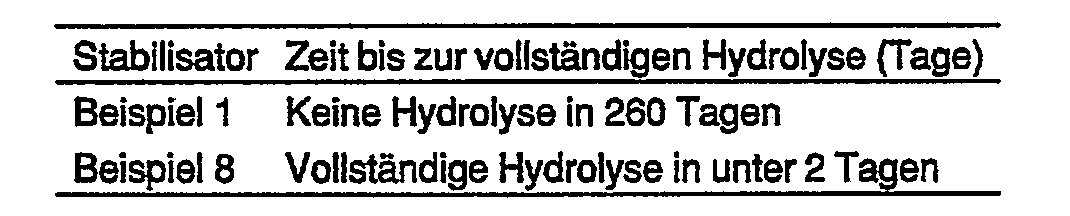
- Die erfindungsgemässe Verbindung erweist sich somit als vorteilhaft in einem weiteren, für eine gewerbliche Stabilisatorverbindung wichtigen Gebiet.
Claims (25)


Applications Claiming Priority (2)
| Application Number | Priority Date | Filing Date | Title |
|---|---|---|---|
| US68537084A | 1984-12-24 | 1984-12-24 | |
| US685370 | 1984-12-24 |
Publications (3)
| Publication Number | Publication Date |
|---|---|
| EP0186628A2 EP0186628A2 (de) | 1986-07-02 |
| EP0186628A3 EP0186628A3 (en) | 1987-10-21 |
| EP0186628B1 true EP0186628B1 (de) | 1989-12-13 |
Family
ID=24751912
Family Applications (1)
| Application Number | Title | Priority Date | Filing Date |
|---|---|---|---|
| EP19850810606 Expired EP0186628B1 (de) | 1984-12-24 | 1985-12-17 | Pentaerythritdiphosphite, Verfahren zu deren Herstellung und deren Verwendung als Stabilisatoren |
Country Status (4)
| Country | Link |
|---|---|
| EP (1) | EP0186628B1 (de) |
| JP (1) | JPH0655750B2 (de) |
| CA (1) | CA1256117A (de) |
| DE (1) | DE3574701D1 (de) |
Families Citing this family (17)
| Publication number | Priority date | Publication date | Assignee | Title |
|---|---|---|---|---|
| JPH0637507B2 (ja) * | 1986-03-26 | 1994-05-18 | 旭電化工業株式会社 | 有機ホスフアイト組成物 |
| JP2663399B2 (ja) * | 1987-05-18 | 1997-10-15 | 出光興産 株式会社 | 熱安定性ポリスチレン系樹脂組成物 |
| JP2681643B2 (ja) * | 1988-01-14 | 1997-11-26 | 出光興産株式会社 | ポリスチレン系樹脂組成物 |
| JPS63112655A (ja) * | 1986-10-29 | 1988-05-17 | Kanegafuchi Chem Ind Co Ltd | 滞留熱安定性に優れた熱可塑性樹脂組成物 |
| JPS63186750A (ja) * | 1987-01-27 | 1988-08-02 | Sumitomo Chem Co Ltd | 難燃性スチレン系樹脂組成物 |
| JPS63159470A (ja) * | 1986-12-23 | 1988-07-02 | Idemitsu Petrochem Co Ltd | ポリアリ−レンスルフイド樹脂組成物 |
| JPS649252A (en) * | 1987-07-01 | 1989-01-12 | Adeka Argus Chemical Co Ltd | Radiation-resistant polyolefin composition |
| JPS6436634A (en) * | 1987-07-30 | 1989-02-07 | Adeka Argus Chemical Co Ltd | Polyolefin composition |
| JP2546344B2 (ja) * | 1988-07-06 | 1996-10-23 | 日本合成ゴム株式会社 | 熱可塑性樹脂組成物 |
| JPH0224304A (ja) * | 1988-07-13 | 1990-01-26 | Shin Etsu Chem Co Ltd | 塩化ビニル系樹脂の製造方法 |
| JP2684733B2 (ja) * | 1988-12-16 | 1997-12-03 | 東レ株式会社 | ポリアリーレンスルフィド樹脂組成物 |
| US5103035A (en) * | 1990-04-05 | 1992-04-07 | Ethyl Corporation | Process for preparing bis(alkylphenyl)pentaerythritol diphosphites |
| US5132426A (en) * | 1990-08-23 | 1992-07-21 | Ciba-Geigy Corporation | Substituted 3,7,9-trioxa-1-aza-2,8-diphosphaspiro(4,5)decanes and stabilized compositions |
| GB2252325A (en) * | 1991-01-31 | 1992-08-05 | Ciba Geigy Ag | Stabilised polyolefin |
| JP3300392B2 (ja) * | 1991-10-24 | 2002-07-08 | 三井化学株式会社 | 熱可塑性樹脂組成物およびその用途 |
| US6426429B1 (en) * | 2000-08-11 | 2002-07-30 | General Electric Company | Process for the preparation of hindered phosphites |
| US6504065B1 (en) * | 2000-09-29 | 2003-01-07 | General Electric Company | Method of making metal salts of 2,4,6-tri-t-butylphenol |
Family Cites Families (3)
| Publication number | Priority date | Publication date | Assignee | Title |
|---|---|---|---|---|
| US2847443A (en) * | 1956-05-02 | 1958-08-12 | Shea Chemical Corp | Pentaerythritol products |
| US4180498A (en) * | 1976-07-30 | 1979-12-25 | Ciba-Geigy Corporation | Hindered phenyl phosphites |
| JPS56152863A (en) * | 1980-04-28 | 1981-11-26 | Adeka Argus Chem Co Ltd | Synthetic resin composition |
-
1985
- 1985-12-17 EP EP19850810606 patent/EP0186628B1/de not_active Expired
- 1985-12-17 DE DE8585810606T patent/DE3574701D1/de not_active Expired - Lifetime
- 1985-12-20 CA CA000498241A patent/CA1256117A/en not_active Expired
- 1985-12-24 JP JP60291818A patent/JPH0655750B2/ja not_active Expired - Lifetime
Also Published As
| Publication number | Publication date |
|---|---|
| JPH0655750B2 (ja) | 1994-07-27 |
| DE3574701D1 (de) | 1990-01-18 |
| EP0186628A2 (de) | 1986-07-02 |
| EP0186628A3 (en) | 1987-10-21 |
| CA1256117A (en) | 1989-06-20 |
| JPS61165397A (ja) | 1986-07-26 |
Similar Documents
| Publication | Publication Date | Title |
|---|---|---|
| EP0002821B1 (de) | Cyclische Phosphite und mit deren Hilfe stabilisiertes organisches Material | |
| EP0053098B1 (de) | Alkanolaminester von cyclischen 1,1'-Biphenyl-2,2'-diyl- und Alkyliden-1,1'-biphenyl-2,2'-diyl-phosphiten | |
| EP0511156B1 (de) | Unsymmetrische Aryl-phosphite | |
| EP0186628A2 (de) | Pentaerythritdiphosphite, Verfahren zu deren Herstellung und deren Verwendung als Stabilisatoren | |
| EP0250367A2 (de) | Neue Stabilisatoren für organische Polymere | |
| DE3713375A1 (de) | 1,3,2-oxazaphospholidin-stabilisatoren | |
| EP0081457B1 (de) | Phenole und ihre Verwendung als Stabilisatoren | |
| EP0140297A2 (de) | Thiocarbamat Stabilisatoren | |
| DE3923492A1 (de) | Kunststoff-formmasse | |
| EP0145658A1 (de) | Amide von Hydroxyphenylalkylthio-alkancarbonsäuren | |
| EP0214935B1 (de) | Sterisch gehinderte Siliciumesterstabilisatoren | |
| EP0079855A1 (de) | Alkylierte Hydroxyphenylthioalkansäureester | |
| EP0240463B1 (de) | Substituierte Aminoxypropionamide | |
| EP0005447B1 (de) | Orthoalkylierte Phenylphosphonite, Verfahren zu ihrer Herstellung und stabilisierte Massen | |
| EP0004026B1 (de) | Hydrolysestabile, ortho-alkylierte Phenylphosphonite und stabilisierte Massen | |
| EP0114148B1 (de) | Dioxasilepin und Dioxasilocin Stabilisatoren | |
| EP0537223B1 (de) | NEUE 6-ARYL-6H-DIBENZO-[c,e][1,2]-OXAPHOSPHORINE, EIN VERFAHREN ZU IHRER HERSTELLUNG UND DEREN VERWENDUNG ZUR STABILISIERUNG VON KUNSTSTOFFEN, INSBESONDERE POLYOLEFINFORMMASSEN | |
| EP0553059B1 (de) | Neue Cycloalkyliden-bisphenol-phosphite | |
| DE3541234A1 (de) | Substituierte (4-hydroxyphenylthioalkyl)-derivate | |
| DE3639336A1 (de) | Hydroxylamine und deren verwendung als stabilisatoren fuer organisches material | |
| EP0110820B1 (de) | Aminosubstituierte Dibenzodioxaphosphepine und Dioxaphosphocine | |
| EP0114785B1 (de) | Polymere, sterisch gehinderte Phosphonatstabilisatoren | |
| EP0226545B1 (de) | Substituierte Aminoxyethylphosphonate | |
| EP0246190A2 (de) | Isocyanursäurederivate | |
| EP0108714A1 (de) | Dibenzodioxaphosphepin- und -dioxaphosphocin-Verarbeitungsstabilisatoren |
Legal Events
| Date | Code | Title | Description |
|---|---|---|---|
| PUAI | Public reference made under article 153(3) epc to a published international application that has entered the european phase |
Free format text: ORIGINAL CODE: 0009012 |
|
| 17P | Request for examination filed |
Effective date: 19851219 |
|
| AK | Designated contracting states |
Kind code of ref document: A2 Designated state(s): BE DE FR GB IT NL |
|
| PUAL | Search report despatched |
Free format text: ORIGINAL CODE: 0009013 |
|
| AK | Designated contracting states |
Kind code of ref document: A3 Designated state(s): BE DE FR GB IT NL |
|
| 17Q | First examination report despatched |
Effective date: 19881221 |
|
| GRAA | (expected) grant |
Free format text: ORIGINAL CODE: 0009210 |
|
| AK | Designated contracting states |
Kind code of ref document: B1 Designated state(s): BE DE FR GB IT NL |
|
| ITF | It: translation for a ep patent filed | ||
| REF | Corresponds to: |
Ref document number: 3574701 Country of ref document: DE Date of ref document: 19900118 |
|
| GBT | Gb: translation of ep patent filed (gb section 77(6)(a)/1977) | ||
| ET | Fr: translation filed | ||
| PLBE | No opposition filed within time limit |
Free format text: ORIGINAL CODE: 0009261 |
|
| STAA | Information on the status of an ep patent application or granted ep patent |
Free format text: STATUS: NO OPPOSITION FILED WITHIN TIME LIMIT |
|
| 26N | No opposition filed | ||
| ITTA | It: last paid annual fee | ||
| PGFP | Annual fee paid to national office [announced via postgrant information from national office to epo] |
Ref country code: NL Payment date: 19941231 Year of fee payment: 10 |
|
| PGFP | Annual fee paid to national office [announced via postgrant information from national office to epo] |
Ref country code: BE Payment date: 19950104 Year of fee payment: 10 |
|
| PG25 | Lapsed in a contracting state [announced via postgrant information from national office to epo] |
Ref country code: BE Effective date: 19951231 |
|
| BERE | Be: lapsed |
Owner name: CIBA-GEIGY A.G. Effective date: 19951231 |
|
| PG25 | Lapsed in a contracting state [announced via postgrant information from national office to epo] |
Ref country code: NL Effective date: 19960701 |
|
| NLV4 | Nl: lapsed or anulled due to non-payment of the annual fee |
Effective date: 19960701 |
|
| REG | Reference to a national code |
Ref country code: GB Ref legal event code: 732E |
|
| REG | Reference to a national code |
Ref country code: FR Ref legal event code: TP |
|
| PGFP | Annual fee paid to national office [announced via postgrant information from national office to epo] |
Ref country code: FR Payment date: 19981029 Year of fee payment: 14 |
|
| PGFP | Annual fee paid to national office [announced via postgrant information from national office to epo] |
Ref country code: DE Payment date: 19981106 Year of fee payment: 14 |
|
| PGFP | Annual fee paid to national office [announced via postgrant information from national office to epo] |
Ref country code: GB Payment date: 19981124 Year of fee payment: 14 |
|
| PG25 | Lapsed in a contracting state [announced via postgrant information from national office to epo] |
Ref country code: GB Free format text: LAPSE BECAUSE OF NON-PAYMENT OF DUE FEES Effective date: 19991217 |
|
| GBPC | Gb: european patent ceased through non-payment of renewal fee |
Effective date: 19991217 |
|
| PG25 | Lapsed in a contracting state [announced via postgrant information from national office to epo] |
Ref country code: FR Free format text: LAPSE BECAUSE OF NON-PAYMENT OF DUE FEES Effective date: 20000831 |
|
| PG25 | Lapsed in a contracting state [announced via postgrant information from national office to epo] |
Ref country code: DE Free format text: LAPSE BECAUSE OF NON-PAYMENT OF DUE FEES Effective date: 20001003 |
|
| REG | Reference to a national code |
Ref country code: FR Ref legal event code: ST |