EP0511558A2 - Racemat-Spaltverfahren und diastereomere Assoziate - Google Patents
Racemat-Spaltverfahren und diastereomere Assoziate Download PDFInfo
- Publication number
- EP0511558A2 EP0511558A2 EP92106591A EP92106591A EP0511558A2 EP 0511558 A2 EP0511558 A2 EP 0511558A2 EP 92106591 A EP92106591 A EP 92106591A EP 92106591 A EP92106591 A EP 92106591A EP 0511558 A2 EP0511558 A2 EP 0511558A2
- Authority
- EP
- European Patent Office
- Prior art keywords
- acid
- bis
- alkyl
- phenylcarbamoyloxy
- aryl
- Prior art date
- Legal status (The legal status is an assumption and is not a legal conclusion. Google has not performed a legal analysis and makes no representation as to the accuracy of the status listed.)
- Granted
Links
Classifications
-
- C—CHEMISTRY; METALLURGY
- C07—ORGANIC CHEMISTRY
- C07F—ACYCLIC, CARBOCYCLIC OR HETEROCYCLIC COMPOUNDS CONTAINING ELEMENTS OTHER THAN CARBON, HYDROGEN, HALOGEN, OXYGEN, NITROGEN, SULFUR, SELENIUM OR TELLURIUM
- C07F9/00—Compounds containing elements of Groups 5 or 15 of the Periodic Table
- C07F9/02—Phosphorus compounds
- C07F9/28—Phosphorus compounds with one or more P—C bonds
- C07F9/50—Organo-phosphines
- C07F9/53—Organo-phosphine oxides; Organo-phosphine thioxides
- C07F9/5329—Polyphosphine oxides or thioxides
-
- C—CHEMISTRY; METALLURGY
- C07—ORGANIC CHEMISTRY
- C07C—ACYCLIC OR CARBOCYCLIC COMPOUNDS
- C07C271/00—Derivatives of carbamic acids, i.e. compounds containing any of the groups, the nitrogen atom not being part of nitro or nitroso groups
- C07C271/06—Esters of carbamic acids
- C07C271/08—Esters of carbamic acids having oxygen atoms of carbamate groups bound to acyclic carbon atoms
- C07C271/26—Esters of carbamic acids having oxygen atoms of carbamate groups bound to acyclic carbon atoms with the nitrogen atom of at least one of the carbamate groups bound to a carbon atom of a six-membered aromatic ring
- C07C271/28—Esters of carbamic acids having oxygen atoms of carbamate groups bound to acyclic carbon atoms with the nitrogen atom of at least one of the carbamate groups bound to a carbon atom of a six-membered aromatic ring to a carbon atom of a non-condensed six-membered aromatic ring
-
- C—CHEMISTRY; METALLURGY
- C07—ORGANIC CHEMISTRY
- C07F—ACYCLIC, CARBOCYCLIC OR HETEROCYCLIC COMPOUNDS CONTAINING ELEMENTS OTHER THAN CARBON, HYDROGEN, HALOGEN, OXYGEN, NITROGEN, SULFUR, SELENIUM OR TELLURIUM
- C07F9/00—Compounds containing elements of Groups 5 or 15 of the Periodic Table
- C07F9/02—Phosphorus compounds
- C07F9/547—Heterocyclic compounds, e.g. containing phosphorus as a ring hetero atom
- C07F9/655—Heterocyclic compounds, e.g. containing phosphorus as a ring hetero atom having oxygen atoms, with or without sulfur, selenium, or tellurium atoms, as the only ring hetero atoms
- C07F9/65515—Heterocyclic compounds, e.g. containing phosphorus as a ring hetero atom having oxygen atoms, with or without sulfur, selenium, or tellurium atoms, as the only ring hetero atoms the oxygen atom being part of a five-membered ring
Definitions
- the present invention relates to a racemate cleavage process and certain diastereomeric associates that result from this process.
- the present invention is a new process for cleaving racemic diphosphine oxides into the optically active antipodes by reacting the racemate with a cleaving reagent.
- This process is characterized in that a carbamate or thiocarbamate of an optically active ⁇ -hydroxy or ⁇ -aminocarboxylic acid is used as the cleavage reagent. Both mono- and dicarboxylic acids can be used here. The carbamates thereof are preferred.
- the process according to the invention is distinguished in that the respective racemic diphosphine oxide unexpectedly forms two diastereomeric associates of different solubility with the carbamate or thiocarbamate used in an ⁇ -hydroxy or ⁇ -aminocarboxylic acid.
- various racemic diphosphine oxides can be cleaved into their optically active antipodes which, using cleavage reagents known to date, such as the (-) - (L) -dibenzoyl-tartaric acid mentioned in European Patent 15514, cannot or only with difficulty, i.e. with very low yields.
- European Patent 15514 describes a process for the resolution of racemic mixtures of phosphine oxides, which is carried out according to the principles of enantiomer separation via stereomeric compounds in organic solution.
- an optically pure isomer of a mono- or bisacylated is used as the cleavage reagent Tartaric acid, such as (-) - (L) -dibenzoyltartaric acid monohydrate, is used.
- the racemic mixture of the diphosphine oxides to be separated is reacted with an optically pure (+) - or (-) - isomer of a carbamate or thiocarbamate of an ⁇ -hydroxy- or ⁇ -aminocarboxylic acid, expediently in a suitable organic solvent .
- an optically pure (+) - or (-) - isomer of a carbamate or thiocarbamate of an ⁇ -hydroxy- or ⁇ -aminocarboxylic acid expediently in a suitable organic solvent .
- one separates the sparingly soluble of the two diastereomeric associates in the solvent for example by filtration
- treats this with a base in order to release the optically pure (or largely pure) diphosphine oxide enantiomer.
- the second optically pure or enriched diphosphine oxide enantiomer which accumulated as the more soluble diastereomeric associate in the solution, can also be isolated by crystallization. If this method fails, the second enantiomer is released by treatment with a base and then a new diastereomeric, now more poorly soluble associate is formed with the antipode of the previously used cleavage reagent and the cleavage process is repeated.
- cleavage reagent ie one molar equivalent of a dicarboxylic acid or two molar equivalents of a monocarboxylic acid per mole equivalent of diphosphine oxide
- the unreacted (or largely unreacted) diphosphine oxide then remains in the solution as the second antipode.
- the two antipodes can be isolated in a manner known per se.
- the carbamates or thiocarbamates of optically active ⁇ -hydroxy- or ⁇ -aminocarboxylic acids which can be used as cleaving reagents in the cleavage process according to the invention are compounds which form the “core” of the formula respectively.
- X is oxygen or sulfur and R1 is hydrogen, alkyl or aryl, and the ring-condensed derivatives of those carbamates and thiocarbamates defined above which have two carboxy groups and in which R1 is hydrogen.
- ring-condensed derivatives are obtained by eliminating H2O between the carboxy group (OH portion), which in the ⁇ -position to the (thio) carbamoyloxy group (-NH-CX-O-) or (thio) ureido group (-NH-CX- NH-), and the carbamoyl or thiocarbamoyl group (H portion) itself with the resulting ring closure. They have a "core" of the formula respectively.
- core are 2,4-dioxo-1,3-oxazolidines or 2-thio-4-oxo-1,3-oxazolidines ("core” (c), in which X is oxygen or sulfur) or 2,4- Imidazolidinediones or 2-thio-4-oxoimidazolidine (“core (d), wherein X represents oxygen or sulfur).
- alkyl (R1 or R2) used with respect to the formulas I-IV above means in particular C1 ⁇ 6-alkyl groups. If R1 or R2 is aryl, this is preferably optionally substituted phenyl or naphthyl, the substituents being in particular C1 ⁇ 6-alkyl, such as methyl, ethyl and n-propyl; Halogen, preferably fluorine and chlorine; C1 ⁇ 6 alkoxy such as methoxy and ethoxy; and nitro come into consideration. The same applies to the aryl part of the aryl-C1 ⁇ 3-alkyl group, which is a further meaning of R2.
- the phenyl or naphthyl group is preferably mono- or disubstituted, it being possible for the substituents in poly-substituted phenyl or naphthyl to be the same or different.
- Preferred meanings of R2 as aryl-C1 ⁇ 3-alkyl are optically active ⁇ -phenylethyl, ⁇ -phenylpropyl, 1- ( ⁇ -naphthyl) ethyl and 1- ( ⁇ -naphthyl) propyl.
- R5 or R6 is necessarily a group which has carboxy.
- Examples of such Groups are carboxymethyl, carboxyhydroxymethyl, a group (s) and a group (f) as above.
- Preferred cleavage reagents of the formulas I-IV which can be used according to the invention are: the phenyl carbamate of optically active lactic acid, ie (+) - or (-) - 2-phenylcarbamoyloxypropionic acid of the formula (+) / (-) - C6H5NHCOO-CH (CH3) COOH; the phenyl carbamate of optically active mandelic acid, ie (+) - or (-) - ⁇ -phenylcarbamoyloxy-phenylacetic acid of the formula (+) / (-) - C6H5NHCOO-CH (C6H5) COOH; the phenyl carbamate of optically active malic acid, ie (+) - or (-) - 2-phenylcarbamoyloxy succinic acid of the formula (+) / (-) - C6H5NHCOO-CH (COOH) CH2COOH; the pheny
- alkyl and "cycloalkyl” (R7) used with respect to the formulas V and VI above are to be understood in particular as C1 ⁇ 6-alkyl or C5 ⁇ 7-cycloalkyl groups, it being possible for the alkyl groups to be straight-chain or branched. If R7 is aryl, this is preferably optionally substituted phenyl. Such phenyl groups R7, if substituted, can be substituted in the ortho, meta or para position or also multiply. Lower alkyl groups, preferably methyl, and / or lower alkoxy groups, preferably methoxy, and / or also di (lower alkyl) amino, preferably dimethylamino, and fluorine and chlorine are suitable as substituents here.
- the term “five-membered heteroaromatic” stands for a substituent of the formula (g), (h), (i) or (j):
- A is oxygen, sulfur or -NR10
- R9 is hydrogen, lower alkyl, in particular methyl, or lower alkoxy, in particular methoxy
- R10 is lower alkyl, in particular methyl.
- lower alkyl or “lower alkoxy” means in the context of the present invention, for example also for R8, R9 and R10, straight-chain or branched groups with up to 3 carbon atoms, such as methyl, ethyl, n-propyl and isopropyl and the corresponding alkoxy groups.
- the customary ether-forming agents are particularly suitable as protective groups for the hydroxymethyl group (R8) Groups such as methyl, methoxymethyl and benzyl, and also ester-forming groups such as acetyl and benzoyl.
- R8 Groups such as methyl, methoxymethyl and benzyl
- ester-forming groups such as acetyl and benzoyl.
- further substituents for the naphthalene rings are, for example, those substituents which are mentioned above in connection with optionally substituted phenyl (R7).
- the reaction of the racemic diphenylphosphine oxide with the cleavage reagent, which is the first stage in the cleavage process according to the invention, is expediently carried out in an organic or aqueous-organic solvent, such as, for example, a lower alkanol (such as methanol), a di (lower alkyl) ketone (such as acetone), or a lower one Alkanoic acid ethyl ester (such as ethyl acetate), an aromatic (such as toluene), an aqueous organic solvent (such as an aqueous lower alkanol, especially aqueous methanol, or an aqueous di (lower alkyl) ketone, especially aqueous acetone) or a mixture of two or more of the above and / or other organic solvents (such as Methylene chloride / methanol mixture, acetone / n-hexane mixture or toluene / n
- the reaction is suitably carried out at temperatures between about -20 ° C and about + 80 ° C, preferably at about 4 to 25 ° C. If not used in equimolar amounts, the racemic diphosphine oxide and the cleavage reagent are used in a molar ratio of about 1: 2, as already explained above. In most cases, the result is a crystallizate of the sparingly soluble associate, which can expediently be separated off by filtration, but also by centrifugation. If the association does not fail on its own, the crystallization can be promoted by adding a seed crystal and / or by cooling.
- the reaction and crystallization conditions can be optimized by specifically coordinating the various parameters with one another, for example the choice of solvent, concentration of the two reactants in the solvent and temperature, in order to achieve the desired result.
- the latter is usually dissolved or suspended in a water-insoluble organic solvent, such as, for example, methylene chloride, ethyl acetate or toluene, and a suitable base in aqueous solution is added to the solution or suspension.
- a water-insoluble organic solvent such as, for example, methylene chloride, ethyl acetate or toluene
- a suitable base in aqueous solution is added to the solution or suspension.
- Particularly suitable bases are sodium hydroxide, potassium hydroxide, sodium carbonate, potassium carbonate, sodium bicarbonate or potassium bicarbonate. The sodium or.
- Potassium salt of the cleavage reagent (carbamate or thiocarbamate of an optically active ⁇ -hydroxy or ⁇ -aminocarboxylic acid) in the aqueous phase, and the resulting released diphosphine oxide enantiomers in the organic phase.
- the optically active diphosphine oxide can then be isolated from the organic phase in a conventional manner, for example by concentration under reduced pressure and possibly also at a slightly elevated temperature.
- the optical purity of the diphosphine oxide recovered in this way is already very high. If necessary, the optical purity can be increased to 100% (ee) by repeating the splitting process. In most cases, the product obtained by concentration can be subjected to recrystallization as the last step to the optically pure enantiomer.
- the diastereomeric associates according to the invention are the direct products of the cleavage process, i.e. diastereomeric associates of an (R) - or (S) -diphosphine oxide and a carbamate or thiocarbamate of an optically active ⁇ -hydroxy or ⁇ -aminocarboxylic acid.
- Examples of such associates are those which arise from an (R) - or (S) -diphosphine oxide, for example of the above formula V or VI, and a cleavage reagent of the above formula I, II, III or IV.
- Preferred diastereomeric associations according to the invention are those in which the one component is (R) - or (S) -BIPHEMPO, p-TOLBIPHEMPO, CyBIPHEMPO, FURBIPHEMPO, BINAPO, p-TOLBINAPO, m-TOLBINAPO or CyBINAPO and the second component is (+) - or (-) - 2-phenylcarbamoyloxy-propionic acid, (+) - or (-) - ⁇ -phenylcarbamoyloxy-phenylacetic acid, (+) - or (-) - 2-phenylcarbamoyloxy-succinic acid, (+) - or (-) -2,3-di (phenylcarbamoyloxy) succinic acid, (+) - or (-) - 2- (3-phenylureido) propionic acid, (+) - or (-) - 2- (3-phenylureido) succin
- racemic diphosphine oxides used as starting materials in the cleavage process according to the invention and the cleavage reagents used according to the invention are partly known, partly new but can be prepared by methods known per se (see, for example, European Patent Publications Nos. 15,514, 104,375 and 398,132).
- the products of the cleavage process according to the invention ie the optically active [(R) - or (S) -] diphosphine oxides, can be reduced to the corresponding (R) - or (S) -diphosphines in a manner known per se.
- the latter are suitable in the form of their complexes with metals from group VIII of the periodic table, in particular with ruthenium, rhodium, iridium and cobalt, as catalysts for asymmetric hydrogenations and for enantioselective hydrogen shifts in prochiral allylic systems.
- (S) -CyBIPHEMPO is released from the (S) -CyBIPHEMPO / (S) -2-phenylcarbamoyloxypropionic acid (1: 2) associate.
- (R) -BIPHEMPO is released from the (R) -BIPHEMPO / (R, R) -2,3-di (phenylcarbamoyloxy) succinic acid (1: 1) associate.
- the first and second crystals are combined (7.8 g), dissolved in 300 ml of methylene chloride, the solution washed once with 3N aqueous sodium hydroxide solution and three times with 100 ml of water, over anhydrous sodium sulfate dried and evaporated under reduced pressure.
- the residue (5.4 g) is dissolved in as little ethyl acetate as possible, the solution is diluted with 50 ml of n-hexane and the diluted solution is left to stand at -20 ° C. for 3 days.
Landscapes
- Chemical & Material Sciences (AREA)
- Organic Chemistry (AREA)
- Health & Medical Sciences (AREA)
- Life Sciences & Earth Sciences (AREA)
- Biochemistry (AREA)
- General Health & Medical Sciences (AREA)
- Molecular Biology (AREA)
- Organic Low-Molecular-Weight Compounds And Preparation Thereof (AREA)
- Pharmaceuticals Containing Other Organic And Inorganic Compounds (AREA)
- Nitrogen And Oxygen Or Sulfur-Condensed Heterocyclic Ring Systems (AREA)
Abstract
Description
- Die vorliegende Erfindung betrifft ein Racemat-Spaltverfahren und gewisse diastereomere Assoziate, die in diesem Verfahren entstehen.
- Insbesondere handelt es sich bei der vorliegenden Erfindung um ein neues Verfahren zur Spaltung racemischer Diphosphinoxide in die optisch aktiven Antipoden durch Umsetzung des Racemats mit einem Spaltreagens. Dieses Verfahren ist dadurch gekennzeichnet, dass man als Spaltreagens ein Carbamat oder Thiocarbamat einer optisch aktiven α-Hydroxy- oder α-Aminocarbonsäure verwendet. Es können hierbei sowohl Mono- als auch Dicarbonsäuren verwendet werden. Die Carbamate hiervon sind bevorzugt.
- Das erfindungsgemässe Verfahren zeichnet sich dadurch aus, dass das jeweilige racemische Diphosphinoxid unerwartet mit dem eingesetzten Carbamat oder Thiocarbamat einer α-Hydroxy- oder α-Aminocarbonsäure zwei diastereomere Assoziate unterschiedlicher Löslichkeit bildet. Dadurch lassen sich gemäss diesem Verfahren verschiedene racemische Diphosphinoxide in ihre optisch aktiven Antipoden spalten, die unter Verwendung bisher bekannter Spaltreagenzien, wie beispielsweise die in der europäischen Patentschrift 15514 erwähnte (-)-(L)-Dibenzoylweinsäure, nicht oder nur schwer, d.h. mit sehr niedrigen Ausbeuten, zugänglich waren.
- In der besagten europäischen Patentschrift 15514 wird u.a. ein Verfahren zur Spaltung von racemischen Gemischen von Phosphinoxiden beschrieben, das nach den Prinzipien der Enantiomerentrennung über stereomere Verbindungen in organischer Lösung erfolgt. In diesem bekannten Verfahren wird als Spaltreagens ein optisch reines Isomeres einer mono- oder bisacylierten Weinsäure, wie beispielsweise (-)-(L)-Dibenzoylweinsäuremonohydrat, verwendet. Es hat sich aber herausgestellt, dass dieses Verfahren beispielsweise für die Spaltung von racemischem (6,6'-Dimethylbiphenyl-2,2'-diyl)-bis-(di-p-tolylphosphinoxid) ("p-TOLBIPHEMPO") mit (-)-(L)-Dibenzoylweinsäure-monohydrat nicht geeignet ist. Hingegen gelingt die Spaltung gemäss der vorliegenden Erfindung z.B. unter der Verwendung des Phenylcarbamats von (-)- oder (+)-Milchsäure, also eines Spaltreagens, das bisher noch nie zur optischen Spaltung von racemischen Diphosphinoxiden verwendet worden ist.
- Zur Durchführung des erfindungsgemässen Spaltverfahrens setzt man das aufzutrennende racemische Gemisch der Diphosphinoxide mit einem optisch reinen (+)- oder (-)-Isomeren eines Carbamats oder Thiocarbamats einer α-Hydroxy- oder α-Aininocarbonsäure um, und zwar zweckmässigerweise in einem geeigneten organischen Lösungsmittel. Dann trennt man das im Lösungsmittel schwerer lösliche der beiden diastereomeren Assoziate ab (beispielsweise durch Filtration) und behandelt dieses anschliessend mit einer Base, um das eine optisch reine (oder weitgehend reine) Diphosphinoxid-Enantiomere freizusetzen. In den meisten Fällen lässt sich das zweite optisch reine bzw. anreicherte Diphosphinoxid-Enantiomere, das sich als das löslichere diastereomere Assoziat in der Lösung anreicherte, ebenfalls durch Kristallisation isolieren. Falls diese Methode versagt, wird das zweite Enantiomere durch Behandlung mit einer Base freigesetzt und anschliessend mit dem Antipoden des zuvor verwendeten Spaltreagens ein neues diastereomeres, nunmehr schwerer lösliches Assoziat gebildet und das Spaltverfahren wiederholt.
- Bei der obigen Erläuterung des Spaltverfahrens wird davon ausgegangen, dass genügend Spaltreagens, d.h. pro Moläquivalent Diphosphinoxid ein Moläquivalent einer Dicarbonsäure bzw. zwei Moläquivalente einer Monocarbonsäure, eingesetzt wird, um die Bildung der beiden diastereomeren Assoziate zu ermöglichen. Als Alternative kann man allerdings von der halben molaren Menge des Spaltreagens, bezogen auf die Menge des aufzuspaltenden racemischen Diphosphinoxids, ausgehen, wobei man das schwerer lösliche diastereomere Assoziat als Festkörper erhält. In der Lösung verbleibt dann das nicht umgesetzte (oder weitgehend nicht umgesetzte) Diphosphinoxid als zweiter Antipode. Auch in diesem Fall können die beiden Antipoden auf an sich bekannte Weise isoliert werden.
- Die im erfindungsgemässen Spaltverfahren als Spaltreagenzien verwendbaren Carbamate oder Thiocarbamate von optisch aktiven α-Hydroxy- oder α-Aminocarbonsäuren sind Verbindungen, die den "Kern" der Formel

bzw.
aufweisen, worin X Sauerstoff oder Schwefel und R¹ Wasserstoff, Alkyl oder Aryl bedeuten,
sowie die ringkondensierten Derivate derjenigen oben definierten Carbamate und Thiocarbamate, die zwei Carboxygruppen aufweisen und in denen R¹ Wasserstoff bedeutet. Diese ringkondensierten Derivate werden durch Eliminierung von H₂O zwischen der Carboxygruppe (OH-Anteil), die sich in der α-Stellung zur (Thio)Carbamoyloxygruppe (-NH-CX-O-) bzw. (Thio)Ureidogruppe (-NH-CX-NH-) befindet, und der Carbamoyl- bzw. Thiocarbamoylgruppe (H-Anteil) selbst mit daraus resultierendem Ringschluss gebildet. Sie weisen einen "Kern" der Formel
bzw.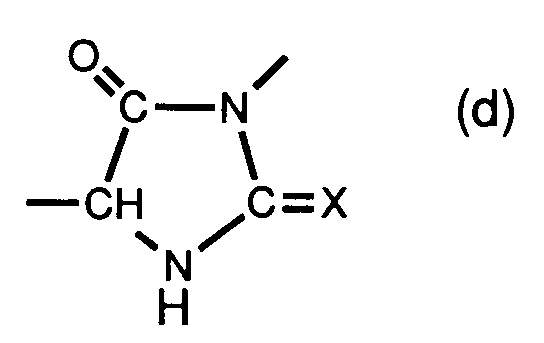
auf, sind also 2,4-Dioxo-1,3-oxazolidine oder 2-Thio-4-oxo-1,3-oxazolidine ("Kern" (c), worin X Sauerstoff oder Schwefel bedeutet) bzw. 2,4-Imidazolidindione oder 2-Thio-4-oxoimidazolidine ("Kern (d), worin X Sauerstoff oder Schwefel bedeutet). - Beispiele solcher Spaltreagenzien sind die Verbindungen der nachstehenden Formeln I-IV:

worin - X und R¹
- die oben angegebenen Bedeutungen besitzen, und
- R²
- Wasserstoff, Alkyl, Aryl-C₁₋₃-alkyl oder Aryl
- R³
- den verbleibenden Teil der verwendeten α-Hydroxycarbonsäure bedeuten,
- X, R¹ und R²
- die oben angegebenen Bedeutungen besitzen
- R⁴
- den verbleibenden Teil der verwendeten α-Aminocarbonsäure bedeutet;
- X
- die oben angegebene Bedeutung besitzt
- R2'
- Alkyl, Aryl-C₁₋₃-alkyl oder Aryl und
- R⁵
- den verbleibenden Teil der verwendeten zwei Carboxygruppen aufweisenden α-Hydroxycarbonsäure bedeuten;
- X und R2'
- die oben angegebenen Bedeutungen besitzen
- R⁶
- den verbleibenden Teil der verwendeten zwei Carboxygruppen aufweisenden α-Aminocarbonsäure bedeutet.
- Unter dem bezüglich der obigen Formeln I-IV verwendeten Ausdruck "Alkyl" (R¹ bzw. R²) sind insbesondere C₁₋₆-Alkylgruppen zu verstehen. Falls R¹ oder R² für Aryl steht, ist dies vorzugsweise gegebenenfalls substituiertes Phenyl oder Naphthyl, wobei als Substituenten insbesondere C₁₋₆-Alkyl, wie beispielsweise Methyl, Aethyl und n-Propyl; Halogen, vorzugsweise Fluor und Chlor; C₁₋₆-Alkoxy, wie beispielsweise Methoxy und Aethoxy; und Nitro in Betracht kommen. Das Gleiche gilt für den Arylteil der Aryl-C₁₋₃-alkylgruppe, die eine weitere Bedeutung von R² ist. Falls substituiert, ist die Phenyl-oder Naphthylgruppe vorzugsweise mono- oder disubstituiert, wobei in mehrfach substituiertem Phenyl bzw. Naphthyl die Substituenten gleich oder verschieden sein können. Bevorzugte Bedeutungen von R² als Aryl-C₁₋₃-alkyl sind optisch aktives α-Phenyläthyl, α-Phenylpropyl, 1-(α-Naphthyl)-äthyl sowie 1-(α-Naphthyl)-propyl.
- Beispiele des Ausdrucks "der verbleibende Teil der α-Hydroxycarbonsäure" (R³) bzw. "der verbleibende Teil der α-Aminocarbonsäure" (R⁴) sind Methyl, Phenyl, Carboxymethyl, Carboxyhydroxymethyl oder eine Gruppe (e) oder (f)

worin X, R¹ und R² die oben angegebenen Bedeutungen besitzen. - Bei dem entsprechenden Ausdruck in bezug auf R⁵ bzw. R⁶ handelt es sich zwingend um eine Gruppe, die Carboxy aufweist. Beispiele solcher Gruppen sind Carboxymethyl, Carboxyhydroxymethyl, eine Gruppe (e) und eine Gruppe (f), wie oben.
- Bevorzugte erfindungsgemäss verwendbare Spaltreagenzien der Formeln I-IV sind:
das Phenylcarbamat der optisch aktiven Milchsäure, d.h. (+)- oder (-)-2-Phenylcarbamoyloxy-propionsäure der Formel (+)/(-)-C₆H₅NHCOO-CH(CH₃)COOH;
das Phenylcarbamat der optisch aktiven Mandelsäure, d.h. (+)- oder (-)-α-Phenylcarbamoyloxy-phenylessigsäure der Formel (+)/(-)-C₆H₅NHCOO-CH(C₆H₅)COOH;
das Phenylcarbamat der optisch aktiven Aepfelsäure, d.h. (+)- oder (-)-2-Phenylcarbamoyloxy-bernsteinsäure der Formel (+)/(-)-C₆H₅NHCOO-CH(COOH)CH₂COOH;
das Phenylcarbamat der optisch aktiven Weinsäure, d.h. (+)- oder (-)-2,3-Di(phenylcarbamoyloxy)-bernsteinsäure der Formel
das Phenylcarbamat des optisch aktiven Alanins, d.h. (+)- oder (-)-2-(3-Phenylureido)-propionsäure der Formel (+)/(-)-C₆H₅NHCONH-CH(CH₃)COOH;
das Phenylcarbamat der optisch aktiven Asparginsäure, d.h. (+)- oder (-)-2-(3-Phenylureido)-bernsteinsäure der Formel (+)/(-)-C₆H₅NHCONHCH-(COOH)CH₂COOH;
das ringkondensierte Derivat des Phenylcarbamats der optisch aktiven Aepfelsäure, d.h. (+)- oder (-)-5-Carboxymethyl-3-phenyl-2,4-dioxo-1,3-oxazolidin der Formel
das ringkondensierte Derivat des entsprechenden Phenylthiocarbamats, d.h. (+)- oder (-)-5-Carboxymethyl-3-phenyl-2-thio-4-oxo-1,3-oxazolidin der Formel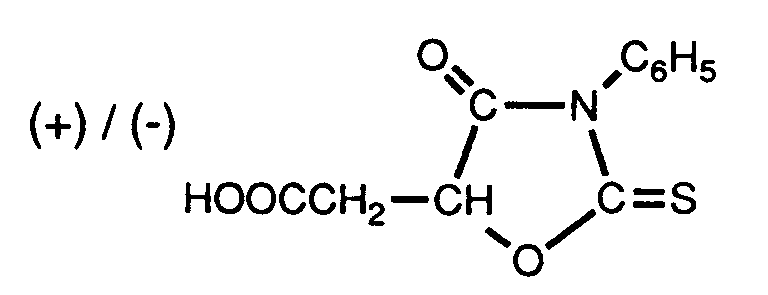
sowie das ringkondensierte Derivat des Phenylcarbamats der optisch aktiven Asparginsäure, d.h. (+)- oder (-)-5-Carboxymethyl-3-phenyl-2,4-imidazolidindion der Formel
- Als zu spaltende racemische Diphosphinoxide kann man gemäss der vorliegenden Erfindung im Prinzip alle derartigen Verbindungen verwenden. Beispiele solcher Diphosphinoxide sind die Verbindungen der nachstehenden Formeln V und VI sowie die im folgenden angegebenen weiteren derartigen Verbindungen:

worin - R⁷
- Alkyl, Cycloalkyl, Aryl oder einen fünfgliedrigen Heteroaromaten bedeutet, und
- R⁸
- jeweils Wasserstoff, niederes Alkyl, niederes Alkoxy oder geschütztes Hydroxymethyl
- n
- 1,2,3 oder 4 bedeuten,
- Unter den bezüglich der obigen Formeln V und VI verwendeten Ausdrücken "Alkyl" und "Cycloalkyl" (R⁷) sind insbesondere C₁₋₆-Alkyl- bzw. C₅₋ ₇-Cycloalkylgruppen zu verstehen, wobei die Alkylgruppen geradkettig oder verzweigt sein können. Falls R⁷ für Aryl steht, ist dies jeweils vorzugsweise gegebenenfalls substituiertes Phenyl. Solche Phenylgruppen R⁷, falls substituiert, können in ortho-, meta- oder para-Stellung oder auch mehrfach substituiert sein. Als Substituenten kommen hier in Frage niedere Alkylgruppen, vorzugsweise Methyl, und/oder niedere Alkoxygruppen, vorzugsweise Methoxy, und/oder auch Di(niederes Alkyl)amino, vorzugsweise Dimethylamino, sowie Fluor und Chlor. Der Ausdruck "fünfgliedriger Heteroaromat" steht für einen Substituenten der Formel (g), (h), (i) oder (j):

- In diesen Formeln bedeuten A Sauerstoff, Schwefel oder -NR¹⁰, R⁹ Wasserstoff, niederes Alkyl, insbesondere Methyl, oder niederes Alkoxy, insbesondere Methoxy, und R¹⁰ niederes Alkyl, insbesondere Methyl. Der Ausdruck "niederes Alkyl" bzw. "niederes Alkoxy" bedeutet im Rahmen der vorliegenden Erfindung, z.B. auch für R⁸, R⁹ und R¹⁰, geradkettige oder verzweigte Gruppen mit bis zu 3 Kohlenstoffatomen, wie Methyl, Aethyl, n-Propyl und Isopropyl und die entsprechenden Alkoxygruppen. Als Schutzgruppen für die Hydroxymethylgruppe (R⁸) kommen im Rahmen der vorliegenden Erfindung insbesondere in Betracht die üblichen Aetherbildenden Gruppen, wie beispielsweise Methyl, Methoxymethyl und Benzyl, sowie auch Ester-bildende Gruppen, wie beispielsweise Acetyl und Benzoyl. Im Falle der Formel VI kommen als weitere Substituenten der Naphthalinringe beispielsweise diejenigen Substituenten in Betracht, die oben im Zusammenhang mit gegebenenfalls substituiertem Phenyl (R⁷) genannt sind.
- Als bevorzugte racemische Diphosphinoxide im erfindungsgemässen Spaltverfahren können folgende Verbindungen der Formeln V und VI genannt werden:
Verbindungen der Formel V:-
(RS)-(6,6'-Dimethylbiphenyl-2,2'-diyl)-bis-(diphenylphosphinoxid) [genannt "(RS)-BIPHEMPO"],
(RS)-(6,6'-Dimethylbiphenyl-2,2'-diyl)-bis-(di-p-tolylphosphinoxid) [genannt "(RS)-p-TOLBIPHEMPO"],
(RS)-(6,6'-Dimethylbiphenyl-2,2'-diyl)-bis-(dicyclohexylphosphinoxid) [genannt "(RS)-CyBIPHEMPO"];
(RS)-(6,6'-Dimethylbiphenyl-2,2'-diyl)-bis-(di-2-furylphosphinoxid) [genannt "(RS)-FURBIPHEMPO"];
Verbindungen der Formel VI:-
(RS)-2,2'-Bis(diphenylphosphinoxido)-1,1'-binaphthyl [genannt "(RS)-BINAPO"],
(RS)-2,2'-Bis[di(p-tolyl)phosphinoxido]-1,1'-binaphthyl [genannt "(RS)-p-TOLBINAPO"],
(RS)-2,2'-Bis[di(m-tolyl)phosphinoxido]-1,1'-binaphthyl [genannt "(RS)-m-TOLBINAPO"] und
(RS)-2,2'-Bis(dicyclohexylphosphinoxido)-1,1'-binaphthyl [genannt "(RS)-CyBINAPO"].
Die als erste Stufe im erfindungsgemässen Spaltverfahren geltende Umsetzung des racemischen Diphenylphosphinoxids mit dem Spaltreagens erfolgt zweckmässigerweise in einem organischen oder wässrig-organischen Lösungsmittel, wie beispielsweise einem niederen Alkanol (wie Methanol), einem Di(nieder Alkyl)keton (wie Aceton), einem niederen Alkansäureäthylester (wie Aethylacetat), einem Aromaten (wie Toluol), einem wässrigorganischen Lösungsmittel (wie einem wässrigen niederen Alkanol, insbesondere wässrigem Methanol, oder einem wässrigen Di(nieder Alkyl)keton, insbesondere wässrigem Aceton) oder einem Gemisch zweier oder mehrerer der oben genannten und/oder weiterer organischer Lösungsmittel (wie Methylenchlorid/Methanol-Gemisch, Aceton/n-Hexan-Gemisch oder Toluol/n-Hexan-Gemisch). Es stellt sich als bevorzugtes Lösungsmittel zu diesem Zweck Methanol, Aethylacetat oder Toluol heraus. Zudem wird die Umsetzung geeigneterweise bei Temperaturen zwischen etwa -20°C und etwa +80°C durchgeführt, vorzugsweise bei etwa 4 bis 25°C. Wenn nicht in äquimolaren Mengen eingesetzt, werden das racemische Diphosphinoxid und das Spaltreagens in einem Molverhältnis von etwa 1:2 eingesetzt, wie dies bereits oben erläutert ist. Es resultiert in den meisten Fällen ein Kristallisat des schwerer löslichen Assoziats, das zweckmässigerweise durch Filtration, aber auch durch Zentrifugation, abgetrennt werden kann. Sollte das Assoziat nicht von allein ausfallen, kann man die Kristallisation durch Zusatz eines Impfkristalls und/oder durch Kühlen fördern. Auf jeden Fall kann man die Umsetzungs- und Kristallisationsbedingungen durch gezielte Abstimmung der verschiedenen Parameter untereinander, z.B. Wahl des Lösungsmittels, Konzentration der beiden Reaktionsteilnehmer im Lösungsmittel und Temperatur, optimieren, um zu dem gewünschten Ergebnis zu gelangen.
Zur anschliessenden Freisetzung des Diphosphinoxid-Enantiomeren vom abgetrennten Assoziat löst oder suspendiert man dieses üblicherweise in einem wasserunlöslichen organischen Lösungsmittel, wie beispielsweise Methylenchlorid, Aethylacetat oder Toluol, und gibt der Lösung bzw. Suspension eine geeignete Base in wässriger Lösung zu. Als Basen eignen sich insbesondere Natriumhydroxid, Kaliumhydroxid, Natriumcarbonat, Kaliumcarbonat, Natriumbicarbonat oder Kaliumbicarbonat. Dabei löst sich das so gebildete Natrium-bzw. Kaliumsalz des Spaltreagens (Carbamats oder Thiocarbamats einer optisch aktiven α-Hydroxy- oder α-Aminocarbonsäure) in der wässrigen Phase, und das resultierende freigesetzte Diphosphinoxid-Enantiomere in der organischen Phase. Das optisch aktive Diphosphinoxid kann sodann aus der organischen Phase auf konventionelle Weise, beispielsweise durch Einengen unter vermindertem Druck und eventuell auch noch bei leicht erhöhter Temperatur, isoliert werden. Die optische Reinheit des auf diese Weise zurückgewonnenen Diphosphinoxids ist bereits dann sehr hoch. Die optische Reinheit kann gegebenenfalls durch eine Wiederholung des Spaltverfahrens auf 100% (ee) erhöht werden. In den meisten Fällen kann als letzter Schritt zum optisch reinen Enantiomeren das durch Einengen gewonnene Produkt einer Umkristallisation unterworfen werden. - Die nach Abtrennung des schwerer löslichen (ersten) Assoziats zurückbleibende organische Lösung des zweiten Assoziats (des anderen Diastereomeren) kann gewünschtenfalls mit Base versetzt und das optisch reine bzw. weitgehend reine Diphosphinoxid-Enantiomere analog der oben beschriebenen Aufarbeitung des ersten Assoziats freigesetzt werden. Falls aber bei dem Spaltverfahren von der halben molaren Menge das Spaltreagens ausgegangen wird, entfällt die Behandlung mit Base.
- Bei den erfindungsgemässen diastereomeren Assoziaten handelt es sich um die unmittelbaren Produkte des Spaltverfahrens, d.h. um diastereomere Assoziate aus einem (R)- oder (S)-Diphosphinoxid und einem Carbamat oder Thiocarbamat einer optisch aktiven α-Hydroxy- oder α-Aminocarbonsäure. Beispiele solcher Assoziate sind diejenigen, die aus einem (R)- oder (S)-Diphosphinoxid, beispielsweise der obigen Formel V oder VI, und einem Spaltreagens der obigen Formel I, II, III oder IV entstehen. Bevorzugte erfindungsgemässe diastereomere Assoziate sind diejenigen, bei denen der eine Bestandteil (R)- oder (S)-BIPHEMPO, p-TOLBIPHEMPO, CyBIPHEMPO, FURBIPHEMPO, BINAPO, p-TOLBINAPO, m-TOLBINAPO oder CyBINAPO ist und der zweite Bestandteil (+)- oder (-)-2-Phenylcarbamoyloxy-propionsäure, (+)- oder (-)-α-Phenylcarbamoyloxy-phenylessigsäure, (+)- oder (-)-2-Phenylcarbamoyloxy-bernsteinsäure, (+)- oder (-)-2,3-Di(phenylcarbamoyloxy)-bernsteinsäure, (+)- oder (-)-2-(3-Phenylureido)-propionsäure, (+)- oder (-)-2-(3-Phenylureido)-bernsteinsäure, (+)- oder (-)-5-Carboxymethyl-3-phenyl-2,4-dioxo-1,3-oxazolidin, (+)- oder (-)-5-Carboxymethyl-3-phenyl-2-thio-4-oxo-1,3-oxazolidin oder (+)- oder (-)-5-Carboxy-3-phenyl-2,4-imidazolidindion ist.
- Sowohl die im erfindungsgemässen Spaltverfahren als Ausgangsmaterialien verwendeten racemischen Diphosphinoxide als auch die erfindungsgemäss verwendeten Spaltreagenzien sind teils bekannte, teils neue aber nach an sich bekannten Methoden herstellbare Verbindungen (siehe beispielsweise die europäischen Patentpublikationen Nrn. 15.514, 104.375 und 398.132).
- Die Produkte des erfindungsgemässen Spaltverfahrens, d.h. die optisch aktiven [(R)- oder (S)-]Diphosphinoxide, können auf an sich bekannte Weise zu den entsprechenden (R)- bzw. (S)-Diphosphinen reduziert werden. Letztere eignen sich in Form ihrer Komplexe mit Metallen der Gruppe VIII des Periodensystems, insbesondere mit Ruthenium, Rhodium, Iridium und Cobalt, als Katalysatoren bei asymmetrischen Hydrierungen sowie für enantioselektive Wasserstoffverschiebungen in prochiralen allylischen Systemen. Die Herstellung der (R)- und (S)-Diphosphine, deren Ueberführung in die Komplexe, und die angesprochene Verwendung der letzteren sind beispielsweise in den europäischen Patentpublikationen Nrn. 15.514, 104.375 und 398.132 beschrieben.
- Die nachfolgenden Beispiele dienen zur näheren Erläuterung der Erfindung. Die angegebenen Enantiomerenzusammensetzungen (ee-Bestimmung, R/S-Verhältnisse) sowohl der Diphosphinoxide als auch der diastereomeren Diphosphinoxid-Spaltreagens-Assoziate werden gemäss der in Org. Synth. 67, 20-30 (1987) beschriebenen CSP-HPLC-Methode bestimmt.
- 2,0 g (3,3 mMol) (RS)-CyBIPHEMPO und 1,5 g (7,3 mMol) (S)-2-Phenylcarbamoyloxy-propionsäure werden in 25 ml eines (1:4)-Gemisches von Aethylacetat und n-Hexan gelöst, und die Lösung wird ca. 16 Stunden bei +4°C stehen gelassen. Danach trennt man das resultierende weisse, kristalline (S)-CyBIPHEMPO/(S)-2-Phenylcarbamoyloxy-propionsäure-(1:2)-Assoziat (Erstkristallisat) [0,7 g; 40% der theoretischen Ausbeute bezogen auf eingesetztes Racemat; R/S = 2,5%/97,5%] durch Filtration ab und kristallisiert aus Toluol/Aethylacetat (5:1) um. Auf diese Weise erhält man 0,6 g [34,3% der theoretischen Ausbeute bezogen auf eingesetztes Racemat; R/S = 0%/100%] reines (S)-CyBIPHEMPO/(S)-2-Phenylcarbamoyloxy-propionsäure-(1:2)-Assoziat, Smp. 197,2°C;


Infrarot-Spektrum (cm⁻¹): 3439, 3299 (-NH, -NH₂), 2930, 2653 (aliph. CH), 2496, 2411 (-COOH), 1730 (-COOH), 1708 (Carbamat-CO), 1541 (CONH), 1220 (Ester-CO), 770 (trisubst. Benzol), 756, 692 (monosubst. Benzol); ¹H-NMR (ppm, CD₃OD, 250 MHz): 1,15-2,10 (m, 42x aliph. H), 2,55-2,75 (m, 2x aliph. H), 1,50 (d, J=7,5, 2x CH₃), 1,90 (s, 2x CH₃), 5,05 (q, J=7,5, 2x aliph. H), 7,05 (m, 2x arom. H), 7,25-7,45 (m, 14x arom. H); Massenspektrum: 606 (10,M⁺), 605 (10,M⁺-H), 523 (96, M⁺-C₆H₁₁), 441 (32, M⁺-C₆H₁₁,-C₆H₁₀), 393 (100, M⁺-P(O)Cyclohexyl₂; Mikroanalyse: ber. für C₅₈H₇₈P₂O₁₀N₂ (1025,229) C 67,95%, H 7,67%, N 2,73%, gef. C 67,67%, H 7,57%, N 2,67%. - Eine Kristallisation des aus der Mutterlauge durch Eindampfen unter vermindertem Druck gewonnenen Rückstandes [2,7 g, R/S = 66%/34%] aus Aethylacetat ergibt ein Zweitkristallisat von mit (S)-CyBIPHEMPO angereichertem Assoziat [0,7 g; 40% der theoretischen Ausbeute bezogen auf eingesetztes Racemat; R/S = 4%/96%].
- Zur Freisetzung des (R)-CyBIPHEMPO werden die Mutterlaugen vereinigt und in 150 ml Aethylacetat gelöst. Dann wird die organische Phase einmal mit 80 ml gesättigter wässriger Natriumbicarbonatlösung und zweimal mit je 100 ml Wasser gewaschen, über wasserfreiem Natriumsulfat getrocknet und unter vermindertem Druck eingedampft. Man löst den Rückstand [1,3 g, R/S = 79%/21%] in 25 ml eines (2:1)-Gemisches von Aethylacetat und Methylenchlorid und lässt die Lösung bei Raumtemperatur ca. 48 Stunden stehen. Das resultierende Kristallisat [0,9 g; 90% der theoretischen Ausbeute bezogen auf eingesetztes Racemat; R/S = 100%/0%] wird abgetrennt, und die Mutterlaugen werden zur Trockene eingedampft [0,3 g; R/S = 19,8%/80,2%].
- Auf analoge Weise wird (S)-CyBIPHEMPO aus dem (S)-CyBIPHEMPO/(S)-2-Phenylcarbamoyloxy-propionsäure-(1:2)-Assoziat freigesetzt.
- 5,0 g (8,6 mMol) (RS)-BIPHEMPO und 3,7 g (9,5 mMol) (R,R)-2,3-Di(phenylcarbamoyloxy)-bernsteinsäure (hergestellt durch Umsetzung von (RR)-Weinsäure-dibenzylester mit Phenylisocyanat und anschliessende Hydrogenolyse) werden in 64 ml eines (25:7)-Gemisches von Aethylacetat und Methanol gelöst, und die Lösung wird ca. 16 Stunden bei Raumtemperatur stehen gelassen. Das resultierende Kristallisat wird abgetrennt und die Mutterlauge nochmals zur Kristallisation gebracht. Auf diese Weise entstehen ein Erst- und ein Zweitkristallisat von (R)-BIPHEMPO/(R,R)-2,3-Di(phenylcarbamoyloxy)-bernsteinsäure-(1:1)-Assoziat, die jeweils durch Filtration abgetrennt werden [1,6 g; 36,8% der theoretischen Ausbeute bezogen auf eingesetztes Racemat; R/S = 99,9%/0,1%; und 0,6 g; 13,8% der theoretischen Ausbeute bezogen auf eingesetztes Racemat; R/S = 100%/0%]. Zur Analyse wird das Zweitkristallisat 7 Stunden bei 70°C/15 mbar getrocknet: Smp. 208,7-210,9°C;


Infrarot-Spektrum (cm⁻¹): 3406, 3319 (-NH, -NH₂), 2829, 2794 (-COOH), 1729 (-COOH), 1603 (Ar), 1591 (CONH), 1441 (P-Ar), 1209 (-P=O), 750, 723 (o-disubst. Benzol), 692 (monosubst. Benzol); ¹N-NMR (ppm, DMSO, 250 MHz): 1,20 (s, 2x CH₃), 5,57 (5, 2H), 6,94-7,80 (m, 36x arom. H), 9,96 (s, 2x NH), 13,7 (bs, 2x OH); Massenspektrum: BIPHEMPO Fragmentationsmuster, keine Fragmente des Spaltreagens; Mikroanalyse: ber. für C₅₆H₄₈N₂O₁₀P₂ (970,947) C 69,27%, H 4,98%, N 2,89%, gef. C 68,89%, H 5,18%, N 2,82%. - Eine Kristallisation des aus der Mutterlauge durch Eindampfen unter vermindertem Druck gewonnenen Rückstandes [7,0 g, R/S = 38,6%/61,4%] ergibt ein Drittkristallisat von mit (R)-BIPHEMPO angereichertem Assoziat [1,7 g, 39,1% der theoretischen Ausbeute bezogen auf eingesetztes Racemat; R/S = 70%/30%].
- Zur Freisetzung des (S)-BIPHEMPO wird der aus der verbleibenden Mutterlauge durch Eindampfen unter vermindertem Druck gewonnene Rückstand [5,0 g, R/S = 15%/85%] in 200 ml Aethylacetat gelöst und die organische Phase einmal mit gesättigter wässriger Natriumbicarbonatlösung und zweimal mit je 150 ml Wasser gewaschen, über wasserfreiem Natriumsulfat getrocknet und unter vermindertem Druck eingedampft. Nach der Umkristallisation des Rückstandes [2,7 g, R/S = 15%/85%] aus Aethylacetat resultieren kristallines (RS)-BIPHEMPO [1,0 g, R/S = 49%/51%] und eine mit (S)-BIPHEMPO angereicherte Mutterlauge [1,7 g, 68% der theoretischen Ausbeute bezogen auf eingesetztes Racemat, R/S = 2,5%/97,5%]. Aus diesem Material erhält man nach einer weiteren Kristallisation aus Aethylacetat enantiomerenreines (S)-BIPHEMPO.
- Auf analoge Weise wird (R)-BIPHEMPO aus dem (R)-BIPHEMPO/(R,R)-2,3-Di(phenylcarbamoyloxy)-bernsteinsäure-(1:1)-Assoziat freigesetzt.
- 2,7 g (4,1 mMol) (RS)-p-TOLBIPHEMPO und 2,0 g (9,6 mMol) (S)-2-Phenylcarbamoyloxy-propionsäure werden in ca. 20 ml heissem Methanol gelöst, einige Tropfen Wasser hinzugefügt und die Lösung ca. 16 Stunden bei Raumtemperatur stehen gelassen.
- Die weitere Prozedur erfolgt analog der in Beispiel 1 oder 2 beschriebenen Methodik, nach der die folgenden Produkte isoliert werden:
0,7 g Erstkristallisat: (S)-p-TOLBIPHEMPO/(S)-2-Phenylcarbamoyloxy-propionsäure-(1:2)-Assoziat, R/S = 6%/94%, Smp. 191-193°C,
(c = 1,0, CHCl₃);
1,0 g Zweitkristallisat: (S)-p-TOLBIPHEMPO/(S)-2-Phenylcarbamoyloxy-propionsäure-(1:2)-Assoziat, R/S = 25%/75%;
3,0 g Kristallisat des aus der Mutterlauge durch Eindampfen unter vermindertem Druck gewonnenen Rückstandes: (R)-p-TOLBIPHEMPO/(S)-Phenylcarbamoyloxy-propionsäure-(1:2)-Assoziat, R/S = 75%/25%. - Analysenpräparat:
(R)-p-TOLBIPHEMPO/(S)-2-Phenylcarbamoyloxy-propionsäure-(1:2)-Assoziat, 100% ee, Smp. 182-183°C;
(S)-p-TOLBIPHEMPO/(S)-2-Phenylcarbamoyloxy-propionsäure-(1:2)-Assoziat, 100% ee, Smp. 191-193°C;
- 3,8 g (6,0 mMol) (RS)-p-TOLBIPHEMPO und 1,4g (6,7 mMol) (S)-2-Phenylcarbamoyloxy-propionsäure werden in ca. 25 ml warmem Methanol gelöst, ca. 5 ml eines (4:1)-Gemisches von Methanol und Wasser hinzugefügt und die Lösung ca. 16 Stunden bei Raumtemperatur stehen gelassen.
- Die weitere Prozedur erfolgt analog der in Beispiel 1 oder 2 beschriebenen Methodik, nach der die folgenden Produkte isoliert werden:
3,0 g Kristallisat: (S)-p-TOLBIPHEMPO/(S)-2-Phenylcarbamoyloxy-propionsäure-(1:2)-Assoziat, R/S = 25%/75%;
In dem nach dem Eindampfen der Mutterlauge verbleibenden Rückstand (2,2 g) ist das (R)-p-TOLBIPHEMPO angereichert, R/S = 84%/16%. - 3,8 g (6,0 mMol) (PS)-p-TOLBIPHEMPO und 2,7 g (13,0 mMol) (S)-2-Phenylcarbamoyloxy-propionsäure werden in ca. 20 m warmem Methanol gelöst, einige Tropfen Wasser hinzugefügt und die Lösung ca. 16 Stunden bei Raumtemperatur stehen gelassen.
- Die weitere Prozedur erfolgt analog der in Beispiel 1 oder 2 beschriebenen Methodik, nach der die folgenden Produkte isoliert werden:
1,5 g Erstkristallisat: (S)-p-TOLBIPHEMPO/(S)-2-Phenylcarbamoyloxy-propionsäure-(1:2)-Assoziat, R/S = 3%/97%; 1,1 g Zweitkristallisat: (S)-p-TOLBIPHEMPO/(S)-2-Phenylcarbamoyloxy-propionsäure-(1:2)-Assoziat, R/S = 2%/98%;
3,7 g Kristallisat des aus der Mutterlauge durch Eindampfen unter vermindertem Druck gewonnenen Rückstandes: (R)-p-TOLBIPHEMPO/(S)-Phenylcarbamoyloxy-propionsäure-(1:2)-Assoziat, R/S = 86%/14%. - 1,0 g (1,5 mMol) (RS)-BINAPO und 0,6 g (3,0 mMol) (S)-2-Phenylcarbamoyloxy-propionsäure werden in ca. 10 ml Methylenchlorid gelöst. Dann versetzt man die Lösung mit etwas Methanol und bläst unter einem Stickstoffstrom bei Raumtemperatur das Methylenchlorid ab.
- Die weitere Prozedur erfolgt analog der in Beispiel 1 oder 2 beschriebenen Methodik, nach der die folgenden Produkte isoliert werden:
0,3 g Kristallisat: (S)-BINAPO/(S)-2-Phenylcarbamoyloxy-propionsäure-(1:2)-Assoziat, R/S = 2%/98%;
1,3 g Kristallisat des aus der Mutterlauge durch Eindampfen unter vermindertem Druck gewonnenen Rückstandes: (R)-BINAPO/(S)-2-Phenylcarbamoyloxy-propionsäure-(1:2)-Assoziat, R/S = 61%/39%. - Analysenpräparat:
(R)-BINAPO/(S)-2-Phenylcarbamoyloxy-propionsäure-(1:2)-Assoziat, 100% ee, Smp. 156-158°C (Z),
(S)-BINAPO/(S)-2-Phenylcarbamoyloxy-propionsäure-(1:2)-Assoziat, 100% ee. - 0,6 g (1,0 mMol) (RS)-BIPHEMPO und 0,5 g (2,1 mMol) (R)-2,4-Dioxo-3-phenyl-5-oxazolidinessigsäure werden in 40 mi heissem Aethylacetat gelöst. Man engt dann die Lösung ein und lässt das Konzentrat ca. 16 Stunden stehen.
- Die weitere Prozedur erfolgt analog der in Beispiel 1 oder 2 beschriebenen Methodik, nach der die folgenden Produkte isoliert werden:
0,3 g Kristallisat: (R)-BIPHEMPO/(R)-2,4-Dioxo-3-phenyl-5-oxazolidinessigsäure-(1:2)-Assoziat, R/S =94%/6%;
0,7 g Kristallisat des aus der Mutterlauge durch Eindampfen unter verminertem Druck gewonnenen Rückstandes: (S)-BIPHEMPO/(R)-2,4-Diox-3-phenyl-5-oxazolidinessigsäur(1:2)-Assoziat, R/S =36%/64%. - 0,8 g (1,2 mMol) (PS)-BINAPO und 0,6 g (2,6 mMol) (R)-2,4-Dioxo-3-phenyl-5-oxazolidinessigsäure werden in 50 ml heissem Aethylacetat gelöst und die Lösung ca. 16 Stunden bei Raumtemperatur stehen gelassen.
- Die weitere Prozedur erfolgt analog der in Beispiel 1 oder 2 beschriebenen Methodik, nach der die folgenden Produkte isoliert werden:
0,7 g Kristallisat: (S)-BINAPO/(R)-2,4-Dioxo-3-phenyl-5-oxazolidinessigsäure-(1:2)-Assoziat, R/S =10%/89%;
0,7 g Kristallisat des aus der Mutterlauge durch Eindampfen unter vermindertem Druck gewonnenen Rückstandes: (R)-BINAPO/(R)-2,4-Dioxo-3-phenyl-5-oxazolidinessigsäure-(1:2)-Assoziat, R/S = 80%/18%. - Analysenpräparat:
(S)-BINAPO/(R)-2,4-Dioxo-3-phenyl-5-oxazolidinessigsäure(1:2)-Assoziat 100% ee; Smp. 169-173°C;
(R)-BINAPO/(R)-2,4-Dioxo-3-phenyl-5-oxazolidibnessigsäure-(1:2)-Assoziat 100% ee; Smp. 170-174°C;
- 1,9 g (2,9 mMol) (RS)-BINAPO und 1,14 g (2,9 mMol) (RR)-2,3-Di(phenyl-carbamoyloxy)-bernsteinsäure werden in 100 ml eines heissen (4:1)-Gemisches von Toluol und n-Hexan gelöst und die Lösung ca. 16 Stunden bei Raumtemperatur stehengelassen.
- Die weitere Prozedur erfolgt analog der in Beispiel 1 oder 2 beschriebenen Methodik, nach der die folgenden Produkte isoliert werden:
1,3 g Erstkristallisat: (S)-BINAPO/(RR)-2,3-Di(phenylcarbamoyloxy)-bernsteinsäure-(1:1)-Assoziat, R/S = 2%/98%;
0,5 g Zweitkristallisat: (R)-BINAPO/(RR)-2,3-Di(phenylcarbamoyloxy)-bernsteinsäur-(1:1)-Assoziat, R/S = 57%/43%,
1,3 Kristallisat des aus der Mutterlauge durch Eindampfen unter vermindertem Druck gewonnenen Rückstandes: (R)-BINAPO/(RR)-2,3-Di(phenylcarbamoyloxy)-bernsteinsäure-(1:1)-Assoziat, R/S =89%/11%. - Analysenpräparat:
(S)-BINAPO/(RR)-2,3-Di(phenylcarbamoyloxy)-bernsteinsäur(1:1)-Assoziat 100% ee; Smp. 199-201°C;
(R)-BIBAPO/(RR)-2,3-Di(phenylcarbamoyloxy)-bernsteinsäure(1:1)-Assoziat 100% ee. - 18,6 g (26 mMol) (PS)-m-TOLBINAPO und 11,62 g (30 mMol) (RR)-2,3-Di(phenylcarbamoyloxy)-bernsteinsäure werden in 154 ml eines (75:2)-Gemisches von Aethylacetat und Methanol bei 60°C gelöst und die Lösung ca. 16 Stunden bei Raumtemperatur stehen gelassen.
- Die weitere Prozedur erfolgt analog der in Beispiel 1 oder 2 beschriebenen Methodik, nach der die folgenden Produkte isoliert werden:
2,4 g Erstkristallisat: (S)-m-TOLBINAPO/(RR)-2,3-Di(phenylcarbamoyloxy)-bernsteinsäure-(1:1)-Assoziat, R/S =2,3%/97,7%;
5,4 g Zweitkristallisat: (S)-m-TOLBINAPO/(RR)-2,3-Di(phenylcarbamoyloxy)-bernsteinsäure-(1:1)-Assoziat, R/S = 1,5%/98,5%;
6,7 g Drittkristallisat: (R)-m-TOLBINAPO/(RR)-2,3-Di(phenylcarbamoyloxy)-bernsteinsäure-(1:1)-Assoziat, R/S = 83%/17%;
15,7 g Kristallisat des aus der Mutterlauge durch Eindampfen unter vermindertem Druck gewonnenen Rückstandes: (R)-m-TOLBINAPO/(RR)-2,3-Di(phenylcarbamoyloxy)-bernsteinsäure-(1:1)-Assoziat, R/S = 60%/40%. - Zur Freisetzung des (S)-m-TOLBINAPO werden die Erst- und die Zweitkristallisate vereinigt (7,8 g), in 300 ml Methylenchlorid gelöst, die Lösung einmal mit 3N wässriger Natriumhydroxidlösung und dreimal mit je 100 ml Wasser gewaschen, über wasserfreiem Natriumsulfat getrocknet und unter vermindertem Druck eingedampft. Man löst den Rückstand (5,4 g) in möglichst wenig Aethylacetat, verdünnt die Lösung mit 50 ml n-Hexan und lässt die verdünnte Lösung 3 Tage bei -20°C stehen. Das resultierende weisse Kristallisat (4,2 g, 45% der theoretischen Ausbeute bezogen auf eingesetztes Racemat; R/S = 0,7%/99,3%) wird abgetrennt; es besteht aus fast reinem (S)-m-TOLBINAPO, αD = -224,8° (c =1,0, CHCl₃). Die Mutterlauge wird zur Trockene eingedampft, wobei 0,8 g Rückstand (8,6% der theoretischen Ausbeute bezogen auf eingesetztes Racemat; R/S = 2,7%/97,3%) erhalten wird.
- 5,0 g (8,6 mMol) (PS)-BIPHEMPO und 3,7 g (9,5 mMol) (RR)-2,3-Di(phenylcarbamoyloxy)-bernsteinsäure werden in einem Gemisch aus 50 ml Aethylacetat und 14 ml Methanol gelöst und die Lösung ca. 18 Stunden bei Raumtemperatur stehen gelassen.
- Die weitere Prozedur erfolgt analog der in Beispiel 1 oder 2 beschriebenen Methodik, nach der die folgenden Produkte isoliert werden:
1,7 g Erstkristallisat: (R)-BIPHEMPO/(RR)-2,3-Di(phenylcarbamoyloxy)-bernsteinsäure-(1:1)-Assoziat, R/S = 100%/0%;
0,5 g Zweitkristallisat: (R)-BIPHEMPO/(RR)-2,3-Di(phenylcarbamoyloxy)-bernsteinsäure-(1:1)-Assoziat, R/S = 99,6%/0,4%;
6,5 g Kristallisat des aus der Mutterlauge durch Eindampfen unter vermindertem Druck gewonnenen Rückstandes: (S)-BIPHEMPO/(RR)-Di(phenylcarbamoyloxy)-bernsteinsäure-(1:1)-Assoziat, R/S = 33%/67%. - Analysenpräparat:
(R)-BIPHEMPO/(RR)-2,3-Di(phenylcarbamoyloxy)-bernsteinsäure-(1:1)-Assoziat, 100% ee; Smp. 214-215°C;
(S)-BIPHEMPO/(RR)-2,3-Di(phenylcarbamoyloxy)-bernsteinsäure-(1:1)-Assoziat, 100% ee. - 1,44 g (2,2 mMol) (PS)-BINAPO und 0,9 g (4,4 mMol) (S)-2-(3-Phenylureido)-propionsäure werden in ca. 50 ml eines Gemisches aus Methylenchlorid, Methanol und Aethylacetat gelöst, die Lösung auf ca. 30 ml eingeengt und ca. 18 Stunden bei Raumtemperatur stehen gelassen.
- Die weitere Prozedur erfolgt analog der in Beispiel 1 oder 2 beschriebenen Methodik, nach der die folgenden Produkte isoliert werden:
0,8 g Kristallisat: (R)-BINAPO/(S)-2-(3-Phenylureido)-propionsäure-(1:2)-Assoziat, R/S = 95%/5%;
1,5 Kristallisat des aus der Mutterlauge durch Eindampfen unter vermindertem Druck gewonnenen Rückstandes: (S)-BINAPO/(S)-2-(3-Phenylureido)-propionsäure-(1:2)-Assoziat, R/S = 26%/74%. - Analysenpräparat:
(R)-BINAPO/(S)-2-(3-Phenylureido)-propionsäure-(1:2)-Assoziat, 100% ee, Smp. 125-129°C,
(S)-BINAPO/(S)-2-(3-Phenylureido)-propionsäure-(1:2)-Assoziat, 100% ee.

worin

worin

worin
sowie weitere ähnliche Diphosphinoxide, wie diese beispielsweise in der europäischen Patentpublikation Nr. 104.375 (Verbindungen der dortigen Formel V) und der europäischen Patentpublikation Nr. 398.132 (Verbindungen der dortigen Formel III) beschrieben sind;

worin R⁷ die oben angegebene Bedeutung besitzt und die Naphthalinringe gegebenenfalls weiter substituiert sind.
Claims (6)
- Verfahren zur Spaltung racemischer Diphosphinoxide in die optisch aktiven Antipoden durch Umsetzung des Racemats mit einem Spaltreagens, dadurch gekennzeichnet, dass man als Spaltreagens ein Carbarnat oder Thiocarbamat einer optisch aktiven α-Hydroxy- oder α-Aminocarbonsäure verwendet.
- Verfahren nach Anspruch 1, dadurch gekennzeichnet, dass das Spaltreagens eine Verbindung der Formel I, II, III oder IV ist
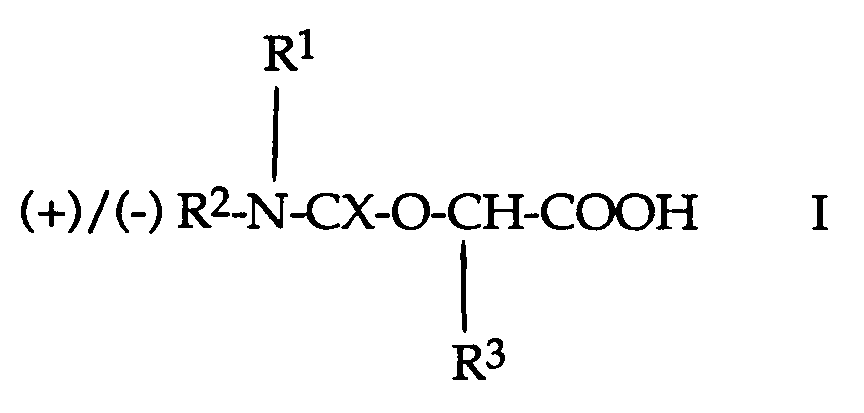 X Sauerstoff oder Schwefel,R¹ Wasserstoff, Alkyl oder ArylR² Wasserstoff, Alkyl, Aryl-C₁₋₃-alkyl oder ArylundR³ den verbleibenden Teil der verwendeten α-Hydroxycarbonsäure bedeuten,mit der Massgabe, dass eines von R¹ und R² Wasserstoff ist;
 X, R¹ und R² die oben angegebenen Bedeutungen besitzenundR⁴ den verbleibenden Teil der verwendeten α-Aminocarbonsäure bedeutet;
 X die oben angegebene Bedeutung besitztundR2' Alkyl, Aryl-C₁₋₃-alkyl oder Aryl undR⁵ den verbleibenden Teil der verwendeten zwei Carboxygruppen aufweisenden α-Hydroxycarbonsäure bedeuten;
 X und R2' die oben angegebenen Bedeutungen besitzenundR⁶ den verbleibenden Teil der verwendeten zwei Carboxygruppen aufweisenden α-Aminocarbonsäure bedeutet.
 - Verfahren nach Anspruch 2, dadurch gekennzeichnet, dass das Spaltreagens (+)- oder (-)-2-Phenylcarbamoyloxy-propionsäure, (+)- oder (-)-α-Phenylcarbamoyloxy-phenylessigsäure, (+)- oder (-)-2-Phenylcarbamoyloxy-bernsteinsäure, (+)- oder (-)-2,3-Di(phenylcarbamoyloxy)-bernsteinsäure, (+)-oder (-)-2-(3-Phenylureido)-propionsäure, (+)- oder (-)-2-(3-Phenylureido)-bernsteinsäure, (+)- oder (-)-5-Carboxymethyl-3-phenyl-2,4-dioxo-1,3-oxazolidin, (+)- oder (-)-5-Carboxymethyl-3-phenyl-2-thio-4-oxo-1,3-oxazolidin oder (+)- oder (-)-5-Carboxymethyl-3-phenyl-2,4-imidazolidindion ist.
- Verfahren nach einem der Ansprüche 1 bis 3, dadurch gekennzeichnet, dass das zu spaltende Diphosphinoxid eine Verbindung der Formel V oder VI ist:
 R⁷ Alkyl, Cycloalkyl, Aryl oder einen fünfgliedrigen Heteroaromaten bedeutet, undR⁸ jeweils Wasserstoff, niederes Alkyl, niederes Alkoxy oder geschütztes Hydroxymethylundn 1,2,3 oder 4 bedeuten,mit der Massgabe, dass die beiden Stellungen 6 und 6' stets einen Substituenten R⁸ tragen;
- Verfahren nach Anspruch 4, dadurch gekennzeichnet, dass das zu spaltende racemische Diphosphinoxid eine der Verbindungen
(RS)-(6,6'-Dimethylbiphenyl-2,2'-diyl)-bis-(diphenylphosphinoxid),
(RS)-(6,6'-Dimethylbiphenyl-2,2'-diyl)-bis-(di-p-tolylphosphinoxid),
(RS)-(6,6'-Dimethylbiphenyl-2,2'-diyl)-bis'(dicyclohexylphosphinoxid),
(RS)-(6,6'-Dimethylbiphenyl-2,2'-diyl)-bis-(di-2-furylphosphinoxid),
(RS)-2,2'-Bis(diphenylphosphinoxido)-1,1'-binaphthyl,
(RS)-2,2'-Bis[di(p-tolyl)phosphinoxido]-1,1'-binaphthyl,
(RS)-2,2'-Bis(di(m-tolyl)phosphinoxido)-1,1'-binaphthyl und
(RS)-2,2'-Bis(dicyclohexylphosphinoxido)-1,1'-binaphthyl
ist. - Diastereomeres Assoziat, dadurch gekennzeichnet, dass es das unmittelbare Produkt des Verfahrens gemäss einem der Ansprüche 1 bis 5 ist.
Applications Claiming Priority (2)
| Application Number | Priority Date | Filing Date | Title |
|---|---|---|---|
| CH1272/91 | 1991-04-29 | ||
| CH127291 | 1991-04-29 |
Publications (3)
| Publication Number | Publication Date |
|---|---|
| EP0511558A2 true EP0511558A2 (de) | 1992-11-04 |
| EP0511558A3 EP0511558A3 (en) | 1993-12-08 |
| EP0511558B1 EP0511558B1 (de) | 1996-10-23 |
Family
ID=4206531
Family Applications (1)
| Application Number | Title | Priority Date | Filing Date |
|---|---|---|---|
| EP92106591A Expired - Lifetime EP0511558B1 (de) | 1991-04-29 | 1992-04-16 | Racemat-Spaltverfahren und diastereomere Assoziate |
Country Status (6)
| Country | Link |
|---|---|
| US (1) | US5334766A (de) |
| EP (1) | EP0511558B1 (de) |
| JP (1) | JPH05148278A (de) |
| AT (1) | ATE144521T1 (de) |
| DE (1) | DE59207400D1 (de) |
| DK (1) | DK0511558T3 (de) |
Families Citing this family (3)
| Publication number | Priority date | Publication date | Assignee | Title |
|---|---|---|---|---|
| US6288280B1 (en) * | 1999-07-09 | 2001-09-11 | Hoffmann-La Roche Inc. | Racemization of atropisomeric bis(phosphine oxide) compounds |
| EP2958894B8 (de) | 2013-02-20 | 2020-02-26 | Reuter Chemische Apparatenbau e.K. | Verfahren zur herstellung von enantiomer angereichertem 3-aminoperidin |
| CN118479984B (zh) * | 2024-05-11 | 2026-03-24 | 山东福长药业有限公司 | 一种使用酒石酸衍生物拆分剂的非奈利酮拆分方法 |
Family Cites Families (4)
| Publication number | Priority date | Publication date | Assignee | Title |
|---|---|---|---|---|
| DE2908358A1 (de) * | 1979-03-03 | 1980-09-11 | Basf Ag | Optisch aktive tertiaere phosphinoxide und tertiaere phosphine, verfahren zu deren herstellung und verwendung der optisch aktiven tertiaeren phosphine fuer asymmetrische synthesen |
| DK350383A (da) * | 1982-08-27 | 1984-02-28 | Hoffmann La Roche | Phosphorforbindelser |
| JPS59157094A (ja) * | 1983-02-28 | 1984-09-06 | Takasago Corp | 2,2′−ビス(ジフエニルホスフイノ)−1,1′−ビナフチルジオキサイドのラセミ体を光学分割する方法 |
| DK0398132T3 (da) * | 1989-05-18 | 1995-12-18 | Hoffmann La Roche | Phosphorforbindelser |
-
1992
- 1992-04-09 US US07/866,384 patent/US5334766A/en not_active Expired - Fee Related
- 1992-04-16 AT AT92106591T patent/ATE144521T1/de not_active IP Right Cessation
- 1992-04-16 DK DK92106591.8T patent/DK0511558T3/da active
- 1992-04-16 DE DE59207400T patent/DE59207400D1/de not_active Expired - Fee Related
- 1992-04-16 EP EP92106591A patent/EP0511558B1/de not_active Expired - Lifetime
- 1992-04-23 JP JP4129377A patent/JPH05148278A/ja active Pending
Also Published As
| Publication number | Publication date |
|---|---|
| EP0511558A3 (en) | 1993-12-08 |
| EP0511558B1 (de) | 1996-10-23 |
| ATE144521T1 (de) | 1996-11-15 |
| US5334766A (en) | 1994-08-02 |
| DE59207400D1 (de) | 1996-11-28 |
| JPH05148278A (ja) | 1993-06-15 |
| DK0511558T3 (de) | 1997-02-17 |
Similar Documents
| Publication | Publication Date | Title |
|---|---|---|
| EP0508296B1 (de) | Verfahren zur Herstellung phosphorhaltiger L-Aminosäuren, deren Derivate und Zwischenprodukte für dieses Verfahren | |
| EP0822935B1 (de) | Verfahren zur herstellung von enantiomerenreinen tropasäureestern | |
| DE69728730T9 (de) | Verfahren für die Trennung einer Enantiomermischung | |
| DE1568621B2 (de) | Diurethane, Verfahren zur Herstellung dieser Verbindungen sowie diese enthaltende herbizide Mittel | |
| DE3817956A1 (de) | Verfahren zur herstellung phosphorhaltiger l-aminosaeuren sowie ihrer ester und n-derivate | |
| EP0146080B1 (de) | Verfahren zur Racematspaltung bicyclischer Imino-alpha-carbonsäureester | |
| EP0546566B1 (de) | Verfahren zur Herstellung von L-Phosphinothricin und seinen Derivaten | |
| EP0511558B1 (de) | Racemat-Spaltverfahren und diastereomere Assoziate | |
| DE60210696T2 (de) | Optisch aktive 4-(tert-Butoxycarbonyl)piperazin Derivate und Verfahren zu ihrer Herstellung | |
| DE60008160T2 (de) | Enantiomerisch reine Reagenzien und Verfahren zur Trennung von Enantiomeren | |
| EP0029175A1 (de) | Verfahren zur Gewinnung der enantiomeren Formen von 4-Cyan-1-(N-methyl-N-(2'-((3",4"-dimethoxyphenyl))-ethyl)-amino)-5-methyl-4-(3',4',5'-trimethoxyphenyl)-hexan und dessen Salzen | |
| EP0048994A1 (de) | Verfahren zur Herstellung von optisch aktiven 2-Anilino-propionsäureestern | |
| DE3878560T2 (de) | Verfahren zur herstellung von estern n-substituierter aminosaeuren. | |
| DE69610549T2 (de) | Neue carbamatverbindungen die eine thiocarbamoylgruppe enthalten und verfahren zu ihrer herstellung | |
| EP0385423B1 (de) | Verfahren zur Herstellung der optischen Isomeren von 1,4-Dihydro-5-isopropoxy-2-methyl-4-(2-trifluormethylphenyl)-1,6-naphthyridin-3-carbonsäure-ethyl-ester und 1,4-Dihydro-5-isopropoxy-2-methyl-4-(2-trifluormethylphenyl)-1,6-naphthyridin-3-carbonsäure- 2-(N-methyl-N-phenylmethylamino)ethyl ester | |
| EP0530506B1 (de) | Optisch aktive Omega-Halogen-2-amino-alkancarbonsäure-derivate, Verfahren zu ihrer Herstellung und ihre Verwendung zur Herstellung optisch aktiver phosphorhaltiger Alpha-Aminosäuren | |
| EP0110202B1 (de) | Verfahren zur Herstellung von Phenylethanolaminen | |
| DE69811358T2 (de) | Verfahren zur herstellung von 1-chlorocarbonyl-4-piperidinopiperidin oder dem hydrochlorid davon | |
| DE69509745T2 (de) | Neue carbamatverbindungen und verfahren zu ihrer herstellung | |
| DE60024540T2 (de) | Synthese von alpha-amino-alpha',alpha'-dihaloketonen und verfahren zur herstellung von beta)-aminosäurederivaten durch verwendung derselben | |
| DE3734219C2 (de) | ||
| DE2810923B2 (de) | Zyklische Phosphorsäureamidester, Verfahren zu deren Herstellung und diese Ester enthaltende insektizide Mischungen | |
| DE2627709C2 (de) | Malonsäure-pentachlorphenylester und deren Herstellung | |
| DE69206400T2 (de) | Aminoalkohole als reagenzien zur optischen auflösung. | |
| DE3137376C2 (de) | Verfahren zur Herstellung von 1,5-Alkylen-3-aryl-hydantoin-Derivaten |
Legal Events
| Date | Code | Title | Description |
|---|---|---|---|
| PUAI | Public reference made under article 153(3) epc to a published international application that has entered the european phase |
Free format text: ORIGINAL CODE: 0009012 |
|
| 17P | Request for examination filed |
Effective date: 19920416 |
|
| AK | Designated contracting states |
Kind code of ref document: A2 Designated state(s): AT BE CH DE DK FR GB IT LI NL SE |
|
| PUAL | Search report despatched |
Free format text: ORIGINAL CODE: 0009013 |
|
| AK | Designated contracting states |
Kind code of ref document: A3 Designated state(s): AT BE CH DE DK FR GB IT LI NL SE |
|
| GRAG | Despatch of communication of intention to grant |
Free format text: ORIGINAL CODE: EPIDOS AGRA |
|
| 17Q | First examination report despatched |
Effective date: 19960119 |
|
| GRAH | Despatch of communication of intention to grant a patent |
Free format text: ORIGINAL CODE: EPIDOS IGRA |
|
| GRAH | Despatch of communication of intention to grant a patent |
Free format text: ORIGINAL CODE: EPIDOS IGRA |
|
| GRAA | (expected) grant |
Free format text: ORIGINAL CODE: 0009210 |
|
| AK | Designated contracting states |
Kind code of ref document: B1 Designated state(s): AT BE CH DE DK FR GB IT LI NL SE |
|
| REF | Corresponds to: |
Ref document number: 144521 Country of ref document: AT Date of ref document: 19961115 Kind code of ref document: T |
|
| REF | Corresponds to: |
Ref document number: 59207400 Country of ref document: DE Date of ref document: 19961128 |
|
| ITF | It: translation for a ep patent filed | ||
| ET | Fr: translation filed | ||
| GBT | Gb: translation of ep patent filed (gb section 77(6)(a)/1977) |
Effective date: 19970120 |
|
| REG | Reference to a national code |
Ref country code: DK Ref legal event code: T3 |
|
| PLBE | No opposition filed within time limit |
Free format text: ORIGINAL CODE: 0009261 |
|
| STAA | Information on the status of an ep patent application or granted ep patent |
Free format text: STATUS: NO OPPOSITION FILED WITHIN TIME LIMIT |
|
| 26N | No opposition filed | ||
| PGFP | Annual fee paid to national office [announced via postgrant information from national office to epo] |
Ref country code: SE Payment date: 20000406 Year of fee payment: 9 |
|
| PGFP | Annual fee paid to national office [announced via postgrant information from national office to epo] |
Ref country code: FR Payment date: 20000411 Year of fee payment: 9 |
|
| PGFP | Annual fee paid to national office [announced via postgrant information from national office to epo] |
Ref country code: GB Payment date: 20000412 Year of fee payment: 9 Ref country code: DK Payment date: 20000412 Year of fee payment: 9 Ref country code: AT Payment date: 20000412 Year of fee payment: 9 |
|
| PGFP | Annual fee paid to national office [announced via postgrant information from national office to epo] |
Ref country code: CH Payment date: 20000414 Year of fee payment: 9 |
|
| PGFP | Annual fee paid to national office [announced via postgrant information from national office to epo] |
Ref country code: DE Payment date: 20000417 Year of fee payment: 9 |
|
| PGFP | Annual fee paid to national office [announced via postgrant information from national office to epo] |
Ref country code: NL Payment date: 20000428 Year of fee payment: 9 |
|
| PGFP | Annual fee paid to national office [announced via postgrant information from national office to epo] |
Ref country code: BE Payment date: 20000622 Year of fee payment: 9 |
|
| PG25 | Lapsed in a contracting state [announced via postgrant information from national office to epo] |
Ref country code: GB Free format text: LAPSE BECAUSE OF NON-PAYMENT OF DUE FEES Effective date: 20010416 Ref country code: DK Free format text: LAPSE BECAUSE OF NON-PAYMENT OF DUE FEES Effective date: 20010416 Ref country code: AT Free format text: LAPSE BECAUSE OF NON-PAYMENT OF DUE FEES Effective date: 20010416 |
|
| PG25 | Lapsed in a contracting state [announced via postgrant information from national office to epo] |
Ref country code: SE Free format text: LAPSE BECAUSE OF NON-PAYMENT OF DUE FEES Effective date: 20010417 |
|
| PG25 | Lapsed in a contracting state [announced via postgrant information from national office to epo] |
Ref country code: FR Free format text: THE PATENT HAS BEEN ANNULLED BY A DECISION OF A NATIONAL AUTHORITY Effective date: 20010430 Ref country code: BE Free format text: LAPSE BECAUSE OF NON-PAYMENT OF DUE FEES Effective date: 20010430 |
|
| PG25 | Lapsed in a contracting state [announced via postgrant information from national office to epo] |
Ref country code: LI Free format text: LAPSE BECAUSE OF NON-PAYMENT OF DUE FEES Effective date: 20010515 Ref country code: CH Free format text: LAPSE BECAUSE OF NON-PAYMENT OF DUE FEES Effective date: 20010515 |
|
| BERE | Be: lapsed |
Owner name: F. HOFFMANN-LA ROCHE A.G. Effective date: 20010430 |
|
| PG25 | Lapsed in a contracting state [announced via postgrant information from national office to epo] |
Ref country code: NL Free format text: LAPSE BECAUSE OF NON-PAYMENT OF DUE FEES Effective date: 20011101 |
|
| EUG | Se: european patent has lapsed |
Ref document number: 92106591.8 |
|
| GBPC | Gb: european patent ceased through non-payment of renewal fee |
Effective date: 20010416 |
|
| REG | Reference to a national code |
Ref country code: CH Ref legal event code: PL |
|
| NLV4 | Nl: lapsed or anulled due to non-payment of the annual fee |
Effective date: 20011101 |
|
| PG25 | Lapsed in a contracting state [announced via postgrant information from national office to epo] |
Ref country code: DE Free format text: LAPSE BECAUSE OF NON-PAYMENT OF DUE FEES Effective date: 20020201 |
|
| REG | Reference to a national code |
Ref country code: FR Ref legal event code: ST |
|
| PG25 | Lapsed in a contracting state [announced via postgrant information from national office to epo] |
Ref country code: IT Free format text: LAPSE BECAUSE OF NON-PAYMENT OF DUE FEES;WARNING: LAPSES OF ITALIAN PATENTS WITH EFFECTIVE DATE BEFORE 2007 MAY HAVE OCCURRED AT ANY TIME BEFORE 2007. THE CORRECT EFFECTIVE DATE MAY BE DIFFERENT FROM THE ONE RECORDED. Effective date: 20050416 |