EP0511882B1 - Cyclopentadienyl- und/oder Dicyclopentadienylengruppen enthaltende Polyorganosiloxane, ihre Herstellung und ihre Verwendung in zu Elastomeren vernetzbaren Zusammensetzungen - Google Patents
Cyclopentadienyl- und/oder Dicyclopentadienylengruppen enthaltende Polyorganosiloxane, ihre Herstellung und ihre Verwendung in zu Elastomeren vernetzbaren Zusammensetzungen Download PDFInfo
- Publication number
- EP0511882B1 EP0511882B1 EP92400668A EP92400668A EP0511882B1 EP 0511882 B1 EP0511882 B1 EP 0511882B1 EP 92400668 A EP92400668 A EP 92400668A EP 92400668 A EP92400668 A EP 92400668A EP 0511882 B1 EP0511882 B1 EP 0511882B1
- Authority
- EP
- European Patent Office
- Prior art keywords
- chosen
- formula
- group
- meaning
- given above
- Prior art date
- Legal status (The legal status is an assumption and is not a legal conclusion. Google has not performed a legal analysis and makes no representation as to the accuracy of the status listed.)
- Expired - Lifetime
Links
- 0 CCC1C(C2)CCC(C3)C=*(CC)CC3C2C1CC Chemical compound CCC1C(C2)CCC(C3)C=*(CC)CC3C2C1CC 0.000 description 3
Classifications
-
- C—CHEMISTRY; METALLURGY
- C08—ORGANIC MACROMOLECULAR COMPOUNDS; THEIR PREPARATION OR CHEMICAL WORKING-UP; COMPOSITIONS BASED THEREON
- C08L—COMPOSITIONS OF MACROMOLECULAR COMPOUNDS
- C08L83/00—Compositions of macromolecular compounds obtained by reactions forming in the main chain of the macromolecule a linkage containing silicon with or without sulfur, nitrogen, oxygen or carbon only; Compositions of derivatives of such polymers
- C08L83/04—Polysiloxanes
-
- C—CHEMISTRY; METALLURGY
- C08—ORGANIC MACROMOLECULAR COMPOUNDS; THEIR PREPARATION OR CHEMICAL WORKING-UP; COMPOSITIONS BASED THEREON
- C08G—MACROMOLECULAR COMPOUNDS OBTAINED OTHERWISE THAN BY REACTIONS ONLY INVOLVING UNSATURATED CARBON-TO-CARBON BONDS
- C08G77/00—Macromolecular compounds obtained by reactions forming a linkage containing silicon with or without sulfur, nitrogen, oxygen or carbon in the main chain of the macromolecule
- C08G77/04—Polysiloxanes
- C08G77/20—Polysiloxanes containing silicon bound to unsaturated aliphatic groups
-
- C—CHEMISTRY; METALLURGY
- C08—ORGANIC MACROMOLECULAR COMPOUNDS; THEIR PREPARATION OR CHEMICAL WORKING-UP; COMPOSITIONS BASED THEREON
- C08G—MACROMOLECULAR COMPOUNDS OBTAINED OTHERWISE THAN BY REACTIONS ONLY INVOLVING UNSATURATED CARBON-TO-CARBON BONDS
- C08G77/00—Macromolecular compounds obtained by reactions forming a linkage containing silicon with or without sulfur, nitrogen, oxygen or carbon in the main chain of the macromolecule
- C08G77/04—Polysiloxanes
- C08G77/38—Polysiloxanes modified by chemical after-treatment
-
- C—CHEMISTRY; METALLURGY
- C08—ORGANIC MACROMOLECULAR COMPOUNDS; THEIR PREPARATION OR CHEMICAL WORKING-UP; COMPOSITIONS BASED THEREON
- C08G—MACROMOLECULAR COMPOUNDS OBTAINED OTHERWISE THAN BY REACTIONS ONLY INVOLVING UNSATURATED CARBON-TO-CARBON BONDS
- C08G77/00—Macromolecular compounds obtained by reactions forming a linkage containing silicon with or without sulfur, nitrogen, oxygen or carbon in the main chain of the macromolecule
- C08G77/48—Macromolecular compounds obtained by reactions forming a linkage containing silicon with or without sulfur, nitrogen, oxygen or carbon in the main chain of the macromolecule in which at least two but not all the silicon atoms are connected by linkages other than oxygen atoms
- C08G77/50—Macromolecular compounds obtained by reactions forming a linkage containing silicon with or without sulfur, nitrogen, oxygen or carbon in the main chain of the macromolecule in which at least two but not all the silicon atoms are connected by linkages other than oxygen atoms by carbon linkages
-
- C—CHEMISTRY; METALLURGY
- C08—ORGANIC MACROMOLECULAR COMPOUNDS; THEIR PREPARATION OR CHEMICAL WORKING-UP; COMPOSITIONS BASED THEREON
- C08L—COMPOSITIONS OF MACROMOLECULAR COMPOUNDS
- C08L83/00—Compositions of macromolecular compounds obtained by reactions forming in the main chain of the macromolecule a linkage containing silicon with or without sulfur, nitrogen, oxygen or carbon only; Compositions of derivatives of such polymers
- C08L83/14—Compositions of macromolecular compounds obtained by reactions forming in the main chain of the macromolecule a linkage containing silicon with or without sulfur, nitrogen, oxygen or carbon only; Compositions of derivatives of such polymers in which at least two but not all the silicon atoms are connected by linkages other than oxygen atoms
-
- C—CHEMISTRY; METALLURGY
- C08—ORGANIC MACROMOLECULAR COMPOUNDS; THEIR PREPARATION OR CHEMICAL WORKING-UP; COMPOSITIONS BASED THEREON
- C08G—MACROMOLECULAR COMPOUNDS OBTAINED OTHERWISE THAN BY REACTIONS ONLY INVOLVING UNSATURATED CARBON-TO-CARBON BONDS
- C08G77/00—Macromolecular compounds obtained by reactions forming a linkage containing silicon with or without sulfur, nitrogen, oxygen or carbon in the main chain of the macromolecule
- C08G77/04—Polysiloxanes
- C08G77/12—Polysiloxanes containing silicon bound to hydrogen
-
- C—CHEMISTRY; METALLURGY
- C08—ORGANIC MACROMOLECULAR COMPOUNDS; THEIR PREPARATION OR CHEMICAL WORKING-UP; COMPOSITIONS BASED THEREON
- C08G—MACROMOLECULAR COMPOUNDS OBTAINED OTHERWISE THAN BY REACTIONS ONLY INVOLVING UNSATURATED CARBON-TO-CARBON BONDS
- C08G77/00—Macromolecular compounds obtained by reactions forming a linkage containing silicon with or without sulfur, nitrogen, oxygen or carbon in the main chain of the macromolecule
- C08G77/04—Polysiloxanes
- C08G77/14—Polysiloxanes containing silicon bound to oxygen-containing groups
-
- C—CHEMISTRY; METALLURGY
- C08—ORGANIC MACROMOLECULAR COMPOUNDS; THEIR PREPARATION OR CHEMICAL WORKING-UP; COMPOSITIONS BASED THEREON
- C08G—MACROMOLECULAR COMPOUNDS OBTAINED OTHERWISE THAN BY REACTIONS ONLY INVOLVING UNSATURATED CARBON-TO-CARBON BONDS
- C08G77/00—Macromolecular compounds obtained by reactions forming a linkage containing silicon with or without sulfur, nitrogen, oxygen or carbon in the main chain of the macromolecule
- C08G77/04—Polysiloxanes
- C08G77/14—Polysiloxanes containing silicon bound to oxygen-containing groups
- C08G77/16—Polysiloxanes containing silicon bound to oxygen-containing groups to hydroxy groups
-
- C—CHEMISTRY; METALLURGY
- C08—ORGANIC MACROMOLECULAR COMPOUNDS; THEIR PREPARATION OR CHEMICAL WORKING-UP; COMPOSITIONS BASED THEREON
- C08G—MACROMOLECULAR COMPOUNDS OBTAINED OTHERWISE THAN BY REACTIONS ONLY INVOLVING UNSATURATED CARBON-TO-CARBON BONDS
- C08G77/00—Macromolecular compounds obtained by reactions forming a linkage containing silicon with or without sulfur, nitrogen, oxygen or carbon in the main chain of the macromolecule
- C08G77/04—Polysiloxanes
- C08G77/14—Polysiloxanes containing silicon bound to oxygen-containing groups
- C08G77/18—Polysiloxanes containing silicon bound to oxygen-containing groups to alkoxy or aryloxy groups
-
- C—CHEMISTRY; METALLURGY
- C08—ORGANIC MACROMOLECULAR COMPOUNDS; THEIR PREPARATION OR CHEMICAL WORKING-UP; COMPOSITIONS BASED THEREON
- C08G—MACROMOLECULAR COMPOUNDS OBTAINED OTHERWISE THAN BY REACTIONS ONLY INVOLVING UNSATURATED CARBON-TO-CARBON BONDS
- C08G77/00—Macromolecular compounds obtained by reactions forming a linkage containing silicon with or without sulfur, nitrogen, oxygen or carbon in the main chain of the macromolecule
- C08G77/04—Polysiloxanes
- C08G77/22—Polysiloxanes containing silicon bound to organic groups containing atoms other than carbon, hydrogen and oxygen
- C08G77/24—Polysiloxanes containing silicon bound to organic groups containing atoms other than carbon, hydrogen and oxygen halogen-containing groups
-
- C—CHEMISTRY; METALLURGY
- C08—ORGANIC MACROMOLECULAR COMPOUNDS; THEIR PREPARATION OR CHEMICAL WORKING-UP; COMPOSITIONS BASED THEREON
- C08G—MACROMOLECULAR COMPOUNDS OBTAINED OTHERWISE THAN BY REACTIONS ONLY INVOLVING UNSATURATED CARBON-TO-CARBON BONDS
- C08G77/00—Macromolecular compounds obtained by reactions forming a linkage containing silicon with or without sulfur, nitrogen, oxygen or carbon in the main chain of the macromolecule
- C08G77/04—Polysiloxanes
- C08G77/22—Polysiloxanes containing silicon bound to organic groups containing atoms other than carbon, hydrogen and oxygen
- C08G77/26—Polysiloxanes containing silicon bound to organic groups containing atoms other than carbon, hydrogen and oxygen nitrogen-containing groups
-
- C—CHEMISTRY; METALLURGY
- C08—ORGANIC MACROMOLECULAR COMPOUNDS; THEIR PREPARATION OR CHEMICAL WORKING-UP; COMPOSITIONS BASED THEREON
- C08G—MACROMOLECULAR COMPOUNDS OBTAINED OTHERWISE THAN BY REACTIONS ONLY INVOLVING UNSATURATED CARBON-TO-CARBON BONDS
- C08G77/00—Macromolecular compounds obtained by reactions forming a linkage containing silicon with or without sulfur, nitrogen, oxygen or carbon in the main chain of the macromolecule
- C08G77/70—Siloxanes defined by use of the MDTQ nomenclature
Definitions
- the present invention relates to polyorganosiloxane polymers with cyclopentadienyl and / or cyclopentadienylene and / or dicyclopentadienylene functionality linked to silicon atoms via a hydrocarbon ball joint, their preparation and their use in silicone compositions which can be crosslinked into an elastomer, in particular by atmospheric humidity and / or oxygen in the air.
- US-A-2957901 describes a silane or a polysiloxane carrying pentadienyl rings, but the latter are here directly linked to the silicon atoms.
- R1 is chosen from methyl, phenyl and vinyl radicals, at least 70% by number of the radicals R1 being methyl.
- the polyorganosiloxanes according to the present invention can have a linear, cyclic or branched structure and are advantageously in the form of oils with a viscosity of between 1 and 1,000,000 mPa.s at 25 ° C, preferably between 100 and 500,000 mPa .s.
- the polyorganosiloxanes according to the figure (3 ") can be prepared for example by reacting a polyorganosiloxane of formula with cyclopentadienyl sodium of formula During this reaction, sodium chloride and the product of formula (3 ") are formed, the meanings of R, d 'and e' having been given above.
- Sodium cyclopentadienyl is a product whose preparation is for example described in US Patent 2,957,901 in Examples I and II.
- the polyorganosiloxanes of formulas (1), (1 '), (3) and (4) can be prepared by hydrolysis and polycondensation of the silanes of formulas and / or silanes of formula
- chlorosilanes of formula (6) makes it possible to incorporate into the organopolysiloxane of formula (1), units of formula (2).
- the polycondensation can be stopped by simple neutralization of the reaction medium.
- the dichlorosilane R1YCl2Si is hydrolyzed and polycondensed with optionally the dichlorosilane of formula R 2 1 SiCl2.
- reaction mixture comprising polymers of formula (3) blocked at each of their ends by a hydroxyl group or by the motif R 1 2 YSiO 0.5 if the in addition, the silane R 1 2 YSiCl is used at the start, the meanings of Y and R1 being the same as those given above.
- the polycondensation can also be stopped by adding, at the end of the reaction, an organosilicon compound capable of reacting with the terminal hydroxyls of the polymer of formula (3) formed, this organosilicon compound being able to correspond to the formulas: R1 3SiCl, R1 3SiNHSiR1 3 and R1 3SiOSiR1 3.
- the duration of the hydrolysis can be between a few seconds and several hours.
- the aqueous phase is separated from the siloxane phase by any suitable physical means, generally by decantation and extraction with an organic solvent such as isopropyl ether.
- the siloxane phase can be subsequently washed with water, then optionally distilled to separate the linear polymers of formula (3) from the cyclic polymers of formula (4).
- silanes of formula (5) can be prepared according to the teaching of US Pat. No. 4,645,850, while the silanes of formula (5 ′) come from the partial or total dimerization of the silane of formula (5).
- silanes of formula (5 ⁇ ) mention may be made of those of formulas:
- the polyorganosiloxane resins having at least two hydroxyl functions used are preferably liquid and are well known to specialists in silicone. They comprise T and / or Q units (at least 30% by weight) with M and D units, the meaning of T, Q, D and M being well known to those skilled in the art of silicones and explained in NOLL's book, page 3, titled Chemistry and Technology of Silicones.
- polysiloxanes obtained by reaction of a silane of formula (5 ') with an ⁇ , ⁇ -dihydroxypolydiorganosiloxane oil according to formula (7) correspond to the polyorganosiloxanes of formula (3') described above.
- the present invention further relates to a polyorganosiloxane composition which is stable on storage in the absence of moisture and / or oxygen and which can be crosslinked into an elastomer by exposure to ambient temperature (and optionally by heating) to atmospheric humidity and / or to oxygen in the air.
- curing catalyst (2) it is possible to use in particular the salts of monocarboxylic acid of metals such as barium, bismuth, calcium, cerium, cobalt, chromium, copper, iron, lead, magnesium, manganese, nickel, rare earths, tin, zinc and zirconium.
- Other organic ligands can be linked to metals such as the chelated ligands (acetylacetonate) and carbonyl.
- the recommended catalysts are the salts of cobalt, iron and manganese monocarboxylic acids, in particular cobalt 2-ethylhexanoate and more particularly dibutyltin dilaurate or diacetylacetonate.
- catalytically effective amount of catalyst is meant an amount sufficient to ensure suitable crosslinking. Amounts of 0.01 to 5 parts, preferably 0.1 to 3 parts by weight of metal salt per 100 parts of polysiloxane (1), are generally suitable.
- composition may also comprise a drying agent chosen, for example, from alkali and alkaline earth metal oxides.
- a redox agent of the iron oxide, copper sulphate type, etc. for example at a dose of 0.1 to 3 parts per 100 parts of oil (1).
- the mineral fillers (3) are used in an amount of 0 to 250 parts, preferably 20 to 200 parts, per 100 parts of polymer (1).
- fillers can be in the form of very finely divided products, the average particle diameter of which is less than 0.1 micrometer.
- these fillers are combustion silicas and precipitation silicas; their BET specific surface is generally greater than 40 m / g.
- fillers can also be in the form of more roughly divided products, with an average particle diameter greater than 0.1 micrometer.
- examples of such fillers include ground quartz, diatomaceous silicas, calcium carbonate, calcined clay, titanium oxide of the rutile type, iron oxides, zinc, chromium, zirconium, magnesium, the different forms of alumina (hydrated or not), boron nitride, lithopone, barium metaborate, barium sulphate, glass microbeads, their specific surface is generally less than 30 m / g.
- the fillers (3) may have been modified at the surface by treatment with the various organosilicon compounds usually used for this use.
- these organosilicon compounds can be organochlorosilanes, diorganocyclopolysiloxanes, hexaorganodisiloxanes, hexaorganodisilazanes or diorganocyclopolysiloxanes (French patents FR-A-1,126,884, FR-A-1,136,885, FR-A-1,236,505; English patent GB -A-1 247 234).
- the treated fillers contain, in most cases, from 3 to 30% of their weight of organosilicon compounds.
- the fillers (3) can consist of a mixture of several types of fillers of different particle size; thus for example, they can consist of 5 to 95% of finely divided silicas with BET specific surface greater than 40 m / g and 95 to 5% of more roughly divided silicas, of specific surface less than 30 m / g or of treated or untreated calcium carbonate.
- the amount used represents 1 to 30 parts of oil per 100 parts of polymer (1).
- a bonding agent (5) can be added in an amount of 0 to 20 parts, preferably 0.2 to 10 parts, per 100 parts of polysiloxane (1).
- This agent is chosen from organosilicon compounds carrying on the one hand organic groups substituted by radicals chosen from the group of amino, ureido, isocyanato, epoxy, alkenyl, isocyanurate, hydantoid, mercaptoester radicals and on the other hand hydrolyzable groups bound to silicon atoms.
- organosilicon compounds corresponding to the following formulas: NH2CH2CH2NHCH2CH (CH3) COO (CH2) 3Si (OCH3) 3 (C2H5O) 3Si (CH2) 3NH2 (CH3O) 3Si (CH2) 3NHCH2CH2NH2
- compositions according to the invention may also contain the usual adjuvants or additives, usually used in silicone elastomer compositions, well known to those skilled in the art.
- adjuvants or additives mention may in particular be made of coloring pigments, thermal stabilizers, antioxidants, fluidization agents, thixotropic agents, antioxidants, thermal stabilizers, perfumes, etc.
- compositions according to the present invention can harden only under the action of air oxygen if the polyorganosiloxanes (1) used do not contain hydrolysable groups X, or can harden under the action of atmospheric moisture and / or oxygen from the air if they contain hydrolyzable groups X.
- compositions in accordance with the invention it is necessary to use an apparatus which makes it possible to intimately mix, protected from humidity and / or gaseous oxygen and preferably without the addition of heat, the various constituents fundamentals to which the aforementioned adjuvants and additives may be added.
- a more particularly recommended process is that which consists in introducing into a mixer, at room temperature, protected from humidity and / or oxygen from the air, the ingredients in the following order: the oil (1), optionally the oil (4), possibly the plasticizer, the catalyst (2), then optionally the drying agent and finally the filler (3) with possibly the adhesion agent (5).
- a degassing is then preferably carried out under a reduced pressure of, for example, between 0.01 and 10 KPa.
- compositions according to the invention are stable on storage, in the absence of humidity and / or gaseous oxygen, for at least 6 months and even a year, and are more particularly usable for grouting in the building industry, assembly of the most diverse materials (metals, plastics, natural and synthetic rubbers, wood, cardboard, earthenware, brick, ceramic, glass, stone, concrete, masonry elements), insulation of electrical conductors, coating of electronic circuits, the preparation of molds for the manufacture of synthetic resin or foam objects.
- the amount of diluent remains generally small, it is generally less than 50% by weight relative to the total weight of the composition.
- the aforementioned dilutions of these compositions in organic diluents are more particularly usable for the impregnation in thin layers of woven or nonwoven articles, the coating of sheets of metal or of plastic or cellulosic material; however they can be sprayed, for example by spraying using a paint spray gun, on any substrate, for which it is necessary to obtain a coating with a thickness of the order of 5 to 300 ⁇ m .
- the diluents evaporate and the released compositions harden into a perfectly uniform rubbery film.
- this elastomer film can serve as an inert, non-toxic non-stick coating of various substrates in contact with food products such as (i) wrapping papers for confectionery, or frozen meats, (2i) metal bins usable for the preparation of ice creams and sorbets and (3i) of metallic nets in which the bread dough is deposited and molded and which is introduced with their contents into the ovens for baking bread. It can also be used as a non-stick and non-toxic coating of materials in contact with the human body such as compresses, special dressings for burns.
- compositions according to the invention are capable of crosslinking into an elastomer either by exposure of the silicone composition to heat, or by exposure of the composition to ultraviolet radiation.
- the deposited layer is transformed into a rubbery film; the elastomer film is removed as soon as it is demouldable and, after aging for x days at room temperature, measures the dynamometric properties of the elastomers, namely:
- the mixture is stirred for one hour at 25 ° C under an inert nitrogen atmosphere.
- the viscosity of the oil is then 18,950 mPa.s at 25 ° C.
- An assay of the remaining silanols shows that there has been no disappearance of the latter. There was therefore no functionalization.
- Example 2 The procedure is the same as for Example 1 except that the oil / silane mixture is heated under nitrogen to 80 ° C. before starting the functionalization reaction by the introduction of 1.44 g of methanolic solution of lithine containing 2 , 85 mmol of LiOH acting as catalyst. It is further heated for one hour to 80 ° C., then a neutralizing solution of phosphoric acid is poured in and it is left for another 10 minutes at 80 ° C. It is then cooled to 20 ° C. and a functionalized oil is recovered which no longer contains silanols whose viscosity is 70,000 mPas.
- the oil obtained has the formula and corresponds to a polysiloxane according to the present invention, of general formula (3 ′).
- Elastomeric compositions are produced from the oil obtained in Example 2 and these compositions crosslink to atmospheric humidity and to oxygen in the air.
- compositions obtained are stored in a cartridge which is sealed against humidity and oxygen from the air for 48 hours or 3 months before being extruded and then spread to form elastomeric films, the dynamometric properties of which are measured during crosslinking. .
- the thickness of the films is 2 mm.
- porous silica microbeads also called spherosil, grafted with sulfonated polystyrene and having H+ catalytic sites (0.6 meq / kg) are introduced into a 4 cm diameter, 20 cm long and therefore 250 cm3 capacity cylindrical reactor. g).
- the particle size of the beads is 100 to 200 microns.
- the system is provided with a heating jacket and a probe makes it possible to measure the temperature inside the reactor.
- the reactor is connected to a pump for continuously supplying the reactants, a mixture comprising: 5000 g, not dried,
- the mass is heated to 84 ° C. and one begins to feed the reactor at the rate of 2 ml / min.
- Example 6 512 parts of the oil (HU6) of Example 6 are introduced into a 2-liter glass reactor fitted with a central stirring system and one with a double-jacket cooling or heating system.
- the oil is stored away from air and is called (HU 7) thereafter.
- the expected product represents 75% of the reaction crude.
- the mixture is left stirring for 2 hours 15 minutes under argon at 90 ° C. and then the methanol formed is removed under absolute pressure of 1 mm Hg at 90 ° C.
- the viscosity of the oil obtained at 25 ° C is 12,000 mPa.s and the average molecular weight of the oil is approximately 40,000. This oil will be called HU9 subsequently.
- the mixture is left stirring for 1 hour at 90 ° C. and then the methanol formed is removed under absolute pressure of 1 mmHg at 90 ° C. for 2 hours.
- the viscosity of the oil obtained at 25 ° C is 35,000 mPa.s (HUII).
- Elastomeric compositions are produced from oil (HUII).
- compositions crosslink to atmospheric humidity and to oxygen in the air.
- compositions obtained are stored in a cartridge which is sealed against humidity and oxygen from the air for 48 hours before being extruded and then spread to form elastomeric films, the dynamometric properties of which are measured during crosslinking.
- the thickness of the films is 2 mm.
- EXAMPLE 12 EXAMPLE 13 STORAGE 48 hours 48 hours x 0 3.8 y 0.59 0.23 z 0.5 0.24 not 0 0.12 Aspect Ivory Ivory tfp (mn) 10 5 Demoulding (days) > 7 days 4 Shore A hardness 7 days - 5 14 days - 20 R. Break (Mpa) 7 days - 0.6 Elongation at break (%) 7 days - 220 100% module - 0.4
Landscapes
- Chemical & Material Sciences (AREA)
- Health & Medical Sciences (AREA)
- Chemical Kinetics & Catalysis (AREA)
- Medicinal Chemistry (AREA)
- Polymers & Plastics (AREA)
- Organic Chemistry (AREA)
- General Chemical & Material Sciences (AREA)
- Compositions Of Macromolecular Compounds (AREA)
- Silicon Polymers (AREA)
Claims (10)
- Polyorganosiloxan-Polymer, dadurch gekennzeichnet, daß es ein Polysiloxan (P₁), das pro Molekül mindestens eine Struktureinheit der Formel (1)

 - X, gleich oder verschieden, hydrolysierbare Gruppen darstellt, ausgewählt unter einem Halogenatom und unter den Resten N-Amino substituiert, N-Amido substituiert, N,N-Amino disubstituiert, Cetiminoxy, Aldiminoxy, Alkoxy, Acyloxy, Enoxy, Alkoxyalkylenoxy,- R¹, gleich oder verschieden, monovalente Kohlenwasserstoffgruppen mit 1 bis 10 Kohlenstoffatomen darstellt, gegebenenfalls substituiert durch Halogenatome oder Cyangruppen,- Z einen gesättigten divalenten, linearen oder verzweigten Kohlenwasserstoffrest mit 1 bis 10 Kohlenstoffatomen bedeutet,- a null, 1 oder 2 ist,- b null, 1 oder 2 ist,- a + b höchstens gleich 2 ist,- p gleich 1 oder 2 ist,- das Polysiloxan (P₁) pro Molekül mindestens eine Struktureinheit (1) aufweist, wenn a verschieden von null ist und mindestens zwei Struktureinheiten (1), wenn a gleich null ist.
 - Polyorganosiloxan-Polymer nach Anspruch 1, dadurch gekennzeichnet, daß das Polysiloxan der Formel (1) und/oder (1') außerdem andere Siloxyl-Struktureinheiten umfaßt, die der Formel (2)
(R¹)c SiO(4-c)/2
entsprechen, in der- R¹ die gleiche Bedeutung wie oben angegeben besitzt,- c unter null, 1, 2 und 3 ausgewählt wird. - Polyorganosiloxan nach irgendeinem der vorstehenden Ansprüche, dadurch gekennzeichnet, daß es unter den statistischen, sequenzierten oder Block-Diorganopolysiloxan-Copolymeren der mittleren Formel (3)
 - Y die Gruppe
 - R¹ und X die gleiche Bedeutung wie oben angegeben besitzen,- Y' unter den Resten Y, R¹ und Hydroxyl ausgewählt wird,- R⁸ unter einem Rest R¹ und einem Rest X ausgewählt wird,- d eine Zahl zwischen 0 und 1000 ist,- e eine ganze Zahl zwischen 0 und 50 ist,- wenn e = 0 ist die zwei Reste Y' gleich Y sind,und unter denen der Formel (4)
 - R¹ und Y die oben angegebene Bedeutung besitzen,- f eine ganze Zahl zwischen 0 und einschließlich 9 ist,- g eine ganze Zahl zwischen 1 und einschließlich 9 ist,- f + g zwischen 3 und einschließlich 10 beträgt.
 - Polyorganosiloxan-Polymer nach irgendeinem der Ansprüche 1 oder 2, dadurch gekennzeichnet, daß es ausgewählt wird unter. den Polysiloxanen der Formel (3')
 - Y eine Gruppe
 - Z die oben angegebene Bedeutung besitzt,- R¹ die oben angegebene Bedeutung besitzt,- R⁸ unter einem Rest R¹ und einem Rest X ausgewählt wird, deren Bedeutung oben angegeben wurde,- A ausgewählt wird unter :. einem Wasserstoffatom,. einer Gruppe R1 3Si-, wobei die Bedeutung von R¹ oben angegeben wurde,. einer Gruppewobei die Bedeutungen von R⁸, Y und X oben angegeben wurden,
 - A' ausgewählt wird unter. dem Rest X, dessen Bedeutung oben angegeben wurde,. der Gruppe
 - t zwischen 5 und 1000 beträgt, Grenzwerte eingeschlossen,- v zwischen 1 und 200 beträgt, Grenzwerte eingeschlossen, und zwischen 2 und 200, wenn A unter einem Wasserstoffatom oder einer Gruppe R1 3Si- ausgewählt wird,. und/oder den Polysiloxanen der Formel (3"')
 - Z die gleiche Bedeutung wie oben angegeben besitzt,- B ausgewählt wird unter. R⁸ wie oben definiert,. der Gruppe
 - B' ausgewählt wird unter. dem Wasserstoffatom,. einer Gruppe R1 3Si-,. einer Gruppe
 - t zwischen 5 und 1000 beträgt, Grenzwerte eingeschlossen,- v zwischen 1 und 200 beträgt, Grenzwerte eingeschlossen, und zwischen 2 und 200, wenn B' ein Wasserstoffatom oder eine Gruppe R1 3Si- darstellt,. und/oder den Polysiloxanen der Formel (3"")
 - Y⁵ eine Gruppe
 - R¹ und R⁸ die gleiche Bedeutung wie oben angegeben besitzen,- C ausgewählt wird unter. einem Wasserstoffatom,. einer Gruppe R1 3Si-,. einer Gruppe
 - C' ausgewählt wird unter. dem Rest X, dessen Bedeutung oben angegeben wurde,. der Gruppe
 - t zwischen 5 und 1000 beträgt, Grenzwerte eingeschlossen,- v zwischen 1 und 200 beträgt, Grenzwerte eingeschlossen, und zwischen 2 und 200, wenn C unter einem Wasserstoffatom oder einer Gruppe R1 3Si- ausgewählt wird.
 - Polyorganosiloxan-Polymer nach irgendeinem der Ansprüche 1 bis 3, dadurch gekennzeichnet, daß es ein Polysiloxan der Formel (3")
 - Y die Gruppe
 - R, gleich oder verschieden, monovalente Kohlenwasserstoffgruppen mit 1 bis 10 Kohlenstoffatomen darstellt,- d' eine Zahl zwischen 10 und 1000 ist,- e' eine Zahl zwischen 2 und 50 ist.
 - Verfahren zur Herstellung des Polyorganosiloxans der Formel (3") nach Anspruch 5, dadurch gekennzeichnet, daß man ein Polyorganosiloxan der Formel

- Verfahren zur Herstellung der Polysiloxane nach Anspruch 1 bis 3, dadurch gekennzeichnet, daß man Silane der Formel


 - gegebenenfalls in Anwesenheit eines Halogensilans, vorzugsweise eines Chlorsilans der Formel (6)
(R¹)j (Cl)k Si (6)
in der- Z, R¹ und X die oben angegebenen Bedeutungen besitzen,- h zwischen 2 und 3 gewählt wird,- i zwischen null und 1 gewählt wird,- h + i = 3 beträgt,- i' zwischen null, 1 oder 2 gewählt wird,- h' zwischen 1, 2 oder 3 gewählt wird,- i' + h' = 3 beträgt,- j zwischen null, 1, 2 oder 3 gewählt wird,- k zwischen 1, 2, 3 oder 4 gewählt wird,- j + k = 4 beträgt,hydrolysiert und polykondensiert. - Verfahren zur Herstellung von Polyorganosiloxan-Polymeren nach Anspruch 4, dadurch gekennzeichnet, daß man- ein lineares Polydiorganosiloxan der Formel (7)
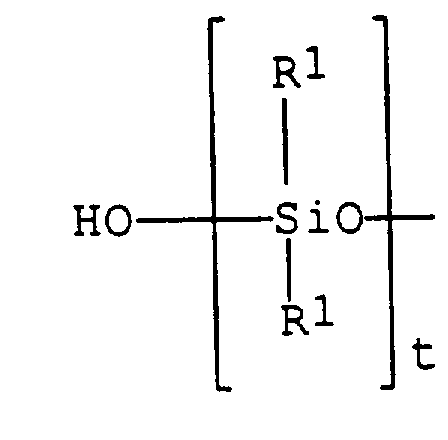
 - t zwischen 5 und 1000 beträgt, Grenzwerte eingeschlossen,- R¹ die gleiche Bedeutung wie oben angegeben besitzt, mit mindestens einem Silan, ausgewählt unter denen der Formeln (5), (5') und (5") nach Anspruch 7, zur Reaktion bringt.
 - Polyorganosiloxan-Zusammensetzung, die bei Abwesenheit von Feuchtigkeit und/oder gasförmigem Sauerstoff lagerstabil und durch atmosphärische Feuchtigkeit und/oder Luftsauerstoff, gegebenenfalls unter Erwärmung, zu einem Elastomer aushärtbar ist, dadurch gekennzeichnet, daß sie in Gewicht umfaßt:1. - 100 Teile von mindestens einem Polyorganosiloxan, ausgewählt unter denen der obigen Ansprüche 1 bis 5,2. - eine katalytisch wirksame Menge eines metallischen Härtungskatalysators,3. - 0 bis 250 Teile von mindestens einem mineralischen Füllstoff, wobei die genannte Zusammensetzung unter Einwirkung von lediglich atmosphärischer Feuchtigkeit aushärten kann, wenn hydrolysierbare Gruppen X in den Polyorganosiloxanen nach Anspruch 1 bis 5 verbleiben.
- Zusammensetzung nach Anspruch 9, dadurch gekennzeichnet, daß sie außerdem pro 100 Teile Polyorganosiloxan (1) umfaßt:
+ 1 bis 30 Teile eines nicht reaktiven Polydiorganosiloxan-Öles der Formel (8) - R' unter den linearen oder verzweigten Alkylresten mit 1 bis 12 Kohlenstoffatomen und einem Phenylrest, gegebenenfalls substituiert durch einen oder mehrere niedere Alkylreste, ausgewählt wird;- w eine ganze oder gebrochene Zahl in der Weise bedeutet, daß das Polymer der Formel (8) eine Viskosität bei 25 °C von unter 100.000 mPa˙s aufweist;+ und/oder 0,2 bis 10 Teile eines Haftmittels.
Applications Claiming Priority (2)
| Application Number | Priority Date | Filing Date | Title |
|---|---|---|---|
| FR9105648 | 1991-04-30 | ||
| FR919105648A FR2676064B1 (fr) | 1991-04-30 | 1991-04-30 | Polyorganosiloxanes a groupements cyclopentadienyles et/ou cyclopentadienylenes et/ou dicyclopentadienylenes, leurs preparations et leur utilisation dans des compositions reticulables en elastomeres. |
Publications (2)
| Publication Number | Publication Date |
|---|---|
| EP0511882A1 EP0511882A1 (de) | 1992-11-04 |
| EP0511882B1 true EP0511882B1 (de) | 1996-05-08 |
Family
ID=9412639
Family Applications (1)
| Application Number | Title | Priority Date | Filing Date |
|---|---|---|---|
| EP92400668A Expired - Lifetime EP0511882B1 (de) | 1991-04-30 | 1992-03-13 | Cyclopentadienyl- und/oder Dicyclopentadienylengruppen enthaltende Polyorganosiloxane, ihre Herstellung und ihre Verwendung in zu Elastomeren vernetzbaren Zusammensetzungen |
Country Status (9)
| Country | Link |
|---|---|
| US (1) | US5292798A (de) |
| EP (1) | EP0511882B1 (de) |
| JP (1) | JPH0784526B2 (de) |
| AT (1) | ATE137779T1 (de) |
| DE (1) | DE69210468T2 (de) |
| DK (1) | DK0511882T3 (de) |
| ES (1) | ES2086679T3 (de) |
| FR (1) | FR2676064B1 (de) |
| GR (1) | GR3020327T3 (de) |
Families Citing this family (5)
| Publication number | Priority date | Publication date | Assignee | Title |
|---|---|---|---|---|
| US5364922A (en) * | 1993-09-07 | 1994-11-15 | Dow Corning Corporation | Curable compositions containing an anaerobically inactive hydrosilation catalyst and method for preparing said compositions |
| US5380812A (en) * | 1994-01-10 | 1995-01-10 | Dow Corning Corporation | One part curable compositions containing deactivated hydrosilation catalyst and method for preparing same |
| JP5057078B2 (ja) | 2007-03-12 | 2012-10-24 | 信越化学工業株式会社 | ヒドロシリル化反応制御剤、ヒドロシリル化触媒組成物、及び硬化性組成物 |
| JP6390562B2 (ja) * | 2015-09-08 | 2018-09-19 | 信越化学工業株式会社 | 新規熱可塑性オルガノポリシロキサンの製造方法及び該熱可塑性オルガノポリシロキサン |
| WO2017043294A1 (ja) * | 2015-09-08 | 2017-03-16 | 信越化学工業株式会社 | 新規ビニルシラン化合物 |
Family Cites Families (6)
| Publication number | Priority date | Publication date | Assignee | Title |
|---|---|---|---|---|
| US2957901A (en) * | 1954-04-20 | 1960-10-25 | Pittsburgh Plate Glass Co | Cyclopentadienyltrialkoxysilanes and derivatives thereof |
| DE3427922A1 (de) * | 1984-07-28 | 1986-01-30 | Degussa Ag, 6000 Frankfurt | Silyl-substituierte cyclopentadiene, verfahren zur herstellung und sie enthaltende kunststoff- und kautschukmischungen |
| US4900779A (en) * | 1986-08-27 | 1990-02-13 | Hercules Incorporated | Organosilicon polymers |
| EP0282927B1 (de) * | 1987-03-20 | 1997-06-18 | Hercules Incorporated | Vernetzte Organosiloxanpolymer |
| US5068303A (en) * | 1989-10-16 | 1991-11-26 | Hercules Incorporated | Organosilicon materials |
| FR2654737B1 (fr) * | 1989-11-21 | 1992-03-13 | Rhone Poulenc Chimie | Composition organopolysiloxane a resine cyclopentenyle reticulable en un elastomere. |
-
1991
- 1991-04-30 FR FR919105648A patent/FR2676064B1/fr not_active Expired - Fee Related
-
1992
- 1992-03-13 ES ES92400668T patent/ES2086679T3/es not_active Expired - Lifetime
- 1992-03-13 EP EP92400668A patent/EP0511882B1/de not_active Expired - Lifetime
- 1992-03-13 AT AT92400668T patent/ATE137779T1/de not_active IP Right Cessation
- 1992-03-13 DE DE69210468T patent/DE69210468T2/de not_active Expired - Fee Related
- 1992-03-13 DK DK92400668.7T patent/DK0511882T3/da active
- 1992-04-24 JP JP4129752A patent/JPH0784526B2/ja not_active Expired - Fee Related
- 1992-04-30 US US07/876,523 patent/US5292798A/en not_active Expired - Fee Related
-
1996
- 1996-06-24 GR GR960401696T patent/GR3020327T3/el unknown
Also Published As
| Publication number | Publication date |
|---|---|
| JPH05194742A (ja) | 1993-08-03 |
| JPH0784526B2 (ja) | 1995-09-13 |
| ATE137779T1 (de) | 1996-05-15 |
| GR3020327T3 (en) | 1996-09-30 |
| EP0511882A1 (de) | 1992-11-04 |
| DE69210468T2 (de) | 1996-10-02 |
| ES2086679T3 (es) | 1996-07-01 |
| FR2676064B1 (fr) | 1994-07-29 |
| DE69210468D1 (de) | 1996-06-13 |
| FR2676064A1 (fr) | 1992-11-06 |
| US5292798A (en) | 1994-03-08 |
| DK0511882T3 (da) | 1996-06-10 |
Similar Documents
| Publication | Publication Date | Title |
|---|---|---|
| EP0102268B1 (de) | Einkomponent-Silikonharzmassen die Acyloxy- oder Ketoximinogruppen enthaltende Silane als Vernetzungsmittel und organische Titan- oder Zirkonverbindungen als Katalysator enthalten | |
| EP0147323B1 (de) | Elastomere härtbare Silikonzusammensetzungen, die einen Zinnchelatkatalysator enthalten | |
| EP0235049B1 (de) | Zinn-enthaltende Katalysatormischung für bei Umgebungstemperatur härtbare Siloxanzusammensetzungen | |
| EP0430827B1 (de) | Zu einem Elastomeren vernetzbare Cyclopentenylgruppen enthaltende Organopolysiloxanzusammensetzung | |
| EP3385304A1 (de) | Bei raumtemperatur vulkanisierbare organopolysiloxan-zusammensetzung zur bildung eines elastomers, und neue katalysatoren zur polykondensation von organopolysiloxanen | |
| EP0184966A1 (de) | Silikonzusammensetzung die bei Umgebungstemperatur in ein selbstklebendes Elastomer vulkanisierbar ist | |
| EP0340120A1 (de) | Zum selbstklebenden Elastomer härtende Ketoximgruppe enthaltende Polysiloxanzusammensetzung | |
| EP1877470B1 (de) | Organopolysiloxanzusammensetzungen, die bei umgebungstemperatur in gegenwart von feuchtigkeit zu elastomeren härten | |
| EP0298877A1 (de) | Zinnkatalysator aus Zinnoxid und Beta-Dicarbonyl-Verbindungen für Silikonelastomerzusammensetzungen | |
| EP0300928B1 (de) | Zinnkatalysator, der aus beta-Dicarbonylverbindung und einem Zinnsalz bereitet ist und seine Anwendung in elastomeren Siloxanzusammensetzungen | |
| FR2629828A1 (fr) | Composition organopolysiloxane a fonction acyloxy durcissable en elastomere autoadherent | |
| FR2575168A1 (fr) | Compositions organopolysiloxaniques utilisables pour le traitement antiadherent des parois des moules | |
| FR2517684A1 (fr) | Procede de reticulation de compositions organopolysiloxaniques ne comportant pas de liaisons si-h et de radicaux organiques a insaturation ethylenique activee | |
| EP0511882A1 (de) | Cyclopentadienyl- und/oder Dicyclopentadienylengruppen enthaltende Polyorganosiloxane, ihre Herstellung und ihre Verwendung in zu Elastomeren vernetzbaren Zusammensetzungen | |
| CA2106957C (en) | Organo(poly)siloxanes, their preparation and their use | |
| EP0390706A1 (de) | Mittels Alkoxysilangruppen vernetzbare, ein wasserrückhaltendes Mittel enthaltende Zweikomponenten-Organopolysiloxanzusammensetzungen und Verfahren zu ihrer Herstellung | |
| CA2030339C (fr) | Silane et organopolysiloxane a reste cyclopentenyle pouvant etre obtenu par une reaction de michael | |
| FR2649116A1 (fr) | Composition organopolysiloxane monocomposante a stabilite au stockage amelioree | |
| WO2000020425A1 (fr) | Silanes et polyorganosiloxanes a fonction(s) boronate | |
| FR2604713A1 (fr) | Procede de preparation d'une composition de caoutchouc de polydiorganosiloxane a terminaison alcoxy, vulcanisable a la temperature ambiante, catalysee autitane et composition obtenue par ce procede | |
| FR2579605A1 (fr) | Additif ester et diester organique pour prevenir la cristallisation du methyltriacetoxysilane dans les compositions organopolysiloxaniques monocomposantes | |
| CA1280760C (fr) | Procede de preparation de diorganopolysiloxanes a groupements terminaux alcoxy | |
| FR2669341A1 (fr) | Polyorganosiloxane a reste(s) butadienyle(s), ses procedes de preparation et les compositions qui en derivent reticulables en un elastomere. | |
| FR2539422A1 (fr) | Compositions organopolysiloxaniques monocomposantes comportant en tant que reticulants des silanes a groupements acyloxyle ou cetoniminoxyle et catalysees par des derives organiques du titane | |
| FR2539423A1 (fr) | Compositions organopolysiloxaniques monocomposantes comportant en tant que reticulants des silanes a groupements acyloxyle ou cetoniminoxyle et catalysees par des derives organiques du zirconium |
Legal Events
| Date | Code | Title | Description |
|---|---|---|---|
| PUAI | Public reference made under article 153(3) epc to a published international application that has entered the european phase |
Free format text: ORIGINAL CODE: 0009012 |
|
| AK | Designated contracting states |
Kind code of ref document: A1 Designated state(s): AT BE CH DE DK ES FR GB GR IT LI LU NL PT SE |
|
| 17P | Request for examination filed |
Effective date: 19921127 |
|
| 17Q | First examination report despatched |
Effective date: 19940726 |
|
| GRAA | (expected) grant |
Free format text: ORIGINAL CODE: 0009210 |
|
| ITF | It: translation for a ep patent filed | ||
| AK | Designated contracting states |
Kind code of ref document: B1 Designated state(s): AT BE CH DE DK ES FR GB GR IT LI LU NL PT SE |
|
| REF | Corresponds to: |
Ref document number: 137779 Country of ref document: AT Date of ref document: 19960515 Kind code of ref document: T |
|
| RIN1 | Information on inventor provided before grant (corrected) |
Inventor name: LEISING, FREDERIC Inventor name: FRANCES, JEAN-MARC |
|
| REG | Reference to a national code |
Ref country code: CH Ref legal event code: NV Representative=s name: KIRKER & CIE SA |
|
| REG | Reference to a national code |
Ref country code: DK Ref legal event code: T3 |
|
| REF | Corresponds to: |
Ref document number: 69210468 Country of ref document: DE Date of ref document: 19960613 |
|
| REG | Reference to a national code |
Ref country code: ES Ref legal event code: FG2A Ref document number: 2086679 Country of ref document: ES Kind code of ref document: T3 |
|
| GBT | Gb: translation of ep patent filed (gb section 77(6)(a)/1977) |
Effective date: 19960611 |
|
| REG | Reference to a national code |
Ref country code: GR Ref legal event code: FG4A Free format text: 3020327 |
|
| SC4A | Pt: translation is available |
Free format text: 960510 AVAILABILITY OF NATIONAL TRANSLATION |
|
| PLBE | No opposition filed within time limit |
Free format text: ORIGINAL CODE: 0009261 |
|
| STAA | Information on the status of an ep patent application or granted ep patent |
Free format text: STATUS: NO OPPOSITION FILED WITHIN TIME LIMIT |
|
| 26N | No opposition filed | ||
| REG | Reference to a national code |
Ref country code: GB Ref legal event code: IF02 |
|
| PGFP | Annual fee paid to national office [announced via postgrant information from national office to epo] |
Ref country code: SE Payment date: 20030306 Year of fee payment: 12 |
|
| PGFP | Annual fee paid to national office [announced via postgrant information from national office to epo] |
Ref country code: PT Payment date: 20030307 Year of fee payment: 12 |
|
| PGFP | Annual fee paid to national office [announced via postgrant information from national office to epo] |
Ref country code: FR Payment date: 20030310 Year of fee payment: 12 |
|
| PGFP | Annual fee paid to national office [announced via postgrant information from national office to epo] |
Ref country code: GB Payment date: 20030312 Year of fee payment: 12 Ref country code: AT Payment date: 20030312 Year of fee payment: 12 |
|
| PGFP | Annual fee paid to national office [announced via postgrant information from national office to epo] |
Ref country code: CH Payment date: 20030314 Year of fee payment: 12 |
|
| PGFP | Annual fee paid to national office [announced via postgrant information from national office to epo] |
Ref country code: LU Payment date: 20030317 Year of fee payment: 12 |
|
| PGFP | Annual fee paid to national office [announced via postgrant information from national office to epo] |
Ref country code: DK Payment date: 20030318 Year of fee payment: 12 |
|
| PGFP | Annual fee paid to national office [announced via postgrant information from national office to epo] |
Ref country code: DE Payment date: 20030320 Year of fee payment: 12 |
|
| PGFP | Annual fee paid to national office [announced via postgrant information from national office to epo] |
Ref country code: NL Payment date: 20030327 Year of fee payment: 12 Ref country code: GR Payment date: 20030327 Year of fee payment: 12 |
|
| PGFP | Annual fee paid to national office [announced via postgrant information from national office to epo] |
Ref country code: ES Payment date: 20030328 Year of fee payment: 12 |
|
| PGFP | Annual fee paid to national office [announced via postgrant information from national office to epo] |
Ref country code: BE Payment date: 20030516 Year of fee payment: 12 |
|
| PG25 | Lapsed in a contracting state [announced via postgrant information from national office to epo] |
Ref country code: LU Free format text: LAPSE BECAUSE OF NON-PAYMENT OF DUE FEES Effective date: 20040313 Ref country code: GB Free format text: LAPSE BECAUSE OF NON-PAYMENT OF DUE FEES Effective date: 20040313 Ref country code: AT Free format text: LAPSE BECAUSE OF NON-PAYMENT OF DUE FEES Effective date: 20040313 |
|
| PG25 | Lapsed in a contracting state [announced via postgrant information from national office to epo] |
Ref country code: SE Free format text: LAPSE BECAUSE OF NON-PAYMENT OF DUE FEES Effective date: 20040314 |
|
| PG25 | Lapsed in a contracting state [announced via postgrant information from national office to epo] |
Ref country code: ES Free format text: LAPSE BECAUSE OF NON-PAYMENT OF DUE FEES Effective date: 20040315 |
|
| PG25 | Lapsed in a contracting state [announced via postgrant information from national office to epo] |
Ref country code: LI Free format text: LAPSE BECAUSE OF NON-PAYMENT OF DUE FEES Effective date: 20040331 Ref country code: DK Free format text: LAPSE BECAUSE OF NON-PAYMENT OF DUE FEES Effective date: 20040331 Ref country code: CH Free format text: LAPSE BECAUSE OF NON-PAYMENT OF DUE FEES Effective date: 20040331 Ref country code: BE Free format text: LAPSE BECAUSE OF NON-PAYMENT OF DUE FEES Effective date: 20040331 |
|
| BERE | Be: lapsed |
Owner name: *RHONE-POULENC CHIMIE Effective date: 20040331 |
|
| PG25 | Lapsed in a contracting state [announced via postgrant information from national office to epo] |
Ref country code: NL Free format text: LAPSE BECAUSE OF NON-PAYMENT OF DUE FEES Effective date: 20041001 Ref country code: DE Free format text: LAPSE BECAUSE OF NON-PAYMENT OF DUE FEES Effective date: 20041001 |
|
| PG25 | Lapsed in a contracting state [announced via postgrant information from national office to epo] |
Ref country code: GR Free format text: LAPSE BECAUSE OF NON-PAYMENT OF DUE FEES Effective date: 20041006 |
|
| PG25 | Lapsed in a contracting state [announced via postgrant information from national office to epo] |
Ref country code: PT Free format text: LAPSE BECAUSE OF NON-PAYMENT OF DUE FEES Effective date: 20041015 |
|
| EUG | Se: european patent has lapsed | ||
| GBPC | Gb: european patent ceased through non-payment of renewal fee |
Effective date: 20040313 |
|
| REG | Reference to a national code |
Ref country code: CH Ref legal event code: PL |
|
| PG25 | Lapsed in a contracting state [announced via postgrant information from national office to epo] |
Ref country code: FR Free format text: LAPSE BECAUSE OF NON-PAYMENT OF DUE FEES Effective date: 20041130 |
|
| REG | Reference to a national code |
Ref country code: PT Ref legal event code: MM4A Free format text: LAPSE DUE TO NON-PAYMENT OF FEES Effective date: 20040930 |
|
| NLV4 | Nl: lapsed or anulled due to non-payment of the annual fee |
Effective date: 20041001 |
|
| REG | Reference to a national code |
Ref country code: FR Ref legal event code: ST |
|
| PG25 | Lapsed in a contracting state [announced via postgrant information from national office to epo] |
Ref country code: IT Free format text: LAPSE BECAUSE OF NON-PAYMENT OF DUE FEES;WARNING: LAPSES OF ITALIAN PATENTS WITH EFFECTIVE DATE BEFORE 2007 MAY HAVE OCCURRED AT ANY TIME BEFORE 2007. THE CORRECT EFFECTIVE DATE MAY BE DIFFERENT FROM THE ONE RECORDED. Effective date: 20050313 |
|
| REG | Reference to a national code |
Ref country code: ES Ref legal event code: FD2A Effective date: 20040315 |
|
| PG25 | Lapsed in a contracting state [announced via postgrant information from national office to epo] |
Ref country code: PT Free format text: LAPSE BECAUSE OF NON-PAYMENT OF DUE FEES Effective date: 20040313 |