EP0512062B1 - Eisenreiche metallische gläser mit hoher sättigungsinduktion und guten weichmagnetischen eigenschaften mit hohen magnetisierungsgeschwindigkeiten - Google Patents
Eisenreiche metallische gläser mit hoher sättigungsinduktion und guten weichmagnetischen eigenschaften mit hohen magnetisierungsgeschwindigkeiten Download PDFInfo
- Publication number
- EP0512062B1 EP0512062B1 EP91904292A EP91904292A EP0512062B1 EP 0512062 B1 EP0512062 B1 EP 0512062B1 EP 91904292 A EP91904292 A EP 91904292A EP 91904292 A EP91904292 A EP 91904292A EP 0512062 B1 EP0512062 B1 EP 0512062B1
- Authority
- EP
- European Patent Office
- Prior art keywords
- ranges
- alloy
- magnetic
- saturation induction
- alloys
- Prior art date
- Legal status (The legal status is an assumption and is not a legal conclusion. Google has not performed a legal analysis and makes no representation as to the accuracy of the status listed.)
- Expired - Lifetime
Links
- 230000006698 induction Effects 0.000 title claims abstract description 52
- 239000005300 metallic glass Substances 0.000 title claims abstract description 34
- 230000005415 magnetization Effects 0.000 title claims abstract description 17
- XEEYBQQBJWHFJM-UHFFFAOYSA-N Iron Chemical compound [Fe] XEEYBQQBJWHFJM-UHFFFAOYSA-N 0.000 title description 21
- 229910052742 iron Inorganic materials 0.000 title description 9
- 230000005294 ferromagnetic effect Effects 0.000 title description 4
- 229910045601 alloy Inorganic materials 0.000 claims abstract description 77
- 239000000956 alloy Substances 0.000 claims abstract description 77
- 230000005291 magnetic effect Effects 0.000 claims abstract description 47
- 239000000203 mixture Substances 0.000 claims abstract description 10
- 229910052748 manganese Inorganic materials 0.000 claims abstract description 5
- 239000011162 core material Substances 0.000 claims description 45
- 239000011436 cob Substances 0.000 claims description 4
- 229910001004 magnetic alloy Inorganic materials 0.000 claims description 4
- 239000002245 particle Substances 0.000 abstract description 4
- 230000008878 coupling Effects 0.000 abstract description 3
- 238000010168 coupling process Methods 0.000 abstract description 3
- 238000005859 coupling reaction Methods 0.000 abstract description 3
- 230000004927 fusion Effects 0.000 abstract description 3
- 238000011160 research Methods 0.000 abstract description 3
- 239000000463 material Substances 0.000 description 13
- 230000004907 flux Effects 0.000 description 9
- 238000000034 method Methods 0.000 description 8
- 229910052799 carbon Inorganic materials 0.000 description 7
- OKTJSMMVPCPJKN-UHFFFAOYSA-N Carbon Chemical compound [C] OKTJSMMVPCPJKN-UHFFFAOYSA-N 0.000 description 5
- 238000007792 addition Methods 0.000 description 5
- 238000000576 coating method Methods 0.000 description 5
- 229910001092 metal group alloy Inorganic materials 0.000 description 5
- 230000009467 reduction Effects 0.000 description 5
- 229910017052 cobalt Inorganic materials 0.000 description 4
- 239000010941 cobalt Substances 0.000 description 4
- GUTLYIVDDKVIGB-UHFFFAOYSA-N cobalt atom Chemical compound [Co] GUTLYIVDDKVIGB-UHFFFAOYSA-N 0.000 description 4
- 230000000694 effects Effects 0.000 description 4
- 238000004519 manufacturing process Methods 0.000 description 4
- 239000000155 melt Substances 0.000 description 4
- 239000011248 coating agent Substances 0.000 description 3
- 239000003302 ferromagnetic material Substances 0.000 description 3
- CPLXHLVBOLITMK-UHFFFAOYSA-N Magnesium oxide Chemical compound [Mg]=O CPLXHLVBOLITMK-UHFFFAOYSA-N 0.000 description 2
- 238000002441 X-ray diffraction Methods 0.000 description 2
- 230000009286 beneficial effect Effects 0.000 description 2
- 230000008901 benefit Effects 0.000 description 2
- 230000005333 ferromagnetic domain Effects 0.000 description 2
- 229910000697 metglas Inorganic materials 0.000 description 2
- 229910052710 silicon Inorganic materials 0.000 description 2
- 239000004642 Polyimide Substances 0.000 description 1
- VYPSYNLAJGMNEJ-UHFFFAOYSA-N Silicium dioxide Chemical compound O=[Si]=O VYPSYNLAJGMNEJ-UHFFFAOYSA-N 0.000 description 1
- 230000008859 change Effects 0.000 description 1
- 229910052804 chromium Inorganic materials 0.000 description 1
- 239000008119 colloidal silica Substances 0.000 description 1
- 230000006835 compression Effects 0.000 description 1
- 238000007906 compression Methods 0.000 description 1
- 230000001010 compromised effect Effects 0.000 description 1
- 239000000470 constituent Substances 0.000 description 1
- 238000002425 crystallisation Methods 0.000 description 1
- 230000008025 crystallization Effects 0.000 description 1
- 230000007423 decrease Effects 0.000 description 1
- 238000000113 differential scanning calorimetry Methods 0.000 description 1
- 238000007598 dipping method Methods 0.000 description 1
- 238000009826 distribution Methods 0.000 description 1
- 230000008030 elimination Effects 0.000 description 1
- 238000003379 elimination reaction Methods 0.000 description 1
- 239000011521 glass Substances 0.000 description 1
- 210000003127 knee Anatomy 0.000 description 1
- 238000011031 large-scale manufacturing process Methods 0.000 description 1
- 230000007774 longterm Effects 0.000 description 1
- 239000000395 magnesium oxide Substances 0.000 description 1
- 238000005259 measurement Methods 0.000 description 1
- 229910052750 molybdenum Inorganic materials 0.000 description 1
- 229910052758 niobium Inorganic materials 0.000 description 1
- 229920001721 polyimide Polymers 0.000 description 1
- 238000012545 processing Methods 0.000 description 1
- 238000010791 quenching Methods 0.000 description 1
- 230000000171 quenching effect Effects 0.000 description 1
- 230000005855 radiation Effects 0.000 description 1
- 239000002994 raw material Substances 0.000 description 1
- 230000004044 response Effects 0.000 description 1
- 229920006395 saturated elastomer Polymers 0.000 description 1
- 239000010703 silicon Substances 0.000 description 1
- 238000005507 spraying Methods 0.000 description 1
- 238000004544 sputter deposition Methods 0.000 description 1
- 238000010561 standard procedure Methods 0.000 description 1
- 238000012546 transfer Methods 0.000 description 1
- 229910052720 vanadium Inorganic materials 0.000 description 1
Images
Classifications
-
- C—CHEMISTRY; METALLURGY
- C22—METALLURGY; FERROUS OR NON-FERROUS ALLOYS; TREATMENT OF ALLOYS OR NON-FERROUS METALS
- C22C—ALLOYS
- C22C45/00—Amorphous alloys
- C22C45/02—Amorphous alloys with iron as the major constituent
-
- H—ELECTRICITY
- H01—ELECTRIC ELEMENTS
- H01F—MAGNETS; INDUCTANCES; TRANSFORMERS; SELECTION OF MATERIALS FOR THEIR MAGNETIC PROPERTIES
- H01F1/00—Magnets or magnetic bodies characterised by the magnetic materials therefor; Selection of materials for their magnetic properties
- H01F1/01—Magnets or magnetic bodies characterised by the magnetic materials therefor; Selection of materials for their magnetic properties of inorganic materials
- H01F1/03—Magnets or magnetic bodies characterised by the magnetic materials therefor; Selection of materials for their magnetic properties of inorganic materials characterised by their coercivity
- H01F1/12—Magnets or magnetic bodies characterised by the magnetic materials therefor; Selection of materials for their magnetic properties of inorganic materials characterised by their coercivity of soft-magnetic materials
- H01F1/14—Magnets or magnetic bodies characterised by the magnetic materials therefor; Selection of materials for their magnetic properties of inorganic materials characterised by their coercivity of soft-magnetic materials metals or alloys
- H01F1/147—Alloys characterised by their composition
- H01F1/153—Amorphous metallic alloys, e.g. glassy metals
- H01F1/15308—Amorphous metallic alloys, e.g. glassy metals based on Fe/Ni
Definitions
- This invention relates to iron-rich metallic glass alloys having high saturation induction that evidence particularly superior soft ferromagnetic properties when subjected to high magnetization rates.
- Glassy metal alloys are metastable materials lacking any long range order. They are conveniently prepared by rapid quenching from the melt using processing techniques that are conventional in the art. Examples of such metallic glasses and methods for their manufacture are disclosed in U.S. Patents No. 3,856,513, 4,067,732 and 4,142,571. The advantageous soft magnetic characteristics of metallic glasses, as disclosed in these patents, have been exploited in their wide use as materials in a variety of magnetic cores, such as in distribution transformers, switch-mode power supplies, tape recording heads and the like.
- pulse power applications Applications for soft magnetic cores, in a particular class that is now receiving increased attention, are generically referred to as pulse power applications.
- a low average power input with a long acquisition time, is converted to an output that has high peak power delivered in a short transfer time.
- very fast magnetization reversals ranging up to 100 T/ ⁇ s (or 100 MT/s)
- pulse power applications include saturable reactors for magnetic pulse compression and for protection of circuit elements during turn on, and pulse transformers in linear induction particle accelerators.
- Metallic glasses are very well suited for pulse power applications because of their high resistivities and thin ribbon geometry, which allow low losses under fast magnetization reversals.
- Metallic Glasses in High-Energy Pulsed-Power Systems by C.H. Smith, in Glass...Current Issues , A.J. Wright and J. Dupuy, eds., (NATO ASI Series E, No. 92, Martinus Nijhoff Pub., Dordrecht, The Netherlands, 1985) pp.
- metallic glasses due to their noncrystalline nature, bear no magneto-crystalline anisotropy and, consequently, may be annealed to deliver very large flux swings, with values approaching the theoretical maximum value of twice the saturation induction of the material, under rapid magnetization rates.
- metallic glass materials have led to their use as core materials in various pulse power applications: in high power pulse sources for linear induction particle accelerators, as induction modules for coupling energy from the pulse source to the beam of these accelerators, as magnetic switches in power generators, in inertial confinement fusion research, and in magnetic modulators for driving excimer lasers.
- the core material is initially "parked” in, or biased into, a specific magnetic state through the imposition of appropriate external magnetic fields.
- a large, negative d.c. field will place the core material in a negatively saturated state.
- the direction in which the core material will be driven into saturation during the application is referred to as the positive direction.
- a subsequent removal of this field will position the core material at negative remanence.
- the former procedure allows for a maximum flux swing of twice the saturation induction in the core material but, as a matter of convenience, the latter procedure, known as the pulse reset, is most commonly employed.
- the maximum flux swing is then the sum of the remanent and saturation inductions.
- the term “maximum flux swing”, as used herein, connotes a value that is determined by the sum of the remanent and saturation inductions.
- Metallic glasses may easily be annealed to yield a value for B r , the remanent induction, that is very close to B s , the saturation induction.
- the input that is to be compressed, or transformed, in the application, is then applied to the core material.
- METGLAS® 2605CO nominal composition: Fe66Co18B15Si1
- Allied-Signal Inc. is a high induction metallic glass alloy currently used in many of the pulse power applications recited above. This metallic glass is taught by U.S. Patent No. 4,321,090, wherein metallic glasses having a high saturation induction are disclosed.
- the saturation induction of this glassy alloy is about 1.75 T.
- the high cobalt content in this alloy imparts a high value for the magnetic anisotropy energy and, consequently, high core losses.
- the value of about 900 J/m3 for the magnetic anisotropy energy in this alloy is among the highest obtained in metallic glasses.
- a maximum flux swing of only about 3.2 T is attainable from this alloy.
- the high Co content in this alloy leads to high raw material costs.
- the cores used in pulse power applications may contain as much as 100 kg of core material per core, and considering that Co had been classified as a strategic material, a more economical alloy containing substantially reduced levels of Co is highly desirable.
- a metallic glass alloy that contains no cobalt is METGLAS® 2605SC (nominal composition: Fe81B 13.5 Si 3.5 C2), available from Allied-Signal Inc. This alloy is disclosed in U.S. Patent No. 4,219,355.
- the low magnetic anisotropy energy (about 100 J/m3) of this alloy has been exploited in certain pulse power applications.
- the lower saturation induction (about 1.57 T) and a correspondingly lower maximum flux swing (about 2.9 T) available from this alloy have deterred widespread use of this alloy in pulse power applications.
- a metallic glass alloy that offered a combination of high induction (large flux swings) and low magnetic anisotropy energy would be highly desirable for the purpose of pulse power applications.
- An additional advantage would be derived if such an alloy were to offer economy in production costs.
- the present invention provides iron-rich magnetic alloys that are at least about 80% glassy and are characterized by a combination of high saturation induction and low magnetic anisotropy energy.
- the glassy metal alloys of the invention have a composition described by the formula Fe a Co b B c Si d C e , where "a” - “e” are in atom percent, “a” ranges from 72 to 84, “b” ranges from 2 to 8, “c” ranges from 11 to 16, “d” ranges from 1 to 4, and “e” ranges from 3 to 4, with the provisos that the sum (“a”+"b”+”c"+”d”+”e") equals 100.
- alloys may, optionally, contain up to about 1 atom percent of Mn.
- the metallic glasses of the invention when suitably annealed, additionally evidence large values for the dc swing from negative remanence to positive saturation.
- the saturation induction ranges from 1.55 T to 1.75 T
- the magnetic anisotropy energy ranges between J/m3 and 400 J/m3
- the above mentioned dc swing typically ranges from 2.9 T to 3.2 T.
- the metallic glasses of this invention are especially suitable for use in large magnetic cores used in various pulse power applications requiring high magnetization rates.
- Representative of such applications are high-power pulse sources for linear induction particle accelerators, induction modules for coupling energy from the pulse source to the beam of these accelerators, magnetic switches in power generators in inertial confinement fusion research and magnetic modulators for driving excimer lasers.
- Other uses include cores of airborne transformers, current transformers, ground fault interrupters, switch-mode power supplies, and the like.
- iron-rich magnetic metallic glass alloys that are at least about 80% glassy and are characterized by a combination of high saturation induction and low magnetic anisotropy energy.
- the glassy metal alloys of the invention have a composition described by the formula Fe a Co b B c Si d C e , where "a” - “e” are in atom percent, “a” ranges from 72 to 84, “b” ranges from 2 to 8, “c” ranges from 11 to 16, “d” ranges from 1 to 4, and “e” ranges from 3 to 4, with the provisos that the sum (“a”+"b”+”c"+”d”+”e") equals 100.
- alloys may, optionally, contain up to about 1 atom percent of Mn.
- the purity of the above compositions is that found in normal commercial practice.
- the metallic glasses of the invention when suitably annealed, additionally evidence large values for the dc swing from negative remanence to positive saturation.
- the saturation induction ranges from 1.55 T to 1.75 T
- the magnetic anisotropy energy ranges between 300 J/m3 and 400 J/m3
- the above mentioned dc swing typically ranges from 2.9 T to 3.2 T.
- the alloys of the invention are preferably at least 90% glassy, and most preferably 100% glassy, as established by X-ray diffraction. Furthermore, the glassy alloys of the invention that evidence a saturation induction of at least 1.6 T are to be especially preferred from the point of view of pulse power applications.
- metallic glasses of the invention examples include, Fe78Co6B12Si1C3, Fe76Co7B12Si2C3, Fe78Co2B14Si2C4, Fe77Co6B12Si2C3
- the presence of Co in the alloys serves to increase the saturation induction level.
- Cobalt contents of less than about 2 at.% provide only marginal increases in saturation induction levels over alloys containing no cobalt.
- the rate of increase of saturation induction due to the presence of Co reduces substantially above a certain maximum level for Co, a level which seems to be a function of the iron content in the alloy; the lower the Fe content, the higher is the maximum Co content. Specifically, it has been found that when the Fe content of the alloy is at or above 80 atomic percent, this maximum level for Co is about 4 atomic percent. Above this level of Co in such alloys, there is a negligible effect on the saturation induction. Higher levels of Co are , therefore, not desired because of the substantial cost of the element.
- the Co level may be increased in the alloy by an amount that is four times the extent of reduction in the iron content, before the beneficial effects of Co on the saturation induction level are muted. In other words, for each atom percent reduction in iron from 80, the maximum Co level may increase by 4 atom percent.
- the alloys of the invention that contain carbon are alloys of the invention, for a variety of reasons: First, the introduction of C in the alloys has been found to increase even further the saturation induction levels of the alloys. It has been found that the rate of increase of the saturation induction level due to additions of C is slowed above 2 at.% C. The data in Table I serve to illustrate the effects of C on the saturation induction of the alloys of the invention.
- the second reason for requiring the presence of C in the preferred alloys of the invention is that the handling characteristics of an iron-rich alloy melt are improved with the introduction of C in the melt. From the point of view of large scale production of rapidly solidified ribbons of metallic glasses, improved handling characteristics of the alloy melt are an important asset.
- the maximum amount of 4 at.% for C in the alloys of the invention offers an acceptable compromise between the loss of saturation induction levels and the improvements in melt handling characteristics. Since improve melt handling characteristics are a critical factor in large scale, economic production of commercial alloys, the alloys of the invention that contain between 3 and 4 atom percent C are especially preferred alloys of the invention. It will be noted from Table I that the saturation induction of an alloy with 4 at.% C is approximately the same as in an alloy without any carbon.
- the magnetic anisotropy energy of a ferromagnetic material is a measure of the energy required to rotate the magnetic moments in the material away from an established, preferred direction of alignment. The magnitude of this energy dictates the ease with which a particular domain structure may be established in the material.
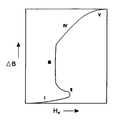
- FIG. 1 is a schematic representation of the dynamic magnetization curves ("B-H loops") obtained from ferromagnetic materials which are subjected to high magnetization rates; H a is the applied magnetic field on the core material and ⁇ B is the flux swing obtained from the core material. As noted in the figure, this magnetization curve may be broken down to five regions (or parts) of magnetic response from the core material.
- H a In region I, after a rapid increase usually limited by stray inductances, H a reaches a maximum and then actually decreases in many cases.
- This peak in region II is associated with the establishment of bar shaped ferromagnetic domains spanning the ribbon thickness, the minimum in H corresponding to the attainment of an efficient domain wall spacing. Magnetization progresses by the motion of these bar domain walls in region III, costing very little in H a .
- the higher mobility of the portion of the domain walls near the ribbon surface soon results in a single domain wall which encircles the interior of the ribbon, and is generally referred to as the "sandwich" domain. While no detailed understanding is available, it is generally understood in the art that the magnetization behavior in region IV is related to the progression of this sandwich domain, before saturation is attained in region V.
- the area enclosed by the dynamic magnetization curve and the ordinate axis in the Figure represents the core loss of the magnetic core material.
- This core loss is really a "half-cycle" loss, in that only one-half of a conventional hysteresis loop is being traversed by the material.
- all references to core losses of materials, whether of this invention or not, in connection with the description of this invention will imply these half-cycle losses.
- the core loss may be reduced if the efficiency of establishment of the bar domains is improved upon, i.e., if the "knee" in region II is shortened. Since this efficiency is directly related to the ferromagnetic anisotropy energy, an alloy targeted for use in pulse power applications should preferably have a low magnetic anisotropy energy.
- the magnetic anisotropy energy of metallic glasses in the Fe-B-Si system may be reduced by the addition of suitable amounts of a fourth element.
- carbon is one such element.
- other such elements include Mo, Nb, V, and Cr.
- the effect of Si in the alloys of the invention is to reduce the saturation induction but increase the thermal stability of the glassy state of the alloys by increasing their crystallization temperatures.
- the maximum level of 4 at.% Si in the alloys of this invention defines an acceptable balance between these two effects of Si. Since higher thermal stability implies better long term performance of an alloy in an application, higher Si levels are to be desired. However, when C is present in an alloy of the invention, high Si levels are to be avoided, lest the beneficial increase in saturation induction due to C be compromised.
- alloys of the invention containing carbon and between 1 and 2 at.% silicon are another class of preferred alloys of the invention, wherein high saturation induction and good thermal stability are obtained in combination.
- Coated ribbons may conveniently be obtained by dipping as-cast ribbons in a diluted solution of colloidal silica.
- Glassy metal alloys designated as samples no. 1 to 30 in Table III, were rapidly quenched from the melt following the techniques taught by Narasimhan in U.S. Patent No. 4,142,571, the disclosure of which is hereby incorporated by reference thereto. All casts were made in a vacuum chamber, using 0.025 to 0.100 kg melts comprising constituent elements of high purity. The resulting ribbons, typically 25 to 30 ⁇ m thick and about 6 mm wide, were determined to be free of crystallinity by x-ray diffractometry using Cu-K ⁇ radiation and differential scanning calorimetry. Some of the alloys were also cast separately as 50 mm wide ribbons, to facilitate a direct comparison with commercial alloys. Each of the alloys was at least 80% glassy, most of them more than 90% glassy and, in many instances, the alloys were 100% glassy. Ribbons of these glassy metal alloys were strong, shiny, hard and ductile.
- a commercial vibrating sample magnetometer was used for the measurement of the saturation magnetic moment of these alloys. As-cast ribbon from a given alloy was cut into several small squares (approximately 2 mm X 2 mm), which were randomly oriented about a direction normal to their plane, their plane being parallel to a maximum applied field of about 755 kA/m. By using the measured mass density, the saturation induction, B s , was then calculated. The density of many of these alloys was measured using standard techniques invoking Archimedes' Principle.
Landscapes
- Chemical & Material Sciences (AREA)
- Engineering & Computer Science (AREA)
- Physics & Mathematics (AREA)
- Electromagnetism (AREA)
- Dispersion Chemistry (AREA)
- Power Engineering (AREA)
- Materials Engineering (AREA)
- Mechanical Engineering (AREA)
- Metallurgy (AREA)
- Organic Chemistry (AREA)
- Soft Magnetic Materials (AREA)
Claims (6)
- Magnetische metallische Glaslegierung, welche zu zumindest 80 % glasig ist und eine Zusammensetzung hat, die durch die Formel FeaCobBcSidCe bestimmt ist, worin "a" - "e" Atomprozente sind und "a" 72 bis 84, "b" 2 bis 8, "c" 11 bis 16, "d" 1 bis 4 und "e" 3 bis 4 betragen, und wobei gegebenenfalls bis zu 1 Atomprozent Mn in der Legierung vorhanden ist, mit der Maßgabe, daß die Summe ("a"+"b"+"c"+"d"+"e") gleich 100 ist, welche Legierung vergütet wurde und eine Sättigungsinduktion von 1,55 T bis 1,75 T, eine magnetische Anisotropie-Energie von 300 J/m³ bis 400 J/m³ und einen Gleichstromsprung von der negativen Remanenz zur positiven Sättigung von etwa 2,9 T bis 3,2 T aufweist.
- Magnetische Legierung nach Anspruch 1, worin "d" 1 bis 2 ist.
- Magnetische Legierung nach Anspruch 1, worin "c" 11 bis 14 ist.
- Magnetische Legierung nach Anspruch 2, worin "c" 11 bis 14 ist.
- Magnetischer Kern mit einer Sättigungsinduktion von 1,55 T bis 1,75 T, einer magnetischen Anisotropie-Energie von etwa 300 J/m³ bis 400 J/m³ und (3) einem Gleichstromsprung von der negativen Remanenz zur positiven Sättigung von etwa 2,9 T bis 3,2 T bei Magnetisierungsgeschwindigkeiten größer als etwa 1 MT/s, welcher Kern als sein Kernmaterial eine metallische Glaslegierung aufweist, welche zu zumindest 80 % glasig ist, vergütet wurde und eine Zusammensetzung hat, die durch die Formel FeaCobBcSidCe gegeben ist, worin "a" - "e" Atomprozente sind und "a" 72 bis 84, "b" 2 bis 8, "c" 11 bis 16, "d" 1 bis 4 und "e" 3 bis 4 betragen, wobei gegebenenfalls bis 1 Atomprozent Mn in der Legierung vorhanden sind, mit den Maßgaben, daß (i) wenn "a" größer als oder gleich 80 ist, "b" nicht größer als 4 ist, (ii) wenn a" geringer als 80 um einen Betrag x ist, "b" nicht größer als (4+4x) ist und (iii) die Summe ("a"+"b"+"c"+ "d"+"e") gleich 100 ist.
- Magnetischer Kern nach Anspruch 5, worin "c" 11 bis 14 und "d" 1 bis 2 betragen.
Applications Claiming Priority (2)
| Application Number | Priority Date | Filing Date | Title |
|---|---|---|---|
| US46966790A | 1990-01-24 | 1990-01-24 | |
| US469667 | 1999-12-22 |
Publications (2)
| Publication Number | Publication Date |
|---|---|
| EP0512062A1 EP0512062A1 (de) | 1992-11-11 |
| EP0512062B1 true EP0512062B1 (de) | 1993-11-10 |
Family
ID=23864643
Family Applications (1)
| Application Number | Title | Priority Date | Filing Date |
|---|---|---|---|
| EP91904292A Expired - Lifetime EP0512062B1 (de) | 1990-01-24 | 1990-11-30 | Eisenreiche metallische gläser mit hoher sättigungsinduktion und guten weichmagnetischen eigenschaften mit hohen magnetisierungsgeschwindigkeiten |
Country Status (5)
| Country | Link |
|---|---|
| EP (1) | EP0512062B1 (de) |
| JP (1) | JPH05503551A (de) |
| CA (1) | CA2071930A1 (de) |
| DE (1) | DE69004580T2 (de) |
| WO (1) | WO1991011815A1 (de) |
Families Citing this family (7)
| Publication number | Priority date | Publication date | Assignee | Title |
|---|---|---|---|---|
| US6930581B2 (en) * | 2002-02-08 | 2005-08-16 | Metglas, Inc. | Current transformer having an amorphous fe-based core |
| US20160329139A1 (en) * | 2015-05-04 | 2016-11-10 | Carpenter Technology Corporation | Ultra-low cobalt iron-cobalt magnetic alloys |
| JP7245474B2 (ja) * | 2018-02-22 | 2023-03-24 | ジェネラル エンジニアリング アンド リサーチ,エル.エル.シー. | 磁気冷凍用途に有用な磁気熱量合金 |
| CN112420709B (zh) * | 2019-08-23 | 2023-06-06 | 中国科学院物理研究所 | 转变PbTiO3/SrTiO3超晶格材料的涡旋畴的方法 |
| JP7230967B2 (ja) * | 2020-09-30 | 2023-03-01 | Tdk株式会社 | 軟磁性合金および磁性部品 |
| JP6938743B1 (ja) * | 2020-09-30 | 2021-09-22 | Tdk株式会社 | 軟磁性合金および磁性部品 |
| JP7230968B2 (ja) * | 2020-09-30 | 2023-03-01 | Tdk株式会社 | 軟磁性合金および磁性部品 |
Citations (1)
| Publication number | Priority date | Publication date | Assignee | Title |
|---|---|---|---|---|
| US4321090A (en) * | 1980-03-06 | 1982-03-23 | Allied Corporation | Magnetic amorphous metal alloys |
Family Cites Families (2)
| Publication number | Priority date | Publication date | Assignee | Title |
|---|---|---|---|---|
| US4219355A (en) * | 1979-05-25 | 1980-08-26 | Allied Chemical Corporation | Iron-metalloid amorphous alloys for electromagnetic devices |
| DE69004962T2 (de) * | 1989-07-14 | 1994-03-24 | Allied Signal Inc | Eisenreiche metallische gläser mit hoher sättigungsinduktion und guten weichmagnetischen eigenschaften bei hohen magnetisierungsgeschwindigkeiten. |
-
1990
- 1990-11-30 EP EP91904292A patent/EP0512062B1/de not_active Expired - Lifetime
- 1990-11-30 JP JP91504326A patent/JPH05503551A/ja active Pending
- 1990-11-30 CA CA002071930A patent/CA2071930A1/en not_active Abandoned
- 1990-11-30 WO PCT/US1990/006997 patent/WO1991011815A1/en not_active Ceased
- 1990-11-30 DE DE1990604580 patent/DE69004580T2/de not_active Expired - Fee Related
Patent Citations (1)
| Publication number | Priority date | Publication date | Assignee | Title |
|---|---|---|---|---|
| US4321090A (en) * | 1980-03-06 | 1982-03-23 | Allied Corporation | Magnetic amorphous metal alloys |
Also Published As
| Publication number | Publication date |
|---|---|
| WO1991011815A1 (en) | 1991-08-08 |
| CA2071930A1 (en) | 1991-07-25 |
| DE69004580T2 (de) | 1994-03-10 |
| JPH05503551A (ja) | 1993-06-10 |
| DE69004580D1 (de) | 1993-12-16 |
| EP0512062A1 (de) | 1992-11-11 |
Similar Documents
| Publication | Publication Date | Title |
|---|---|---|
| CA1082491A (en) | Near-zero magnetostrictive amorphous alloy with high saturation induction | |
| Makino et al. | Nanocrystalline soft magnetic Fe-MB (M= Zr, Hf, Nb) alloys and their applications | |
| CA1073705A (en) | Glassy alloys having near-zero magnetostriction and high saturation induction | |
| US4881989A (en) | Fe-base soft magnetic alloy and method of producing same | |
| EP0574513B1 (de) | VERFAHREN ZUR HERSTELLUNG VON WEICHMAGNETISCHEN LEGIERUNGEN AUF Fe-Ni BASIS MIT NANOKRISTALLINER STRUKTUR | |
| EP0049770A2 (de) | Amorphe Legierungen für elektromagnetische Geräte | |
| GB1580498A (en) | Metallic glasses having a combination of high permeability low magnetostriction low ac core loss and high thermal stability | |
| CA1222646A (en) | Metallic glasses having a combination of high permeability, low coercivity, low ac core loss, low exciting power and high thermal stability | |
| Ohnuma et al. | Magnetic properties of (Fe, Co and Ni)-Zr amorphous alloys | |
| EP0253428B1 (de) | Permanent magnetisches Material | |
| EP0512062B1 (de) | Eisenreiche metallische gläser mit hoher sättigungsinduktion und guten weichmagnetischen eigenschaften mit hohen magnetisierungsgeschwindigkeiten | |
| CA1317484C (en) | Glassy metal alloys with perminvar characteristics | |
| EP0084138B1 (de) | Metallegierungen mit Glasstruktur, einer Magnetostriktion in der Nähe von Null und hoher thermischer und magnetischer Stabilität | |
| EP0482012B1 (de) | Amorphe legierungen auf eisenbasis mit hoher sättigungsinduktion und ausgezeichneten weichferromagnetischen eigenschaften | |
| EP0482064B1 (de) | Eisenreiche metallische gläser mit hoher sättigungsinduktion und guten weichmagnetischen eigenschaften bei hohen magnetisierungsgeschwindigkeiten | |
| US5062909A (en) | Iron rich metallic glasses having saturation induction and superior soft ferromagnetic properties at high magnetization rates | |
| US5364477A (en) | Iron rich metallic glasses having high saturation induction and superior soft ferromagnetic properties at high magnetization rates | |
| US4834814A (en) | Metallic glasses having a combination of high permeability, low coercivity, low AC core loss, low exciting power and high thermal stability | |
| EP0329704B1 (de) | Metallglasslegierungen mit sehr kleiner magnetostriktion für hochfrequenzanwendungen | |
| US4473400A (en) | Magnetic metallic glass alloy | |
| US5296049A (en) | Iron rich metallic glasses having high saturation induction and superior soft ferromagnetic properties at high magnetization rates | |
| US5100614A (en) | Iron-rich metallic glasses having high saturation induction and superior soft induction and superior soft ferromagnetic properties | |
| Chen et al. | Effects of Cr substitution on the formation, structure and magnetic properties of Sm/sub 2/(Fe, Cr)/sub 17/C/sub x/alloys | |
| Ishikawa et al. | Soft magnetic properties of ring-shaped Fe-Co-B-Si-Nb bulk metallic glasses | |
| JPH04209504A (ja) | 希土類永久磁石 |
Legal Events
| Date | Code | Title | Description |
|---|---|---|---|
| PUAI | Public reference made under article 153(3) epc to a published international application that has entered the european phase |
Free format text: ORIGINAL CODE: 0009012 |
|
| 17P | Request for examination filed |
Effective date: 19920619 |
|
| AK | Designated contracting states |
Kind code of ref document: A1 Designated state(s): DE FR GB |
|
| 17Q | First examination report despatched |
Effective date: 19930128 |
|
| GRAA | (expected) grant |
Free format text: ORIGINAL CODE: 0009210 |
|
| AK | Designated contracting states |
Kind code of ref document: B1 Designated state(s): DE FR GB |
|
| REF | Corresponds to: |
Ref document number: 69004580 Country of ref document: DE Date of ref document: 19931216 |
|
| ET | Fr: translation filed | ||
| PLBE | No opposition filed within time limit |
Free format text: ORIGINAL CODE: 0009261 |
|
| STAA | Information on the status of an ep patent application or granted ep patent |
Free format text: STATUS: NO OPPOSITION FILED WITHIN TIME LIMIT |
|
| 26N | No opposition filed | ||
| PGFP | Annual fee paid to national office [announced via postgrant information from national office to epo] |
Ref country code: GB Payment date: 20001004 Year of fee payment: 11 |
|
| PGFP | Annual fee paid to national office [announced via postgrant information from national office to epo] |
Ref country code: FR Payment date: 20001107 Year of fee payment: 11 |
|
| PGFP | Annual fee paid to national office [announced via postgrant information from national office to epo] |
Ref country code: DE Payment date: 20001124 Year of fee payment: 11 |
|
| PG25 | Lapsed in a contracting state [announced via postgrant information from national office to epo] |
Ref country code: GB Free format text: LAPSE BECAUSE OF NON-PAYMENT OF DUE FEES Effective date: 20011130 |
|
| REG | Reference to a national code |
Ref country code: GB Ref legal event code: IF02 |
|
| PG25 | Lapsed in a contracting state [announced via postgrant information from national office to epo] |
Ref country code: DE Free format text: LAPSE BECAUSE OF NON-PAYMENT OF DUE FEES Effective date: 20020702 |
|
| GBPC | Gb: european patent ceased through non-payment of renewal fee |
Effective date: 20011130 |
|
| PG25 | Lapsed in a contracting state [announced via postgrant information from national office to epo] |
Ref country code: FR Free format text: LAPSE BECAUSE OF NON-PAYMENT OF DUE FEES Effective date: 20020730 |
|
| REG | Reference to a national code |
Ref country code: FR Ref legal event code: ST |
|
| REG | Reference to a national code |
Ref country code: FR Ref legal event code: ST |