EP0513755A2 - Verfahren zur Herstellung eines Beugungsgitters - Google Patents
Verfahren zur Herstellung eines Beugungsgitters Download PDFInfo
- Publication number
- EP0513755A2 EP0513755A2 EP92108066A EP92108066A EP0513755A2 EP 0513755 A2 EP0513755 A2 EP 0513755A2 EP 92108066 A EP92108066 A EP 92108066A EP 92108066 A EP92108066 A EP 92108066A EP 0513755 A2 EP0513755 A2 EP 0513755A2
- Authority
- EP
- European Patent Office
- Prior art keywords
- diffraction grating
- phase
- producing
- shifted
- substrate
- Prior art date
- Legal status (The legal status is an assumption and is not a legal conclusion. Google has not performed a legal analysis and makes no representation as to the accuracy of the status listed.)
- Withdrawn
Links
Images


Classifications
-
- G—PHYSICS
- G02—OPTICS
- G02B—OPTICAL ELEMENTS, SYSTEMS OR APPARATUS
- G02B5/00—Optical elements other than lenses
- G02B5/18—Diffraction gratings
- G02B5/1847—Manufacturing methods
- G02B5/1857—Manufacturing methods using exposure or etching means, e.g. holography, photolithography, exposure to electron or ion beams
Definitions
- This invention relates to a method for producing a diffraction grating, and more particularly, to a method for producing a phase-shifted diffraction grating such as ⁇ /4-shifted diffraction grating for use in various devices such as filters and semiconductor lasers, typically distributed feedback (DFB) type lasers.
- a phase-shifted diffraction grating such as ⁇ /4-shifted diffraction grating for use in various devices such as filters and semiconductor lasers, typically distributed feedback (DFB) type lasers.
- DFB distributed feedback
- Diffraction gratings have been used in opto-electronic fields as various optical circuit devices such as filters, optical couplers, distributed feedback (DFB) type lasers, distributed Bragg reflection (DBR) type lasers and the like.
- DFB and DBR lasers using diffraction gratings as resonators for lasers have been studied and developed for their stable dynamic single mode characteristics that make oscillation wavelengths stable even if the lasere are directly modulated.
- ⁇ /4-shifted DFB lasers with phase-shifted diffraction gratings have been developed several years ago to improve the oscillation singularity of these lasers (see Japanese Patent Laid-open No. 62-262004).
- the ⁇ /4-shifted DFB laser oscillates in a single longitudinal mode which is equal to a Bragg wavelength thereof, so that a previous problem of oscillation occuring in two longitudinal modes in conventional lasers has almost been solved.
- Method (1) can be realized comparatively readily.
- ordinary diffraction grating producing techniques can be adopted.
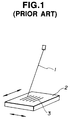
- a proximity effect appears between adjacent gratings depending on the relationship between the grating interval (e.g., 0.25 ⁇ m) and the electron beam diameter (e.g., 0.1 ⁇ m) and a backscattering due to the electron beam scattering on a substrate surface having a photoresist coated thereon.
- the diffraction grating 3 having a pitch of less than 0.3 ⁇ m on a thick resist or a thick substrate. Further, its throughput and yield are inevitably reduced.
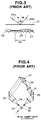
- the phase transient area 25 of the laser resonator 24 is widened due to a Fresnel diffraction of light beams 26a and 26b applied to cause the interference exposure unless the contact between the contact mask 21 and the photoresist layer coated on the substrate's surface 22 is sufficient.
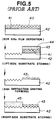
- the phase shifter 31 of a quartz plate having a step corresponding to a phase shift is disposed in the optical system, and this phase shifter 31 is irradiated with a slant projected light beam.
- the slant projection is required since the image must be formed on the sample surface 37 to which two beams are slantedly applied. As a result, abberations occur on the sample surface 37, and hence an area on which the diffraction grating can be formed is limited.
- a first diffraction grating pattern of a first material having a reference pitch on a substrate coating a second material different from the first material on both of the first material and an exposed portion of the substrate in a region where a second diffraction grating pattern having a pitch reverse to the reference pitch of the first diffraction grating pattern of the first material is to be formed, removing the first material by a lift-off method to obtain the second diffraction grating pattern of the second material having the reverse pitch in the region on the substrate, etching the substrate with the first diffraction grating pattern of the first material having the reference pitch used as an etching mask to form a first diffraction grating and etching the substrate with the second diffraction grating pattern of the second material having the reverse pitch used as an etching mask to obtain a second diffraction grating continuous to the first diffraction grating and hence a phase-shifted
- a first diffraction grating pattern of a first material having a reference pitch on a substrate coating a second material different from the first material on both of the first material and an exposed portion of the substrate in a region where a second diffraction grating pattern having a pitch reverse to the reference pitch of the first diffraction grating pattern of the first material is to be formed, forming a first etching protection layer on the region where the second diffraction grating pattern is to be formed, etching the substrate with the first diffraction grating pattern of the first material having the reference pitch used as an etching mask to form a first diffraction grating, forming a second etching protection layer on a region where the first diffraction grating is formed, removing the first material by a lift-off method to obtain the second diffraction grating pattern of the second material having the reverse pitch, and etching the substrate with the second d
- the first diffraction grating pattern is preferebly shaped into a rectangular or square shape in order to stably and accurately perform the first material removing step by the lift-off method. Further, a boundary between the first and second diffraction gratings can be stably and accurately defined in a self-alignment manner, i.e., automatically without using mask alignment.
- Fig. 1 is a view illustrating steps of a first prior art diffraction grating fabricating method.
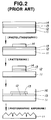
- Fig. 2 is a view illustrating steps of a second prior art diffraction grating fabricating method.
- Fig. 3 is a view illustrating steps of a third prior art diffraction grating fabricating method.
- Fig. 4 is a view illustrating steps of a fourth prior art diffraction grating fabricating method.
- Fig. 5 is a view illustrating steps of a fifth prior art diffraction grating fabricating method.
- Figs. 6A-6M are views illustrating steps of an embodiment according to the present invention.
- Figs. 6A-6M respectively show steps of an embodiment of a diffraction grating producing method according to the present invention.
- a semiconductor substrate 61 is cleaned by a surface active agent, and then is cleaned by ultrasonic means two or three times using an organic solvent. Thereafter, the substrate 61 is heat-treated at a temperature of 200°C for thirty (30) minutes by drying it with an N2 blow. Then, a photoresist layer 62 for a two-beam interference exposure is formed on the substrate 61 by coating a photoresist made by diluting to a desired concentration over the substrate 62.
- This substrate 61 with the photoresist 62 is soft-baked at a temperature of 115 °C for forty five (45) seconds
- hexamethyldisilazane (trade name HMDS : produced by Tisso Inc.) that is a contact-enhancing agent may be spin-coated on the substrate 61 and the heat-treatment at a temperature of 150°C may be performed for ten (10) minutes.
- a composition of the photoresist for interference exposure is as follows: Polyvinylphenol (its average molecular weight is 15,000 in terms of a polystyrene reduction) and a mixture of naphtoquinonediazide-5-sulfonylchrolide and ester compound of 2,3,4 trihydroxybenzophenon (photosensitive agent) (weight ration 3:1) are dissolved into ethylcellosolveaceto, and this is filtered by a membrane filter of 0.2 ⁇ m made of Teflon (trade name).
- the thickness of the photoresist 62 is properly set to 800 ⁇ -1000 ⁇ or less than 3000 ⁇ (see Fig. 6A).
- the photoresist layer 62 is then developed with a developer of alkali group.
- a resist pattern (diffraction grating) 63 is formed corresponding to a photosensitivity degree resulting from the intensity distribution of interference fringes caused by the interference exposure (see Fig. 6B).
- the diffraction grating 63 has a rectangular or square shape.
- a specific photoresist is used, and after the two-wave interference exposure is performed using the He-Cd laser or the like, the development is conducted using a specific developer.
- a base resin that is as transparent as possible to the wavelength of the exposure light (i.e., its absorption factor thereto is as small as possible).
- Polyvinylphenol or its copolymer with an appropriate different monomer or monomers is desirably used. For example, styrene, paramethylstyrene, ⁇ -methylstyrene, derivatives of styrene can be enumerated.
- quinonediazide group such as a mixture of 1,2 naphtoquinonediazide-5-sulfonylchrolide, 1,2 naphtoquinonediazide-4-sulfonylchrolide or the like mixed with compound having no carbonyl group such as bisphenol A exhibiting no absorption to the wavelength of the exposure light is desirably used.
- ethyllactate ethyl acetate cellosolve
- propylene glycol ⁇ monomethyl ether acetate lactic acid ethyl, diacetone alcohol, cyclohexanone or the like
- an alkaline solution such as trimethyl hydroxy ethyl, ammonium hydroxide, sodium hydroxide, potassium hydroxide, tetramethyl ammonium and hydraxide solution is desirably used.
- a photoresist layer 65 (trade name RD-2000N : produced by Hitachi Kasei Inc.), for example, is coated over all of the semiconductor substrate 61 to form a phase region (reference pitch region) and a phase shift region (reverse pitch region). This is then dried at a temperature of 80 °C for twenty (20) minutes (see Fig. 6D). The thickness of the photoresist layer 65 is properly set to 1.5 ⁇ m-2.0 ⁇ m.
- a mask exposure is conducted by a photomask 66 using an ordinary photolithographic technique (see Fig. 6E). Then, development and cleaning are successively performed using a specific developer for the photoresist layer 65 (trade name RD-developer : produced by Hitachi Kasei Inc.) and a specific cleaning liquid (trade name RD-postrinse).
- a striped pattern 67 is formed on the semiconductor substrate 61 (see Fig. 6F).
- the striped pattern 67 functions as both of an etching protection layer for the phase shift region at the time of etching the phase region and a lift-off layer for forming a protection layer of the phase region.
- Unnecessary metal titanium is then etched using, for example, a buffered hydrofluoric acid for the purpose of performing the etching of the semiconductor substrate 61 in the phase region (see Fig. 6G). Only the diffraction grating pattern 63 of photoresist remains in the phase region .
- the semiconductor substrate 61 is then etched using, for example, the reactive ion beam etching (RIBE) of chrolide series with the diffraction grating pattern 63 of photoresist on the phase region used as an etching mask (Fig. 6H). At this time, the phase shift region is covered by the etching protection layer of the striped pattern 67.
- RIBE reactive ion beam etching
- a semiconductor diffraction grating 68 is obtained on the phase region of the semiconductor substrate 61 by removing the above-discussed etching mask in a dry or wet manner (see Fig. 6I).
- Metal titanium for example, is then deposited over all of the substrate 61 to form an etching mask layer 69 for the semiconductor diffraction grating 68, using the electron beam deposition method.
- Conditions thereof are such that an arrival vacuum degree is less than 2.0 ⁇ 10 ⁇ 6 Torr, a substrate temperature is a room temperature, an acceleration voltage is 10 kV and an emission current is 95 mA. Under these conditions, a deposition rate is 2 ⁇ /sec.
- the film thickness of the metal titanium 69 is properly set to 2600 ⁇ -3000 ⁇ (see Fig. 6J).
- a self-alignment using the striped pattern 67 without a mask alignment is conducted to form the phase region and the phase shift region.
- the reverse mask layer 64 of metal titanium is then formed by a lift-off method in order to form a diffraction grating in the phase shift region.
- the photoresist of the striped pattern 67 which becomes unnecessary together with the diffraction grating pattern 63 of photoresist and the metal titanium 69 for the lift-off which is deposited in the previous step are simultaneously lifted off.
- Conditions at this time are such that a remover liquid (trade name Microposit Remover 140 : produce by Shipley Inc.) is heated to 80°C-90 °C by a hot plate and the lift-off is then conducted by means of ultrasonic cleaning.
- a remover liquid trade name Microposit Remover 140 : produce by Shipley Inc.
- the semiconductor substrate 61 is then etched using, for example, the reactive ion beam etching (RIBE) of chrolide series with the reverse mask layer 64 on the phase shift region used as an etching mask.
- RIBE reactive ion beam etching
- a diffraction grating 70 whose pitch is reverse to that on the phase region is obtained.
- the semiconductor diffraction grating 68 on the phase region is protected by the etching mask layer 69 of metal titanium (see Fig. 6L).
- Unnecessary metal titanium of the reverse mask layer 64 and the etching mask layer 69 are then removed using, for example, buffered hydrofluoric acid. As a result, a phase-shifted type diffraction grating 71 is obtained on the semiconductor substrate 61 (see Fig. 6M).
- the wavelength and kind of the ultraviolet laser for interference exposure may be determined depending on specifications (pitch, depth and so forth) of the phase-shifted diffraction grating.
- the semiconductor substrate is used in the above embodiment, glass, optical glass or the like may be utilized.
- the photoresist is used as the film material 62, an oxide film such as SiO2 film, a nitride film such as Si3N4 film or other metal layers, for example, may be used as long as the diffraction grating pattern having the reference period or pitch can be formed.
- the kind and type (positive or negative) of the photoresist may be determined according to the specifications of the phase-shifted diffraction grating.
- the metal titanium is used as the reverse mask layer 64 and the etching mask layer 69, but an oxide layer such as SiO2 film, a nitride film such as Si3N4 film or other metal layers, for example, may be used. This material may be determined depending on a ratio of layers, a selective ratio or difference in the etching rates between etched materials at the time of etching and the specisications of the phase-shifted diffraction grating.
- the electron beam deposition method is used as a method for forming the metal titanium of the reverse mask layer 64 and the etching mask layer 69
- a sputtering deposition method or a resistance heating deposition method may be used depending on the specifications and the materials.
- the chrolide gas RIBE of a dry method is used for performing the etching of the semiconductor substrate 61, kinds of the etching and the gas are not limited. They may be determined depending on the specifications, materials, selective ratio and the like.
- the following advantages can be obtained, compared with the prior art methods of fabricating the phase-shifted type diffraction grating:
- phase-shifted diffraction grating can be readily fabricated, a diffraction grating having a deep groove can be produced since the etching mask layer can be thickened, the pattern accuracy and the shape stability can be improved, and the transient area can be shortened.
- a phase-shifted diffraction grating for devices such as semiconductor lasers is produced by forming a first diffraction grating pattern of a first material having a reference pitch on a substrate.
- the substrate is then coated with a second material on both the first material and an exposed portion of the substrate in a region where a second diffraction grating having a pitch which is the reverse of the reference pitch of the first diffraction grating pattern is to be formed.
- the first material is removed by lift off to obtain the second diffraction grating pattern on the second diffraction grating region.
- the substrate is etched using the first diffraction grating as an etching mask to form the first diffraction grating and then the substrate is etched with the second diffraction grating pattern as an etching mask to obtain a second diffraction grating continuous with the first diffraction grating.
- the first diffraction grating pattern may have a rectangular or square shape to stably and accurately remove the first material by lift-off and the boundary between the first and second diffraction gratings can be stably and accurately defined by self-alignment.
Landscapes
- Physics & Mathematics (AREA)
- Engineering & Computer Science (AREA)
- Manufacturing & Machinery (AREA)
- General Physics & Mathematics (AREA)
- Optics & Photonics (AREA)
- Diffracting Gratings Or Hologram Optical Elements (AREA)
- Semiconductor Lasers (AREA)
Applications Claiming Priority (4)
| Application Number | Priority Date | Filing Date | Title |
|---|---|---|---|
| JP138228/91 | 1991-05-14 | ||
| JP13822891A JPH04337701A (ja) | 1991-05-14 | 1991-05-14 | 回折格子の作成方法 |
| JP138229/91 | 1991-05-14 | ||
| JP13822991A JPH04337702A (ja) | 1991-05-14 | 1991-05-14 | 回折格子の作成方法 |
Publications (2)
| Publication Number | Publication Date |
|---|---|
| EP0513755A2 true EP0513755A2 (de) | 1992-11-19 |
| EP0513755A3 EP0513755A3 (en) | 1994-05-18 |
Family
ID=26471336
Family Applications (1)
| Application Number | Title | Priority Date | Filing Date |
|---|---|---|---|
| EP19920108066 Withdrawn EP0513755A3 (en) | 1991-05-14 | 1992-05-13 | A method for producing a diffraction grating |
Country Status (2)
| Country | Link |
|---|---|
| US (1) | US5225039A (de) |
| EP (1) | EP0513755A3 (de) |
Cited By (6)
| Publication number | Priority date | Publication date | Assignee | Title |
|---|---|---|---|---|
| DE4233500A1 (de) * | 1992-10-06 | 1994-04-07 | Ant Nachrichtentech | Lichtwellenleiter zur kontinuierlichen Phasenverschiebung der DFB-Gitterperiode für auf DFB-Gitterfeldern mit konstanter Gitterperiode basierende optoelektronische Komponenten |
| EP0632297A1 (de) * | 1993-07-02 | 1995-01-04 | Xerox Corporation | Phasenkontrolle in binären optischen Elementen durch räumliche Verschiebung |
| EP0683404A1 (de) * | 1994-04-08 | 1995-11-22 | Enea Ente Per Le Nuove Tecnologie, L'energia E L'ambiente | Verfahren und Gerät für die Herstellung von Beugungsgittern in schnellem Bearbeitungssystem |
| EP1316993A1 (de) * | 2001-11-29 | 2003-06-04 | Denselight Semiconductors Pte Ltd. | Ätzen von Halbleitern |
| GB2417730A (en) * | 2004-08-06 | 2006-03-08 | Agilent Technologies Inc | Method to fabricate diffractive optics |
| CN111033324A (zh) * | 2017-06-02 | 2020-04-17 | 迪斯帕列斯有限公司 | 制造经高度调制的光学衍射光栅的方法 |
Families Citing this family (18)
| Publication number | Priority date | Publication date | Assignee | Title |
|---|---|---|---|---|
| JP2738623B2 (ja) * | 1992-04-23 | 1998-04-08 | 三菱電機株式会社 | 回折格子の形成方法 |
| JP2546135B2 (ja) * | 1993-05-31 | 1996-10-23 | 日本電気株式会社 | 半導体微細形状の形成方法、InP回折格子の製造方法および分布帰還型レーザの製造方法 |
| US5417799A (en) * | 1993-09-20 | 1995-05-23 | Hughes Aircraft Company | Reactive ion etching of gratings and cross gratings structures |
| JP3366441B2 (ja) * | 1994-06-21 | 2003-01-14 | 三菱電機株式会社 | λ/4シフト回折格子の製造方法 |
| KR100424774B1 (ko) * | 1998-07-22 | 2004-05-17 | 삼성전자주식회사 | 선택영역회절격자형성과선택영역성장을위한마스크및이를이용한반도체소자의제조방법 |
| US6072579A (en) * | 1998-08-27 | 2000-06-06 | Ricoh Company, Ltd. | Optical pickup apparatus having improved holographic optical element and photodetector |
| JP3797462B2 (ja) * | 1999-07-08 | 2006-07-19 | 富士写真フイルム株式会社 | 回折格子作製方法 |
| US6961490B2 (en) * | 2000-01-27 | 2005-11-01 | Unaxis-Balzers Aktiengesellschaft | Waveguide plate and process for its production and microtitre plate |
| US6510263B1 (en) * | 2000-01-27 | 2003-01-21 | Unaxis Balzers Aktiengesellschaft | Waveguide plate and process for its production and microtitre plate |
| US6904201B1 (en) * | 2001-05-09 | 2005-06-07 | Intel Corporation | Phase-controlled fiber Bragg gratings and manufacturing methods |
| US6869754B2 (en) * | 2001-10-23 | 2005-03-22 | Digital Optics Corp. | Transfer of optical element patterns on a same side of a substrate already having a feature thereon |
| KR100908234B1 (ko) * | 2003-02-13 | 2009-07-20 | 삼성모바일디스플레이주식회사 | 전계 발광 표시 장치 및 이의 제조방법 |
| US7349101B2 (en) * | 2003-12-30 | 2008-03-25 | Asml Netherlands B.V. | Lithographic apparatus, overlay detector, device manufacturing method, and device manufactured thereby |
| US7449215B2 (en) * | 2004-03-05 | 2008-11-11 | Toshiba Matsushita Display Technology Co., Ltd. | Method of manufacturing display device |
| US7554123B2 (en) * | 2004-08-25 | 2009-06-30 | Sensor Electronic Technology, Inc. | Ohmic contact for nitride-based semiconductor device |
| KR100915326B1 (ko) * | 2007-10-22 | 2009-09-03 | 주식회사 파이컴 | 전기 검사 장치의 제조 방법 |
| KR101494153B1 (ko) * | 2007-12-21 | 2015-02-23 | 주성엔지니어링(주) | 박막형 태양전지 및 그 제조방법 |
| WO2021042265A1 (zh) * | 2019-09-03 | 2021-03-11 | 京东方科技集团股份有限公司 | 导光基板及其制备方法、对向基板、液晶显示装置 |
Family Cites Families (7)
| Publication number | Priority date | Publication date | Assignee | Title |
|---|---|---|---|---|
| JPS627001A (ja) * | 1985-07-04 | 1987-01-14 | Kokusai Denshin Denwa Co Ltd <Kdd> | 回折格子の製造方法 |
| JPS62262004A (ja) * | 1986-05-08 | 1987-11-14 | Nec Corp | 回折格子の製造方法 |
| DE3632999A1 (de) * | 1986-09-29 | 1988-03-31 | Siemens Ag | Verfahren zur erzeugung einer gitterstruktur mit phasensprung auf der oberflaeche eines substrats |
| JPS63313149A (ja) * | 1987-06-17 | 1988-12-21 | Nippon Zeon Co Ltd | パタ−ン形成材料 |
| JPH02108003A (ja) * | 1988-10-17 | 1990-04-19 | Mitsubishi Electric Corp | 1次回折格子の形成方法 |
| DE3837874A1 (de) * | 1988-11-08 | 1990-05-10 | Siemens Ag | Verfahren zur herstellung von gitterstrukturen mit um eine halbe gitterperiode gegeneinander versetzten abschnitten |
| JPH02224386A (ja) * | 1989-02-27 | 1990-09-06 | Mitsubishi Electric Corp | λ/4シフト型回折格子の製造方法 |
-
1992
- 1992-05-13 US US07/882,614 patent/US5225039A/en not_active Expired - Fee Related
- 1992-05-13 EP EP19920108066 patent/EP0513755A3/en not_active Withdrawn
Cited By (7)
| Publication number | Priority date | Publication date | Assignee | Title |
|---|---|---|---|---|
| DE4233500A1 (de) * | 1992-10-06 | 1994-04-07 | Ant Nachrichtentech | Lichtwellenleiter zur kontinuierlichen Phasenverschiebung der DFB-Gitterperiode für auf DFB-Gitterfeldern mit konstanter Gitterperiode basierende optoelektronische Komponenten |
| EP0632297A1 (de) * | 1993-07-02 | 1995-01-04 | Xerox Corporation | Phasenkontrolle in binären optischen Elementen durch räumliche Verschiebung |
| EP0683404A1 (de) * | 1994-04-08 | 1995-11-22 | Enea Ente Per Le Nuove Tecnologie, L'energia E L'ambiente | Verfahren und Gerät für die Herstellung von Beugungsgittern in schnellem Bearbeitungssystem |
| EP1316993A1 (de) * | 2001-11-29 | 2003-06-04 | Denselight Semiconductors Pte Ltd. | Ätzen von Halbleitern |
| GB2417730A (en) * | 2004-08-06 | 2006-03-08 | Agilent Technologies Inc | Method to fabricate diffractive optics |
| GB2417730B (en) * | 2004-08-06 | 2009-10-28 | Agilent Technologies Inc | Method to fabricate diffractive optics |
| CN111033324A (zh) * | 2017-06-02 | 2020-04-17 | 迪斯帕列斯有限公司 | 制造经高度调制的光学衍射光栅的方法 |
Also Published As
| Publication number | Publication date |
|---|---|
| US5225039A (en) | 1993-07-06 |
| EP0513755A3 (en) | 1994-05-18 |
Similar Documents
| Publication | Publication Date | Title |
|---|---|---|
| US5225039A (en) | Method for producing a diffraction grating | |
| US7018783B2 (en) | Fine structure and devices employing it | |
| JPH07209851A (ja) | リソグラフィ露光マスクおよびその製造方法 | |
| JP2829555B2 (ja) | 微細レジストパターンの形成方法 | |
| US5300378A (en) | Method of producing a phase shifting mask | |
| JP2936187B2 (ja) | レジストパタ−ンの形成方法 | |
| US4826291A (en) | Method for manufacturing diffraction grating | |
| US5221429A (en) | Method of manufacturing phase-shifted diffraction grating | |
| EP0566886B1 (de) | Verfahren zur Herstellung eines Beugungsgitters | |
| JPH06300909A (ja) | ホログラフィック干渉露光法を用いた回折格子作成方法及びこれを用いた光半導体装置 | |
| US5891596A (en) | Method for fabricating phase shifting mask | |
| US5543252A (en) | Method for manufacturing exposure mask and the exposure mask | |
| EP0490320B1 (de) | Verfahren zur Herstellung eines Beugungsgitters | |
| US5468576A (en) | Method for manufacturing exposure mask | |
| JP2824314B2 (ja) | 反射型光曲げ導波路の製造方法 | |
| JPH03242648A (ja) | ホトマスクの製造方法 | |
| WO2005048338A1 (en) | A method and a semiconductor substrate for transferring a pattern from a phase mask to a substrate | |
| JPH0323884B2 (de) | ||
| JPS61292923A (ja) | 位相反転型パタンの形成方法 | |
| JP3112153B2 (ja) | グレーティングの作製方法 | |
| JPH11112105A (ja) | 半導体レーザ装置の製造方法、及びそれを用いて製造した光モジュール並びに光応用システム | |
| JPH0461331B2 (de) | ||
| JP2786229B2 (ja) | 回折格子の製造方法 | |
| JPS61217003A (ja) | 回折格子の製造方法 | |
| JPH052201B2 (de) |
Legal Events
| Date | Code | Title | Description |
|---|---|---|---|
| PUAI | Public reference made under article 153(3) epc to a published international application that has entered the european phase |
Free format text: ORIGINAL CODE: 0009012 |
|
| AK | Designated contracting states |
Kind code of ref document: A2 Designated state(s): BE CH DE ES FR GB IT LI NL SE |
|
| PUAL | Search report despatched |
Free format text: ORIGINAL CODE: 0009013 |
|
| AK | Designated contracting states |
Kind code of ref document: A3 Designated state(s): BE CH DE ES FR GB IT LI NL SE |
|
| 17P | Request for examination filed |
Effective date: 19941004 |
|
| 17Q | First examination report despatched |
Effective date: 19950518 |
|
| STAA | Information on the status of an ep patent application or granted ep patent |
Free format text: STATUS: THE APPLICATION IS DEEMED TO BE WITHDRAWN |
|
| 18D | Application deemed to be withdrawn |
Effective date: 19950929 |