EP0514686A2 - Système de transmission optique d'informations avec control optique d'un amplificateur optique ou avec conversion de longueur d'onde du signal optique - Google Patents
Système de transmission optique d'informations avec control optique d'un amplificateur optique ou avec conversion de longueur d'onde du signal optique Download PDFInfo
- Publication number
- EP0514686A2 EP0514686A2 EP92107088A EP92107088A EP0514686A2 EP 0514686 A2 EP0514686 A2 EP 0514686A2 EP 92107088 A EP92107088 A EP 92107088A EP 92107088 A EP92107088 A EP 92107088A EP 0514686 A2 EP0514686 A2 EP 0514686A2
- Authority
- EP
- European Patent Office
- Prior art keywords
- light
- laser
- optical
- wavelength
- signal
- Prior art date
- Legal status (The legal status is an assumption and is not a legal conclusion. Google has not performed a legal analysis and makes no representation as to the accuracy of the status listed.)
- Granted
Links
- 230000003287 optical effect Effects 0.000 title claims abstract description 157
- 230000005540 biological transmission Effects 0.000 title claims abstract description 26
- 238000006243 chemical reaction Methods 0.000 title description 8
- 230000003321 amplification Effects 0.000 claims abstract description 23
- 238000003199 nucleic acid amplification method Methods 0.000 claims abstract description 23
- 239000013543 active substance Substances 0.000 claims abstract description 21
- 238000010521 absorption reaction Methods 0.000 claims abstract description 9
- 230000007704 transition Effects 0.000 claims abstract description 6
- 239000004065 semiconductor Substances 0.000 claims description 8
- 238000005086 pumping Methods 0.000 claims description 5
- 229910001218 Gallium arsenide Inorganic materials 0.000 claims description 4
- 229910000530 Gallium indium arsenide Inorganic materials 0.000 claims description 2
- 230000001419 dependent effect Effects 0.000 claims description 2
- 230000031700 light absorption Effects 0.000 claims description 2
- 239000013307 optical fiber Substances 0.000 description 13
- 239000000835 fiber Substances 0.000 description 12
- 238000004891 communication Methods 0.000 description 8
- 150000002500 ions Chemical class 0.000 description 5
- 239000000463 material Substances 0.000 description 4
- 230000005281 excited state Effects 0.000 description 3
- VYPSYNLAJGMNEJ-UHFFFAOYSA-N Silicium dioxide Chemical compound O=[Si]=O VYPSYNLAJGMNEJ-UHFFFAOYSA-N 0.000 description 2
- 230000008878 coupling Effects 0.000 description 2
- 238000010168 coupling process Methods 0.000 description 2
- 238000005859 coupling reaction Methods 0.000 description 2
- 239000002019 doping agent Substances 0.000 description 2
- 230000000694 effects Effects 0.000 description 2
- 230000005855 radiation Effects 0.000 description 2
- 230000002269 spontaneous effect Effects 0.000 description 2
- 229910052691 Erbium Inorganic materials 0.000 description 1
- KRHYYFGTRYWZRS-UHFFFAOYSA-M Fluoride anion Chemical compound [F-] KRHYYFGTRYWZRS-UHFFFAOYSA-M 0.000 description 1
- 229910052681 coesite Inorganic materials 0.000 description 1
- 229910052906 cristobalite Inorganic materials 0.000 description 1
- 238000005516 engineering process Methods 0.000 description 1
- UYAHIZSMUZPPFV-UHFFFAOYSA-N erbium Chemical compound [Er] UYAHIZSMUZPPFV-UHFFFAOYSA-N 0.000 description 1
- 239000011521 glass Substances 0.000 description 1
- 230000001678 irradiating effect Effects 0.000 description 1
- 239000000203 mixture Substances 0.000 description 1
- 229910052761 rare earth metal Inorganic materials 0.000 description 1
- 230000008054 signal transmission Effects 0.000 description 1
- 239000000377 silicon dioxide Substances 0.000 description 1
- 235000012239 silicon dioxide Nutrition 0.000 description 1
- 229910052682 stishovite Inorganic materials 0.000 description 1
- 229910052905 tridymite Inorganic materials 0.000 description 1
Images


Classifications
-
- H—ELECTRICITY
- H01—ELECTRIC ELEMENTS
- H01S—DEVICES USING THE PROCESS OF LIGHT AMPLIFICATION BY STIMULATED EMISSION OF RADIATION [LASER] TO AMPLIFY OR GENERATE LIGHT; DEVICES USING STIMULATED EMISSION OF ELECTROMAGNETIC RADIATION IN WAVE RANGES OTHER THAN OPTICAL
- H01S3/00—Lasers, i.e. devices using stimulated emission of electromagnetic radiation in the infrared, visible or ultraviolet wave range
- H01S3/10—Controlling the intensity, frequency, phase, polarisation or direction of the emitted radiation, e.g. switching, gating, modulating or demodulating
- H01S3/102—Controlling the intensity, frequency, phase, polarisation or direction of the emitted radiation, e.g. switching, gating, modulating or demodulating by controlling the active medium, e.g. by controlling the processes or apparatus for excitation
-
- H—ELECTRICITY
- H01—ELECTRIC ELEMENTS
- H01S—DEVICES USING THE PROCESS OF LIGHT AMPLIFICATION BY STIMULATED EMISSION OF RADIATION [LASER] TO AMPLIFY OR GENERATE LIGHT; DEVICES USING STIMULATED EMISSION OF ELECTROMAGNETIC RADIATION IN WAVE RANGES OTHER THAN OPTICAL
- H01S3/00—Lasers, i.e. devices using stimulated emission of electromagnetic radiation in the infrared, visible or ultraviolet wave range
- H01S3/09—Processes or apparatus for excitation, e.g. pumping
- H01S3/091—Processes or apparatus for excitation, e.g. pumping using optical pumping
- H01S3/094—Processes or apparatus for excitation, e.g. pumping using optical pumping by coherent light
- H01S3/094003—Processes or apparatus for excitation, e.g. pumping using optical pumping by coherent light the pumped medium being a fibre
Definitions
- optical system is a combination of different optical devices such as e.g. Lasers, optical fibers, fiber-optic amplifiers understood that interact with each other, whereby they can be arranged spatially far apart.
- the laser-active substance that is used in the fiber optic amplifier consists of Er3+ ions, which are contained as dopants in a piece of optical waveguide.
- the first laser generating the pump light is a Kr3+ gas laser, and the pump light wavelength is 530.9 nm.
- the second laser is located far from the fiber optic amplifier. The light it emits has a wavelength of 1537nm and is transmitted through amplified the fiber optic amplifier.
- An optical waveguide that is over 70 km long serves as a means of coupling the light generated by the second laser into the fiber optic amplifier.
- the second laser generates light which is modulated in intensity by the electrical message signal to be transmitted. It is therefore referred to as the transmission laser of the optical communication system.
- modulation of the light generated by the second laser and some special properties of the known optical system e.g. the spatial distance of its various components, not at. It is only essential that it has a fiber optic amplifier with a pump laser and that a second laser is present, the output light of which is coupled into the fiber optic amplifier and amplified there.
- the object is achieved as indicated in claim 1.
- the principle of the solution is: There is a third laser, the light of which is coupled into the optical amplifier in addition to the light coming from the second laser, in order to control the amplification of the light coming from the second laser. It is therefore an optical control of the amplification taking place in an optical amplifier.
- the claim 2 contains a teaching how to choose the third wavelength, namely so that the occupation of the metastable energy level from which the induced emission of light with the second wavelength takes place can be controlled by absorption of light with the third wavelength.
- the claim 3 teaches an embodiment of the system according to the invention, which enables an interesting application of the invention for wavelength conversion in optical communication systems.
- the second laser which generates the amplifiable light is - in contrast to the known system mentioned at the outset - a laser which emits unmodulated light
- the third laser is a laser which emits light modulated by message signals. Since its modulation controls the amplification of the light emitted by the second laser, it is transmitted to the intensity of the light appearing at the output of the optical amplifier with the second wavelength. In other words, the optical input signal with the third wavelength is converted into an optical output signal with the second wavelength.
- An advantage of a system designed in this way and used for wavelength conversion is that the wavelength conversion takes place by purely optical means, instead of first converting light of the first wavelength into a photodiode into a current and using this current to operate a laser, the light of the desired wavelength emitted.
- Such a system is advantageous for optical message transmission for the following reasons: It allows the use of an inexpensive transmitter laser for the optical message transmission system, for example a semiconductor laser emitting light signals in the wavelength range around 850 nm, in conjunction with an optical waveguide transparent at a wavelength of 1550 nm has only a low attenuation at this wavelength.
- the conversion of the light signals emitted by the transmission laser into light signals with a wavelength of 1550 nm ensures that the optical signal to be transmitted has the wavelength suitable for transmission over long distances.
- an embodiment of the optical system is also part of the invention, in which the second laser, the output light of which is amplified in the optical amplifier, is the signal transmission laser of an optical message transmission system.
- the amplification of the signal light can then be optically controlled using the third laser.
- the invention can therefore be used whenever it is necessary to control or regulate the gain of an optical signal to be transmitted. If the light emitted by the third laser is modulated by an additional electrical signal, e.g. a signal from a service channel, the dependent control of the amplification of the optical signal originating from the second laser has the effect that the additional signal is modulated thereon.
- a modulation signal or control signal can also be formed from optical signals from a plurality of lasers with the same wavelength ⁇ 3, so that the message signal to be transmitted from the second laser can either be controlled by a plurality of control signals or can be additionally modulated by a plurality of additional signals.
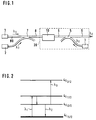
- the optical system according to FIG. 1 contains an optical amplifier which is highlighted by a dashed border and provided with the reference number 20.
- the optical amplifier is inserted in an optical fiber link. It receives its optical input signal to be amplified from an optical fiber 8, and outputs its optical output signal via an optical fiber 9, which is transmitted to an optical receiver, not shown. Because of its laser function that the optical amplifier 20 has, it emits light of a certain wavelength that it receives at its input, with increased intensity and the same wavelength at its output. In Fig.1 such a wavelength is indicated with ⁇ 2, and a laser 2 is shown, which generates light with such a wavelength.
- the optical amplifier 20 contains a medium 10 which contains a laser active substance, e.g. Er3+ contains ions.
- the medium 10 is an optical waveguide piece that is associated with the laser active substance, e.g. Er3+ ions, is doped.
- the optical waveguide piece has that of the usual optical waveguide, that is, SiO2. But it can also be one with a different base material, e.g. Fluorozirconate.
- the laser-active substance can also be an element other than erbium, in particular another rare earth element. It does not have to occur as a doping material in the optical waveguide piece. In certain cases, it can also be the material of the medium 10 itself, so that the medium 10 consists of the pure laser-active substance.
- the medium 10 is preferably a piece of optical waveguide doped with a laser-active substance, and in this case the optical amplifier is called a fiber-optical amplifier.
- the optical amplifier 20 also contains a laser 1, usually called a pump laser, which generates pump light with a wavelength ⁇ 1. It is connected to the medium 10 containing the laser-active substance, e.g. an Er3+-doped optical fiber piece connected.
- the wavelength ⁇ 1 of the pump light and the wavelength ⁇ 2 of the input light to be amplified of the optical amplifier correspond to distances between the energy levels of the laser-active substance, as will be explained with reference to Fig.2. If the laser 2 is viewed as the laser providing the optical signal to be transmitted from a message transmission system, the part of the optical system according to FIG. 1 described so far corresponds to the known optical message transmission system mentioned at the beginning.
- the laser 2 is the signal source of an optical transmission system. In principle, the only thing that matters is that it generates light in the optical Amplifier can be amplified, regardless of whether it is unmodulated or modulated by message signals.
- the pump laser 1 is referred to as the "first laser” and the laser 2 that generates the amplifiable light as the "second laser” of the optical system.
- the term "light” is used for any optical radiation, including those with wavelengths outside the visible range.
- the optical system according to FIG. 1 contains a third laser 3, the output light of which is irradiated with a wavelength ⁇ 3 into the medium 10 containing the laser-active substance.
- a third laser 3 the output light of which is irradiated with a wavelength ⁇ 3 into the medium 10 containing the laser-active substance.
- an optical fiber coupler 7 is used, one output of which is connected to the optical fiber piece 8, the second connection of which is connected to the output of the laser 2, and the third connection of which is via an optical fiber piece or an optical fiber path 80 the output of the third laser 3 is connected.
- the wavelength ⁇ 3 of the light generated by the third laser 3 is chosen so that depending on the intensity of this light, the amplification of the light with the wavelength ⁇ 2 by the second laser 2, which takes place in the optical amplifier 20 due to the pump light, is controllable.
- the laser-active substance is the doping material Er3+ contained in an optical waveguide piece.
- the electrons are excited from the basic level 4I 15/2 to a first energy level, the energy level 4I 11/2 .
- This energy level decays through radiation of light of the wavelength 2700 nm into a second energy level, the metastable energy level 4I 13/2 .
- the light of the wavelength 2700 nm is absorbed either in the optical waveguide piece 10 itself or in the optical waveguides 6, 8 adjoining it.
- the laser-active substance If light strikes the laser-active substance, the energy of which corresponds to the energy difference between the second energy level and an even lower third energy level, which is the basic level in the case of Er3zine, the laser-active substance passes into the third energy level with the induced emission of photons, whereby the light striking the laser-active substance is amplified.
- ⁇ 2 1550 nm.
- there is also a spontaneous emission of light of the same wavelength which causes the electrons from the energy level 4I 13/2 to the basic level 4I 15/2 return, which forms a third energy level.
- the emission of light of the wavelength ⁇ 2 1550 nm is influenced.
- the known excited state absorption (ESA) is used to control the amplification of light of the wavelength ⁇ 2.
- the absorption from the excited state 4I 13/2 is known for a laser whose laser-active substance consists of Er3+ ions, which are contained as dopants in a fluorozirconate optical fiber piece, from: CA Millar et al: "Efficient Up-Conversion Pumping at 800 nm of an Erbium-Doped Fluoride Fiber Laser Operating at 850 nm ", Electronics Letters, 25th October 1990, Vol. 26 No. 22, pages 1871 to 1873. It is used there to occupy an even higher energy level in order to enable spontaneous emission which emanates from this even higher energy level.
- the absorption mentioned thus serves for pumping to a higher energy level from an energy level occupied by a first pumping.
- the intensity of the light that is emitted via the optical waveguide section 6 and the optical waveguide coupler 5 from the optical waveguide section 10 into the optical waveguide 9 depends on the absorption, which causes transitions from the energy level 4I 13/2 to the energy level 4S 3/2 , at a constant Irradiation of light from the first laser 1 and the second laser 2 depends on whether the third laser 3 is switched on and the intensity of the light emitted by it.
- the gain of the light transmitted by the second laser 2 can thus be controlled by changing the intensity of the light radiated into the optical waveguide piece 10 from the third laser 3.
- the arrangement of the first laser 1 and the third laser 3 with respect to the optical waveguide piece 10 is interchangeable.
- the light from all three lasers 1 to 3 can also be fed into the optical waveguide piece 8 via a single optical waveguide coupler.
- the light from the first laser 1 and the third laser 3 is jointly fed into the optical waveguide piece 10 against the direction of transmission of the light from the second laser 2.
- Lasers 1 to 3 are preferably semiconductor lasers, the composition of which results in accordance with the wavelength they are intended to emit.
- the first laser 1 is an InGaAs / GaAs semiconductor laser
- the second laser 2 is an InGaAsP / InP semiconductor laser
- the third laser 3 is a GaAlAs / GaAs semiconductor laser.
- FIG. 3 A development of the optical system according to FIG. 1 is shown in FIG. 3.
- these have further lasers 31, 32, 33.
- the lasers 3, 31, 32, 33 are each connected to an optical multiplexer 30 via optical fibers 80, 81, 82, 83 , in which they each irradiate light signals with the wavelength ⁇ 3.
- optical multiplexers are known per se, e.g. from EP 0 200 613 B1.
- the multiplexer 30 generates a multiplex light signal from the light signals, by means of which the amplification of light of the wavelength ⁇ 2 can be controlled, just as it can be controlled by light from the third laser 3 in the first exemplary embodiment.
- the wavelength ⁇ 3 of the optical multiplex signal in the optical waveguide section 10 can be converted to the wavelength ⁇ 2, so that it can be transmitted over the optical waveguide 9 over long distances with only slight attenuation.
- the optical system offers the possibility of controlling the amplification of light in an optical amplifier by light from another laser, called the "third laser".
- the optical system need not be an optical communication system, but can be any system in which controlling the amplification of light in an optical amplifier is useful.
- the new optical system can be used as an optical communication system in which the wavelength of the transmitted optical signal is converted.
- the modulation ⁇ contained in the light emitted by the transmitting laser 3 changes into a modulation of the light emerging at the output of the optical amplifier with the wavelength ⁇ 2 .
- signal light with the wavelength ⁇ 3 is produced from signal light with the wavelength ⁇ 2.
- An inherent property of the new optical system is that it acts not only as an optical wavelength converter, but also as an optical inverter.
- a "0" or “1” value of a bit of the digital electrical modulation signal of the transmission laser 3 corresponds to a "1" or. "0" - value of the corresponding bit of the digitally modulated light signal which is emitted from the optical waveguide section 10.
- the light signal resulting from wavelength conversion is transmitted with the wavelength ⁇ 2 to a receiver, not shown. The fact that an inversion of the received digital signal is required there means only an insignificant effort.
- FIG. 4 illustrates the embodiment of the new optical system described above as an optical transmission system which effects a wavelength conversion.
- the transmission laser 3 is located far away from the optical amplifier 20, which is indicated by the optical waveguide 80 running between them.
- the amplifiable light with the wavelength ⁇ 2 generating second laser 2 is preferably arranged in the optical amplifier 20. It produces unmodulated light.
- the optical amplifier is preferably a fiber optic amplifier with an optical waveguide piece 10, which is for example an Er3+-doped optical waveguide piece. Otherwise, the same reference numerals are used as for the corresponding system parts of the system shown in FIG. 1, so that a further explanation is unnecessary.
- an inexpensive 850 nm laser can be used as the transmitting laser 3 and that, according to the invention, the wavelength of the optical signal emitted by it is converted into a wavelength of 1550 nm, which is the suitable wavelength for further transmission over a large optical waveguide path.
- the invention enables the large number of transmission lasers to be inexpensive lasers for the subscribers and only a single expensive 1550nm laser, the laser 2 in the fiber optic amplifier 20, is required in order to give the multiplex signal to be transmitted the desired wavelength ⁇ 2, which is suitable for retransmission over a large optical fiber link.
- the second laser 2 which generates the light which can be amplified in the optical amplifier 20 is a transmission laser of an optical communication system, ie its output light is one optical signal, i.e. light modulated with an electrical message signal.
- a laser 2 which is arranged in the system at a distance from the optical amplifier 20 and is connected to the optical amplifier 20 via an optical waveguide 85.
- the third laser 3 provided according to the invention here offers the possibility of controlling the amplification of the optical signal to be transmitted with the wavelength ⁇ 2.
- the invention can thus be used for any application in which control of the amplification of an optical signal in an optical amplifier is useful.
- a single laser 3 which generates light with the wavelength ⁇ 3
- several such lasers can be present, as is indicated by dashed lines with lasers 31, 32, 33, whose output light signals, as shown in FIG. 3, all have the same wavelength ⁇ 3 and can be combined in a multiplexer 30 to form a multiplex signal.
- This makes it possible to control the amplification of the optical signal with the wavelength ⁇ 2 by several mutually independent signals or to additionally modulate the optical signal with the wavelength ⁇ 2 a multiplex signal consisting of several partial signals.
Landscapes
- Physics & Mathematics (AREA)
- Electromagnetism (AREA)
- Engineering & Computer Science (AREA)
- Plasma & Fusion (AREA)
- Optics & Photonics (AREA)
- Lasers (AREA)
- Optical Communication System (AREA)
- Semiconductor Lasers (AREA)
- Optical Integrated Circuits (AREA)
Applications Claiming Priority (2)
| Application Number | Priority Date | Filing Date | Title |
|---|---|---|---|
| DE4116433 | 1991-05-18 | ||
| DE4116433 | 1991-05-18 |
Publications (3)
| Publication Number | Publication Date |
|---|---|
| EP0514686A2 true EP0514686A2 (fr) | 1992-11-25 |
| EP0514686A3 EP0514686A3 (en) | 1993-03-31 |
| EP0514686B1 EP0514686B1 (fr) | 1995-08-16 |
Family
ID=6432033
Family Applications (1)
| Application Number | Title | Priority Date | Filing Date |
|---|---|---|---|
| EP92107088A Expired - Lifetime EP0514686B1 (fr) | 1991-05-18 | 1992-04-25 | Système de transmission optique d'informations avec control optique d'un amplificateur optique ou avec conversion de longueur d'onde du signal optique |
Country Status (8)
| Country | Link |
|---|---|
| US (1) | US5247529A (fr) |
| EP (1) | EP0514686B1 (fr) |
| JP (1) | JPH05181176A (fr) |
| AU (1) | AU655018B2 (fr) |
| CA (1) | CA2068775A1 (fr) |
| DE (1) | DE59203263D1 (fr) |
| ES (1) | ES2079094T3 (fr) |
| NZ (1) | NZ242763A (fr) |
Cited By (2)
| Publication number | Priority date | Publication date | Assignee | Title |
|---|---|---|---|---|
| EP0637107A1 (fr) * | 1993-07-26 | 1995-02-01 | Alcatel SEL Aktiengesellschaft | Amplificateur à fibre optique utilisé comme convertisseur de longueur d'onde |
| DE19729539A1 (de) * | 1997-07-10 | 1999-01-14 | Daimler Benz Ag | Laseroszillator und Verstärker zur Farbbildprojektion mit integrierter Bildmodulation |
Families Citing this family (12)
| Publication number | Priority date | Publication date | Assignee | Title |
|---|---|---|---|---|
| JPH07273391A (ja) * | 1994-03-30 | 1995-10-20 | Sony Corp | レーザ光発生装置 |
| JP3846918B2 (ja) * | 1994-08-02 | 2006-11-15 | 富士通株式会社 | 光伝送システム、光多重伝送システム及びその周辺技術 |
| US6061173A (en) * | 1994-09-26 | 2000-05-09 | Fujitsu Limited | Wavelength-division-multiplexing optical amplifier |
| US5761234A (en) | 1996-07-09 | 1998-06-02 | Sdl, Inc. | High power, reliable optical fiber pumping system with high redundancy for use in lightwave communication systems |
| JP3299684B2 (ja) | 1997-04-23 | 2002-07-08 | 日本電信電話株式会社 | 光増幅器および光増幅方法 |
| US6166850A (en) * | 1998-11-04 | 2000-12-26 | Nortel Networks Limited | Optical amplifier gain control |
| JP3344475B2 (ja) * | 1999-03-19 | 2002-11-11 | 日本電気株式会社 | レーザ発振器及びレーザ増幅器 |
| US6407853B1 (en) * | 1999-10-29 | 2002-06-18 | Corning Incorporated | Broadhead dual wavelength pumped fiber amplifier |
| US6584261B2 (en) | 2000-11-22 | 2003-06-24 | Pirelli Cavi E Sistemi S.P.A. | Optical gating apparatus and methods |
| EP1209782B1 (fr) * | 2000-11-22 | 2007-05-02 | Pirelli & C. S.p.A. | Appareil et procédé de commutation optique |
| US7046710B2 (en) * | 2003-08-28 | 2006-05-16 | Raytheon Company | Gain boost with synchronized multiple wavelength pumping in a solid-state laser |
| EP2074684B1 (fr) * | 2006-06-08 | 2016-03-23 | Ramesh K. Shori | Procédé de pompage multi-longueur d'onde pour améliorer la performance des lasers à erbium |
Family Cites Families (5)
| Publication number | Priority date | Publication date | Assignee | Title |
|---|---|---|---|---|
| FR2580414B1 (fr) * | 1985-04-12 | 1987-06-05 | Telecommunications Sa | Dispositif multiplexeur demultiplexeur pour fibres optiques et son procede de fabrication |
| IT1237135B (it) * | 1989-10-30 | 1993-05-24 | Pirelli Cavi Spa | Gruppo di amplificazione ottico a basso rumore, con riflessione della potenza di pompaggio. |
| IT1237980B (it) * | 1990-02-12 | 1993-06-19 | Pirelli Cavi Spa | Amplificatore ottico a fibra attiva monomodale incurvata |
| CA2042697C (fr) * | 1990-05-18 | 1994-08-16 | Kenji Tagawa | Amplificateur a fibres optiques |
| US5140456A (en) * | 1991-04-08 | 1992-08-18 | General Instrument Corporation | Low noise high power optical fiber amplifier |
-
1992
- 1992-04-25 EP EP92107088A patent/EP0514686B1/fr not_active Expired - Lifetime
- 1992-04-25 ES ES92107088T patent/ES2079094T3/es not_active Expired - Lifetime
- 1992-04-25 DE DE59203263T patent/DE59203263D1/de not_active Expired - Fee Related
- 1992-05-14 AU AU16314/92A patent/AU655018B2/en not_active Ceased
- 1992-05-15 NZ NZ242763A patent/NZ242763A/en unknown
- 1992-05-15 CA CA002068775A patent/CA2068775A1/fr not_active Abandoned
- 1992-05-18 US US07/884,343 patent/US5247529A/en not_active Expired - Fee Related
- 1992-05-18 JP JP4124954A patent/JPH05181176A/ja active Pending
Non-Patent Citations (4)
| Title |
|---|
| ECOC 1989 Bd. 1, 10. September 1989, GOTHENBURG Seiten 86 - 89 B.WEDDING ET AL. 'TUA5-7 5 GBIT/S TRANSMISSION OVER 146 KM USING ERBIUM-DOPED FIBRE AMPLIFIER' EXPERIMENTAL SET UP * |
| ECOC 1989 Bd. 1, 10. September 1989, Gothenburg, SS. 86-89; B. WEDDING et al.: '5 GBIT/S TRANSMISSION OVER 146 KM USING ERBIUM_DOPED FIBRE AMPLIFIER', TuA5-7 * |
| ELECTRONICS LETTERS Bd. 26, Nr. 22, 25. Oktober 1990, ENAGE GB Seiten 1871 - 1873 C.A.MILLAR ET AL. 'EFFICIENT UP-CONVERSION PUMPING AT 800 NM OF AN ERBIUM-DOPED FLUORIDE FIBRE LASER OPERATING AT 850 NM' * |
| JOURNAL OF LIGHTWAVE TECHNOLOGY Bd. 9, Nr. 2, Februar 1991, NEW YORK US Seiten 234 - 250 , XP000225314 W.J.MINISCALCO 'ERBIUM-DOPED GLASSES FOR FIBER AMPLIFIER AT 1500 NM' * |
Cited By (3)
| Publication number | Priority date | Publication date | Assignee | Title |
|---|---|---|---|---|
| EP0637107A1 (fr) * | 1993-07-26 | 1995-02-01 | Alcatel SEL Aktiengesellschaft | Amplificateur à fibre optique utilisé comme convertisseur de longueur d'onde |
| AU677394B2 (en) * | 1993-07-26 | 1997-04-24 | Alcatel N.V. | Optical system |
| DE19729539A1 (de) * | 1997-07-10 | 1999-01-14 | Daimler Benz Ag | Laseroszillator und Verstärker zur Farbbildprojektion mit integrierter Bildmodulation |
Also Published As
| Publication number | Publication date |
|---|---|
| EP0514686A3 (en) | 1993-03-31 |
| NZ242763A (en) | 1994-11-25 |
| JPH05181176A (ja) | 1993-07-23 |
| ES2079094T3 (es) | 1996-01-01 |
| AU655018B2 (en) | 1994-12-01 |
| CA2068775A1 (fr) | 1992-11-19 |
| DE59203263D1 (de) | 1995-09-21 |
| AU1631492A (en) | 1992-11-19 |
| EP0514686B1 (fr) | 1995-08-16 |
| US5247529A (en) | 1993-09-21 |
Similar Documents
| Publication | Publication Date | Title |
|---|---|---|
| DE69532178T2 (de) | Verstärktes Telekommunikationssystem für Wellenlängenmultiplexübertragung mit Ausgleich der empfangenen Leistung | |
| DE69034006T2 (de) | Optischer Verstärker, optisches Übertragungssystem mit einem optischen Verstärker und Verfahren zum Verstärken eines optischen Signals | |
| DE69301655T2 (de) | Generator optischer Signale für Telekommunikationsanlage | |
| EP0514686B1 (fr) | Système de transmission optique d'informations avec control optique d'un amplificateur optique ou avec conversion de longueur d'onde du signal optique | |
| DE19732568C1 (de) | Verfahren und optisches Übertragungssystem zur Kompensation von Dispersion in optischen Übertragungsstrecken | |
| DE69815314T2 (de) | Mehrstufiger faseroptischer verstärker | |
| DE69610455T2 (de) | Hochleistungsgepumpter Dreiniveau-Faserlaserverstärker | |
| DE69527325T2 (de) | Verstärkendes Telekommunikationssystem für Wellenlängenmultiplexübertragung | |
| DE69430614T2 (de) | Faseroptischer Verstärker und optischer Zwischenverstärker | |
| DE69623219T2 (de) | Vorrichtung und Verfahren zur Veränderung der Spektraleigenschaften von optischen Signalen | |
| DE4234599A1 (de) | Optischer Sender | |
| DE4109683A1 (de) | System fuer optische signaluebertragung, insbesondere optisches kabelfernsehsystem, mit ueberwachungs- und dienstkanaleinrichtung | |
| DE4208858A1 (de) | Faseroptischer verstaerker mit regelung der pumplicht-wellenlaenge | |
| DE69836670T2 (de) | Optischer Ein-/Ausfügemultiplexer | |
| DE69725840T2 (de) | Faseroptisches Telekommunikationssystem | |
| EP0563524A1 (fr) | Système de transmission optique à amplificateurs optiques et régulation de la longueur d'onde de l'émetteur | |
| DE60036989T2 (de) | Faseroptisches Übertragungssystem unter Verwendung eines Wellenlängenwandlers für eine Breitbandübertrangung | |
| DE69020362T2 (de) | Verlustfreie optische komponente. | |
| EP0568897B1 (fr) | Amplificateur à fibre optique avec laser de pompage insensible à la rétroaction | |
| EP0485813B1 (fr) | Système de télécommunications optique avec amplificateur en fibre optique | |
| DE2234445C3 (de) | Optisches Nachrichtenübertragungssystem | |
| DE602004009900T2 (de) | Optisches übertragungssystem | |
| DE69009725T2 (de) | Optischer Leistungsverstärker mit dotierter aktiver Faser. | |
| DE69115390T2 (de) | Optischer Sternkoppler mit der Verwendung von faseroptischer Verstärkungstechnik | |
| EP0618650B1 (fr) | Amplificateur à fibres optiques avec dispositif de contrÔle de la puissance d'entrée |
Legal Events
| Date | Code | Title | Description |
|---|---|---|---|
| PUAI | Public reference made under article 153(3) epc to a published international application that has entered the european phase |
Free format text: ORIGINAL CODE: 0009012 |
|
| AK | Designated contracting states |
Kind code of ref document: A2 Designated state(s): AT BE CH DE DK ES FR GB IT LI NL SE |
|
| PUAL | Search report despatched |
Free format text: ORIGINAL CODE: 0009013 |
|
| AK | Designated contracting states |
Kind code of ref document: A3 Designated state(s): AT BE CH DE DK ES FR GB IT LI NL SE |
|
| 17P | Request for examination filed |
Effective date: 19930716 |
|
| 17Q | First examination report despatched |
Effective date: 19940201 |
|
| RAP1 | Party data changed (applicant data changed or rights of an application transferred) |
Owner name: ALCATEL N.V. Owner name: ALCATEL SEL AKTIENGESELLSCHAFT |
|
| RBV | Designated contracting states (corrected) |
Designated state(s): CH DE ES FR GB IT LI SE |
|
| GRAA | (expected) grant |
Free format text: ORIGINAL CODE: 0009210 |
|
| AK | Designated contracting states |
Kind code of ref document: B1 Designated state(s): CH DE ES FR GB IT LI SE |
|
| REF | Corresponds to: |
Ref document number: 59203263 Country of ref document: DE Date of ref document: 19950921 |
|
| ITF | It: translation for a ep patent filed | ||
| GBT | Gb: translation of ep patent filed (gb section 77(6)(a)/1977) |
Effective date: 19951009 |
|
| ET | Fr: translation filed | ||
| REG | Reference to a national code |
Ref country code: ES Ref legal event code: FG2A Ref document number: 2079094 Country of ref document: ES Kind code of ref document: T3 |
|
| PLBE | No opposition filed within time limit |
Free format text: ORIGINAL CODE: 0009261 |
|
| STAA | Information on the status of an ep patent application or granted ep patent |
Free format text: STATUS: NO OPPOSITION FILED WITHIN TIME LIMIT |
|
| 26N | No opposition filed | ||
| PGFP | Annual fee paid to national office [announced via postgrant information from national office to epo] |
Ref country code: GB Payment date: 19970314 Year of fee payment: 6 |
|
| PGFP | Annual fee paid to national office [announced via postgrant information from national office to epo] |
Ref country code: DE Payment date: 19970320 Year of fee payment: 6 |
|
| PGFP | Annual fee paid to national office [announced via postgrant information from national office to epo] |
Ref country code: SE Payment date: 19970324 Year of fee payment: 6 |
|
| PGFP | Annual fee paid to national office [announced via postgrant information from national office to epo] |
Ref country code: CH Payment date: 19970326 Year of fee payment: 6 |
|
| PGFP | Annual fee paid to national office [announced via postgrant information from national office to epo] |
Ref country code: ES Payment date: 19970418 Year of fee payment: 6 |
|
| PGFP | Annual fee paid to national office [announced via postgrant information from national office to epo] |
Ref country code: FR Payment date: 19980313 Year of fee payment: 7 |
|
| PG25 | Lapsed in a contracting state [announced via postgrant information from national office to epo] |
Ref country code: GB Free format text: LAPSE BECAUSE OF NON-PAYMENT OF DUE FEES Effective date: 19980425 |
|
| PG25 | Lapsed in a contracting state [announced via postgrant information from national office to epo] |
Ref country code: SE Free format text: LAPSE BECAUSE OF NON-PAYMENT OF DUE FEES Effective date: 19980426 |
|
| PG25 | Lapsed in a contracting state [announced via postgrant information from national office to epo] |
Ref country code: ES Free format text: LAPSE BECAUSE OF EXPIRATION OF PROTECTION Effective date: 19980427 |
|
| PG25 | Lapsed in a contracting state [announced via postgrant information from national office to epo] |
Ref country code: LI Free format text: LAPSE BECAUSE OF NON-PAYMENT OF DUE FEES Effective date: 19980430 Ref country code: CH Free format text: LAPSE BECAUSE OF NON-PAYMENT OF DUE FEES Effective date: 19980430 |
|
| REG | Reference to a national code |
Ref country code: CH Ref legal event code: PL |
|
| GBPC | Gb: european patent ceased through non-payment of renewal fee |
Effective date: 19980425 |
|
| EUG | Se: european patent has lapsed |
Ref document number: 92107088.4 |
|
| PG25 | Lapsed in a contracting state [announced via postgrant information from national office to epo] |
Ref country code: DE Free format text: LAPSE BECAUSE OF NON-PAYMENT OF DUE FEES Effective date: 19990202 |
|
| PG25 | Lapsed in a contracting state [announced via postgrant information from national office to epo] |
Ref country code: FR Free format text: LAPSE BECAUSE OF NON-PAYMENT OF DUE FEES Effective date: 19991231 |
|
| REG | Reference to a national code |
Ref country code: FR Ref legal event code: ST |
|
| REG | Reference to a national code |
Ref country code: ES Ref legal event code: FD2A Effective date: 20000601 |
|
| PG25 | Lapsed in a contracting state [announced via postgrant information from national office to epo] |
Ref country code: IT Free format text: LAPSE BECAUSE OF NON-PAYMENT OF DUE FEES;WARNING: LAPSES OF ITALIAN PATENTS WITH EFFECTIVE DATE BEFORE 2007 MAY HAVE OCCURRED AT ANY TIME BEFORE 2007. THE CORRECT EFFECTIVE DATE MAY BE DIFFERENT FROM THE ONE RECORDED. Effective date: 20050425 |