EP0514823B1 - Gas absorbierende Korde enthaltender Luftreifen - Google Patents
Gas absorbierende Korde enthaltender Luftreifen Download PDFInfo
- Publication number
- EP0514823B1 EP0514823B1 EP92108400A EP92108400A EP0514823B1 EP 0514823 B1 EP0514823 B1 EP 0514823B1 EP 92108400 A EP92108400 A EP 92108400A EP 92108400 A EP92108400 A EP 92108400A EP 0514823 B1 EP0514823 B1 EP 0514823B1
- Authority
- EP
- European Patent Office
- Prior art keywords
- cords
- tire
- gas absorbing
- reinforcing
- article
- Prior art date
- Legal status (The legal status is an assumption and is not a legal conclusion. Google has not performed a legal analysis and makes no representation as to the accuracy of the status listed.)
- Expired - Lifetime
Links
- 230000003014 reinforcing effect Effects 0.000 claims description 46
- 230000002787 reinforcement Effects 0.000 claims description 19
- 229920000728 polyester Polymers 0.000 claims description 14
- 239000000463 material Substances 0.000 claims description 13
- 239000004677 Nylon Substances 0.000 claims description 6
- 229920000297 Rayon Polymers 0.000 claims description 6
- 229920001778 nylon Polymers 0.000 claims description 6
- 239000002964 rayon Substances 0.000 claims description 6
- 239000011324 bead Substances 0.000 claims description 5
- 239000011521 glass Substances 0.000 claims description 4
- 239000007787 solid Substances 0.000 claims description 4
- 239000007789 gas Substances 0.000 description 27
- OKTJSMMVPCPJKN-UHFFFAOYSA-N Carbon Chemical compound [C] OKTJSMMVPCPJKN-UHFFFAOYSA-N 0.000 description 15
- 239000004744 fabric Substances 0.000 description 13
- 238000010276 construction Methods 0.000 description 5
- 238000004519 manufacturing process Methods 0.000 description 5
- 230000007547 defect Effects 0.000 description 4
- 238000009826 distribution Methods 0.000 description 3
- 229920000742 Cotton Polymers 0.000 description 2
- 238000003490 calendering Methods 0.000 description 2
- 239000000835 fiber Substances 0.000 description 2
- 230000006872 improvement Effects 0.000 description 2
- 238000000034 method Methods 0.000 description 2
- 230000004048 modification Effects 0.000 description 2
- 238000012986 modification Methods 0.000 description 2
- 230000008569 process Effects 0.000 description 2
- 230000009467 reduction Effects 0.000 description 2
- 238000000926 separation method Methods 0.000 description 2
- 241000203482 Polyscias Species 0.000 description 1
- 238000004891 communication Methods 0.000 description 1
- 230000002950 deficient Effects 0.000 description 1
- 230000001419 dependent effect Effects 0.000 description 1
- 238000011161 development Methods 0.000 description 1
- 238000007598 dipping method Methods 0.000 description 1
- 238000007689 inspection Methods 0.000 description 1
- 239000011159 matrix material Substances 0.000 description 1
- 238000012545 processing Methods 0.000 description 1
- 230000007480 spreading Effects 0.000 description 1
- 238000003892 spreading Methods 0.000 description 1
- 229920003002 synthetic resin Polymers 0.000 description 1
- 239000000057 synthetic resin Substances 0.000 description 1
- 239000012815 thermoplastic material Substances 0.000 description 1
- 230000000007 visual effect Effects 0.000 description 1
- 238000004073 vulcanization Methods 0.000 description 1
- 238000009941 weaving Methods 0.000 description 1
Images
Classifications
-
- D—TEXTILES; PAPER
- D02—YARNS; MECHANICAL FINISHING OF YARNS OR ROPES; WARPING OR BEAMING
- D02G—CRIMPING OR CURLING FIBRES, FILAMENTS, THREADS, OR YARNS; YARNS OR THREADS
- D02G3/00—Yarns or threads, e.g. fancy yarns; Processes or apparatus for the production thereof, not otherwise provided for
- D02G3/44—Yarns or threads characterised by the purpose for which they are designed
- D02G3/48—Tyre cords
-
- B—PERFORMING OPERATIONS; TRANSPORTING
- B60—VEHICLES IN GENERAL
- B60C—VEHICLE TYRES; TYRE INFLATION; TYRE CHANGING; CONNECTING VALVES TO INFLATABLE ELASTIC BODIES IN GENERAL; DEVICES OR ARRANGEMENTS RELATED TO TYRES
- B60C9/00—Reinforcements or ply arrangement of pneumatic tyres
- B60C9/0042—Reinforcements made of synthetic materials
-
- B—PERFORMING OPERATIONS; TRANSPORTING
- B60—VEHICLES IN GENERAL
- B60C—VEHICLE TYRES; TYRE INFLATION; TYRE CHANGING; CONNECTING VALVES TO INFLATABLE ELASTIC BODIES IN GENERAL; DEVICES OR ARRANGEMENTS RELATED TO TYRES
- B60C9/00—Reinforcements or ply arrangement of pneumatic tyres
- B60C9/02—Carcasses
- B60C9/12—Carcasses built-up with rubberised layers of discrete fibres or filaments
-
- Y—GENERAL TAGGING OF NEW TECHNOLOGICAL DEVELOPMENTS; GENERAL TAGGING OF CROSS-SECTIONAL TECHNOLOGIES SPANNING OVER SEVERAL SECTIONS OF THE IPC; TECHNICAL SUBJECTS COVERED BY FORMER USPC CROSS-REFERENCE ART COLLECTIONS [XRACs] AND DIGESTS
- Y10—TECHNICAL SUBJECTS COVERED BY FORMER USPC
- Y10S—TECHNICAL SUBJECTS COVERED BY FORMER USPC CROSS-REFERENCE ART COLLECTIONS [XRACs] AND DIGESTS
- Y10S57/00—Textiles: spinning, twisting, and twining
- Y10S57/902—Reinforcing or tyre cords
-
- Y—GENERAL TAGGING OF NEW TECHNOLOGICAL DEVELOPMENTS; GENERAL TAGGING OF CROSS-SECTIONAL TECHNOLOGIES SPANNING OVER SEVERAL SECTIONS OF THE IPC; TECHNICAL SUBJECTS COVERED BY FORMER USPC CROSS-REFERENCE ART COLLECTIONS [XRACs] AND DIGESTS
- Y10—TECHNICAL SUBJECTS COVERED BY FORMER USPC
- Y10T—TECHNICAL SUBJECTS COVERED BY FORMER US CLASSIFICATION
- Y10T428/00—Stock material or miscellaneous articles
- Y10T428/29—Coated or structually defined flake, particle, cell, strand, strand portion, rod, filament, macroscopic fiber or mass thereof
- Y10T428/2904—Staple length fiber
-
- Y—GENERAL TAGGING OF NEW TECHNOLOGICAL DEVELOPMENTS; GENERAL TAGGING OF CROSS-SECTIONAL TECHNOLOGIES SPANNING OVER SEVERAL SECTIONS OF THE IPC; TECHNICAL SUBJECTS COVERED BY FORMER USPC CROSS-REFERENCE ART COLLECTIONS [XRACs] AND DIGESTS
- Y10—TECHNICAL SUBJECTS COVERED BY FORMER USPC
- Y10T—TECHNICAL SUBJECTS COVERED BY FORMER US CLASSIFICATION
- Y10T428/00—Stock material or miscellaneous articles
- Y10T428/29—Coated or structually defined flake, particle, cell, strand, strand portion, rod, filament, macroscopic fiber or mass thereof
- Y10T428/2913—Rod, strand, filament or fiber
-
- Y—GENERAL TAGGING OF NEW TECHNOLOGICAL DEVELOPMENTS; GENERAL TAGGING OF CROSS-SECTIONAL TECHNOLOGIES SPANNING OVER SEVERAL SECTIONS OF THE IPC; TECHNICAL SUBJECTS COVERED BY FORMER USPC CROSS-REFERENCE ART COLLECTIONS [XRACs] AND DIGESTS
- Y10—TECHNICAL SUBJECTS COVERED BY FORMER USPC
- Y10T—TECHNICAL SUBJECTS COVERED BY FORMER US CLASSIFICATION
- Y10T428/00—Stock material or miscellaneous articles
- Y10T428/29—Coated or structually defined flake, particle, cell, strand, strand portion, rod, filament, macroscopic fiber or mass thereof
- Y10T428/2913—Rod, strand, filament or fiber
- Y10T428/2973—Particular cross section
- Y10T428/2975—Tubular or cellular
Definitions
- This invention relates to pneumatic tires and more particularly to a novel and improved tire cord fabric and the use thereof in a pneumatic tire to reduce defects in tires known as blows.
- tire reinforcement cords contain passages extending generally throughout the length of the cord, lying between and bounded by the filaments which make up the cords, and that air or other gases can travel along such passages. It has been observed that the treatment of tire reinforcement cords such as stretching of heated cords, for example cords made of continuous synthetic resin filament materials such as polyester and nylon, tends to significantly reduce the cross sectional area of the interfilamentary passages. Stretching of heated cords may result in a reduction of a cross sectional area of the individual filaments and a compacting of the filaments more closely to one another.
- any air trapped within the tire or any gases generated during the vulcanization of the tire may be sufficient in volume to prevent the development of a satisfactory bond between the rubber material and the reinforcing cords within the tire or may break such bonds by forcing a separation between the rubber and the reinforcement cords.
- the resulting defects are known as blisters or blows. Examples of attempts to minimize such blister or blows are described in US-A-2 541 506 and US-A-3 552 468.
- US-A-4 363 346 discloses a pneumatic tire according to the preamble of claim 1 including a plurality of gas absorbing cords in at least one reinforcing ply, each gas absorbing cord extending parallel to and disposed between a pair of reinforcing cords.
- US-A-4 024 895 describes a reinforcing fabric for tires wherein the weft yarns comprise a cotton sheath twisted about a core of spin-oriented polyester filaments.
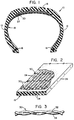
- Fig. 1 is a cross-sectional view of a pneumatic tire incorporating and made in accordance with the present invention, with the view taken in a plane extending radially of and containing the rotational axis of the tire.
- Fig. 2 is a perspective, partially cutaway view of a tire reinforcement ply used in the manufacture of the tire of Fig. 1.
- Fig. 3. is an enlarged fragmentary plan view of a gas absorbing cord of the ply of Fig. 2.
- a pneumatic tire generally indicated at 10, which comprises a pair of sidewall portions 12 terminating at their radially outer ends in a tread portion 14 and at their radially inner ends in a pair of beads 16.
- radially means “in a direction radially of the tire rotational axis”
- axially means in the direction of the rotational axis of the tire.
- the tire further comprises at least one reinforcement ply 18 connected to each of the beads 16 and extending through the sidewalls of the tire and under the tread portion 14.
- the tire may have one or more of such reinforcement plies which are generally referred to as carcass plies.
- the tire 10 may further include additional reinforcing plies in the form of one or more breaker or belt plies 20, 22 disposed in the crown region of the tire between the carcass ply 18 and the tread 14.
- the tire 10 may have a bias, bias belted, or radial ply construction.
- the reinforcing ply 18 is composed of a plurality of reinforcing cords extending in parallel spaced apart relation.
- these reinforcing cords extend at a suitable angle to the mid-circumferential center plane of the tire at the circumferential centerline of the carcass ply 18, which angle may be, for example, from 25 to 40 degrees.
- the cords of the carcass ply 18 will extend substantially radially of the tire, for example, at an angle from 80 to 90 degrees to the mid-circumferential center plane of the tire.
- the breaker or belt plies such as 20 and 22 shown in Fig. 1 each also include a plurality of reinforcing cords extending in parallel spaced apart relation.
- the cords will extend at a relatively low angle, for example, 15 to 25 degrees when the belt plies 20, 22 are used in combination with a radial ply carcass and at a somewhat higher angle, perhaps 25 to 35 degrees when used in conjunction with a bias ply carcass either as a belt or as breaker plies.
- the cords will have an angle at the mid-circumferential centerline of the tire which is normally at least 5 degrees less than the corresponding angle of the carcass ply or plies, and where used as a breaker in conjunction with a bias tire will have an angle at the mid-circumferential centerline of the tire which is equal or approximately equal to the corresponding angle of the carcass plies.
- the ply 18 comprises a plurality of reinforcing cords 24 disposed in parallel spaced apart relation and a plurality of gas absorbing cords 30 substantially perpendicular to the reinforcing cords and intertwined therewith, embedded in a matrix of rubber or rubber-like material 26, preferably by a conventional calendering process wherein the fabric is passed between rolls which press rubber between the cords 24 and coat the cords on both sides thereof with rubber.
- each gas absorbing cord lies generally in the same plane as that defined by the reinforcing cords. It should be noted, as in apparent from Fig. 1, that the ends of the reinforcement and gas absorbing cords are not in communication with the exterior of the tire.
- gas absorbing cords provide a path for expulsion of gas through the tread area of the tire, and gas that is not expelled is trapped within channels of the gas absorbing cord away from ply interfaces.
- the reinforcing cords 24 may be of any material or construction suitable for the reinforcement of a pneumatic tire and the term "cord" is used herein, and in the appended claims, to indicate any strength member suitable for the reinforcement of a pneumatic tire.
- the invention has particular utility where the reinforcing cords are formed of a single yarn or multiple yarns twisted together and wherein each yarn is composed of continuous filaments of a thermoplastic material such as nylon or polyester of a type suitable for the reinforcement of a pneumatic tire.
- Each gas absorbing cord 30 consists of a single yarn, or as shown in Fig. 3, a plurality of yarns, such as 32 and 34, twisted together.
- the yarn or yarns of each cord 30 is composed of staple fibers of material selected from the group consisting of rayon, nylon, polyester or glass.
- the terms "rayon,” “nylon,” “polyester,” or “glass” as used herein and in the appended claims are intended to cover any such material commonly referred to by such terms and suitable for the use in a pneumatic tire such as those that are commonly known and used presently in the reinforcement of pneumatic tires.
- each gas absorbing cord 30 is not intended to contribute to the reinforcement of the tire and thus are not reinforcing cords.
- each gas absorbing cord has a break strength of between about one pound and two pounds, which is no greater than about one-fifth of the breaking strength of a reinforcing cord 24.
- a break strength of about one pound is necessary to assure that the gas absorbing cords will not break, until necessary, under the usual tensions to which they will be subjected during manufacture of the reinforcing ply.
- the material of the gas absorbing cords 30 is selected from the group consisting of rayon, nylon, polyester or glass. More particularly, the gas absorbing cord 30 may be made of a single one of these materials or a combination thereof. In the cord 30 of Fig. 3, yarn 32 and yarn 34 are made of polyester staple filaments.
- the gas absorbing cords are hollow cords and may have solid walls or perforated walls.
- Suitable bleeder cords that may be used in the invention are Thermax®, available from DuPont de Nemours, Wilmington, Delaware, and Wellkey®, available from Tejin, Osaka, Japan. Filaments of both are made of polyester, but Thermax® has solid walls whereas the Wellkey® filaments have minute holes or perforations in the walls.
- Thermax® 24/1, 1,7 dtex (1.5 denier) staple hollow filaments were prepared according to Goodyear's specifications by Dixie Yarn, Gastonia, North Carolina into fill yarns.
- the Thermax® fill cords or yarns were used by Goodyear to prepare reinforcing fabric employing conventional polyester reinforcing cords in the warp direction and the Thermax® cable in the weft direction.
- gas absorbing cords are run parallel and between the reinforcing cords.
- gas absorbing cords for example rayon
- the reinforcing cords for example polyester
- the GA cords comprise about one in six of the reinforcing cords in a reinforcing ply. Since every sixth cord in the reinforcement ply is different, some non-uniformity may be observed between different reinforcing cords in the ply in a tire.
- the properties of the Non GA reinforcing cords are compared to the properties of the GA reinforcing cords in Table 1 below.
- the first cord compared is 3300 dtex (3000 denier) and comprises 3 yarns in an 3,3 x 3,3 turns per cm (8 1/2 x 8 1/2 TPI) (turns per inch) twist.
- the second cord is 2200 dtex (2000 denier) and comprises 2 yarns in a 4,7 x 4,7 turns per cm (12 x 12 TPI) twist.
- N is Newtons
- Ult Elong is Ultimate Elongation.
- a plurality or reinforcing cords are located in substantially a common plane in parallel spaced apart relation with a gas absorbing cord lying in the same general plane, substantially perpendicular to the reinforcing cords. All the reinforcing cords used in the ply are made in the same manner and have substantially the same properties.
- the reinforcing cords and gas absorbing cords are passed through a conventional calender to embed and completely surround each of the reinforcing and gas absorbing cords in rubber or rubber-like material to form the reinforcement ply.
- the fabric be pantographed, i e. stretched so that the angle between the reinforcing cords and gas absorbing cords is other than 90°, eg. 30°-89°, preferably 65° to 89°.
- a specific example of a reinforced ply which provided a significant reduction in the number of blows or blisters in a tire in which it has been used is one wherein the reinforcing cord comprised plies which were each a 1100 dtex (1000 denier) single yarn having a twist of about 4,7 turns per cm (12 turns per inch) as described in Table 1.
- the reinforcing cords were equally spaced apart with a density of 11,8 cords per cm (30 cords per inch).
- Each reinforcing cord had a gauge or diameter of approximately 0,056 cm (0.022) inch.
- the gas absorbing cord used as the fill cord (yarn) consisted of hollow polyester staple fibers.
- the fill cords (yarn) were interwoven with the reinforcing cords and were spaced 1,9 cm (0.75) inch apart along the length of the tire cord fabric.
- the fill cord (yarn) had a breaking strength of 7,5N (1.7 pounds) and an ultimate elongation of 15.5%.
- Tire fill cord had a size of 24 by the cotton count system (221.4 denier).
- the ply treatment gauge was 0,10 cm (0.042 inch).
- Thermax® has greater strength and elongation properties than prior art fill cords, and it has correspondingly been discovered that there are about 75% fewer loom stops during weaving. Also, there is less likelihood of fabric splitting during dipping and calendering. About 75% less fill is needed as compared to fabric prepared according to U.S. Patent No. 4,363,346. It has also been found that in a completed tire, distribution of the reinforcing cord is more uniform when the hollow bleeder cords are used as fill, and all the reinforcing cords have uniform properties.
- the properties of the Thermax® cable, as compared with its prior art counterparts are illustrated in Table 2.
- the Randolf HWM (high wet modulus) rayon is the standard fill in the tire industry.
- control is polyester fabric prepared in accordance with U. S. Patent 4,363,346.
- EBP in the table refers to a surface precure using Electronic Beam Processing.
- TABLE 4 Defective WEEK ENDING 1/20 1/27 2/03 2/10 2/14 2/17 3/2 Days on Thermax 0 0 2 5 4+ some EBP 4 1 Produced 1986 2657 1688 2088 2036 2040 2138 Blows (#) 68 23 9 11 29 10 13 Blows (%) 3.42 .87 .53 .53 1.42 .48 .60 Liner Blisters (#) 0 0 2 1 2 0 0 Uniformity Scrap for Radial FV or Radial Harmonic (#) 2 2 0 0 1 2 0 TABLE 5 UNIFORMITY RFV RH1 LFV CON Control (50) 3-5 X 16.0 8.7 12.3 10.8 S 5.1 5.3 5.5 5.7 Trial (Thermax) (100) 2-15 X 14.1 7.5 13.4 5.0 S 4.3 4.0 4.2 8.3
Landscapes
- Engineering & Computer Science (AREA)
- Mechanical Engineering (AREA)
- Textile Engineering (AREA)
- Tires In General (AREA)
- Woven Fabrics (AREA)
- Yarns And Mechanical Finishing Of Yarns Or Ropes (AREA)
Claims (14)
- Elastomerer Gegenstand umfassend zumindest eine Verstärkungsschicht, wobei die Verstärkungsschicht (18) eine Vielzahl von Verstärkungskorden (24) umfaßt, welche in Gummi (26) oder gummiähnlichem Material eingebettet sind, wobei sich die Verstärkungskorde in einer parallelen beabstandeten Beziehung erstrecken; wobei die Verstärkungsschicht (18) des weiteren umfaßt Schußkorde, welche die Verstärkungskorde in einer stabilen Beziehung relativ zueinander halten, und eine Vielzahl von gasabsorbierenden Korden,
dadurch gekennzeichnet, daß die Schußkorde gasabsorbierende Korde (30) sind. - Gegenstand nach Anspruch 1, dadurch gekennzeichnet, daß die gasabsorbierenden Korde (30) aus hohen Stapelfilamenten hergestellt sind.
- Gegenstand nach Anspruch 2, dadurch gekennzeichnet, daß die hohlen Stapelfilamente perforiert sind.
- Gegenstand nach Anspruch 2, dadurch gekennzeichnet, daß die Wände der hohlen Stapelfilamente aus Vollmaterial sind.
- Gegenstand nach Anspruch 1, dadurch gekennzeichnet, daß die gasabsorbierenden Korde (30) einen Schrumpfungswert von 2,5 bis 3,7% aufweisen.
- Gegenstand nach Anspruch 1, dadurch gekennzeichnet, daß die gasabsorbierenden Korde (30) eine Bruchfestigkeit zwischen 4,4 N (1 Pfund) und 8,9 N (2 Pfund) aufweisen.
- Gegenstand nach Anspruch 1, dadurch gekennzeichnet, daß die gasabsorbierenden Korde (30) einzelne Garne sind.
- Gegenstand nach Anspruch 1, dadurch gekennzeichnet, daß die gasabsorbierenden Korde ausgewählt sind aus der Gruppe bestehend aus Rayon, Polyester, Nylon oder Glas.
- Gegenstand nach Anspruch 1, dadurch gekennzeichnet, daß die gasabsorbierenden Korde aus Polyesterstapelfilamenten hergestellt sind.
- Luftreifen (10) mit einem Paar von beabstandeten ringförmigen Wülsten (16), zumindest einer Verstärkungskarkassenschicht (18), welche um die Wüste herum gewickelt ist, verstärkenden optionale Gürtel- oder Kissenschichten (20, 22), welche über der Karkassenschicht in einem Kronenbereich des Reifens angeordnet sind, einem Profil (14), welches über der Karkassenschicht und der optionalen Gürtel- oder Kissenschicht in einem Kronenbereich des Reifens angeordnet ist, und Seitenwänden (12), welche zwischen dem Profil und den Wülsten angeordnet sind, dadurch gekennzeichnet, daß zumindest eine der Verstärkungsschichten eine Vielzahl von gasabsorbierenden Korden gemäß Anspruch 1 umfaßt.
- Reifen nach Anspruch 10, dadurch gekennzeichnet, daß die gasabsorbierenden Korde aus hohen Stapelfilamenten hergestellt sind.
- Reifen nach Anspruch 11, dadurch gekennzeichnet, daß die Wände der hohlen Stapelfilamente perforiert sind.
- Reifen nach Anspruch 11, dadurch gekennzeichnet, daß die Wände der hohlen Stapelfilamente aus Vollmaterial sind.
- Reifen nach Anspruch 10, dadurch gekennzeichnet, daß die gasabsorbierenden Korde einen Schrumpfungswert von 2,5 bis 3,7% aufweisen.
Applications Claiming Priority (2)
| Application Number | Priority Date | Filing Date | Title |
|---|---|---|---|
| US07/698,527 US5221382A (en) | 1991-05-10 | 1991-05-10 | Pneumatic tire including gas absorbing cords |
| US698527 | 2000-10-27 |
Publications (2)
| Publication Number | Publication Date |
|---|---|
| EP0514823A1 EP0514823A1 (de) | 1992-11-25 |
| EP0514823B1 true EP0514823B1 (de) | 1996-02-28 |
Family
ID=24805637
Family Applications (1)
| Application Number | Title | Priority Date | Filing Date |
|---|---|---|---|
| EP92108400A Expired - Lifetime EP0514823B1 (de) | 1991-05-10 | 1992-05-19 | Gas absorbierende Korde enthaltender Luftreifen |
Country Status (10)
| Country | Link |
|---|---|
| US (2) | US5221382A (de) |
| EP (1) | EP0514823B1 (de) |
| JP (1) | JP3169432B2 (de) |
| AU (1) | AU647710B2 (de) |
| BR (1) | BR9201538A (de) |
| CA (1) | CA2054848C (de) |
| DE (1) | DE69208517T2 (de) |
| ES (1) | ES2085516T3 (de) |
| MX (1) | MX9202164A (de) |
| TR (1) | TR26444A (de) |
Families Citing this family (33)
| Publication number | Priority date | Publication date | Assignee | Title |
|---|---|---|---|---|
| JP3037460U (ja) * | 1996-11-05 | 1997-05-16 | 花王株式会社 | 鼻用パック |
| US6427741B1 (en) | 1997-07-25 | 2002-08-06 | The Goodyear Tire & Rubber Company | Aircraft tire |
| AU3965297A (en) * | 1997-07-25 | 1999-02-16 | Goodyear Tire And Rubber Company, The | Aircraft tire |
| US6460588B1 (en) * | 1997-09-26 | 2002-10-08 | The Goodyear Tire & Rubber Company | Pen reinforcement for rubber composites |
| DE69714794T2 (de) | 1997-12-09 | 2003-04-03 | The Goodyear Tire & Rubber Co., Akron | Reifendrucksensor und verfahren dazu |
| US6503354B1 (en) | 1999-11-12 | 2003-01-07 | Jonathan Martindale | System and method for reducing blistering in automobile racing tires |
| CA2438445C (en) * | 2002-12-26 | 2006-11-28 | Hyosung Corporation | Lyocell multi-filament for tire cord and method of producing the same |
| US20070063369A1 (en) * | 2005-09-19 | 2007-03-22 | Bridgestone Firestone North American Tire, Llc | Method of molding a tire |
| DE602008004867D1 (de) * | 2007-11-23 | 2011-03-24 | Hankook Tire Co Ltd | Herstellungsverfahren für Schwerlastluftreifen und Schwerlastluftreifen |
| FR2940184B1 (fr) * | 2008-12-22 | 2011-03-04 | Michelin Soc Tech | Pneumatique comportant des cables d'armature de carcasse presentant une faible permeabilite, et des fils textiles associes a l'armature de carcasse |
| BR112012008836B1 (pt) | 2009-10-15 | 2019-01-22 | Michelin Recherche Et Technique, S.A. | método para modificar uma banda de cisalhamento e banda de cisalhamento |
| FR2953449B1 (fr) * | 2009-12-03 | 2011-11-18 | Michelin Soc Tech | Pneumatique comportant une armature de carcasse constituee de cables et de tubes capillaires |
| US9272576B2 (en) * | 2010-03-12 | 2016-03-01 | Michelin Recherche Et Technique S.A. | Structurally supported, non-pneumatic wheel with continuous loop reinforcement assembly |
| US9555591B2 (en) | 2010-10-27 | 2017-01-31 | Compagnie Generale Des Establissements Michelin | Tire tread with apertures and a method for the manufacture of a tire tread with apertures |
| BR112013010354A2 (pt) | 2010-10-27 | 2016-08-02 | Michelin & Cie | banda de rodagem de pneu com ranhuras transversais e um método de fabricação de uma banda de rodagem de pneu com ranhuras transversais |
| JP5745090B2 (ja) | 2010-12-29 | 2015-07-08 | コンパニー ゼネラール デ エタブリッスマン ミシュラン | 補強体を備えた構造的補助型非空圧式ホイール及び製造方法 |
| US20130032266A1 (en) * | 2011-08-03 | 2013-02-07 | Sujith Nair | Rubber reinforced article with voided fibers |
| JP6038917B2 (ja) * | 2011-08-03 | 2016-12-07 | ミリケン・アンド・カンパニーMilliken & Company | テープ要素を伴う補強ゴム製品 |
| US20130056128A1 (en) * | 2011-09-06 | 2013-03-07 | Carlo Kanz | Pneumatic tire with conductive bleeder cords |
| JP6299109B2 (ja) * | 2013-08-21 | 2018-03-28 | 横浜ゴム株式会社 | 空気入りタイヤ及び空気入りタイヤの製造方法 |
| CN105934741B (zh) * | 2013-12-27 | 2019-04-05 | 英特尔公司 | 3d视差用户接口中的音频遮挡效果 |
| JP6229231B2 (ja) * | 2014-02-27 | 2017-11-15 | 株式会社ブリヂストン | ブリーダコード貼付装置 |
| CN106061720B (zh) * | 2014-02-27 | 2018-01-12 | 株式会社普利司通 | 放泄绳贴附装置及贴附方法 |
| JP6015798B2 (ja) * | 2015-03-26 | 2016-10-26 | 横浜ゴム株式会社 | 空気入りタイヤ |
| EP3307560B1 (de) * | 2015-06-15 | 2020-11-11 | Bridgestone Americas Tire Operations, LLC | Reifen mit einer leiterbahn |
| JP6164268B2 (ja) * | 2015-09-30 | 2017-07-19 | 横浜ゴム株式会社 | 空気入りタイヤ及びその製造方法 |
| JP6260598B2 (ja) * | 2015-09-30 | 2018-01-17 | 横浜ゴム株式会社 | 空気入りタイヤ及びその製造方法 |
| DE102016201926A1 (de) * | 2016-02-09 | 2017-08-10 | Continental Reifen Deutschland Gmbh | Verfahren zur Herstellung einer Materialbahn |
| KR102007869B1 (ko) * | 2017-11-28 | 2019-08-06 | 금호타이어 주식회사 | 공기입 타이어 |
| TR201909662A1 (tr) * | 2019-06-28 | 2021-01-21 | Kordsa Teknik Tekstil As | Bi̇r kord ve kord üreti̇m yöntemi̇ |
| JP7406081B2 (ja) * | 2019-12-04 | 2023-12-27 | 横浜ゴム株式会社 | 空気入りタイヤ |
| JP7477746B2 (ja) * | 2020-01-23 | 2024-05-02 | 横浜ゴム株式会社 | 空気入りタイヤ |
| US20230064368A1 (en) * | 2021-08-25 | 2023-03-02 | The Goodyear Tire & Rubber Company | Pneumatic aviation tire |
Family Cites Families (23)
| Publication number | Priority date | Publication date | Assignee | Title |
|---|---|---|---|---|
| US1875517A (en) * | 1932-09-06 | Samuel a | ||
| US2541506A (en) * | 1949-04-29 | 1951-02-13 | Us Rubber Co | Method of building pneumatic tires |
| US2650642A (en) * | 1950-08-24 | 1953-09-01 | Us Rubber Co | Method of preventing blows in manufacture of pneumatic tires |
| NL91226C (de) * | 1954-02-10 | |||
| US2973799A (en) * | 1957-12-18 | 1961-03-07 | Goodrich Co B F | Vented rubberized fabric article and method of making same |
| US3024827A (en) * | 1960-10-21 | 1962-03-13 | Washington Rubber Company | Vehicle tire construction and method of making same |
| BE637721A (de) * | 1962-09-25 | |||
| US3552468A (en) * | 1967-09-12 | 1971-01-05 | Goodyear Tire & Rubber | Pneumatic tire with reduced susceptibility to defects |
| US3563295A (en) * | 1968-05-15 | 1971-02-16 | Washington Rubber Co | Vehicle tire construction and method of making same |
| US3837982A (en) * | 1970-09-03 | 1974-09-24 | Goodyear Tire & Rubber | Wire woven fabric for pneumatic tires |
| CA1046914A (en) * | 1974-03-14 | 1979-01-23 | Claude H. Allard | Tire cord fabrics for belts of belted pneumatic tires |
| US4024895A (en) * | 1976-03-24 | 1977-05-24 | E. I. Du Pont De Nemours And Company | Product reinforcing fabric and two-component weft yarn useful therein |
| GB1590809A (en) * | 1976-11-05 | 1981-06-10 | Teijin Ltd | Tyre cord fabric and tyre construction |
| JPS56330A (en) * | 1979-06-15 | 1981-01-06 | Teijin Ltd | Original fiber for tire cord textile woof and tire cord textile |
| DD149191A1 (de) * | 1980-02-18 | 1981-07-01 | Liane Bohn | Fahrzeugluftreifen mit verbessertem aufbau |
| US4487814A (en) * | 1981-05-15 | 1984-12-11 | Dayco Corporation | Polymeric strip for a power transmission belt, belt made using such strip |
| US4363346A (en) * | 1981-09-23 | 1982-12-14 | The Goodyear Tire & Rubber Company | Pneumatic tire including gas absorbing cords |
| US4548866A (en) * | 1983-10-18 | 1985-10-22 | Allied Corporation | High strength hollow filament yarn |
| DE3562581D1 (en) * | 1984-04-09 | 1988-06-16 | Michelin & Cie | Method to adhere two rubber elements by vulcanisation of a binding layer and products suited for such a method |
| FR2567924B1 (fr) * | 1984-07-19 | 1986-09-19 | Michelin & Cie | Nappe de renfort constituee au moins en partie par un tissu tridimensionnel dont la section a une largeur variable; articles comportant au moins une telle nappe; procedes permettant d'obtenir ces articles |
| US4992332A (en) * | 1986-02-04 | 1991-02-12 | Ube Industries, Ltd. | Porous hollow fiber |
| JP2682127B2 (ja) * | 1989-04-12 | 1997-11-26 | 東洋紡績株式会社 | 高強度、高弾性率ポリエステル中空繊維 |
| JPH02299903A (ja) * | 1989-05-13 | 1990-12-12 | Toyo Tire & Rubber Co Ltd | 空気入りタイヤ |
-
1991
- 1991-05-10 US US07/698,527 patent/US5221382A/en not_active Expired - Fee Related
- 1991-11-01 CA CA002054848A patent/CA2054848C/en not_active Expired - Fee Related
-
1992
- 1992-04-27 BR BR929201538A patent/BR9201538A/pt not_active IP Right Cessation
- 1992-05-08 AU AU16128/92A patent/AU647710B2/en not_active Ceased
- 1992-05-08 MX MX9202164A patent/MX9202164A/es not_active IP Right Cessation
- 1992-05-08 TR TR92/0443A patent/TR26444A/xx unknown
- 1992-05-11 JP JP14363292A patent/JP3169432B2/ja not_active Expired - Fee Related
- 1992-05-19 ES ES92108400T patent/ES2085516T3/es not_active Expired - Lifetime
- 1992-05-19 DE DE69208517T patent/DE69208517T2/de not_active Expired - Fee Related
- 1992-05-19 EP EP92108400A patent/EP0514823B1/de not_active Expired - Lifetime
- 1992-12-01 US US08/047,343 patent/US6254989B1/en not_active Expired - Lifetime
Also Published As
| Publication number | Publication date |
|---|---|
| US5221382A (en) | 1993-06-22 |
| JPH05178003A (ja) | 1993-07-20 |
| ES2085516T3 (es) | 1996-06-01 |
| AU1612892A (en) | 1992-11-12 |
| US6254989B1 (en) | 2001-07-03 |
| TR26444A (tr) | 1995-03-15 |
| CA2054848C (en) | 2001-02-20 |
| BR9201538A (pt) | 1993-01-05 |
| MX9202164A (es) | 1992-11-01 |
| EP0514823A1 (de) | 1992-11-25 |
| DE69208517D1 (de) | 1996-04-04 |
| DE69208517T2 (de) | 1996-10-02 |
| AU647710B2 (en) | 1994-03-24 |
| CA2054848A1 (en) | 1992-11-11 |
| JP3169432B2 (ja) | 2001-05-28 |
Similar Documents
| Publication | Publication Date | Title |
|---|---|---|
| EP0514823A1 (de) | Gas absorbierende Korde enthaltender Luftreifen | |
| EP0075528B1 (de) | Luftreifen | |
| EP2222480B1 (de) | Reifen mit einem mit einem hybridgarn verstärkten strukturelement | |
| CA1170127A (en) | Elongatable reinforcement cord for an elastomeric article | |
| US7222481B2 (en) | Hybrid cables, a process for obtaining such and composite fabrics incorporating such | |
| GB2070654A (en) | Cord fabric | |
| EP2567833B1 (de) | Luftreifen mit leitfähigen Cords | |
| EP0016114B1 (de) | Zusammengesetzter Cordfaden zum Verstärken von Elastomer-Artikeln und Verfahren zur Herstellung eines dehnbaren Radialreifens | |
| CA2232494A1 (en) | Wire cord for reinforcing rubber items | |
| US4744401A (en) | Pneumatic tire reinforced with fabric | |
| KR20010080337A (ko) | 타이어 및 타이어 제조 방법 | |
| US3395744A (en) | Reinforcing fabric for tires | |
| EP0924109A2 (de) | Luftreifen für PKW | |
| US3071919A (en) | Cable for use in reinforcing elastomeric product | |
| EP0470835B1 (de) | Radialer Luftreifen | |
| EP0705209B1 (de) | Band mit gummieinlage | |
| JP3910851B2 (ja) | 簾織物、ゴム付き布、それを用いたタイヤ用プライ材料の製造方法、及びそのプライ材料を用いたタイヤ | |
| CA1200745A (en) | Woven wire fabric and tire made thereof | |
| JPH10315708A (ja) | タイヤ補強用すだれ織物及びこれを用いた空気入りタイヤ | |
| EP0365465A2 (de) | Luftreifen mit einer undurchdringlichen Schicht | |
| EP3281779B1 (de) | Herstellungsverfahren für ein gewalztes gummielement |
Legal Events
| Date | Code | Title | Description |
|---|---|---|---|
| PUAI | Public reference made under article 153(3) epc to a published international application that has entered the european phase |
Free format text: ORIGINAL CODE: 0009012 |
|
| 17P | Request for examination filed |
Effective date: 19920519 |
|
| AK | Designated contracting states |
Kind code of ref document: A1 Designated state(s): DE ES FR GB IT LU |
|
| 17Q | First examination report despatched |
Effective date: 19940831 |
|
| GRAA | (expected) grant |
Free format text: ORIGINAL CODE: 0009210 |
|
| AK | Designated contracting states |
Kind code of ref document: B1 Designated state(s): DE ES FR GB IT LU |
|
| REF | Corresponds to: |
Ref document number: 69208517 Country of ref document: DE Date of ref document: 19960404 |
|
| ET | Fr: translation filed | ||
| ITF | It: translation for a ep patent filed | ||
| REG | Reference to a national code |
Ref country code: ES Ref legal event code: FG2A Ref document number: 2085516 Country of ref document: ES Kind code of ref document: T3 |
|
| PLBE | No opposition filed within time limit |
Free format text: ORIGINAL CODE: 0009261 |
|
| STAA | Information on the status of an ep patent application or granted ep patent |
Free format text: STATUS: NO OPPOSITION FILED WITHIN TIME LIMIT |
|
| 26N | No opposition filed | ||
| PGFP | Annual fee paid to national office [announced via postgrant information from national office to epo] |
Ref country code: LU Payment date: 20000324 Year of fee payment: 9 |
|
| PGFP | Annual fee paid to national office [announced via postgrant information from national office to epo] |
Ref country code: ES Payment date: 20000512 Year of fee payment: 9 |
|
| PG25 | Lapsed in a contracting state [announced via postgrant information from national office to epo] |
Ref country code: LU Free format text: LAPSE BECAUSE OF NON-PAYMENT OF DUE FEES Effective date: 20010519 |
|
| PG25 | Lapsed in a contracting state [announced via postgrant information from national office to epo] |
Ref country code: ES Free format text: LAPSE BECAUSE OF NON-PAYMENT OF DUE FEES Effective date: 20010521 |
|
| REG | Reference to a national code |
Ref country code: GB Ref legal event code: IF02 |
|
| PGFP | Annual fee paid to national office [announced via postgrant information from national office to epo] |
Ref country code: DE Payment date: 20020531 Year of fee payment: 11 |
|
| PGFP | Annual fee paid to national office [announced via postgrant information from national office to epo] |
Ref country code: GB Payment date: 20030401 Year of fee payment: 12 |
|
| REG | Reference to a national code |
Ref country code: ES Ref legal event code: FD2A Effective date: 20030203 |
|
| PGFP | Annual fee paid to national office [announced via postgrant information from national office to epo] |
Ref country code: FR Payment date: 20030505 Year of fee payment: 12 |
|
| PG25 | Lapsed in a contracting state [announced via postgrant information from national office to epo] |
Ref country code: DE Free format text: LAPSE BECAUSE OF NON-PAYMENT OF DUE FEES Effective date: 20031202 |
|
| PG25 | Lapsed in a contracting state [announced via postgrant information from national office to epo] |
Ref country code: GB Free format text: LAPSE BECAUSE OF NON-PAYMENT OF DUE FEES Effective date: 20040519 |
|
| GBPC | Gb: european patent ceased through non-payment of renewal fee |
Effective date: 20040519 |
|
| PG25 | Lapsed in a contracting state [announced via postgrant information from national office to epo] |
Ref country code: FR Free format text: LAPSE BECAUSE OF NON-PAYMENT OF DUE FEES Effective date: 20050131 |
|
| REG | Reference to a national code |
Ref country code: FR Ref legal event code: ST |
|
| PG25 | Lapsed in a contracting state [announced via postgrant information from national office to epo] |
Ref country code: IT Free format text: LAPSE BECAUSE OF NON-PAYMENT OF DUE FEES Effective date: 20050519 |