EP0514912B1 - Procédés de codage et décodage de parole - Google Patents
Procédés de codage et décodage de parole Download PDFInfo
- Publication number
- EP0514912B1 EP0514912B1 EP92108633A EP92108633A EP0514912B1 EP 0514912 B1 EP0514912 B1 EP 0514912B1 EP 92108633 A EP92108633 A EP 92108633A EP 92108633 A EP92108633 A EP 92108633A EP 0514912 B1 EP0514912 B1 EP 0514912B1
- Authority
- EP
- European Patent Office
- Prior art keywords
- random
- codevector
- repetitious
- codevectors
- vector
- Prior art date
- Legal status (The legal status is an assumption and is not a legal conclusion. Google has not performed a legal analysis and makes no representation as to the accuracy of the status listed.)
- Expired - Lifetime
Links
Images













Classifications
-
- G—PHYSICS
- G10—MUSICAL INSTRUMENTS; ACOUSTICS
- G10L—SPEECH ANALYSIS TECHNIQUES OR SPEECH SYNTHESIS; SPEECH RECOGNITION; SPEECH OR VOICE PROCESSING TECHNIQUES; SPEECH OR AUDIO CODING OR DECODING
- G10L19/00—Speech or audio signals analysis-synthesis techniques for redundancy reduction, e.g. in vocoders; Coding or decoding of speech or audio signals, using source filter models or psychoacoustic analysis
- G10L19/04—Speech or audio signals analysis-synthesis techniques for redundancy reduction, e.g. in vocoders; Coding or decoding of speech or audio signals, using source filter models or psychoacoustic analysis using predictive techniques
- G10L19/08—Determination or coding of the excitation function; Determination or coding of the long-term prediction parameters
- G10L19/12—Determination or coding of the excitation function; Determination or coding of the long-term prediction parameters the excitation function being a code excitation, e.g. in code excited linear prediction [CELP] vocoders
- G10L19/135—Vector sum excited linear prediction [VSELP]
-
- G—PHYSICS
- G10—MUSICAL INSTRUMENTS; ACOUSTICS
- G10L—SPEECH ANALYSIS TECHNIQUES OR SPEECH SYNTHESIS; SPEECH RECOGNITION; SPEECH OR VOICE PROCESSING TECHNIQUES; SPEECH OR AUDIO CODING OR DECODING
- G10L19/00—Speech or audio signals analysis-synthesis techniques for redundancy reduction, e.g. in vocoders; Coding or decoding of speech or audio signals, using source filter models or psychoacoustic analysis
- G10L19/04—Speech or audio signals analysis-synthesis techniques for redundancy reduction, e.g. in vocoders; Coding or decoding of speech or audio signals, using source filter models or psychoacoustic analysis using predictive techniques
- G10L19/08—Determination or coding of the excitation function; Determination or coding of the long-term prediction parameters
- G10L19/12—Determination or coding of the excitation function; Determination or coding of the long-term prediction parameters the excitation function being a code excitation, e.g. in code excited linear prediction [CELP] vocoders
-
- G—PHYSICS
- G10—MUSICAL INSTRUMENTS; ACOUSTICS
- G10L—SPEECH ANALYSIS TECHNIQUES OR SPEECH SYNTHESIS; SPEECH RECOGNITION; SPEECH OR VOICE PROCESSING TECHNIQUES; SPEECH OR AUDIO CODING OR DECODING
- G10L19/00—Speech or audio signals analysis-synthesis techniques for redundancy reduction, e.g. in vocoders; Coding or decoding of speech or audio signals, using source filter models or psychoacoustic analysis
- G10L2019/0001—Codebooks
- G10L2019/0002—Codebook adaptations
-
- G—PHYSICS
- G10—MUSICAL INSTRUMENTS; ACOUSTICS
- G10L—SPEECH ANALYSIS TECHNIQUES OR SPEECH SYNTHESIS; SPEECH RECOGNITION; SPEECH OR VOICE PROCESSING TECHNIQUES; SPEECH OR AUDIO CODING OR DECODING
- G10L19/00—Speech or audio signals analysis-synthesis techniques for redundancy reduction, e.g. in vocoders; Coding or decoding of speech or audio signals, using source filter models or psychoacoustic analysis
- G10L2019/0001—Codebooks
- G10L2019/0003—Backward prediction of gain
-
- G—PHYSICS
- G10—MUSICAL INSTRUMENTS; ACOUSTICS
- G10L—SPEECH ANALYSIS TECHNIQUES OR SPEECH SYNTHESIS; SPEECH RECOGNITION; SPEECH OR VOICE PROCESSING TECHNIQUES; SPEECH OR AUDIO CODING OR DECODING
- G10L19/00—Speech or audio signals analysis-synthesis techniques for redundancy reduction, e.g. in vocoders; Coding or decoding of speech or audio signals, using source filter models or psychoacoustic analysis
- G10L2019/0001—Codebooks
- G10L2019/0004—Design or structure of the codebook
- G10L2019/0005—Multi-stage vector quantisation
-
- G—PHYSICS
- G10—MUSICAL INSTRUMENTS; ACOUSTICS
- G10L—SPEECH ANALYSIS TECHNIQUES OR SPEECH SYNTHESIS; SPEECH RECOGNITION; SPEECH OR VOICE PROCESSING TECHNIQUES; SPEECH OR AUDIO CODING OR DECODING
- G10L19/00—Speech or audio signals analysis-synthesis techniques for redundancy reduction, e.g. in vocoders; Coding or decoding of speech or audio signals, using source filter models or psychoacoustic analysis
- G10L2019/0001—Codebooks
- G10L2019/0011—Long term prediction filters, i.e. pitch estimation
-
- G—PHYSICS
- G10—MUSICAL INSTRUMENTS; ACOUSTICS
- G10L—SPEECH ANALYSIS TECHNIQUES OR SPEECH SYNTHESIS; SPEECH RECOGNITION; SPEECH OR VOICE PROCESSING TECHNIQUES; SPEECH OR AUDIO CODING OR DECODING
- G10L25/00—Speech or voice analysis techniques not restricted to a single one of groups G10L15/00 - G10L21/00
- G10L25/03—Speech or voice analysis techniques not restricted to a single one of groups G10L15/00 - G10L21/00 characterised by the type of extracted parameters
- G10L25/06—Speech or voice analysis techniques not restricted to a single one of groups G10L15/00 - G10L21/00 characterised by the type of extracted parameters the extracted parameters being correlation coefficients
Definitions
- the present invention relates to a high efficiency speech coding method which employs a random codebook and is applied to Code-Excited Linear Prediction (CELP) coding or Vector Sum Excited Linear Prediction (VSELP) coding to encode a speech signal to digital codes with a small amount of information.
- CELP Code-Excited Linear Prediction
- VSELP Vector Sum Excited Linear Prediction
- the invention also pertains to a decoding method for such a digital code.
- a high efficiency speech coding method wherein the original speech is divided into equal intervals of 5 to 50 msec periods called frames, the speech of one frame is separated into two pieces of information, one being the envelope configuration of its frequency spectrum and the other an excitation signal for driving a linear filter corresponding to the envelope configuration, and these pieces of information are encoded.
- a known method for coding the excitation signal is to separate the excitation signal into a periodic component considered to correspond to the fundamental frequency (or pitch period) of the speech and the other component (in other words, an aperiodic component) and encode them.
- Conventional excitation signal coding methods are known under the names of Code-Excited Linear Prediction (CELP) coding and Vector Sum Excited Linear Prediction (VSELP) coding methods.
- CELP Code-Excited Linear Prediction
- VSELP Vector Sum Excited Linear Prediction
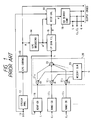
- the original speech X input to an input terminal 11 is provided to a speech analysis part 12, wherein a parameter representing the envelope configuration of its frequency spectrum is calculated.
- a linear predictive coding (LPC) method is usually employed for the analysis.
- the LPC parameters thus obtained are encoded by a LPC parameter encoding part 13, the encoded output A of which is decoded by LPC parameter decoding part 14, and the decoded LPC parameters a' are set as the filter coefficients of a LPC synthesis filter 15.
- an excitation signal (an excitation vector) E to the LPC synthesis filter 15
- a reconstructed speech X' is obtained.
- an adaptive codebook 16 there is always held a determined excitation vector of the immediately preceding frame.
- a segment of a length L corresponding to a certain period (a pitch period) is cut out from the excitation vector and the vector segment thus cut out is repeatedly concatenated until the length T of one frame is reached, by which a codevector corresponding to the periodic component of the speech is output.
- the cut-out length L which is provided as a period code (indicated by the same reference character L as that for the cut-out length) to the adaptive codebook 16
- the codevector which is output from the adaptive codebook will be referred to as an adaptive codevector.
- random codebooks 17 1 and 17 2 While one or a desired number of random codebooks are provided, the following description will be given of the case where two random codebooks 17 1 and 17 2 are provided.
- the random codebooks 17 1 or 17 2 there are prestored in the random codebooks 17 1 or 17 2 , independently of the input speech, various vectors usually based on a white Gaussian noise and having the length T of one frame. From the random codebooks the stored vectors specified by given random codes C (C 1 , C 2 ) are read out and output as codevectors corresponding to aperiodic components of the speech.
- the codevectors output from the random codebooks will be referred to as random codevectors.
- the codevectors from the adaptive codebook 16 and the random codebooks 17 1 or 17 2 are provided to a weighted accumulation part 20, wherein they are multiplied, in multiplication parts 21 0 , 21 1 and 21 2 , by weights (i.e., gains) g 0 , g 1 and g 2 from a weight generation part 23, respectively, and the multiplied outputs are added together in an addition part 22.
- the weight generation part 23 generates the weights g 0 , g 1 and g 2 in accordance with a weight code G provided thereto.
- the added output from the addition part 22 is supplied as an excitation vector candidate to the LPC synthesis filter 15, from which the synthesized speech X' is output.
- a distortion d of the synthesized speech X', with respect to the original speech X from the input terminal 11, is calculated in a distance calculation part 18.
- a codebook search control part 19 searches for a most suitable cut-out length L in the adaptive codebook 16 to determine an optimal codevector of the adaptive codebook 16. Then, the codebook search control part 19 determine sequentially optimal codevectors of the random codebooks 17 1 and 17 2 and optimal weights g 0 , g 1 and g 2 of the weighted accumulation part 20. In this way, a combination of codes is searched which minimizes the distortion d, and the excitation vector candidate at that time is determined as an excitation vector E for the current frame and is written into the adaptive codebook 16.
- the period code L representative of the cut-out length of the adaptive codebook 16 the random codes C 1 and C 2 representative of code vectors of the random codebooks 17 1 and 17 2 , a weight code G representative of the weights g 0 , g 1 and g 2 , and a LPC parameter code A are provided as coded outputs and transmitted or stored.
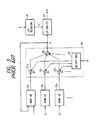
- Fig. 3 shows a decoding method.
- the input LPC parameter code A is decoded in a LPC parameter decoding part 26 and the decoded LPC parameters a' are set as filter coefficients in a LPC synthesis filter 27.
- a vector segment of a period length L of the input period code L is cut out of an excitation vector of the immediately preceding frame stored in an adaptive codebook 28 and the thus cut-out vector segment is repeatedly concatenated until the frame length T is reached, whereby a codevector is produced.
- codevectors corresponding to the input random codes C 1 and C 2 are read out of random codebooks 29 1 and 29 2 , respectively, and a weight generation part 32 of a weighted accumulation part 30 generates the weights g 0 , g 1 and g 2 in accordance with the input eight code G.
- These output code vectors are provided to multiplication parts 31 0 , 31 1 and 31 2 , wherein they are multiplied by the weights g 0 , g 1 and g 2 from the weight generation part 32 and then added together in an addition part 33.
- the added output is supplied as a new excitation vector E to the LPC synthesis filter 27, from which a reconstructed speech X' is obtained.
- the random codebooks 29 1 and 29 2 are identical with those 17 1 and 17 2 used for encoding. As referred to previously, only one or more than one random codebooks may sometimes be employed.
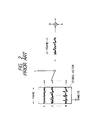
- codevectors to be selected as optimal codevectors are directly prestored in the random codebooks 17 1 , 17 2 and 29 1 , 29 2 in Figs. 1 and 3. That is, when the number of codevectors to be selected as optimal code vectors is N, the number of vectors stored in each random codebook is also N.
- the random codebooks 17 1 and 17 2 in Fig. 1 are substituted with a random codebook 17 shown in Fig. 4, in which M vectors (referred to as basis vectors in the case of VSELP coding) stored in a basis vector table 25 are simultaneously read out, they are provided to multiplication parts 34 1 to 34 M , wherein they are multiplied by +1 or -1 by the output of a random codebook decoder 24, and the multiplied outputs are added together in an addition part 35, thereafter being output as a codevector.
- M vectors referred to as basis vectors in the case of VSELP coding
- the number of different code vectors obtainable with all combinations of the sign values +1 and -1, by which the respective basis vectors are multiplied is 2 M , one of the 2 M codevectors is chosen so that the distortion d is minimized, and the code C (M bits) indicating a combination of signs which provides the chosen codevector is determined.
- weights g 0 , g 1 and g 2 which are used in the weighted accumulation part 20 in Fig. 1; a method in which weights are scalar quantized, which are theoretically optimal so that the distortion is minimized during the search for a period (i.e., the search for the optimal cut-out length L of the adaptive codebook 16) and during search for a random code vector (i.e., the search for the random codebooks 17 1 and 17 2 ), and a method in which a weight codebook is searched, which has prestored therein, as weight vectors, a plurality of sets of weights g 0 , g 1 and g 2 , the weight vector (g 0 , g 1 and g 2 ) is determined to minimize the distortion.
- a coding method according to the precharacterizing clause of claim 1 and a corresponding decoding method are disclosed in the document EP-A-0 296 764.
- This prior art uses an adaptive codebook in which the optimum excitation vectors for a certain number of preceding frames are stored. For each frame the stored excitation vector consists of the same number of samples as the sampled original speech frame. To find the optimum adaptive codevector, overlapping sets of this number of samples are read from the adaptive codebook as respective adaptive codevectors. A virtual search is performed repeating accessed information from the adaptive codebook into a later portion of a set for which there are no samples in the codebook.
- a part or whole of the random codevector which is output from a random codebook, a part of the component of the output random codevector, or a part of a plurality of random codebooks, which has no periodicity in the prior art is provided with periodicity related to that of the output vector of the adaptive codebook.
- Fig. 5 shows a coding procedure in the case where the speech coding method according to the present invention is applied to a coding part in the CELP coding.
- the coding procedure will be described with reference to Figs. 1 and 6.
- the conceptual construction of the encoder employed In this case is identical with that shown in Fig. 1.
- the codebook being identified by reference numeral 17.
- the LPC synthesis filter 15 has set therein from the LPC parameter decoding part 14, as its filter coefficients, the LPC parameters a' corresponding to those obtained by analyzing in the speech analysis part 12 the input speech frame (a vector composed of a predetermined number of samples) to be encoded.
- the vector X of the speech frame (the input speech vector) is provided as an object for comparison to the distance calculation part 18.
- the coding procedure begins with selecting one of a plurality of periods L within a predetermined range of pitch periods (the range over which an ordinary pitch period exists) in step S1.
- a vector segment of the length of the selected period L is cut out from the excitation vector E of the preceding frame in the adaptive codebook 16 and the same vector segment is repeatedly concatenated until a predetermined frame length is reached, by which a codevector of the adaptive codebook is obtained.
- step S3 the codevector of the adaptive codebook is provided to the LPC synthesis filter 15 to excite it, and its output (a reconstructed speech vector) X' is provided to the distance calculation part 18, wherein the distance to the input vector, i.e. the distortion is calculated.
- step S1 The process returns to step S1, wherein another period L is selected and in steps S2 and S3 the distortion is calculated by the same procedure as mentioned above. This processing is repeated for all the periods L.
- step S4 the period L (and the period code L) which provided a minimum one of the distortions and the corresponding codevector of the adaptive codebook are determined.
- step S5 one stored vector is selected from the random codebook 17 1 .
- step S6 as indicated by a in Fig. 6, a vector segment 36 of the length of the period L determined as mentioned above is cut out from the selected stored vector and the vector segment 36 thus cut out is repeatedly concatenated until one frame length is reached, by which is generated a codevector provided with periodicity (hereinafter referred to as a repetitious random codevector or repetitious codevector).
- the vector segment 36 is cut out from the codevector by the length L backwardly of its beginning or forwardly of its terminating end.
- the vector segment 36 shown in Fig. 6 is cut out from the codevector backwardly of its beginning.
- step S7 wherein the repetitious random codevector is provided to the synthesis filter 15 and a distortion of the reconstructed speech vector X' relative to the input speech vector X is calculated in the distance calculation part 18, taking into account the optimum codevector of the adaptive codebook determined in step S4.
- step S5 The process goes back to step S5, wherein another codevector of the random codebook is selected and the distortion is similarly calculated in steps S6 and S7. This processing is repeated for all codevectors stored in the random codebook 17.
- step S8 the codevector (and the random code C) of the random codebook which provided the minimum distortion is determined.
- step S9 wherein one of prestored sets of weights (g 0 , g 1 ) is selected and provided to the multiplication parts 21 0 and 21 1 .
- step S10 the process proceeds to step S10, wherein the above-mentioned determined adaptive codevector and the repetitious random codevector are provided to the multiplication parts 21 0 and 21 1 , and their output vectors are added together in the addition part 22, the added output being provided as an excitation vector candidate to the LPC synthesis filter 15.
- the reconstructed speech vector X' from the synthesis filter 15 is provided to the distance calculation part 18, wherein the distance (or distortion) between the vector X' and the input vector X is calculated.
- step S9 wherein another set of weights is selected, and the distortion is similarly calculated in step S10. This processing is repeated for all sets of weights.
- step S11 the set of weights (g 0 , g 1 ) which provided the smallest one of the distortions thus obtained and the weight code G corresponding to such a set of weight are determined.
- the period code L, the random code C and the weight code G which minimize the distance between the reconstructed speech vector X' available from the LPC synthesis filter 15 and the input speech vector X are determined as optimum codes by vector quantization for the input speech vector X. These optimum codes are transmitted together with the LPC parameter code A or stored on a recording medium.
- a random codevector taking into consideration the optimum codevector of the adaptive codebook in step S7, two methods can be used for evaluating the distortion of the reconstructed speech vector X' with respect to the input speech vector X.
- the codevector of the random codebook is orthogonalized by the adaptive codevector and is provided to the LPC synthesis filter 15 to excite it and then the distance between the reconstructed speech vector provided therefrom and the input speech vector is calculated as the distortion.
- a second method is to calculate the distance between a speech vector reconstructed by the random codevector and the input speech vector orthogonalized by the adaptive codevector.
- Either method is well-known in this field of art and is a process for removing the component of the adaptive codevector in the input speech vector and the random codevector, but from the theoretical point of view, the first method permits more accurate or strict evaluation of the distortion rather than the second method.
- steps S5 to S7 in Fig. 5 are performed for each of the random codebooks 17 1 , 17 2 , ... and optimum codevectors are selected one by one from the respective codebooks.
- steps S5 to S7 in Fig. 5 are performed for each of the random codebooks 17 1 , 17 2 , ... and optimum codevectors are selected one by one from the respective codebooks.
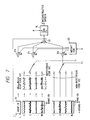
- Fig. 7 illustrates only the principal part of an example of the construction of the latter.
- the random codebook 17 1 outputs repetitious codevectors
- the random codebook 17 2 outputs its stored vectors intact as codevectors.
- VSELP VSELP
- predetermined ones of M basis vectors are output as repetitious vectors obtained by the afore-mentioned method and the other vectors are output as non-repetitious vectors.
- multiplication parts 34 1 to 34 M are each shown to be capable of inputting thereinto both of the repetitious basis vector and the non-repetitious basis vector, either one of them is selected prior to the starting of the encoder.
- the repetitious basis vectors and the non-repetitious basis vectors are each multiplied by a sign value +1 or -1, and the multiplied outputs are added together in an addition part 35 to provide an output codevector therefrom.
- the selection of the sign value +1 or -1, which is applied to each of the multiplication parts 34 1 to 34 M is done in the same manner as in the prior art to optimize the output vector.
- the ratio between the numbers of repetitious basis vectors and the non-repetitious basis vectors i.e. the ratio between the ranges of selection of the periodic and aperiodic components in the excitation signal can be set arbitrarily and can be made close to an optimum value. This ratio is preset.
- the search for the optimum codevector can be followed by separate generation of the periodic component (obtained by an accumulation of only the repetitious basis vectors multiplied by a sign value) and the aperiodic component (obtained by an accumulation of only the non-repetitious basis vector multiplied by a sign value) of the vector.
- the periodic component and the aperiodic component contained in one vector which is output from the accumulation part 22 can be weighted with different values.
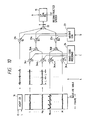
- the basis vectors 1 to M S are provided with periodicity and the outputs obtained by multiplying them by the sign value +1 or -1 are accumulated in an accumulation part 35A to obtain the repetitious codevector of the random codebook.
- the remaining basic vectors M S+1 to M are held non-repetitious and the outputs obtained by multiplying them by the sign value ⁇ 1 are accumulated in an accumulation part 35B to obtain the non-repetitious codevector of the random codebook.
- the outputs of the accumulation parts 35A and 35B are provided to multiplication parts 21 11 and 21 12 , wherein they are multiplied by weights g 11 and g 12 , respectively, and the multiplied outputs are applied to the accumulation part 22.
- the optimum output vector of the random codebook is determined by selecting the sign value +1 or -1 which is provided to the multiplication part 34 1 to 34 M , followed by the search for the optimum weights g 11 and g 1 2 for the repetitious codevector and the non-repetitious codevector which are output from the accumulation parts 35A and 35B.
- the ratio between the periodic component and the aperiodic component of the excitation signal E can be optimized for each frame by changing the ratio as mentioned above.
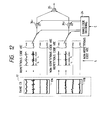
- the random codebook 17 is formed by, for example, two sub-random codebooks 17A and 17B each composed of four stored vectors
- one of the four stored vectors is selected as the output vector of each sub-random codebook
- the output vectors are multiplied by the sign value +1 or -1 in the multiplication parts 34 1 and 34 2 and the multiplied outputs are accumulated in an accumulation part 35 to obtain the output codevector
- the output of the sub-random codebook 17A is made repetitious and the output of the sub-random codebook 17B is held non-repetitious.
- sub-codevectors in the sub-random codebooks 17A and 17B may also be made repetitious as shown in Fig. 12.
- Fig. 12 two of the four vectors in each sub-random codebook are made repetitious.
- the random codevector contained in the excitation signal is made repetitious, and hence the reconstructed speech becomes smooth.
- the ratio between the range of selection of the periodic and aperiodic components in the excitation signal can be set to an arbitrary value, which can be made close to the optimum value. Further, the ratio can be changed for each frame by making some of codevectors of one random codebook repetitious.
- the periodic and aperiodic components can each be weighted with a different value for each frame and an optimum weight ratio for the frame can be obtained by searching the weight codebook.
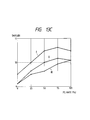
- Figs. 13A, 13B and 13C show, by way of example, the improving effect on the reconstructed speech quality by speech coding with a coding rate of about 4 kbit/s.
- Fig. 13A shows the signal-to-noise (SN) ratio and the segmental SN ratio in the case of employing two random codebooks, one being a VSELP type random codebook having M S basis vectors rendered repetitious and the other being a VSELP type random codebook having (12-M S ) non-repetitious basis vectors.
- Fig. 13B shows the SN ratio and the segmental SN ratio in the case where the number M of basis vectors is 12 in Fig. 9, M S basis vectors are made repetitious but the remaining vectors are held non-repetitious.
- 13C shows the SN ratio with respect to "the number of repetitious vectors/the total number of vectors" (hereinafter referred to simply as a PS rate) represented on the abscissa in the case where the number N of vectors in each of the two channels of sub-random codebooks 17A and 17B in Fig. 12 is 32.
- the curve II shows the SN ratio with respect to the PS rate in the case where four sub-random codebooks are used in Fig. 12 and the number N of vectors in each sub-random codebook is 4.
- 13C shows the SN ratio with respect to "the number of sub-codebooks to be made repetitious/the total number of sub-codebooks" in the case where four sub-random codebooks are used in Fig. 11 and each sub-random codebook has four vectors.
- the optimum SN ratio can be obtained when the PS rate is 75%.
- the optimum period (i.e. pitch period) L is determined by use of the adaptive codebook alone as shown in Fig. 5 and then the random code C of the random codebook and consequently its random codevector is determined, but it has been found that this method cannot always determine a correct pitch period, for example, a twice the correct pitch period is often determined as optimum.
- a description will be given of an embodiment of the present invention intended to overcome such a shortcoming.
- a loop for searching for the optimum codevector of the random codebook is included in a loop for determining the period L by repeating the processing of setting the period L and then evaluating the distortion.
- step S1 one period L is set which is selected within a predetermined range of pitch periods, and in step S2 the codevector of the adaptive codebook is generated as in steps S1 and S2 shown in Fig. 5.
- step S3 a random codevector selected from the random codebook is made repetitious as shown in steps S5, S6 and S7 in Fig. 5 and in Fig. 6, the weighted repetitious random codevector is added to the weighted adaptive codevector, and the added output is applied to the LPC synthesis filter to excite it, then the distortion is calculated. This processing is performed for all the random codevectors of the random codebook.
- step S4 the random code C of the random codevector of the random codebook, which minimizes the distortion, is searched for. This determines the optimum random code C temporarily for the initially set period L.
- step S5 a combination of the period L and the random code C, which minimizes the distortion, is finally obtained from the random codes C temporarily determined for each period L.
- Fig. 15 illustrates a modified form of the Fig. 14 embodiment.
- the random codebook is not searched for all periods L but instead periods L and random codevectors are preselected in step SO and the random codebook is searched only for each preselected period L in steps S1, S2, S3 and S4.
- step S3 the optimum codevector of the random codevectors is searched among the preselected codevectors of the random codebook alone.
- the optimum value is determined in all combinations of the period L and the random code C, the loop for search is double, and consequently, the amount of data to be processed becomes enormous according to conditions. To avoid this, the period L and the codevector of the random codebook are each only searched from a small number of candidates in this embodiment.
- the distortion is evaluated using only codevectors of the adaptive codebook as in the prior art and a predetermined number of periods are selected which provided the smallest distortions. It is also possible to use, as the candidates for the period L, a plurality of delays which increase an auto-correlation of a LPC residual signal which is merely derived from the input speech in the speech analysis part 12 in Fig. 1. That is, the delays which increase the auto-correlation are usually used as the candidates for the pitch period, but in the present invention the delays are used as the preselected values of the period L. In the case of obtaining the pitch period on the basis of the auto-correlation, no distance calculation is involved, and consequently, the computational complexity is markedly reduced as compared with that involved in the case of obtaining the pitch period by the search of the adaptive codebook.
- the random codevectors (and their codes) of the random codebook are preselected by such a method as mentioned below.
- the codevectors of the random codebook are made repetitious using one of the preselected periods L, distortions are examined which are caused in the cases of using the repetitious random codevectors and a plurality of random codevectors (and their codes) are selected as candidates in increasing order of distortion.
- the alternative is a method according to which one period is determined on the basis of the output from the adaptive codebook alone, the correlation is obtained between the input speech vector and each random codevector orthogonalized by the adaptive codevector corresponding to the period, and then random codevectors corresponding to some of high correlations are selected as candidates.
- steps S1 through S4 distortion of the synthesized speech is examined which is caused in the case where each of such preselected codevectors of the random codebook is made repetitious using each of the preselected periods, and that one of combinations of the preselected random codevectors and preselected periods which minimizes the distortion of the synthesized speech is determined in step S5.
- the codevectors of the random codebook need not always all be rendered repetitious and only predetermined ones of them may be made repetitious.
- the random codevectors may be made repetitious using not only the period obtained with the adaptive codebook but also periods twice or one-half of that period.
- the present invention is applicable to VSELP coding as well as to CELP coding.
- the codevectors of the random codebook are made repetitious in accordance with the pitch period and repetition period, i.e. the pitch period is determined taking into account the codevectors of the adaptive codebook and the random codebook.
- the pitch period is determined taking into account the codevectors of the adaptive codebook and the random codebook.
- This increases the interdependence of the codevector from the adaptive codebook and the codevector from the random codebook on each other, providing the optimum repetition period which minimizes the distortion in the frame. Accordingly, coding distortion can be made smaller than in the case where the pitch period of the adaptive codebook is obtained and is used intact as the repetition period of the random codebook.
- the combined use of preselection makes it possible to obtain substantially an optimum period with a reasonable amount of data to be processed.
- the random codevector is made repetitious only using the pitch period of the adaptive codebook, but improvement in this processing will permit a speech coding and decoding method which provides a high quality coded speech even at a low bit rate of 4 kbit/s or so. This will be described hereinbelow with reference to Fig. 16.
- Fig. 16 illustrates only the principal part of the embodiment.
- the encoder used is identical in block diagram with the encoder depicted in Fig. 1.
- the adaptive codebook 16 is used to select the period L which minimizes the distortion of the synthesized speech.
- the random codebook 17 is searched.
- stored vectors of the random codebook 17 are taken out one by one, a vector segment 36 having the length of the period L obtained with the adaptive codebook 16 is cut out from the stored vector 37, and the vector segment 36 thus cut out is repeated to form a repetitious codevector 38 of one frame length.
- a vector segment 39 having a length one-half the period L is cut out from the same stored vector and the cut-out vector segment 39 is repeated to form a repetitious codevector 41 of one frame length.
- These repetitious codevectors 38 and 41 are individually provided to the multiplication part 21 l . In this case, it is necessary to send a code indicating whether the period L or L/2 was used to make the selected random codevector repetitious to the decoding side together with the random code C.
- This embodiment is identical with the Fig. 5 embodiment except the above.
- each codevector of the random codebook 17 is made repetitious with the period L and the codevector of the random codebook which minimizes the distortion of the synthesized speech is searched taking into account of the optimum codevector of the adaptive codebook.
- each codevector of the random codebook 17 is made repetitious with the period L/2 and the codevector of the random codebook 17 which minimizes the distortion of the synthesized speech is searched taking into account of the optimum codevector of the adaptive codebook.
- the codevector of the random codebook 17 which minimizes the distortion of the synthesized speech can be obtained as a whole.
- a codevector of a length twice the pitch period is often detected as the codevector which minimizes the distortion.
- that one of the codevectors of the random codebook made repetitious with the period L/2 which minimizes the distortion is selected.
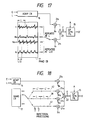
- Fig. 17 it is also possible to make codevectors 1 to N S of the random codebook 17 repetitious with the period L and codevectors N S+1 to N repetitious with the period L/2. Also in this case, when the period L becomes twice the pitch period, the codevector which minimizes the distortion of the synthesized speech is selected from the codevectors N S+1 to N. In the example of Fig. 16 it is necessary to send to the decoding side, together with the random code C indicating the selected random codevector, a code indicating whether the period L or L/2 was used to make the selected random codevector repetitious, but the example of Fig. 17 does not call for sending such a code.
- the random codevector of the random codebook can be made repetitious using the optimum period L obtained from the adaptive codebook, the afore-mentioned period L/2, a period 2L, an optimum period L' obtained by searching the adaptive codebook in the preceding frame, a period L'/2, or 2L'.
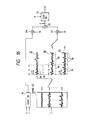
- Fig. 18 illustrates another modified form of the Fig. 16 embodiment.
- codevectors of the random codebook 17 are made repetitious with the period L identical with the optimum period obtained by the search of the adaptive codebook 16 and the codevector is selected which minimizes the distortion of the synthesized speech. Then, the selected codevector is made repetitious with other periods L' and L/2 in this example as shown in Fig. 18, thereby obtaining codevectors 41 and 42.
- the repetitious codevectors 41 and 42 and the codevector 38 made repetitious with the period L are subjected to a weighted accumulation, by which are obtained gains (i.e., weights) g 11 , g 1 2 and g 1 3 for the repetitious codevectors 38, 41 and 42 which minimize the distortion of the synthesized speech.
- gains i.e., weights
- the pitch period L used in the adaptive codebook 16 is sufficiently ideal, then the gain g 1 1 for the random codevector made repetitious with that period will automatically increase.
- the gain g 1 2 or g 13 for the random codevector rendered repetitious with a more suitable period L/2 or L' will increase.
- the pitch period searched in the adaptive codebook is not correct, codevectors of the random codebook are made repetitious with a desirable period, and consequently, the distortion of the synthesized speech can be further reduced.
- the pitch period obtained by searching the adaptive codebook may sometimes be twice the original pitch period, but the distortion in this case can be reduced.
- Fig. 19 illustrates an embodiment improved from the Fig. 8 embodiment.
- the search of the adaptive codebook 16 for the basic period is the same as in the embodiment of Fig. 5.
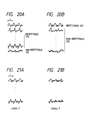
- a part 43 for determining the number of codevectors to be made repetitious is provided in the encoder shown in Fig. 1, by which the periodicity of the current frame of the input speech is evaluated.
- the periodicity of the input speech is evaluated on the basis of, for example, the gain g 0 for the adaptive codevector and the power P and the spectral envelope configuration (the LPC parameters) A both derived from the input speech in the speech analysis part 12 in Fig. 1, and the number Ns of random codevectors in the random codebook 17 to be rendered repetitious is determined in accordance with the periodicity of the input speech.
- the number Ns of random codevectors to be made repetitious with the pitch period L is selected large as shown in Fig. 20A, whereas when the evaluated periodicity is low, the number Ns of random codevector to be made repetitious is selected small as depicted in Fig. 20B.
- the pitch gain g 0 is used as the evaluation of the periodicity and the number Ns of random codevectors to be made repetitious is determined substantially in proportion to the pitch gain g 0 .
- the pitch gain g 0 is determined simultaneously with the determination of the gain g 1 of the determined random codevector
- the slope of the spectral envelope and the power of the speech are used as estimated periodicity. Since the periodicity of the speech frame has high correlation with the power of the speech and the slope of its spectral envelope (a first order coefficient), the periodicity can be evaluated on the basis of them.
- the decoded speech is available in the coder and the decoder in common to them as seen from Figs. 1 and 3, and the periodicity of the speech frame does not abruptly change in adjoining speech frames; hence, the periodicity of the preceding speech frame may also be utilized.
- the periodicity of the preceding speech frame is evaluated, for example, in terms of auto-correlation.
- the decoding side performs exactly the same processing as that in the encoding side.
- the determination of the number of random codevectors to be rendered repetitious is followed by the determination of the vector which minimizes the distortion of the synthesized speech, relative to the input speech vector. Also in the decoder, similar periodicity evaluation is performed to control the number of random codevectors to be rendered repetitious and the excitation signal E is produced accordingly, then a LPC synthesis filter (corresponding to the synthesis filter 27 in Fig. 3) is excited by the excitation signal E to obtain the reconstructed speech output.
- the control of the degree to which the codevectors of the random codebook are each made repetitious is not limited specifically to the control of the number Ns of codevectors to be made repetitious, but it may also be effected by a method in which repetition degree is introduced in making one codevector repetitious and the degree of repetitiousness is controlled in accordance with the evaluated periodicity.
- the vector component (1 - ⁇ )C(i) held non-repetitious remains as a non-repetitious component in the repetitious codevector C'.
- the repetitious codevector varies with the value of the repetition degree ⁇ .
- the number is selected larger with an increase in the evaluated periodicity.
- the degree ⁇ is selected larger with an increase in the evaluated periodicity. It is possible, of course, to combine the control of the number of codevectors to be made repetitious and the control of the repetition degree ⁇ .
- the control of the repetitious codevectors is not only the control of the number of codevectors to be made repetitious but also the number of basis vectors to be made repetitious in the case of VSELP coding, and the control of the repetition degree ⁇ may also be effected by controlling the repetition degree in making the basis vectors repetitious.
- the codevectors are made repetitious using the period L obtained by searching the adaptive codebook in the frame concerned, the period L may also be those L', L/2, 2L, L'/2, etc. which are obtained by searching the adaptive codebook of the preceding frame.
- the pitch period in the adaptive codebook 16 it is effective to employ a method of determining the pitch period by using a waveform distortion of the reconstructed speech as a measure to reduce the distortion, or a method employing the period of a non-integral value. More specifically, it is preferable to utilize, as a procedure using the pitch period, a method in which for each pitch period L the excitation signal (vector) E in the past is cut out as a waveform vector segment, going back to a sample point by the pitch period from the current analysis starting time point, the waveform vector segment is repeated, as required, to generate a codevector and the codevector is used as the codevector of the adaptive codebook.
- the codevector of the adaptive codebook is used to excite the synthesis filter.
- the vector cut-out length in the adaptive codebook i.e. the pitch period, is determined so that the distortion of the reconstructed speech waveform obtained from the synthesis filter, relative to the input speech, is minimized.
- the desirable pitch period to be ultimately obtained is one that minimizes the ultimate waveform distortion, taking into account its combination with the codevectors of the random codebook, but it involves enormous computational complexity to search combinations of codevectors of the adaptive codebook 16 and the codevectors of the random codebooks 17 1 and 17 2 , and hence is impractical.
- the pitch period is determined which minimizes the distortion of the reconstructed speech when the synthesis filter 15 is excited by only the codevector of the adaptive codebook 16 with no regard to the codevectors of the random codebooks.
- the pitch period thus determined differs from the ultimately desirable period. This is particularly conspicuous in the case of employing the coding method of Fig. 5 in which the codevector of the random codebooks are also made repetitious using the pitch period.
- Either of the above-mentioned methods involves computational complexity 10 times or more than that in a method which obtains the pitch period on the basis of peaks of the auto-correlation of a speech waveform, and this constitutes an obstacle to the implementation of a real-time processor.
- a method which selects a plurality of candidates for the pitch period in step S0 in Fig. 15 and searching only the candidates for the optimum pitch period in step S1 et seq. using the measure of minimization of the waveform distortion so as to decrease the computational complexity the waveform distortion cannot always be reduced.
- step S1 the periodicity of the waveform of the input speech is analyzed in the speech analysis part 1 in Fig. 1.
- the lengths of the n periods are an integral multiple of the sample period of the input speech frame (accordingly, the value of each period length is an integral value), and values of auto-correlation corresponding to non-integral period length in the vicinity of these period lengths are obtained in advance by simple interpolating computation.
- the analysis window is selected sufficiently larger than the length of one speech frame.
- step S2 the codevector of the adaptive codebook, generated using each of the n candidates for the pitch period and the predetermined number of non-integral-value periods in the vicinity of the n candidates, is provided as the excitation vector to the synthesis filter 15 and the waveform distortion of the reconstructed speech provided therefrom is computed.
- Eq. (1) is partially differentiated by the gain g to determine an optimum gain g which reduces the differentiated value to zero, that is, minimizes the distortion d.
- e( ⁇ ) is computed for each of the candidates found in step S1.
- step S3 the pitch period ⁇ is selected, based not only on the waveform distortion when the codevector of the adaptive codebook is used as the excitation signal but also on a measure taking into account the value of the auto-correlation ⁇ ( ⁇ k ) obtained in step S1. In this instance, only the candidate ⁇ k obtained in step S1 and its vicinity are searched.
- the denominator of Eq. (4) represents the power of the output of the synthesis filter supplied with the output from the adaptive codebook. Since it can be regarded as substantially constant even if the period ⁇ is varied, it is also possible to sequentially preselect periods having large values of the numerator ⁇ ( ⁇ k )(X T HP( ⁇ k )) 2 and calculate Eq. (4) , including the denominator, for each of the preselected periods, that is, it is possible to obtain ⁇ . This is intended to reduce the computational complexity of the denominator of Eq. (4) since it is far higher than the computational complexity of the numerator.
- the measure for selecting the pitch in step S3 can be adaptively controlled in accordance with the constancy of the speech in that speech period (or the analysis window). That is, the auto-correlation ⁇ ( ⁇ ) is a function which depends on the mean pitch period viewed through a relatively long window.
- the term e( ⁇ ) is a function which depends on a local pitch period only in the speech frame which is encoded. Accordingly, the desirable pitch period can be determined by attaching importance to the function ⁇ ( ⁇ ) in the constant or steady speech period and the function e( ⁇ ) in a waveform changing portion. More specifically, the variation ratio of speech power is converted to a function V taking values 0 to 1 as shown in Fig.
- step S3 it is possible to obtain the pitch period which is most desirable to the output vector of the random codebook, in step S3, by taking into account both of the distortion of the waveform synthesized only by the codevector of the adaptive codebook and the periodicity analyzed in step S1.
- This permits the determination of the pitch period more correct or accurate than that obtainable with the method which merely limits the number of candidates for the pitch periods in step S1.
- the waveform distortion can be reduced.
- a vector quantization method which handles, as a unit, a vector composed of plural samples, such as the codevector of the random codebook in Fig. 1.
- a gain-shape quantization method which quantizes the signal waveform in pairs of shape and gain vectors is usually employed.
- codevectors are held, as shape vectors, in the random codebooks 17 1 and 17 2 , for example, and a selected one of such shape vectors in each random codebook and weights (gains) g 1 and g 2 which are provided to the multiplication parts 21 1 and 21 2 are used to vector quantize a random component of the input speech waveform.
- Such a gain-shape vector quantization method is constituted so that, in the selection of a quantization vector (a reference shape vector) of the smallest distance to the input waveform, one of the shape vectors (i.e., codevectors) stored in the shape vector codebook (i.e., the random codebook) 17 is selected and is multiplied by a desired scalar quantity (gain) g in the multiplication part 21 to provide the shape vector with a desired amplitude.
- the input waveform is represented (i.e. quantized) by a pair of a code corresponding to the shape vector and the code of the gain.
- Fig. 24 illustrates a basic process which is (applicable to the foregoing embodiments).
- a reference shape vector Cs selected from a shape vector codebook 44 having a plurality of reference shape vectors Cs each represented by a shape code S, is provided to a multiplication part 45.
- an amplitude envelope characteristic generation part 46 generates an amplitude envelope characteristic Gy corresponding to an amplitude characteristic code Y provided thereto, and the amplitude envelope characteristic Gy thus created is provided to the multiplication part 45.
- the amplitude envelope characteristic Gy is a vector which has the same number of dimensions (the number of samples) as does the shape vector Cs.
- the shape vector codebook 44 has a plurality of pairs of reference shape vectors Cs and codes S.
- Fig. 25 shows examples of comprehensive features of the multiplication part 45 and the amplitude envelope characteristic generation part 46 in Fig. 24.
- a reference shape vector Cs selected from the shape vector codebook 44 is separated into front, middle and rear portions of the shape vector, using three amplitude envelope characteristic window functions W 0 , W 1 and W 2 , and the separated portions are multiplied by the gains g 0 , g 1 and g 2 , respectively. The results are added together and the added result is output as the reconstructed vector U.
- window functions W 0 , V 1 and W 2 are each expressed by a vector of the same number of dimensions as that of the vector Cs.
- gains for the three different portions of the shape vector Cs in the time-axis direction can be controlled.
- the number of elements of the gain vector is three in this example but it needs only to be two or more and smaller than the number of dimensions of the shape vector.
- the reconstructed vector may be expressed simply by the products of corresponding elements of the shape vector and the amplitude envelope vector.
- Fig. 26 shows other examples of the comprehensive features of the multiplication part 45 and the amplitude envelope characteristic generation part 46, the amplitude envelope characteristic being expressed by a quadratic polynomial.
- the window functions W 0 , W 1 and W 2 represent a constant, a first order term and a second order term of the polynomial, respectively.
- the elements g 0 , g 1 and g 2 of the gain vector are zero-order, first-order and second-order polynomial expansion coefficients of the amplitude envelope characteristic, respectively. That is, the element g 0 represents the gain for the constant term, g 1 the gain for the first-order variable term and g 2 the gain for the second-order variable term.
- the amplitude envelope characteristic is separated by modulation with orthogonal polynomials, the gains are multiplied independently, and all the components are added together, whereby the reconstructed vector is obtained.
- the use of the orthogonal polynomials is not necessarily required to synthesize the reconstructed vector but is effective in obtaining the optimum gain vector g as in the case of training a gain codebook.
- the codevector of the gain g has to be obtained as a solution of simultaneous equations, but the modulation by the orthogonal polynomials enables non-diagonal terms of the equations to be approximate to zero, and hence allows ease in obtaining the solution.
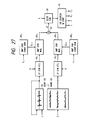
- Fig. 27 illustrates in block form an embodiment in which the vector quantization method utilizing the above-mentioned amplitude envelope characteristic is applied to speech signal coding.
- the codevector output from the adaptive codebook 16 and the codevector output from the random codebook 17 are provided as excitation vectors to LPC synthesis filters 15 1 and 15 2 , the reconstructed outputs of which are provided to amplitude envelope multiplication parts 45 1 and 45 2 , respectively in each of the LPC synthesis filters 15, and 15 2 there is set the LPC parameters A from the speech analysis part as in the case of Fig. 1.
- Amplitude envelope characteristic generation parts 46, and 46 2 generate amplitude envelope characteristics Gy 1 and Gy 2 based on parameter codes Y 1 and Y 2 provided thereto and supply them to the amplitude envelope multiplication parts 45 1 and 45 2 .
- Each codevector for each frame is provided as an excitation vector to each of the synthesis filters 15 1 and 15 2 , the reconstructed outputs of which are input into the amplitude envelope multiplication parts 45 1 and 45 2 , wherein they are multiplied by the amplitude envelope characteristics Gy 1 and Gy 2 from the amplitude envelope characteristic generation parts 46 1 and 46 2 , respectively.
- the multiplied outputs are accumulated in an accumulation part 47, the output of which is provided as the reconstructed speech vector X'.
- the amplitude envelope characteristics Gy 1 and Gy 2 are each constructed, for instance, as the products of the window functions W 0 , W 1 , W 2 and the gain g 0 , g 1 , g 2 in Figs. 25 and 26.
- the distortion of the reconstructed speech X' relative to the input speech X is calculated in the distortion calculation part 18, and the pitch period L, the random code C and amplitude characteristic codes Y 1 and Y 2 which minimize the distortion are determined by the codebook search control part 19.
- the decoder reconstructed vectors, which are obtained by the products of out-put vectors of the adaptive codebook and the random codebook obtainable and the amplitude envelope characteristics Gy 1 , Gy 2 from the codes L, C and Y 1 , Y 2 , are accumulated and provided to the synthesis filter to yield the reconstructed speech.
- the reconstructed vector U is expressed by the product of the shape vector Cs of a substantially flat amplitude characteristic and a gentle amplitude characteristic Gy specified by a small number of parameters, and a desired input vector is quantized using the codes S and Y representing the shape vector Cs and the amplitude characteristic Gy.
- the code Y which specifies the gain vector (g 0 , g 1 , g 2 ) which is a parameter representing the amplitude envelope characteristic
- the code S which specifies the shape vector Cs of a substantially flat amplitude characteristic are determined by referring to each codebook.
- the decoder outputs the reconstructed vector U obtained as the product of the shape vector Cs and the amplitude envelope characteristic Gy obtainable from respective codes determined by the encoder.
- the quantization distortion can be made smaller than that obtainable with the gain-shape vector quantization method used in other embodiments in which the codevector of the random codebook and the scalar value of the gain g are used to express the reconstructed vector as shown Fig. 2. That is, the signal can be quantized in units of vector with a minimum quantity of information involved and with the smallest possible distortion. This method is particularly effective when the number of dimensions of the vector is large and when the amplitude envelope characteristic undergoes a substantial change in the vector.
- the outputs of the adaptive codebook 16 and the random codebook 17 are shown to be applied directly to the LPC synthesis filters 15 1 and 15 2 prior to their accumulation, only one synthesis filter may be provided at the output side of the accumulation part 47 as in the other embodiments. Conversely, the synthesis filter 15 provided at the output side of the accumulation part 47 may be provided at the output side of each of the adaptive codebook 16 and the random codebook 17 in the embodiments described above and those described later on.
- the CELP method calls for prestoring 2048 vectors in the random codebook, while the VSELP method needs only 12 stored vectors (basis vectors) to generate the 4096 different codevectors.
- the CELP method With the CELP method, a speech of good quality can be decoded and reconstructed as compared with that by the VSELP method, but the number of prestored vectors is so large that it is essentially difficult to design them by training.
- Fig. 28 illustrates in block form an embodiment of a speech coding method which is a compromise or intermediate between the two methods, guarantees the reconstructed speech quality to some extent and calls for only a small number of prestored vectors.
- FIG. 1 is formed by the sub-random codebooks 17A and 17B, from which sub-codevectors are read out, the read-out sub-codevectors are provided to the multiplication parts 34 1 and 34 2 , wherein their signs are controlled, and they are accumulated in the accumulation part 35, thereafter being output.
- This embodiment is identical in construction with the encoder of Fig. 1 except the above. In the interests of brevity and clarity, there are omitted from Fig. 28 the LPC parameter coding part 13 and the LPC parameter decoding part 14 shown in Fig. 1.
- the input speech X provided to the terminal 11 is provided to the LPC analysis part 12, wherein it is subjected to LPC analysis in units of frames to compute the predictive coefficients A.
- the predictive coefficients A are quantized and then transmitted as auxiliary information and, at the same time, they are used as coefficients of the LPC synthesis filter 15.
- the output vector of the adaptive codebook 16 can be determined by determining the pitch period in the same manner as in the case of Fig. 1.
- the sub-codevectors read out from each sub-random codebooks 17A and 17B are each multiplied by the sign value +1 or -1, thereafter being accumulated in the accumulation part 35. Its output is applied as the excitation vector E to the LPC synthesis filter 15.
- Combinations of two vectors and two sign values which minimize the distortion d of the reconstructed speech X' obtained from the synthesis filter 15, relative to the input speech X, are selected from the sub-random codebooks 17A and 17B while taking into account the output vector of the adaptive codebook.
- a set of optimum gains g 0 and g 1 for the output vector thus selected from the adaptive codebook 16 and the vector from the accumulation part 35 is determined by searching the gain codebook 23.
- a method which uses a random codebook which has only one excitation channel corresponds to the CELP method
- a method in which the number of channels forming the random codebook is equal to the number of bits allocated, B, and each sub-random codebook has only one basis vector corresponds to the VSELP method.
- This embodiment contemplates a coding method which is intermediate between the CELP method and the VSELP method.
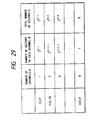
- Fig. 29 compares number of channels, K, number of vectors, N, in each channel and total number of vectors, S, among CELP, VSELP and intermediate schemes including the embodiment of Fig. 28, where it is assumed that the respective channels have the same number of bits, but an arbitrary number of bits can be allocated to each channel as long as the total number of bits allocated to each channel is B.
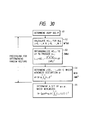
- Fig. 30 shows processing for selecting random codevectors of the sub-random codebooks 17A and 17B in such a manner as to minimize the distortion of the synthesized speech.
- step S1 an output vector P of the adaptive codebook 16 is determined by determining the pitch period L in the same manner as in the case of Fig. 1.
- C ij represents the random codevectors made repetitious.
- step S5 the thus determined codes J(0) to J(K - 1) are used to determine the set of gains g 0 and g 1 which minimizes the following equation: where the vectors are all assumed to be M-dimensional.
- the numbers of computations needed in steps S2, S3 and S4 in Fig. 30 are shown at the right-hand side of their blocks.
- the total number of vectors needed in the two sub-random codebooks is also 64 in the embodiment of Fig. 28, as is evident from the table shown in Fig. 29; so that the orthogonalization by Eq. (1) can be performed within a practical range of computational complexity.
- the number of codebook vectors corresponding to 11 bits except the sign bit is as large as 2 11 , which leads to enormous computational complexity, making real-time processing difficult.
- the distance calculation step S4 in Fig. 30, that is, Eq. (6) is expanded as follows.
- K is the number of channels of the random codebooks
- M is the number of dimensions of vectors
- N is the number of vectors per channel of the random codebook.
- the gain g is quantized after determination of the excitation vector, and hence is allowed to take an arbitrary value.
- ⁇ is expressed by the following equation:
- the computation of the ⁇ involves MNK sum-of-products calculations for the inner product of the numerator of the ⁇ and MN k sum-of-products calculations for the computation of the energy of the denominator, besides calls for N k additions, subtractions, divisions and comparisons.
- K 2
- the number of sum-of-products calculations of the numerator in this case is 64M, whereas the calculation of the energy of the denominator needs 1024M computations. Therefore, the computational complexity can be reduced by preselecting a plurality of vectors in descending order of values beginning with the largest obtained only by the inner product calculation of the numerator and calculating the energy of the denominator for only the small number of such preselected candidates. Substituting D in the parentheses on the term of the numerator in Eq.
- Step S1 The adaptive codevector P is determined. At this time, HP is calculated.
- Step S2 Next, X T H, P T H T H, ⁇ HP ⁇ 2 are calculated.
- Step S3 Next, for the vector C 0j of one of the sub-random codebooks, C 0j - (P T H T HC 0j P)/ ⁇ HP ⁇ 2 is calculated.
- Step S5 n largest inner products d 0j are selected.
- Step S6 Similarly, d 1j is calculated for the vector C 1j of the other sub-random codebook, and n largest inner products d 1j are selected.
- Step S7 U 0j and U 1j are calculated only for vectors C 0j and C 1 j for the selected 2n inner products d 0 j and d 1 j .
- Step S8 The vectors C 0j and C 1j which maximize the value ⁇ of Eq. (4) , including denominator ⁇ U 0 j + U 1 j ⁇ 2 , is searched for.
- Step S8 For C 0j(0) and C 1 j(j) , a pair of g 1 and g 2 which minimizes ⁇ X - ⁇ g 1 HP + g 2 H(C 0j(0) + C 1j(j) ⁇ ⁇ 2 is determined.
- impulse response matrix H is used as the transfer function of the synthesis filter, it is also possible to employ a transfer function which provides a filter operation equivalent to that by the impulse response matrix H.
- the previous excitation signal is cut out from the adaptive codebook 16 by the length of the pitch period L and the cut-out segment is repeatedly concatenated to one frame length.
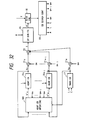
- the excitation vector E is provided to the LPC synthesis filter 15 to synthesize (i.e. decode) a speech, and in a distortion minimization control part 19 the pitch period L, the random code C and gains g 0 , ..., g M-1 , g M of respective codevector V 0 , ..., V M -1 , V M are determined so that the weighted waveform distortion of the synthesized speech waveform X' relative to the input speech X is minimized.
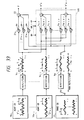
- Fig. 33 shows the synthesis of the excitation signal E and the updating of each adaptive codebook 16 i in Fig. 32.
- each adaptive codebook 16 i is the sum of codevectors f i , 0 V 0 , f i,1 V 1 , f i,2 V 2 , ..., f i,M-1 V M-1 obtained by weighting adaptive codevectors of the previous frame and a codevector f i,M V M obtained by weighting the random codevector.
- L ⁇ T a signal which goes back by the length L from the terminating end 0 of the codevector V' i is repeatedly used until the frame length T is reached.
- L > T a signal which comes down from the time point -L by the length T is used intact.
- the codevector V M of the random codebook 17 the codevector V M of the random codebook is used without being made repetitious, or a signal which repeats the length T from the beginning to the time point L is used.
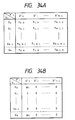
- the coefficient f i,j for obtaining the codevector V' i is such as depicted in Fig. 34A.
- the component of the random codevector of the preceding frame is emphasized by V' 1 in the deter mination of the excitation signal of the current frame, and consequently, the correlation between the random codevector of the previous frame and the excitation signal can be enhanced. That is, when L > T, the random codevector cannot be made repetitious, but it can be made repetitious by such a method as shown in Fig. 35A.
- the random codevector component V M once updated, appears as g M V M in the codevector V' M -1 , and after being updated next, it appears as g M+ 1 V M-1 in the codevector V' M -2 , and thereafter it similarly appears.
- one of M random codevectors selected in the previous frames is stored in one adaptive codebook 16 i .
- the excitation signal is synthesized by a weighted sum of adaptive codevectors V 0 to V M-1 stored in the M adaptive codebooks and the random codevector V M .
- Fig. 36 illustrates a modified form of the Fig. 32 embodiment, the parts corresponding to those in Fig. 32 being identified by the same reference numerals.
- the Fig. 32 embodiment uses, as the pitch period L, a value common to every adaptive codebook 16 i .
- pitch periods L 0 , ..., L M-1 , L M are allocated to plurality of adaptive codebooks 16 0 to 16 M-1 and the random codebook 17.
- the pitch period is likely to become tow-fold or one-half.
- the pitch period is likely to become tow-fold or one-half.
- a plurality of adaptive codebooks are prepared and the excitation signal of the current frame is expressed by a weighted linear sum of a plurality of adaptive codevectors of the adaptive codebooks and the random codevector of the random codebook, and this provides an advantage that it is possible to implement speech coding which is more adaptable and higher quality than the prior art speech coding.
Landscapes
- Engineering & Computer Science (AREA)
- Computational Linguistics (AREA)
- Signal Processing (AREA)
- Health & Medical Sciences (AREA)
- Audiology, Speech & Language Pathology (AREA)
- Human Computer Interaction (AREA)
- Physics & Mathematics (AREA)
- Acoustics & Sound (AREA)
- Multimedia (AREA)
- Compression, Expansion, Code Conversion, And Decoders (AREA)
Claims (27)
- Procédé de codage de parole dans lequel une parole d'entrée (X) est analysée par prédiction linéaire sous forme d'unités de trames afin d'obtenir des coefficients prédictifs, un vecteur d'excitation (E) est appliqué à un filtre de synthèse prédictive linéaire (15) pour obtenir une trame de parole reconstruite (X'), ledit filtre utilisant lesdits coefficients prédictifs comme coefficients de filtre, le vecteur d'excitation optimal qui minimise la distorsion (d) de ladite trame de parole reconstruite (X') par rapport à une trame respective de ladite parole d'entrée (X) est déterminé, et des paramètres (A, L, C1, C2, G) représentant lesdits coefficients prédictifs (A) et ledit vecteur d'excitation optimal (E) sont donnés en résultat du codage de parole, dans lequel ledit vecteur d'excitation optimal comprend des premier et deuxième vecteurs de code de composante assemblés à partir de vecteurs de code mémorisés dans des moyens formant registres de codes adaptatifs et aléatoires (16, 17, 171, 172), respectivement, et lesdits moyens formant registres de codes adaptatifs (16) comprennent le vecteur d'excitation optimal trouvé pour une trame précédente de ladite parole d'entrée (X), ledit procédé étant caractérisé par la réalisation, pour chaque trame :d'une première étape de coupure d'un premier segment d'une longueur (L) représentant une période de pas à partir dudit vecteur d'excitation d'une trame précédente conservée dans lesdits moyens formant registres de codes adaptatifs (16) et de concaténation répétée dudit segment afin de générer un vecteur de code de composante périodique ;d'une deuxième étape de sélection d'un ou plusieurs premiers vecteurs de code aléatoires à partir desdits moyens formant registres de codes aléatoires (17 ; 171, 172) ;d'une troisième étape de coupure d'un deuxième segment respectif d'une longueur correspondant à ladite période de pas à partir de chacun desdits un ou plusieurs premiers vecteurs de code aléatoires sélectionnés, et de concaténation répétée dudit deuxième segment, respectivement, afin de générer un ou plusieurs vecteurs de code aléatoires répétitifs ;d'une quatrième étape de délivrance en sortie d'un vecteur de composante aléatoire en fonction desdits un ou plusieurs vecteurs de code aléatoires répétitifs ;d'une cinquième étape de génération d'un vecteur d'excitation (E) en fonction dudit vecteur de composante périodique et dudit vecteur de composante aléatoire ;d'une sixième étape d'excitation dudit filtre de synthèse (15) par le vecteur d'excitation généré dans la quatrième étape, et de calcul de ladite distorsion (d) ; etd'une septième étape de recherche de la période de pas et des vecteurs de code aléatoires au nombre d'un ou plus qui minimisent ladite distorsion, de façon à obtenir par conséquent ledit vecteur d'excitation optimal.
- Procédé selon la revendication 1, dans lequel ladite deuxième étape comprend de plus une étape de sélection d'un ou plusieurs deuxièmes vecteurs de code aléatoires sous la forme de vecteurs de code aléatoires non répétitifs, et ladite quatrième étape comprend une étape de génération dudit vecteur de composante aléatoire par couplage linéaire desdits un ou plusieurs vecteurs de code aléatoires répétitifs et desdits un ou plusieurs vecteurs de code aléatoires non répétitifs.
- Procédé selon la revendication 2, dans lequel ladite quatrième étape comprend une étape de multiplication desdits un ou plusieurs vecteurs de code aléatoires répétitifs et desdits un ou plusieurs vecteurs de code aléatoires non répétitifs par des premier et deuxième poids (g1, g2), respectivement, et d'accumulation desdits vecteurs de code aléatoires pondérés pour obtenir ledit vecteur de composante aléatoire, et dans lequel ladite septième étape comprend une étape de recherche du rapport desdits premier et deuxième poids qui minimise ladite distorsion (d).
- Procédé selon la revendication 1, 2 ou 3, dans lequel ladite septième étape comprend :une étape de répétition, à chaque génération dudit vecteur de code de composante périodique dans ladite première étape, d'une séquence desdites deuxième à sixième étapes pour chacun d'un nombre prédéterminé de vecteurs de code aléatoires sélectionnés à partir desdits moyens formant registres de codes aléatoires (17 ; 171, 172) ; etune étape d'exécution de ladite étape de répétition pour chacune d'un nombre prédéterminé de périodes de pas.
- Procédé selon la revendication 4, dans lequel, avant ladite étape de répétition, pour chacune d'une pluralité de périodes de pas, un vecteur de composante périodique respectif est généré dans ladite première étape et délivré sous la forme de vecteur d'excitation audit filtre de synthèse (15), la distorsion (d) est calculée pour chaque vecteur de code de composante périodique respectif, et un nombre de périodes de pas correspondant à celui des vecteurs de code de composante périodique respectifs qui ont donné les distorsions les plus faibles est présélectionné comme étant ledit nombre prédéterminé de périodes de pas.
- Procédé selon la revendication 4, dans lequel un résidu de prédiction de ladite parole d'entrée est calculé, une auto-corrélation dudit résidu de prédiction est calculée, un nombre prédéterminé des valeurs de crête les plus élevées de ladite auto-corrélation en ordre décroissant desdites valeurs de crête est sélectionnée, et ledit nombre prédéterminé de périodes de pas est déterminé en fonction de retards qui donnent ledit nombre sélectionné de valeurs de crête.
- Procédé selon la revendication 4, 5 ou 6, dans lequel, pour chacune d'une pluralité de périodes de pas, un vecteur de code de composante périodique respectif est généré dans ladite première étape et délivré comme vecteur d'excitation audit filtre de synthèse (15), la distorsion (d) est calculée pour chaque vecteur de code de composante périodique respectif, la période de pas correspondant au vecteur de code de composante périodique qui a donné une distorsion minimale est sélectionnée, la période de pas sélectionnée est utilisée pour exécuter ladite étape de répétition pour tous les vecteurs de code aléatoires desdits moyens formant registres de codes aléatoires (17 ; 171, 172), et un nombre de ces vecteurs de code aléatoires qui a donné les distorsions les plus faibles (d) est présélectionné sous la forme dudit nombre prédéterminé de vecteurs de code aléatoires.
- Procédé selon la revendication 4, 5 ou 6, dans lequel, pour chacune d'une pluralité de périodes de pas, un vecteur de code de composante périodique respectif est généré dans ladite première étape, et délivré à titre de vecteur d'excitation audit filtre de synthèse (15), ladite distorsion (d) est calculée pour chaque vecteur de code de composante périodique respectif, la période de pas correspondant au vecteur de code de composante périodique qui a donné une distorsion minimale est sélectionnée, une valeur de corrélation respective est obtenue entre une composante d'erreur obtenue en retirant de ladite parole d'entrée la composante dudit vecteur de code de composante périodique qui a donné ladite distorsion minimale et chacun des vecteurs de code aléatoires desdits moyens formant registres de codes aléatoires (17 ; 171, 172), et un nombre des vecteurs de code aléatoires qui ont donné les valeurs de corrélation les plus importantes est présélectionné à titre dudit nombre prédéterminé de vecteurs de code aléatoires.
- Procédé selon la revendication 1, dans lequel ladite troisième étape comprend la génération d'un premier vecteur de code aléatoire répétitif (38) par sélection de la longueur dudit deuxième segment afin de correspondre à ladite période de pas, et d'un deuxième vecteur de code aléatoire répétitif (40) par sélection de la longueur dudit deuxième segment de façon à correspondre à une période différente, et ladite quatrième étape comprend la délivrance en sortie de l'un desdits premier et deuxième vecteurs de code aléatoires répétitifs à titre dudit vecteur de composante aléatoire, dans lequel ladite période différente est l'une des périodes comprenant au moins une période égale à la moitié de ladite période de pas, une période égale à deux fois ladite période de pas, une période égale à la moitié de la période de pas de la trame précédente, une période égale à la période de pas de la trame précédente, et une période égale à deux fois la période de pas de la trame précédente, la période de pas de la trame précédente étant celle qui minimisait ladite distorsion (d) dans la trame précédente.
- Procédé selon la revendication 9, dans lequel ladite quatrième étape comprend la délivrance en sortie, à titre dudit vecteur de composante aléatoire, dudit premier vecteur de code aléatoire répétitif (38) correspondant à un vecteur de code aléatoire sélectionné à partir d'un nombre prédéterminé de vecteurs de code aléatoires desdits moyens formant registres de codes aléatoires (17 ; 171, 172), et dudit deuxième vecteur de code aléatoire répétitif (40) correspondant à un vecteur de code aléatoire sélectionné parmi les vecteurs de code aléatoires restants desdits moyens formant registres de codes aléatoires
- Procédé selon la revendication 1, dans lequel ladite troisième étape comprend la génération d'un premier vecteur de code aléatoire répétitif (38) par sélection de la longueur dudit deuxième segment de façon à correspondre à ladite période de pas et d'au moins un deuxième vecteur de code aléatoire répétitif (41, 42) par sélection de la longueur dudit deuxième segment de façon à correspondre à une période différente, et ladite quatrième étape comprend la délivrance en sortie d'une combinaison linéaire desdits premier et deuxième vecteurs de code aléatoires répétitifs à titre dudit vecteur de composante aléatoire, dans lequel ladite période différente est l'une des périodes comprenant au moins une période égale à la moitié de ladite période de pas, une période égale à deux fois ladite période de pas, une période égale à la moitié de la période de pas de la trame précédente, une période égale à la période de pas de la trame précédente, et une période égale à deux fois la période de pas de la trame précédente, la période de pas de la trame précédente étant celle qui minimisait ladite distorsion dans la trame précédente.
- Procédé selon la revendication 1, 2 ou 3, comprenant de plus une étape d'évaluation de la périodicité de la trame actuelle ou précédente de la parole d'entrée, dans lequel ladite troisième étape comprend une étape de changement adaptatif du degré de répétitivité desdits un ou plusieurs vecteurs de code aléatoires desdits moyens formant registres de codes aléatoires (17) pour chaque trame en fonction de ladite périodicité.
- Procédé selon la revendication 12, lorsqu'elle dépend de la revendication 2 ou 3, dans lequel ledit degré de répétitivité est changé par changement du rapport entre le nombre de vecteurs de code aléatoires dans lesdits moyens formant registres de codes aléatoires (17) pour les rendre répétitifs et le nombre de vecteurs de code aléatoires dans lesdits moyens formant registres de codes aléatoires pour les maintenir non répétitifs, en fonction de ladite périodicité de ladite parole d'entrée.
- Procédé selon la revendication 12, dans lequel ledit degré de répétitivité est changé par addition à des éléments d'un vecteur de code aléatoire répétitif obtenu selon la troisième étape correspondant respectivement à des éléments du vecteur de code aléatoire sélectionné correspondant lui-même, les éléments du vecteur de code aléatoire sélectionné étant pondérés par rapport aux éléments dudit vecteur de code aléatoire répétitif avec un poids augmentant ou diminuant selon que ladite périodicité de ladite parole d'entrée diminue ou augmente, respectivement.
- Procédé selon la revendication 1, comprenant de plus :une étape d'analyse de la périodicité de la parole d'entrée et d'obtention d'une pluralité de candidats pour une période de pas et de la périodicité de chacun desdits candidats ;une étape de délivrance d'un vecteur de code de composante périodique respectif, généré dans ladite première étape, à titre de vecteur d'excitation, audit filtre de synthèse (15) pour chacun de ladite pluralité de candidats de période de pas, et de calcul de valeurs respectives correspondant aux distorsions de forme d'onde des paroles reconstruites résultantes délivrées par ledit filtre de synthèse ; etune étape de sélection d'une période de pas à partir de ladite pluralité de candidats pour une période de pas en fonction de ladite périodicité obtenue pour chacun desdits candidats et desdites valeurs respectives correspondant auxdites distorsions de forme d'onde.
- Procédé selon la revendication 15, dans lequel ladite étape d'obtention desdits candidats pour ladite période de pas et la périodicité desdits candidats comprend une étape de calcul d'une auto-corrélation d'un résidu de prédiction linéaire de ladite parole d'entrée, de sélection d'un nombre prédéterminé de crêtes les plus grandes en ordre décroissant, de détermination de valeurs de corrélation des crêtes constituant ladite périodicité, et de détermination des périodes de crêtes qui ont donné lesdites valeurs de corrélation les plus grandes, constituant lesdits candidats pour ladite période de pas.
- Procédé selon la revendication 16, dans lequel ladite étape de calcul de valeurs correspondant à des distorsions de forme d'onde comprend une étape dans laquelle, si l'on suppose que ladite parole d'entrée, ladite période de pas, ledit vecteur de code de composante périodique généré dans ladite première étape, une réponse d'impulsion dudit filtre de synthèse (15) et une valeur correspondant à ladite distorsion de forme d'onde sont représentés par X, τ, P(τ), H et e(τ), respectivement, ladite valeur e(τ) étant exprimée par :
- Procédé selon la revendication 1, dans lequel lesdits moyens formant registres de codes aléatoires comprennent K registres de codes aléatoires (17A, 17B) comportant chacun une pluralité de vecteurs de code aléatoires, K étant un entier supérieur ou égal à 2, et dans lequel :ladite première étape comprend une étape de génération, à partir dudit registre de code adaptatif, d'un vecteur de composante périodique P qui minimise la distorsion de ladite parole reconstruite (X') par rapport à ladite parole d'entrée (X) ;ladite deuxième étape comprend la sélection d'un vecteur de code aléatoire Cij à partir de chacun des registres de codes aléatoires, i représentant un ième desdits K registres de codes aléatoires, i = 0, ..., K-1, et j représentant un jème de Ni vecteurs de code aléatoires dans le ième desdits registres de codes aléatoires, j = 0, ..., Ni, Ni étant un entier supérieur ou égal à 2 et représentant le nombre desdits vecteurs de codes aléatoires dudit ième registre de codes aléatoires ;ladite troisième étape comprend la génération de vecteurs de code aléatoires répétitifs en fonction des vecteurs de code aléatoires sélectionnés ;ladite cinquième étape comprend la combinaison desdits vecteurs de code aléatoires répétitifs et dudit vecteur de code de composante périodique P afin de produire le vecteur d'excitation (E) ;ladite sixième étape comprend une étape d'obtention de HCij et HP par excitation du filtre de synthèse (15) avec le vecteur d'excitation, H représentant une matrice de réponse d'impulsion dudit filtre de synthèse ; une étape d'orthogonalisation dudit HCij et dudit HP l'un par rapport à l'autre afin d'obtenir un vecteur reconstruit Uij donné par l'équation suivante :où T représente une matrice transposée ; et une étape de calcul, pour chacun desdits K registres de codes aléatoires, d'une distorsion d dudit vecteur reconstruit Uij par rapport à la parole d'entrée X, ladite distorsion étant donnée par l'équation suivante :
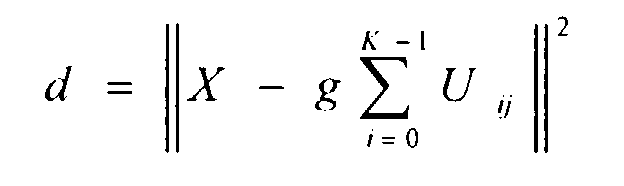 où g représente une variable de gain ; etladite septième étape comprend une étape de détermination d'un code J(i) dudit vecteur de code aléatoire qui minimise ladite distorsion d ; une étape de pondération dudit vecteur de code de composante périodique P et d'un vecteur de code aléatoire Cij(i) dudit code J(i) avec des gains g0 et g1, respectivement, et d'addition l'un à l'autre du vecteur de code de composante périodique pondéré et du vecteur de code aléatoire pondéré, de calcul, pour chacun d'une pluralité de jeux de gains g0 et g1, de la distorsion d1, par rapport à la parole d'entrée (X), d'une parole reconstruite obtenue lorsque le résultat de ladite addition est délivré à titre dudit vecteur d'excitation audit filtre de synthèse (15) pour exciter celui-ci, ladite distorsion d1 étant exprimée par :
 et, ensuite, de détermination de l'un des jeux de gains g0 et g1 devant être codé à titre de partie desdits paramètres délivrés en résultat du codage de parole qui minimise ladite distorsion d1.
 - Procédé selon la revendication 18, dans lequel :ladite étape d'orthogonalisation comprend une étape de précalcul de XTH, PTHTH et ∥HP∥2 à titre de constantes, respectivement, et une étape de calcul du vecteur de différence suivant Ψij pour ledit vecteur de code aléatoire Cij, grâce à l'utilisation desdites constantes précalculées :où i = 0, 1, ..., K-1 et j = 0, 1, ..., Ni ; et qui comprend de plus une étape de calcul du produit intérieur dij = XTHΨij pour le ième registre de code aléatoire, et une étape de sélection de ni plus grands dij en ordre décroissant de leurs valeurs pour chaque nombre i, etladite étape de calcul de la distorsion dans ladite sixième étape comprend une étape de calcul du quotient suivant pour un jeu de nombres (i, j) correspondant auxdits dij sélectionnés :
 et de détermination dudit jeu de nombres (i, j) qui maximise ledit quotient .
 - Procédé selon la revendication 1, dans lequel lesdits moyens formant registres de codes adaptatifs comprennent une pluralité de registres de codes adaptatifs (160, 16M-1), et dans lequel :
ladite première étape comprend :ladite quatrième étape comprend :une étape de génération, à partir de la pluralité de registres de codes adaptatifs, de vecteurs de code de composante périodique (V0, VM-1) rendus répétitifs avec des périodes de pas respectifs ; etune étape de remise à jour du vecteur de code de composante périodique de chacun desdits registres de codes adaptatifs avec une somme linéaire pondérée de ladite pluralité de vecteurs de codes de composante périodique et dudit vecteur de code aléatoire venant dudit registre de codes aléatoires ; etune étape de génération dudit signal d'excitation de la trame en cours avec une nouvelle somme linéaire pondérée desdits vecteurs de code de composante périodique remis à jour de ladite pluralité de registres de codes adaptatifs et dudit vecteur de code aléatoire dudit registre de codes aléatoires. - Procédé de codage de parole selon la revendication 20, dans lequel le vecteur de code adaptatif venant d'au moins l'un de ladite pluralité de registres de codes adaptatifs (160, 16M-1) est rendu répétitif à une période de pas différente de celles appliquées aux vecteurs de code adaptatifs des autres registres de codes adaptatifs.
- Procédé selon la revendication 1, dans lequel la parole d'entrée (X) est codée pour chaque trame grâce à l'utilisation dudit vecteur de code de composante périodique et dudit vecteur de code aléatoire de telle sorte que la distorsion de ladite parole reconstruite (X') par rapport à ladite parole d'entrée soit minimisée, et dans lequel ladite première étape comprend :une étape de génération du vecteur de code de composante périodique d'une période de pas optimale pour ladite parole d'entrée en fonction dudit vecteur d'excitation de la trame précédente conservée dans ledit registre de codes adaptatifs ;une étape de multiplication dudit vecteur de code de composante périodique par m fonctions de fenêtre prédéterminées pour obtenir m vecteurs d'enveloppe, de multiplication desdits vecteurs d'enveloppe par m éléments de poids de vecteurs de poids sélectionnés à partir d'un registre de codes de poids, et de délivrance en sortie de la somme des résultats desdites multiplications à titre dudit vecteur de code de composante périodique, m étant un entier supérieur ou égal à 2 ; etune étape d'excitation dudit filtre de synthèse (15) avec ledit vecteur de code de composante périodique, de recherche dudit registre de codes de poids pour un vecteur de poids qui minimise la distorsion de ladite parole reconstruite (X') à partir dudit filtre de synthèse par rapport à ladite parole d'entrée (X), et de détermination d'un paramètre de poids représentant ledit vecteur de poids.
- Procédé selon la revendication 1, dans lequel la parole d'entrée (X) est codée pour chaque trame grâce à l'utilisation dudit vecteur de code de composante périodique et dudit vecteur de code aléatoire, de telle sorte que la distorsion de ladite parole reconstruite (X') par rapport à ladite parole d'entrée soit minimisée, et dans lequel ladite deuxième étape comprend :une étape de multiplication dudit vecteur de code aléatoire par m fonctions de fenêtre prédéterminées afin d'obtenir m vecteurs d'enveloppe, de multiplication desdits vecteurs d'enveloppe par m éléments de poids de vecteurs de poids sélectionnés à partir d'un registre de codes de poids, et de délivrance en sortie de la somme des résultats de ladite multiplication à titre dudit vecteur de code aléatoire, m étant un entier supérieur ou égal à 2 ; etune étape de recherche dudit registre de codes de poids pour un vecteur de poids qui minimise la distorsion de ladite parole reconstruite venant dudit filtre de synthèse par rapport à ladite parole d'entrée, et de détermination d'un code de poids représentant ledit vecteur de poids.
- Procédé de décodage de parole dans lequel une parole est reconstruite par unités de trames en excitant un filtre de synthèse prédictif linéaire (27) avec un vecteur d'excitation (E) obtenu en combinant un vecteur de code de composante périodique généré à partir d'un registre de codes adaptatifs en fonction d'un code de période donné et d'un vecteur de code aléatoire délivré en sortie d'un registre de codes aléatoires en fonction d'un code aléatoire donné, ledit procédé étant caractérisé par la réalisation, pour chaque trame :d'une première étape de coupure d'un premier segment d'une longueur (L) représentant une période de pas déterminée en fonction dudit code de période à partir d'un vecteur d'excitation de la trame précédente et de concaténation répétée dudit premier segment afin de générer un vecteur de code de composante périodique ;d'une deuxième étape de sélection, à partir dudit registre de codes aléatoires, d'un vecteur de code aléatoire correspondant audit code aléatoire, de coupure d'un deuxième segment d'une longueur correspondant à ladite période de pas à partir dudit vecteur de code aléatoire sélectionné, de génération d'un vecteur de code aléatoire répétitif en répétant ledit deuxième segment, et de délivrance en sortie d'un vecteur de composante aléatoire répétitif correspondant audit vecteur de code aléatoire répétitif ;d'une troisième étape de génération dudit vecteur d'excitation en combinant de façon linéaire ledit vecteur de composante périodique et ledit vecteur de composante aléatoire répétitif ; etd'une quatrième étape de synthèse d'une parole par excitation dudit filtre de synthèse prédictif linéaire (27) avec ledit vecteur d'excitation (E).
- Procédé selon la revendication 24, dans lequel ladite deuxième étape comprend une étape de génération dudit vecteur de composante aléatoire répétitif par combinaison linéaire dudit vecteur de code aléatoire répétitif et d'un vecteur de code aléatoire non répétitif.
- Procédé selon la revendication 24, dans lequel ladite deuxième étape comprend une étape de génération d'un premier vecteur de code aléatoire répétitif en rendant ledit vecteur de code aléatoire venant dudit registre de code aléatoire répétitif avec ladite période de pas, et d'un deuxième vecteur de code aléatoire répétitif en rendant ledit vecteur de code aléatoire répétitif avec une période différente, et une étape de délivrance en sortie d'une combinaison linéaire desdits premier et deuxième vecteurs de code aléatoires répétitifs à titre dudit vecteur de composante aléatoire, dans lequel ladite période différente est l'une des périodes comprenant au moins une période égale à la moitié de ladite période de pas, une période égale à deux fois ladite période de pas, une période égale à la moitié de la période de pas de la trame précédente, une période égale à la période de pas de la trame précédente, et une période égale à deux fois la période de pas de la trame précédente.
- Procédé selon la revendication 24, comprenant de plus une étape d'évaluation de la périodicité de ladite parole reconstruite de la trame actuelle ou précédente, dans lequel ladite deuxième étape comprend une étape de changement adaptatif du degré de répétitivité dudit vecteur de code aléatoire dudit registre de codes aléatoires pour chaque trame en fonction de ladite périodicité de ladite parole reconstruite.
Applications Claiming Priority (14)
| Application Number | Priority Date | Filing Date | Title |
|---|---|---|---|
| JP117646/91 | 1991-05-22 | ||
| JP11764691A JP3275247B2 (ja) | 1991-05-22 | 1991-05-22 | 音声符号化・復号化方法 |
| JP164263/91 | 1991-07-04 | ||
| JP3164263A JP3049573B2 (ja) | 1991-07-04 | 1991-07-04 | 振幅包絡分離ベクトル量子化法 |
| JP167078/91 | 1991-07-08 | ||
| JP03167078A JP3099836B2 (ja) | 1991-07-08 | 1991-07-08 | 音声の励振周期符号化方法 |
| JP3167081A JP2538450B2 (ja) | 1991-07-08 | 1991-07-08 | 音声の励振信号符号化・復号化方法 |
| JP167124/91 | 1991-07-08 | ||
| JP3167124A JP2613503B2 (ja) | 1991-07-08 | 1991-07-08 | 音声の励振信号符号化・復号化方法 |
| JP167081/91 | 1991-07-08 | ||
| JP258936/91 | 1991-10-07 | ||
| JP25893691A JP3353252B2 (ja) | 1991-10-07 | 1991-10-07 | 音声符号化方法 |
| JP27298591A JP3194481B2 (ja) | 1991-10-22 | 1991-10-22 | 音声符号化法 |
| JP272985/91 | 1991-10-22 |
Publications (3)
| Publication Number | Publication Date |
|---|---|
| EP0514912A2 EP0514912A2 (fr) | 1992-11-25 |
| EP0514912A3 EP0514912A3 (en) | 1993-06-16 |
| EP0514912B1 true EP0514912B1 (fr) | 1998-10-28 |
Family
ID=27565852
Family Applications (1)
| Application Number | Title | Priority Date | Filing Date |
|---|---|---|---|
| EP92108633A Expired - Lifetime EP0514912B1 (fr) | 1991-05-22 | 1992-05-21 | Procédés de codage et décodage de parole |
Country Status (3)
| Country | Link |
|---|---|
| US (1) | US5396576A (fr) |
| EP (1) | EP0514912B1 (fr) |
| DE (1) | DE69227401T2 (fr) |
Families Citing this family (57)
| Publication number | Priority date | Publication date | Assignee | Title |
|---|---|---|---|---|
| US5701392A (en) * | 1990-02-23 | 1997-12-23 | Universite De Sherbrooke | Depth-first algebraic-codebook search for fast coding of speech |
| CA2010830C (fr) * | 1990-02-23 | 1996-06-25 | Jean-Pierre Adoul | Regles de codage dynamique permettant un codage efficace des paroles au moyen de codes algebriques |
| US5754976A (en) * | 1990-02-23 | 1998-05-19 | Universite De Sherbrooke | Algebraic codebook with signal-selected pulse amplitude/position combinations for fast coding of speech |
| DE69309557T2 (de) * | 1992-06-29 | 1997-10-09 | Nippon Telegraph & Telephone | Verfahren und Vorrichtung zur Sprachkodierung |
| JP2800618B2 (ja) * | 1993-02-09 | 1998-09-21 | 日本電気株式会社 | 音声パラメータ符号化方式 |
| US5481739A (en) * | 1993-06-23 | 1996-01-02 | Apple Computer, Inc. | Vector quantization using thresholds |
| JP2626492B2 (ja) * | 1993-09-13 | 1997-07-02 | 日本電気株式会社 | ベクトル量子化装置 |
| JP3024468B2 (ja) * | 1993-12-10 | 2000-03-21 | 日本電気株式会社 | 音声復号装置 |
| US6463406B1 (en) * | 1994-03-25 | 2002-10-08 | Texas Instruments Incorporated | Fractional pitch method |
| JP2970407B2 (ja) * | 1994-06-21 | 1999-11-02 | 日本電気株式会社 | 音声の励振信号符号化装置 |
| JP3179291B2 (ja) * | 1994-08-11 | 2001-06-25 | 日本電気株式会社 | 音声符号化装置 |
| JP3273455B2 (ja) * | 1994-10-07 | 2002-04-08 | 日本電信電話株式会社 | ベクトル量子化方法及びその復号化器 |
| JP3328080B2 (ja) * | 1994-11-22 | 2002-09-24 | 沖電気工業株式会社 | コード励振線形予測復号器 |
| JP3303580B2 (ja) * | 1995-02-23 | 2002-07-22 | 日本電気株式会社 | 音声符号化装置 |
| JPH08263099A (ja) * | 1995-03-23 | 1996-10-11 | Toshiba Corp | 符号化装置 |
| JPH08292797A (ja) * | 1995-04-20 | 1996-11-05 | Nec Corp | 音声符号化装置 |
| JP3308764B2 (ja) * | 1995-05-31 | 2002-07-29 | 日本電気株式会社 | 音声符号化装置 |
| FR2739964A1 (fr) * | 1995-10-11 | 1997-04-18 | Philips Electronique Lab | Dispositif de prediction de periode de voisement pour codeur de parole |
| ATE192259T1 (de) * | 1995-11-09 | 2000-05-15 | Nokia Mobile Phones Ltd | Verfahren zur synthetisierung eines sprachsignalblocks in einem celp-kodierer |
| US5889891A (en) * | 1995-11-21 | 1999-03-30 | Regents Of The University Of California | Universal codebook vector quantization with constrained storage |
| JP3481027B2 (ja) * | 1995-12-18 | 2003-12-22 | 沖電気工業株式会社 | 音声符号化装置 |
| JP3364825B2 (ja) * | 1996-05-29 | 2003-01-08 | 三菱電機株式会社 | 音声符号化装置および音声符号化復号化装置 |
| US5794185A (en) * | 1996-06-14 | 1998-08-11 | Motorola, Inc. | Method and apparatus for speech coding using ensemble statistics |
| JPH1091194A (ja) * | 1996-09-18 | 1998-04-10 | Sony Corp | 音声復号化方法及び装置 |
| DE69710505T2 (de) * | 1996-11-07 | 2002-06-27 | Matsushita Electric Industrial Co., Ltd. | Verfahren und Vorrichtung zur Erzeugung eines Vektorquantisierungs-Codebuchs |
| US6058359A (en) * | 1998-03-04 | 2000-05-02 | Telefonaktiebolaget L M Ericsson | Speech coding including soft adaptability feature |
| JP3263347B2 (ja) * | 1997-09-20 | 2002-03-04 | 松下電送システム株式会社 | 音声符号化装置及び音声符号化におけるピッチ予測方法 |
| JP3765171B2 (ja) * | 1997-10-07 | 2006-04-12 | ヤマハ株式会社 | 音声符号化復号方式 |
| WO1999021174A1 (fr) * | 1997-10-22 | 1999-04-29 | Matsushita Electric Industrial Co., Ltd. | Codeur de sons et decodeur de sons |
| DE69736446T2 (de) | 1997-12-24 | 2007-03-29 | Mitsubishi Denki K.K. | Audio Dekodierverfahren und -vorrichtung |
| JP3268750B2 (ja) * | 1998-01-30 | 2002-03-25 | 株式会社東芝 | 音声合成方法及びシステム |
| US6199040B1 (en) * | 1998-07-27 | 2001-03-06 | Motorola, Inc. | System and method for communicating a perceptually encoded speech spectrum signal |
| US6493665B1 (en) * | 1998-08-24 | 2002-12-10 | Conexant Systems, Inc. | Speech classification and parameter weighting used in codebook search |
| US6480822B2 (en) * | 1998-08-24 | 2002-11-12 | Conexant Systems, Inc. | Low complexity random codebook structure |
| US6823303B1 (en) * | 1998-08-24 | 2004-11-23 | Conexant Systems, Inc. | Speech encoder using voice activity detection in coding noise |
| CA2259094A1 (fr) * | 1999-01-15 | 2000-07-15 | Universite De Sherbrooke | Methode et dispositif de conception et de consultation de longs guides de codage stochastique pour codeurs de la parole a faible debit binaire |
| WO2001020595A1 (fr) * | 1999-09-14 | 2001-03-22 | Fujitsu Limited | Codeur/decodeur vocal |
| JP4367808B2 (ja) * | 1999-12-03 | 2009-11-18 | 富士通株式会社 | 音声データ圧縮・解凍装置及び方法 |
| JP2001282278A (ja) * | 2000-03-31 | 2001-10-12 | Canon Inc | 音声情報処理装置及びその方法と記憶媒体 |
| US6850884B2 (en) * | 2000-09-15 | 2005-02-01 | Mindspeed Technologies, Inc. | Selection of coding parameters based on spectral content of a speech signal |
| US6842733B1 (en) | 2000-09-15 | 2005-01-11 | Mindspeed Technologies, Inc. | Signal processing system for filtering spectral content of a signal for speech coding |
| DE60126149T8 (de) * | 2000-11-27 | 2008-01-31 | Nippon Telegraph And Telephone Corp. | Verfahren, einrichtung und programm zum codieren und decodieren eines akustischen parameters und verfahren, einrichtung und programm zum codieren und decodieren von klängen |
| AU2002218520A1 (en) * | 2000-11-30 | 2002-06-11 | Matsushita Electric Industrial Co., Ltd. | Audio decoder and audio decoding method |
| US7647223B2 (en) * | 2001-08-16 | 2010-01-12 | Broadcom Corporation | Robust composite quantization with sub-quantizers and inverse sub-quantizers using illegal space |
| US7610198B2 (en) * | 2001-08-16 | 2009-10-27 | Broadcom Corporation | Robust quantization with efficient WMSE search of a sign-shape codebook using illegal space |
| US7617096B2 (en) * | 2001-08-16 | 2009-11-10 | Broadcom Corporation | Robust quantization and inverse quantization using illegal space |
| JP3887598B2 (ja) * | 2002-11-14 | 2007-02-28 | 松下電器産業株式会社 | 確率的符号帳の音源の符号化方法及び復号化方法 |
| US7792670B2 (en) * | 2003-12-19 | 2010-09-07 | Motorola, Inc. | Method and apparatus for speech coding |
| US20060136202A1 (en) * | 2004-12-16 | 2006-06-22 | Texas Instruments, Inc. | Quantization of excitation vector |
| US8352254B2 (en) * | 2005-12-09 | 2013-01-08 | Panasonic Corporation | Fixed code book search device and fixed code book search method |
| US20090164211A1 (en) * | 2006-05-10 | 2009-06-25 | Panasonic Corporation | Speech encoding apparatus and speech encoding method |
| WO2008072735A1 (fr) * | 2006-12-15 | 2008-06-19 | Panasonic Corporation | Dispositif de quantification de vecteur de source sonore adaptative, dispositif de quantification inverse de vecteur de source sonore adaptative, et procédé associé |
| CN101604525B (zh) * | 2008-12-31 | 2011-04-06 | 华为技术有限公司 | 基音增益获取方法、装置及编码器、解码器 |
| ES2924180T3 (es) * | 2009-12-14 | 2022-10-05 | Fraunhofer Ges Forschung | Dispositivo de cuantificación vectorial, dispositivo de codificación de habla, procedimiento de cuantificación vectorial y procedimiento de codificación de habla |
| US9812141B2 (en) | 2010-01-08 | 2017-11-07 | Nippon Telegraph And Telephone Corporation | Encoding method, decoding method, encoder apparatus, decoder apparatus, and recording medium for processing pitch periods corresponding to time series signals |
| US9537460B2 (en) * | 2011-07-22 | 2017-01-03 | Continental Automotive Systems, Inc. | Apparatus and method for automatic gain control |
| ES2744904T3 (es) * | 2014-05-01 | 2020-02-26 | Nippon Telegraph & Telephone | Dispositivo de codificación de señal de sonido, método de codificación de señal de sonido, programa y medio de grabación |
Family Cites Families (5)
| Publication number | Priority date | Publication date | Assignee | Title |
|---|---|---|---|---|
| US4910781A (en) * | 1987-06-26 | 1990-03-20 | At&T Bell Laboratories | Code excited linear predictive vocoder using virtual searching |
| US4817157A (en) * | 1988-01-07 | 1989-03-28 | Motorola, Inc. | Digital speech coder having improved vector excitation source |
| JPH02250100A (ja) * | 1989-03-24 | 1990-10-05 | Mitsubishi Electric Corp | 音声符合化装置 |
| JPH0451199A (ja) * | 1990-06-18 | 1992-02-19 | Fujitsu Ltd | 音声符号化・復号化方式 |
| US5195137A (en) * | 1991-01-28 | 1993-03-16 | At&T Bell Laboratories | Method of and apparatus for generating auxiliary information for expediting sparse codebook search |
-
1992
- 1992-05-20 US US07/886,013 patent/US5396576A/en not_active Expired - Lifetime
- 1992-05-21 EP EP92108633A patent/EP0514912B1/fr not_active Expired - Lifetime
- 1992-05-21 DE DE69227401T patent/DE69227401T2/de not_active Expired - Lifetime
Also Published As
| Publication number | Publication date |
|---|---|
| EP0514912A3 (en) | 1993-06-16 |
| EP0514912A2 (fr) | 1992-11-25 |
| DE69227401D1 (de) | 1998-12-03 |
| US5396576A (en) | 1995-03-07 |
| DE69227401T2 (de) | 1999-05-06 |
Similar Documents
| Publication | Publication Date | Title |
|---|---|---|
| EP0514912B1 (fr) | Procédés de codage et décodage de parole | |
| EP0443548B1 (fr) | Codeur de parole | |
| KR100938017B1 (ko) | 벡터 양자화 장치 및 방법 | |
| EP1221694B1 (fr) | Codeur/decodeur vocal | |
| EP1224662B1 (fr) | Codage de la parole a debit binaire variable de type celp avec classification phonetique | |
| JP3268360B2 (ja) | 改良されたロングターム予測器を有するデジタル音声コーダ | |
| JPH0990995A (ja) | 音声符号化装置 | |
| JP3582589B2 (ja) | 音声符号化装置及び音声復号化装置 | |
| JP2970407B2 (ja) | 音声の励振信号符号化装置 | |
| US6751585B2 (en) | Speech coder for high quality at low bit rates | |
| US6044339A (en) | Reduced real-time processing in stochastic celp encoding | |
| JP3319396B2 (ja) | 音声符号化装置ならびに音声符号化復号化装置 | |
| JP3299099B2 (ja) | 音声符号化装置 | |
| JPH08185199A (ja) | 音声符号化装置 | |
| JPH1069297A (ja) | 音声符号化装置 | |
| JP3192051B2 (ja) | 音声符号化装置 | |
| JPH08320700A (ja) | 音声符号化装置 | |
| KR100955126B1 (ko) | 벡터 양자화 장치 | |
| JPH05289697A (ja) | 音声のピッチ周期符号化法 | |
| JPWO2000000963A1 (ja) | 音声符号化装置 |
Legal Events
| Date | Code | Title | Description |
|---|---|---|---|
| PUAI | Public reference made under article 153(3) epc to a published international application that has entered the european phase |
Free format text: ORIGINAL CODE: 0009012 |
|
| 17P | Request for examination filed |
Effective date: 19920521 |
|
| AK | Designated contracting states |
Kind code of ref document: A2 Designated state(s): DE FR GB |
|
| PUAL | Search report despatched |
Free format text: ORIGINAL CODE: 0009013 |
|
| AK | Designated contracting states |
Kind code of ref document: A3 Designated state(s): DE FR GB |
|
| RAP1 | Party data changed (applicant data changed or rights of an application transferred) |
Owner name: NIPPON TELEGRAPH AND TELEPHONE CORPORATION |
|
| 17Q | First examination report despatched |
Effective date: 19960823 |
|
| RHK1 | Main classification (correction) |
Ipc: G10L 9/18 |
|
| GRAG | Despatch of communication of intention to grant |
Free format text: ORIGINAL CODE: EPIDOS AGRA |
|
| GRAG | Despatch of communication of intention to grant |
Free format text: ORIGINAL CODE: EPIDOS AGRA |
|
| GRAH | Despatch of communication of intention to grant a patent |
Free format text: ORIGINAL CODE: EPIDOS IGRA |
|
| GRAH | Despatch of communication of intention to grant a patent |
Free format text: ORIGINAL CODE: EPIDOS IGRA |
|
| GRAA | (expected) grant |
Free format text: ORIGINAL CODE: 0009210 |
|
| AK | Designated contracting states |
Kind code of ref document: B1 Designated state(s): DE FR GB |
|
| REF | Corresponds to: |
Ref document number: 69227401 Country of ref document: DE Date of ref document: 19981203 |
|
| ET | Fr: translation filed | ||
| PLBE | No opposition filed within time limit |
Free format text: ORIGINAL CODE: 0009261 |
|
| STAA | Information on the status of an ep patent application or granted ep patent |
Free format text: STATUS: NO OPPOSITION FILED WITHIN TIME LIMIT |
|
| 26N | No opposition filed | ||
| REG | Reference to a national code |
Ref country code: GB Ref legal event code: IF02 |
|
| PGFP | Annual fee paid to national office [announced via postgrant information from national office to epo] |
Ref country code: FR Payment date: 20110420 Year of fee payment: 20 |
|
| PGFP | Annual fee paid to national office [announced via postgrant information from national office to epo] |
Ref country code: GB Payment date: 20110518 Year of fee payment: 20 |
|
| PGFP | Annual fee paid to national office [announced via postgrant information from national office to epo] |
Ref country code: DE Payment date: 20110531 Year of fee payment: 20 |
|
| REG | Reference to a national code |
Ref country code: DE Ref legal event code: R071 Ref document number: 69227401 Country of ref document: DE |
|
| REG | Reference to a national code |
Ref country code: DE Ref legal event code: R071 Ref document number: 69227401 Country of ref document: DE |
|
| REG | Reference to a national code |
Ref country code: GB Ref legal event code: PE20 Expiry date: 20120520 |
|
| PG25 | Lapsed in a contracting state [announced via postgrant information from national office to epo] |
Ref country code: DE Free format text: LAPSE BECAUSE OF EXPIRATION OF PROTECTION Effective date: 20120522 |
|
| PG25 | Lapsed in a contracting state [announced via postgrant information from national office to epo] |
Ref country code: GB Free format text: LAPSE BECAUSE OF EXPIRATION OF PROTECTION Effective date: 20120520 |