EP0516043A2 - Methode für die Trockenätzung - Google Patents
Methode für die Trockenätzung Download PDFInfo
- Publication number
- EP0516043A2 EP0516043A2 EP92108844A EP92108844A EP0516043A2 EP 0516043 A2 EP0516043 A2 EP 0516043A2 EP 92108844 A EP92108844 A EP 92108844A EP 92108844 A EP92108844 A EP 92108844A EP 0516043 A2 EP0516043 A2 EP 0516043A2
- Authority
- EP
- European Patent Office
- Prior art keywords
- gas
- etching
- film
- layer
- silicon
- Prior art date
- Legal status (The legal status is an assumption and is not a legal conclusion. Google has not performed a legal analysis and makes no representation as to the accuracy of the status listed.)
- Granted
Links
Images







Classifications
-
- H—ELECTRICITY
- H10—SEMICONDUCTOR DEVICES; ELECTRIC SOLID-STATE DEVICES NOT OTHERWISE PROVIDED FOR
- H10P—GENERIC PROCESSES OR APPARATUS FOR THE MANUFACTURE OR TREATMENT OF DEVICES COVERED BY CLASS H10
- H10P50/00—Etching of wafers, substrates or parts of devices
-
- H—ELECTRICITY
- H10—SEMICONDUCTOR DEVICES; ELECTRIC SOLID-STATE DEVICES NOT OTHERWISE PROVIDED FOR
- H10P—GENERIC PROCESSES OR APPARATUS FOR THE MANUFACTURE OR TREATMENT OF DEVICES COVERED BY CLASS H10
- H10P50/00—Etching of wafers, substrates or parts of devices
- H10P50/20—Dry etching; Plasma etching; Reactive-ion etching
- H10P50/26—Dry etching; Plasma etching; Reactive-ion etching of conductive or resistive materials
- H10P50/264—Dry etching; Plasma etching; Reactive-ion etching of conductive or resistive materials by chemical means
- H10P50/266—Dry etching; Plasma etching; Reactive-ion etching of conductive or resistive materials by chemical means by vapour etching only
- H10P50/267—Dry etching; Plasma etching; Reactive-ion etching of conductive or resistive materials by chemical means by vapour etching only using plasmas
-
- H—ELECTRICITY
- H10—SEMICONDUCTOR DEVICES; ELECTRIC SOLID-STATE DEVICES NOT OTHERWISE PROVIDED FOR
- H10P—GENERIC PROCESSES OR APPARATUS FOR THE MANUFACTURE OR TREATMENT OF DEVICES COVERED BY CLASS H10
- H10P50/00—Etching of wafers, substrates or parts of devices
- H10P50/20—Dry etching; Plasma etching; Reactive-ion etching
- H10P50/26—Dry etching; Plasma etching; Reactive-ion etching of conductive or resistive materials
- H10P50/264—Dry etching; Plasma etching; Reactive-ion etching of conductive or resistive materials by chemical means
- H10P50/266—Dry etching; Plasma etching; Reactive-ion etching of conductive or resistive materials by chemical means by vapour etching only
- H10P50/267—Dry etching; Plasma etching; Reactive-ion etching of conductive or resistive materials by chemical means by vapour etching only using plasmas
- H10P50/268—Dry etching; Plasma etching; Reactive-ion etching of conductive or resistive materials by chemical means by vapour etching only using plasmas of silicon-containing layers
Definitions
- the present invention relates to a dry etching method for etching a film having a multilayered structure including an insulation film such as silicon oxide film, and a film of tungsten, molybdenum, or a silicate of each, formed on the insulation film, or a structure including a film of one of those high melting point metal and a polycrystal silicon film.
- the gate, source, and drain regions can be formed in the form of mask such that they self-matches with each other, and polycrystal silicon is relatively stable in a heating process; therefore wiring can be carried out in a multilayered manner, thereby achieving a high integration density.
- a polycrystal silicon film has a resistivity (specific resistance), and therefore it is necessary to add appropriate impurities to the film to decrease its resistance.
- the resistivity can be decreased only to 1 ⁇ 10 ⁇ cm, which is still very high as compared to 1 ⁇ 10 ⁇ 6 II ⁇ cm of W or 1 ⁇ 10 ⁇ 5 I ⁇ cm of Mo. Consequently, when circuit elements on a semiconductor are connected with each other by means of the polycrystal silicon film, transmission of a signal becomes so slow that the operation speed is limited.
- polycrystal silicon is used as a gate electrode of a MOSFET, the resistance-capacitance product becomes large due to its large resistance. Consequently, it takes long time to raise the voltage of the gate up to a set operation voltage, thereby reducing the operation speed.
- the gate electrode is made of a crystal material having a small grain size; the surface of the electrode can be easily stabilized; the chemical resistance thereof is high; the contactibility thereof against Al or an Si substrate is high; and the anti-electromigration property is high.
- a gate material having a multilayered structure of a metal silicide film such as tungsten silicide (WSi2) and a polycrystal silicon film has been proposed for manufacturing a semiconductor device having the above-mentioned characteristics, namely a high integration density of polycrystal silicon gate electrode MOSFET, high stability and reliability of the MOSFET in a heating process during the course of manufacture, a low resistivity of the semiconductor device as compared to polycrystal silicon, and a high-speed operability of the device.
- a multilayered structure of a high melting point metal such as tungsten and a polycrystal silicon film has been also proposed.
- gate electrodes are minimized. Accordingly, gate insulation films formed underneath the gate electrodes have been thinned to about 10 nm. Therefore, the processability of a gate electrode depends not on its high melting point metal silicide film crystal, but on its polycrystal silicon film. If a desired shape is not obtained, i.e., the end of a silicon film cannot be withdrawn from the level of the end of a silicide film, deviation of the channel length occurs.
- etching selection ratio between an oxidation silicon film serving as the gate insulation film and a polycrystal silicon film serving as the gate electrode is a main factor for determining the yield of products
- an etching process must be carried out based on a high selection ratio between the oxidation silicon film and the gate insulation film.
- the process for forming a gate electrode entails a difficult problem.
- an etching gas containing fluorine (SF6, CF4, CF3 Br or the like) are used.
- SF6, CF4, CF3 Br or the like an etching gas containing fluorine
- etching cannot be performed by use of a fluorine-containing gas such as sulfur hexafluoride (SF6) or a mixture gas of a fluorine-containing gas and a carbon tetrachloride (CCl4) or Cl2, which is a conventionally-used etching gas for a metal silicide film, because the selection ratio of these gas against silicon oxide is not sufficient as 10 or less.
- a fluorine-containing gas such as sulfur hexafluoride (SF6) or a mixture gas of a fluorine-containing gas and a carbon tetrachloride (CCl4) or Cl2, which is a conventionally-used etching gas for a metal silicide film, because the selection ratio of these gas against silicon oxide is not sufficient as 10 or less.
- a reactive ion etching technique is employed to etch a polycrystal silicon film.
- anode coupling?? mode is employed for patterning
- the selection ratio becomes large, but the processed shape will be undesirable
- the selection ratio becomes small, but the desirable shape can be obtained.
- the etching proceeds at the same speed anywhere in a wafer surface. For example, if the etching proceeds faster in the periphery portion of the wafer than in the center portion, a problem occurs, that is, when etching is carried out until the center portion of the polycrystal silicon is completely removed, some of the underlying silicon oxide film in the periphery portion has been already etched.
- the present invention has been proposed in consideration of the above-described circumstance, and the purpose thereof is to provide a dry etching method for achieving an excellent processed shape and sufficient selectivity, in process of a multilayer film formed on a silicon oxidation film or the like, consisting of a high melting point metal or a silicide of the metal and a polycrystal silicon.
- the main feature of the invention is to select the most suitable type of gas in the dry etching process, and set the best possible etching condition for processing the above-mentioned multilayer film.
- a dry etching method wherein a multilayer film including one selected from the group consisting of tungsten, molybdenum, a tungsten silicide, and a molybdenum silicide, as the first layer, and polycrystal silicon as the second layer underlying is formed on a silicon oxide insulation film, a processed substrate prepared by forming a mask pattern on the multilayer film is placed in a vacuum container, an etching gas is introduced into the vacuum container, and an electrical discharge is induced by applying an electrical field to the vacuum container, thereby anisotropically etching the multilayered film in accordance with the mask pattern, comprising: the first etching step for etching the first layer by use of the first gas which is selected from the group consisting of fluorine, sulfur hexafluoride, and nitrogen trifluoride, or a mixture gas consisting of the first gas and the second gas which is one selected from the group consisting of hydrogen chloride, hydrogen bromide, chlorine, bro
- etching of the first step should preferably be carried out under the conditions that a mixture gas containing sulfur hexafluoride and chloride is used as an etching gas, the mixture ratio of sulfur hexafluoride and chlorine is set between 4 : 6 and 7 : 3, the gas flow amount is set between 20 and 150sccm, and the high frequency power density is set between 0.4 and 0.9 W/cm2.
- the amount of the third gas added to the second gas should preferably be in the range between 0 and 10 volume % of the whole etching gas, the third gas being one selected from the group consisting of inert gas, nitrogen gas, oxygen gas, silicon tetrachloride gas, and carbon monoxide gas.
- the third gas which is one selected from the group consisting of inert gas, nitrogen gas, oxygen gas, silicon tetrachloride gas, and carbon monoxide gas, may be added to the etching gas in an amount of the range between 0 and 10 volume % of the whole etching gas.
- the first and second etching process should be carried out while maintaining the temperature of the to-be-processed substrate in the range between -10 and -120°C, more specifically, between -30 and -60°C.
- the pressure of the etching gas should preferably be set between 50 and 150 m Torr.
- the first etching process may be performed while detecting the end point of the etching by monitoring light emitted from the reactive substances, pressure change of the reaction resultants, plasma impedance or the like. More specifically, in the step of etching the first layer, the end point of etching is detected by monitoring light emitted from tungsten, molybdenum, or a molybdenum fluoride. Similarly, in the step of etching the second layer, the end point is detected by monitoring light emitted from chlorine, bromine, silicon chloride, or silicon bromide.
- the etching may be continued to etch the underlying polycrystal silicon until complete removal of the first layer.
- a dry etching method wherein a thin film including one selected from the group consisting of tungsten, molybdenum, a tungsten silicide, and a molybdenum silicide, as the first layer, is formed on a silicon oxide insulation film, a to-be-processed substrate prepared by forming a mask pattern on the thin film is placed in a vacuum container, an etching gas is introduced into the vacuum container, and an electrical discharge is induced by applying an electrical field to the vacuum container, thereby anisotropically etching the thin film in accordance with the mask pattern, characterized in that the first layer is etched while maintaining the temperature of the to-be-processed substrate in the range between -10 and -120°C by use of: the first gas which is one selected from the group consisting of fluorine, sulfur hexafluoride, and nitrogen trifluoride; or a mixture gas containing the first gas and the second gas which is one selected from the group
- the inventors of the present invention conducted a variety of experiments regarding etching of a multilayer film formed on an silicon oxide film, and including a tungsten silicide film as the upper layer, and a phosphor-containing polycrystal silicon film as the lower layer, and has discovered the following fact.
- the etching speed when the temperature of the substrate is 25°C is as fast as 300-400 nm/min.
- high-speed etching can be achieved.
- side etching of the tungsten silicide film and the underlying polycrystal silicon is unavoidable. Such side etching can create problems, especially where the size of the elements becomes smaller and smaller.
- the etching speed when the temperature of the substrate is 25°C is as slow as 50-100 nm/min.
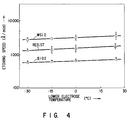
- the substrate-temperature dependency of the etching speed was examined with regard to the case where a tungsten silicide is etched by use of SF6 gas.
- the etching speed decreases in proportional to the inverse number of the substrate temperature, but at the substrate temperature of -30°C, the etching speed was still as fast as 230-370 nm/min.
- side etching did not occur to the pattern of the tungsten silicide, and therefore a vertical shape was obtained.
- side etching occurred to the underlying polycrystal silicon to a certain level.
- the etching speed for the silicon oxide can be significantly increased by adding a small amount of SF6. Accordingly, if the etching selection ratio between polycrystal silicon and the silicon oxide film is small, and the etching speed within the wafer surface cannot be sufficiently uniformed, the oxide silicon film is completely etched at a section of the wafer surface.
- each etching step was analyzed with regard to emission of light. More specifically, the peak value in connection with tungsten or tungsten silicide in the first step, and the peak value in connection with Cl2 in the second step were detected to find out the end point of etching. It was confirmed that with this end point detecting technique, each etching step can be controlled at an extremely high accuracy.
- the temperature of the to-be-processed substrate is cooled down to -60°C, and etching of the tungsten silicide film was conducted as in the first step.
- the polycrystal silicon film was etched by use of solely Cl2 as in the second step.
- the selectivity between the polycrystal silicon and the silicon oxide film was significantly improved. Further, there were no residuals or deposits observed.
- a tungsten silicide film is etched by solely SF6 gas, or a gas mixture of Cl2 and SF6 until there is no etching residuals, and then, a polycrystal silicon film is etched by a gas mainly containing Cl2.
- etching having a high selectivity against the silicon oxide can be achieved, and the overlaying tungsten silicide and the underlaying polycrystal silicon can be appropriately etched without side etching, or residuals such as deposits.
- the overlaying and underlaying films can be etched at the same wafer temperature, the procedure of the etching method is simplified, thereby improving the efficiency.
- Fig. 1 is a schematic view showing a structure of a dry etching device used in a method according to the present invention.
- the device includes an etching chamber 10 of a vacuum container, an inlet preparatory chamber 20, and an outlet preparatory chamber 30, connected with each other in series.
- a gate valve 21 is provided between the etching chamber 10 and the inlet preparatory chamber 20 so as to close the connection therebetween, and a gate valve 31 is between the inlet and outlet preparatory chambers 10 and 20 so as to close the connection therebetween.
- a substrate mounting base 23 is provided, and similarly, another substrate mounting base 33 is provided in the outlet preparatory chamber 30. While maintaining the vacuum state in the etching chamber 10, a to-be-processed substrate 11 can be input to the inlet preparatory chamber 20 through the gate valve 22, or output from the outlet preparatory chamber 30 through the gate valve 32. Thus, influences by moisture, oxygen, or the like in the atmosphere, can be avoided.
- the first electrode 12 On which the to-be-processed substrate 11 is mounted.
- a high frequency power source 14 is connected to the electrode 12 via a blocking diode 13, and the high frequency voltage of 13.56 MHz is applied to the electrode 12.
- An electrostatic chuck (not shown) for fixing the substrate 11 is provided on the electrode 12, and the temperature of the chuck is controlled by a cooling tube 15.
- the periphery of the electrode 12 is covered by a ring 50 made of carbon so that the electrode is not etched by plasma.
- the upper wall of the etching chamber 12 serves as an opposite electrode 10a (second electrode) to the first electrode 12.
- a permanent magnet 18 is set on the upper portion of the second electrode 10a, and the magnet 18 is rotated by a motor 18.
- the magnetic flux density in the surface portion of the substrate 11 can be varied in the range between 60 and 120 [G] by changing the magnetic force of the permanent magnet 18.
- the inner wall surface of the etching chamber 10 is heated by a heater (not shown) to a predetermined temperature.
- a chlorine gas supplying line a To the etching chamber 10, connected are a chlorine gas supplying line a, an oxygen supplying line b, an SF6 supplying line d, and an F2 supplying line e.
- Valves 16a-16e and flow amount adjusters 17a-17e are set in the respective gas supplying lines a-e so as to control the flow amount and gas pressure of each line.
- a predetermined gas is introduced into the etching chamber 10, and then a high frequency voltage is applied between the first and second electrodes 12 and 10a to induce electrical discharge therebetween.
- an end point detector 34 for detecting the end point of etching for each of the first and second layers may be provided as indicated by the broken lines in the figure, in the outer side of the gate valve 31.
- the end point detector 34 may be of the type in which change in light emitting amount corresponding to the wavelength of a resultant of reaction is detected to locate its end point, or the type in which pressure change of the resultant of reaction is detected, or the type in which change in plasma impedance is detected.
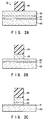
- nm-thick silicon oxide (SiO2) film 41 is formed on a silicon substrate 40 by heat oxidation, and a 150nm polycrystal silicon film 42 is deposited thereon by the CVD method. Phosphor is then diffused into the polycrystal silicon film 42 to form an N-type polycrystal silicon film, on which a 200 nm-thick tungsten silicide (WSi2) film 43 is formed by the spatter deposition method. After that, a resist pattern 44 is formed on the formed layer.
- the resist pattern 44 is prepared by coating a substrate surface with a photosensitive resist made of novolak resin, and the coat is selectively removed into a desired pattern by the lithography method.
- substrate 11 to be processed is placed on the electrode 12 of the dry etching device shown in Fig. 1, and the WSi2 film 43 is selectively etched by a method later explained as shown in Fig. 2. Further, the polycrystal silicon film 42 is selectively etched as shown in Fig. 2C.
- Fig. 3 is a graph showing the correlation between the mixture ratio of a mixture gas and an etching speed, where an SF6 and Cl2 mixture gas having a particular mixture ratio was introduced to the etching chamber 10 to etch the WSi2 film 43, the polycrystal silicon film 42, the SiO2 film 41, and the resist 44, and gas 10, and the etching speed for etching each of the layers, which varies along with a mixture ratio of the mixture gas, was examined.
- the partial pressures of the Cl2 gas and SF6 gas were changed while maintaining the pressure in the etching chamber 10 at constant (75 m Torr), and also the total flow amount at 100 sccm.
- the temperature of the electrode 12 was -30°C, and the high frequency power was 100W (power density: 0.57 W/cm2).
- the side walls of the etching chamber 10, and the upper electrode 10a were heated up to 60°C.
- the etching time was 1 minute.
- ⁇ denotes the etching speed for WSi2, ⁇ for resist, ⁇ for polycrystal Si, and ⁇ for SiO2.
- the etching speed with regard to SiO2 is 12 nm/min, whereas by use of 80% Cl2 gas, the etching speed is 36 nm/min.
- the etching speed is increased by a small amount of SF6 added.
- a deposit is created in Cl2 gas (100%), and the etching speed is quickly decreased.
- the etching speed with regards to each of WSi2, resist, and SiO2 somewhat slowed down.
- the etching speed was about 350 nm/min at the lower electrode temperature of 25°C, whereas about 300 nm/min at -30°C. No significant drop was observed.
- the etching speed was 70 nm/min at the lower electrode temperature of 25°C, whereas 60 nm/min at -30°C, and thus no significant drop was observed.
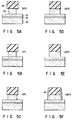
- Fig. 5A-5F show pattern shapes of the WSi2 film etched at several lower electrode temperatures.
- alike elements are denoted by the same reference numerals as of Fig. 2A, such as silicon substrate 40, 10 nm-thick silicon oxide (SiO2) film 41, 150nm-thick polycrystal silicon film 42, 200 nm-thick tungsten silicide (WSi2) film 43, and resist pattern 44.
- Figs. 5A-5F show the cases where the lower electrode temperature (or substrate temperature) was 25°C, 0°C, -10°C, -30°C, -120°C, and -150°C, respectively.
- the lower the lower electrode temperature the smaller the amount of side etching of the pattern.
- etching of the WSi2 into a vertical shape was possible by use of solely SF6 gas.
- the side etching amount was 10% at the most, which is in the range of general allowance for patterning.
- side-wall deposits 45 were created to deform the pattern (fattening the bottom portion).
- the substrate should preferably be in the range between -10°C and - 120°C.
- Figs. 6A-6C show SEM-observed cross sections of a material having a WSi2/polycrystal Si multilayer structure etched at a variety of mixture ratio of Cl2 and SF6 under the same conditions as those of Fig. 3.
- alike elements are denoted by the same reference numerals as of Fig. 2A, such as silicon substrate 40, 10 nm-thick silicon oxide (SiO2) film 41, 150 nm-thick polycrystal silicon film 42, 200 nm-thick tungsten silicide (WSi2) film 43, and resist pattern 44.
- Figs. 6A-6C show the cases where the SF6 gas was 100%, 40-70%, and the Cl2 gas was 100%, respectively.
- the pattern of the polycrystal silicon film 42 and the WSi2 film 43 was deformed into a fattened bottom.
- deposits 45 were created on the side wall of the pattern as shown in Fig. 6C.
- the created deposits are expected to be tungsten chlorides, which were contained in the WSi2 film, such as tungsten pentachloride (WCl5) and tungsten hexachloride (WCl6), and these chlorides were deposited due to a low vapor pressure.
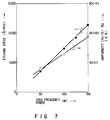
- Fig. 7 is a graph showing the etching speed for the WSi2 and the uniformity thereof, at the mixture ratio between Cl2 and SF6 (Cl2/Cl2+SF6) fixed to 60%, the total flow amount to 100 sccm, and the pressure to 75 m Torr, along with a variable high frequency power.
- the etching speed becomes faster as the high frequency power increases, whereas the uniformity thereof is lowered.
- the figure indicates that to achieve a uniformity of 20% or less, which is within the range of allowance for patterning of a gate electrode or the like, the high frequency power should be set to 160 W or less, and to achieve an etching speed of 100 nm/min or higher, the high frequency power should be set to 70 W or higher. It should be noted that 70-160 W of power is equivalent to 0.4-0.9 W/cm2 of power density in consideration of the size (6 inches) of the wafer used in this experiment.
- Fig. 8 is a graph showing the etching speed for the WSi2 and the uniformity thereof, at the mixture ratio between Cl2 and SF6 (Cl2/Cl2+SF6) fixed to 60%, the total flow amount to 100 sccm, and the high frequency power to 75 W, along with a variable pressure.
- the etching speed does not change even if the pressure is varied, whereas the uniformity thereof is improved when the pressure is raised.
- a pressure of 100 m Torr or higher under-cut occurs to the WSi2 film pattern, and therefore a desired shape cannot be obtained.
- Fig. 9 is a graph showing the etching speed for the WSi2 and the uniformity thereof, at the mixture ratio between Cl2 and SF6 (Cl2/Cl2+SF6) fixed to 60%, the high frequency power to 75 W, and the pressure to 75 m Torr, along with a variable total flow amount.
- the etching speed does not change as the flow amount is varied, whereas the uniformity thereof improves as the flow amount becomes smaller.
- the flow amount was decreased to less than 20 sccm, formation of deposits on the side wall of the resist pattern was observed, whereas when the flow amount exceeded 150sccm, the uniformity went over 20%. Therefore, the flow amount of a mixture gas introduced into the etching chamber should preferably be 20-150 sccm.
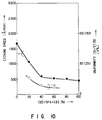
- Fig. 10 is a graph showing the etching speed for the WSi2 and the uniformity thereof, at the high frequency power fixed to 75 W, the pressure to 75 m Torr, and the total flow amount to 30 sccm, along with a variable mixture ratio between Cl2 and SF6.
- the etching speed becomes slower as the mixture ratio of Cl2 is increased as already shown in Fig. 3, whereas the uniformity thereof improves along with increase in the Cl2 ratio.
- the SiO2 film 41 is etched in the periphery area, as shown in Fig. 12B.
- the important items are: the substrate should be cooled down to a necessary temperature; the WSi2 film 43 should be etched by a mixture gas containing SF6 and Cl2; the polycrystal silicon film 42 should be etched by an etching gas mainly containing Cl2 gas such as to have a sufficient etching selection ratio with respect to the polycrystal silicon film 42 and SiO2 film 41 after etching the WSi2 43.
- the etching speed for phosphor-added polycrystal Si, and the uniformity thereof along with a variable high frequency power were measured.
- the temperature of the lower substrate was fixed to -30°C.
- the etching gas used was 100% Cl2, and the flow amount thereof was 100 sccm.
- Fig. 11 shows the correlations between the etching speed for phosphor-added polycrystal Si and a variable high frequency power, and between the uniformity of the etching speed and a variable high frequency power.
- ⁇ denotes the uniformity of an etching speed
- ⁇ denotes an etching speed.
- the etching speed increased as the high frequency power was raised, whereas the uniformity of the etching speed in the wafer surface significantly improved around 90 W.
- the high frequency power of 50 W under-cut occurred to the polycrystal silicon, whereas at a powder of 75 W or higher, a vertical shape was obtained by etching.
- etching speed for polycrystal Si and the uniformity of the etching speed along with a variable pressure were measured.
- Fig. 13 shows the etching speed (denoted by ⁇ ) for polycrystal silicon, the uniformity ( ⁇ ), and the selection ratio (Si/SiO2) ( ⁇ ), by use of Cl2 gas, at the high frequency power 150 fixed to 150 W, the substrate temperature to -30°C, the flow amount to 100 sccm, except for a pressure which was variable.
- the etching speed for polycrystal silicon increased as the pressure was raised.
- the selection ratio between the polycrystal silicon and SiO2 (heat oxidation film) increased proportionally along with the pressure.
- the uniformity of the etching speed improved to the peak value around the pressure of 75 m Torr, and when the pressure went away from 75 m Torr to a higher or lower region, the uniformity deteriorated. Then, observation of the etched shape by the SEM indicated that side etching occurred to the pattern when the pressure was higher than 75 m Torr.
- the etching process was evaluated in terms of the etching speed, uniformity, selection ratios against SiO2 and resist, and shape of the pattern, and the etching conditions were: the pressure, high frequency power, and gas flow amount were fixed to 75 m Torr, 100 W, and 100 sccm, and about 0-10% of oxygen (O2), silicon tetrachloride (SiCl4), nitrogen (N2), and carbon monoxide (CO) were added to the Cl2 gas.
- O2 oxygen
- SiCl4 silicon tetrachloride
- N2 nitrogen
- CO carbon monoxide
- Table 1 shows the results of this examination.
- the etching characteristics vary in accordance with pressure, high frequency power, flow amount, and amount of gas add.
- a small amount of O2 added to Cl2 helped to improve the selection ratio while maintaining the uniformity, and anisotropic shape.
- the etching step was divided into two, etching of WSi2 film, and that of polycrystal silicon film, based on the etching characteristics, and a to-be-processed substrate having a multilayered structure of WSi2/polycrystal Si/SiO2, was etched by use of the device shown in Fig. 1 under the most appropriate etching conditions and with the most suitable etching gas.
- the WSi2 film 43 was etched.
- the etching conditions are: the temperature of the lower electrode was fixed to -30°C; Cl2-SF6 mixture gas having the mixture ratio (Cl2/Cl2+SF6) of 40% was used as the etching gas; and the gas flow amount, pressure, and high frequency power (power density) were set to 30 sccm, 75 m Torr, and 75 W (about 0.4 W/cm2). Under these conditions, magnetron discharge was induced to perform reactive-ion etching until the WSi2 is completely etched.
- Fig. 12A shows the results of the etching. As is clear from this figure, no side etching occurred to either the periphery or the center portion of the wafer, or WSi2 film 34, or the phosphor-added polycrystal silicon film 42, and a vertical shape in cross section was obtained. Further, the underlaying silicon oxide was preserved in good condition without being etched.
- the etching step was divided into two steps, one for the WSi2 film 43, and another for the polycrystal silicon film 42.
- the lower electrode was cooled down to -30°C.
- a fluorine-containing gas such as F2, or SF6
- Cl2 gas or the same but containing a small amount of O2 added thereto, was used.
- etching of both WSi2 and polycrystal Si a sufficient etching speed, a desired shape, a sufficient uniformity of the etching speed, and a high selectivity between the polycrystal silicon film 42 and SiO2 film 41 were achieved, and therefore etching of the wafer having the multilayered structure were carried out with an extremely high accuracy, and high reliability.
- etching gas for the tungsten silicide film a SF6/Cl2 mixture gas was used in the aforementioned example for the following reason. That is, by cooling the lower electrode to -30°C, it is possible to form a vertical shape of the tungsten silicide film by use of solely SF6. However, in the case where the etching process was continued for another 20% of the etching time to make sure the tungsten silicide film was completely etched by use of the mentioned gas even after the film appeared to be etched, side etching occurs to the underlaying polycrystal silicon film due to the degree of the ununiformity of the etching speed.
- etching of the tungsten silicide film was carried out by use of solely SF6 gas, and detection of the end point of the etching was conducted for the purpose of increasing the etching speed, and preventing contamination and waste caused by tungsten silicides having a small vapor pressure. Thus, the time for over-etching was shortened.
- the etching conditions were: the high frequency power of 100 W, the pressure of 75 m Torr, the lower electrode temperature of -30°C, and the flow amount of SF6 of 100 sccm.
- a spectroscope was used to detect the emission spectrum (wavelength: 468 nm, 466 nm) of the molybdenum fluoride.
- the attenuation point of the emission spectrum intensity was monitored, to determine the end point of etching.
- the etched shape of the tungsten silicide film was actually observed by the SEM, and compared with the attenuation point of the spectrum intensity, and it was confirmed that the end point of etching coincides with the end point measured from the emission spectrum monitored.
- etching was carried out while monitoring emission spectrum to detect the end point of the tungsten silicide film. Then, etching of the underlaying polycrystal silicon was conducted by use of Cl2 as the etching gas under the conditions that: the high frequency power of 100 W, the pressure of 75 m Torr, and the lower electrode temperature of -60°C. Observation of the etched shape indicated no side etching occurred to the tungsten silicide film and polycrystal silicon, and therefore a vertical shape pattern was obtained.
- NF3 nitrogen trifluoride gas
- F2 fluorine gas
- etching gas a gas mainly containing Cl2 gas was used as the etching gas.
- the emission spectrum of Cl (wavelength: 285nm) was monitored during etching.
- the attenuation point of the emission spectrum coincides with the end point of etching, and therefore the end point could be detected at a high reproducibility.
- etching of the polycrystal silicon was carried out by use of hydrogen chloride (HCl), hydrogen bromide (HBr), carbon tetrachloride (CCl4) and bromine (Br2).
- the etching conditions were set based on the case of Cl2 gas, namely the pressure of 75 m Torr, the high frequency power of 100 W, the flow amount of 100 sccm, and the lower electrode temperature of -30°C, and the conditions are varied for the purpose of each experiment. The results showed that formation of a vertical shape pattern was possible under appropriate conditions by use of these gases.
- the uniformity of the etching speed can be improved.
- a noble gas such as He, Ar, Kr, or Xe
- the etching method of this experiment can be applied to a wafer having a multilayered structure of high melting point metal silicides such as tungsten silicide and titanium silicide, or of these metals, polycrystal silicon and silicon oxide film.
- the temperature of the lower electrode can be varied in the range between -120°C and 50°C in accordance with a material to be etched, combination of etching gases, and etching conditions.
- the reactive ion etching device used in this example was of the magnetron type having parallel flat plate electrodes.
- the invention is not limited to devices of this type.
- the type in which a microwave is applied to induce ECR discharge, or the type in which a voltage is applied to a to-be-etched substrate in discharge plasma generated by applying microwave or electron beam can be used.
- Figs. 14 and 15 illustrate etching devices which are applicable to the present invention. More specifically, Fig.
- the cooling tube 15 is connected to the lower electrode 12 as in the device shown in Fig. 1, to cool the lower electrode 12 to a predetermined temperature.
- an electrode body 52 including an upper electrode 51 such as to face the lower electrode 12.
- a gas supplying tube 54 through which a reaction gas can be supplied to the space 53 from the outside gas source.
- the reaction gas supplied to this space 53 can be introduced to the etching chamber 10 through a number of holes 55 formed in the upper electrode 51.
- a high frequency power source 14 is connected to the upper electrode 51 via a capacitor 13.
- Fig. 15 shows a dry etching device of a reactive ion etching mode, having a similar structure to that of the dry etching device, except that a high frequency electrode 14 is connected to a lower electrode 12.
- Alike elements are labeled with the same numerals as those of Fig. 14, and explanations thereof are omitted.
- the emission spectrum of tungsten atom was monitored to detect the end point of etching, but it may be the emission spectrum of a tungsten compound such as tungsten fluoride which is monitored.
- the emission spectrum of chlorine was monitored to detect the end point of etching, but it may be the emission spectrum of a silicon compound such as silicon tetrachloride which is monitored.
- the end point of etching may be detected by monitoring change in pressure of the resultant of reaction, or change in plasma impedance.
- a method of processing a film having a multilayered structure including a metal silicide (or high melting point metal) formed on a insulation thin film such as silicon oxide, and polycrystal silicon which is divided into the first step for etching the metal silicide by use of a gas mainly containing SF6, NF3, or F2, and the second step for etching the polycrystal silicon film by use of a fluorine-free halogen gas such as Cl2, while controlling the temperature of the substrate. Therefore, a high-quality pattern formation, where no side etching occurred and the silicon oxide can be preserved in a good condition, can be achieved.
Landscapes
- Drying Of Semiconductors (AREA)
- Internal Circuitry In Semiconductor Integrated Circuit Devices (AREA)
- Electrodes Of Semiconductors (AREA)
Applications Claiming Priority (3)
| Application Number | Priority Date | Filing Date | Title |
|---|---|---|---|
| JP124297/91 | 1991-05-29 | ||
| JP12429791A JP3210359B2 (ja) | 1991-05-29 | 1991-05-29 | ドライエッチング方法 |
| JP12429791 | 1991-05-29 |
Publications (3)
| Publication Number | Publication Date |
|---|---|
| EP0516043A2 true EP0516043A2 (de) | 1992-12-02 |
| EP0516043A3 EP0516043A3 (en) | 1993-10-06 |
| EP0516043B1 EP0516043B1 (de) | 1999-08-18 |
Family
ID=14881849
Family Applications (1)
| Application Number | Title | Priority Date | Filing Date |
|---|---|---|---|
| EP92108844A Expired - Lifetime EP0516043B1 (de) | 1991-05-29 | 1992-05-26 | Methode für die Trockenätzung |
Country Status (6)
| Country | Link |
|---|---|
| US (1) | US5259923A (de) |
| EP (1) | EP0516043B1 (de) |
| JP (1) | JP3210359B2 (de) |
| KR (1) | KR0170412B1 (de) |
| DE (1) | DE69229814T2 (de) |
| TW (1) | TW282561B (de) |
Cited By (22)
| Publication number | Priority date | Publication date | Assignee | Title |
|---|---|---|---|---|
| US5354417A (en) * | 1993-10-13 | 1994-10-11 | Applied Materials, Inc. | Etching MoSi2 using SF6, HBr and O2 |
| EP0814501A3 (de) * | 1996-06-17 | 1998-01-07 | Applied Materials, Inc. | Verfahren zum Ätzen von Metallsiliziden mit hoher Selektivität zum Polysilizium |
| US5759922A (en) * | 1993-08-25 | 1998-06-02 | Micron Technology, Inc. | Control of etch profiles during extended overetch |
| US5866483A (en) * | 1997-04-04 | 1999-02-02 | Applied Materials, Inc. | Method for anisotropically etching tungsten using SF6, CHF3, and N2 |
| WO1999025015A1 (en) * | 1997-11-12 | 1999-05-20 | Applied Materials, Inc. | Self-cleaning etch process |
| US6008139A (en) * | 1996-06-17 | 1999-12-28 | Applied Materials Inc. | Method of etching polycide structures |
| WO2000052749A1 (en) * | 1999-03-05 | 2000-09-08 | Applied Materials, Inc. | Method for enhancing etching of titanium silicide |
| WO2001001473A1 (en) * | 1999-06-30 | 2001-01-04 | Lam Research Corporation | A method and apparatus for etching a gold metal layer using a titanium hardmask |
| WO2001029882A3 (en) * | 1999-10-21 | 2001-11-08 | Applied Materials Inc | Method for in situ removal of a dielectric antireflective coating during a gate etch process |
| US6322714B1 (en) | 1997-11-12 | 2001-11-27 | Applied Materials Inc. | Process for etching silicon-containing material on substrates |
| WO2002005317A3 (en) * | 2000-07-12 | 2002-04-11 | Applied Materials Inc | Method of etching tungsten or tungsten nitride electrode gates in semiconductor structures |
| US6527968B1 (en) | 2000-03-27 | 2003-03-04 | Applied Materials Inc. | Two-stage self-cleaning silicon etch process |
| US6544887B1 (en) | 2000-03-31 | 2003-04-08 | Lam Research Corporation | Polycide etch process |
| EP1160849A3 (de) * | 2000-05-30 | 2003-07-02 | Sharp Kabushiki Kaisha | Verfahren zur anisotropischen Plasma-Ätzung mit einem fluorchlorkohlenstofffreien, fluorinierten Gas |
| US6797188B1 (en) | 1997-11-12 | 2004-09-28 | Meihua Shen | Self-cleaning process for etching silicon-containing material |
| US6852242B2 (en) | 2001-02-23 | 2005-02-08 | Zhi-Wen Sun | Cleaning of multicompositional etchant residues |
| US6872322B1 (en) | 1997-11-12 | 2005-03-29 | Applied Materials, Inc. | Multiple stage process for cleaning process chambers |
| US6905800B1 (en) | 2000-11-21 | 2005-06-14 | Stephen Yuen | Etching a substrate in a process zone |
| DE10358025A1 (de) * | 2003-12-11 | 2005-07-21 | Infineon Technologies Ag | Verfahren zum Ätzen von Wolfram mit einer kontrollierten Seitenwandpassivierung und mit hoher Selektivität zu Polysilizium |
| US8889024B2 (en) | 2011-10-31 | 2014-11-18 | Hitachi High-Technologies Corporation | Plasma etching method |
| TWI497586B (zh) * | 2011-10-31 | 2015-08-21 | 日立全球先端科技股份有限公司 | Plasma etching method |
| CN110571151A (zh) * | 2019-09-02 | 2019-12-13 | 武汉新芯集成电路制造有限公司 | 多晶硅层的制作方法、闪存及其制作方法 |
Families Citing this family (45)
| Publication number | Priority date | Publication date | Assignee | Title |
|---|---|---|---|---|
| JPH06151382A (ja) * | 1992-11-11 | 1994-05-31 | Toshiba Corp | ドライエッチング方法 |
| JP3181741B2 (ja) * | 1993-01-11 | 2001-07-03 | 富士通株式会社 | 半導体装置の製造方法 |
| US5421957A (en) * | 1993-07-30 | 1995-06-06 | Applied Materials, Inc. | Low temperature etching in cold-wall CVD systems |
| JP3172758B2 (ja) * | 1993-11-20 | 2001-06-04 | 東京エレクトロン株式会社 | プラズマエッチング方法 |
| JPH07221076A (ja) * | 1994-02-07 | 1995-08-18 | Nec Corp | エッチング方法及びこれに用いられる装置 |
| JPH07331460A (ja) * | 1994-06-02 | 1995-12-19 | Nippon Telegr & Teleph Corp <Ntt> | ドライエッチング方法 |
| JP2792459B2 (ja) * | 1995-03-31 | 1998-09-03 | 日本電気株式会社 | 半導体装置の製造方法 |
| JP3028927B2 (ja) * | 1996-02-16 | 2000-04-04 | 日本電気株式会社 | 高融点金属膜のドライエッチング方法 |
| US5698113A (en) * | 1996-02-22 | 1997-12-16 | The Regents Of The University Of California | Recovery of Mo/Si multilayer coated optical substrates |
| US5854137A (en) * | 1996-04-29 | 1998-12-29 | Taiwan Semiconductor Manufacturing Company, Ltd. | Method for reduction of polycide residues |
| US5910452A (en) * | 1996-05-13 | 1999-06-08 | Winbond Electronics Corporation | Method for reducing antenna effect during plasma etching procedure for semiconductor device fabrication |
| US5874363A (en) * | 1996-05-13 | 1999-02-23 | Kabushiki Kaisha Toshiba | Polycide etching with HCL and chlorine |
| JPH1068094A (ja) | 1996-06-13 | 1998-03-10 | Samsung Electron Co Ltd | 遷移金属薄膜用蝕刻ガス混合物およびこれを用いた遷移金属薄膜の蝕刻方法 |
| KR100259609B1 (ko) * | 1996-06-13 | 2000-08-01 | 우성일 | 전이금속 박막의 식각방법 |
| JP2904167B2 (ja) * | 1996-12-18 | 1999-06-14 | 日本電気株式会社 | 半導体装置の製造方法 |
| JPH10223608A (ja) * | 1997-02-04 | 1998-08-21 | Sony Corp | 半導体装置の製造方法 |
| KR100259352B1 (ko) * | 1998-01-09 | 2000-08-01 | 김영환 | 반도체 소자의 다층막 건식각 방법 |
| JP4013308B2 (ja) * | 1998-01-21 | 2007-11-28 | ヤマハ株式会社 | 配線形成方法 |
| JP3171161B2 (ja) * | 1998-03-20 | 2001-05-28 | 日本電気株式会社 | プラズマエッチング方法及びプラズマエッチング装置 |
| US6067999A (en) * | 1998-04-23 | 2000-05-30 | International Business Machines Corporation | Method for deposition tool cleaning |
| JP2000252259A (ja) * | 1999-02-25 | 2000-09-14 | Sony Corp | ドライエッチング方法及び半導体装置の製造方法 |
| US6660643B1 (en) * | 1999-03-03 | 2003-12-09 | Rwe Schott Solar, Inc. | Etching of semiconductor wafer edges |
| JP2000353804A (ja) * | 1999-06-11 | 2000-12-19 | Mitsubishi Electric Corp | 半導体装置およびその製造方法 |
| JP2001237218A (ja) | 2000-02-21 | 2001-08-31 | Nec Corp | 半導体装置の製造方法 |
| US6225202B1 (en) * | 2000-06-21 | 2001-05-01 | Chartered Semiconductor Manufacturing, Ltd. | Selective etching of unreacted nickel after salicidation |
| US6440870B1 (en) | 2000-07-12 | 2002-08-27 | Applied Materials, Inc. | Method of etching tungsten or tungsten nitride electrode gates in semiconductor structures |
| US6461974B1 (en) | 2000-10-06 | 2002-10-08 | Lam Research Corporation | High temperature tungsten etching process |
| KR100593826B1 (ko) * | 2001-04-19 | 2006-06-28 | 동경 엘렉트론 주식회사 | 드라이 에칭 방법 |
| WO2003019590A1 (en) * | 2001-08-21 | 2003-03-06 | Seagate Technology Llc | Enhanced ion beam etch selectivity of magnetic thin films using carbon-based gases |
| US6479383B1 (en) | 2002-02-05 | 2002-11-12 | Chartered Semiconductor Manufacturing Ltd | Method for selective removal of unreacted metal after silicidation |
| US20030235995A1 (en) * | 2002-06-21 | 2003-12-25 | Oluseyi Hakeem M. | Method of increasing selectivity to mask when etching tungsten or tungsten nitride |
| US7098141B1 (en) * | 2003-03-03 | 2006-08-29 | Lam Research Corporation | Use of silicon containing gas for CD and profile feature enhancements of gate and shallow trench structures |
| US7141505B2 (en) * | 2003-06-27 | 2006-11-28 | Lam Research Corporation | Method for bilayer resist plasma etch |
| US20050252529A1 (en) * | 2004-05-12 | 2005-11-17 | Ridgeway Robert G | Low temperature CVD chamber cleaning using dilute NF3 |
| JP2007036018A (ja) * | 2005-07-28 | 2007-02-08 | Toshiba Corp | 半導体装置の製造方法 |
| JP4593402B2 (ja) * | 2005-08-25 | 2010-12-08 | 株式会社日立ハイテクノロジーズ | エッチング方法およびエッチング装置 |
| US7544621B2 (en) * | 2005-11-01 | 2009-06-09 | United Microelectronics Corp. | Method of removing a metal silicide layer on a gate electrode in a semiconductor manufacturing process and etching method |
| JP2007266466A (ja) * | 2006-03-29 | 2007-10-11 | Tokyo Electron Ltd | プラズマエッチング方法、プラズマエッチング装置、コンピュータ記憶媒体及び処理レシピが記憶された記憶媒体 |
| US7754610B2 (en) * | 2006-06-02 | 2010-07-13 | Applied Materials, Inc. | Process for etching tungsten silicide overlying polysilicon particularly in a flash memory |
| KR20090125087A (ko) | 2007-02-20 | 2009-12-03 | 퀄컴 엠이엠스 테크놀로지스, 인크. | 마이크로전자기계 시스템〔mems〕의 에칭장치 및 에칭 방법 |
| US7985681B2 (en) * | 2007-06-22 | 2011-07-26 | Micron Technology, Inc. | Method for selectively forming symmetrical or asymmetrical features using a symmetrical photomask during fabrication of a semiconductor device and electronic systems including the semiconductor device |
| KR20100061731A (ko) | 2007-09-14 | 2010-06-08 | 퀄컴 엠이엠스 테크놀로지스, 인크. | Mems 제조에 이용되는 에칭 방법 |
| US8118946B2 (en) | 2007-11-30 | 2012-02-21 | Wesley George Lau | Cleaning process residues from substrate processing chamber components |
| JP6725176B2 (ja) * | 2016-10-31 | 2020-07-15 | 株式会社日立ハイテク | プラズマエッチング方法 |
| WO2022039849A1 (en) * | 2020-08-18 | 2022-02-24 | Applied Materials, Inc. | Methods for etching structures and smoothing sidewalls |
Family Cites Families (8)
| Publication number | Priority date | Publication date | Assignee | Title |
|---|---|---|---|---|
| DE3216823A1 (de) * | 1982-05-05 | 1983-11-10 | Siemens AG, 1000 Berlin und 8000 München | Verfahren zum herstellen von strukturen von aus metallsilizid und polysilizium bestehenden doppelschichten auf integrierte halbleiterschaltungen enthaltenden substraten durch reaktives ionenaetzen |
| US4680086A (en) * | 1986-03-20 | 1987-07-14 | Motorola, Inc. | Dry etching of multi-layer structures |
| US4713141A (en) * | 1986-09-22 | 1987-12-15 | Intel Corporation | Anisotropic plasma etching of tungsten |
| US4878995A (en) * | 1987-07-02 | 1989-11-07 | Kabushiki Kaisha Toshiba | Method of dry etching and apparatus for use in such method |
| JPH0383335A (ja) * | 1989-08-28 | 1991-04-09 | Hitachi Ltd | エッチング方法 |
| EP0439101B1 (de) * | 1990-01-22 | 1997-05-21 | Sony Corporation | Trockenätzverfahren |
| US5169487A (en) * | 1990-08-27 | 1992-12-08 | Micron Technology, Inc. | Anisotropic etch method |
| US5094712A (en) * | 1990-10-09 | 1992-03-10 | Micron Technology, Inc. | One chamber in-situ etch process for oxide and conductive material |
-
1991
- 1991-05-29 JP JP12429791A patent/JP3210359B2/ja not_active Expired - Lifetime
-
1992
- 1992-05-26 DE DE69229814T patent/DE69229814T2/de not_active Expired - Lifetime
- 1992-05-26 EP EP92108844A patent/EP0516043B1/de not_active Expired - Lifetime
- 1992-05-28 US US07/889,627 patent/US5259923A/en not_active Expired - Lifetime
- 1992-05-29 KR KR1019920009345A patent/KR0170412B1/ko not_active Expired - Lifetime
- 1992-06-29 TW TW081105118A patent/TW282561B/zh not_active IP Right Cessation
Cited By (30)
| Publication number | Priority date | Publication date | Assignee | Title |
|---|---|---|---|---|
| US5759922A (en) * | 1993-08-25 | 1998-06-02 | Micron Technology, Inc. | Control of etch profiles during extended overetch |
| US5354417A (en) * | 1993-10-13 | 1994-10-11 | Applied Materials, Inc. | Etching MoSi2 using SF6, HBr and O2 |
| EP0814501A3 (de) * | 1996-06-17 | 1998-01-07 | Applied Materials, Inc. | Verfahren zum Ätzen von Metallsiliziden mit hoher Selektivität zum Polysilizium |
| US5880033A (en) * | 1996-06-17 | 1999-03-09 | Applied Materials, Inc. | Method for etching metal silicide with high selectivity to polysilicon |
| US6008139A (en) * | 1996-06-17 | 1999-12-28 | Applied Materials Inc. | Method of etching polycide structures |
| US5866483A (en) * | 1997-04-04 | 1999-02-02 | Applied Materials, Inc. | Method for anisotropically etching tungsten using SF6, CHF3, and N2 |
| WO1999025015A1 (en) * | 1997-11-12 | 1999-05-20 | Applied Materials, Inc. | Self-cleaning etch process |
| US6872322B1 (en) | 1997-11-12 | 2005-03-29 | Applied Materials, Inc. | Multiple stage process for cleaning process chambers |
| US6136211A (en) * | 1997-11-12 | 2000-10-24 | Applied Materials, Inc. | Self-cleaning etch process |
| US6797188B1 (en) | 1997-11-12 | 2004-09-28 | Meihua Shen | Self-cleaning process for etching silicon-containing material |
| US6699399B1 (en) | 1997-11-12 | 2004-03-02 | Applied Materials, Inc | Self-cleaning etch process |
| US6322714B1 (en) | 1997-11-12 | 2001-11-27 | Applied Materials Inc. | Process for etching silicon-containing material on substrates |
| US6544896B1 (en) | 1999-03-05 | 2003-04-08 | Applied Materials Inc. | Method for enhancing etching of TiSix |
| WO2000052749A1 (en) * | 1999-03-05 | 2000-09-08 | Applied Materials, Inc. | Method for enhancing etching of titanium silicide |
| WO2001001473A1 (en) * | 1999-06-30 | 2001-01-04 | Lam Research Corporation | A method and apparatus for etching a gold metal layer using a titanium hardmask |
| US6613682B1 (en) | 1999-10-21 | 2003-09-02 | Applied Materials Inc. | Method for in situ removal of a dielectric antireflective coating during a gate etch process |
| WO2001029882A3 (en) * | 1999-10-21 | 2001-11-08 | Applied Materials Inc | Method for in situ removal of a dielectric antireflective coating during a gate etch process |
| US6787054B2 (en) | 2000-03-27 | 2004-09-07 | Xikun Wang | Two-stage etching process |
| US6527968B1 (en) | 2000-03-27 | 2003-03-04 | Applied Materials Inc. | Two-stage self-cleaning silicon etch process |
| US6544887B1 (en) | 2000-03-31 | 2003-04-08 | Lam Research Corporation | Polycide etch process |
| EP1160849A3 (de) * | 2000-05-30 | 2003-07-02 | Sharp Kabushiki Kaisha | Verfahren zur anisotropischen Plasma-Ätzung mit einem fluorchlorkohlenstofffreien, fluorinierten Gas |
| WO2002005317A3 (en) * | 2000-07-12 | 2002-04-11 | Applied Materials Inc | Method of etching tungsten or tungsten nitride electrode gates in semiconductor structures |
| US6905800B1 (en) | 2000-11-21 | 2005-06-14 | Stephen Yuen | Etching a substrate in a process zone |
| US6852242B2 (en) | 2001-02-23 | 2005-02-08 | Zhi-Wen Sun | Cleaning of multicompositional etchant residues |
| DE10358025A1 (de) * | 2003-12-11 | 2005-07-21 | Infineon Technologies Ag | Verfahren zum Ätzen von Wolfram mit einer kontrollierten Seitenwandpassivierung und mit hoher Selektivität zu Polysilizium |
| US8889024B2 (en) | 2011-10-31 | 2014-11-18 | Hitachi High-Technologies Corporation | Plasma etching method |
| TWI497586B (zh) * | 2011-10-31 | 2015-08-21 | 日立全球先端科技股份有限公司 | Plasma etching method |
| TWI560770B (de) * | 2011-10-31 | 2016-12-01 | Hitachi High Tech Corp | |
| CN110571151A (zh) * | 2019-09-02 | 2019-12-13 | 武汉新芯集成电路制造有限公司 | 多晶硅层的制作方法、闪存及其制作方法 |
| CN110571151B (zh) * | 2019-09-02 | 2021-10-26 | 武汉新芯集成电路制造有限公司 | 多晶硅层的制作方法、闪存及其制作方法 |
Also Published As
| Publication number | Publication date |
|---|---|
| JPH04350932A (ja) | 1992-12-04 |
| DE69229814T2 (de) | 2000-01-20 |
| KR0170412B1 (ko) | 1999-03-30 |
| TW282561B (de) | 1996-08-01 |
| KR920022416A (ko) | 1992-12-19 |
| DE69229814D1 (de) | 1999-09-23 |
| JP3210359B2 (ja) | 2001-09-17 |
| EP0516043A3 (en) | 1993-10-06 |
| EP0516043B1 (de) | 1999-08-18 |
| US5259923A (en) | 1993-11-09 |
Similar Documents
| Publication | Publication Date | Title |
|---|---|---|
| EP0516043B1 (de) | Methode für die Trockenätzung | |
| US6670278B2 (en) | Method of plasma etching of silicon carbide | |
| US5302240A (en) | Method of manufacturing semiconductor device | |
| US5013398A (en) | Anisotropic etch method for a sandwich structure | |
| US6232209B1 (en) | Semiconductor device and manufacturing method thereof | |
| US5416048A (en) | Method to slope conductor profile prior to dielectric deposition to improve dielectric step-coverage | |
| US5597438A (en) | Etch chamber having three independently controlled electrodes | |
| US6284149B1 (en) | High-density plasma etching of carbon-based low-k materials in a integrated circuit | |
| US6583065B1 (en) | Sidewall polymer forming gas additives for etching processes | |
| US6489248B2 (en) | Method and apparatus for etch passivating and etching a substrate | |
| US20020177321A1 (en) | Plasma etching of silicon carbide | |
| US20030045114A1 (en) | Plasma etching of dielectric layer with etch profile control | |
| US20020142598A1 (en) | Plasma dielectric etch process using a long fluorocarbon | |
| EP0354463A2 (de) | Trockenätzverfahren für wärmebeständige Metalle und ihre Verbindungen | |
| US20020182881A1 (en) | Method of plasma etching organic antireflective coating | |
| US20060216926A1 (en) | Method of fabricating a dual damascene interconnect structure | |
| WO2002080230A2 (en) | Method of plasma etching low-k organosilicate materials | |
| US20020142610A1 (en) | Plasma etching of dielectric layer with selectivity to stop layer | |
| WO1999016110A2 (en) | Plasma process for selectively etching oxide using fluoropropane or fluoropropylene | |
| JP2002526919A (ja) | 誘電材料をプラズマ・エッチングする方法 | |
| US5849641A (en) | Methods and apparatus for etching a conductive layer to improve yield | |
| JP3472196B2 (ja) | エッチング方法及びそれを用いた半導体装置の製造方法 | |
| US6008132A (en) | Dry etching suppressing formation of notch | |
| US20020046986A1 (en) | Method and apparatus for etching silicon nitride film and manufacturing method of semiconductor device | |
| EP0840348B1 (de) | Ätzkammer mit drei unabhängig von einander gesteuerten Elektroden |
Legal Events
| Date | Code | Title | Description |
|---|---|---|---|
| PUAI | Public reference made under article 153(3) epc to a published international application that has entered the european phase |
Free format text: ORIGINAL CODE: 0009012 |
|
| 17P | Request for examination filed |
Effective date: 19920526 |
|
| AK | Designated contracting states |
Kind code of ref document: A2 Designated state(s): DE GB IT |
|
| PUAL | Search report despatched |
Free format text: ORIGINAL CODE: 0009013 |
|
| AK | Designated contracting states |
Kind code of ref document: A3 Designated state(s): DE GB IT |
|
| 17Q | First examination report despatched |
Effective date: 19931203 |
|
| GRAG | Despatch of communication of intention to grant |
Free format text: ORIGINAL CODE: EPIDOS AGRA |
|
| GRAG | Despatch of communication of intention to grant |
Free format text: ORIGINAL CODE: EPIDOS AGRA |
|
| GRAH | Despatch of communication of intention to grant a patent |
Free format text: ORIGINAL CODE: EPIDOS IGRA |
|
| GRAH | Despatch of communication of intention to grant a patent |
Free format text: ORIGINAL CODE: EPIDOS IGRA |
|
| GRAA | (expected) grant |
Free format text: ORIGINAL CODE: 0009210 |
|
| AK | Designated contracting states |
Kind code of ref document: B1 Designated state(s): DE GB IT |
|
| REF | Corresponds to: |
Ref document number: 69229814 Country of ref document: DE Date of ref document: 19990923 |
|
| ITF | It: translation for a ep patent filed | ||
| PLBE | No opposition filed within time limit |
Free format text: ORIGINAL CODE: 0009261 |
|
| STAA | Information on the status of an ep patent application or granted ep patent |
Free format text: STATUS: NO OPPOSITION FILED WITHIN TIME LIMIT |
|
| 26N | No opposition filed | ||
| REG | Reference to a national code |
Ref country code: GB Ref legal event code: IF02 |
|
| PGFP | Annual fee paid to national office [announced via postgrant information from national office to epo] |
Ref country code: GB Payment date: 20050525 Year of fee payment: 14 |
|
| PG25 | Lapsed in a contracting state [announced via postgrant information from national office to epo] |
Ref country code: GB Free format text: LAPSE BECAUSE OF NON-PAYMENT OF DUE FEES Effective date: 20060526 |
|
| GBPC | Gb: european patent ceased through non-payment of renewal fee |
Effective date: 20060526 |
|
| PGFP | Annual fee paid to national office [announced via postgrant information from national office to epo] |
Ref country code: DE Payment date: 20110518 Year of fee payment: 20 Ref country code: IT Payment date: 20110520 Year of fee payment: 20 |
|
| REG | Reference to a national code |
Ref country code: DE Ref legal event code: R071 Ref document number: 69229814 Country of ref document: DE |
|
| REG | Reference to a national code |
Ref country code: DE Ref legal event code: R071 Ref document number: 69229814 Country of ref document: DE |
|
| PG25 | Lapsed in a contracting state [announced via postgrant information from national office to epo] |
Ref country code: DE Free format text: LAPSE BECAUSE OF EXPIRATION OF PROTECTION Effective date: 20120530 |