EP0516675B1 - Brosse a dents - Google Patents
Brosse a dents Download PDFInfo
- Publication number
- EP0516675B1 EP0516675B1 EP91904375A EP91904375A EP0516675B1 EP 0516675 B1 EP0516675 B1 EP 0516675B1 EP 91904375 A EP91904375 A EP 91904375A EP 91904375 A EP91904375 A EP 91904375A EP 0516675 B1 EP0516675 B1 EP 0516675B1
- Authority
- EP
- European Patent Office
- Prior art keywords
- bristle
- bristles
- holes
- toothbrush
- arc
- Prior art date
- Legal status (The legal status is an assumption and is not a legal conclusion. Google has not performed a legal analysis and makes no representation as to the accuracy of the status listed.)
- Expired - Lifetime
Links
- 210000004195 gingiva Anatomy 0.000 abstract description 6
- 230000015572 biosynthetic process Effects 0.000 abstract description 4
- 208000005888 Periodontal Pocket Diseases 0.000 abstract 1
- 238000004140 cleaning Methods 0.000 description 21
- 230000000694 effects Effects 0.000 description 9
- 210000003739 neck Anatomy 0.000 description 4
- 230000006978 adaptation Effects 0.000 description 3
- 238000010276 construction Methods 0.000 description 3
- 230000004054 inflammatory process Effects 0.000 description 3
- 208000002064 Dental Plaque Diseases 0.000 description 1
- 229920005176 Hostaform® Polymers 0.000 description 1
- 206010061218 Inflammation Diseases 0.000 description 1
- 230000000740 bleeding effect Effects 0.000 description 1
- 230000001680 brushing effect Effects 0.000 description 1
- 230000001055 chewing effect Effects 0.000 description 1
- 230000000052 comparative effect Effects 0.000 description 1
- 230000000295 complement effect Effects 0.000 description 1
- 230000002380 cytological effect Effects 0.000 description 1
- 230000007423 decrease Effects 0.000 description 1
- 238000009826 distribution Methods 0.000 description 1
- 210000000981 epithelium Anatomy 0.000 description 1
- 230000002349 favourable effect Effects 0.000 description 1
- 239000010794 food waste Substances 0.000 description 1
- 239000000203 mixture Substances 0.000 description 1
- 230000008092 positive effect Effects 0.000 description 1
- 230000002195 synergetic effect Effects 0.000 description 1
- 229940034610 toothpaste Drugs 0.000 description 1
- 239000000606 toothpaste Substances 0.000 description 1
- 238000009827 uniform distribution Methods 0.000 description 1
Images
Classifications
-
- A—HUMAN NECESSITIES
- A46—BRUSHWARE
- A46B—BRUSHES
- A46B9/00—Arrangements of the bristles in the brush body
- A46B9/02—Position or arrangement of bristles in relation to surface of the brush body, e.g. inclined, in rows, in groups
- A46B9/04—Arranged like in or for toothbrushes
- A46B9/045—Arranged like in or for toothbrushes specially adapted for cleaning a plurality of tooth surfaces simultaneously
-
- A—HUMAN NECESSITIES
- A46—BRUSHWARE
- A46B—BRUSHES
- A46B2200/00—Brushes characterized by their functions, uses or applications
- A46B2200/10—For human or animal care
- A46B2200/1066—Toothbrush for cleaning the teeth or dentures
Definitions
- the invention relates to a toothbrush according to the preamble of claim 1.
- toothbrushes have become known in a wide variety of embodiments. A particularly proven design is described in the PCT applications according to the publications WO 86/07527 and WO 89/01303. However, these known toothbrushes have in common with the rest of the prior art that the bristle holes on the bristle holder run in a straight line one behind the other, parallel to the main axis of the handle.
- the generic toothbrush according to DE-C-674 288 comprises three brush heads which are arranged essentially within a U-shaped carrier and which are intended to enable the teeth to be gripped around on three sides during cleaning. Although some of the bristles of the lateral bristle fields are not arranged parallel to one another on straight lines, the cleaning result does not achieve the desired positive effects.
- main axis will generally be the longitudinal axis, which, however, is bent in many ways in some embodiments of known toothbrushes, which of course do not occur in the rows of bristles.
- the term “main axis” should therefore only refer to the general direction, neglecting bends and kinks.
- tooth pockets i.e. the cavities below the edge of the gums on the tooth neck. Food residues easily get caught in these tooth pockets, which then lead to inflammatory processes.
- a The main cause of this phenomenon is the plaque or plaque that slides under the gums and detaches them from the tooth neck.
- a number of special toothpaste compositions have already been developed to combat this phenomenon, but nothing was known to counter this on the part of toothbrush design.
- the invention is based on the object of designing a toothbrush or a bristle holder in such a way that he or she counteracts the phenomenon discussed above in the best possible way. This is achieved in a surprisingly simple manner by the features of the characterizing part of claim 1.
- the bristle holes are arranged in an arc shape or along an arc with different radii, they adapt more flexibly to the arches that form the gumline edges on normal teeth when the brush is appropriately held or arranged appropriately. As clinical trials to be discussed later, this is the best way to clean the marginal and interdental gingiva.
- This adaptation is particularly supported if the bristle holders are connected to the handle via elastic webs in a manner known per se and will be explained later and / or the bristles are of different lengths or hardness in the manner shown in the drawing.
- the toothbrush is designed as an electric toothbrush, it is of course sufficient if the associated bristle holder, which can be releasably attached to it, is designed in the manner described in the characterizing part of claim 1.
- the design of the toothbrush according to claim 1 and in particular also according to claim 3 also allows for some toothbrush constructions, in particular for simple toothbrushes, to be used in any position, and also allows cleaning of the upper and lower rows of teeth without having to change the position of the toothbrush.
- toothbrush If the toothbrush is designed according to claim 4, its shape approximates that of the optimized design as described in the two WO documents mentioned at the beginning.
- a bristle holder according to the invention has the features of claim 7, as a result of which - in contrast to the usual rectangular shape in plan view - it becomes approximately square.
- This square shape is in connection with the above explanations for claim 1, because if it is important to adapt the toothbrush to the course of the gum line on the tooth neck, this is best achieved with such a shape.
- this shape is not necessarily tied to the realization of the features of claim 1, because it can - in place of the arcuate configuration - the bristles also be adjusted in that the holes fill a square area, but softer at the corners of this square Bristles are provided so that the hard bristles are again arranged approximately along an arc. Also by different angular positions of the bristles arranged at the corners relative to the arranged in between achieve the desired adaptation to the arches of the gum line.
- the embodiment according to claim 9 will be of particular interest if the bristle holder is intended for electric toothbrushes, but it can also be used for manually operated toothbrushes.
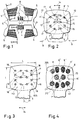
- a connecting web 3 extends transversely or perpendicular to the main axis 2 of the handle 1.
- This connecting web 3 carries bristles 4 which are intended to act on the chewing surfaces of the teeth upwards and downwards.
- bristle holders 5 are articulated transversely thereto via a plastic joint 6, so that they can be elastically bent apart with deformation of the plastic joint 6 when a tooth is inserted between two bristle holders 5 with bristles 7, 8 facing one another.
- the bristle length increases from the bristles 7 to the bristles 8, so that the bristles of two bristle holders 5 lying opposite one another delimit a space that opens towards the handle. This seems unusual in itself because the tooth to be inserted between them forms a cross-section of an oppositely directed triangle with its gingiva, but it has been shown that such a shape goes hand in hand with optimal cleaning effect and improved massage of the gums.
- a preferred embodiment of a toothbrush or a bristle holder to solve the problems explained at the outset will now be described with reference to FIG. 2. It should be mentioned that with reference to FIG. 1, as a bristle holder 5, only a very narrowly limited part of a joint 6 is described, but that the bristle holder 5 may also include connection attachments, in particular if it is a pluggable or bristle holder that can be detachably attached.
- Fig. 2 three teeth next to each other are indicated by dash-dot-dotted lines at 9.
- the teeth 9 sit in the upper jaw and are covered at the top by the marginal gingiva 10, which runs in an arch-like manner in 90% of the inhabitants of cultivated countries.
- at least one edge zone of the bristles 8 (FIG. 1) is arranged in a corresponding arc shape in bristle holes 8 '.
- "Correspondingly” preferably means that the dash-dotted arc 11 on which the holes 8 'are located has a radius in the region from 3 mm to 10 mm, the latter digit actually representing the top area. It is cheaper to measure the arc radius not larger than 8 mm.
- radii of 5 mm ⁇ 20% have proven particularly useful, although, as will be explained below, it is entirely conceivable and desirable to dimension the arc radii of different bristle hole arcs on the bristle holder or within the bristle array 12 arranged thereon.
- the central bristles 15 are arranged in such a way that they together with the two bristle holes at the end of the arch 13 also result in an arc 16 which is parallel to the arc 11.
- the arrangement of the bristle holes shown here means that the bristle holder 5 - as can be seen - is almost square in plan view of the bristle field 12 (although it would be entirely possible for simple toothbrushes with only one bristle holder and handle, corresponding to the contour 10 in succession Bends 11)), the diagonals through the bristle holder 5, which are shown here as dashed lines 17, enclosing an angle with one another in the range from 75 ° to 105 °, that is to say on average about 90 ° ⁇ 10%. It is irrelevant whether this angle is measured at the point alpha shown in FIG. 2 or its associated complementary angle, because both angles must necessarily lie in this range.
- the resulting weakly rectangular to square shape is not only advantageous for toothbrushes of the type shown in FIG. 1, although it is also most easily applicable there and in combination with whose peculiarities (see above) exorbitantly improve the cleaning result in a synergetic way. Rather, the explanation based on tooth contours 9, 10 shows that such a shape is also particularly suitable for conventional toothbrushes for cleaning and massaging the marginal gingiva and its neighboring areas on the tooth surface.
- the density of the bristle holes plays a role, which should be about 25 to 30 holes per cm 2 in order to achieve favorable results.
- the angle alpha does not say anything about the specific size of the bristle holder 5, which is supposed to be adapted to the average size of the sheets 10.
- Tests have shown that an edge length 1 or L (cf. FIG. 3) of the order of 5 to 15 mm and in particular 5 to 10 mm corresponds best to the average.
- L edge length 1 or L (cf. FIG. 3) of the order of 5 to 15 mm and in particular 5 to 10 mm corresponds best to the average.
- the lower limit of about 5 mm (-10%) is somewhat more critical than the upper limit.
- the bristle field 112 here also has bristle holes 18 which, together with the other bristle holes, delimit an - at first almost conventional-looking, bristle field of rectangular shape.
- the difference from the prior art lies in the fact that the bristles of the bristle holes 18 are only very soft, whereas the hard bristles of the bristle holes 7 ', 8' and 15 again, as in FIG. 2, along arches 11, 13 and 16 are arranged.
- the middle bristle holes 15 can also be viewed as being located on an arc 19 running parallel to the arc 13.
- FIG. 4 illustrates a top view of a further embodiment variant.
- the bristles 7, 8 protrude approximately perpendicular to the plane of the bristle holder or the bristle field 12, or that there is no great deviation from the vertical (maximum 10 °).
- bristles 8 and 15 ' are arranged perpendicular to the plane of the bristle holder 205 or of the bristle field 212, but that the bristles 8''and 7 ′′ are inclined in opposite directions in such a way that their ends lie on an arc 11 ′ or 13 ′, although it would be ascertained when cutting through the bristles that their bristle holes are on or within a Rectangle 20 lie.
- the bristles 7 ′′ ′′ located at the end of the arch 13 ′ can also be arranged obliquely, as can be seen from FIG. 4, namely opposite to the inclination of the bristles 7 ′′. But this also results in an arc 16 'from a line connecting the ends of the bristles 15' with those of the bristles 7 '''.
Landscapes
- Health & Medical Sciences (AREA)
- Dentistry (AREA)
- General Health & Medical Sciences (AREA)
- Brushes (AREA)
Claims (7)
- Brosse à dents avec une poignée et au moins un support de poils relié à celle-ci, lequel support de poils comporte un certain nombre de trous pour poils, trous hors desquels s'étendent les poils (7, 8, 15') d'un champ de poils de la brosse à dents, dont au moins les extrémités libres de deux rangées de poils sont disposées le long respectivement d'un arc (11, 13) bordant le champ de poils (12), lesquels arcs tournent leurs côtés concaves l'un vers l'autre, caractérisée par la fait que les arcs (11, 13) bordant le champ de poils (12), et tournant leurs côtés concaves l'un vers l'autre, ont des rayons (R, r) différents.
- Brosse à dents selon la revendication 1, caractérisée par le fait que les arcs de trous pour poils (11, 13, 16) ont un rayon (R ou r) d'au moins 3 mm et au maximum de 10 mm, de préférence au maximum de 8 mm, avantageusement de 5 mm ± 20 %.
- Brosse à dents selon l'une des revendications précédentes, caractérisée par le fait qu'entre deux arcs de trous pour poils (11, 13) limitant le champ de poils (12 ; 112) est disposé au moins un autre trou pour poils (15), de préférence une rangée de trous pour poils (15), qui de manière appropriée ou bien est elle-même en forme d'arc ou bien est disposée , avec au moins un trou pour poils (7' ou 8') d'un arc voisin de trous pour poils (11, 13), le long d'un autre arc (16 ou 19) qui possède le cas échéant un rayon ( r ) plus petit qu'un arc (11) parallèle à lui (16), par exemple un rayon plus petit d'environ 10%.
- Brosse à dents selon l'une des revendications précédentes, caractérisée par le fait que le champ de poils ( 12; 112; 212) se trouve au moins sensiblement centré sur un axe défini par deux diagonales (17) du support de poils ( 5; 105; 205), lesquelles diagonales (17) forment entre elles un angle (alpha) de 75° à 105°.
- Brosse à dents selon l'une des revendications précédentes caractérisée par le fait que les deux diagonales forment entre elles un angle (alpha) de 90° ± 10° et/ou que la longueur d'arête du support de poils (5 ; 105 ; 205) est de 5 mm à 15 mm, en particulier 5 mm à 10 mm.
- Brosse à dents selon l'une des revendications précédentes, caractérisée par le fait que le support de poils est fixé à une traverse de liaison (3), en particulier démontable, disposée transversalement par rapport à une poignée (1) (Fig. 1).
- Brosse à dents selon l'une des revendications précédentes, caractérisée par le fait que les trous pour poils (7', 8', 15) présentent une densité de 10 à 25, de préférence 15 à 20 trous/cm2.
Applications Claiming Priority (3)
| Application Number | Priority Date | Filing Date | Title |
|---|---|---|---|
| CH623/90 | 1990-02-28 | ||
| CH62390 | 1990-02-28 | ||
| PCT/EP1991/000349 WO1991012748A1 (fr) | 1990-02-28 | 1991-02-26 | Brosse a dents |
Publications (2)
| Publication Number | Publication Date |
|---|---|
| EP0516675A1 EP0516675A1 (fr) | 1992-12-09 |
| EP0516675B1 true EP0516675B1 (fr) | 1996-10-02 |
Family
ID=4191318
Family Applications (1)
| Application Number | Title | Priority Date | Filing Date |
|---|---|---|---|
| EP91904375A Expired - Lifetime EP0516675B1 (fr) | 1990-02-28 | 1991-02-26 | Brosse a dents |
Country Status (8)
| Country | Link |
|---|---|
| EP (1) | EP0516675B1 (fr) |
| JP (1) | JPH05504281A (fr) |
| AT (1) | ATE143573T1 (fr) |
| CA (1) | CA2076645A1 (fr) |
| DE (1) | DE59108245D1 (fr) |
| DK (1) | DK0516675T3 (fr) |
| ES (1) | ES2095933T3 (fr) |
| WO (1) | WO1991012748A1 (fr) |
Families Citing this family (3)
| Publication number | Priority date | Publication date | Assignee | Title |
|---|---|---|---|---|
| DE9419778U1 (de) * | 1994-12-09 | 1995-03-09 | Brandt, Holger, 65232 Taunusstein | Reinigungsgerät für den Mundraum |
| HRP20041036A2 (en) * | 2004-11-03 | 2006-10-31 | Gaberšnik Zdravko | Double-sided toothbrush with hinged handle |
| ES2379170B1 (es) | 2011-06-17 | 2012-12-18 | Fernando Miñano Fernández | Autolimpiador buco-dental por mascada. |
Family Cites Families (3)
| Publication number | Priority date | Publication date | Assignee | Title |
|---|---|---|---|---|
| DE674288C (de) * | 1936-12-05 | 1939-04-12 | Wilhelm Ernst Reeser | Zahnbuerste mit dreifachem (U-foermigem) Buerstenkopf mit Borstensaetzen |
| FR1075171A (fr) * | 1952-08-28 | 1954-10-13 | Brosse à dents | |
| DE3378248D1 (en) * | 1983-07-05 | 1988-11-24 | Raymond Ernest | Modular interproximal toothbrushes |
-
1991
- 1991-02-26 AT AT91904375T patent/ATE143573T1/de not_active IP Right Cessation
- 1991-02-26 CA CA002076645A patent/CA2076645A1/fr not_active Abandoned
- 1991-02-26 ES ES91904375T patent/ES2095933T3/es not_active Expired - Lifetime
- 1991-02-26 JP JP3504221A patent/JPH05504281A/ja active Pending
- 1991-02-26 WO PCT/EP1991/000349 patent/WO1991012748A1/fr not_active Ceased
- 1991-02-26 DE DE59108245T patent/DE59108245D1/de not_active Expired - Fee Related
- 1991-02-26 EP EP91904375A patent/EP0516675B1/fr not_active Expired - Lifetime
- 1991-02-26 DK DK91904375.2T patent/DK0516675T3/da not_active Application Discontinuation
Also Published As
| Publication number | Publication date |
|---|---|
| EP0516675A1 (fr) | 1992-12-09 |
| ATE143573T1 (de) | 1996-10-15 |
| WO1991012748A1 (fr) | 1991-09-05 |
| DK0516675T3 (da) | 1997-03-03 |
| CA2076645A1 (fr) | 1991-08-29 |
| ES2095933T3 (es) | 1997-03-01 |
| JPH05504281A (ja) | 1993-07-08 |
| DE59108245D1 (de) | 1996-11-07 |
Similar Documents
| Publication | Publication Date | Title |
|---|---|---|
| DE69629062T3 (de) | Zahnbürste | |
| DE68917291T2 (de) | Zahnärztliches gerät. | |
| EP0269665B1 (fr) | Brosse a dents | |
| DE4412301C2 (de) | Motorisch, insbesondere elektromotorisch, betriebene Zahnbürste | |
| DE69533930T2 (de) | Zahnbürste | |
| EP0756474B1 (fr) | Douche buccale pourvue d'un element a ajutages en forme d'etrier | |
| EP1646299A1 (fr) | Brosse a dents manuelle | |
| DE2021711C2 (de) | Zahnbürste | |
| EP0716821A1 (fr) | Brosse à dents | |
| EP1001693A1 (fr) | Brosse a dents | |
| EP1173081B1 (fr) | Brosse a dents | |
| WO1988003772A1 (fr) | Brosse a dents | |
| DE202007017676U1 (de) | Bürstenkopf für eine Zahnbürste | |
| DE69628347T2 (de) | Zahnbürste | |
| DE4317983A1 (de) | Zahnbürste | |
| EP0098910B1 (fr) | Brosse à dents pour l'enlèvement des dépôts sur les dents humaines et pour les soins dentaires | |
| EP0885573A1 (fr) | Tête de brosse à dents | |
| EP0516675B1 (fr) | Brosse a dents | |
| DE3152404T1 (de) | Zahnhygiene-werkzeug | |
| DE19616154A1 (de) | Zahnbürste | |
| DE4409395C1 (de) | Zahnbürstenkopf | |
| WO1998002062A1 (fr) | Brosse a dents | |
| DE2518845A1 (de) | Zahnbuerste | |
| CH663334A5 (de) | Buerste zum reinigen herausnehmbarer zahnprothesen. | |
| DE2505803C3 (de) | Zahnbürste |
Legal Events
| Date | Code | Title | Description |
|---|---|---|---|
| PUAI | Public reference made under article 153(3) epc to a published international application that has entered the european phase |
Free format text: ORIGINAL CODE: 0009012 |
|
| 17P | Request for examination filed |
Effective date: 19920925 |
|
| AK | Designated contracting states |
Kind code of ref document: A1 Designated state(s): AT BE CH DE DK ES FR GB GR IT LI LU NL SE |
|
| 17Q | First examination report despatched |
Effective date: 19941221 |
|
| RAP1 | Party data changed (applicant data changed or rights of an application transferred) |
Owner name: BRANDT, HOLGER |
|
| GRAG | Despatch of communication of intention to grant |
Free format text: ORIGINAL CODE: EPIDOS AGRA |
|
| GRAH | Despatch of communication of intention to grant a patent |
Free format text: ORIGINAL CODE: EPIDOS IGRA |
|
| GRAH | Despatch of communication of intention to grant a patent |
Free format text: ORIGINAL CODE: EPIDOS IGRA |
|
| GRAA | (expected) grant |
Free format text: ORIGINAL CODE: 0009210 |
|
| RIN1 | Information on inventor provided before grant (corrected) |
Inventor name: HAEUSSER, MANFRED |
|
| AK | Designated contracting states |
Kind code of ref document: B1 Designated state(s): AT BE CH DE DK ES FR GB GR IT LI LU NL SE |
|
| PG25 | Lapsed in a contracting state [announced via postgrant information from national office to epo] |
Ref country code: GR Free format text: LAPSE BECAUSE OF FAILURE TO SUBMIT A TRANSLATION OF THE DESCRIPTION OR TO PAY THE FEE WITHIN THE PRESCRIBED TIME-LIMIT Effective date: 19961002 |
|
| REF | Corresponds to: |
Ref document number: 143573 Country of ref document: AT Date of ref document: 19961015 Kind code of ref document: T |
|
| REF | Corresponds to: |
Ref document number: 59108245 Country of ref document: DE Date of ref document: 19961107 |
|
| ITF | It: translation for a ep patent filed | ||
| REG | Reference to a national code |
Ref country code: CH Ref legal event code: NV Representative=s name: BOVARD AG PATENTANWAELTE |
|
| GBT | Gb: translation of ep patent filed (gb section 77(6)(a)/1977) |
Effective date: 19970110 |
|
| ET | Fr: translation filed | ||
| REG | Reference to a national code |
Ref country code: ES Ref legal event code: FG2A Ref document number: 2095933 Country of ref document: ES Kind code of ref document: T3 |
|
| REG | Reference to a national code |
Ref country code: DK Ref legal event code: T3 |
|
| PLBE | No opposition filed within time limit |
Free format text: ORIGINAL CODE: 0009261 |
|
| STAA | Information on the status of an ep patent application or granted ep patent |
Free format text: STATUS: NO OPPOSITION FILED WITHIN TIME LIMIT |
|
| 26N | No opposition filed | ||
| PGFP | Annual fee paid to national office [announced via postgrant information from national office to epo] |
Ref country code: SE Payment date: 19990215 Year of fee payment: 9 Ref country code: GB Payment date: 19990215 Year of fee payment: 9 Ref country code: AT Payment date: 19990215 Year of fee payment: 9 |
|
| PGFP | Annual fee paid to national office [announced via postgrant information from national office to epo] |
Ref country code: LU Payment date: 19990217 Year of fee payment: 9 |
|
| PGFP | Annual fee paid to national office [announced via postgrant information from national office to epo] |
Ref country code: ES Payment date: 19990224 Year of fee payment: 9 |
|
| PGFP | Annual fee paid to national office [announced via postgrant information from national office to epo] |
Ref country code: DK Payment date: 19990225 Year of fee payment: 9 |
|
| PGFP | Annual fee paid to national office [announced via postgrant information from national office to epo] |
Ref country code: FR Payment date: 19990226 Year of fee payment: 9 |
|
| PGFP | Annual fee paid to national office [announced via postgrant information from national office to epo] |
Ref country code: NL Payment date: 19990228 Year of fee payment: 9 |
|
| PGFP | Annual fee paid to national office [announced via postgrant information from national office to epo] |
Ref country code: CH Payment date: 19990301 Year of fee payment: 9 |
|
| PGFP | Annual fee paid to national office [announced via postgrant information from national office to epo] |
Ref country code: BE Payment date: 19990419 Year of fee payment: 9 |
|
| PGFP | Annual fee paid to national office [announced via postgrant information from national office to epo] |
Ref country code: DE Payment date: 19990428 Year of fee payment: 9 |
|
| PG25 | Lapsed in a contracting state [announced via postgrant information from national office to epo] |
Ref country code: LU Free format text: LAPSE BECAUSE OF NON-PAYMENT OF DUE FEES Effective date: 20000226 Ref country code: GB Free format text: LAPSE BECAUSE OF NON-PAYMENT OF DUE FEES Effective date: 20000226 Ref country code: DK Free format text: LAPSE BECAUSE OF NON-PAYMENT OF DUE FEES Effective date: 20000226 Ref country code: AT Free format text: LAPSE BECAUSE OF NON-PAYMENT OF DUE FEES Effective date: 20000226 |
|
| PG25 | Lapsed in a contracting state [announced via postgrant information from national office to epo] |
Ref country code: SE Free format text: LAPSE BECAUSE OF NON-PAYMENT OF DUE FEES Effective date: 20000227 |
|
| PG25 | Lapsed in a contracting state [announced via postgrant information from national office to epo] |
Ref country code: ES Free format text: LAPSE BECAUSE OF NON-PAYMENT OF DUE FEES Effective date: 20000228 Ref country code: BE Free format text: LAPSE BECAUSE OF NON-PAYMENT OF DUE FEES Effective date: 20000228 |
|
| PG25 | Lapsed in a contracting state [announced via postgrant information from national office to epo] |
Ref country code: LI Free format text: LAPSE BECAUSE OF NON-PAYMENT OF DUE FEES Effective date: 20000229 Ref country code: CH Free format text: LAPSE BECAUSE OF NON-PAYMENT OF DUE FEES Effective date: 20000229 |
|
| BERE | Be: lapsed |
Owner name: BRANDT HOLGER Effective date: 20000228 |
|
| PG25 | Lapsed in a contracting state [announced via postgrant information from national office to epo] |
Ref country code: NL Free format text: LAPSE BECAUSE OF NON-PAYMENT OF DUE FEES Effective date: 20000901 |
|
| EUG | Se: european patent has lapsed |
Ref document number: 91904375.2 |
|
| REG | Reference to a national code |
Ref country code: CH Ref legal event code: PL |
|
| GBPC | Gb: european patent ceased through non-payment of renewal fee |
Effective date: 20000226 |
|
| PG25 | Lapsed in a contracting state [announced via postgrant information from national office to epo] |
Ref country code: FR Free format text: LAPSE BECAUSE OF NON-PAYMENT OF DUE FEES Effective date: 20001031 |
|
| NLV4 | Nl: lapsed or anulled due to non-payment of the annual fee |
Effective date: 20000901 |
|
| REG | Reference to a national code |
Ref country code: FR Ref legal event code: ST |
|
| REG | Reference to a national code |
Ref country code: DK Ref legal event code: EBP |
|
| REG | Reference to a national code |
Ref country code: ES Ref legal event code: FD2A Effective date: 20010910 |
|
| PG25 | Lapsed in a contracting state [announced via postgrant information from national office to epo] |
Ref country code: IT Free format text: LAPSE BECAUSE OF NON-PAYMENT OF DUE FEES;WARNING: LAPSES OF ITALIAN PATENTS WITH EFFECTIVE DATE BEFORE 2007 MAY HAVE OCCURRED AT ANY TIME BEFORE 2007. THE CORRECT EFFECTIVE DATE MAY BE DIFFERENT FROM THE ONE RECORDED. Effective date: 20050226 |