EP0517565A2 - Verfahren zur Zubereitung von biologisch aktiven Komponenten enthaltenden Mikrospheren - Google Patents
Verfahren zur Zubereitung von biologisch aktiven Komponenten enthaltenden Mikrospheren Download PDFInfo
- Publication number
- EP0517565A2 EP0517565A2 EP92401433A EP92401433A EP0517565A2 EP 0517565 A2 EP0517565 A2 EP 0517565A2 EP 92401433 A EP92401433 A EP 92401433A EP 92401433 A EP92401433 A EP 92401433A EP 0517565 A2 EP0517565 A2 EP 0517565A2
- Authority
- EP
- European Patent Office
- Prior art keywords
- microspheres
- solvent
- mixture
- phases
- polymer
- Prior art date
- Legal status (The legal status is an assumption and is not a legal conclusion. Google has not performed a legal analysis and makes no representation as to the accuracy of the status listed.)
- Granted
Links
- 239000004005 microsphere Substances 0.000 title claims abstract description 199
- 238000000034 method Methods 0.000 title claims description 17
- 238000002360 preparation method Methods 0.000 title description 47
- 230000008569 process Effects 0.000 title description 5
- 239000000203 mixture Substances 0.000 claims abstract description 164
- 229920002674 hyaluronan Polymers 0.000 claims abstract description 88
- 229960003160 hyaluronic acid Drugs 0.000 claims abstract description 86
- KIUKXJAPPMFGSW-DNGZLQJQSA-N (2S,3S,4S,5R,6R)-6-[(2S,3R,4R,5S,6R)-3-Acetamido-2-[(2S,3S,4R,5R,6R)-6-[(2R,3R,4R,5S,6R)-3-acetamido-2,5-dihydroxy-6-(hydroxymethyl)oxan-4-yl]oxy-2-carboxy-4,5-dihydroxyoxan-3-yl]oxy-5-hydroxy-6-(hydroxymethyl)oxan-4-yl]oxy-3,4,5-trihydroxyoxane-2-carboxylic acid Chemical compound CC(=O)N[C@H]1[C@H](O)O[C@H](CO)[C@@H](O)[C@@H]1O[C@H]1[C@H](O)[C@@H](O)[C@H](O[C@H]2[C@@H]([C@@H](O[C@H]3[C@@H]([C@@H](O)[C@H](O)[C@H](O3)C(O)=O)O)[C@H](O)[C@@H](CO)O2)NC(C)=O)[C@@H](C(O)=O)O1 KIUKXJAPPMFGSW-DNGZLQJQSA-N 0.000 claims abstract description 59
- 150000002148 esters Chemical class 0.000 claims abstract description 10
- 238000013270 controlled release Methods 0.000 claims abstract description 7
- NOESYZHRGYRDHS-UHFFFAOYSA-N insulin Chemical compound N1C(=O)C(NC(=O)C(CCC(N)=O)NC(=O)C(CCC(O)=O)NC(=O)C(C(C)C)NC(=O)C(NC(=O)CN)C(C)CC)CSSCC(C(NC(CO)C(=O)NC(CC(C)C)C(=O)NC(CC=2C=CC(O)=CC=2)C(=O)NC(CCC(N)=O)C(=O)NC(CC(C)C)C(=O)NC(CCC(O)=O)C(=O)NC(CC(N)=O)C(=O)NC(CC=2C=CC(O)=CC=2)C(=O)NC(CSSCC(NC(=O)C(C(C)C)NC(=O)C(CC(C)C)NC(=O)C(CC=2C=CC(O)=CC=2)NC(=O)C(CC(C)C)NC(=O)C(C)NC(=O)C(CCC(O)=O)NC(=O)C(C(C)C)NC(=O)C(CC(C)C)NC(=O)C(CC=2NC=NC=2)NC(=O)C(CO)NC(=O)CNC2=O)C(=O)NCC(=O)NC(CCC(O)=O)C(=O)NC(CCCNC(N)=N)C(=O)NCC(=O)NC(CC=3C=CC=CC=3)C(=O)NC(CC=3C=CC=CC=3)C(=O)NC(CC=3C=CC(O)=CC=3)C(=O)NC(C(C)O)C(=O)N3C(CCC3)C(=O)NC(CCCCN)C(=O)NC(C)C(O)=O)C(=O)NC(CC(N)=O)C(O)=O)=O)NC(=O)C(C(C)CC)NC(=O)C(CO)NC(=O)C(C(C)O)NC(=O)C1CSSCC2NC(=O)C(CC(C)C)NC(=O)C(NC(=O)C(CCC(N)=O)NC(=O)C(CC(N)=O)NC(=O)C(NC(=O)C(N)CC=1C=CC=CC=1)C(C)C)CC1=CN=CN1 NOESYZHRGYRDHS-UHFFFAOYSA-N 0.000 claims description 78
- 108010025020 Nerve Growth Factor Proteins 0.000 claims description 56
- 102000015336 Nerve Growth Factor Human genes 0.000 claims description 56
- 229940053128 nerve growth factor Drugs 0.000 claims description 53
- 102000004196 processed proteins & peptides Human genes 0.000 claims description 41
- 108090000765 processed proteins & peptides Proteins 0.000 claims description 41
- 229940125396 insulin Drugs 0.000 claims description 40
- 229920001184 polypeptide Polymers 0.000 claims description 40
- 102000055006 Calcitonin Human genes 0.000 claims description 38
- 108060001064 Calcitonin Proteins 0.000 claims description 38
- 102000004877 Insulin Human genes 0.000 claims description 38
- 108090001061 Insulin Proteins 0.000 claims description 38
- BBBFJLBPOGFECG-VJVYQDLKSA-N calcitonin Chemical group N([C@H](C(=O)N[C@@H](CC(C)C)C(=O)NCC(=O)N[C@@H](CCCCN)C(=O)N[C@@H](CC(C)C)C(=O)N[C@@H](CO)C(=O)N[C@@H](CCC(N)=O)C(=O)N[C@@H](CCC(O)=O)C(=O)N[C@@H](CC(C)C)C(=O)N[C@@H](CC=1NC=NC=1)C(=O)N[C@@H](CCCCN)C(=O)N[C@@H](CC(C)C)C(=O)N[C@@H](CCC(N)=O)C(=O)N[C@@H]([C@@H](C)O)C(=O)N[C@@H](CC=1C=CC(O)=CC=1)C(=O)N1[C@@H](CCC1)C(=O)N[C@@H](CCCNC(N)=N)C(=O)N[C@@H]([C@@H](C)O)C(=O)N[C@@H](CC(N)=O)C(=O)N[C@@H]([C@@H](C)O)C(=O)NCC(=O)N[C@@H](CO)C(=O)NCC(=O)N[C@@H]([C@@H](C)O)C(=O)N1[C@@H](CCC1)C(N)=O)C(C)C)C(=O)[C@@H]1CSSC[C@H](N)C(=O)N[C@@H](CO)C(=O)N[C@@H](CC(N)=O)C(=O)N[C@@H](CC(C)C)C(=O)N[C@@H](CO)C(=O)N[C@@H]([C@@H](C)O)C(=O)N1 BBBFJLBPOGFECG-VJVYQDLKSA-N 0.000 claims description 36
- 229960004015 calcitonin Drugs 0.000 claims description 36
- 150000002270 gangliosides Chemical class 0.000 claims description 25
- 238000007918 intramuscular administration Methods 0.000 claims description 5
- 108060003951 Immunoglobulin Proteins 0.000 claims description 3
- 102000018358 immunoglobulin Human genes 0.000 claims description 3
- 210000004877 mucosa Anatomy 0.000 claims description 3
- 210000002850 nasal mucosa Anatomy 0.000 claims description 3
- 108010005939 Ciliary Neurotrophic Factor Proteins 0.000 claims description 2
- 102100031614 Ciliary neurotrophic factor Human genes 0.000 claims description 2
- 239000003102 growth factor Substances 0.000 claims 3
- 210000004379 membrane Anatomy 0.000 claims 2
- 239000012528 membrane Substances 0.000 claims 2
- 210000004400 mucous membrane Anatomy 0.000 claims 2
- 239000012071 phase Substances 0.000 description 225
- 239000002904 solvent Substances 0.000 description 145
- 229920000642 polymer Polymers 0.000 description 114
- XEKOWRVHYACXOJ-UHFFFAOYSA-N Ethyl acetate Chemical compound CCOC(C)=O XEKOWRVHYACXOJ-UHFFFAOYSA-N 0.000 description 105
- 238000003756 stirring Methods 0.000 description 86
- WVDDGKGOMKODPV-UHFFFAOYSA-N Benzyl alcohol Chemical compound OCC1=CC=CC=C1 WVDDGKGOMKODPV-UHFFFAOYSA-N 0.000 description 78
- 238000000605 extraction Methods 0.000 description 78
- 239000000839 emulsion Substances 0.000 description 75
- IAZDPXIOMUYVGZ-UHFFFAOYSA-N Dimethylsulphoxide Chemical compound CS(C)=O IAZDPXIOMUYVGZ-UHFFFAOYSA-N 0.000 description 72
- 239000004094 surface-active agent Substances 0.000 description 72
- 239000000725 suspension Substances 0.000 description 62
- 239000000047 product Substances 0.000 description 55
- 239000000243 solution Substances 0.000 description 53
- 230000009471 action Effects 0.000 description 40
- 238000009472 formulation Methods 0.000 description 38
- -1 hyaluronic acid ester Chemical class 0.000 description 38
- 125000003178 carboxy group Chemical group [H]OC(*)=O 0.000 description 37
- 239000002245 particle Substances 0.000 description 37
- NWGKJDSIEKMTRX-BFWOXRRGSA-N [(2r)-2-[(3r,4s)-3,4-dihydroxyoxolan-2-yl]-2-hydroxyethyl] (z)-octadec-9-enoate Chemical compound CCCCCCCC\C=C/CCCCCCCC(=O)OC[C@@H](O)C1OC[C@H](O)[C@H]1O NWGKJDSIEKMTRX-BFWOXRRGSA-N 0.000 description 36
- 239000000010 aprotic solvent Substances 0.000 description 36
- 239000012298 atmosphere Substances 0.000 description 36
- 238000001035 drying Methods 0.000 description 36
- 238000004945 emulsification Methods 0.000 description 36
- 238000001914 filtration Methods 0.000 description 36
- 239000002480 mineral oil Substances 0.000 description 36
- 235000010446 mineral oil Nutrition 0.000 description 36
- VLKZOEOYAKHREP-UHFFFAOYSA-N n-Hexane Chemical compound CCCCCC VLKZOEOYAKHREP-UHFFFAOYSA-N 0.000 description 36
- 230000003381 solubilizing effect Effects 0.000 description 36
- LFQSCWFLJHTTHZ-UHFFFAOYSA-N Ethanol Chemical compound CCO LFQSCWFLJHTTHZ-UHFFFAOYSA-N 0.000 description 28
- IJGRMHOSHXDMSA-UHFFFAOYSA-N Atomic nitrogen Chemical compound N#N IJGRMHOSHXDMSA-UHFFFAOYSA-N 0.000 description 26
- 235000019445 benzyl alcohol Nutrition 0.000 description 26
- 102000004169 proteins and genes Human genes 0.000 description 21
- 108090000623 proteins and genes Proteins 0.000 description 21
- 210000004369 blood Anatomy 0.000 description 18
- 239000008280 blood Substances 0.000 description 18
- 210000002381 plasma Anatomy 0.000 description 17
- 235000019441 ethanol Nutrition 0.000 description 15
- 239000007788 liquid Substances 0.000 description 14
- 229910052757 nitrogen Inorganic materials 0.000 description 13
- 239000008055 phosphate buffer solution Substances 0.000 description 13
- 230000000694 effects Effects 0.000 description 11
- QPJBWNIQKHGLAU-IQZHVAEDSA-N ganglioside GM1 Chemical compound O[C@@H]1[C@@H](O)[C@H](OC[C@H](NC(=O)CCCCCCCCCCCCCCCCC)[C@H](O)\C=C\CCCCCCCCCCCCC)O[C@H](CO)[C@H]1O[C@H]1[C@H](O)[C@@H](O[C@]2(O[C@H]([C@H](NC(C)=O)[C@@H](O)C2)[C@H](O)[C@H](O)CO)C(O)=O)[C@@H](O[C@H]2[C@@H]([C@@H](O[C@H]3[C@@H]([C@@H](O)[C@@H](O)[C@@H](CO)O3)O)[C@@H](O)[C@@H](CO)O2)NC(C)=O)[C@@H](CO)O1 QPJBWNIQKHGLAU-IQZHVAEDSA-N 0.000 description 10
- 239000011159 matrix material Substances 0.000 description 10
- VEXZGXHMUGYJMC-UHFFFAOYSA-N Hydrochloric acid Chemical compound Cl VEXZGXHMUGYJMC-UHFFFAOYSA-N 0.000 description 9
- 239000013543 active substance Substances 0.000 description 9
- 239000000126 substance Substances 0.000 description 9
- OYPRJOBELJOOCE-UHFFFAOYSA-N Calcium Chemical compound [Ca] OYPRJOBELJOOCE-UHFFFAOYSA-N 0.000 description 8
- 239000011575 calcium Substances 0.000 description 8
- 229910052791 calcium Inorganic materials 0.000 description 8
- 230000007423 decrease Effects 0.000 description 8
- 230000000144 pharmacologic effect Effects 0.000 description 8
- 241001494479 Pecora Species 0.000 description 7
- 239000003814 drug Substances 0.000 description 7
- WQZGKKKJIJFFOK-GASJEMHNSA-N Glucose Natural products OC[C@H]1OC(O)[C@H](O)[C@@H](O)[C@@H]1O WQZGKKKJIJFFOK-GASJEMHNSA-N 0.000 description 6
- 101000976075 Homo sapiens Insulin Proteins 0.000 description 6
- 238000010521 absorption reaction Methods 0.000 description 6
- 238000004458 analytical method Methods 0.000 description 6
- 229940079593 drug Drugs 0.000 description 6
- 239000008103 glucose Substances 0.000 description 6
- 230000003993 interaction Effects 0.000 description 5
- 239000000843 powder Substances 0.000 description 5
- 238000012360 testing method Methods 0.000 description 5
- 101100322805 Arabidopsis thaliana AHL15 gene Proteins 0.000 description 4
- 101100322816 Arabidopsis thaliana AHL25 gene Proteins 0.000 description 4
- 239000003795 chemical substances by application Substances 0.000 description 4
- 210000001331 nose Anatomy 0.000 description 4
- HTTJABKRGRZYRN-UHFFFAOYSA-N Heparin Chemical compound OC1C(NC(=O)C)C(O)OC(COS(O)(=O)=O)C1OC1C(OS(O)(=O)=O)C(O)C(OC2C(C(OS(O)(=O)=O)C(OC3C(C(O)C(O)C(O3)C(O)=O)OS(O)(=O)=O)C(CO)O2)NS(O)(=O)=O)C(C(O)=O)O1 HTTJABKRGRZYRN-UHFFFAOYSA-N 0.000 description 3
- DGAQECJNVWCQMB-PUAWFVPOSA-M Ilexoside XXIX Chemical compound C[C@@H]1CC[C@@]2(CC[C@@]3(C(=CC[C@H]4[C@]3(CC[C@@H]5[C@@]4(CC[C@@H](C5(C)C)OS(=O)(=O)[O-])C)C)[C@@H]2[C@]1(C)O)C)C(=O)O[C@H]6[C@@H]([C@H]([C@@H]([C@H](O6)CO)O)O)O.[Na+] DGAQECJNVWCQMB-PUAWFVPOSA-M 0.000 description 3
- 241000700159 Rattus Species 0.000 description 3
- FAPWRFPIFSIZLT-UHFFFAOYSA-M Sodium chloride Chemical compound [Na+].[Cl-] FAPWRFPIFSIZLT-UHFFFAOYSA-M 0.000 description 3
- WYURNTSHIVDZCO-UHFFFAOYSA-N Tetrahydrofuran Chemical compound C1CCOC1 WYURNTSHIVDZCO-UHFFFAOYSA-N 0.000 description 3
- 238000010171 animal model Methods 0.000 description 3
- 230000015556 catabolic process Effects 0.000 description 3
- 230000001886 ciliary effect Effects 0.000 description 3
- 230000000875 corresponding effect Effects 0.000 description 3
- 239000003246 corticosteroid Substances 0.000 description 3
- 238000006731 degradation reaction Methods 0.000 description 3
- 238000005516 engineering process Methods 0.000 description 3
- 238000001704 evaporation Methods 0.000 description 3
- 230000008020 evaporation Effects 0.000 description 3
- 238000002474 experimental method Methods 0.000 description 3
- 229920000669 heparin Polymers 0.000 description 3
- 229960002897 heparin Drugs 0.000 description 3
- 238000001727 in vivo Methods 0.000 description 3
- PBGKTOXHQIOBKM-FHFVDXKLSA-N insulin (human) Chemical compound C([C@@H](C(=O)N[C@@H](CC(C)C)C(=O)N[C@H]1CSSC[C@H]2C(=O)N[C@H](C(=O)N[C@@H](CO)C(=O)N[C@H](C(=O)N[C@H](C(N[C@@H](CO)C(=O)N[C@@H](CC(C)C)C(=O)N[C@@H](CC=3C=CC(O)=CC=3)C(=O)N[C@@H](CCC(N)=O)C(=O)N[C@@H](CC(C)C)C(=O)N[C@@H](CCC(O)=O)C(=O)N[C@@H](CC(N)=O)C(=O)N[C@@H](CC=3C=CC(O)=CC=3)C(=O)N[C@@H](CSSC[C@H](NC(=O)[C@H](C(C)C)NC(=O)[C@H](CC(C)C)NC(=O)[C@H](CC=3C=CC(O)=CC=3)NC(=O)[C@H](CC(C)C)NC(=O)[C@H](C)NC(=O)[C@H](CCC(O)=O)NC(=O)[C@H](C(C)C)NC(=O)[C@H](CC(C)C)NC(=O)[C@H](CC=3NC=NC=3)NC(=O)[C@H](CO)NC(=O)CNC1=O)C(=O)NCC(=O)N[C@@H](CCC(O)=O)C(=O)N[C@@H](CCCNC(N)=N)C(=O)NCC(=O)N[C@@H](CC=1C=CC=CC=1)C(=O)N[C@@H](CC=1C=CC=CC=1)C(=O)N[C@@H](CC=1C=CC(O)=CC=1)C(=O)N[C@@H]([C@@H](C)O)C(=O)N1[C@@H](CCC1)C(=O)N[C@@H](CCCCN)C(=O)N[C@@H]([C@@H](C)O)C(O)=O)C(=O)N[C@@H](CC(N)=O)C(O)=O)=O)CSSC[C@@H](C(N2)=O)NC(=O)[C@H](CCC(N)=O)NC(=O)[C@H](CCC(O)=O)NC(=O)[C@H](C(C)C)NC(=O)[C@@H](NC(=O)CN)[C@@H](C)CC)[C@@H](C)CC)[C@@H](C)O)NC(=O)[C@H](CCC(N)=O)NC(=O)[C@H](CC(N)=O)NC(=O)[C@@H](NC(=O)[C@@H](N)CC=1C=CC=CC=1)C(C)C)C1=CN=CN1 PBGKTOXHQIOBKM-FHFVDXKLSA-N 0.000 description 3
- 210000004731 jugular vein Anatomy 0.000 description 3
- 230000036470 plasma concentration Effects 0.000 description 3
- 210000002966 serum Anatomy 0.000 description 3
- 239000011734 sodium Substances 0.000 description 3
- 229910052708 sodium Inorganic materials 0.000 description 3
- 210000001519 tissue Anatomy 0.000 description 3
- 210000001215 vagina Anatomy 0.000 description 3
- WFDIJRYMOXRFFG-UHFFFAOYSA-N Acetic anhydride Chemical compound CC(=O)OC(C)=O WFDIJRYMOXRFFG-UHFFFAOYSA-N 0.000 description 2
- RTZKZFJDLAIYFH-UHFFFAOYSA-N Diethyl ether Chemical compound CCOCC RTZKZFJDLAIYFH-UHFFFAOYSA-N 0.000 description 2
- 238000002965 ELISA Methods 0.000 description 2
- 108010010803 Gelatin Proteins 0.000 description 2
- 241000282414 Homo sapiens Species 0.000 description 2
- 241001465754 Metazoa Species 0.000 description 2
- 241000700157 Rattus norvegicus Species 0.000 description 2
- 239000008346 aqueous phase Substances 0.000 description 2
- 230000004071 biological effect Effects 0.000 description 2
- 229940088623 biologically active substance Drugs 0.000 description 2
- 150000001875 compounds Chemical class 0.000 description 2
- 239000007857 degradation product Substances 0.000 description 2
- 238000009792 diffusion process Methods 0.000 description 2
- LQZZUXJYWNFBMV-UHFFFAOYSA-N dodecan-1-ol Chemical compound CCCCCCCCCCCCO LQZZUXJYWNFBMV-UHFFFAOYSA-N 0.000 description 2
- 230000032050 esterification Effects 0.000 description 2
- 238000005886 esterification reaction Methods 0.000 description 2
- 229920000159 gelatin Polymers 0.000 description 2
- 239000008273 gelatin Substances 0.000 description 2
- 235000019322 gelatine Nutrition 0.000 description 2
- 235000011852 gelatine desserts Nutrition 0.000 description 2
- 150000002339 glycosphingolipids Chemical class 0.000 description 2
- JYGXADMDTFJGBT-VWUMJDOOSA-N hydrocortisone Chemical compound O=C1CC[C@]2(C)[C@H]3[C@@H](O)C[C@](C)([C@@](CC4)(O)C(=O)CO)[C@@H]4[C@@H]3CCC2=C1 JYGXADMDTFJGBT-VWUMJDOOSA-N 0.000 description 2
- 230000002209 hydrophobic effect Effects 0.000 description 2
- 238000000338 in vitro Methods 0.000 description 2
- 238000010348 incorporation Methods 0.000 description 2
- 238000004519 manufacturing process Methods 0.000 description 2
- 230000004048 modification Effects 0.000 description 2
- 238000012986 modification Methods 0.000 description 2
- 210000003928 nasal cavity Anatomy 0.000 description 2
- 229920005615 natural polymer Polymers 0.000 description 2
- PEKIAHWVRGDDMN-UHFFFAOYSA-N oxalic acid;hydrofluoride Chemical compound F.OC(=O)C(O)=O PEKIAHWVRGDDMN-UHFFFAOYSA-N 0.000 description 2
- 239000008363 phosphate buffer Substances 0.000 description 2
- 229920001282 polysaccharide Polymers 0.000 description 2
- 239000005017 polysaccharide Substances 0.000 description 2
- 150000004804 polysaccharides Chemical class 0.000 description 2
- 239000011780 sodium chloride Substances 0.000 description 2
- 238000007920 subcutaneous administration Methods 0.000 description 2
- 230000001988 toxicity Effects 0.000 description 2
- 231100000419 toxicity Toxicity 0.000 description 2
- XLYOFNOQVPJJNP-UHFFFAOYSA-N water Substances O XLYOFNOQVPJJNP-UHFFFAOYSA-N 0.000 description 2
- 238000005303 weighing Methods 0.000 description 2
- 102000009027 Albumins Human genes 0.000 description 1
- 108010088751 Albumins Proteins 0.000 description 1
- 229920001661 Chitosan Polymers 0.000 description 1
- 102000008186 Collagen Human genes 0.000 description 1
- 108010035532 Collagen Proteins 0.000 description 1
- IAJILQKETJEXLJ-UHFFFAOYSA-N Galacturonsaeure Natural products O=CC(O)C(O)C(O)C(O)C(O)=O IAJILQKETJEXLJ-UHFFFAOYSA-N 0.000 description 1
- 229920002148 Gellan gum Polymers 0.000 description 1
- 241000282412 Homo Species 0.000 description 1
- OVRNDRQMDRJTHS-UHFFFAOYSA-N N-acelyl-D-glucosamine Chemical group CC(=O)NC1C(O)OC(CO)C(O)C1O OVRNDRQMDRJTHS-UHFFFAOYSA-N 0.000 description 1
- OVRNDRQMDRJTHS-FMDGEEDCSA-N N-acetyl-beta-D-glucosamine Chemical group CC(=O)N[C@H]1[C@H](O)O[C@H](CO)[C@@H](O)[C@@H]1O OVRNDRQMDRJTHS-FMDGEEDCSA-N 0.000 description 1
- 241000283977 Oryctolagus Species 0.000 description 1
- 241000283973 Oryctolagus cuniculus Species 0.000 description 1
- 102000035195 Peptidases Human genes 0.000 description 1
- 108091005804 Peptidases Proteins 0.000 description 1
- 108020004511 Recombinant DNA Proteins 0.000 description 1
- VMHLLURERBWHNL-UHFFFAOYSA-M Sodium acetate Chemical compound [Na+].CC([O-])=O VMHLLURERBWHNL-UHFFFAOYSA-M 0.000 description 1
- 229920002472 Starch Polymers 0.000 description 1
- 229920001284 acidic polysaccharide Polymers 0.000 description 1
- 150000004805 acidic polysaccharides Chemical class 0.000 description 1
- 150000001298 alcohols Chemical class 0.000 description 1
- 229920000615 alginic acid Polymers 0.000 description 1
- 235000010443 alginic acid Nutrition 0.000 description 1
- 239000000783 alginic acid Substances 0.000 description 1
- 229960001126 alginic acid Drugs 0.000 description 1
- 150000004781 alginic acids Chemical class 0.000 description 1
- AEMOLEFTQBMNLQ-WAXACMCWSA-N alpha-D-glucuronic acid Chemical group O[C@H]1O[C@H](C(O)=O)[C@@H](O)[C@H](O)[C@H]1O AEMOLEFTQBMNLQ-WAXACMCWSA-N 0.000 description 1
- 210000000702 aorta abdominal Anatomy 0.000 description 1
- 239000007864 aqueous solution Substances 0.000 description 1
- 210000001367 artery Anatomy 0.000 description 1
- 230000008901 benefit Effects 0.000 description 1
- 229920002988 biodegradable polymer Polymers 0.000 description 1
- 239000004621 biodegradable polymer Substances 0.000 description 1
- 239000013060 biological fluid Substances 0.000 description 1
- 239000008366 buffered solution Substances 0.000 description 1
- 210000001715 carotid artery Anatomy 0.000 description 1
- 210000004027 cell Anatomy 0.000 description 1
- 238000005119 centrifugation Methods 0.000 description 1
- 230000008859 change Effects 0.000 description 1
- 238000012512 characterization method Methods 0.000 description 1
- 238000007385 chemical modification Methods 0.000 description 1
- 229920001436 collagen Polymers 0.000 description 1
- 230000002596 correlated effect Effects 0.000 description 1
- 238000007865 diluting Methods 0.000 description 1
- 230000008030 elimination Effects 0.000 description 1
- 238000003379 elimination reaction Methods 0.000 description 1
- 230000001804 emulsifying effect Effects 0.000 description 1
- 230000006862 enzymatic digestion Effects 0.000 description 1
- 210000001035 gastrointestinal tract Anatomy 0.000 description 1
- 239000000499 gel Substances 0.000 description 1
- 238000004128 high performance liquid chromatography Methods 0.000 description 1
- 229960000890 hydrocortisone Drugs 0.000 description 1
- 230000001184 hypocalcaemic effect Effects 0.000 description 1
- 230000002163 immunogen Effects 0.000 description 1
- 229920002521 macromolecule Polymers 0.000 description 1
- 210000000214 mouth Anatomy 0.000 description 1
- 229950006780 n-acetylglucosamine Drugs 0.000 description 1
- 239000005445 natural material Substances 0.000 description 1
- 239000012074 organic phase Substances 0.000 description 1
- WVDDGKGOMKODPV-ZQBYOMGUSA-N phenyl(114C)methanol Chemical compound O[14CH2]C1=CC=CC=C1 WVDDGKGOMKODPV-ZQBYOMGUSA-N 0.000 description 1
- 239000002244 precipitate Substances 0.000 description 1
- 230000002035 prolonged effect Effects 0.000 description 1
- 229940024999 proteolytic enzymes for treatment of wounds and ulcers Drugs 0.000 description 1
- 238000000746 purification Methods 0.000 description 1
- 230000009257 reactivity Effects 0.000 description 1
- 210000000664 rectum Anatomy 0.000 description 1
- 238000011160 research Methods 0.000 description 1
- 238000000926 separation method Methods 0.000 description 1
- 239000001632 sodium acetate Substances 0.000 description 1
- 235000017281 sodium acetate Nutrition 0.000 description 1
- 238000004611 spectroscopical analysis Methods 0.000 description 1
- 238000005507 spraying Methods 0.000 description 1
- 239000008107 starch Substances 0.000 description 1
- 235000019698 starch Nutrition 0.000 description 1
- 125000001424 substituent group Chemical group 0.000 description 1
- 238000003786 synthesis reaction Methods 0.000 description 1
- 229940124597 therapeutic agent Drugs 0.000 description 1
- 230000001228 trophic effect Effects 0.000 description 1
Images




Classifications
-
- A—HUMAN NECESSITIES
- A61—MEDICAL OR VETERINARY SCIENCE; HYGIENE
- A61K—PREPARATIONS FOR MEDICAL, DENTAL OR TOILETRY PURPOSES
- A61K38/00—Medicinal preparations containing peptides
- A61K38/16—Peptides having more than 20 amino acids; Gastrins; Somatostatins; Melanotropins; Derivatives thereof
- A61K38/17—Peptides having more than 20 amino acids; Gastrins; Somatostatins; Melanotropins; Derivatives thereof from animals; from humans
- A61K38/22—Hormones
- A61K38/28—Insulins
-
- A—HUMAN NECESSITIES
- A61—MEDICAL OR VETERINARY SCIENCE; HYGIENE
- A61K—PREPARATIONS FOR MEDICAL, DENTAL OR TOILETRY PURPOSES
- A61K38/00—Medicinal preparations containing peptides
- A61K38/16—Peptides having more than 20 amino acids; Gastrins; Somatostatins; Melanotropins; Derivatives thereof
- A61K38/17—Peptides having more than 20 amino acids; Gastrins; Somatostatins; Melanotropins; Derivatives thereof from animals; from humans
- A61K38/18—Growth factors; Growth regulators
- A61K38/185—Nerve growth factor [NGF]; Brain derived neurotrophic factor [BDNF]; Ciliary neurotrophic factor [CNTF]; Glial derived neurotrophic factor [GDNF]; Neurotrophins, e.g. NT-3
-
- A—HUMAN NECESSITIES
- A61—MEDICAL OR VETERINARY SCIENCE; HYGIENE
- A61K—PREPARATIONS FOR MEDICAL, DENTAL OR TOILETRY PURPOSES
- A61K38/00—Medicinal preparations containing peptides
- A61K38/16—Peptides having more than 20 amino acids; Gastrins; Somatostatins; Melanotropins; Derivatives thereof
- A61K38/17—Peptides having more than 20 amino acids; Gastrins; Somatostatins; Melanotropins; Derivatives thereof from animals; from humans
- A61K38/22—Hormones
- A61K38/23—Calcitonins
-
- A—HUMAN NECESSITIES
- A61—MEDICAL OR VETERINARY SCIENCE; HYGIENE
- A61K—PREPARATIONS FOR MEDICAL, DENTAL OR TOILETRY PURPOSES
- A61K9/00—Medicinal preparations characterised by special physical form
- A61K9/0012—Galenical forms characterised by the site of application
- A61K9/0034—Urogenital system, e.g. vagina, uterus, cervix, penis, scrotum, urethra, bladder; Personal lubricants
-
- A—HUMAN NECESSITIES
- A61—MEDICAL OR VETERINARY SCIENCE; HYGIENE
- A61K—PREPARATIONS FOR MEDICAL, DENTAL OR TOILETRY PURPOSES
- A61K9/00—Medicinal preparations characterised by special physical form
- A61K9/14—Particulate form, e.g. powders, Processes for size reducing of pure drugs or the resulting products, Pure drug nanoparticles
- A61K9/16—Agglomerates; Granulates; Microbeadlets ; Microspheres; Pellets; Solid products obtained by spray drying, spray freeze drying, spray congealing,(multiple) emulsion solvent evaporation or extraction
- A61K9/1605—Excipients; Inactive ingredients
- A61K9/1629—Organic macromolecular compounds
- A61K9/1652—Polysaccharides, e.g. alginate, cellulose derivatives; Cyclodextrin
Definitions
- An object of the invention is a composition of microspheres and a process for their preparation starting with biodegradable and bioabsorbable semisynthetic polymers and single molecules or mixtures of the same having pharmacological activity, allowing the chemical characteristics of the semisynthetic polymer used and the biological or pharmacological activity of the molecules to remain unaltered, guaranteeing controlled release depending on the hydrophilic properties of the chemical substituents present on the semisynthetic polymer.
- Proteins and peptides are today considered to be an important base for therapeutic agents. Recombinant DNA technology has made it possibile to produce many such macromolecular agents with interesting and useful biological and pharmacological properties. The enormous technological advancement in chemical synthesis has made many polypeptides with high pharmacological activity accessible. For these drugs however problems still persist regarding stability and their administration to man. When an active principle is administered to man, it is essential to guarantee that its pharmacological activity will remain unaltered and that its release will be controlled, in order to avoid undesirable side-effects. It is known that these macromolecular agents are not usually efficacious after oral administration, since they are rapidly degraded and deactivated by the proteolytic enzymes present in the gastrointestinal tract.
- Hyaluronic acid is a polysaccharide widely distributed in animal organisms, and is constituted by alternating units of D-glucuronic acid and N-acetyl-D-glucosamine. The mean molecular weight varies between 2 x 10⁴ and 7 x 10⁶ according to the purification method used.
- Hyaluronic acid has been used, as described, for example, in US patent 4,772,419, to prevent adhesion and tissue enlargement.
- US patent 4,636,524 also describes a release system for biologically active substances to be dispersed in the molecular "cage" formed by the meshwork of hyaluronic acid gel.
- Hyaluronic acid has also been described in the literature as a carrier for drugs trapped in the biodegradable, collagen-based matrix.
- microspheres containing -biologically and/or pharmacologically active molecules are described in the PCT patent WO 89/03207. These release systems include the association of pharmacologically and/or biologically active molecules, denaturable like polypeptides, with natural polymers (starch, gelatin or albumin).
- hyaluronic and and/or its derivatives as a polymeric carrier to prepare formulations (microspheres) to be used for the release of active substances through the mucosa, such as the vaginal or nasal mucosa, is not described.
- the emulsifying phase is constituted by microdroplets of a solvent containing modified hyaluronic acid and the substance, or suitable mixtures of biologically and/or pharmacologically active substances.
- the other phase of the emulsion is represented by a second solvent in which the microdroplets are homogeneously dispersed.
- the paper by Benedetti et al. (1990) refers, in particular, to the possibility of obtaining microspheres by evaporation, because the extraction method produces microspheres with very porous surfaces; and, consequently, the polymeric matrix of which they are constituted has no control over the release of the active principle (corticosteroid).
- the prsent invention surprisingly, the possibility of producing, by extraction, smooth-surfaced microspheres which therefore have more control over the release of the substances which are incorporated therein.
- Another advantage of the extraction technique of the present invention lies in the possibility of obtaining microspheres with a notably smaller diameter than those cited in Benedetti et al.
- microspheres unlike those with a larger diameter, guarantees a greater total surface area and therefore more contact with the tissues to be treated.
- the present invention describes the preparation of microspheres containing molecules of a proteic nature (such as calcitonin, insulin, immunoglobin, trophic factors such as hCNTF/hNGF) and/or of a glycosphingolipid nature (natural gangliosides or their chemical derivatives), that is, the preparation of compounds which are quite different in structure, chemical-physical characteristics and stability from the compound (corticosteroid) discussed in the paper by Benedetti et al. It has been demonstrated, surprisingly, that by using this release system, the proteins associated with the polymer do not undergo degradation and maintain their biological activity.
- a proteic nature such as calcitonin, insulin, immunoglobin, trophic factors such as hCNTF/hNGF
- a glycosphingolipid nature natural gangliosides or their chemical derivatives
- the present invention also demonstrates the incorporation of high-molecular-weight molecules, i.e., the molecular weight of the incorporated molecules is considerably higher than that of the corticosteroid.
- microspheres from HYAFF derivatives with distinct chemical-physical (hydrophilic/ hydrophobic) characteristics, chosen according to the chemical-physical characteristics of the biologically active molecule used, and where the biologically active molecule is to be applied, the release time and consequent action of the pharmacologically active molecule, is described according to the present invention.
- microspheres where the pharmacologically and/or biologically active substance or mixture of substances is superficially adsorbed.
- compositions of microspheres starting from chemically modified hyaluronic acid, having different molecular weights, and from solutions of single agents and suitable mixtures thereof, which exercise a biological and/or pharmacological action, and which can be prepared according to the desired site of their desired time of release, the type of biologically and/or pharmacologically active agent to be released, while leaving intact, the biological and pharmacological properties of the agents.
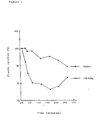
- Figure 1 shows the levels of calcium in plasma (%) after vaginal administration of calcitonin in solution.
- Figure 2 shows the levels of calcium in plasma (%) after vaginal administration of calcitonin associated with mircospheres of HYAFF-11 and HYAFF-11 p75.
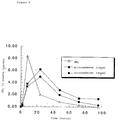
- Figure 3 shows the effect of different doses of HYAFF-11 microspheres containing insulin on plasma glucose decrease after nasal administration in sheep.
- Figure 4 shows the levels of insulin in plasma after nasal administration to sheep of different doses of HYAFF-11 microspheres.
- Figure 5 shows the plasma levels of GM1 after intramuscular administration to rabbits, on its own and with microspheres of different diameters.
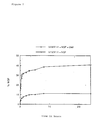
- Figure 6 shows the NGF released from microspheres of HYAFF-11 p75.
- Figure 7 shows the NGF released from microspheres of HYAFF-11.
- Figure 8 shows the NGF released from microspheres of HYAFF-7.
- microspheres according to the present invention must have a particle size of between 1 and 100 ⁇ m, preferably between 1 and 15 ⁇ m, and they must have smooth surfaces.
- the following examples are purely illustrative of how to obtain the microspheres according to the present invention and their use and shall not be construed as limiting the scope of the invention.
- a hyaluronic acid ester where all the carboxy groups of hyaluronic acid are esterified with benzyl alcohol (HYAFF-11, as described in the US patent No. 4,965,353) is dissolved in an aprotic solvent such as dimethylsulfoxide, at a concentration varying between 5 and 10% weight/volume, generally 7% w/v.
- an aprotic solvent such as dimethylsulfoxide
- a polypeptide such as human insulin
- the mixture obtained will be referred to hereinafter as the discontinuous phase.
- a mixture is prepared in a suitable reactor of high-viscosity mineral oil containing Arlacel R , a non-ionic surface-active agent, at a concentration of 1% w/v.
- This mixture will be referred to hereinafter as the continuous phase.
- the continuous phase is kept at 25°C while being stirred at a fixed speed of 1000 RPM, then the discontinuous phase, prepared as previously described, is added to it. In these conditions, emulsification of the two phases is instantaneous.
- the ratio between the two phases (discontinuous and continuous) is about 1 to 16.
- This solvent mixes perfectly with the two phases of the emulsion but it is a nonsolvent for the polymer and the human insulin polypeptide. It has been proven that the volume of extracting solvent needed to obtain complete extraction is two and a half times the total volume of the emulsion.
- the stirring speed is set at 1400-1500 RPM for 10 minutes and then lowered to 500 RPM.
- the suspension thus obtained continues to be stirred while being pumped with a screw pump through a filter press set at 1 atmosphere. Once this filtration is complete, it is pumped through a filter of normal-hexane, this being a solvent with the double action of "drying" the preparation and solubilizing any residue surfactant which may be present on the surface of the microspheres.
- the product is then put in suitable containers and stored at 4°C.
- the resulting mean particle size is 10 ⁇ m.
- the quantity of incorporated insulin is 4 IU per mg of microsphere.
- a hyaluronic acid ester wherein all the carboxy groups of hyaluronic acid are esterified with benzyl alcohol (HYAFF-11, as described in the US patent No. 4,965,353), is dissolved in an aprotic solvent such as dimethylsulfoxide at a concentration varying from 5 to 10% weight/volume, generally 7% p/v.
- aprotic solvent such as dimethylsulfoxide
- the solution obtained will be referred to hereinafter as the discontinuous phase.
- a mixture is prepared in a suitable reactor of highviscosity mineral oil containing Arlacel R , a non-ionic surface-active agent, at a concentration of 1% p/v.
- the continuous phase is kept at a temperature of 25°C and stirred at a rate of 1000 RPM, while the discontinuous phase, prepared as previously described, is added to it.
- This solvent can be mixed perfectly with the two emulsion phases, but it is not a solvent for the polymer. It has been proven that the volume of extracting solvent needed to obtain complete extraction is two and a half times the total volume of the emulsion.
- the stirring speed is set at 1400-1500 RPM for 10 minutes, then lowered to 500 RPM.
- the suspension thus obtained continues to be stirred, while being pumped by a screw pump through a filter press set at 1 atmosphere. Once this filtration is complete, it is pumped through a filter of normal-hexane, this being a solvent with the double action of "drying" the preparation and solubilizing any residue surfactant which may be present on the surface of the microspheres.
- the suspension is freeze-dried for 24 hrs and the product stored at 4°C.
- the mean particle size is 15 ⁇ m.
- the quantity of incorporated insulin is 2 IU per mg di microsfere.
- an aprotic solvent such as dimethylsulfoxide
- the continuous phase is kept at a temperature of 25°C and stirred at a rate of 1000 RPM, while the discontinuous phase, prepared as previously described, is added to it. In these conditions, emulsification of the two phases is instantaneous.
- the ratio between the two phases (discontinuous and continuous) is about 1 to 16.
- This solvent can be mixed perfectly with the two emulsion phases, but it is not a solvent for the polymer or the human insulin polypeptide. It has been proven that the volume of extracting solvent needed to obtain complete extraction is two and a half times the total volume of the emulsion.
- the stirring speed is set at 1400-1500 RPM for 10 minutes, then lowered to 500 RPM.
- the suspension thus obtained continues to be stirred, while being pumped by a screw pump through a filter press set at 1 atmosphere. Once this filtration is complete, it is pumped through a filter of normal-hexane, this being a solvent with the double action of "drying" the preparation and solubilizing any residue surfactant which may be present on the surface of the microspheres.
- the product is then put in suitable containers and stored at 4°C.
- the mean particle size is 20 ⁇ m.
- the quantity of incorporated insulin is 4 IU per mg of microspheres.
- a hyaluronic acid ester wherein all the carboxy groups of hyaluronic acid are esterified with ethyl alcohol (HYAFF-7, as described in the US patent No. 4,965,353), is dissolved in an aprotic solvent such as dimethylsulfoxide, at a concentration varying from 5 to 10% weight/volume, generally 7% w/v.
- an aprotic solvent such as dimethylsulfoxide
- the continuous phase is kept at temperature of 25°C and stirred at a rate of 1000 RPM, while the discontinuous phase, prepared as previously described, is added to it.
- This solvent can be mixed perfectly with the two emulsion phases, but it is not a solvent for the polymer or the human insulin polypeptide. It has been proven that the volume of extracting solvent needed to obtain complete extraction is two and a half times the total volume of the emulsion.
- the stirring speed is set at 1400-1500 RPM for 10 minutes, then lowered to 500 RPM.
- the suspension thus obtained is stirred while being pumped by a screw pump, through a filter press set at 1 atmosphere. Once this filtration is complete, it is pumped through a filter of normal-hexane, this being a solvent with the double action of "drying" the preparation and solubilizing any residue surfactant which may be present on the surface of the microspheres.
- the product is then put in suitable containers and stored at 4°C.
- the dimensions of the microshperes and the mean particle size is 30 ⁇ m.
- the quantity of incorporated insulin is 4 I.U. per mg of microspheres.
- a hyaluronic acid ester wherein all the carboxy groups of hyaluronic acid are esterified with ethyl alcohol (HYAFF-7, as described in the US patent No. 4,965,353) is dissolved in an aprotic solvent such as dimethylsulfoxide, at a concentration varying from 5 to 10% weight/volume, generally 7% w/v.
- aprotic solvent such as dimethylsulfoxide
- the solution obtained will be referred to hereinafter as the discontinuous phase.
- a mixture is prepared in a suitable container of high-viscosity mineral oil containing Arlacel R , a non-ionic surface-active agent, at a concentration of 1% w/v.
- This mixture will be referred to hereinafter as the continuous phase. It is kept at temperature of 25°C and stirred at a rate of 1000 RPM, while the discontinuous phase, prepared as previously described, is added to it.
- This solvent can be mixed perfectly with the two emulsion phases, but it is not a solvent for the polymer. It has been proven that the volume of extracting solvent needed to obtain complete extraction is two and a half times the total volume of the emulsion.
- the stirring speed is set at 1400-1500 for 10 minutes, then lowered to 500 RPM.
- the suspension thus obtained continues to be stirred, while being pumped by a screw pump through a filter press set at 1 atmosphere. Once filtration is complete, it is pumped through a normal-hexane filter, this being a solvent with the double action of "drying" the preparation and solubilizing any residue surfactant which may be present on the surface of the microspheres.
- the product is then put in suitable containers and stored at 4°C.
- the suspension is freeze-dried for 24 hrs and the product stored at 4°C.
- the mean particle size is 30 ⁇ m.
- the quantity of incorporated insulin is 2 I.U. per mg of microspheres.
- a hyaluronic acid ester wherein all the carboxy groups of hyaluronic acid are esterified with benzyl alcohol (HYAFF-11, as described in the US patent No. 4,965,353), is dissolved in an aprotic solvent such as dimethylsulfoxide at a concentration varying from 5 to 10% weight/volume, generally 7% w/v.
- an aprotic solvent such as dimethylsulfoxide at a concentration varying from 5 to 10% weight/volume, generally 7% w/v.
- NMF Nerve Growth Factor
- the mixture thus obtained will be referred to hereinafter as the discontinuous phase.
- a mixture is prepared in a suitable reactor of high-viscosity mineral oil containing Arlacel R , a non-ionic surface-active agent, at a concentration of 1% w/v.
- This mixture will be referred to hereinafter as the continuous phase. It is kept at temperature of 25°C and stirred at a rate of 1000 RPM, while the discontinuous phase, prepared as previously described, is added to it. In these conditions, emulsification of the two phases is instantaneous. The ratio between the two phases (discontinuous and continuous) is about 1 to 16.
- This solvent can be mixed perfectly with the two emulsion phases, but it is not a solvent for the polymer e il polipeptide NGF. It has been proven that the volume of extracting solvent needed to obtain complete extraction is two and a half times the total volume of the emulsion.
- the stirring speed is set at 1400-1500 RPM for 10 minutes, then lowered to 500 RPM.
- the suspension thus obtained continues to be stirred, while being pumped by a screw pump through a filter press set at 1 atmosphere. Once this filtration is complete, it is pumped through a filter of normal-hexane, this being a solvent with the double action of "drying" the preparation and solubilizing any residue surfactant which may be present on the surface of the microspheres.
- the product is then put in suitable containers and stored at 4°C.
- the resulting mean particle size is 10 ⁇ m.
- the quantity of incorporated NGF is 10 ng per mg of microspheres.
- a hyaluronic acid ester where all the carboxy groups of hyaluronic acid are esterified with benzyl alcohol (HYAFF-11, as described in the US patent No. 4,965,353), is dissolved in an aprotic solvent such as dimethylsulfoxide, at a concentration varying from 5 to 10% weight/volume, generally 7% w/v.
- an aprotic solvent such as dimethylsulfoxide
- NMF Nerve Growth Factor
- the solution obtained will be referred to hereinafter as the discontinuous phase.
- a mixture is prepared in a suitable reactor of high-viscosity mineral oil containing Arlacel R , a non-ionic surface-active agent, at a concentration of 1% w/v.
- This mixture will be referred to hereinafter as the continuous phase. It is kept at a temperature of 25°C and stirred at a rate of 1000 RPM, while the discontinuous phase, prepared as previously described, is added to it.
- This solvent can be mixed perfectly with the two emulsion phases but it is not a solvent for the polymer. It has been proven that the volume of extracting solvent needed to obtain complete extraction is two and a half times the total volume of the emulsion.
- the stirring speed is set at 1400-1500 for 10 minutes, then lowered to 500 RPM.
- the suspension thus obtained continues to be stirred, while being pumped by a screw pump through a filter press set at 1 atmosphere. Once this filtration is complete, it is pumped through a filter of normal-hexane, this being a solvent with the double action of "drying" the preparation and solubilizing any residue surfactant which may be present on the surface of the microspheres.
- the product is then put in suitable containers and stored at 4°C.
- the suspension is freeze-dried for 24 hrs and the product stored at 4°C.
- the mean particle size is 10 ⁇ m.
- the quantity of incorporated NGF is 10 ng per mg of microspheres.
- an aprotic solvent such as dimethylsulfoxide
- This mixture will be referred to hereinafter as the continuous phase. It is kept at a temperature of 25°C and stirred at a rate of 1000 RPM, while the discontinuous phase, prepared as previously described, is added to it.
- This solvent can be mixed perfectly with the two emulsion phases, but it is not a solvent for the polymer or the NGF polypeptide. It has been proven that the volume of extracting solvent needed to obtain complete extraction is two and a half times the total volume of the emulsion.
- the stirring speed is set at 1400-1500 RPM for 10 minutes, then lowered to 500 RPM.
- the suspension thus obtained continues to be stirred, while being pumped by a screw pump through a filter press set at 1 atmosphere. Once this filtration is complete, it is pumped through a filter of normal-hexane, this being a solvent with the double action of "drying" the preparation and solubilizing any possible residues of surfactant which may be present on the surface of the microspheres.
- the product is then put in suitable containers and stored at 4°C.
- the mean particle size is 15 ⁇ m.
- the quantity of incorporated NGF is 10 ng per mg of microspheres.
- a hyaluronic acid ester where all the carboxy groups of hyaluronic acid are esterified with ethyl alcohol (HYAFF-7, as described in the US patent No. 4,965,353), is dissolved in an aprotic solvent such as dimethylsulfoxide, at a concentration varying from 5 to 10% weight/volume, generally 7% w/v.
- an aprotic solvent such as dimethylsulfoxide
- This mixture will be referred to hereinafter as the continuous phase. It is kept at a temperature of 25°C and stirred at a rate of 1000 RPM, while the discontinuous phase, prepared as previously described, is added to it.
- This solvent can be mixed perfectly with the two emulsion phases, but it is not a solvent for the polymer or for the NGF polypeptide. It has been proven that the volume of extracting solvent needed to obtain complete extraction is two and a half times the total volume of the emulsion.
- the stirring speed is set at 1400-1500 RPM for 10 minutes, then lowered to 500 RPM.
- the suspension thus obtained continues to be stirred, while being pumped by a screw pump through a filter press set at 1 atmosphere. Once this filtration is complete, it is pumped through a filter of normal-hexane, this being a solvent with the double action of "drying" the preparation and solubilizing any residue surfactant which may be present on the surface of the microspheres.
- the product is then put in suitable containers and stored at 4°C.
- the mean particle size is 30 ⁇ m.
- the quantity of incorporated NGF is 10 ng per mg of microspheres.
- a hyaluronic acid ester where all the carboxy groups of hyaluronic acid are esterified with ethyl alcohol (HYAFF-7, as described in the US patent No. 4,965,353), is dissolved in an aprotic solvent such as dimethylsulfoxide, at a concentration varying from 5 to 10% weight/volume, generally 7% w/v.
- aprotic solvent such as dimethylsulfoxide
- the solution obtained will be referred to hereinafter as the discontinuous phase.
- a mixture is prepared in a suitable reactor of high-viscosity mineral oil containing Arlacel R , a non-ionic surface-active agent, at a concentration of 1% w/v.
- This mixture will be referred to hereinafter as the continuous phase. It is kept at a temperature of 25°C and stirred at a rate of 1000 RPM, while the discontinuous phase, prepared as previously described, is added to it. In these conditions, emulsification of the two phases is instantaneous. The ratio between the two phases (discontinuous and continuous) is about 1 to 16.
- This solvent can be mixed perfectly with the two emulsion phases, but it is not a solvent for the polymer. It has been proven that the volume of extracting solvent needed to obtain complete extraction is two and a half times the total volume of the emulsion.
- the stirring speed is set at 1400-1500 for 10 minutes, then lowered to 500 RPM.
- the suspension thus obtained is stirred while being pumped by screw pump through a filter press set at 1 atmosphere. Once this filtration is complete, it is pumped through a filter of normal-hexane, this being a solvent with the double action of "drying" the preparation and solubilizing any residue surfactant which may be present on the surface of the microspheres.
- the product is then put in suitable containers and stored at 4°C.
- the suspension is freeze-dried for 24 hrs and the product stored at 4°C.
- the dimensions of the microshperes and the mean particle size is 30 ⁇ m.
- the quantity of incorporated NGF is 10 ng per mg of microspheres.
- a hyaluronic acid ester where all the carboxy groups of hyaluronic acid are esterified with benzyl alcohol (HYAFF-11, as described in the US patent No. 4,965,353), is dissolved in an aprotic solvent such as dimethylsulfoxide, at a concentration varying from 5 to 10% weight/volume, generally 7% w/v.
- an aprotic solvent such as dimethylsulfoxide
- the mixture thus obtained will be referred to hereinafter as the discontinuous phase.
- a mixture is prepared in a suitable reactor of high-viscosity mineral oil containing Arlacel R , a non-ionic surface-active agent, at a concentration of 1% w/v.
- This mixture will be referred to hereinafter as the continuous phase. It is kept at temperature of 25°C and stirred at a rate of 1000 RPM, while the discontinuous phase, prepared as previously described, is added to it.
- This solvent can be mixed perfectly with the two emulsion phases, but it is not a solvent for the polymer or the polypeptide CNTF. It has been proven that the volume of extracting solvent needed to obtain complete extraction is two and a half times the total volume of the emulsion.
- the stirring speed is set at 1400-1500 RPM for 10 minutes, then lowered to 500 RPM.
- the suspension thus obtained continues to be stirred, while being pumped by a screw pump through a filter press set at 1 atmosphere. Once this filtration is complete, it is pumped through a filter of normal-hexane, this being a solvent with the double action of "drying" the preparation and solubilizing any residue surfactant which may be present on the surface of the microspheres.
- the product is then put in suitable containers and stored at 4°C.
- the resulting mean particle size is 10 ⁇ m.
- the quantity of incorporated CNTF is 10 ng per mg of microspheres.
- a hyaluronic acid ester where all the carboxy groups of hyaluronic acid are esterified with benzyl alcohol (HYAFF-11, as described in the US patent No. 4,965,353), is dissolved in an aprotic solvent such as dimethylsulfoxide at a concentration varying from 5 to 10% weight/volume, generally 7% w/v.
- aprotic solvent such as dimethylsulfoxide
- the solution obtained will be referred to hereinafter as the discontinuous phase.
- a mixture is prepared in a suitable reactor of high-viscosity mineral oil containing Arlacel R , a non-ionic surface-active agent, at a concentration of 1% w/v.
- This mixture will be referred to hereinafter as the continuous phase. It is kept at a temperature of 25°C and stirred at a rate of 1000 RPM, while the discontinuous phase, prepared as previously described, is added to it.
- This solvent can be mixed perfectly with the two emulsion phases, but it is not a solvent for the polymer. It has been proven that the volume of extracting solvent needed to obtain complete extraction is two and a half times the total volume of the emulsion.
- the stirring speed is set at 1400-1500 for 10 minutes, then lowered to 500 RPM.
- the suspension thus obtained continues to be stirred, while being pumped by a screw pump through a filter press set at 1 atmosphere. Once this filtration is complete, it is pumped through a filter of normal-hexane, this being a solvent with the double action of "drying" the preparation and solubilizing any residue surfactant which may be present on the surface of the microspheres.
- the product is then put in suitable containers and stored at 4°C.
- CNTF Central Neuronotrofic Factor
- the suspension is freeze-dried for 24 hrs and the product stored at 4°C.
- the mean particle size is 10 ⁇ m.
- the quantity of incorporated CNTF is 10 ng per mg of microspheres.
- a hyaluronic acid ester where all the carboxy groups of hyaluronic acid are esterified with ethyl alcohol (HYAFF-7, as described in the US patent No. 4,965,353), is dissolved in an aprotic solvent such as dimethylsulfoxide, at a concentration varying from 5 to 10% weight/volume, generally 7% w/v.
- an aprotic solvent such as dimethylsulfoxide
- This mixture will be referred to hereinafter as the discontinuous phase.
- a mixture is prepared in a suitable reactor of high-viscosity mineral oil containing Arlacel R , a non-ionic surface-active agent, at a concentration of 1% w/v.
- This mixture will be referred to hereinafter as the continuous phase. It is kept at a temperature of 25°C and stirred at a rate of 1000 RPM, while the discontinuous phase, prepared as previously described, is added to it.
- This solvent can be mixed perfectly with the two emulsion phases, but it is not a solvent for the polymer or the polypeptide CNTF. It has been proven that the volume of extracting solvent needed to obtain complete extraction is two and a half times the total volume of the emulsion.
- the stirring speed is set at 1400-1500 RPM for 10 minutes, then lowered to 500 RPM.
- the suspension thus obtained continues to be stirred, while being pumped by a screw pump through a filter press set at 1 atmosphere. Once this filtration is complete, it is pumped through a filter of normal-hexane, this being a solvent with the double action of "drying" the preparation and solubilizing any residue surfactant which may be present on the surface of the microspheres.
- the product is then put in suitable containers and stored at 4°C.
- the mean particle size is 30 ⁇ m.
- the quantity of incorporated CNTF is 10 ng per mg of microspheres.
- a hyaluronic acid ester where all the carboxy groups of hyaluronic acid are esterified with ethyl alcohol (HYAFF-7, as described in the US patent No. 4,965,353), is dissolved in an aprotic solvent such as dimethylsulfoxide, at a concentration varying from 5 to 10% weight/volume, generally 7% w/v.
- aprotic solvent such as dimethylsulfoxide
- the solution obtained will be referred to hereinafter as the discontinuous phase.
- a mixture is prepared in a suitable reactor of high-viscosity mineral oil containing Arlacel R , a non-ionic surface-active agent, at a concentration of 1% w/v.
- This mixture will be referred to hereinafter as the continuous phase. It is kept at a temperature of 25°C and stirred at a rate of 1000 RPM, while the discontinuous phase, prepared as previously described, is added to it.
- This solvent can be mixed perfectly with the two emulsion phases, but it is not a solvent for the polymer. It has been proven that the volume of extracting solvent needed to obtain complete extraction is two and a half times the total volume of the emulsion.
- the stirring speed is set at 1400-1500 for 10 minutes, then lowered to 500 RPM.
- the suspension thus obtained continues to be stirred, while being pumped by a screw pump through a filter press set at 1 atmosphere. Once this filtration is complete, it is pumped through a filter of normal-hexane, this being a solvent with the double action of "drying" the preparation and of solubilizing any possible residues of surfactant which may be present on the surface of the microspheres.
- the product is then put in suitable containers and stored at 4°C.
- the suspension is freeze-dried for 24 hrs and the product stored at 4°C.
- the mean particle size is 30 ⁇ m.
- the quantity of incorporated CNTF is 10 ng per mg of microspheres.
- a hyaluronic acid ester where all the carboxy groups of hyaluronic acid are esterified with benzyl alcohol (HYAFF-11, as described in the US patent No. 4,965,353), is dissolved in an aprotic solvent such as dimethylsulfoxide, at a concentration varying from 5 to 10% weight/volume, generally 7% w/v.
- a polypeptide for example NGF at the predetermined concentration, for example 0.01% of the weight of the polymer mass
- a ganglioside mixture having as major components, GM1 21%, GD12 40%, GD1b 16% and GT1b 19% (Cronassial®) are added at a ratio of 1:1000 in terms of weight.
- the mixture thus obtained will be referred to hereinafter as the discontinuous phase.
- a mixture is prepared in a suitable reactor of high-viscosity mineral oil containing Arlacel R , a non-ionic surface-active agent, at a concentration of 1% w/v.
- This mixture will be referred to hereinafter as the continuous phase. It is kept at a temperature of 25°C and stirred at a rate of 1000 RPM, while the discontinuous phase, prepared as previously described, is added to it.
- This solvent can be mixed perfectly with the two emulsion phases, but it is not a solvent for the polymer or the polypeptide NGF or the GA mixture (Cronassial). It has been proven that the volume of extracting solvent needed to obtain complete extraction is two and a half times the total volume of the emulsion.
- the stirring speed is set at 1400-1500 RPM for 10 minutes, then lowered to 500 RPM. The suspension thus obtained continues to be stirred, while being pumped by a screw pump through a filter press set at 1 atmosphere.
- the dimensions of the microspheres and the mean particle size is 10 ⁇ m.
- the quantity of incorporated NGF and GA is 10 ng and 10 ⁇ g respectively per milligram of microspheres.
- a hyaluronic acid ester where all the carboxy groups of hyaluronic acid are esterified with benzyl alcohol (HYAFF-11, as described in the US patent No. 4,965,353), is dissolved in an aprotic solvent such as dimethylsulfoxide, at a concentration varying from 5 to 10% weight/volume, generally 7% w/v.
- an aprotic solvent such as dimethylsulfoxide
- a ganglioside mixture (Cronassial®) at the predetermined concentration, for example 20% of the weight of the polymer, is added to the solution.
- the solution obtained will be referred to hereinafter as the discontinuous phase.
- a mixture is prepared in a suitable reactor of high-viscosity mineral oil containing Arlacel R , a non-ionic surface-active agent, at a concentration of 1% w/v.
- This mixture will be referred to hereinafter as the continuous phase. It is kept at a temperature of 25°C and stirred at a rate of 1000 RPM, while the discontinuous phase, prepared as previously described, is added to it. In these conditions, emulsification of the two phases is instantaneous. The ratio between the two phases (discontinuous and continuous) is about 1 to 16.
- This solvent can be mixed perfectly with the two emulsion phases, but it is not a solvent for the polymer or the ganglioside mixture. It has been proven that the volume of extracting solvent needed to obtain complete extraction is two and a half times the total volume of the emulsion.
- the stirring speed is set at 1400-1500 RPM for 10 minutes, then lowered to 500 RPM.
- the suspension thus obtained continues to be stirred, while being pumped by a screw pump through a filter press set at 1 atmosphere. Once this filtration is complete, it is pumped through a filter of normal-hexane, this being a solvent with the double action of "drying" the preparation and solubilizing any residue surfactant which may be present on the surface of the microspheres.
- the product is then put in suitable containers and stored at 4°C.
- the container After 15 minutes of stirring with a semiautomatic system the container is immersed in liquid nitrogen until the suspension is completely frozen. Once frozen, the suspension is freeze-dried for 24 hrs and the product stored at 4°C.
- the mean particle size is 10 ⁇ m.
- the quantity of incorporated NGF and GA is 20 ng and 20 ⁇ g, respectively, per milligram of microspheres.
- a hyaluronic acid ester where all the carboxy groups of hyaluronic acid are esterified with ethyl alcohol (HYAFF-7, as described in the US patent No. 4,965,353), is dissolved in an aprotic solvent such as dimethylsulfoxide, at a concentration varying from 5 to 10% weight/volume, generally 7% w/v.
- an aprotic solvent such as dimethylsulfoxide
- the mixture thus obtained will be referred to hereinafter as the discontinuous phase.
- a mixture is prepared in a suitable reactor of high-viscosity mineral oil containing Arlacel R , a non-ionic surface-active agent, at a concentration of 1% w/v.
- This mixture will be referred to hereinafter as the continuous phase. It is kept at a temperature of 25°C and stirred at a rate of 1000 RPM, while the discontinuous phase, prepared as previously described, is added to it.
- This solvent can be mixed perfectly with the two emulsion phases, but it is not a solvent for the polymer, the polipeptide (NGF) or the GA mixture. It has been proven that the volume of extracting solvent needed to obtain complete extraction is two and a half times the total volume of the emulsion.
- the stirring speed is set at 1400-1500 RPM for 10 minutes, then lowered to 500 RPM. The suspension thus obtained continues to be stirred, while being pumped by a screw pump through a filter press set at 1 atmosphere.
- the dimensions of the microspheres and the mean particle size is 30 ⁇ m.
- the quantities of incorporated NGF and GA are 10 ng and 10 ⁇ g respectively per milligram of microspheres.
- a hyaluronic acid ester where all the carboxy groups of hyaluronic acid are esterified with ethyl alcohol (HYAFF-7, as described in the US patent No. 4,965,353), is dissolved in an aprotic solvent such as dimethylsulfoxide, at a concentration varying from 5 to 10% weight/volume, generally 7% w/v.
- an aprotic solvent such as dimethylsulfoxide
- a mixture is prepared in a suitable reactor of high-viscosity mineral oil containing Arlacel R , a non-ionic surface-active agent, at a concentration of 1% w/v.
- This mixture will be referred to hereinafter as the continuous phase. It is kept at a temperature of 25°C and stirred at a rate of 1000 RPM, while the discontinuous phase, prepared as previously described, is added to it.
- This solvent can be mixed perfectly with the two emulsion phases, but it is not a solvent for the polymer or the ganglioside mixture. It has been proven that the volume of extracting solvent needed to obtain complete extraction is two and a half times the total volume of the emulsion.
- the stirring speed is set at 1400-1500 RPM for 10 minutes, then lowered to 500 RPM.
- the suspension thus obtained continues to be stirred, while being pumped by a screw pump through a filter press set at 1 atmosphere. Once this filtration is complete, it is pumped through a filter of normal-hexane, this being a solvent with the double action of "drying" the preparation and solubilizing any residue surfactant which may be present on the surface of the microspheres.
- the product is then put in suitable containers and stored at 4°C.
- the suspension is freeze-dried for 24 hrs and the product stored at 4°C.
- the mean particle size is 30 ⁇ m.
- the quantities of incorporated NGF and GA are 20 ng and 20 ⁇ g respectively per milligram of microspheres.
- a hyaluronic acid ester where all the carboxy groups of hyaluronic acid are esterified with dodecyl alcohol (HYAFF-73, as described in the US patent No. 4,965,353), is dissolved in an aprotic solvent such as dimethylsulfoxide, at a concentration varying from 5 to 10% weight/volume, generally 7% w/v.
- an aprotic solvent such as dimethylsulfoxide
- the mixture thus obtained will be referred to hereinafter as the discontinuous phase.
- a mixture is prepared in a suitable reactor of high-viscosity mineral oil containing Arlacel R , a non-ionic surface-active agent, at a concentration of 1% w/v.
- This mixture will be referred to hereinafter as the continuous phase. It is kept at a temperature of 25°C and stirred at a rate of 1000 RPM, while the discontinuous phase, prepared as previously described, is added to it.
- This solvent can be mixed perfectly with the two emulsion phases, but it is not a solvent for the polymer or the polypeptide (NGF) or the GA mixture (Cronassial®). It has been proven that the volume of extracting solvent needed to obtain complete extraction is two and a half times the total volume of the emulsion.
- the stirring speed is set at 1400-1500 RPM for 10 minutes, then lowered to 500 RPM. The suspension thus obtained continues to be stirred, while being pumped by a screw pump through a filter press set at 1 atmosphere.
- this filtration is pumped through a filter of normal-hexane, this being a solvent with the double action of "drying" the preparation and solubilizing any residue surfactant which may be present on the surface of the microspheres.
- the product is then put in suitable containers and stored at 4°C. In these working conditions the resulting mean particle size is 20 ⁇ m.
- the quantities of incorporated NGF and GA are 10 ng and 10 ⁇ g respectively per milligram of microspheres.
- a hyaluronic acid ester where all the carboxy groups of hyaluronic acid are esterified with benzyl alcohol (HYAFF-11, as described in the US patent No. 4,965,353), is dissolved in an aprotic solvent such as dimethylsulfoxide, at a concentration varying from 5 to 10% weight/volume, generally 7% w/v.
- an aprotic solvent such as dimethylsulfoxide
- a polypeptide for example NGF at the predetermined concentration, for example 0.01% of the weight of the polymer mass, and a monosialoganglioside GM1 in a weight ratio of 1:1000 (NGF:GM1).
- the mixture thus obtained will be referred to hereinafter as the discontinuous phase.
- a mixture is prepared in a suitable reactor of high-viscosity mineral oil containing Arlacel R , a non-ionic surface-active agent, at a concentration of 1% w/v.
- This mixture will be referred to hereinafter as the continuous phase. It is kept at a temperature of 25°C and stirred at a rate of 1000 RPM, while the discontinuous phase, prepared as previously described, is added to it.
- This solvent can be mixed perfectly with the two emulsion phases, but it is not a solvent for the polymer or the polipeptide (NGF) or the monosialoganglioside GM1. It has been proven that the volume of extracting solvent needed to obtain complete extraction is two and a half times the total volume of the emulsion.
- the stirring speed is set at 1400-1500 RPM for 10 minutes, then lowered to 500 RPM. The suspension thus obtained continues to be stirred, while being pumped by a screw pump through a filter press set at 1 atmosphere.
- the resulting mean particle size is 10 ⁇ m.
- the quantities of NGF and monosialoganglioside GM1 are 10 ng and 10 ⁇ g respectively per milligram of microspheres.
- a hyaluronic acid ester where all the carboxy groups of hyaluronic acid are esterified with ethyl alcohol (HYAFF-7, as described in the US patent No. 4,965,353), is dissolved in an aprotic solvent such as dimethylsulfoxide, at a concentration varying from 5 to 10% weight/volume, generally 7% w/v.
- an aprotic solvent such as dimethylsulfoxide
- This mixture will be referred to hereinafter as the continuous phase. It is kept at a temperature of 25°C and stirred at a rate of 1000 RPM, while the discontinuous phase, prepared as previously described, is added to it.
- This solvent can be mixed perfectly with the two emulsion phases, but it is not a solvent for the polymer, the polypeptide (NGF) or the monosialoganglioside GM1. It has been proven that the volume of extracting solvent needed to obtain complete extraction is two and a half times the total volume of the emulsion. Two facilitate extraction, the stirring speed is set at 1400-1500 RPM for 10 minutes, then lowered to 500 RPM. The suspension thus obtained is stirred while being pumped by screw pump through a filter press set at 1 atmosphere.
- the mean particle size is 30 ⁇ m.
- the quantities of NGF and monosialoganglioside GM1 are 10 ng and 10 ⁇ g respectively per milligram of microspheres.
- a hyaluronic acid ester where all the carboxy groups of hyaluronic acid are esterified with benzyl alcohol (HYAFF-11, as described in the US patent No. 4,965,353), is dissolved in an aprotic solvent such as dimethylsulfoxide, at a concentration varying from 5 to 10% weight/volume, generally 7% w/v.
- the mixture thus obtained will be referred to hereinafter as the discontinuous phase.
- a mixture is prepared in a suitable reactor of high-viscosity mineral oil containing Arlacel R , a non-ionic surface-active agent, at a concentration of 1% w/v.
- This mixture will be referred to hereinafter as the continuous phase. It is kept at a temperature of 25°C and stirred at a rate of 1000 RPM, while the discontinuous phase, prepared as previously described, is added to it.
- This solvent can be mixed perfectly with the two emulsion phases, but it is not a solvent for the polymer or the polypeptide CNTF. It has been proven that the volume of extracting solvent needed to obtain complete extraction is two and a half times the total volume of the emulsion.
- the stirring speed is set at 1400-1500 RPM for 10 minutes, then lowered to 500 RPM.
- the suspension thus obtained continues to be stirred, while being pumped by a screw pump through a filter press set at 1 atmosphere. Once this filtration is complete, it is pumped through a filter of normal-hexane, this being a solvent with the double action of "drying" the preparation and solubilizing any residue surfactant which may be present on the surface of the microspheres.
- the product is then put in suitable containers and stored at 4°C.
- the resulting mean particle size is 10 ⁇ m.
- the quantity of incorporated CNTF and GA is 10 ng and 10 ⁇ g respectively per milligram of microspheres.
- a hyaluronic acid ester where all the carboxy groups of hyaluronic acid are esterified with benzyl alcohol (HYAFF-11, as described in the US patent No. 4,965,353), is dissolved in an aprotic solvent such as dimethylsulfoxide, at a concentration varying from 5 to 10% weight/volume, generally 7% w/v
- a ganglioside mixture at the predetermined concentration, for example 20% of the weight of the polymer, is added to the solution.
- the solution obtained will be referred to hereinafter as the discontinuous phase.
- a mixture is prepared in a suitable reactor of high-viscosity mineral oil containing Arlacel R , a non-ionic surface-active agent, at a concentration of 1% w/v.
- This mixture will be referred to hereinafter as the continuous phase. It is kept at a temperature of 25°C and stirred at a rate of 1000 RPM, while the discontinuous phase, prepared as previously described, is added to it.
- This solvent can be mixed perfectly with the two emulsion phases, but it is not a solvent for the polymer or the ganglioside mixture. It has been proven that the volume of extracting solvent needed to obtain complete extraction is two and a half times the total volume of the emulsion. To facilitate extraction the stirring rate was set at 1400-1500 RPM for 10 minutes, then lowered to 500 RPM. The suspension thus obtained continues to be stirred, while being pumped by a screw pump through a filter press set at 1 atmosphere. Once this filtration is complete, it is pumped through a filter of normal-hexane, this being a solvent with the double action of "drying" the preparation and solubilizing any residue surfactant which may be present on the surface of the microspheres. The product is then put in suitable containers and stored at 4°C.
- the suspension is freeze-dried for 24 hrs and the product stored at 4°C.
- the mean particle size is 10 ⁇ m.
- the quantities of incorporated CNTF and GA are 20 ng and 20 ⁇ g respectively per milligram of microspheres.
- a hyaluronic acid ester where all the carboxy groups of hyaluronic acid are esterified with ethyl alcohol (HYAFF-7, as described in the US patent No. 4,965,353), is dissolved in an aprotic solvent such as dimethylsulfoxide, at a concentration varying from 5 to 10% weight/volume, generally 7% w/v.
- an aprotic solvent such as dimethylsulfoxide
- the mixture thus obtained will be referred to hereinafter as the discontinuous phase.
- a mixture is prepared in a suitable reactor of high-viscosity mineral oil containing Arlacel R , a non-ionic surface-active agent, at a concentration of 1% w/v.
- This mixture will be referred to hereinafter as the continuous phase. It is kept at a temperature of 25°C and stirred at a rate of 1000 RPM, while the discontinuous phase, prepared as previously described, is added to it.
- This solvent can be mixed perfectly with the two emulsion phases, but it is not a solvent for the polymer, the polypeptide (CNTF) or the GA mixture (Cronassial®). It has been proven that the volume of extracting solvent needed to obtain complete extraction is two and a half times the volume of the emulsion.
- the stirring speed is set at 1400-1500 RPM for 10 minutes, then lowered to 500 RPM. The suspension thus obtained continues to be stirred, while being pumped by a screw pump through a filter press set at 1 atmosphere.
- the mean particle size is 30 ⁇ m.
- the quantities of incorporated CNTF and GA are 10 ng and 10 ⁇ g respectively per milligram of microspheres.
- a hyaluronic acid ester where all the carboxy groups of hyaluronic acid are esterified with ethyl alcohol (HYAFF-7, as described in the US patent No. 4,965,353), is dissolved in an aprotic solvent such as dimethylsulfoxide, at a concentration varying from 5 to 10% weight/volume, generally 7% w/v.
- an aprotic solvent such as dimethylsulfoxide
- a ganglioside mixture (Cronassial®) at the predetermined concentration, for example 10% of the weight of the polymer, is added to the solution.
- the solution obtained will be referred to hereinafter as the discontinuous phase.
- a mixture is prepared in a suitable reactor of high-viscosity mineral oil containing Arlacel R , a non-ionic surface-active agent, at a concentration of 1% w/v.
- This mixture will be referred to hereinafter as the continuous phase. It is kept at a temperature of 25°C and stirred at a rate of 1000 RPM, while the discontinuous phase, prepared as previously described, is added to it.
- This solvent can be mixed perfectly with the two emulsion phases, but it is not a solvent for the polymer or the ganglioside mixture. It has been proven that the volume of extracting solvent needed to obtain complete extraction is two and a half times the volume of the emulsion.
- the stirring speed is set at 1400-1500 RPM for 10 minutes, then lowered to 500 RPM.
- the suspension thus obtained continues to be stirred, while being pumped by a screw pump through a filter press set at 1 atmosphere. Once this filtration is complete, it is passed through a normal-hexane filter, this being a solvent with the double action of "drying" the preparation and solubilizing any residue surfactant which may be present on the surface of the microspheres.
- the product is then put in suitable containers and stored at 4°C.
- microspheres thus prepared are suspended in a phosphate buffer solution (0.01M) (ionic strength 0.15 M), containing a concentration of CNTF such that a protein titer equal to 0.01% in weight of the suspended microspheres is reached-and such that the weight ratio of 1:1000 (CNTF:gangliosides) is maintained. After 15 minutes of stirring with a semiautomatic system the container is immersed in liquid nitrogen until the suspension is completely frozen.
- a phosphate buffer solution (0.01M) (ionic strength 0.15 M)
- concentration of CNTF such that a protein titer equal to 0.01% in weight of the suspended microspheres is reached-and such that the weight ratio of 1:1000 (CNTF:gangliosides) is maintained.
- the suspension is freeze-dried for 24 hrs and the product stored at 4°C.
- the mean particle size is 30 ⁇ m.
- the quantities of incorporated CNTF and GA are 10 ng and 10 ⁇ g respectively per milligram of microspheres.
- a hyaluronic acid ester where all the carboxy groups of hyaluronic acid are esterified with benzyl alcohol (HYAFF-11, as described in the US patent No. 4,965,353), is dissolved in an aprotic solvent such as dimethylsulfoxide, at a concentration varying from 5 to 10% weight/volume, generally 7% w/v.
- an aprotic solvent such as dimethylsulfoxide, at a concentration varying from 5 to 10% weight/volume, generally 7% w/v.
- the mixture thus obtained will be referred to hereinafter as the discontinuous phase.
- a mixture is prepared in a suitable reactor of high-viscosity mineral oil containing Arlacel R , a non-ionic surface-active agent, at a concentration of 1% w/v.
- This mixture will be referred to hereinafter as the continuous phase. It is kept at a temperature of 25°C and stirred at a rate of 1000 RPM, while the discontinuous phase, prepared as previously described, is added to it.
- This solvent can be mixed perfectly with the two emulsion phases, but it is not a solvent for the polymer or the polypeptide CNTF or the monosialoganglioside GM1 (Sygen). It has been proven that the volume of extracting solvent needed to obtain complete extraction is two and a half times the total volume of the emulsion.
- the stirring speed is set at 1400-1500 RPM for 10 minutes, then lowered to 500 RPM. The suspension thus obtained continues to be stirred, while being pumped by a screw pump through a filter press set at 1 atmosphere.
- the resulting mean particle size is 10 ⁇ m.
- the quantity of incorporated CNTF and GM1 is 10 ng and 10 ⁇ g respectively per milligram of microspheres.
- a hyaluronic acid ester where all the carboxy groups of hyaluronic acid are esterified with benzyl alcohol (HYAFF-11, as described in the US patent No. 4,965,353), is dissolved in an aprotic solvent such as dimethylsulfoxide, at a concentration varying from 5 to 10% weight/volume, generally 7% w/v.
- an aprotic solvent such as dimethylsulfoxide
- a polypeptide for example CNTF
- AMF1 inner esters of the ganglioside mixture
- AMF1 inner esters of the ganglioside mixture
- the mixture thus obtained will be referred to hereinafter as the discontinuous phase.
- a mixture is prepared in a suitable reactor of high-viscosity mineral oil containing Arlacel R , a non-ionic surface-active agent, at a concentration of 1% w/v.
- This mixture will be referred to hereinafter as the continuous phase. It is kept at a temperature of 25°C and stirred at a rate of 1000 RPM, while the discontinuous phase, prepared as previously described, is added to it.
- This solvent can be mixed perfectly with the two emulsion phases, but it is not a solvent for the polymer or the polypeptide CNTF or the inner esters of the ganglioside mixture (AGF1). It has been proven that the volume of extracting solvent needed to obtain complete extraction is two and a half times the total volume of the emulsion.
- the stirring speed is set at 1400-1500 RPM for 10 minutes, then lowered to 500 RPM. The suspension thus obtained continues to be stirred, while being pumped by a screw pump through a filter press set at 1 atmosphere.
- the resulting mean particle size is 10 ⁇ m.
- the quantity of incorporated CNTF and AGF1 is 10 ng and 10 ⁇ g respectively per milligram of microspheres.
- a hyaluronic acid ester where all the carboxy groups of hyaluronic acid are esterified with benzyl alcohol (HYAFF-11, as described in the US patent No. 4,965,353), is dissolved in an aprotic solvent such as dimethylsulfoxide, at a concentration varying from 5 to 10% weight/volume, generally 7% w/v.
- the mixture thus obtained will be referred to hereinafter as the discontinuous phase.
- a mixture is prepared in a suitable reactor of high-viscosity mineral oil containing Arlacel R , a non-ionic surface-active agent, at a concentration of 1% w/v.
- This mixture will be referred to hereinafter as the continuous phase. It is kept at a temperature of 25°C and stirred at a rate of 1000 RPM, while the discontinuous phase, prepared as previously described, is added to it. In these conditions, emulsification of the two phases is instantaneous. The ratio between the two phases (discontinuous and continuous) is about 1 to 16.
- This solvent can be mixed perfectly with the two emulsion phases, but it is not a solvent for the polymer or the polypeptide CNTF or the monosialoganglioside GM1 inner ester (AGF2). It has been proven that the volume of extracting solvent needed to obtain complete extraction is two and a half times the total volume of the emulsion.
- the stirring speed is set at 1400-1500 RPM for 10 minutes, then lowered to 500 RPM. The suspension thus obtained continues to be stirred, while being pumped by a screw pump through a filter press set at 1 atmosphere.
- the resulting mean particle size is 10 ⁇ m.
- the quantity of incorporated CNTF and AGF2 is 10 ng and 10 ⁇ g respectively per milligram of microspheres.
- a hyaluronic acid ester where all the carboxy groups of hyaluronic acid are esterified with benzyl alcohol (HYAFF-11, as described in the US patent No. 4,965,353), is dissolved in an aprotic solvent such as dimethylsulfoxide, at a concentration varying from 5 to 10% weight/volume, generally 8% w/v.
- an aprotic solvent such as dimethylsulfoxide
- GM1 concentration varying from 5 to 10% weight/volume, generally 8% w/v.
- GM1 a solution of GM1 at the predetermined concentration, for example 20% of the weight of the polymer mass.
- the solution thus obtained will be referred to hereinafter as the discontinuous phase.
- a mixture is prepared in a suitable reactor of high-viscosity mineral oil containing Arlacel R , a non-ionic surface-active agent, at a concentration of 1% w/v.
- This mixture will be referred to hereinafter as the continuous phase. It is kept at a temperature of 25°C and stirred at a rate of 700 RPM, while the discontinuous phase, prepared as previously described, is added to it.
- This solvent can be mixed perfectly with the two emulsion phases, but it is not a solvent for the polymer. It has been proven that the volume of extracting solvent needed to obtain complete extraction is two and a half times the total volume of the emulsion.
- the stirring speed is set at 1400-1500 RPM for 10 minutes, then lowered to 500 RPM.
- the suspension thus obtained continues to be stirred, while being pumped by a screw pump through a filter press set at 1 atmosphere. Once this filtration is complete, it is pumped through a filter of normal-hexane, this being a solvent with the double action of "drying" the preparation and solubilizing any residue surfactant which may be present on the surface of the microspheres.
- the product is then put in suitable containers and stored at 4°C. In these working conditions the resulting mean particle size is 40 ⁇ m.
- the quantity of incorporated GM1 is 180 ⁇ g per milligram of microspheres.
- a hyaluronic acid ester where all the carboxy groups of hyaluronic acid are esterified with benzyl alcohol (HYAFF-11, as described in the US patent No. 4,965,353), is dissolved in an aprotic solvent such as dimethylsulfoxide, at a concentration varying from 5 to 10% weight/volume, generally 8% w/v.
- an aprotic solvent such as dimethylsulfoxide
- a mixture is prepared in a suitable reactor of high-viscosity mineral oil containing Arlacel R , a non-ionic surface-active agent, at a concentration of 1% w/v.
- This mixture will be referred to hereinafter as the continuous phase. It is kept at a temperature of 25°C and stirred at a rate of 1000 RPM, while the discontinuous phase, prepared as previously described, is added to it.
- This solvent can be mixed perfectly with the two emulsion phases, but it is not a solvent for the polymer. It has been proven that the volume of extracting solvent needed to obtain complete extraction is two and a half times the total volume of the emulsion.
- the stirring speed is set at 1400-1500 RPM for 10 minutes, then lowered to 500 RPM.
- the suspension thus obtained continues to be stirred, while being pumped by a screw pump through a filter press set at 1 atmosphere. Once this filtration is complete, it is pumped through a filter of normal-hexane, this being a solvent with the double action of "drying" the preparation and solubilizing any residue surfactant which may be present on the surface of the microspheres.
- the product is then put in suitable containers and stored at 4°C. In these working conditions the resulting mean particle size is 10 ⁇ m.
- the quantity of incorporated GM1 is 180 ⁇ g per milligram of microspheres.
- a hyaluronic acid ester where all the carboxy groups of hyaluronic acid are esterified with benzyl alcohol (HYAFF-11, as described in the US patent No. 4,965,353) is dissolved in an aprotic solvent such as dimethylsulfoxide at a concentration varying from 5 to 10% weight/volume, generally 7% w/v.
- aprotic solvent such as dimethylsulfoxide
- the solution obtained will be referred to hereinafter as the discontinuous phase.
- a mixture is prepared in a suitable reactor of high-viscosity mineral oil containing Arlacel R , a non-ionic surface-active agent, at a concentration of 1% w/v.
- This mixture will be referred to hereinafter as the continuous phase. It is kept at a temperature of 25°C and stirred at a rate of 1000 RPM, while the discontinuous phase, prepared as previously described, is added to it. In these conditions, emulsification of the two phases is instantaneous.
- the ratio between the two phases is about 1 to 16.
- This solvent can be mixed perfectly with the two emulsion phases, but it is not a solvent for the polymer. It has been proven that the volume of extracting solvent needed to obtain complete extraction the total volume of the emulsion, in order to obtain complete extraction.
- the stirring speed is set at 1400-1500 for 10 minutes, then lowered to 500 RPM.
- the suspension thus obtained continues to be stirred, while being pumped by a screw pump through a filter press set at 1 atmosphere. Once this filtration is complete, it is pumped through a filter of normal-hexane, this being a solvent with the double action of "drying" the preparation and solubilizing any residue surfactant which may be present on the surface of the microspheres.
- the product is then put in suitable containers and stored at 4°C.
- microspheres thus prepared are suspended in a phosphate buffer solution (0.01M), containing a concentration of immunoglobulin such that a protein titer of 3 ⁇ g per mg of suspended microspheres is reached. After 15 minutes of stirring with a semiautomatic system the container is immersed in liquid nitrogen until the suspension is completely frozen.
- the suspension is freeze-dried for 24 hrs and the product stored at 4°C.
- the mean particle size is 10 ⁇ m.
- the quantity of incorporated immunoglobulin is 2.5 ⁇ g per mg of microspheres.
- a hyaluronic acid ester where all the carboxy groups of hyaluronic acid are esterified with benzyl alcohol (HYAFF-11, as described in the US patent No. 4,965,353), is dissolved in an aprotic solvent such as dimethylsulfoxide, at a concentration varying from 5 to 10% weight/volume, generally 7% w/v.
- an aprotic solvent such as dimethylsulfoxide
- a polypeptide for example calcitonin
- the predetermined concentration for example 15 I.U. per mg of polymer
- This mixture will be referred to hereinafter as the continuous phase. It is kept at a temperature of 25°C and stirred at a rate of 1000 RPM, while the discontinuous phase, prepared as previously described, is added to it.
- This solvent can be mixed perfectly with the two emulsion phases, but it is not a solvent for the polymer or the polypeptide calcitonin. It has been proven that the volume of extracting solvent needed to obtain complete extraction is two and a half times the total volume of the emulsion.
- the stirring speed is set at 1400-1500 RPM for 10 minutes, then lowered to 500 RPM.
- the suspension thus obtained continues to be stirred, while being pumped by a screw pump through a filter press set at 1 atmosphere. Once this filtration is complete, it is pumped through a filter of normal-hexane, this being a solvent with the double action of "drying" the preparation and solubilizing any residue surfactant which may be present on the surface of the microspheres.
- the product is then put in suitable containers and stored at 4°C.
- the resulting mean particle size is 10 ⁇ m.
- the quantity of incorporated calcitonin is 13 I.U. per mg of microspheres.
- a hyaluronic acid ester where all the carboxy groups of hyaluronic acid are esterified with benzyl alcohol (HYAFF-11, as described in the US patent No. 4,965,353), is dissolved in an aprotic solvent such as dimethylsulfoxide, at a concentration varying from 5 to 10% weight/volume, generally 7% w/v.
- aprotic solvent such as dimethylsulfoxide
- the solution obtained will be referred to hereinafter as the discontinuous phase.
- a mixture is prepared in a suitable reactor of high-viscosity mineral oil containing Arlacel R , a non-ionic surface-active agent, at a concentration of 1% w/v.
- This mixture will be referred to hereinafter as the continuous phase. It is kept at a temperature of 25°C and stirred at a rate of 1000 RPM, while the discontinuous phase, prepared as previously described, is added to it.
- This solvent can be mixed perfectly with the two emulsion phases, but it is not a solvent for the polymer. It has been proven that the volume of extracting solvent needed to obtain complete extraction is two and a half times the total volume of the emulsion.
- the stirring rate is set at 1400-1500 RPM for 10 minutes, then lowered to 500 RPM.
- the suspension thus obtained is stirred while being pumped through a screw pump through a filter press set at 1 atmosphere. Once this filtration is complete, it is pumped through a filter of normal-hexane, this being a solvent with the double action of "drying" the preparation and solubilizing any residue surfactant which may be present on the surface of the microspheres.
- the product is then put in suitable containers and stored at 4°C.
- the suspension is freeze-dried for 24 hrs and the product stored at 4°C.
- the mean particle size is 10 ⁇ m.
- the quantity of incorporated calcitonin is 13 IU/mg of microspheres.
- an aprotic solvent such as dimethylsulfoxide at a concentration varying from 5 to 10% weight/volume, generally 7% w/v.
- This mixture will be referred to hereinafter as the continuous phase. It is kept at a temperature of 25°C and stirred at a rate of 1000 RPM, while the discontinuous phase, prepared as previously described, is added to it.
- This solvent can be mixed perfectly with the two emulsion phases, but it is not a solvent for the polymer or the polypeptide calcitonin. It has been proven that the volume of extracting solvent needed to obtain complete extraction is two and a half times the total volume of the emulsion.
- the stirring speed is set at 1400-1500 RPM for 10 minutes, then lowered to 500 RPM.
- the suspension thus obtained continues to be stirred, while being pumped by a screw pump through a filter press set at 1 atmosphere. Once this filtration is complete, it is pumped through a filter of normal-hexane, this being a solvent with the double action of "drying" the preparation and solubilizing any residue surfactant which may be present on the surface of the microspheres.
- the product is then put in suitable containers and stored at 4°C.
- the mean particle size is 15 ⁇ m.
- the quantity of incorporated calcitonin is 13 1.U per mg of microspheres.
- a hyaluronic acid ester where all the carboxy groups of hyaluronic acid are esterified with ethyl alcohol (HYAFF-7, as described in the US patent No. 4,965,353), is dissolved in an aprotic solvent such as dimethylsulfoxide at a concentration varying from 5 to 10% weight/volume, generally 7% w/v.
- the mixture thus obtained will be referred to hereinafter as the discontinuous phase.
- a mixture is prepared in a suitable reactor of high-viscosity mineral oil containing Arlacel R , a non-ionic surface-active agent, at a concentration of 1% w/v.
- This mixture will be referred to hereinafter as the continuous phase. It is kept at a temperature of 25°C and stirred at a rate of 1000 RPM, while the discontinuous phase, prepared as previously described, is added to it.
- This solvent can be mixed perfectly with the two emulsion phases, but it is not a solvent for the polymer or the polipeptide calcitonin. It has been proven that the volume of extracting solvent needed to obtain complete extraction is two and a half times the total volume of the emulsion.
- the stirring speed is set at 1400-1500 RPM for 10 minutes, then lowered to 500 RPM.
- the suspension thus obtained continues to be stirred, while being pumped by a screw pump through a filter press set at 1 atmosphere. Once this filtration is complete, it is pumped through a filter of normal-hexane, this being a solvent with the double action of "drying" the preparation and solubilizing any residue surfactant which may be present on the surface of the microspheres.
- the product is then put in suitable containers and stored at 4°C.
- the mean particle size is 30 ⁇ m.
- the quantity of incorporated calcitonin is 13 I.U. per mg of microspheres.
- a hyaluronic acid ester where all the carboxy groups of hyaluronic acid are esterified with ethyl alcohol (HYAFF-7, as described in the US patent No. 4,965,353), is dissolved in an aprotic solvent such as dimethylsulfoxide at a concentration varying from 5 to 10% weight/volume, generally 7% w/v.
- aprotic solvent such as dimethylsulfoxide
- the solution thus obtained will be referred to hereinafter as the discontinuous phase.
- a mixture is prepared in a suitable reactor of high-viscosity mineral oil containing Arlacel R , a non-ionic surface-active agent, at a concentration of 1% w/v.
- This mixture will be referred to hereinafter as the continuous phase. It is kept at a temperature of 25°C and stirred at a rate of 1000 RPM, while the discontinuous phase, prepared as previously described, is added to it. In these conditions, emulsification of the two phases is instantaneous. The ratio between the two phases (discontinuous and continuous) is about 1 to 16.
- This solvent can be mixed perfectly with the two emulsion phases, but it is not a solvent for the polymer. It has been proven that the volume of extracting solvent needed to obtain complete extraction is two and a half times the total volume of the emulsion.
- the stirring speed is set at 1400-1500 for 10 minutes, then lowered to 500 RPM.
- the suspension thus obtained continues to be stirred, while being pumped by a screw pump through a filter press set at 1 atmosphere. Once this filtration is complete, it is pumped through a filter of normal-hexane, this being a solvent with the double action of "drying" the preparation and solubilizing any residue surfactant which may be present on the surface of the microspheres.
- the product is then put in suitable containers and stored at 4°C.
- the suspension is freeze-dried for 24 hrs and the product stored at 4°C.
- the mean particle size is 30 ⁇ m.
- the quantity of incorporated calcitonin is 13 I.U. per mg of microspheres.
- Microspheres were prepared containing different concentrations of calcitonin, mainly between 5 x 10⁻³ and 10 I.U. per mg of microspheres, with different hyaluronic acid derivatives. Polymers with different degrees of hydrophobicity were used. The following are reported as examples: HYAFF-11 (HA totally esterified with benzyl alcohol) HYAFF-11 p75 (HA partially esterified with benzyl alcohol) HYAFF-7 (HA totally esterified with ethyl alcohol)
- microspheres were prepared as reported in Examples 32-33-34-35-36, and tested in an in vivo animal model for the subcutaneous absorption of calcitonin.
- formulations were tested with the protein, either incorporated internally in the polymer matrix, or adsorbed externally on the surface of the microspheres.
- the formulations were known as:
- microspheres were administered to male Wistar rats (115-125 gr) by subcutaneous route. The rats were not fed for 20 hrs before the experiment. For each formulation, 30 mg of microspheres were suspended in 20 ml of diluting solution, composed of a mixture of 425 ml of sodium acetate (1%) and 31.25 ml of 16% gelatin brought to pH 4.00 with HCl 1N. Subsequently, 0.4 ml (3 m I.U.) of each formulation were injected subcutaneously.
- Table 1 shows the decrease in blood calcium values over time for all the formulations tested. From this table it is possible to see that the polymer has a clearly delaying effect on calcitonin release, which has evident repercussions on the times and behaviour of the Ca++ decrease in the blood.
- Microspheres were prepared which contained calcitonin at various concentrations, mainly 5x10⁻³ at 10 I.U. per mg of microspheres) with different hyaluronic acid derivatives. Polymers with different degrees of hydrophobicity were used.
- HYAFF-11 HA totally esterified with benzyl alcohol
- HYAFF-11 p75 HA partially esterified with benzyl alcohol
- formulations were tested having the protein incorporated within the microspheres or externally adsorbed on their surfaces.
- the above formulations were administered to female, oophorectomized, Wistar rats weighing 150-200 gr.
- the rats were anesthetized and tracheotomized.
- the carotid artery and the jugular vein were catheterized to allow blood withdrawal and replacement with saline at the established times.
- the calcitonin solution was instilled into the vagina at a dose of 400 ul/kg, equal to 100 I.U./kg.
- the same volume of saline, pH 4, in the absence of calcitonin, was administered to a group of control rats.
- microspheres were administered at a dose of 100 I.U. 20 mg/kg by inserting a catheter into the vagina and spraying the microspheres in dry powder form.
- the blood samples were gathered in heparin-treated containers and the plasma, obtained by centrifugation, was stored at -20°C until analysis.
- the concentration of calcium in the plasma was measured by spectroscopy in atomic absorption and expressed as a percentage of the initial concentration in the plasma.
- Figure 1 shows the decline in blood calcium after vaginal administration of 100 I.U. calcitonin. A decrease can be seen in blood plasma after 15 minutes while the maximum hypocalcemic effect is reached after 2 or 3 hours.
- Figure 2 shows calcium levels in the plasma after vaginal administration of calcitonin formulated in HYAFF-11 and HYAFF-11 p75 microspheres.
- the difference in plasma profiles obtained with the two formulations can be attributed to the different chemical-physical characteristics of the polymeric matrix.
- the release of calcitonin can, therefore, be modulated according to the degree of esterification of the polymer.
- Microspheres containing insulin were prepared and tested in an in vivo model.
- a 35-cm tube was inserted into the nasal cavity, taking care to place it at the set depth of 10 cm from the opening of the nostril.
- a 6.5- ⁇ m intratracheal tube was filled with the established dose of microspheres and placed in the nostril. In this case the device was placed at a depth of 6 cm from the opening of the nostril. Insulin was administered 2 I.U./Kg by intranasal route both in solution and associated with microspheres. Groups of four sheep were used for each experiment. The following formulations were prepared:
- a 5-ml sample of blood was taken from each previously cannulated jugular vein.
- Each blood sample was divided in half, 2.5 ml was placed in a heparin-treated test tube for insulin analysis, while for glycemia analysis the other 2.5 ml was placed in a test tube containing fluoride oxalate.
- Table 2 shows the lowering of the plasma levels of glucose obtained after nasal administration of insulin.
- HYAFF-11 p75 has a more marked interaction with the mucosal cells and in this case too the decrease in glycemia is correlated with the type of derivative: HYAFF-11 p75 has less effect than HYAFF-11, showing that the derivative's chemical-physical characteristics can pilot the release of the protein.
- a 35-cm tube was inserted into the nasal cavity, taking care to place it at the set depth of 10 cm from the opening of the nostril.
- a 6.5- ⁇ m intratracheal tube was filled with the established dose of microspheres and placed in the nostril. In this case the device was placed at a depth of 6 cm from the opening of the nostril. Insulin associated with microspheres of HYAFF-11 was administered by intranasal route at doses of 1-2-4-8 I.U./Kg. Groups of four sheep (about 40 kg) were used for each experiment.
- the following formulations were prepared:
- Each sheep in each group was treated with a dose of 2 I.U./kg of insulin associated with different quantities of microspheres.
- a 5-ml sample of blood was taken from each previously cannulated jugular vein.
- Each blood sample was divided in half, 2.5 ml was placed in a heparin-treated test tube for insulin analysis, while for glycemia analysis the other 2.5 ml was placed in a test tube containing fluoride oxalate.
- Figure 3 shows mean values of the blood glucose concentrations after administration of 2.0 I.U./kg of insulin associated with 2.0 - 1.0 - 0.5 or 0.25 mg/kg of HYAFF-11.
- Figure 4 shows insulin levels in plasma obtained after nasal administration of the aforesaid formulations.
- the graph shows the appearance of a plasma insulin peak for all formulations between the first fifteen and thirty minutes after administration.
- the plasma insulin profile is similar for all formulations.
- Analysis of the area under the curve of the plasma insulin concentration shows that the only statistically significant difference is to be found between the highest dose and the lowest dose of HYAFF-11. It can also be seen that an eightfold increase in the dose of HYAFF-11 only doubles the area under the curve.
- the results show that this system can be applied to humans where low doses of microspheres can be used to administer insulin.
- Microspheres of different dimensions of HYAFF-11 containing GM1 (10-40 ⁇ m) were prepared as described in Examples 29-30.
- the ganglioside was administered by intramuscular route to groups of New Zealand rabbits (weighing 2.5 kg) at a concentration of 2 mg/kg.
- the graph in Figure 5 shows the levels of GM1 in plasma after intramuscular administration.
- microspheres with larger diameters guarantee the presence of the drug in the circulation for longer than those with a smaller diameter, probably because the diffusion time of GM1 from the larger microspheres is longer.
- Microspheres containing NGF and NGF+GM1 were prepared with different polymeric matrices, chosen according to the different chemical-physical characteristics of the polymer (Examples 6-8-9-20-21). Three types of the hyaluronic acid derivatives used are reported here as examples: (HYAFF-11; HYAFF-11 p75; HYAFF-7).
- NGF and GM1 release times of the incorporated products were assessed in vitro.
- the release of NGF followed a particular pattern in relation to the chemical-physical characteristics of the polymer used to prepare the microspheres and depending on the presence or absence of GM1 in the formulation. In those without GM1, as expected, NGF was released and quantified according to the hydrophilic characteristics of the matrix used.
- Fig. 6 reports as an example the release of NGF from HYAFF-11 p75 in the presence/absence of GM1. It can be seen that the release of NGF is more abundant and faster in the presence of GM1 than in the samples without ganglioside, for this type of microsphere.
Landscapes
- Health & Medical Sciences (AREA)
- Life Sciences & Earth Sciences (AREA)
- Engineering & Computer Science (AREA)
- Bioinformatics & Cheminformatics (AREA)
- Chemical & Material Sciences (AREA)
- Medicinal Chemistry (AREA)
- Pharmacology & Pharmacy (AREA)
- Epidemiology (AREA)
- Animal Behavior & Ethology (AREA)
- General Health & Medical Sciences (AREA)
- Public Health (AREA)
- Veterinary Medicine (AREA)
- Zoology (AREA)
- Proteomics, Peptides & Aminoacids (AREA)
- Gastroenterology & Hepatology (AREA)
- Immunology (AREA)
- Endocrinology (AREA)
- Biomedical Technology (AREA)
- Psychology (AREA)
- Reproductive Health (AREA)
- Urology & Nephrology (AREA)
- Diabetes (AREA)
- Neurology (AREA)
- Neurosurgery (AREA)
- Gynecology & Obstetrics (AREA)
- Medicinal Preparation (AREA)
- Medicines That Contain Protein Lipid Enzymes And Other Medicines (AREA)
- Manufacturing Of Micro-Capsules (AREA)
- Medicines Containing Material From Animals Or Micro-Organisms (AREA)
- Pharmaceuticals Containing Other Organic And Inorganic Compounds (AREA)
- Medicines Containing Antibodies Or Antigens For Use As Internal Diagnostic Agents (AREA)
Priority Applications (1)
| Application Number | Priority Date | Filing Date | Title |
|---|---|---|---|
| EP99202579A EP0979648A3 (de) | 1991-05-31 | 1992-05-26 | Mikrospheren aus Hylauronsäureestern für die kontrollierte Freigabe von Wirkstoffe |
Applications Claiming Priority (2)
| Application Number | Priority Date | Filing Date | Title |
|---|---|---|---|
| ITPD910102A IT1247472B (it) | 1991-05-31 | 1991-05-31 | Processo per la preparazione di microsfere contenenti componenti biologicamente attivi. |
| ITPD910102 | 1991-05-31 |
Related Child Applications (1)
| Application Number | Title | Priority Date | Filing Date |
|---|---|---|---|
| EP99202579A Division EP0979648A3 (de) | 1991-05-31 | 1992-05-26 | Mikrospheren aus Hylauronsäureestern für die kontrollierte Freigabe von Wirkstoffe |
Publications (3)
| Publication Number | Publication Date |
|---|---|
| EP0517565A2 true EP0517565A2 (de) | 1992-12-09 |
| EP0517565A3 EP0517565A3 (de) | 1992-12-30 |
| EP0517565B1 EP0517565B1 (de) | 2000-10-18 |
Family
ID=11389598
Family Applications (2)
| Application Number | Title | Priority Date | Filing Date |
|---|---|---|---|
| EP99202579A Withdrawn EP0979648A3 (de) | 1991-05-31 | 1992-05-26 | Mikrospheren aus Hylauronsäureestern für die kontrollierte Freigabe von Wirkstoffe |
| EP92401433A Expired - Lifetime EP0517565B1 (de) | 1991-05-31 | 1992-05-26 | Verfahren zur Zubereitung von biologisch aktiven Komponenten enthaltenden Mikrospheren |
Family Applications Before (1)
| Application Number | Title | Priority Date | Filing Date |
|---|---|---|---|
| EP99202579A Withdrawn EP0979648A3 (de) | 1991-05-31 | 1992-05-26 | Mikrospheren aus Hylauronsäureestern für die kontrollierte Freigabe von Wirkstoffe |
Country Status (9)
| Country | Link |
|---|---|
| US (2) | US6066340A (de) |
| EP (2) | EP0979648A3 (de) |
| JP (1) | JPH07179363A (de) |
| AT (1) | ATE196991T1 (de) |
| CA (1) | CA2070095C (de) |
| DE (1) | DE69231507T2 (de) |
| ES (1) | ES2153355T3 (de) |
| GR (1) | GR3034789T3 (de) |
| IT (1) | IT1247472B (de) |
Cited By (49)
| Publication number | Priority date | Publication date | Assignee | Title |
|---|---|---|---|---|
| WO1994017840A1 (en) * | 1993-02-04 | 1994-08-18 | Fidia Advanced Biopolymers S.R.L. | Pharmaceutical compositions comprising a spongy material consisting of ester derivatives of hyaluronic acid combined with other pharmacologically active substances |
| EP0706798A1 (de) * | 1994-07-22 | 1996-04-17 | Sanwa Kagaku Kenkyusho Co., Ltd. | Pharmaceutische Zusammensetzung von biologisch aktiven Peptiden oder Proteinen |
| WO1996029998A1 (en) * | 1995-03-28 | 1996-10-03 | Fidia Advanced Biopolymers S.R.L. | Nanospheres comprising a biocompatible polysaccharide |
| WO1999062546A1 (en) * | 1998-06-01 | 1999-12-09 | Chiron Corporation | Use of hyaluronic acid polymers for mucosal delivery of vaccine antigens and adjuvants |
| WO2000078358A3 (en) * | 1999-06-18 | 2001-06-14 | Collaborative Group Ltd | Hyaluronic acid microspheres for sustained gene transfer |
| WO2001064188A1 (en) * | 2000-02-29 | 2001-09-07 | Quadrant Healthcare (Uk) Limited | Therapeutic compositions for pulmonary delivery |
| DE10064219A1 (de) * | 2000-12-22 | 2002-07-11 | Audit Inst For Medical Service | Neue pharmazeutische Zusammensetzung von wasserlöslichen oder schwer wasserlöslichen Wirkstoffen |
| US6607784B2 (en) | 2000-12-22 | 2003-08-19 | Baxter International Inc. | Microprecipitation method for preparing submicron suspensions |
| US6824793B1 (en) | 1998-06-01 | 2004-11-30 | Chiron Corporation | Use of hyaluronic acid polymers for mucosal delivery of vaccine antigens and adjuvants |
| US7202230B2 (en) | 1997-07-28 | 2007-04-10 | Fidia Advanced Biopolymers, S.R.L. | Use of hyaluronic acid derivatives in the preparation of biomaterials with a physical haemostatic and plugging activity |
| WO2008137747A1 (en) | 2007-05-02 | 2008-11-13 | The Regents Of The University Of Michigan | Nanoemulsion therapeutic compositions and methods of using the same |
| WO2009086003A1 (en) | 2007-12-20 | 2009-07-09 | Xoma Technology Ltd. | Methods for the treatment of gout |
| EP2163562A2 (de) | 2005-06-21 | 2010-03-17 | XOMA Technology Ltd. | IL-1 beta bindende Antikörper und deren Fragmente |
| WO2010057197A1 (en) | 2008-11-17 | 2010-05-20 | The Regents Of The University Of Michigan | Cancer vaccine compositions and methods of using the same |
| EP2275133A1 (de) | 1999-02-26 | 2011-01-19 | Novartis Vaccines and Diagnostics, Inc. | Verwendung von Bioklebstoffen und Impfstoff-Adjuvantien für mucosale Verabreichung von antigenem Material |
| WO2012092539A2 (en) | 2010-12-31 | 2012-07-05 | Takeda Pharmaceutical Company Limited | Antibodies to dll4 and uses thereof |
| WO2013096516A1 (en) | 2011-12-19 | 2013-06-27 | Xoma Technology Ltd. | Methods for treating acne |
| WO2013106489A1 (en) | 2012-01-09 | 2013-07-18 | The Scripps Research Institute | Humanized antibodies with ultralong cdr3s |
| WO2013106485A2 (en) | 2012-01-09 | 2013-07-18 | The Scripps Research Institute | Ultralong complementarity determining regions and uses thereof |
| US8658603B2 (en) | 2010-06-16 | 2014-02-25 | The Regents Of The University Of Michigan | Compositions and methods for inducing an immune response |
| WO2015010100A2 (en) | 2013-07-18 | 2015-01-22 | Fabrus, Inc. | Humanized antibodies with ultralong complementarity determining regions |
| WO2015017146A2 (en) | 2013-07-18 | 2015-02-05 | Fabrus, Inc. | Antibodies with ultralong complementarity determining regions |
| US8962026B2 (en) | 2008-09-26 | 2015-02-24 | The Regents Of The University Of Michigan | Nanoemulsion therapeutic compositions and methods of using the same |
| WO2015038938A1 (en) | 2013-09-13 | 2015-03-19 | The California Institute For Biomedical Research | Modified therapeutic agents and compositions thereof |
| WO2015057852A1 (en) | 2013-10-15 | 2015-04-23 | The California Institute For Biomedical Research | Chimeric antigen receptor t cell switches and uses thereof |
| WO2015057834A1 (en) | 2013-10-15 | 2015-04-23 | The California Institute For Biomedical Research | Peptidic chimeric antigen receptor t cell switches and uses thereof |
| WO2015063611A2 (en) | 2013-11-01 | 2015-05-07 | University Of Oslo | Albumin variants and uses thereof |
| WO2015071763A2 (en) | 2013-11-15 | 2015-05-21 | Oslo Universitetssykehus Hf | Ctl peptide epitopes and antigen-specific t cells, methods for their discovery, and uses thereof |
| WO2016057921A1 (en) | 2014-10-10 | 2016-04-14 | Baker Jr James R | Nanoemulsion compositions for preventing, suppressing or eliminating allergic and inflammatory disease |
| EP3020412A1 (de) | 2009-06-16 | 2016-05-18 | The Regents of the University of Michigan | Eine immunogene zusammensetzung die nanoemulsion inaktivierte rsv enthält |
| WO2016205488A1 (en) | 2015-06-17 | 2016-12-22 | The California Institute For Biomedical Research | Modified therapeutic agents and compositions thereof |
| WO2016207730A1 (en) | 2015-06-22 | 2016-12-29 | The University Of Oslo | Targeting of vaccine antigen to an intracellular compartment |
| EP3124045A2 (de) | 2006-12-20 | 2017-02-01 | Xoma (Us) Llc | Behandlung von il-1-beta-bedingten erkrankungen |
| US9700866B2 (en) | 2000-12-22 | 2017-07-11 | Baxter International Inc. | Surfactant systems for delivery of organic compounds |
| WO2018075807A1 (en) | 2016-10-19 | 2018-04-26 | California Institute For Biomedical Research | Chimeric antigen receptor effector cell switches with humanized targeting moieties and/or optimized chimeric antigen receptor interacting domains and uses thereof |
| WO2018096396A1 (en) | 2016-11-22 | 2018-05-31 | University Of Oslo | Albumin variants and uses thereof |
| WO2019048936A1 (en) | 2017-09-07 | 2019-03-14 | University Of Oslo | VACCINE MOLECULES |
| WO2019048928A1 (en) | 2017-09-07 | 2019-03-14 | University Of Oslo | VACCINE MOLECULES |
| US10800828B2 (en) | 2015-03-26 | 2020-10-13 | The Scripps Research Institute | Switchable non-scFv chimeric receptors, switches, and methods of use thereof to treat cancer |
| WO2021030251A1 (en) | 2019-08-12 | 2021-02-18 | Purinomia Biotech, Inc. | Methods and compositions for promoting and potentiating t-cell mediated immune responses through adcc targeting of cd39 expressing cells |
| WO2021081440A2 (en) | 2019-10-24 | 2021-04-29 | Minotaur Therapeutics, Inc. | Chimeric cytokine modified antibodies and methods of use thereof |
| US11091546B2 (en) | 2015-04-15 | 2021-08-17 | The Scripps Research Institute | Optimized PNE-based chimeric receptor T cell switches and uses thereof |
| US11173207B2 (en) | 2016-05-19 | 2021-11-16 | The Regents Of The University Of Michigan | Adjuvant compositions |
| WO2022207793A1 (en) | 2021-03-31 | 2022-10-06 | Vib Vzw | Vaccine compositions for trypanosomatids |
| WO2022232321A1 (en) | 2021-04-28 | 2022-11-03 | Minotaur Therapeutics, Inc. | Humanized chimeric bovine antibodies and methods of use |
| EP4212180A1 (de) | 2013-12-18 | 2023-07-19 | The Scripps Research Institute | Modifizierte therapeutika, geklammerte peptidlipidkonjugate und zusammensetzungen davon |
| EP4226936A2 (de) | 2015-03-05 | 2023-08-16 | Northwestern University | Nichtneuroinvasive viren und verwendungen davon |
| WO2023212483A1 (en) | 2022-04-29 | 2023-11-02 | Purinomia Biotech, Inc. | Methods and compositions for treating eosinophil driven diseases and disorders |
| US12458705B2 (en) | 2018-06-12 | 2025-11-04 | Angiex, Inc. | Antibody-oligonucleotide conjugates |
Families Citing this family (33)
| Publication number | Priority date | Publication date | Assignee | Title |
|---|---|---|---|---|
| GB9221329D0 (en) * | 1992-10-10 | 1992-11-25 | Delta Biotechnology Ltd | Preparation of further diagnostic agents |
| KR100236771B1 (ko) * | 1997-04-01 | 2000-02-01 | 성재갑 | 히아루론산을 이용한 약물의 서방성 미세입자 제형 |
| US7276251B2 (en) * | 1997-04-01 | 2007-10-02 | Lg Life Sciences, Ltd., Inc. | Sustained-release composition of drugs encapsulated in microparticles of hyaluronic acid |
| US6623732B1 (en) | 1998-05-20 | 2003-09-23 | Highchem Company, Ltd. | Pharmaceutical formulation for nasal administration |
| US7582311B1 (en) * | 1999-10-15 | 2009-09-01 | Genentech, Inc. | Injection vehicle for polymer-based formulations |
| US8067032B2 (en) | 2000-12-22 | 2011-11-29 | Baxter International Inc. | Method for preparing submicron particles of antineoplastic agents |
| US6977085B2 (en) | 2000-12-22 | 2005-12-20 | Baxter International Inc. | Method for preparing submicron suspensions with polymorph control |
| US6951656B2 (en) | 2000-12-22 | 2005-10-04 | Baxter International Inc. | Microprecipitation method for preparing submicron suspensions |
| US6884436B2 (en) | 2000-12-22 | 2005-04-26 | Baxter International Inc. | Method for preparing submicron particle suspensions |
| US7193084B2 (en) | 2000-12-22 | 2007-03-20 | Baxter International Inc. | Polymorphic form of itraconazole |
| US20050048126A1 (en) | 2000-12-22 | 2005-03-03 | Barrett Rabinow | Formulation to render an antimicrobial drug potent against organisms normally considered to be resistant to the drug |
| EP1249247B1 (de) * | 2001-03-30 | 2007-02-28 | Chisso Corporation | Pharmazeutische Zusammensetzung zur Behandlung gynäkologischer Erkrankungen |
| FR2825273B1 (fr) * | 2001-05-29 | 2006-11-24 | Oreal | Composition pour le traitement des signes cutanes du vieillissement |
| AU2002337692B2 (en) | 2001-09-26 | 2007-09-13 | Baxter International Inc. | Preparation of submicron sized nanoparticles via dispersion and solvent or liquid phase removal |
| US20060003012A9 (en) | 2001-09-26 | 2006-01-05 | Sean Brynjelsen | Preparation of submicron solid particle suspensions by sonication of multiphase systems |
| US7112340B2 (en) | 2001-10-19 | 2006-09-26 | Baxter International Inc. | Compositions of and method for preparing stable particles in a frozen aqueous matrix |
| US7276254B2 (en) * | 2002-05-07 | 2007-10-02 | Xerox Corporation | Emulsion/aggregation polymeric microspheres for biomedical applications and methods of making same |
| TW200638946A (en) * | 2002-05-17 | 2006-11-16 | Wyeth Corp | Injectable solid hyaluronic acid carriers for delivery of osteogenic proteins |
| US20040197264A1 (en) * | 2003-04-04 | 2004-10-07 | Alexander Schwarz | Microspheres comprising therapeutic and diagnostic radioactive isotopes |
| ES2226567B1 (es) * | 2003-06-20 | 2006-07-01 | Universidad De Santiago De Compostela | Nanoparticulas de acido hialuronico. |
| ES2232287B1 (es) * | 2003-07-04 | 2006-11-01 | Advanced In Vitro Cell Technologies, S.L. | Nanoparticulas de derivados polioxietilenados. |
| US8124120B2 (en) * | 2003-12-22 | 2012-02-28 | Anika Therapeutics, Inc. | Crosslinked hyaluronic acid compositions for tissue augmentation |
| ES2246694B1 (es) * | 2004-04-29 | 2007-05-01 | Instituto Cientifico Y Tecnologico De Navarra, S.A. | Nanoparticulas pegiladas. |
| ES2246695B1 (es) * | 2004-04-29 | 2007-05-01 | Instituto Cientifico Y Tecnologico De Navarra, S.A. | Composicion estimuladora de la respuesta inmunitaria que comprende nanoparticulas a base de un copolimero de metil vinil eter y anhidrido maleico. |
| US8426467B2 (en) | 2007-05-22 | 2013-04-23 | Baxter International Inc. | Colored esmolol concentrate |
| US8722736B2 (en) | 2007-05-22 | 2014-05-13 | Baxter International Inc. | Multi-dose concentrate esmolol with benzyl alcohol |
| ITMI20080981A1 (it) * | 2008-05-27 | 2009-11-28 | Fidia Advanced Biopolymers Srl | Processo per la preparazione di microsfere di polimeri semi-sintetici |
| GB201017889D0 (en) * | 2010-10-22 | 2010-12-01 | Univ Dublin | A polymeric nanoparticle |
| US9687573B2 (en) | 2013-03-13 | 2017-06-27 | Biosphere Medical, Inc. | Compositions and associated methods for radioisotope-binding microparticles |
| CN105663052B (zh) * | 2016-02-05 | 2019-03-15 | 舒泰神(北京)生物制药股份有限公司 | 神经生长因子缓释微球制剂及其制备方法 |
| KR102296304B1 (ko) | 2020-11-30 | 2021-09-01 | 조광용 | 고팽윤성 히알루론산 비드 겔 제조 방법 |
| KR102366394B1 (ko) | 2021-01-05 | 2022-02-23 | 조광용 | 고팽윤성 히알루론산 비드 겔 |
| WO2025225629A1 (ja) * | 2024-04-23 | 2025-10-30 | 株式会社メディラボRfp | 経鼻投与用組成物 |
Citations (7)
| Publication number | Priority date | Publication date | Assignee | Title |
|---|---|---|---|---|
| US4636524A (en) | 1984-12-06 | 1987-01-13 | Biomatrix, Inc. | Cross-linked gels of hyaluronic acid and products containing such gels |
| EP0251905A2 (de) | 1986-06-30 | 1988-01-07 | FIDIA S.p.A. | Ester von Alginsäure |
| US4772419A (en) | 1985-03-01 | 1988-09-20 | Pharmacia Ab | Shaped article and processes for its preparation |
| WO1989003207A1 (en) | 1987-10-10 | 1989-04-20 | Cosmas-Damian Limited | A drug composition with microspheres and process for its preparation |
| EP0330180A1 (de) | 1988-02-24 | 1989-08-30 | Biomaterials Universe, Inc. | Physiologisch aktive Substanzen enthaltende Mikrosphären des Polymilchsäuretyps sowie Verfahren zu deren Herstellung |
| EP0341745A1 (de) | 1988-05-13 | 1989-11-15 | FIDIA S.p.A. | Vernetzte Karboxylgruppe enthaltende Polysaccharide |
| US4965353A (en) | 1985-07-08 | 1990-10-23 | Fidia S.P.A. | Polysaccharide esters and their salts |
Family Cites Families (21)
| Publication number | Priority date | Publication date | Assignee | Title |
|---|---|---|---|---|
| DE2750090A1 (de) * | 1976-11-19 | 1978-06-01 | Sandoz Ag | Neue verabreichungsformen fuer organische verbindungen |
| JPS59163313A (ja) * | 1983-03-09 | 1984-09-14 | Teijin Ltd | 経鼻投与用ペプチドホルモン類組成物 |
| WO1987003197A1 (en) * | 1985-11-29 | 1987-06-04 | Fisons Plc | Pharmaceutical composition including sodium cromoglycate |
| GB8601100D0 (en) * | 1986-01-17 | 1986-02-19 | Cosmas Damian Ltd | Drug delivery system |
| US4946870A (en) * | 1986-06-06 | 1990-08-07 | Union Carbide Chemicals And Plastics Company Inc. | Delivery systems for pharmaceutical or therapeutic actives |
| WO1988001213A1 (en) * | 1986-08-18 | 1988-02-25 | Clinical Technologies Associates, Inc. | Delivery systems for pharmacological agents |
| JPH0725689B2 (ja) * | 1986-10-07 | 1995-03-22 | 中外製薬株式会社 | 顆粒球コロニ−刺激因子を含有する徐放性製剤 |
| US5108759A (en) * | 1987-04-01 | 1992-04-28 | Ranney David F | Endothelial envelopment drug carriers |
| US4883666A (en) * | 1987-04-29 | 1989-11-28 | Massachusetts Institute Of Technology | Controlled drug delivery system for treatment of neural disorders |
| GB8712176D0 (en) * | 1987-05-22 | 1987-06-24 | Cosmas Damian Ltd | Drug delivery system |
| US5073543A (en) * | 1988-07-21 | 1991-12-17 | G. D. Searle & Co. | Controlled release formulations of trophic factors in ganglioside-lipsome vehicle |
| US5008116A (en) * | 1988-11-14 | 1991-04-16 | Frederick Cahn | Immunostimulatory microsphere |
| JP3187410B2 (ja) * | 1989-08-10 | 2001-07-11 | 住友製薬株式会社 | 脳内投与用徐放性製剤 |
| US5707644A (en) * | 1989-11-04 | 1998-01-13 | Danbiosyst Uk Limited | Small particle compositions for intranasal drug delivery |
| GB2237510B (en) * | 1989-11-04 | 1993-09-15 | Danbiosyst Uk | Small particle drug compositions for nasal administration |
| GB9202464D0 (en) * | 1992-02-05 | 1992-03-18 | Danbiosyst Uk | Composition for nasal administration |
| US5879359A (en) * | 1992-08-03 | 1999-03-09 | Fidia S.P.A. | Biodegradable guide channels comprised of esters of hyaluronic acid for use in tissue repair as surgical aids |
| IT1268955B1 (it) * | 1994-03-11 | 1997-03-18 | Fidia Advanced Biopolymers Srl | Esteri attivi di polisaccaridi carbossilici |
| US5874029A (en) * | 1996-10-09 | 1999-02-23 | The University Of Kansas | Methods for particle micronization and nanonization by recrystallization from organic solutions sprayed into a compressed antisolvent |
| US5833891A (en) * | 1996-10-09 | 1998-11-10 | The University Of Kansas | Methods for a particle precipitation and coating using near-critical and supercritical antisolvents |
| EP0907721A1 (de) * | 1996-05-28 | 1999-04-14 | Brown University Research Foundation | Biologisch abbaubarer träger auf basis von hyaluronan für die gewebewiederherstellung |
-
1991
- 1991-05-31 IT ITPD910102A patent/IT1247472B/it active IP Right Grant
-
1992
- 1992-05-26 AT AT92401433T patent/ATE196991T1/de not_active IP Right Cessation
- 1992-05-26 EP EP99202579A patent/EP0979648A3/de not_active Withdrawn
- 1992-05-26 DE DE69231507T patent/DE69231507T2/de not_active Expired - Lifetime
- 1992-05-26 ES ES92401433T patent/ES2153355T3/es not_active Expired - Lifetime
- 1992-05-26 EP EP92401433A patent/EP0517565B1/de not_active Expired - Lifetime
- 1992-05-29 CA CA002070095A patent/CA2070095C/en not_active Expired - Lifetime
- 1992-05-29 JP JP4139012A patent/JPH07179363A/ja active Pending
-
1993
- 1993-12-20 US US08/169,558 patent/US6066340A/en not_active Expired - Lifetime
-
1999
- 1999-01-13 US US09/231,353 patent/US6039970A/en not_active Expired - Lifetime
-
2000
- 2000-11-08 GR GR20000402482T patent/GR3034789T3/el unknown
Patent Citations (7)
| Publication number | Priority date | Publication date | Assignee | Title |
|---|---|---|---|---|
| US4636524A (en) | 1984-12-06 | 1987-01-13 | Biomatrix, Inc. | Cross-linked gels of hyaluronic acid and products containing such gels |
| US4772419A (en) | 1985-03-01 | 1988-09-20 | Pharmacia Ab | Shaped article and processes for its preparation |
| US4965353A (en) | 1985-07-08 | 1990-10-23 | Fidia S.P.A. | Polysaccharide esters and their salts |
| EP0251905A2 (de) | 1986-06-30 | 1988-01-07 | FIDIA S.p.A. | Ester von Alginsäure |
| WO1989003207A1 (en) | 1987-10-10 | 1989-04-20 | Cosmas-Damian Limited | A drug composition with microspheres and process for its preparation |
| EP0330180A1 (de) | 1988-02-24 | 1989-08-30 | Biomaterials Universe, Inc. | Physiologisch aktive Substanzen enthaltende Mikrosphären des Polymilchsäuretyps sowie Verfahren zu deren Herstellung |
| EP0341745A1 (de) | 1988-05-13 | 1989-11-15 | FIDIA S.p.A. | Vernetzte Karboxylgruppe enthaltende Polysaccharide |
Non-Patent Citations (2)
| Title |
|---|
| BENEDETTI ET AL.: "Microspheres of Hyaluronic Acid Esters Fabrication Methods and in vivo Hydrocortisone Release", JOURNAL OF CONTROLLED RELEASE, vol. 13, 1990, pages 33 - 41 |
| LANGER R., SCIENCE, 1990, pages 1527 |
Cited By (75)
| Publication number | Priority date | Publication date | Assignee | Title |
|---|---|---|---|---|
| WO1994017840A1 (en) * | 1993-02-04 | 1994-08-18 | Fidia Advanced Biopolymers S.R.L. | Pharmaceutical compositions comprising a spongy material consisting of ester derivatives of hyaluronic acid combined with other pharmacologically active substances |
| EP0706798A1 (de) * | 1994-07-22 | 1996-04-17 | Sanwa Kagaku Kenkyusho Co., Ltd. | Pharmaceutische Zusammensetzung von biologisch aktiven Peptiden oder Proteinen |
| WO1996029998A1 (en) * | 1995-03-28 | 1996-10-03 | Fidia Advanced Biopolymers S.R.L. | Nanospheres comprising a biocompatible polysaccharide |
| US6541035B1 (en) * | 1995-03-28 | 2003-04-01 | Fidia Advanced Biopolymers S.R.L. | Nanosheres comprising a biocompatible polysaccharide |
| US7202230B2 (en) | 1997-07-28 | 2007-04-10 | Fidia Advanced Biopolymers, S.R.L. | Use of hyaluronic acid derivatives in the preparation of biomaterials with a physical haemostatic and plugging activity |
| WO1999062546A1 (en) * | 1998-06-01 | 1999-12-09 | Chiron Corporation | Use of hyaluronic acid polymers for mucosal delivery of vaccine antigens and adjuvants |
| US7947309B2 (en) | 1998-06-01 | 2011-05-24 | Fidia Farmaceutici S.P.A | Use of hyaluronic acid polymers for mucosal delivery of vaccine antigens and adjuvants |
| US6824793B1 (en) | 1998-06-01 | 2004-11-30 | Chiron Corporation | Use of hyaluronic acid polymers for mucosal delivery of vaccine antigens and adjuvants |
| EP2275133A1 (de) | 1999-02-26 | 2011-01-19 | Novartis Vaccines and Diagnostics, Inc. | Verwendung von Bioklebstoffen und Impfstoff-Adjuvantien für mucosale Verabreichung von antigenem Material |
| WO2000078358A3 (en) * | 1999-06-18 | 2001-06-14 | Collaborative Group Ltd | Hyaluronic acid microspheres for sustained gene transfer |
| WO2001064188A1 (en) * | 2000-02-29 | 2001-09-07 | Quadrant Healthcare (Uk) Limited | Therapeutic compositions for pulmonary delivery |
| DE10064219B4 (de) * | 2000-12-22 | 2006-10-12 | Nasalis Pain Relief International Gmbh | Neue Fentanyl und/oder dessen Derivate enthaltende enthaltende pharmazeutische Zusammensetzung zur nasalen Anwendung |
| DE10064219B9 (de) * | 2000-12-22 | 2009-02-12 | Nasalis Pain Relief International Gmbh | Neue Fentanyl und/oder dessen Derivate enthaltende pharmazeutische Zusammensetzung zur nasalen Anwendung |
| US9700866B2 (en) | 2000-12-22 | 2017-07-11 | Baxter International Inc. | Surfactant systems for delivery of organic compounds |
| US6607784B2 (en) | 2000-12-22 | 2003-08-19 | Baxter International Inc. | Microprecipitation method for preparing submicron suspensions |
| DE10064219A1 (de) * | 2000-12-22 | 2002-07-11 | Audit Inst For Medical Service | Neue pharmazeutische Zusammensetzung von wasserlöslichen oder schwer wasserlöslichen Wirkstoffen |
| EP2163562A2 (de) | 2005-06-21 | 2010-03-17 | XOMA Technology Ltd. | IL-1 beta bindende Antikörper und deren Fragmente |
| EP3056511A2 (de) | 2005-06-21 | 2016-08-17 | Xoma (Us) Llc | Il-1 beta bindende antikörper und fragmente davon |
| EP2314623A1 (de) | 2005-06-21 | 2011-04-27 | XOMA Technology Ltd. | IL-1 beta bindende Antikörper und deren Fragmente |
| EP3124045A2 (de) | 2006-12-20 | 2017-02-01 | Xoma (Us) Llc | Behandlung von il-1-beta-bedingten erkrankungen |
| WO2008137747A1 (en) | 2007-05-02 | 2008-11-13 | The Regents Of The University Of Michigan | Nanoemulsion therapeutic compositions and methods of using the same |
| US8747872B2 (en) | 2007-05-02 | 2014-06-10 | The Regents Of The University Of Michigan | Nanoemulsion therapeutic compositions and methods of using the same |
| US9801842B2 (en) | 2007-05-02 | 2017-10-31 | The Regents Of The University Of Michigan | Nanoemulsion therapeutic compositions and methods of using the same |
| WO2009086003A1 (en) | 2007-12-20 | 2009-07-09 | Xoma Technology Ltd. | Methods for the treatment of gout |
| EP2851373A1 (de) | 2007-12-20 | 2015-03-25 | Xoma (Us) Llc | Verfahren zur Behandlung von Gicht |
| US8962026B2 (en) | 2008-09-26 | 2015-02-24 | The Regents Of The University Of Michigan | Nanoemulsion therapeutic compositions and methods of using the same |
| US9259407B2 (en) | 2008-09-26 | 2016-02-16 | The Regents Of The University Of Michigan | Nanoemulsion therapeutic compositions and methods of using the same |
| US9974844B2 (en) | 2008-11-17 | 2018-05-22 | The Regents Of The University Of Michigan | Cancer vaccine compositions and methods of using the same |
| US11116825B2 (en) | 2008-11-17 | 2021-09-14 | The Regents Of The University Of Michigan | Cancer vaccine compositions and methods of using the same |
| WO2010057197A1 (en) | 2008-11-17 | 2010-05-20 | The Regents Of The University Of Michigan | Cancer vaccine compositions and methods of using the same |
| EP3020412A1 (de) | 2009-06-16 | 2016-05-18 | The Regents of the University of Michigan | Eine immunogene zusammensetzung die nanoemulsion inaktivierte rsv enthält |
| US8658603B2 (en) | 2010-06-16 | 2014-02-25 | The Regents Of The University Of Michigan | Compositions and methods for inducing an immune response |
| US9555086B2 (en) | 2010-06-16 | 2017-01-31 | The Regents Of The University Of Michigan | Compositions and methods for inducing an immune response |
| WO2012092539A2 (en) | 2010-12-31 | 2012-07-05 | Takeda Pharmaceutical Company Limited | Antibodies to dll4 and uses thereof |
| WO2013096516A1 (en) | 2011-12-19 | 2013-06-27 | Xoma Technology Ltd. | Methods for treating acne |
| EP3050900A1 (de) | 2011-12-19 | 2016-08-03 | Xoma (Us) Llc | Verfahren zur behandlung von akne |
| WO2013106489A1 (en) | 2012-01-09 | 2013-07-18 | The Scripps Research Institute | Humanized antibodies with ultralong cdr3s |
| WO2013106485A2 (en) | 2012-01-09 | 2013-07-18 | The Scripps Research Institute | Ultralong complementarity determining regions and uses thereof |
| EP3663314A1 (de) | 2012-01-09 | 2020-06-10 | The Scripps Research Institute | Humanisierte antikörper mit ultralangem cdr3s |
| WO2015010100A2 (en) | 2013-07-18 | 2015-01-22 | Fabrus, Inc. | Humanized antibodies with ultralong complementarity determining regions |
| WO2015017146A2 (en) | 2013-07-18 | 2015-02-05 | Fabrus, Inc. | Antibodies with ultralong complementarity determining regions |
| WO2015038938A1 (en) | 2013-09-13 | 2015-03-19 | The California Institute For Biomedical Research | Modified therapeutic agents and compositions thereof |
| WO2015057852A1 (en) | 2013-10-15 | 2015-04-23 | The California Institute For Biomedical Research | Chimeric antigen receptor t cell switches and uses thereof |
| WO2015057834A1 (en) | 2013-10-15 | 2015-04-23 | The California Institute For Biomedical Research | Peptidic chimeric antigen receptor t cell switches and uses thereof |
| US10391155B2 (en) | 2013-10-15 | 2019-08-27 | The Scripps Research Institute | Peptidic chimeric antigen receptor T cell switches and uses thereof |
| WO2015063611A2 (en) | 2013-11-01 | 2015-05-07 | University Of Oslo | Albumin variants and uses thereof |
| WO2015071763A2 (en) | 2013-11-15 | 2015-05-21 | Oslo Universitetssykehus Hf | Ctl peptide epitopes and antigen-specific t cells, methods for their discovery, and uses thereof |
| EP4212180A1 (de) | 2013-12-18 | 2023-07-19 | The Scripps Research Institute | Modifizierte therapeutika, geklammerte peptidlipidkonjugate und zusammensetzungen davon |
| EP4112076A1 (de) | 2014-10-10 | 2023-01-04 | The Regents of The University of Michigan | Nanoemulsionszusammensetzungen zur prävention, unterdrückung oder eliminierung von allergischen und entzündlichen erkrankungen |
| US12403192B2 (en) | 2014-10-10 | 2025-09-02 | The Regents Of The University Of Michigan | Nanoemulsion compositions for preventing, suppressing or eliminating allergic and inflammatory disease |
| US11806318B2 (en) | 2014-10-10 | 2023-11-07 | The Regents Of The University Of Michigan | Nanoemulsion compositions for preventing, suppressing or eliminating allergic and inflammatory disease |
| WO2016057921A1 (en) | 2014-10-10 | 2016-04-14 | Baker Jr James R | Nanoemulsion compositions for preventing, suppressing or eliminating allergic and inflammatory disease |
| US11083788B2 (en) | 2014-10-10 | 2021-08-10 | The Regents Of The University Of Michigan | Nanoemulsion compositions for preventing, suppressing or eliminating allergic and inflammatory disease |
| EP4226937A2 (de) | 2015-03-05 | 2023-08-16 | Northwestern University | Nichtneuroinvasive viren und verwendungen davon |
| EP4226936A2 (de) | 2015-03-05 | 2023-08-16 | Northwestern University | Nichtneuroinvasive viren und verwendungen davon |
| US10800828B2 (en) | 2015-03-26 | 2020-10-13 | The Scripps Research Institute | Switchable non-scFv chimeric receptors, switches, and methods of use thereof to treat cancer |
| US11091546B2 (en) | 2015-04-15 | 2021-08-17 | The Scripps Research Institute | Optimized PNE-based chimeric receptor T cell switches and uses thereof |
| WO2016205488A1 (en) | 2015-06-17 | 2016-12-22 | The California Institute For Biomedical Research | Modified therapeutic agents and compositions thereof |
| WO2016207730A1 (en) | 2015-06-22 | 2016-12-29 | The University Of Oslo | Targeting of vaccine antigen to an intracellular compartment |
| US11173207B2 (en) | 2016-05-19 | 2021-11-16 | The Regents Of The University Of Michigan | Adjuvant compositions |
| US11174306B2 (en) | 2016-10-19 | 2021-11-16 | The Scripps Research Institute | Chimeric antigen receptor effector cell switches with humanized targeting moieties and/or optimized chimeric antigen receptor interacting domains and uses thereof |
| EP4559928A2 (de) | 2016-10-19 | 2025-05-28 | The Scripps Research Institute | Chimäre antigenrezeptoreffektorzellenschalter mit humanisierten targeting-teilen und/oder optimierten interagierenden chimären antigenrezeptordomänen und verwendungen davon |
| WO2018075807A1 (en) | 2016-10-19 | 2018-04-26 | California Institute For Biomedical Research | Chimeric antigen receptor effector cell switches with humanized targeting moieties and/or optimized chimeric antigen receptor interacting domains and uses thereof |
| WO2018096396A1 (en) | 2016-11-22 | 2018-05-31 | University Of Oslo | Albumin variants and uses thereof |
| US12447205B2 (en) | 2017-09-07 | 2025-10-21 | University Of Oslo | Vaccine molecules |
| WO2019048936A1 (en) | 2017-09-07 | 2019-03-14 | University Of Oslo | VACCINE MOLECULES |
| WO2019048928A1 (en) | 2017-09-07 | 2019-03-14 | University Of Oslo | VACCINE MOLECULES |
| US12005112B2 (en) | 2017-09-07 | 2024-06-11 | University Of Oslo | Vaccine molecules |
| US12268736B2 (en) | 2017-09-07 | 2025-04-08 | University Of Oslo | Vaccine molecules |
| US12458705B2 (en) | 2018-06-12 | 2025-11-04 | Angiex, Inc. | Antibody-oligonucleotide conjugates |
| WO2021030251A1 (en) | 2019-08-12 | 2021-02-18 | Purinomia Biotech, Inc. | Methods and compositions for promoting and potentiating t-cell mediated immune responses through adcc targeting of cd39 expressing cells |
| WO2021081440A2 (en) | 2019-10-24 | 2021-04-29 | Minotaur Therapeutics, Inc. | Chimeric cytokine modified antibodies and methods of use thereof |
| WO2022207793A1 (en) | 2021-03-31 | 2022-10-06 | Vib Vzw | Vaccine compositions for trypanosomatids |
| WO2022232321A1 (en) | 2021-04-28 | 2022-11-03 | Minotaur Therapeutics, Inc. | Humanized chimeric bovine antibodies and methods of use |
| WO2023212483A1 (en) | 2022-04-29 | 2023-11-02 | Purinomia Biotech, Inc. | Methods and compositions for treating eosinophil driven diseases and disorders |
Also Published As
| Publication number | Publication date |
|---|---|
| CA2070095C (en) | 2000-04-25 |
| ITPD910102A1 (it) | 1992-12-01 |
| GR3034789T3 (en) | 2001-02-28 |
| JPH07179363A (ja) | 1995-07-18 |
| EP0979648A3 (de) | 2000-10-04 |
| US6066340A (en) | 2000-05-23 |
| EP0517565B1 (de) | 2000-10-18 |
| DE69231507T2 (de) | 2001-05-03 |
| ITPD910102A0 (it) | 1991-05-31 |
| DE69231507D1 (de) | 2000-11-23 |
| ATE196991T1 (de) | 2000-11-15 |
| EP0517565A3 (de) | 1992-12-30 |
| EP0979648A2 (de) | 2000-02-16 |
| CA2070095A1 (en) | 1992-12-01 |
| ES2153355T3 (es) | 2001-03-01 |
| IT1247472B (it) | 1994-12-17 |
| US6039970A (en) | 2000-03-21 |
Similar Documents
| Publication | Publication Date | Title |
|---|---|---|
| EP0517565B1 (de) | Verfahren zur Zubereitung von biologisch aktiven Komponenten enthaltenden Mikrospheren | |
| US5981474A (en) | Solubilization of pharmaceutical substances in an organic solvent and preparation of pharmaceutical powders using the same | |
| DE69213739T2 (de) | Osteogene proteine enthaltende arzneimittel | |
| EP1335661B1 (de) | Herstellung von mikrokügelchen | |
| US4853226A (en) | Sustained-release particulate preparation and process for preparing the same | |
| EP0910342B1 (de) | Auf temperatur ansprechendes gel zur verzögerten freisetzung von proteinarzneistoffen | |
| DE69131677T2 (de) | Arzneimittel freisetzendes System mit Wechselwirkung zwischen Calcitonin und einem hydrophoben, biologisch abbaubaren Polymeren | |
| AU785288B2 (en) | Slow release protein polymers | |
| JP2670680B2 (ja) | 生理活性物質含有ポリ乳酸系微小球およびその製造法 | |
| EP0494654B1 (de) | Stabile pharmazeutische Zubereitung und Verfahren zu deren Herstellung | |
| EP1255534B1 (de) | Herstellungsverfahren von kolloidale systeme enthaltenden mikrokugeln | |
| EP0752245A1 (de) | Biokompatibele und biodegradierbare Nanokapseln zur Absorption und Verabreichung von proteinischen Arzneimitteln | |
| PL195223B1 (pl) | Mikrocząsteczka leku o spowolnionym uwalnianiu, preparat iniekcyjny i preparat aerozolowy | |
| EP0941068B1 (de) | Mikropartikel mit gesteuerter Freisetzung | |
| US6372260B1 (en) | Incorporation of active substances in carrier matrixes | |
| EP1729733A1 (de) | Hydrogel-mikrokügelchen mit verbessertem freisetzungsprofil | |
| EP4696304A1 (de) | Herstellungsverfahren für injizierbare pla-mikrokugeln und verwendung davon | |
| Jederstrom et al. | Formulating insulin for oral administration: preparation of hyaluronan-insulin complex | |
| HK1025745A (en) | Microspheres of esters of hyaluronic acid for controlled release of an active | |
| JP3532580B2 (ja) | 医薬組成物 | |
| KR100329336B1 (ko) | 히아루론산을 이용한 단백질 약물의 서방성 미세 입자 제형 | |
| WO1996022786A1 (en) | Sustained-release preparation and use | |
| Wu et al. | Preparation and characterisation of PLGA microspheres for sustained release of recombinant human granulocyte colony-stimulating factor | |
| ZA200508021B (en) | Delivery system for drug and cell therapy | |
| MXPA05009494A (en) | Delivery system for drug and cell therapy |
Legal Events
| Date | Code | Title | Description |
|---|---|---|---|
| PUAI | Public reference made under article 153(3) epc to a published international application that has entered the european phase |
Free format text: ORIGINAL CODE: 0009012 |
|
| PUAL | Search report despatched |
Free format text: ORIGINAL CODE: 0009013 |
|
| AK | Designated contracting states |
Kind code of ref document: A2 Designated state(s): AT BE CH DE DK ES FR GB GR IT LI LU MC NL PT SE |
|
| AK | Designated contracting states |
Kind code of ref document: A3 Designated state(s): AT BE CH DE DK ES FR GB GR IT LI LU MC NL PT SE |
|
| 17P | Request for examination filed |
Effective date: 19930107 |
|
| 17Q | First examination report despatched |
Effective date: 19940520 |
|
| 111L | Licence recorded |
Free format text: 980216 0100 FIDIA ADVANCED BIOPOLYMERS S.R.L. |
|
| GRAG | Despatch of communication of intention to grant |
Free format text: ORIGINAL CODE: EPIDOS AGRA |
|
| GRAG | Despatch of communication of intention to grant |
Free format text: ORIGINAL CODE: EPIDOS AGRA |
|
| GRAG | Despatch of communication of intention to grant |
Free format text: ORIGINAL CODE: EPIDOS AGRA |
|
| GRAH | Despatch of communication of intention to grant a patent |
Free format text: ORIGINAL CODE: EPIDOS IGRA |
|
| GRAH | Despatch of communication of intention to grant a patent |
Free format text: ORIGINAL CODE: EPIDOS IGRA |
|
| GRAA | (expected) grant |
Free format text: ORIGINAL CODE: 0009210 |
|
| AK | Designated contracting states |
Kind code of ref document: B1 Designated state(s): AT BE CH DE DK ES FR GB GR IT LI LU MC NL PT SE |
|
| PG25 | Lapsed in a contracting state [announced via postgrant information from national office to epo] |
Ref country code: NL Free format text: LAPSE BECAUSE OF FAILURE TO SUBMIT A TRANSLATION OF THE DESCRIPTION OR TO PAY THE FEE WITHIN THE PRESCRIBED TIME-LIMIT Effective date: 20001018 Ref country code: BE Free format text: LAPSE BECAUSE OF FAILURE TO SUBMIT A TRANSLATION OF THE DESCRIPTION OR TO PAY THE FEE WITHIN THE PRESCRIBED TIME-LIMIT Effective date: 20001018 |
|
| REF | Corresponds to: |
Ref document number: 196991 Country of ref document: AT Date of ref document: 20001115 Kind code of ref document: T |
|
| REG | Reference to a national code |
Ref country code: CH Ref legal event code: EP |
|
| ET | Fr: translation filed | ||
| REF | Corresponds to: |
Ref document number: 69231507 Country of ref document: DE Date of ref document: 20001123 |
|
| REG | Reference to a national code |
Ref country code: CH Ref legal event code: NV Representative=s name: A. BRAUN, BRAUN, HERITIER, ESCHMANN AG PATENTANWAE |
|
| ITF | It: translation for a ep patent filed | ||
| PG25 | Lapsed in a contracting state [announced via postgrant information from national office to epo] |
Ref country code: SE Free format text: LAPSE BECAUSE OF FAILURE TO SUBMIT A TRANSLATION OF THE DESCRIPTION OR TO PAY THE FEE WITHIN THE PRESCRIBED TIME-LIMIT Effective date: 20010118 Ref country code: PT Free format text: LAPSE BECAUSE OF FAILURE TO SUBMIT A TRANSLATION OF THE DESCRIPTION OR TO PAY THE FEE WITHIN THE PRESCRIBED TIME-LIMIT Effective date: 20010118 Ref country code: DK Free format text: LAPSE BECAUSE OF FAILURE TO SUBMIT A TRANSLATION OF THE DESCRIPTION OR TO PAY THE FEE WITHIN THE PRESCRIBED TIME-LIMIT Effective date: 20010118 |
|
| NLV1 | Nl: lapsed or annulled due to failure to fulfill the requirements of art. 29p and 29m of the patents act | ||
| REG | Reference to a national code |
Ref country code: ES Ref legal event code: FG2A Ref document number: 2153355 Country of ref document: ES Kind code of ref document: T3 |
|
| PG25 | Lapsed in a contracting state [announced via postgrant information from national office to epo] |
Ref country code: LU Free format text: LAPSE BECAUSE OF NON-PAYMENT OF DUE FEES Effective date: 20010526 |
|
| PG25 | Lapsed in a contracting state [announced via postgrant information from national office to epo] |
Ref country code: MC Free format text: LAPSE BECAUSE OF NON-PAYMENT OF DUE FEES Effective date: 20010531 |
|
| PLBE | No opposition filed within time limit |
Free format text: ORIGINAL CODE: 0009261 |
|
| STAA | Information on the status of an ep patent application or granted ep patent |
Free format text: STATUS: NO OPPOSITION FILED WITHIN TIME LIMIT |
|
| 26N | No opposition filed | ||
| REG | Reference to a national code |
Ref country code: GB Ref legal event code: IF02 |
|
| REG | Reference to a national code |
Ref country code: CH Ref legal event code: PFA Owner name: FIDIA FARMACEUTICI S.P.A. Free format text: FIDIA S.P.A.#VIA PONTE DELLA FABBRICA 3-A#35031 ABANO TERME (PADOVA) (IT) -TRANSFER TO- FIDIA FARMACEUTICI S.P.A.#VIA PONTE DELLA FABBRICA, 3/A#35031 ABANO TERME (PADOVA) (IT) |
|
| REG | Reference to a national code |
Ref country code: FR Ref legal event code: CD |
|
| PG25 | Lapsed in a contracting state [announced via postgrant information from national office to epo] |
Ref country code: IT Free format text: LAPSE BECAUSE OF NON-PAYMENT OF DUE FEES;WARNING: LAPSES OF ITALIAN PATENTS WITH EFFECTIVE DATE BEFORE 2007 MAY HAVE OCCURRED AT ANY TIME BEFORE 2007. THE CORRECT EFFECTIVE DATE MAY BE DIFFERENT FROM THE ONE RECORDED. Effective date: 20050526 |
|
| REG | Reference to a national code |
Ref country code: CH Ref legal event code: PFA Owner name: FIDIA FARMACEUTICI S.P.A. Free format text: FIDIA FARMACEUTICI S.P.A.#VIA PONTE DELLA FABBRICA, 3/A#35031 ABANO TERME (PADOVA) (IT) -TRANSFER TO- FIDIA FARMACEUTICI S.P.A.#VIA PONTE DELLA FABBRICA, 3/A#35031 ABANO TERME (PADOVA) (IT) |
|
| PGFP | Annual fee paid to national office [announced via postgrant information from national office to epo] |
Ref country code: GB Payment date: 20100329 Year of fee payment: 19 |
|
| PGFP | Annual fee paid to national office [announced via postgrant information from national office to epo] |
Ref country code: FR Payment date: 20100428 Year of fee payment: 19 Ref country code: ES Payment date: 20100420 Year of fee payment: 19 |
|
| PGFP | Annual fee paid to national office [announced via postgrant information from national office to epo] |
Ref country code: DE Payment date: 20100419 Year of fee payment: 19 Ref country code: AT Payment date: 20100419 Year of fee payment: 19 |
|
| PGFP | Annual fee paid to national office [announced via postgrant information from national office to epo] |
Ref country code: CH Payment date: 20100416 Year of fee payment: 19 |
|
| PGFP | Annual fee paid to national office [announced via postgrant information from national office to epo] |
Ref country code: GR Payment date: 20100419 Year of fee payment: 19 |
|
| PGFP | Annual fee paid to national office [announced via postgrant information from national office to epo] |
Ref country code: IT Payment date: 20100504 Year of fee payment: 19 |
|
| PGRI | Patent reinstated in contracting state [announced from national office to epo] |
Ref country code: IT Effective date: 20110616 |
|
| REG | Reference to a national code |
Ref country code: CH Ref legal event code: PL |
|
| GBPC | Gb: european patent ceased through non-payment of renewal fee |
Effective date: 20110526 |
|
| PG25 | Lapsed in a contracting state [announced via postgrant information from national office to epo] |
Ref country code: CH Free format text: LAPSE BECAUSE OF NON-PAYMENT OF DUE FEES Effective date: 20110531 Ref country code: LI Free format text: LAPSE BECAUSE OF NON-PAYMENT OF DUE FEES Effective date: 20110531 |
|
| REG | Reference to a national code |
Ref country code: GR Ref legal event code: ML Ref document number: 20000402482 Country of ref document: GR Effective date: 20111202 |
|
| REG | Reference to a national code |
Ref country code: AT Ref legal event code: MM01 Ref document number: 196991 Country of ref document: AT Kind code of ref document: T Effective date: 20110526 |
|
| REG | Reference to a national code |
Ref country code: FR Ref legal event code: ST Effective date: 20120131 |
|
| PG25 | Lapsed in a contracting state [announced via postgrant information from national office to epo] |
Ref country code: GR Free format text: LAPSE BECAUSE OF NON-PAYMENT OF DUE FEES Effective date: 20111202 Ref country code: AT Free format text: LAPSE BECAUSE OF NON-PAYMENT OF DUE FEES Effective date: 20110526 |
|
| PGRI | Patent reinstated in contracting state [announced from national office to epo] |
Ref country code: IT Effective date: 20110616 |
|
| REG | Reference to a national code |
Ref country code: DE Ref legal event code: R119 Ref document number: 69231507 Country of ref document: DE Effective date: 20111201 |
|
| PG25 | Lapsed in a contracting state [announced via postgrant information from national office to epo] |
Ref country code: FR Free format text: LAPSE BECAUSE OF NON-PAYMENT OF DUE FEES Effective date: 20110531 |
|
| PG25 | Lapsed in a contracting state [announced via postgrant information from national office to epo] |
Ref country code: GB Free format text: LAPSE BECAUSE OF NON-PAYMENT OF DUE FEES Effective date: 20110526 |
|
| REG | Reference to a national code |
Ref country code: ES Ref legal event code: FD2A Effective date: 20121116 |
|
| PG25 | Lapsed in a contracting state [announced via postgrant information from national office to epo] |
Ref country code: ES Free format text: LAPSE BECAUSE OF NON-PAYMENT OF DUE FEES Effective date: 20110527 |
|
| PG25 | Lapsed in a contracting state [announced via postgrant information from national office to epo] |
Ref country code: DE Free format text: LAPSE BECAUSE OF NON-PAYMENT OF DUE FEES Effective date: 20111201 |